Agitating the void: phenomenology and its
practical application in drawing
by
David Edgar BFA (Hons) MFA Tasmanian School of Creative Arts
Declaration
This thesis contains no material, which has been accepted, for a degree or diploma by the
University or any other institution, except by way of background information and duly
acknowledged in the thesis, and to the best of my knowledge and belief no material
previously published or written by another person except where due acknowledgement is
made in the text of the thesis, nor does the thesis contain any material that infringes
copyright.
Signature of candidate
David Edgar
Declaration
This thesis may be made available for loan and limited copying and communication in
accordance with the Copyright Act 1968.
Signature of candidate
David Edgar
Abstract
Our conscious experience of things is what gives them meaning distinct from the things
themselves. Agitating the Void takes this philosophical notion, critically interrogating
Edmund Husserl’s phenomenologic theory of conscious experience, and applies it in new
practical ways in the field of drawing. In doing so, this project creates new pathways in the
application of descriptive, interpretive and explanatory systems for creative practice.
The project’s drawings derive their subject matter from analyzing personal experiences that
engage qualities of the void at four different geographic locations. Grounded in Husserl’s
characterisation of phenomenology, the project’s theoretical context enables me to
postulate and advance a link between my personal experience – of cognitive and
remembered impressions of the void – and its materialisation in drawing. Through adapting
and testing phenomenologic theory in practice, subsequentlythe void, as manifest in
drawings, in landscape, in memory and within myself, becomes transformed, viewed
emphatically as both an entity and a feeling.
I interrogate a number of artists and theorists who manifest deeply reflective
interpretations of their tacit experience of the material world, such as Christopher Tilley’s
practical application of phenomenology as a method to gain insights into the meaning and
purpose of ancient rock formations in Europe, and Maurice Merleau-Ponty’s view that the
meaning of conscious experience is emphasised by the sensing body as a conduit between
the perception of the thinking mind and things as they exist in the world. I explore Gaston
Alain Badiou and Jacques Derrida’s analytic approaches that encapsulate the dichotomy of
certainty and uncertainty in the act of drawing.
The creative work of this thesis sheds new light on the void; through intense observation of
the striking geological forms and the surface of rocks found at each site; through the
ambience of the site as affected by my personal viewpoint; and, fundamentally through the
experiential lens of my own mood and temperament. Sensations of being on edge, feeling
despair and melancholy, or isolation, emptiness, negation or absence, are channelled to
manifest the void through drawing. Central also is the effect of absence and forgetting, and
traces of remembered experiences actively recalled in the studio as a phenomenological
mechanism in the creative process. Intrinsically, it is in the act of remembering the void,
rather than that of the direct experience, that informs the development and resolution of
the drawings. The drawings picture the void, where its qualities – as uncertain, equivocal
and tenuous – are manifest in the different attributes and qualities of drawn marks, and at
times, their erasure and/or re-layering.
Within this, the paradox of the void is revealed – it is empty yet full, it is both form and
nothingness, and in a pictorial sense it is both representational and abstract. It is revealed
through fluctuating snippets of memory replete with forgetting and absences; and in the
tenuous materialisation of internal emotive states. In these circumstances, the void agitates
connections between both feeling and material things.
The significance of the research lies in the expansion of inquiry into, and knowledge of,
metaphysical world through the application of Husserl’s phenomenologic theory. This
approach creates a new pathway to gain tacit knowledge and understanding of phenomena,
Acknowledgements
To my supervisors, Dr Mary Scott and Dr Jan Hogan, my immense gratitude for your
generous and forthright guidance throughout the project. To Dr Megan Keating, academic
staff at the School of Creative Arts and fellow High-Degree by Research colleagues, my many
thanks for your input and inspiration during the candidature.
To my beautiful family, Annette Murphy (for decades of unfailing love, support and sanity),
my two sporty progenies Sam Edgar and Gabriele Edgar – Chillie, Dusty and Peanut (for
keeping me sane during the many lonely hours in the studio) – Trish Murphy, Miriam and
Paul Edgar, and Mark and Stephanie Ridley; thank you for so graciously putting up with me.
Enormous gratitude to Trudy Woodcock for proof reading and editing, Geoff Parr and Dr
Bernhard Sachs, Eric Holowacz for having me in Arizona, Allanah Dopson, Sarah Sansom and
all at Handmark Gallery, Joanna Gair, Dr Eliza Burke, Professor Elaine Stratford, Peter
Timms, Dr Jane Stewart, David Malacari, Dr Jane Deeth, Jodi Robbins, Arts Tasmania, and all
of the generous Pozible crowd-funding campaign supporters. A big thank you to Paul Staley
at Staley and Son art & framing, Carol Jackson and all at Friends of Tasman Island, Antonia
Aitken, the always helpful admin staff at the School of Creative Arts – Dr Lucia Usmiani, Jane
Barlow, Suan Lee, Christina Vincent – and those in the Hunter St library. Thanks to
Enigmatic: Film Club, Kate Savage, Emma McDowell and Bow Campbell for moral advice,
and all those who attended the great cream pie fight of 2016. Finally, thank you to all of the
drawing and printmaking students who I have taught over the years; your energy, thinking
Table of Contents
Declaration ... ii
Abstract ... iv
Acknowledgements ... vii
Table of Contents ... viii
List of illustrations ... x
Introduction ... 1
Chapter 1: Phenomenology, void and drawing ... 26
1.1: Phenomenology ... 28
1.2: Husserl’s Phenomenology ... 34
1.3: Suspended in the void ... 41
1.4: Drawing: line in action ... 51
Chapter 2: Layers of experience, agitating the void, and altered space ... 61
2.1: Layers of experience – Cézanne, Goya, Turcot, McKeever ... 62
2.1.1: Paul Cézanne ... 64
2.1.2: Francisco Goya ... 67
2.1.3: Susan Turcot ... 69
2.1.4: Ian McKeever ... 71
2.2: Layers of tone – Virtue, Štrukelj, Auerbach ... 75
2.2.1: John Virtue ... 76
2.2.2: Miha Štrukelj ... 78
2.2.3: Frank Auerbach ... 81
2.3: Into the void – Courbet, Serra, Kapoor ... 83
2.3.1: Gustave Courbet ... 83
2.3.2: Richard Serra ... 86
2.3.3: Anish Kapoor ... 90
Chapter 3: Shifting perspectives ... 107
3.1: Drawing: the face of being ... 109
3.2: Techniques and media ... 130
Chapter 4: Conclusion ... 144
Appendix ... 151
List of illustrations
Fig. 1. David Edgar, pathway (detail), 2010. Charcoal on paper, 75 x 300 cm.
Fig. 2. David Edgar, unwilling, 2018. Charcoal on 2 sheets of paper, 145 x 253 cm.
Fig. 3. David Edgar, Cape Raoul and Tasman Island, 2012. Digital image.
Fig. 4. David Edgar, Bond Store basement, 2017. Digital image.
Fig. 5. David Edgar, Gorge du Cians, France, 2014. Digital image.
Fig. 6. David Edgar, Cathedral Rock, 2016. Digital image.
Fig. 7. David Edgar, Rock surfaces and crevices on Tasman Island, 2010. Digital image.
Fig. 8. David Edgar, Gorge du Cians, 2014. Digital image.
Fig. 9. Michael Heizer, Levitated Mass, 2012. Diorite granite and concrete, 106.7 × 1389.8 ×
66 cm. Los Angeles County Museum of Art (LACMA), image by Carol H. Highsmith.
Fig. 10. David Edgar, Cliff edge, Tasman Island, 2010. Digital image.
Fig. 11. Caspar David Friedrich, Monk by the Sea, 1809. Oil on canvas, 110 x 172 cm. Alte
Nationalgalerie.
Fig. 12. David Edgar, Looking off Tasman Island, 2008. Digital image.
Fig. 13. Paul Klee, Pedagogical Sketchbook, Screen shot of pages 16-17
(Pedagogical Sketchbook, Klee & Moholy-Nagy 1968).
Fig. 14. Käthe Kollwitz, Self-portrait, 1933. Charcoal on brown laid Ingres paper, 47.7 × 63.5
cm. National Gallery of Art, Washington DC.
Fig. 15. Paul Cézanne, The Garden at Les Lauves (Le Jardin des Lauves), 1906. Oil on canvas,
2.575 x 3.188 cm. The Phillips Collection.
Fig. 16. Francisco Goya, Funereal folly, plate 18, Disparates series, 1820-1823. Etching,
Tanenbaum Family Trust.
Fig. 17. Francisco Goya, Sad presentiments of what is to come, Disasters series, Pl. 1. 1810–
1820. Etching with aquatint, 20.3 × 24.8 cm. Sarah Campbell Blaffer Foundation,
Houston.
Fig. 18. Susan Turcot, Beguine, from the series ‘Divided Subjects’, 2003. Graphite on paper,
30 x 40 cm. Ardnt & Partner, Berlin/Zurich.
Fig. 19. Ian McKeever, Waterfalls No.1, 1979. Silver gelatine print, and charcoal and pastel
on paper, 152 x 172 cm. (www.ianmckeever.com)
Fig. 20. Ian McKeever, Untitled, 1985. Pencil, gouache and photograph on paper, 105 x 75
cm. Gerlinde Gabriel, Hartgrove, (Ian McKeever: Works on Paper 1981-1996, Green
1996).
Fig. 21. John Virtue, Landscape No. 671, 2003-04. Acrylic, shellac & black ink on canvas,
167.6 x 167.6 cm. Annandale Galleries.
Fig. 22. Miha Štrukelj, Prince Street, 2009. Marker on tracing paper, 44 x 56 cm. Galerija
Škuc 2.
Fig. 23. Frank Auerbach, Head of Catherine Lampert VI, 1979-80. Charcoal and chalk on
paper, 77.2 x 58.4 cm, Museum of Modern Art (MoMA), New York.
Fig. 24. Gustave Courbet, The Man Made Mad with Fear, 1843-44. Oil on paper mounted on
canvas, 61 × 91.4 cm. National Gallery of Norway.
Fig. 25. Gustave Courbet, The Source of the Loue, 1863. Oil on canvas, 84 x 107 cm.
Kunsthaus Zürich.
Fig. 26. Kazimir Malevich, Black Square, 1915. Oil on linen canvas, 79.5 x 79.5 cm. Tretyakov
Fig. 27. Richard Serra, The American Flag is not an object of worship, 1989. Paintstick on
paper, 288 x 376 cm. Location unknown.
Fig. 28. Georges Seurat, The Gateway, 1882-84. Conté crayon on paper, 24.8 × 32.4 cm.
Solomon R. Guggenheim Foundation.
Fig. 29. Anish Kapoor, Void Field, 1989. Installation, four blocks of Northumbrian sandstone
and pigment, dimensions variable. Art Gallery of New South Wales.
Fig. 30. Michelangelo Antonioni, L’avventura, 1960. Screen shot from the film.
Fig. 31. Michelangelo Antonioni, (the final shot from) L’avventura, 1960. Screen shot from
the film.
Fig. 32. Michelangelo Antonioni, La Notte, 1961. Screen shot from the film.
Fig. 33. Edgar Degas, Dancer on the stage, 1876-77. Pastel on paper, 44 x 60 cm. Musee
d'Orsay, Paris.
Fig. 34. Michelangelo Antonioni, L’eclisse, 1961. Screen shot from the film.
Fig. 35. John Ruskin, study of Gneiss Rock, Glenfinlass, 1853. Pen, brown ink, ink wash
(lamp-back) and body colour, 47.7 x 32.7 cm. Ashmolean Museum, England.
Fig. 36. David Edgar, delivered, 2016. Charcoal on paper, 120 x 120 cm.
Fig. 37. David Edgar, narrow extremities, 2015. Charcoal on paper, 95 x 95 cm. Private
collection.
Fig. 38. David Edgar, deep (diptych), 2017. Charcoal on chalkboard paint and gesso on paper,
210 x 220 cm.
Fig. 39. David Edgar, freak, 2016. Charcoal on paper, 120 x 120 cm.
Fig. 40. David Edgar, puzzle, 2016. Charcoal on paper, 120 x 120 cm.
Fig. 41. David Edgar, chasm (diptych), 2017. Charcoal and pastel on chalk board paint and
Fig. 42. David Edgar, remote exertion 2, 2015. Charcoal on 28 sheets of paper, 300 x 1050
cm.
Fig. 43. David Edgar, remote exertion 2, (detail).
Fig. 44. David Edgar, compulsion, 2017. Charcoal on 7 sheets of paper, 150 x 525 cm.
Fig. 45. David Edgar, cultivation, 2015. Charcoal on paper, 87 x 87 cm.
Fig. 46. David Edgar, locality, 2015. Charcoal on paper, 87 x 87 cm. Private collection.
Fig. 47. David Edgar, estranged, 2015. Charcoal on paper, 75 x 75 cm.
Fig. 48. David Edgar, mirror, 2016. Charcoal on paper, 150 x 80 cm.
Fig. 49. David Edgar, psychosomatic (triptych), 2017. Charcoal and pastel on chalkboard
paint and gesso on paper, 210 x 270 cm.
Fig. 50. David Edgar, heat, 2016. Charcoal on paper, 82 x 62 cm.
Fig. 51. David Edgar, brink, 2017. Charcoal on paper, 75 x 95 cm.
Fig. 52. David Edgar, base, 2017. Charcoal on paper, 75 x 95 cm.
Fig. 53. David Edgar, finding zion, 2017. Charcoal on paper, 75 x 95 cm.
Fig. 54. David Edgar, life, 2017. Charcoal on paper, 117 x 88 cm.
Fig. 55. David Edgar, past, 2017. Charcoal on paper, 98 x 71 cm.
Fig. 56. David Edgar, midway point, 2017. Charcoal on paper, 75 x 95 cm.
Fig. 57. David Edgar, panic, 2017. Charcoal on paper, 95 x 75 cm.
Fig. 58. David Edgar, awaken, 2016. Charcoal on paper, 120 x 120 cm.
Fig. 59. David Edgar, peak, 2016. Charcoal on paper, 120 x 120 cm.
Fig. 60. David Edgar, blade, 2016. Charcoal on paper, 120 x 120 cm.
Fig. 61. David Edgar, eclipse, 2018. Charcoal on 2 sheets of paper, 145 x 330 cm.
Fig. 62. David Edgar, arch, 2018. Charcoal on paper, 125 x 125 cm.
Fig. 64. David Edgar, penetrating the origin, 2015. Charcoal on paper, 95 x 92 cm. Private
collection.
Fig. 65. David Edgar, night, 2018. Charcoal on paper, 125 x 125 cm.
Fig. 66. David Edgar, unsettled, 2018. Charcoal on paper, 125 x 125 cm.
Fig. 67. David Edgar, curtain, 2016. Charcoal on paper, 80 x 145 cm.
Fig. 68. David Edgar, derived, 2016. Charcoal on paper, 120 x 120 cm.
Fig. 69. David Edgar, remote exertion 3 (reworked detail), 2017. Charcoal on paper, 145 x
145 cm.
Introduction
Agitating the Void critically interrogates phenomenologic theory of conscious experience
and applies it as a method to interpret qualities of the void in the practical application for
making drawings. The drawings derive their subject matter from analysing personal
experiences of the void at four different geographic sites. Qualities of the void are derived
and documented from careful observation of the geological rock forms; the spaces and gaps
in between them at each site; through the ambience of the site as affected by my personal
viewpoint; and, fundamentally through the experiential lens of my own mood and
temperament. Crucial to the development of the drawings is that the documented material
collected at each site subsequently transforms over time, as it is reflected upon, at a later
date, in my studio. Transformations conjure the void in the drawings in the form of
mutations, alterations and erasure of subject matter indicative of the effect of memory, as
remembering and forgetting, of experience.
The project’s aim is to produce a series of drawings that capture metaphysical
characteristics of the void revealed whilst experiencing a variety of rock forms. The premise
is that intense experiences of these forms, when observed, recorded and reflected upon,
transform or erode when experienced as memory. Such transformations characterise the
existential nature and fragility of experience and invoke elements of the void.
The intention is to move beyond the pictorial conventions of depicting things in the world,
understanding and expression of human’s psychological and physiological connections to
experiencing the world through drawing.
I am interested in the void because, as a subject, it is ambiguous in definition, and fluctuates
in presence and meaning. Similarly, I feel these characteristics when I observe certain types
of landscapes and when I’m engaged in the act of drawing. Throughout the exegesis, the
terms ‘void’ and ‘void-like’ are frequently used and refer to the fluid, ambiguous,
unknowable and uncertain qualities of the void as a phenomenon. These terms are
unravelled and expanded upon in relation to phenomenological experience as described in
the theories of German philosopher Edmund Husserl and others.
The challenges of representing or picturing the void lies in its intangibility; it has neither
material qualities nor distinct spatial dimensions. However, a review of literature on the
void shows that it can be materialised as the subtle presence of something vacant or absent.
These subtleties I engage with as a range of cognitive thinking and are informed by tacit
knowledge gained whilst exploring at each site. Important concepts around the
materialisation of the void include: identifying empty things with fullness, as presence and
absence in relation to remembering and forgetting; and, as loose and expressive forms of
mark making to signify internal emotive states. These concepts are described in my
drawings with masses of drawn scribbles and hatched lines, and in the picturing of dark
yielding space, empty and/or minimal space beside the representational figurative image of
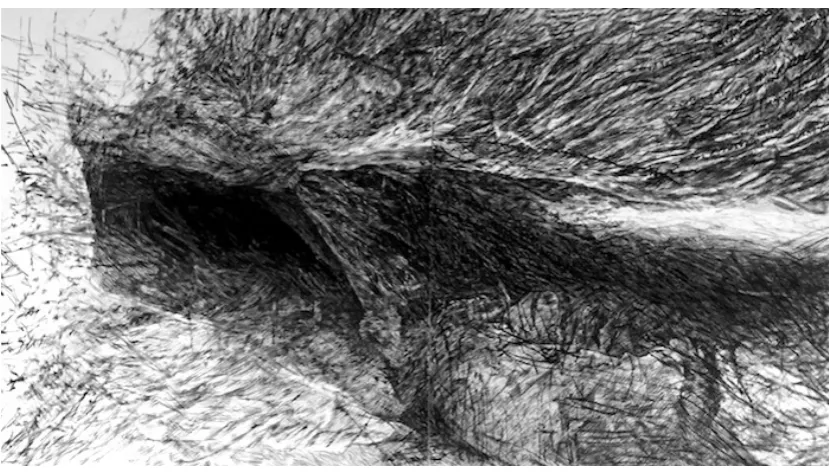
Fig. 1. David Edgar, pathway (detail), 2010. Charcoal on paper, 75 x 300 cm.
In my pictures, an experience, as a form of memory, is drawn as layers of marks across the
surface of the picture plane. To make a drawing I build it up with many other layers of mark
making using slightly different processes and techniques each time. Each layer acts as a
‘modification of’ (Husserl 2012, p. 212) the streams of conscious perception of experience,
and alters the form of the work through the progressive act of drawing. The process
amplifies and extends the characteristics of the memories (of alteration or deterioration) of
experience. Further, the drawing occurs in a studio removed from the original place of the
experience, causing an additional displacement. Thus, the subject matter and the original
experience is further altered, adding to the metaphysical effect of void in the image.
The project expands on these ideas by surveying a broad array of artistic practice. My aim is
to evoke a rich platform of enquiry into exploring and synthesising a wide variety of
methods and processes of visual mark making in relation to representing relationships
between perceived sensations of an experience of place and event with void-like
characteristics. Within this, an exchange of multi-sensory experience occurs in the
personality of the artworks examined, between the things observed in the world and the
way these things are observed.1
1 I use the word ‘things’ in reference to Husserl’s definition in Phenomenology of things, or objects, as perceived through the
I take these learnings and position them around four of my own intense experiences. Each
experience corresponds to a different type of site I visited. Each site has its own unique set
of rocky features. Each also has its own type of evocative atmosphere and ambience with a
level of intensity which informs the experience, the structure and the processes involved
with making drawings. Overall, each experience embodies a consciousness of observation
subsequently altered by the void-like qualities of memory. These qualities are speculative,
slight, and minimal in recognisable content, which I subtly alter and mutate in response to
remembering or forgetting. Void-like qualities are also developed as forms of emptiness
with fullness. These qualities include negation, as flat or yielding areas of tone or as loosely
drawn open-ended space. Emptiness with fullness is an expression coined by Susan Sontag
to consider the way artists broaching the perception of emptiness, or the void, in the world
should consider it alongside that of fullness, which marks it off. Further, Sontag explains, to
create a sense of emptiness in art, the artist must focus on the fullness of that emptiness to
enrich its meaning (Sontag 1978).
I explore Sontag’s theme by drawing matter as rock forms, against a fullness of emptiness
relative to the spaces between them. The rock forms provide the figurative forms within the
drawings. However, these forms also characterise the unknown of the void as they refer to a
sense of deep metaphysical time relative to their formation. Whereas, the spaces between
them are vacant or with minimal form and are expressed within the drawings through use
of solid areas of flat black or by leaving blank space. These intervals or gaps expose the
I have set out to explore representing qualities of the void as derived from observations
made during the experience of four geographic sites. Crucial is an acknowledgement of the
influence of the emotive content of each experience as well as displacement and memory,
with each representing the abovementioned void-like qualities. These emotional
experiences precede and are informative to the subsequent drawings.
First, I observe and record carefully, using sketches, photographs and note-taking. I focus
particularly on the shapes of the rock forms and the dark shadowy spaces in between them.
For example, when I look down into a sink hole, I note and memorise the concrete elements
such as shape, size and in relation to, as John Dewey writes, “all the qualities and values of
… [the] esthetic experience” (Dewey 1980, p. 230), found within the dark shadows and the
intrinsic qualities of the surrounding rock. I then record idiosyncrasies of the rock not at first
seen, such as the minutiae, or the corners and edges. This knowledge provides information
that underlies the drawing that occurs at a later date in my studio. I find John R. Searle’s
comments relevant in this regard. He writes of this type of reengagement as:
“Representation comes by way of resemblance” (Searle 2015, p. 225).
Back in my studio, the observations that I made and recorded are reinterpreted in drawing
through forms of mark making and tone. Working this way exposes contrasts in the way
things are observed and drawn. But before I make a mark, other factors are also observed. I
acknowledge that a period of time has elapsed from when I had observed the rock forms to
when I review the experience in my studio. The direct experience fades and deteriorates in
intensity, and what remains is an essence of what occurred in situ via the recordings I made.
had made when in situ. I consider how the existential thoughts and feelings recorded in the
writing alter and enrich elements of the recorded information.
These factors influence the drawing and mark making yet to unfold. Dewey writes of this in
reference to the act of representation, in the sense of expression, as a means to cover “all
the qualities and values of any possible esthetic experience” (Dewey 1980, p. 230), where
the artist will “… resee the object in terms of lines, colours, light, space …” and its “relations
that form a pictorial whole…” (Dewey 1980, p. 93). In my drawings, it is the arrangement of
lines, tones and spaces that allude to the qualities of experiencing the void. An essence of
the rock forms I observe, my mood and temperament, the influence of memory, and the
marks that I make to represent them further articulate these qualities of the void, as they
interpenetrate and fuse through drawing.
Geoffrey Bailey writes of drawing representation as a becoming of the relational structure
of an artist’s vision of the world. The artist fashions his drawing from his own unique vision.
This is reached via careful observation of the subject matter being drawn and the context to
which it is placed. Of importance is the relationship to and application of the medium to
enhance the subject matter and context. With these many levels of engagement feeding
into the drawing, the process is arduous, and as Bailey notes calls “for prolonged and
concentrated guided vision” (Bailey 1982, p. 42). The involved process of drawing is made
up of many different glances of the thing being drawn manifest from the “residue of many
visions always from memory” (Bailey 1982, p. 40) with each of these continually changing as
meaning "... not by a general similarity of surface but by a structure of symbolic elements
which are formulated as method" (Rawson 1969, p. 24).
As I start to draw, building-up marks, form and tone, my sense experience and memories of
the rock forms deteriorate and fade further as the act of drawing continues. What is crucial
is that I create various types of forms from marks as illusions of three-dimensional form.2 However, these forms do not always conform to the observed qualities of the rock forms as
recorded in situ, rather they interrelate with other ambiguous spatial forms and marks
made relative to the qualities of void that I am seeking to represent.
The rock forms in my images are viewed separately from the process (the marks made) that
go into making a picture. Dewey writes of this as the “individual contribution” (Dewey 1980,
p. 85) of the artist, which makes the picturing of the rock forms something new. Things, that
is the rock forms that I draw, are not merely represented, rather, they picture the
presentation of
“a material passed through the alembic of personal experience. They have no
precedents in existence or in universal being. But, nevertheless, their material came
from the public world and so has qualities in common with the material of other
experiences, while the product awakens in other person’s new perceptions of the
meanings of the common world” (Dewey 1980, p. 86).
2 This is one of the fundamental problems an artist has to deal with when drawing objects as observed from within the world –
To add to the uniqueness of the drawing, Patrick Maynard writes, “… representations are
things with the function of mandating that we imagine in certain ways, mainly depending on
their relevant properties” (Maynard 2005, p. 88). The relevant properties, or forms or
qualities of the void represented in my drawings include:
• the dark shadowy gaps between the rock forms, made with charcoal soft pastel sticks, and representative of the uncertainty of the darkness of the interior shadowy realm
around the rock forms that cannot be seen. These are suggested as ambiguous spatial
concerns manifest as areas of dark in my pictures.
• as unknowable, represented in the broader gaps of blank underworked spaces on the margins of the picture plane and in the erasure/erosion of marks that leaves traces and
fragments of previously made marks, in many of the drawings. These refer to the fragile
act of remembering and forgetting experiences, as they subtly alter or deteriorate over
time. A memory, like drawing, therefore creates its own fragile condition of the
representation of experience.
• as registered in the ambiguous picturing of loose speculative and repetitive scribbly forms, made with charcoal soft pastel sticks and a range of soft, medium and hard
charcoal pencils, and as mutations formed in the act of mark making made by the
layering and/or erasing of redrawn sketches.
The marks I make respond to my own unique emotive moods and temperaments as
recorded in my diary, and when remembering the experiences as they subtly alter over
time. These marks are fragile in representative qualities as they either counteract with other
marks to reveal marks existing independently from the rest of the picture, or as they
inform the presence of the rocks in the pictures. But they also suggest a peeling away of the
representational qualities of the rock formations, like the peeling away of memories over
time. Avis Newman writes, “Only during the process of marking is a cohesion found, a
somewhat precarious frame constructed, almost as the byproduct of the articulation of
marking thoughts, which by definition are open-ended in a state of flux, and suggestive of a
perpetual potentiality" (Tate Gallery. et al. 2003, p. 169).
Essentially, the marks I make hover in a state of flux between the representation of
something, a rock form, and the representation of a mark itself. These marks depict
subjective and emotive states as they combine with the objectively observed and
realistically drawn representation of rocks. However, both forms of mark making, although
perceived differently, make up the experience that is recognised in the drawing. They create
a new type of experience that incorporates the subtle, ambiguous and uncertain qualities of
the void. The intention is to heighten the psychological impact and descriptive and
[image:23.595.90.505.508.745.2]interpretative form of the void in an image.
As I commenced this project, I reflected on much earlier encounters that I had had to
particular places. These specific places invoked intense experiences where the presence of
mystery, the unknown and the distinct feeling of being on edge were present. These
experiences, had left strong palpable memories, with each of them disturbing in different
ways my sense perception in relation to being consumed by darkness. The places include; a
year-long period working as a Structural Engineers’ Assistant inspecting coal mine structures
deep underground via long vertical shafts in the rock or horizontally into the side
of the mountain; and, periods exploring coastal and inland underground caves. In these
instances, I recall the feeling of being utterly consumed by the rock of the earth. With the
caves, I remember how the entrance would draw me in with a feeling of being seduced by
its dark, seemingly infinite receding depths. At times, I would venture so deep in that when
my torch was switched off there was only the nothingness of an all-consuming blackness
that remained. The coal mines produced a different ‘blackness’. At the end of each day I
would be completely covered in black coal dust from head to toe. The fine dust would leech
into every pore of my skin and be ingested into just about every orifice of my body. For days
following periods of working in a mine I would be regurgitating the dust out from my body. I
was literally blackened throughout. When I think about these experiences today,
I wonder if this was the start of a transformation within me in regards to landscape, the use
of charcoal, and the beginning of a deeper morphological engagement with geology that
this project aims to interrogate in more detail.
The consequence of this reflection has led me to study four specific sites that provide all of
the source material used in the drawings for this project. Each site is characterised by its
dank basement both in Tasmania; an area of steep rocky-mountains in southern France and
the high-altitude desert of Arizona in the United States of America.
My experiences of the basement and Arizona were recorded whilst being in situ and
thereafter explored in memory, whereas my experiences on the island and in France are
examined through memory only.
The first site, Tasman Island, is located off the most south-easterly point of Tasmania. I
commenced this project with the island because it was an opportunity to expand upon
knowledge and personal experience that I gained through more than a decade of return
visits. I have not physically been back to the island in two and half years prior to
commencing this project; I have extended my knowledge of it through memories. Thus, the
drawings, and my perceptions of Tasman Island, are interpreted through both remembering
[image:25.595.94.506.482.695.2]and forgetting.
My memories of the island recall the intense past experiences I had when I went there.
These include recalling the hazardous perimeter of the island with its spectacular tall
vertical rock forms and the dark fissures between them. What is also clearly apparent is
remembering the feelings that the island provoked of isolation, solitude and displacement
from the rest of the world. While I can no longer recall the nuances of the island, its essence
has seeped deep into my psyche.
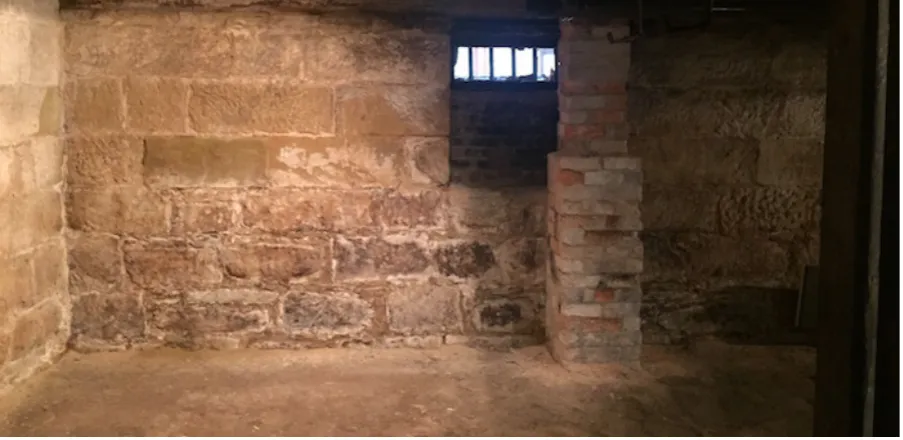
The second site in Tasmania is an old basement, with walls made of roughly hewn rock,
located in the Bond Store in the Tasmanian Museum and Art Gallery. In contrast to working
from memories of an island, I developed a series of pictures responding directly to the
essence of the conscious experience of being within the site. Working on site embedded me
[image:26.595.73.525.425.645.2]within place, providing a more intensive focus on the rocky interior and my experience of it.
The mood of the dark dank space triggered associations of melancholy within me, tinged
with depression, loss and nostalgia. The recording and grasping of the experience felt richer
than those based on memory. I perceived the site as multiple unravelling streams of
conscious experience with specific forms of associations of the void influencing the process.
The third site focuses on a brief yet intense physiological and psychological experience
lasting less than an hour that occurred in the rocky mountainous Alpes Maritimes region in
southern France. The experience combines both an acute awareness of observing the world
in combination with the memory of it – seeing the physical elements of rock in conjunction
with feeling my emotions at the time, later recalled in memory. At the time, the
temperament of that day was of an unsettling tension and trepidation. When I commenced
working with the site over a year later I was conscious of the impact of both remembering
and forgetting aspects of what had occurred, even though much of the intensity of elements
of the experience was still evident. This led to a speculative period of practice-led inquiry
into various forms of dynamic and energetic mark making in response to memories of place.
The fourth and final series of work is derived from a four-week arts residency in the iron-rich
mountains of the high-altitude desert of central Arizona. The opportunity substantiated the
previous three explorations, in particular, one intense experience that occurred while I was
there. One day I observed a palpable combination of the presence of rock forms with an
overwhelming emotional charge of euphoria and oneiric affection. The drawings that
resulted from the residency build on many of the key attributes from earlier drawings.
Produced in my studio, the Arizona drawings exhibit the most rigorously observed and
recorded experience of the project and thus developed the most complicated and involved
processes and methods of drawing.
Fig. 6. David Edgar, Cathedral Rock, 2016. Digital image.
The method I use to explore, reveal and link the void with the rock forms, emotive and
atmospheric states and memory is through phenomenologic inquiry. Phenomenology is the
study of the essential nature of the conscious experience. My study of it is contextualised
through reading works of phenomenology in relation to experience and memory by German
philosopher Edmund Husserl. Crucial to Husserl’s phenomenology is that it articulates an
essence of experience as a method for observing, objectifying, reflecting and enriching,
Phenomenology has been applied within the visual arts as a theoretical philosophy as
exemplified by Maurice Merleau-Ponty’s essay titled Cézanne’s Doubt, (1945). In this he
analyses Paul Cézanne’s final years as a painter through a phenomenological approach to
the artist’s examination of the world (Smith & Johnson 1993). And in recent decades, there
has been a steady increase in the application of phenomenology as a working methodology
for descriptive observation, interpretation and art-making that has resulted in various
research outcomes.3
For this inquiry, I build on the phenomenological writings of Husserl, and others, by using
their theories of phenomenology as a method to advance my own knowledge when
observing, recording and interpreting the content of my own streams of intentional
conscious experiences of the world. These are inherently personal and existential as the
observations I make reflect the emotive content of each experience. The experiences also
concern memory and imagination. This approach distinguishes this inquiry from others that
I have encountered.
However, with this project, I predominantly build on the phenomenological writings of
Husserl, whilst also referring to other writers from time to time, by using their theories of
phenomenology as a method to advance my own knowledge when observing, recording and
interpreting the content of my own streams of intentional conscious experiences of the
world. These are inherently personal and existential as the observations I make reflect the
emotive content of each experience. The experiences also concern memory and
imagination.
I use phenomenology to compose experiences of the world with intentional thoughts
through sense perception. This occurs by my being and moving through the world and
remembering it. I re-analyse experience by writing, photographing and sketching it before
finally making a drawing of it sometime later. The first phase involved is fieldwork, as
experiential understanding, followed by re-evaluation and re-contextualising as a way in
which to provoke the memory through drawing. It is, in itself, an act of transformation, of
observing, imagining and proposing – a combination of my mind and my body sensing things
as they are formed in the world.
I use the phenomenologic method to reveal and link the physical rock formations, voids, and
emotive and atmospheric states. I articulate an essence of experience of the void when
observing the physical things (rocks) combined with my temperament at the time of
experiencing (moods and emotions). The process involves presence and absence in
remembering and forgetting as well as displacement. An experience moves from
observations in the world to reflection and re-evaluation many times over while in my
studio preparing to make drawings. Gaps occur through this process, such as experiences
that may be forgotten over time, as well as the physical gap or dislocation from the source
site. These gaps conjure qualities of the void, like a missing memory. The drawing process
enables an engagement with these gaps. A mark made is a trace of a remembered conscious
moment, its erasure, an absence. Like experience, the mark making unravels as a stream of
layers of experience into a whole as a way to gain deeper knowledge and understanding of
my tacit experiences in the world.
I contribute to the use of phenomenology as a science that studies the nature of being by
providing insights into methods for manifesting qualities of the void visually with drawing.
The void is located in the relationship of elements of experience in the observation of
things, moods, and atmospheres. These are developed into forms of drawing representative
of my void-like observations of the world. Whereas Husserl’s analysis of the effect of
experience on memory was crucial for conceiving the void as deteriorated and erased forms
in the drawings.
_______________
The project primarily examines concepts of the void that occur within the thinking mind. In
particular, I am interested in how the void is manifest visually by re-focusing the way I
observe my experience of things in the world. Here the void acts as the presence of
something vacant or absent. The drawings mediate between being (rocks) and emptiness
(space), as inner (self) and outer (rocks), and as palpable corporeal forms of energy (Morley
2010). These ideas have roots in eastern perspectives of the void, such as in the practices of
Buddhism, Hinduism and Taoism (Levy 2006). Whilst elements of these belief systems exist
in relation to my work, such as the meditative, spiritual and esoteric qualities of the void,
and are possible avenues for further analysis (see Levy 2006) they are not the primary focus
of this thesis. I engage with ambiguous notions of void as form and subject through the
Further, I have mostly avoided analysing scientific investigations of the void, often discussed
in scientific arenas such as astronomy or physics. Science does however attempt to question
what makes a void, and it is here that I have engaged the theory of phenomenology to assist
my inquiry. Even though an analysis of eastern and scientific qualities of the void may
deepen the scope of the investigation, I have, for the most part, left them aside. Rather the
focus is on the drawing investigation of mark making to provoke subtleties of fullness in
empty things as an attempt to ‘visualise’ qualities of the void.
The notion of being affected by the relationship between thoughts and the perception of
the physical and material qualities of the rock forms I observed is an important concept of
the project. The types of sites that I have studied produce feelings of an inner immensity –
where small things in the world conjure a sense of grandness (Bachelard 1988). While it is
important to acknowledge characteristics of the sublime in response to mental states of
experiencing these rocky sites, I have purposely focussed on the void and not interrogated
the sublime in depth. The void in this way engages a symbiotic dialogue between my
thinking self and the material elements of a site as a quiet/lonely and gentle/benign subject,
one that is subtle, intimate, dark and brooding, as well as mysterious, tenuous and fragile in
content.
Successful drawings captured characteristics of the void and developed relationships
between the embodied perception of an object (rock forms), the alteration and mutation of
experience of that object as effected by memory, and mark making as an abstract entity.
The outcome are drawings that embody both the physical and metaphysical, where
In scoping the project, a number of criticisms of the Kantian notion of sublime4 are relevant to the study I have pursued. James Elkins suggests the sublime is shaped by the infinite
mind, which I consider as having characteristics of the void. But he also acknowledges the
problem of the sublime as a contemporary concept because of its association with a
romantic historical past, with roots in religion and transcendence in particular. He suggests
these are outdated modes and rather than using the term sublime, he proposes we should
instead think of our own synonyms to better and more directly describe it (Elkins 2009). My
approach is thus to examine feelings and impressions of the void that are triggered when
observing gaps and ruptures in the world. These respond to ruptures in the earth or built
environment rather than the qualities of massiveness or great torrential force. As
mentioned above, the qualities that put me on edge, such as vacuous-ness, isolation and
solitude, euphoria tinged with regard, melancholy and loneliness have also been examined.
These moods and emotions are indeed resonant with the sublime but I have explored them
in response to the many layered characteristics perceived as emotive states and in the
deterioration of experience in memory to produce a more uncertain, equivocal and
psychologically fragile approach.
An additional criticism of the sublime, as explored by Emily Brady, suggests that interpreting
the experience of the sublime in visual art is problematic. And there is no doubt that these
qualities do impact on my study. I do not attempt to replicate my experience as it occurred,
even though the subject is mostly drawn with verisimilitude. My attempt is to combine
4 Emily Brady notes the Kantian sublime is an aesthetics of fear and pleasure perceived inside of the self/mind when confronted
various facets of mutated, altered and eroded experience into the artworks. Thus, the scale
of the sublime, as considered by Brady as formless and unbounded in character, as well as
the wild visceral qualities as they unravel over time of an experience of being in the world,
do indeed inform limitations of the portrayal of the sublime in art (Brady 2013) and the
work I made for this project.
As mentioned earlier, I have primarily based my phenomenologic study on Husserl’s
writings. I have, however, also implemented a pragmatic approach to phenomenology, one
rarely used by Husserl in his writing but similar to that used by British archaeologist
Christopher Tilley. Tilley uses strands of Husserl’s phenomenologic method to investigate his
experience of walking through Neolithic stone structures in Europe. Walking amongst the
structures, and taking notes about his experience, Tilley then imagines how the ancient
people may have lived and what these stones might have been used for. Tilley’s main
theoretical underpinning of phenomenology is in the writings of Merleau-Ponty’s mind and
body relationship to conscious experiencing, and Martin Heidegger’s notion of getting to
‘know’ a place through the deep engagement of ‘being-there’ (Heidegger 1962, p. 27). Tilley
particularly explores Merleau-Ponty’s view that the meaning of conscious experience is
emphasised by the sensing body as a conduit between the perception of the thinking mind
and things as they exist in the world. For Tilley, the movements of his body amongst the
stone structures underpin his phenomenological inquiry.
In my analysis, I examine the relationships between my mind and the site with my body as
an influencing factor. Whereas in my writing on drawing, I examine a much closer
Merleau-Ponty’s views on phenomenology are important. But for the most part, my
phenomenologic inquiry responds to Husserl’s writing.5 I do this because a major
component of my thought process is towards my mental aptitude observing specific things
in conscious experience. Although, I do not deny the importance of Merleau-Ponty’s
contribution, my aim is to attain an understanding of psychological impressions of the void,
and the effect these have on my relationship to site and drawing. Husserl’s insights offer a
more practical and workable framework to the project.
As previously mentioned, my approach to observing rock forms explores phenomenology as
a method for articulating details of the conscious experience. The impact of this affects the
decision process when making drawings. In recent decades, phenomenology, as an
approach to drawing research has gained traction. In my readings, I found the following
three studies to have relevance to the project’s aims and approach – Dr Rosemary
Montgomery-Whicher’s 1997 PhD study of the significance of drawing from observation
examined through existential dimensions of space, time, relation and the body
(Montgomery-Whicher 1997); Dr Deborah Harty’s 2012 study observing the relationship
between her thoughts and bodily actions whilst in the process of drawing repetitively (Harty
2012); and, Dr Alex Ashton’s 2014 PhD study into the inter-relations of the conscious
experience of her body and mind to landscape and place and its embodied relationship to
drawing (Ashton 2014). These artist researchers engage a range of phenomenological
sources, but crucial to each is Heidegger’s notion of ‘being’, and Merleau-Ponty’s inquiry of
the experiential body. My approach engages ‘being’ within each site and the body’s
5 Husserl does refer to the body in his writing, but it was Merleau-Ponty, who following reading Husserl, put forward the view of
involvement in drawing but I do not analyse my experience of drawing when I am in the act
of drawing. My theoretical analysis of drawing does, however, consider the act of an
intentional connection between mind and body, the drawing medium, drawing surface and
studio. In difference to Harty and Ashton, but with a similar approach to
Montgomery-Whicher, I use phenomenology during the first stage of analysis, of my being at a site. My
drawings explore a number of threads within experience but I do not use phenomenology to
examine my experience of making the drawing or the mark making process.
Further, in defining the scope of drawing within this project, I have consciously decided to
work only with tonal variations of black and white, and primarily in one medium, that of
charcoal. This limits the scope for embedding other forms of psychological qualities, such as
in the fields of colour theory, colour psychology and colour therapy. As an example,
choosing to work solely with tonal variations of black and white has allowed for a deeper
and more concentrated analysis around the notion of darkness and light and their
relationship to the void.
_______________
The research produced an exhibition of charcoal drawings that embody the void as both a
physical and metaphysical entity. The drawings picture the void as found within geological
formations, and from recalled personal experience, from the four sites studied. The
metaphysical is manifest in the pictorial space of the pictures registering both as presences
and absences of the void as ambiguous space, deep time and displacement. The emotive
mood and temperament of the experiences are embodied in the loose and speculative
drawings as a consequence simultaneously function as figurative and abstract. The former
relates to site, the latter to subjective and emotive factors. Within this, qualities of the void
– as uncertain, equivocal and tenuous – are invoked. The impact of this, in the drawings, is
to heighten the psychological qualities of an image with the purpose of augmenting a
deeper understanding and expression of drawing and the world in which I exist.
The significance of this PhD research thesis lies in the expansion of inquiry into, and
knowledge of, individual or social-cultural relationships and their connection to the physical
and metaphysical world through the application of Husserl’s phenomenologic theory. This
approach creates a new pathway to gain tacit knowledge and understanding of phenomena,
experience and their interpretation and expression through artistic practice.
Agitating the Void develops drawing as a deeper and richer learning platform and method
with regard to how one perceives, describes and interprets things in the world. As such, the
project adapts drawing as a means to conflate layers of experience and memory into a
whole. I recognise too, that during the act of drawing deeper layers of information
pertaining to my knowledge of an experience are embedded into my mind as each mark is
made.
_______________
The exegesis is divided into three parts. The first part, Chapter One, sets out the general
theoretical context and considers the significance, relationships and associations generated
by: using embodied forms of knowledge associated with phenomenologic approaches to
sites; the void, as an ambiguous entity identified in form and as a subject for observing and
recording experiences at the four sites, inclusive of its erosive correlation to the conditions
of memory; and, drawing as an expressive, immediate dialogue between oneself and the
world used to visualise, through variations in marks, tone and pictorial space, embodied
relationships of phenomenologic impressions of the void.
Chapter One provides the theoretical basis for Chapter Two, which concentrates on a range
of artistic contextual sources from the perspective of uncovering types of dynamic pictorial
spaces, figure and ground disruptions, and expressive mark making in the visual
representations of things. The artists I explore include historic reference to the works of:
Casper David Friedrich, Paul Cézanne, Francesco Goya, Käthe Kollwitz and Gustave Courbet
and examining contemporaries such as Michael Heizer, Susan Turoct, Ian McKeever, John
Virtue, Miha Štrukelj, Frank Auerbach, Richard Serra and Anish Kapoor.
I examine how each artist represents their own personal response to elements of the places
or events they experience. Whilst the void is not always central to the artists’ work, I have
illuminated ways to interpret their marks and pictorial spaces to align with it, as appropriate
within the parameters of the project.
In addition, a deeper exploration of pictorial space, as spatial disunity, is developed
alongside a study of the filmic tropes of Italian Michelangelo Antonioni. I have analysed, in
particular, the way his films explore alternative spatial registers, as he grapples with
visualising notions of implied existential psychology. Antonioni employs void-like features
subjects to heighten narrative and visual impact in the form of his films.
Chapter Three concerns the pictorial methodologies and strategies, and techniques and
media used to develop the studio-based investigation. This chapter addresses the governing
methodologies and strategies in relation to the research aims and objectives and to the
theoretical sphere in response to the four sites. Each site was chosen for the specific
qualities and features of their rock forms but also because they offered fruitful paths for
investigation into the challenges of picturing the void. Included is discussion of site as:
memory (as remembering and forgetting); and emotion (observing intense emotive states)
as engaging with perceived sensations of mood and atmosphere in response to the rock
forms at each site. Combined, these qualities affect content, pictorial space and mark
making processes when transformed into drawing, forging meaningful links between mind,
body and site. I will discuss criteria for the selection of imagery for drawing – source image
capture, sketching, photography, notes and writing; the use of source material, collage and
computer manipulation, scale, perspective, and viewpoint, and the consistent use of
Chapter 1: Phenomenology, void and drawing
The aim of this chapter is to expand on three key theoretical concepts on which the project
is based and present an overview of their relationships. The first concept considers
embodied forms of knowledge relative to conscious experience, memory and imagination
within the field of Phenomenology as developed by German thinker Edmund Husserl.
Phenomenology articulates sense perception as the essence of experience as a method for
observing, objectifying, reflecting and enriching, through faithful and rigorous recording. I
build on Husserl’s phenomenologic method to inform detail in the content of my drawings
around the experience of observing rock forms at four geographic sites. Integral also to
Husserl’s phenomenologic method is that alterations of experience are entwined by
memory – when remembered or forgotten as types of presences and absences. These
alterations, he explains, creates gaps and modifications in perception. I adapt this from
Husserl to conjure the void, which influences unique ways I perceive each subsequent site.
Introducing and developing a workable definition of the concept of void commences in
section two of this chapter. I explore the void as the central overarching theme of how I
experience rock forms. Initially, I examine the void as a dialogue with the world, as
fluctuating, content-less and immaterial, incorporating emptiness, nothingness and
displacement, but my primary concern is agitating the void into life, by provoking it as
subtleties in visual form. An example, is expressed by Mark Levy’s notion of the void as it
occurs in the space between two objects, or as dark or blank spaces in an artwork, or as
activating as an ‘energy field’ (Levy 2006, p. 2). Within these voids, I consider vacant and in
which concerns the deterioration of forms, as a range of ambiguous and abstract spaces,
the portrayal of presence and absence, and elements of emptiness with fullness.
Thirdly, I analyse the practice of drawing as an exploratory, immediate, and intimate
embodied form of mark making that I use to visualise phenomenologic observations of the
void. I explore processes for developing dialogues between mark maker and the expressive
and energetic drawing of things as they are observed in nature. Important to this is
identifying a link between drawing and the essence of a thing experienced where the
conscious perception of a thing can be considered in two ways. Firstly, as a real thing, and
second, as an impression of that real thing as poetically manufactured by drawing. From
this, an understanding of drawing emerges as an enigmatic yet dynamic relationship
between marks made and the ideas and things being drawn. The relationship involves the
thinking mind, body, hand, medium, surface and studio with the process and outcome
developing in flux. Within this flux there is intensity and fragility as well as gaps where ideas
relating to phenomenology, void, memory, emotion and the senses combine.
To conclude section three, I review experimental ways these ideas have been envisioned in
drawing by others and refer to statements made by Deanna Petherbridge, John Willat and
John Ruskin. Each of these writers/artists develop personalised, playful and investigative
processes of mark making to visually communicate their observations of the world. I take
their exploratory and speculative drawing processes and adapt them into my own
personalised approach to drawing. Identifying with the uncertain and equivocal attributes of
1.1: Phenomenology
“I am present to myself continually as someone who perceives, represents, thinks,
feels, desires, and so forth; and for the most part herein I find myself related in
present experience to the fact-world which is constantly about me." (Husserl 2012, p.
54)
For many years, I have looked at various types of things in the world and drawn them. Over
time, my concentration in this manner has sharpened as has my response to these things
through drawing. Each new series of drawings reveals a new thing of interest for me to
discover and learn. From this, new moments6 in the experience of things emerge. For example, following a period of drawing broad mountainous landscapes, I found myself then
seeking information about the smaller elements, such as individual rocks, that group and
grow forming the larger ones, the mountains.
The way I perceive the world is integrally tied to my experience of observing it. Edward
Casey writes of the experience of visually observing a new wild place for the first time and
for him being immediately struck by its “sensuous surface” (Casey 1993, p. 204). When I
examine a rocky outcrop in a part of the world I have never seen before, I am struck by the
richness of the ‘sensuous surfaces’ in front of me. I observe the undulating forms, what
occurs around, on top of and next to each form, and I analyse its qualities of shape, weight,
colour, tone and texture.
As I look, I am simultaneously influenced by other perceptions; my history of observing
rocks and the social and cultural factors that include “perceptual habits, belief systems,
styles of living, and traditions of behavior and judgment” (Berleant 1992, p. 18). These have
been acquired over my lifetime and indicate that observations are also inherently existential
and psychological. I thus perceive rock forms as a fusion of my psychological disposition
with my awareness of things in the consciousness of the immediate moment.
Over the years, I have found that the
most intense experiences and
memories I have had are emphasized
by emotive states.7 Some of these memories are characterised by
emptiness with being alone in an open
space, or melancholy and anxiety
when faced with adversity or
darkness. The void is the
undetermined in the combination of
physical things and emotive states in
my experiences. I have found this
being triggered when observing the in between spaces of rock formations – the negative or
7 When confronted by an intense experience the amygdala part of the brain awakens commandeering other parts of the brain
to attend to the situation at hand. These parts of the brain are where memories are laid down in explicit detail. Thus, when intense experiences/memories are embedded into the brain they are laid down in more detail. When I recall an experience like this, it appears to have greater clarity, and I feel like I have slowed down what I think I have experienced even though that isn’t the case. David Eagleman writes, “conscious awareness is nothing but lots of fast memory querying: our brains are always asking "What just happened? What just happened?" Thus, conscious experience is really just immediate memory" (Eagleman 2015, pp. 72-73).
dark spaces. These undetermined spaces provoke in me a sense of the periphery and
uncertainty of the world, triggering metaphysical sensations of mystery and the unknown.
When I observe at a site, I am seeking out these things with the intention to combine sight
and physiological effects into drawings.
An example of this I experienced whilst I was in the rocky, mountainous landscape of the
Gorge du Cians in the Alpes Maritimes region, Provence-Alpes-Cote d'Azur, in France shortly
after commencing the project. It was an intense, emotionally-charged experience; exciting
and uncertain and yet pivotal in being able to better understand connections between
consciously experiencing the physical matter of a place in tandem with my mood and
temperament. I was in France visiting my brother who lives in the region. The day after I
arrived we went for a drive, up into the Alps, as he wanted to show me a distinctive rocky
section of the mountains that he felt I would be interested in exploring.
I was quite nervous making this trip over to the other side of the world to be with my
brother. What brought on these nerves, was that this was the first time I had visited him on
his home ground. He had been put up for adoption by our mother, in the UK, before I was
born and, prior to this point, I had spent over 5 and a half years searching for him. There
was a palpable psychological tension and trepidation within us both, and I think this trip into
the mountains was a way to break down some of the nerves.
We made our way through the coastal city of Nice before the road went inland, slowly
winding its way higher up into the mountains. On either side of the road, steep cliffs rose
mountain where the rock distinctly changed colour from light umber to deep purple. The
walk couldn’t have been any longer than 30 or 40 minutes. It took us through naturally
occurring and man-made pathways and underneath numerous tunnels hewn into the
mountain rock. All the while we were flanked by various layered, angular and undulating
rock forms, some sharply linear, others round and bulbous. The rock rose sharply at times
blocking light from the sun. Yet around the next corner the sun would bounce off one
mountainside rock-face only for another to remain in shadow. The contrast of tone and the
striking rock formations made for sharp contrasting intensities of form.
The perception I took home with me of the
short experience was nervous energy,
unfamiliar tension and trepidation. The
potency of the rocks seemed to reflect the
potency of the social situation of being with
my brother. I was on edge psychologically;
the road leading in was on an edge, and the
form of the gorge evidenced by the sharp
linear fractures, faults, layers and erosion,
fused with my emotional temperament.
I realised the sensations felt during this
experience were akin with similar qualities perceived when viewing certain types of art. For Fig. 8. David Edgar, Gorge du Cians, 2014. Digital
instance, Michael Heizer’s Levitated Mass8 sculpture produces in me a tension brought on
by the material qualities of a rock combined with a sense of feeling unease. Although I have
only seen this sculpture in photographic images the impression I am left with is a
combination of the material presence of weight, gravity, scale and the surface texture of
rock interacting with the negative space around it.
Fig. 9. Michael Heizer, Levitated Mass, 2012. Diorite granite and concrete, 106.7 × 1389.8 × 66 cm. Los Angeles County Museum of Art (LACMA), image by Carol H. Highsmith.
My perception of it agitates the presence of myself in the now, whilst sparking my
imagination into thinking about the deep geologic time of the rock Heizer used, as well as an
infinite sense of time in the negative space of the work. It is evocative and yet simple. I can
only imagine how experiencing the work in situ would heighten my impressions. Perhaps it
would be similar to the day I was walking through the carved tunnels in the French
mountains, palpable tension and trepidation.
When reflecting on these types of experiences, what remains is the suggestion of an
inexplicable, tenuous and intangible gap between the sensations of viewing a physical thing
– rock with the memory of the intensity of moods and feelings at the time of experience.
This provokes an in between sensation of the two qualities observed. In this space lurks the
void, as qualities of hesitancy and uncertainty. Amplifying these qualities is a realisation that
the longer these experiences linger in time, and are then recalled as memories, that they
are prone to alter, fade and disappear. These sequences of the void inform the drawings
that I make, but they are intangible qualities based in my mind. The problem this presents I
will expand on in section two of this chapter.
It is in my experience of being at places, such as France, where the initial powerful and
intense embodied engagements occur. These sensations are palpable, of course less so
when looking at a reproduction of an image of Michael Heizer’s work, however they do elicit
some sort of emotive reaction nonetheless. When I am observing at a site, my aim is to
develop greater awareness of my conscious perceptions. These are traits of
phenomenology, which throughout the project I embed as a method to better understand
and articulate my experience observing void-like things at each site, before translating them