INTERACTION OF NINHYDRIN WITH N-HYDROXYUREA AND
N-ALKOXYUREAS IN ACETIC ACID
Vasiliy G. Shtamburg,
[a]*Victor V. Shtamburg,
[a]Andrey A. Anishchenko,
[b]Svitlana V. Shishkina,
[c]Irina S. Konovalova
[c]and Alexander V. Mazepa
[d]Keywords: Ninhydrin, N-hydroxyurea, N-alkoxyureas, synthesis, structure, C–C bond elongation.
We have found that ninhydrin reacted with N-hydroxyurea and N-alkoxyureas in acetic acid with the predominant formation of diastereomers of 1,3a,8a-trihydroxy-1,3,3a,8a-tetrahydroindeno[1,2-d]imidazole-2,8-dione and 1-alkoxy-3a,8a-dihydroxy-1,3,3a,8a-tetrahydroindeno[1,2-d]imidazole-2,8-diones, respectively. with sic-orientation of 3a,8a-HO-groups. The X-ray structural analysis of 1,3aS,8aR-trihydroxy-1,3,3a,8a-tetrahydroindeno[1,2-d]imidazole-2,8-dione and 1-n-butyloxy-3aS,8aR -dihydroxy-1,3,3a,8a-tetrahydro-indeno[1,2-d]imidazole-2,8-dione has demonstrated their specific structural features.
* Corresponding Authors Phone: +380-97-651-61-72 E-Mail: [email protected]
[a] 49005 Ukraine, Dnepr, Gagarina st., 8. Ukrainian State University of Chemical Technology.
[b] 49050 Ukraine, Dnepr, Nauchnaya st. 25. O. Gonchar Dnepropetrovsk National University.
[c] 61001 Ukraine, Kharkov, Science ave., 60 . SSI “Institute for Single Crystals”, National Academy of Sciences of Ukraine. [d] 65080 Odessa, Luystdorfskaya Doroga st., 86. A.V.
Bogatsky Physico-Chemical Institute of NAS of Ukraine.
INTRODUCTION
Nitrogen-containing heterocyclic systems, such as hydantoins and imidazolidli-2-ones, are common in pharmaceutical materials. It is therefore important to create the reaction strategies that give access to such biologically active synthones. As it is known,1-4 ninhydrin (indane-1,2,3-trione hydrate) reacts with urea and N,N’-dimethylureas yielding
3a,8a-dihydroxy-1,3,3a,8a-tetrahydroindeno[1,2-d]imidazole-2,8-diones (1a,b) (Scheme 1).
Scheme 1. Ninhydrin’s interaction with the ureas.
Compounds 1a,b were used as the essential intermediates in the diastereoselective synthesis of some dihydrofuran derivatives3 and pharmaceuticals.3,5
The study of the vicinal polycarbonyl compounds interaction with N-hydroxyurea and it derivatives6-10 has recently been started by our research group and needs to be continued. Derivatives of N-hydroxyurea are common in pharmaceuticals. But the ninhydrin’s interaction with N -hydroxyurea and N-alkoxyureas has not been investigated in contrast to the arylglyoxal reactions with N-hydroxyurea and
N-alkoxyureas.6-10
Earlier we have found8 that most of arylglyoxals reacted with N-hydroxyurea and N-alkoxyureas in acetic acid producing 3-hydroxyhydantoins2 and 3-alkoxyhydantoins 3
(Scheme 2).
Scheme 2. Interaction of the most of arylglyoxals with N -hydroxyurea and N-alkoxyureas in the acetic acid.
In aqueous medium this reaction can have ambiguous results and. the product’s nature strongly depends on the nature of arylglyoxal.6 4-Nitrophenylglyoxal, however, reacts with N-hydroxyurea producing9 the mixture of 5-aryl-3,4,5-trihydroxyimidazolidin-2-ones 4a and 4b in molar ratio approximately 3:1(Scheme 3).
Scheme 3. Interaction of 4-nitrophenylglyoxal with N-hydroxyurea.
Moreover, 4-nitrophenylglyoxal diastereoselectively reacts with N-alkoxy-N’-arylureas and N-alkoxy-N’ -alkylureas in acetic acid at 17–20º C mainly producing 3-alkoxy-1-aryl-4S,5S -dihydroxy-5-(4-nitrophenyl)imidazoli-din-2-ones 5 and 3-alkoxy-1-alkyl-4S,5S -dihydroxy-5-(4-nitrophenyl)imidazolidin-2-ones 6.10 These diastereomers
5,6 have cis orientation of 4-HO- and 5-HO-moieties (Scheme 4).
N
O H
N H
O
OH
HO
R = H (a), Me (b) O
O
OH OH
1a,b RHN NHR
O
OH
OH
O
Ar H
H N
O
H2N
OR
N
Ar O
O OR N
H H
Ar = p-XC6H4, X = H (a), F(b), Cl(c), Br(d) AcOH, r.t.
2,3
R=H(2), Me, Et, Bu(3)
OH
OH
O
Ar
H N
HO OH
O
OH
N
Ar H
H N
HO H
O
OH
N H
Ar OH
H N
O
H2N
OH
Ar = p-O2NC6H4
+
Scheme 4. Interaction of 4-nitrophenylgyoxal with N-alkoxy-N’ -arylureas and N-alkoxy-N’-alkylureas.
Thusthe goal of our present research is to investigate the interaction of ninhydrin with N-hydroxyurea and N -alkoxyureas in acetic acid medium.
EXPERIMENTAL
1HNMR spectra were recorded on a Varian VXP-300 spectrometer (300 MHz). 13C NMR spectra were recorded on a Varian VXP-300 spectrometer (75 MHz). The solvent DMSO-d6 was used. 1HNMR chemical shifts relative to the residual solvent protons as an internal standard [(CD3)2SO: 2.500 ppm] were reported. Solvent carbon atoms served as an internal standard for 13C NMR spectra [(CD
3)2SO: 39.52 ppm]. Mass spectra were recorded on a VG 70-70EQ mass spectrometer in fast atom bombardment mode (FAB). The solvents were purified and dried according to the standard procedures.
1,3a,8a-Trihydroxy-1,3,3a,8a-tetrahydroindeno[1,2-d]imidazole-2,8-dione (7)
A.N-Hydroxyurea (74.6 mg, 0.981 mmol) was dissolved in a solution of ninhydrin (145.6 mg, 0.817 mmol) in acetic acid (7 mL) by stirring at 16 ºC. the reaction solution was maintained at 8 ºC for 23 h, then it was heated to 16 ºC, the obtained white precipitate was filtered out, dried under vacuum (3 mmHg) at 25 ºC, washed with MeCN (2 mL) and dried under vacuum (3 mmHg), giving 190 mg (98 %)
cis-3a,8a-dihydroxydiastereomer of 7, colorless crystals, m. p. 169–171 ºC (with decomp.), m. p. 172–174 ºC (with decomp., THF–hexane). 1H NMR (300 MHz, DMSO-d
6) δ = 6.646 (1H, s, OH), 7.268 (1H, s, OH), 7.615 (1H, t, J = 7.5 Hz, Ar), 7.750 (1H, d, J = 7.2 Hz, Ar), 7.762 (1H, d, J = 7.2 Hz, Ar), 7.859 (1H, t, J = 7.5 Hz, Ar), 8.409 (1H, s, NH), 9.131 (1H, s, NOH). 13C NMR (75 MHz, DMSO-d
6) δ = 84.33 (C–OH), 89.36 (C–OH), 123.44 [C(H) Ar], 124.92 [C(H) Ar], 130.46 [C(H) Ar], 132.28 [Cq Ar], 136.53 [C(H) Ar], 150.82 [Cq Ar], 156.05 [HN(C=O)NOH], 195.63 (C=O). MS (FAB) m/z 237 [M+H]+(90), 176 [M+H-H
2O-HCNO]+ (68), 90(57), 72(100). Anal. Calc. for C10H8N2O5: C 50.85, H 3.41, N 11.86. Found: C 50.87, H 3.51, N 11.69.
B. Ninhydrin (149.1 mg, 0.837 mmol) was dissolved in the solution of N-hydroxyurea (71.6 mg, 0.941 mmol) in acetic acid (5 mL) by stirring at 20 ºC for 3 h. The obtained white precipitate was filtered out, dried under vacuum (3 mmHg) at 25 ºC, yielding 182.3 mg (92 %) of cis-
3a,8a-dihydroxydiastereomer 7, colorless crystals, m. p. 169-171 ºC (with decomp.).
1-Methoxy-3aS,8aR-dihydroxy-1,3,3a,8a-tetrahydroindeno[1,2-d]imidazole-2,8-dione (8a)
A. Ninhydrin (150.3 mg, 0.844 mmol) was dissolved in the solution of N-methoxyurea (76 mg, 0.844 mmol) in acetic acid (6 mL) by stirring at 20 ºC for 1h. The reaction solution was maintained at 20 ºC for 1h, maintained at 5ºC for 20 h, then acetic acid was evaporated under vacuum (3 mmHg) at 18 ºC, the residue was extracted with water (3 mL) at 5ºC. The obtained precipitate was filtered off, dried under vacuum (3 mmHg) giving 142 mg (67 %) of
cis-3a,8a-dihydroxydiastereomer of 8a, colorless crystals,m. p. 197-199 ºC (with decomp., THF–hexane). 1H NMR (300 MHz, DMSO-d6) δ = 3.598 (3H, s, NOMe), 6.792 (1H, s, OH), 7.524 (1H, s, OH), 7.632 (1H, t, J = 7.5 Hz, Ar), 7.748 (1H, d, J = 7.5 Hz, Ar), 7.784 (1H, d, J = 7.5 Hz, Ar), 7.879 (1H, t, J = 7.5 Hz, Ar), 8.663 (1H, s, NH). 13C NMR (75 MHz, DMSO-d6): δ = 64.36 (NOMe), 84.37 (C–OH), 88.92 (C–OH), 123.63 [C(H) Ar], 124.90 [C(H) Ar], 130.57 [C(H) Ar], 131.91 [Cq Ar], 136.83 [C(H) Ar], 150.73 [Cq Ar], 155.19 [N(C=O)N], 196.14 (C=O). MS (FAB) m/z 501(2M+H)+ (10), 251 (M+H)+ (100), 191 (30), 161 (16). Anal. Calc. for C11H10N2O5: C 52.80, H 4.03, N 11.20. Found: C 52.82, H 4.03, N 11.14.
B. Ninhydrin (130 mg, 0.730 mmol) was dissolved in the solution of N-methoxyurea (66 mg, 0.730 mmol) in acetic acid (6 mL) by stirring at 19 ºC for 1 h. The reaction mixture was maintained at 16 ºC for 2 h, then acetic acid was evaporated under vacuum (3 mmHg) at 20 ºC, giving 182 mg (99 %) of mixture of cis-3a,8a-dihydroxydiastereomer
8a (89 %) and trans-3a,8a-dihydroxydiastereomer 8b
(11 %). This mixture was extracted by water (10 mL) at 4ºC for 25 h, the precipitate was filtered off, washed with water (5 mL), the combined aqueous filtrate was evaporated under vacuum (3 mmHg) at 20 ºC, giving 91 mg (50 %) of 8a.
1-Ethoxy-3aS,8aR-dihydroxy-1,3,3a,8a-tetrahydroindeno[1,2-d]imidazole-2,8-dione (9a)
A. Ninhydrin (214.9 mg, 1.206 mmol) was dissolved in the solution of N-ethoxyurea (125.6 mg, 1.206 mmol) in acetic acid (6 mL) by stirring at 14 ºC for 6 h, the reaction solution was maintained at 17 ºC for 22 h, then it was frozen and acetic acid was evaporated under vacuum (3 mmHg). The obtained residue was washed with water (2 mL) at 5 ºC, dried under vacuum (3 mmHg), giving 230 mg (72 %) of
cis-3a,8a-dihydroxydiastereomer 9a, colorless crystals,m. p. 161-163 ºC (with decomp., THF–hexane). 1H NMR (300 MHz, DMSO-d6): δ = 1.072 (3H, t, J = 7.0 Hz, NOCH2Me), 3.731–3.894 (2H, m, NOCH2Me), 6.795 (1H, s, OH), 7.488 (1H, s, OH), 7.625 (1H, t, J = 7.5 Hz, Ar), 7.751 (1H, d, J = 7.2 Hz, Ar), 7.775 (1H, d, J = 7.2 Hz, Ar), 7.873 (1H, t, J = 7.5 Hz, Ar), 8.650 (1H, s, NH). 13C NMR (75 MHz, DMSO-d6): δ = 13.73 (Me), 71.73 (NOCH2), 84.42 (C–OH), 89.14 (C–OH), 123.55 [C(H) Ar], 124.88 [C(H) Ar], 130.54 [C(H) Ar], 132.00 [Cq Ar], 136.78 [C(H) Ar], 150.72 [Cq Ar], 155.55 [N(C=O)N], 196.07 (C=O). MS (FAB) m/z 265 [M+H]+(100), 204 [M+H-H
2O-HNCO]+ (95), 177 (31), 161 (21), 150 (27), 131 (30), 105 (33). Anal. Calc. for C12H12N2O5: C 54.55, H 4.58, N 10.60. Found: C 54.38, H 4.30, N 10.70.
OH OH
O H
NO2
N
HO OH
O OR N
H
A r O2N
AcOH, r.t.
Ar = p-MeC6H4, R=Me(d), Bu(e)
Ar = Ph, R=Me(a),Et(b), Bn(c)
Ar = p-BrC6H4, R=Et(f), Bu(g)
N
HO OH
O OR N
H R' O2N
AcOH, r.t.
5a,e-i
R' = Me(a), CH2Naf (b) 6a,b
R=Pr(a), Et(b)
ArHN HN OR
O
R'HN HN OR
B. Ninhydrin (173 mg, 0.973 mmol) was dissolved in the solution of N-ethoxyurea (101 mg, 0.973 mmol) in acetic acid (6 mL) by stirring at 17 ºC for 1.5 h, the reaction solution was maintained at 15 ºC for 1.5 h, then it was frozen and acetic acid was evaporated under vacuum (3 mmHg). The obtained residue was washed with benzene (6 mL) at 10 ºC and dried under vacuum (3 mmHg) giving 254 mg (99 %) mixture of diastereomes of cis- 3a,8a-dihydroxydiastereomer 9a (92 %) and trans- 3a,8a-dihydroxydiastereomer 9b (8 %). This mixture was extracted by water (12 mL) at 4 ºC for 23 h, solid phase was filtered off, dried under vacuum (3mmHg), giving 174 mg (67.6 %) of cis-3a,8a-dihydroxydiastereomer 9a.
1-n-Butyloxy-3aS,8aR-dihydroxy-1,3,3a,8a-tetrahydroinde-no[1,2-d]imidazole-2,8-dione (10a)
A. Ninhydrin (183 mg, 1.027 mmol) was dissolved in the solution of N-n-butyloxyurea11 (136 mg, 1.027 mmol) in acetic acid (6 mL) by stirring at 18 ºC for 3 h. The reaction solution was maintained at 18 ºC for 21 h, then it was frozen and acetic acid was evaporated under vacuum (3 mmHg). The obtained residue was washed with water (4 mL) at 5 ºC and dried under vacuum (3 mmHg) giving 229 mg (77 %) of
cis-3a,8a-dihydroxydiastereomer 10a, colorless crystals,m. p. 163-164 ºC (with decomp.). 1H NMR (300 MHz, DMSO-d6): δ = 0.852 (3H, t, J = 7.2 Hz, NO(CH2)Me), 1.335 (2H, sex, J = 7.2 Hz, NOCH2CH2CH2Me), 1.464 (2H, quint, J = 7.2 Hz, NOCH2CH2CH2Me), 3.706–3.857 (2H, m, NOCH2), 6.750 (1H, s, OH), 7.390 (1H, s, OH), 7.618 (1H, t, J = 7.2 Hz, Ar), 7.756 (1H, d, J = 6.6 Hz, Ar), 7.777 (1H, d, J = 6.6 Hz, Ar), 7.865 (1H, t, J = 7.2 Hz, Ar), 8.609 (1H, s, NH). 13C NMR (75 MHz, DMSO-d
6): δ = 13.77 (Me), 18.56 (CH2), 29.90 (CH2), 76.03 (NOCH2), 84.37 (C–OH), 89.08 (C–OH), 123.51 [C(H) Ar], 124.86 [C(H) Ar], 130.48 [C(H) Ar], 132.01 [Cq Ar], 136.71 [C(H) Ar], 150.72 [Cq Ar], 155.40 [N(C=O)N], 195.96 (C=O). MS (FAB) m/z 293 [M+H]+(100), 232 [M+H-H
2O-HNCO]+ (39), 177 (75), 161(23), 150 (15), 131 (25), 105 (14). Anal. Calc. for C14H16N2O5: C 57.53, H 5.52, N 9.58. Found: C 57.36, H 5.71, N 9.37.
B.Ninhydrin (138 mg, 0.774 mmol) was dissolved in the solution of N-n-butyloxyurea11 (102 mg, 0.774 mmol) in acetic acid (6 mL) at stirring at 19 ºC for 1h, the reaction solution was maintained at 17 ºC for 2 h, then it frozen and acetic acid was evaporated under vacuum (3 mmHg). The obtained residue was washed by benzene (3 mL), dried under vacuum, giving 209 mg (92%) of cis- 3a,8a-dihydroxydiastereomer10a and trans -3a,8a-dihydroxydiastereomer10b (94:6). This mixture was extracted by water (5.5 mL) at 4 ºC for 26 h, the white precipitate was filtered off, washed with cold water (3.5 mL) and dried under vacuum (3 mmHg) at 20 ºC, to give 148 mg (65 %) cis-3a,8a-dihydroxydiastereomer 10a, white powder, m. p. 160-161 ºC (with decomp.).
1-Benzyloxy-3aS,8aR-dihydroxy-1,3,3a,8a-tetrahydroindeno-[1,2-d]imidazole-2,8-dione (11a)
A. Ninhydrin (81.0 mg, 0.459 mmol) was dissolved in the solution of N-benzyloxyurea (76.2 mg, 0.459 mmol) in acetic acid (4 mL) by stirring at 16 ºC. The reaction solution
was maintained at 16 ºC for 25 h, then acetic acid was evaporated under vacuum (3 mmHg). The obtained residue was washed with water (5 mL) at 5 ºC and dried under vacuum (3 mmHg), giving 108.4 mg (72 %) cis- 3a,8a-dihydroxydiastereomer 11a, colourless crystals, m. p. 174-176 ºC (with decomp.). 1H NMR (300 MHz, DMSO-d
6): δ = 4.745 (1H, d, J = 10.2 Hz, NOCH2), 4.896 (1H, d, J = 10.2 Hz, NOCH2), 6.850 (1H, s, OH), 7.298–7.386 (3H, m, Ph), 7.396–7.444 (2H, m, Ph), 7.566 (1H, s, OH), 7.634 (1H, t, J
= 7.5 Hz, C6H4), 7.749–7.788 (2H, m, C6H4), 7.884 (1H, t, J = 7.5 Hz, C6H4), 8.719 (1H, s, NH). 13C NMR (75 MHz, DMSO-d6): δ = 78.41 (NOCH2), 84.43 (C–OH), 89.17 (C– OH), 123.62 [C(H) C6H4], 124.84 [C(H) C6H4], 128.16 [C(H) Ph], 128.33 [C(4)H Ph], 129.01[C(H) Ph], 130.48 [C(H) C6H4], 131.95 [Cq C6H4], 135.48 [C(1) Ph], 136.76 [C(H) C6H4], 150.72 [Cq C6H4], 155.23 [N(C=O)N], 195.89 (C=O). MS (FAB) m/z 327 [M+H]+(9), 91 Bn+ (100). Anal. Calc. for C17H14N2O5: C 62.58, H 4.32, N 8.58. Found: C 62.69, H 4.20, N 8.45.
B.Ninhydrin (50.1 mg, 0.281 mmol) was dissolved in the solution of N-benzyloxyurea (46.7 mg, 0.281 mmol) in acetic acid (3 mL) by stirring at 18 ºC for 2 h. The reaction solution was maintained at 16 ºC for 14 h, then acetic acid was evaporated under vacuum (3 mmHg). The obtained residue was washed by benzene (4 mL) and dried under vacuum (3 mmHg) to give 86.2 mg (94 %) of mixture of
cis-3a,8a-dihydroxydiastereomer 11a and trans -3a,8a-dihydroxydiastereomer 11b (91:9). This mixture was dissolved in THF (2 mL) then hexane (5 mL) was added to it. After the maintaining at 4 ºC for 72 h the obtained precipitate was filtered off, dried, extracted by water (3 mL) at 4 ºC for 48 h. The resulting precipitate was filtered off and dried under vacuum (3 mmHg), giving 61 mg (66 %) of
11a.
Crystals of compound 7 were grown from AcOH at 14
°
С. The studied crystals are triclinic, C10H8N2O5, at 20°
С, a = 7.430(5) Å, b = 7.827(4) Å, c = 10.237(4) Å, α = 76.91(4)°,β = 77.88(5)°, γ = 66.53(6)°, V = 527.0(5) Å3, M
r = 236.18,
Z = 2, space group Р
1, d
calc.= 1.488 g cm-3,µ
(MoKα) = 0.122 mm -1, F(000) = 244.Crystals of compound 10a were grown from THF-C6H14 at -14
°
С. The studied crystals are tetragonal, C14H16N2O5, at 20°
С, a = 22.2342(16) Å, c = 6.1638(10) Å, V =3047.1(7) Å3, M
r = 292.29, Z = 8, space group P42/n, dcalc.= 1.274 g cm-3,
µ
(MoKα) = 0.098 mm-1, F(000) = 1232. X-ray structural study of compounds 7 and 10a was performed on an “Xcalibur 3” diffractometer (MoKα-radiation, graphite monochromator, Sapphire-3 CCD detector, ω-scanning, 2θ
макс= 50
°
).The structure was solved by the direct methods with the SHELX-201612 software. The positions of the hydrogen atoms were located from electron density difference maps and refined by the “riding” model with Uiso = nUeq of the carrier atoms (n = 1.5 for methyl and hydroxyl groups and n = 1.2 for other hydrogen atoms). Full-matrix least-squares refinement of the structures against F2 in anisotropic approximation for non-hydrogen atoms was converged to wR2 = 0.194 using 1846 reflections (R1 = 0.078 for 699
reflections with F>4σ(F), S = 0.903) for compound 7, wR2 = 0.201 using 2688 reflections (R1 = 0.0695 for 1645
atomic coordinates, molecular geometry parameters, and crystallographic data of compound 7 and 10a were deposited to the Cambridge Crystallographic Data Center, 12 Union Road, CB2, 1EZ UK [fax:+44-1223-336033, e-mail: [email protected] and is available on request quoting the deposit number CCDC 1976149 (7), 1971812 (10a).
RESULTS AND DISCUSSION
The ninhydrin interaction with N-hydroxyurea in acetic acid at 16-20 ºC produces 1,3a,8a-trihydroxy-1,3,3a,8a-tetrahydroindeno[1,2-d]imidazole-2,8-dione (7) as single
cis-3a(HO),8a(HO)-diastereomer with high yield (Scheme 4). The alternative trans-3a(HO),8a(HO)-diastereomer formation was not observed (Scheme 5).
Scheme 5. The synthesis of 1,3aS,8aR -trihydroxy-1,3,3a,8a-tetrahydroindeno[1,2-d]imidazole-2,8-dione 7.
Ninhydrin reacts with N-alkoxyureas in the same conditions yielding mixtures of diastereomers of 1-alkoxy-
3a,8a-dihydroxy-1,3,3a,8a-tetrahydroindeno[1,2-d]imidazole-2,8-diones 8–11 (Scheme 6).
Scheme 6. The synthesis of 1-alkoxy-3a,8a-dihydroxy-1,3,3a,8a-tetrahydroindeno[1,2-d]imidazole-2,8-diones 8–11.
In these mixtures the diastereomers 8a–11a with cis
orientation of hydroxyl groups at C-3a, 8a carbon atoms dominate. Usually, the ratio 8a–11a/8b–11b is 9:1–10:1. The diastereomers 8b–11b with trans orientation of 3a-HO and 8a-HO-groups have been observed in the trace amounts of the reaction mixtures (1H NMR). The cis-3a,8a-dihydroxy diastereomers 8a–11a can be easily obtained in pure form by the washing of the reaction mixture with water.
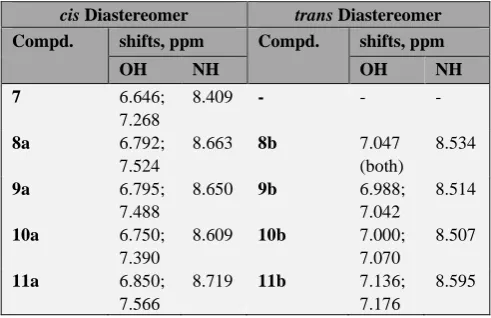
In the 1H NMR spectra of compounds 7, 8a–11a the singlets of protons of cis 3a-HO and 8a-HO groups are situated in the different fields (6.64–6.85 ppm and 7.26–7.56 ppm) whereas the singlets of trans 3a-HO and 8a-HO moieties of diastereomers 8b–11b aresituated closely in the 6.99–7.17 ppm region (Table 1). The singlets of NH-protons of cis-3a,8a-dihydroxy diastereomers 8a–11a are situated in the lower field than the same singlets of NH-protons of
trans-3a,8a-dihydroxy diastereomers 8b–11b.
Table 1. The typical 1H NMR chemical shifts of 3a,8a-HO-protons and NH-protons of compounds 7, 8a–11a and 8b–11b.
cis Diastereomer trans Diastereomer
Compd. shifts, ppm Compd. shifts, ppm
OH NH OH NH
7 6.646;
7.268
8.409 - - -
8a 6.792;
7.524
8.663 8b 7.047 (both)
8.534
9a 6.795;
7.488
8.650 9b 6.988; 7.042
8.514
10a 6.750; 7.390
8.609 10b 7.000; 7.070
8.507
11a 6.850; 7.566
8.719 11b 7.136; 7.176
8.595
In the 13C NMR spectra of compounds 7, 8a–11a the chemical shifts of carbon atoms connected with HO-groups, NOCH2 (NOMe for compound 8a) carbon atoms, and the carbon atoms of carbonyl groups are typical (Table 2).
Table 2. The typical 13C NMR chemical shifts of carbon atoms of compounds 7, 8a–11a.
Compound Shifts, ppm
C–OH NOCH2 NC(=O)N C=O
7 84.33;
89.36
156.05 195.63
8a 84.37;
88.92
64.36 155.19 196.14
9a 84.42;
89.14
71.73 155.55 196.07
10a 84.37;
89.08
76.03 155.40 195.96
11a 84.43;
89.17
78.41 155.23 195.89
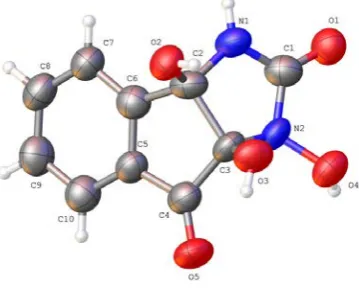
Finally, the structure of compound 7 and 10a have been proved by XRD study (Figures 1-3, Tables 3 and 4). The molecular structure of compound 7 is similar to the molecular structure of compound 10a. The molecular structures of compounds 7 and 10a contains cis-fused indane and imidazolidine moiety (Fig. 1, 2) with the angle between the indane and imidazolidine planes is 64º (7), 60º (10a). At that two hydroxyl groups are cis-oriented to each other (the O(2)–C(2)–C(3)–O(3) torsion angle in Table 3). However, some difference is revealed in the compensation of steric repulsion appeared due to cis-fusing. The C(3) atom deviates on 0.42 Å from the mean plain of remaining atoms of the heterocycle and on 0.24 Ǻ from the mean plane of five-membered carbocycle in molecule 7. In molecule
10a, the N(2) atom deviates on 0.20 Å from the mean plain of remaining heterocyclic atoms while the carbocycle is planar. The endocyclic C(2)–C(3) bond which is joint for
cis-fused cycles is elongated (Table 3) as compared to C(sp3)–C(sp3) ordinary bond (1.54 Å)13 that is typical.14,15 N
O OH
N H
O OH
HO O
O OH
OH AcOH
7 H2N NHOH
O
NHOR O H2N
N O OR N H
O OH
HO O
O
OH OH
AcOH, r.t.
N O OR N H
O OH
HO
R=Me(8),Et(9),n-Bu(10),Bn(11)
+
Figure 1. Molecular structure of 1,3aS,8aR -trihydroxy-1,3,3a,8a-tetrahydroindeno[1,2-d]imidazole-2,8-dione 7 with atoms represented by thermal vibration ellipsoids at 50 % probability level.
Figure 2.Molecular structure of 1-n-butyloxy-3aS,8aR -dihydroxy-1,3,3a,8a-tetrahydroindeno[1,2-d]imidazole-2,8-dione 10a with atoms represented by thermal vibration ellipsoids at 50 % probability level.
Table 3. Some molecular characteristics in the 7 and 10a crystals.
Bond 7 10a
O(2)–C(2)–C(3)–O(3), ° -21.8(7) 6.3(3)
C(2)–C(3), Å 1.619(7) 1.585(3)
C(3)–C(4), Å 1.575(8) 1.535(3)
C(2)–C(6), Å 1.557(8) 1.499(3)
O(2)–C(2), Å 1.439(6) 1.395(2)
O(3)–C(3), Å 1.411(6) 1.390(2)
N(1)–C(1), Å 1.369(7) 1.334(2)
N(2)–C(1), Å 1.409(7) 1.364(2)
C(4)=O(4), Å 1.206(3)
C(1)=O(1), Å 1.242(2) 1.272 (6)
C(4)=O(5), Å 1.250(7)
∑N(1), ° 360 360
∑N(2), ° 341.9 348.5
The C(3)-C(4) bond in molecules 7, 10a is elongated (Table 3) compare to average length of C(sp3)–C(sp2) ordinary bond (1.510 Å).13 In the molecule 7, the endocyclic C(2)–C(6) bond is elongated compare to the same C(2)– C(6) bond in the molecule 10a (Table 3) and average length of C(sp3)–C(sp2) ordinary bond.
The O(2)–C(2) and O(3)–C(3) ordinary bonds are similar in molecules 7 and 10a (Table 3). In molecules 4a, 5, 6 the similar cis oriented vicinal (H)O-C bonds are so different.9,10
The N(1) atom has a planar configuration while the N(2) atom has a pyramidal configuration (Table 3) in the both molecules. At thatthe N(1)–C(1) amide bond is shorter than N(2)–C(1) amide bond (Table 3) indicating stronger conjugation between N(1) lone pair and C(1)=O(1) carbonyl bond as compared to conjugation between N(2) lone pair and C(1)=O(1) carbonyl bond in both molecules. The similar phenomenon is typical for 3-hydroxy- and 3-alkoxy-5-arylimidazolidine-2,4-diones,6,8 N-methoxyurea11 and in the cyclic N-alkoxyureas 5,6.10
The N(2)–O(4)H bond [1.429(5) Å] in molecule 7 is longer than N(2)–O(5)Bu bond [1.397(2) Å] in molecule
10a, and N–OH bond [1.398(7) Å] in molecule 4a,9 N–OH bond [I.3745(17) Å] in 3-hydroxy-5-phenylimidazolidine-2,4-dione.6
In molecule 10a the butyloxy moiety has +ас
-conformation to the С(1)–N(2) endocyclic bond [the C(1)– N(2)–O(5)–С(11) torsion angle is 115.1(2)°] and the butyl fragment is turned relatively to the N(2)–O(5) bond [the N(2)–О(5)–C(11)–С(12) torsion angle is -75.6(2)°]. The C(13) and C(14) atoms are disordered on two position A and
B with the population ratio of 60:40 due to the rotation around the С(11)–С(12) bond. The О(5)–C(11)–С(12)–
С(13) torsion angle is -175.7(2)° in conformer A and 167.7(2)° in conformer B while the C(11)-C(12)-C(13)-C(14) torsion angle is -168.3(2)° in conformer A and 68.7(2)° in conformer B. In the both molecules 7 and 10a
the ketone carbonyl bond is shorter as compared to urea carbonyl bond.
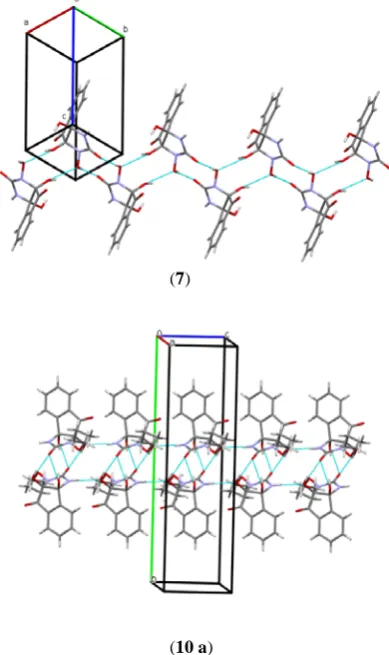
In the crystal phase, molecules 7 and 10a form the centrosymmetrical dimers bound by the O(4)-H(4)…O(1) (7), O(2)-H(2)…O(1) and O(3)-H(3)…O(1) (10a) intermolecular hydrogen bonds (Table 3, Figure 3). These dimers form the chains along [1 0 0] crystallographic direction due to the intermolecular hydrogen bond N(1)-H(1)…O(5) in the 7 crystal and along [001] crystallographic direction due to the N(1)-H(1)…O(3) intermolecular hydrogen bond in the 10a crystal (Table 3, Figure 3). The neighboring chains link by the O(3)-H(3)…O(4) and O(2)-H(2)…O(1) intermolecular hydrogen bonds in the 10a
crystal (Table 4).
Table 4. Intermolecular hydrogen bonds in the 7 and 10a crystals.
Crystal Hydrogen bond
Symmetry operations
Н…А,
Å
D-Н…А, deg.
7
O(4)-H(4)…O(1)
1-x, 2-y, 2-z
1.94 160
N(1)-H(1)…O(5)
-1+x, y, z
2.21 156
O(3)-H(3)…O(4)
2-x, 1-y, 2-z
2.20 139
O(2)-H(2)…O(1)
1-x, 1-y, 2-z
2.11 161
10a
O(2)-H(2)…O(1)
1-x, 1-y, 1-z
2.01 156
O(3)-H(3)…O(1)
1-x, 1-y, 1-z
1.92 165
N(1)-H(1)…O(3)
x, y, -1+z
(7)
(10 a)
Figure 3. The arrangement of the molecules in compound 7, 10a in the crystal.
Scheme 7. The proposed formation mechanism of the compounds
7–11.
The formation of tricyclic compounds 7–11 may be realized in the following way (Scheme 7). At the first stage the ninhydrin’s interaction with N-hydroxyurea or N -alkoxyureas on N-hydroxyamino group or N-alkoxyamino group takes place, forming ureas 12. In the same manner the arylglyoxals react with N-hydroxyurea,6-8 N-alkoxyureas,9 N-alkoxy-N’-arylureas10 and N-alkoxy-N’-alkylureas.10
On the second stage compounds 7 and 8a–11a are formed due to the intramolecular cyclization. In these heterocycles the vicinal HO-groups of hemiaminal moieties have cis
mutual orientation.
In the ureas 12 the rotation around N–C bond with further cyclization gives diastereomers 8b–11b having trans mutual orientation of the vicinal HO-groups. Probably, this rotation is retarded and proceeds more slowly than the cyclization yielding cis-3a,8a-dihydroxydiastereomers 7 and 8a–11a.
CONCLUSIONS
We have found that ninhydrin reacts with N-hydroxyurea and N-alkoxyreas in acetic acid with the predominant formation of the diastereomers of the 1,3a,8a-trihydroxy-1,3,3a,8a-tetrahydroindeno[1,2-d]imidazole-2,8-dione and
1-alkoxy-3a,8a-dihydroxy-1,3,3a,8a-tetrahydroindeno[1,2-d]imidazole-2,8-diones having the cis-orientation of 3a,8a-HO-groups. The structures of1,3aS,8aR -trihydroxy-1,3,3a,8a-tetrahydroindeno[1,2-d]imidazole-2,8-dione 7 and 1-n-butyloxy-3aS,8aR -dihydroxy-1,3,3a,8a-tetrahydroinde-no[1,2-d]imidazole-2,8-dione 10a have been investigated by XRD study.
REFERENCES
1Shapiro, R., Chatterjie, N., Cyclization Reactions of Ninhydrin with Aromatic Amines and Ureas, J. Org. Chem., 1970,
35(2), 447–450. https://doi.org/10.1021/jo00827a034
2Van Slyke, D. D., Hamilton, P. B., The Synthesis and Properties of Ninhydrin Ureide. J. Biol. Chem., 1943, 150(2), 471–476. 3Azizian, J., Karimi, A. R., Soleimani, E., Mohammadi, A.A.,
Mohammadizadeh, M. R., Highly Functionalized Dihydrofuran Derivatives: Synthesis by Diastereoselective Intramolecular Wittig Reaction, Heteroatom. Chem., 2006,
17(4), 277–279. DOI: 10/1002hc
4Jong, J. A. W., Moret, M.-E., Verhaar, M. C., Hennink, W. E., Gerritsen, K. G. F., Van Nostrum, C. F.. Effect of Substituents on the Reactivity of Ninhydrin with Urea,
ChemistrySelect, 2018, 3, 1224–1229. DOI: 10/1002slct201800040.
5Jong, J. A. W., Smakman, R., Moret, M.-E., Verhaar, M. C., Hennink, W. E., Gerritsen, K. G. F., Van Nostrum, C. F., Reactivity of (Vicinal) Carbonyl Compounds with Urea ,
ACS Omega, 2019, 4, 11928–11937. DOI: 10/1021acsomega.9b01177
6Shtamburg, V. G., Anishchenko, A. A., Shtamburg, V. V., Shishkin, O. V., Zubatyuk, R. I., Mazepa, A. V., Rakipov, I. M., Kostyanovsky, R. G., Synthesis and crystal structure of new imidazolidine-2,4-dione and imidazolidin-2-one derivatives, Mendeleev Commun., 2008, 18, 102–104. DOI: 10.1016/j.mencom.2008.03.018.
7Kostyanovsky, R. G., Shtamburg, V. G., Shishkin, O. V., Zubatyuk R. I., Shtamburg, V. V., Anishchenko, A. A., Mazepa, A. V.. Pyramidal nitrogen in the crystal of N -[(benzoyl)-(hydroxy)methyl]-N-benzyloxy-N’
-(2-bromophenyl)urea. Mendeleev Commun., 2010, 20, 167–169. DOI: 10.1016/j.men.com.2010.05.015.
8Shtamburg, V. G., Shtamburg, V. V., Anishchenko, A. A., Zubatyuk R. I., Mazepa, A. V., Klotz, E. A., Kravchenlo, S. V., Kostyanovsky, R. G., Single-stage synthesis of 3-hydroxy- and 3-alkoxy-5-arylimidazolidine-2,4-diones by reaction of arylglyoxal hydrates with N-hydroxy- and
N-alkoxyureas, Chem. Heterocycl. Comp., 2015, 51(6), 553– 559, DOI 10.1007/s10593-015-1735-0
9Shtamburg, V. G., Shtamburg, V. V., Anishchenko, A. A., Mazepa, Shishkina, S. V., Konovalova, I. S., Synthesis and structure of 3,4,5-trihydroxy-5-(4-nitrophenyl)imidazolidin-2-one, Eur. Chem. Bull., 2019, 8(4), 110–114. DOI: 10.17628/ecb.2019.8.110-114.
NHOR
O H2N
N
O OR
N H
O OH
HO O
O OH
OH
O
O OH
N OR
H2N
O
O
O OH
N OR
H2N
O
O
O OH
N OR
H2N
O
N
O OR
N
H O
OH
HO 7,8a-11a
R=H(7),Me(8),Et(9),n-Bu(10),Bn(11)
8b-11b 12
10Shtamburg, V. G., Shtamburg, V. V., Anishchenko, A. A., Shishkina, S. V., Mazepa, A. V., Konovalova, I. S., Alkoxy-1,5-diaryl-4,5-dihydroxyimidazolidin-2-ones and 3-Alkoxy-1-alkyl-5-aryl-4,5-dihydroxyimidazolidin-2-ones: Synthesis and Structure, Eur. Chem. Bull., 2019, 8(9), 282– 290. DOI: http:/dx.doi.org./10.17628/ecb.2019.8.282-290
11Shtamburg, V. G., Klots, E. A., Pleshkova, A. P., Avramenko, V. I., Ivonin, S. P., Tsygankov, A. V, Kostyanovsky, R. G., Geminal systems. 50. Synthesis and alcoholysis on N -acyloxy-N-alkoxy derivatives of ureas, carbamates and benzamide, Russ. Chem. Bull., Int. Ed., 2003, 52(10), 2251−2260.
https://doi.org./10.1023/B:RUCB.0000011887.405.29.b0
12Sheldrick, G. M., SHELXT – integrated space-group and crystal-structure determination, Acta Crystallogr., Sect. A: Found. Crystallogr., 2015, A71(1), 3–8.
https://doi.org./10.1007/S2053273314026370
13Burgi, H.-B., Dunitz, J. D., Structure correlation. Vol. 2.VCH. Weinheim, 1994,741−784.
https://doi.org./10.1107/S0108768195009931
14Agapiou, K., Cauble,D. F., Krische, M. J., Copper-Catalyzed Tandem Conjugate Addition–Electrophilic Trapping: Ketones, Esters, and Nitriles as Terminal Electrophiles, J.Am. Chem. Soc., 2004, 126(14), 4528–4529. DOI: 10.1021/ja030603l.
15Deng, Q.-H., Wadepohl, H., Gade, L. H., Highly Enantioselective Copper-Catalyzed Alkylation of β-Ketoesters and Subsequent Cyclization to Spirolactones/Bi-spirolactones, J. Am. Chem. Soc., 2012, 134(6), 2946–2949. DOI: 10.1021/ja211859w.