1
Child Trafficking: An International Problem
by
Stefenie Tan Peik Yi, LLB (Hons)
Faculty of Law
2
This thesis contains no material which has been accepted for a degree or diploma by the University or any other institution, except by way of background information and duly
acknowledged in the thesis, and to the best of my knowledge and belief no material previously published or written by another person except where due acknowledgement is made in the text of the thesis, nor does the thesis contain any material that infringes copyright.
This thesis may be made available for loan and limited copying and communication in accordance with the Copyright Act 1968.
3
Introduction
This thesis focuses on the failure of the international law regime to effectively address child trafficking. There is a need for the establishment of a new international instrument specifically addressing the trafficking in children, separate from that of the trafficking in adults.
Chapter one shows that the trafficking in children differs from the trafficking in adults in such significant ways that a new international instrument specific to combating child trafficking is required. The more lucrative nature of child trafficking and the fact that children are trafficked to fulfill a specific demand indicates that child trafficking is not a side business for human traffickers, but is in fact a criminal enterprise on its own. Also, children are more vulnerable to being
trafficked and they have different needs and interests with regards to rehabilitation and legal procedures. These needs must be attended to with the establishment of anti-trafficking measures specific to children and only the establishment of an instrument specifically addressing child trafficking will ensure that this happens.
In chapter two, the inadequacies of the definition of child trafficking in current international instruments are examined. This centers on the definition of child trafficking in the 2000 Protocol to Prevent, Suppress and Punish Trafficking in Persons, Especially Women and Children,
4
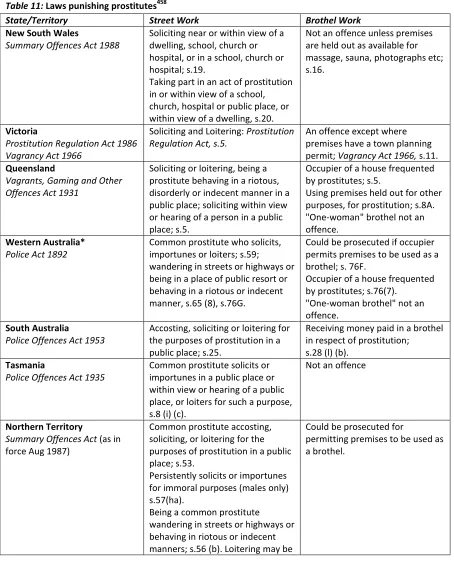
Chapter four discusses the problems in national implementation of the current international framework to address child trafficking. The weaknesses of the current definition of child trafficking have led to a failure to criminalize internal child trafficking as well as to inconsistent national laws concerning prostitution, age of consent and penalties for perpetrators of child trafficking. The difficulty of realizing idealistic principles in international law concerning child trafficking is demonstrated through the implementation of the ‘best interests of the child’ principle, found in Article 3 of the Convention on the Rights of the Child, into national legal systems. The effect of phrasing key obligations in discretionary language, such as the obligation to ‘cooperate and communicate towards the eradication of child trafficking’, is revealed in the failure of individual States to effectively cooperate and communicate with non-governmental organizations and border control agencies.
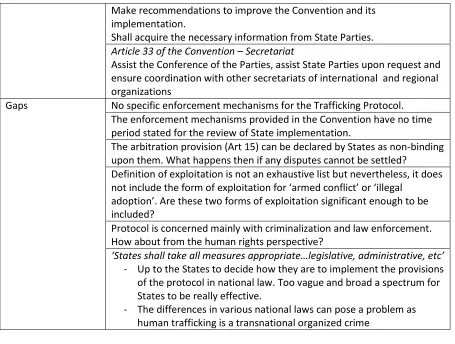
Chapter five identifies the weaknesses of the existing enforcement system with regards to child trafficking. There is an unnecessary duplication of work, a lack of focus on child trafficking and each enforcement mechanism has a limited focus. Each is concerned with only certain areas of international law. The enforcement mechanisms also have limitations as the fulfillment of their mandate is dependent on State cooperation which, however, is not based on any hard
obligations. Enforcement mechanisms do not compel States to answer for any allegations or proven breaches; they can only monitor progress of national implementation and make
recommendations. Moreover, there is a limited accountability of individual States to some of the key mechanisms in this enforcement system with regards to their reporting obligations and other international obligations.
In conclusion, chapter six provides recommendations for the improvement of this international regime, starting with the creation of a holistic new international agreement specifically addressing child trafficking. This new international agreement will contain a new definition of child
5
6
Chapter 1
Combating Child Trafficking Requires a
Separate International Instrument:
Child Trafficking Differs from Adult
Trafficking
The trafficking of human beings is a global issue and no country is immune from the
phenomenon. As the United Nations Office on Drugs and Crime (UNODC) notes in its 2008 Annual Report: “victims from 127 countries undergo exploitation in 135 nations.”1 Between 12 to 27 million people are enslaved in the world today, a figure more than all three centuries of the Trans-Atlantic slave trade combined.2 Since the 1904 International Agreement for the Suppression of the White Slave Traffic (1904 White Slave Traffic Agreement) until the 2000 Protocol to Prevent, Suppress and Punish Trafficking in Persons, Especially Women and Children (Trafficking Protocol), supplementing the United Nations Convention against Transnational Organized Crime, the trafficking of children has been addressed together with the trafficking of adults. However, this approach has proven to be unsuccessful as the trafficking of children is growing at an alarming rate.
In 2009, trafficking in persons was said to be the third largest criminal enterprise in the world but in 2010, it had risen in ranks when identified by the United States State Department as the second largest criminal enterprise, after drugs. According to Kara, the industry is ‘akin to a mature, multinational corporation that has achieved steady-state growth and produces immense cash
1
U.N. OFF. ON DRUGS & CRIME, Annual Report 2008: Human Trafficking: A Crime That Shames Us All 5 (2008), 25 <http://www.unodc.org/documents/about-unodc/AR08_WEB.pdf> at 20June 2009.
2
Kevin Bales, Understanding Global Slavery as cited in World Vision, Child Trafficking and Exploitation
7
flows’.3 It is clear that as the second most profitable transnational organized crime after trafficking in drugs4, human trafficking is driven by economic gain. The United Nations Global Initiative to Fight Human Trafficking (UN.GIFT) 2008 report ‘Human Trafficking: An Overview’ prepared by the United Nations Office on Drugs and Crime (UNODC) estimates that the annual profit from this crime is around 32 billion dollars5 with a global weighted average net profit margin of almost 70 percent.6 In comparison, Google’s net profit margin in 2006 was 29 percent, and it is one of the most profitable companies in the United States; Microsoft was 28.5 percent; and Intel was 14.3 percent.7 The point is clear, the trafficking of human beings makes profits soar. Also, costs incurred in the trafficking of human beings are low, usually with simply a one-off investment to ‘buy’ the victim plus perhaps a small, regular ‘tax’, i.e. “bribe” to law enforcement authorities.8 These costs are negligible because unlike drugs or firearms, humans can be exploited over and over again.
Kara also notes that assuming a 3.5 percent growth rate, there will be 1.48 million sex slaves worldwide by the end of 2012.9 This assumed growth rate has proven to be too low as it has already been estimated that there are two million children trapped in sexual slavery worldwide as of 2009.10 Moreover, the United Nations (UN) estimates that approximately 80 percent of around 600,000 to 800,000 people trafficked transnationally and millions trafficked internally each year are female and about 50 percent are minors.11 The International Labour Organization (ILO) estimates that at any given time, there are about 2.5 million people in forced labour, including
3
Siddharth Kara, Sex Trafficking: Inside the Business of Modern Day Slavery (2009) 17.
4 Perla Trevizo, Georgia Educators Learn about Human Trafficking, 1 February 2012
<http://www.timesfreepress.com/news/2012/feb/01/georgia-educators-learn-about-human-trafficking/> at 23 April 2012.
5UNODC, Human Trafficking: An Overview, UN.GIFT (2008)
<http://www.ungift.org/docs/ungift/pdf/knowledge/ebook.pdf> at 12 March 2010.
6
Siddharth Kara, Sex Trafficking: Inside the Business of Modern Day Slavery (2009) 21-22.
7 Siddharth Kara, Sex Trafficking: Inside the Business of Modern Day Slavery (2009) 21-22. 8
UNIAP, Human Trafficking in the GMS, UNIAP (2005)
<http://www.no-trafficking.org/content/About_Human_Trafficking/about_human.htm> at 26 May 2009.
9 Siddharth Kara, Sex Trafficking: Inside the Business of Modern Day Slavery (2009) 17. 10
US State Department, Trafficking in Persons Report (2010) p.11; World Vision, Child Trafficking and Exploitation <http://www.worldvision.org/content.nsf/learn/globalissues-child-trafficking> at 19 August 2010.
11
8
sexual servitude, and most victims are between the ages 18 to 24.12 The United Nations estimated in 2004 that 700,000 children were forced into domestic servitude in Indonesia; 559,000 in Brazil; 264,000 in Pakistan; 200,000 in Kenya; and 250,000 in Haiti.13
It must be noted that statistics with regards to child trafficking are problematic. There is a lack of accuracy due to the complexity of the phenomenon, coupled with its criminal and lucrative nature which results in the perpetrators’ desire to keep it undetected and flourishing. Because of this lack of accuracy, some argue that these numbers given in relation to child trafficking are
exaggerated. However, it is more likely that these numbers and estimations are too low since the statistics are based on the successful prosecution of traffickers and not all traffickers are
successfully prosecuted. This is because victims’ testimonies are essential to each successful prosecution and most victims are unwilling to come forward for various reasons, including a fear for family, a fear of being prosecuted themselves, a fear of stigma and of not knowing who to trust.
International law has not had much success in eradicating child trafficking. As mentioned above, international law only addresses human trafficking generally and not child trafficking specifically because at a glance, child trafficking seems similar to the trafficking of adults. In actual fact, the trafficking of children is a unique phenomenon requiring specific solutions and needs to be dealt with separately from the trafficking of adults. Therefore this chapter addresses the need for such a distinction, which is based on the fact that:
(i) Trafficked children bring in more money than trafficked adults; (ii) Children are demanded for specific types of work;
(iii) Children are more vulnerable than adults; and (iv) Children have special needs as compared to adults.
12
International Labour Organization, A Global Alliance Against Forced Labour (Geneva, International Labour Office, 2005) as cited in the 2008 report by UNODC, Human Trafficking: An Overview, UN.GIFT (2008) <http://www.ungift.org/docs/ungift/pdf/knowledge/ebook.pdf> at 12 March 2010.
; International Organization for Migration, Counter-Trafficking Database, 78 Countries, 1999-2006 (1999) as cited in UN.GIFT, Human Trafficking : The Facts, UN.GIFT
<http://64.22.127.124/docs/issues_doc/labour/Forced_labour/HUMAN_TRAFFICKING_-_THE_FACTS_-_final.pdf> at 12 March 2010.
13 ILO, Helping Hands or Shackled Lives? Understanding Child Domestic Labour and Responses to it, 2004
9
The higher profits that children bring perpetrators of trafficking make the trafficking in children a more attractive enterprise than the trafficking in adults. For this reason, and also the fact that children are trafficked to satisfy a specific demand, the trafficking in children is a criminal enterprise on its own. As perpetrators give special attention to trafficking in children and treat it as a criminal enterprise on its own, distinct from the trafficking in adults, international law should similarly not address child trafficking as a sub-issue to trafficking in adults. In addition, the fact that children are more vulnerable than adults to being trafficked and have special needs as compared to adults with regards to protection during rehabilitation and legal procedures necessitate that these differences must be addressed directly by a separate treaty specific to children.
1.1 Child Trafficking is a criminal enterprise on its own
One of the reasons that child trafficking requires a separate international instrument from the trafficking in adults is that perpetrators view and treat the trafficking in children as a criminal enterprise of its own. Children are trafficked to satisfy different purposes as compared to adults, purposes that specifically demand children. The reasons children are specifically demanded vary depending on the type of work that these children are required to perform. Also, children generate more profit for their exploiters, incur less cost than adults, satisfy the specific requirements demanded for the type of work they are forced to perform, are easier to control and subdue as compared to adults and raise less suspicion when out in society performing their “work”. These reasons suggest that traffickers do not traffic children as a side business to the trafficking in adults but rather they do it as a criminal enterprise on its own.
1.1.1 Higher Profits
Like all businesses, human traffickers seek to increase their profitability. For this reason,
10
young girl.14 Also, virgins can be sold at a high rate; in Cambodia a virgin can be sold for at least $600.15
Aggravating the situation is that children are easier to exploit and can be paid less, if they are paid at all, due to the fact that children are easier to control, manipulate and deceive.16 In situations where children have been trafficked under the deception that their families would receive
remuneration for their labour, the amount of money that is sent back to the family to keep up the deception are less than what a trafficked adult in the same situation would ‘earn’.17 The reason behind the higher profits that trafficked children generate is that children are being trafficked to meet specific demands for specific types of work. The more specific the demand, the higher the price paid.
1.1.2 Specific Demand
Child trafficking, like any business, is carried out to satisfy a demand from customers. Customers of trafficking are described as those who procure the ‘services’ of the victim of trafficking. 18 They are significant in terms of producing the demand that keeps human trafficking profitable.19 The customers of child trafficking are those who are responsible for the increase in the demand for children for sexual activities, forced labour and many other forms of exploitation. These include and are not limited to sex tourists, who seek children for sexual activities, owners of factories or businesses that use child labour, guerilla armies who force captured children to become soldiers, and those seeking cheap live-in domestic workers. The demand for children for these purposes comes from everywhere around the world and the sourcing of children to fulfill these demands is
14
Kelly M. Cotter, ‘Combating Child Sex Tourism in Southeast Asia’, (2009) 37 Denv. J. Int'l L. & Pol'y 493, 497; Donna Hughes, ‘The Demand for Victims of Sex Trafficking’ (June 2005), available at
<http://www.uri.edu/artsci/wms/hughes/pubtrfrep.htm> at 14 September 2010.
15 Dateline NBC, Children For Sale: Dateline Assists International Justice Mission In Investigating And
Rescuing Children From Sexual Slavery In Cambodia (NBC television broadcast Jan. 23, 2004); see also NBC News, Children for Sale: Dateline Goes Undercover with a Human Rights Group to Expose Sex Trafficking in Cambodia, Dateline NBC, Jan. 9, 2005, <http://www.msnbc.msn.com/id/4038249/> at 14 September 2010.
16 As cited in Dr. Ranee Khooshie Lal Panjabi, Sacrificial Lambs of Globalization: Child Labor in the Twenty-First Century, Denv. J. Int’l L. & Pol’y Vol. 73:3 421 at 422.
17
Siddharth Kara, Sex Trafficking: Inside the Business of Modern Day Slavery (2009) 8-9.
18 Virginia Garrard, ‘Sad Stories: Trafficking in Children--Unique Situations Requiring New Solutions’ (2006)
35 The Georgia Journal of International and Comparative Law 145, 151.
19
11
similarly from all over the world. For instance, a 13 year old Nigerian girl was trafficked as a domestic worker in London and by 2002, more than 2000 children from Albania had been trafficked to Greece to earn money by begging.20
The forms of exploitation may vary considerably with the age and gender21 of the child but may not be limited to just one type for any one child. For instance, a female child could be trafficked for the purposes of becoming a child soldier and at the same time serve as a sex slave for the men in those particular armed forces. There is inevitably an overlap of types of exploitation that trafficked children may experience. Even so, for the purposes of this discussion, some sort of categorization need to be provided and any overlaps acknowledged. Each identified category of exploitation particular to trafficked children will be briefly examined for the reasons which compel the specific demand for children. These categories are:
(i) Child prostitution and related activity;
(ii) Child labour, including camel jockeys and others; and (iii) Warfare.
i. Child Prostitution and Related Activity
Research in Central Asia and Europe shows that the most common form of exploitation in the trafficking of children is sexual exploitation.22 However, it is unclear whether this is because sexual exploitation of children is the most prevalent type of exploitation in child trafficking or because it is the most visible and therefore the most frequently reported form of exploitation, with greater interest shown by media, researchers and others.23 The sexual exploitation of children in child trafficking is not limited to child prostitution but also includes production of pornographic material, strip dancing and related activity, and as sex slaves in warfare.
20Reference Guide on Protecting the Rights of Child Victims of Trafficking in Europe, UNICEF 2006, 2.4.3.1
and 2.4.3.2.
21
M Dottridge, Kids as Commodities? Child Trafficking and What to Do About It (International Federation Terre des Hommes, 2004) 23.
22
UNICEF, Child Trafficking in Europe, A Broad Vision to Put Children First (2008) at 12.
23
12
One reason why children are increasingly demanded for sexual activities is the fear of AIDS which has led to the demand for younger and younger prostitutes.24 Local myths have exacerbated this by saying that having sex with a virgin will cure one of AIDS and other sexually transmitted
diseases or prevent one from contracting them.25 This myth has also contributed to the trafficking in children for child marriage.26
Another reason is that there is undeniably an existing demand for children for the sexual gratification of adults. One only has to look at the media to see that this is true. For instance, in 2008, “millions of archives of videos and photographs” that show child sex abuse were seized in a series of nationwide raids in Spain. The operation uncovered a widespread network which spanned 75 countries and in which two of those arrested were using their own children in the creation of these videos and photographs.27 Unfortunately, this report is only one of the many depicting the sexual exploitation of children. Thus it is clear that there exists a strong demand for the sexual exploitation of children; leading to an increase of trafficking in children for this sole purpose.
ii. Child Labour
Trafficking of children for the purpose of child labour is another common form of exploitation in child trafficking. Children are trafficked for the purposes of domestic service, sweatshops28 and
24 Virginia Garrard, ‘Sad Stories: Trafficking in Children--Unique Situations Requiring New Solutions’ (2006)
35 The Georgia Journal of International and Comparative Law 145, 156; Stacey Mathews, ‘Comment, International Trafficking in Children: Will New U.S. Legislation Provide an Ending to the Story?’, (2005) 27 Hous. J. Int'l L. 649, 664 However, this belief is misguided. Karene Jullien, The Recent International Efforts to End Commercial Sexual Exploitation of Children, (2003) 31 Denv. J. Int'l L. & Pol'y 579 601-02 ("[D]octors believe that sexually active children [in the context of trafficking] are more likely to carry the virus than adults.")
25 Virginia Garrard, ‘Sad Stories: Trafficking in Children--Unique Situations Requiring New Solutions’ (2006)
35 The Georgia Journal of International and Comparative Law 145, 156; Stacey Mathews, ‘Comment, International Trafficking in Children: Will New U.S. Legislation Provide an Ending to the Story?’, (2005) 27 Hous. J. Int'l L. 649, 664-665; Linda Smith & Mohamed Mattar, ‘Global Challenges: Trafficking in Persons, Humanitarian Intervention, and Energy Policy: Creating International Consensus on Combating Trafficking in Persons: U.S. Policy, the Role of the U.N., and Global Responses and Challenges’, (2004) 28 Fletcher F. World Aff. 155, 167.
26
Elizabeth Warner, ‘Behind the Wedding Veil: Child Marriage as a Form of Trafficking in Girls’, 12 Am. U.J. Gender Soc. Pol'y & L. 233, 242.
27 BBC News, Spain holds 121 over child porn, 1 October 2008 <http://news.bbc.co.uk/2/hi/7645626.stm>
accessed at 22 September 2011.
28
13
agriculture where they are forced to work for little or no money at all.29 Other types of forced labour include camel jockeys and others, such as organized begging and illicit activities.
The use of trafficked children as camel jockeys has been documented; children from Bangladesh, Pakistan, Sudan and Mauritania are trafficked to the Gulf States for this purpose.30 Children, not adults, are used for this practice because they are smaller and lighter than adults, and tend to scream louder at a higher pitch than adults, causing the camels to run faster.31 International denunciation by the Special Rapporteur on the Sale of Children, Child Prostitution and Child Pornography in 199932of this dangerous practice, as the children can be injured or even die falling from the camels, has had the effect of producing some positive effects with Qatar, Kuwait and Oman enacting laws to ban the use of children for these races.33
Other forms of labour exploitation of trafficked children include organized begging, illicit activities and trade of human organs34. Organized begging is a form of exploitation that is rampant in
Europe but from reports it is also clear that not all children who are involved in organized begging
29
Dr. Ranee Khooshie Lal Panjabi, Sacrificial Lambs of Globalization: Child Labor in the Twenty-First Century, Denv. J. Int’l L. & Pol’y Vol. 73:3 421 at 422.
30
US State Department, Trafficking in Persons Report (2006) 68, 198 and 250.
31
Daoud Khan, ‘Riding for their lives’, New Internationalist Magazine, Issue 381
<http://www.newint.org/columns/essays/2005/07/01/camel-jockies/> at 14 September 2010; Stephen MacNeil, ‘The Realities of Camel Racing’, November 2005 IHS Child Slave Labor News
<http://ihscslnews.org/view_article.php?id=74> at 14 September 2010.
32 UNCHR, Report of the Special Rapporteur on the sale of children, child prostitution and child pornography, Ms. Ofelia Calcetas-Santos (1999) UN Doc E/CN.4/1999/71 [79].
33
US State Department, Trafficking in Persons Report (2006) 157, 197, 208 and 250.
34 There is a lack of research in this area and what is more commonly suggested through media is that
trafficking and adoption is linked in cases whether pregnant women, sometimes under the age of 18, are trafficked for the sale and adoption of their newborn babies. There may also be a link with trafficking where children are moved from one country to another for the purpose of illegal adoption to create monetary gain for those organizing the adoption. However, the element of exploitation in the adoption process is hard to define unless the adoption or the way in which it was conducted does not give due consideration to the child’s best interest. Therefore, instead of child trafficking, it is more likely that such adoption may be related to the sale of children or the illegal transfer of children instead. Even so, the definitions of these terms as found in national law, often linked to the implementation of the Optional Protocol to the Convention on the Rights of the Child on the Sale of Children, Child Prostitution and Child Pornography (2000), creates a blurring between these terms as some address child trafficking and the sale of children together, making no differentiation between the two. In any case, studies indicate that statistics on children who leave one country for adoption do not always coincide with the number of children who actually reach their destination country. Thus it is possible that trafficking of children could happen under the guise of adoption and even though child trafficking and adoption may be related to some extent, there is a need to better understand the connection between the two issues as they are two distinct phenomena.*
Therefore, for the purposes of this thesis, this aspect of exploitation in relation to child trafficking would not be discussed any further.
14
have been trafficked. 35 Even so, the existence of trafficking for the purpose of street begging is very real. Ms Ofelia Calcetas-Santos, a Special Rapporteur on the Sale of Children from 1994-2001, acknowledged in her 1999 report that this is rampant in the Mekong region, particularly from Cambodia to Thailand.36 It can be argued that children are favoured for this purpose as they garner more sympathy and trust from people whom these children are sent to beg from.
Human trafficking for the removal and trade of organs has been documented in respect to adults, as early as 1994 when Mr Vitit Muntarbhorn, another former Special Rapporteur on the Sale of Children from 1991-1994, acknowledged the issue. However, Mr Vitit Muntarbhorn could not say that the same market for organs existed concerning child victims.37 Ms Ofelia Calcetas-Santos stated five years later that she received allegations of street children being killed for their organs to be used in transplant operations, allegations which have recurred repeatedly for over 20 years, but nobody has yet been convicted of being connected with such an offence.38 Whether or not these children were killed for the purposes of harvesting their organs remains a question with no clear answer. In 2006, Mr Juan Miguel Petit, also a former Special Rapporteur on the Sale of Children from 2001-2008, noted that knowledge of the trafficking of children for the removal and trade of organs is still scarce and this is mainly due to the existence of an ‘overload of rumours and hearsay’.39
Similarly, there is not much information available on the use of trafficked children in illicit activities such as drug production, drug trafficking and petty theft. However, an investigation led by the United Kingdom (UK) demonstrated that around two thirds to three quarters of cannabis farms are run by Vietnamese criminal gangs who are trafficking Vietnamese children into the UK to cultivate the drug in exploitative conditions.40 It also seems that the phenomenon might be
35
UNICEF, Child Trafficking in Europe, A Broad Vision to Put Children First (2008) at 13.
36 UNCHR, Report of the Special Rapporteur on the sale of children, child prostitution and child pornography, Ms. Ofelia Calcetas-Santos (1999) UN Doc E/CN.4/1999/71 [74].
37
UNCHR, Report submitted by Mr. Vitit Muntarbhorn, Special Rapporteur, in accordance with Commission on Human Rights resolution 1993/82 (1994) UN Doc E/CN.4/1994/84 [100].
38
UNCHR, Report of the Special Rapporteur on the sale of children, child prostitution and child pornography, Ms. Ofelia Calcetas-Santos (1999) UN Doc E/CN.4/1999/71 [85].
39 UNCHR, Report submitted by the Special Rapporteur on the sale of children, child prostitution and child pornography, Juan Miguel Petit (2006) UN Doc A/HRC/4/31 [20].
40
15
widespread in the UK as an average of one child a week is rescued.41 It can again be argued that children are used in these activities because of their vulnerability and tendency to raise less suspicion.
iii. Warfare
In warfare, children play roles as child soldiers, sex slaves, porters and spies.42 Children are used for warfare because they are easier to control and obey orders with less questioning than adults. Additionally, children are used because they provide an advantage in warfare. Enemy soldiers are less likely to injure or kill a child. Also, a child is smaller in size and may be faster than an adult thus making better messengers and spies. And, a child raises less suspicion than an adult and has a higher chance of surviving when entering into enemy territory to spy or attack.43 There are also instances where guerilla armies have forced captured children to fight against their own people,44 a great advantage for the guerilla armies as the people would most likely not kill their own children.
1.2 Children have different protection needs from adults
Another reason that supports the need for a separate treaty addressing child trafficking is that the needs of child victims of trafficking differ from the needs of adult victims. The fact is that children are more vulnerable to being trafficked as compared to adults and thus require anti-trafficking measures established specifically to protect children. Also, the impact of trafficking on children is different as they suffer abuse during the developmental years of their life. Accordingly, they have special rehabilitation needs and special protection needs during legal procedures as compared to adult victims of trafficking.
1.2.1 Heightened Vulnerability
41 M Daly, Children trafficked from Asia to UK to work in cannabis factories, The Independent (London, 23
September 2007) <http://www.independent.co.uk/news/uk/crime/children-trafficked-from-asia-to-uk-to-work-in-cannabis-factories-403251.html> at 11 August 2010.
42 Dr. Ranee Khooshie Lal Panjabi, Sacrificial Lambs of Globalization: Child Labor in the Twenty-First Century,
Denv. J. Int’l L. & Pol’y Vol. 73:3 421 at 422.
43
Silvia Scarpa, ‘Fourth Annual World Congress on Family Law and Children’s Rights: Child Trafficking: International Instruments to Protect the Most Vulnerable Victims’ (2006) 44 Fam. Ct. Rev. 429, 433.
44
16
The methods involved in the trafficking of children are similar to the trafficking of adults. For instance, children, like adults who having decided to migrate in search of a better future, sometimes end up becoming the victims of human trafficking. According to the Reference Guide on Protecting the Rights of Child Victims of Trafficking in Europe, the majority of children
trafficked in Europe come from the age group of 15-17 years45; just before attaining majority, and it is in this age group where most trafficked children leave home voluntarily, with or without the permission of parents or their guardian. They are able to do so since this age group has completed compulsory education, are old enough to enter employment legally and to migrate.46
Similarly, victims of trafficking, both adults and children, are said to be ‘vulnerable to deceit due to economic desperation’. Over one billion people today are living on an average of one dollar per day or less.47 Kara suggests that the phenomenon itself is ‘directly produced by the harmful inequalities spread by the process of economic globalization’48. Increasing poverty, starvation of financial opportunities, exploitation of poorer economies by richer ones and the ‘general erosion of human freedoms across the developing world’ all contribute to the success of human
trafficking.49 Traffickers or the facilitators of human trafficking include a variety of people who often stem from organized criminal groups.50 Similar to all other businesses, modern technology aids communication and trade, making it irrelevant that these criminal groups are small, loosely organized and dispersed.51 The key player is usually a local person who appears trustworthy and ensnares victims with promises of work, marriage or educational opportunities.52 Also, some of
45Reference Guide on Protecting the Rights of Child Victims of Trafficking in Europe, UNICEF 2006, 2.4.1. 46
Reference Guide on Protecting the Rights of Child Victims of Trafficking in Europe, UNICEF 2006, 2.4.1.
47
Siddharth Kara, Sex Trafficking: Inside the Business of Modern Day Slavery (2009) 8-9.
48
Siddharth Kara, Sex Trafficking: Inside the Business of Modern Day Slavery (2009) 8-9.
49 Siddharth Kara, Sex Trafficking: Inside the Business of Modern Day Slavery (2009) 8-9. 50
Virginia Garrard, ‘Sad Stories: Trafficking in Children--Unique Situations Requiring New Solutions’ (2006) 35 The Georgia Journal of International and Comparative Law 145, 151; US State Department, Trafficking in Persons Report (2010) p.67. Organized criminal groups are defined as "a structured group of three or more persons, existing for a period of time and . . . [having] the aim of committing . . . [a] serious crime[] . . . in order to obtain, directly or indirectly, a financial or other material benefit." U.N. Gen. Assembly, Convention Against Transnational Organized Crime, U.N. Doc. A/55/383 (Nov. 2, 2000). The Protocol is contained within this Convention.
51
Virginia Garrard, ‘Sad Stories: Trafficking in Children--Unique Situations Requiring New Solutions’ (2006) 35 The Georgia Journal of International and Comparative Law 145, 151; Stacey Mathews, ‘Comment, International Trafficking in Children: Will New U.S. Legislation Provide an Ending to the Story?’, (2005) 27 Hous. J. Int'l L. 649, 660; LeRoy G. Potts, Jr., ‘Global Trafficking in Human Beings: Assessing the Success of the United Nations Protocol to Prevent Trafficking in Persons’, (2003) 35 Geo. Wash. Int'l L. Rev. 227, 231.
52
17
these victims, when they are older, become traffickers themselves or get involved in the trafficking process in order to avoid being exploited any further.53
As a result, many victims of human trafficking are procured through sale by family and recruitment by former victims. Other methods used are seduction or romance, and less
frequently, abduction.54 Besides that, victims of trafficking have few resources available to them. Usually the victim is in a new place or country with little or no knowledge of the local language, possessing little or no money, no passport, no visa and no one to turn to. They are normally subjected to a wide variety of methods to control them and make them obey orders. These vary from physical and sexual abuse, forced use of alcohol, drugs or sedatives55 and even being told by their traffickers or ‘owners’ that if they tried to escape, law enforcement authorities will
prosecute them or that their families back in their home country will be killed.56 Thus the victims themselves are too afraid to seek help.
However, what sets the child victims of trafficking apart from the adult victims is the fact that by their very nature, children are more vulnerable than adults to trafficking and its consequences. Children are younger, more easily exploited, more susceptible to deception and control, and are less able to demand their rights.57 They are more dependent for food, shelter or emotional needs, therefore making it easier to persuade the children to do as they are told. They also have a less-developed capacity than adults to assess risk, voice their worries, distinguish right from wrong, or to take action to defend themselves from harm.58
Sexual Exploitation of Children: Suppressing the Global Demand and Domestic Options for Regulating Prostitution’, (2005)13 Tul. J. Int'l & Comp. L.333, 334; LeRoy G. Potts, Jr., ‘Global Trafficking in Human Beings: Assessing the Success of the United Nations Protocol to Prevent Trafficking in Persons’, (2003) 35 Geo. Wash. Int'l L. Rev. 227, 229
53 UNODC, Profiling Human Traffickers, UN.GIFT (2008)
<http://www.ungift.org/ungift/en/stories/profiling-human-traffickers.html> at 26 May 2009.
54
Siddharth Kara, Sex Trafficking: Inside the Business of Modern Day Slavery (2009) 8-9.
55Reference Guide on Protecting the Rights of Child Victims of Trafficking in Europe, UNICEF 2006, 2.5.2. 56
UNODC, Trafficking in Persons: Global Patterns 11 (Apr. 2006),
<http://new.vawnet.org/category/www.unodc.org/pdf/traffickinginpersons_report_2006ver2.pdf> at 20 June 2009; Amanda Kloer, 10 Reasons Trafficking Victims Can’t Leave, End Human Trafficking (2009) <http://humantrafficking.change.org/> at 26 May 2009.
57
World Vision Australia School Resources, World Vision 2007 <
http://www.worldvision.com.au/Libraries/3_1_1_-_Issues_-_Children/Child_Trafficking.sflb.ashx> at 19 August 2010.
58
18
An even more crucial fact is that children often do not have an independent legal status and thus often do not have a say in what happens to them.59 Children are traditionally viewed by legal systems as passive subjects who are unable to assess reality effectively, make decisions and act with initiative, self-reliance and responsibility. Consequently, entire legal systems are built upon the concept where the adult will be the representative of the child. Therefore government laws and practices consistently place a child’s fate in the hands of an adult: a family member, state official or appointed guardian.60 This societal structure and thinking makes children more vulnerable than adults in two ways: to being trafficked and to harm from trafficking after extraction.
For example, children, whose families are stricken with poverty, are usually more vulnerable to being trafficked61 as they can be sent away from home by their parents or guardians, with or without the child’s consent. There are always intermediaries willing to take advantage of the vulnerability of poverty-stricken families by suggesting to the parents that their child will have a better future abroad and may offer an advance to the parents on the child’s subsequent earnings62, thus deceiving them when in actual fact the children will be delivered to brothels, factories, fishing boats, private homes as domestic servants and even onto the streets to beg. In some cases, parents or guardians take the initiative to send the child away due to their financial difficulties and in other cases, parents or guardians are not fully informed of the risk of serious abuse to the child.63 However, some parents or guardians close their eyes and ears to reports of abuse to children in similar situations and simply hope that their child will be one of the lucky ones who will earn a significant amount of money instead.64
For instance, in Thailand and the Mekong Subregion, the rural and hill tribe families are stricken by poverty. In order to survive, they sometimes have no choice but to sell their daughters to slave traders impersonating as job agents who give them false promises of providing good jobs and
59 World Vision Australia School Resources, World Vision 2007 <
http://www.worldvision.com.au/Libraries/3_1_1_-_Issues_-_Children/Child_Trafficking.sflb.ashx> at 19 August 2010.
60 UNICEF, Child Trafficking in Europe, A Broad Vision to Put Children First, 2008 at 40-43. 61
Kevin Bales, Disposable People: New Slavery in the Global Economy (1999) 15-16.
62
Reference Guide on Protecting the Rights of Child Victims of Trafficking in Europe, UNICEF 2006, 2.4.1 and 2.5.1.
63
Reference Guide on Protecting the Rights of Child Victims of Trafficking in Europe, UNICEF 2006, 2.4.1.
64
19
better lives to the girls.65 The same situation happens in Nepal as well, one of the poorest regions in the world. Kara records his encounter with Maya, a victim of trafficking, who has worked in Mumbai for 4 years as a sex slave. Maya was born in Nepal where her parents sold her for $55 to an agent on the promise that she would have a good job at a carpet factory from which she could send home up to $10 per month.66
In addition, as adults often act as representatives of children, any movement of trafficked children is harder to detect than the movement of trafficked adults. Traffickers could easily bring the trafficked children with them under the guise of being a parent or relative. Even more alarming is that family members of victims participate in the trafficking of children.67 It is not uncommon to hear of reports where teenage girls are trafficked by relatives, including female relatives, as well as young men posing as boyfriends or fiancés, and where younger children are trafficked into begging by relatives.68 Moreover, the nature of a child generally makes it easier for the trafficker to control them in order not to alert anyone of what is really happening.
Another effect of the absence of an independent legal status for children is that it makes children particularly vulnerable after being extracted from trafficking. There is difficulty in deciding the appropriate long-term care for such children, especially for children whose nationality is unknown. These children would have to have appointed guardians to act as representatives for them; but unfortunately not all legal systems have this requirement built into them. Thus some of these children would have to navigate legal systems on their own, legal systems which were designed primarily for adults. In addition, having been under the control of traffickers and exploiters, the fact that they would still have no say over what happens to them after being extracted from trafficking could further aggravate their emotional and mental trauma and social fragility.
1.2.2 Special Needs
65
Siddharth Kara, Sex Trafficking: Inside the Business of Modern Day Slavery (2009) 175-176.
66 Siddharth Kara, Sex Trafficking: Inside the Business of Modern Day Slavery (2009) 8-9. 67
Virginia Garrard, ‘Sad Stories: Trafficking in Children--Unique Situations Requiring New Solutions’ (2006) 35 The Georgia Journal of International and Comparative Law 145, 151; Stacey Mathews, ‘Comment, International Trafficking in Children: Will New U.S. Legislation Provide an Ending to the Story?’, (2005) 27 Hous. J. Int'l L. 649, 660.
68
20
Victims of child trafficking differ from victims of adult trafficking because of the special needs of such children. Trafficking has a different impact on children than on adults. The recognition of this fact is highly important and must be kept in mind throughout this thesis. However, despite recommendations from the Human Rights Caucus, the UN High Commissioner for Human Rights, UNICEF, the International Organization for Migration and others to address the special needs and legal status of children, there has been a failure to do so.69 The factors which compose these special needs of children are discussed below. They are a large part of why the trafficking of children warrants targeted efforts.
i. Rehabilitation Needs
Scientific studies have generated a deeper understanding of the developmental years of the human being and have a deeper appreciation of:
(i) the importance of early life experiences and how it can affect the development of the brain and subsequent unfolding behavior,
(ii) the central role of early relationships that either provide support and adaptation or risk and dysfunction,
(iii) the capabilities, emotions and essential social skills that develop during the early years of life, and
(iv) the capacity to increase the chances of favourable development through planned intervention.70
Due to the fact that victims of child trafficking are subjected to abuse in their years of physical, mental and emotional development, the trauma and harm resultant from that abuse is different from that experienced by adult victims of human trafficking. Under normal circumstances, children receive the proper guidance and role models in the development of their morality, personality and identity, significantly through their parents and the society around them.71 Thrust into trafficking, the proper development of the child is violated as victims are not only deprived of
69 Ann D. Jordan, The Annotated Guide to the Complete UN Trafficking Protocol, May 2002 (Updated August
2002) 12.
70
Jack P. Shonkoff, Deborah Phillips, ‘From Neurons to Neighborhoods: The science of early childhood development’ (2000) 1-2.
71
21
these proper role models and guidance but their social, psychological and emotional development is deformed by the extremely harmful situation that they are in.
Therefore the rehabilitation and reintegration process of victims of child trafficking would be unlike that which an adult victim of trafficking would need. This is affirmed by UNICEF in its two publications:
Reference Guide on Protecting the Rights of Child Victims of Trafficking in Europe 2006 at 8.1 states that child victims have ‘special rights and needs’ and should be cared for by adequately trained professionals who are aware of these needs and are knowledgeable about gender issues; and again at 8.5.4 which states that because of ‘the particular harm caused to girls on account of their immaturity and the particular needs that they have in recovering…it is important to ensure that adolescent girls are given care and
opportunities which would not be appropriate for adult women.’72
Child Trafficking in Europe, A Broad Vision to Put Children First 2008 at 39 states that ‘children’s increased vulnerability to exploitation and the particular harm suffered by trafficked children require that child trafficking and trafficking in adult persons be dealt with as separate issues.’73
Specific efforts are needed not only to fulfill the child’s material needs but also to empower the child and give the child a sense of self-esteem and of being able to make his or her own decisions and to control his or her own life74 and to cultivate the child’s ability to interact with other people in society in a socially acceptable way.75 The age of trafficked children also influence the type of attention they need in their rehabilitation process. For instance, younger children would need to restart school education, whereas the older adolescents may not favour a return to school and may benefit more from other forms of education such as vocational training.76
Chapter 8 of the Reference Guide on Protecting the Rights of Child Victims of Trafficking in Europe 2006 outlines the general principles of interim care and protection for a victim of child trafficking. One of these principles includes: “Under no circumstance should a child be placed in any type of
72 UNICEF, Reference Guide on Protecting the Rights of Child Victims of Trafficking in Europe 2006 at 8.1 and
8.5.4.
73
UNICEF, Child Trafficking in Europe, A Broad Vision to Put Children First 2008 at 39.
74 UNICEF, Reference Guide on Protecting the Rights of Child Victims of Trafficking in Europe 2006 at 8.5.6. 75
UNICEF, Reference Guide on Protecting the Rights of Child Victims of Trafficking in Europe 2006 at 8.5.6.2.
76
22
detention facility, including police cells, prisons or even special detention centers for children.”77
This suggests that even though child victims need to have a safe and secure accommodation, protected from traffickers and their associates, whether or not they are still under the trafficker’s or exploiter’s direct control, they remain vulnerable and sensitive to a range of maltreatment78 including the sense of being ‘imprisoned’ which is likely to cause them further harm.79 It must be noted that one of the core concepts of development is that the developing child remains
vulnerable to risks and open to protective influences throughout the early years of life and into adulthood.80 This is why age and gender-specific help is needed for victims of child trafficking to provide optimum chance for successful rehabilitation.
What must also be taken into consideration is the special vulnerability and innocence of children which are taken advantage of by traffickers to assert control over their victims by
‘pre-programming’ them, through the use of fear or emotional manipulation, to leave and contact them if by any chance the child was extracted from the trafficker’s direct control.81 This vulnerability and innocence of children, combined with the experiences endured while being trafficked, may result in the misplaced trust or distrust of children. For example, a Ukrainian boy trafficked to Poland was with his mother who was simultaneously trafficked but she had refused to seek assistance82and sometimes child victims of trafficking, once extracted, make contact with their parents, who subsequently instruct the child to re-join their trafficker. These situations could cause a child to devalue the protective capacity of a parent or guardian and hinder a successful rehabilitation process which would require some sort of trust relationship to be built with the child’s appointed guardian. Therefore, there needs to be a balance struck, however delicate it
77 UNICEF, Reference Guide on Protecting the Rights of Child Victims of Trafficking in Europe 2006 at 8.1. 78 Which could come from staff or other children living in the same residential facility, journalists or others
who may violate their right to privacy, or even members of the public who attack, criticize or discriminate against these children because of the stigma and blame attached to trafficked children and the activities in which they may have engaged, such as prostitution or theft, UNICEF, Reference Guide on Protecting the Rights of Child Victims of Trafficking in Europe 2006 at 8.2.
79
UNICEF, Reference Guide on Protecting the Rights of Child Victims of Trafficking in Europe 2006 at 8.5.1.
80 Jack P. Shonkoff, Deborah Phillips, ‘From Neurons to Neighborhoods: The science of early childhood
development’ (2000) 4.
81
UNICEF, Reference Guide on Protecting the Rights of Child Victims of Trafficking in Europe 2006 at 8.5.1.
82 Case cited in: Centre of Social Expertise of the Institute of Sociology, National Academy of
23
might be, to ‘de-programme’ such mindsets and provide them with the resources necessary for their recovery.83
ii. Special Needs in regards to Legal Procedures
The legal assistance and criminal justice process involving victims of child trafficking must be different from that tailored to aid adult victims of trafficking. Children have special needs and interests which are already protected in courts of justice and this should be no different when a prosecution of traffickers involves a child victim giving evidence in the case. Moreover, a child may be charged with an offence, either in connection with illegal entry into a county or another offence, or may need to seek asylum in the country to which he or she has been trafficked or may simply need to secure the most appropriate durable solution that is in the child’s best interest. In all these situations, the legal representative involved should be someone who is skilled in
representing children, has knowledge of the experience of trafficked children, is aware of the risks a trafficked child faces even after extraction from the control of his or her traffickers or exploiters, and has knowledge of child-specific forms of persecution and the asylum process.84
1.3 A United Effort
In summary, the key failure of the international law regime against child trafficking is an absence of recognition that the trafficking in children must be dealt with separately from the trafficking in adults. There is a clear need for a separate treaty specifically addressing child trafficking as the trafficking in children differs from the trafficking in adults. It is a fact that children generate higher profits for traffickers and also that children are trafficked to fulfill a specific demand. This means that child trafficking is not a side business for human traffickers but is an enterprise of its own. Accordingly, international law should respond appropriately by no longer addressing the trafficking in children as a sub-issue to the trafficking in adults.
In addition, the needs of child victims of trafficking differ from that of adult victims of trafficking. They have a heightened vulnerability to being trafficked as compared to adults and they also have special needs and interests with regards to rehabilitation and legal procedures. Moreover, the type of societal structure and thinking where children are viewed as passive subjects with their fate constantly placed in the hands of adults, is contradictory to successful prevention and
83
UNICEF, Reference Guide on Protecting the Rights of Child Victims of Trafficking in Europe 2006 at 8.5.1.
84
24
detection measures for the trafficking of children. To successfully prevent children from becoming victims to trafficking and to detect children who are being victimized, children must be recognized as agents of their own, having a right to have their views and opinions heard and be given means to understand the issues at stake, raising awareness of the risks that they face, make informed choices and protect themselves as fully as possible.85
These differences which set trafficking in children apart from the trafficking in adults change the dynamics of the way which this phenomenon must be dealt with. It is a unique phenomenon which requires a new solution, requiring that the trafficking in children be dealt with separately from the trafficking in adults. Addressing child trafficking together with trafficking in adults has the effect of children not receiving the adequate attention needed in the system established to combat human trafficking. Furthermore, the increasing statistics of the exploitation of children, as outlined at the beginning of this chapter, suggest that there is a need for the international
community to be united and target their efforts against child trafficking to ensure that such exploitation of children will face zero tolerance.
85
25
Chapter 2
Weaknesses of the Definition of Child
Trafficking in Current International
Instruments
The 2000 Protocol to Prevent, Suppress and Punish Trafficking in Persons, Especially Women and Children (Trafficking Protocol), supplementing the United Nations Convention against
Transnational Organized Crime addresses child trafficking as a sub-issue to the trafficking in adults. Children are only mentioned briefly in the Trafficking Protocol’s definition of human trafficking and again in Article 6.4 in the Trafficking Protocol which states that State Parties are to take into account the special needs of children in the provision of assistance and protection to victims of trafficking in persons. As a result of being addressed as a sub-issue, the current
definition of child trafficking has weaknesses which make it inadequate to effectively combat child trafficking. These weaknesses are:
(i) The scope of application is restricted to transnational organized crime carried out by at least three or more persons;
(ii) It is neutral with regards to prostitution; and (iii) It has limitations on the age of victims.
26
2.1 Current Definition of Child Trafficking
A number of existing international instruments define child trafficking. Article 3 of the
International Labour Organisation (ILO) C182 Worst Forms of Child Labour Convention 1999 states that child trafficking is a form of slavery. Under Article 7 of the Rome Statute of International Criminal Court which defines crimes against humanity, the trafficking of children is mentioned under the definition of enslavement as being a process whereby enslavement could occur. However, the most comprehensive and widely utilized definition of child trafficking which has achieved international status and acceptance is contained in the Trafficking Protocol, but not as a separate or stand alone definition. It is included within the overarching definition of human trafficking. Therefore to understand the current definition of child trafficking, it is necessary to first outline the elements of the definition of human trafficking in the Trafficking Protocol:
“ ‘Trafficking in persons’ shall mean the recruitment, transportation, transfer, harbouring, or receipt of persons, by means of the threat or use of force or other forms of coercion, of abduction, of fraud, of deception, of the abuse of power or of a position of vulnerability or of the giving or receiving of payments or benefits to achieve the consent of a person having control over another person, for the purpose of exploitation. Exploitation shall include, at a minimum, the exploitation of the prostitution of others or other forms of sexual exploitation, forced labour or services, slavery or practices similar to slavery, servitude or the removal of organs.” Article 3(a) of the Trafficking Protocol
This definition of human trafficking can be broken down into three key elements: (i) the conduct associated with moving people across borders,
(ii) with coercive or deceptive means, (iii) and for the purpose of exploitation.86
In addition, because any apparent, implied or express consent is mitigated by the use of
deception, coercion, or other forms of violence, it is implied that consent will be relevant where
86
PROTOCOL TO PREVENT, SUPPRESS AND PUNISH TRAFFICKING IN PERSONS, ESPECIALLY WOMEN AND CHILDREN (SUPPLEMENTING THE UNITED NATIONS CONVENTION AGAINST TRANSNATIONAL ORGANIZED CRIME), G.A. Res. 55/25, Annex II, U.N. Doc A/Res/55/25/Annex II (Nov. 15 , 2000)
27
none of those coercive or deceptive means are present. Therefore, consent is irrelevant in identifying victims of human trafficking but is considered to be relevant as an element of evidence.87
The Trafficking Protocol makes a reference to children in its definition of human trafficking in subparagraph (c):
“The recruitment, transportation, transfer, harbouring or receipt of a child for the purpose of exploitation shall be considered ‘trafficking in persons’ even if this does not involve any of the means set forth in subparagraph (a) of this article”
Article 3(c) of theTrafficking Protocol deletes the requirement for coercion and deception; therefore, as long as a child has been moved elsewhere to be exploited, it is regarded as the trafficking of children. Thus, because of the removal of the requirement for coercion and deception, consent is considered irrelevant.88 The reasons for child trafficking being defined as such requires examining the intention of the drafters of the existing definition in the Trafficking Protocol.
2.1.1 Intention of the Drafters
In 1904, the understanding of human trafficking was such that it was suggested to affect only women and girls for ‘immoral purposes’ or prostitution with no distinctions made between forced or voluntary prostitution, or to issues of consent.89 However, the 1921 Convention for the
Suppression of the Traffic in Women and Children90 expanded the understanding of human trafficking to apply to not only women and girls, but also to boys, with the focus remaining on trafficking for the purposes of prostitution only. The 1949 Convention for the Suppression of the Traffic in Persons and the Exploitation of the Prostitution of Others (1949 Convention) 91 adopted
87
Anna Gekht, ‘Shared but Differentiated Responsibility: Integration of International Obligations in Fight Against Trafficking in Human Beings’ (2008) Denver Journal of International Law and Policy, Volume 37 Number 1 29, 35.
88
Dr. Ranee Khooshie Lal Panjabi, ‘Born Free Yet Everywhere in Chains: Global Slavery in the Twenty-First Century’ (2008) Denver Journal of International Law and Policy, Volume 37 Number 1 1, 20.
89 International Agreement for the Suppression of the White Slave Traffic, May 18, 1904, 35 Stat. 1979, 1
L.N.T.S. 83, Article 1.
90
International Convention for the Suppression of the Traffic in Women and Children, opened for signature Sept. 30, 1921, 9 L.N.T.S. 416 (entered into force June 15, 1922).
91
28
more gender-neutral language by referring to "persons" rather than to women and/or children but still focused only on trafficking for the purposes of prostitution, regardless of the consent of the “victim”. As prostitution mainly affected women and female children, the political focus thus remained on them.92 In addition, one of the numerous criticisms of the 1949 Convention is that its definition of trafficking limited the scope to prostitution and did not address trafficking for other purposes, such as other sex work, domestic, manual or industrial labour, or marriage, adoption or other intimate relationships.93
The 2000 Trafficking Protocol was drafted partly in response to these criticisms. It attempts to address human trafficking more effectively by adopting a holistic approach.94 This effort is
reflected in the Trafficking Protocol’s definition of human trafficking which attempts to address all the existing types of human trafficking.
First, as exploitation is considered as fundamental to the trafficking experience, this definition attempts to address all the different types of trafficking by including a non-exhaustive list of exploitative acts. The definition thus incorporates trafficking for the other purposes besides prostitution, such as trafficking for the purposes of forced labour, slavery, servitude and the removal of organs. This demonstrates a shift away from prostitution as being the only identified purpose of human trafficking, widening the scope of the definition. In addition, this definition also attempts to identify all possible actors involved in human trafficking. Facilitators of trafficking are identified to include all those from recruiters to recipients of trafficked persons and it also identifies victims as to encompass all persons and not just women and children.
Thus the Trafficking Protocol’s attempt to establish a holistic, and hence more effective, approach towards human trafficking by addressing all the different types of trafficking is the reason that the definition of child trafficking is drafted as a part of the overarching definition of human trafficking. Some may even argue that the current definition of human trafficking in the Trafficking Protocol has given special consideration to children by providing a separate paragraph in article 3 to define what constitutes the trafficking of children. However, even though it recognizes the increased
92
Alice Edwards, ‘Traffic in Human Beings: At the Intersection of Criminal Justice, Human Rights, Asylum/Migration and Labor’, (2007) 36 Denv. J. Int'l L. & Pol'y 9, 13.
93
Special Rapporteur on Violence Against Women, Report on Trafficking in Women, Women's Migration and Violence Against Women, Submitted in Accordance with Commission on Human Rights Resolution 1997/44, at 10, delivered to the U.N. Economic & Social Council [ECOSOC] and the Commission on Human Rights, U.N. Doc. E/CN.4/2000/68 (Feb. 29, 2000), at paras. 22, 24, 25.
94
29
vulnerability of children as compared to adults by deleting the requirement of coercion or deception, this attempt to give extra protection to child victims of trafficking is insufficient to effectively address the complexity and gravity of this phenomenon.
As discussed in chapter one, the trafficking of children is different from the trafficking of adults and thus entails distinct responses and solutions.95 Therefore, this all-inclusive definition in the Trafficking Protocol is particularly ineffective in addressing child trafficking. It is difficult to address the issues particular to child trafficking with a definition which has been sufficiently generalized to be all-inclusive. This inadvertently causes some limitations and weaknesses in the current
definition of child trafficking.
2.2 Weaknesses of the Current Definition
The current definition of child trafficking is merely a sub-text, necessitating that it draws from and refers back to the over-arching definition of human trafficking. The words “does not involve any of the means set forth in subparagraph (a) of this article” in subparagraph (c) of Article 3 requires going back to the definition of human trafficking as found in Article 3(a) of the Trafficking
Protocol. Similarly, “exploitation” is not defined in the Trafficking Protocol definition of child trafficking and therefore again requires referring back to the general definition of human trafficking. Consequently, there is a danger of issues particular to child trafficking not being effectively addressed in the implementation of international obligations into national law. For instance, the context in which the current definition has been placed limits the scope of the definition to transnational trafficking in children in the context of organized crime carried out by at least three or more persons. This means that trafficking in children with no transnational aspect and/or carried out by less than three persons falls outside the scope of the Trafficking Protocol.
There is also neutrality in the current definition with regards to criminalizing or legalizing prostitution; an issue that need not be debated and should be straightforward with regards to children.
95
30
In addition, there is a limitation placed on the age of victims; there is no acknowledgment that the age of victims of child trafficking may be over 18 years at the point of extraction from the
trafficking experience. The absence of such an acknowledgement, together with neutrality towards prostitution, places victims of child trafficking at further risk. Due to the age specification or lack thereof, victims of child trafficking are difficult to identify and/or classify if they are extracted from their trafficking experience at over 18 years of age. They are also at risk of being prosecuted themselves if the national law of the country they are found in penalizes prostitutes, with no distinction made towards child prostitutes.
Subsequently, because of this age limitation, victims of child trafficking may not receive their due protection and assistance in both legal and rehabilitation procedures.
2.2.1 Restricted to Transnational Organized Crime by Three or More Persons
The Trafficking Protocol is a supplement to the United Nations Convention against Transnational Crime. Due to this connection, the scope of application of the child trafficking definition in the Trafficking Protocol is restricted to transnational child trafficking in the context of organized crime carried out by at least three or more persons.96
Article 4 of the Trafficking Protocol states that the Protocol shall apply “where those offences are
transnational in nature and involve an organized criminal group” (emphasis added).
As this Protocol supplements the United Nations Convention against Transnational Organized Crime and is meant to be interpreted together with the Convention97,the meanings of the terms “transnational” and “organized criminal group” are found in Articles 2(a) and 3.2 of the
Convention.
Article 2(a) of the Convention states that an “organized criminal group shall mean a structured group of three or more persons, existing for a period of time and acting in concert with the aim of committing one or more serious crimes or offences established [by] the Convention [or Trafficking Protocol], in order to obtain, directly or indirectly, financial or other material benefit” (emphasis added).
96
Alice Edwards, ‘Traffic in Human Beings: At the Intersection of Criminal Justice, Human Rights, Asylum/Migration and Labor’, (2007) 36 Denv. J. Int'l L. & Pol'y 9, 15.
97
31
Article 3.2 of the Convention provides that an offence is transnational in nature if: (a) It is committed in more than one State;
(b) It is committed in one State but a substantial part of its preparation, planning , directing or control takes place in another State;
(c) It is committed in one State but involves an organized criminal group that engages in criminal activities in more than one State; or
(d) It is committed in one State but has substantial effects in another State.(emphasis added)
Thus, transnational trafficking of children involves the movement of children between countries of origin, transit and destination. The 2008 UNICEF publication, Child Trafficking in Europe, A Broad Vision to Put Children First, provides definitions for these terms: 98
(i) Country of origin
Country where a person is first recruited or abducted for trafficking. Usually, it is the home country of the trafficked person but it also may be the country of residence or the country to which the trafficked person has migrated before being recruited by traffickers.
(ii) Transit country
Country through which the trafficking route leads, for geographic or logistic reasons, before reaching the destination country.
(iii) Country of destination
Country to which a trafficked person is brought for the purpose of exploitation.
However, the trafficking of children from one place to another is not only transnational but can also happen within borders. The same 2008 UNICEF publication provides a definition of this process described as “internal trafficking”:
“Trafficking which occurs within a country’s own borders and the country is considered both a country of origin and destination.”99
98
UNICEF, Child Trafficking in Europe, A Broad Vision to Put Children First (2008) at 9.
99
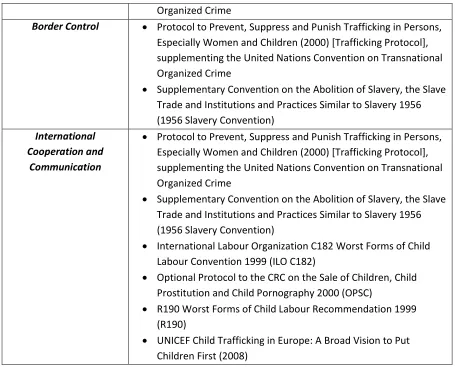
![Table 4: Summary of the Optional Protocol to the CRC on the Sale of Children, Child Prostitution and Child Pornography (2000) [OPSC]](https://thumb-us.123doks.com/thumbv2/123dok_us/8423460.330218/159.612.78.543.117.717/table-summary-optional-protocol-children-child-prostitution-pornography.webp)
![Table 5: Summary of the Optional Protocol to the CRC on the Involvement of Children in Armed Conflict (2000) [OPAC]](https://thumb-us.123doks.com/thumbv2/123dok_us/8423460.330218/160.612.79.535.70.376/table-summary-optional-protocol-involvement-children-armed-conflict.webp)
![Table 6: Summary of the ILO C182 Worst Forms of Child Labour Convention (1999) [ILO C182]](https://thumb-us.123doks.com/thumbv2/123dok_us/8423460.330218/162.612.81.535.162.712/table-summary-ilo-worst-forms-child-labour-convention.webp)
![Table 7: Summary of the R190 Worst Forms of Child Labour Recommendation (1999) [R190]](https://thumb-us.123doks.com/thumbv2/123dok_us/8423460.330218/163.612.84.535.68.485/table-summary-r-worst-forms-child-labour-recommendation.webp)
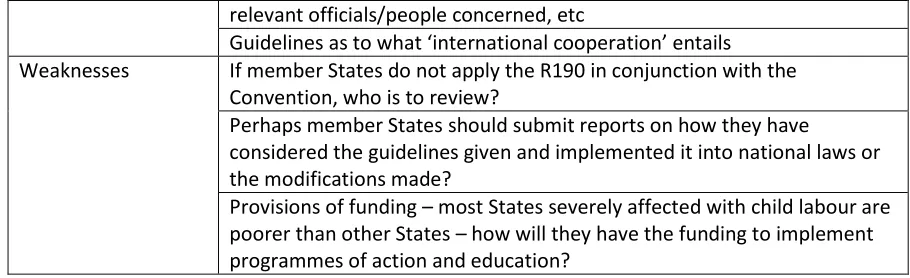
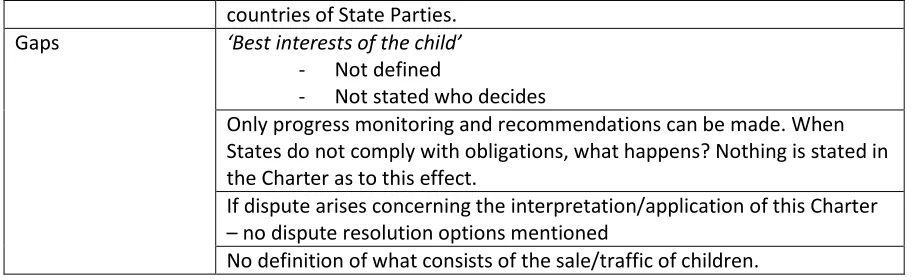
![Table 9: Summary of the African Charter on The Rights and Welfare of the Child (1990) [ACRC]](https://thumb-us.123doks.com/thumbv2/123dok_us/8423460.330218/165.612.80.534.68.532/table-summary-african-charter-rights-welfare-child-acrc.webp)