arXiv:1506.04406v3 [math.CO] 22 May 2017
A Formula for the M¨
obius function of the Permutation
Poset Based on a Topological Decomposition
Jason P Smith
Department of Computer and Information Sciences University of Strathclyde, Glasgow, UK
Abstract
We present a two term formula for the M¨obius function of intervals in the poset of all permutations, ordered by pattern containment. The first term in this formula is the number of so called normal occurrences of one permutation in another. Our definition of normal occurrences is similar to those that have appeared in several variations in the literature on the M¨obius function of this and other posets, but simpler than most of them. The second term in the formula is complicated, but we conjecture that it equals zero for a significant proportion of intervals. We present some cases where the second term vanishes and others where it is nonzero. Computing the M¨obius function recursively from its definition has exponential complexity, whereas the computation of the first term in our formula is polynomial and the exponential part is isolated to the second term, which seems to often vanish. We also present a result on the M¨obius function of posets connected by a poset fibration.
1. Introduction
Letσ andπ be permutations of positive integers. We define anoccurrence
ofσ in π to be a subsequence of π with the same relative order of size as the letters inσ. For example, 132 occurs twice in 23541, as the subsequences 254 and 354. Thepermutation poset P consists of all permutations with the partial orderσ ≤π if there is an occurrence ofσ in π. An interval [σ, π] inP is the subposet {z ∈ P |σ ≤ z ≤ π}. The M¨obius function for a poset is defined recursively as: µ(a, b) = 0 ifa6≤b,µ(a, a) = 1 for allaand, fora < b:
µ(a, b) =− X
a≤z<b
µ(a, z).
The first systematic study of the M¨obius function of general posets appeared in [10] and the first result pertaining to the M¨obius function of intervals of P
appendingπ to σ after adding the length of σ to each letter of π. For exam-ple, 312⊕213 = 312546. There is an analogous skew sum σ⊖π where π is appended to σ after the length of π is added to each element of σ. In [5] a formula for the M¨obius function is presented for intervals ofdecomposable per-mutations, that is, permutations that can be written as the direct sum of two or more non-empty permutations. This formula, however, is recursive and bottoms out in intervals bounded by indecomposable permutations, for which there is no general formula for the M¨obius function.
Furthermore, in [5] a formula is presented for intervals ofseparable tations, that is, permutations that avoid 2413 and 3142, or equivalently, permu-tations that can be written using only direct sums, skew sums and the singleton permutation 1. A formula for the M¨obius function of intervals of permutations with a fixed number of descents is given in [14], where adescent occurs at po-sitioniin a permutation π=π1. . . πn ifπi> πi+1. Further results have been
presented in [8, 13, 16]. However, the proportion of intervals [σ, π] which satisfy any of these properties approaches zero as the length ofπincreases. There are indications that the formula we present here reduces the computation of the M¨obius function to polynomial time for a significant proportion of intervals.
Many of the results on the M¨obius function of intervals ofP, and also of some posets of words, are linked to the number of what have been termednormal occurrences, or normal embeddings, in the literature, see [2, 3, 5, 11, 14]. The first appearance of normal occurrences is in Bj¨orner’s paper [2] where a formula for the M¨obius function of intervals of words with subword order is presented. The definition of a normal occurrence has varied in these papers, but all follow a similar theme.
Our definition of normal occurrences, which is simpler than most previous ones, is based upon the adjacencies of a permutation, where an adjacency in a permutation is a maximal sequence of increasing or decreasing consecutively valued letters in consecutive positions and the tail of an adjacency is all but its first letter. Anormal occurrence of σin π, in our definition, is any occur-rence that includes all the tails of all the adjacencies of π. This definition of normal occurrences based on adjacencies does not seem to have been considered previously, but in [14] we presented a slightly different version.
It is shown in [8] that ifπis decomposable and has equal consecutive com-ponents then for any subpermutation σ obtained by removing k > 1 of the equal components, the interval [σ, π] contains a disconnected subinterval. Many of the definitions of normal occurrences have an extra condition for the case whenπhas this property. We prove a result that indicates the second term of our formula for the M¨obius function is often non-zero for the slightly simpler case thatπ is decomposable and all the components are equal. Exactly what the connection is between this second term and the topology of such intervals is another mystery.
Computing the M¨obius function using the original recursive formula has exponential complexity, whereas our formula splits the computation into two parts. The first part, that is, computing the number of normal occurrences, can be done in polynomial time and the second part has exponential complexity in the general case, but computational evidence suggests that in a significant proportion of cases this second term vanishes. Our formula here is the first formula for arbitrary intervals of permutations that seems to have polynomial time complexity for a significant proportion of intervals.
In Section 2 we introduce some definitions, give a brief introduction to the topology of posets and present a poset fibration of [σ, π] that we later use to computeµ(σ, π). In Section 3 we present and prove our main result, that the M¨obius function of intervals ofP equals the number of normal occurrences plus an extra term that we define. In Section 3.1 we present a result that links the M¨obius function of two posets connected by a poset fibration satisfying a certain condition. This indicates there is possibly a more general condition for the main result of Bj¨orner, Wachs and Welker in [4]. In Section 4 we apply our formula to show that the M¨obius function of [σ, π] equals the number of normal occurrences ofσinπif for eachλ∈[σ, π) there is at least one letter ofπwhich is not in any occurrence ofλ. We also show that the value of the second term of our formula for the M¨obius function of [σ, π] is often nonzero when πcan be decomposed into the direct sum of equal components. Furthermore, we consider for which permutations all occurrences are normal.
2. Definitions and Preliminaries
In this section we introduce some definitions required to present our main re-sult. We begin with an important property of permutations that is fundamental to our results:
Definition 1. An adjacency in a permutation is a maximal sequence, of length ℓ ≥ 1, of increasing or decreasing consecutively valued letters in con-secutive order. The tailof an adjacency of length at least 2 is all but the first letter of the adjacency. An adjacency of length 1 does not have a tail.
Next we define embeddings and our version of normal embeddings. Embed-dings are in one-to-one correspondence with occurrences, and we use embedEmbed-dings instead of occurrences throughout the rest of the paper because they allow for easier presentation of the required definitions.
Definition 3. Consider permutations σ ≤ π. An embedding η of σ in π is a sequence of the same length as π such that the nonzero letters in η are the letters of an occurrence ofσinπ and in the same positions inη as in π.
An embedding η of σin π is normal if the positions of all the letters in all the tails of the adjacencies in π are nonzero in η. We denote the number of normal embeddings of σinπ asNE(σ, π).
Example 4. For σ = 132and π= 2314765 the sequence 0300065is the only normal embedding ofσ inπ, soNE(σ, π) = 1.
Proposition 5. ComputingNE(σ, π)for a fixedσ can be done in time polyno-mial in the length ofπ.
Proof. Counting the number of occurrences ofσ in π, of lengthsk and n, re-spectively, can be done in polynomial time O(nk) by exhaustive search, and
testing for normality is linear.
We use the adjacencies of a permutation to break down the permutation and embeddings into smaller components.
Definition 6. Consider permutations σ ≤ π and an embedding η of σ in π. Let πˆ = (ˆπ1, . . . ,πˆt)be the decomposition of π into its adjacencies, that is, ˆπi
is a maximal increasing or decreasing permutation corresponding to the i’th adjacency ofπ.
Define ηˆ:= (ˆη1, . . . ,ηˆt) whereηˆi is the permutation obtained from the
non-zero letters thatη embeds in thei’th adjacency ofπ. Ifη does not embed in any letters of thei’th adjacency thenηˆi=∅.
Example 7. If σ = 132 and π = 2314765 then πˆ = (12,1,1,321) and the embedding η= 0010760gives ηˆ= (∅,1,∅,21).
When considering embeddings the selection of letters within an adjacency is usually irrelevant. This is made formal by the following equivalence relation.
Definition 8. LetEσ,πbe the set of embeddings ofσinπ. Define an equivalence
relation on embeddings where η ∼ ψ if the only differences between η and ψ
occur within adjacencies ofπ. DefineEbσ,π as the set containing the rightmost
embedding, that is, the embedding where the nonzero letters are the furthest right, of each equivalence class ofEσ,π/∼.
Considerη∈Ebσ,π and define the zero set ofη asZ(η) ={i|η
i= 0}. Define
EZσ,πto be the set of sets of embeddings inEbσ,πsuch that for each setS ∈EZσ,π
When definingEbσ,π we choose the rightmost embedding to ensure that all
normal embeddings are in Ebσ,π. Note that ifη ∼ψ then ˆη = ˆψ, which can be
used as an equivalent definition of the equivalence relation. The set EZσ,π is upwards closed under containment because if we take any setS∈EZσ,π adding a new embedding toS will result in a set that still has empty intersection of zero sets.
Example 9. If σ= 132 and π= 413265then the embedding 013200 has zero setZ(013200) ={1,5,6} and
Eσ,π ={013200,400065,010065,003065,000265},
b
Eσ,π ={013200,400065,010065,000265},
EZσ,π ={{013200,400065},{013200,400065,010065},
{013200,400065,000265},{013200,400065,010065,000265}}.
Using our decomposition we build posets from embeddings in the follow-ing way:
Definition 10. Given an embeddingη∈Eσ,π define the posetP(η) := [ˆη1,ˆπ1]×
· · · ×[ˆηt,πˆt]and
Aσ,π := [ η∈Ebσ,π
P(η)o,
whereP(η)odenotes the interior ofP(η), that is,P(η)with the top and bottom
elements removed.
Example 11. Consider[132,413265]and letη1, η2, η3andη4be the embeddings listed in Ebσ,π in Example 9. Then πˆ = (1,1,21,21) and η1ˆ = (∅,1,21,∅),
ˆ
η2= (1,∅,∅,21),η3ˆ = (∅,1,∅,21)andη4ˆ = (∅,∅,1,21). See Figure 1 for P(ηi)
andA132,413265.
The poset Aσ,π consists of the elements ˆη for all η ∈ Ebλ,π and all λ ∈
(σ, π). Therefore, we define a surjective poset mapf fromAσ,π to (σ, π) in the
following way:
Definition 12. Let f : Aσ,π →(σ, π) be the map which maps all elements ηˆ,
whereη∈Ebλ,π, toλ.
Example 13. If [132,413265]and ηˆ= (1,∅,1,21)thenη = 400265∈Eb2143,π,
sof(ˆη) = 2143.
2.1. The Topology of a Poset
We study the topology of a poset by constructing a simplicial complex from the poset in the following way:
Definition 14. Let P be a poset. A chain in P is a totally ordered subset {z1 < · · · < zt}. The order complex of P, denoted ∆(P), is the simplicial
(∅,1,21,∅)
(1,1,21,∅) (∅,1,21,1) (1,1,21,1) (∅,1,21,21)
(1,1,21,21)
P(013200) = [∅,1]×[1,1]×[21,21]×[∅,21]
(1,∅,∅,21)
(1,1,∅,21) (1,∅,1,21) (1,1,1,21) (1,∅,21,21)
(1,1,21,21)
P(400065) = [1,1]×[∅,1]×[∅,21]×[21,21]
(∅,1,∅,21)
(1,1,∅,21) (∅,1,1,21) (1,1,1,21) (∅,1,21,21)
(1,1,21,21)
P(010065) = [∅,1]×[1,1]×[∅,21]×[21,21]
(∅,∅,1,21)
(1,∅,1,21) (∅,1,1,21) (∅,∅,21,21)
(1,1,1,21)
(1,∅,21,21) (∅,1,21,21) (1,1,21,21)
P(000265) = [∅,1]×[∅,1]×[1,21]×[21,21]
(∅,1,21,21) (1,1,1,21) (1,∅,21,21) (1,1,21,1)
(∅,1,1,21) (∅,∅,21,21) (1,1,∅,21) (∅,1,21,1) (1,∅,1,21) (1,1,21,∅)
[image:6.612.150.476.349.454.2]A132,413265
When we refer to the order complex of an interval [σ, π] we mean the order complex of the interior (σ, π), which we denote ∆(σ, π).
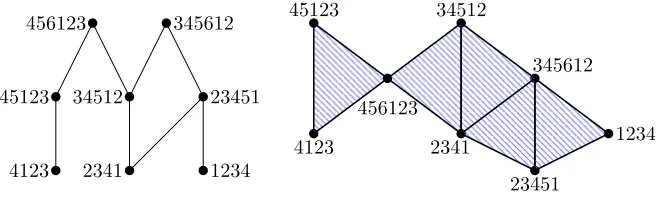
Example 15. Consider the intervalI= [123,4567123]. An example of a chain in(123,4567123)is4123<456123. The order complex and Hasse diagram ofI
are given in Figure 2.
We refer to a poset and its order complex interchangeably, so a topological property of a poset refers to that property of its order complex. For further background on order complexes and poset topology in general see [17].
We can use the order complex of [σ, π] to calculate µ(σ, π) due to the fol-lowing formula, which is an application of the Philip Hall Theorem and the Euler-Poincar´e formula for the reduced Euler characteristic, see [17, Section 1.2]:
µ(σ, π) = ˜χ(∆(σ, π)) =
|πX|−|σ|
i=−1
(−1)iβ˜i(∆(σ, π)), (1)
where ˜χ is the reduced Euler characteristic and ˜βi is the i’th reduced Betti
number, that is, the rank of thei’th reduced homology group. Therefore, by calculating the homology of [σ, π] we can compute the M¨obius function. For example, if we can show that ∆(σ, π) is contractible this implies µ(σ, π) = 0, and if ∆(σ, π) and ∆(α, β) are homotopically equivalent thenµ(σ, π) =µ(α, β). The first explicit results on the topology of intervals of permutations appear in [8] and [13].
4123 2341 1234
45123 34512 23451
456123 345612
4123 45123
456123
34512
2341
345612
23451
[image:7.612.142.474.425.525.2]1234
Figure 2: Left: Hasse diagram of (123,4567123). Right: The order complex ∆(123,4567123).
3. The Main Result
We use the mapf in Definition 12 to calculate the M¨obius function of [σ, π] by calculatingµ(Aσ,π) and the effect on the M¨obius function when applyingf.
First we computeµ(Aσ,π). Given a setA of posets the M¨obius function of the
Euler characteristic and Equation (1):
µ [
a∈A
a
!
= X
S⊆A S6=∅
(−1)|S|−1µ \
a∈S
a
!
, (2)
For more background on this see [9]. Applying Equation (2) toAσ,π gives:
µ(Aσ,π) = X S⊆Ebσ,π
S6=∅
(−1)|S|−1µ(\
η∈S
P(η)o). (3)
To calculate this we need to know the M¨obius function of the intersections
∩η∈SP(η)o. Note that when calculating the M¨obius function of a poset we add a
top and bottom element. Therefore, a contractible intersection has M¨obius func-tion 0, an empty intersecfunc-tion has M¨obius function−1 andµ(P(η)o) = µ(ˆη,π).ˆ
Lemma 16. If S⊆Ebσ,π and|S|>1then:
µ(\
η∈S
P(η)o) =
(
−1, ifS∈EZσ,π
0, otherwise .
Proof. Let ˆπ= (ˆπ1, . . . ,πˆt) and define thejoin ofS to be ∨S= (maxη∈S(ˆη1),
. . . ,maxη∈S(ˆηt)). The join is well defined because for eachithe set{ηˆi|η ∈S}
forms a chain, so there is an ˆηi that contains all others. The join of S is the
smallest element containing every embedding inS, so it is the bottom element of the intersectionI=Tη∈SP(η)o. Therefore, if ∨S <ˆπthenIis contractible
and so has M¨obius function 0, otherwise ∨S = ˆπ so I is empty and thus has M¨obius function−1. If ∨S = ˆπ this implies that every letter ofπ is non-zero for someη∈S, that is,Shas empty intersection of zero sets, soS∈EZσ,π.
Example 17. Consider our running example of[132,413265]. IfS1={013200, 010065}then 013200decomposes to(∅,1,21,∅)and010065decomposes to
(∅,1,∅,21), so the join is:
∨S1= (max(∅,∅),max(1,1),max(21,∅),max(∅,21)) = (∅,1,21,21).
Therefore, ∨S1 < πˆ so the intersection is contractible. We can check this by
looking at Figure 1 where we can see that the intersectionP(013200)∩P(010065)
is the single point(∅,1,21,21), which is contractible.
The following sum over EZσ,π plays in important role in our results:
EZ(σ, π) := X
S∈EZσ,π
(−1)|S|.
Lemma 18.
µ(Aσ,π) = (−1)|π|−|σ|NE(σ, π) + EZ(σ, π).
Proof. We can split Equation (3) into two parts:
µ(Aσ,π) = X
η∈Ebσ,π
µ(P(η)o) + X
S⊆Ebσ,π |S|>1
(−1)|S|−1µ(\
η∈S
P(η)o). (4)
By Lemma 16 the second part of the right hand side of Equation (4) equals EZ(σ, π).
By the definition ofP(η), and the identityµ(A×B) =µ(A)µ(B), we know
µ(P(η)o) = Y
1≤i≤t
µ(ˆηi,πˆi).
We know that [ˆηi,πˆi] is always a chain, so by the definition of normality ifη is
not normal there is someisuch that|ηˆi| ≤ |πˆi|−2, soµ(ˆηi,ˆπi) = 0, which implies
µ(P(η)o) = 0. Ifη is normal then|πˆ
i| − |ηˆi|= 0 or 1, soµ(ˆηi,πˆi) = 1 or−1, for
alli. There are|π| − |σ|parts [ˆηi,ˆπi] withµ(ˆηi,πˆi) =−1, one for each zero inη,
and the remaining have µ(ˆηi,πˆi) = 1. Therefore, µ(P(η)o) = (−1)|π|−|σ| for
each normal embedding, so the first term in the right hand side of Equation (4) equals (−1)|π|−|σ|NE(σ, π).
We now present our formula for the M¨obius function that applies to any interval of permutations:
Theorem 19. For any permutationsσ andπ:
µ(σ, π) = (−1)|π|−|σ|NE(σ, π) + X
λ∈[σ,π)
µ(σ, λ) EZ(λ, π).
Proof. We take the posetAσ,πand for eachλ∈(σ, π) we retractEbλ,πto a point
we denoteλ. This transformsAσ,π into the interval (σ, π). We need to know
what effect this has on the M¨obius function ofAσ,π.
We work our way from the bottom to the top so we can assume that all elements below the elements of Ebλ,π have already been retracted and all
ele-ments above have not. Define the poset W(λ) := {τ ∈ Aσ,π|τ ≤ η orτ ≥
η for someη ∈ Ebλ,π}. When we retract the elements of Ebλ,π to λ we
re-tractW(λ) onto a contractible poset, since in that poset the elementλis compa-rable to all other elements and thus represents a cone point in the corresponding order complex. This implies the change to the M¨obius function is−µ(W(λ)).
To computeµ(W(λ)) we splitW(λ) into two disjoint parts
W(λ)<:={τ∈W(λ)|τ < ηfor someη∈Ebλ,π},
The posetW(λ)<is isomorphic to (σ, λ) because all points belowλhave already
been retracted. The posetW(λ)≥is equal toS
η∈Ebλ,π(P(η)\π) whose atoms areˆ b
Eλ,π, so by the Crosscut Theorem, see Proposition 29, the M¨obius function is
given byµ(W(λ)≥) = EZ(λ, π) (this also follows by inclusion-exclusion formula
and Lemma 16).
Because every element of Ebλ,π lies above every element of (σ, λ) this
implies W(λ) = W(λ)< ⋆ W(λ)≥, where ⋆ denotes the topological join,
soµ(W(λ)) =−µ(W(λ)<)⋆ µ(W(λ)≥) by [7, Theorem 10.23(2)]. Therefore,
−µ(W(λ)) =µ(σ, λ) EZ(λ, π).
So we start withµ(Aσ,π), given by Lemma 18, and then subtractµ(W(λ)) for
eachλ∈(σ, π), which gives the desired formula.
Remark 20. Computer tests1 indicate that 95% of intervals [σ, π], where
|π| < 9, satisfy µ(σ, π) = (−1)|π|−|σ|NE(σ, π). Thus, for these intervals the latter term in Equation (19)is zero.
Remark 21. The complexity of counting the number of normal embeddings is polynomial so in the cases where we can show that the latter term of Equa-tion(19)equals zero we have a polynomial time formula for the M¨obius function. This is a dramatic improvement over the original recursive formula that has ex-ponential complexity. However, computing the latter term of Equation (19)also has exponential complexity.
Tests show that using Equation (19) is often much quicker than computing the M¨obius function using the recursive formula. When computing the M¨obius function of the rank 15 interval
[54123,9 7 10 4 8 1 2 6 5 3 19 17 20 14 18 11 12 16 15 13],
the formula in Equation (19) took 1.75 minutes and the recursive formula took 13.5 hours. Note that this interval has M¨obius function −3 but no normal embeddings so the latter term of Equation (19) is nonzero in this case. Fur-thermore, using Equation (19) we were able to compute the M¨obius function of a rank 16 interval in 1 hour and a rank 17 interval in 6 hours. However, ifσ has a large number of occurrences inπthen using Equation (19) can be quite slow. For example, if σ = 2413 and π = 2 4 6 8 10 1 3 5 7 9 then there are 35 occurrences of σ in π and µ(σ, π) can be computed in 0.06 seconds using the recursive formula but takes 15.5 hours using Equation (19).
3.1. Poset Fibration
In this subsection we present a generalisation of the argument used to prove Theorem 19. We can view the pair ((σ, π),{Ebλ,π}
λ∈(σ,π)) as a poset fibration
1
which makesf the projection map andAσ,πthe total space. In [4] various
theo-rems are presented which relate two posetsPandQlinked by a poset fibrationf satisfying a certain condition, see Theorem 2.5 of [4] for the most general form of this condition. However, our poset fibration does not always satisfy this con-dition, for example the condition is not true on the interval [1,456123]. We present a result with a different condition on the poset fibration that generalises the argument in the proof of Theorem 19, this result can be seen as an applica-tion of [18, Corollary 3.2]. We letf∗ and f−1 denote the image and preimage off, respectively.
Proposition 22. Let f:P →Qbe a surjective poset map such thatf∗(P<p) =
Q<q, for any q∈Q andp∈f−1(q). Then
µ(Q) =µ(P) +X
q∈Q
µ(Q<q)µ(f−1(Q≥q)).
Proof. We begin withP and for eachq∈Qwe retractf−1(q) to a single point and observe the effect this retraction has on the M¨obius function of P. We do this inductively from the bottom to the top, so when consideringq∈Qwe assume all points inP<p, for allp∈f−1(q), have been retracted.
To calculate the effect the retraction has on the M¨obius function of the poset we consider
W(q) :={p∈P|p < λ orp≥λfor someλ∈f−1(q)}.
When we retractf−1(q) to a point we retractW(q) to a contractible poset, which implies the change to the M¨obius function is−µ(W(q)). We can rewriteW(q) in the following way:
W(q) = [
p∈f−1(q)
P<p⋆ P≥p=
[
p∈f−1(q)
Q<q⋆ P≥p
=Q<q⋆
[
p∈f−1(q)
P≥p=Q<q⋆ f−1(Q≥q).
We can replaceP<pwithQ<qbecause our induction assumption is thatP<phas
been retracted and our condition of the proposition isf∗(P
<p) =Q<q.
There-fore,−µ(W(q)) =µ(Q<q)µ(f−1(Q≥q)) and summing over allq∈Qcompletes
the proof.
Remark 23. An interesting question is whether Proposition 22 can be gener-alised to show homotopy equivalence. Also, is there a more general condition that encompasses the conditions of both Proposition 22 and Theorem 2.5 of [4]?
4. Applications
Lemma 24. The average total number of letters in the tails of adjacencies in a permutation of lengthnis2(n−1
n ). In particular, whenntends to infinity the
average number of letters in the tails of adjacencies tends to 2.
Proof. Note first thatk = 1 cannot be in the tail of an increasing adjacency and ncannot be in the tail of a decreasing adjacency. For k > 1 the number of permutations of lengthnin whichk is in the tail of an increasing adjacency is (n−1)!, because these are precisely all permutations of the letters 1,2, . . . , n where (k−1)k is regarded as a single letter. So the probability that a letter k >1 is in the tail of an increasing adjacency is (n−1)!/n! = 1/n. Likewise, the probability that a letterk < nis in the tail of a decreasing adjacency is 1/n. Therefore, the probability thatkis in the tail of an adjacency is
(
1
n, ifk= 1 orn
2
n, otherwise
.
Summing over all lettersk= 1, . . . , ncompletes the proof.
An embedding in a permutationπis likely to be normal if there is only a small proportion of letters in the tails of the adjacencies ofπ. Therefore, Lemma 24 indicates that the proportion of embeddings of λ in a random permutation π that are normal increases as the length ofπincreases. If a permutation has no adjacencies of size ℓ > 1 then all embeddings will be normal, the proportion of such permutations tends to 1/e2 as the length of the permutations increase, see [12].
By Remark 20 we suspect that the second part of Equation (19) vanishes for a significant proportion of intervals. A consequence of Proposition 3.3 in [14] is that if σ and π have the same number of descents then the second part of Equation (19) vanishes. Note that although the definition of normal embeddings in [14] does not consider decreasing adjacencies, it is equivalent to Definition 3 when the number of descents is fixed. To see this note that ifσandπhave the same number of descents then any letters inπthat form a decreasing adjacency, and thus a descent, must be nonzero in all embeddings otherwise that descent would not be in σ, contradicting the assumption thatσ and π have the same number of descents.
One route to simplifying Equation (19) is answering the following question:
Question 25.Given an interval[σ, π], for whichλ∈[σ, π)isEZ(λ, π)nonzero?
One case where EZ(λ, π) = 0 is when EZλ,π = ∅, which leads us to the following definition and proposition. Our notation here follows from the idea of interval blocks in [16].
Definition 26.We say an interval[σ, π]has a single blockif there exists somei
such that ηi = 0 for any η ∈ Ebσ,π. That is, there is a letter in π that is not
contained in any of the occurrences inEbσ,π.
Proposition 27. If [σ, π]is single then µ(σ, π) = (−1)|π|−|σ|NE(σ, π).
Proof. If [λ, π] has a single block then EZλ,π must be empty which implies EZ(λ, π) = 0. Therefore, if [σ, π] is single then EZ(λ, π) = 0 for allλ∈[σ, π), combining this with Equation (19) completes the proof.
Intervals that contain a disconnected subinterval of rank at least 3 are non-shellable, as shown by Bj¨orner in [1], and thus not amenable to some of the elegant methods of topological combinatorics, see [8] for further background. In the rest of the paper we consider a particular type of interval [α, β] that is known to be disconnected and show that EZ(α, β) is nonzero for these intervals. Whether there is a topological “reason” for EZ(α, β) being nonzero in these cases we don’t know.
We consider decomposable permutations and write them in the form π1 ⊕ · · · ⊕πn where each πi, which we call a component of π, is
indecom-posable. Consider a permutation π = π1⊕ · · · ⊕πℓ, where πi = π1 for any
i ∈ {1, . . . , ℓ}, and λ ≤ π obtained from π by removing k of the components from this sequence, whereℓ > k≥1. The interval [λ, π] is disconnected, which follows from Lemma 4.2 in [8]. Intervals of this form are the cause of the extra conditions in the formulas for the M¨obius function that appear in [5] and [8].
Definition 28. Given an indecomposable permutation λlet
λn:=λ⊕ · · · ⊕λ
| {z }
×n
.
Before we continue let us introduce a very useful result for computing the M¨obius function of lattices known as the Crosscut Theorem. We denote the join ofA⊆X as ∨A:= min{x∈X|x≥afor alla∈A}:
Proposition 29. (Crosscut Theorem, see [15, Corollary 3.9.4]) LetLbe a finite lattice with top element ˆ1 and bottom element ˆ0. LetX be a subset ofL such thatˆ06∈X and for alls∈L,s= ˆ6 0, there is somet∈X such thats≥t. Then
µ(ˆ0,ˆ1) = X
A⊆X
∨A=ˆ1
(−1)|A|.
The Crosscut theorem is traditionally used to compute the M¨obius function of a lattice, but we can use it in reverse if we can represent our problem as a lattice for which we already know the M¨obius function.
Consider the interval [λm, λn], for some indecomposable permutationλ, the
embeddings of λm in λn can be considered as subsets of [n] := {1, . . . , n} of
sizem. So we can regard our problem as that of computing the M¨obius function of a sublattice of the Boolean lattice:
Definition 30. The Boolean lattice Bn is the poset of subsets of [n] with the
Define the truncated Boolean lattice B≥k
n as the subposet of Bn where all
elements a∈Bn such that|a|< k are retracted to a single point ˆ0. Similarly,
define B≤k
n as the subposet of Bn where all elementsa∈Bn such that|a|> k
are retracted to a single pointˆ1.
1234
123 124 134 234
12 13 23 14 24 34
ˆ 0
ˆ 1
1 2 3 4
[image:14.612.145.470.196.308.2]∅
Figure 3: The truncated Boolean latticesB≥42 andB ≤1 4 .
We take the notation for a truncated Boolean lattice from [17, Section 3.2.1]. See Figure 3 for examples of truncated Boolean lattices. The embeddings ofλm
in λn can be viewed as the atoms of the truncated Boolean lattice B≥m n , so
using the Crosscut theorem we can compute EZ(λm, λn) by computingµ(B≥m n ).
The M¨obius function of a Boolean lattice is given byµ(Bn) = (−1)n, see [10,
Section 3]. We can use this to compute the M¨obius function of the truncated Boolean lattice.
Lemma 31. The M¨obius function of a truncated Boolean lattice is given by:
µ(B≤k
n ) = (−1)k−
1
n−1 k
and µ(B≥k
n ) = (−1)n−k−
1
n−1 k−1
.
Proof. First consider B≤k
n . For each element λ ∈ Bn≤k, with |λ| = ℓ, the
in-terval [∅, λ] is isomorphic to the boolean lattice Bℓ, thereforeµ(∅, λ) = (−1)ℓ.
There are n ℓ
elements inB≤k
n with sizeℓ, for 0≤ℓ≤k. To computeµ(Bn≤k)
we need to sum all elements and negate, we do this by summing overℓ. We can then apply an identity on the alternating sum of binomial coefficients, a proof of which can be found in Section 0 of [6], this gives:
µ(Bn≤k) =− k
X
ℓ=0 (−1)ℓ
n ℓ
= (−1)k−1
n−1 k
.
Note that the latticeB≥k
n is isomorphic to (Bn≤n−k)∗, the dual ofB≤nn−k, that is,
the lattice with the partial order reversed. Therefore,µ(B≥k
n ) =µ((B≤nn−k)∗) =
µ(B≤n−k
n ) which completes the proof.
Proposition 32. Let λbe an indecomposable permutation, of lengthℓ >1, and consider the interval[λm, λn]. Then:
EZ(λm, λn) = (−1)n−m−1
n−1 m−1
.
Proof. We can consider each embedding ofλminλn as a subseta⊆ {1, . . . , n}
with|a| =m. Therefore, the embeddings correspond to the atoms of the lat-ticeB≥m
n . So we can apply the Crosscut theorem and Lemma 31 to complete
the proof.
Finally, we present two results showing that, in certain cases, we can prepend or append components to both permutationsσandπwithout changing the value of EZ(σ, π). This allows us to begin with an interval for which we know the value of EZ(σ, π) and build up to larger intervals.
Proposition 33. Consider a pair of indecomposable permutationsαandλsuch that[α, λ] is single. Then:
EZ(α⊕λm, α⊕λn) = EZ(λm, λn) = EZ(λm⊕α, λn⊕α).
Proof. First we show that EZ(α⊕λm, α⊕λn) = EZ(λm, λn). Let σ = λm,
π=λn, ¯σ=α⊕σand ¯π=α⊕π. Furthermore, let π
i be thei’th copy of λ
inπ. Similarly define σi, ¯σi and ¯πi and let ¯π0= ¯σ0=α.
Given an embeddingφofσinπ, letr(φ) be the index of the first component ofπthatφembeds in, minus 1. Each embeddingφofσinπcan be extended to an embedding of ¯σin ¯πby choosing where to embed ¯λ0in ¯π. We can embed ¯λ0 in ¯π0or in eachπiinw:=|Eˆα,λ|different ways, for all 0< i≤r(φ). Therefore,
there are 1 +r(φ)wways to extendφ.
We can extend a set S ∈ EZσ,π to a set ¯S ∈ EZ¯σ,¯π by extending each embeddingφ∈S. In fact we can extend each φmultiple times to create ¯S by adding new copies ofφextended in different ways. Note that becauseS ∈EZσ,π every letter is nonzero for at least one embedding ofS. So there exists at least one embeddingη∈S withr(η) = 0. Therefore, the only way to extendη is to embed ¯σ0in ¯π0, which implies that any extension ofS is in EZσ,¯π¯.
We claim that every set of EZσ,¯¯πcan be obtained by extending a set of EZσ,π. Suppose for a contradiction thatS∈EZσ,¯π¯ cannot be obtained by extending a set of EZσ,π. This implies that there is a ¯πi, withi >0, which is not embedded
in byλfor any embedding in S. Moreover, because [α, λ] is single, ifλis not embedded in ¯πi, then there is a letter of ¯πi that is zero for all embeddings inS.
This impliesS 6∈EZσ,¯π¯, which gives a contradiction.
So we can compute EZ(¯σ,π) by considering each set¯ S ∈ EZσ,π and how
EZ(¯σ,π) =¯ X
S∈EZσ,π
(−1)|S|Y
φ∈S
1+r(φ)w
X
k=1
(−1)k−1
1 +r(φ)w k
. (5)
The sum overkon the right hand side of Equation (5) equals 1, so the result follows immediately.
The proof is analogous to show that EZ(λm, λn) = EZ(λm⊕α, λn⊕α).
Proposition 34. Consider a permutationπand a permutationα=α1⊕ · · · ⊕
αa. If αa6≤π, then:
EZ(α⊕λ, α⊕π) = EZ(λ, π).
Proof. In any embedding of α⊕λin α⊕πwe must embed αa in αa.
There-fore, α must embed in α. This implies that the embedding set of α⊕ λ in α⊕π can be obtained by prepending α to each embedding of λ in π. Furthermore, these embeddings sets have the same zero sets, which implies EZ(α⊕λ, α⊕π) = EZ(λ, π).
We know that if [α, λ] is single, then EZ(α, λ) = 0. Therefore, the following conjecture is a generalisation of Proposition 33.
Conjecture 35. Consider a pair of indecomposable permutationsαandλsuch thatEZ(α, λ) = 0. Then:
EZ(α⊕λm, α⊕λn) = EZ(λm, λn).
Acknowledgements
I would like to thank the anonymous referees for their extremely useful com-ments and corrections which greatly improved the paper.
[1] Bj¨orner, A., 1980. Shellable and Cohen-Macaulay partially ordered sets. Transactions of the American Mathematical Society 260 (1), 159–183.
[2] Bj¨orner, A., 1990. The M¨obius function of subword order. Institute for Mathematics and its Applications 19, 118.
[3] Bj¨orner, A., 1993. The M¨obius function of factor order. Theoretical Com-puter Science 117 (1), 91–98.
[4] Bj¨orner, A., Wachs, M., Welker, V., 2005. Poset fiber theorems. Transac-tions of the American Mathematical Society 357 (5), 1877–1899.
[5] Burstein, A., Jel´ınek, V., Jel´ınkov´a, E., Steingr´ımsson, E., 2011. The M¨obius function of separable and decomposable permutations. Journal of Combinatorial Theory. Series A 118 (8), 2346–2364.
[7] Kozlov, D., 2008. Combinatorial Algebraic Topology. Algorithms and Com-putation in Mathematics. Springer.
[8] McNamara, P. R. W., Steingr´ımsson, E., 2015. On the topology of the permutation pattern poset. Journal of Combinatorial Theory, Series A 134, 1–35.
[9] Narushima, H., 1974. Principle of inclusion-exclusion on semilattices. Jour-nal of Combinatorial Theory, Series A 17 (2), 196–203.
[10] Rota, G.-C., 1964. On the foundations of combinatorial theory I. Theory of M¨obius functions. Probability Theory and Related Fields 2 (4), 340–368.
[11] Sagan, B. E., Vatter, V., 2006. The M¨obius function of a composition poset. Journal of Algebraic Combinatorics 24 (2), 117–136.
[12] Sloane, N. J. A., 1991. The On-Line Encyclopedia of Integer Sequences. Published electronically at http://oeis.org, sequence A002464.
[13] Smith, J. P., 2014. On the M¨obius function of permutations with one de-scent. The Electronic Journal of Combinatorics 21, 2.11.
[14] Smith, J. P., 2016. Intervals of permutations with a fixed number of descents are shellable. Discrete Mathematics 339 (1), 118 – 126.
[15] Stanley, R. P., 2012. Enumerative Combinatorics. Vol. 1, 2nd Edition. Cam-bridge Studies in Advanced Mathematics. CamCam-bridge University Press.
[16] Steingr´ımsson, E., Tenner, B. E., 2010. The M¨obius function of the permu-tation pattern poset. Journal of Combinatorics 1 (1), 39–52.
[17] Wachs, M. L., 2007. Poset topology: Tools and applications. In: Geometric Combinatorics. Vol. 13 of IAS/Park City Math. Ser. Amer. Math. Soc., pp. 497–615.
[18] Walker, J. W., 1981. Homotopy type and Euler characteristic of partially ordered sets. European Journal of Combinatorics 2 (4), 373–384.