City, University of London Institutional Repository
Citation
:
Kloos, Reinhold (2013). ACTAS: Adaptive Composition and Trading with Agentsfor Services. (Unpublished Doctoral thesis, City University London)
This is the unspecified version of the paper.
This version of the publication may differ from the final published
version.
Permanent repository link:
http://openaccess.city.ac.uk/2722/Link to published version
:
Copyright and reuse:
City Research Online aims to make research
outputs of City, University of London available to a wider audience.
Copyright and Moral Rights remain with the author(s) and/or copyright
holders. URLs from City Research Online may be freely distributed and
linked to.
-ACTAS-
ADAPTIVE COMPOSITION AND
TRADING WITH AGENTS FOR SERVICES
SUBMISSION FOR DOCTOR OF PHILOSOPHY
by
Reinhold Kloos
Diplom-Informatiker
E-Mail: [email protected]
April 2013
Supervisor: Prof. Dr. Rainer Unland, University of Duisburg-Essen Assistant Dean: Dr. Peter W.H. Smith, City University London Department of Computing
School of Informatics City University London
Institute for Computer Science and Business Information Systems
CONTENT
Content... iii
Figures ... vi
Tables ... viii
Abbreviations...xii
ACTAS Abbreviations ...xiii
Introduction ... 1
1 Motivation ...1
1.1 The challenges of Service-Oriented Computing (SOC) ... 2
1.2 Introduction of ACTAS ... 4
1.3 Structure of the thesis... 6
State of the Art ... 7
2 Service-Oriented Computing...7
2.1 Service ... 7
2.2 Electronic Service and Web Service ... 10
2.3 Aspects of services ... 11
2.3.1 1st aspect of services: Different views on a service... 12
2.3.2 2nd aspect of services: non-functional attributes ... 12
2.3.3 3rd aspect of services: The inherent complexity ... 13
2.3.4 4th aspect of services: The extended life cycle of services... 13
2.4 Summary... 16
3 The integration challenge ... 18
3.1 Motivation and Evolution of DIS middleware ... 19
3.2 Delimitation of Software Paradigms... 21
3.3 Web Service standards... 24
3.4 Service Composition and Service Coordination... 27
3.5 Web Service Composition (WSC)... 31
3.6 Cloud Computing- offering computing resources as service... 33
3.7 Summary... 35
4 The semantic challenge ... 36
4.1 Ontology ... 36
4.2 Capability Descriptions with DL ... 39
4.3 Capability description in SWS ... 42
4.4 Predominant Discovery Approaches in SWS ... 43
4.4.1 OWL-S (formerly DAML-S) ... 44
4.4.2 Semantic Web Services Framework (SWSF) ... 45
4.4.3 Web Service Modelling Ontology (WSMO) ... 46
4.4.4 SAWSDL (formerly WSDL-S) ... 47
4.4.5 Selected Approaches of SWS ... 48
4.5 Summary... 49
5 Autonomic Service-Oriented Computing ... 50
5.1 Improvements of Service Discovery and Composition... 53
5.2 Semantic Web Services Execution Frameworks ... 55
5.2.1 METEOR-S ... 55
5.2.3 SESA ... 56
5.3 Agents and Web Services... 57
5.4 Artificial Intelligence (AI) in SOC ... 58
5.5 Enhancements through new concepts and algorithms ... 59
5.6 Summary... 60
6 Problem Statement ... 60
ACTAS – Adaptive Composition... 61
7 Hypothesis of ACTAS ... 61
8 System Environment ... 63
8.1 Phase 1 – Composition Model and Service Description... 67
8.2 Phase 2 – Service Availability and Trading... 69
8.3 Phase 3 – Service Request and Composition ... 69
8.4 Phase 4 – Checking constraints ... 71
8.5 Phase 5 – Grounding and Schedule of the Services ... 72
8.6 Phase 6 – Service Execution and Feedback ... 73
ACTAS - Service Model (S-Model)... 75
9 Introduction to Service Model (S-Model) ... 75
9.1 S-Model: Semantic Characteristics ... 80
9.2 S-Model: Property Classes ... 85
10 Service Description... 88
10.1 Service Templates (ST) and SOER ... 89
10.2 The Environment Declaration ... 93
10.3 Description of compatibility ... 96
10.4 Constraints in the Service Description ... 99
10.4.1 Value Constraints ...100
10.4.2 Merge Constraints ...101
10.4.3 Exchange Constraints ...105
ACTAS - Request Model (R-Model)... 109
11 Request Model (R-Model)... 109
11.1 Service Request (SRe) ...112
11.2 Trading Request (TRe) ...114
11.3 The environment description of the R-Model ...114
ACTAS - Composition Model (C-Model) ... 117
12 Introduction to Composition Model (C-Model) ... 117
13 C-Model: The Composition Process ... 120
13.1 The Proper ty Objects/Classes in the C-Model ...121
13.2 Step 1 : Getting Information ...127
13.2.1 Service Offer ...129
13.2.2 Actor Service Offer (ASO) ...130
13.3 Step2 : Initialisation of the Composite Structure ...132
13.3.1 The Composite (Service) Structure (CompSt) ...133
13.3.2 Working with the Extended Composite (Service) Structure (CompSt-plus)...135
13.3.3 Initialisation of CompSt-plus and Selection of a Service Mode ...137
13.3.4 Value Constraints ...142
13.4 Step 3 : Service Discovery and Principal Compatibility ...144
13.5 Step 4 : Checking of Merge Constraints ...155
13.6 Step 5 : Checking of Exchange Constraints ...158
13.6.1 The access of information for the Exchange Constraint ...159
13.6.2 A closer look at the application of an Exchange Constraint...162
Evaluation ... 169
14 ACTAS ... 169
14.1 Environment of ACTAS ...173
14.2 Service Design - “Building Blocks” of ACTAS ...175
14.2.1 Simple Semantic Characteristics ...178
14.2.2 Extended usability of Semantic Characteristics...180
14.3 Service Request ...182
14.4 Composition Process ...184
15 Case Study 1: Technical Services with translation ... 191
15.1 The ACTAS Administrator ...192
15.2 Translation Offer ...194
16 Case Study 2: Distribute Feature Composition (DFC) ... 198
17 Case Study 3: Supply Chain, B2B Integration ... 208
17.1 Offering the local solution in ACTAS ...210
18 Case Study 4: Weather Forecast Scenario ... 211
19 Case Study 5: Interpretation of Smart Grid as SOC ... 214
19.1 SOC for a smart grid...216
19.2 ACTAS for an enhanced service environment ...220
19.3 Semantic Characteristics for smart grid scenarios ...223
19.4 Service Descriptions for smart grid scenarios ...227
19.5 Application of the Service Descriptions and Requests ...229
20 Limitations of ACTAS ... 233
21 Summary of evaluation ... 236
Conclusion ... 239
22 Conclusion and Future Research ... 239
Appendix ... 249
A Collection of used ontologies and ACTAS Entities ... 249
A-1 Used Ontologies ...249
A-2 ACTAS entities...250
A-2.1 Descriptions of used General Characteristics (GCh) ...250
A-2.2 Descriptions of used Compatibility Characteristics (CCh and RCh) ...251
A-2.3 Property Classes ...253
A-3 Formal definitions of Semantic Characteristics ...256
A-3.1 General Characteristics ...257
A-3.2 Compatibility Characteristics ...258
A-3.3 Compatibility Characteristics for Service Requests – Request Characteristics ...259
B NFP-Ontologies ... 261
B-1 NFP-Ontology for availability ...262
B-2 NFP-Ontology for provider ...263
B-3 NFP-Ontology for location (locative) ...264
B-4 NFP-Ontology for discount ...273
Bibliography ... 275
Definitions ... 299
Examples ... 300
FIGURES
Fig. 1 - Communication Service ... 10
Fig. 2 - Phases of the extended life cycle of e-services... 15
Fig. 3 - SOA ... 18
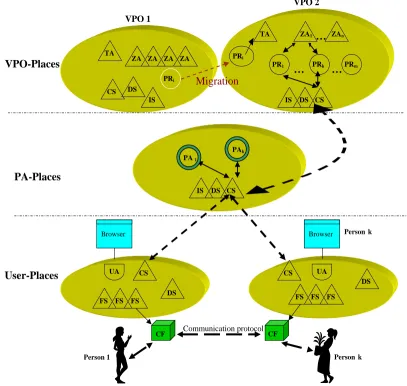
Fig. 4 - VPO with Working Zones ... 20
Fig. 5 - Agent Definition ... 22
Fig. 6 - Development of Software Paradigm... 22
Fig. 7 - Principal Multi-Agent-System of VPO environment ... 23
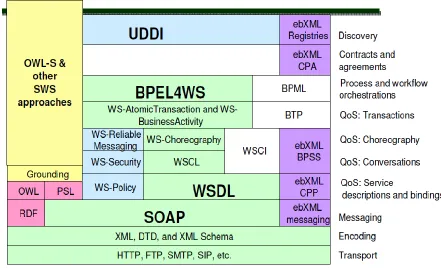
Fig. 8 - Web Service and ebXML standards ... 25
Fig. 9 - Horizontal and vertical protocols (adapted from [AloCas et al.2004]) ... 26
Fig. 10 - Business Service ... 29
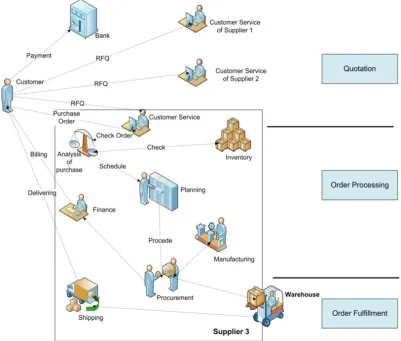
Fig. 11 - Supply Chain (typical EAI application) ... 29
Fig. 12 - Business Process Tools [Bar2010 p. 18] ... 30
Fig. 13 - Service Models of Cloud Computing ... 33
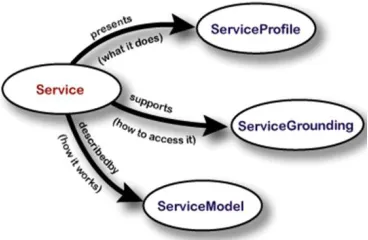
Fig. 14 - The models of OWL-S ... 44
Fig. 15 - Elements of WSMO... 46
Fig. 16 - OWL-S Virtual Machine (VM) [Pao2003] ... 55
Fig. 17 - SESA ... 56
Fig. 18 - Agents Environment of ACTAS... 64
Fig. 19 - MAS of ACTAS and life cycle of Service ... 65
Fig. 20 - Phase 1 ... 67
Fig. 21 - Phase2 ... 68
Fig. 22 - Phase 3 ... 70
Fig. 23 - Phase 4 ... 71
Fig. 24 - Phase 5 ... 72
Fig. 25 - Phase 6 ... 73
Fig. 26 - Elements of the S-Model ... 75
Fig. 27 - Semantic Description... 81
Fig. 28 - Principal ontological categorization of Semantic Characteristics ... 83
Fig. 29 - Property Classes ... 86
Fig. 30 - Service Template data structure ... 92
Fig. 31 - Principal Compatibility for directed and non-directed composition ... 98
Fig. 32 - Me-Constraints for directed and non-directed composition ... 103
Fig. 33 - The different views on a Merge Property Object ... 104
Fig. 34 - Exchange Constraint with General Characteristic ... 107
Fig. 35 - Sequence Diagram ... 109
Fig. 36 - Visibility of Properties in CompSt ... 138
Fig. 37 - Initialised Composite Structure ... 141
Fig. 38 - Technical Service shown with principal compatibility ... 151
Fig. 39 - The Object Dictionary ... 174
Fig. 40 - Actor Service Offer (ASO) for Alternative Client Requests ... 183
Fig. 41 - Composite Structure (CompSt) with use of Multi Ports ... 186
Fig. 42 - Multi Port in an ASO for OWL-S Service Composition... 187
Fig. 43 - Business Service with principal compatibility ... 188
Fig. 44 - Several compositions between selected Service Modes ... 189
Fig. 46 - Audio-Video-Communication with Translation... 195
Fig. 47 - Alternative Example of Translation Offer... 196
Fig. 48 - Audio-Video-Communication with alternative Translation... 197
Fig. 49 - Service Template for the Feature Composition example ... 203
Fig. 50 - Initialised Composite Structure (CompSt) with global GCh from SRe ... 204
Fig. 51 - Composite Structure with global GCh for Ex-Constraint ... 206
Fig. 52 - Weather Forecast Scenario ... 213
Fig. 53 - Smart Grid ... 215
Fig. 54 - SGMA adapted from [CEN2011]... 217
Fig. 55 - Smart Grid and ACTAS ... 220
Fig. 56 - Service Template/Offer for wind turbine scenario ... 227
Fig. 57 - Sketched Service Mode of the “Consumer Service” ... 228
Fig. 58 - Service Template for billing service... 228
Fig. 59 - Consumer Scenario applied by TrA ... 230
Fig. 60 - Principal Compatibility with applied Merge Constraints ... 231
Fig. 61 - Possible Service Request for the Billing Scenario ... 231
Fig. 62 - Billing Scenario with resulting Composite Service... 232
Fig. 63 - New entities of ACTAS ... 240
TABLES
Table 1 - Applicability of “Unique Characteristics of Services” ... 9
Table 2 - Taxonomy of trading ... 16
Table 3 - Examples of criteria for the four aspects of services ... 17
Table 4 - Comparison between DL and FOL ... 38
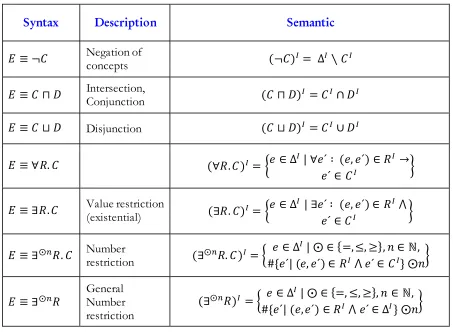
Table 5 - Constructors of DL ... 39
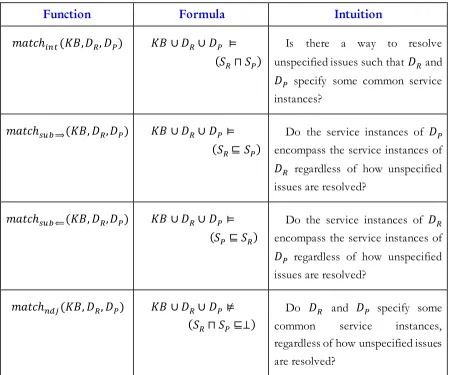
Table 6 - Alternatives of matching for DL based Capability Descriptions ... 41
Table 7 - Control flow constructs of workflows in OWL-S ... 44
Table 8 - Classification of OWL-S through the four aspects ... 45
Table 9 - Classification of SWSF (extension of OWL-S)... 45
Table 10 - Classification of WSMO through the four aspects ... 47
Table 11 - Overview of the life cycle... 67
Table 12 - Elements of the S-Model ... 80
Table 13 - Option-Slots of Service Ports ... 95
Table 14 - Option-Slots of Service Modes and Common Part of Service Descriptions ... 96
Table 15 - Compatible sets of Option-Slots (cf. Table 13) ... 98
Table 16 - Elements of the R-Model ... 112
Table 17 - Option-Slots of Request Ports/TRe... 115
Table 18 - Elements of the C-Model ... 119
Table 19 - Steps of the Composition Process... 120
Table 20 - Flow Trace of Service Composition with CompSt ... 153
Table 21 - Points of Evaluation... 172
Table 22 - Terms for the description of the Composition Process ... 191
Table 23 - Telephone Features ... 201
Table 24 - Key requirements for the data network ... 219
Table 25 - Semantic Characteristics ... 226
Table 26 - Features of ACTAS ... 246
Table 27 - Assumed Ontologies for the classification ... 249
Table 28 - Used General Characteristics (GCh)... 251
Table 29 – Used Compatibility and Request Characteristics ... 253
Table 30 – Used Char Property Classes ... 255
Table 31 – Used Exchange Property Classes ... 255
Table 32 - General Characteristics (GCh) ... 258
Table 33 - Compatibility Characteristics (CCh) ... 258
Table 34 - Request Characteristics (RCh) ... 260
ACKNOWLEDGEMENTS
I am most indepted to my supervisors Prof. Dr. Rainer Unland and Prof. Dr. Michael Schroeder for their support. Sincere thanks I give to Prof. Bernhard Cohen, who was my second supervisor and inspirator for a long period of my research.
I enjoyed working with my colleages and fellow students Tshiamo, Penny, Panos, Panayiota, Aloysius, and Marcus. Their motivation kept me going. My gratitude goes especially towards Dr. Swen Wagner, Dr. Jacek Gomoluch, Dr. Dominik Stein, and Dr. Stefan Hanenberg, who gave me valued advice and help through proof reading as well as other phases of my disertation. The support of Dr. Andrew Tuson, Marc Firman, Eric Smith, Dr. Eddy Parkinson, Veronika Muntoni, Christina Braun, Bernd Göhing, and Gottfried Merkel, I will never forget.
Publications of my research are [KlUnBr2009], [KlUnBr2010], and [KlUnBr2012]. Early publications of my research have been [KlReSc2002], [KlReSc2001], [KlHoSc2000], and [KlScRe2000]. I started my research in software agents and services as a research fellow at the institute of Secure Telecommunication of the Fraunhofer society (FhG-SIT, former GMD-SIT) in Darmstadt, Germany. The declarative environment of ACTAS is based on my research with Prof. Dr. Christoph Beierle for my academic title as a Computer Scientist with diploma at the University of Hagen (cf. [BeKlMe2000]). The work was sponsored through two scholarships: a one year program by the German Academic Exchange Service (DAAD) and a three year funding by the City University London.
My thesis is dedicated to:
My Father
Otto Franz Alban Kloos
23.04.1934 – 25.01.2000
My Mother
Annemarie Kloos, née Karbaum
03.06.1929 – 04.07.2012
My Godfather
Georg Karbaum, who died 2006
Declaration
ABSTRACT
Mainly in business domains, the vision of gaining flexible, adaptive service environments is based on the standardization and practical proliferation of (Semantic) Web Services, ontologies, and agents. The standards of Web Services and their Service-oriented Architectures (SOA) became the standard paradigm for software component integration. Dynamic changes and the permanently increasing amount of available e-services of different domains are a challenge of Service Discovery and Composition. Mediation between different approaches and expert knowledge is often necessary for the composition of services of different domains. Semantic enhancements, Autonomic Service Discovery, and the research for more holistic concepts for the classification of e-services are current attempts of overcoming this challenge, in order to reach the ultimate goal of Autonomic SOC.
ABBREVIATIONS
B2B Business-to-Business interface
B2C Business-to-Customer interface
BPEL, BPEL4WS Business Process Execution Language for Web Services
BPMs Business Process Management Systems
DAML DARPA Agent Markup Language
DFC Distributed Feature Composition
DIS Distributed Information System
DL Description Logics
DOC Distributed Object Computing
DSL Domain-Specific Language
EAI Enterprise Application Integration
FDL Feature Description Language
FOL First Order Logic
OWL-S Ontology Web Language for Services
SAWSDL,
WSDL-S Semantic Annotations for WSDL (Web Service Description Language)
SLA Service License Agreement
SOA Service-Oriented Architecture
SOC Service-Oriented Computing
(S)WS (Semantic) Web Service
SWSF Semantic Web Services Framework
WSMO, WSML Web Service Modelling Ontology / Language
ACTAS ABBREVIATIONS
ASO Actor Service Offer
AST Actor Service Template
CCh Compatibility Characteristic
Char Semantic Characteristic
CoA Composition Agent
CompSt Composition (Service) Structure
CompSt-plus
Composition (Service) Structure enhanced
Ex-Co Exchange Constraint
ExName Exchange Name of Exchange Constraint
Env
Environment (Value Constraints, Exchange Constraints,
and Option-Slots)
FA Facility Agent
GCh General Characteristic
Me-Co Merge Constraint (Mediation and Matching)
PA Personal Agent
PC Property Class
RCh Request Characteristic
ReA Request Agent
RM Request Mode
RP Request Port
SM Service Mode
SO Service Offer
SOER Service Offer Export Record
SP Service Port
ST Service Template
SRe Service Request
TrA Trader Agent
TRe Trading Request
INTRODUCTION
1
Motivation
We live in a world of services. Services performed by agents on behalf of others are part of our daily life. A service is sensed as an asset with an inherent value and its consumption normally involves the transfer of value and the generation of cost with the consequent need of its settlement. In business for instance, supply chains demanded early on the discovery, composition and planning of services through electronic services (e-services). In fact e-business became a main area for the application of the service paradigm. Nevertheless, the development towards a web of services will have its implication on many disciplines including associated ones like social services and psychology for the support of the security of data and an improved observation of the privacy of people.
Generally, a Service Requester can request services offered by Service Providers. The Service Requester does not need a complete knowledge about the services; he1 has to rely and trust on
the established interfaces and policies of the Service Providers. Business Services distinguish relationships between a service and Service Client (B2C) as well as between two services (B2B). The latter relationship follows matching rules determined by internal policies of businesses. Other domains like Computer Supported Cooperative Work (CSCW) had their own ideas about services; they thought of several Service Clients demanding Technical Services. The transparent establishment of a communication service between two Service Clients with the currently available communication facilities is an example of such a Technical Service. The term “Web 2.0”, introduced by [Kno2003], is used in the context of services for social networking and Cloud Computing. The intent of the latter is quite similar to Technical Services of CSCW approaches. However, it is combined with ideas of Business Services, because Cloud Computing propagates a specifically scaled billing of computing resources offered in several ways.
The number of services, which will be offered on the Internet, is expected to rise dramatically in the next few years. Technologies like Semantic Web [W3C2009a; W3C2009b] or Web Services [BooHaa et al.2004; IBM2009] transform the Internet from a network of information to a network of knowledge and services, generating dreams of Web3.0; also called Autonomic Service-Oriented Computing [RamHol et al.2009; ToDePe2009], i.e. the reduction of the requirement of manual, human intervention in service-oriented software scenarios including learning of the users’ preferences. Research Projects, like e.g. Service Web3.0 [Eur2009; Ser2009], drew already the picture of a new generation of the World Wide Web after Web2.0. Interestingly, Tim Berners-Lee, inventor of the World Wide Web, questioned whether one could use the term Web2.0 in any meaningful way, since many of the technological components of Web2.0 had
1
existed since the early days of the Web[Ars2006].[IBM2006]. He strongly propagated the ideas of Semantic Web and the web of services [Ber2003; TalWor2008], which led to the research of Semantic Web Services (SWS) [BrzRek et al.2010; KlUnBr2010].
1.1
The challenges of Service-Oriented Computing (SOC)
Two main challenges appear with Service-Oriented Computing (SOC): (1) the integration challenge and (2) the semantic challenge. The integration challenge describes the problem to integrate and to compose services running on different systems. For the tackling of the integration challenge, Business Services developed the multi-layered middleware of Distributed Information Systems (DIS). The DIS approach was soon extended to an Enterprise Application Integration (EAI), which enriched the composition mechanism with business logic like the workflow management or petri nets. However, the developed environments for Service Composition suffered under the integration problem due to the lack of standards.
The standards of Web Services changed the situation. They described Service-oriented Architectures (SOA), offering Service Trading, Service Composition, and Service Coordination. The goal of the latter was a coordinated starting of services in the phase of service deployment (Deployment Phase). Phases of a life cycle of a Composite Service consisting of several Component Services can be introduced in general: Service Design, Service Discovery, Service Composition, Service Grounding, Service Deployment, and Service Consumption/Execution. Component Services can be Abstract Services, which possibly enforce an anew Service Discovery for Concrete Services, which can be deployed. Services can have an inherent complexity, i.e. their orchestration (the description of the Component Services called for the realisation of one Composite Service) and their choreography (the possible protocols of message exchanges between the Component Services) can be hidden or transparent to Service Clients due to company policies for instance. In Software Engineering, Service-oriented Architectures became a standard paradigm for software component integration besides distributed objects and agents. Although these terms are used in so many domains in various contexts with different purposes, there is no commonly agreed and standardised distinction of the entities.
SWS approaches do not describe the functionality offered by a service through its messages, operations, or orchestration, but through its service capability, which contains semantically enhanced elements. The semantic classification of the elements used in a capability description is done through the application of ontologies. Both Semantic Web Service standards (OWL-S and WSMO) define or allow different kinds of capability descriptions. The mostly used capability description in the context of OWL-S is called IOPE standing for Input, Output, Pre-Conditions, and Effects.
The descriptions of (Semantic) Web Services are informal. That is well intended because in this form, the Service Descriptions can be designed and exchanged in the World Wide Web network easily. It needs approaches for the Service-Oriented Computing, in order to deal with the information of these Service Descriptions properly, i.e. according to given policies of t he requesting application environment. New challenges for Service Discovery and Service Composition arise due to dynamic changes of Service Descriptions as well as the permanently increasing amount of available e-services of different domains in various semantic contexts. For instance, the distinct laws in countries can define different semantic contexts for the consumption of a service. Mediation between different approaches of SOC demands an expert knowledge about their various Service Descriptions. Even the number and versions of standards for Web Services increased in such a way, that standards were developed, in order to determine compatible standards and their versions for the service deployment.
1.2
Introduction of ACTAS
The thesis introduces ACTAS – Adaptive Composition and Trading based on Agents. ACTAS is not another complete architecture supporting the whole Life Cylce of a service. It does not even propagate another complete functional description of a service. ACTAS suggest the introducion of a classification of services, in order to select services through their categories. It promises the early exclusion of non-matching services in the phases of Service Discovery and Service Composition through the classification of the services and the use of approved algorithms. The algorithms are used, in order to check constraints valid in the semantic context of a certain category of services. Services are selected and declared as principally compatible through the categories, they belong to. ACTAS might only discover and compose Candidate Services, but the adaptable discovery and composition should provide alternative Service Providers and information for the subsequent phases of the life cycle of services.
ACTAS is based on a Multi-Agents System (MAS), which uses the pro-activeness of the agents, in order to integrate the roles and policies involved in the SOC. Service Providers are integrated through Facility Agents (FA). The Service Requester, originated in the applicati on environment, is represented by the Request Agent (ReA). The ReA create an agent for the Composition Process (CoA). In this way the Composition Process can be adapted to the policies of the application environment. A Trader Agent (TrA) can discover and compose services following its own policies. Due to its pro-active behaviour, the TrA could be also used for the integration of existing trading approaches. ACTAS introduced the role of a Service Client, in order to support Technical Services. A Service Client can be represented through a Personal Agent (PA). The MAS of ACTAS builds the middleware for the declarative environment of ACTAS. The declarative environment realizes Service Discovery and Service Composition through a backtracking based on approved algorithms. In the thesis, the declarative environment for the realisation of the Composition Process is described through the Composition Model (C-Model).
Similar to WSMO, which distinguishes between the concepts “service” and “goal”, ACTAS presents separate models for the description of services (Service Model, S-Model) and requests (Request Model, R-Model). ACTAS is not restricted on Web Services, but e-services of any domain could be addressed through the Service Descriptions and Requests of ACTAS. The classification of services in ACTAS is defined through a special kind of ontological concepts, the so-called Semantic Characteristics, which integrate several aspects of services in their semantic description through relationships to ontological concepts of various ontologies. Aware that an absolute definition of services does not exist, a classification of e-services through four different aspects was developed: (1) the domain of a service, (2) its non-functional properties, (3) its inherent complexity, created through policies, orchestration, and choreography, as well as (4) its categorization in the phases of the service life cycle.
selection of services. A set of Semantic Characteristics addresses all services, which belong to the category described through the intersection of the categories of the Semantic Characteristics enumerated in the set. As “building blocks” Semantic Characteristics ease the Service Description and Service Composition. Services holding the same Semantic Characteristics (so-called Compatibility Characteristics) are principally compatible. ACTAS distinguishes between B2C (Business-to-Client) and B2B like Service Composition. The B2C like Service Composition, i.e. the (principal) compatibility between Service Request and Service Offer, is done through a specific kind of Compatibility Characteristics named Request Characteristics that can be related with ontologically defined user groups. ACTAS supports directed Service Composition, which define a server and a client side for the composition as it is usual in B2C relationships. Non-directed relationships, which can occur in the Service Composition of Technical Services, are also covered by ACTAS.
Semantic Characteristics define additionally a semantic context for properties (so-called Char Properties). Service Properties, i.e. properties of Service Descriptions in ACTAS, are always declared as Char Properties in the semantic context of a Semantic Characteristic. Similar to the association of a mediation algorithm with the mediator concept in WSMO, the Char Properties are associated with algorithms for the information handling, the matching, and the mediation. The research of ACTAS was concerned with the vision to take advantage of given algorithms. The Semantic Characteristics allow an application of these algorithms in a fitting semantic context. The algorithms are described through so-called Property Classes.
ACTAS defines three different kinds of constraints on the base of the algorithms associated with properties through Property Classes: Value Constraints, Merge Constraints, and Exchange Constraints. Algorithms for the handling of the information of a Char Property can be used for the definition of Value Constraints, in order to describe for instance domain specific restrictions valid in the Semantic Context of the Semantic Characteristic. Merge Constraints define the application of matching algorithms on the level of the Service Properties. So-called Exchange Constraints realize the mediation between Service Properties of different Semantic Characteristics.
ACTAS advocates the publications of Semantic Characteristics and Property Classes, in order to have commonly agreed concepts for the categorization of services as well as in order to have proven and effective algorithms for dealing with the properties. The management of these repositories as well as the association of algorithms with Char Properties could be the task of ACTAS Administrators. A Service Designer uses the Semantic Characteristics for the Service Description. A Service Request can be designed with the Semantic Characteristics and fitting constraints.
precisely, in order to translate from one kind of formalism to another one. In principle, ACTAS extends the idea of Semantic Web Services, which tackled the semantic challenge through the use of semantically enhanced capability specifications of services. For this purpose, the parameters of the functional description were ontologically classified. ACTAS classifies the services and uses the resulting categories of services for the Service Discovery and Service Composition. Additionally, approved algorithms associated with the Service Properties of the discovered services are used for constraints.
1.3
Structure of the thesis
The thesis starts with a description of the State-of-the-Art of services and discovery frameworks. The State-of-the-Art is parted in four parts. Chapter 2 has a closer look at a service and Service-Oriented Computing (SOC). It compares the classical idea of services with e-services and develops four aspects for the classification of services. The chapter 3 considers the approaches for solving the challenges of integration in the domains of e-business and software engineering. Web Services standards and Service Compositions are discussed. The Semantic Challenge for SOC is covered in chapter 4, which rely on ontologies. Capability Descriptions, i.e. semantically enhanced functional descriptions, are introduced, which are used in some of the covered approaches of Semantic Web Services. The introduced aspects of services structure the discussion of developments of Autonomic SOC in chapter 5. Holistic approaches with Semantic Web Services Execution Frameworks are sketched. The State-of-the-Art ends with the problem statement in chapter 6.
The description of ACTAS starts with the hypothesis (chapter 7) and the introduction of the System Environment (chapter 8). In the subsequent chapters 9 and 10, the Service Model (S-Model) covers the Semantic Characteristics and Property Classes as well as the Service Description of ACTAS (chapter 10). The perspective is changed from the Service Provider to the Service Requester with the Request Model (R-Model) introduced in chapter 11. The S-Model and the R-Model deliver the informal data structures of ACTAS.
STATE OF THE ART
2
Service-Oriented Computing
In the last two decades, the (electronic) service (e-service) paradigm became dominant as a presentation of remote applications and as a modular entity of Software Engineering in distributed computing. The hype of Service-Oriented Computing (SOC) is based on Web Service (WS) technology and its idea of Service-Oriented Architecture (SOA) for a web-based, modular implementation of complex, distributed software.
In relation to Web 1.0, which is based on protocols and languages like HTTP, TCP/IP and HTML, the term Web 2.0 (especially in context of social networking and Cloud Computing), was introduced [Kno2003] with WS as a universal, standards-based integration platform. Besides the integration of applications, WS technology increasingly integrates a standardised publishing, transparent accessing, and specifically scaled billing of computing resources as they a re propagated through grid [GuZaRo2009] and Cloud Computing [FuHao et al.2010; GraMax et al.2010]. Also real-time computing built with Web Service technology became a subject of recent research [HuaZha et al.2010; LiGaSh2010; TsaSha et al.2010]. One goal of the on-going research is Autonomic Service-Oriented Computing [RamHol et al.2009; ToDePe2009], i.e. the reduction of the requirement of manual, human intervention in service-oriented software scenarios including learning of the users’ preferences. This is often phrased as Web 3.0.
E-services allow us the access of increasingly complex distributed software systems and resources of formerly often separated, heterogeneous domains through a standardised architecture. However, a commonly agreed idea of a service does not exist. Therefore, it is necessary to have a closer look at the aspects of services and terminology, in order to achieve the goals of autonomy.
2.1
Service
Generally, a service is not simply a function, it is a function performed by a Service Provider
on behalf of another entity, commonly the Service Requester or Service Client/Customer. The consumption of a service transfers a value from the provider to the customer. The definition of the service (Definition 1) also mentions the potential generation of costs, which has to be settled (mostly) by the consumer of the service (service could be a Business Service). The costs of a service are an example of non-functional properties (nfp) connected with a service. Reliability, availability, and Quality-of-Service are further examples of non-functional properties of services. A service with a bank is likely split into separate transactions, which have to be controlled. The transactions could be services on their own. In this way, a service can be composed on different levels of abstractions. This kind of abstraction of services leads to the distinction between Composite Services, Component Services, and Basic Services or Atomic Services.
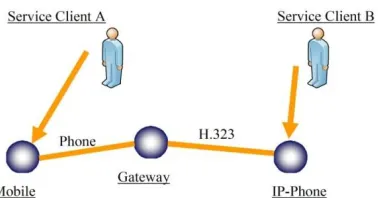
Example 1 illustrates a simple Technical Service realising a telecommunication service, an audio communication using a gateway service. The technical service is a Composite Service with more than one Service Client. A telecommunication service can be described as a packaged set of capabilities for exchange information over distances, perceived by human end user [Bet2008]. On the one hand, a Technical Service can be treated as a Business Service, since it has to be paid for the use of a telephone. Therefore, both Service Clients have a client-server relationship with the service of the communication facility (cf. Fig. 1). On another hand, the Technical Service consists of several Component Services of communication facilities, in order to realise the technical function. The relationship between these Component Services of a Technical Service can be called non-directed or peer-to-peer relationship, because both communication facilities are equally involved. A Service Provider of a telecommunication service will only advertise a telephone service, but not the technical Component Services for its realisation. The different view on a service is reflected in the Service Descriptions. Business Services distinguish between Business-to-Customer Service Composition (B2C) and Business-to-Business Service Composition (B2B).
Definition 1. Classic Definition of Service (Manual Service)
A service consists of actions performed by an entity on behalf of another.
It is an asset with an inherent value. The consumption of a service involves the transfer of value and (mostly) the generation of cost with the consequent need of its settlement.
The “Unique Characteristics of Services” are: 1. A service is intangible.
2. A service is heterogeneous.
It is up to the Service Provider, if he advertises only Concrete Services or an Abstract Service (another kind of abstraction). For example, a travel agency might use Abstract Services, in order to advertise journeys. The concrete journey is a result of negotiation between Service Requester and Service Provider. The orchestration of Composite Services in Component Services and the coordination of the execution of the functions of the Concrete Services are common challenges of Service Providers and Service Clients. These challenges led to an inherent complexity of the Service Description, which is disclosed to the different service users according given policies, e.g. the orchestration may be transparent for a Service Client. The used policies can be used for a categorization of services. Besides the inherent complexity, services can be categorized through further aspects, which will be discussed in section 2.3.
Characteristic Service Category
Physical Acts to Customers’ Bodies (e.g. passenger transport,
restaurant service)
Physical Acts to Owned Objects (e.g. freight transport, repair, health care) Non-physical Acts to Customers’ Minds (e.g. education, entertainment) Processing of Information and Communication (e.g. cloud, Web 2.0, CSCW)
Intangibility Performance is ephemeral, but experience may be highly tangible and even result in physical changes. Misleading point: performance is ephemeral but may physically transform possession in tangible ways.
Yes. Yes.
Heterogeneity Yes.
Often hard to standardize because of direct labour and customer involvement
Numerous exceptions. Service can often be standardised Numerous exceptions. Services can often be standardised Numerous exceptions. Services can often be standardised Inseparability of production and consumption Yes.
During production No. Customer is usually absent during production. Only when performance is delivered “live”. Many exceptions. Customers are often absent. Perishability, i.e. service cannot be inventoried after production.
Yes Yes Numerous
exceptions. Performance can often be stored in electronic or printed form.
Many exceptions. Performance can often be stored in electronic or printed form.
[image:24.596.69.528.76.535.2]A Communication Service
Example 1
Fig. 1 shows the telecommunication between a Service Client A and a Service Client B, which might be requested through their avatars in the working zone. A is using a mobile and B an IP-phone. In order to establish the communication connection between the two Service Clients, a gateway or gatekeeper might be necessary for the conversion of signals and protocols consistent with different telecommunication standards. The standardised telecommunication protocol H.323 [IEC2007] allows the voice over IP communication.
2.2
Electronic Service and Web Service
Early on, IT researchers and practitioners have commonly agreed about the importance and potential of e-services in Distributed Object Computing (DOC) or Open Distributed Processing (ODP) [ISOITU1996; ITUISO1997b; Joy2005]. An e-service was defined as an abstract, electronically processable notion that must be implemented by a concrete agent (Definition 2), which can be a concrete application, hardware, or a physical agent (e.g. Service Provider, actor in case of a manual service). A service in this context [ITUISO1997a; ODP 2004] is for instance the electronic exchange of information (“When goes the next train?”), the supply of computing power (e.g. grid, cloud), the access of a manual service (e.g. flight, hair-cutting), the offering of remote applications (remote procedure call (RPC), RMI, CORBA, CGI, servlets), or the access of technical facilities (JINI, ODBC, JDBC [Fra2007; OraSUN2005; WalArn2001]). In e-business, the necessary integration of the (distributed) resources of services with their application logic and presentation was addressed through Distributed Information Systems (DIS).
Service-Oriented Computing (SOC) introduced the service as a new software paradigm similar to an object. Due to the loose coupling, Software Services can be easier reused than objects or modules, although their granularity is rather coarse. While initially services were meant to be a simple object access protocol, the provision of functionality independent of its implementation technology and execution location gained importance. SOC has to deal with two challenges: the (extended) integration challenge and the semantic challenge. The former is the challenge to integrate multiple independent and heterogeneous data repositories, processes, and applications in a dynamic system environment. The later tries to avoid semantic mismatches
Fig. 1 - Communication Service
Definition 2. Electronic service (e-service)
[image:25.596.336.525.96.195.2]and to overcome the heterogeneity of data, in order to have a more reliable Service Discovery (cf. [Syc2010; VetLen2005]).
The standardizations of a Web Service (Definition 3) eased the integration of applications. New functionality is created from existing building blocks and communication is enabled between various elements. In contrast to the former approaches that addressed (at least partially) similar goals, such as CORBA or Multi-Agent Systems (MAS), the approach of Web Services takes advantage of simple, open, platform-independent protocols based on accepted Internet standards. WS techniques and standards allow the encapsulation of existing code and the integration of applications.
Berners-Lee [Ber2003] describes Web Services and their standards as belonging to the information space based on URI links and namespaces with an unambiguous identity. UDDI (Universal Description Discovery and Integration) [OAS2005] realises the name and directory server, the Discovery Agency of Web Services. Web Services allow the creation of self-contained, self-describing, modular applications that can be published, located, and invoked across the Web. Web Services define functions that can be anything from simple requests to complicated business processes. Once a Web Service is published, applications can discover and invoke the service [W3C2006].
2.3
Aspects of services
Since the “Unique Characteristics of Services” do not hold for electronic services in all cases (e.g. the delivery and reading of an e-mail separates the production and consumption of a service), the next sections discuss four aspects of services specially introduced in this thesis, in order to achieve a classification of services. Through this classification, services can be categorized. Examples for criteria of this classification are shown in Table 3:
(1) Different views on a service,
(2) the non-functional attributes/properties (nfp) of a service,
(3) the inherent Complexity of a service, and
(4) The different phases of the life cycle of a service.
Definition 3. Web Service
2.3.1 1st aspect of services: Different views on a service
The idea and task of a service differs with its application domain. For instance, a service in a technical domain (Technical Service) can be distinguished from a service in a mainly business oriented domain (Business Service). A Technical Service (e.g. Fig. 1) can have peer-to-peer Service Compositions and several Service Clients. A Business Service can have alternating client-server bindings.
Software Engineering has its own views on services. It looks at Software Services as a distribution model [ElfLay2002] and as a software paradigm [SaeJaf2005]. As a distribution model, the applying software can subscribe to the whole functionality of a software service, or it restricts its subscription to parts of the functionality (e.g. Cloud Computing). So-called autonomous services can be used as general software modules, which are not stateless or fixed to certain resources. Depending on the Service Provider the separations between autonomous agents (Fig. 6) and autonomous services disappear.
A requester of a service (Service Requester) has another view on a service than the provider of a service (Service Provider). Business Services distinguish between interfaces for Business -to-Customer (B2C) relationship and Business-to-Business (B2B) relationship. It is a similar case with Technical Services. Service Traders are acting with their assigned policies for Service Discovery and Service Composition. In their construction of a semantically enhanced environment for Semantic Web Services, Medjahed and Bouguettaya show that the community is another possible perspective for describing services and their framework [MedBou2005]. The user roles of the Service Client or the Service Requester inside of the community influence the reception of a service. A manager will have another access on a service than a worker. For instance, a manager might see more confidential data.
2.3.2 2nd aspect of services: non-functional attributes
Non-functional attributes are considered to be constraints over the functionality of the service [O'EdHo2002]. The literature alternatively speaks of attributes, properties, or parameters. In the thesis, mostly the terms parameters and properties are used. Some non-functional properties (nfp) are simply annotations like contributor, coverage, creator, date, format, identifier, language, owner, publisher, rights, source, and version. Traditionally, Service Discovery of e-services works with the functional description. The annotating non-functional properties are not really used for the Service Discovery. This implies a general assumption of the traditional Service Discovery environments that it is not likely that anybody wants only services of a certain publisher. Nevertheless, this category of nfp can be quite useful for the selection of services (e.g. most recent offered services). Another category of nfp is more helpful for several phases of the Service life cycle (4th aspect of service): Service Discovery, negotiation, monitoring, and substitution of
intellectual property, rewards, provider, reliability, robustness, scalability, performance, transactional, and channels (usually a channel describes the way how a service is delivered).
For instance in Example 1, it would be unacceptable for Service Discovery, if the IP-phone was not accessible for spatial or security reasons, non-functional properties like availability of a service have to be considered, in order to ensure that the Component Services can be deployed. The dealing with non-functional properties like Service Quality, Settlement, or Warranty can involve new Component Services. Therefore, the support of non-functional properties increases the inherent complexity of a service (3rd aspect of service).
The monitoring of Service Quality may lead to a stop of the Service Delivery, when the detected values fall under a given threshold. A possible reaction to an interruption is the Service Substitution. In the worst case of substitution, the phases of the life cycle have to be repeated, in order to discover and deliver a new (component) service.
In the field of computer networking and other packet-switched telecommunication networks, the traffic engineering term Quality-of-Service (QoS) refers to resource reservation control mechanisms rather than the achieved service quality [EvaFil2007; Mar2007; Xia2008]. Quality-of-Service is the ability to adapt priority to different applications, users, or data flows, or to guarantee a certain level of performance to a data flow. For example, a required bit rate, delay, jitter, packet dropping probability and/or bit error rate may be guaranteed. Quality-of-Service guarantees are important if the network capacity is insufficient. The standards organisation FIPA specified a Quality-of-Service Ontology [Dal2002b].
2.3.3 3rd aspect of services: The inherent complexity
The inherent complexity of a service is created through Service Composition and Service Coordination, i.e. that a service can consist of several Component Services, which have to coordinate their message exchange in order to achieve the goal state of the service. The process of Service Composition is recursive, since a Composite Service can be a Component Service of another Composite Service. The terms of orchestration and choreography are discussed in section 3.5. The choreography describes the behavioural aspect of services that means the possible message exchange sequences, which are called a process. Different kinds of Service Composition are distinguished depending besides others on the matching methods. The Service Composition of WS with BPEL is often called process oriented, whereas the Service Composition of SWS with Service Capabilities is rather service-oriented. The distinction between Abstract Services and Concrete Services has to be mentioned in this context as belonging to this aspect of services.
2.3.4 4th aspect of services: The extended life cycle of services
software product. As the software is often part of greater system environment, a software life cycle can be considered as a subset of a systems development life cycle. There are several models (e.g. Waterfall Model, Spiral Model, or Rapid Application Development) for processes. Each model describes a variety of tasks or activities that take place during the process. Typical activities in this context are Planning, Implementation, Testing, and Documentation. Some people consider a life cycle model as a more general term and a software development process as a more specific term. An international standard for software life cycle processes is ISO/IEC 122072. It
aims to be the standard that defines all the tasks required for developing and maintaining software.
Objects, software agents, and e-services can be software paradigms for the construction of a software product. They are the main entities of the activities during the mentioned process, and they have to be deployed and maintained when the software product gets alive or executional in the system environment. A manual service can directly be seen as a part of the system environment. With the introduction of the e-service, a service as a paradigm (including manual services) is also described through meta-information for the Service Discovery and Composition on various levels of abstraction. The design and application of such meta-information leads to a new, extended life cycle for Service Discovery, which is specific for the service paradigm. The fourth aspect of services considers this extended life cycle of services from two perspectives. According to the Service-oriented Architecture, a discovered service will be finally deployed by at least one Service Provider. The deployment phase can be seen as the connection between the Service Discovery life cycle and the software/manual (executional) life cycle of the service. In the thesis, the Service Discovery life cycle is addressed with the term (extended) life cycle.
On the one hand, the service life cycle can be described in several processes from the perspective of the Service Provider (Service Definition, Property Provision, Service Delivery) as well as from the perspective of the Service Requester (Provider Discovery, Property Discovery, Service Call). The Property Discovery and Property Provision are negotiating processes for the refinement of the Service Properties. The result of the negotiations is a Service Level Agreement (SLA). Service Call and Service Delivery are corresponding processes for the Service Consumption phase.
On the other hand, the life cycle can also be described in six phases (Fig. 2): In Phase 1 (Service Design), the Service Provider uses a given Service Description language, in order to describe the interface of the offered services (e.g. WSDL for Web Services). The Service Design is followed by the Service Discovery consisting of three phases: Service Trading, Service Matching, and Service Ranking/Checking. The SOA enables the publishing of the Service Definitions in Phase 2, the Service Trading. Service Trading can be done actively through Service Traders or passively with a Service Registry (for instance UDDI). An active Service Trading can include Automatic Service Composition (i.e. the dynamic composition of a new service from the
2
offered services). Active Service Trading is in principal independent from a concrete Service Request. The Service Matching (Phase 3) will take advantage of the Service Trading, when no fitting Service Provider is known (the process of Provider Discovery). The Service Request is the starting point of the Service Discovery and Service Matching process of Phase 3, which ends with the matching of Service Request and Service Offer in a successful case. In phase 4, the Service Ranking, the found Service Offers are checked and eventually ranked. Service Negotiation (Phase 5) is necessary for the refinement of Service Properties; it comprises the earlier mentioned processes of Property Discovery and Property Provision. During Service Grounding, system specific constraints for the Service Delivery (e.g. resource management) as well as coordination issues are solved. Possibly, the phases 3 to 5 must be repeated, if (component) services do not fulfil the resulting constraints of Service Negotiation/Grounding. In the Service Deployment (Phase 6), the Component Services are scheduled and deployed. The Service Execution might observe the Service Quality. In case of non-fulfilment of guaranteed QoS properties, earlier phases have to be repeated. A feedback for learning and keeping up the Service Quality might be provided at the end of phase 6.
Service Traders or Service Registries provide a vital aspect of services Discovery in SOA. However, already Vasudevan [Vas1998] introduced a proposal for taxonomy of traders (Table 2). Service Discovery can be based on a centralized or distributed Service Registry (cf. [RamHol et al.2009]). One or several, federated Service Traders can be involved in Service Discovery. Peer-to-Peer-Networks realise a federated Service Trading. A Service Broker is a Service Trader, which enacts as the discovered service. Web Service standards does not define a trading, but a central registry supporting the keyword of Service Offers: The Universal Description, Discovery and Integration (UDDI) [OAS2005; Org2004] specifications define a registry service for Web Services and for other electronic and non-electronic services. The UDDI consortium has released guidelines on how to use WSDL to describe service interfaces and store them in UDDI registries [CuEhRo2002].
Before the emergence of Web Services, ODP-Trading [Bea1997; Int1995] drafted a standard for trading; this draft inspired several trading approaches in the nineties (e.g. , [JacMud1996; MarMer et al.2001; PudMar et al.1995; VoBeIa1995]). These traders already included QoS
attributes [Kos1999] and semantic enhancements with ontology based IOPE Capability Descriptions [Ber2003; Klu2000b; Klu2000a].
In Table 3 - Examples of criteria for the four aspects of services, possible criteria for the classification of services through the introduced aspects are listed. For instance a service could belong to the domain of Cloud Computing and is described as SaaS from the perspective of the Service Provider (1st aspect). The service can be linked with distinct criteria of reliability, cost and
settlement scheme (2nd aspect). The orchestration of the service might be completely transparent
for the user, due to company policies (3rd aspect). The third aspect also distinguishes between
Abstract and Concrete Services. Finally, the Service Description can be proprietarily adapted to the specific Cloud Services of a given Service Provider, who also offers an own Trading Environment for the available Cloud Services. At last, the Service Provider demands a distinct protocol for the handling of his services. In this way, the Service Provider generated several criteria belonging to the 4th
aspect of services (phase 1, phase 2, and phase 5), which led to the so-called “Lock-in-Effect” (cf. section 3.6).
2.4
Summary
The chapter showed that a commonly accepted definition of services does not exist, because the idea of a service changes with the domain and the perspective of the user. Alternatively, four aspects of services were discussed, which could be used for the classification of services.
Two challenges of SOC were pointed out: (1) the integration and (2) the semantic challenge. The former comes up at the integration of applications of different Service Providers, since various resources and actors have to be included, incompatible data schemata need mediation, as well as communication protocols, i.e. the choreography, must be harmonised. The semantic challenge looks for distinct informal descriptions of service functionality.
The integration challenge was tackled with the Web Service standards. Web Services define communication protocols, describe the functional interfaces, and allow a Service Discovery based on structure, syntax, and vocabulary. Semantic Web Service (SWS) extends the used vocabulary of the functionality description with semantics and pragmatics. SWS techniques ease the Autonomic Service Discovery, because they are an answer to the semantic challenge. The next
Criterion Description
Knowledge Representation
Advertising of Service Offer to the trader (push scheme, pull scheme) Functional, semantic, adaptive (gained at runtime)
Hierarchical or flat name/directory space (e.g. X.500 hierarchical, URI flat) Matching
Heuristic Property-based or Artificial Intelligence (AI) concept-based Service Invocation Trader can be a matchmaker or broker (enactor)
Federation
Approach Single (monolithic) trader or cooperating (federated) traders.
chapters have a closer look at the integration challenge, the semantic challenge, and the Autonomic Service Discovery.
Aspect of Services Examples
1.) View on service Domain: e.g. CSCW, software engineering, supply chain
Role in SOC: Service Provider, Service Requester, Service Client
Role of user: e.g. Administrator, Travel Agent, Researcher
Kind of cloud service: IaaS, PaaS, or SaaS 2.) Non-functional Aspect e.g. QoS, trust, reliability, availability, user preferences 3.) Inherent Complexity, orchestration, choreography, coordination, transaction
Abstract Service vs. Concrete Service
Workflow Management Systems (WfMs)
Business Process Tools (cf. Fig. 12)
company policy, law, political correctness 4.) Life cycle of service Phase 1 - Service Design
• Functional view – syntactical or semantically enhanced • Service Request specification – requester view
• Mediation – data, process, and protocol level • Service Composition on service and/or process level • non-functional properties – keywords or concepts Phase 2 – Service Trading
• The kind of trading – Matchmaker, Broker, or P2P • Registry federation – central, distributed, decentral • Preferences, Learning, Trust
• Trading Policy – keywords only, concepts, or Data Mining Phase 3 – Service Matching
• Property based or enhanced concepts (e.g. IR in OWL-MX as an enhanced concept) • Functional Matching
• only input/output parameters or complete IOPE • Intersection, plugin, subsumes, equivalence (exact) • Matching of Abstract Services or Concrete Services Phase 4 – Service Checking/Ranking
• Preferences • Constraints
• Prioritisation of Service Providers • Availability of Resources, Reservation
Phase 5 – Service Negotiation and Service Grounding • Negotiation of further Service Properties
• Agreeing on Concrete Services if Abstract Services matched • Tools for Service Composition on process level
• Agreement on Web Service standards (e.g. WS-I) Phase 6 - Deployment and Execution
• Deployment Environment • Monitoring QoS
• Robustness
• Integration into the application environment (e.g. VPO)
• Feedback (especially for learning of Preferences)
3
The integration challenge
The integration challenge can be split in two tasks that have to be solved:
The first task is the integration of resources and actors into the environment of an application, whereby the resources and actors are possibly located in a dynamic and distributed environment.
The second task is the integration of applications, in order to take advantage of existing solutions.
In e-business, the first task was tackled with (Distributed) Information Systems (DIS) (cf. [AloCas et al.2004 section 1]), which offered an application as an e-service. Since the environment of a DIS was mostly under control of one enterprise, the application integration could often also be realized in the application logic layer of the DIS, because the policies and security rules of the controlling enterprise could be adapted accordingly.
The challenge of the application integration increased, when the applications were running on separated DIS environments controlled by different enterprises. The DIS concept had to be extended through the concept of Enterprise Application Integration (EAI), in order to allow application integration over several enterprises. SOC with the composition of services came alive and it has moved mainstream with the introduction of the standards of Web Services for the last decade, as the realisation of DIS with EAI extensions became realistic.
The Service-oriented Architecture (SOA) allows the dealing with dynamic environments. The Service Provider can advertise a service with a Discovery Agency. Through this Discovery Agency, a Service Requester can discover advertised services, which have a Service Description fulfilling the Service Request (Fig. 3). From 2007 onwards, WS technology initiated Cloud Computing, which extended the SaaS concept in the direction of a general e-service (cf. Definition 2).
In this chapter, the integration challenge is
illustrated. DIS middleware approaches are discussed and the standards of Web Services introduced. Finally the paradigm of Cloud Computing is presented. In the subsequent thesis, DIS and EAI are used synonymously for distributed information systems, which encompass the EAI concept of application integration.
3.1
Motivation and Evolution of DIS middleware
In the domain of Computer Supported Cooperative Work (CSCW), the first task of the integration challenge became for instance apparent in the supporting of a world-wide dispersed project-team (Example 2). A Virtual Project Office (VPO) showed with avatars the currently working project members. The interface integrated various services: information services, business services, and technical services. Additional context information was linked with so-called working zones. The availability of the services and the number of people currently working at the project changed constantly. Additionally, the team members were not bound to specific locations, since they could access the VPO interface through the Internet. In order to establish transparently a communication service, the currently accessible communication facilities of the intended Service Clients have to be discovered and deployed automatically. Without WS technology, VPO became a non-modular approach. The middleware was realised with a Multi-Agent System (MAS) and resources were accessed through technologies like JINI or ODBC. The transparent access of resources already reflects the utilisation idea of Cloud Computing. However, Cloud Computing relies on the service paradigm, in order to have a standardised interface and on-demand accounting (cf. section 3.6).
JINI3 [WeiBel2002] offered an early, Java based solution of the integration challenge in the
domain of technical services. Technical facilities became accessible with a unified interface as technical services (e.g. in VPO). A Service Provider could advertise a JINI service through a lookup service (LUS) with a Service Registrar object to the service. The LUS returned a Java proxy, specifying how to connect directly to the service. The availability of services was addressed in JINI through the concept of leasing. When a service registered with a LUS, a lease of a specified duration was granted. Leases had to be periodically renewed. In this way, JINI addressed availability and the Service-oriented Architecture (SOA) (Fig. 3) on the level of resources. The disadvantage of JINI was its proprietary standard depending on Java.
The classical three-layer design of an Information System integrates the Application Logic Layeras middleware into a Presentation Layer and a Resource Management Layer. Wrappers like JINI in the Resource Management Layer allowed the reaction on changing resource environments without the need of changing the application logic. The service (Definition 2) paradigm became the external presentation of the application and was introduced as a specific user interface.
Early DIS approaches evolved from the Remote Procedure Calling (RPC) concept of Open Distributed Processing (ODP). The RPC-based systems were soon extended with transaction control. The resulting TP Monitors were according to [AloCas et al.2004] long time the most known and stable technology of DIS middleware (IBM CICS, MS MTS, BEA Tuxedo). ODP
3

![Fig. 9 - Horizontal and vertical protocols (adapted from [AloCas et al.2004])](https://thumb-us.123doks.com/thumbv2/123dok_us/1547746.107300/41.596.72.509.171.391/fig-horizontal-vertical-protocols-adapted-alocas-et-al.webp)
![Fig. 12 - Business Process Tools [Bar2010 p. 18]](https://thumb-us.123doks.com/thumbv2/123dok_us/1547746.107300/45.596.79.522.185.503/fig-business-process-tools-bar-p.webp)