Rochester Institute of Technology
RIT Scholar Works
Theses Thesis/Dissertation Collections
5-1-2012
Through place
Sarah NewmanFollow this and additional works at:http://scholarworks.rit.edu/theses
This Thesis is brought to you for free and open access by the Thesis/Dissertation Collections at RIT Scholar Works. It has been accepted for inclusion in Theses by an authorized administrator of RIT Scholar Works. For more information, please [email protected].
Recommended Citation
A Thesis Submitted in Partial Fulfillment of the Requirements For the Degree of
Master of Fine Arts in Imaging Arts
School of Photographic Arts and Sciences College of Imaging Arts and Sciences
Rochester Institute of Technology Rochester, NY
May 2012 By
Sarah W. Newman
Approval:
Christine Shank Date
Committee Chair
Gregory Halpern Date
Committee Member
William Osterman Date
Committee Member
Laura Shackelford Date
ACKNOWLEDGEMENTS
I would like to thank my committee: Christine Shank, Laura Shackleford, Willie
Osterman, and Greg Halpern for your support, counsel, and guidance in helping me realize
my thesis exhibition and final thesis document. Each of you brought something unique to
the table, and I am grateful to have worked with all of you.
I also would like to thank the many other MFA faculty with whom I studied during
my time at RIT, and who contributed in significant ways to my education. In particular, I
would like to thank Alex Miokovic and Tim Engström for your insights, edits, and countless
conversations about my work.
I would like to thank my classmates for their support. A special thanks to Matt
(“Thew”) Chung, whose friendship, humor, patience, and wisdom immeasurably enriched
ABSTRACT
By
Sarah W. Newman
B.A., Philosophy, Washington University in St. Louis, 2005 M.F.A., Imaging Arts, Rochester Institute of Technology, 2012
Through Place is comprised of diverse, sometimes un-idyllic landscapes. Many of the
pictures contain a trace—an alteration to the land, a specter of human presence. Yet these
marks are pictured inclusively; the scenes are explored with interest and without judgment.
They offer a reformulation of the division between the human and the natural, wherein “the
natural” draws the largest circle.
The images are made in geographically and culturally diverse places (from the
Peruvian Amazon to ski mountains in California). “Place” becomes replaced by
interpretation, fiction: representations that intermingle with our own agency, expectations,
TABLE OF CONTENTS
Acknowledgements... i
Abstract... ii
Table of Contents... iii
List of Figures... iv
Introduction... 1
Chapter I: Context... 3
1.1 Early History ... 3
1.2 Background & Influences ... 4
1.3 Contemporary Context... 5
1.4 Linguistic Context ... 8
Chapter II: The Work... 10
2.1 Where and Why ... 10
2.2 Methodology & Working Process ... 16
Chapter III: Themes... 19
3.1 Nature as Other... 19
3.2 Wildness is Relative... 23
3.3 Thinking Through Place ... 25
Chapter IV: Show & Installation... 28
4.1 Installation... 28
4.2 Opening & Defense... 31
4.3 What’s Next ... 33
Conclusion... 34
LIST OF FIGURES
Figure 1. Untitled (VII), Through Place, 2011
Figure 2. Joseph Nicéphore Niépce, View from the Window at Gras, 1826
Figure 3. Bridge, 1998
Figure 5. Untitled (VI) from Mountain, 2010
Figure 6.Untitled (III) from Mountain, 2010
Figure 7. Robert Adams, Burning Oil Sludge, North of Denver, Colorado, 1973-1974; Frank
Gohlke Aerial View, Downed Forest Near Elk Rock, Approximately Ten Miles Northwest of Mount
St. Helens, Washington, 1981; Lewis Baltz, Nevada, 1984
Figure 8. Ron Jude, San Fernando Valley, CA, 2004
Figure 9. John Ganis Alaska Pipeline, North of Valdez, Alaska, 2001
Figure 10. Untitled (XI) from Through Place, 2011
Figure 11. Untitled (V) from Through Place, 2011
Figure 12. Untitled (XII) from Through Place, 2011
Figure 13. Untitled (X) from Through Place, 2011
Figure 14. Untitled (IV) from Through Place, 2011
Figure 15. Untitled (IX) from Through Place, 2011
Figure 16. Through Place, installation view, SPAS Gallery
Figure 17. Through Place, installation view, SPAS Gallery
Figure 18. Untitled (VIII) from Through Place, 2010
Figure 19. Untitled (XIII) from Through Place, 2010
Figure 20. Untitled (VII) from Through Place, 2011
Figure 21. Untitled (III) from Through Place, 2011
Figure 23. Through Place installation view, SPAS Gallery
Figure 24. Through Place installation view, SPAS Gallery
Figure 25. Untitled (VI) from Through Place, 2010
Figure 26. Through Place installation view, SPAS Gallery
INTRODUCTION
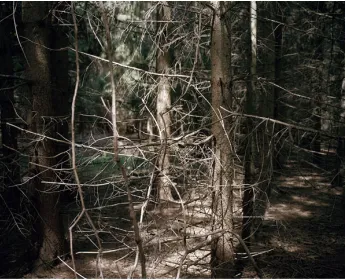
Figure 1. Untitled (VII), Through Place, 2011
Humans do not stand outside nature: we, too, are animals, a part of the very thing we have tried to control, whether for exploitation or protection. Just as humanity cannot be separated from nature, so our conception of nature cannot be said to stand outside of culture and society. We construct and are constructed by nature.
- Mark Dion1
Destruction is inseparable from creation, at times indistinguishable.
- Frank Gohlke2
We are constantly moving through places. As thinking, sentient, and embodied
beings we continually re-negotiate what, who, and where we are, the sorts of places we are
moving through, and what our relationships to these places might mean, or how we might
1 Mark Dion, “Some Notes towards a Manifesto for Artists Working with or about the Living World,” in
Radical Nature: Art and Architecture for a Changing Planet 1969–2009, catalogue (London: Barbican Art Gallery and Koenig Books, 2009), 239-40.
through photography explore, signify or represent that meaning. In natural places, further
questions emerge around our interaction with the natural world, including to what degree it
is “natural,” and what “natural” itself might mean.
Most of us pass by trees without thought, regarding them as stationary fixtures in the
landscape. Yet trees are alive and complex, with histories, futures, and memories. At times
we appreciate—perhaps for two moments rather than one—the density of the forest, the
tracks in the snow, or the quiet light of dusk. Sometimes it is these moments that become
photographs. Sometimes through just a line, a trace, an intimate detail, a whole world is
revealed.
CHAPTER I:CONTEXT
1.1 Early History
The first known photographs, from the early nineteenth century, were pictures of the
landscape. Early photographic emulsions were slow to react to light; stationary scenes made
good subjects. Additionally, the long history of representing the landscape in drawing and
painting made for a tradition in which the newly established photographic medium could
participate.
Photography largely commandeered the role of documenting or recording the
natural world, though such “recording” cannot be taken uncritically. Realist notions of
copying and documenting co-existed with metaphysical commitments to mysticism,
spiritualizing, stylizing, and appropriating nature. Photography has never been a direct copy
of anything; stylized or not, camera technology was (and is) designed to represent the world
in certain ways.3
Figure 2. Joseph Nicéphore Niépce, View from the Window at Gras, 1826
3 David Hockney writes, “Brunelleschi, looking through a hole at a street in Florence, makes a depiction of it
from a fixed viewpoint.... The photographic process is simply the invention in the 19th century of a chemical substance that could ‘freeze’ the image projected from the hole in the wall, as it were, onto a surface. It was the invention of the chemicals that was new, not the particular way of seeing.... So the photograph is, in a sense, the end of something old, not the beginning of something new.” From David Hockney, “The Limitations of
1.2 Background & Influences
For the world is movement, and you cannot be stationary in your attitude toward something that is moving.
– Henri Cartier-Bresson4
The most important influence in my development as an artist is my interest in the
natural world. Growing up in Miami, Florida, my first real, sustained connection to
“wilderness” was a month-long summer backpacking trip in northern California at the age of
fourteen. I loved being “in nature,” while at the same time I felt conflicted about my place in
it, due to the devastation human beings cause. I continue to feel awed and inspired by
[image:11.612.194.458.310.488.2]nature’s beauty, tragedy, and ironies. Photography allows me to explore these complexities.
Figure 3. Bridge, 1998
At the age of seven I made my first black and white pictures. In high school, I
studied photography with Rob Friedman. I learned from the works and writings of Eugène
Atget, Lee Friedlander, Robert Frank, Henri Cartier-Bresson, and many others.
I have always felt a pressing need to be unique, maybe because I am a twin.
Photography gave me a means of expressing my individualized way of seeing and
understanding the world, and subsequently became for me a means of being in the world.
That is, my being and understanding came about by exploring the world photographically,
extending my vision into lasting works. In college at Washington University in St. Louis I
continued to make photographs. I studied philosophy, focusing on the philosophy of art.
In graduate school at RIT I returned to my interest in exploring—photographically
and philosophically—the world and its diverse natural and constructed environments. The
photographs that comprise Through Place have been made in various places. Conceptually, the
work builds upon ideas I developed during my first year in graduate school, with the body of
work Mountain, which explores the constructed “natural” spaces of commercial ski
mountains.
Figure 5. Untitled (VI) from Mountain, 2010 Figure 6.Untitled (III) from Mountain, 2010
1.3 Contemporary Context
Over the past several decades, artists have been considering the landscape in terms
of changes brought about by humans. The exhibition, “New Topographics: Photographs of
in 1975.5 The New Topographics exhibition was one of the seminal turns in the
photographic consideration of what “landscape” is, and how it is represented. Instead of
turning the camera away from change (as many previous landscape photographers had done,
Ansel Adams and Edward Weston among them), the New Topographics photographers
began to photographically embrace—unapologetically, sometimes aesthetically—changes
that were coming about through industrialization and urbanization.6
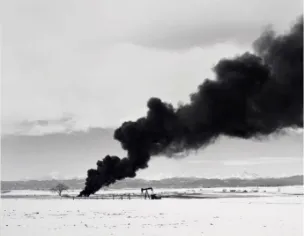
Robert Adams Burning Oil Sludge, North of Denver, Colorado, 1973-1974
Frank Gohlke Aerial View, Downed Forest Near Elk Rock, Lewis Baltz Nevada, 1984
[image:13.612.249.402.235.353.2]Approximately Ten Miles Northwest of Mount St. Helens, Washington, 1981
Figure 7.
The New Topographics photographers and the aesthetic sensibility they popularized
directly influenced my work in Through Place. While I do not try to mimic their ways of
seeing, having been exposed to this work all through my photographic education, I adopted
5 The show was curated by William Jenkins, and included six American photographers: Robert Adams, Lewis
Baltz, Frank Gohlke, Stephen Shore, Joe Deal, John Schott, and Henry Wessel, Jr., as well as the German photographers Bernd and Hilla Becher.
6 For a contemporary and insightful analysis of the full scope and consequences of this historic exhibition, see
a similar aesthetic intrigue in my own complex landscape. However, the way we now view
the pictures from New Topographics is different than how they would have been received at
the time they were made; at that point photographs of the landscape generally idealized the
beauty of nature, hiding, rather than portraying, human-made changes in the environment.
In my view my work departs from the New Topographics aesthetic in its representation of
space. My pictures are both dense and intimate, holding the viewer in, rarely showing an
expansive view or a horizon for visual exit. There is something a bit softer and quieter about
my pictures. My work additionally brings color into the visual conversation (though it is
often subdued, muted color.) Robert Adams and Frank Gohlke continue to influence my
work, through both their photographs and their writings about photography.
Jonathon Porritt writes: “Even the most artificial built environment is part of the
natural world; nature, in fact, does not exist as a separate entity: we are always inside an
environment with a group of other interdependent living organisms.”7 Many contemporary
photographers have participated in and expanded this dialogue about our changing
landscape, and this is a dialogue with which my work is also engaged. Mark Klett and Byron
Wolfe, John Ganis, and Ron Jude are among many whose work has been influential.
[image:14.612.338.539.518.654.2]
Figure 8. Ron Jude San Fernando Valley, CA, 2004 Figure 9. John Ganis Alaska Pipeline, North of Valdez, Alaska, 2001
7 Jonathon Porritt, Radical Nature: Art and Architecture for a Changing Planet 1969–2009 catalogue (London:
1.4 Linguistic Context
The word “landscape,” which comes from the Flemish landschap, means, by
definition, a man-made or man-altered and designated place. A particular space is not a
landscape until it is landscaped, or photographed, or described:
Photographs slice space into place; land is framed as landscape. Representation envelops reality; it becomes an act of colonisation. Photography contributes to characterizing sites as particular types of places within the order of things. The photographic image, in its precision and its detail, operates topographically and metaphorically.8
Thus there can be something problematic about discussing “landscape” as such.
“Landscape” presupposes a selected and determined space, usually in art. One goes walking
in the land; one does not “go walking in the landscape.” Landscape has a singular
perspective, a fixed point of view, and boundaries of its frame. A landscape is a view of land.
Though my photographs are landscapes, I still resist calling myself a “landscape
photographer.” I prefer to think I make photographs in nature rather than of nature. Likewise
I hope that my images bring a feeling of being in or moving through place, rather than looking at
place.
Figure 10. Untitled (XI) from Through Place, 2011
Wilderness—and its big sister “nature”—are cultural constructs, states of mind.
- Charles Warren9
There are also problems with discussing “nature,” as such. “Nature” is a linguistic
and social construct.10 We project boundaries and limitations onto the world, and then
impose our definitions to delineate them. We stand and point and say, “that over there is
natural.” We exclude ourselves from our own imposed definitions. Liz Wells writes:
Naming involves the objectification of that which is being designated. Designation of places inserts a sense of distance; in order to describe and categorize we position ourselves conceptually as somehow outside of our environment. Thus we can look on, and give it a name (whilst simultaneously being part of it experientially).11
These issues are an important part of my work, but they also make writing and talking about
the pictures difficult. My project considers what nature is and how our definitions and
images of nature shape our conceptions of our place in the world. These investigations are
complicated by linguistic conventions within which I must participate in order to discuss
them. Though there are important parallels between our linguistic and pictorial conventions,
this text deliberately meanders through these ideas the way the pictures do: suggestively and
unobtrusively (and sometimes inconclusively).
***
9 Charles Warren, “Wilderness,” in Patterned Ground: Entanglements of Nature and Culture, ed. Stephan Harrison,
Steve Pile, and Nigel Thrift (London: Reaktion Books, 2004), 140-1.
10 This is not to say that without us (or our language) the natural world would not exist. Nor does it mean if we
close our eyes it will go away. Rather it means that we have linguistically and socially decided what “Nature” is.
CHAPTER II:THE WORK
The lure, the wonder, of wild nature and its power to inspire does not depend on its existing in some antediluvian state of untrammeled perfection. It comes from the humbling yet uplifting sense of “nature in charge”—the perception that people are just visitors passing through.
- Charles Warren12
2.1 Where and Why
Taking pictures is, for me, a meditative way of considering, viewing, and engaging
my environment. Rather than documenting some thing that is there, my pictures ponder
curiosities that I see or ideas I wish to explore. I am interested in how plants and animals,
including humans, coexist and co-inhabit spaces, and how such co-habitation—which often
includes alteration—manifests visually.
My first body of work in graduate school, Mountain, explored the aesthetic and
conceptual complexities of the ski mountain landscape. Winter sports are somewhat
paradoxical. They are activities that allow us to be in and appreciate nature while
simultaneously requiring the mechanical invasion (and compromise) of that very place we
wish to be in to admire and enjoy. This setting can serve as a metaphor for larger
considerations about how we choose to live in an industrialized natural world.
The images in Mountain depict openings, paths, marks, and traces, which require the
alteration of one space, but which in turn create new spaces. Some of the marks are lasting,
some are temporary; some are intended, others are accidental. Some marks seem, and
appear, as natural as animal tracks; others feel foreign, distant, mysterious.
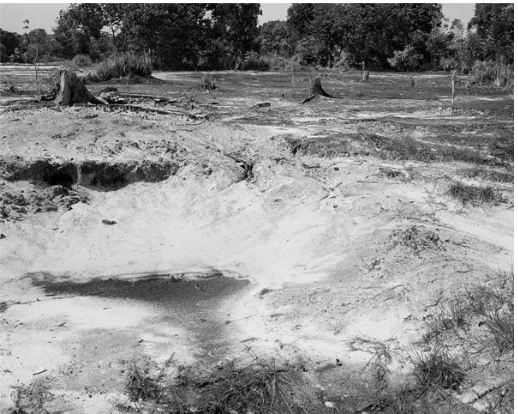
These explorations continued and expanded into other environments. I spent
January 2011 at a plant-medicine center in the northern Peruvian Amazon. This was my
second trip to this center where native plants, in combination with chanting, are used for
healing in Shapibo ceremonial traditions. The work I was doing and what I was learning
from the plants and facilitated through Shapibo ceremonies, enabled me to see differently.
This (culturally and experientially) different way of seeing influenced the type of
photographs I made. I began to see—though it felt more like being reminded—how
relationally connected everything in the world is. Our human paths through the world and
marks on it are signs not of our separation but of our connection. Things are not “in-” or
“out-of-” place, but rather complicated and connected places, places in time and space and
memories, places with histories.
I did not go to Peru in order to take pictures. I seldom go places in order to take
pictures. I photograph in places I already want to be in and explore (for other reasons) and
that exploration for me extends into the photographic. Making photographs is a way of
immersing myself in what I am learning: a way to try on newly learned ways of seeing the
world. This is one reason that traveling for me pairs with photography; not because I am in
some novel place in which I am seduced to photograph what looks different, but instead
because when I travel I am often learning the most about myself and about how others see
and understand the world. I practice and integrate what I am learning by making
photographs. This happens intuitively; I often do not see until later how my ways of seeing
were influenced by the place, culture, and history in which I was learning and traveling.
The way I made photographs in Peru influenced how I photographed my more
familiar landscape upon my return, and how I understood images I had previously made. I
began to see that the images I make share certain elements—for example, I tend to
photograph marks on the land that are beautiful and at the same time slightly ominous.
horizons. If there is a horizon at all it is usually blocked or obscured. In the picture, as in our
immersion in nature—like our immersion in language—there is no exit.
Figure 11. Untitled (V) from Through Place, 2011
The Amazon is rich with ironies, complexities, and contradictions. Within a
few-kilometer radius you could find: indigenous people living very close to the land, a luxurious
tourist lodge being built, and the greatest concentration of biodiversity in the world, at times
scattered with littered batteries and soda bottles.
During my time the jungle, despite the depths of its “wildness” (or maybe because of
it), I photographed complex visual scenes that often included a trace left by humans or other
beings, either intentionally or as a by-product of other activities. My process of looking and
photographing is dialogical. I move through space and observe the space, and question it,
listen to it. I do not feel I am “taking” pictures; I feel I am making pictures, in collaboration
with the place. As I discussed earlier, I make pictures when I am in places, not outside them.
Our experience of landscape involves a continual tension between the familiar and the new, the typical and the unique, between the tendency to fall back on comfortable habits of perception and the necessity for a heightened attentiveness to what is unprecedented in every situation. As a photographer my relationship to the landscape I photograph is one of dialogue. I am not simply the interrogator of a passive subject; I, too, am being questioned. I look at this place and ask “What is important here?” and the reply comes back, “What is important to you?” The work that results encompasses both questions. The faith one works with is that the answers have a measure of congruence.13
In the Shapibo tradition the relationship to plants is one of reverence, respect, and
humility. Plants are teachers and healers. Additionally they are utilized (and necessary) for
life—for building, food, energy, warmth, and medicine. Seeing life’s interconnectedness
influenced how and what I was photographing. One thing is not actually separate from the
next, though this is how we in Western culture linguistically describe, visually represent, and
subsequently have come to understand our surroundings. Photography as a medium
inherently contains this division: by photographing one is putting an object (a camera)
between the viewer and the place pictured. Despite the medium, I seek out ways to explore
this interconnectedness in my photographs. Like language, inherent divisions can, at the
same time, become transparent to a user, can become internalized conventions that
interconnect, not just divide.
As I returned to familiar environments (which looked different upon my return), I
photographed equally complex ecologies here, noticing that images made in dramatically
different places can compliment each other, and in certain ways fit together, as for example,
in Figures 12 and 13 (below).Untitled (XII) was made in the springtime in Rochester, while
Untitled (X) was made in the winter in California.
Figure 12. Untitled (XII) from Through Place, 2011 Figure 13. Untitled (X) from Through Place, 2011
In the image on the right the “marks” in the image are grooves cut in ice, by skis; in
the image on the left the “marks” are the lines of dead brush against the grass. By including
both pictures in the exhibition (and on the same wall), each complicates the other. Since
many of the marks in my images are on ephemeral surfaces—snow, ice, sand—in a sense the
more lasting mark is actually the photograph, not the trace itself.
Some, but not all, of the photographs in Through Place contain such a trace.
Sometimes it is explicit or invasive (or clearly human-made); other times, it is not. As the
series developed, the images became subtler. In the image below, the only indication of a
possible human presence is the alignment of the trees, suggesting they may have been
[image:21.612.239.412.556.696.2]planted, which you can see on the right side of the image where they glow in the light.
Some of the images are dense entanglements. Just as we are immersed and
inseparable from place (we are always both in a place and moving through a place), likewise
certain images hold the viewer in the image. Other images contain almost a piece of a story
or narrative, inviting interpretation but incomplete. The pictures give some information but
hold some information back. For example, in the picture below, the juxtaposition of the light
in the tree (and the unexpectedness of it being there at all) could be read to have any number
of meanings. At the opening reception of the exhibition it was interesting to hear how many
different interpretations people had of this picture. One person said it looked like a jewel in
the tree, another person said it could be an eye, and someone else asked if it was a camera. In
the context of the other pictures it is even more curious, since it is the only photograph in
the series that includes a mechanical structure.
2.2 Methodology & Working Process
“Through” suggests movement; it suggests being in something, but between two
other things. As I continue to make pictures, newer works give different meaning to
previous works; likewise, my ways of seeing one place affect how I see the next. As I
mentioned above, travel has been important in much of my work, both the exploration
afforded by new physical and cultural environments, and equally the way absence can make
the familiar appear and feel new and different upon return.
I work alone; making pictures for me is meditative. I combine color and black and
white because each offers different possibilities of aesthetic, mood, and tone. Combining the
two diversifies the group as a whole, and reminds us that the images are not places, they are
interpretations of place: “There is always a subjective aspect in landscape art, something in
the picture that tells us as much about who is behind the camera as about what is in front of
it. Pictures are never…cleanly tautological.”14 By combining color with black and white, I at
once participate in and depart from this history of traditional landscape photography. The
images are intended to be diverse. They are about more than the places they were made; they
are about the places created when represented in this way, and viewed together. In Chapter
IV I will elaborate on the experiential value of moving through the installation.
Figure 16. Through Place, installation view, SPAS Gallery
My process is a hybrid of digital and analog processes. I make my photographs with
a Mamiya 7 medium-format rangefinder camera. I work with film for its aesthetic qualities
as well as the physicality of the process—I appreciate the finite number of images per roll.
Not seeing the pictures until later allows me to remain engaged with my surroundings while
shooting. Viewing my pictures later allows me the chance to first sort and arrange them in
my memory.
Shooting, editing, and printing are equally important parts of my practice. I prefer to
focus on either shooting or editing/printing for a sustained time, rather than trying to move
back and forth between them. With each aspect of the process, a different set of skills,
sensibilities, and sensitivities emerges.
The darkroom is for me a place of inspiration, reflection, and contemplation. I work
in both the color and black and white darkrooms to make work prints, then scan my
negatives for large-scale digital output. The prints in this exhibition measure 32 x 40 inches
At this size they engage the viewer’s physical body and presence in the space, while retaining
enough information in the details that viewers also approach the prints to see them close up.
Most viewers move between viewing the image close and then standing back, thus engaging
both the viewers’ eyes and their bodies.
CHAPTER III:THEMES
Representation is, of course, ideological, but so is looking, since our engagement with what we perceive is subject to cultural currencies and preconceptions. […] We know that photographic vision is highly constructed. Nonetheless, photography significantly contributes to our sense of knowledge, perception and experience, and to (trans)forming our feelings about our relation to history and geography and, by extension, to our sense of ourselves.
- Liz Wells15
The idea of human beings standing apart from their surrounding environment is so deeply rooted, culturally and politically, that no amount of enforced instruction about today’s interdependencies and even physical indivisibility has yet dislodged it from our dominant worldviews.
- Jonathon Porritt16
3.1 Nature as Other
Photography, like language, is, a “dividing practice.”17 Although in many belief
systems, and in certain scientific and philosophical descriptions, one thing is not separate
from the next, this is often how we describe, represent, and understand our surroundings:
Naming involves the objectification of that which is being designated. Designation of places inserts a sense of distance; in order to describe and categorize, we position ourselves conceptually as somehow outside of our environment. Thus we can look on, and give it a name (whilst simultaneously being part of it experientially).18
Certain continental philosophers have contended that language is bigger than we are,
in contrast to how we normally conceive of it as something we possess. Instead, it is
something that possesses us. It is not our tool, we are its tool. Martin Heidegger writes,
“Language speaks, not the man; man only speaks insofar as he is artfully bespoken by
language.”19 Just as language is bigger than we are, despite our common descriptions of it, so
can nature be conceived similarly. We cannot step outside it; we are always enmeshed in the
larger inter-workings of the natural world.
15 Wells, 56.
16 Porritt, 6.
17 Cf. Michel Foucault on dividing practices; Power/Knowledge: Selected Interviews and Other Writings 1972-1977 ed.
Colin Gordon (New York: Pantheon, 1980), 78-109.
18 Wells, 20.
Yet photographs can depict nature as either interconnected or as separate from
humans and “unspoiled” by us; this was done in many photographs, including, for example,
those of Ansel Adams, who often depicted the sublime majesty of the “untouched” natural
world. While photographing does put something between the photographer and the scene
pictured, photography need not perpetuate the myth or experience of nature’s separateness.
The photographs that comprise Through Place are meant to complicate these
traditional conceptions of humans as outside of the natural world. In the photographs that
contain a trace of presence, the trace is explored aesthetically, with interest and without
judgment. In Figure 18, for example, the hovering (unnatural/mediated) perspective, and
the beautiful and graceful marks in the snow suggest a very definite presence and interaction
while the image is nevertheless instilled with tranquility.
Certain pictures suggest motion, though not necessarily human presence. Gilles Deleuze
writes:
Nature does not make any distinction at all between things that might be called natural and things that might be called artificial. Artifice is fully a part of Nature, since each thing, on the immanent plane of Nature, is defined by the arrangements of the motions and affects into which it enters, whether these arrangements are artificial or natural.20
Indeed, we are in nature, we are a part of it. Our representations can reject or embrace this.
Figure 19. Untitled (XIII) from Through Place, 2010
The moral and the aesthetic are not unrelated. These photographs are intended to be
both morally and aesthetically diverse. As a group they do not take a singular or explicit
normative stance; at times they aestheticize the development, alteration, and re-purposing of
various environments, yet they picture such things nevertheless for consideration. They were
made humbly, pondering curiosities. Taken out of context, individual images could be read
to have any of a number of different, and likely conflicting stances on our complex
human-altered environment. But taken as a group, the images are diverse and thus ambivalent. As a
series, Through Place is not geared toward a particular political or environmental end. Instead,
the series is intended to promote a variety of contemplative aesthetic experiences. I tried to
position the work in this way through my sparse and somewhat untraditional artist
statement:
What does it mean to be in a place, from a place, or move through place?
Tracks in sand and snow – marks of change. They will wash away but what caused those marks might not wash away. The picture points to the place where the marks point to change.
Traces wash away Light is changing now, as always
And right now somewhere has afternoon sunlight elsewhere it has heavy fog, cool gray light over the water, over the mountains…
Light is everything to pictures. It is their oxygen. I take pictures with air and light and movement. Sometimes the movement is arrested; there is an entanglement in picturing,
halting movement from passing through
stopping the viewer from passing (but not from looking).
Entanglements are enigmatic, they take us to places in our minds. Dense brush or dense packed ice shine with a silver tone from the light which changed
The picture is not the place; the picture is a place.
I walk so as to discover ambiguities of presence, unexpected conversations between me and place, between camera and place, between movement and memory.
These photographs are collaborations. The marks we make on the world are not signs of separation but of connection. Nature is not other.
These places exist now as representations that intermingle with our own beliefs, experiences, expectations, and memories. They extend temporally and spatially into an ever-changing and elusive world.
The aesthetic and the moral are not unrelated.
Paths take you through a place to an unknown and not yet visible place: a path stimulates and withholds expectations.
Every thing is moving, in-between. Tracks in snow
3.2 Wildness is Relative
While I was in the “wildness” of the Amazon, it was I who felt foreign. I thought, I
am wild in this place. Wild animals, for example, are “wild” only when they are in a zoo, or in a
children’s story, or viewed from a safari, or otherwise displaced from their native context, or
viewed from another’s context. “Wild,” like “natural,” is a construct that we project onto the
world. This projection then shapes our experience of being in, and seeing the world; “the
order that we place upon the world may not be the way in which the world is, in fact,
ordered.”21 Photographs have the potential to question our tendencies to order and organize
the world quantitatively.
In this body of work I have combined pictures made in diverse places ranging from
parks in Rochester to the Sierra Nevada Mountains to the Peruvian Amazon. I display these
images together so that they interact with one another, complicating the meanings of each
other (and the group). My intention with these juxtapositions is to dissolve traditional (and
often reductive) frameworks of order that we place on the world.
Photographs are, after all, “out of context messages.”22 In order to understand
photographs we must interpret them. J.M. Jauch explores this experience in Are Quanta Real?
in a fictional dialogue between two characters, Salviati and Sagredo:
Salviati: Nature presents us with a host of phenomena which appear mostly as chaotic randomness until we select some significant events, and abstract from their particular, irrelevant circumstances so that they become idealized. Only then can they exhibit their true structure in full splendour.
Sagredo: This is a marvelous idea! It suggests that when we try to understand nature, we should look at the phenomena as if they were messages to be understood. Except that each message appears to be random until we establish a code to read it. This code takes the form of an abstraction, that is, we choose to ignore content of the message by a free choice. These irrelevant signals form the ‘background noise,’ which will limit the accuracy of our message.
21 Harrison, Nigel, and Thrift, 27.
But since the code is not absolute there may be several messages in the same raw material of the data, so changing the code will result in a message of equally deep significance in
something that was merely noise before, and conversely: In a new code a former message may be devoid of meaning. Thus a code presupposes a free choice among different, complimentary aspects, each of which has equal claim to reality. 23
Jauch utilizes this example to demonstrate that, “we may not discover things as much as
actually create things according to our own predilections.”24 I have this in mind when
making, viewing, and writing about photographs. “Wildness” is relative to a larger paradigm
of normalcy or domesticity.
Figure 20. Untitled (VII) from Through Place, 2011
Often through basic compositional elements, photographs can nudge us to consider
these constructs through which we view the world. In Through Place, the viewer’s gaze might
be held by the formal complexity of the picture space (including the use of tone, line, and
the edge of the frame), or the mysterious marks depicted in the image, or the entanglements
that do not allow an exit, or the path that goes nowhere, leading into a mysterious thickness.
This builds on the phenomenological view that perception is an extension of our embodied
being in the world. Perception is active, not passive; it is part of our agency. In making these
photographs I am moving through space; I create these images so the viewer might feel her
own embodiment and directed perception while looking. Additionally, the installation itself
(and not just the photographs or the making of them) relates to this point about guiding,
shaping, and contributing to our phenomenological engagement with perception and
embodiment.
3.3 Thinking Through Place
These images are intended to complicate traditional ways of conceiving of nature or
viewing “place,” which tend to be site-specific, and somehow outside of time: static and
passive. My attention to temporal change and spatial movement in and through place also
challenges this idea about natural places. While a viewer can discern that these images were
made in diverse environments, there are few markers of a specific place. Without such
markers, the series begins to suggest that “place” might be more akin to fluid subjective
experience and interpretation than it is to specific geography or fixed physical location.
Photographs are multi-layered. They are representations of (or refer to) one place.
The subject of a photograph must exist or have once existed.25 Generally, and certainly
historically, a referent has been required for a photograph. In this sense photographs are
documents, they are (read to be) evidence of some thing’s existence.
The next layer or space in the photograph is temporal space. Photographs are made
in time, and thus, in a sense, they contain time. The picture exists in other times, but carries
with it the time in which it was made. Photographs of ecological spaces in which plants are
growing, water is flowing, and elements are continually at work carry this time. The site
where a photograph is made was changing, slowly, during the making of the picture, and has
been changing since: the snow has melted, the leaves have fallen, the light has changed, the
path has been trodden, the tracks have washed away. The static, unchanging, fixed
photograph contrasts, with the dynamic nature of the elements pictured.
Then there is the picture space: what is happening within the frame. Formal and
compositional elements contribute to the picture-space. This space is what makes a
photograph different from another one made in the “same place,” or why a photograph may
speak to someone in a different way than the place itself. The picture space can transform
something unsightly to something beautiful.26
Figure 21. Untitled (III) from Through Place, 2011
While I will discuss details of the installation in the next chapter, I here want to
mention the fourth layer of space that the photographs create: the installation space. This is
the physical, three-dimensional space in which the pictures are displayed, in which they
interact with each other, and with the viewer.
26 Susan Sontag writes, “Nobody ever discovered ugliness through photographs… what moves people to take
photographs is finding something beautiful. […] Nobody exclaims, ‘Isn’t that ugly! I must take a photograph of
[image:33.612.197.456.327.534.2]Lastly is the experiential interpretive space—the experience of the viewer, which
combines her own predilections, projections, expectations, and experiences with those
qualities offered by the picture. The interpretive space is not a fixed Newtonian space, but
rather an undefined place, one that varies between viewers, and even within the same viewer
from one time to another. In Six Walks in the Fictional Woods, Umberto Eco states:
There are two ways of walking through a wood. The first is to try one or several routes (so as to get out of the wood as fast as possible, say, or to reach the house of the
grandmother, Tom Thumb, or Hansel and Gretel); the second is to walk so as to discover what the wood is like and find out why some paths are accessible and others are not.27
My process of making photographs is the latter—to walk so as to discover. I hope my
pictures, too, invite and guide this sort of exploration, curiosity, interpretation, and diversity
of meaning.
Viewers will bring their own creative interpretations to the work. Robert Adams
writes, “We rely, I think, on landscape photography to make intelligible to us what we
already know.”28 I think for the interested viewer, photographs can also make intelligible to
us what we think we know, or thought we knew. At their best they can make us conscious of
our own predilections, self-reflective of our own supposed “knowledge.”
***
27 Umberto Eco, Six Walks in the Fictional Woods (Cambridge: Harvard University Press, 1994), 28.
CHAPTER IV:SHOW &INSTALLATION
Figure 22. Through Place installation view, SPAS Gallery
4.1 Installation
Exhibiting images together creates a conversation among them. Meaning emerges
not only from individual images but also by what happens (or does not happen) between
them—either within the photograph or in reference to something outside the frame. For
example, four images are displayed on the southern wall of the gallery; three are black and
white and one is in color. The color image is subdued; the image is of snow and nearly
monochromatic. This creates a relationship to the other images on the wall. Instead of
contrasting with the others, it (tonally) blends in. This references the photographic
conventions of color and black and white. The images highlight a continuum where in other
Figure 23. Through Place installation view, SPAS Gallery
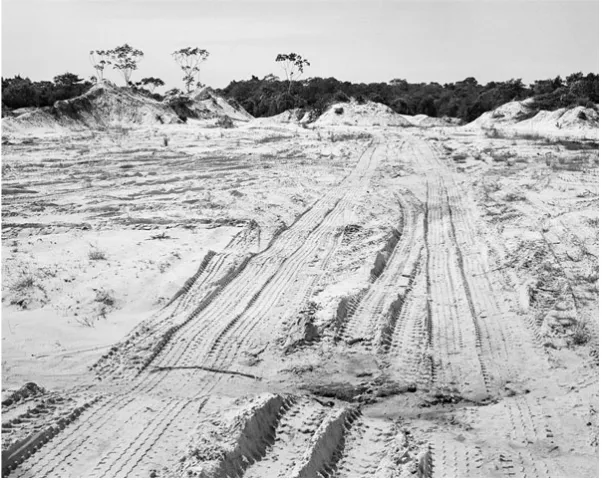
Likewise the show contains images that include both snow and sand from diverse
locales in different continents. Unlike what one might expect, there is no consistency of
place. In my exhibition, diverse places are shown beside each other, sometimes equalized,
other times contrasting. Photography here is not a medium of reportage, of conveying
specific information about a particular place. Instead, ski tracks, bulldozer tracks, and a
wooden boardwalk become about moving through place, and our relationship—visual and
existential—both to places and to their representations. In Thoughts on Landscape, Gohlke
discusses this aspect of his own work:
Thinking in pairs was a way of allowing the photographs to comment on one another while simultaneously undermining the claim of any one picture to be definitive… I hope that the unions create a conversation in which all parties—the two photographs, the places represented in them, the photographer behind them, and the people in front of them—are equally active, in which question and statement, fact and implication, clarity, and mystery all make their contributions. These open harmonies are not intended to resolve themselves; perhaps instead the shifting music of the voices in this conversation will help to vivify our perceptions, even when the overtones generated pass beyond the range of audibility.29
The SPAS Gallery contains three movable walls that allowed me to arrange the space
so that it could be most conducive to my work. The images are divided onto the walls in
groups of two and three; each set contains its own tones and diverse pictorial elements. As
the viewer walks through the space, the large prints engage the viewer spatially. Somewhat
counter-intuitively, the large scale of the pictures makes for a more intimate viewing
experience than with a photograph that a viewer can physically possess by holding in her
hand. The prints are larger than the viewers, and they encompass space around them; the
viewer must move into the space that surrounds the photograph. After all, these pictures are
about both: us consuming “the landscape” and the land containing (and consuming) us,
which it ultimately does.
Figure 24. Through Place installation view, SPAS Gallery
The photographs in Through Place constitute different voices in an ongoing
conversation: a conversation about humans and the natural world, marks and change,
representation of spaces, and knowledge and understanding through representations. Some
something ugly, but something whose ugliness is brought into a shared space with the
beautiful in their shared unresolve.
While the photographs exist in discrete space, the places they represent take on a
different (and distributed) existence: they intermingle with our own beliefs, experiences,
expectations, and memories. They extend temporally and spatially into an ever-changing and
elusive world; “a fictional universe doesn’t end with the story but extends indefinitely.”30
Figure 25. Untitled (VI) from Through Place, 2010
4.2 Opening & Defense
The opening reception of the exhibition was December 1, 2011. The show was well
attended by people both within and outside of the RIT community. People populating and
circulating in the gallery space gave the pictures an additional opportunity to challenge me as
the photographer, to suggest yet another layer of exploration of how nature, image, and
embodiment interrelate.
The gallery space became active and fluid with people milling around, which
contributed nicely to the underlying concepts of the show. I heard various interpretations of
the pictures, answered questions about where and why I made them, and discussed the
layout and other technical information. It was interesting to see the gallery space activate
with movement, sound, and energy during the opening. The pictures were made to be seen.
Having viewers in the space brought the show to life.
My thesis defense was on December 15, 2011. I presented a modified version of this
paper, discussed particulars of some of the images, and showed slides both of the works
themselves as well as the installation and the opening. Many insightful questions arose; I
have since gone back through this paper to address and answer the questions that were
posed by both my committee and the audience during my defense.
4.3 What’s Next: Malmö, Sweden
My next project, Building a Sustainable Aesthetic, expands the ideas I have explored in
this thesis. I will continue to explore the entangled and complex interactions between
humans and the natural world, extending this exploration to consider the aesthetics of
environmental and social sustainability. For this project, I will spend the fall semester 2012
as a visiting artist-scholar at Malmö University. I will photograph sustainable energy
installations, such as wind and solar power, focusing on how such technologies are
aesthetically and socially integrated into a diverse metropolitan environment. I will
supplement my photography by conducting research and interacting with scholars and urban
planners. Malmö is a world leader in sustainability studies and sustainable design; the city, in
partnership with the university, has been transformed from a previously industrial city into a
center of green innovation and university-community collaboration. My project pursues ways
photography can interact with green energy initiatives, and the role artists can play in
contributing to this interaction. Additionally I will be participating in the newly established
partnership between the Rochester Institute of Technology and Malmö University.
Knowledge and poetry are not in conflict.
- Mark Dion31
CONCLUSION
A picture can be dense, like a forest. It can at once invite us to enter, and prevent us
from entering…or exiting. It can refer to things we have seen, things we think we know. It
can be foreign and familiar at the same time.
Who are we, as viewers? Where do we stand in relation to the image and to the
world? Are we voyeurs or inhabitants, observers or participants? Where is our place in
“nature?” Our photographic conventions are not unlike our linguistic ones – we exclude
ourselves (linguistically and photographically) from the picture.
These photographs do something else. They are un-idyllic landscapes; many of them
contain a trace—an alteration to the land, a specter of presence. Yet these marks are pictured
inclusively—the scenes are explored aesthetically, without judgment. The images offer a
reformulation of the division between the human and the natural, wherein “the natural”
draws the largest circle.
The images are made in geographically and culturally diverse places. “Place” becomes
replaced by interpretation, fiction: representations that intermingle with our own agency,
expectations, and memories. The images are intended to be respectful interpretations of
moments in a beautiful, compromised, and changing world.
SELECTED BIBLIOGRAPHY
Adams, Robert. Beauty in Photography: Essays in Defense of Traditional Values. New York: Aperture, 1981.
--- Why People Photograph: Selected Essays and Reviews. New York: Aperture, 1994.
Barthes, Roland. Camera Lucida: Reflections on Photography. Translated by Richard Howard. New York: Farrar, Straus and Giroux, 1980.
Cartier-Bresson, Henri. The Mind’s Eye: Writings on Photography and Photographers. New York: Aperture, 1999.
Deleuze, Gilles. Spinoza: Practical Philosophy. San Francisco: City Lights, 1988.
Dion, Mark. “Some Notes towards a Manifesto for Artists Working with or about the Living World,” Radical Nature: Art and Architecture for a Changing Planet 1969–2009, catalogue. London: Barbican Art Gallery and Koenig Books, 2009.
Eco, Umberto, Six Walks in the Fictional Woods. Cambridge: Harvard University Press, 1994.
Foucault, Michel. Power/Knowledge: Selected Interviews and Other Writings 1972-1977. Edited by Colin Gordon. New York: Pantheon, 1980.
Ganis, John. Consuming the American Landscape. Stockport: Dewi Lewis, 2003.
Gohlke, Frank. Thoughts on Landscape: Selected Interviews and Writings. Tucson: Hol Art Books, 2009.
Heidegger, Martin. Poetry, Language, Thought. Translated by Albert Hofstadter. New York: Harper Collins, 1971.
Hockney, David. That's the Way I See It. Edited by Nikos Stangos. New York, Thames and Hudson, 2005.
Jauch, J.M. Are Quanta Real? Bloomington: Indiana University Press, 1973.
Porritt,Jonathon. “Foreward,” Radical Nature: Art and Architecture for a Changing Planet 1969–
2009, catalogue. London: Barbican Art Gallery and Koenig Books, 2009.
Sontag, Susan. On Photography. New York, Farrar, Straus and Giroux, 1977.
Warren, Charles. “Wilderness,” in Patterned Ground: Entanglements of Nature and Culture. Edited by Stephan Harrison, Steve Pile, and Nigel Thrift. London: Reaktion Books, 2004.
Wells, Liz. Land Matters: Landscape Photography, Culture and Identity. New York: I.B. Tauris, 2011.