Int. J. Electrochem. Sci., 8 (2013) 7948 - 7958
International Journal of
ELECTROCHEMICAL
SCIENCE
www.electrochemsci.orgEffect of Triethanolamine and Chloride Ions on Properties of
the Passive Films in Saturated Ca(OH)
2Solution
Xia Zhao1,*, Kun Cao1, Weihua Li1, Zuquan Jin2, Baorong Hou1
1
Key laboratory of corrosion science of Shandong province, Institute of Oceanology, Chinese Academy of Sciences, Qingdao 266071, PR China
2
School of civil engineering, Qingdao Technology University, Qingdao 266071, PR China
*
E-mail: [email protected]
Received: 29 March 2013 / Accepted: 10 May 2013 / Published: 1 June 2013
The influence of triethanolamine and chloride ions on protective ability and semi-conductive performance of the passive films, which formed on carbon steel surface in saturated Ca(OH)2 solution,
were investigated by electrochemical impedance spectroscopy(EIS), Mott-Schottky(M-S) plots as well as polarization curves. Two parameters, film resistance Rf and film capacitance Qf were provided by
fitting the EIS data with appropriate equivalent circuit. The semiconductor parameter, donor density Nd
was characterized by M-S plot. Based on the analysis of Rf, Qf, Nd in conjuction with point defect
model(PDM), the relationship between the film protective ability and its semi-conductive properties were concluded.
Keywords: Carbon steel; EIS; Polarization; Passive films
1. INTRODUCTION
Generally speaking, passive films could spontaneously form on carbon steel surface under alkaline environment[1-2], such as concrete pore solution with PH>12.5. The passive film with the main component Fe3O4·γFe2O3 owned stable performance to shield steel from corrosion as PH value
As previously reported[7-8], transmission of electrons and ions could lead to passive film formation, damage and pitting corrosion. The electric field, influenced by electron structure of the passive film, would promote the transmission process. So the barrier ability of the film is closely related with its semi-conductive characteristic.
In this paper, triethanolamine, one kind of the amines, which was applied as one of the earliest organic migrating rebar inhibitors in protecting the reinforced concrete structures[9], was selected to study its effect on electrochemical characteristic of the passive films formed on carbon steel surface in saturated Ca(OH)2 solution by electrochemical impedance spectroscopy(EIS), Mott-Schottky plots,
potentiodynamic polarization curves. Then the effect of the chloride ions on the passive film were researched in saturated Ca(OH)2 solution containing 0.5% and 2%(Wt.%)triethanolamine. Ultimately,
the relationship between the passive film protective properties and the semiconductor parameters were explored.
2. MATERIALS AND METHODS
2.1. Materials and sample preparation
The following chemical composition of carbon steel balance Fe: %C:0. 17; %P:0.0047; %S:0.017; %Mn: 0.46; %Si:0.26; %Cu: 0.019 was used.
Specimens used in the electrochemical experiment were sealed by epoxy resin with the exposure area of 1.0 cm×1.0 cm as working electrodes. The working surface was gradually polished with SiC abrasive papers to 800 grade, rinsed with distilled water, degreased ultrasonically in ethanol and acetone, and then dried at room temperature. Saturated Ca(OH)2 solutions(PH=12.7) with
0.5%,2%,4%(Wt.%) triethanolamine were selected as electrolyte solutions. The range of chloride concentration is different from 1% to 10%.
2.2 Electrochemical experiments
Electrochemical experiments were performed in a classical three-electrodes cell assembly with carbon steel as working electrode, a platinum foil of 2.0cm×2.0cm as counter-electrode, and a saturated calomel electrode (SCE) provided with a Luggin capillary as reference electrode. The electrochemical measurements are performed on cuboid carbon steel electrodes with 1cm surface area at 288K with PARSTAT 2273 Potentiostat/Galvanostat. EIS measurement was carried out in the 100kHz~10mHz frequency range at steady open circuit potential (OCP) disturbed with amplitude of 5mV. Mott-Schottky plots were executed in the potential range 1.0V~-1.4V(SCE) at the frequency 1kHz with the scanning rate of 20mv/s and amplitude of 5mV. The potentiodynamic polarization curves were obtained from -800 mVSCE versus OCP to +1000 mVSCE versus OCP with a scan rate of
1mV/s.
3.RESULTS AND DISCUSSION
3.1 EIS analysis
3.1.1 EIS diagrams without chloride ions
EIS diagrams of the passive films formed in saturated Ca(OH)2 solutions with
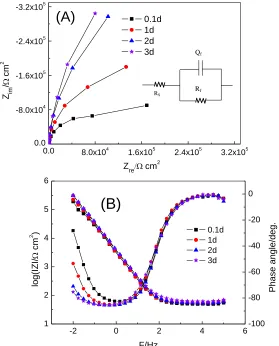
0,0.5%,2%,4%(Wt.%) triethanolamine were thoroughly determined. The curves present the similar law, so take the sample solution of 2% concentration for example. Fig.1 shows the evolution of EIS diagrams obtained at different time exposed in saturated Ca(OH)2 solution with 2% triethanolamine.
The diameter of the capacitance loop increased obviously at the initial time and attained a stable value two days later, indicating that the passive films formed gradually and could reach a steady state finally.
Figure 1. EIS plots of the passive film/carbon steel system at different time in saturated Ca(OH)2
solution with 2% triethanolamine.(A) Nyquist plots;(B)Bode plots.
3.1.2 EIS diagrams with chloride ions
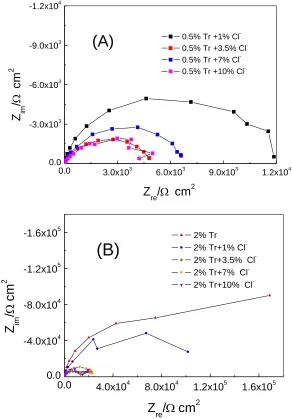
Fig.2 presented the Nyquist plots of carbon steel electrodes exposed in saturated Ca(OH)2
solution with triethanolamine and different concentrations of chloride ions. It was evident that all the plots presented the character of single capacitive loop, and the radius reduced with increasing the
0.0 8.0x10⁴
1.6x10⁵ 2.4x10⁵ 3.2x10⁵
0.0 -8.0x10⁴ -1.6x10⁵ -2.4x10⁵ -3.2x10⁵
RS
Qf
Rf
Zim
/
cm
2
Zrecm2 0.1d 1d 2d 3d
(A)
-2 0 2 4 6
1 2 3 4 5 6
-100 -80 -60 -40 -20 0
log(IZI/
cm
2 )
F/Hz
0.1d 1d 2d 3d
Phase
angle/d
eg.
[image:3.596.147.426.281.627.2]
chloride ions concentration, indicating that the protective ability of the passive film was gradually undermined by chloride ions.
Figure 2. Nyquist plots of carbon steel in saturated Ca(OH)2 solution containing 0.5%(A), 2%(B)
triethanolamine(Tr) and different concentrations of chloride ions.
3.2 Polarization curves
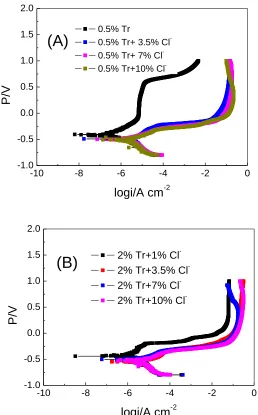
Some available information, such as passivation voltage and passivation current, could be obtained from polarization curves[10]. Fig.3 incorporated the polarization curves of the carbon steel electrode immersed in saturated Ca(OH)2 solution with 0.5% and 2% triethanolamine containing
different concentrations of chloride ions.
0.0 3.0x10³ 6.0x10³ 9.0x10³ 1.2x10⁴ 0.0
-3.0x10³ -6.0x10³ -9.0x10³ -1.2x10⁴
Z im
/
cm
2
Zre/cm2
0.5% Tr +1% Cl 0.5% Tr +3.5% Cl 0.5% Tr +7% Cl
0.5% Tr +10% Cl
-(A)
0.0 4.0x10⁴
8.0x10⁴ 1.2x10⁵ 1.6x10⁵ 0.0
-4.0x10⁴ -8.0x10⁴ -1.2x10⁵ -1.6x10⁵
Z im
/
cm
2
Zre/cm2 2% Tr 2% Tr+1% Cl 2% Tr+3.5% Cl 2% Tr+7% Cl 2% Tr+10% Cl
[image:4.596.128.420.131.550.2]
Figure 3. Change of polarization curves of passive film in saturated Ca(OH)2 solution with 0.5%(A)
and 2% (B) triethanolamine(Tr) and different concentrations of chloride ions.
From Fig.3A it could be seen that, in the solution without chloride ions but with 0.5% triethanolamine, the carbon steel could be passivated at about 0V(SCE) and the passivation current density was identified as 5.89×10⁻⁶A·cm-2
. But with the addition of chloride ions, the corrosion potential was decreased, the anodic dissolution was accelerated and even the passivation process could not be conducted. From the thermodynamic point of view, these changes indicated that the passive film was unstable[11]. The same process can also be observed in Fig.3B as the triethanolamine concentration was improved to be 2%.
3.3 M-S plots
To evaluate the effect of triethanolamine and chloride ions concentration on electronic properties of passive films, M-S plots were drawn[12]. The application of M-S plots is generally based
-10 -8 -6 -4 -2 0
-1.0 -0.5 0.0 0.5 1.0 1.5 2.0
P
/V
logi/A cm-2
2% Tr+1% Cl 2% Tr+3.5% Cl 2% Tr+7% Cl 2% Tr+10% Cl
-(B)
-10 -8 -6 -4 -2 0
-1.0 -0.5 0.0 0.5 1.0 1.5 2.0
P
/V
logi/A cm-2 0.5% Tr
0.5% Tr+ 3.5% Cl 0.5% Tr+ 7% Cl 0.5% Tr+10% Cl
[image:5.596.148.406.75.490.2]
on the assumption that the space-charge capacitance is much less than that of the Helmholtz layer, and hence, the measured capacitance is equal to the space-charge capacitance[13]. For n-type semiconductor, Eq.(1) is satisfied[14].
) (
2 1
0 2
q kT E E qN
CSC d fb (1)
Where, CSC is the space-charge capacitance, ε(about 15.6)is the dielectric constant of the
passive film, ε0(8.854×10⁻¹²F/m) is the vacuum permittivity, q(1.602×10⁻¹⁹C) is the electron charge,
k(1.38×10⁻²³
J/K) is Boltzmann constant, T(288K) is the absolute temperature, Nd is donor density and
[image:6.596.134.461.249.469.2]Efb is flat-band potential.
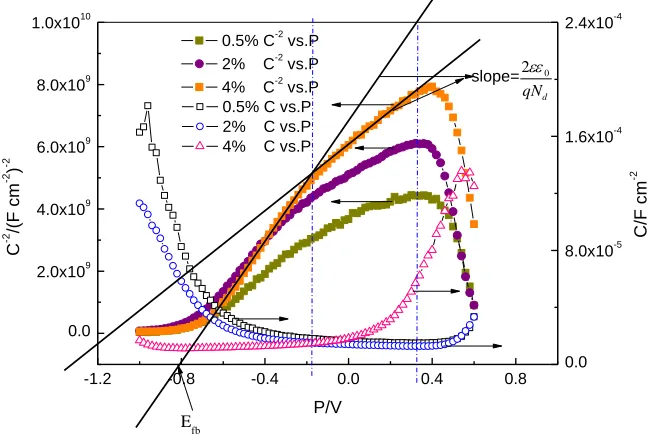
Figure 4. M-S plots and C/P plots of the passive film in saturated Ca(OH)2 with various concentrations
of triethanolamine.
Fig.4 and Fig.5 individually show the curves of C and C-2 plotted as a function of potential for the passive films in saturated Ca(OH)2 solution with various concentrations of triethanolamine and
chloride ions after two days immersion. It can be seen from Fig.4, the capacitance decreases with increasing the potential at the range of -0.66V~0.32V. The relation curve between 1/CSC2 and potential
can be departed into two straight lines with different slopes[15]. It is known that the passive films are composed of inner Fe3O4 layer and outer -Fe2O3 layer[16]. As the potential is lower than -0.18V,
Fe3O4 keeps at the thermodynamically stable state. The film capacitance would be controlled by Fe3O4
[17], so the first line was formed and the donor density was marked as Nd1. As the potential was bigger
than -0.18V, -Fe2O3 would stay at the thermodynamically stable state, now the film capacitance
would be controlled by -Fe2O3[17], so the second line appeared and the donor density was marked as
Nd2. Nd1 and Nd2 can all be calculated by Eq.1[18].At the potential range of -0.66V~0.32V, the slope of
the two lines were positive, which indicated that the passive film owns a typical behavior of n-type semiconductor[14]. As the concentration of triethanolamine changed from 0.5% to 4%, the passive
-1.2 -0.8 -0.4 0.0 0.4 0.8
0.0 2.0x10⁹ 4.0x10⁹ 6.0x10⁹ 8.0x10⁹ 1.0x10¹⁰
0.0 8.0x10⁻⁵ 1.6x10⁻⁴ 2.4x10⁻⁴
C
-2 /(
F cm
-2 )
-2
P/V
0.5% C-2 vs.P 2% C-2 vs.P 4% C-2 vs.P 0.5% C vs.P 2% C vs.P 4% C vs.P
d
qN
0
2
C
/F cm
-2
Efb
film always remained as the n-type semiconductors, and the line slopes increased with increasing the triethanolamine concentration. According to Eq.1, the donor density and the impurity density in the film would decrease simultaneously.
Figure 5. M-S plots and C/P plots of passive film in saturated Ca(OH)2 solution containing 0.5%
triethanolamine and different concentrations of chloride ions
Once the chloride ions added to the pore solution, as shown in Fig.5, the shape of the curves between E and CSC2 were different from those in Fig.4. The semi-conductive properties of the film
were ambiguous.
3.4 Point Defect Model (PDM)[19,20]
(2-1)
(2-2)
(2-3)
[image:7.596.136.436.152.354.2]
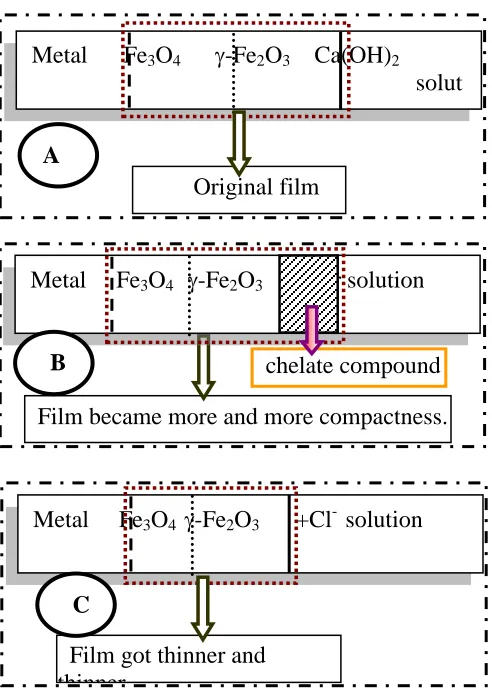
Figure 6. gives the schematics of the passive film structures on carbon steel surface in three different solutions.
3 8 3
'' ''
2
O 2
'
2 V V Fe O or
Fe Fe O
x Fe x
O
3
2 2 3 '' ' O nH Tr O nH Tr
VFe Fe
M-S pair reaction
O nH Cl O nH Cl
VO 2 O 2
VO
V 2
' Fe
-1.2 -0.8 -0.4 0.0 0.4
0.0 4.0x10⁷ 8.0x10⁷ 1.2x10⁸ 0.000 0.005 0.010 0.015 C -2 /(F cm -2 ) -2 P/V
1% C-2 vs.P
3% C-2 vs.P 5% C-2 vs.P
7% C-2 vs.P
C
/F
cm
-2
The PDM postulates that the point defects present in a barrier layer are, in general, cation vacancies (VM'), oxygen vacancies(VO), and cation interstitials (Mi ), as designated by the Kroger-Vink notation.
Eq.(2-1),Eq.(2-2)and Eq.(2-3) present the interfacial defect generation-annihilation reactions which are postulated to occur in the growth of passive film according to the PDM.
Where, OOis oxygen anion on the oxygen sublattice of the passive film, FeFe is iron cation on the iron sublattice of the passive film, '
Fe
V is iron vacancy on the iron sublattice of the passive film,
O
[image:8.596.185.431.251.597.2]V is oxygen vacancy on the oxygen sublattice of the passive film, Tr is the abbreviation of triethanolamine.
Figure 6. Schematics of the passive film structures on carbon steel surface. (A) In saturated Ca(OH)2
solution;(B) Added triethanolamine(Tr);(C)Added chloride ions.
In the pure saturated Ca(OH)2 solution shown in Fig.6(A), the corresponding equilibrium
reaction like Eq.(2-1) occurred.
In the solution shown in Fig.6(B), the reaction like Eq.(2-2) would appear. Triethanolamine would be a favorable chelate of Fe3+ to form the steady chelate compound. With the concentration of triethanolamine increased, more and more Fe3+ would be chelated. So, the donor density and the
Metal Fe3O4 -Fe2O3 +Cl- solution
Film got thinner and thinner.
C
Metal Fe3O4 -Fe2O3 Ca(OH)2
solut ion
Original film
A
Film became more and more compactness. Metal Fe3O4 -Fe2O3 +Tr solution
impurity density would decreased and ultimately, the compactness and uniformity of the film would be raised.
In Fig.6(c), as the solution including chloride ions, oxygen vacancies(VO) existing in the films/electrolyte interface would absorb the chloride ion and react with it to generate metal vacancy( '
Fe
V )/oxygen vacancy(VO) pairs via a Mott-Schottky Pair type of reaction, shown as (2-3). The generated oxygen vacancies(VO) react with additional chloride ion at the film/solution interface to
generate more metal vacancies( '
Fe
V ) in turn. Importantly, the generation of metal vacancies( '
Fe
V ) is autocatalytic, so the additional metal vacancies(VFe') will condense in local region, and then isolate the underlying metal and the passive to prevent the growth of the passive film. In this way, the dynamic equilibrium of the passive film was broken down. The dissolution rate of the passive film was faster than its growth rate. Finally, the pitting corrosion occurred and developed. The lattice structure of the passive film got changed. More and more oxygen and metal vacancies were involved in the passive films, which resulting in higher donor or acceptor densities.
3.5 Correlation between protective ability and semi-conductive properties
Table 1 has integrated all the results of donor density Nd1, Nd2, film resistance Rf and film
capacitance Qf of the passive film formed on carbon steel surface in saturated Ca(OH)2 solution with
various concentrations of triethanolamine at the second day. The values of Nd1 and Nd2 could be
calculated from the linear portion of 1/CSC2 plotted as a function of potential according to Eq.(1). The parameters of Rf and Qf could be obtained by modeling EIS experimental data with the equivalent
circuit(EC) embedded in Fig.1.
From Table 1 it can be summarized that Nd1 and Nd2 decreased while film resistance Rf
increased with the addition of triethanolamine, signifying that the charges on steel surface were altered accordingly, which can be spelled out by the thickness SC of the spacial-charge layer in Eq.(3)[21]:
2 / 1
0
2
q kT E
E
qNd fb
SC
(3)
Where, SC is the thickness of the space-charge layer. The significance of the other notations
[image:9.596.42.558.670.735.2]are as the same as Eq.(1).
Table 1. Values of donor density Nd , film resistance Rf and film capacitance Qf of the passive films
formed on carbon steel surface in saturated Ca(OH)2 solution containing different
concentrations of triethanolamine(Tr) two days later.
CTr/Wt.% Nd1/ m-3 Nd2/ m-3 Rf/Ω cm2 Qf/F cm-2 (Nd1+ Nd2)/ m-3
0.5 1.63×10¹⁹ 3.17×10¹⁹ 9.54×10⁵ 4.71×10⁻⁵ 4.80×10¹⁹
2 1.22×10¹⁹ 2.51×10¹⁹ 1.20×10⁶ 4.38×10⁻⁵ 3.73×10¹⁹
Eq.(3) proved that the donor density Nd was in inverse proportion to the thickness SC of the
space-charge layer. Here, the film thickness is considered to be equal to the thickness SC of the space-charge layer[22,23].
Therefore, donor density of the semiconductor film decreased, the thickness SC of the space-charge layer would increase instead, which would directly lead to natural improvement of protective ability of the passive film.
4.CONCLUSIONS
(1) The growing process of the passive films in saturated Ca(OH)2 solution with
triethanolamine can be judged by EIS method. The film growth rate was fast at the initial time, and then attained a relative steady state within 2 days.
(2) In saturated Ca(OH)2 solution, triethanolamine could enhance the protective ability of the
passive film with the film becoming more and more compactness, while the chloride ions would gradually weaken the protective ability of the passive film with pitting corrosion occurred, which can be strongly supported by the analysis of point defect model.
(3) From the perspective of the thickness of the space-charge layer, the donor density was inverse proportion to the protective ability of the passive film.
ACKNOWLEDGEMENTS
This work has been greatly supported by National Science Fundation (51178230).
References
1. U. Stimming, J. W. Schultze, Electrochim.Acta.,24(1979) 859-869.
2. D. G. Li, D.R.Chen, Y.-R.Feng, Acta. Chim. Sinica.,66(2008) 2329-2335.
3. D.H. Hong. Corrosion and protection of rebar in concrete, China railway press, Beijing, 1998,P1 4. K. Vinod. Corrosion. Rev., 16(1988) 317-358.
5. M.Moreno, W. Morris, M.G. Alvarez, Corros. Sci., 46(2004) 2681-2699. 6. A.Shamsad. Cement. Concrete. Comp.,25(2003) 459-471.
7. T. Okada, Corros. Sci., 31 (1990) 453-458.
8. J.W. Schultze, M.M.Lohrengel, Electrochim. Acta., 45(2000) 2499-2513. 9. A. Eydelnant, B.A. Miksic, L.Gelner, Conchem. J., 2(1993) 38-42.
10.M. Hara, Y. Shinata, Corros. Sci., 31(1990) 691-696.
11.J.G. YU, J.L.Luo, P.Norton, Appl. Surf. Sci., 177(2001)129-138.
12.R.J. Jiang, C.F. Chen, S.Q. Zheng. Electrochim. Acta. 55 (2010) 2498-2504.
13.A.M.P. Simoes, M.G.S. Ferreira, B. Rondot, B.M.D. Cunha, J Electrochem. Soc. 137(1990) 82-87. 14.H.Q. Wu. Dynamics of Electrochemistry Theory, Higher Education Press, Beijing, 1998.
15.H.X. Guo, B.T. Lu, J.L. Luo. Electrochim. Acta., 52 (2006) 1108-1116. 16.K. Azumi, T. Ohtsuka, N. Sato, J Electrochem. Soc., 134(1987)1352-1356.
19.A. Fattah-alhosseini, F. Soltani, F. Shirsalimi, B. Ezadi, N. Attarzadeh.Corro. Sci., 53 (2011) 3186–3192.
20.D.D. Macdonald, J. Electrochem. Soc., 153 (2006) B213-B224. 21.Y.Zhang, Q.Li, J. Zhejiang. Univ. SCIENCE A., 7(2006) 1447-1453.
22.A. Fattah-alhosseini, A. Saatchi, M.A. Golozar, K. Raeissi, Electrochim. Acta., 54 (2009) 3645-3650.
23.D.D. Macdonald, J. Nucl. Mater., 379 (2008) 24-32.