Contents lists available atScienceDirect
Computers & Education
journal homepage:www.elsevier.com/locate/compedu
The In
fl
uence of Values on E-learning Adoption
Ashwin Mehta
a,∗, Neil P. Morris
b, Bronwen Swinnerton
b, Matt Homer
baMedical Research Council, North Star Avenue, Swindon, SN2 1FL, UK bSchool of Education, University of Leeds, Hillary Place, Leeds, LS2 9JT, UK
A R T I C L E I N F O
Keywords: Technology adoption e-learning
Cross-cultural projects Culture and values UTAUT
A B S T R A C T
As technology continues to pervade our lives, the influence of culture on technology adoption is of significant interest to researchers. However, culture, as a group-level construct may not give meaningful results when related to individual-level adoption. Although culture has been in-tegrated into technology adoption models, values are the individual-level representation of culture, and are more appropriate to include in technology adoption models. There have been few studies attempting to explore the influence of values on adoption models, and none within the sphere of digital education. The purpose of this exploratory study is to integrate values with technology adoption models and apply the novel conceptual model to the context of digital education. In this study we investigate the influence of individual-level values on the adoption of e-learning by workers in The Gambia and the UK. Using the Unified Theory of the Acceptance and Use of Technology (UTAUT2) as a base model, we integrate values relating to conservation of the status quo and self-enhancement from Schwartz's Theory of Human Values. Taking this ap-proach, we develop and introduce the Values-Enhanced Technology Adoption (VETA) model. We tested the VETA model on the adoption of e-learning by workers in The Gambia and the UK. Empirical results demonstrated the influence of self-enhancement values in the model via social influence, price value and performance expectancy. The UTAUT2 base model was partially va-lidated in that performance expectancy, price value and habit primarily influenced worker in-tention to use e-learning. We conclude that VETA will be a useful model to researchers studying technology adoption.
1. Introduction
In recent years, there have been significant investments in digital learning technologies across all sectors. Despite such invest-ments, learning technology might be poorly adopted, discontinued or rejected by learners (Adelé & Brangier, 2013;Recker, 2016), therefore learner motivation and engagement remain topics of interest for researchers (Jung & Lee, 2018;Zhu, Sari, & Lee, 2018). Individual acceptance of technology has been investigated within the information systems literature, indicating that intention to use technology is predicted by user perceptions of technology attributes, specifically usefulness and ease of use (Davis, Bagozzi, & Warshaw, 1989).
Technology adoption models generally explain user intention as a function of user perceptions of attributes of the target tech-nology within the context of use (Venkatesh & Bala, 2008;Venkatesh & Davis, 2000). The latest iterations of technology adoption models include individual consumer preferences (price value, habit and intrinsic motivation) (Venkatesh, Thong, & Xu, 2012) and context (social factors and physical infrastructure) (Taylor & Todd, 1995;Venkatesh et al., 2012;Venkatesh, Morris, Davis, & Davis,
https://doi.org/10.1016/j.compedu.2019.103617
Received 10 December 2018; Received in revised form 28 June 2019; Accepted 29 June 2019
∗Corresponding author.
E-mail address:[email protected](A. Mehta).
Available online 03 July 2019
0360-1315/ © 2019 The Authors. Published by Elsevier Ltd. This is an open access article under the CC BY license (http://creativecommons.org/licenses/BY/4.0/).
2003). In the context of technology adoption models, incorporating social factors requires some consideration of culture (an ag-gregate, group-level framework that represents societal views), or values (an individual-level framework of internally held, enduring beliefs) (Hofstede, Hofstede, & Minkov, 2010;Rokeach, 1973;Schwartz, 1992). Few studies have integrated culture or values into the technology acceptance framework (Srite & Karahanna, 2006), using group-level cultural dimensions: the effects of individual-level values on individual-level decision-making remains an area for further investigation. This paper proposes that individual-level values influence user perception of the relative importance of technology, context or consumer-focussed attributes that lead to the intention to use technology. This study surveys workers across two contexts (The Gambia and the UK) to gather technology adoption and values data to determine the influence of these values on the adoption model derived from UTAUT2. The research objective of this study is to extend the UTAUT2 model to incorporate values at the individual level. This study contributes to the literature by being amongst the first to incorporate Schwartz's values framework into technology adoption literature, to investigate the influence of values on e-learning adoption, and to develop and validate the Values-Enhanced Technology Adoption (VETA) model.
2. Literature review
The adoption of e-learning depends on a learner's decision to use the technology, expressed in the literature asbehavioural intention(Davis et al., 1989). The Technology Acceptance Model (TAM), explainsbehavioural intentionas a product of user attitude toward technology attributes:perceived usefulnessandperceived ease of use(Davis et al., 1989). Venkatesh et al. empirically compared and consolidated the acceptance literature producing the Unified Theory of the Acceptance and Use of Technology (UTAUT and UTAUT2) which increased the explanatory power of prior technology acceptance models (Venkatesh et al., 2003,2012).
Although TAM has been used to explain learner adoption of technology-enhanced learning (Abbasi, Chandio, Soomro, & Shah, 2011;Ong, Lai, & Wang, 2004;Roca & Gagné, 2008), extended models such as UTAUT (Khechine, Pascot, & Bytha, 2014;Sumak, Polancic, & Hericko, 2010) and UTAUT2 (El-Masri & Tarhini, 2017;Raman & Don, 2013;Yang, 2013) have demonstrated the role of social and physical context, and consumer judgement in determining learner behaviour with educational technology.
User attitude, based on prior experience or an individual's worldview or culture, is linked with values, which may influence perceptions of technology or contextual attributes that help form decisions (Fishbein & Ajzen, 1975b;Rokeach, 1975). Culture is a multi-layered, multi-dimensional construct that represents an aggregate value system shared by individuals within a group (Hofstede et al., 2010;Rokeach, 1968;Schwartz, 2012). (Taras, Rowney, & Steel, 2009). Values are internally held beliefs about preferred end-states or outcomes that transcend situation and may act as a standard of behaviour (Rokeach, 1973). At an individual level, values explain the motivational foundation of attitude and behaviour, while the prioritisation of value structures at a group level help determine culture (Boer & Fischer, 2013;Schwartz, 1994a). Attitudes are formed towards an object applied in a scenario, and differ as values priorities shift even if the object and scenario are kept constant (Fishbein & Ajzen, 1975a). The premise that an attitude leads to a discriminatory response links values and technology acceptance theories.
The literature contains some studies that have investigated the influence of espoused culture (as a proxy for individual-level values) on user behaviour with technology (Srite, 2006;Srite & Karahanna, 2006;Tams, Thatcher, & Srite, 2012), with comparative studies in European (Göğüş, Nistor, & Lerche, 2012;Nistor et al., 2014;Nistor, Göğüş, & Lerche, 2013) and Middle-Eastern (Tarhini, Hone, & Liu, 2013;Tarhini, Hone, Liu, & Tarhini, 2017) e-learning applications. These studies generally agree that the social en-vironment provides a mechanism to link subjective norm to intention, with some agreement that collectivist cultures prefer to maintain normative stability. These studies, however, do not include African cultures, nor do they use theoretically derived values at an individual level to explore learner perceptions, relying instead on espoused national culture arbitrarily demarcated at geographical borders (McSweeney, 2002;Schaffer & Riordan, 2003).
Prior investigation on culture and values in technology acceptance models has used the empirically derived group-level di-mensions of culture proposed by Hofstede, operationalised by Dorfman and Howell (Dinev, Goo, Hu, & Nam, 2009;El-Masri & Tarhini, 2017;Hoehle, Zhang, & Venkatesh, 2015;McCoy, Galletta, & King, 2005;Srite & Karahanna, 2006). These studies collec-tively have found that Hofstede's group-level cultural constructs, such aspower distanceandindividualism, espoused at an individual level, can moderate the influence of adoption factors, such assubjective normsandperceived usefulness, onbehavioural intentionto use technology. However, these studies do not always agree on which dimensions produce an effect and demonstrate that effects differ across different countries and population groups (Nistor et al., 2014;Udo, Bagchi, & Kirs, 2012). The impact of Hofstede's cultural dimensions on the landscape of cross-cultural literature is significant, but not without critique (McSweeney, 2002). However, using group-level constructs such as culture to explain individual-level decisions potentially risks the ecological fallacy: an individual-level proxy for culture must be sought to integrate with decision models that operate at the individual level (Brewer & Venaik, 2014).
3. Model development
3.1. UTAUT
3.1.1. Performance expectancy (PE)
From the primary literature on technology acceptance (Davis et al., 1989), meta-analyses (Dwivedi, Rana, Chen, & Williams, 2011), and literature specific to e-learning (El-Masri & Tarhini, 2017;Šumak, Heričko, & Pušnik, 2011), perceptions of usefulness and ease of use are important in predicting behavioural intention to use e-learning. In UTAUT,performance expectancyis the‘degree to which an individual believes that system use will yield gain in work performance’and is typically the strongest predictor of intention. For workplace e-learning to be perceived as useful, learners judge their ability to achieve outcomes in their working environment (Chau, 2010). Therefore, consistent with TAM, UTAUT and UTAUT2, we includeperformance expectancy(PE) as a predictor of behavioural intention(BI).
3.1.2. Effort expectancy (EE)
[image:3.544.43.501.207.489.2]TAM and UTAUT have been used to explore the acceptance of e-learning by students and teachers in higher education settings, as well as the acceptance of vocational e-learning by employees in business settings. However, research has been conducted Table 1
Schwartz's values framework (Schwartz et al., 2012).
Value Dimension Value Conceptual Definition & Sub-Types
Openness to Change Following one's own intellectual interests
Self-Direction Self-direction of action and of thought. Priority of independent thought and action. Stimulation Priority of variety and excitement in life.
Hedonism Priority of pleasure and gratification. Self-Enhancement Priority of personal interests over others
Achievement Priority of personal success through the demonstration of competence.
Power Power over resources or dominance over people. Priority of social status, prestige and control over people and resources.
Conservation Preserving the status quo
Security Personal and societal security. Priority of safety, harmony and stable social relationships. Tradition Priority of existing customs and ideals.
Conformity Interpersonal and rule-based conformity. Priority of restraint in actions and impulses. Self-Transcendence Commitment to the welfare of others
Benevolence Priority of the welfare of others.
Universalism Priority of the welfare of the natural environment and wider society.
predominantly in developed countries with mixed results: the relevance ofperceived ease of useis greatest for vocational settings; the applicability of the model in developing countries is still relatively under-tested (Mbarika, Meso, Musa, Kah, & Amougou, 2007; Raman et al., 2014;Thomas, Singh, & Gaffar, 2013;Šumak et al., 2011).Effort expectancyis analogous to ease of use (TAM) and represents the‘degree to which system use is free from effort’. From the TAM (Davis et al., 1989),effort expectancyis expected to predictperformance expectancyas users perceive a technology to be more useful when it is easy to use. Therefore, we includeeffort expectancyas both a predictor ofperformance expectancy(PE) andbehavioural intention(BI).
3.1.3. Social influence (SI)
Social influencerepresents the pressure of subjective norm defined as the‘perception of group influence on an individual's de-cision’. In an organisation, users may perceive a technology to be more useful in helping to achieve job-related goals if referent others in the organisation, such as managers, endorse the use of such technology. The predictive influence of social factors onperformance expectancyhas been made in prior literature (Abdullah & Ward, 2016;Dwivedi, Rana, Jeyaraj, Clement, & Williams, 2017;Venkatesh et al., 2003). Similar toperformance expectancy, research in Africa has found varying effects fromsocial influenceonbehavioural intention(Kolog, 2015;Mtebe & Raisamo, 2014). Across the contexts of this study, learners who perceive e-learning as endorsed by referent others within their social environment are more likely to intend to use e-learning. Therefore, consistent with UTAUT and UTAUT2, the VETA model includessocial influence(SI) as a predictor ofbehavioural intention(BI).
3.2. UTAUT2 extensions
The most recent iteration of UTAUT (UTAUT2) has been adapted to include three additional variables:hedonic motivation(HM) expressed as perceived playfulness, enjoyment, fun and reward (Agarwal & Karahanna, 2000;Koivisto & Hamari, 2014;Martocchio & Webster, 1992; Roca, Chiu, & Martínez, 2006);price value(PV) incorporating cost, benefit, perceived sacrifice and status gains through assumed expensiveness (S. A.Brown & Venkatesh, 2005;Chau, 2010;Chen & Sun, 2014;Zeithaml, 1988); andhabit(HAB) (Labrecque, Wood, Neal, & Harrington, 2017;Limayem, Hirt, & Cheung, 2007;Venkatesh et al., 2012;Wood, 2017). While e-learning is not explicitly a consumer application of technology, digital education can be argued as a commodity (Chau, 2010), making concepts such ashedonic motivation,price valueandhabitrelevant to learner engagement.
3.2.1. Hedonic motivation (HM)
In the context of e-learning, intrinsic, or hedonic, motivation can be linked to learner enjoyment, playfulness with e-learning, learning strategy, theflow of the learning experience, and engagement, as well as the success of online learning (Barak, Watted, & Haick, 2016;Padilla-Meléndez, Del Aguila-Obra, & Garrido-Moreno, 2013;Sánchez-Franco, Martínez-López, & Martín-Velicia, 2009; Sørebø, Halvari, Gulli, & Kristiansen, 2009).Hedonic motivationmay link to learner perception of the usefulness of e-learning by facilitating learner exploration of information in an online environment, particularly in cultures where the extrinsic motivation focus of TAM does not explain learner behaviour (Saadé, Nebebe, & Mak, 2009). Acknowledging Ryan and Deci's Self-Determination Theory, there is likely to be a continuum of motivation for learners to use e-learning technology from purely extrinsic to purely intrinsic, with the reality likely to be a complex mixture of both (Ryan & Deci, 2000). However, e-learning courses that are engaging, well designed and interesting are likely to be perceived as useful by e-learners (Roca & Gagné, 2008). Across the contexts of this study, learners who perceive e-learning as intrinsically motivating are likely to perceive e-learning as useful; and, learners who are intrinsically motivated are more likely to intend to use e-learning, therefore, we includehedonic motivation(HM) in the VETA model, as a predictor ofperformance expectancy(PE) andbehavioural intention(BI).
3.2.2. Price value (PV)
Price valueis linked to a user making a cost-benefit decision, therefore a user may deem technologies more useful if the benefits are greater relative to the cost incurred (Venkatesh et al., 2012;Zeithaml, 1988). Althoughprice valueis often excluded from, or is found non-significant in studies where applications exclude direct monetary cost to users (El-Masri & Tarhini, 2017;Lewis, Fretwell, Ryan, & Parham, 2013;Raman & Don, 2013), for workplace learning, non-monetary costs may include time and effort required to access e-learning around work priorities, and the benefits can be linked to the extrinsic outcomes from learning, linking overall learning value to performance expectancy (Ain, Kaur, & Waheed, 2016). Therefore, we includeprice valuein the VETA model applied to e-learning in this study, as a predictor ofperformance expectancy(PE) andbehavioural intention(BI).
3.2.3. Habit (HAB)
Established routines in the workplace, forfinding information and learning job-related skills can be important in determining future actions with respect to achieving work-related goals and participating in work-related initiatives, such as e-learning (Verplanken & Aarts, 1999;Wood, 2017). Prior behaviours, perceived to be automatic, can result in initial adoption and prolonged use (Kim & Malhotra, 2005;Limayem et al., 2007;Venkatesh et al., 2012), or can provide a barrier to new initiatives (Labrecque et al., 2017). Therefore, consistent with UTAUT2, we includehabit (HAB) in the VETA model, as a predictor ofbehavioural intention (BI).
3.3. The Values-Enhanced Technology Adoption (VETA) model
that the learner places on their own interest inself-enhancement,and the priority they place on preserving the organisational fra-mework around them (conservation). Learning, irrespective of whether technology is involved, is likely to be linked with an in-dividual's priority forself-enhancement. E-learning is intended to enhance individual-level performance, and therefore intention to use e-learning should be predicted by a learner's preference forself-enhancement(Veiga, Floyd, & Dechant, 2001). Learner priority on achievementthrough course completion, and on the extrinsic outcomes that arise fromachievement, such as increased status, perceived knowledge and career opportunity are linked to the values ofachievementandpowerwithin theself-enhancementdimension. With respect to workplace e-learning, values related to Schwartz'sconservationdimension are likely to be important in determining learner opinion. Values in theopenness-to-change dimension, such ashedonism, are likely to link to learner perception of enjoyment in learning. Values in theself-transcendencedomain link to perceptions of society and the natural environment, which are unlikely to be relevant to individual-level adoption of technology such as e-learning, and therefore not included in the VETA model for e-learning adoption, although may be considered when applying the model to technologies that have societal impact. Definitions of Schwartz's values are shown inTable 1.
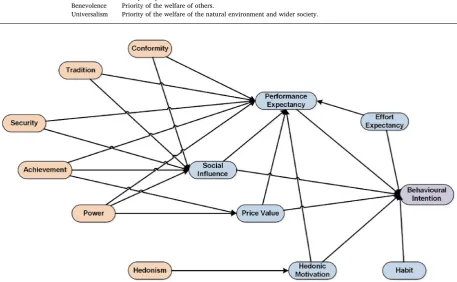
This study theorises that an individual's values will predict their perception of technological, contextual or personal attributes that lead them to make decisions about using technology and are therefore best placed as antecedents to those factors in a structural model. The Values-Enhanced Technology Adoption (VETA) model is shown inFig. 1.
3.3.1. Conservation values (security (SE), tradition (TR), and conformity (CO))
Individuals expressing highconservation values, both interpersonal and compliance, are likely to place great importance on meeting obligations within their social and organisational spheres including meeting the expectations of significant influencers in their social environment, both in terms of peer and organisational influence (Schwartz, 1992).Conformityin a workplace scenario might arise through following rules laid down by the organisation in terms of mandatory or endorsed training programmes. The value ofsecurity contains subtypes of personal security (personal health, safety, wellbeing) and societal security (stable social order) (Schwartz et al., 2012): for vocational training, it can be expected that workers complete basic training delivered via technology to safeguard their future employment against threat of competition from peers and through maintaining competence, therefore in-dividuals who place importance on personal security will perceive educational technology to be useful to their job performance. The value oftradition indicates an individual's priority on existing paradigms within their organisation (Schwartz, 1992). Workers prioritising the importance of existing organisational norms that relate to learning, development and career progression are likely to perceive the completion of workplace e-learning as worthwhile and endorsed by their normative framework. Workers will perceive vocational e-learning as useful to their career objectives, endorsed by referent others in their organisational hierarchy and worth their time and effort to complete. Therefore, we include conservation-type values (security,tradition andconformity) as predictors of performance expectancyandsocial influence.
3.3.2. Self-enhancement and openness-to-change values (achievement (AC), power (PO) and hedonism (HE))
Workplace learning, with or without technology assistance, can be expected to link withself-enhancementvalues. The concept of achievementincludes the demonstration of competence by the standards of one's reference groups and the pursuit of personal success (Schwartz, 1994a). The inherent worth of e-learning is linked toself-enhancement: learners use content to generate knowledge which improves their understanding, their social status, achievement within standardised testing, and potentially influences their ex-trinsically-rewarded job performance, such as career or promotion benefits (Schwartz et al., 2012; Venkatesh & Davis, 2000). Considering costs and benefits within the concept ofprice value, benefits of learning technologies may be linked to self-enhancement outcomes, while costs may be linked to context (Ain et al., 2016). The concept of dominance over resources and people are linked to both formal and informal status in an organisation: progression within the formal organisational hierarchy typically brings increased resource responsibility, as well as managerial responsibility over others; increased social status also brings informal power through perceived expertise (Schwartz et al., 2012). However, consideringachievement-related outcomes in the light of perceived learner value (Ain et al., 2016), it is expected that learners will consider learning outcomes relative to the effort incurred to access learning materials. The value ofhedonismoverlaps with both the dimensions of self-enhancement and openness-to-change and can be con-sidered as part of either dimension on the continuum of values proposed by Schwartz.Hedonism, incorporates intrinsic motivation, including novelty, challenge, excitement and pleasure (Schwartz et al., 2012), which is likely to predict user perception of e-learning enjoyment. Therefore, we include self-enhancement-type values (achievementandpower) as predictors ofperformance expectancy price value, andsocial influence andthe valuehedonismas a predictor ofhedonic motivation.
3.3.3. Excluded constructs
Demographic moderators of adoption are included in the UTAUT models as moderators of the relationships between adoption factors and behavioural intention (Venkatesh et al., 2003,2012). Demographic moderation has been studied in western ( Burton-Jones & Hubona, 2005;Venkatesh, Morris, & Ackerman, 2000), middle-eastern (Al-Ghaith, Sanzogni, & Sandhu, 2010) and Far-Eastern (Ong & Lai, 2006) environments. Overall, these studies have shown that age (Wang, Wu, & Wang, 2009;Wu, 2003), gender (Ong & Lai, 2006;Venkatesh et al., 2000), income (Al-Ghaith et al., 2010) and education can influence user intention to adopt (Li, Harris, Rossi, & Luck, 2013). However, moderator analysis requires large sample sizes, than were collected in this exploratory study combining two significant bodies of literature (values and e-learning adoption), are not included in the VETA model.
were not relevant to the individual-level adoption of technology. Secondly, values relating tostimulationandself-direction, while potentially relevant to learning were not reliable as constructs within the data collected in this study.
Our research question for this study is: Does the combination of Unified Theory of the Acceptance and Use of Technology (UTAUT2) and Schwartz's Theory of Human Values in a new model (Values Enhanced Technology Adoption (VETA)) explain learner intention to use e-learning in The Gambia and the UK?
4. Method
4.1. Sampling
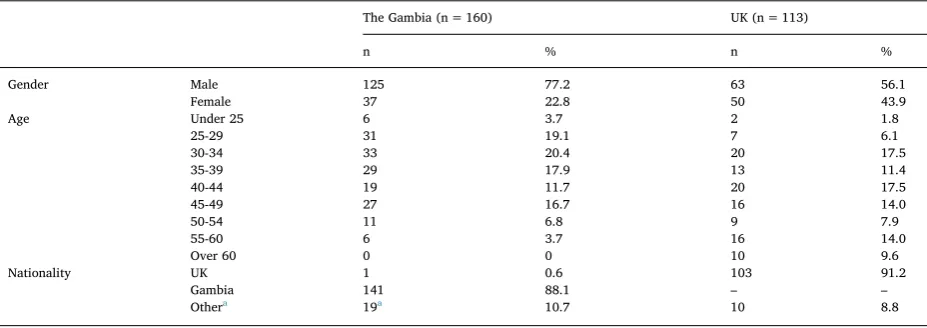
Two organisations participated in the study, one organisation in the UK, one organisation in The Gambia. Study participants were workers in each organisation who undertook the professional e-learning courses developed for this study. The e-learning course and survey were made available to all workers in each organisation for a duration of 3 months during 2016. Workers participated in the e-learning and self-selected into the survey. Workers in the UK were involved in the collection of geological data, workers in The Gambia were involved in the collection of clinical trial data. Both UK workers and Gambian workers had a variety of educational and professional backgrounds. Ethics approval was obtained in each country. The details of each group sample are shown inTable 2.
4.2. Survey design
E-learning was created in Articulate Storyline 2 to provide training relevant to the work of the participants. Workers in the UK received training on computer use, workers in The Gambia received training on community engagement. Embedded within the e-learning introductory screens was a three-part survey (deployed throughwww.onlinesurveys.ac.uk) where participants answered questions about demography, UTAUT2 (as shown inSection 12) and values. UTAUT2 adapted items (Venkatesh et al., 2012) (shown inSection 12) were scored on a 7-point Likert scale (7 = Strongly Agree, 6 = Agree, 5 = Slightly Agree, 4 = Neutral, 3 = Slightly Disagree, 2 = Disagree, 1 = Strongly Disagree) such that a high score indicated high perception of the latent variable. Values items were used directly from Schwartz's Portrait Values Questionnaire (PVQ5x) on a 6-point Likert scale (6 = Very much like me, 5 = Like me, 4 = Somewhat like me, 3 = A little like me, 2 = Not like me, 1 = Not like me at all) (Schwartz et al., 2012) (shown inSection 12).
4.3. Data screening and software
Partial Least Squares (PLS) was used to test the model, using the software SmartPLS (version 3.2.6, SmartPLS GmbH) (Ringle, Wende, & Becker, 2015). Means and standard deviations were calculated in the Statistical Package for Social Sciences (SPSS version 22, IBM). Data were cleaned to remove partial responses and outliers using a z-score of 3 as a threshold for removal (Tripathy, 2013). This process yielded 160 useable responses from The Gambia, and 113 from the UK.
5. Results
5.1. The sample
[image:6.544.41.505.76.240.2]Demographic information for the two country groups is shown inTable 2. The UK sample was relatively balanced in terms of Table 2
Demographic information.
The Gambia (n = 160) UK (n = 113)
n % n %
Gender Male 125 77.2 63 56.1
Female 37 22.8 50 43.9
Age Under 25 6 3.7 2 1.8
25-29 31 19.1 7 6.1
30-34 33 20.4 20 17.5
35-39 29 17.9 13 11.4
40-44 19 11.7 20 17.5
45-49 27 16.7 16 14.0
50-54 11 6.8 9 7.9
55-60 6 3.7 16 14.0
Over 60 0 0 10 9.6
Nationality UK 1 0.6 103 91.2
Gambia 141 88.1 – –
Othera 19a 10.7 10 8.8
gender (56% male) compared to the Gambian group (77% male). Both groups were spread across the working population in terms of age, with the Gambian group reflecting a lower retirement age, with no participants over 60 years old.
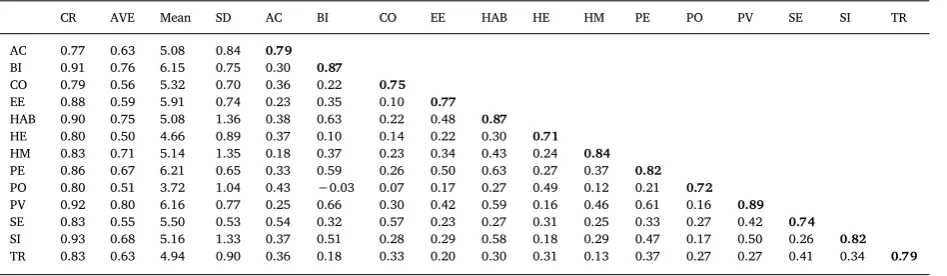
Reliability and validity data for the two country groups are shown inTable 3,Table 4, with the measurement model data shown in Table 5.
5.2. The measurement model
The measurement model was constructed using UTAUT2 as a base with values as predictors of adoption factors as theoretically proposed in the model development section above. Values were constructed as per their validated inventories (Schwartz et al., 2012; Venkatesh et al., 2012). Items with outer loadings below 0.7 in both groups were considered for removal if doing so increased composite reliability (CR) or average variance explained (AVE) in the construct (Joseph F.Hair, Hult, Ringle, & Sarstedt, 2014; Sarstedt, Ringle, & Hair, 2017). Item loadings were above 0.6 in each country group with the exception of item COI1 in The Gambian group. Items removed from thefinal model are shown insection 12.
[image:7.544.40.514.76.214.2]Tables 3 and 4 show the convergent and discriminant validity data for the VETA model for each country group. Composite Reliability (CR) for constructs in each country group was above 0.7 (Dijkstra & Henseler, 2015; Hair, Ringle, & Sarstedt, 2011; Nunnally & Bernstein, 1994). Average Variance Extracted (AVE) was above the threshold of 0.5 for all constructs in each country group (Hair, Anderson, Tatham, & Black, 1998b). Divergent validity was established by the Fornell-Larcker criterion: latent variable correlations exceeded the square root of AVE for each construct (Fornell & Larcker, 1981) (Tables 3 and 4). Outer VIF values were below the threshold of 5, indicating collinearity was not of concern (Hair, Anderson, Tatham, & Black, 1998a;Pan & Jackson, 2008; Rogerson, 2001;Venkatesh et al., 2012). Inner VIF values were below 5, indicating that common method variance was not of concern (Kock, 2015). Therefore, the data in the measurement model was sufficient to proceed with analysis in the structural model. Table 3
Reliability, validity and descriptive statistics (The Gambia).
CR AVE Mean SD AC BI CO EE HAB HE HM PE PO PV SE SI TR
AC 0.77 0.63 5.08 0.84 0.79 BI 0.91 0.76 6.15 0.75 0.30 0.87 CO 0.79 0.56 5.32 0.70 0.36 0.22 0.75 EE 0.88 0.59 5.91 0.74 0.23 0.35 0.10 0.77 HAB 0.90 0.75 5.08 1.36 0.38 0.63 0.22 0.48 0.87 HE 0.80 0.50 4.66 0.89 0.37 0.10 0.14 0.22 0.30 0.71 HM 0.83 0.71 5.14 1.35 0.18 0.37 0.23 0.34 0.43 0.24 0.84 PE 0.86 0.67 6.21 0.65 0.33 0.59 0.26 0.50 0.63 0.27 0.37 0.82 PO 0.80 0.51 3.72 1.04 0.43 −0.03 0.07 0.17 0.27 0.49 0.12 0.21 0.72 PV 0.92 0.80 6.16 0.77 0.25 0.66 0.30 0.42 0.59 0.16 0.46 0.61 0.16 0.89 SE 0.83 0.55 5.50 0.53 0.54 0.32 0.57 0.23 0.27 0.31 0.25 0.33 0.27 0.42 0.74 SI 0.93 0.68 5.16 1.33 0.37 0.51 0.28 0.29 0.58 0.18 0.29 0.47 0.17 0.50 0.26 0.82 TR 0.83 0.63 4.94 0.90 0.36 0.18 0.33 0.20 0.30 0.31 0.13 0.37 0.27 0.27 0.41 0.34 0.79
[image:7.544.40.517.534.671.2]AC = Achievement; BI=Behavioural Intention; CO=Conformity; EE = Effort Expectancy; HAB=Habit; HE=Hedonism; HM=Hedonic Motivation; PE=Performance Expectancy; PO=Power; PV=Price Value; SE=Security; SI=Social Influence, TR = Tradition.
Table 4
Reliability, validity and descriptive statistics (UK).
CR AVE Mean SD AC BI CO EE HAB HE HM PE PO PV SE SI TR
AC 0.84 0.72 3.46 1.06 0.85 BI 0.87 0.69 4.39 0.99 0.09 0.83 CO 0.84 0.65 4.27 0.94 0.14 −0.04 0.80 EE 0.93 0.73 5.33 0.91 0.00 0.48 −0.07 0.86 HAB 0.82 0.61 2.58 1.18 −0.04 0.50 −0.21 0.21 0.78 HE 0.88 0.66 4.26 0.83 0.28 0.14 0.11 0.25 0.14 0.81 HM 0.93 0.88 3.70 1.17 0.09 0.42 −0.05 0.32 0.32 0.23 0.94 PE 0.92 0.78 4.59 1.01 −0.02 0.59 0.02 0.36 0.45 0.13 0.44 0.89 PO 0.83 0.55 2.49 0.80 0.52 0.23 −0.09 0.12 0.19 0.28 0.17 0.10 0.74 PV 0.90 0.75 4.71 0.86 0.14 0.60 −0.01 0.47 0.39 0.22 0.49 0.53 0.13 0.87 SE 0.90 0.69 4.20 0.94 0.30 0.12 0.40 0.04 −0.01 0.12 0.06 0.12 0.17 0.06 0.83 SI 0.88 0.55 3.41 0.88 0.15 0.35 −0.09 0.14 0.36 −0.01 0.17 0.44 0.06 0.29 0.14 0.74 TR 0.91 0.77 3.07 1.22 0.24 −0.03 0.23 −0.07 −0.01 0.09 0.06 0.03 0.12 0.00 0.49 0.20 0.88
5.3. The structural model
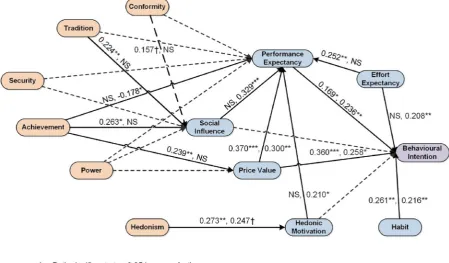
The VETA model (Fig. 2) explained similar variance (Adj. R2) inbehavioural intentionto use e-learning in The Gambia (53%) and the UK (52%), comparable with the literature (Venkatesh et al., 2012). Variance explained was comparable across countries for performance expectancy(48% in The Gambia, 42% in the UK); and forhedonic motivation(5% in The Gambia, 4% in the UK). The variance inprice valueexplained by the model differed in The Gambia (55%) and in the UK (4%), indicating a difference between groups in the perception of value from e-learning, and insocial influence(18% in The Gambia, 4% in the UK) indicating a difference in perceptions of social context.
[image:8.544.40.507.77.231.2]Influence onbehavioural intentioncame fromprice value,performance expectancyandhabitin both The Gambia and the UK; the predictors ofperformance expectancywereprice valuein both countries, withhedonic motivation, effort expectancyandsocial influence Table 5
Measurement model.
Items Item Loadings (The Gambia) Item Loadings (UK)
Achievement (AC) 2 AC2 (0.73), AC3 (0.85) AC2 (0.95), AC3 (0.74) Behavioural Intention (BI) 3 BI1 (0.86), BI2 (0.86), BI3 (0.91) BI1 (0.85), BI2 (0.74), BI3 (0.90) Conformity (CO) 3 COI1 (0.57), COI2 (0.82), COI3 (0.83) COI1 (0.90), COI2 (0.75), COI3 (0.76) Effort Expectancy (EE) 5 EE1 (0.78), EE2 (0.84), EE3 (0.84), EE4 (0.70), EE5
(0.65)
EE1 (0.91), EE2 (0.91), EE3 (0.93), EE4 (0.75), EE5 (0.76)
Habit (HAB) 3 HAB1 (0.86), HAB2 (0.90), HAB3 (0.85) HAB1 (0.90), HAB2 (0.78), HAB3 (0.64) Hedonism (HE) 4 HE1 (0.61), HE2 (0.68), HE3 (0.87), HE4 (0.66) HE1 (0.84), HE2 (0.69), HE3 (0.84), HE4 (0.86) Hedonic Motivation (HM) 2 HM1 (0.73), HM3 (0.94) HM1 (0.95), HM3 (0.92)
Performance Expectancy (PE) 3 PE1 (0.83), PE2 (0.79), PE3 (0.84) PE1 (0.83), PE2 (0.92), PE3 (0.90)
Power (PO) 4 POD3 (0.61), POR1 (0.78), POR2 (0.86), POR3 (0.58) POD3 (0.90), POR1 (0.62), POR2 (0.70), POR3 (0.72) Price Value (PV) 3 PV1 (0.89), PV2 (0.90), PV3 (0.90) PV1 (0.86), PV2 (0.84), PV3 (0.89)
Security (SE) 4 SEP2 (0.73), SEP3 (0.75), SES2 (0.77), SES3 (0.70) SEP2 (0.79), SEP3 (0.83), SES2 (0.91), SES3 (0.77) Social Influence (SI) 6 SI1 (0.88), SI2 (0.89), SI3 (0.87), SI6 (0.73), SI7 (0.73),
SI8 (0.82)
SI1 (0.76), SI2 (0.76), SI3 (0.82), SI6 (0.67), SI7 (0.72), SI8 (0.71)
Tradition (TR) 3 TR1 (0.70), TR2 (0.80), TR3 (0.87) TR1 (0.95), TR2 (0.85), TR3 (0.83)
[image:8.544.46.496.363.626.2]predicting performance expectancy in one country group only.Social influenceandhedonic motivationhad no direct predictive in-fluence onbehavioural intentionin either country group. The strongest influence from values on the model came from the priority of achievementon price value, social influenceandperformance expectancy;priority of hedonismon hedonic motivation, and priority of traditiononsocial influence. The structural VETA model for both The Gambia and the UK is shown inFig. 2.
For The Gambia, Composite Reliability (CR) were between 0.77 and 0.93, and Average Variance Extracted (AVE) were all be-tween 0.50 and 0.80 and greater than squared latent variable correlations indicating adequate convergent validity and internal consistency. Mean response and standard deviation (SD) is shown. Diagonal elements (bold) are the square root of AVE; off-diagonal elements are latent variable correlations. For discriminant validity, diagonal elements should be greater than off-diagonal elements. For the UK, Composite Reliability (CR) were between 0.82 and 0.93, and Average Variance Extracted (AVE) were all between 0.55 and 0.88 and greater than squared latent variable correlations indicating adequate convergent validity and internal consistency. Mean response and standard deviation (SD) is shown. Diagonal elements (bold) are the square root of AVE; off-diagonal elements are latent variable correlations. For discriminant validity, diagonal elements should be greater than off-diagonal elements.
5.3.1. The UTAUT2 core of the VETA model
Performance expectancy(PE) predictedbehavioural intention(BI) in both country groups indicating that both Gambian and UK learners intended to use e-learning where it was perceived as useful in achieving their goals (Fig. 2, β[The Gambia] = 0.169, p = 0.042;β[UK] = 0.236, p = 0.006). Price value(PV) predictedbehavioural intention(BI) in the both The Gambia and the UK (Fig. 2,β[The Gambia] = 0.360, p < 0.001;β[UK] = 0.258, p = 0.013), such that learners intended to use e-learning where it was perceived as worth the effort that they perceived they needed to contribute towards use.Habit(HAB) predictedbehavioural intention (BI) in both The Gambia and the UK (Fig. 2,β[The Gambia] = 0.261, p = 0.005;β[UK] = 0.216, p = 0.005), indicating that prior experience with online learning was an important factor in determining learnerbehavioural intentionto use e-learning irrespective of context. Price value (PV) predicted performance expectancy (PE) (Fig. 2, β[The Gambia] = 0.370, p < 0.001; β[UK] = 0.300, p = 0.004) such that learners perceived e-learning as useful if the benefits outweighed the costs.
Effort expectancy(EE) directly predictedbehavioural intention (BI) for UK learners (Fig. 2,β[UK, EE-BI] = 0.208, p = 0.005), supporting research in developed contexts, but acted viaperformance expectancy(PE) in The Gambia (Fig. 2,β[The Gambia, EE-PE] = 0.252, p = 0.006), indicating that while UK learners intended to use e-learning where it was easy to use, Gambian learners formed a perception of e-learning usefulness which included ease of use amongst other factors.Hedonic motivation(HM) had no direct relationship withbehavioural intention(BI) such that participants did not intend to use e-learning solely because they perceived it to be interesting or enjoyable (Fig. 2,β[The Gambia] = 0.019, p = 0.846;β[UK] = 0.046, p = 0.627). Similarly,social influence(SI) had no direct effect onbehavioural intention (BI) in either group (Fig. 2, β[The Gambia] = 0.103, p = 0.114; β[UK] = 0.050, p = 0.526): learners did not intend to use e-learning solely because of social pressures. However, for bothsocial influence(SI) and hedonic motivation(HM) there was an effect on the model viaperformance expectancy(PE) in the UK (Fig. 2,β[UK, SI-PE] = 0.329, p < 0.001;β[UK, HM-PE] = 0.210, p = 0.016) such that where e-learning was enjoyable, or there was endorsement of e-learning in the social environment, learners found e-learning useful in achieving tangible outcomes in their context.
5.3.2. Integrating values into the UTAUT2 model
There was no influence ofconformity, traditionorsecurityonperformance expectancyin either country group. The value oftradition had a significant influence onsocial influence(TR-SI) in the Gambian group (Fig. 2,β= 0.224, p = 0.003), with the path ofconformity onsocial influenceapproaching significance at the p < 0.05 level in the Gambian group (Fig. 2,β= 0.157, p = 0.053). There was an influence ofachievement(AC) in the VETA model: the path (AC-PV) was important in The Gambia (β= 0.239, p = 0.005) but not in the UK. An individual's priority on the value ofachievement predicted their perception ofsocial influence(AC-SI) in The Gambia (β= 0.263, p = 0.013), but not in the UK. The influence of achievement on performance expectancy was negative in the UK (β=−0.178, p = 0.026), and non-significant in The Gambia. An individual's priority for the value ofhedonismpredicted learner's perception ofhedonic motivation with a positive and significant path in the Gambian group with the path in the UK group also approaching significance at the p < 0.05 level (Fig. 2,β[The Gambia] = 0.273, p = 0.002;β[UK] = 0.247, p = 0.067).
6. Discussion
6.1. UTAUT2 was partially validated
This study supports the magnitude and direction of the direct relationships of:performance expectancy;price value; andhabiton behavioural intention.Performance expectancypredictedbehavioural intentionto use e-learning, in support offindings from the primary technology acceptance literature (Davis, 1989;Davis et al., 1989;Venkatesh et al., 2003,2012) and from previous e-learning studies (Ching-Ter, Hajiyev, & Su, 2017). Learners across The Gambia and the UK intended to use learning because they perceived that e-learning was useful in achieving their goals. The effect ofperformance expectancywas smaller than expected but dominant when compared with the effect of the other UTAUT constructs,effort expectancyorsocial influence, confirmingfindings from meta-analysis (Dwivedi et al., 2011;Khechine, Lakhal, & Ndjambou, 2016;Taiwo & Downe, 2013).Price valuewas the strongest direct predictor of behavioural intention, supporting the primary UTAUT2 literature in direction and significance (Venkatesh et al., 2012). Learners intended to use e-learning based on an evaluation of the non-financial costs, such as time and effort taken to use e-learning around work priorities, and the benefits, such as the increased competence gained from e-learning. Habit predicted behavioural intention to use e-learning supporting part of the literature that has found an effect of habit (Alawan, Dwivedi, & Williams, 2013;Venkatesh et al., 2012;Yuan, Ma, Kanthawala, & Peng, 2015). Learners intended to use e-learning where they had established routines that involved online methods of learning.
This study contributes to theory development by adding second-order relationships in the UTAUT model, bridging the gap be-tween e-learning adoption research (Abdullah & Ward, 2016) and the technology-agnostic information systems literature (Venkatesh et al., 2012).Performance expectancymediated relationships betweensocial influence,price valueandhedonic motivationonbehavioural intentionto use e-learning, supporting the dominant place ofperceived usefulnessin the adoption literature (Dwivedi et al., 2011; Šumak et al., 2011;Taiwo & Downe, 2013). The direct effect of social influence on learner intention was non-significant supporting prior literature (Teo, 2011;Terzis & Economides, 2011) and meta-analysis (Taiwo & Downe, 2013). In the UK, there was an indirect relationship of social influence on learner intention viaperformance expectancyimplying the influence was informational in nature, rather than normative, as learners gather information on usefulness from referent others in their environment.Hedonic motivationwas similarly only significant in the UK, indicating a potential difference in how enjoyment in workplace e-learning was perceived as effectual in helping to achieve knowledge outcomes by the two cohorts.
The influence ofeffort expectancydiffered between the UK and The Gambia.Effort expectancyonly directly predictedbehavioural intentionto use e-learning for the UK group. Thisfinding adds to the speculation that the place of the construct ofeffort expectancyas a technology-agnostic, context-agnostic direct predictor of intention in the UTAUT paradigm is uncertain (Baptista & Oliveira, 2016). UK learners intended to use e-learning because of ease of use directly, without the mediating effect of performance expectancy, supporting the literature from developed nation contexts (Tarhini, Hone, & Liu, 2014). The influence ofeffort expectancydiffered by context, acting directly on intention in the UK, and viaperformance expectancyin The Gambia, reinforcing prior claims that the literature corpus generated in developed countries cannot be readily applied in the context of sub-Saharan Africa without additional research (Brown, 2002;Musa, 2006).
6.2. Self-enhancement values predicted the adoption model
Thefinding that learners who prioritisedachievementperceived e-learning as worth the cost, was supported in the Gambian group. The construct ofprice valueindicates a positive balance of cost and worth perceived by the learner, leading to three possible ex-planations for thisfinding, either: UK workers did not link e-learning withachievement; UK workers did not place worth on the perceivedachievementthat was linked with completing the e-learning course; or did not perceive that the worth assigned to e-learning was proportional to the cost incurred. Considering that to monetary cost to participants was zero, cost was theoriseda priorito be incurred in other ways, such as time management or the cost of internet access. There is some indication in the literature that participants in sub-Saharan Africa have difficulties accessing infrastructure such as power, networks and devices (Folorunso, Ogunseye, & Sharma, 2006;Tarus, Gichoya, & Muumbo, 2015;Touray, Salminen, & Mursu, 2013). Therefore, for Gambian learners, travelling to a place that has appropriate network, power and device infrastructure or the cost of providing such infrastructure for themselves may be perceived costs.
The argument that cost/benefit proportionality explains the negative link betweenachievementandprice valuefor UK workers is unlikely to be the explanation because the costs for UK workers were small. The explanation of thisfinding might, therefore, be linked to the worth placed by a learner on the achievement from e-learning. In the UK workplace e-learning is relatively abundant and might not precede career advancement; in the Gambian group, e-learning was relatively scarce, and further courses might link to career advancement (Njenga & Fourie, 2010).
Thefinding that learners who prioritisedachievementperceived a similar sentiment in their reference group was only supported in the Gambian group. Thisfinding indicates that the group perception of e-learning is linked toachievement, and that members of the group perceive e-learning as linked to a sense of achievement. Thisfinding supports the literature that argues that African societies are more collectivist than the UK, and therefore place more emphasis on group influence (Hofstede et al., 2010).
Thefinding that learners who prioritise pleasure in their livesfind e-learning enjoyable may be more complex than a trivial link between value and perception. With the literature emphasis onhedonic motivationas perception that has a target (a technology) (Brown & Venkatesh, 2005), and the investment priority in educational technology to make engaging and interesting learning products through creative instructional design, thefinding that a learner's prior interest in engagement with educational technology determines intrinsic motivation indicates that producing engaging products may be less important than previously thought.
individuals place on maintaining a status quo of subjective norms and the influence they feel from their reference group was not apparent in the data (Schwartz et al., 2012). Potentially, a loose mandate for professional e-learning removes the link toconformity and jobsecurity: if learners perceive e-learning in their workplace as encouraged but not mandatory, and there is no explicit reward or punishment, then ideas such as conformity and security may not be important. Linking withachievementvalues, if theachievement accrued through e-learning has no tangible benefit associated with it in terms of job security or career structure, thenconformityand securitywould not be important in determining e-learning adoption. The link between these values and the adoption model should be explored further in future research.
6.3. Limitations
Due to the relatively small sample collected, it was not possible to run moderator analysis, so gender and age effects were not included. A larger study, incorporating different countries, organisations or different technologies, might provide the additional experimental power and data stability to investigate moderator effects, as well as the additional values in theself-transcendenceand openness-to-changevalues dimensions to determine their influence on adoption. Similarly, it was not possible to develop a more complex model, with constructs forfacilitating conditions,self-directionandstimulationproving unreliable with the small sample of data collected. Additional data would add to the strength of thefindings and the explanatory power of the model.
It was not possible to conduct the study on two organisations with similar worker profiles: UK workers have an infrastructure which supports technology, and as such, workers are comfortable with computing devices; Gambian workers have an infrastructure that is susceptible to power and network instability, and lack of device availability. It was not possible to conduct random sampling due to the small populations of workers in the target organisations, instead, all workers were invited to participate, resulting in self-selection, which is a limitation of this study.
6.4. Implications for practice
The importance of achievement has important implications for practitioners: e-learning that is perceived as yielding low achievementis unlikely to be linked to an intention to adopt the e-learning. Linking this to prior literature that indicates prior experience of low-value learning is likely to yield poor learner perception of learning, since users may not always separate e-learning into content, pedagogy, and the complex network of hard and soft technology, practitioners should ensure that the content, design, pedagogy, implementation, and technology are all perceived as high value to learners if a course is to be adopted.
Practitioners implementing e-learning in workplace contexts should also be mindful of the link between perceived cost and usefulness in achievement. Practical considerations for training managers should include providing adequate time and resources to complete e-learning, and providing appropriate reward following e-learning, such as a certificate of achievement and follow-on courses for further development.
Organisations can apply e-learning in similar manners in different cultures but must be mindful that what works in one might not work in another. It is therefore important to investigate what learners in each organisation deem as expected outcomes, costs and who key players in the social environment might be, before investing in an e-learning project.
6.5. Future research
To explain similarities and differences, it is important to expand the differing perceptions of UTAUT2 variables by context, therefore a qualitative study would be beneficial to deconstruct these variables. With the VETA model developed and validated in this study, further work is required to generalisefindings to other contexts, to determine the breadth of applicability of the model.
Although this study uses e-learning as a vehicle to test the model, the nature of human values being scenario-agnostic, and UTAUT being technology-agnostic, mean that the VETA model could be applied to other scenarios. Although links between the dimensions of self-transcendence and individual-level adoption were not included in the VETA model for e-learning adoption, they should be considered when applying the model to technologies that have societal impact.
7. Conclusion
Schwartz's theory of human values was used to extend the UTAUT2, to develop the Values-Enhanced Technology Adoption (VETA) model, which was validated in the context of e-learning adoption in The Gambia and the UK. This exploratory study de-monstrated that the VETA model partially applied in both contexts, withbehavioural intentionpredicted byperformance expectancy, price valueandhabit, and the value ofachievementbeing an important predictor of adoption factors.
Funding and approvals
Conflicts of interest
The authors declare no conflicts of interest.
Acknowledgements
The authors would like to thank staffat each organisation who participated in the study, particularly local e-learning champions at: Medical Research Council Unit The Gambia at the London School of Hygiene & Tropical Medicine (Sheikh Mafuji Dibba) and the Natural Environment Research Council British Geological Survey in the UK (Chris Milne), and Michael Stephens (Medical Research Council, part of UK Research & Innovation) for supporting the project.
Appendix A. Survey Items
UTAUT2 Items
Item Statement
Performance Expectancy (Venkatesh et al., 2012) PE1
PE2 PE3
Ifind e-learning useful in my daily life
Using e-learning helps me accomplish things more quickly Using e-learning increases my productivity
Effort Expectancy (Venkatesh et al., 2012) EE1
EE2 EE3 EE4 EE5
Learning how to use e-learning is easy for me
My interaction with e-learning is clear and understandable Ifind e-learning easy to use
It is easy to become skilful at e-learning
Using e-learning is as easy as using any other systems I have previously used Social Influence (Nasution, 2007;Venkatesh et al., 2012)
SI1 SI2 SI3 SI4* SI5* SI6 SI7 SI8
People who are important to me think that I should use e-learning People who influence my behaviour think that I should use e-learning People whose opinions that I value prefer that I use e-learning My organisation supports the use of e-learning
I use e-learning because of the proportion of my co-workers who use e-learning People in my organisation who use e-learning have a high profile
Having e-learning is a status symbol in my organisation
Using e-learning strengthens my position and influence in my organisation Habit (Venkatesh et al., 2012)
HAB1 HAB2 HAB3
The use of e-learning has become a habit for me I am addicted to the use of e-learning I must use e-learning
Hedonic Motivation (Venkatesh et al., 2012) HM1
HM2* HM3
Using e-learning is fun Using e-learning is enjoyable Using e-learning is very entertaining Price Value (Venkatesh et al., 2012)
PV1 PV2 PV3
Compared to the effort I need to put in, e-learning is beneficial for me Compared to the sacrifice I need to make, e-learning is worthwhile for me Overall, e-learning is good value
Behavioural Intention (Venkatesh et al., 2012) BI1
BI2 BI3
I intend to continue using e-learning in the future I will always try to use e-learning in my daily life I plan to continue to use e-learning frequently
*Removed from model due to loading below 0.6 across both country groups.
Portrait Values Questionnaire (PVQ-5X)
Survey Item Question/statement (Male version is shown) (Schwartz et al., 2012)
“Here we describe some people. Please read each description and think about how much each person is or is not like you. Select the option that shows how much the person in the description is like you. How much like you is this person?”
Conformity
COR1* COR2* COR3* COI1 C-OI2 COI3
He believes he should always do what people in authority say It is important to him to follow rules even when no one is watching Obeying all the laws is important to him
Tradition
TR1 TR2 TR3 It is important to him to maintain traditional values or beliefs
Following his family's customs or the customs of a religion is important to him He strongly values the traditional practices of his culture
Security
SEP1* SEP2 SEP3 SES1* SES2 SES3
He avoids anything that might endanger his safety His personal security is extremely important to him It is important to him to live in secure surroundings
It important to him that his country protect itself against all threats He wants the state to be strong so it can defend its citizens Having order and stability in society is important to him Power
POR1 POR2 POR3 POD1* PO-D2* POD3
Having the feeling of power that money can bring is important to him Being wealthy is important to him
He pursues high power and status He wants people to do what he says
It is important to him to be the most influential person in any group It is important to him to be the one who tells others what to do Achievement
AC1* AC2 AC3 He thinks it is important to be ambitious Being successful is important to him He wants people to admire his achievements Hedonism
HE1 HE2 HE3 HE4
Having a good time is important to him Enjoying life's pleasures is important to him He takes advantage of every opportunity to have fun Excitement in life is important to him
*Removed from model due to loading below 0.6 across both country groups.
References
Abbasi, M. S., Chandio, F. H., Soomro, A. F., & Shah, F. (2011). Social influence, voluntariness, experience and the internet acceptance: An extension of technology acceptance model within a south-Asian country context.Journal of Enterprise Information Management, 24(1), 30–52.https://doi.org/10.1108/
17410391111097410.
Abdullah, F., & Ward, R. (2016). Developing a general extended technology acceptance model for E-learning (GETAMEL) by analysing commonly used external factors. Computers in Human Behavior, 56, 238–256.https://doi.org/10.1016/j.chb.2015.11.036.
Adelé, S., & Brangier, E. (2013). Evolutions in the human technology relationship: Rejection, acceptance and technosymbiosis.IADIS International Journal on WWW/ Internet, 11(3), 46–60.
Agarwal, R., & Karahanna, E. (2000). Timeflies when you’re having fun: Cognitive absorption and beliefs about information technology usage.MIS Quarterly, 24(4), 665–694.
Ahmad, W., & Sun, J. (2018). Antecedents of SMMA continuance intention in two culturally diverse countries: An empirical examination.Journal of Global Information Technology Management, 21(1), 45–68.https://doi.org/10.1080/1097198X.2018.1423840.
Ain, N., Kaur, K., & Waheed, M. (2016). The influence of learning value on learning management system use: An extension of UTAUT2.Information Development, 32(5), 1306–1321.https://doi.org/10.1177/0266666915597546.
Al-Ghaith, W., Sanzogni, L., & Sandhu, K. (2010). Factors influencing the adoption and usage of online services in Saudi Arabia.The Electronic Journal on Information Systems in Developing Countries, 40(1), 1–32.
Alawan, A., Dwivedi, Y. K., & Williams, M. D. (2013). Adoption of self-service technology by Jordanian customers.Proceedings of business School postgraduate research conference(pp. 47–54). Swansea University.
Baptista, G., & Oliveira, T. (2016). A weight and a meta-analysis on mobile banking acceptance research.Computers in Human Behavior, 63, 480–489.https://doi.org/ 10.1016/j.chb.2016.05.074.
Barak, M., Watted, A., & Haick, H. (2016). Motivation to learn in massive open online courses: Examining aspects of language and social engagement.Computers & Education, 94, 49–60.https://doi.org/10.1016/j.compedu.2015.11.010.
Boer, D., & Fischer, R. (2013). How and when do personal values guide our attitudes and sociality? Explaining cross-cultural variability in attitude–value linkages. Psychological Bulletin, 139(5), 1113–1147.https://doi.org/10.1037/a0031347.
Brewer, P., & Venaik, S. (2014). The ecological fallacy in national culture research.Organization Studies, 35(6), 1–24.https://doi.org/10.1177/0170840613517602. Brown, I. T. J. (2002). Individual and technological factors affecting perceived ease of use of web-based learning technologies in a developing country.The Electronic
Journal on Information Systems in Developing Countries, 9(5), 1–15.
Brown, S. A., & Venkatesh, V. (2005). Model of adoption of technology in households: A baseline model test and extension incorporating household life cycle.MIS Quarterly, 29(3), 399–426.
Burton-Jones, A., & Hubona, G. S. (2005). Individual differences and usage behavior: Revisiting a technology acceptance model assumption.The DATA BASE for Advances in Information Systems, 36(2), 58–77.
Chau, P. (2010). Online higher education commodity.Journal of Computing in Higher Education, 22(3), 177–191.https://doi.org/10.1007/s12528-010-9039-y. Chen, H.-J., & Sun, T.-H. (2014). Clarifying the impact of product scarcity and perceived uniqueness in buyers' purchase behavior of games of limited-amount version.
Asia Pacific Journal of Marketing & Logistics, 26(2), 232–249.https://doi.org/10.1108/APJML-07-2013-0084.
Ching-Ter, C., Hajiyev, J., & Su, C.-R. R. (2017). Examining the students' behavioral intention to use e-learning in Azerbaijan? The general extended technology acceptance model for E-learning approach.Computers & Education, 111, 128–143.https://doi.org/10.1016/j.compedu.2017.04.010.
Davis, F. D. (1989). Perceived usefulness, perceived ease of use, and user acceptance of information technology.MIS Quarterly,(September), 319–340.
Davis, F. D., Bagozzi, R. P., & Warshaw, P. R. (1989). User acceptance of computer technology: A comparison of two theoretical models.Management Science, 35(8), 982–1003.https://doi.org/10.1287/mnsc.35.8.982.
Diddi, S., & Niehm, L. S. (2017). Exploring the role of values and norms towards consumers' intentions to patronize retail apparel brands engaged in corporate social responsibility (CSR).Fashion and Textiles, 4(1)https://doi.org/10.1186/s40691-017-0086-0.
Dijkstra, T. K., & Henseler, J. (2015). Consistent and asymptotically normal PLS estimators for linear structural equations.Computational Statistics & Data Analysis, 81, 10–23.https://doi.org/10.1016/j.csda.2014.07.008.
Journal, 19(4), 391–412.https://doi.org/10.1111/j.1365-2575.2007.00289.x.
Dwivedi, Y., Rana, N., Chen, H., & Williams, M. (2011). A meta-analysis of the unified theory of acceptance and use of technology (UTAUT).IFIP international working conference on governance and sustaibability in information systems: Managing the transfer and diffusion of IT(pp. 155–170). Springer Berlin Heidelberg.https://doi. org/10.1007/978-3-642-24148-2_10.
Dwivedi, Y. K., Rana, N. P., Jeyaraj, A., Clement, M., & Williams, M. D. (2017). Re-examining the unified theory of acceptance and use of technology (UTAUT): Towards a revised theoretical model.Information Systems Frontiers,1–16.https://doi.org/10.1007/s10796-017-9774-y.
El-Masri, M., & Tarhini, A. (2017). Factors affecting the adoption of e-learning systems in Qatar and USA: Extending the Unified Theory of Acceptance and Use of Technology 2 (UTAUT2).Educational Technology Research & Development, 65(3), 1–21.https://doi.org/10.1007/s11423-016-9508-8.
Fishbein, M., & Ajzen, I. (1975a). Attitude formation.Belief, attitude, intention, and behavior, an introduction to theory and research(pp. 216–287). Reading, MA: Addison-Wesley.https://doi.org/10.1016/B978-0-12-375000-6.00041-0.
Fishbein, M., & Ajzen, I. (1975b).Chapter 2. Theories of attitude (EVT). Belief, attitude, intention, and behavior, an Introduction to Theory and research.https://doi.org/10. 2307/2065853.
Folorunso, O., Ogunseye, O. S., & Sharma, S. K. (2006). An exploratory study of the critical factors affecting the acceptability of e-learning in Nigerian universities. Information Management & Computer Security, 14(5), 496–505.https://doi.org/10.1108/09685220610717781.
Fornell, C., & Larcker, D. F. (1981). Evaluating structural equation models with unobservable variables and measurement error.Journal of Marketing Research, 18(1), 39–50.https://doi.org/10.2307/3151312.
Goncalves, G., Oliveira, T., & Cruz-Jesus, F. (2018). Understanding individual-level digital divide: Evidence of an African country.Computers in Human Behavior, 87(May), 276–291.https://doi.org/10.1016/J.CHB.2018.05.039.
Göğüş, A., Nistor, N., & Lerche, T. (2012). Educational technology acceptance across cultures: A validation of the unified theory of acceptance and use of technology in the context of Turkish national culture.The Turkish Online Journal of Educational Technology, 11(4), 394–408.
Grigoryan, L. K., Lebedeva, N., & Breugelmans, S. M. (2018). A cross-cultural study of the mediating role of implicit theories of innovativeness in the relationship between values and attitudes toward innovation.Journal of Cross-Cultural Psychology, 49(2), 336–352.https://doi.org/10.1177/0022022116656399. Hair, J. F., Anderson, R. E., Tatham, R., & Black, W. C. (1998a). Multiple regression analysis.Multivariate data analysis(pp. 141–216). (5th ed.). New Jersey: Prentice
Hall.
Hair, J. F., Anderson, R. E., Tatham, R., & Black, W. C. (1998b). Structural equation modelling.Multivariate data analysis(pp. 577–644). (5th ed.). New Jersey: Prentice Hall.
Hair, J. F., Hult, G. T. M., Ringle, C. M., & Sarstedt, M. (2014).A primer on partial Least squares structural equation modelling (PLS-SEM).Thousand Oaks, CA: SAGE Publications, Inc.
Hair, J. F., Ringle, C. M., & Sarstedt, M. (2011). PLS-SEM: Indeed a silver bullet.Journal of Marketing Theory and Practice, 19(2), 139–151.https://doi.org/10.2753/ MTP1069-6679190202.
Hoehle, H., Zhang, X., & Venkatesh, V. (2015). An espoused cultural perspective to understand continued intention to use mobile applications: A four-country study of mobile social media application usability.European Journal of Information Systems, 24(3), 337–359.https://doi.org/10.1057/ejis.2014.43.
Hofstede, G., Hofstede, G. J., & Minkov, M. (2010).Cultures and organisations: Software of the mind(3rd ed.). McGraw Hill.
Jung, Y., & Lee, J. (2018). Learning engagement and persistence in massive open online courses (MOOCS).Computers and Education, 122(February), 9–22.https://doi. org/10.1016/j.compedu.2018.02.013.
Khechine, H., Lakhal, S., & Ndjambou, P. (2016). A meta-analysis of the UTAUT model: Eleven years later.Canadian Journal of Administrative Sciences, 33(2), 138–152. https://doi.org/10.1002/cjas.1381.
Khechine, H., Pascot, D., & Bytha, A. (2014). UTAUT model for blended learning: The role of gender and age in the intention to use webinars.Interdisciplinary Journal of E-Learning and Learning Objects, 10, 33–52.
Kim, S. S., & Malhotra, N. K. (2005). A longitudinal model of continued IS use: An integrative view of four mechanisms underlying postadoption phenomena. Management Science, 51(5), 741–755.https://doi.org/10.1287/mnsc.1040.0326.
Kock, N. (2015). Common method bias in PLS-SEM: A full collinearity assessment approach.International Journal of e-Collaboration, 11(4), 1–10.https://doi.org/10. 4018/ijec.2015100101.
Koivisto, J., & Hamari, J. (2014). Demographic differences in perceived benefits from gamification.Computers in Human Behavior, 35, 179–188.https://doi.org/10. 1016/j.chb.2014.03.007.
Kolog, E. A. (2015). Using unified theory of acceptance and use of technology model to predict students’behavioral intention to adopt and use E-counseling in Ghana. International Journal of Modern Education and Computer Science, 11(November), 1–11.https://doi.org/10.5815/ijmecs.2015.11.01.
Labrecque, J. S., Wood, W., Neal, D. T., & Harrington, N. (2017). Habit slips: When consumers unintentionally resist new products.Journal of the Academy of Marketing Science, 45(1), 119–133.https://doi.org/10.1007/s11747-016-0482-9.
Lewis, C. C., Fretwell, C. E., Ryan, J., & Parham, J. B. (2013). Faculty use of established and emerging technologies in higher education: A unified theory of acceptance and use of technology perspective.International Journal of Higher Education, 2(2), 22–34.https://doi.org/10.5430/ijhe.v2n2p22.
Li, E., Harris, D. P., Rossi, D., & Luck, J. (2013). When urban meets rural: The interactive effect of location, age, and education on technology adoption.Proceedings of 7th global business and social science research conference(pp. 1–9). (Beijing).
Limayem, M., Hirt, S. G., & Cheung, C. M. K. (2007). How habit limits the predictive power of intention: The case of information systems continuance.MIS Quarterly, 31(4), 705–737.https://doi.org/10.1002/fut.10029.
Martocchio, J. J., & Webster, J. (1992). Effects of feedback and cognitive playfulness on performance in microcomputer software training.Personnel Psychology, 45, 553–578.
Mbarika, V. W., Meso, P., Musa, P., Kah, M., & Amougou, J. (2007). Developing a research agenda for ICT research in developing countries: A focus on sub-saharan Africa.Proceedings of the American Society for Information Science and Technology, 43(1), 1–8.https://doi.org/10.1002/meet.14504301184.
McCoy, S., Galletta, D. F., & King, W. R. (2005). Integrating national culture into IS research: The need for current individual-level measures.Communications of the Association for Information Systems, 15, 211–224. Retrieved fromhttps://pdfs.semanticscholar.org/fc3f/a8b4a7d731ec54ec83352f5d8d6a4d11d776.pdf. McSweeney, B. (2002). Hofstede's model of national cultural differences and their consequences: A triumph of faith - a failure of analysis.Human Relations, 55(1),
89–118.https://doi.org/10.1177/0018726702551004.
Mtebe, J. S., & Raisamo, R. (2014). Investigating students' behavioural intention to adopt and use mobile learning in higher education in East Africa.International Journal of Education and Development using Information and Communication Technology, 10(3), 4–20.
Musa, P. F. (2006). Making a case for modifying the technology acceptance model to account for limited accessibility in developing countries.Information Technology for Development, 12(3), 213–224.https://doi.org/10.1002/itdj.
Nasution, M. F. F. A. (2007). Investigating social influence on acceptance of executive information systems: A UTAUT framework approach.Proceedings of the 2007 Southern association for information systems conference(pp. 201–205)..
Nistor, N., Göğüş, A., & Lerche, T. (2013). Educational technology acceptance across national and professional cultures: A european study.Educational Technology Research & Development, 61(4), 733–749.https://doi.org/10.1007/s11423-013-9292-7.
Nistor, N., Lerche, T., Weinberger, A., Ceobanu, C., Heymann, J. O., & Heymann, O. (2014). Towards the integration of culture into the unified theory of acceptance and use of technology.British Journal of Educational Technology, 45(1), 36–55.https://doi.org/10.1111/j.1467-8535.2012.01383.x.
Njenga, J. K., & Fourie, L. C. H. (2010). The myths about e-learning in higher education.British Journal of Educational Technology, 41(2), 199–212.https://doi.org/10. 1111/j.1467-8535.2008.00910.x.
Nunnally, J. C., & Bernstein, I. H. (1994).Psychometric theory(3rd ed.). McGraw Hill.
Ong, C.-S., & Lai, J.-Y. (2006). Gender differences in perceptions and relationships among dominants of e-learning acceptance.Computers in Human Behavior, 22(5), 816–829.https://doi.org/10.1016/j.chb.2004.03.006.