European Commission
Industrial Relations in Europe
[
2006
]
Industrial Relations in Europe 2006
European Commission
Directorate-General for Employment, Social Affairs and Equal Opportunities Unit F.1
Directorate-General for Employment, Social Affairs and Equal Opportunities, please send an e-mail to [email protected]. The newsletter is published on a regular basis in English, French and German.
Further language versions of the executive summary can be found on the social dialogue website of DG Employment, Social Affairs and Equal Opportunities:
http://ec.europa.eu/employment_social/social_dialogue/reports_en.htm
Comments would be gratefully received and should be sent to:
Unit F.1 Social Dialogue, Industrial Relations
Directorate-General for Employment, Social Affairs and Equal Opportunities European Commission
B-1049 Brussels Belgium
A great deal of additional information on the European Union is available on the Internet. It can be accessed through the Europa server (http://europa.eu).
Cataloguing data can be found at the end of this publication.
Luxembourg: Office for Official Publications of the European Communities, 2006 ISBN 92-79-02252-0
© European Communities, 2006
Reproduction is authorised provided the source is acknowledged.
Printed in Belgium
PRINTED ON WHITE CHLORINE-FREE PAPER
Europe Direct is a service to help you find answers to your questions about the European Union
Freephone number (*):
00 800 6 7 8 9 10 11
(*) Certain mobile telephone operators do not allow access to 00 800 numbers or these calls may be billed.
4 4
4 2
2
1: © European Communities 2: © Dailylife/Carl Cordonnier 3: © Stock.exchange 4: © Stock.exchange 4
Foreword by the Commissioner
Last year marked the 20th anniver-sary of social partnership at EU level. In 1985 the three cross-industr y social partner organisations (UNICE, ETUC and CEEP) engaged in the European social dialogue initiated by Jacques Delors, President of the European Commission at that time. Since then the social partners have embarked on a large number of activities aimed at successfully building and strengthen-ing the social dimension of the Euro-pean Union. They have promoted active and participative democracy in their specific policy areas by develop-ing and usdevelop-ing a large range of different tools adapted to the relevant circum-stances at cross-industry and sectoral level. These results affect millions of workers throughout the whole Union at their respective work places and hence accompany, support and strengthen or even initiate Communi-ty action through legislation. Euro-pean social dialogue is a tool for work-ers and employwork-ers’ representatives to participate in the European decision-making process and to increase own-ership of the European project. It can play its part in regaining trust and involvement. The partnership has pro-duced very good results as this report shows. This should inspire practice in the Member States. However, let me also add that these efforts should still be stepped up in a consensual manner and implemented with more vigour at
all appropriate levels, in order to demonstrate to all employers, workers and the public at large the important added value social partnership is able to deliver. This will help in our quest to modernise our economies and soci-eties while respecting the commonly shared European values.
Last year was also decisive for the relaunch of the Lisbon Strategy. This included an appeal to the social part-ners to assume their indispensable role to reach the Strategy’s ambitious objectives by way of fostering part-nerships for change at national and European level. With the adoption of their second joint work programme 2006-2008 discussed at the Tripartite Social Summit in March 2006, the social partners have increased their commitment to jointly address major challenges ahead. These include issues related to the globalisation of economic activities and the ageing of the population and the impact of these phenomena on employment and working conditions in Europe. Greater involvement of social part-ners at national level is required to make the growth and jobs strategy work and to underpin the efforts undertaken by the governments with-in their national reform programmes.
This is the fourth report on Industrial Relations in Europe. After the enlargement of the Union in 2004 and the integration of the new Member States into the Lisbon agenda it is of major importance to look again in this wider context at ways to develop the
contributions social partners can deliver to reach the ambitious objec-tive of the growth and jobs strategy. This aims to see Europe become the most dynamic and competitive knowledge-based economy capable of sustainable development with more and better jobs and greater social cohesion – a global objective shared by all major actors on the labour mar-ket. The crucial role social partners have to play in this context depends significantly on their representative strength and capacity to join forces in a balanced way with each other and government at all levels, be it at Euro-pean, national, sector, regional and company level. These themes are reflected in various ways in most of the chapters of this report, which builds on the research and articles presented in its predecessors, notably in 2004. It equally continues report-ing on recent developments of the European social dialogue and Com-munity legislation regarding the labour market in a wider sense.
I hope that the material presented in this report and the often complex interplay between the various poli-cies, instruments and actors it identi-fies will again provide relevant infor-mation to foster mutual understand-ing, learning and discussion. This will contribute in a concrete way to not only more but also better jobs in a competitive economic environ-ment. The importance of this exciting policy area for advancing the Euro-pean project and the results it is set to harvest can hardly be overestimated.
Vladimír Špidla
Contents
Foreword by the Commissioner
... 3Editorial
... 7Executive summary
... 9Chapter 1: The social partners as membership organisations: an overview of forms
and trends in the Member States
... 191. Trade unions
... 192. Employers’ organisations
... 323. Conclusion... 38
Chapter 2: The evolving relationship between collective bargaining and law in
the Member States
... 411. Collective bargaining as a key component of the European tradition... 41
2. Trends and emerging legal questions in the relationship between law and collective agreements... 46
3. Interpreting trends with regulatory schemes... 49
4. Conclusion... 54
Chapter 3: Employee representation at the workplace in the Member States
... 571. Representation: a specific type of employee participation... 57
2. More than ever part of the European social model... 59
3. Legal provisions of information and consultation... 60
4. Practices... 68
5. Conclusion... 76
Chapter 4: Social dialogue capacity-building initiatives in the new
Member States, accession and candidate countries
... 791. Responding to the challenge of enlargement... 79
2. Commission initiatives in the new Member States... 79
3. Social partner initiatives with regard to enlargement... 85
4. Initiatives by the International Training Centre of the International Labour Organisation... 86
5. Projects set up by the European Foundation for the Improvement of Living and Working Conditions... 87
6. Social dialogue capacity-building projects in the candidate countries and potential candidate countries in the Western Balkans... 88
1. Introduction... 91
2. Contributing to the Lisbon objectives through tripartite consultation... 93
3. Policy developments in bipartite social dialogue... 96
4. Strengthening working methods... 111
5. Conclusion... 119
Chapter 6: Review of European Legislation 2004-06
... 1211. Introduction... 121
2. Labour law... 121
3. Health and safety of workers... 126
4. Equality rights... 128
5. Free movement of workers and social security... 130
6. Conclusion: future perspectives... 132
Chapter 7: Trends and potential risks in the EU labour market
... 1351. Driving forces: push factors and policy incentives... 135
2. Identifying structural drawbacks... 144
3. Vulnerability: long-term traps for some groups... 147
4. Conclusion... 150
Chapter 8: Industrial relations and economic performance: an overview of
research results
... 1511. Measurements and international comparisons of performance... 151
2. Competitiveness and economic performances: the place of industrial relations... 153
3. Industrial relations in Europe and the new growth regime... 157
With the relaunch of the Lisbon Strategy in 2005 the European Union has made growth and jobs its priori-ties for the coming years. All politi-cal actors as well as all stakeholders at the European and national levels are called upon to mobilise the potential that lies in European soci-eties and in their social models in order to create stronger growth, more jobs and social cohesion while respecting environmental sustain-ability. In this context employers and workers, the social partners, play a key role.
The mid-term review filled the Lis-bon Strategy with new life as the Annual Progress Report 2006 con-firmed. The National Reform Pro-grammes (NRP) of autumn 2005 outlining the three-year strategy on macro and micro economic as well as on employment policy are promis-ing signs that the new partnership is already beginning to work. However, the strategy can only work when the partnership is not only between EU institutions and Member States but also includes the social partners. In its Annual Progress Report of Janu-ary 2006 the Commission concluded that social partner involvement still falls short in many Member States. This might be due to the short time-frame given to draw up the NRPs. But social partners have a key role both as participants in the process and as communicators of the mes-sage. Therefore, the Commission expects stronger involvement of the social partners in the governance and implementation process.
In particular, the priority action three proposed by the Commission (responding to globalisation and age-ing) that addresses the employment dimension, will need the active par-ticipation of social partners. While all Member States attach a high importance to attracting and retain-ing more people in employment few of them have comprehensive
strate-gies. Meanwhile, social partners in some Member States have become active in the fields of active ageing, reconciliation of family and work or integration of young people. Some sectoral social dialogues at the Euro-pean level have also addressed these issues. The Commission consulted social partners on better ways to rec-oncile family and professional life and on the active inclusion of the people furthest away from the labour market in 2006. Many NRPs largely neglect further measures to improve the adaptability of workers and enterprises. The Commission, there-fore, called on the active involve-ment of social partners when it comes to developing active labour market policies, flexibility, and reli-able and responsive lifelong learning systems. A real breakthrough and sufficient investment are still lacking on this last point. Social partners are called upon to contribute to this.
The UK Presidency launched a dis-cussion on how European values can drive modernisation in our eco-nomies and societies and help to tackle key challenges in a distinc-tively European way at the occasion of the meeting of heads of States at Hampton Court in October 2005. In its contribution(1) ‘European values
in the globalised world’ the Commis-sion identifies as one common char-acteristic of the Member States’ social models that ‘there is a strong tradition of social dialogue and part-nership between governments, industry and trade unions – even if the detailed mechanisms vary con-siderably between Member States’. But like many elements of our social systems, the social dialogue must also constantly reform and mod-ernise itself to play a role in the gov-ernance systems of the Member States and the European Union. Therefore, the Commission calls for a ‘renewal of the social dialogue at all levels. It should play a full role in mobilising broad support and a
com-mon understanding of the challenges we face and the solutions proposed. Given the close linkage between action at EU and national level, the social partners should better articu-late what they do at each level.’
The need to combine sufficient flex-ibility of the labour market and of employment contracts with employ-ment security for workers is key for adaptation to change while, at the same time, ensuring social justice. The Austrian Presidency put the issue of ‘flexicurity’ on the agenda in the beginning of 2006 and the Spring European Council agreed that the Commission, jointly with Member States and social partners, will explore the development of a set of common principles on flexicurity in 2007.
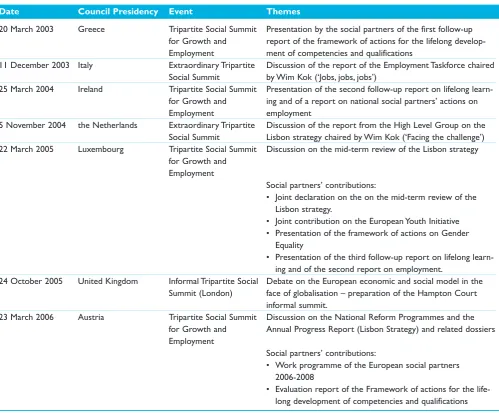
At the Tripartite Social Summit in March 2006, the European social partners presented their second multi-annual work programme for 2006-2008 and reconfirmed that they ‘want to contribute to and pro-mote growth, jobs and the moderni-sation of the EU social model’. They will strive to develop convergent views on the most pressing econom-ic, labour market and social issues starting from a profound analysis of key challenges facing Europe’s labour markets. On that basis, they will put forward joint recommenda-tions and define a framework of actions on employment of the social partners. In addition, they intend to negotiate an autonomous agreement, either on the integration of disadvan-taged groups on the labour market or on lifelong learning. They will also keep on contributing to policy devel-opment in the EU and they are com-mitted to making progress on quality of work. Within this overall context this report addresses a number of issues which are at the core of the challenges social partners face in all parts of the EU.
Editorial
8
They will only be able to live up to the high expectations that are put on them if their organisational structure, their representativeness and their interaction patterns are adequate to play a role at the workplace and in participative democracy. This report reviews trends in membership and on the interaction of social partners, particularly in Chapter 1. While there is a general trend of decreasing employer organisation and trade union membership, both are still well established in the societies and economies of most Member States. The important issue of capacity building in those Member States that have gone through a transition period to a market economy and democratic system is treated in Chapter 4. Trade unions’ and employer organisations’ density as well as collective bargain-ing vary between Member States. Enlargement has contributed to this diversity.
The diversity of social dialogue in the Member States shows that stan-dardised European solutions cannot work. Common standards and shared objectives have to be implemented according to national traditions. The Lisbon Strategy acknowledges that the focus for action in many areas lies at the national level (or regional or local), e.g. for employment and labour market policies where social partners must be involved. But each action has an impact across borders as European societies and economies are interdependent in many ways in the single market and the monetary and economic union. This report should contribute to the mutual understanding of how industrial rela-tions work elsewhere.
The relationship between collective bargaining and labour law will play an important role in the attempt to move to ‘flexicurity’. Increased decentralisation and involvement of the legislator have implications for the autonomy of collective bargain-ing and the challenge is to arrive at an appropriate institutional setting
that allows for an economically viable and socially acceptable com-promise. Chapter 2 reviews trends in the interaction between collective bargaining and public policy.
For many employees flexibility is a reality. Self-employment, telework, flexible and long working hours, fixed-term contracts or agency work are spreading on Europe’s labour markets. Trade unions must reach out to new types of employees and the social partners have a joint responsibility to create the condi-tions for ‘flexicurity’ and, while doing so, having an eye on the possi-ble downsides of increased flexibili-ty without new forms of securiflexibili-ty. The Commission invited the sectoral as well as the cross-industry social partners to actively contribute to the debate on ‘flexicurity’. Trends and potential risks in the labour market are the topic of Chapter 7.
Collective bargaining and employee participation at the company level can be an important tool to manage change and to involve the workforce in the development of the enterprise. Restructuring can be more efficient and less disruptive if negotiated solutions at company level are possi-ble. Chapter 3 draws a picture of employee representation at the work-place.
Social dialogue at the European level has developed an array of instru-ments that can ensure that actors on different levels work towards shared objectives while respecting the spe-cific governance structure and the social and economic situation in their Member States (or region). Chapter 5 describes how the Euro-pean social partners engage in the Lisbon Strategy and how the results of social dialogue contribute to qual-ity of work, training systems, youth integration into the labour market, gender equality, active ageing as well as to corporate social responsibility. Starting from the European Social Dialogue, social partners can make a
real difference with respect to own-ership of the Lisbon Strategy. Their members must get the feeling that they can contribute – in their field and at their level – to a European reform project. At the same time, they will only make the effort to engage in reforms when they are convinced that these are needed and pay off. Social partners have a dual task of involving people in the process and of delivering their con-tribution to reforms.
Chapter 6 reviews EU labour legisla-tion in the period from 2004 to 2006. The developments concerning work-ing time, health and safety regula-tions, instruments to fight anti-dis-crimination and foster equality for men and women as well as the fur-ther development of legal measures fostering the free movement of work-ers are all necessary components to enhance the quality of work and to develop a true European labour mar-ket. As such they are a direct contri-bution to the successful implementa-tion of the Lisbon Strategy.
The Industrial Relations in Europe Report 2006 builds on the work of the previous report of 2004.(2) The
first three chapters focus on industri-al relations in the Member States: developments with regard to national industrial relations actors, the inter-action between collective bargaining and the law in the Member States and developments in workplace rep-resentation mechanisms and prac-tices. The next three chapters deal with European developments: con-cerning the promotion of social dia-logue capacity building in the new Member States and candidate coun-tries, as well as European social dia-logue developments at cross-indus-try and sectoral level and European legislative developments. The sev-enth chapter addresses forms of non-standard working conditions in the enlarged EU, including trends and industrial relations perspectives on tackling potential risks to social cohesion and sustainability, and the last one endeavours to discuss the complex relationship between the industrial relations, and economic performance.
Chapter 1: Social partners as mem-bership organisations: an overview of forms and trends in the Member States
Most unions continue to be organ-ised on a sectoral or occupational basis, with the traditionally more powerful blue-collar unions losing influence and the white-collar unions gaining significance. In most coun-tries there is more than one peak organisation or confederation, with divisions on occupational, religious or political lines. In general, howev-er, confederations are increasingly distant from their political party counterparts.
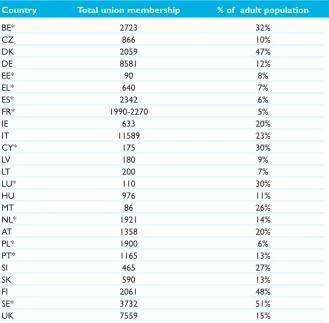
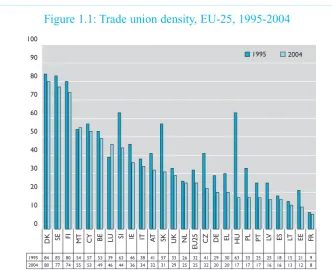
Large differences in trade union den-sity – the ratio of actual to potential membership – continue to exist between the Member States, ranging from 80% in Denmark to 8% in
France. The density rate is high in the Nordic countries, while Spain, France and most of the new Central and Eastern European Member States have comparatively low rates. The overall weighted average density rate in the EU is now between 25% to 30% of wage earners, and the trend in union density is clearly downward across Europe. Ten years ago, one in three European workers was a member of a trade union, now it is one in four. Most of the EU Member States experienced a fall in density over the period from 1995 to 2004, with unions in Central and Eastern Europe facing dramatic membership losses. Union density varies notably according to certain characteristics such as sector, age and gender: men are more likely to be unionised, as are older workers. The highest union density is usually found in public administration, health and social services with mem-bership in the services sector the lowest. Minority ethnic groups and workers in small workplaces also tend to be less organised.
Confronting the challenge of declin-ing membership in many countries has led the unions to introduce numerous innovations. An organis-ing model – seekorganis-ing more ‘empow-erment’ of the workforce, for exam-ple, by targeting specific workplaces – is one approach. Alternatively, delivering new services such as legal and careers advice has been attempt-ed to attract and retain members. Social movement unionism attempts to transcend the shop floor, focusing on community-based activism and campaigning about local issues. Challenges to proposed welfare reforms in, for example France (2005 and 2006) and Italy (2005) have also been used to promote the profile of the unions. Mergers to pro-mote economies of scale and enable expansion into growing sectors are also common. Recent significant mergers, both in 2004, include that
of two unskilled workers’ unions in Denmark to form the country’s largest union and the amalgamation of six blue-collar public sector unions in Finland.
The power and structure of employ-ers’ organisations also varies across the Member States. Some countries, such as Italy – with 12 cross-sector peak organisations – have difficulty in establishing a unified front of employers’ umbrella organisations. In some countries, macro-sectoral organisations are more significant than general peak federations, and peak organisations do not always play a significant role in bargaining. While there is a substantial role for the peak organisations in the small west European economies, in the large economies – such as Germany – sectoral organisations are more important. Employer organisation density (the proportion of employees working in companies which are members of an employers’ organisa-tion) suggests that they are generally well-established actors in industrial relations. Except for the Nordic countries, density is higher for employers’ organisations than unions. The (weighted) average employer rate of organisation is approximately 55 to 60%. However, there are signif-icant variations between countries. Small west European countries like Austria and Belgium have a high degree of associational power on the employers’ side, while the Czech Republic, Estonia, Latvia, Slovakia, Portugal, Lithuania and Poland have lower than average rates. In the last two countries, employers’ organisa-tions density is 20%.
There is a variety of trends in mem-bership structures of employers’ con-federations in Europe. Mergers and rationalising have happened in sever-al countries in recent years, for example in Luxembourg (2000) and Finland (2004), and the two major Dutch confederations have recently
Executive summary
announced an alliance. These devel-opments result from a push for economies-of-scale or the integra-tion of industrial relaintegra-tions interests and trade interests. Splits and dis-agreements on representativeness have also occurred in some coun-tries. The principal general peak organisation in Denmark, for exam-ple, is in a phase of restructuring because a major member organisa-tion has expressed doubts about the need to be serviced by a central employers’ confederation. In central and eastern Europe mergers and splits happen on a larger and occa-sionally more turbulent scale.
While the employers’ organisations appear not to be confronted with declining membership density – probably since they are also active in networking and lobbying activities in other areas such as competition policy – they do face certain recruitment and organising challenges. Pro-moting membership of SMEs is often difficult, the role of (con)feder-ations in countries where decentrali-sation of collective bargaining is sig-nificant is potentially in question and there remain capacity-building issues in new Member States. Furthermore, employers’ organisations face in-creasing pressures from their mem-bers to economise on resources, enhance the accountability of the leadership and be more assertive in promoting entrepreneurship. None-theless, employers’ organisations, with few exceptions, are well estab-lished actors in the industrial rela-tions systems of the EU.
Chapter 2: The evolving relationship between collective bargaining and law in the Member States
In the European tradition, collective bargaining is autonomous, enabling a free definition of wage policies and working conditions. The legal princi-ples underpinning the autonomy of collective bargaining are: freedom of association, the presence of collec-tive parties, the generalised enforce-ability of agreements through legis-lation or other administrative
measures and the procedural func-tion of collective agreements, which may, for example, pre-determine the contents of collective agreements at a lower level. The institutional con-text for autonomous collective agreements remains solid, but in cer-tain areas covered by EU law in par-ticular – such as working time – and where derogations from the law and collective agreements are increasing-ly frequent, there are ongoing discus-sions about the proper relationship between autonomous bargaining and the law.
Current trends in the relationship between law and collective agree-ments include an almost universal move toward decentralisation to the company level. The forms of decen-tralisation vary quite significantly, however, from country to country and are often highly changeable. In Spain, works councils operate with a clear mandate and sign 74% of plant agreements, in Germany single employer agreements have tripled since 1990 and the spread of ‘open-ing clauses’ increases decentralisa-tion. In Austria, commentators observe ‘organised decentralisation’, a phenomenon linked to ‘delegation’ or ‘opening’ clauses, enabling some flexibility on certain economic and working conditions.
Other developments include the use of collective agreements to tackle issues of restructuring, non-standard workers and social rights. According to the Swedish Employment Pro-tection Act, for example, agreements on redundancy must include meas-ures to facilitate redundant employ-ees’ return to work. Sweden has also been innovative in extending the benefits of collective agreements to agency workers. In Finland too, agencies must comply with the min-imum wages used by the company. Collective agreements are also being used to establish certain social rights. In France, for example, an inter-professional agreement on life-long access to learning was signed in 2003, guaranteeing an individual right to training. Other examples
have included measures in agree-ments in Denmark and Greece to reconcile work and family life.
In understanding and interpreting the main trends in collective bargaining, the chapter proposes three ‘regulatory schemes’. Firstly, collective agree-ments may precede law. That is, an agreement in collective bargaining may prepare the ground for the adop-tion of the same norm in law. Exam-ples include the 2004 French statute on training which was inspired by the 2003 agreement on lifelong learning. Alternatively, there may be a vertical hierarchy between law and collective agreements, with a num-ber of possible variations. In some countries collective agreements are subject to extension by decree. In Italy, for example, collective agree-ments in the public sector are gener-ally enforceable. On the other hand, this scheme can allow for deroga-tions from the law. For example, the Spanish Workers’ Statute provides for derogations from legal standards on working time, some conditions and wages when the employer can prove that economic, technical or productive reasons may damage the firm’s competitive position. Recent developments suggest that in the name of ‘modernisation’ and labour market flexibility, such as in Italy, there has been expansion of the areas in which derogations are allowed. A final regulatory scheme is horizontal subsidiarity between law and collec-tive agreements, with the regime of semi-mandatory law in Denmark being one example.
attempt-Executive summary
ing to handle the increasingly promi-nent tension between the public rele-vance of certain rights and the avail-able private means to achieve them. Poland sees a lively debate on possi-ble criteria for current derogations from statutory standards through collective bargaining.
The chapter notes that while the basic rules of national labour sys-tems have not been shaken in recent years, there are certain tendencies which challenge the traditional rela-tionship between the law and collec-tive bargaining. As well as the dis-cussions on the comparability of standards arising from increased derogations from the law and higher collective agreements, it emerges that strengthening the legal ground on which voluntary sources must rely involves the need to clarify crite-ria for the negotiation of binding agreements, particularly when there is a departure from higher standards. The increasing recourse to non-legal terminology, like in 'experimental' or 'temporary' legislation, as well as legislation aimed at ‘modernisation’ often leaves significant space for manoeuvre to the relevant social partners and collective agreements can be crucial in setting standards adaptable to different contracts of employment. Finally, increasing decentralisation of bargaining that sometimes deals with fundamental rights implies the need to strengthen the procedural rules coordinating company and plant bargaining as well as transnational company bar-gaining. As part of its new social agenda, the Commission is exploring this latter question.
Chapter 3: Employee representation at the workplace in the Member States
Workplace representation has been legally established and formally installed in most of the EU countries and is a distinctive feature of the EU industrial relations system. There is, however, a great range of forms of representation, reflecting the specific characteristics of industrial relations
in particular countries. The most sig-nificant European legislation on workplace representation is the framework directive of minimum standards for informing and consult-ing employees at company level in all Member States (Directive 2002/14). This generalised the obligation to inform and consult employees and, in effect, institutionalised mandatory workplace representation in the Euro-pean social model. However, the directive is drafted in very broad terms, leaving considerable scope for individual States to implement its terms. Thus it creates a general frame-work for informing and consulting employees, without harmonising rep-resentation. There remains, therefore, a patchwork of information and con-sultation requirements, although most countries have adopted a system in line with the EU directive, with implementation leading to a policy debate in several countries. The biggest statutory changes as a result of the directive are occurring in the previously non-statutory countries of the UK and Ireland and in some cen-tral and eastern European countries.
The principle differences in work-place representation in the EU are to be found in the structures of the national models and in the levels of participatory rights. The legal basis of representation is also variable: while it is mostly statutory law which creates the national frame-work, in the Nordic countries, collec-tive agreements form the legal basis. Structurally, differences arise in whether representations are elected by all employees, are elected or nom-inated by trade union members with-in the company or whether there is a combination of the two channels (dual channel system). While in Cyprus, Ireland and Sweden, for example, single channel representa-tion by a trade union is the norm, in France, Greece, Portugal and Spain, the works councils are seen as com-plementary bodies to the trade union representation. Very significant vari-ations are also obvious in minimum thresholds for representation. While in Portugal and Sweden there is no
minimum, in Belgium at least 100 employees are required for a works council. Rights to participation also vary. While statutory prescriptions in many Member States require em-ployers to give information on finan-cial and business matters, employ-ment levels and closures and so on – as well as to consult on structur-al changes – co-determination or joint decision-making is less common. In Austria, Germany and Sweden, however, there are strong participatory rights extending to sub-stantial co-determination.
The presence and impact of work-place representation also varies according to a range of factors such as sector, establishment size and occupational category. Coverage – the share of employees working in an establishment with a workplace rep-resentation – is quite variable. While the EU average is approximately 50%, over 80% are covered in Swe-den, while the Baltic States have coverage of only 25% or under. Cover-age also varies substantially by sector, with 80% represented in the education sector across Europe, compared with only approximately a third in sales, hotels and restaurants. There is, broadly speaking, a linear relationship between size of estab-lishment and coverage of representa-tion, with 87% coverage in establish-ments of 500 workers or more, compared to only 24% in workplaces with under 10 employees. Occu-pational category also has some bearing on the chances of representa-tion, with professional and managerial staff more likely to have representa-tion than manual workers. In terms of the perceived impact of workplace representation in influencing condi-tions at work, those covered by representative arrangements seem to discern only a relatively moderate influence. Broadly speaking, employ-ees in the new Member States perceive representation to be less influential.
available research suggests that the practice – the processes and dilem-mas faced by representatives – is often broadly similar. Nevertheless, certain differences at a national level can be seen. In Germany, research suggests that the institution of the works council retains strength, but that the role of the representative has become increasingly difficult with increased company restructurings, economic problems and organisa-tional changes. The research also suggests that works councils have a moderate positive impact on eco-nomic performance, but that that those in particular which have a strong cooperative role in organisa-tional or technological changes may have a more noticeable positive effect. In the Netherlands it appears that the institution of works councils has matured with legal obligations and procedures being more closely followed, but that influence on strate-gic matters remains relatively limit-ed. Barriers to enhanced impact include a certain degree of mistrust on the part of the business side and the challenge of changing organisa-tional structures. In Nordic countries research suggests that the well-estab-lished structures of workplace repre-sentation are increasingly developing into more involvement and co-deter-mination.
Representation remains broadly speaking low or lacking in influence, however, in the central and eastern European countries and southern Europe. Recent research on the Czech Republic, for example, sug-gests that lack of enthusiasm among employees and indifference from employers are barriers to expansion in representation. While France has a well-developed and increasingly institutionalised, professional and influential system of workplace rep-resentation, Portuguese and Greek representation remains relatively weak in terms of impact and influ-ence. Despite the fact that workplace representation has been strengthened and professionalised in recent years in countries with an already institu-tionalised tradition, and despite the
growing evidence from north-west Europe that a well-functioning repre-sentation can play a significant role in modernisation and performance, there remains therefore a weak sys-tem of employee representation in several countries, with significant gaps in the private sector. This poses a challenge for those advocating rep-resentation in countries with less well-established traditions, while in countries with strong institutions, the challenge is more to adapt represen-tation to the increasingly complex landscape of internationalisation and the network economy to ensure its ongoing contribution.
Chapter 4: Social dialogue capacity-building initiatives in the new Mem-ber States accession and candidate countries
The Commission has, the chapter notes, continually stressed the importance of social dialogue for better governance and made various recommendations for the improve-ment of the capacity and involve-ment of social partners in new Mem-ber States, accession and candidate countries. The industrial relations traditions in the new Member States, however, pose something of a chal-lenge for the EU approach, since they have tended to emphasise more tripartite bargaining and national level concertation than bipartite, col-lective bargaining. Colcol-lective bar-gaining has largely been limited to the company level and both trade unions and employers’ organisations in eastern and central Europe are weak. The Commission is particular-ly concerned about the capacity of social partners in these countries, because of the difficulties it poses in terms of involvement in the various fora of the European social dialogue. This encouraged the Commission to request accession countries to include social dialogue projects in the context of the Phare programme.
Between 2001 and 2005, social dia-logue capacity-building projects were established in all former and current accession countries of
cen-tral and eastern Europe. Each coun-try could choose one or two twinning partners from the EU-15 – typically social affairs and labour ministries and national experts – with whom they would work. Examples included the Czech Ministry of Social and Labour Affairs’ collaboration with Danish twinning partners which pro-duced an initial assessment report, developed recommendations on pro-cedures for extending collective agreements and promoted activities aimed at strengthening the extension of collective agreements at enter-prise level. Similar capacity-building activities such as seminars and work-ing groups were reproduced in the other CEE countries, with the part-ners’ monitoring reports often emphasising positive impacts on public awareness and on the strength of employers’ and employee associa-tions. However, as well as some fluc-tuating political support, projects faced the difficulty that employers’ organisations were generally less well represented – something project partners believed needed to be reme-died if the projects were to be sus-tainable.
The European cross-industry social partners also initiated their own proj-ects funded by the EU either through the Phare programme or the Com-mission’s social dialogue budget headings. These included business support programmes such as the European Association of Craft, SME (UEAPME) designed project – SME-FIT – which focused on help-ing small enterprises familiarise themselves with the acquis. The cross-industry partners ‘Integrated Programme’, launched in 2003 aimed to enhance the capacity of social partners to participate in Euro-pean social dialogue through, for example, developing competencies and providing resource centres.
the internal structure of the employ-ers’ organisations, with new commit-tees being established, for example. ACTRAV was the corresponding project aimed at strengthening the capacity of workers’ organisations. The European Foundation for the Improvement of Living and Working Conditions (EFILWC), an EU agency, also launched a number of projects preparing the national social partners for enlargement, including a project on social dialogue and EMU in the candidate countries.
Social dialogue capacity-building projects in the candidate countries and potential candidate countries are also being increasingly emphasised. For example, a conference organised by the Commission in Skopje in October 2005 on strengthening social dialogue in the Western Balka-ns highlighted the key role of social dialogue as a social policy tool.
Broadly speaking, evaluation of the projects suggests positive and encouraging results. However, there remain important weaknesses. The availability of independent, struc-tured and representative organisa-tions, particularly on the employers’ side, is still limited. Bipartite social dialogue, particularly at the sectoral level, can be strengthened. The on-going viability of the improvements that have been made and the capaci-ty to respond to these challenges will depend on the will of the social part-ners, since social partners are autonomous, and will also be signif-icantly influenced by the determina-tion of nadetermina-tional governments to pro-mote social dialogue.
Chapter 5: European social dialogue developments
The chapter offers an overview of recent developments in social dia-logue at European level. 2005 was a notable year, marking the 20th anniversary of the launch of Euro-pean social dialogue by the then Commission President Jacques Delors. A special Social Dialogue Summit was held in September
2005, chaired by Commission Presi-dent Jose Manuel Barroso, looking back over the previous 20 years and considering future challenges. The leaders of the European Social Part-ners also officially launched their discussions on the next multi-annual work programme for European social dialogue (2006-2008).
In terms of tripartite dialogue, the mid-term review of the Lisbon Strat-egy called for enhanced ownership of the process through improved governance, streamlined processes and stronger involvement of all stakeholders. The European cross-industry social partners issued a joint declaration on the mid-term review of the Lisbon Strategy and supported the refocusing exercise. Tripartite social summits continue to meet ahead of every Spring European Council, and all EU presidencies have so far held extraordinary autumn meetings on specific issues. These have been seen as valuable opportunities for the Commission and the Council to monitor progress and discuss various aspects of the Lisbon Strategy. In almost all Mem-ber States, social partners were informed and consulted to varying degrees on the national reform pro-grammes, outlining their strategy on employment and macro- and micro-economic policy. The Commission’s 2006 Annual Progress Report again emphasised the importance of the involvement of social partners in the implementation phase of the Lisbon strategy.
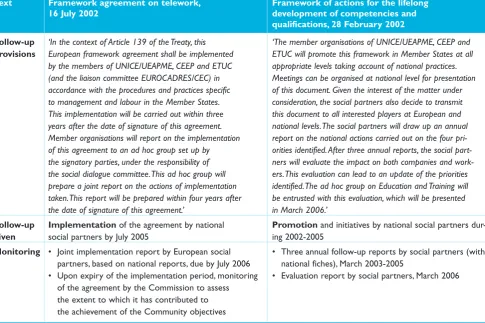
At the bipartite level, the ‘flexicurity’ model of employment relations, combining labour market flexibility and employment security, has been promoted through various social dia-logue activities. Implementation of the ‘autonomous’ European frame-work agreement on teleframe-work, for example, has been ongoing in the Member States; European social partners have continued to monitor the process and will draw up a report. Subsequent to the 2002 cross-industry framework of action on life-long learning, annual reports have
monitored social partner initiatives at the national level. An evaluation report examined the impact of the framework on both companies and workers, arguing that it has both sup-ported pre-existing actions and helped to bring about new initiatives. Sectoral social dialogue committees have also developed instruments to improve training systems and provi-sion in ways adapted to their eco-nomic activities. In response to the Commission’s encouragement to work more on the anticipation of change and restructuring, the cross-industry social partners agreed in the joint work programme for 2006-2008 to complete national studies of economic and social change for all Member States and, on that basis, promote and assess the 2003 ‘orien-tations for reference’. Sector-level initiatives include the innovative ‘tool box’ of the ship-building sector, containing guidance on best practice on dealing with cyclical fluctuations in demand. The sugar sector also developed various initiatives such as an electronic practical guide to accessing structural funds. In 2005 the cross-industry social partners also discussed the functioning of European Works Councils (EWC) on the basis of case studies and drew conclusions in their join text ‘Lessons learned on EWC’.
The social partners have considered the challenges arising from demo-graphic change, with youth integra-tion and active aging taken up by the 2006-2008 cross-industry work pro-gramme. Sectoral social dialogue committees also developed propos-als for integrating young people into the labour market. In promoting gen-der equality the Commission roadmap of March 2006 and the ‘European Pact for Gender Equality’ endorsed by the 2006 Spring Council underline the role of social partners. In March 2005, the cross-industry social partners agreed a framework of actions on gender equality, addressing gender roles, promoting women in decision-making, support-ing work-life balance and tacklsupport-ing the pay gap.
One of the areas in which social part-ners have been most active is quality of work. The Council adopted in July 2005 a directive which implements the agreement on certain aspects of the working conditions of mobile railway workers. In the area of health and safe-ty at work, the Commission launched several article 138 consultations (car-cinogens, mutagens and substances which are toxic for human reproduc-tion; musculoskeletal disorders), and some sectors responded with their own initiatives. Seventeen European social partner and industrial organisa-tions in various sectors concluded the first multi-sector agreement on pro-tecting workers against silica crys-talline dusts in April 2006. The agri-culture sector also signed a framework of actions on musculoskeletal disor-ders in 2005. In the area of well-being at work the cross-industry social part-ners signed a second autonomous agreement on stress in October 2004 which has to be implemented by member organisations by 2007. On violence and harassment, they started negotiations on an autonomous agree-ment in February 2006. Corporate social responsibility (CSR) continues to attract and retain considerable inter-est, with sectoral initiatives including websites and the collection and dis-semination of best practice.
Steps have also been taken to strengthen working methods. In line with the Commission communica-tion of August 2004 identifying future challenges, social partners have devoted efforts to improve their working methods and the function-ing of European social dialogue. According to the cross-industry social partners, their first joint work programme for 2003-2005 has helped to focus European social dia-logue and to enhance its autonomy. A second work programme has therefore been drawn up for 2006-2008. This programme foresees social partners developing a com-mon understanding of their instru-ments and how they can have a pos-itive impact at the various levels of social dialogue. The adoption of annual or multi-annual work
pro-grammes by all sectoral social dia-logue committees (SSDCs) has also been a positive development. Three new SSDCs have been set up with the social partners of the chemical industry, the steel industry and the hospital sector. Other requests for the creation of SSDCs (gas) are being considered by the Commis-sion. An external evaluation of the use of financial instruments in sup-port of European social dialogue, carried out in 2005, confirmed their positive impact. The 1011 projects carried out by 525 social partner organisations in research, capacity-building, conferences and seminars were aimed principally at increasing participation, supporting the Euro-pean Employment Strategy and increasing awareness of legislation. Added value and additionality of projects were found to be generally high. The evaluation suggested increasing participation of organisa-tions from Member States that recently joined the EU, of knowl-edge intensive growth sectors and of sectors with predominantly small and medium-sized companies.
Chapter 6: Review of European legis-lation 2004-2006
This chapter notes that legislative action in the reference period was carried out in the areas of labour law, health and safety at work, equality between men and women and free movement of workers, including social security issues. A number of legislative acts were proposed or adopted with a view to recasting existing legislation regarding health and safety, equality and free move-ment of workers, in line with Euro-pean policy aiming at better regula-tion and simplificaregula-tion. The Com-mission continued to make consider-able efforts to monitor the imple-mentation and application of EU law, particularly in the context of the enlargement.
In the field of labour law, a Commis-sion proposal on working time, cur-rently under discussion before the Council and the European
Parlia-ment, involves amending the existing directive as regards mainly the issues of on-call time, reference period, opt-out and reconciliation of work and family life. In the railway sector, the EU social partners concluded an agreement on certain working condi-tions of mobile workers engaged in interoperable cross-border services which was implemented, at their request, by way of Directive 2005/47/EC. The Commission Com-munication on restructuring of March 2005 outlines measures that should be developed or strengthened around the various means that the Union can use in anticipation and management of corporate restructur-ing. It constitutes the second stage of consultation of the European social partners, calling on them to become more involved in anticipating and managing restructuring. The new cross-border mergers directive regu-lates, among other things, the issue of employee participation in the company resulting from the merger.
The Commission undertook several actions in order to ensure the effec-tive implementation of Community labour law, including launching a series of studies concerning the transposition and application of the relevant acquis in the enlarged Union. Looking forward, the Com-mission plans to publish a Green Paper on the evolution of labour law analysing trends in new work pat-terns and the role labour law can play in tackling these developments. The publication of this paper, and the ensuing public debate that it will launch, will play a key strategic role for future developments in this field.
February 2006 established a second list of indicative occupational expo-sure limit values in implementation of earlier directives on chemical agents. Furthermore, in April 2006 a directive on minimum requirements regarding the exposure of workers to risks arising from artificial optical radiation was adopted. Other devel-opments included the December 2004 launch by the Commission of the first stage of consultation of the social partners on the protection of workers from violence at work, and the 2004 communication on the practical implementation of six health and safety directives.
In the area of anti-discrimination, the Commission focused its efforts on the full and correct transposition into national law of the two anti-discrim-ination directives (the racial equality directive and the employment equal-ity directive) as well as upon their effective application in practice. These directives have helped to raise significantly the level of protection in the EU and have led to the intro-duction of legal provisions covering certain grounds for the first time in some Member States. In the field of equality for women and men the Commission adopted in April 2004 a proposal for a directive on the imple-mentation of the principle of equal treatment in matters of employment and occupation that aims at simplify-ing and updatsimplify-ing existsimplify-ing Communi-ty legislation. A directive was adopt-ed in December 2004 on access to and supply of goods and services establishing for the first time the principle of equal treatment outside the employment field.
The complex body of EU legislation on the mobility and residence rights of workers exercising their fundamen-tal right to free movement was simpli-fied and improved by way of a directive adopted in April 2004. Member States had until April 2006 to transpose this directive. In the framework of the reg-ular up-dating of EU legislation on the coordination of social security schemes, a 2005 Regulation reduced
the number of special non-contributo-ry benefits to which special coordina-tion rules apply. In October 2005, the Commission presented a proposal for a directive on improving the portabil-ity of supplementary pension rights. This directive intends to support the ‘Jobs and Growth’ strategy by making it easier for workers to move jobs and countries. The European Health Insurance card formally replaced the E-forms in all EU and EEA States from the beginning of January 2006 (end of the transitional period regard-ing some Member States).
Chapter 7: Trends and potential risks in the EU labour market
This chapter considers the increas-ing trend towards enhancincreas-ing flexi-bility of labour markets and towards non-standard working conditions in terms of greater diversity in employment contracts and working time arrangements, as well as the potential associated benefits and risks. Some countries gave prefer-ence to one form of flexible contract over others, such as Spain, which remains the country with the high-est proportion of employees – one third – on temporary work con-tracts, followed by Poland, Portugal, Slovenia and Finland. However, while between 1998 and 2005 this percentage slightly decreased in Spain and Finland, and did not sig-nificantly increase in Portugal, it doubled over the same period in Poland (from 5.4% to 25.5%) and increased substantially in Slovenia (from 11.5% to 17%). In other EU countries where it was still only marginally developed in 1998 the increase was more significant, as in Sweden, the Netherlands and Italy. In the UK, the share or temporary jobs grew during the 1990s and then decreased from 7% to around 5.5% of the workforce. The EU-wide trend is towards more temporary contracts (12.8% in 1998 and 14.2% in 2005) although permanent con-tracts remain more common. Inter-im agency work and part-tInter-ime work also show upward trends. While
these different contract forms can be summarised as external numeri-cal flexibility, flexible working time arrangements – internal numerical flexibility – continue to become more important. These develop-ments are found with regard to over-all flexibility in working time, as evidenced in a recent survey of the European Foundation for the Improvement of Living and Work-ing Conditions, as well as concern-ing increased proportions of employees reporting shift and night work and those working during weekends.
The motivation for greater flexibility comes from both employers and national governments. At the compa-ny level, the perceived need for increased competitiveness in the context of globalisation as well increasing expectations of con-sumers is leading to more flexible and atypical forms of employment and work organisation. National gov-ernments promote flexibility meas-ures with the aim of boosting employment. In particular, govern-ments try to facilitate exit and entry to the labour market. There is evi-dence, furthermore, to suggest that measures to enhance flexibility have had success. For example, in Sweden recent data suggests that interim agency work led to employment with the agency’s client for the majority of employees and also provided an inte-grative role for immigrants and young workers. More generally, part-time work has become very impor-tant in a large number of countries and has enhanced employment opportunities, while one fifth of part-time workers would prefer to work full-time.
Focusing on the risks associated with more flexible work it has been found that it is mostly employees aged under 30 who are on temporary con-tracts and exposed to the greater risks associated with enhanced labour market flexibility. 54.6% of workers under 30 are on such con-tracts in Spain, 49.3% in Poland and
42.3% in Slovenia. Women tend to be more likely to be employed on a temporary basis, especially in Slove-nia, where 48 per cent of women under 30 are affected compared to 38% of their male colleagues, but also in Finland (48% and 36%) and Sweden (46% versus 36%). Certain sectors appear to be more affected by ‘flexible’ and atypical forms of employment, such as those exposed to international competition and the retail sector.
Increasing labour market flexibility does not, however, necessarily lead to higher job quality. There are many virtuous combinations leading to increases in jobs and job quality, but there are also the potential risks of increased poverty and inequality in working conditions, weakening social dialogue, and reduced worker motivation. Concentration of un-skilled jobs in contingent employ-ment, shortening of contract duration and involuntary part-time work are forms of employment which can lead to reduced possibilities to find and retain a secure place in the labour market. They also offer more limited prospects of upward mobility, partic-ularly where access to training is limited and can, on the contrary lead to higher segmentation on the labour market and an underutilisation of human capital. Uncoordinated work-ing time arrangements may, for example, impede an optimal work/life balance. These uncertainties on the labour market may also have a demo-graphic impact as they can lead young people to postpone the deci-sion to set up a family. While each of the individual risks does not neces-sarily imply exclusion, in combina-tion they may lead to workers being trapped in ‘vulnerability vectors’ and facing long term exclusion. The chapter observes that certain groups are most at risk of facing exclusion through an accumulation of risks: women, young people, older people, minority groups and those with lower levels of education.
In attempting to balance flexibility, job quality and employment securi-ty, governments and social partners have implemented measures to limit excessive forms of flexibility, including enhanced quality of train-ing and lifelong learntrain-ing. The chap-ter urges for more efforts in this respect. For example, there has to be monitoring and, where appropriate, action needs to be taken by both governments and social partners with regard to limiting certain forms of inequality in working con-ditions, including those related to health and safety, access to training and combining work with family life. Certain groups on the labour market such as female contingent employees on low pay and young workers facing possible vicious cir-cles of exclusion need particular attention. More generally, the inci-dence of low pay is high in a num-ber of Memnum-ber States (notably where more than 30% of all employees receive less than 60% of the average/median wage as in most of the new Member States, but also in the UK and Portugal). While statutory minimum wages have been in place in most Member States, the percentage of workers covered by them is very variable among Member States. But the aim endorsed by the European Council of substantially reducing the inci-dence of poverty including the working poor requires further force-ful action. Overall, the chapter underlines the importance of ensur-ing that employment growth is not pursued at the expense of social cohesion and sustainability and that the possible risk factors are counter-acted in the promotion of economic growth and job creation.
Chapter 8: Industrial relations and economic performance: an overview of research results
The aim of the Lisbon agenda is to promote Europe as the most compet-itive knowledge economy, while
retaining social cohesion. The social partners are encouraged to partici-pate in this process, and this chapter examines the social foundations of competitiveness, addressing the role of industrial relations in promoting economic growth and efficiency.
The contested nature of indicators of economic performance and classifi-cations of industrial relations sys-tems makes a definitive statement of the relationship – particularly in quantitative terms – difficult to achieve. Indicators of international comparisons of competitiveness and performance are numerous and sub-ject to some dispute, while the diver-sity of industrial relations and national social-protection systems in Europe resist any straightforward quantitative classification. Never-theless, there is a substantial body of research addressing the relationship between industrial relations systems and competitiveness. No single model of social dialogue emerges as the best for promoting competitive-ness. Indeed, the findings of compar-ative studies are relcompar-atively modest on the impact of industrial relations on growth and economic performance. Rather, the importance of comple-mentarity between industrial rela-tions systems and other institurela-tions of labour, employment and social protection seems to be decisive.
broadly speaking to be lower and less persistent in systems with high union-ism. The most robust results, however, are on incomes. Union density and high coverage by collective bargaining go hand in hand with more limited income inequalities and a more limited wage distribution as well as higher average wages, fringe benefits and training.
A definitive statement of the single best system is therefore impossible. However, the research does suggest that low coordination generally leads to poorer results than high coordina-tion or no coordinacoordina-tion at all. The most crucial dimension is the com-plementarity between industrial rela-tions system and other institurela-tions which constitute a ‘package of insti-tutions’. Research also suggests that the participation of industrial-rela-tions players in political and institu-tional debates can offer a decisive means of improving the environment
necessary for economic growth, where the parties see the coordina-tion as a common good.
In the context of the changes occur-ring in the European polity as it moves towards the competitive knowledge economy envisaged by the Lisbon Strategy, the social part-ners face a number of challenges. The development of the knowledge economy implies an individualisa-tion of the employment relaindividualisa-tionship and emphasises the importance of individual skills and competencies and constantly replenishing knowl-edge to ensure employability, rather than rigid organisational routines. This implies an emphasis on indus-trial relations agreements on qualifi-cations and on the definition and organisation of careers. In general, the creation of methods of training and acquisition of skills are becom-ing critical challenges for the social partners.
Other developments also pose chal-lenges. The increasing emphasis on greater individual responsibility for insurance against risk in the context of the difficulties faced by Euro-pean welfare States poses a problem for unions which are more accus-tomed to defending members’ rights rather than assuming specific indi-vidual duties of their members. And an increasing re-orientation of industrial relations activity to the company because of diversification of productive activities limits the notion of sector. There is arguably an increasing weakening of the role of sectoral negotiations ‘from hard law to soft law’, with an increasing number of firms negotiating opt-outs or drop-opt-outs. Tensions between the national context of industrial relations and the globalisation of the economy tend to increase, rais-ing the question of the need of fur-ther Europeanisation of industrial relations.
In this first chapter, the two key col-lective actors of industrial relations in the EU Member States are intro-duced: trade unions and employers’ organisations.(4) Both are so-called
intermediate organisations. They act as an interface between the state, the economy and their membership. Both organisational types are driven by the logics of membership and influence. They aggregate the inter-ests of their diverse rank and file and represent these interests at different forums and levels. They are further-more driven by logics of efficiency and effectiveness. Taking these log-ics into account implies that they are involved in four types of activity: participation for members, represen-tation of members, services to mem-bers and control over memmem-bers.(5)In a
model of organised industrial rela-tions – typical of the traditional European social model and social dialogue – these associations are cornerstones.
1.
Trade unions
A trade union can be defined as an independent association (coalition) of workers, who have united for the representation and defence of their interests in the workplace, but also at the general level of the economy and politics. This free and independent association of workers is a statutory right recognised throughout the European Union. Unions can be further typified by the following features:
4They are mass organisations with a centralised structure and a divi-sion of work between a network of volunteers (activists or militants) and a professional apparatus (trade union officers).
4They are organisations recognised by the law maker and have a quasi public status.
4They have a distributive function in the economy (settling wages) but also a normative function (through an involvement in decid-ing labour regulations).
4They are representative organisa-tions: they speak in the name of their members and can mobilise these members, but they also have the power to convince this rank-and-file of a negotiated compromise.(6)
We will first present an organisation-al overview of these trade unions for the EU-25, followed by a discussion of membership figures and trends. The section concludes with an overview of recent revitalisation strategies, deployed by unions in Europe.
1.1.
Organisational structure
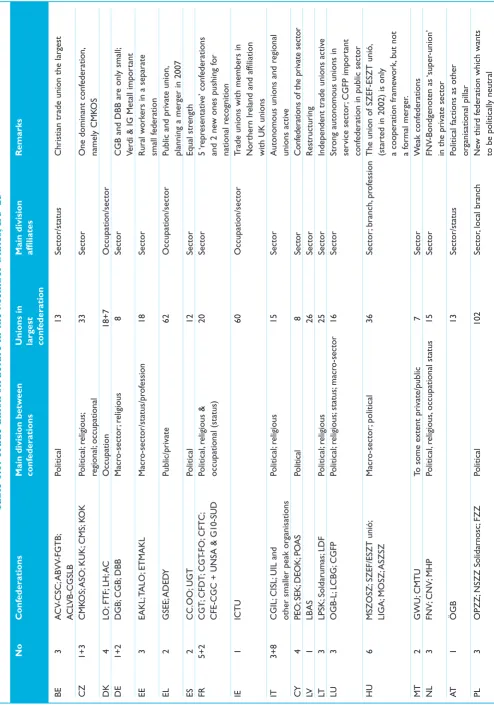
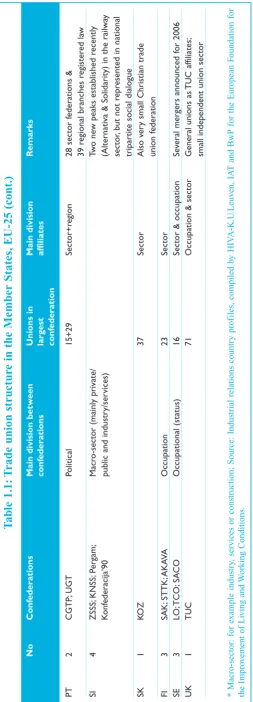
Table 1.1 presents the main structur-al characteristics of the trade union movement in each of the Member States: the number of union peak organisations and the reason for
divi-sions between them; an indication of the most important confederation and its affiliation structure.
Most of the unions are organised on a sector or occupational base throughout the EU. Traditionally, blue-collar unions were the most powerful, but they are losing ground everywhere in Europe and white-col-lar unions or public sector unions are increasingly more important. In many of the Member States unions exist, which are not part of a confed-eration, but are so-called ‘auto-nomous’ unions. Often these autonomous unions organise profes-sional and managerial staff or certain rural regions.
Austria, Ireland, Latvia, Slovakia and the UK have only one confeder-ation, which unites all the unions in the country. In Germany and the Czech Republic, one confederation is strongly dominating the others in membership figures and power. In southern countries like Greece, Por-tugal and Spain two main confedera-tions are active. Unions in France, Hungary, Italy and Slovenia have a rather complicated and fragmented confederate structure. In Greece, Ire-land, Poland and the UK the (main) confederation is composed of a frag-mented network of affiliated trade unions, which can be organised on the company, occupational or local branch level. In other countries, the union structure is more and more dominated by large ‘super-unions’, like GPA in Austria, Verdi in
Ger-The social partners as membership organisations:
an overview of forms and trends in
the Member States
(3)Chapter 1
(3) This chapter is drafted by Guy Van Gyes, Hoger Instituut voor de Arbeid, University of Leuven.
(4) A significant part of the information in this chapter has been compiled by a project on industrial relations profiles of the 25 Member States, commis-sioned by the European Foundation for the Improvement of Living and Working Conditions and conducted by HIVA-K.U.Leuven (G. Van Gyes & T. Van-denbrande), Institut Arbeit und Technik (S. Lehndorff, S. Schief & G. Schilling) and BwP (H. Kohl).
(5) P.C. Schmitter & W. Streeck (1999), The organisation of business interests: studying the associative action of business in advanced industrial societies, Max Planck Institute for the study of societies, discussion paper 99/1.
T
a
[image:22.595.56.551.95.802.2]b
le 1.1:
T
rade union structur
e in the Member States,
EU-25
No
Conf
ederations
Main division betw
een Unions in Main division Remarks conf ederations larg est affiliates conf ederation BE 3 A CV -CSC; ABVV -FGTB; P olitical 13 Sector/status
Christian trade union the largest
A CL VB-CGSLB CZ 1+3 CMK OS; ASO; KUK; CMS; K OK P olitical; religious; 33 Sector
One dominant conf
ederation, regional; occupational namel y CMK OS DK 4 LO; FTF; LH; A C Occupation 18+7 Occupation/sector DE 1+2 DGB; CGB; DBB Macr o-sector ;r eligious 8 Sector
CGB and DBB ar
e onl
y small;
V
er
di & IG Metall impor
tant EE 3 EAKL; T ALO; ETMAKL Macr o-sector/status/pr of ession 18 Sector Rural w ork
ers in a separate
small f ederation EL 2 GSEE; ADED Y Public/private 62 Occupation/sector
Public and private union, planning a merger in 2007
ES 2 CC .OO; UGT P olitical 12 Sector Equal str ength FR 5+2 CGT ;CFDT ;CGT -FO; CFTC; P olitical, religious & 20 Sector 5 ‘r epr esentativ e’ conf ederations
CFE-CGC + UNSA & G10-SUD
occupational (status)
and 2 ne
w ones pushing f
or national r ecognition IE 1 ICTU 60 Occupation/sector T
rade unions with members in Nor
thern Ir
eland and affiliation
with UK unions
IT 3+8 CGIL; CISL; UIL and P olitical; religious 15 Sector
Autonomous unions and r
egional
other smaller peak organisations
unions activ e CY 4 PEO; SEK; DEOK; PO AS Political 8 Sector Conf
ederations of the private sector
LV 1 LB AS 26 Sector Restructuring LT 3 LPSK; Soldarumas; LDF P olitical; religious 25 Sector
Independent trade unions activ
e LU 3 OGB-L; LCBG; CGFP P olitical; religious; status; macr o-sector 16 Sector Str
ong autonomous unions in
ser
vice sector
;CGFP impor
tant
conf
ederation in public sector
HU 6 MSZOSZ; SZEF/ESZT unió; Macr o-sector ;political 36 Sector ;branch, pr of ession
The union of SZEF-ESZT unió,
LIGA;
MOSZ;
ASZSZ
(star
ted in 2002) is onl
y
a cooperation frame
w ork, but not a f ormal merger . MT 2 GWU; CMTU
To some extent private/public
7 Sector W eak conf ederations NL 3 FNV; CNV; MHP P olitical, religious, occupational status 15 Sector FNV -Bondgenoten as ‘super -union’
in the private sector
A T 1 ÖGB 13 Sector/status P
olitical factions as other organisational pillar
PL 3 OPZZ; NSZZ Solidarnosc; FZZ P olitical 102 Sector ,local branch Ne w thir d f
ederation which wants
to be politicall