Abstract
Mathematical analyses and modelling have an important role informing malaria eradication strategies. Simple mathematical approaches can answer many questions, but it is important to investigate their assumptions and to test whether simple assumptions affect the results. In this note, four examples demonstrate both the effects of model structures and assumptions and also the benefits of using a diversity of model approaches. These examples include the time to eradication, the impact of vaccine efficacy and coverage, drug programs and the effects of duration of infections and delays to treatment, and the influence of seasonality and migration coupling on disease fadeout. An excessively simple structure can miss key results, but simple mathematical approaches can still achieve key results for eradication strategy and define areas for investigation by more complex models.
Background
Mathematical models are a helpful tool for testing as-sumptions and elucidating the quantitative implications of disease features. Most of the time, results of a math-ematical modelling study match mental models of expert opinion, which have been shaped by years of research and experience. Occasionally, surprising or counterintui-tive results emerge from models. This can happen with simple compartmental models, but sometimes the sur-prising nature of modelling results is due to mistaken in-tuition based on mental or simplified mathematical models taken too far. Such findings must be examined closely, but they enhance understanding when validated. This note examines four examples from malaria eradica-tion of how modelling can produce useful results that may initially strike one as unanticipated, especially if one relies too heavily on simple modelling concepts or men-tal pictures.
Time to eradication
The classic epidemiological model concept of the basic reproductive number R0 nominally represents the sec-ondary infections resulting from a single primary infec-tion in an immunologically naïve populainfec-tion. Macdonald developed the original formulation for malaria [1,2], and others have extended the theory over time [3]. This
concept has become ubiquitous in epidemiological mod-elling, and while it can be helpful, it can also cause con-fusion and even misguided planning if used incorrectly. The basic theory is that if R0is reduced to a controlled reproductive number Rc, the number of secondary infec-tions resulting from a single primary infection under control measures, below 1, then the disease will dis-appear eventually. Each infection is replaced by less than one infection, and prevalence exponentially decays to zero. While this simplified equilibrium view is true, plan-ning eradication efforts requires investigation of the dy-namics and timelines as described by Macdonald and others [4,5], not just the equilibrium conditions.
This R0 tends to be implemented in simple
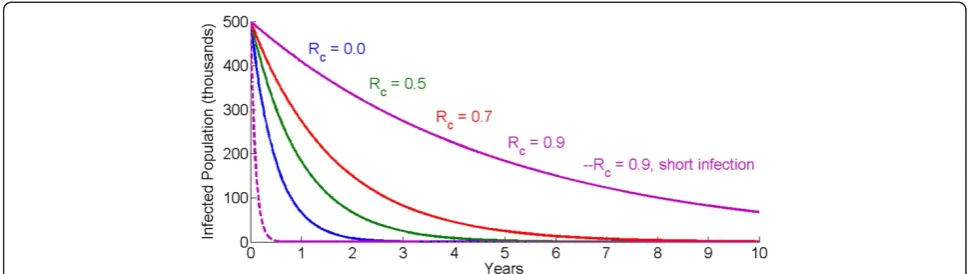
compart-mental models or ordinary differential equations, charac-terized by an exponential distribution for infection durations. A reduction of R0to Rc<1 corresponds to ex-ponential decay of the infected population. The fastest possible decay of the infected population without active clearance of infections is attained when Rc= 0 and has the inverse of the average duration of infection as its decay constant. For short duration infections, such as flu, the infectious reservoir decays rapidly. Malaria, on the other hand, has average infection durations of up to six months [6-8]. As such, exponential decay of the in-fectious reservoir can take years under the best case, and over ten years if Rc= 0.9. Figure 1 shows the decay of the malaria infectious reservoir for four values of Rc, with infection duration averaging 180 days. A controlled * Correspondence:[email protected]
Institute for Disease Modeling, Bellevue, WA, USA
reproductive number of 0.9, 0.7, 0.5, or even 0 exhibits slow declines in the total number of infected individuals. In contrast, a disease with Rc= 0.9 but an infectious dur-ation of just 3.5 days rapidly depletes its infectious reservoir.
When human infections are not actively cleared and elimination is driven by attaining Rc <1 solely through transmission reductions, this slow decay has serious programme implications that limit the chances of elim-ination. For many diseases the durations of interventions that reduce transmission, such as vaccines, are much longer than the durations of infection. As such, trans-mission reductions that reduce R0 below 1 can succeed in driving local eliminations of the pathogen while the interventions are still efficacious without replacement. For malaria however, the average infection duration of six months is only a factor of six away from three-year lifetimes of insecticide-treated bed nets (ITNs). Indoor residual spraying (IRS) campaigns need to be repeated every two to six months depending on the active ingre-dient [9] in areas with year-round transmission and need to be repeated yearly in highly seasonal settings. These frequencies are considerably faster than the timelines to elimination based on transmission reductions alone. The current lead vaccine candidate, RTS,S [10], has a dur-ation of efficacy that is not longer than ITNs. As seen in Figure 1, the infectious reservoir may still be quite ro-bust by the time these interventions need to be replaced, or else the reproductive number will rise back above 1 without having achieved elimination.
The result of this matching of decay constants and intervention durability drives elimination programmes down one of two routes. The first is that elimination campaigns need to reduce transmission for many years to maintain Rc<1, with repeated distributions. The sec-ond possible route is to actively clear the infectious res-ervoir with drug-based campaigns in order to reduce the duration of infections and to achieve rapid drops in prevalence. Reducing the duration of infections in fact
also drives further decreases in Rc [3].This makes mal-aria more like diseases of shorter infectious duration and more susceptible to transient transmission-driven reduc-tions of Rc<1.
Coverage and R0
In contrast to many common childhood diseases with R0 ranging from 1.5 to 12, malaria can exhibit an R0over 100 in well-suited settings [3]. Traditional epidemio-logical modelling shows that the vaccine coverage re-quired to interrupt transmission with a perfect 100% effective vaccine without decay can be calculated as 1-1/ R0. The higher the value of R0, the higher the covered fraction needs to be. If R0= 2, then exceeding 50% cover-age will result in Rc<1. If R0= 10, then 90% coverage is required.
The other side of this relationship is that the higher the coverage, the disproportionately greater R0 that can be overcome for each increase in coverage. With a per-fect inper-fection-preventing vaccine, one that provides complete sterilizing immunity in vaccinated individuals, high levels of coverage provide dramatic increases in the
maximum R0 that can be eliminated. Coverage of 50%
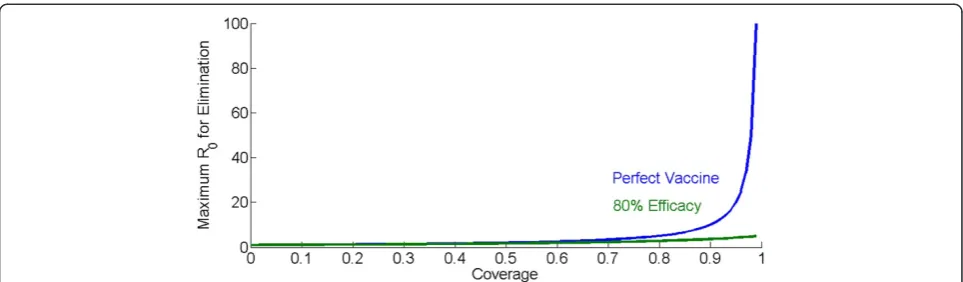
can eliminate an R0of 2, coverage of 80% can eliminate an R0 of 5, and coverage of 90% can eliminate an R0of 10. Above 90%, the gains become dramatic as seen in Figure 2: coverage of 95% will eliminate an R0of 20 and coverage of 99% will eliminate an R0of 100.
This relationship also has implications for the impact of vaccine efficacy. If a vaccine instead of preventing all infections prevents only a fraction Veffof infections, with Veff <1, then the coverage required to achieve Rc<1
be-comes (1-1/R0)/Veff. At some combinations of R0 and
[image:2.595.55.540.89.226.2]close to the R0’s eliminated by the perfect vaccine. At 90% coverage, however, where the perfect vaccine can eliminate an R0of 10, the leaky vaccine can only elimin-ate R0up to 4. Even perfect coverage only approaches a maximum R0of 5. The situation becomes even more dif-ficult if vaccine efficacy decays over time, requiring re-peated boosting vaccination, higher coverage, higher initial efficacy, or all three.
The result of this relationship is to quantify the value of achieving higher intervention coverage. It is com-monly accepted that it becomes increasingly costly to in-crease coverage at higher baseline coverages. To achieve greater than 90% coverage might be prohibitively expen-sive. An important counterpoint to these dramatically rising costs of achieving coverage is that one actually buys a much higher eliminate-able R0. The high baseline R0exhibited by malaria in some pockets also drives non-linearly increasing value to higher vaccine efficacies. In-creasing vaccine efficacies has a challenging set of scien-tific hurdles and increasing coverage has logistical hurdles, but understanding what is required for success can quantify the value of surmounting either or both sets of hurdles. A similar effect of non-linearly increas-ing benefits of coverage has been demonstrated in model studies of drug impacts for elimination [11]. In sum-mary, although coverage increases become increasingly expensive as baseline coverage increases, the benefits correspondingly grow.
Case detection delays and transmission-blocking drugs
There has recently been significant debate about the possible role of low-dose primaquine in elimination sce-narios [11]. The basic argument builds from achievable coverage and time constants. If the average duration of a falciparum infection is approximately six months, and the duration of gametocytaemia following clearance with schizonticidal anti-malarial drugs approximately two weeks, then clearing an infection reduces 12 times more
onward transmission than adding low-dose primaquine to the schizonticidal regimen. Thus, if MSAT campaigns are reaching 50% of the population with an artemisinin-combination therapy (ACT) to clear infections, adding primaquine to the MSAT regimen for all 50% would only reduce the same amount of transmission as increas-ing ACT coverage to 54%. Limitations in who could re-ceive primaquine would further reduce this marginal impact. As has previously been pointed out [11], prima-quine only begins to have a discernable impact at high coverages, similar to that discussed in the previous section.
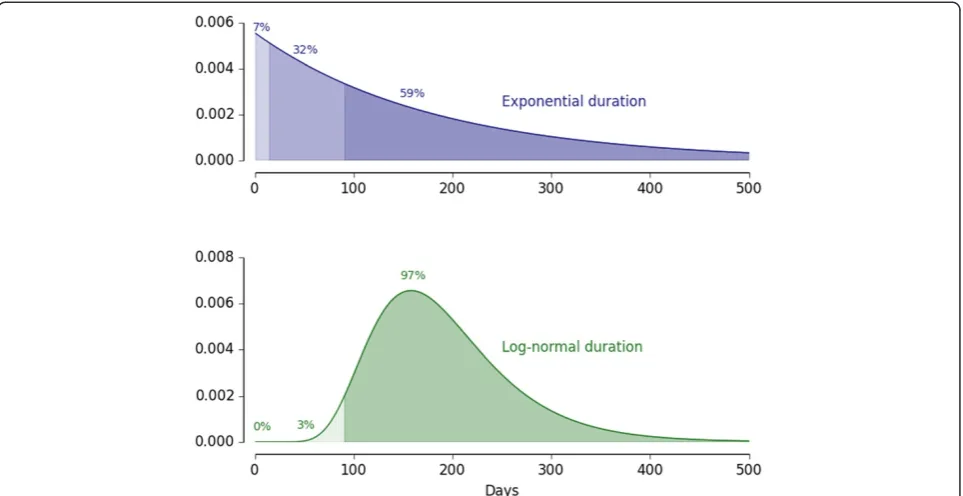
However, this calculus depends on the assumption of exponential distributions of infection durations, which is the standard implementation in most compartmental and ordinary differential equation (ODE) based models [12]. Since an exponential distribution is memoryless, no matter how long an infection has lasted, its expected remaining duration remains the average duration of an infection. So in a compartmental or ODE-based model, any cleared infection removes six months of residual transmission. As has been seen [6-8], durations of falcip-arum infections are not exponentially distributed. In pri-mary infections in tertiary syphilis patients, very few infections were cleared before three months, although the average duration was still in the order of half a year.
[image:3.595.57.539.88.229.2]normal distribution, both with the same mean duration. However, the two-week reduction in transmission due to primaquine remains two weeks, now just a six-fold smaller relative impact. The longer the delay in case find-ing, the higher is the relative impact of reducing onward transmission of adding primaquine to the schizonticidal regimen compared to just treating with a schizonticidal regimen.
For drug-based clearance of the infectious reservoir, the most important factors remain achieving high coverage with ACT and reducing the delay in case finding, but the impacts of realistic delays in case finding and data-driven distributions of infection duration constitute an import-ant, although minor, effect. This is an example in which excessively simple assumptions may get the basic result correct but miss an important nuance, while somewhat more detailed mathematical approaches can capture real-istic effects and improve accuracy. Realreal-istic delays in case finding and data-driven distributions of infection duration together reduce the target ACT coverage at which adding a transmission blocking drug (not necessarily primaquine) to the ACT regimen begins to show equivalent epidemio-logical impact to a fixed fraction increase in coverage with the schizonticidal regimen alone. Compared to the previ-ous two examples, this impact of infection senescence is a minor effect. However, this effect can still be elucidated with mathematical analyses.
Metapopulations and synchrony
While malaria transmission is very much a local phenomenon driven by mixing of mosquitoes and humans on short spatial scales, malaria eradication is a global issue. Areas are connected spatially by human mi-gration and elimination is not possible without consider-ing the spatial context. Excellent work has been done to show the impact of human mobility on malaria [13], and how the coupling of regions raises the difficulty of achieving elimination. Human movements superimposed on a landscape of heterogeneous transmission intensities and campaign coverages have the potential to reintro-duce infection to temporarily cleared areas before the benefits of elimination ‘stickiness’can be achieved, con-tributing to malaria resurgence [14,15]. As such, initiat-ing an elimination campaign is largely a regional, rather than a local decision [16].
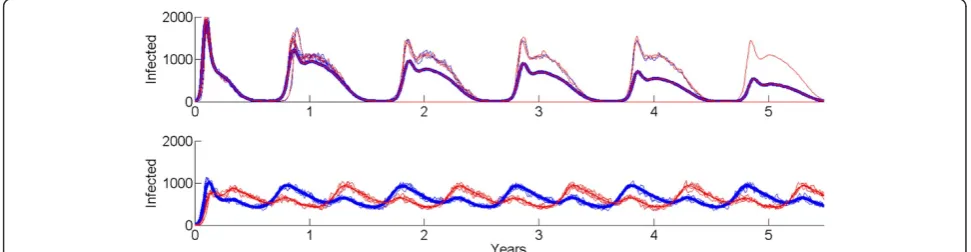
[image:4.595.58.540.89.337.2]populations with stochastic susceptible-infected-recovered-susceptible (SIRS) dynamics and synchronous (top) and asynchronous (bottom) forcing, with homogeneous mixing within each population. Even though the peak number of cases is higher in the synchronous case, the coupled system exhibits stochastic fade-out each low season, as seen in the mean of 100 runs of the system trending downwards over time. The asynchronously forced system, which having less dramatically bad high seasons, never comes close to extinction.
This benefit of synchrony for achieving elimination has several implications for malaria eradication. The campaign benefits from seasonal forcing being similar in phase over locally connected areas, and the chance of elimination increases if anti-malarial treatments are used to shorten the length of infections sufficiently to have rapid decays of the infectious reservoir during the low transmission season. In addition, locations with more stable year-round transmission, even if they do not have the high spikes in case counts of highly seasonal settings, will be more difficult to eliminate and may require higher campaign coverages for a given annual average R0. Finally, achieving elimination across connected geo-graphic regions will be easier if the external forcing on transmission, namely campaign pressures such as vector control spraying and anti-malarial drug mass screen-and-treating, are synchronized across the region of interest.
with both stochastic and deterministic dynamic models is essential.
Each of the four examples in this note can be exam-ined in the relatively simple frameworks here or in more complex microsimulation models. Simple mathematical analyses can often arrive at the correct big picture, while small modifications can capture nuances that improve accuracy, as in the third example. More complicated models can then confirm results while investigating whether the effects of realistic details affect policy con-clusions or not. Since it would be possible to investigate irrelevant details in complex models forever, simple models have an additional important role in focusing at-tention on areas where the capacities of complex models could influence the answer. Starting with a simple framework is thus strategically useful.
[image:5.595.55.541.557.683.2]It is important to make sure that seemingly straight-forward conclusions from a simple model structure be rigorously examined with model structures that can ac-commodate improved realism [11,18-20]. If the same re-sult for a given question is obtained from simple and complex models, then one gains confidence in the re-sults from the simpler structures. More complex micro-simulation models can recreate and test results obtained in simple analyses and facilitate extensions of questions that would have been otherwise less tractable. Such questions raised by the examples above could include
the interrelationships among decay of vaccine efficacy, heterogeneity in vaccine coverage, delivery strategy and schedule, transmission context, and coverage targets or the effects on disease fadeout of spatial variation in seasonality and local heterogeneity in risk. When used properly in con-cert, a diversity of mathematical models and approaches will play an essential role in eradication planning.
Received: 15 September 2014 Accepted: 6 December 2014 Published: 11 December 2014
References
1. Macdonald G:Theory of the eradication of malaria.Bull World Health Organ1956,15:369–387.
2. Macdonald G:The Epidemiology and Control of Malaria.London, New York: Oxford University Press; 1957.
3. Smith DL, McKenzie FE, Snow RW, Hay SI:Revisiting the basic reproductive number for malaria and its implications for malaria control.PLoS Biol
2007,5:e42.
4. Smith D, Hay S:Endemicity response timelines forPlasmodium falciparum
elimination.Malar J2009,8:87.
5. Macdonald G, Goeckel GW:The Malaria Parasite Rate and the Interruption of Transmission.Bull World Health Organ1964,31:365–377.
6. Sama W, Dietz K, Smith T:Distribution of survival times of deliberate
Plasmodium falciparuminfections in tertiary syphilis patients.Trans R Soc Trop Med Hyg2006,100:811–816.
7. Sama W, Killeen G, Smith T:Estimating the duration ofPlasmodium falciparuminfection from trials of indoor residual spraying.Am J Trop Med Hyg2004,70:625–634.
8. Eckhoff P:P. falciparuminfection durations and infectiousness are shaped by antigenic variation and innate and adaptive host immunity in a mathematical model.PLoS ONE2012,7:e44950.
9. Pluess B, Tanser FC, Lengeler C, Sharp BL:Indoor residual spraying for preventing malaria.Cochrane Database of Systematic Reviews2010. Issue 4. Art. No.: CD006657. doi:10.1002/14651858.CD006657.pub2.
10. RTS SCTP:A Phase 3 trial of RTS, S/AS01 malaria vaccine in African infants.N Engl J Med2012,367:2284–2295.
11. Johnston GL, Gething PW, Hay SI, Smith DL, Fidock DA:Modeling within-host effects of drugs onPlasmodium falciparumtransmission and prospects for malaria elimination.PLoS Comput Biol2014,10:e1003434. 12. Gillespie DT:Exact stochastic simulation of coupled chemical reactions.
J Phys Chem1977,81:2340–2361.
13. Wesolowski A, Eagle N, Tatem AJ, Smith DL, Noor AM, Snow RW, Buckee CO:Quantifying the impact of human mobility on malaria.Science2012,
338:267–270.
14. Smith DL, Cohen JM, Chiyaka C, Johnston G, Gething PW, Gosling R, Buckee CO, Laxminarayan R, Hay SI, Tatem AJ:A sticky situation: the unexpected stability of malaria elimination.Philos Trans R Soc London B: Biol Sci2013,368:
15. Cohen J, Smith D, Cotter C, Ward A, Yamey G, Sabot O, Moonen B:Malaria resurgence: a systematic review and assessment of its causes.Malar J
2012,11:122.
16. Moonen B, Barrett S, Tulloch J, Jamison DT:Making the decision. In
Shrinking the Malaria Map: A Prospectus on Malaria Elimination.Edited by Feachem RGA, Phillips AA, Targett GA, Group ME. San Francisco: The Global Health Group: UCSF Global Health Sciences; 2009:1–18.
17. Grenfell BT, Bolker BM, Kleczkowski A:Seasonality and extinction in chaotic metapopulations.Proc Biol Sci1995,259:97–103.
18. Smith T, Killeen GF, Maire N, Ross A, Molineaux L, Tediosi F, Hutton G, Utzinger J, Dietz K, Tanner M:Mathematical modeling of the impact of malaria vaccines on the clinical epidemiology and natural history ofPlasmodium falciparummalaria: Overview.Am J Trop Med Hyg2006,75:1–10.
19. Wenger E, Eckhoff P:A mathematical model of the impact of present and future malaria vaccines.Malar J2013,12:126.
20. Griffin JT, Hollingsworth TD, Okell LC, Churcher TS, White M, Hinsley W, Bousema T, Drakeley CJ, Ferguson NM, Basáñez M-G, Ghani AC:Reducing
Plasmodium falciparummalaria transmission in Africa: a model-based evaluation of intervention strategies.PLoS Med2010,7:e1000324.
doi:10.1186/1475-2875-13-486
Cite this article as:Eckhoffet al.:Fun with maths: exploring implications of mathematical models for malaria eradication.Malaria Journal
201413:486.
Submit your next manuscript to BioMed Central and take full advantage of:
• Convenient online submission
• Thorough peer review
• No space constraints or color figure charges
• Immediate publication on acceptance
• Inclusion in PubMed, CAS, Scopus and Google Scholar
• Research which is freely available for redistribution