0022-538X/87/020584-06$02.00/0
CopyrightX3 1987,American SocietyforMicrobiology
Structure
and
Function of Bicistronic
RNA
Encoding the
Phosphoprotein
and Matrix Protein of Measles
Virus
TIMOTHY C. WONG* ANDAKIKO HIRANO
DepartmentofMicrobiology andImmunology, University of Washington School ofMedicine, Seattle, Washington 98195 Received1 August1986/Accepted16October1986
Twoindependent full-length replicasofabicistronic RNAspeciescontainingthecompleteP andMgenesof measlesvirus arrangedintandemwereisolated fromanexpressiblecDNAlibrary. Sequencesat the 5' and3' termini suggested that the bicistronic RNAwasinitiated andterminated atpreciselythesamelocationsasthe monocistronic mRNAs of the P andMgenes,respectively. TheP andMcistronswere fusedtogetherviaan intergenic region whichwasexactlycolinear with andcomplementarytothe intergenic regionofthegenomic
RNA. This RNA species waspolyadenylated atthe normal polyadenylation site at the 3' terminus of theM cistron, butnot inthe intergenic region.ByDNA-mediated genetransfer, these cDNA cloneswereexpressed intobicistronic RNAcontainingboth P andMsequencesinprimatecells.RNA thusgenerateddid notundergo nucleolytic processing but was translated into high levels of a 70,000AMr protein immunoprecipitated by monoclonal antiserum againstthe measles virus Pprotein.Mproteinwasnotproducedinthe samecellseven
thoughthe Mcistroncould directMprotein synthesisinvitroonceexcised from theupstreamPcistron.These results suggested that bicistronic RNA coulddirectprotein synthesisfrom the first butnotthe secondcistron andmightcontribute atleast inpart toexpressionof viralgenes invivo.
The genome of nonsegmentednegative-strand RNAvirus
typically consists ofa number oflinearly arrangedcistrons separated by conserved intergenic regions. Upon infection ofhostcells, thegeneticinformation stored in the genome is
transcribedbyavirion-associatedpolymerase complex into a series of plus-strand mRNA species (10). Transcription
starts from the 3' terminus of the genome and proceeds
towards the 5' terminus through a series of termination
followed by reinitiation at specific sites in the intergenic
regions (1). The products of this stop-start transcriptional
process are mainly monocistronic mRNA capped at the 5' termini and polyadenylated at the 3' termini. However, polyadenylated RNA species which contain sequences de-rivedfromtwoormoreadjacentcistrons have beenfound in cellsinfectedbyavariety of nonsegmented negative-strand
RNA viruses, including vesicular stomatitis virus (14, 15), respiratory syncytial virus (11), Newcastle disease virus (34), simian virus 5(16, 25) and measlesvirus (27).
Thesehigh-molecular-weightRNAspecies are believed to be derived from readthrough transcription which fails to
terminate at the normal intergenic termination sites. The
originand possible functionof the bicistronic RNAspecies
remain unclear. Herman et al. (14, 15) originally proposed that bicistronic RNA might serve as precursors to monocistronic mRNA. Others viewed bicistronic RNA as
aberrant transcription products which serve no function in virus replication. In Newcastle disease virus-infected cells, bicistronic RNA species could make up up to 25% of the
total polyadenylated RNA and were associated with polysomes. The researchers thus postulated that these RNA species might be functional and could contribute to viral geneexpression (34). However, the protein-coding potential
ofthebicistronic RNA species and the putative gene prod-ucts, if any, have not been demonstrated or characterized.
* Correspondingauthor.
The genome ofparamyxovirus measles virus contains at leastsevengenes. The N gene located near the 3' terminus of thegenome encodes an RNA-binding nucleoprotein (7, 26,
27, 35). Theneighboring P gene encodes both the phospho-protein andanonstructuralprotein C intwodifferentreading
frames (6, 35). The M gene encodes the matrix protein
postulatedtobe involved in maturation (5; T. C. Wong, G. Wipf, and A. Hirano, submitted for publication). The enve-lope-associated hemagglutinin and fusion protein are en-coded by the H and F genes, respectively (2). The 5'-proximal L gene encodes a largepolypeptide believed to be part of the polymerase complex (10, 17, 22). In measles
virus-infected cells, six electrophoretically distinct species ofvirus-specific RNA could be detected (13). In addition, hybridization with gene-specific DNA probes revealed polyadenylated RNA species twice the size of the normal mRNA (27). These probably represented bicistronic RNA species analogous to those in other negative-strand RNA viruses.
Toclearly understand the nature of thebicistronic RNA of measles virus, we isolated two independent full-length cDNA clones representing the complete sequence of a bicistronic RNAspeciesfromanexpressiblecDNA library. By high-efficiency cDNA cloning techniques, the gene ex-pression products in Edmonston strain measles virus-infected cells were converted into over 3 x
10'
full-length and expressible cDNA clones (35). After screening about 0.3% of the library with a DNA probe representing the 3'regionof the mRNAof theMgene
(cl-M)
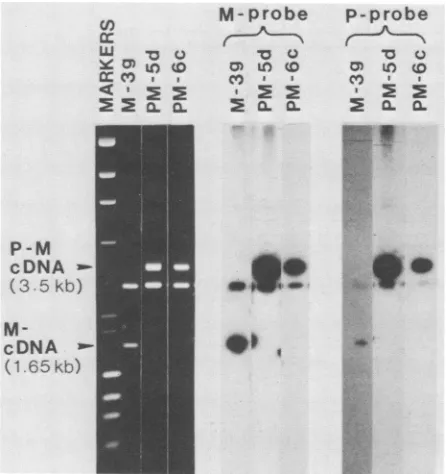
(28), two classes of M-related cDNAcloneswereisolated.The majority of these were monocistronic clones which contained cDNA inserts about 1.65 kilobasepairs (kbp) long. A representative clone of thisclass designated aspcD-M3g is shown in Fig. 1 (left panel, lane M-3g). The 1.65-kbp inserts in these clones contained the complete Mgene, which could be expressed into the corresponding M protein in vivo (Wong et al.,submitted). Inaddition to these typical M clones, a second class of M-related cDNA clones which contained inserts 584
on November 10, 2019 by guest
http://jvi.asm.org/
61, 1987
10
P-M
cDNA (3 5
kb)
cDNA
(1.65kb)
M-probe
CD LO
C,,'I I E E E c. ci.
p-probe
10 0 lt)
E O CL
-z.
^ w - W*e: tw
FIG. 1. cDNA clones pcD-PM5d and pcD-PM6ccontained both P and M sequences. The cDNA inserts of clones pcD-M3g,
pcD-PM5d, and pcD-PM6c were released from the vectorby digestion with XhoI enzyme and analyzed by electrophoresis in a 0.7% agarosegel.Clone pcD-M3gwasanexpressiblemonocistronic clone
which contained the completesequenceof theMgene(Wongetal.,
submitted). The resolved DNA fragments were stained with ethidium bromide (left panel), transferred onto nitrocellulose filter
paper(30),andhybridizedwith eithera32P-labeledM-specific DNA
probe (BamHIfragment from clone pcD-M2i [Fig. 2]) (middle panel)
or a P-specific DNA probe (XhoI fragment from pcD-P8) (right panel). Markers consisted of double-strand DNA from bacterio-phagesXand(X174digested with HindlIl and HaeIIl,respectively.
cDNAinsertsareindicatedbyarrows.Thecommonfragmentabout 2.9kbp longwas the linearizedvector.
roughly 3.5 kbp long were isolated (Fig. 1, left panel).
Analysis oftwoclonesfrom this latter class (pcD-PM5d and pcD-PM6c) revealed that they were bicistronic. Southern
hybridization analysis showed that, whereas the 1.65-kbp insert froma typical full-length M clone (pcD-M3g)
hybrid-ized only to an M-specific DNA probe, the 3.5-kbp inserts
from clones pcD-PM5d and pcD-PM6c hybridized to both M- and P-specific probes. (Fig. 1, middle and right panels, lanes M-3g, PM-Sd, and PM-6c). Restriction enzyme analy-sis confirmed that pcD-PM5d and pcD-PM6c clones
con-tained landmark restriction enzyme sites of both the P and
the Mgenes.
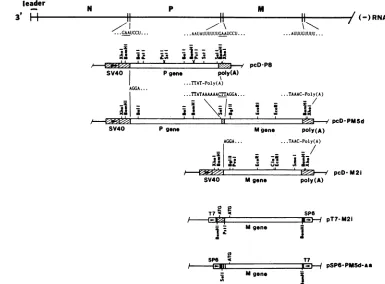
To define the structure and possible origin of the bicistronic RNA, clones pcD-PM5d and pcD-PM6c were analyzed by DNA sequencing (29). Both clones contained thecomplete P and Msequencesarrangedin tandem (Fig. 2;
only clone pcD-PM5d is shown). The 5' termini of these clones began with the tetranucleotide 5'-AGGA-3', a se-quence identical to that at the 5' terminus of a full-length
monocistronic cDNA clone of the P gene (pcD-P8 [Fig. 2])
(35). The protein-coding regions of the bicistronic clones
were identical to those ofthe monocistronic pcD-P8 clone and the genomic clones previously reported (6). However, when the intergenic regions of the bicistronic clones were
compared with the 3' terminus ofthe monocistronic clone pcD-P8, distinct differences were revealed. The highly
con-served
intergenic
regions ofthe measles viral genomecon-tained six uridine residues followed by the trinucleotide 3'-GAA-5'(Fig. 2) (26). The (U)6 sequence denoted thesite
for polyadenylation during mRNA synthesis; whereas the
trinucleotide 3'-GAA-5' was not transcribed during mRNA
synthesis.
Thus,themonocistronicclonepcD-P8 terminated with a polyadenylated sequence at a positioncorresponding to the (U)6 sequence; and the sequence complementary to the intergenic trinucleotide 3'-GAA-5' was notrepresentedin pcD-P8 or any other monocistronic clone (Fig. 2). In contrast, the intergenic regions of the bicistronic clones pcD-PM5d and pcD-PM6c were exactly colinear with and
complementary to the intergenic sequence in the genomic
RNA. ThePandMcistrons in these clones were separated
by
six A residues followed by the trinucleotide 5'-CTT-3'(Fig. 2). Moreover, the 5'-AGGA-3' sequence signifying the
beginningof the followingMcistron was immediately
adja-cent to this intergenic sequence with no omission or inter-ruption by polyadenylated regions. The protein-coding
re-gion in the M cistron was identical to that of a full-length monocistronic M clone, pcD-M2i, which has been com-pletely sequenced (Wong et al., submitted). Finally, both the
bicistronic P-M clones and the monocistronic M clone terminated atthe normal transcription termination site with a 3' sequence,
5'-TAAAC(A)n-3'.
The structural arrange-ment and pertinent sequence of the bicistronic clone pcD-PM5d incomparisonwith the monocistronic P clonepcD-P8and the Mclone pcD-M2i are summarized in Fig. 2. These results provided insight into the possible origin of the bicistronic RNA. The sequence arrangement suggested that the bicistronic P-M RNA species might be produced in a similar manner as a normal monocistronic mRNA. Initia-tion and termination of transcription occurred precisely at
the respective 3' and 5' termini of the P and M cistrons on the RNA template. The bicistronic transcripts appeared to bederived from a failure to observe the polyadenylation and termination signals at the intergenic region. Similar to the bicistronic RNA observed in vesicular stomatitis virus (15), the intergenic trinucleotide normally untranscribed during production of monocistronic mRNA was faithfully repre-sented in the bicistronic P-M RNA of measles virus. How-ever, unlike the bicistronic RNA in vesicular stomatitis virus, the P-M RNA of measles virus was polyadenylated only at the 3' terminus, not at the intergenic region. In this regard, the bicistronic RNA of measles virus was similar to that of Newcastle disease virus, which also possessed no intergenic polyadenylated sequences hybridizable to oligo(dT) (34). Interestingly, anotherparamyxovirus, simian virus 5, produced bicistronic RNA both with and without
polyadenylated sequences in theintergenic regions (16, 25). Bicistronic RNA has been postulated to serve as either a precursor tomonocistronic mRNA or a dead-end byproduct of transcription. The sequence of the bicistronic RNA of measles virus provided no clue to its putative function. The precursor hypothesis invoked a virus- or host-derived RNase activity which could cleave the bicistronic RNA specifically at the intergenic regions. The newly formed 3' termini could in turn serve as substrates for a putative poly(A) polymeraselike activity. Such an RNA-processing
mechanism has notbeendemonstrated. Totestwhether host cells could carryoutthis putative nucleolytic process in the absence of other viral functions, we analyzed RNA ex-pressed from the bicistronic cDNA clones via DNA-mediated gene transfer.
The monocistronic pcD-M2i and bicistronic pcD-PM5d
clones were transfected into simian virus 40-transformed
NOTES 585
on November 10, 2019 by guest
http://jvi.asm.org/
[image:2.612.64.287.74.311.2]leader
3'
H
N I I p...GAAUCCU...
M
II
'I-,' \
..AAUAUUUUUUGAAUCCU.. ..,AUUUGWUUU...
7/
(-)RNAIE
__ - _
Y V
Pgone
pcD-PS poly(A)
...ITAT-Poly(A)
...TTATAAAAAACITAGGA...
ic Ismg
Pgene
AGGA...
x
_S =_ X
....TAAAC-Poly(A)
* ao E Uo
., 11
Mgene POIy(A)
...TAAC-Poly(A)
-Z E-/
..
E.-SV40 M gone
T7'
4!
Mgene
poly(A)tpcD-M21 poly(A)
SPe
SP6 X T7
IpT7-M21
pSPG-PM5d-as
[image:3.612.112.497.72.356.2]M gone
FIG. 2. Sequencecomparisonamongbicistronicandmonocistronic clones and their derivativesfor in vitroexpression.DNAsequences
ofmonocistronic cDNA clonesrepresentingthecompleteP(pcD-P8)and M(pcD-M2i) genesof measles virus(35;Wongetal., submitted)
werecomparedwithbicistronicclonepcD-PM5d.Thepertinentsequencesandmajorrestrictionenzymesitestestedaredepicted, showing
theexactlocationsofinitiation,polyadenylation, andtermination of theplus-strandRNA withrespectto thenegative-strandRNAgenome.
Cross-hatched boxesrepresentsequencesderived from theOkayama-Berg cloningvector, which contains thesimian virus40(SV40)early
promoterandsplice signalsonthe 5' side andpolyadenylationsequencesonthe 3' side of the cDNA inserts(24,35). Stippledboxesrepresent
sequences derived from the intergenic 3'-(U)6-GAA-5' sequence of thegenomic RNA. The intergenic trinucleotide present only inthe
bicistronicclones,notin themonocistronic clones,is underlined. ClonepT7-M2iwasderivedfrompcD-M2i byinsertingthecompleteMgene
definedbythetwoBamHI sites into the BamHI sitein thecloning region (filled boxes)ofaninvitro expressionvector, pGEM-3 (Promega Biotec), such that the Mgene was colinear with a promoter derived from bacteriophage T7. This construct retained partof the SV40
sequences(hatched box)includinganin-frameATG codon located inashort intron(24; Wongetal.,submitted). ClonepSP6-PM5d-Aawas
derived frompcD-PM5dby excisingtheMcistron definedbytheSallandBamHI sitesandcloningitinto theSail andBamHI sites inthe
cloning regionofpGEM-3,such that the Mcistronwascolinear withapromoterderived frombacteriophage SP6.Thisconstruct retainedthe extreme3'terminus of the P cistron and theintergenic region (stippled box)but containednoupstreamATG codonprecedingtheATGcodon
of the Mgene.
Africangreenmonkeykidneycells(COScells) (12). At 48 h posttransfection,cellular RNAwaspurifiedandanalyzed by electrophoresis in agarose gel in the presence of methyl-mercuric hydroxide (4}. As a control, RNA purified from measlesvirus-infected cellswasanalyzed inparallel.
Hybridization with P and M gene-specific DNA probes revealed atleastthree size classes of virus-specificRNA in measles virus-infected cells (Fig. 3). The high-molecular-weightgenome-length RNAwas accompanied by heteroge-neous subgenomic RNA (Fig. 3, lanes A and B), whichwas also observed inpurified preparations of genomic RNA of
measlesvirus(20, 31) unless removed by extensive gradient centrifugation, nuclease treatment, or both (3). A second
classofintracellular RNA consisted of monocistronic RNA whichmigrated faster than the 18S ribosomal RNAmarker (Fig. 3, lanes A and B). In addition, distinct RNA species which migrated in between the 18S and 28Smarker RNAs
were detected by both P- and M-specific probes. These
represented bicistronic RNA. In cells transfected with M clonepcD-M2i,asingle species ofRNAwith electrophoretic mobility similar to that of the 18S RNA marker was
ex-pressed (Fig. 3, lane D). This RNA species hybridizedonly
to an M-specific probe, not to a P-specific probe (Fig. 3, lanes C andD). Incontrast,bicistronicclonepcD-PM5dwas expressedinto RNA whichcomigrated withthe bicistronic RNA from measles virus-infected cells and hybridized to both P- and M-specific probes (Fig. 3, lanes E and F). Moreover, virus-specific RNA ofmonocistronicsizewasnot detected in cultures transfected with clone pcD-PM5d by either gene-specific probe (Fig. 3, lanes E and F). These results didnotsupport nucleolytic processingofbicistronic RNA in transfected cells. However, theseexperiments did notruleoutthepossibility thatthe hypothetical processing pathway mightbe carriedoutby aviralfunctionnotpresent inthetransfected cells.
All bicistronic RNA species in Newcastle disease virus-infected cells were associated with polysomes (34). This raised the interesting question ofwhetherbicistronic RNA was translationally functional and, if so, what kinds of productscould beproduced. Toanswerthese questions, we
examinedthe in vivogeneproductsof thebicistronic clones at theprotein level.
COS cells transfected with monocistronic Mclone pcD-M2iproduceda38,000-Mr protein recognizedbymonoclonal SV40
AGGA...
iE =
ad:
aSV40
pcD-PM5d
,,rwtt
) F-w" -t-r,
I P-11.1
XH)-.
on November 10, 2019 by guest
http://jvi.asm.org/
*0
> C a
Genome-length
28St*
Bicistronic I
i
18S ,
Monocistronic
terminus of theP genejoined viatheintergenic region, such that the M cistron in this clone was not preceded by any upstreamATG codon (See Fig.2for details ofconstruction). For comparison, the complete M gene derived from monocistronic clone pcD-M2i was inserted into the same vectordownstream ofthe T7promotertogeneratepT7-M2i (Fig. 2). These constructed cloneswere transcribed bySP6 orT7polymerase into RNA for in vitro translation (19).
U) CYJ
.
a2 es
P-M RNA
M RNA
WY
.a97.4-
-68- Jw
FIG. 3. Expression ofmonocistronic and bicistronic RNAs by DNA-mediatedgenetransfer. Cultures of 1.5 x 10⁶COS cellswere transfectedwith 30 ,ug of cloned DNA pcD-M2i (lanes C and D) or pcD-PM5d (lanes E and F) by a modified calcium phosphate coprecipitation method (33, 35). At 48 h posttransfection, total intracellularRNA wasextracted with 4 M guanidine thiocyanate and purifiedbycentrifugationthrough a CsCl cushion (9). Amounts of 20 pLg ofthe purifiedRNA were resolved by electrophoresis in a 1% agarosegel in the presence of 7.5 mM methylmercuric hydroxide (4), transferredonto nitrocellulose filterpaper(32), andhybridized witha32P-labeledP-specific probe(XhoIfragment of pcD-P8) (lanes A,C, and E)or anM-specific probe(BamHI fragment of pcD-M2i) (lanes B, D, and F). Forcomparison,anRNApreparation contain-ing genome-length, bicistronic and monocistronic RNAs purified from measles virus-infected COS cells was similarly analyzed in parallel (lanesAand B). Thispreparation also contained heteroge-neoussub-genome-lengthRNAcharacteristic of measles virus (20). Openarrowsindicatethepositions of 28Sand 18SribosomalRNA markers.
antiserumagainstMprotein ofmeasles virus(Fig. 4,laneB).
This protein has been shown to be the genuine M gene
product (Wongetal., submitted). An additional minor
pro-tein of42,000 Mrwasderivedfromaberrant translation with an upstream in-frame ATG codon located in the vector sequence (Wong et
al.,
submitted).
The bicistronic clonepcD-PM5d produced
high
levels of a70,000-Mr protein
immunoprecipitated by
monoclonal antiserumagainst
mea-sles virusP protein(Fig.
4, lane D). NoM-specific protein
was detected in the same cells transfected with this
bicistronic clone
(Fig. 4,
laneC).
To rule out apossible
defectin theprotein-coding
function of theMcistron in thisclone, theMcistronwas excisedfrom
pcD-PM5d
by
diges-tion with Sall and BamHI and inserted into an in vitro
expression
vectorwhich contained promoters derived frombacteriophages
SP6 and T7(pGEM-3)
(Promega Biotec).
The
resulting
clone,
pSP6-PM5d-Aa,
contained thecomplete
M gene
preceded by
31 nucleotides derived from the 3'43-5
M m
25.7-9
[image:4.612.52.292.77.357.2]A B C D E F
FIG. 4. Expressionofprotein products from monocistronic and bicistronicclones invivoand invitro. Cultures of 1.5 x 10⁶ COS cells were transfected with 30 ,ug of cloned DNA as previously
described (35). At 30 h posttransfection, cellswere starved for 30
mininmethionine-free Eagleminimal essential medium and labeled
with30,uCi of [35S]methionineperculture. At 48 hposttransfection,
cell lysates were prepared and immunoprecipitated with 5 1.l of
monoclonal antiserumagainstthe MorPproteinofmeasles virus(8, 23). LaneBrepresentsproteinsimmunoprecipitatedfrom
pcD-M2i-transfected cells by antiserum againstM protein. Lanes C and D representproteinsimmunoprecipitatedfrompcD-PM5d-transfected
cellsby antiseraagainst the M and Pproteins,respectively. For in
vitroexpression, thecompleteMgenefromamonocistronic clone orthe M cistron fromabicistronic clone wasinsertedinto
expres-sionvector pGEM-3to generate clones pT7-M2i and
pSP6-PM5d-Aa, respectively (see Fig. 2 for details). These constructs were
linearizedat arestriction enzyme site inthe cloning region down-streamfrom the insertedMgene andtranscribed in vitrobyT7or
SP6 polymerase (21). Equal amounts (1 jig) ofin-vitro-generated
RNA were translated in rabbit reticulocyte lysates (19). Lane E
represents [35S]methionine-labeled proteins translated from RNA
derived frompT7-M2i.Lane Frepresentstranslationproductsfrom
pSP6-PM5d-Aa. The molecular mass markers in lane A are in kilodaltons.
It)
0.
_
0
I
I.
c c
4r <
to
CD
X0
a. o.
S
_d4
3 M
NOTES 587
on November 10, 2019 by guest
http://jvi.asm.org/
[image:4.612.343.512.174.513.2]RNA transcribed from the monocistronic clone pcD-M2i was translated in vitro into a 38,000-Mr protein which comigrated with the M protein produced in vivo in trans-fected cells(lanes E). Thisin-vitro-generated Mproteinwas also recognized by monoclonal antiserum against the M protein of measles virus (Wong et al., submitted). A
42,000-Mrprotein derived from the upstream in-frameATG codon as described above was also produced by in vitro translation. RNA generated from clone pSP6-PM5d-Aawas translated into the38,000-Mr protein(Fig. 4, lane F). Inter-estingly, RNA from pSP6-PM5d-Aa was more efficiently translated than that frompT7-M2i(comparelanes E andF). The difference in translationalefficiencywasprobablydueto aninhibitoryeffectof the poly(G * C) sequences introduced into the 5' termini of the cDNA clones during the cloning procedure, since these polymeric sequencesweredeletedin
pSP6-PM5d-A&a, and clones with shorter 5' polymeric se-quences were moreefficiently expressedattheproteinlevel (unpublished data).
These results indicated that the bicistronic cDNA clones of measles virus could be expressed into bicistronic RNA which did not undergo detectable processing in the trans-fected cells but was translationally functional in vivo. The tandemly arrangedPand M cistronsin thebicistronic RNA could directproteinsynthesis only fromthe first(P),not the second(M), cistron, even thoughthe AUG start codon for theMcistron was in a more favorable context for initiation oftranslation (5, 6, 18). This last observation underlies the need for the highly conserved mechanism to generate
monocistronic mRNAforexpressionofmultipleviralgenes in negative-strand RNA viruses.
WethankGregory Wipf forexpert technicalassistance, Shmuel Rozenblatt for providing cDNA cl-M, and Wolfgang Bohn and Erling Norrby for providingmonoclonalantisera.
This workwas supported by grantMV-238 from the American CancerSociety andaBiomedicalResearchSupportGrant awarded toT.W. andby American CancerSocietygrant IN-267awardedto
A.H.
LITERATURE CITED
1. Abraham,G., and A. K. Banerjee. 1976. Sequential transcrip-tion ofgenesofvesicular stomatitis virus.Proc.Natl.Acad.Sci. USA73:1504-1508.
2. Alkhatib, G., and D.J. Briedis. 1986. The predicted primary structure of the measles virus hemagglutinin. Virology 150:479-490.
3. Baczko,K., M. Billeter, and V. ter Meulen. 1983. Purification andmolecularweight determination ofmeasles virusgenomic RNA. J. Gen. Virol.64:1409-1413.
4. Bailey, J.M., and N. Davidson. 1976. Methylmercury as a reversible denaturing agent for agarose gel electrophoresis. Anal.Biochem. 70:75-88.
5. Bellini,W.J., G.Englund,C. D.Richardson,S.Rozenblatt,and R.A.Lazzarini. 1986.Matrix genesof measles virus and canine distemper virus: cloning, nucleotide sequences, and deduced amino acid sequences. J.Virol.58:408-416.
6. Bellini, W.J., G. Englund, S. Rozenblatt, H. Arnheiter, and C. D. Richardson. 1985. Measles virus Pgene codes for two proteins. J.Virol. 53:908-919.
7. Billeter,M.A., K. Baczko, A. Schmid, and V. ter Meulen. 1984. Cloningof DNA corresponding to four different measles virus genomic regions. Virology 132:147-159.
8. Bohn, W., G.Rutter, and K.Mannweiler. 1982. Production of monoclonalantibodies tomeasles virus proteins by immuniza-tion of mice with heatedanddetergent-treatedantigens. Virol-ogy116:368-371.
9. Chirgwin,J. M., A. E. Przybyla, R. J. MacDonald, and W. J. Rutter. 1979. Isolation of biologically active ribonucleic acid
fromsources enriched in ribonuclease. Biochemistry 18:5294-5299.
10. Choppin, P.W., and R. W. Compans. 1975. Reproduction of paramyxoviruses, p. 95-178. In H. Fraenkel-Conratand R.R. Wagner(ed.),Comprehensive virology,vol. 4.Plenum Publish-ing Corp.,New York.
11. Collins, P., andG. W. Wertz. 1983. cDNA cloning and tran-scriptional mapping ofninepolyadenylated RNAs encodedby thegenome ofhuman respiratory syncytial virus. Proc. Natl. Acad. Sci. USA80:3208-3212.
12. Gluzman, Y. 1981. SV40-transformed simian cells support the replicationofearly SV40mutants. Cell23:175-182.
13. Hall,W.W.,W.Kiessling,andV. terMeulen.1978. Membrane proteins of subacute sclerosing panencephalitis and measles viruses. Nature(London)272:460-462.
14. Herman,R.C.,S.Adler,R. A.Lazzarini,R.J. Colonno,A.K. Banerjee, and H. Westphal. 1978. Interveningpolyadenylated sequencesin RNAtranscriptsofvesicular stomatitis virus. Cell 15:587-596.
15. Herman,R. C.,M.Schubert, J.D.Keene,and R. A.Lazzarini. 1980. Polycistronic vesicular stomatitis virus RNAtranscripts. Proc. Natl. Acad. Sci. USA77:4662-4665.
16. Hiebert,S.W.,R. G.Paterson,and R.A. Lamb. 1985. Hemag-glutinin-neuraminidase protein of the paramyxovirus simian virus 5: nucleotide sequence of the mRNA predicts an N-terminal membrane anchor. J. Virol. 54:1-6.
17. Kingsbury,D.W.1985. Orthomyxo-andparamyxoviruses and theirreplication, p. 1157-1178. In B. N. Fields(ed.),Virology. RavenPress,New York.
18. Kozak, M. 1984. Compilation and analysis of sequences up-stream from the translation start site in eukaryotic mRNAs. Nucleic Acids Res. 12:857-872.
19. Krieg, P.A., and D. A. Melton. 1984. Functional messenger RNAs are produced by SP6 in vitro transcription of cloned cDNAs. Nucleic Acids Res. 12:7057-7070.
20. Lund,G.A.,D. L.J. Tyrrell, R. D. Bradley, and D.G.Scraba. 1984. The molecular length of measles virus RNA and the structuralorganizationofmeaslesnucleocapsids.J.Gen. Virol. 65:1535-1542.
21. Melton, D. A., P. A. Krieg, M. R. Rebagliati, T. Maniatis, K. Zinn, and M. R. Green. 1984. Efficient in vitro synthesis of biologically active RNA and RNA hybridization probes from plasmids containing a bacteriophage SP6 promoter. Nucleic Acids Res. 12:7035-7056.
22. Norrby, E. 1985. Measlesvirus, p. 1305-1321. In B. N. Fields (ed.), Virology. RavenPress,New York.
23. Norrby, E., S.-N. Chen, T. Togashi, H.Shesberadaran,and K. P. Johnson.1982. Five measles virus antigens demonstrated byuse
ofmouse hybridomaantibodies inproductively infected tissue culture cells. Arch. Virol. 71:1-11.
24. Okayama, H., and P. Berg. 1983. A cDNA cloning vector that permits expression of cDNA inserts in mammalian cells. Mol. Cell. Biol. 3:280-289.
25. Paterson, R. G., T. J. R. Harris, and R. A. Lamb. 1984. Fusion protein of the paramyxovirus simian virus 5: nucleotide se-quence of mRNApredicts ahighly hydrophobicglycoprotein. Proc. Natl.Acad. Sci. USA 81:6706-6710.
26. Richardson, C. D., A. Berkovich, S. Rozenblatt, and W. J. Bellini. 1985. Use ofantibodies directedagainst synthetic pep-tides foridentifyingcDNA clones, establishing reading frames, and deducing the gene order of measles virus. J. Virol. 54:186-193.
27. Rozenblatt, S., 0. Eizenberg, R. Ben-Lavy, V. Lavie, and W. Bellini. 1985. Sequence homologywithin themorbilliviruses. J. Virol. 53:684-690.
28. Rozenblatt, S., C. Gesang, V. Lavie, and S. Neumann. 1982. Cloning and characterization of DNA complementary to the measlesvirus mRNA encoding hemagglutinin and matrix pro-tein.J. Virol. 42:790-797.
29. Sanger, F., S. Nicklen, and A. R.Coulson.1977. DNA sequenc-ing with chain-terminating inhibitors. Proc. Natl. Acad. Sci. USA 74:5463-5467.
30. Southern, E.M. 1975. Detection of specific sequences among
on November 10, 2019 by guest
http://jvi.asm.org/
NOTES 589
DNAfragments separated by gelelectrophoresis. J. Mol.Biol. 98:503-517.
31. Stephenson, J. R., and V. ter Meulen. 1982. A comparative analysis of measles virus RNA oligonucleotide fingerprinting. Arch. Virol. 71:279-290.
32. Thomas, P. A.1980. Hybridizationof denaturedRNAand small DNAfragments transferredtonitrocellulose.Proc.Natl. Acad. Sci. USA77:5201-5205.
33. Wigler,M., A.Pellicer, S.Silverstein,R. Axel, G.Urlaub, and L.
Chasin. 1979. DNA-mediated transfer of adenine phosphori-bosyltransferase locusintomammalian cells.Proc. Natl. Acad. Sci.USA76:1373-1376.
34. Wilde, A., and T. Morrison. 1984. Structural and functional characterization of Newcastledisease viruspolycistronicRNA species. J. Virol. 51:71-76.
35. Wong, T. C., and A. Hirano. 1986.FunctionalcDNAlibrary for efficientexpression ofmeasles virus-specific gene products in primatecells. J. Virol. 57:343-348.