Special Polynomial Families for Generating More Suitable
Elliptic Curves for Pairing-Based Cryptosystems
Pu Duan, Shi Cui and Choong Wah Chan
School of Electrical and Electronic Engineering Nanyang Technological University
Singapore [email protected] [email protected]
Abstract
Constructing non-supersingular elliptic curves for pairing-based cryptosystems have attracted much attention in recent years. The best previous technique builds curves with ρ = lg(q)/lg(r) ≈ 1 (k = 12) and ρ = lg(q)/lg(r) ≈ 1.25 (k = 24). When k > 12, most of the previous works address the question by representing r(x) as a cyclotomic polynomial. In this paper, we propose a new method to find more pairing-friendly elliptic curves with arbitrary embedding degree k by certain special polynomial families. The new method generates curves with lg(q)/lg(r) ≈ 1 (k ≥ 48) by random forms of r(x). Different representations of r(x) allow us to obtain many new families of pairing-friendly elliptic curves. In addition, we propose a equation to illustrate how to obtain small values of ρ by choosing appropriate forms of discriminant D and trace
t. Numerous parameters of certain pairing-friendly elliptic curves are presented with support for the theoretical conclusions.
Keywords: pairing-friendly elliptic curves, special polynomial families, cyclotomic polynomials
1.
Introduction
embedding degree k ≤ 6 [11], researchers have explored other form of curves, e.g. non-supersingular elliptic curves.
In 2001, Miyaji, Nakabayashi and Takano [8] first proposed a method to find suitable non-supersingular elliptic curves for pairing-based cryptosystems. They discussed the problem from the point of view of tract t. Scott and Barreto [1] extended the method of Miyaji et al. and found more suitable non-supersingular elliptic curves when k ∈ [3, 4, 6]. Gallbraith, Mckee and Valenca [3] summarized the method proposed by early researchers and presented some appropriate families of group orders of such elliptic curves when embedding degree k ≤ 6. Duan, Cui and Chan [5] extended the work of Gallbraith et al. by proposing the idea of effective polynomial families of pairing-friendly elliptic curves.
For larger values of k, Brezing and Weng proposed an alternative method to find these curves [7]. They used t − 1 as a kth root of unity modulo prime r. They generated the curves with best performance so far as lg(q)/lg(r) = 1.25 (k = 24). Dupont, Enge and Morain [16] proposed another method for finding the suitable non-supersingular elliptic curves. Most of the curves they found had lg(q)/lg(r) ≈ 2. In their method, tract t was chosen large enough to make 4q – t2 small as to produce effective values of D. Barreto and Naehrig [17] generated non-supersingular elliptic curves with lg(q)/lg(r) = 1 when embedding degree k = 12. They presented the best curves with prime group order known so far. Their work was actually generated by a special polynomial family of q(x), t(x) and r(x), where 4q(x) – t2(x) can be factorized as one square polynomial multiplying with one constant number. In the most recent work, Murphy and Fitzpatrick [4] extended the work of Brezing et al. and generated pairing-friendly elliptic curves over prime fields with discriminant D > 4 for arbitrary values of k.
In this paper we propose a new method for finding more pairing-friendly elliptic curves. Compared to the previous works, we explicitly present the special polynomial families for generating elliptic curves suitable for pairing-based cryptosystmes with arbitrary values of embedding degree k. We also illustrate the relation to obtain small values of ρ by choosing appropriate forms of discriminant D, trace t and embedding degree k. Our method allows to find more pairing-friendly elliptic curves with higher security (k ≥ 48) and more efficiency (ρ≤ 1.2) by various representations of r(x). In fact, the work of Brezing et al. [17] and Murphy et al. [4] can be represented as a special case of our new method, since they implement r(x) only as cyclotomic polynomials in their work.
curves with ρ = lg(q)/lg(r) ≈ 1 for large values of k ≥ 48. We draw the conclusion in Section 5. The parameters of some pairing-friendly elliptic curves, based on the proposed polynomial families, are presented in Appendix (a), (b), (c) and (d) over prime fields.
2. Mathematics Background
To find suitable elliptic curves for pairing-based cryptosystems, we need to solve certain equations. Assume the cofactor h is an integer, r is the order of a point as a big prime number and t is the trace of an elliptic curve, we want to find an elliptic curve over Fq, where q = p is a prime number (we only consider the prime fields in this
paper). ECDLP on such elliptic curves can be reduced to DLP over Fqk, where k is the
smallest integer satisfying certain conditions, defined as the embedding degree [1]. The following equations determine whether such an elliptic curve exists or not.
In a strict sense, to find the suitable elliptic curves for pairing-based cryptosystems [10], we need
r | qk – 1 (1)
However, under a mild condition [6], we just consider q as a kth root of unity modulo r
[7]. Meanwhile, since k is the smallest integer satisfying r | qk – 1, equation (1) should be presented as r | qk – 1 and qi – 1 is not divisible by r when 0 < i < k. From [14] we have
dr =Φk(q) (2)
where d is an integer and Φk(q) is the cyclotomic polynomial of q with embedding
degree k and
d’r ≠Φi(q), 0 < i < k (3)
Besides these conditions we need
hr = q + 1 – t (4)
where h is an integer. Combining equation (2) and (4) together, we obtain
sr = Φk(t – 1) (5)
where s is also an integer [1]. Since k is the smallest integer, we have
s’r ≠Φi(t – 1),0 < i < k (6)
By Hasse’s bound we need
|t| ≤ 2q1/2 (7)
With all the above equations, we compute the elliptic curve by solving
DV2 = 4q – t2 (8)
where D is chosen by certain conditions [2].
meanwhile h, d, s, D and V should be considered as h(x), d(x), s(x), D(x) and V(x). Duan et al. [5] have proposed a lemma which illustrates the fact that in polynomial fields, equation (2) and (5) are already both sufficient and necessary conditions. Thus for finding suitable elliptic curves for pairing-based cryptosystems in polynomial fields, the equations (2, 4, 5, 7, 8) are required and rewritten as:
d(x)r(x) =Φk(q(x)) (9)
h(x)r(x) = q(x) + 1 – t(x) (10)
s(x)r(x) =Φk(t(x) – 1) (11)
|t(x)| < 2q(x)1/2 (12)
D(x)V(x)2 = 4q(x) – t2(x) (13)
How to build pairing-friendly elliptic curves by finding the polynomial families satisfying equation (9) to (13) were presented in [1, 3, 5, 8, 17]. Most of the work concentrated on embedding degree k ≤ 6. Only one special polynomial family whe k = 12 was found by Barreto et al. [17], which built the best curves with prime group order known so far.
For larger values of k, the polynomial families of q(x), t(x) and r(x) will not satisy all the conditions from equation (9) to (13). Only some of the parameters will maintain the polynomial relations and the other ones will only be valid for certain x as
x0. Brezing and Weng [7] proposed a method to find these curves. In their method, in
polynomial fields, t(x) and r(x) will satisfy equation (11) by representing t(x) – 1 as a kth root of unity modulo r(x). The irreducible polynomial r(x) is always set as a cyclotomic polynomial. q and DV2 will not have the polynomial relations. They can not be represented as polynomials in cyclotomic fields. But all the parameters are satisfying equations (9) - (13) for a specific x0. In the next section, we will present a
new method for finding more pairing-friendly elliptic curves with arbitrary embeddin degree k by some special polynomial families. The new method allows r(x) to be an irreducible polynomial with different forms.
3. A New Method for Producing More Pairing - Friendly Elliptic
Curves with Special Polynomial Families
In this section the math evidence for the new method is provided. As proposed in [7], from equation (4) and (8), difference between 4q and t2can be obtained after finding t
and r:
DV2 = 4q – t2 = 4(hr + t – 1) – t2 (14)
Represented in polynomial fields, equation (16) can be rewritten as
where D is a square-free integer. This is a standard polynomial family of pairing-friendly elliptic curves proposed in [1, 3, 5, 8, 17] with the satisfaction to equation (9) - (13). In polynomial fields, choose r(x) and t(x) as
s(x)r(x) =Φk(t(x) – 1)
This can be viewed as
r(x) |Φk(t(x) – 1) (16)
We should mention that polynomial families are hard to find for large values of k (e.g.
k > 12) when equation (15) is satisfied. To find more curves, we choose suitable r(x)
and t(x) satisfying equation (16). Then for a specific x0, assuming equation (15) is
satisfied, this can be presented as
DV2(x0) =4h(x0)r(x0) – (t(x0) – 2)2 (17)
Dividing D from both sides of equation (17), we have
V2(x0) = [4h(x0)r(x0) / D] – [t(x0) – 2]2 / D (18)
where 4h(x0)r(x0) and [t(x0) – 2]2 divides D. Assuming [t(x0) – 2]2 | 4Dh(x0), equation
(18) can be rewritten as
V2(x0) = {[t(x0) – 2]2 / D2 }{[4Dh(x0)r(x0) / (t(x0) – 2)2] – D} (19)
Here we use a technique to consider 4Dh(x0)/ (t(x0) – 2)2 as a polynomial h’(x) for
certain x0. This means for a specific x0, 4Dh(x0) divides [t(x0) – 2]2 and it can be
represented in polynomial fields as a polynomial h’(x). Then equation (19) can be represented as
V2(x0) = {[t(x0) – 2]2 / D2 }{h’(x)r(x) – D} (20)
Thus if h’(x)r(x) – D can be viewed as a square polynomial S2(x), in equation (20) all parameters have square forms. If h’(x)r(x) – D = S2(x), for any suitable x0, equation
(20) is satisfied and can be written as
V2(x0) = {[t(x0) – 2]2 / D2 }S2(x) (21)
This equation represents a modified polynomial family. For the specific x0, we have
DV2(x0) = {[t(x0) – 2]2 / D }S2(x0) (22)
Representing equation (14) into equation (22), we obtain
q = [t2(x0) + DV2(x0)] / 4 (23)
We choose x0 as to satisfy that r(x0) is a prime integer. Then for the specific x0, if q = [t2(x0) + DV2(x0)] / 4 is a prime integer, we find all the suitable parameters with
satisfaction to a pairing-friendly elliptic curve.
The main idea can be presented as the following procedures. First we choose a specific r(x) and trace polynomial t(x) with r(x) |Φk(t(x) – 1). Then after choosing a
suitable discriminant D, we find polynomial families h’(x) satisfying that h’(x)r(x) – D = S2(x) as a square polynomial. In the following steps, we choose a suitable x0 with r(x0) is a prime integer and test whether q = {t2(x0) + [(t(x0) – 2)2 / D ]S(x0)} / 4 is also
The main step in the new method is to find a suitable discriminant D and special polynomial families h’(x), r(x), S(x) with h’(x)r(x) – D = S2(x). The other work to test prime r(x0) and q(x0) is trivial. When r(x) is taken as a standard cyclotomic
polynomial, finding suitable S(x) is equal to find the polynomial representations of (-D)1/2 in cyclotomic fields. This is because
S2(x) + D ≡ 0 mod r(x) (24)
In such circumstances, our method is same with the methods proposed by Brezing and Weng [7] since equation (24) can be rewritten as
DV2(x) = {[t(x) – 2]2 / D}S2(x) (25)
where S(x) is the representation of (-D)1/2 in cyclotomic fields. This equation is same as the main relation proposed in [7]. Thus the work of Brezing et al. is a special case of our new method since in their method r(x) is only taken as a standard cyclotomic polynomial. Our proposed method ignores the restrictions imposed on the form of r(x). By our method more pairing-friendly elliptic curves are found by various forms of
r(x).
Based on the above analysis, we propose a new algorithm for finding the suitable pairing-friendly elliptic curves.
Algorithm 1
Input: embedding degree k, qk≥ 21024 and r ≥ 2160
Output: x0, q(x0), t(x0), r(x0), DV2(x0)
1. Choose an irreducible polynomial r(x).
2. Compute trace polynomial t(x) by Φk(t(x) – 1) ≡ 0 mod r(x).
3. Choose a polynomial family h’(x) and a suitable discriminant D with h’(x)r(x) – D = S2(x), where S2(x) is a square polynomial.
4. Find a specific x0 with r(x0) is a prime integer and q(x0) = {t2(x0) + S2(x0)[(t(x0) – 2)2 / D] } / 4 is also a prime integer.
5. Output x0, q(x0), t(x0), r(x0), DV2(x0)
6. Establish the elliptic curve by CM method with the above parameters. 7. If no suitable parameters are found, repeat from step 1
Because the key procedure of the new method is to find special polynomial families h’(x), r(x) and S2(x), in the next section we will list some polynomial families with different embedding degree k, ρ = lg(q)/lg(r) and r(x).
4. Special Polynomial Families for Producing More Pairing -
Friendly Elliptic Curves
with different forms of r(x), small values of ρ and arbitrary values of embedding degree k.
4.1 Special Polynomial Families with Small Values of ρ
The new method indicates that the value of ρ is related to the choice of r(x), t(x) and
h’(x). It is because ρ = lg(q)/lg(r) = degree(q(x)) / degree(r(x)). Since DV2(x0) = {[t(x0) – 2]2 / D }{h’(x)r(x) – D}, we have degree(q(x)) = degree(DV2(x)) ≈ 2degree(t(x)) + degree(h’(x)) + degree(r(x)). Thus the value of ρ = degree(q(x)) / degree(r(x)) = [2degree(t(x)) + degree(h’(x)) + degree(r(x))] / degree(r(x)) = 1 + [2degree(t(x)) + degree(h’(x))] / degree(r(x)). It is to say that ρ will always be larger than 1. This can also be deduced from the conditions used in the new method. Since we assume [t(x0) – 2]2 | 4Dh(x0) in the algorithm, when ρ = 1, h(x) will be a constant
integer as h. Then [t(x0) – 2]2 | 4Dh will not be satisfied since |t2(x0)| > 4Dh. When
the degree of h’(x) is 0 (h’(x) is a constant number), ρ has the smallest values as 1 + 2degree(t(x)) / degree(r(x)). Thus for finding ρ close to 1, h’(x) should be chosen as a constant number and t(x) should be chosen with smallest degrees.
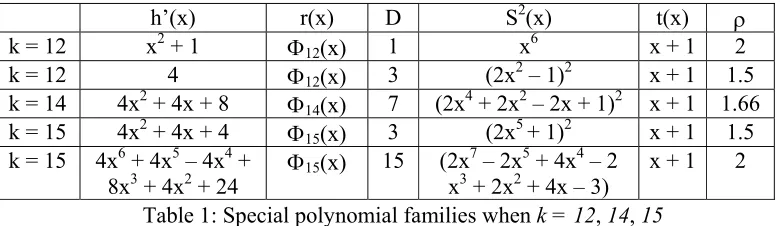
Table 1 presents all the different special polynomial families when embedding degree k ∈ [12, 14, 15, 16] over cyclotomic fields. All the results satisfy the nice representations of (-D)1/2 in the work of Murphy and Fitzpatrick [4].
h’(x) r(x) D S2(x) t(x) ρ
k = 12 x2 + 1 Φ
12(x) 1 x6 x + 1 2
k = 12 4 Φ12(x) 3 (2x2 – 1)2 x + 1 1.5
k = 14 4x2 + 4x + 8 Φ
14(x) 7 (2x4 + 2x2 – 2x + 1)2 x + 1 1.66
k = 15 4x2 + 4x + 4 Φ15(x) 3 (2x5 + 1)2 x + 1 1.5
k = 15 4x6 + 4x5 – 4x4 +
8x3 + 4x2 + 24 Φ15(x)
15 (2x7 – 2x5 + 4x4 – 2
x3 + 2x2 + 4x – 3)
x + 1 2
Table 1: Special polynomial families when k = 12, 14, 15
In Table 2 we tabulate all the possible special polynomial families when k = 28. When r(x) is fixed as a cyclotomic polynomial with embedding degree k, h’(x) and t(x)
should be chosen with smallest degrees. Thus t(x) always should be taken as x + 1 if
r(x) = Φk(x). Although in cyclotomic fields we can modulo S2(x0)[t(x0) - 2)]2 / D by Φk(x0) to a smaller integer; from the deductions of section 3 we can find that the best
choice is still to set t(x) as x + 1. Murphy et al. [4] implemented t(x) as x3 + 1 with
standard cyclotomic polynomial r(x) when k = 28. They found the elliptic curves with ρ ≈ 1.8. We will present some pairing-friendly elliptic curves when k = 15, 28 in Appendix (a). These curves have smaller values of ρ compared to the work of Murphy et al. [4] when representing t(x) as x + 1.
h’(x) r(x) D S2(x) t(x) ρ
k = 28 x2 + 1 Φ
k = 28 4x4 + 4x2 + 8 Φ28(x) 7 (-2x8 – 2x4 + 2x2 – 1)2 x + 1 1.5
Table 2: Special polynomial families when k = 12, 14, 15
Brezing et al. [7] and Murphy et al. [4] have implemented r(x) as Φik(x) for a
given embedding degree k, where i is an integer. In fact, such techniques can not obtain elliptic curves with smaller values of ρ. First we analyze the situation when k is an even number. When r(x) is taken as Φik(x), we have degree(r(x)) = degree(Φik(x)) = i × degree(Φk(x)); meanwhile, we have i × degree(t(x)) and i × degree(h’(x)). Thus
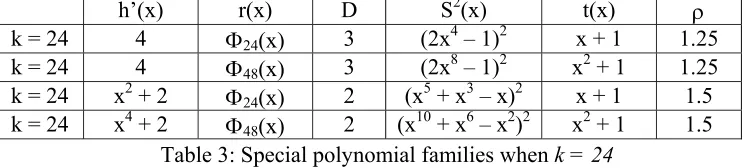
the value of ρ is not related to the choice of cyclotomic polynomials since the degrees of r(x), t(x) and h’(x) are increased with same multiples. When k is an odd number, the analysis is similar. Brezing et al. [7] have found the best curves with ρ≈ 1.25, k = 24. They took r(x) as Φ48(x) and t(x) as x2 + 1. In Table 3, we tabulate some
polynomial families when k = 24 which illustrates that ρ≈ 1.25 is also obtained for k = 24 when t(x) = x + 1, r(x) = Φ24(x). These polynomial families prove that the value
of ρ has no relation with the choice of the degrees of Φk(x) and t(x).
h’(x) r(x) D S2(x) t(x) ρ
k = 24 4 Φ24(x) 3 (2x4 – 1)2 x + 1 1.25
k = 24 4 Φ48(x) 3 (2x8 – 1)2 x2 + 1 1.25
k = 24 x2 + 2 Φ24(x) 2 (x5 + x3 – x)2 x + 1 1.5
k = 24 x4 + 2 Φ48(x) 2 (x10 + x6 – x2)2 x2 + 1 1.5
Table 3: Special polynomial families when k = 24
4.2 Special Polynomial Families with Arbitrary Values of k
As finding the special polynomial families, we notice a fact which can be implemented to construct pairing-friendly elliptic curves with arbitrary embedding degree k. When k is an even integer, Φsk(x) will have the same form as Φk(x) where s = 2i (i is a positive integer). The only difference is that x in Φ
k(x) will be represented
as xs in Φ
sk(x). Meanwhile, h’(x) will also have the same property. Thus if we find a
special polynomial family for embedding degree k, we can easily obtain the families with the same forms for embedding degree sk (s = 2i). The only work is to represent x
as xs, where s is a positive integer power of 2.
The beauty of this property is to find curves with larger embedding degree k with smaller ρ. It is because ρ = 1 + [2degree(t(x)) + degree(h’(x))] / degree(r(x)). When degree of r(x) is increased with same multiples of h’(x), if the degree of t(x) is not changed, the value of ρ will be decreased. When h’(x) is a constant integer, the situations are more easily to analyze. Since if we always choose t(x) as x + 1, the values of ρ equals 1 + [2 / degree(r(x))]. By choosing larger values of embedding degree k, the degree of r(x) will increase, then the value of ρ will be decreased (but it can not reach 1 for ever).
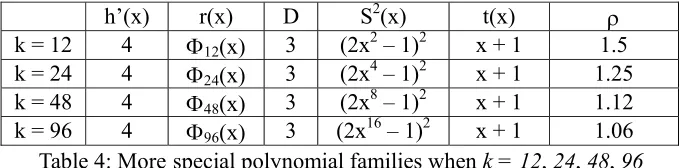
with k = 2i3j as large as possible. In Table 4, we tabulate the polynomial families when k = 12, 24, 48, 96. The value of ρ is decreased close to 1 when taking larger values of k. Since in these families the value of h is always 4, the small values of ρ is obtained when k = 96. When k = 48, we construct the parameters of certain paring-friendly elliptic curves with ρ≈ 1. 125. When k = 96, we construct the parameters of certain paring-friendly elliptic curves with ρ ≈ 1. 06. These curves have better performance compared to previous works, since they have smaller values of ρ for larger values of k. The results are presented in Appendix (b).
h’(x) r(x) D S2(x) t(x) ρ
k = 12 4 Φ12(x) 3 (2x2 – 1)2 x + 1 1.5
k = 24 4 Φ24(x) 3 (2x4 – 1)2 x + 1 1.25
k = 48 4 Φ48(x) 3 (2x8 – 1)2 x + 1 1.12
k = 96 4 Φ96(x) 3 (2x16 – 1)2 x + 1 1.06
Table 4: Morespecial polynomial families when k = 12, 24, 48, 96
With this technique we could find any pairing-friendly elliptic curves with arbitrary embedding degree k, e.g. finding curves with larger k than 96 is not a hard task. But since the suitable values of x become sparse when k is increased, finding parameters of elliptic curves with the essential security level (r is a 160 bits prime) [9] is more difficult with large k. This is the reason we find the parameters of an elliptic curve with r as a 416 bits prime integer when k = 96. In addition, it is still not aware how large the embedding degree k should be for a pairing-friendly curve with best performance. (To find curves with prime r close to 160 bits integer for larger values of
k, e.g. k = 96, we should use some other techniques. This question will be further discussed in section 4.4.)
4.3 Special Polynomial Families with Different Forms of r(x)
Brezing and Weng [7] had successfully found pairing-friendly elliptic curves with arbitrary embedding degree. But the limitation of their work was that r(x) was only represented as the standard cyclotomic polynomial. It was because their method was to derive kth roots of unity and polynomial representations of (-D)1/2 in the cyclotomic fields. They did not provide any explanations to the circumstances when r(x) was taken as an arbitrary irreducible polynomial. The work of Murphy and Fitzpatrick [4] was also based on the standard representations of r(x) as Φk(x).
Our method ignores the limitation imposed on the forms of r(x) since we only need to find h’(x) and D with h’(x)r(x) – D = S2(x). For this point, r(x) can be any irreducible polynomials satisfying r(x) |Φk(t(x) – 1). This allows us to find much more
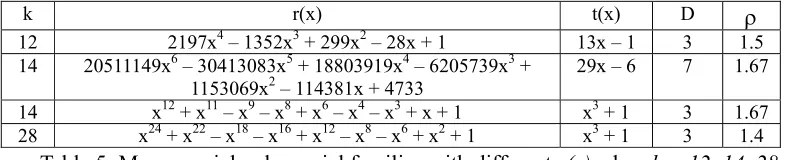
with degree as small as possible to obtain desired values of ρ. In Appendix (c) we generate certain parameters of pairing-friendly elliptic curves by the polynomial families listed in Table 5.
k r(x) t(x) D ρ
12 2197x4 – 1352x3 + 299x2 – 28x + 1 13x – 1 3 1.5 14 20511149x6 – 30413083x5 + 18803919x4 – 6205739x3 +
1153069x2 – 114381x + 4733
29x – 6 7 1.67
14 x12 + x11 – x9 – x8 + x6 – x4 – x3 + x + 1 x3 + 1 3 1.67 28 x24 + x22 – x18 – x16 + x12 – x8 – x6 + x2 + 1 x3 + 1 3 1.4
Table 5: More special polynomial families with different r(x) when k = 12, 14, 28
Table 5 just tabulates some new polynomial families of different r(x) when k = 12,
14 and 28. When the irreducible polynomial r(x) is not limited as a cyclotomic polynomial, more values of the discriminant D will be suitable for generating pairing-friendly elliptic curves. Appendix (c) presents parameters of curves with D = 3 when embedding degree k=14 and 28. Such curves have not been proposed in any relative works before. By the new method, more polynomial families can be found for other values of k. It is no way to list all the special polynomial families with various values of embedding degree k. Table 6 presents such special polynomial families with different forms of r(x) when k = 13, 14 and 15. These new polynomial families will be implemented for finding much more pairing-friendly elliptic curves.
k r(x) t(x) 13 x22 – 11x20 + 56x18 – 173x16 + 359x14 – 524x12 + 548x10 – 410x8 + 215x6 – 75x4
+ 16x2 – 1
x2
13 x22 + 11x20 + 56x18 + 173x16 + 359x14 + 524x12 + 548x10 + 410x8 + 215x6 +
75x4 + 16x2 + 1 –x 2
14 343x6 – 343x5 + 147x4 – 49x3 + 21x2 – 7x + 1 7x2 + 1 14 343x6 + 343x5 + 147x4 + 49x3 + 21x2 + 7x + 1 7x2 + 1 15 81x8 + 81x7 + 54x6 + 27x5 + 9x4 + 9x3 + 6x2 + 3x + 1 –3x2 + 1 15 625x8 + 625x7 + 250x6 + 125x5 + 75x4 + 25x3 + 10x2 + 5x + 1 5x2 + 1 15 50625x8 + 50625x7 + 27000x6 + 10125x5 + 2925x4 + 675x3 + 120x2 + 15x + 1 –15x2 + 1
Table 6: More special polynomial families with different r(x) when k = 13, 14, 15
4.4 More r with a small factor
In fact, when it is allowed that r contains a small factor s as r = sn (n is a prime larger than 2160), much more suitable elliptic curves are found. The same technique has been
presented some examples with this technique when k = 96. By this technique, we effectively decrease the length of r.
5. Conclusion
In this paper, we propose a new method to find more pairing-friendly elliptic curves with arbitrary embedding degree k by certain special polynomial families. This method allows us to obtain new families of pairing-friendly elliptic curves by representing r(x) with various forms. In addition, we propose a new technique to let prime r contain a small factor s. Numerous parameters of new pairing-friendly elliptic curves are found with the proposed method. These curves have higher security (k ≥ 48) and more efficiency (ρ ≤ 1.2) compared to the previous work for paring-based cryptosystems.
Reference
[1] M. Scott and P. S. L. M. Barreto. Generating more MNT elliptic curves. Cryptology ePrint Archive, Report 2004/058, 2004.
[2] IEEE Computer Society, New York, USA. IEEE Standard Specifications for Public Key Cryptography- IEEE Std 1363-2000, 2000.
[3] S. D. Galbraith, J. Mckee and P. Valenca. Ordinary abelian varieties having small embedding degree. Cryptology ePrint Archive, Report 2004/365, 2004.
[4] A. Murphy and N. Fitzpatrick. Elliptic curves for pairing applications. Cryptology ePrint Archive, Report 2005/302, 2005.
[5] P. Duan, S. Cui and C. W. Chan. Effective polynomial families for generating more pairing-friendly elliptic curves. Cryptology ePrint Archive, Report 2005/236, 2005.
[6] R. Balasubramanian and N. Koblitz. The improbability that an elliptic curve has subexponential discrete log problem under the Menezes-Okamoto-Vanstone algorithm. Journal of Cryptology, vol. 11, pp. 141- 145, 1998.
[8] A. Miyaji, M. Nakabayashi, and S. Takano. New explicit conditions of elliptic curve traces for FR-reduction. IEICE Transactions on Fundamentals, E84-A(5):1234-1243, 2001.
[9] A. M. Odlyzko. Discrete logarithms: the past and the future. Design, Codes and Cryptography, 19:129-145, 2000.
[10] A. Menezes, T. Okamoto, and S. Vanstone. Reducing elliptic curve logarithms to logarithms in a finite field. Proc.22nd Annual ACM Symposium on the Theory of Computing, pp. 80-89, 1991.
[11] D. Page, N. P. Smart and F. Vercauteren. A comparison of MNT curves and supersingular curves. Cryptology ePrint Archive, Report 2004/165, 2004.
[12] D. Boneh and M. Franklin. Identity based encryption from the Weil pairing. SIAM Journal. of Computing, vol. 32, no.3, pp. 586-615, 2003.
[13] D. Boneh, B. Lynn and H. Shacham. Short signatures from the Weil pairing. Advances in Cryptology – Asiacrypt’2001, volume 2248 of Lecture Notes in Computer Science, page 514-532, Springer-Verlag, 2002.
[14] P. S. L. M. Barreto, B. Lynn, and M. Scott. Constructing elliptic curves with prescribed embedding degrees. In Security in Communication Networks – SCN’2002, volume 2576 of Lecture Notes in Computer Science, pages 263 – 273. Springer-Verlag, 2002.
[15] G. Frey, M. Muller and H. G Ruck. The Tate Pairing and the Discrete Logarithm Applied to Elliptic Curve Cryptosystems. IEEE Transactions on Information Theory, Vol 45, 1999.
[16] R. Dupont, A. Enge, and F. Morain. Building curves with arbitrary small MOV degree over finite prime fields. Journal of Cryptology, 18(2): 79-89, 2005.
[17] P. S. L. M. Barreto and M. Naehrig. Pairing-Friendly Elliptic Curves of Prime Order. Cryptology ePrint Archive, Report 2005/133, 2005.
[18] N. Koblitz and A. Menezes. Pairing-based cryptography at high security levels. Cryptography ePrint Archive, Report 2005/076, 2005.
[20] P. S. L. M. Barreto, H. Y. Kim, B. Lynn and M. Scott. Efficient algorithms for pairing-based cryptosystems. In Advances in Cryptology – Crypto’ 2002, volume 2442 of Lecture Notes in Computer Science, pages 354-368. Springer-Verlag, 2002.
Appendix
(a) Special Polynomial Families with Small Values of ρ
(1) k = 15, ρ≈ 1.5
S(x)2 = 4x10 + 4x5 + 1 = ( 2x5 + 1)2, D = 3, h'(x) = 4x2 + 4x + 4, r(x) = x8 – x7 + x5 – x4
+ x3 – x + 1; t = x + 1
x = 962542
r = 736812625806875488411619464155914329720828004251 (160 bits) t = 962543
q = 210821116242423781273928707154678491170030343072612390007530063190082481 DV2 = 3 × 5301837621585227705195563314577478552
x = 963691
r = 743878444107727695162122767267461445685217722161 (160 bits) t = 963692
q = 213860944736631842553256727901553298223449065045182728561325970849274791 DV2 = 3 × 5339924403168167730089675391368106902
(2) k = 28, ρ≈ 1.3
S(x)2 = x14 = ( x7)2, D = 1, h'(x) = x2 + 1, r(x) = x12 – x10 + x8 – x6 + x4 – x2 + 1
x = 9803
r = 787604206770071823093201411395167729501255763497 (160 bits) t = 9804
q = 1818006543181202958475850993256242972686798649470526225526834373 DV2 = 1 × 852761758800475986371318138157742
x = 11137
r = 3640982842728443680116187727215542591828879918337 (162 bits) t = 11138
(3) k = 28, ρ≈ 1.5
S(x)2 = 4x16 + 8x12 – 8x10 + 8x8 – 8x6 + 8x4 - 4x2 + 1 = ( -2x8 – 2x4 + 2x2 – 1)2, D = 7, h'(x) = 4x4 + 4x2 + 8, r(x) = x12 – x10 + x8 – x6 + x4 – x2 + 1; t = x + 1
x = 41707
r = 27701763920994110467659972445730100441267452808766711657 (160 bits) t = 41708
q = 208277458642659286262143174064593219937166390246750999549996523200303792983 73672379
DV2 = 7 × 1090943127082929853215344524469782706355062
(b) Special Polynomial Families with Arbitrary Values of k
(1) k = 24, ρ≈ 1.25
S(x)2 = 4x8 – 4x4 + 1 = ( 2x4 – 1)2, D = 3, h'(x) = 4, r(x) = x8 – x4 + 1
x = 962833
r = 738597331833134695682651527040098006595721222721 (160 bits) t = 962834
q = 228237767803155599843901956912501345675531789475531151146001 DV2 = 3 × 5516493666610529154082978851042
x = 965365
r = 754279653484785063609361644146986474789548990001 (160 bits) t = 965366
q = 234311355599190690060865477933001341274428958628739903196197 DV2 = 3 × 5589410888447197706886083132122
(2) k = 48, ρ≈ 1.125
S(x)2 = 4x16 – 4x8 + 1 = ( 2x8 – 1)2, D = 3, h'(x) = 4, r(x) = x16 – x8 + 1; t = x + 1
x = 2470
r = 1919337073641697218700435018344997774751611743900000001 (181 bits) t = 2471
q = 3900067982257971406335440851621796993324203292652129302034457 DV2 = 3 × 22803707249065070695405999991772
x = 5479
r = 659509122132996966757981555872075218495015674349333558784961 (199 bits) t = 5480
q = 6596956313127361783001807130560758413668060647820395503153853875187 DV2 = 3 × 29657952982018975439914161301765462
S(x)2 = 4x32 – 4x16 + 1 = ( 2x16 – 1)2, D = 3, h'(x) = 4, r(x) = x32 – x16 + 1; t = x + 1
x = 8053
r = 978692749574626480538230483695999678074871490897268541981732772686715308827 46626642467570423271029692259277387159136085590721 (416 bits)
t = 8054
q = 211510849085390112587526446980689883706931943167877001092990725747474905933 6578748454299585997310640624280446883451996334997687068581
DV2 = 3 × 16793286320645724546395741908139966484886888380448141772569659444442
(c) Special Polynomial Families with Different Forms of r(x)
(1) k = 12
r(x) =2197x4 – 1352x3 + 299x2 – 28x + 1, t(x) = 13x – 1
x = 137438953782
r = 783915802287873738784769281395853185119086316917 (160 bits) t = 1786706399165
q = 10844209581049657402029453962827548199750866489317427585866728276041510847 DV2 = 3 × 38024920917822051230350291383772163112
ρ≈ 1.5
(2) k = 14
r(x) = 20511149x6 – 30413083x5 + 18803919x4 – 6205739x3 + 1153069x2 – 114381x + 4733, t(x) = 29x – 6
x = 5936652
r = 897923694407722064866709188398349353035596592369 (160 bits) t = 172162902
q = 326811759720835564714732775797503236447913111267853657917916780522421188688 3682901
DV2 = 7 × 432145319288933879814785107185576180841002
ρ≈ 1.7
(3) k = 14
r(x) = x12 + x11 – x9 – x8 + x6 – x4 – x3 + x + 1, t(x) = x3 + 1
x = 15232
r = 155995361021362964986617313981716948403826318130049 (167 bits) t = 3534034567169
q = 150666731193060465857318079463252879097159019829490149782649859359850965103 446502059
DV2 = 3 × 4482063976831216776190228563210827094207152
x = 20407
r = 5216404427914503790876787321022549418762696795540849 (172 bits) t = 8498406359144
q = 522952248798243310204873263632960856258466277996750710866325979985092879120 71180641259
DV2 = 3 × 83502674511917545742339959134594621851352902
ρ≈ 1. 64
(4) k = 28
r(x) = x24 + x22 – x18 – x16 + x12 – x8 – x6 + x2 + 1, t(x) = x3 + 1
x = 4771
r = 1934755172897947994728410192480110834394779405134439011249404032388632622350 0566190371441 (294 bits)
t = 108599606012
q = 394093170064435167699977896702602761176849345869715722490624647866252375122 25087429072337377153934782355126366807430018348711
DV2 = 3 × 2292286107984589163102148226430615780564889744551566505799398702
ρ≈ 1. 4
x = 11482
r = 2756900067682603914910428454190159455946018000396363226508589807671190772572 0348452657645369203301 (324 bits)
t = 1513744672169
q = 365995032854028830181112733247410682700743071734828589143267860527579628417 228792670715862301671800267296582683863393831025766200151340707
DV2 = 3 × 6985652275476536392271825766370207017600309452882150334904590408712832
ρ≈ 1. 4
(d) More r with a small factor
(1) k = 96
x = 790
r = 10434720951603582380562581218122202100877840495787457852353 (193 bits) t = 791
DV2 = 3 × 121065166821654956774192774537524599999999999997372
q = 109925809631663581112233601417794309888777824519815968844486928993958095044 494654530000000000208297
x = 1075
r = 9602444773024990186558868308887683846050319720923974013729 (193 bits) h = 193 × 189697 × 5 548897 × 44511 743233 × 116 517189 305089
t = 1076
DV2 = 3 × 22774478984574661338473130929283797740936279296871422
q = 389007669764124673056208123236933160496464959539104119574614994745358704230 5725812911987304687500385567
ρ≈ 1.75
x = 1462
r = 7998565106006563123727929799215532040801815430031249192586457180982904662797 1851073 (276 bits)
h = 97 × 24464261226891361 t = 1463
DV2 = 3 × 4243428792486717802991307284426585084195237795786910972
q = 135050159376789629563661162494941702923787864008293359224562874946890295339 329479610347558831805883810832649
ρ≈ 1.3
x = 1990
r = 4995305491877891169028998357156355876186080752202802023341143310844554193252 3117458511731692993 (315 bits)
h = 769 × 95237953 t = 1991
DV2 = 3 × 802033939506683756041610933761788055812599999999999993372
q = 482443830090458143970598719142978471444730710196094627023340791823785775650 9183337390177849436930000000001320697
ρ≈ 1.17
(5) x = 2344
r = 3265344136080389756117061362948346136410185602877472164948887012210851476357 2456390768929387700504882561 (344 bits)
h = 21121 t = 2345
DV2 = 3 × 12971874761632176402622474504460802316195215015492158742912
q = 126202151123602375023567112106696114961035327131602564074987641333594437147 7169742695240677028410003616420637439267