
Contents lists available atScienceDirect
Renewable and Sustainable Energy Reviews
journal homepage:www.elsevier.com/locate/rser
A review of energy simulation tools for the manufacturing sector
Tom Lloyd Garwood
a,⁎, Ben Richard Hughes
a, Michael R. Oates
b, Dominic O
’
Connor
a,
Ruby Hughes
caEnergy 2050, Department of Mechanical Engineering, The University of Sheffield, Level 1, Arts Tower, Bolsover Street, Sheffield, South Yorkshire S3 7NA,
United Kingdom
bIntegrated Environmental Solutions Limited, Helix Building, West of Scotland Science Park, Glasgow G20 0SP, United Kingdom
cAdvanced Manufacturing Research Centre with Boeing, The University of Sheffield, Advanced Manufacturing Park, Wallis Way, Catcliffe, Rotherham S60
5TZ, United Kingdom
A R T I C L E I N F O
Keywords:
Building Energy Modelling Manufacturing Process Simulation Holistic industrial energy use simulation Co-simulation
Industry Energy use
A B S T R A C T
Manufacturing is a competitive global market and efforts to mitigate climate change are at the forefront of public perception. Current trends in manufacturing aim to reduce costs and increase sustainability without negatively affecting the yield offinished products, thus maintaining or improving profits. Effective use of energy within a manufacturing environment can help in this regard by lowering overhead costs. Significant benefit can be gained by utilising simulations in order to predict energy demand allowing companies to make effective retrofit decisions based on energy as well as other metrics such as resource use, throughput and overhead costs. Traditionally, Building Energy Modelling (BEM) and Manufacturing Process Simulation (MPS) have been used extensively in their respectivefields but they remain separate and segregated which limits the simulation window used to identify energy improvements.
This review details modelling approaches and the simulation tools that have been used, or are available, in an attempt to combine BEM and MPS, or elements from each, into a holistic approach. Such an approach would be able to simulate the interdependencies of multiple layers contained within a factory from production machines, process lines and Technical Building Services (TBS) to the building shell. Thus achieving a greater perspective for identifying energy improvement measures across the entire operating spectrum and multiple, if not all, manufacturing industries. In doing so the challenges associated with incorporating BEM in manufacturing simulation are highlighted as well as gaps within the research for exploitation through future research. This paper identified requirements for the development of a holistic energy simulation tool for use in a manufacturing facility, that is capable of simulating interdependencies between different building layers and systems, and a rapid method of 3D building geometry generation from site data or existing BIM in an appropriate format for energy simulations of existing factory buildings.
1. Introduction
Against the backdrop of increasingly competitive global markets and climate change, manufacturers aim to reduce costs and increase sustainability without negatively affecting the yield of their finished products, thus maintaining or improving profits. An improvement in energy efficiency or reduction in energy use during manufacturing is an effective method of achieving both goals [1,2]. The energy use by industry accounted for 54% of delivered end-use energy globally in 2012[3], seeFig. 1-1a, and this is predicted to have reduced slightly to 53% in 2040. Therefore, attempts at reducing energy usage within industry could have the greatest effect on reducing global end-use energy when compared with residential buildings, commercial
build-ings, transportation and other end-use sectors. Although the global end-use energy for industry is 54%, each country will deviate from this global mean depending on its own manufacturing activity[4]. This is illustrated inFig. 1-1b which depicts the breakdown of 2015 United Kingdom (UK) end-use energy by sector, of which 17% accounts for industrial use[5].
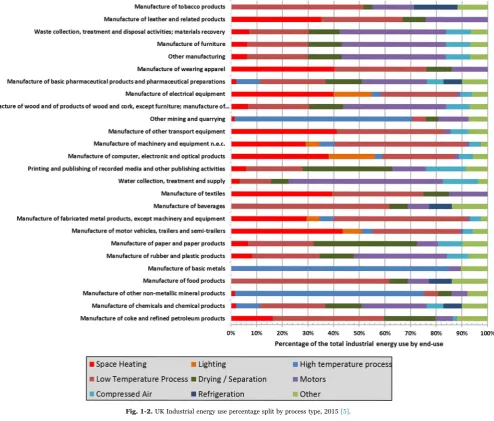
By examining the UK industrial energy use, seeFig. 1-2, it is clear that a significant proportion of energy is utilised on building services (e.g. space heating and lighting) as well as manufacturing or industrial processes. As such, both should be considered together in attempts to achieve more effective energy savings within industry.
By modelling entire manufacturing facilities, a holistic approach can be taken in assessing all of the interconnected systems[6], allowing
http://dx.doi.org/10.1016/j.rser.2017.08.063
Received 29 November 2016; Received in revised form 10 January 2017; Accepted 14 August 2017
⁎Corresponding author.
E-mail address:t.garwood@sheffield.ac.uk(T.L. Garwood).
Available online 31 August 2017
1364-0321/ © 2017 The Authors. Published by Elsevier Ltd. This is an open access article under the CC BY license (http://creativecommons.org/licenses/BY/4.0/).
for the identification of areas, where the most potential exists for improvements in energy efficiency, throughput or both. This is applic-able to existing factories, that may have undergone decades’worth of renovation, demolition and rebuilding, and new factories. In the UK it is estimated that 70% of the existing building stock from 2010 will still be utilised in 2050[7]. Thisfigure is for residential and commercial buildings; however, a similarly large proportion of the existing manufacturing plants would be expected to still be in use in 2050; albeit with modifications to meet changing business demands.
Building Energy Modelling (BEM) and Manufacturing Process Simulation (MPS) are mature techniques for analysis. BEM is tradi-tionally used to analyse a thermal building envelope and is widely used for residential and commercial building assessment (e.g. DesignBuilder [8], EnergyPlus Simulation Engine [9], eQuest [10], Green Building Studio [11], International Building Physics Toolbox (IBPT) [12], Integrated Environmental Solutions (IES) Virtual Environment (VE) [13], Modelica Buildings Library [14] and Sefaira [15]). MPS is traditionally used to optimise a manufacturing process line by asses-sing parameters such as machine utilisation and throughput (e.g. AnyLogic [16], Arena [17], DELMIA [18], FlexSim [19], Plant Simulation[20], Simio[21]and SIMUL8[22]). BEM application in a manufacturing facility has only begun to be applied in recent years [23,24]and traditionally MPS has not focused on energy use between manufacturing equipment, utilities or the building for the purposes of energy efficiency improvements[25,26].
A combination of elements from both techniques offer a potential solution that would allow effective retrofit or modification decisions to be made holistically within a manufacturing facility. Such a solution should aim to identify potential options to reduce energy use while maintaining or improving facility productivity. Rahimifard et al.[27] argue that considering energy use at a “plant” (BEM) or “process” (MPS) level independently does now allow manufacturers to identify how much energy is used per unit product. As such this review will address the research undertaken to date that has attempted to combine elements of BEM and MPS.
A note on terminology and definitions;
•
Several modelling approaches are discussed within this paper and are defines as thus;○ Time-driven–A modelling approach in which time is a simulation variable that is incremented at set discrete intervals and all computation is conducted at each increment.
○ Event-driven–A modelling approach in which discrete events in a sequence, such as a production line, are incremented sequentially, regardless of time between events, and all computation is conducted at each increment.
○ Continuousflow –A modelling approach that simulates a contin-uous time and mixed state Markov Process for a system that utilises buffers and continuous massflow concepts, such as a production line [28].
○ Numerical techniques – A modelling approach that uses any numerical methodology other than simulation. This can include measurements, experimentation and calculation from first princi-ples.
○ Agent driven–A modelling approach that comprises components of a whole system that are autonomous agents interacting in and with a defined environment. Agent driven modelling can be either time-driven or event-time-driven or a hybrid of both using an event-time-driven time advance[29].
○ Co-simulation–A modelling approach where each subsystem within a larger system is simulated independently using the most suitable technique. Between system simulation iterations, the inputs and outputs of each subsystem are communicated between each applic-able subsystem. This is then repeated until a system equilibrium is achieved.
•
This paper includes discussion and comparison of the merits of simulation software Graphical User Interfaces (GUIs), that use external simulation engines, with the simulation engines them-selves. This is to highlight the limitations of using certain software configurations for future research.1.1. Methodology
[image:2.595.116.474.56.306.2]research that had built on the initial tranche of research papers. This was repeated as many times as required until the most current research in the field was identified and the citation trails stopped. This methodology is summarised inFig. 1-3.
1.2. Previous related Work
Previous studies have focussed on either BEM or MPS modelling approaches that incorporate elements of the other. In addition, reviews that are considered a holistic approach without a specific focus on either BEM or MPS have been summarised here.
While there are previous reviews in the use of varying BEM methodologies [30–35] an examination of the literature highlighted that reviews of BEM research that attempt to incorporate MPS is scarce, except for the fully holistic reviews described later in this
[image:3.595.59.554.57.478.2]Section. However, Seow et al. [36] reviewed current commercially available software for energy management and analysis. The software packages were categorized as follows; 1) Product life cycle or 2) Energy management based. Ten software packages were assessed in the product lifecycle category and twenty were considered in the energy management category. The authors identified that there was a distinct lack of product life cycle tools that are able to model energy use for manufacturing. But the tools that were available lacked details on the embodied energy in product manufacture. The energy management software reviewed could model and monitor the energyflows within a manufacturing facility but could not provide a detailed breakdown of energy used per product manufactured. As such both tools are considered as static analytical tools but the authors speculated that the use of Discrete Event Simulation (DES) could allow the use of dynamics of a system to be included in any simulation. The paper Fig. 1-2.UK Industrial energy use percentage split by process type, 2015[5].
[image:3.595.119.464.486.560.2]concluded that there is a gap in existing approaches for modelling energy flows, a lack of tools to highlight energy hotspots during a product lifecycle and tools that can handle the complexities of produc-tion operaproduc-tions required to manufacture a product. The paper was limited in that it did not attempt any of the modelling techniques it had highlighted as potential solutions.
Previous literature reviews exist with a focus on MPS however the majority fail to, or to a limited extent, include attempts to incorporate elements of BEM or Technical Building Services (TBS). A summary of these reviews is not included within this paper however they still provide value in modelling energy use at the process or machine level [37–48].
Haapala et al.[25]produced a comprehensive review of research in the subject area of sustainable manufacturing. This included one of the main areas of research for achieving a sustainable manufacturing system; “design of environmentally conscious production systems”. This considered techniques such as energy auditing and appropriate planning and schedule of manufacturing processes. In the discussions the authors recommend that manufacturing systems should focus attention on resource use, waste production and reduction of negative environmental impacts through continuous improvements. They noted that facility level savings in the region of 5–10%, for low cost changes, or up to 50%, following significant changes to facilities, operations and practices, are possible. Gutowski et al. [49] identified that idle machines can use 85% of equipment energy and other research papers [6,50] showed improvements in energy efficiency of 30% via simula-tion-assisted process planning. In conclusion the authors noted that development and application of technology can dramatically affect the sustainability of manufacturing systems.
Herrmann et al.[50]and Thiede et al.[2]reviewed the use of DES for modelling energy use within manufacturing facilities with a focus on commercially available tools. Both identified that commercially available DES software did not incorporate energyflows as standard. However, Herrmann et al. [50] acknowledged that existing research had achieved energy modelling by developing DES software and categorised them into three paradigms, seeFig. 1-4. Paradigm-A would allow good modelling of energyflows by having the evaluation external to the DES but would not be able to model the interdependencies and dynamic energy flows within a facility. Paradigm-B allows a high resolution in assessment of energy flows but would require specific simulation models in separate tools reducing transferability and increasing modelling and simulation time. Paradigm-C provides a “one-stop solution”and can handle the dynamics of energy use within facility layers. However, it is limited by the GUI and features provided to the user. Outcomes of this research are detailed inSection 3.
Thiede et al.[2]surveyed commercially available DES software and presented the survey results, seeFig. 1-5. Future areas for research in DES were identified as including energy not directly related to the manufacturing process in simulation tools [36], ensuring tools are capable of assessing multiple“what-if?”scenarios, complete a compre-hensive review of electricity metering and monitoring systems,
estab-lishing appropriate level of simulation details, integration of energy modelling with production control systems and that a centralised database to support energy modelling would be extremely beneficial that could be enabled by the development of an international frame-work to standardise the approach of energy modelling in production systems.
The MPS reviews have shown that DES is the most favoured method for modelling manufacturing process lines. However, DES will not be able to simulate thermal building energy performance which is usually performed using a time-step method. As such Paradigm-B as proposed by Herrmann et al. [50], where the two are modelled separately and then evaluated together appears the most promising approach to incorporate BEM into MPS.
Two papers[51,52]included a holistic consideration of the facility and process, however they were predominantly policy based and did not provide sufficient details on holistic modelling and simulation methodologies. These papers are excluded from this paper for this reason. However, they do provide value in considering future policy direction that aims to combine ecology and economics of a manufac-turing environment.
Duflou et al. [53]produced a comprehensive review of literature investigating the potential for improved energy and material efficiency ranging across thefive key manufacturing levels. 1) Process tools; the authors identified that redesigns to the equipment offered the most potential. 2) Multi-machine systems; resource reuse opportunities can be identified via exergy cascading techniques and simulation techni-ques can support reduction of peak power and energy use. 3) Factory level; simulation becomes a predominant tool to handle the complex-ities of an entire facility and it was noted that TBS can be responsible for a large proportion of energy usage. 4) Multi-facility systems; co-location of production plants offers a significant opportunity for resource sharing and reuse. 5) Supply chain; regional electricity generation techniques hold sway on the environmental impact of the entire supply chain with proximity and local climate of individual facilities in a supply chain influencing energy requirements. The authors concluded that the techniques discussed can be implemented using current knowledge and technology offering a reduction in global energy use of at least 50%.
[image:4.595.309.557.56.142.2]Mousavi et al.[54] reviewed existing research as a pre-cursor to their own research as summarised inSection 4. The reviewed research
[image:4.595.119.481.607.733.2]Fig. 1-4.Paradigms for simulating energyflows in manufacturing systems[50].
reported the organisation of manufacturing activities, based on three of the levels suggested by Duflou et al.[53]; Process tools, Multi-machine systems and Factory, including current approaches on each level to achieving improved energy efficiency, and water efficiency in manu-facturing. At a process level, state-based modelling (e.g. DES) is the preferred technique, however these are not comprehensive as they cannot account for energy use in states other than machining and are therefore limited for a total facility energy use simulation. At a system level the authors described efforts made to incorporate facility energy modelling by extending state-based modelling to incorporate TBSs based on the demand of production processes. The authors also described other non-state-based methods such as the energy-block concept, petri-net concept or splitting demand into energy used directly by processes and energy used by supporting systems. Research into water efficiency was identified as a scarce topic within the literature however some attempts had been made. The authors concluded their review of the literature by stating that there is no holistic method to simulate energy and water use from machine tools to the factory level. Herrmann et al.[55]described the concept of a holistic factory and the different variations this takes within the literature. The key to the holistic concept is the ability to simulate the complex interactions and interdependencies of all equipment, process and facility systems, see Fig. 1-6. The authors reviewed six research papers against six research focuses; 1) Production structure, 2) Energyflows, 3) Resourceflows, 4) Human factor, learning and social aspects, 5) Symbiosis and spatial context and 6) Information and Communication Technology (ICT) and Cyber Physical Systems (CPS). In the review the authors identified the extent of consideration each research paper gave to each research topic. The authors identified that energy and resourceflow is well considered but human factors, learning and social aspects as well as ICT and CPS considerations were lacking within the literature. The paper concluded by stating that the described holistic factory concept, and how it can be achieved, closed a research gap regarding trends in manufacturing allowing the factory of the future to address sustainable manufacturing by considering ecological and social aspects compared to the existing
economic viewpoint.
Webber et al. [26] emphasised the importance of an integrated consideration (i.e. holistic) of manufacturing facilities. The authors described a methodology, that when applied, would enable decision making for remodelling and expanding existing facilities. They also identified that by considering systems within a manufacturing envir-onment, holistically, untapped energy and resource potentials could be exploited. Following a brief review of literature, it was identified that the effectiveness of a holistic modelling approach is important due to the interoperability of different software platforms and that computer interfaces are yet to be standardised. This makes it a challenge to apply the existing methodologies to Small and Medium sized Enterprises (SMEs). This is compounded by a lack of evaluation methods and adequate tools to assess advanced energy savings. The proposed methodology included how to plan for remodelling and expansion of a facility, incorporation of smart grid technology and identifying potential recovery options of waste heat. The methodology was then applied to two industrial use cases. The authors concluded that waste heat and battery storage were identified as important enabling technologies for SMEs and were then assessed further to develop tools for the identification of potential savings.
Common among these holistic research reviews is the requirement to structure and compartmentalise the facility into machine, process and facility type arrangement; in some cases, more layers are used[53]. This would allow for the best simulation to be selected for each area under consideration however this may not achieve the desired level of interaction between all different processes to be truly holistic. Ultimately the increase in accuracy on a truly holistic simulation may determine if it is worth pursuing over a compartmentalised holistic approach.
1.3. Scope of current study
This paper presents the modelling approaches reviewed within the existing literature, building on the previous reviews described in
Section 1.2, and describes the software tools available that are able to implement the discussed modelling approaches. This is split into three Section; 1) BEM, 2) MPS and 3) Holistic Simulation. BEM initially focuses on the energy modelling of a building shell and gradually works into the manufacturing equipment. MPS initially focusses on the energy modelling of the manufacturing equipment and gradually works out to building shell. Holistic Simulation, in the context of this paper, aims to consider the Building and Processes equally. Next, capability matrices presenting a summary of the modelling approaches and software tools are discussed, a discussion of the review'sfindings is presented including observations made as well as identification of key challenges and potential solutions for overcoming these challenges via future research.
2. Building Energy Modelling (BEM)
Using two case studies, Bawaneh et al.[23]presented four separate time-driven methods, for estimating the non-process energy use; 1) direct measurement of non-process energy, 2) direct measurement of process energy to be subtracted from total facility energy use, 3) creation of a regression model and 4) using BEM software, in this case the EnergyPlus Simulation Engine [9]. The authors concluded their study by highlighting the advantage of being able to utilise different non-process energy estimation methods as comparators, based on the available plant information and to inspect accuracy of each method. Thefirst three methods were deemed to produce accurate results but were time consuming and expensive to implement whereas method number four was able to easily produce results quickly but the accuracy of results was diminished. To conclude the authors claimed the results of the four techniques were“close”to each other suggesting any of the methods could be selected. On review of thefirst case study presented by the authors, it can be calculated that the range about the mean energy use in kWh of all four methods was approximately 15% (+7%/ −9%).
Liu et al. [56], building on their previous research [57] for evaluation and optimisation for energy use in a typical welding shop, explored energy efficient building design for manufacturing plants after identification that limited research results studying manufacturing plants had been reported. The authors developed a time-driven EnergyPlus [9]-integrated overall energy use estimation four step framework for a specific class of manufacturing plant. The authors assumed that environmental conditions had no effect on the energy use of production processes. The paper speculated that the proposed framework should help to quantitatively identify some energy con-servation opportunities related to the facility and its climate control. The authors described how optimisation of the industrial environment, from an energy use perspective is more challenging than residential buildings as 1) production activities can have a significant effect on the indoor environmental conditions and 2) the scheduling of production processes also needs consideration. The paper provided a building design optimisation example of a simple workshop and presented a methodology for optimising the energy cost via building design modification. The results also highlighted advantages of considering production scheduling and uncertainties in the optimisation process. The authors concluded by identifying that the methodology should be extended substantially by applying it to more challenging building designs.
Moynihan and Triantafillu [58] sought to pair the software packages DesignBuilder[8], as a User Interface (UI), and EnergyPlus [9], as a simulation engine, for accurate time-driven modelling of a manufacturing facility and validation of the facility's annual energy use. Students from the Alabama Industrial Assessment Centre (AIAC) conducted an energy audit on the facility which provided the authors with a raw data required for the research. Initial 3D modelling took place in the UI DesignBuilder where production internal gains were specified following analysis of energy use of equipment based on a
maximum calculation of 60 W/m2. The model was then exported to the simulation engine EnergyPlus so that additional functionality, not provided by DesignBuilder, could be utilised such as a tariffschedule. The internal gains were then increased to account for the total energy use (watt) of motors and compressors in the facility, ignoring thefloor area. The simulation results, for the annual energy use of all motors and compressors, were found to differ by 0.67% when compared with the AIAC assessment implying an accurate model and simulation. Several retrofit options were considered for the facility and reported in terms of payback time and after tax analysis providing a useful template for engineering managers to make effective decisions in energy reduction and improved efficiencies.
Katunsky et al.[59]developed a method of analysis of industrial building energy use including potential energy saving measures. Energy requirements were computed numerically via site measure-ments using national standards for Slovakia and Austria as well as via two independent simulations in parallel with ESP-r[60]and BuildOpt-VIE[61]. For the numerical analysis the authors assumed internal heat gains from equipment and lighting at 12.35 W/m2 and 4.5 W/m2
respectively. This was compared against other typical non-residential buildings such as sports arenas and conference centres and it was identified that internal heat gain information must be defined as accurately as possible for calculation accuracy. When using the simulation software, the internal gains from equipment and occupants was estimated on an hourly basis with the result being validated with experimental data. The authors concluded that both simulations are able to agree with numerically derived results when using accurate input information and that facility energy use can be reduced by adjusting the facility heating system appropriately and adopting a good maintenance schedule.
[image:6.595.311.555.580.730.2]Zhao et al.[62] presented a new Product Lifecycle Management (PLM) information model for a manufacturing facility. A framework was developed which incorporated a simulation using the EnergyPlus Simulation Engine[9], seeFig. 2-1. This was applied to an example case study with a factory that utilised Heating, Ventilation and Air Conditioning (HVAC) and equipment for a coating process. The simulation was conducted in five steps; 1) model the plant using Autodesk Revit[63], 2) manual input of data defined by the Product, Process, Plant, Resource and Energy (P3RE) information model; this was developed from the conventional Product, Process, Plant and Resource (P3R) model[64], 3) simulate with EnergyPlus Simulation Engine, 4) simulation outputs produced and 5) export simulation outputs. This enabled the authors to assess three different scenarios for changing the HVAC operating procedures which identified signifi -cant potential energy savings (i.e. 21–27% compared with baseline). In concluding the authors identified that the study may be limited as it only considers a narrow spectrum of PLM components. In future work, connecting the framework to manufacturing system modelling was
identified as of benefit.
The BEM approaches included in this paper have included the consideration of energy use during manufacturing using time-driven approaches. However, although progress has been made in this area, where manufacturing is simulated it is via assumed internal gains or via direct measurement of facility energy use. The assumed internal gains are prone to errors that could provide misleading results. The direct measurement only allows the existing manufacturing confi gura-tion to be simulated. This does allow for improvements and efficiency savings to the existing configuration to be identified but is restrictive in assessing other factory configurations or extensive process retrofit options in order to reduce overall facility energy use as no measured data is available. In addition, both methods fail to provide any resolution of energy use at a “micro” process, machine or material flow level restricting any improvements to the“macro”facility level. Kissock et al.[65]argues that this“outside-in”approach is the least effective method of establishing energy efficiency improvements within a manufacturing facility. Consideration of a facility “inside-out”, by considering production equipmentfirst, ensures any improvements are magnified. Kissock et al. explains that this is because minimising“ end-use loads in the manufacturing processes reduces the expense of and losses from the distribution system, which in turn reduces the expense of modifying, and losses from, the primary energy and material conversion equipment”.
2.1. BEM software
EnergyPlus [9] is a free and open-source simulation engine, developed by the USA Department of Energy (DoE), for assessing the energy and water use within a building. This includes HVAC, solar gains, occupant schedules and equipment loads. EnergyPlus is com-monly found within research literature and is utilised by some commercial entities to provide building simulations within their own software [8,63]. The energy simulations utilise thermal zones and component-based HVAC models and are solved using a time-step methodology that can be refined by the user at the expense of simulation run time. EnergyPlus lacks an integrated GUI to visualise the model. eQUEST[10]or“the QUick Energy Simulation Tool”is also developed by the USA DoE with the aim of bridging this problem by providing an intuitive GUI for building energy analysis.
Autodesk Revit[63]is a commercially available Computer Aided Design (CAD) software that enables the user to follow a Building Information Model (BIM) workflow for any Architectural, Engineering and/or Construction (AEC) project. This includes, among other fea-tures, producing 3D geometry and an energy analysis of the building. The energy simulation is conducted using Autodesk Insight 360[66]as a Revit Plug-in. Autodesk Insight provides whole building energy, heating, cooling, daylighting and solar radiation simulation by utilising the EnergyPlus [9]simulation engine. As such it is limited to using assumed internal gains that utilise an operating schedule. Autodesk Green Building Studio [11] is an additional Autodesk plugin that utilises cloud computing to power whole building energy simulations in the EnergyPlus Simulation Engine.
DesignBuilder[8]is also a commercially available CAD software for 3D modelling of buildings for the purpose of energy efficient design and building operation. DesignBuilder is developed allowing the import of BIM data from another computing environment–presumably so that only energy relevant BIM parameters are used. Again, EnergyPlus[9]is the simulation engine used utilising thermal zones and component-based HVAC systems.
IES VE [13] is a commercially available whole building energy simulator. It has a range of features including good interoperability with BIM for rapid model import and generation, simulation of HVAC systems, thermal environmental effects, occupant schedules, airflows and lighting design. The software also has a library of components from building suppliers such as natural ventilation wind catchers that can be
incorporated into simulations. IES VE utilises a time-based simulation for modelling thermal zones and TBS. While primarily a BEM tool, there have been approaches to consider a holistic factory system [24,67] for manufacturing equipment that can be considered as thermal zones, such as ovens and drying tanks. These approaches are discussed inSection 4.
IBPT[12]is a free and open-source toolbox containing a library of blocks used for thermal modelling of buildings by considering the building construction, thermal zones, systems such as HVAC, internal building gains and additional parameters to fully define building construction elements or climate data. The IBPT is used to model the interaction of thesefive elements through a blockflow diagram, the behaviour of which is then simulated, using a time-based approach, using Simulink[68]. This is traditionally focused on BEM but research has been conducted[24,30]to develop a novel technique that included thermal zones for bulk fluid processes within the larger building thermal zone, this is discussed inSection 4.
ESP-r[60]is a free and open source modelling tool that enables building performance simulations using a time-based approach. It is capable of simulating heat, air, moisture, light and electrical power flows within thermal zones which is common among BEM software. ESP-r was utilised by Katunsky et al.[59]for an industrial building to measure energy use. However, the machinery energy load and internal gains were assumed and validated against experimental data which makes it difficult to simulate different and potentially more efficient machinery configurations.
BuildOpt-VIE[61]is a detailed multi-zone thermal and daylighting building performance simulation tool that utilises differential algebraic equations. BuildOpt-VIE was utilised by Katunsky et al.[59] for an industrial building to measure energy use. However, as with ESP-r [60], the machinery energy load and internal gains were assumed and validated against experimental data which makes it difficult to simulate different and potentially more efficient machinery configurations. BuildOpt-VIE no longer appears to be readily available for use or supported by its developers.
Modelica Buildings Library[14]is a free and open source dynamic simulator capable of time-based simulation and DES that is primarily focussed on simulating building energy use (via thermal and internal loads) and control systems. It uses object-orientated equation based simulation where all assumptions and equations used are editable making it useful for research and development. It works across multi-domains and it is able to model a range of systems including electrical, mechanical, hydraulic and thermodynamic. Fritzon and Bunus [69] illustrate that Modelica is suited to the development of hybrid models of both time-based simulation and DES.
IDA ICE [70] is a commercially available whole BEM software utilising a time-based approach. It interfaces well with BIM file imports, provides a 3D GUI, utilises equation based modelling and is fully editable to enable research and development. No evidence can be found within the reviewed literature of its use in a manufacturing environment to-date.
Sefaira[15]is a commercially available energy simulation tool that enables users to produce 3D models of buildings and analyse the internal energy use, thermal comfort and lighting levels. The software is compatible with other popular AEC software such as Sketchup[71] and Autodesk Revit[63]. Once a 3D model has been produced Sefaira has further capabilities such as assessing potential design strategies options (e.g. triple glazing) and the proposed HVAC system options. No evidence can be found within the reviewed literature of its use in a manufacturing environment to-date.
evidence can be found within the reviewed literature of its use in a manufacturing environment to-date.
3. Manufacturing Process Simulation (MPS)
[image:8.595.82.515.56.200.2]Rahimifard et al.[27]developed a novel modelling framework, see Fig. 3-1, for a manufacturing facility to calculate the energy demand to produce a single product unit; the Embodied Product Energy (EPE). The framework was demonstrated using a case study for a simple product which underwent three processes; 1) Casting, 2) Spray Painting and 3) Ultrasonic Inspection. The authors explained that the EPE could be broken down into two elements; 1) Direct Energy (DE) which is the energy required to perform a manufacturing process and 2) Indirect Energy (IE) which accounts for building services such as HVAC and lighting. DE can then be further split into 1a) Theoretical Energy (TE) to perform a process with 100% efficiency and 1b) Auxiliary Energy (AE) required to run the process. A simulation was conducted in Arena [17]to determine the TE required to produce a single component. This was then further enhanced using on-site measurements and metering to determine the respective AE and IE; the sum of which produced an EPE for the component under consideration. The authors note that theflexibility of modern simula-tion software will allow for more complex processes to be simulated and that by assessing a sufficiently large number of case studies the accuracy and resolution of the EPE methodology can be refined and improved during future research.
Herrmann et al.[50]developed an energy oriented manufacturing system simulation that aimed to provide a flexible, scalable and modular simulation environment. Having identified the three cate-gories that existing simulation tools fit into the authors focused on creating a hybrid system of two paradigms (B & C), seeFig. 1-4; DES and time-based simulation, to mitigate against the disadvantages of each in isolation. The simulation included all relevant energy flows within the manufacturing facility including the dynamics of applicable subsystems, seeFig. 3-2. The prototype produced a generic simulation environment utilising AnyLogic[16]. The authors presented two case studies in which site data was collected and the models were validated with > 95% consistency with obtained results. The authors were able to assess various scenarios or production interventions and examine the effect on energy use, production output, energy efficiency and elec-tricity cost savings to provide recommendations. Both case studies assessed uncertainty in the results and concluded that statically robust results had been obtained. Future work was identified as the addition of TBS simulation, automated life cycle costing methodologies and integration into an industrial data environment.
Kohl et al. [74] presented a methodology of extending Plant Simulation's[20]current materialflow DES models with the addition of a module that maps energyflows within a production process. The results of the methodology were interpreted within Plant Simulation but then exported to Microsoft Excel[75]making it align closely with
Paradigm-C as proposed by Herrmann et al.[50], seeFig. 1-4. This approach can take advantage of the existing ability of Plant Simulator modules to differentiate between different machine states such as working, waiting, setup or blocked. The module assigns a machine energy profile to each unit machine which, combined with the full production line, results in a process load curve. The combination of load curves for varying processes such as manufacturing and assembly then results in the facility load curve. This hierarchical arrangement allows for detailed assessment of energy use throughout the factory. However, there is no attempt at linking the module to the TBS. Future work is identified as the implementation of further modules to enable dynamic simulation of more continuous processes such as ovens. Incidentally, this would also be compatible for TBS simulation.
Mousavi et al.[76]developed an integrated modelling approach to consider energy use at a single machine level and at an overall process level. The paper describes the benefit and potential utilisation of TBS towards a holistic manufacturing facility simulation however the inclusion of TBS in the developed simulation is excluded. The authors identified that some process equipment such as curing ovens have relatively stable power and operating duration profiles, which can be simplistically included in process modelling. However, other equip-ment such as milling and turning machines have rapidly changing power and operating duration profiles depending on the specific operating state. The authors developed equations in order to simulate individual machine energy profiles using empirically derived coeffi -cients. Using these unique energy profiles for each machine a process line can be generated consisting of multiple profiles which combines the advantages of state-based and empirical models. Two applications are presented using objective functions to minimise energy use and total production time. If a unique solution cannot be identified, then maximising energy efficiency is also included in the objective functions. The authors identified that the inclusion of TBS into the integrated facility simulation should be considered in future research as well as other energy carriers, in a manufacturing facility, such as gas, compressed air or steam.
was completed in which the tool was used on an existing manufacturing line that could be validated against real world data. The authors concluded by remarking that the tool introduces an interactive approach to the presentation of simulation results that could be easily understood by manufacturing engineers and managers as well as providing more detail on the energy use of machines in different states. There is a need to compare the toolkit against other simulation packages for comparative validation and in addition, research should be undertaken to determine how accurate energy simulations should be at the expense of cost to implement them.
Seow et al.[79]discussed the various“Design for X”approaches currently used in the design or products such as Design for Environment, Design for Manufacture or Design for Energy Minimisation (DfEM). In addition, the authors included commentary on established design methodologies. It is proposed that specific tools can be used, depending on the current stage of the product lifecycle, for DfEM; a Lifecycle Assessment tool during the concept design phase, an Energy Simulation model tool for the detailed design phase and an Advanced Energy Metering system tool for the Manufacturing/ Operating phase. The authors proposed that a conceptual Energy Simulation model tool should evaluate EPE by modelling energyflows of the manufacturing lifecycle phase. Using Arena [17], simple and complex product case studies were completed in which the authors developed a House of Quality matrix based on the software output. This matrix then enabled effective decisions, regarding energy hotspots and “what if”scenarios, to be made to improve energy minimisation in the manufacture of the products including the consideration of direct and indirect use of energy.
MPS dominated approaches that aim to incorporate select elements of TBS are scarce within the literature. While some of the MPS methods, summarised above, have considered the holistic energy use by a manufacturing facility the simulation has been combined with a site data collection technique requiring extensive metering of a building and equipment to model auxiliary and IEflows. These approaches are generally limited to use on existing factory buildings, however, they could become more useful as factories tend towards modular designs in the future (e.g. Tesla's Gigafactory[80]). In some of the above cases, energy has only been considered at process and machine level via event/state based simulation. Although TBS has not been included in
these MPS approaches, multiple researchers have identified the benefit of incorporating TBS in order to achieve a holistic simulation[50,76]. All of the MPS methods described above have utilised event-driven simulation. It appears that the compatibility of event-driven manufac-turing simulations with time-based TBS simulation is challenging. It could be argued that for very large and complex multi-product factories, the sheer number of events occurring in quick succession could approximate time-based use therefore improving compatibility. The MPS approach enables assessment at the“micro”machine level thereby allowing decision makers to interrogate simulated energy use with greater resolution to aid effective retrofit and modification options.
Arena Simulation Software[17] is a commercially available DES software package that has applications within the manufacturing industry. It offers significant benefits by enabling process optimisation, lean manufacturing, machine optimisation and bottleneck identifi ca-tion via simulaca-tion. The main focus of the software is improving throughput and enable decision making regarding productivity. Although increasing throughput will tend to make more efficient use of energy within a factory this may lead to an increase in energy use. This is highlighted by the simulation results obtained by Herrmann et al.[50]. It should be noted that the software does not physically map energy use by default. However, a study using Arena has illustrated a reduction in energy and carbon footprint through improved production practices in the mining industry [81]. DELMIA[18], FlexSim [19], Plant Simulation[20], Simio LLC[21], SIMUL8[22]and WITNESS [78] are all, also, commercially available manufacturing simulation software that enables manufacturers to simulate their production lines in order to reduce waste, increase productivity and optimise material flow, resource utilisation and logistics in a similar manner to the Arena Simulation Software. These additional DES software are also limited in that they are unable to directly model energy usage of equipment in a manufacturing line.
4. Holistic simulation
[image:9.595.82.515.56.310.2]sector. In doing so the paper identified that the complex and dynamic interdependencies of machines, processes, TBS and the building shell could only be understood via a holistic view of the factory. The authors illustrated that manufacturing equipment has unique energy profiles depending on the current state of operation. Considering the combina-tion of different energy profiles, in a facility, results in a cumulative load curve that is dependent on production scheduling. A case study was used to illustrate the complexity and dynamic nature of resources and processes within a manufacturing facility. This led to a proposed solution of coupling four separate simulations or“co-simulation”of a manufacturing facility in order to achieve a holistic view through consideration of manufacturing and building interdependencies, see Fig. 4-1. The four different simulation software were selected as being highly regarded in their respectivefields at the time in analysing TBS (HKSim[83]), Building Climate (TRNSYS[84]), Production Machines/ Material Flow (SIMFLEX/3D [85]) and Production Management (AnyLogic [16]). Following this proposition, the authors speculated that, rather than an isolated view, the holistic approach would offer more significant benefits for assessing energy efficiency decisions. The paper finishes by identifying a long term goal of developing an “integrated and verified tool based methodology”that can be utilised across a large range of industries and companies.
Herrmann and Thiede[6]developed the approach of aflexible and scalable simulation which included integrated evaluation capabilities. The authors then described a five step process that the developed simulation follows; 1) simulate process chains (event-driven), 2) analyse process energy use, 3) analyse TBS energy use, 4) analyse load profile and energy costs and 5) provide integrated simulation and evaluation of production system, seeFig. 4-2. Following discussion of a case study, the authors concluded that the developed concept allowed an integrated evaluation of technical, ecological and economic criteria for a production system. The application of the concept highlighted the influence that production management measures have on energy use within a manufacturing facility. Further research was identified into the dynamic coupling of production, TBS and the factory building shell.
Wright et al. [24] identified that for a successful integrated manufacturing and building model the following would require con-sideration; 1) material flows, 2) heat transfer between product and environment, 3) vessels used to holdfluids, 4) appropriate parameters for a manufacturing facility, 5) use of stochastic events and correct
model granularity. Using the developed prototype IBPT[12]and IES VE[13]models, to allow integration between buildings and manufac-turing processes, the authors validated the model of an industrial drying process and tested different energy saving scenarios. Using real process data, the IBPT model was found to correspond well with simulating material temperatures. The authors concluded that BEM, in its current form, cannot model industrial processes however the results presented show that prototype models can be applied to produce accurate results. The difference between IES VE and IBPT results was no greater than 12% with IBPT underestimating the IES VE result. It was also identified that improving process efficiency was likely to produce the best efficiency gains instead of utilising waste heat. The authors identified greater process measurements to aid model genera-tion as an area for improvement.
[image:10.595.307.555.329.493.2]Oates[30], building on research by Wright et al.[24], developed a novel time-driven approach to combine BEM and MPS into a holistic energy simulation using the IBPT[12]. This“Adapted IBPT” simula-tion was able to model energyflows related to manufacturing process systems, plant and materialflow coupled with the built environment, seeFig. 4-3a. The simulation framework was validated, where applic-able, using an equivalent model in IES VE[13], see Fig. 4-3b. The Fig. 4-1.a) Coupling of simulation approaches b) Interdependencies between manufacturing and TBS[82].
Fig. 4-2.Systematic approach to increase energy efficiency in manufacturing companies
author demonstrated the simulation framework against three industry case studies including an industrial drying tank, industrial treatments process and an air supply house. All manufacturing processes were based on gas or liquid processes such as tanks and dryers. Each process could be modelled as thermalfluid zones within the overall facility's thermal air zone. The tool provided the ability to assess energyflows at a “macro” and “micro”level providing varying resolution to results from the full facility down to individual manufacturing processes. The research also included the modelling of thermal energy flows from processes and materials to its surrounding environment allowing for consideration of interdependencies between facility layers. Further research work has been identified as follows; 1) include modelling of moisture transfer 2) extend range of manufacturing processes mod-elled, 3) consider energy interactions at a material level during manufacture such as laser cutting, grinding, welding and forming, 4) accommodate temperatures greater than 100 °C and 5) combine time-driven and event-time-driven modelling in a hybrid approach.
Despeisse et al.[67]presented a novel approach to“systemise the identification of improvement opportunities in factories”as well as a cross-functional factory modelling tool and the associated workflow to enable energy use improvements. This involved the structuring of a sustainability tactics library into an appropriate hierarchy; 1) Prevention by avoiding resource use, 2) Reduction of waste generation, 3) Reduction of resource use by improving efficiency, 4) Reuse of waste as resource and 5) Substitution by changing supply or process. The proposed workflow allowed for an integrated systems view of a manufacturing facility; building, processes and equipment. The authors focussed on a case study application on an existing facility, by building on work developed by Oates [30], with a focus on energy reduction utilising a time-driven simulation in IES VE [13], see Fig. 4-4. The simulation presented 74% energy savings for the case study with additional, unexplored, scope for further efficiency improvements. The paper concluded by discussing that the developed tool would
enable more informed decisions on improving resourceflows within a facility. It was noted however that the resources included in the analysis did not consider capital or employees.
Brundage et al.[86]investigated the potential for energy savings within a factory by coupling the manufacturing process with the HVAC system. The manufacturing process was modelled as a continuousflow model that utilised intermediate buffers to account for binary random machine downtime. This enabled the identification of “opportunity windows”in which machines could be turned off, with zero energy use, when not utilised to prevent wasted energy use while ensuring less than 5% drop in manufacturing throughput. An example production line model was produced using Simulink/MATLAB[68,87]and included a random effective processing time by accounting for the effect of random manufacturing machine downtime. The factory building, including HVAC, was then simulated using the EnergyPlus Simulation Engine [9]. The production system was modelled as an internal thermal heat load utilising the established production schedule profile exported from Simulink/MATLAB. The authors were able to coordinate the machine opportunity windows with the facility systems and high energy charge times to optimise facility energy use and cost. It should be noted that the assumed internal gains are only unidirectional and the simulation does not model bidirectional interdependencies on different facility layers. No other building utilities such as compressed air or water were considered in the simulation. The authors identified future work as extending the model to larger multi-zone facilities and development of an optimal control system to minimise costs.
[image:11.595.139.462.53.380.2]curve from a manufacturing facility to an simulation in the EnergyPlus Simulation Engine and concluded that, the simulation considered production capability, electricity pricing, limitation of power demand and ambient temperature. The authors speculated that this would provide a good foundation for further research to be built on. Future identified research gaps should aim to relax some of the assumptions made to be more realistic (e.g. treat the facility as a multi-zone/object environment), investigate heat capacity model for factory zone, HVAC efficiency could be explored, application of method in a winter season and the decision making on a real-time basis will be investigated.
Davé et al.[89]utilised an industrial paint shop as a case study. The authors recognised that common practice is to assess factory assets on an individual basis when attempting to achieve energy efficiency targets or statutory requirements. The absence of“frameworks, methods and tools”enabling a holistic view of the plant has also compounded this common practice. The authors stipulated that research into the areas of combining“manufacturing, utility and building assets”was scarce and as part of increasing the available literature on this topic there was a need to“understand factory eco-efficiency through granularity factors, including time-step”. The paper objectives included 1) produce a factory model that combines all required assets, 2) use IES VE [13] to assess step granularities, and 3) provide guidance on the time-step assessment results. Five different time-steps were analysed with data taken every 1 minute, 2 minutes, 6 minutes, 10 minutes and 30 minutes. The results highlighted the significant effect of the time-step granularity factor with peaks and troughs being eroded for the larger time-steps. The authors concluded by identifying areas for further research in greater understanding of other granularity factors, data composition and cleaning methods, noise reduction from mea-surements, and detailing of assets and their connection to data within modelling tools.
Mousavi et al. [54] produced research focussing on three levels within a manufacturing facility; 1) machine tools, 2) manufacturing lines and 3) whole facility. Following a summary of existing research, the authors identified that a holistic view is required in order to improve energy and water efficiencies within a manufacturing building. The authors developed a conceptual framework to quantify the use of water and energy in a facility, seeFig. 4-5. The framework consisted of five separate modules; 1) process module, 2) steam generation module, 3) compressed air module, 4) Production Planning and Control Module (PPCM) and 5) Integration and Evaluation Module (IEM). The frame-work was applied and validated against a case study using three objective functions as performance indicators; throughput, total energy used and total water consumed. The framework was modelled using Microsoft Excel [75] and AnyLogic [16]. Several different facility scenarios were considered which illustrated potential savings of energy
and water of 6.42% and 1.97% respectively when considered in isolation and depending on the scenario. When considered concur-rently, a Pareto solution was developed which identified several possible alternative solutions to improving facility energy and water efficiencies simultaneously. The authors concluded by remarking that the developed framework provided a robust structure for facility resource modelling allowing a range of alternative improvements to be identified.
Thiede et al. [90] identified that many manufacturing energy simulation approaches only focus on a single level; processes, process chains or building level. This neglects the interdependencies between levels in terms of resource, material and energy flows. The paper proposed a framework for multi-level simulation, seeFig. 4-6, as well as recording author recommendations for model coupling and data exchange between levels. The authors speculated that the framework should support developers of multi-level simulations in identifying the required sub-models and their corresponding interactions. Additionally, a case study demonstrated the application and advan-tages of the proposed framework. The paper concluded that dynamic model coupling is a promising approach for multi-level simulations and that the application of the proposed framework had been successfully demonstrated. The authors concluded the paper by identifying im-proved model details, the integration of further models and the framework application to other manufacturing domains as areas for further research.
There are a range of other holistic approaches[91–95]that appear to have used a purely numerical or data processing technique to model energyflows within a factory rather than with a simulation software. These provide valuable methodologies and mathematical techniques of identifying critical areas within a factory and energy use however they can only be used for existing buildings, instead of predictive early design phases, following extensive data collection and energy metering procedures. These approaches may benefit SMEs that utilise older buildings that may not produce products using a well-defined produc-tion or assembly line. For example, this could be applicable to a machine, welding or fabrication shop.
[image:12.595.132.461.55.231.2]process level occurs in a separate software which is then simplified and assumed as an internal thermal load with a simplistic operating schedule within BEM software. The lack of specific machine energy profiles limits the resolution that can be achieved for decision making but this becomes less relevant with increasing factory size and complexity where a single non-bottleneck machine reduces in signifi -cance. Early concepts aimed at a central environment that could couple multiple separate simulations to benefit from the “best in class” software known as co-simulation. The research that has followed the early concepts has aimed at incorporating the holistic approach within a single environment as much as possible. Both could be effective methods due to the large market of different modelling software and file formats. Either way, to-date the development of a comprehensive holistic simulation approach is still not available.
4.1. Holistic software
AnyLogic[16]is a commercially available simulation tool that is marketed as the“only”tool capable of DES, System Dynamics (time-driven) and Agent Based Modelling simulations. With this in mind it
[image:13.595.136.460.56.268.2]can readily be applied to the manufacturing industry as highlighted by the developers. Although, similar to Arena[17], the examples given are based on throughput and productivity and not the simulation of energy flows in a production environment. One potential benefit in using AnyLogic is that it allows the user to combine system dynamic components of a model, such a building thermal model, with DES components, such as a manufacturing line. This offers a potential solution in providing interoperability and compatibility between sys-tem time-driven and event-driven simulations within a single environ-ment. However, at this stage of research, it is unclear on how the underlying software code performs this and whether the potential benefits would outweigh any trade-offs required to allow co-simulation. TRNSYS[84]is a commercially available component-based simula-tion tool for transient environments such as time-based simulasimula-tions. Its applications are far ranging but traditionally have focussed on energy use in thermal and electrical systems. This makes it well suited for simulating the internal thermal environment for a manufacturing building but not necessarily the manufacturing process itself; unless it can be simplified as a thermal zone. A large library of standard components is available to users that can be readily edited as well of a Fig. 4-5.Conceptual framework of the simulation model[54].
[image:13.595.134.461.509.734.2]range of routines for coupling TRNSYS to other simulation programs. This was proposed by Hesselbach et al.[82], as previously described.
HKSim [83] was also used by Hesselbach et al. [82] in the conceptual framework for dynamic simulation of the TBS (e.g. HVAC, compressed air). The software was developed by Imtech Deutschland GmbH & Co KG but they no longer support the software following insolvency proceedings in November 2015[96]. HKSim-v1.6 is still available for free online through third party providers. In addition, SIMFLEX/3D [85] was identified for the simulation of materialflow within a factory. SIMFLEX/3D was a DES and provides a GUI to visualise a factory production system[97]. Development on SIMFLEX/3D at Kassel University appears to have stopped in 2010.
Simulink[68]and MATLAB[87]are both developed by Mathworks however they were developed as generic, yet powerful, simulation tools rather than focussed on energy modelling. Simulink is a commercially available simulation environment that utilise libraries of block dia-grams to map out system logic (e.g. IBPT[12]). Simulink is capable of both time-based simulations and DES which provides potential in linking a factory thermal zone with a manufacturing process. MATLAB is a powerful tool designed to solve scientific and engineering problems via its matrix based programming language. Simulink has good interoperability with MATLAB allowing the user to define powerful and custom algorithms in MATLAB for use in Simulink.
Microsoft Excel [75] is a well-established spreadsheet software capable of performing mathematical operations on a large range of data. This makes it useful for analysis of large data sets generated by a separate simulation software or collected from site. It is not specifically for Building Energy use but can prove useful in this application. However, it is limited to data post-processing which can be time consuming to collect and process data. As such it is envisaged that Excel could only be able to contribute a small proportion to any solution for achieving the holistic simulations desired.
Ecoinvent[98]is a free software that provides access to the world's largest transparent life cycle inventory database. This can be used to perform a Life Cycle Assessment on systems including within manu-facturing. This includes the environmental cost of producing products, running equipment and disposal of waste. In achieving a holistic simulation of a manufacturing facility, a database of this type would have several uses including, for example, cataloguing energy profiles of individual machines for incorporation into a larger system model. 5. Results
[image:14.595.307.556.81.226.2]5.1. Modelling approaches
Table 5.1 provides a matrix of modelling approaches identified within literature, as discussed within Sections 2, 3 and 4, that have been identified as offering some functionality that could aid in a holistic simulation of the energy and resource use within a factory.
Based on the literature reviewedTable 5.1illustrates the following;
•
In isolation, both the time-driven and event-driven modelling approaches are unable to simulate energy use across all layers of a production facility.•
A continuous flow methodology offers some promise towards a hybrid solution however further research is required to confirm this hypothesis when applied to a building shell.•
Numerical techniques can be used widely across all aspects of an existing production facility however this can be time intensive and is arguably more prone to human input error than simulation techni-ques. Production facility layers are linked via manual calculation.•
Agent-driven simulation has the potential to offer a hybrid simula-tion approach however further research is required to confirm this hypothesis when applied to facility systems and the building shell.•
Co-simulation is able to model all aspects of a production facility and there is potential for information to be communicated betweenseparate, but coupled, simulations across differing production facility layers.
5.2. Tools
Table 5.2 provides a matrix of software tools identified within literature by previous researchers, as discussed withinSections 2.1, 3 and 4.1as well as other software tools that have been identified as offering some functionality that could aid in a holistic simulation of the energy and resource use within a factory.
Based on the literature reviewedTable 5.2illustrates the following;
•
There is currently no evidence in the reviewed literature of any of the software tools considered having the functionality to model across all production facility layers and link those models together.•
AnyLogic[16], IBPT[12]including the Adapted IBPT[30], IDA ICE [70], IES VE[13], Microsoft Excel[75], Modelica Buildings Library [14], SIMFLEX/3D [85], Simulink [68] including MATLAB [87], TRNSYS[84]and WITNESS[78]all offer the potential functionality to link the simulation of different production facility layers. In all cases further research is required to fully confirm this hypothesis.•
Any of the software tools identified could be utilised, if deemed appropriate, in a co-simulation manner to simulate specific aspects or an individual production facility layer.•
The identification of open source software tools is useful for future research as those only available through commercial licensing arrangements may not easily allow for development towards a holistic production facility energy use simulation.6. Discussion
Energy use by industry is composed of several different main end-uses that traditionally utilise separate and segregated simulation methods for energy prediction (Fig. 1-2). A holistic factory simulation would enable energy savings to be identified within elements across the entire operating spectrum and is therefore more likely to achieve the greatest energy efficiency savings or reduction in energy use.
Previous work contained within this paper identified the efforts taken to date in order to achieve this goal. These efforts can be categorised into two types of holistic simulation;
1. Co-simulation – utilising multiple “best in discipline” software platforms and coupling them to share data between simulation iterations.
2. Hybrid simulation–utilising a single software platform capable of Table 5.1
Summary of modelling approaches.
Modelling Approach Machine Level Energy Process Level Energy Facility Level Energy (HVAC etc.) Facility Building (solar gains etc.) Ability to Link Layers
Time-driven ✗ ✓ ✓ ✓ ✓
Event-driven ✓ ✓ ✗ ✗ ✓
Continuous
flow
✓ ✓ ✓ ?a ?
Numerical technique
✓ ✓ ✓ ✓ ✓
Agent-driven ✓ ✓ ? ? ✓
Co- simula-tion
✓ ✓ ✓ ✓ ✓
a“?”used to denote that it may be possible for a particular modelling approach to have
modelling all entities, including interdependencies, to achieve a holistic factory simulation.
Prior to any simulation efforts, the scale of simulation required is assessed. For a SME it may be more appropriate to use energy metering and numerical approaches to identify potential energy savings or efficiency improvements. Whereas, a holistic facility approach could possibly be better suited to the heavier, more complex, industries such as the manufacture of coke, refined petroleum and chemical products, as well as the automobile manufacturing industry.
Some useful objective functions have been identified within the literature review to aid in the identification of more beneficial changes to the manufacturing environment over other potential options. These include minimising energy use, total production time, total energy used and total water consumed as well as maximising energy efficiency and throughput. These objective functions can be extended as required to include the minimisation of any resource used within a manufacturing facility.
Modelling buildings and associated manufacturing processes from the beginning can be time consuming and costly which is a disincentive to many companies that may have already developed a BIM or manufacturing production model for the building under assessment. As such the use of existing models/simulations or a rapid method of determining building geometry, using site measurements or existing BIM data, within a VE would be extremely beneficial. Some newer buildings would have an associated BIM however this contains a lot of information not required for energy modelling and would most likely need converting into appropriate formats depending on the software selected.
6.1. Scope & limitations
Combining the benefits of BEM and MPS to achieve a holistic manufacturing facility or factory simulation requires a unique
simula-tion approach. This paper reviewed the modelling and simulasimula-tion tools available, or developed as part of previous research, that combine elements of BEM and MPS. In doing so the challenges of combining BEM and MPS were highlighted.
This paper has only focused on modelling and simulation tools that have been developed or applied to a manufacturing facility ignoring the tools available solely for BEM of residential and commercial buildings or MPS that do not consider the use of energy. Consideration was given to the different challenges associated with modelling and simulating existing as-built facilities or future building designs.
The software commercially available that the existing modelling and simulation tools are embedded within or are“bolt-ons”to have been discussed. An emphasis was placed on any existing tools that offer a holistic simulation of a manufacturing facility in terms of energy use. This paper excluded research on the calibration, sensitivity and validation of the building and process energy modelling and simulation tools described within this paper as these are extensive topics by themselves. All existing modelling and simulation tools discussed were assumed to be appropriately calibrated and validated in the existing literature. In addition, methods of renewable energy generation for a factory were also excluded with the focus being placed on increasing energy efficiency or reducing energy use.
7. Conclusion
[image:15.595.38.559.81.370.2]This paper has highlighted the challenges of BEM in manufacturing through a review of existing literature. The review identified that progress has been made in attempting to simulate the energy use across different system levels within a manufacturing facility including interdependencies; machines, process lines, TBS and building shell. However, the progress to date has generally been simplistic and“proof of concept”in nature resulting in possible solutions towards a holistic energy simulation but requiring further development to obtain a comprehensive simulator.
Table 5.2
Summary of modelling tools.
Software Tools Machine Level Energy
Process Level Energy
Facility Level Energy (HVAC etc.)
Facility Building (solar gains etc.)
Ability to Link Layers
Open Source
AnyLogic[16] ✓ ✓ ✓ ✓ ? ✗
Arena[17] ✓ ✓ ✓ ✗ ? ✗
Autodesk Green Building Studio
[11]
✗ ✗ ✓ ✓ ✓ ✗
Autodesk Revit[63] ✗ ✗ ✓ ✓ ✓ ✗
BuildOpt-VIE[61] ✗ ✓ ✓ ✓ ✓ ✗
DELMIA[18] ✓ ✓ ✓ ✗ ✗ ✗
DesignBuilder[8] ✗ ✗ ✗ ✗ ✗ ✗
ecoinvent[98] ✗ ✗ ✗ ✗ ✗ ✓
EnergyPlus Simulation Engine
[9]
✗ ✓ ✓ ✓ ✓ ✓
ESP-r[60] ✗ ✓ ✓ ✓ ✓ ✓
eQUEST[10] ✗ ✓ ✓ ✓ ✓ ✓
FlexSim[19] ✓ ✓ ✓ ✗ ✗ ✗
HKSim[83] ? ? ✓ ? ✗ ✗
IBPT[12]including Adapted IBPT[30]
? ✓ ✓ ✓ ✓ ✓
IDA ICE[70] ? ? ✓ ✓ ✓ ?
IES VE[13] ? ✓ ✓ ✓ ✓ ✗
Microsoft Excel[75] ✓ ✓ ✓ ✓ ✓ ✗
Modelica Buildings Library[14] ✓ ✓ ✓ ✓ ? ✓
Plant Simulation[20] ✓ ✓ ✓ ✗ ✗ ✗
Sefaira[15] ✗ ✗ ✓ ✓ ✓ ✗
SIMFLEX/3D[85] ✓ ✓ ? ? ? ✗
Simio LLC[21] ✓ ✓ ✓ ✗ ✗ ✗
SIMUL8[22] ✓ ✓ ✓ ✗ ✗ ✗
Simulink[68]& MATLAB[87] ✓ ✓ ✓ ✓ ? ✗
TRACE 700[72] ✗ ✗ ✓ ? ? ✗
TRNSYS[84] ? ? ✓ ✓ ✓ ✗
![Fig. 1-1. Breakdown of a) 2012 Global End-Use Energy by Sector [3], b) 2015 UK End-Use Energy by Sector [5].](https://thumb-us.123doks.com/thumbv2/123dok_us/1381586.91360/2.595.116.474.56.306/fig-breakdown-global-end-energy-sector-energy-sector.webp)
![Fig. 1-4. Paradigms for simulating energy flows in manufacturing systems [50].](https://thumb-us.123doks.com/thumbv2/123dok_us/1381586.91360/4.595.309.557.56.142/fig-paradigms-simulating-energy-ows-manufacturing-systems.webp)
![Fig. 1-6. Holistic understanding of factory of the future [55].](https://thumb-us.123doks.com/thumbv2/123dok_us/1381586.91360/5.595.80.517.438.730/fig-holistic-understanding-factory-future.webp)
![Fig. 2-1. Energy simulation framework integrated with PLM information [62].](https://thumb-us.123doks.com/thumbv2/123dok_us/1381586.91360/6.595.311.555.580.730/fig-energy-simulation-framework-integrated-plm-information.webp)
![Fig. 3-1. The EPE framework for modelling energy flows during manufacture [27].](https://thumb-us.123doks.com/thumbv2/123dok_us/1381586.91360/8.595.82.515.56.200/fig-epe-framework-modelling-energy-ows-manufacture.webp)
![Fig. 3-2. Screenshot of developed simulation approach [50].](https://thumb-us.123doks.com/thumbv2/123dok_us/1381586.91360/9.595.82.515.56.310/fig-screenshot-of-developed-simulation-approach.webp)
![Fig. 4-2. Systematic approach to increase energy efficiency in manufacturing companies[6].](https://thumb-us.123doks.com/thumbv2/123dok_us/1381586.91360/10.595.307.555.329.493/fig-systematic-approach-increase-energy-eciency-manufacturing-companies.webp)
![Fig. 4-3. Factory building with climate controlled surrounding zone, a) IES VE, b) IBPT [30].](https://thumb-us.123doks.com/thumbv2/123dok_us/1381586.91360/11.595.139.462.53.380/fig-factory-building-climate-controlled-surrounding-zone-ibpt.webp)
![Fig. 4-4. Simulated analysis with red highlight for operating processes and blue for non-operating processes to identify opportunities for reuse of waste between processesinterpretation of the references to color in this [67]](https://thumb-us.123doks.com/thumbv2/123dok_us/1381586.91360/12.595.132.461.55.231/simulated-highlight-operating-processes-operating-opportunities-processesinterpretation-references.webp)
