1
THE UNIVERSITY OF MANCHESTER
Research Excellence Framework 2014
2 1. Introduction
This code of practice is an important part of our submission to the Research Excellence Framework (REF) 2014. It sets out the positive steps we will take to achieve equality, fairness and transparency in the selection of staff for inclusion within the University’s REF2014 return. It is vital that our decisions are based on the merits of eligible staff who are conducting excellent research.
I am deeply committed to the principles of equality and diversity and I am proud to be President and Vice Chancellor of a University that not only produces world-class research but also champions these principles as part of its approach to every aspect of its work.
Professor Dame Nancy Rothwell President and Vice Chancellor
The University of Manchester is committed to providing equality of opportunity for all. This Code of Practice will ensure that the values set out in the University’s Equality and Diversity Policy and the Equality Act (2010), and other relevant legislation are embedded within the decision making process on REF submissions (Appendix 1).
2. Background
This document is primarily for those who are responsible for making decisions about staff inclusion to the REF. It will also be useful to staff being considered for selection, as it outlines the criteria by which decisions will be made and provides a clear timeframe for those decisions.
The Research Assessment Exercise 2008 (RAE) and the REF 2014 equality impact assessment (EIA) process have provided the building blocks for the development of this Code. We have been able to reflect on the RAE and identify areas that we feel worked well and potential opportunities for improvement. The University’s EIA is a continuous process that has informed the procedures that will be used to select staff for submission (Section 9).
The University is proud of the achievements it has made to advance equality, eliminate discrimination and promote an inclusive working and learning environment. Key activities specific to the advancement of academic careers include:
• A commitment to the key principles of the concordat to support the career development of researchers. The HR Excellence in Research award from the European Commission in recognition of our researcher development activities.
• An active engagement in the career advancement of female academics, through our participation in Athena SWAN and Project JUNO.
• Involvement in a pilot working with the Equality Challenge Unit on initiatives to support and develop Black and Minority Ethnic staff at the University.
• Dedicated staff resource to support disabled staff.
Appendix 1 outlines how the University meets its equality obligations for its entire staff including those on fixed term and part-time contracts.
3 • Transparency - Our selection criteria will be transparent and
communicated widely to all potentially REF-eligible staff, including those who are currently absent from the University.
• Consistency – We will make best efforts to ensure that the principles set out in this document will be applied consistently in respect to staff selection across the whole institution. The University’s REF Steering Group will have responsibility to ensure this takes place (Appendix 2).
• Accountability – This Code clearly defines the responsibilities of individuals and groups involved in the decision making process for the REF2014 (Appendix 2).
• Inclusivity – This Code provides the principles and guidance required to ensure that those responsible for staff selection do so in an inclusive and fair manner. All those involved in the selection process will undertake REF related training in equality and diversity issues during February 2012. Exclusion from the REF submission will not be taken to imply that particular staff members are ‘research inactive’ or that their publications are inadequate. Staff members whose work is excluded from REF2014 are free to apply for research leave and funding support both from sources outside the University and from University funds and such applications will be judged on their merits. Exclusion from REF will not in itself affect either time designated for research in the allocation of departmental duties, or promotion prospects.
Decisions on REF inclusion and support for research activities are quite separate and involve different criteria. In the first, the overriding intention must be to maximise the overall benefit to the University from its REF submission. In the second, the concern is to harmonise individual career development with the longer term institutional interest.
4. Staff Selection
Initial proposals about staff inclusion will be made by Unit of Assessment Coordinators. These decisions will be overseen by the relevant Head of School and Associate Dean for Research, and will be reviewed on behalf of the University by the REF Steering Group.
The key dates for selection include:
• Jan - April 2012 first REF Preparation Exercise - This will collate eligibility and output information and assess the quality of selected outputs. • Autumn - Winter 2012 second REF Preparation Exercise – This will
assess the quality of selected outputs, including those published since January 2012.
• 31 January 2013– Feedback provided to all staff on outcome of provisional selection process and likelihood of inclusion in final submission. • 30 April 2013 – Final deadline for submission of appeals against inclusion
decisions.
• 1 June 2013 – Final deadline for submission of individual circumstances. • 31 October 2013 – REF staff census date
• November 2013 REF Submission Deadline
4 5.1 Eligibility
The formal eligibility of staff for inclusion within the REF submission based upon their contractual status and other criteria is set out in the HEFCE REF 2014: Assessment framework and guidance on submissions (please see Appendix 4). 5.2 Volume of research outputs
The University expects to submit four outputs per research active member of staff. Individual circumstances which may affect the volume of research activity, as defined in section 6, will be considered independently and confidentially.
5.3 Quality of research outputs
The quality of REF-eligible research outputs produced during the REF2014 assessment period as defined in the REF Assessment Framework and Guidance on Submissions.
The REF Preparation Exercise (REFPE) will provide additional supporting data on the quality of research outputs.
As part of the REFPE all selected outputs will be assessed by an internal reviewer and approximately 10% will be assessed by external reviewers, for benchmarking purposes. This process will not make decisions about the inclusion of staff in the REF return and external reviewers will only be asked to assess the quality of individual research outputs, not express opinions on staff inclusion. Please note that these grades are indicative only, to aid the UoA Coordinator in their decision-making.
6. Individual Staff Circumstances
The University will consider cases of individual staff circumstances which may permit their inclusion in a REF2014 submission with fewer than four research outputs.
6.1 Criteria
6.1.1 Clearly defined circumstances
• Qualifying as an early career researcher
(as defined in paragraph 72 and Table 1 of Appendix 4).
• Absence from work due to working part-time, secondments or career breaks (as defined in paragraphs 73-74 and Table 2 of Appendix 4). • Qualifying periods of maternity, paternity or adoption leave
(as defined in paragraphs 75-81 of Appendix 4).
• Other circumstances that apply to junior clinical academics and clinical, health or veterinary professionals in Units of Assessment 1-6
(as defined in paragraph 86 of Appendix 4). 6.1.2 Circumstances that are more complex
• Disability
• Ill health or injury • Mental health conditions
• Constraints related to pregnancy, maternity, paternity, adoption or childcare in addition to the clearly defined circumstances detailed above
5 • Other caring responsibilities (such as caring for an elderly or disabled
family member) • Gender reassignment
• Other circumstances relating to the protected characteristics 6.2 Consideration
• All Cases for individual staff circumstances should be submitted using an online form. If required, alternative formats are available on request. Individuals should contact the equality and diversity team.
• Cases for reduction in output based on individual circumstances will be verified prior to consideration.
• Verified cases will be considered anonymously by the University’s REF Individual Circumstances Committee. The committee will meet regularly during 2012 and 2013 to consider cases and decide on a tariff reduction for individuals with clearly defined and complex circumstances.
• For clearly defined circumstances, the committee will use the tariffs outlined in the Panel Criteria and Working Methods guidance provided by HEFCE, to determine the number of outputs that may be returned.
• For more complex circumstances, the committee will make a judgement on the appropriate reduction in the number of outputs submitted, based on worked examples of complex circumstances, indicating the appropriate reduction in outputs provided by the Equality Challenge Unit.
• The outcome of the decision made will be communicated to the staff member as soon as possible following the committee making its decision. 6.3 Information Management
• The University REF Coordinator will have full details of all cases and manage them confidentially in line with data protection legislation.
• The REF Individual Circumstances Committee will consider all cases anonymously and agree the output reduction and supporting information that should be included.
See Appendix 3 for further information on the management of individual circumstances.
7. Appeals and Feedback
The University is concerned to ensure that its staff have the opportunity to raise complaints where they believe that decisions taken with regard to their inclusion or non-inclusion in the REF submission have been discriminatory. It should be noted that there is no right of appeal against the academic judgement of those responsible for selecting staff for inclusion in the REF submission.
If a staff member believes that there is evidence of discrimination and would like to appeal against a decision on their inclusion in the REF return, they may pursue the matter further under Part III of the Staff Grievance Procedure (Ordinance XXVIII).
Appeals should be made after January 2013 and no later than 30 April 2013 which would allow enough time for amendments to, or inclusion in, the final submission return in August 2013.
6 • Stage 1- In the first instance the grievance will be heard by the
Vice-President and Dean of the staff member’s faculty.
• Stage 2 – If required, a Grievance Panel that will have the following composition will hear the case:
A Vice-President and Dean or Associate Dean of a Faculty other than the staff member’s own (in the Chair);
Vice-President or Associate Vice-President for Research;
One other member of academic staff drawn from a panel of such staff appointed from time to time by the Senate.
Please note that those considering appeals will be independent of the original selection decision and will have received appropriate Equality and Diversity training. There are no other appeals procedures beyond those detailed above. All complaints and consequential outcomes will be monitored and reported to the Equality and Diversity Forum.
8. Committees and Groups
The following committees and groups will be involved in the preparation and approval of submissions for the REF2014.
• REF 2014 Steering Group
• REF 2014 Individual Staff Circumstances Committee • REF 2014 Unit of Assessment Coordinators
• Heads of School
• Associate Deans for Research
Appendix 2 provides details on key committees and groups. REF specific equality and diversity training will be delivered to all members to ensure they are aware of their obligations.
9. Equality Impact Assessment
An equality impact of the approach taken by the University on submissions to the REF2014 will take place throughout 2012 – 2014.
Equality implications will be reviewed and outcomes considered and fed back into the process at key points, these include:
• REF Research Preparation Exercise
• Institutional Criteria and Staff Inclusion Policies • Development of the REF Code of Practice
• REF Pilot
• Consideration of Individual Circumstances • Expected Submissions
• Final Submission • Appeals
The conclusions of these equality reviews will be discussed with relevant stakeholders, including Trade Unions, staff equality networks and by the REF Steering Group. Action will be taken where necessary.
7 10. Information
Should any member of staff have any concerns, they should contact the REF Co-ordinator; Equality and Diversity team; Human Resources or their Head of School. The Code of Practice will be published to all staff by March 2012 and will be reviewed to ensure that it is fit for purpose. The University REF Coordinator and Equality and Diversity team will ensure that the REF Code of Practice is accessible to staff and the public. The code will be available in alternative formats, on request.
The University will ensure that all potential REF eligible staff will be notified and receive an electronic and/or hard copy of the Code of Practice. The REF Coordinator and Human Resources will identify relevant staff who are absent from work and distribute a copy of the Code to them.
11. Appendices
1. Legislation and Equality and Diversity at the University 2. REF Committees and Groups
3. Individual Circumstances Methods
4. REF Assessment Framework and Guidance on Submissions: Extract on Staff and Individual Staff Circumstances
8
12.
Accessible format information
This document can be made available in
large print and electronically upon request.
Arrangements will
If you require another alternative format
please contact us to discuss your
requirements.
Contact details:
Equality and Diversity
Corporate Services Directorate
C28 Sackville Street Building
Manchester
M60 1QD
Tel: 0161 306 5857
Fax: 0161 306 5877
Minicom: 0161 306 5870
Email:
Appendix 1: Legislation and Equality and Diversity at the University
1. Legislation
1.1 The University of Manchester is committed to ensuring all of the work undertaken as part of the institution’s REF preparation and submission meets its legislative obligations under the Equality Act (2010); the Part-time Workers (Prevention of Less Favourable Treatment)
Regulations 2000 and the Fixed-term Employees (Prevention of Less Favourable Treatment) Regulations 2002.
1.2 The University seeks to provide an environment free from discrimination, bullying, harassment or victimisation, where all members of its community are treated with respect and dignity, irrespective of:
• Age • Disability
• Ethnicity (including race, colour and nationality)
• Gender (including gender reassignment, marital status, pregnancy or maternity)
• Religion, belief (or lack of belief)
• Sexual orientation (including civil partnership status)
The University’s intends to meet its aim, to promote equality of opportunity for all.
1.3 This Code of Practice sets out how the University will ensure due consideration is given to all elements of this legislation. Actions include:
• An accessible communications framework;
• Equality data collection (including employment status) and publication;
• Equality and diversity training for all decision makers;
• An equality impact assessment of staff selection methods that will feed into and improve the process;
• Individual circumstances will be considered as part of the selection process.
The information collected as part of this exercise will also help identify and inform any future equality and diversity related development work.
2. Equality and Diversity at the University
2.1 The University of Manchester is led by a President and Vice Chancellor who is ‘deeply committed to the principles of Equality and
Diversity’. There is a clear strategy for embedding inclusive practice and creating a structure that supports and includes all staff and students in all aspects of University life.
2.2 The University has made significant progress in recent years to drive forward the equality agenda, some key achievements include:
• Equality data monitoring and action planning is embedded into the University’s Annual Performance Reviews. This includes monitoring in relation to recruitment, current staff profile and promotion, identifying relevant follow up actions and timescales;
• Key recommendations implemented from the Women and Race in Leadership Projects;
• ‘Two Ticks’ disability symbol awarded to the University. This is a guaranteed interview scheme for disabled job applicants who meet the essential job criteria;
• Athena SWAN Bronze awarded to the University and School of Chemistry and Silver awarded to the Faculty of Life Sciences for commitment to the career advancement of women in Science, Engineering and Technology;
• Launch of dedicated support service for disabled staff. The service has continued to develop with over 300 people being supported. Web based information and advice for disabled staff has been developed along with a series of training sessions;
• North West and Yorkshire regional winner ‘Shaw Trust’ STAR award 2009 for supported work placements;
• Disability access audit completed by the Directorate of Estates; • Positive Action developed in Professional Support Services to
address under representation of Black and Minority Ethnic (BME) staff in senior positions;
• Extensive widening participation programme to encourage
underrepresented groups to consider studying at the University of Manchester.
• Engagement with local communities through the Manchester Beacon for Public Engagement
• The launch and promotion of the Dignity at Work and Study Policy - This included the development of online resources; the
establishment of a Harassment Advisors Network and a Mediation Service for staff and studentsi; on-going briefing sessions for staff
and students and the promotion of the policy during Anti-Bullying Week.
• The promotion of the University’s Diversity Calendar – A number of monthly diversity related events have taken place to celebrate and promote diversity at the University. This has included:
presentations and debates; diversity related walking tours of Manchester; screenings of relevant films as well as the promotion of the University’s staff network groups.
• Research into how unconscious bias may affect recruitment and promotions decisions, is being undertaken by the School of Psychological Sciences.
• Degree Attainment – Work has continued on improving the degree attainment of black and minority ethnic students
Further information is available on the University’s Equality and Diversity intranet
pages
Appendix 2: REF Committees and Groups
(a) Board of Governors, Senate, Planning and Resource Committee (PRC) and the Senior Leadership Team
The Vice-President for Research will provide regular reports on REF preparation to the Senior Leadership Team and provide updates to the Board of Governors, Senate and PRC as required.
(b) University Profiling Group
Arrangements for the REF Preparation Exercise will be formally discussed and agreed by the University Profiling Group, whose membership includes the President and Deputy President, the four Faculty Deans, the Registrar and Secretary, the University Librarian and the membership of REFSG.
(c) REF Steering Group
Reporting regularly to the President and Senior Executive Team, the University REF2014 Steering Group will:
• Provide leadership for the University’s participation in REF2014.
• Determine University REF strategy and ensure its effective
communication throughout the institution.
• Make recommendations on, and co-ordinate, the details of REF planning and preparations across the University.
• Assure the quality and robustness of the University’s submission to REF2014 across all Units of Assessment.
• Provide resolution of any disputes concerning: the allocation of staff to UoAs; the attribution of research income and student numbers to UoAs and any other REF-related matters.
Membership
• Vice-President for Research (Chair)
• Associate Vice-Presidents for Research
• Associate Deans for Research
• Director of Research and Business Engagement Support Services
• University REF Coordinator (Secretary)
(d) Staff Individual Circumstances Committee
Reporting regularly to the REF Steering Group, the University REF2014 Individual Staff Circumstances Committee will:
• Make recommendations on, and co-ordinate, arrangements for the consideration of individual staff circumstances for REF2014 in line with the University’s Code of Practice.
• Consider clearly defined staff circumstances for the REF2014
submission and recommend tariff reductions where appropriate, in line with the HEFCE assessment criteria and working methods.
• Consider in detail complex staff circumstances for the REF2014
submission and recommend tariff reductions where appropriate, in line with the HEFCE assessment criteria and working methods.
• Comply in full with all relevant legislation, including Equality and Diversity and Data Protection laws.
Membership
• Vice-President for Research (Chair)
• Associate Dean for Research, Faculty of Life Sciences
• Associate Dean for Research, Faculty of Humanities
• Associate Dean for Research, Faculty of EPS
• Associate Dean for Research, Faculty of MHS
• Head of Equality and Diversity
• Representative from Human Resources
• University REF Coordinator (Secretary)
(e) Unit of Assessment Coordinators
1. Outline of role
The role of the Unit of Assessment Coordinator is to co-ordinate, manage and sign off the REF2014 return for their assigned unit of assessment. The post-holder must be a senior academic with experience in shaping research strategy.
2. Main duties and responsibilities
• To ensure the timely return of full, appropriate and accurate information for all sections of the Unit of Assessment’s (UoA) return (i.e. REF1, REF2, REF3, REF4 and REF5) in accordance with HEFCE, University and Faculty guidelines and in a manner that ensures optimal organisation of the return in the UoA.
• To ensure that mechanisms are in place in the UoA well before REF2014
for the compilation of REF2 in a manner that optimises the UoA's REF return. This will include management of the process for internal and external review of outputs, which will happen through the 2011/12 and 2012/13 RPEs.
• To complete the required HEFCE templates for REF3 and REF5, writing appropriate text that describes optimally the excellence of the UoA’s promotion of impact from research and research environment.
• To coordinate the production of the best possible impact case studies for the UoAs REF3, including both the identification of potential case studies and their writing and presentation.
• To ensure that appropriate further information and data is entered for the UoA’s returns for REF1, REF2 and REF4.
In undertaking these main responsibilities the postholder will be expected:
• To liaise with University officers with responsibility for: co-ordinating the University’s return; the provision of REF data; the maintenance of accurate data for REF; providing HEFCE and University guidance; determination of research strategy. This will include attendance at any meetings and training sessions organised by University officers and participating fully in all HEFCE consultations about the REF.
• The University officers with whom the UoA Coordinator will liaise will include:
Vice-President for Research
Vice-President and Dean of Faculty Faculty Associate Dean for Research Head of School
Head of the Directorate of Research and Business Support Services University REF Co-ordinator
Faculty REF Admin Co-ordinator
• To be closely involved on an on-going basis in the determination of research strategy with the Head of School and work closely with the relevant Research Directors.
• To communicate key REF information to colleagues, including issues from the official HEFCE guidelines. This should include guidance on how the panel will view differing forms of output and author status and the importance of research funding in the specific subject discipline.
• To review the previous RAE2008 return.
• To work with the Head of School (if appropriate) to ensure that recruitment strategy is consistent with agreed research strategy.
• To consult with senior academic colleagues in drafting text for REF3 and REF5.
• To devise and execute an action plan consistent with the Code of Practice for communicating to and managing any academic staff not returned in REF1 (where appropriate, this should be led by the Head of School with assistance from the UoA Coordinator)
• To ensure that research strategy feeds into the annual appraisal process for academic staff.
• To manage the output review aspect of the annual REFPE for 2011/12 and 2012/13, including the nomination and appointment of external reviewers and the allocation of outputs to reviewers.
• To maintain and update data on the University’s REF management system for the UoA. This system will be the University’s mechanism for managing and submitting the REF2014 return.
• To check and correct in a timely manner drafts of the statistical returns
circulated by the Directorate for Research and Business Support Services.
• Following the completion of the return, to write a description of how the return was determined and undertaken and the factors that influenced it. A copy of this should be forwarded to the Head of School, the Dean and the University REF Co-ordinator.
(f) Associate Deans for Research
1. Outline of role
The role of the Associate Dean for Research is to act on behalf of the Vice-President and Dean as the strategic and operational lead for the Faculty’s REF2014 submissions and to form part of the University’s strategic leadership for the institutional REF submission.
2. Main duties and responsibilities
• To provide strategic guidance to relevant Heads of UoA and Heads of School to support optimal performance in the REF;
• To manage/supervise the Faculty REF Admin Lead in the performance of his/her role;
• To establish and chair appropriate Faculty fora for the determination, discussion and dissemination of information relating to Faculty REF strategy;
• Through membership of Faculty management committees, to help to ensure that Faculty recruitment strategy is consistent with agreed research strategy;
• To update the Dean, the Vice-President for Research and the REF Steering Group of progress toward major REF objectives and to identify barriers and possible solutions to their achievement;
• As a member of Research Strategy Group and the REF2014 Steering
Group, to support the Vice-President for Research in shaping the University’s overall strategy for REF submission; to contribute to the oversight and coordination of the University REF2014 submission; to resolve appeals and unresolved cases and to take part in the review of drafts of the UoA submission documents
Appendix 3: Staff Individual Circumstances Working Methods
Code of Practice
The University of Manchester will run its REF decision-making in accordance with its institutional Code of Practice.
The Code of Practice must be submitted to HEFCE by 31st July 2012 for final
approval. Submission of the institutional Code of Practice to HEFCE is a pre-requisite for participation in REF2014.
Equality and Diversity Training
All staff involved with REF decision-making will be required to take a 90-minute dedicated REF equality and diversity training course during February 2012. Training will be provided by the University of Manchester Equality and Diversity Unit.
Staff appointed to decision-making positions after February 2012 will be provided with Equality and Diversity guidelines and further training events will be arranged on an ad hoc basis as required.
Submission of Individual Circumstances Form
An online University of Manchester form will be developed by March 2012 for the submission of individual circumstances.
The University will actively encourage all staff who may have valid individual circumstances cases to submit them for consideration. RPE and REFPE returns and other University records will be used to identify potential cases and the University will contact those individuals directly with guidance.
All cases for individual staff circumstances must be submitted using the online form; however the form will also be available in different formats where these are required e.g. in cases of disability. Advice will be available to all staff on the REF criteria and help will be available from UoA Coordinators, the Equality and Diversity Unit and the University REF Coordinator.
The information returned for individual circumstances must be based on verifiable evidence. Where this is not already held by HR, staff will be asked to attach / submit evidence to support their case.
Each meeting of the REF Individual Circumstances Committee will have a deadline for submissions and cases received after that date will not be considered until the following meeting. Deadlines will be clearly advertised online. The final deadline for
the submission of cases will be 1st June 2013, and cases submitted after that date
In some cases, the University may also put forward individual staff circumstances cases e.g. maternity leave or early career researcher cases in order to optimise a Unit of Assessment’s overall submission.
Working Methods of Individual Circumstances Committee
The terms of reference of the individual circumstances committee are included at Appendix 2.
The committee will consider cases anonymously and will either:
• Recommend a specific tariff reduction,
• Recommend no tariff reduction or
• Request further information or evidence
The University REF Coordinator will follow up any queries and forward them for consideration by either Chair’s action or the next Committee meeting.
Confidentiality and Data Protection
Full details of cases will be held on a secure database to which only the University REF Coordinator and other key members of the Research Support and Strategy team will have access. Necessary details will be revealed to HR for the purposes of
verification. Cases will be considered anonymously by the Individual Circumstances Committee.
Approved tariff reductions will be entered on the REF Management System by the Research Support and Strategy Team and will be visible only to staff involved in REF decision-making for that UoA. The text for the REF return (form REF1b) will also be written by the University REF Coordinator and recorded on the REF Management System.
Appeal
Arrangements for appeal are outlined in the Code of Practice.
An appeal based on individual staff circumstances would only be appropriate if the University had failed to follow its processes above. Appeal against the judgement of the Committee is not permitted.
Assessment framework and guidance on submissions
(REF 02.2011)
This extract constitutes the arrangements concerning individual staff circumstances in the REF Assessment framework and guidance on submissions (REF 02.2011), as published on 30th January 2012. They are also available online from www.ref.ac.uk
Staff and individual staff circumstances
63. The criteria for determining which staff are eligible to be included in institutions’
submissions are common for all UOAs, and are set out in ‘guidance on submissions’ (paragraphs 78-83).
64. Up to four research outputs must be listed against each member of staff included in the submission. A maximum of four outputs per researcher will provide panels with a sufficient selection of research outputs from each submitted unit upon which to base judgements about the quality of that unit’s outputs. Consultations on the development of the REF confirmed that this is an appropriate maximum volume of research outputs for the purposes of assessment.
65. As a key measure to support equality and diversity in research careers, in all UOAs individuals may be returned with fewer than four outputs without penalty in the assessment, where their individual circumstances have significantly constrained their ability to produce four outputs or to work productively throughout the assessment period. This measure is intended to encourage institutions to submit all their eligible staff who have produced excellent research. 66. HEIs are allowed to list the maximum of four outputs against any researcher, irrespective of their circumstances or the length of time they have had to conduct research. A minimum of one output must be listed against each individual submitted to the REF.
67. In order to provide clarity and consistency on the number of outputs that may be reduced without penalty, there will be a clearly defined reduction in outputs for those types of
circumstances listed at paragraph 69a. Circumstances that are more complex will require a judgement about the appropriate reduction in outputs; these are listed at paragraph 69b. Arrangements have been put in place for complex circumstances to be considered on a consistent basis, as described at paragraphs 88-91.
68. Where an individual is submitted with fewer than four outputs and they do not satisfy the criteria described at paragraphs 69-91 below, any ‘missing’ outputs will be graded as
‘unclassified’.
69. Category A and C staff may be returned with fewer than four outputs without penalty in the assessment, if one or more of the following circumstances significantly constrained their ability to produce four outputs or to work productively throughout the assessment period:
a. Circumstances with a clearly defined reduction in outputs, which are:
i. Qualifying as an early career researcher (on the basis set out in paragraph 72 and Table 1 below).
ii. Absence from work due to working part-time, secondments or career breaks (on the basis set out in paragraphs 73-74 and Table 2 below).
iii. Qualifying periods of maternity, paternity or adoption leave (on the basis set out in paragraphs 75-81).
iv. Other circumstances that apply in UOAs 1-6, as defined at paragraph 86.
b. Complex circumstances that require a judgement about the appropriate
reduction in outputs, which are:
i. Disability. This is defined in ‘guidance on submissions’ Part 4, Table 2 under ‘Disability’.
ii. Ill health or injury.
iii. Mental health conditions.
iv. Constraints relating to pregnancy, maternity, paternity, adoption or childcare that fall outside of – or justify the reduction of further outputs in addition to – the allowances made in paragraph 75 below.
v. Other caring responsibilities (such as caring for an elderly or disabled family member).
vi. Gender reassignment.
vii. Other circumstances relating to the protected characteristics listed at paragraph 190 of ‘guidance of submissions’ or relating to activities protected by employment legislation.
Clearly defined circumstances
70. Where an individual has one or more circumstances with a clearly defined reduction in outputs, the number of outputs that may be reduced should be determined according to the tables and guidance in paragraphs 72-86 below. All sub-panels will accept a reduction in outputs according to this guidance and will assess the remaining number of submitted outputs without any penalty.
71. In REF1b, submissions must include sufficient details of the individual’s circumstances to show that these criteria have been applied correctly. The panel secretariat will examine the information in the first instance and advise the sub-panels on whether sufficient information has been provided and the guidance applied correctly. The panel secretariat will be trained to provide such advice, on a consistent basis across all UOAs. Where the sub-panel judges that the criteria have not been met, the ‘missing’ output(s) will be recorded as unclassified. (For example, an
individual became an early career researcher in January 2011 but only one output is submitted rather than two. In this case the submitted output will be assessed, and the ‘missing’ output recorded as unclassified.)
Early career researchers
72. Early career researchers are defined in paragraphs 85-86 of ‘guidance on submissions’. Table 1 sets out the permitted reduction in outputs without penalty in the assessment for early career researchers who meet this definition.
Table 1 Early career researchers: permitted reduction in outputs Date at which the individual first met the REF
definition of an early career researcher:
Number of outputs may be reduced by up to:
On or before 31 July 2009 0
Between 1 August 2009 and 31 July 2010 inclusive 1 Between 1 August 2010 and 31 July 2011 inclusive 2
On or after 1 August 2011 3
Absence from work due to part-time working, secondments or career breaks
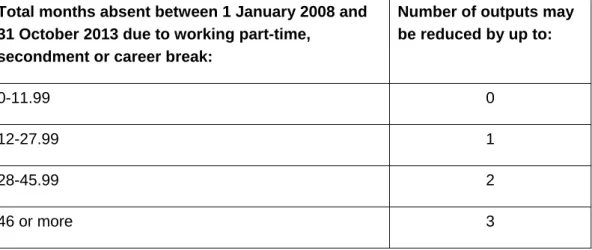
73. Table 2 sets out the permitted reduction in outputs without penalty in the assessment for absence from work due to:
a. part-time working
b. secondments or career breaks outside of the higher education sector, and in which the individual did not undertake academic research.
Table 2 Part-time working, secondments or career breaks: permitted reduction in outputs Total months absent between 1 January 2008 and
31 October 2013 due to working part-time, secondment or career break:
Number of outputs may be reduced by up to:
0-11.99 0 12-27.99 1 28-45.99 2
74. The allowances in Table 2 are based on the length of the individual’s absence or time away from working in higher education. They are defined in terms of total months absent from work. For part-time working, the equivalent ‘total months absent’ should be calculated by multiplying the number of months worked part-time by the full-time equivalent (FTE) not worked during those months. For example, an individual worked part-time for 30 months at 0.6 FTE. The number of equivalent months absent = 30 x 0.4 = 12.
Qualifying periods of maternity, paternity or adoption leave
75. Individuals may reduce the number of outputs by one, for each discrete period of: a. Statutory maternity leave or statutory adoption leave taken substantially during the period 1 January 2008 to 31 October 2013, regardless of the length of the leave. b. Additional paternity or adoption leave1 lasting for four months or more, taken substantially during the period 1 January 2008 to 31 October 2013.
76. The approach to these circumstances is based on the funding bodies’ considered judgement that the impact of such a period of leave and the arrival of a new child into a family is generally sufficiently disruptive of an individual’s research work to justify the reduction of an output. This judgement was informed by the consultation on draft panel criteria, in which an overwhelming majority of respondents supported such an approach.
77. The funding bodies’ decision not to have a minimum qualifying period for maternity leave was informed by the sector’s clear support for this approach in the consultation; recognition of the potential physical implications of pregnancy and childbirth; and the intention to remove any artificial barriers to the inclusion of women in submissions, given that women were significantly less likely to be selected in former RAE exercises.
78. The funding bodies consider it appropriate to make the same provision for those regarded as the ‘primary adopter’ of a child (that is, a person who takes statutory adoption leave), as the adoption of a child and taking of statutory adoption leave is generally likely to have a comparable impact on a researcher’s work to that of taking maternity leave.
79. As regards additional paternity or adoption leave, researchers who take such leave will also have been away from work and acting as the primary carer of a new child within a family. The funding bodies consider that where researchers take such leave over a significant period (four months or more), this is likely to have an impact on their ability to work productively on research that is comparable to the impact on those taking maternity or statutory adoption leave.
1
‘Additional paternity or adoption leave’ refers to leave of up to 26 weeks which is taken to care for a child where the person’s spouse, partner or civil partner was entitled to statutory maternity leave or statutory adoption leave, and has since returned to work. The term ‘additional paternity leave’ is often used to describe this type of leave although it may be taken by parents of either gender. For the purposes of the REF we refer to this leave as ‘additional paternity or adoption leave’.
80. While the clearly defined reduction of outputs due to additional paternity or adoption leave is subject to a minimum period of four months, shorter periods of such leave can be taken into account as follows:
a. By seeking a reduction in outputs under the provision for complex circumstances, for example where the period of leave had an impact in combination with other factors such as ongoing childcare responsibilities.
b. By combining the number of months for shorter periods of such leave in combination with other clearly defined circumstances, according to Table 2.
81. Any period of maternity, adoption or paternity leave that qualifies for the reduction of an output under the provisions in paragraph 75 above may in individual cases be associated with prolonged constraints on work that justify the reduction of more than one output. In such cases, the circumstances should be explained using the arrangements for complex circumstances.
Combining clearly defined circumstances
82. Where individuals have had a combination of circumstances with clearly defined reductions in outputs, these may be accumulated up to a maximum reduction of three outputs. For each circumstance, the relevant reduction should be applied and added together to calculate the total maximum reduction.
83. Where Table 1 is combined with Table 2, the period of time since 1 January 2008 up until the individual met the definition of an early career researcher should be calculated in months, and Table 2 should be applied.
84. When combining circumstances, only one circumstance should be taken into account for any period of time during which they took place simultaneously. (For example, an individual worked part-time throughout the assessment period and first met the definition of an early career researcher on 1 September 2009. In this case the number of months ‘absent’ due to part-time working should be calculated from 1 September 2009 onwards, and combined with the reduction due to qualifying as an early career researcher, as indicated in paragraph 83 above.)
85. Where an individual has a combination of circumstances with a clearly defined reduction in outputs and complex circumstances, the institution should submit these collectively as
‘complex’ so that a single judgement can be made about the appropriate reduction in outputs, taking into account all the circumstances. Those circumstances with a clearly defined reduction in outputs should be calculated according to the guidance above (paragraphs 72-84).
Other circumstances that apply in UOAs 1-6
86. In UOAs 1-6, the number of outputs may be reduced by up to two, without penalty in the assessment, for the following:
a. Category A staff who are junior clinical academics. These are defined as clinically qualified academics who are still completing their clinical training in medicine or dentistry
and have not gained a Certificate of Completion of Training (CCT) or its equivalent prior to 31 October 2013.
b. Category C staff who are employed primarily as clinical, health or veterinary professionals (for example by the NHS), and whose research is primarily focused in the submitting unit.
87. These allowances are made on the basis that the staff concerned are normally significantly constrained in the time they have available to undertake research during the assessment period. The reduction of two outputs takes account of significant constraints on research work, and is normally sufficient to also take account of additional circumstances that may have affected the individual’s research work. Where the individual meets the criteria at paragraph 86, and has had significant additional circumstances – for any of the reasons at paragraph 69 – the institution may return the circumstances as ‘complex’ with a reduction of three outputs, and provide a justification for this.
Complex circumstances
88. Where staff have had one or more complex circumstances – including in combination with any circumstances with a clearly defined reduction in outputs – the institution will need to make a judgement on the appropriate reduction in the number of outputs submitted, and provide a rationale for this judgement.
89. As far as is practicable, the information in REF1b should provide an estimate – in terms of the equivalent number of months absent from work – of the impact of the complex
circumstances on the individual’s ability to work productively throughout the assessment period, and state any further constraints on the individual’s research work in addition to the equivalent months absent. A reduction should be made according to Table 2 in relation to estimated months absent from work, with further constraints taken into account as appropriate. To aid institutions the Equality Challenge Unit (ECU) will publish worked examples of complex circumstances, which will indicate how these calculations can be made and the appropriate reduction in outputs for a range of complex circumstances. These will be available at
www.ecu.ac.uk/our-projects/REF from February 2012.
90. All submitted complex circumstances will be considered by the REF Equality and Diversity Advisory Panel (EDAP), on a consistent basis across all UOAs. The membership and terms of reference of the EDAP are available at www.ref.ac.uk under Equality and diversity. The EDAP will make recommendations about the appropriate number of outputs that may be reduced without penalty to the relevant main panel chairs, who will make the decisions. The relevant sub-panels will then be informed of the decisions and will assess the remaining outputs without any penalty.
91. To enable individuals to disclose the information in a confidential manner, information submitted about individuals’ complex circumstances will be kept confidential to the REF team, the EDAP and main panel chairs, and will be destroyed on completion of the REF (as described in ‘guidance on submissions’, paragraphs 98-99).
Appendix 5: Code of Practice Communication Strategy The University will make every effort to ensure this Code of Practice is communicated to all academic staff. We will do this by:
1. Publicising the Code of Practice and individual circumstances guidance
widely
The Code of Practice will be publicised to all academic staff via a wide range of communication channels including email, staff newsletters and the University’s intranet. A dedicated webpage will include the Code of Practice, REF guidance and a link to the online special circumstances form. A link to this webpage will be provided in other communications.
Guidance about individual staff circumstances will be published on Staffnet, eUpdate and UniLife.
A paragraph will be included in the President’s update in early May, advertising the Code of Practice and special circumstances process and encouraging all staff to submit their circumstances.
2. Targeted letters to those whom we believe have individual staff
circumstances
Staff who submitted special circumstances to REF Preparation Exercise (REFPE), or past Research Profiling Exercises will be e-mailed directly about the Code of Practice and special circumstances process during late March / April.
In addition, the following groups will be contacted directly by the REF Team (please note that lists will be cross-referenced, so staff members do not receive the same message twice):
• Staff with an HR record of maternity leave, paternity leave, secondment,
from HE, part-time work or long-term illness during the REF period.
• Disability office contact list
• Equality and Diversity network groups
Staff will be contacted by work e-mail if they are currently working at the University, or by letter to their home address if they are on long term absence. All materials will be available in accessible form for those with disabilities.
3. REFPE Results
Information about individual staff circumstances and the Code of Practice will be included in the text on the staff portlet when we publish the REFPE results