International Journal of Innovative Technology and Exploring Engineering (IJITEE) ISSN: 2278-3075, Volume-8 Issue-10, August 2019
Abstract: The construction industry is a competitive high-risk industry with an unprecedented uncertainties in technology, budget, and development processes. It has become more dynamic in nature and the execution of projects have become more complex and difficult to manage. The need then evolved to develop a framework for project performance. This study investigates the factors affecting the project success and performance using a knowledge and resource-based approach. Data was collected from project managers, civil engineers, site managers, and architects. A total of 221 responses were collected. The data analysis was conducted using SPSS and Smart PLS. This results from this investigation revealed that knowledge transfer does not mediate the effect of strategic factors or employee factors on the project performance of Iraqi public construction projects. This finding indicated that the role of knowledge practices in Iraqi public project is still not matured. Top management are advised to effectively implement the knowledge management practices in public projects. Implementing knowledge management will avoid the organization the cost of repeating the same mistakes. Thus, it was concluded in this study that knowledge transfer is still in its infancy and currently it has no mediating effect between the variables of this study.
Keywords : Project success; Project failure; Construction project; SPSS; AMOS; Knowledge-base, Resource based
I. INTRODUCTION
The performance of any construction project is a subjective concept that depends largely on the perspective of the individual who is evaluating that success [1]. Over the years the compliance with cost, schedule, and quality or performance have been used conventionally as a criterion to measure project performance [2]. Many researchers had attempted to identify the most critical success factors, as well as the one which leads to failure project with the overall evaluation of project management performance in public sectors. In this study the resource and knowledge based approaches were employed to evaluate the project performance in Iraqi construction industry. The resource-based view (RBV) was developed from the concept of Penrose, Schumpeter, and Ricardo for sustained competitive advantage by using strategic resources. The resource-based approach concentrates on the characteristics of resources and strategies for organization survival, competitive advantage, and long-term performance [3]. Resources and capabilities are seen as sources of superior
Revised Manuscript Received on August 09, 2019. * Correspondence Author
Mohammed Hatem Obaid*, Faculty of Management and Economics Sultan Idris Education University, Malaysia. Email: [email protected]
Nurul Fadly Habidin, Faculty of Management and Economics Sultan Idris Education University, Malaysia.
firm performance. The resource-based view assumes that resources are heterogeneity distributed among the firm and are immobile across the firms [3]. External variables are the strategic factors that impact the firm, including other stakeholders such as buyers, suppliers, intensity of competition, and industry and market structure [4]. These factors impact how resources are conceived, as well as how they are deployed. In the resource-based view, resource acquisition is an important point because resources with value, rareness, inimitableness, and non- substitutability can generate competitive advantages and have a great influence on organizational performance. Basically, resource acquisition can be divided into two aspects: resource acquisition capability and resource acquisition outcome. [5] stated that resource acquisition capability is the ability to acquire both tangible and intangible useful resources through organizations or through the environment. Resource acquisition outcome emphasizes the usability of the resources that organizations spent for long-term performance and for competitive advantages. The resource-based view of firms helps an organization to find their strategic resources for greater advantage than others. In project success or/and performance literature, there has been a call by researchers to implement theories such as RBV in the development of confirmatory studies to investigate the project success/performance [1]. Recently, few studies employed the theory to support their hypotheses development. For example, [2] uses the theory of RBV to support the selection of training and development of human capital in their study and found that the theory is valid to be used in project success. [6] pointed out that the implication of the theory of resource based view in project performance or/and success is still not clear and more research has to be conducted using this theory to understand its validity in the project management. [7] employed the theory of RBV to investigate the relationship between human success factors, IT utilization, and procurement process coordination on the operational performance of building construction industry. However, the study was conceptual, and it concluded that RBV is able to explain the performance of the project in construction industry. However, in knowledge based view (KBV), which comes from RBV and focuses on the value of intangible assets, suggests that knowledge is critical to a company’s long-term success [8]–[10]. Increasing turbulence in the global marketplace has suggested that the tacit knowledge of individual employees is of strategic importance for companies.
The Mediating Effect of Knowledge Transfer in
Construction Project
Tacit knowledge of individual employees is both difficult to transfer and necessitates knowledge management. The primary task of the management is to integrate the specialized knowledge of multiple individuals and units within and across the company. One leading critical source of organizational success is knowledge integration throughout the company and not the knowledge itself. Embracing KBV, the expectation is that knowledge interdependence is an element of organizational design and subject to managerial choice [11]. The current knowledge marketplace is an evolving economy characterized by new technologies, globalization, and an ever- increasing emphasis on intangible services [12].
Strategy scholars, business people, and management researchers suggest that today’s marketplace is knowledge-based. Knowledge and the competencies built upon this platform must be the main factor in determining a company’s current and future value. Knowledge has become source of power and competitive advantage of companies. It can be a long lasting competitive advantage because it takes years to earn knowledge. In light of current complexity of the business environment, knowledge has emerged as the most strategically significant resource of the company. Recently, [13] pointed out that one of the major issues for knowledge management in a project environment is the poor project success analysis and the lack of proper documentation on the results of the previous projects. The authors employed the KBV in their research and found that the finding of the study confirmed that project success analysis, presented through the definition of critical success factors, key performance indicators and performance-measuring process has a positive influence on knowledge acquisition and transfer in project environment. Other studies have found that knowledge management has a positive effect on the construction project performance [13]. The current investigation involved the use of the resource and knowledge based approaches in the evaluation of performance in Iraqi public construction projects using a total of 221 respondents. SPSS and Smart PLS were used for data analysis. The resource based view was deployed because each project should depend on its resource and capabilities to develop and progress toward successfulness [14]. Similarly, Knowledge-based view was used because the theory suggests that knowledge is a source of competitive advantage and superior performance and it is believed based on previous studies that these two theories could enhance the project performance in Iraq.
II. METHODS
A. Research Design and Population Study
Research design played a vital role as it provided researchers with a logical way to collect the required data. A survey design was used in the collection of data and this is because it allows some statistical analysis to be performed in testing the correlation and the effect between variables. A quantitative approach was used to conduct experimental procedures, hypotheses testing and the causal correlation between variables [15]. Related literature were reviewed to understand the problem at hand and develop the research objectives with appropriate research questions. Based on the
literature review, this study refined the factors identified and validated them using experts’ feedback. Thereafter, the conceptual framework was developed and the related hypotheses were stated. The questionnaire was validated by experts in the field and a pilot study was conducted to ensure that the questionnaire is reliable. The data was collected using a questionnaire and it was analyzed using SPSS and Smart PLS as embedded in Structural Equation Modeling (SEM).
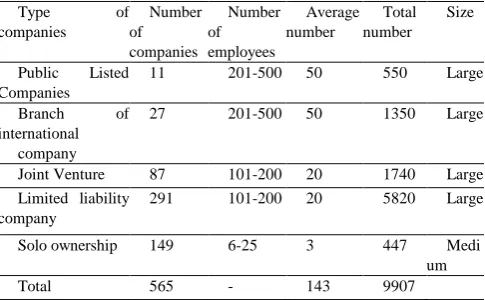
[image:2.595.306.549.322.472.2]Moreover, the population for this study focused on the managerial level of companies that work as contractors to execute project related to public project such as schools, universities, highways, housing, and other public offices. There are 492 medium and large size companies in accordance with the directory of construction companies in Iraq as well as the Iraqi Stock Exchange. A total of 9907 managerial level employees were used as population for this study. The engineers along with project managers, site managers and architects were the population used. The distribution of constructions companies as well as the number of employees in each category are presented in Table 1.
Table 1 Distribution of Construction Companies in Iraq
Type of
companies
Number of companies
Number of employees
Average number
Total number
Size
Public Listed Companies
11 201-500 50 550 Large
Branch of
international company
27 201-500 50 1350 Large
Joint Venture 87 101-200 20 1740 Large
Limited liability company
291 101-200 20 5820 Large
Solo ownership 149 6-25 3 447 Medi
um
Total 565 - 143 9907
Sources: Directory of Iraqi Construction Companies, Iraqi Stock Exchange
III. RESULTS
A. Screening of Respondent Profile
International Journal of Innovative Technology and Exploring Engineering (IJITEE) ISSN: 2278-3075, Volume-8 Issue-10, August 2019
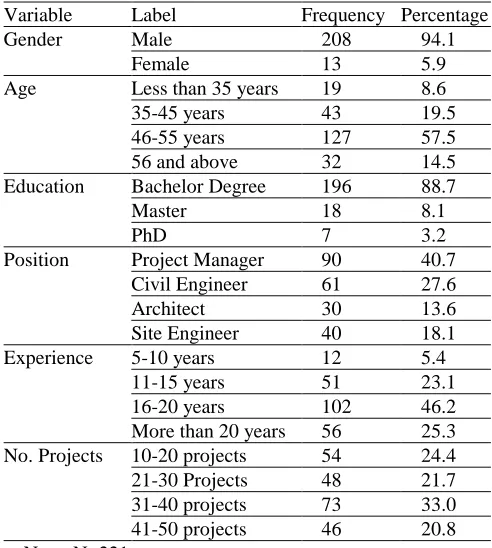
Also, the majority (88.7%) of the respondents were holders of bachelor’s degree while 8.1% were holder of master’s degree. A total of 3.2% of the respondents were PhD holders.
[image:3.595.45.291.297.571.2]On the bases of position, the respondent occupied, 40.7%, 27.6%, 18.1% and 13.6% were project managers, civil engineers, site engineers and architectures, respectively. The classification based on the respondent job experience revealed that 46.2% of them had experience for more than 15 years and less than 20 years which was followed by 25.3% with experience for more than 20 years. A total of 23.1% of the respondents had experience more than 10 years and less than 15 years while only 5.4% had experience of less than 10 years. The number of executed project by the respondents showed that 33% of the respondent had completed 31-40 projects. Moreover, a total of 24.4% of the respondents completed 10 to 20 projects followed by 21.7% have completed 21 to 30 projects and 20.8% of the respondents have completed 41 to 50 projects.
Table 2 Demographic Information of the Respondents
Variable Label Frequency Percentage
Gender Male 208 94.1
Female 13 5.9
Age Less than 35 years 19 8.6
35-45 years 43 19.5
46-55 years 127 57.5
56 and above 32 14.5
Education Bachelor Degree 196 88.7
Master 18 8.1
PhD 7 3.2
Position Project Manager 90 40.7
Civil Engineer 61 27.6
Architect 30 13.6
Site Engineer 40 18.1
Experience 5-10 years 12 5.4
11-15 years 51 23.1
16-20 years 102 46.2
More than 20 years 56 25.3
No. Projects 10-20 projects 54 24.4
21-30 Projects 48 21.7
31-40 projects 73 33.0
41-50 projects 46 20.8
Note: N=221
B. Data Examination
The data obtained were screened to examine the missing value, outliers, normality, and multicollinearity. Data screening was conducted to ensure in order to ensure the completeness of the data that is free of outliers, and normally distributed. A frequency analysis was conducted on all the items of this study. A total of 85 items including the demographic information variables and the items of the questionnaire related to the variables of this study were entered in the frequency analysis. The frequency analysis showed that there were 27 major missing responses. These responses were either totally missed or partially exceeding 50%. A decision was made to remove the responses that included major missing value which resulted in deleting 27 responses. Other missing values were less than 5 % and they
were replaced by the mean score value which resulted in 240 complete responses. Moreover, the boxplot of variables was examined to identify the outliers which resulted in the identification of 14 values as outliers. In order to confirm the selection of these outliers, the variables were converted to z-score to check for values greater than ±4. From these, 14 of the responses were found to have value greater than ±4 and decision was made to delete these responses.
Furthermore, the shape of the histogram together with the Skewness and Kurtosis was examined to test the normal distribution of the data. The results obtained in Table 3 revealed that the skewness ranged from 0.475 to -0.142, which fell within the acceptable range of less than absolute two as supported by George & Mallery (2008). The range of kurtosis also ranged from -0.838 to -.147, which also fell within acceptable range of less than absolute two. Hence the data was concluded to be normally distributed. Furthermore, the multicollinearity analysis between variables was conducted using SPSS. The result generated in Table 4 showed that the Variation Inflation Factor (VIF) of the variables ranged from 1.193 to 2.485 which indicated that the VIF is within the recommended range of less than 10 [16]. In addition, the tolerance of the variables ranges from 0.448 to 0.953 which is greater than 0.10. Thus, it was concluded that there were no multicollinearity issues between the variables. C. Direct Effect Hypotheses
The first hypotheses proposed that the effect of strategic factors on project performance is significant. The result in Table 3 shows that the effect of strategic factors on project performance is positive and significant. In addition, the second hypotheses proposed that the effect of employee factors is positive and significant. The findings indicated that the effect is positive and significant.
D. Mediating Effect
Third and fourth main hypothesis predicted that knowledge transfer can mediate the effect of employee factor and strategic factor on the project performance. To test the hypotheses, the direct effect without the mediator was examined. Next, the direct effect with the mediator was re-examined. Lastly, the indirect effect (strategic factor-knowledge transfer-project performance) and (employee factor-knowledge transfer-project performance) examined and compared with the direct effect with mediator. The result of hypothesis testing of mediator is presented in Table 3. The direct effect without the mediator was included in this table to facilitate the comparison before and after including the mediator.
Table 3 Result of Hypotheses Testing of direct effect and Mediator
H Path β Std T P
Direct Effect without mediator
H1 Strategic Factors -> Project Performance 0.300 0.061 4.889 0.000
H2 Employee Factors -> Project Performance 0.595 0.058 10.25 9
Direct effect with mediator
Strategic Factors -> Project Performance 0.280 0.065 4.338 0.000
Strategic Factors -> Knowledge Transfer 0.250 0.103 2.428 0.015
Knowledge Transfer -> Project Performance
0.088 0.041 2.115 0.034
Employee Factors -> Project Performance 0.566 0.060 9.515 0.000
Employee Factors -> Knowledge Transfer 0.303 0.110 2.755 0.006
Indirect effect
H3 Strategic Factors -> Knowledge Transfer -> Project Performance
0.022 0.014 1.552 0.121
H4 Employee Factors -> Knowledge Transfer ->Project Performance
0.027 0.016 1.629 0.103
This study proposed two mediating hypotheses. The first mediating hypothesis predicted that knowledge transfer mediates the effect of strategic factors on the project performance of Iraqi public project. The statement of the hypothesis H3: Knowledge transfer has a mediating role between strategic related factors and performance of Iraqi public project. The findings in Table 3 indicate that once the mediator included, the direct effect was reduced from 0.300 to 0.280 and stayed significant. However, Smart PLS computed the indirect effect of the path and it showed that the indirect effect (Strategic Factors -> Knowledge Transfer -> Project Performance) is insignificant (β = 0.022, T=1.552, P>0.05). Thus, it was concluded that knowledge transfer does not mediating the effect of strategic factors on the project performance of Iraqi public project. Accordingly, H3a was rejected. In other words, the relationship between strategic factor and project performance cannot be explained through the mediator knowledge transfer. For the second mediating hypothesis, this study proposed that knowledge transfer mediates the effect of employee factors on project performance of Iraqi public project. The statement of the hypothesis stated as “H4: Knowledge transfer has a mediating role between employee related factors and performance of Iraqi public project”. The findings in Table 3 showed that the direct effect reduced from 0.595 to 0.566. However, the indirect effect (Employee Factors -> Knowledge Transfer -> Project Performance) was insignificant (β = 0.027, T=1.629, P>0.05). Accordingly, H3b was rejected. The effect of employee factors on project performance of Iraqi pubic projects cannot be explained through the mediator knowledge transfer and thus, the hypothesis was rejected.
IV. DISCUSSION
The majority of previous studies reported that knowledge transfer mediated the effect of variables such as learning organization and organizational performance [17]. Other researchers highlighted the owledge transfer in achieving better organizational performance [18]. [19] pointed out that the mix of knowledge and expertise within project teams positively influence the organization’s long-term success. Nevertheless, the insignificant effect of knowledge transfer as a mediator could be due to the fact that knowledge is power and the need for this knowledge makes the employees important and the organization cannot lay them out. Thus, the employees will not participate actively in knowledge transfer or transferring their knowledge and expertise to each other
because they link their knowledge to the rewards that they gain as well as to their survival in the organization. Another possible explanation to this insignificant mediating effect is the fact that knowledge management topics and practices in developing countries such as Iraq are still in its infancy and the organization has no clear mechanism to transfer the knowledge or benefits from the knowledge management practices [20] [21], [22]. Furthermore, from the descriptive of the mean score value of the knowledge transfer; it was found that employees do not share their knowledge with their co-workers or provides structural knowledge to them in the form of written documents. The practices of knowledge transfer are weak, and this has affected its potential to affect the project performance of Iraqi construction public project and it was unable to explain the relationship between either strategic factor and project performance path or employee factors and project performance path. Thus, it was concluded in this study that knowledge transfer is still in its infancy and currently it has no mediating effect between the variables of this study. This study revealed that knowledge transfer does not mediate the effect of strategic factors or employee factors on the project performance of Iraqi public construction projects. This finding indicated that the role of knowledge practices in Iraqi public project is still not matured. Top management are advised to effectively implement the knowledge management practices in public projects. Implementing knowledge management will prevent the organization from wasting resources on repeating the same mistakes. In other words, the organization can have a database of its projects and can document lesson learned and cases where problem were solved. Having this database will avoid the organization of repeating the same procedures to find the same solution. Accordingly, additionally operational cost can be avoided, and time can be saved. The experience of project manager is critical factor for the project success. Decision makers have to employ only capable and knowledgeable project managers who have experience and record of successful and high performance projects. A key performance indicator (KPI) of project managers and other key employees must be practiced and must be used when making decision regarding the assignment of project managers.
V. CONCLUSION
International Journal of Innovative Technology and Exploring Engineering (IJITEE) ISSN: 2278-3075, Volume-8 Issue-10, August 2019
ACKNOWLEDGEMENT
The authors’ wishes to acknowledge the support received during the course of this study from the Faculty of Management and Economics Sultan Idris Education University, Malaysia.
REFERENCES
1. F. T. Berssaneti and M. M. Carvalho, “Identification of variables that impact project success in Brazilian companies,” Int. J. Proj. Manag., vol. 33, no. 3, pp. 638–649, 2015.
2. M. M. de Carvalho, L. A. Patah, and D. de Souza Bido, “Project management and its effects on project success: Cross-country and cross-industry comparisons,” Int. J. Proj. Manag., vol. 33, no. 7, pp. 1509–1522, 2015.
3. J. B. Barney, “Resource-based theories of competitive advantage: A ten-year retrospective on the resource-based view,” J. Manage., vol. 27, no. 6, pp. 643–650, 2001.
4. M. Porter, Competitive Advantage: Creating and sustaining superior performance, vol. 15. 1985.
5. L. Zhang and W. Fan, “Improving performance of construction projects: A project manager’s emotional intelligence approach,” Eng. Constr. Archit. Manag., vol. 20, no. 2, pp. 195–207, 2013.
6. A. Badewi and E. Shehab, “The impact of organizational project benefits management governance on ERP project success: Neo-institutional theory perspective,” Int. J. Proj. Manag., vol. 34, no. 3, pp. 412–428, 2016.
7. A. Razif, A. Razak, A. Aini, V. Pandiyan, and K. Sundram, “The relationships of human success factor , information technology , and procurement process coordination on operational performance in building construction industry – A Proposed Conceptual Framework,” Procedia Econ. Financ., vol. 31, no. 15, pp. 354–360, 2015. 8. H. Kim, “Transformational Leadership, Organizational Clan Culture,
Organizational Affective Commitment, and Organizational Citizenship Behavior: A Case of South Korea’s Public Sector,” Public Organ. Rev., vol. 14, no. 3, pp. 397–417, 2014.
9. S. Alaaraj, Z. A. Mohamed, and U. S. Ahmad Bustamam, “External Growth Strategies and Organizational Performance in Emerging Markets: The Mediating Role of Inter-Organizational Trust,” Rev. Int. Bus. Strateg., vol. 28, no. 2, pp. 206–222, 2018.
10.S. Alaarj, A. M. Zainal, and U. Bustamam, “The Effect of Knowledge Management Capabilities on the Performance of Malaysian Large-Scale Organizations: An Empirical Study,” Adv. Glob. Bus. Res., vol. 12, no. 1, pp. 1024–1038, 2015.
11.S. Hart and C. Banbury, “How Strategy-Making Processes Can Make a Difference,” Strateg. Manag. J., vol. 15, no. 4, pp. 251–269, 1994. 12.D. Neef, “Making the case for knowledge management: the bigger
picture,” Manag. Decis., vol. 37, no. 1, pp. 72–78, 1999.
13.M. Lj Todorović, D. Č Petrović, M. M. Mihić, V. Lj Obradović, and S. D. Bushuyev, “Project success analysis framework: A knowledge-based approach in project management,” Jpma, vol. 33, pp. 772–783, 2015.
14.G. Pan, S.-L. Pan, and C.-Y. Lim, “Examining how Firms Leverage IT to Achieve Firm Productivity: RBV and Dynamic Capabilities Perspectives,” Inf. Manag., vol. 52, no. 4, pp. 401–412, 2015. 15.N. Golafshani, “Understanding Reliability and Validity in Qualitative
Research,” Qual. Res., vol. 8, no. 4, pp. 597–607, 2003.
16.J. Pallant, SPSS survival manual: a step by step guide to data analysis using SPSS. 2016.
17.H. H. Chen, S. Qiao, and A. H. I. Lee, “The impacts of different R&D organizational structures on performance of firms: Perspective of absorptive capacity,” J. High Technol. Manag. Res., vol. 25, no. 1, pp. 83–95, 2014.
18.T. Brady and A. Davies, “Learning to deliver a mega-project: The case of heathrow terminal 5,” in Procuring Complex Performance: Studies of Innovation in Product-Service Management, 2012, pp. 174–196. 19.A. Ordanini, G. Rubera, and M. Sala, “Integrating Functional
Knowledge and Embedding Learning in New Product Launches. How Project Forms Helped EMI Music,” Long Range Plann., vol. 41, no. 1, pp. 17–32, 2008.
20.S. Alaarj, Z. Abidin-Mohamed, and U. S. B. A. Bustamam, “Mediating Role of Trust on the Effects of Knowledge Management Capabilities on Organizational Performance,” Procedia - Soc. Behav. Sci., vol. 235, no. 2016, pp. 729–738, 2016.
21.S. Alaarj, Z. A. Mohamed, and U. S. A. Bustamam, “Do Knowledge
Management Capabilities Reduce the Negative effect of Environment Uncertainties on Organizational Performance? A Study of Public Listed Companies in Malaysia,” Int. J. Econ. Res., vol. 14, no. 15, pp. 443–456, 2017.