International Journal of Innovative Technology and Exploring Engineering (IJITEE) ISSN: 2278-3075, Volume-8 Issue-10, August 2019
Abstract: During the last two decades, the concept of Fibre Metal Laminates (FMLs) has been evolved to find solution to the requirement of improving mechanical properties and reducing structural weight of elemental components of aircraft structures. In this work FML is prepared using Al 2024 by placing alternately with glass/carbon/aramid Fibres. From experimental results of FML shows greater advantage in mechanical properties then aluminium monolithic layer and this composite fibre laminates individual. The FMLs tested in this work were made of 3 layers of 2024 T3 aluminium alloy 0.28 mm thickness and fibre mats. The 5-3/2 laminates of size 300x300 mm with 3 mm thick were prepared using Vacuum Assisted Resin Transfer Moulding (VARTM) in cold compaction and test specimen were cut by using abrasive water jet machining as per ASTM Standards. The adhesion between fibre and metal layer will play a major role in strength of FML. By keeping this in consideration FMLs were prepared without blow holes and capable of withstanding delamination while preparing specimens through water jet and during various tests employed. The fracture surfaces of destructed specimens are studied with help Scanning Electron Microscope (SEM) image. Similarly, the numerical simulation of all the tests were done using Ansys APDL 10.0 Software. It is observed that aramid FML have substantially stronger in longitudinal directions. Hence, more priority given in this paper to investigate tensile strength and fatigue life of aramid FML.
Keywords : FML, VARTM, SEM, Fatigue, Fracture Surface, Numerical Simulations.
I. INTRODUCTION
T
he first Fibre Metal Laminates (FMLs) have been developed in the 1980s as a result of increasing demand in aircraft, automobile and marine industry due to their increased fatigue resistance, high impact resistance, high durability, high corrosion resistance and outstanding strength to weight ratio compare to traditional composites.[1] FMLs are highly used in aircraft structures like fuselage panels, wing skins, tail skins etc., because of their excellent strength to weight ratio and damage tolerance capacity. The most commonly used metal for FML is aluminium, and fibres can be carbon/silicon/glass/aramid. The FML with aramid known as ARALL, with Glass known as GLARE and with CarbonRevised Manuscript Received on August 05, 2019.
Boopathy G, Research Scholar, St.Peter’s Institute of Higher Education and Research, Chennai. & Assoc. Professor, Vel Tech Rangarajan Dr. Sangunthala R&D Institute of Science & Technology, Chennai.
Vijayakumar K.R, Professor, Mechanical Engineering, Dr.MGR Educational and Research Institute, Chennai.
Chinnapandian M, Professor, Aeronautical Engineering, St. Peter’s College of Engineering & Technology, Chennai.
Gurusami K, Professor, St. Peter’s Institute of Higher Education and Research, Chennai.
known as CARALL are most widely examined by the researchers for potential applications in aircraft structures.[2] Mostly the aluminium alloys Al-2024-T3 or Al -7475-T6 Sheets are used to make FML with fibers like glass, carbon and aramid in the fuselage skin dominated by fatigue loads. The study concludes that GLARE is good in Corrosion resistance, Fire resistance, having high damage tolerance and high fatigue which implemented in upper fuselage skin structures of Air Bus 380. Also, it confirms that reasonable weight saving compared with traditional composites.[3]
A number of Researchers have investigated the tensile and impact response of FML and concluded that they have high strength due to the presence of metal and fibre reinforced composites both have high stiffness and strength, low density due to the minimum thickness of metal layups. Since the FML are prepared based on polymers, it shows excellent resistance against the corrosion. Also, the outer metal layers in the FML act as good resistance against the moisture absorptions. While the aircraft structures components comprise of 80% aluminium in traditional flights faces major problem in financial as well as strength wise, the development and implementation of modern FML reduces drastically both the factors.[4]
Since the Glare has low and different modulus in longitudinal and transverse directions, its yield strength value become lower, it will consider as major drawback, to overcome aramid and Aramid fibers with same weight tested. Generally, it is not so simple to measure fatigue crack growth of FML like conventional metal fatigue. In metals, grains dislocation mobility and slip help us to find the clear initiation, propagation and growth of crack which leads fatigue. But in the composites, it’s impossible to evaluate the fatigue damage based on single crack, since it may depend on the parameters like fiber strength, matrix crack, delamination, bonding strength of fibre and matrix. [5] The standard tests like tensile, impact, flexural and hardness test were conducted for the ARALL, CARALL and GLARE specimens drawn from plate prepared through VARTM and machined by water jet, the experimental values were correlated with numerical value obtained in APDL.[6]
The authors concluded that the detrimental effect of wrinkle defects plays a vital role in early delamination during tension-tension fatigue. Also, they compared the fatigue life of wrinkle and pristine specimens and unveiled that pristine specimens have higher magnitude of fatigue life than wrinkled specimens. They prepared FML using aluminium 2024- T3 Al sheets of thickness 0.2, 0.4 and 0.6mm with glass fibre and examined the layup sequence
behavior with the results of ultimate and post ultimate
Development and Experimental
Characterization of Fibre Metal Laminates to
Predict the Fatigue Life
Development and Experimental Characterization of Fibre Metal Laminates to Predict the Fatigue Life
2816
Published By:
Blue Eyes Intelligence Engineering & Sciences Publication
Retrieval NumberJ95970881019/2019©BEIESP DOI: 10.35940/ijitee.J9597.0881019
strength. [7] The author prepared CARAL by hand layup method using epoxy resin along with TETA hardener and machined specimens as per ASTM standards. Damage Characteristics due to low velocity impact response were noted and also morphological analysis discussed using SEM. [8] Here the researchers employed with different joining methods like mechanically fastened Huck AA 7075 and GRE were investigated with the stress ratio R =0.1. They unveiled the hybrid joint with the dissimilar – AA 7075/GRE adhered achieved maximum ultimate failure strength compare to those of bolted and bonded single lap joints. [9] Recently, researchers show more interest to study fatigue and damage tolerance techniques of FML. It leads to arrive a well-defined theory known as bridging effect. From this it is possible to study the way of load transfer to the fibers with less tension/ compression in the aluminium layers near the crack tip.[10]
Hence, the aim of present work is to find the new material considering advantages of conventional metal and composite materials to replace aircraft components without compromising the strength to weight ratio. Here we analyzed mentioned three different FMLs and concluded Arall has more beneficial than others. Therefore, we focused on Arall to examine the fatigue strength. With different off axis angle tension-compression fatigue test carried out for six prepared specimens.
II. MATERIALS AND METHODS
In practice, FMLs are manufactured by placing alternative layers of metal and fibre /prepreg in mold through hand lay-up method. Later the structure is cured at desired temperature and pressure or by using an autoclave. But there are more chance to presence of blow holes or bonding failures in this method also these fabrication processes were expensive and suit for limited specimens. In order to maintain high accuracy in bonding with low cost, we prepared our specimens by VARTM process, the facility utilized from Manufacturing Technology Lab, Anna University. Al 2024 drilled sheets of 300X300mm and same size of three layers aramid Fibre are stacked in such a way that top and bottom consists of aramid with alternate aluminium sheets. Polyester resin and HY5/3 hardener in 1:10 ratio combination is used as binding agent to achieve required FML through cold mould set up by VARTM. The mentioned combination is squeezed through vacuum gun into the stacked die with 5 bar pressure and allows them to cure around a day. From the obtained plate, the required test specimens as per ASTM standards were cut by using abrasive water jet machining set-up.
III. TESTING
The adhesion between fibre and matrix is so important for composite material. Similarly, here the interface bond between aluminium layers and fibres are decides the strength of FMLs. It is not so easy to find this adhesion in FML, for this purpose various test methods have been proposed. The mechanical properties such as tensile, impact, flexural and hardness were measured and corresponding SEM observations monitored for related fractured surfaces.
A. Tensile Testing
Tensile test specimens prepared in accordance with ASTM D3039 shown in fig-1. This specimen is held in ASC UTN10 UTM by wedge action grips and pulled at a recommended cross head speed of 2mm/min at room temperature. The tensile strength of six set of tensile specimens were observed and their average values plotted in fig-2.
[image:2.595.312.531.137.374.2]Fig. 1. Tensile Specimen (ASTM D638)
Fig. 2. Tensile Strength of FMLs B. Flexural Test
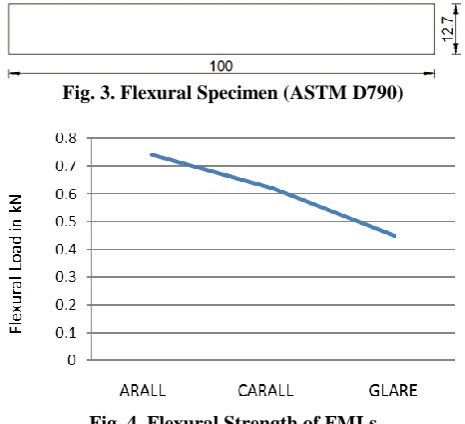
[image:2.595.310.543.462.674.2]Flexural test specimens prepared in accordance with ASTM D790 shown in fig-3. Using the same Universal Testing Machine, flexural strength of prepared 6 set of specimens were measured by three-point bending method and average value of specimens were plotted in fig-4.
Fig. 3. Flexural Specimen (ASTM D790)
Fig. 4. Flexural Strength of FMLs
C. Impact Test
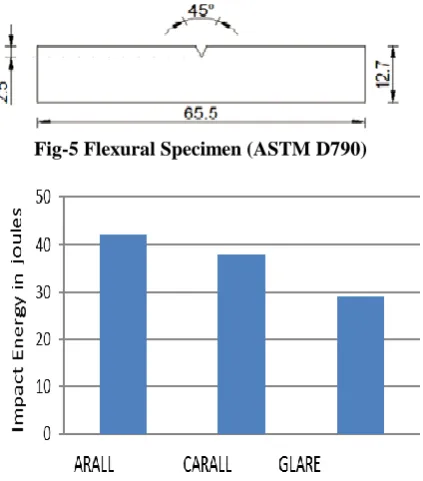
Impact test specimens prepared in accordance with ASTM D256 shown in fig-5. Using Izod impact machine, the impact energy of six specimens of different FMLs found and their average value plotted in
International Journal of Innovative Technology and Exploring Engineering (IJITEE) ISSN: 2278-3075, Volume-8 Issue-10, August 2019
Fig-5 Flexural Specimen (ASTM D790)
Fig. 6. Impact Strength of FMLs
D. Hardness Test
[image:3.595.68.280.50.291.2]Through Barcoll hardness testing machine, the hardness values for three specimens of each FML were observed and plotted in fig-7. Here the load is applied through hand screw in order to make indentations over the specimens and corresponding hardness values are monitored in dial gauge.
Fig.7. Hardness value of FMLs
E. Fatigue Test
Fatigue test is defined as the process of progressive localized permanent structural change occurring in a material subjected to conditions that produce fluctuating stresses and strains at some point or points and that may culminate in cracks or complete fracture after a sufficient number of fluctuations, the machine set-up is shown in fig-8.
Fig. 8. Fatigue Machine Set-up
Fig. 9. Fatigue specimen (ASTM E606)
FMLs owe their priority among researchers because of pertaining better specific fatigue resistance compared with monolithic aluminium. Generally, fatigue evaluation can be measured into two spaces like fatigue crack initiation which mainly depends on the condition of outer surface of material and fatigue crack propagation which mainly depends on material properties. Tensile -compressive nature of load cycle is applied to calculate fatigue life of specimen as per ASTM E606 shown in fig-9 in INSTRAN fatigue machine. Here crack initiation, crack propagation and final fracture are observed and readings obtained through which S-N curve is drawn. Fatigue behavior of material is generally observed through S-N curve which clearly reference the relation between stress amplitude and no of cycles to failure on semi-logarithmic scale.
The results of this experimental work will be described targeting and the output concerning the ultimate tensile strength, life time and the S-N curve. The UTS, which is the strength at the strain rate of fatigue experiment, was practically observed with four ARALL specimens. Table-1 shows the load level corresponding to UTS, the related alternate stress and cycles to failure. The curve between alternate stress and cycles to failure is shown in fig-10
Table. 1. fatigue test data
Load level Cycles to failure Alternating stress in MPa
80% of UTS 3347 96
70% of UTS 22575 84
60% of UTS 58492 72
[image:3.595.71.288.411.523.2]Development and Experimental Characterization of Fibre Metal Laminates to Predict the Fatigue Life
2818
Published By:
Blue Eyes Intelligence Engineering & Sciences Publication
[image:4.595.76.284.46.192.2]Retrieval NumberJ95970881019/2019©BEIESP DOI: 10.35940/ijitee.J9597.0881019
Fig.10. S-N Curve
F. Fracture Surface Using Sem
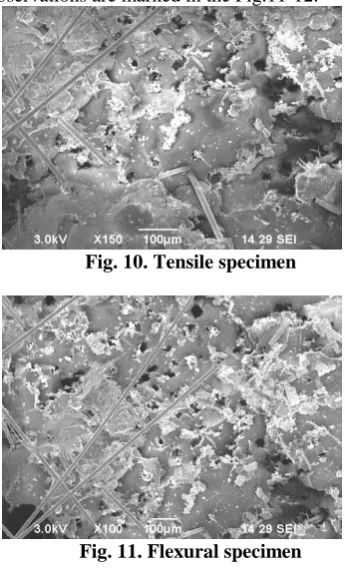
[image:4.595.319.536.49.120.2]A scanning electron microscope (SEM) is one of the most useful system available to study the microstructure morphology of fractures surfaces. In order to explain the mechanism of fracture occurs in the surfaces of test specimens of tensile and flexural. the Zeiss SEM instrument was used and the corresponding images with notification of salient observations are marked in the Fig.11-12.
[image:4.595.82.255.297.582.2]Fig. 10. Tensile specimen
Fig. 11. Flexural specimen
IV. NUMERICAL ANALYSIS
Table-2 & 3 shows the details regarding the nature of FMLs and solution obtained through numerical simulations.
Table 2 - Details of the FMLs
FML
Type Lay-Up
Al Thickness
(mm)
Total Thickness
(mm)
ARALL 3/2 0.27 3
CARALL 3/2 0.27 3
GLARE 3/2 0.27 3
Table 3 - Summary of FML from Experiment and Simulation Description ARALL CARALL GLARE Maximum
stress from Experiment
131 119 67
(MPa) Maximum Stress from FEA (MPa)
123.75 111.5 69.5
V. CONCLUSION
More number of literatures available exhibits the FMLs has high potential in the construction of structures in aerospace and automobile parts. In this work, FMLs were made using glass, carbon and aramid fibres stacked with Al 2024 T3 alloy. Various mechanical destructive tests such as tensile, flexural, impact and hardness were carried out for the prepared specimens as per ASTM standards. The comparison highlights that the aramid fibres have more strength than carbon and glass fibres, the same as observed in numerical output. Based on that, more focus given to ARALL and fatigue life estimation was done in this work.
REFERENCES
1. Alderliesten, R.C., Hagenbeek, M., Homan, J.J. et al, Fatigue and
Damage Tolerance of Glare, Applied Composite Materials ,2003.
2. A,Volt,L.B.Vogelesang,and T.J.de Vries, TowardsApplication of Fiber
Metal Laminates in Larger Aircraft, Aircraft Eng. & Aerospace Technology, 71 (6) (1999), pp,558-570.
3. Woerden, H.J.M., Sinke, J. & Hooijmeijer, P.A, Maintenance of Glare
Structures and Glare as Riveted or Bonded Repair Material, Applied Comp. Materials b, 2003 10: 307.
4. A.Asundi,A.Y.NChoi,Fiber Metal Laminates:An advanced material
for future aircraft, Journal of Materials Processing Technology,63, 1997,384-394.
5. Harris B, Fatigue in Composites, Vol.3.CRG/WP,2003.
6. Boopathy G,Vijaya Kumar K.R, et al., Experimental Characterization
Of Fibre Metal Laminates For Tensile And ImpactProperties With Finite Element Modelling Approach, Caribbean Journal of
Science,Volume 53, ISSUE 2 (MAY - AUG), 2019.
7. Ankush P. Sharma, Sanan H. Khan, Venkitanarayanan Parameswaran, Experimental and numerical investigation on the uni-axial tensile response and failure of fiber metal laminates,Composites Part B:
Engineering, Volume 125, 15 September 2017, Pages 259-274.
8. B.Muthu Chozha Rajana, et al., Impact Response and Damage Characteristics of Carbon Fibre Reinforced Aluminium Laminates (CARAL) under Low Velocity Impact Tests, Materials Today: Proceedings 5 ,2018, 20070–20077.