Ames Laboratory Publications
Ames Laboratory
2012
A novel approach for x-ray scattering experiments in
magnetic fields utilizing trapped flux in type-II
superconductors
R. K. Das
Argonne National Laboratory
Z. Islam
Argonne National Laboratory
J. P. C. Ruff
Argonne National Laboratory
R. P. Sawh
University of HoustonR. Winstein
University of HoustonSee next page for additional authors
Follow this and additional works at:
http://lib.dr.iastate.edu/ameslab_pubs
Part of the
Condensed Matter Physics Commons
The complete bibliographic information for this item can be found at
http://lib.dr.iastate.edu/
ameslab_pubs/212
. For information on how to cite this item, please visit
http://lib.dr.iastate.edu/
howtocite.html
.
A novel approach for x-ray scattering experiments in magnetic fields
utilizing trapped flux in type-II superconductors
Abstract
We introduce a novel approach to x-ray scattering studies in applied magnetic fields by exploiting vortices in
superconductors. This method is based on trapping magnetic flux in a small disk-shaped superconductor
(known as a trapped field magnet, TFM) with a single-crystal sample mounted on or at close proximity to its
surface. This opens an unrestricted optical access to the sample and allows magnetic fields to be applied
precisely along the x-ray momentum transfer, facilitating polarization-sensitive experiments that have been
impractical or impossible to perform to date. The TFMs used in our study remain stable and provide
practically uniform magnetic fields for days, which are sufficient for comprehensive x-ray diffraction
experiments, specifically x-ray resonance exchange scattering (XRES) to study field-induced phenomena at a
modern synchrotron source. The TFM instrument has been used in a “proof-of-principle” XRES study of a
meta-magnetic phase in a rare-earth compound, TbNi
2Ge
2, in order to demonstrate its potential.
Keywords
Physics and Astronomy, Magnetic fields, X-ray scattering, Magnets, X-ray optics, Superconductors
Disciplines
Condensed Matter Physics
Comments
The following article appeared in
Review of Scientific Instruments
83 (2012): 065103 and may be found at
http://dx.doi.org/10.1063/1.4725523
.
Rights
Copyright 2012 American Institute of Physics. This article may be downloaded for personal use only. Any
other use requires prior permission of the author and the American Institute of Physics.
Authors
R. K. Das, Z. Islam, J. P. C. Ruff, R. P. Sawh, R. Winstein, Paul C. Canfield, J.-W. Kim, and J. C. Lang
A novel approach for x-ray scattering experiments in magnetic fields utilizing trapped
flux in type-II superconductors
R. K. Das, Z. Islam, J. P. C. Ruff, R. P. Sawh, R. Weinstein, P. C. Canfield, J.-W. Kim, and J. C. Lang
Citation: Review of Scientific Instruments 83, 065103 (2012); doi: 10.1063/1.4725523
View online: http://dx.doi.org/10.1063/1.4725523
View Table of Contents: http://scitation.aip.org/content/aip/journal/rsi/83/6?ver=pdfcov
Published by the AIP Publishing
Articles you may be interested in
Flux-cutting and flux-transport effects in type-II superconductor slabs in a parallel rotating magnetic field
Low Temp. Phys. 37, 947 (2011); 10.1063/1.3672157
A portable high-field pulsed-magnet system for single-crystal x-ray scattering studies
Rev. Sci. Instrum. 80, 113902 (2009); 10.1063/1.3251273
Voltage from mechanical stress in type-II superconductors: Depinning of the magnetic flux by moving dislocations
Appl. Phys. Lett. 93, 042503 (2008); 10.1063/1.2960337
Synchrotron Xray Powder Diffraction and Absorption Spectroscopy in Pulsed Magnetic Fields with Milliseconds Duration
AIP Conf. Proc. 902, 103 (2007); 10.1063/1.2723633
Synchrotron x-ray powder diffraction studies in pulsed magnetic fields
Rev. Sci. Instrum. 77, 063903 (2006); 10.1063/1.2216914
REVIEW OF SCIENTIFIC INSTRUMENTS83, 065103 (2012)
A novel approach for x-ray scattering experiments in magnetic
fields utilizing trapped flux in type-II superconductors
R. K. Das,1Z. Islam,1,a)J. P. C. Ruff,1R. P. Sawh,2R. Weinstein,2P. C. Canfield,3
J.-W. Kim,1and J. C. Lang1
1X-Ray Science Division, Advanced Photon Source, Argonne National Laboratory, 9700 S. Cass Ave.,
Argonne, Illinois 60439, USA
2Department of Physics, Texas Center for Superconductivity, University of Houston, Houston,
Texas 77004, USA
3Department of Physics and Astronomy, Ames Laboratory, Iowa State University, Ames, Iowa 50010, USA
(Received 13 March 2012; accepted 8 May 2012; published online 8 June 2012)
We introduce a novel approach to x-ray scattering studies in applied magnetic fields by exploiting vortices in superconductors. This method is based on trapping magnetic flux in a small disk-shaped superconductor (known as a trapped field magnet, TFM) with a single-crystal sample mounted on or at close proximity to its surface. This opens an unrestricted optical access to the sample and allows magnetic fields to be applied precisely along the x-ray momentum transfer, facilitating polarization-sensitive experiments that have been impractical or impossible to perform to date. The TFMs used in our study remain stable and provide practically uniform magnetic fields for days, which are suf-ficient for comprehensive x-ray diffraction experiments, specifically x-ray resonance exchange scat-tering (XRES) to study field-induced phenomena at a modern synchrotron source. The TFM instru-ment has been used in a “proof-of-principle” XRES study of a meta-magnetic phase in a rare-earth compound, TbNi2Ge2, in order to demonstrate its potential.© 2012 American Institute of Physics.
[http://dx.doi.org/10.1063/1.4725523]
I. INTRODUCTION
The effects of magnetic fields (B) on material properties are diverse and important to study from basic-science and applied-research points of view.1–5 There are numerous magnet research laboratories and academic research groups worldwide focused on studies of materials in magnetic fields. With the advent of modern synchrotron x-ray sources, sig-nificant efforts have also been invested to study field-induced phenomena with x-rays.6–13 While these efforts have led to many applications of x-ray spectroscopic and imaging techniques to study field effects in materials,6–8 progress in x-ray scattering studies of single-crystal samples in mag-netic fields with split-pair and solenoid magnets have been relatively slower due to two long-standing obstacles. First, optical access required for scattering studies is restricted due to magnet geometries. Second, it is practically impossible to apply magnetic fields along the x-ray momentum transfer (Q), which is frequently an ideal scattering geometry. In a conventional split-pair magnet, the magnetic field is strictly perpendicular to the scattering plane, whereas in the solenoid magnet the magnetic field is typically in the scattering plane but nearly orthogonal to Q (with the exception of back scattering). A new approach that overcomes these geometric limitations would enable one to thoroughly study any arbi-trarily ordered magnetic and orbital structure, allow complete exploitation of polarization-sensitive cross section by angular dependence measurements about Q(withB||Q), and allow precise determination of pure longitudinal magnetostriction
a)Author to whom correspondence should be addressed. Electronic mail: [email protected].
effects. We report efforts at the Advanced Photon Source to develop such a magnet instrument that exploits magnetic properties of bulk superconductors (SC) with the potential to reach applied fields beyond 17 T.14
It is well known that type-II superconductors can trap magnetic flux in the so-called vortex state.15 If the trapped flux is stable over time then the magnetized superconduc-tor can be used as a “permanent” magnet (known as trapped field/flux magnet, TFM). Worldwide research in this area has accelerated16 since the discovery of high-temperature super-conductors over two decades ago, and recent breakthroughs in the understanding of pinning centers (used to trap the flux-oids in place)17–19have made practical applications of super-conducting disks as strong permanent magnets conceivable. The ability to grow high-quality large melt-textured high-Tc superconductors (e.g., YBa2Cu3O7(YBCO) and other related
compounds) and to control the introduction of strong pinning centers in them by chemical18or irradiation17,19methods have reached a high degree of sophistication. The texturing process orients a preferred crystalline axis (e.g.,caxis) of the micro-grains in the superconductor, allowing high critical current density as well as increasing fracture toughness, which is cru-cial for withstanding Maxwell stress of the trapped flux. In-deed it has been shown that a superconducting disk (∼27 mm diameter and 15 mm thick) is capable of trapping magnetic fields in excess of 17 T,14 a result that foresees availability of magnetic fields beyond those available from commercial split-pair magnets for scattering studies.
We have developed a melt-textured YBCO-based TFM instrument in order to circumvent the two long-standing im-pediments to x-ray scattering studies discussed above. In this approach a YBCO SC disk is magnetized by trapping
065103-2 Daset al. Rev. Sci. Instrum.83, 065103 (2012)
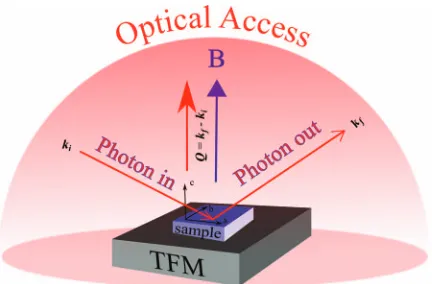
FIG. 1. Sample mounting scheme. In this case the sample is attached di-rectly to the surface of the TFM. Magnetic field (B) direction is normal to the sample surface as indicated by a vertical arrow.
quantized magnetic flux on pinning centers. In the most straightforward configuration, as shown in Fig. 1, a tiny single-crystal sample is mounted directly on the TFM surface. The advantages of this geometry are clear: (1) optical access is over the entire hemisphere, and (2) magnetic fields can be ap-plied along the x-ray momentum transfer (B||Q) in the sym-metrical reflection geometry.20 In addition, the TFM is com-pact, and it can be cooled with a small closed-cycle (or liquid He flow) cryostat for use in any x-ray experimental stations at modern synchrotron beamlines. Since the magnetic fields of a TFM are confined within close proximity of the cryostat cold finger, no significant stray fields are present to interfere with motors or sensitive electronics in the experimental stations. The TFM instrument described in Sec. II would, therefore, be ideal for numerous synchrotron x-ray scattering studies of electronic, magnetic, orbital, and structural properties in mag-netic fields. In Sec. III, we report characterization measure-ments of TFMs and results of a preliminary x-ray magnetic scattering study on TbNi2Ge2 demonstrating the use of the
instrument.
II. EXPERIMENTAL DETAILS
The core of this instrument is a YBCO-based TFM grown by a melt-textured method. Platinum (Pt) powders were in-troduced to create flux pinning centers. During melt textur-ing they react with Y2BaCuO5impurities (a by-product of the
growth) to reduce their size and refine their shapes, which are believed to be responsible for their very high trapped mag-netic fields and critical current density properties. The TFMs were cut to desired sizes, and their trapped field profile was measured at liquid nitrogen (LN2) temperature to check for
signatures of structural flaws before being incorporated into the TFM instrument for further characterization and x-ray measurements. TFMs produced in this way18 achieve fields of about 0.5 T at LN2temperatures in a TFM 20 mm in
diam-eter and 8 mm thick. Other processes provide fields of, e.g., 2.0 T at similar size and temperature.17 Both current density and trappable field increase rapidly at lower temper-atures. Present results19 indicate that further pinning center development will make possible 8-T TFMs at this size and temperature.
The primary instrumentation consists of (1) a small cryo-stat for the TFM and sample, (2) cryogenic Hall probes, and (3) an external superconducting magnet. For x-ray scatter-ing studies, the TFM first needs to be magnetized and then kept below its superconducting transition temperature, Tc. There are different ways to magnetize (or “activate”) a TFM. Whilein situuse of pulsed magnetic fields and flux pump-ing are desirable, at present these techniques remain an active field of research on their own right.21–24Commonly, an exter-nal resistive or superconducting magnet is used with a TFM cooled either in an applied field (field cooled, FC), or in zero field with subsequent application of fields at low temperatures (zero-field cooled, ZFC). While we are able to employ a ZFC method for activating a TFM using our setup described be-low, there is a significant drawback: applied field needs to be at least twice the maximum field that a TFM can trap in order to guarantee full flux penetration into the bulk. In this paper we describe the implementation of the FC method because it ensures a uniform flux penetration into the bulk, the maxi-mum field trapped for a given TFM being limited only by the maximum field available from the external magnet.
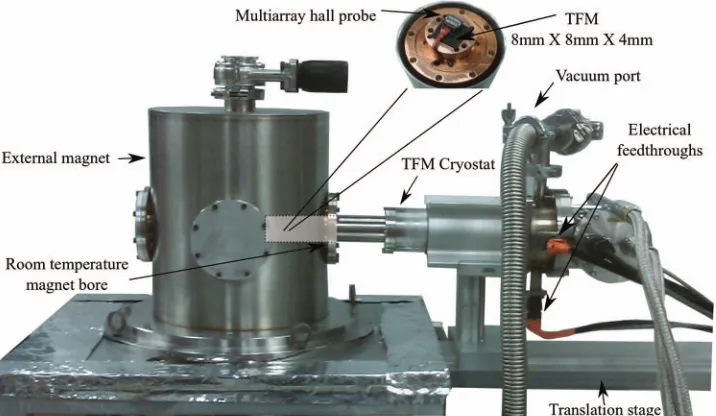
The experimental setup for activating a TFM is shown in Fig.2. A “cryogen-free” superconducting split-pair mag-net is used for applying external fields. The maximum field at gap center is 4 T, while at the center of each coil of the pair the field reaches∼5 T, which in principle sets an upper field limit for activation. However, the outer vacuum jacket of this horizontal magnet was modified to install a room temper-ature (RT) insert into the magnet bore, restricting the magnet to operate at or below∼3.5 T. A small light-weight cryostat, model SRDK-101 from Sumitomo Heavy Industries, is used for cooling the TFM and sample. The TFM cryostat has a nar-row vacuum shroud around the cold finger that fits into the RT insert. During a TFM activation the cryostat is mounted on a translation stage such that it can slide inside the RT bore of the external magnet (Fig. 2) and be positioned at the mag-net center where the volume of field uniformity is the largest. The magnetic field of the external magnet is in the horizon-tal plane and along the axis of the TFM cryostat. The inset of Fig.2 shows a small TFM (black square) of size 8 mm
×8 mm in area and 4 mm thick. The TFM is mounted on the cold finger with a base temperature of∼3.5–4.5 K. The sample can be attached directly to the TFM surface. A Hall probe array (HPA) with seven sensors (model MULTI-7U from AREPOC) is mounted on the TFM near the sample to monitor the magnetic field during and after the activation pro-cess. Two calibrated cernox temperature sensors and a car-tridge heater are installed to monitor and control the TFM (and sample) temperature. The HPA can be read out using an AD25PCI DAQ board and PciDAQ software from AREPOC. For activation, the cryostat is translated into the RT bore of the horizontal magnet and cooled down to 100 K, above the
Tc of YBCO. Next, the applied magnetic field is ramped up to a desired field value followed by a cool down of the TFM to the base temperature. At the base temperature the exter-nal magnetic field is ramped down to zero, leaving the TFM magnetized. The entire activation process takes less than 2 h. X-ray resonance exchange scattering (XRES) (Ref.25) studies were carried out on the 6-ID-B beamline at the
065103-3 Daset al. Rev. Sci. Instrum.83, 065103 (2012)
FIG. 2. Experimental setup for activation of TFMs. The cryostat is mounted on a translation stage. There are three feedthrough ports on the cryostat for electrical connections for Hall probes, temperature sensors, and a heater. The inset shows the TFM (black square) of size 8 mm×8 mm in area and 4 mm thick.
Advanced Photon Source. The measurements were carried out at the Tb LIII (7.514 keV) edge with a large resonant enhancement of the magnetic cross section. The monochro-matic beam from a Si (111) double-bounce monochromator was vertically focused using a mirror. The horizontal size of the incident beam was determined by slits before the sam-ple. A NaI-scintillator point detector was used for recording scattering intensity of charge Bragg and magnetic superlat-tice peaks. However, no polarization analyses were necessary to observe magnetic superlattice peaks. TbNi2Ge2 crystals
were grown out of a high-temperature metallic solution.26,27 A single crystal was oriented and cut in the shape of a 1 mm
×1 mm square plate withcaxis normal to the flat facet. The plate was thinned down to∼200 μm by polishing one side. XRES measurements were performed in reflection geometry on the unpolished as-grown surface. During these x-ray mea-surements the activation setup was moved inside the experi-mental station. The sample was attached to a TFM mounted on the cryostat (Fig.2) and used on the diffractometer to per-form scattering measurements. For activation the TFM cryo-stat was removed from the diffractometer without interfering with cooling. After magnetizing the TFM, the cryostat was put back on the diffractometer in exactly the previous orien-tation. The sample realignment took about half an hour and the x-ray measurements continued until a need to activate the TFM to higher fields arose. Note that trapped fields were mon-itored using the HPA intermittently during the x-ray measure-ments in order to minimize heating of the sample.
III. RESULTS AND DISCUSSION
Preliminary measurements of trapped flux were done in LN2 to check for overall quality of the field distribution.
These measurements were done soon after activation (typi-cally within half an hour) of TFMs in LN2 using an
electro-magnet. Magnetization measurements were done by scanning
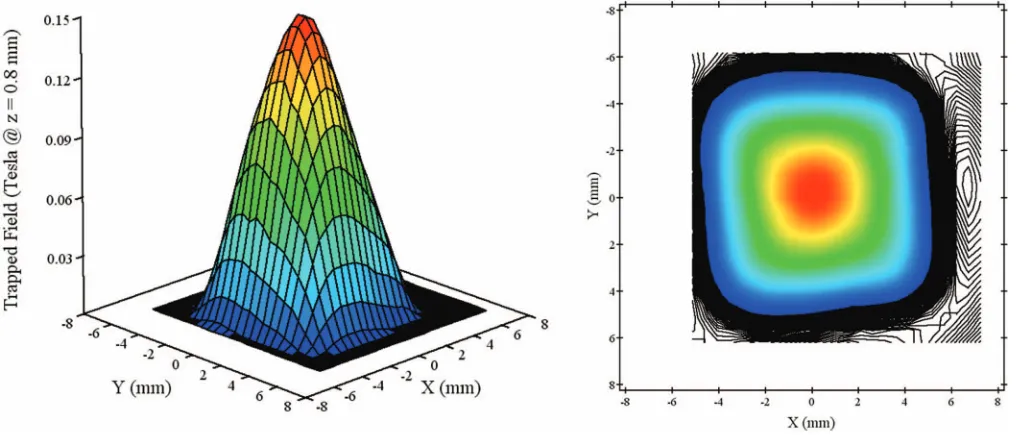
a single Hall probe over the TFM surface at a fixed distance (i.e.,z=0.8 mm). The field distribution (Fig.3) revealed a well-defined central peak field characteristic of a single mag-netized TFM without any signs of structural flaws such as cracks, voids, multi-crystalline growth, or pinning center non-uniformity.15The appearance of a rounded triangular-shaped peak centered on the TFM implies that trapped fields are ap-proaching the maximum value for this magnet at LN2
temper-ature. For the small square TFMs used, this value is less than 0.5 T at LN2temperatures. The magnet was then installed in
the cryostat for low temperature measurements and x-ray use (see inset in Fig.2).
We have characterized several TFMs of the same size and shape discussed above. Figure4(a) shows a typical be-havior of magnetic fields as a function of time through the activation process and beyond. Application of the external magnetic field of 3.5 T at 100 K, cool down of the TFM to ∼4 K, followed by a ramp down to zero, and stability of the trapped field over time are indicated by arrows in Fig. 4(a). After the external field is ramped down to zero, the Hall probe reading corresponds to a central field value at
z= 0.8 mm from the TFM surface due to trapped flux. In this case the maximum trapped field measured by the ar-ray was ∼2.15 ± 0.05 T, which remained practically un-affected over the entire 16 h of measurements. Figure 4(b)
shows the trapped field on an expanded scale, which ex-hibits a well-known logarithmic decay due to flux creep,B(t)
=B(t0)−αln(tt0), whereαis a constant related to flux-flow
rate.28 However, the decay is slow and provides ample time for x-ray scattering studies. We note that even a∼3% decay, which is practically insignificant for experiments of interest, would take five days, a typical duration of x-ray scattering experiments at a synchrotron facility.
065103-4 Daset al. Rev. Sci. Instrum.83, 065103 (2012)
FIG. 3. Magnetic field distribution at 0.8 mm above a TFM surface at 77 K. The profile was measured soon after activation. (Left) A single-dome field profile, as expected for a single-grain bulk YBCO. (Right) Same data in a 2D color map.
as described in Ref.16, is close to∼2.8 T. Measurements of the degree of uniformity of the magnetic field over the surface of the TFM are shown in Fig.4(c)for different trapped field values (corresponding to the maximum of each curve). The trapped field also decreases with radial distance away from the center toward the edge of the TFM. The uniformity de-creases with increasing trapped field value; for a trapped field of 2.8 T on the surface, the field is uniform over an area of
∼2 mm×2 mm. Figure4(d)shows that the TFM is demag-netized by simply warming aboveTc. Since warming reduces the value of the trapped field, one can use this property as a means of performing lower field measurements following those at higher fields. One can warm up to an appropriate temperature to reduce the field (e.g., 1 T) and cool down to base temperature and repeat the process to lower fields, al-lowing one to carry out an entire experiment with a single activation.
According to the results presented in Fig.4the trapped magnetic field is stable over time and centrally uniform over millimeter-length scales parallel to the TFM surface. We note that typical x-ray beam sizes of∼100 ×100μm2 are
rou-tinely available on undulator beamlines of third-generation synchrotron facilities. Furthermore, for resonant scattering such as XRES and many high-resolution diffraction stud-ies, x-ray penetration depths are of the order of μms (for energies 3–15 keV) for numerous materials. Therefore, the magnetic field of a TFM in the scattering volume of such x-ray measurements is practically constant. Note that al-though in reflection geometry the scattering volume is near the top surface of the crystal, for thin samples the probed volume remains very close to the TFM surface. Magnetic fields quoted for x-ray data below are those for the scattering volume.
In order to illustrate the use of TFM for synchrotron ex-periments we have performed XRES studies on TbNi2Ge2,
which is perhaps the most interesting member of theRNi2Ge2
family of compounds.27,29 Magnetic properties in this mate-rial arise from the Tb 4fmoments located at the corners and at the body center of the tetragonal crystal structure (I4/mmm) with an easy axis of magnetization along thecdirection. On cooling belowTN ∼17 K the material becomes an incom-mensurate (IC) amplitude modulated (AM) anti-ferromagnet (AFM), characterized by magnetic scattering atτ1 =(0, 0,
τz). TbNi2Ge2undergoes a second transition belowTt∼9 K into a commensurate structure described by a set of three wave vectors (equal-moment, EM, phase). For both phases, ordered magnetic moments are strictly along thec axis. In applied magnetic field along the caxis at low temperatures a rich phase diagram (Fig. 5) with clearly defined bound-aries and the possible existence of several critical points have been determined by thermodynamic measurements. However, in order to access these “meta-magnetic” phases (MPs) one needs to apply field alongcand also have optical access for x-ray magnetic scattering measurements alongc*=[0, 0, 1], which is the direction of the primary ordering vectorτ1. Our
instrument, with the c axis of TbNi2Ge2 orthogonal to the
TFM surface (i.e., B||c), offers an ideal geometry for such measurements.
We performed the measurements at 0 T and 2.0 T mag-netic fields at 4.5 K (below Tt). Note that at 4.5 K, 2 T should be sufficient to access meta-magnetic phase MPII, which exists over a large field and temperature range. Rele-vant reciprocal-lattice scans are shown in Figs.5(b)and5(c). As expected, in zero field the low-temperature EM phase is characterized by τ1=(0,0,34), τ2=(12,12,0), and τ3 =(12,1
2, 1
2) wave vectors, as observed in [0, 0,L] and [ 1 2,
1 2, L]
scans. We have increased fields up to ∼1.5 T and observed no changes in the EM phase, consistent with the phase dia-gram. However, at 2 T we were able to access a field-induced meta-magnetic phase. At this field the same scans now
065103-5 Daset al. Rev. Sci. Instrum.83, 065103 (2012)
1 10 100
2.05 2.06 2.07 2.08
B(t) = B(t
0) - ln(t/t0)
t
0 = 1 hour
B(t0) = 2.09 T
= 0.00853 T
T
rapped F
ield ( T
@
z = 0.
8
mm)
t (hour)
b)
)
FIG. 4. (a) Trapped magnetic field vs time measured with the HPA. Various steps in FC activation process and trapped field stability with time are indicated by the arrows. (b) Data on an expanded scale for Hall probe 4, located at the center of the TFM and which records the maximum trapped field value. (c) Trapped magnetic field as a function of radial distance from the TFM center. Different colored lines are for FC activation to different maximum values of trapped fields at the center. Trapped field is practically constant around the center over an area of∼2 mm×2 mm. (d) TFM can be fully demagnetized by simply warming aboveTc. Measurements can be performed at lower fields by warming up to someT<Tcto reduce trapped field, followed by cooling, as indicated by arrows.
(a)
FIG. 5. (a) H-T phase diagram of TbNi2Ge2with magnetic field applied along thecaxis (adapted from Ref.27). The dashed–dotted line shows the H-T path
followed in the present study. Note the end points of the thick lines and the areas shaded by ovals where two or more phases coexist. (b) (0,0,L) scans at 0 T (black dotted line) and at 2 T (red solid line) at 4.5 K. We reproduce previous observations of the 0 T phase, with ordering vector (0,0,34). At 2 T the ordering vector is IC (0, 0,∼0.765) with a weaker satellite at (0, 0,∼0.796), as indicated by arrows. (c) (12,12, L) scans at 0 T (black dotted line) and at 2 T field (red solid line) at 4.5 K. EM phase magnetic peaks associated with (1
2, 1 2,0) and (
1 2,
1 2,
1
[image:8.612.65.548.51.435.2] [image:8.612.76.540.562.686.2]065103-6 Daset al. Rev. Sci. Instrum.83, 065103 (2012)
revealed profound changes to the wave vectors and their inten-sity. The EM structureτ1became IC (0, 0,∼0.765) with the
appearance of a weaker τ1=(0,0,∼0.796) satellite, while the half-order peaks characteristic of AFM planes were strongly suppressed. The presence of a weak τ2 peak and
the absence ofτ3peaks indicate that this state is distinct from
the EM or the AM phases observed in zero field. Note that since all the MP phases have net FM components, it is ex-pected that the AFM superlattice peaks in general will de-crease in intensity. Interestingly, the width of the stronger IC peak was larger at 2 T, indicating that the correlation length of the field-induced state also decreased compared to that of the EM phase. This loss of correlation is in contrast to an increase in correlation in the EM-to-AM phase transition at
Tt in zero field. Furthermore, weak peaks due to combina-tions of IC andτ2 peaks appear, indicating a more complex
magnetic structure than the EM phase. We note that since we cooled the sample in applied field, the zero-field IC phase may persist down to lower temperatures (“supercooled”) than the phase diagram in Fig.5suggests, effectively shifting the MP boundaries. So, it is possible that two magnetic phases coex-ist, which appear to be distinct from EM and AM structures in zero fields. The exact relationship of these two MPs observed with XRES to MPI and MPII as identified using magnetiza-tion measurements remains to be clarified.
IV. CONCLUDING REMARKS
We have developed a paradigm-shifting approach to x-ray scattering studies in magnetic fields using trapped flux in type-II superconductors. This novel method utilizing TFMs uniquely facilitates photon-in and photon-out scattering ex-periments with unrestricted optical access over the entire hemisphere and with a capability of applying magnetic fields along the x-ray momentum transfer, respectively. It is eas-ily portable due to the compact and lightweight design of the TFM cryostat. These capabilities have been demonstrated by XRES measurements of a field-induced meta-magnetic state in TbNi2Ge2.
We note that our current instrument has a base tempera-ture of∼4 K with highest available magnetic field of ∼3 T from a small TFM. However, the potential for larger fields and further innovative applications is evident. With the use of larger-sized TFMs, or better designed pinning centers,19 fields in excess of 20 T appear to eventually be within reach. Additionally, a pair of TFMs stacked with a gap in between or a TFM with an axial hole can offer conventional “split-pair” and “solenoid” geometries, should that be desirable. It is possible to activate TFMs to perform higher field measure-ments first, followed by successive warming to appropriate temperatures to reduce fields for lower field measurements. Although one needs to keep track of field-temperature history of the sample, this method offers a wide field range with a single activation of the TFM. Finally, it is possible to inde-pendently cool the TFM and sample by placing them on two separate thermal stages of a single cryostat with the sample mounted on a linear positioner to adjust its distance from the TFM surface. Such a scheme is being implemented, which will enable one to keep the sample at any desired temperature
and change magnetic field simply by varying sample distance while the TFM remains magnetized during the course of the experiment.
ACKNOWLEDGMENTS
We appreciate having fruitful discussions with G. Shenoy, U. Welp, B. W. Veal, and D. Robinson of Argonne National Laboratory, and with D. Parks of University of Houston (UH). The work performed at the Advanced Pho-ton Source was supported by the U.S. Department of Energy (DOE), Office of Science, Office of Basic Energy Sciences under Contract No. DE-AC02-06CH11357. Work at UH on TFM development is supported by The Welch Foundation (Grant No. E-1380), the U.S. Army Research Office (US-ARO), and the State of Texas via the Texas Center for Su-perconductivity at UH. Work at Ames Laboratory was sup-ported by the U.S. Department of Energy, Office of Basic En-ergy Science, Division of Materials Sciences and Engineer-ing. Ames Laboratory is operated for the U.S. Department of Energy by Iowa State University under Contract No. DE-AC02-07CH11358.
1High Magnetic Fields: Science and Technology, edited by F. Herlack and
N. Miura (World Scientific, Singapore, 2003).
2Physical Phenomena in High Magnetic Fields, edited by E. Manousakis,
P. Schlottmann, P. Kumar, K. Bedell, and F. M. Mueller (Addison-Wesley Publishing Company, Redwood City, CA., USA, 1992).
3Opportunities in High Magnetic Field Science(National Research Council,
The National Academies Press, Washington, DC, 2005).
4Condensed-Matter and Materials Physics: The Science of the World
Around Us(National Research Council, The National Academies Press,
Washington DC, 2006).
5Basic Research Needs for Materials under Extreme Environments, BESAC
Report, Office of Science, U.S. Department of Energy, 2007.
6Peter J. E. M. van der Linden, O. Mathon, C. Strohm, and M. Sikora,Rev.
Sci. Instrum.79, 075104 (2008).
7Y. H. Matsuda, Z. W. Ouyang, H. Nojiri, T. Inami, K. Ohwada, M. Suzuki,
N. Kawamura, A. Mitsuda, and H. Wada,Phys. Rev. Lett.103, 046402 (2009).
8Magnetism: From Fundamental to Nanoscale Dynamics, in Solid State
Sci-ences Vol. 152, edited by J. Stöhr and H. C. Siegmann, (Springer-Verlag, 2006).
9J. P. C. Ruff, Z. Islam, J. P. Clancy, K. A. Ross, H. Nojiri, Y. H. Matsuda,
H. A. Dabkowska, A. D. Dabkowski, and B. D. Gaulin,Phys. Rev. Lett.
105, 077203 (2010).
10Zahirul Islam, Jacob P. C. Ruff, H. Nojiri, Y. H. Matsuda, K. A. Ross,
B. D. Gaulin, Z. Qu, and J. C. Lang,Rev. Sci. Instrum. 80, 113902 (2009).
11P. Frings, J. Vanacken, C. Detlefs, F. Duc, J. E. Lorenzo, M. Nardone,
J. Billette, A. Zitouni, W. Bras, and G. L. J. A. Rikken,Rev. Sci. Instrum.
77, 063903 (2006).
12Y. Narumi, K. Kinda, K. Katsumata, M. Kawauchi, Ch. Broennimann,
U. Staub, H. Toyokawa, Y. Tanaka, A. Kikkawa, T. Yamamoto, M. Hagi-wara, T. Ishikawa, and H. Kitamura,J. Synchrotron Radiat.13, 271 (2006).
13C. Detlefs, F. Duc, Z. A. Kaze˘ı, J. Vanacken, P. Frings, W. Bras, J. E.
Lorenzo, P. C. Canfield, and G. L. J. A. Rikken,Phys. Rev. Lett.100, 056405 (2008).
14M. Tomita and M. Murakami,Nature (London)421, 512 (2003).
15High Temperature Superconductor Bulk Materials, edited by G. Krabbes,
G. Fuchs, W.-R. Canders, H. May, and R. Palka (Wiley VCH, 2006).
16R. Weinstein, I. G. Chen, J. Liu, D. Parks, V. Selvamanickam, and
K. Salama,Appl. Phys. Lett.56, 1475 (1990).
17R. Weinstein, R. Sawh, Y. Ren, M. Eisterer, and H. W. Weber,Supercond.
Sci. Technol.11, 959–962 (1998).
18R.-P. Sawh, R. Weinstein, D. Parks, and V. Obot,IEEE Trans. Appl.
Super-cond.19, 2941 (2009).
065103-7 Daset al. Rev. Sci. Instrum.83, 065103 (2012)
19R. Weinstein, R.-P. Sawh, D. Parks, and B. Mayes,Nucl. Instrum. Methods
Phys. Res. B272, 284 (2012).
20We note that the applied magnetic field is always alongQfor all incident
angles in this geometry, as long as the sample and the TFM surfaces are parallel to each other. This configuration is manifest in Fig.1and is used in the rest of the text. Our statement does not preclude measurements in whichBis no longer alongQ.
21K. Yokoyama, T. Oka, and K. Noto,IEEE Trans. Appl. Supercond.20, 973
(2010); L. Chen, Y. S. Cha, H. Claus, H. Zheng, B. W. Veal, and F. Z. Peng,
IEEE Trans. Plasma Sci.34, 1702 (2006); H. Fujishiro, M. Kaneyama, T. Tateiwa, and T. Oka,J. Phys.: Conf. Ser.43, 405 (2006).
22L. J. M. van de Klundert and H. H. J. ten Kate,Cryogenics21, 291 (1981). 23T. A. Coombs, Z. Hong, X. Zhu, and G. Krabbes,Supercond. Sci. Technol.
21, 034001 (2008).
24R. Weinstein, D. Parks, R.-P. Sawh, and K. Davey,Supercond. Sci. Technol. 23, 115015 (2010).
25J. P. Hannon, G. T. Trammell, M. Blume, and Doon Gibbs,Phys. Rev. Lett. 61, 1245 (1988); D. Gibbs, D. R. Harshman, E. D. Isaacs, D. B. McWhan, D. Mills, and C. Vettier,Phys. Rev. Lett.61, 1241 (1988); J. P. Hill and D. F. McMorrow,Acta Crystallogr. Sect. A52, 236 (1996).
26P. C. Canfield and Z. Fisk,Philos. Mag. B65, 1117 (1992).
27S. L. Bud’ko, Z. Islam, T. Wiener, I. R. Fisher, A. H. Lacerda, and P. C.
Canfield,J. Magn. Magn. Mater.205, 53 (1999).
28P. W. Anderson, Phys. Rev. Lett. 9, 309 (1962); P. W. Anderson and
Y. B. Kim,Rev. Mod. Phys.36, 39 (1964); M. R. Beasley, R. Labusch, and W. W. Webb,Phys. Rev.181, 682 (1969).
29Z. Islam, C. Detlefs, A. I. Goldman, S. L. Bud’ko, P. C. Canfield, J. P. Hill,