Abstract : The purpose of this study is to develop an inpatient management system to improve medical service and prevent safety accidents using context-aware information.
Methods/Statistical analysis: To provide efficient medical services and improve quality, sensor module technology to analyze the patient conditions, as well as gateway technology for data transmission, have been applied. In addition, context-aware technology(patients approaching restricted areas, emergency state notifications such as falling) has been applied to prevent safety accidents for patients.
Findings: This study examined the effect of using bodily information, bio information, and exercise information in patient treatment to improve medical services. This study also researched a patient management system to prevent safety accidents. The following conclusions were reached through experimentation. First, sharing and managing the information necessary for patient treatment, such as inpatients exercise, biological information, etc., is effective for recovery in chronic disease patients. Also, according to experiment results for the safety accident prevention system, a safety alarm is generated on a device worn by patients when approaching a specified restricted area within the medical institution. Second, investigation was done into errors generated by the beacon-based communication technology in the collected information due to medical equipment and obstacles in the medical institution. The technology operates normally without interference from medical equipment within specified zones. Third, the safety accident status of patients during accidents was promptly delivered. Context-aware data and the algorithm provided information on safety accidents and relevant locations to medical staff and related parties.
Improvements/Applications: From the study results, inpatients medical service was able to be improved using context-aware data collected from a sensor module, safety accidents were able to be prevented, and prompt action was able to be taken when safety accidents had occurred.
Keywords: BLE Beacon, Indoor Positioning Technology, Internet of Things, Healthcare Service Model, Context-Aware Computing
I. INTRODUCTION
With the recent increase in Internet of Things(IoT) services supporting information exchange and communication by connecting all things based on the Internet, IoT-integrated services are being applied more widely across various areas of life including the healthcare
Revised Manuscript Received on May 22, 2019.
Jung-Heui Oh, Department of Sport Industry Studies, Yonsei University, Korea
Jai-woo Oh Department of Health Management & Education, Kyungdong University, Korea
E-mail:[email protected]
sector where the IoT technology is being actively utilized[1-3]. There has been a surge in IoT-based healthcare services that help improve the quality of life (QOL) by preventing disease and allowing users to take better care of their health on their own, and this is to meet the growing demand for such services arising from the increased interest in health among the general public. Diverse services have been launched in reflection of this current trend, and a large number of medical institutions are also taking a keen interest in IoT-based healthcare services[4,5].Among the wide variety of IoT-based healthcare technologies developed for health status monitoring purposes, Fitbit Flex, Smart Lens, and smart clothing among others have recently been commercialized. The standards for such IoT services aim to provide integrated services that are safe and reliable based on web-based application protocols such as CoAP/DTLS or HTTP/TLS using diverse sensor nodes with the Internet protocol[6].
In the case of the United States, for example, Brigham and Women‟s Hospital (BWH), uses near-field communication (NFC) technology to manage data for drug management and patient health management in a systematic and convenient manner. To be more specific, BWH developed a system for nurses to easily track and manage drug administration for each patient. The biggest characteristic of this system is that it has been designed to run new applications on Android and to manage drug handling in a more cost-effective, easier and safer way. When administering a drug using a bar code system, the nurse uses an NFC tablet to obtain the necessary information by contacting with the tags attached to the drug, the nurse‟s own ID badge and the patient wristband. By tagging the ID badge and the patient wristband, a patient information window opens on the tablet PC to display all the prior drug administration records as well as a guideline on the drugs that need to be administered. This system can be used to record the pain score of the patient at the time of drug administration, based on which a new guideline for the follow-up drug prescription, and in case a drug other than the one specified by the guideline is prescribed, a warning message gets shown. The system is also designed to show the warning message to other nurses when they tag the patient wristband. In the Netherlands, on the other hand, NEDAP Healthcare of a company called NEDAP (Nederlandsche Apparatenfabriek) has developed software for managing system automation to allow healthcare workers to spend more time on patient
treatment and care without worrying about tasks that are unrelated to medical
Development of Inpatient Management System
Using Context-Aware Computing Technology
treatment. For example, the healthcare provider can register patient information on a mobile device using NFC and record the start and end times of the healthcare service provided to the patient. In addition, all types of information such as insurance coverage, payment information and patient recognition saved under the patient ID can be stored on the NFC phone of the healthcare provider, and the patient information is transmitted immediately to the medical company. In short, this system helps reduce the cumbersome procedures in the hospital, and storing data in this manner is deemed effective in terms of data accuracy.
As it can be seen from the above example, medical institutions are introducing IoT technology to design and set up diverse systems that can simplify or automate hospital processes in order for their medical staff to systematically manage patients and design and focus more on patient treatment and care. However, most of these systems mainly apply NFC technology. This study, on the other hand, aims to develop and set up a wide range of medical service models based on beacon technology in addition to NFCThis study will focus on the development of an IoT health care service model based on indoor positioning using beacon technology in order to reduce time and simplify the procedure for inpatient treatment and administrative processing. In the study, equipment containing an indoor positioning sensor was provided to inpatients so that information on patient location and activity status among others could be collected and utilized for patient treatment, and the door positioning information was used in case a patient was in an emergency situation in order to take an immediate response. This system was found to simplify the discharge procedure, as the patient‟s comprehensive medical information could be checked upon arrival at the hospital, and it was observed to reduce the wait time for patients as it could be used to keep track of the locations of hospital beds in the emergency room and the status of empty beds.
II. RELATEDRESEARCH
2.1. Concept of IoT Healthcare Service
The Fourth Industrial Revolution is occurring worldwide, and policies are being put forth to foster new growth industries converged with IoT as a response strategy. To this end, discussions are taking place in regard to various policy instruments that may be applied. Of particular note, in order to gain opportunities for sustainable economic growth during the Fourth Industrial Revolution, which is being accepted as the new paradigm, core IoT technologies incorporated into the healthcare industry are being selected for promotion. In
Table 1: Initial Set of features used for the experimentation
(Unit: USD 100 million, %) Field
Year Prevention Diagnosis Treatment Follow-up management Total
2010 2,140 (6) 5,700 (16) 24.240 (68) 3,560 (10) 35,640 (100)
2015 3,980 (8) 9,190 (19) 31,420 (63) 5,100 (10) 49,690 (100)
2020 6,880 (10) 14,400 (21) 39,100 (57) 8,230 (12) 68,600 (100)
Average annual growth rate (2010~ 2020)
12.4 9.7 4.9 8.7 6.8
※ Source: Samsung Economic Research Institute (SERI) The vast majority of the IoT-based healthcare platforms
and services that have been launched to date are unable to provide integrated convergence services, as each service is provided through a different platform. Therefore, future IoT-based healthcare platforms need to evolve into an open common platform. Moreover, because most of the existing IoT healthcare platforms do not comply with relevant international standards, there is a lack of interoperability between services and products and interworking of the services is difficult, which will become a hindrance to global market entry. In the future, IoT healthcare platforms that reflect the international standards related to healthcare and IoT should be developed. At present, healthcare services such as heart rate measurement sensors, smart bands, and smart shoes services are provided through different cloud and apps, but in the future, such diverse services should be provided through an integrated “one app” service, through data and service convergence based on the international standards.
2.2. Concept of Context-Aware Computing
Context-aware computing refers to the advanced hardware and software technology that collects and analyzes the information on the user environment (temperature, humidity, etc.), biometric information (body temperature, blood pressure, pulse, electrocardiogram, etc.), and exercise information (amount of calories burnt, step count, sleep duration, etc.) to deduce user needs and derive and suggest optimized functions according to the context[15]. In order to provide appropriate services to the user according to his or her context, context-aware computing uses the data collected via the sensors and goes through the process of recognizing, analyzing and deducing the context of the user, after which analysis and prediction are performed for optimum decision-making.
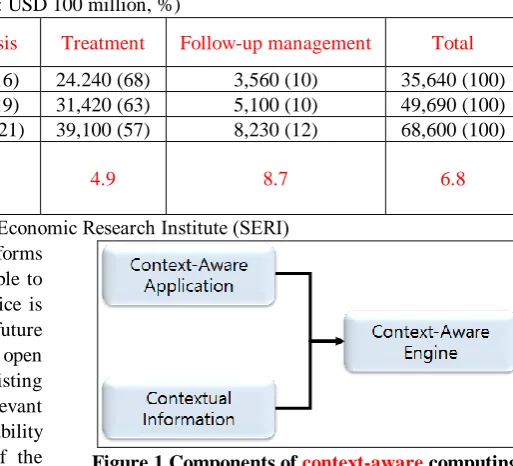
Context-aware computing technology is comprised of three types of technology: the first is contextual information technology that collects information on the contexts around the user from sensors and transmits and shares the information within the network; the second is context-aware application technology that collects the context information received from the sensor network and relays it to the related systems; and the third is context-aware engine technology that analyzes, deduces and processes the shared information. The architecture of a system that uses context-aware computing to provide services is shown in [Figure. 1].
Figure 1.Components of context-aware computing
In order to provide appropriate services to users, context-aware computing systems convert low-quality data obtained from the IoT sensors into high-quality data that are suitable for users. For this purpose, information is first collected from the diverse sensor devices present in the user environment, as shown in [Figure. 3]. The information gathered via the sensors in this manner is merely simple data. Second, the collected data are used to derive more meaningful information. Third, a more meaningful context is deduced. Fourth, appropriate services are provided to the user according to the deduced context. The components of the context-aware computing system architecture may be summarized as a physical layer, which collects data, a context reasoning layer for context recognition using the collected data, an application layer for service implementation, and the modes for the corresponding domains.
2.2.1. Concept of Indoor Positioning System
An indoor positioning system (IPS) is a system that can be used to determine the location of a person or a thing inside a building by using technologies necessary for generating, processing, and maintaining indoor spatial information as well as positioning technology used to locate a person or a thing to set up services indoors.
Of the major positioning technologies available such as Wi-Fi, sensor and beacon, which can be applied to smartphones that are currently playing a major role in the promotion of indoor positioning services and which are undergoing commercialization, the beacon-based positioning technology was applied for the purpose of this study. Lexically speaking, “beacon” means a “signal light” or a “radio transmission station,” but from the perspective of positioning, it can be defined as a “device which provides location information from a
radio waves.” Such beacon-based positioning technology has become widely recognized in location-based services (LBS) since the adoption of Bluetooth 4.0 and the introduction of Bluetooth low energy (BLE) technology, which allows low-power, unlimited terminal synchronization.
The positioning principle of BLE is very simple. To explain, a BLE device transmits advertising packets containing data such as device ID, name of the service location, and strength of the transmitted signal to any nearby terminals. A terminal receiving the packets then determines the location based on the BLE device ID or the distance between the receiving terminal and the BLE device by using the reference point positioning or multilateration. BLE beacon presents advantages such as terminal miniaturization, low power and minimal impact on the indoor environment such as the walls, and mobile advertising and payment services can be integrated through the positioning function as the transmission range of BLE beacons is about 50 meters wider compared with NFC. Beacon-based positioning technology can be used alone for positioning purposes, but synergy can be produced by combining it with other existing positioning technologies.
2.2.2. Concept of Wearable Devices
A wearable device may be defined as an electronic device capable of computing that can be attached to a certain part of the body and contains the related applications for this purpose. In previous research, it has been defined as all types of wearable technology and mobile electronic terminals that can be attached to the body for computing and as a mobile device that can come in diverse forms and be used near the user‟s body, in addition to including applications to perform the necessary functions [16,17]. As such, wearable devices are next-generation electronic devices that are small and lightweight so that they can be worn or attached to the user‟s clothing so that they can be used comfortably by the user, while moving or during an activity. Wearable devices, using diverse sensor technologies, collect the user‟s physical and biometric information and process and analyze the data in order to provide the services and information that the user wants.
The prospects of wearable device development are a portable type, which is carried or worn like an accessory, an attachable type, which is attached to the clothing or the skin in the form of a patch, and an eatable type, which is ingested or implanted. They are also expected to be developed into more practical and convenient forms, along with technical advancements. Wearable devices may be classified according to the purpose of use into health care/medical function, fitness/well-being function, military/industrial function, and infotainment function[16].Wearable devices that are primarily used for a fitness/well-being function can be used to check the travel distance, speed, heart rate, and calories burnt among other information based on the digital data collected during exercise. Initially, one had to link this type of wearable device with an app downloaded on to the smartphone in order to collect and exchange information, but these days, such wearable devices have been reinforced with
tracker and data storage functions and are gaining immense popularity among those who work out regularly. Wearable devices, whose primary purpose is to provide a healthcare/medical function, have been one of the biggest contributors to the rapid growth of the wearable device market. These devices are combined with ubiquitous healthcare technology and wireless body area network (wBAN) technology, and they are used to measure biometric information and signals and transmit the data for utilization. Wearable devices that mainly serve an infotainment (compound word created by combining information and entertainment) function are based on software or media to add entertainment to information transmission, and smart glasses, smart watches, and smart bands fall under this category. Smart glasses, in particular, are regarded as a product that can transform the lifestyle of users. Wearable devices with an infotainment function are currently being developed by leading ICT companies such as Google, Apple and Samsung Electronics. Wearable devices with a focus on a military/industrial function have been developed for special purposes and are heavy as they are equipped with complex features. Among the existing wearable devices available in the market, the ones with a military/industrial function are the most expensive and have the highest specification and they form a high-end market.
III. RESEARCHMETHOD
3.1. Inpatient Management System
Medical institutions are used to provide education to inpatients and caregivers for their safety their daily life management in order to aid in recovery, but there is a limit to this. Some medical institutions use ICT technology such as RFID/USN to prevent safety accidents or to manage the daily lives of inpatients. They are, however, ineffective. It is the purpose of this study to improve the recovery speed of inpatients while improving safety management by developing an inpatient management system that integrates
body information measurement technology and
context-aware computing technology. The technologies applied in this study include sensor module to collect information, wireless network technology to transmit collected information, and indoor positioning technology to prevent safety accidents for inpatients in their daily lives by using the collected information.
※ Source: Development of a healthcare service model using physical information data based on cluster sensing technology(2017)[18]
Figure 2.Inpatient management system configuration diagram
3.2. Applied Technologies in the Inpatient Management System
The technologies of the inpatient management system can be mainly divided into hardware and software. Hardware is composed of the Main Server, Base Station, Gateway, and Sensors. The software is composed of positioning technology to trace location as well as context-aware technology to check the situation of inpatients.
3.2.1. Sensor Technology
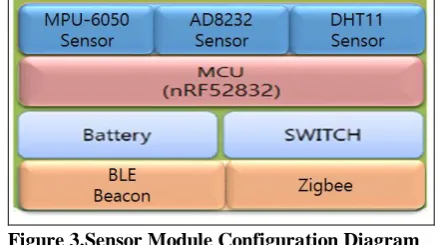
[image:5.595.46.270.52.160.2] [image:5.595.53.273.624.746.2]Sensor technology uses a sensor to scan a Bluetooth beacon signal, collects body information and activity information using data measurement, and transmits the collected through wireless communication. Bluetooth 4.0 or a higher communication function shall be embedded to scan the beacon sensors worn by inpatients. For the recovery of inpatients, the beacon sensor collects bodily information, activity information, heart rate, temperature data, etc. To prevent and manage safety accidents, the beacon sensor shall provide functions to collect positioning data, acceleration, and angular velocity. To provide these functions, the BLE Beacon Sensor, MPU-6050 (Inven Sense Inc.) Sensor (used to measure acceleration and angular velocity), the AD8232 Sensor (used to measure heart rate) and the DHT11 Sensor (used to measure temperature) are mounted. In addition, an nRF52832 chip from the Micro Controller Unit (MCU) Nordic is used. nRF52832 is capable of controlling sensor chips as well as Zigbee transmission chips and is equipped with a BLE function to consume less power when receiving wireless signals. Sensor module configuration is shown in [Figure 3].
Figure 3.Sensor Module Configuration Diagram 3.2.2. Gateway(Node & Base Station Technology)
The sensor module and gateway are configured to use the
same wireless network technology. The data collected by the sensor are transmitted using Zigbee communication. Zigbee is the network technology developed for local area communication and low-speed transmission. It is at the international standard specifications based on the IEEE 802.15.4 standard. It is small in size, offers low power consumption and low cost, and is widely used as a solution to build IoT. The ZigBee frequency can use one of the total 27 channels: 1 channel from 868MHz, 10 channels from 915MHz, and 16 channels from 2.4GHz. The maximum transmission rate can be up to 250Kbps in a 2.4GHz band. Data collected through the sensor module is transmitted using Zigbee communication. The SX1276 transmission chip, which is built in for data transmission, can communicate by setting the desired frequency and bandwidth within the range of 137MHz ~ 1020MHz. Zigbee communication is developed for local area communication, and it is weak at handling low-speed transmissions. The advantages are that long distance communication is possible, which does not require many gateways, and it is suitable to use as an IoT sensor module with low power consumption.
3.2.3. Main Server
The Main Server filters information received from the sensor module, processes data, and provides the necessary information to medical staff or patients. Patient bodily and activity information collected via the sensor module are sent to medical staff to be used for the treatment of each patient. Patient location information is used to send a warning message to the patient when he or she approaches an area where there is a high risk of a safety accident. It also provides information on the real-time live situation of the person approaching the dangerous area. In addition, when a patient has suffered a safety accident such as falling, medical staff will be quickly informed of the accident and its location using context-aware technology, allowing medical staff to promptly provide treatment. In this way, the Main Server provides healthcare and safety accident prevention services for patients using data collected through the sensor module, location tracking software, and context-aware software.
3.2.4. Location Tracking Technology
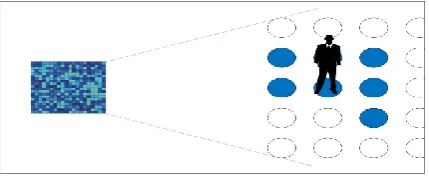
Since inpatients move around in indoor areas that have many obstacles, the technology being used must be able to these environments with little to no errors. The network must transmit a strong signal over a short distance for smooth signal transmission, minimize information loss, and be able to trace locations in real time. Wireless indoor positioning technologies include range-based technology, fingerprinting technology, proximity-based technology, DR(Dead Reckoning) technology, etc. In this study, fingerprinting technology is applied as a positioning technology, as shown in [Figure 4]. Fingerprinting positioning technology estimates locations based on probabilistic modeling, and it
utilizes noise and
this method, a training phase is performed that establishes a database before positioning. In the training phase, multiple sample points at the area are specified for positioning, and a database is prepared and stored using the characteristics of radio waves received from the sample points. In the positioning phase, terminal positional information is provided by extracting the optimal position value from the database using the characteristics of the radio waves received from APs. The accuracy of positioning from this method may vary according to the distance of the database sample points configured during the training phase. Changes may also be seen according to the method of estimating the optimal value from the database and the database configuration method. The advantage of this method is that accurate positioning values can be provided due to using environmental information for positioning. However, the disadvantage is that the process of extracting various radio wave characteristics from every sample point is quite cumbersome, and it requires re-training every time the environment changes.
※ Source: Development of a healthcare service model using physical information data based on cluster sensing technology(2017)
Figure 4.Positioning result using Fingerprinting technology
3.3. Simulation
The bracelet-type sensor module is manufactured by mounting a beacon receiver and adding a vibration motor to give a danger signal to the patient. A vibration motor is used in the sensor module as a warning for the safety of the patient and to prevent safety accidents when patients approach a restricted area or a place where there is a risk of falling or suicide. The following details the content of the experiment and results of the Inpatient Management System.
First, the influence on patient treatment using bodily information, bio information, and exercise information collected via the sensor module are examined as follows. Patients wearing sensor modules are provided with exercise information, bio information, etc. recommended by medical staff for health recovery. The medical staff searches the patient bio information that has been transmitted and the activity information and patient ID stored in the patient information database. If the compared data matches the patient ID, patient information is analyzed and the non-matching data is excluded. Patient IDs are anonymous information that is registered in the hospital in advance. Patient bio information is analyzed only for the data pertaining to patients with a verified patient ID. The analyzed information is sent to medical staff according to
authorization and access levels. At this stage, the analyzing staff provides information that enables differentiated services for patients that utilizes analyzed activity information, hospitalized period, treatment condition, etc. pertaining to each patient. The medical staff whom receive the analysis results use them to review each patient‟s condition and treatment methods. When a treatment method is determined using the analyzed patient information, the medical staff provides a service that shows bio information change in real time or provides a proper medical treatment after interviewing with a doctor. As a result of the experiment, since each patient's bio information and activity information are automatically collected from the sensor module, patient health and activity conditions were able to be promptly analyzed, becoming very helpful in recovery.
The next stage is an experiment regarding patient safety management. It can be arranged into 4 items. First, an experiment was performed to confirm whether the module could be connected using a Bluetooth signal when a patient approaches the area with the transmitter, which delivers a signal stating that the area is restricted. A „danger zone‟ is set with a radius of 5m from the transmitter, and it was confirmed that the bracelet vibrates when approaching the restricted area. In the experiment, a strong vibration was sent when an approach was first recognized, and weak signals were then sent out at regular intervals. In this way, it is considered to be effective in preventing safety accidents only by informing patients of the risk. Second, an experiment was performed to confirm whether a suicide prevention text alarm is sent to medical staff when a patient approaches an area where the suicide risk warning transmitter is installed. A danger zone is set with a radius of 10m from the transmitter, and it was confirmed that the patient location and patient information are sent to the related parties. Third, an experiment was performed to confirm whether there are any changes to the signal strength when there is obstacle or when a set area is changed. Since there are always obstacles in hospitals, including many medical devices and material, this environmental property must be considered. Initially, interference between medical equipment in the ward and concrete wall were set as obstacles for the experiment. The radius was set to 5m, but the signal worked normally without the approach distance changing. Next, interference by medical equipment was performed, and there was no interference between medical equipment. Fourth, an experiment was performed to confirm whether the system recognizes the exact accident location when a patient falls or slips down from a bed and promptly provides emergency status information. Falling is high among other inpatient accidents, and there are many cases of sudden falls among elderly patients. Emergency treatment is able to be provided if the accident is found immediately by another person, but it becomes very dangerous if the accident occurs in a secluded area or in a single-bed room alone. According to the experiment, which took into
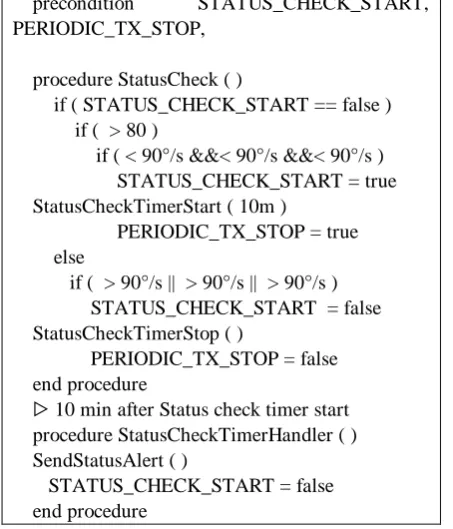
[image:6.595.54.269.317.405.2]occurred and the information of the fallen patient were delivered to the medical staff using a falling detection algorithm with the data collected through an acceleration sensor and gyro sensor attached to the sensor module. After receiving information on the fall, medical staff send a text message to the patient to confirm the emergency situation. If there is no reply, medical staff can find the accident location using positioning technology and respond quickly. [Figure 5] shows the algorithm to determine whether the patient has had a fall.
precondition STATUS_CHECK_START,
PERIODIC_TX_STOP,
procedure StatusCheck ( )
if ( STATUS_CHECK_START == false ) if ( > 80 )
if ( < 90°/s &&< 90°/s &&< 90°/s ) STATUS_CHECK_START = true StatusCheckTimerStart ( 10m )
PERIODIC_TX_STOP = true else
if ( > 90°/s || > 90°/s || > 90°/s ) STATUS_CHECK_START = false StatusCheckTimerStop ( )
PERIODIC_TX_STOP = false end procedure
▷ 10 min after Status check timer start procedure StatusCheckTimerHandler ( ) SendStatusAlert ( )
STATUS_CHECK_START = false end procedure
Figure 5.Pseudo code for algorithm pertaining to the occurrence of falling accidents
IV. CONCLUSION
In this study, a context-aware inpatient management system was implemented to manage inpatients health conditions in real time using wearable devices equipped with sensor technologies and using data on the patient activity statuses, location information, etc. For this purpose, the current status of IoT-based healthcare systems and safety control management status of medical institutions were surveyed, and the problems of the patient management systems were analyzed. Research was done on patient management systems necessary for medical institutions through preceding research, and experiments regarding new ICT technology applied context-aware computing technologies. Medical institutions‟ health care for inpatient recovery has been done through a medical staff-oriented system, and patient health care was instructed to be managed by patients or caregivers. In addition, patient safety management methods were performed in a passive way through document management for patients and caregivers. Recently, as the need for patient safety management rises along with requirements and interests on service quality improvement, there have also been increasing attempts to create medical cost reduction and service enhancement using IoT technology. In this study, a prototype using BLE Beacon-based context-aware
technology was developed to enhance inpatient medical services and to prevent safety accidents. An experiment was performed to investigate the possibility of applying this technology to medical institutions. The findings confirmed that it is possible to provide personalized medical services for patients with chronic diseases such as heart disease or diabetes, and this also applies to hypertensive patients that require continuous management for exercise as well as their own simple biological information. In addition, it was found that it is possible to respond quickly by finding the exact situation and location of patients when in an emergency situation using indoor positioning technology.
This study focused on a system that aims to prevent safety accidents such as falling, as well as suicides. Regarding patient treatment, this study focused on the patient exercise, heart rate, and temperature information. In the future, it is expected to establish a safe and systematic medical environment by integrating ICT technology that enables comprehensive patient management in medical institutions. The limitations of this study are that it did not reflect all of the various safety accidents that can occur in medical institutions, and that there was limitation due to linking sensor modules based on patient body information to medical treatment systems. In the future, it is necessary to extend the patient management system by analyzing more types of safety accidents and applying a bio information-based sensor module to the system.
REFERENCES
1. Kim TY, Jung JJ, Youm SK, Kim EJ. “Multi-Hop WBAN Construction for
Healthcare IoTSystems”, IEEE 2015 International Conference on Platform Technology and Service, 2015, pp. 27-28. Available from: https://ieeexplore.ieee.org/document/7079625/
2. Doukas C, MaglogiannisI. “Bringing IoT and Cloud Computing towards
Pervasive Healthcare”, IEEE 2012 Sixth International Conference on Innovative Mobile and Internet Services in Ubiquitous Computing, 2012,
pp.922-926. Available from:
https://ieeexplore.ieee.org/document/6296978/
3. AmendolaS, LodatoR, ManzariS, OcchiuzziC, MarroccoG. “RFID
Technology for IoT-Based Personal Healthcare in Smart Spaces”, IEEE Internet of Things Journal.2014;1(2): 144-152.
4. CatarinucciL, DonnoDD, MainettiL, PalanoL,PatronoL, StefanizziML,et
al. “An IoT-Aware Architecture for Smart Healthcare Systems”, IEEE Internet of Things Journal. 2015;2(6):515-526.
5. Zhang B, Wang XW, Huang M. “A data replica placement scheme for
cloud storage under healthcare IoT environment”, Mechatronics Engineering, Computing and Information Technology, 2014;556-562, pp.
5511-5517. Available from:
https://doi.org/10.4028/www.scientific.net/AMM.556-562.5511
6. Anurag, S. R. Moosavi ,A. M Rahmani, T. Westerlund, G. Yang, P.
Liljeberg, et al. “Pervasive health monitoring based on Internet of Things: Two case studies ”, IEEE 2014 4th International Conference on Wireless Mobile Communication and Healthcare, 2014, pp. 275-278. Available from: https://ieeexplore.ieee.org/document/7015964/
7. Shen X. “Emerging technologies for e-healthcare”,IEEE Journals
&Managines Network. 2012;26(5):2-3.
8. Burns A, Greene BR, McGrath MJ, O'Shea TJ, Kuris B, Ayer SM, et
al.“SHIMMERTM - A Wireless Sensor Platform for Noninvasive Biomedical Research”, IEEE Sens Journal. 2010;10(9): 1527-1534. 9. V. Shnayder, B. Chen, K. Lorincz, T. R. F. F. Jones, and M. Welsh, "Sensor
networks for medical care," SenSys '05 Proceedings of the 3rd international conference on Embedded networked sensor systems, 2005, p. 314. Available from: https://dl.acm.org/citation.cfm?id=1098979
10. A. T. Barth, M. A. Hanson, H. C. Powell, J. Lach, "TEMPO 3.1: A body
area sensor network platform for
continuous movement
assessment", 2009 Sixth
International Workshop on
[image:7.595.53.280.183.448.2]Sensor Networks, 2009, pp. 71-76. Available from: https://ieeexplore.ieee.org/document/5226915/
11.B. G. Ahn, Y. H. Noh, D. U. Jeong, "Smart chair based on multi heart rate detection system ", 2015 IEEE SENSORS, 2015, pp. 1-4. Available from: https://ieeexplore.ieee.org/document/7370628/
12.Lee HJ, Na OC, Sung SY, Chang HB.“A Design on Security Governance
Framework for Industry Convergence Environment”, Journal of the Korea Convergence Society. 2015;6(4):33-40.
13.Lee MJ.“A Game Design for IoT environment”, Journal of the Korea
Convergence Society. 2015;6(4):133-138.
14.S. K. Lee, “Smart health care industry trend”, Institute for Information & Communication Technology Promotion, 2015, pp.13-20. Available from: http://www.kosen21.org/info/gtbReport/gtbReportDetail.do?articleSeq=0 000000762131
15.Naver Knowledge Encyclopedia IT Term dictionary, Available from:
http://terms.naver.com/entry.nhn?docId=42581.
16.J. H. Kim, “Internet of Things(IoT) Connection Technology Trends and
Implications”, Korea Information Society Development Institute,
2016;28(3): 1-17. Available from:
https://www.kisdi.re.kr/kisdi/common/premium?file=1%7C13791
17.D. G. Kim, “Wearable Device Trends and Implications”, Korea
Information Society Development Institute, 2013;25(21): 1-26. Available from: https://www.kisdi.re.kr/kisdi/common/premium?file=1%7C13245 18.B. H. Kim, J. W. Oh, "Development of healthcare service model using
physical information data based on cluster sensing technology", The Journal of Networks, Software Tools and Applications, Cluster
Comput(2017), pp. 1-15. DOI :