https://doi.org/10.5194/bg-15-6167-2018 © Author(s) 2018. This work is distributed under the Creative Commons Attribution 4.0 License.
The ability of macroalgae to mitigate the negative effects of ocean
acidification on four species of North Atlantic bivalve
Craig S. Young and Christopher J. Gobler
Stony Brook University, School of Marine and Atmospheric Sciences, Southampton, NY 11968, USA Correspondence:Christopher J. Gobler ([email protected])
Received: 2 March 2018 – Discussion started: 29 March 2018
Revised: 17 September 2018 – Accepted: 9 October 2018 – Published: 23 October 2018
Abstract. Coastal ecosystems can experience acidification via upwelling, eutrophication, riverine discharge, and climate change. While the resulting increases inpCO2can have dele-terious effects on calcifying animals, this change in carbon-ate chemistry may benefit some marine autotrophs. Here, we report on experiments performed with North Atlantic popula-tions of hard clams (Mercenaria mercenaria), eastern oysters (Crassostrea virginica), bay scallops (Argopecten irradians), and blue mussels (Mytilus edulis) grown with and without North Atlantic populations of the green macroalgae, Ulva. In six of seven experiments, exposure to elevatedpCO2 lev-els (∼1700 µatm) resulted in depressed shell- and/or tissue-based growth rates of bivalves compared to control condi-tions, whereas rates were significantly higher in the presence of Ulvain all experiments. In many cases, the co-exposure to elevated pCO2 levels and Ulva had an antagonistic ef-fect on bivalve growth rates whereby the presence of Ulva
under elevatedpCO2levels significantly improved their per-formance compared to the acidification-only treatment. Sat-uration states for calcium carbonate () were significantly higher in the presence ofUlvaunder both ambient and ele-vated CO2delivery rates, and growth rates of bivalves were significantly correlated within six of seven experiments. Collectively, the results suggest that photosynthesis and/or nitrate assimilation byUlvaincreased alkalinity, fostering a carbonate chemistry regime more suitable for optimal growth of calcifying bivalves. This suggests that large natural and/or aquacultured collections of macroalgae in acidified environ-ments could serve as a refuge for calcifying animals that may otherwise be negatively impacted by elevated pCO2 levels and depressed.
1 Introduction
The continued delivery of CO2 into surface oceans is ex-pected to cause significant shifts in pools of inorganic car-bon by the end of this century, with projected increases in CO2 and HCO−3 and decreases in CO2−3 and the saturation states of calcite (calcite) and aragonite (aragonite) (Feely et al., 2009; Meehl et al., 2007). Beyond the delivery of CO2 via the combustion of fossil fuels, upwelling, riverine dis-charge, and eutrophication-accelerated microbial respiration all represent strong sources of CO2into coastal zones (Cai et al., 2011; Feely et al., 2008; Melzner et al., 2013; Salisbury et al., 2008; Wallace et al., 2014). Eutrophication-enhanced respiration in coastal zones can lead to the accumulation of respiratory CO2that can exceed concentrations projected for the end of the century (>2000 µatm), as well as result in the undersaturation of aragonite (aragonite<1; Cai et al., 2017; Wallace et al., 2014).
estuarine life will respond to high-pCO2conditions and may, in turn, affect acidification-vulnerable organisms such as bi-valves.
Contrary to the negative effects of increased CO2on cal-cifying organisms, previous studies have shown that some photosynthetic organisms, such as seagrasses (Koch et al., 2013; Palacios and Zimmerman, 2007), phytoplankton (Fu et al., 2012; Hattenrath-Lehmann et al., 2015), and macroal-gae (Olischläger et al., 2013; Young and Gobler, 2016), may benefit from a high-CO2environment. Such photosynthetic autotrophs may also have the capacity to buffer carbonate chemistry, potentially alleviating the harmful effects of ex-cessive CO2 on calcifying organisms. For example, prior studies have observed that daytime productivity within sea-grass meadows can increase pH and aragonite, which, un-der future acidified conditions, may provide temporal refuge for calcifying animals (Garrard et al., 2014; Hendriks et al., 2014). Given the significant global declines in seagrass (Orth et al., 2006; Short et al., 2011; Waycott et al., 2009), as well as the overgrowth of seagrass beds by macroalgae (McGlath-ery, 2001; Valiela et al., 1997), it is plausible macroalgae may more commonly provide similar ecosystem services. While future increases in CO2 may promote the growth of fast-growing macroalgae such as Ulva (Björk et al., 1993; Olischläger et al., 2013; Young and Gobler, 2016, 2017) and could, in turn, provide chemical resilience for calcifying organisms in acidified environments (Anthony et al., 2013; Wahl et al., 2017), such interactions have yet to be fully ex-plored.
Recent studies have demonstrated that populations ofUlva rigidafrom northwest Atlantic coastal waters experience en-hanced growth under elevated CO2 concentrations (Young and Gobler, 2016, 2017). While past studies have suggested that macroalgae may buffer carbonate chemistry to the ben-efit of bivalves (Anthony et al., 2013; Wahl et al., 2017), no study has assessed howUlva, a common macroalga known to undergo enhanced growth under acidified and eutrophic con-ditions, may affect bivalves under CO2-enhanced conditions. The objective of this study, therefore, was to assess how ele-vatedpCO2and the presence ofUlvainfluences the growth and survival of seven cohorts of juvenile bivalves indigenous to the North Atlantic, including hard clams (=northern qua-hogs;Mercenaria mercenaria), eastern oysters (Crassostrea virginica), bay scallops (Argopecten irradians), and blue mussels (Mytilus edulis). Small- and large-sized individuals of bivalves were assessed for three species given the effects of ocean acidification can be size and species dependent for juvenile bivalves (Talmage and Gobler, 2011; Waldbusser et al., 2010). Each bivalve cohort was grown with and without elevated CO2levels as well as with and withoutUlva. Growth and survival of the bivalves were quantified along with car-bonate chemistry within experimental vessels.
2 Methods
2.1 Experimental design
Seven experiments were performed to assess the effects of elevated pCO2 and the presence of Ulva on the growth and survival ofM. mercenaria, C. virginica, A. irradians, andM. edulis. Experiments using smaller bivalves (1–5 mm) were performed in 1 L polycarbonate vessels, while exper-iments with larger bivalves (20–21 mm) were performed in larger 8 L polycarbonate vessels. All containers were acid washed (10 % HCl) and liberally rinsed with deionized wa-ter prior to use. The experimental vessels were placed in an environmental control chamber set to a consistent tempera-ture (∼21◦C), light intensity (∼200 µmol photons m−2s−1), and duration (14 h:10 h, light:dark cycle). The light inten-sity and photoperiod were set to mimic conditions observed at theUlvacollection sites during the time of collection (see below). Containers were filled with filtered (0.2 µm polysul-fone filter capsule, Pall©) seawater and were randomly as-signed, in quadruplicate, to one of four treatments: a con-trol with ambient CO2 concentrations (∼400 µatm) with-out Ulva, a treatment with ambient CO2 levels that re-ceivedUlva, a treatment with elevated CO2 concentrations (∼1700 µatm) withoutUlva, and a treatment with elevated CO2andUlva, resulting in 16 experimental containers. Two additional containers were filled with filtered seawater and bubbled in a manner identical to the ambient or elevated CO2 treatments (described below) and were used to obtain initial DIC measurements. Continuous dissolved oxygen measure-ments were made using HOBO optical dissolved oxygen sen-sors (Onset©) in additional parallel vessels with and with-outUlvaadded at the same levels used in experimental ves-sels and bubbled identically to experimental vesves-sels. All ex-perimental containers for each experiment received nutrient additions (50 µM nitrate, 3 µM phosphate) at the beginning of the experiment, as well as after each twice-weekly water changes (details below) to ensure nutrient-replete growth of
Ulva. The nutrient and CO2 concentrations used during ex-periments were within the range of concentrations present in US East Coast estuaries (Baumann and Smith, 2018; Bau-mann et al., 2015; Wallace et al., 2014; Wallace and Gob-ler, 2015) and were used during prior experiments that in-volved Ulva from Shinnecock Bay, NY, USA (Young and Gobler, 2016, 2017). Across all experiments, bivalves were fed a mixture ofIsochrysis galbanaandChaetoceros muel-leriat a rate known to be ad libitum (4×10⁴cells mL−1d−1; Helm et al., 2004). Microalgal cultures were maintained in exponential phase growth in f/2 media using standard cultur-ing conditions (Helm et al., 2004).
400 µatm) and elevated (∼1700 µatm) CO2 concentrations via a gas proportionator system (Cole Parmer® flowmeter system, multi-tube frame) that mixed ambient air with 5 % CO2gas (Talmage and Gobler, 2010). Gases were mixed and delivered at a flow rate of 2500±5 mL min−1through gang valves into the serological pipettes that fit through an open-ing in the plexiglass used to cover the experimental ers, turning over the volume of the experimental contain-ers >1000 times daily. Bubbling began 2 to 3 days prior to the start of each experiment to allow CO2 concentra-tions and carbonate chemistry to reach a state of equilib-rium. Experiments persisted for ∼2 weeks. Measurements of pH within containers were made daily with a Honeywell Durafet III ion-sensitive field-effect transistor-based (ISFET) solid-state pH sensor (±0.01 pH unit, total scale), which was calibrated with a seawater pH standard (Dickson, 1993). In select experimental containers throughout the duration of ex-periments, continuous measurements of pH were made us-ing an Orion Star A321 Plus electrode (±0.001 pH unit, NBS scale) calibrated prior to use using National Institute of Standards and Technology (NIST) traceable standards. Mea-surements of pH made with the Durafet and Orion instru-ments were compared to measureinstru-ments made spectrophoto-metrically usingm-cresol purple (Dickson et al., 2007) and were found to be nearly identical and never significantly dif-ferent. Discrete water samples were collected at the begin-ning and conclusion of experiments to directly measure DIC within each experimental vessel in each treatment (n=4 per treatment). The DIC samples were preserved using a saturated mercuric chloride (HgCl2) solution and stored at ∼4◦C until analysis. Samples were analyzed by a VIN-DTA 3-D (versatile instrument for the determination of to-tal inorganic carbon) delivery system coupled with a UIC Inc. coulometer (model CM5017O). During the coulomet-ric analysis, all carbonate species were converted to CO2 gas by the addition of excess hydrogen to the sample and the evolved CO2gas was subsequently carried into the titra-tion cell of the coulometer. The gas then reacted quantita-tively with an ethanolamine-based reagent to generate hydro-gen ions, which were titrated with coulometrically hydro-generated OH−, and CO2was measured by integrating the total change required to titrate the hydrogen ions (Johnson et al., 1993). Final total alkalinity,aragonite,calcite,pCO2, and concen-trations of HCO−3, CO2−3 , and OH−(Tables 1 and S1 in the Supplement) were calculated from measured levels of DIC, pH, temperature, and salinity, as well as the first and second dissociation constants of carbonic acid in seawater (Millero, 2010) using the program CO2SYS (http://cdiac.ess-dive.lbl. gov/ftp/co2sys/, last access: 17 October 2018). For quality assurance, levels of DIC and pH within certified reference material (provided by Andrew Dickson of the University of California, San Diego, Scripps Institution of Oceanography; batches 158, 159=2044, 2027 µmol DIC kg seawater−1, re-spectively) were measured during analyses of every set of
samples. The analysis of samples continued only after com-plete recovery (99.8±0.2 %) of certified reference material was attained. Actual meanpCO2 and pH values were 350 and 8.00 µatm, respectively for ambient conditions and 1750 and 7.38 µatm, respectively, for elevated CO2conditions, val-ues within the range found seasonally in some estuarine envi-ronments (Baumann and Smith, 2018; Baumann et al., 2015; Wallace et al., 2014; Wallace and Gobler, 2015). Two-way ANOVA and post hoc tests were used to assess significant differences in carbonate chemistry among experimental ves-sels with the main treatment effects beingpCO2(ambient or elevated) and the presence ofUlvawithin SigmaPlot 11.0.
2.2 Assessing the effects of elevatedpCO2andUlvaon
juvenile bivalves
The macroalgae used for this study were collected from Shinnecock Bay, NY, USA (40.85◦N, 72.50◦W) during low tide. Permission to access this area and collect macroalgae and M. edulis was received from the Southampton Town Trustees, Southampton, NY, USA, who hold jurisdiction over Shinnecock Bay. Large, well-pigmented, robust fronds of
Ulva were collected and transported to the Stony Brook Marine Science Center in seawater-filled containers within 15 min of collection. Previously, internal transcribed spacer (ITS) sequencing and microscopy was used to determine that the species ofUlvathat dominated Shinnecock Bay in summer and fall wasUlva rigida(Young and Gobler, 2016, 2017), and microscopic examinations during this study indi-cated this was the species used in all experiments presented here. We refer to the algae simply as Ulva throughout the study due to the plastic nature of the macroalgal taxonomic nomenclature, as well as the high similarity of ITS sequences among species ofUlva(Hofmann et al., 2010; Kirkendale et al., 2013).
Table 1.Values of mean pH (total scale), temperature (◦C), dissolved oxygen (mg L−1), and salinity (g kg−1), and finalpCO2(µatm), total alkalinity (µmol kg SW−1), total DIC (µmol kg SW−1), HCO−3 (µmol kg SW−1), CO32−(µmol kg SW−1), OH−(µmol kg SW−1),calcite, aragonite, and final microalgal cell counts ofIsochrysis galbanaandChaetoceros muelleri(cells mL−1) at the end of the experiments (n=4 for all treatments). Values represent means±standard error. Asterisks indicate parameters that were directly measured and not calculated. Data from individual experiments appear within Table S1.
Parameter Control Ulva CO2 CO2/Ulva
pH* 7.98±0.01 8.03±0.01 7.37±0.01 7.39±0.01 Temperature* 21.3±0.1 21.2±0.1 21.3±0.1 21.3±0.1 Dissolved oxygen* 9.06±0.01 9.00±0.01 9.17±0.01 9.10±0.01 Salinity* 30.0±0.1 30.1±0.1 30.0±0.1 30.0±0.1 pCO2 373±8 335±9 1763±27 1721±27 Total alkalinity 1740±26 1759±26 1792±25 1803±21 Total DIC* 1561±19 1557±21 1782±22 1797±19 HCO−3 1428±16 1413±18 1690±21 1706±19 CO2−3 119±4 134±5 35±1 37±1 OH− 3.84±0.12 4.51±0.18 0.95±0.02 1.01±0.02 calcite 2.97±0.11 3.36±0.13 0.86±0.03 0.90±0.03 aragonite 1.91±0.07 2.16±0.09 0.56±0.02 0.59±0.02 Microalgae cells* 97 273±5230 97 727±4696 90 455±4388 95 000±5294
Small and large cohorts of Mercenaria mercenaria(∼1 and ∼5 mm, respectively) and Argopecten irradians (∼5 and ∼20 mm, respectively) used during experiments were spawned at the Stony Brook Marine Science Center of the Stony Brook University hatchery (40.89◦N, 72.44◦W) using brood stock from Shinnecock Bay collected 1 to 2 months prior to spawning and exposed to environmental conditions (salinity, dissolved oxygen, pH) similar to their collection site. Small and large cohorts of Crassostrea virginica(∼2 and ∼20 mm, respectively) used during experiments were produced by the Cornell Cooperative Extension shellfish hatchery, NY, USA (40.04◦N, 72.39◦W) using brood stock from the Peconic Estuary, NY, USA. Cohorts of small juve-nileMytilus edulis(∼5 mm) used during experiments were collected from Shinnecock Bay, NY, USA, during low tide (40.84◦N, 72.50◦W). Experiments using smaller bivalves (1–5 mm) were performed in 1 L polycarbonate vessels with 20 individuals per vessel, while experiments with larger bi-valves (20–21 mm) were performed in larger, 8 L polycar-bonate vessels with five individuals per vessel.
Experiments began with the introduction of bivalves,
Ulva, and nutrients into experimental vessels, with discrete measurements of pH and continuous measurements of dis-solved oxygen and temperature made as described above throughout experiments. At the beginning of each experi-ment, 20 individuals from each bivalve cohort were set aside to obtain initial measurements of shell length (defined here as distance from umbo to furthest ventral margin), tissue weight, and shell weight. Bivalve dimensions were deter-mined via digital calipers and digital images with the two ap-proaches producing nearly identical and not statistically dif-ferent measurements. Captured images of bivalves were ana-lyzed using ImageJ, with the scale of each image individually
calibrated. Every 3 to 4 days, a complete water change was performed for all containers using water bubbled in 20 L car-boys with gas mixtures for ambient and elevated CO2 treat-ments as described above to ensure bivalves were exposed to their respective CO2concentrations. Once weekly, Ulva disks from each container were removed, rinsed, spun in the salad spinner, weighed, and returned to the vessels. Addi-tionally, every week, bivalves were collected on a 500 µm sieve, transferred to a petri dish, and measured for length with any mortality noted. Mortality rates were very low (al-ways<10 %) and did not differ among treatments. At the conclusion of experiments, final pH, temperature, and salin-ity measurements were made and final water samples for DIC analysis were collected and analyzed as described above. Ad-ditionally, 50 mL samples were removed from each container to assess final cell concentrations of phytoplankton provided for food (I. galbanaandC. muelleri), which were preserved with Lugol’s iodine (5 %) solution and enumerated via mi-croscopy (Tables 1 and S1).
performed using SigmaPlot 11.0 to assess significant differ-ences in growth rates based on shell length, tissue weight, shell weight, and survival during experiments, for which the main treatment effects werepCO2(ambient or elevated) and the presence of Ulva. All data were log transformed prior to two-way ANOVA to ensure that the assumptions of equal variance and normality were met. Normality was tested via the use of Shapiro–Wilk tests. If significant differences were detected, a Tukey’s honest significant difference (Tukey’s HSD) test using R 3.4.0 within RStudio 1.0.143 was per-formed to identify specific differences among treatments. Finally, linear regression models of growth rates based on shell length, tissue weight, and shell weight withcalciteand aragonite were created using R® software (version: 3.4.0; http://www.r-project.org, last access: 17 October 2017).
3 Results
3.1 Mercenaria mercenaria
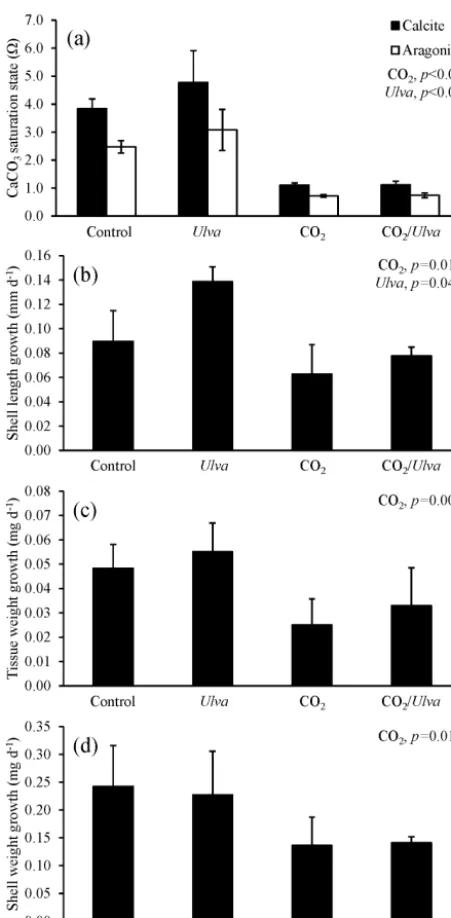
For the cohort of smaller juvenile M. mercenaria (1.34± 0.24 mm),calciteandaragonite were significantly lower in treatments with elevated CO2(two-way ANOVA;p <0.001 for both, Fig. 1; Tables S2–S3) and significantly higher in treatments containing Ulva (two-way ANOVA; p=0.002 andp=0.007, respectively). Growth of the smallM. mer-cenaria based upon shell length, shell weight, and tissue weight was highly sensitive to increases in pCO2 as well as the presence of Ulva. When exposed to elevated CO2 conditions, growth rates based on shell length, shell weight, and tissue weight were 49 %, 66 %, and 41 % lower, respec-tively, when compared to their counterparts in ambient CO2 treatments (two-way ANOVA; p <0.001, p <0.001, and p=0.038, respectively; Fig. 1; Tables S4–S6). In contrast, growth rates based on shell length, shell weight, and tis-sue weight were significantly higher in the presence ofUlva
[image:5.612.313.541.65.529.2](two-way ANOVA; p=0.006, p=0.011, and p=0.008, respectively; Fig. 1; Tables S4–S6) with growth based on shell length, tissue weight, and shell weight being 28 %, 37 %, and 47 % higher, respectively, within elevated CO2 treatments and 10 %, 25 %, and 30 %, respectively, within ambient CO2treatments (Fig. 1). Multiple comparison tests revealed that Ulva often mitigated the negative effects of elevated CO2 on hard clams. For example, length-based growth in elevated CO2 treatments with Ulva was signif-icantly higher than elevated CO2 treatments without Ulva (Tukey HSD; p=0.044; Table S7). Furthermore, growth rates based on shell length showed strong significant posi-tive correlations with aragonite andcalciteacross all treat-ments (R2=0.79,p <0.001 andR2=0.79,p <0.001, re-spectively; Table S10). There were also significant correla-tions between growth based on shell weight and aragonite (R2=0.53,p=0.001; Table S10) andcalcite(R2=0.53, p=0.002; Table S11). For growth based on tissue weight,
Figure 1.Experiment with small juvenileMercenaria mercenaria exposed to ambient and elevated concentrations of CO2with and without the presence ofUlva.(a)calcite andaragonite; growth was based on (b) shell length, (c) tissue weight, and (d) shell weight. Columns represent means±standard deviation. Significant main treatment effects (CO2 andUlva) appear at the top right of each panel.
there were also significant correlations with aragonite and calcite (R2=0.30,p=0.05 andR2=0.30,p=0.05, re-spectively; Tables S10–S11).
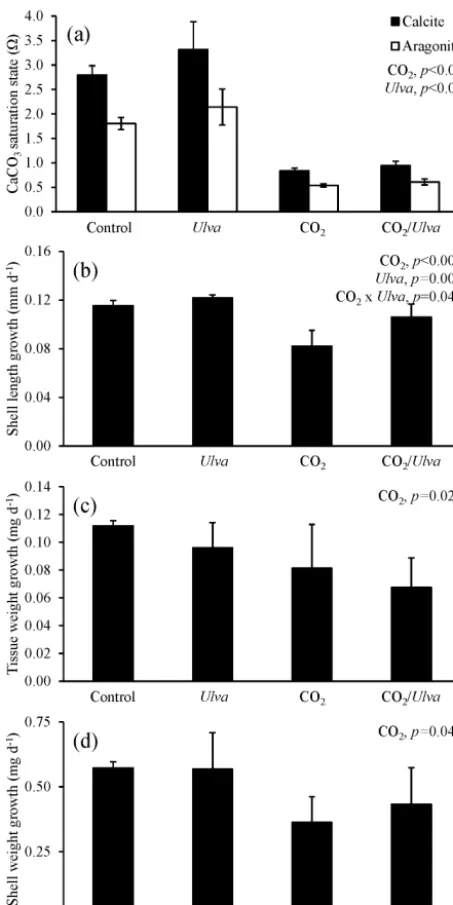
sig-Figure 2.Experiment with large juvenileMercenaria mercenaria exposed to ambient and elevated concentrations of CO2with and without the presence ofUlva.(a)calciteand aragonite; growth was based on (b) shell length, (c) tissue weight, and (d) shell weight. Columns represent means±standard deviation. Significant main treatment effects (CO2and Ulva) appear at the top right of each panel.
nificantly lower in high-CO2treatments (two-way ANOVA; p <0.001 for both). LargerM. mercenariaresponded to el-evated CO2conditions and the presence ofUlvain a manner similar to that of the smaller clams. Under elevated CO2 con-centrations, growth rates based on shell length, shell weight, and tissue weight were significantly lower (by 45 %, 30 %, and 22 %, respectively) than the ambient CO2 treatments
(two-way ANOVA; p=0.010, p=0.010, and p <0.001, respectively; Fig. 2; Tables S4–S6). In the presence ofUlva; however, growth rates based on shell length, shell weight, and tissue weight were significantly higher by 10 %, 21 %, and 20 %, respectively, in elevated CO2 treatments and by 21 %, 18 %, and 162 %, respectively, in ambient CO2 treat-ments that did not receive Ulva (two-way ANOVA; p= 0.003, p=0.006, and p=0.009, respectively; Fig. 2; Ta-bles S4–S6). Across all treatments, growth rates based on shell length and tissue weight were positively correlated with aragonite(R2=0.45,p=0.006 andR2=0.44,p=0.013, respectively; Table S10) andcalcite(R2=0.45,p=0.006 and R2=0.44, p=0.013, respectively; Table S11). For growth based on shell weight, there were positive, nearly significant correlations with aragonite and calcite (R2= 0.28,p=0.063 andR2=0.28,p=0.063, respectively; Ta-bles S10–S11).
3.2 Crassostrea virginica
During the experiment with the cohort of smallC. virginica
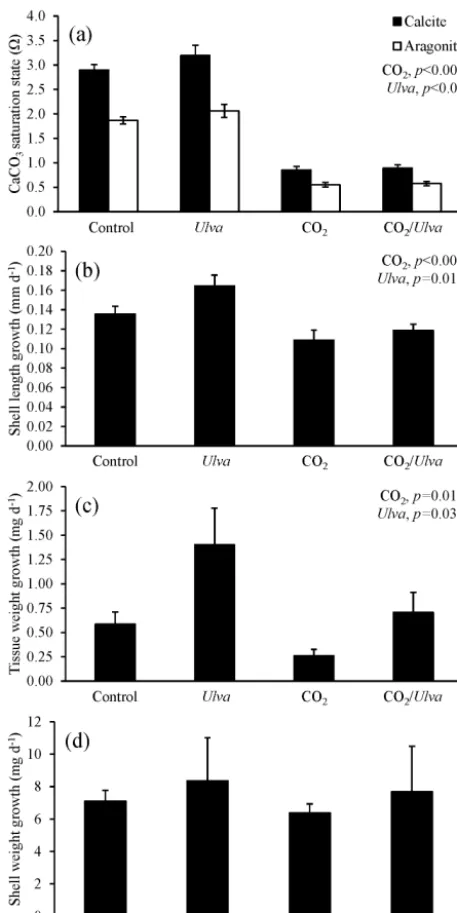
(2.45±0.41 mm), calcite and aragonite were significantly higher in treatments containingUlva(two-way ANOVA;p= 0.025 for both; Fig. 3; Tables S2–S3) and significantly lower in treatments receiving elevated CO2 (two-way ANOVA; p <0.001 for both). Growth rates of smallC. virginicawere sensitive to elevated CO2concentrations and the presence of Ulva. Growth rates based on length, tissue, and shell weight were 63 %, 78 %, and 145 % lower, respectively, when ex-posed to elevated CO2concentrations compared to control treatments (two-way ANOVA; p=0.011, p=0.006, and p=0.012, respectively; Fig. 3; Tables S4–S6). When in the presence ofUlva, growth based on shell length was signif-icantly increased by 24 % and 55 % in elevated and ambi-ent CO2 treatments, respectively (two-way ANOVA; p= 0.040; Fig. 3; Table S4), but growth based on tissue and shell weight was not significantly different than the control (two-way ANOVA;p=0.319 andp=0.946, respectively). Across all experimental vessels, there were significant pos-itive correlations between growth based on shell length, tis-sue weight, and shell weight andaragonite(R2=0.26,p= 0.044;R2=0.53,p=0.003; andR2=0.39,p=0.013, re-spectively; Table S10) andcalcite (R2=0.26, p=0.045; R2=0.53, p=0.003; and R2=0.39, p=0.013, respec-tively; Table S11).
[image:6.612.54.281.69.523.2]Figure 3. Experiment with small juvenile Crassostrea virginica exposed to ambient and elevated concentrations of CO2with and without the presence ofUlva.(a)calciteand aragonite; growth was based on (b) shell length, (c) tissue weight, and (d) shell weight. Columns represent means±standard deviation. Significant main treatment effects (CO2and Ulva) appear at the top right of each panel.
[image:7.612.54.280.66.525.2]respectively) in the presence of Ulvarelative to the control (two-way ANOVA;p=0.001 andp=0.006, respectively; Fig. 4; Table S4). While growth based on shell weight and tissue weight was not significantly altered by elevated CO2 or the presence of Ulva, there was an antagonistic, interac-tive effect between both variables whereby the co-exposure to elevated CO2andUlvayielded growth rates higher than
Figure 4.Experiment with large juvenileCrassostrea virginica ex-posed to ambient and elevated concentrations of CO2 with and without the presence ofUlva.(a)calcite andaragonite; growth was based on (b) shell length, (c) tissue weight, and (d) shell weight. Columns represent means±standard deviation. Significant main treatment effects (CO2 andUlva) appear at the top right of each panel.
Figure 5.Experiment with small juvenileArgopecten irradians ex-posed to ambient and elevated concentrations of CO2 with and without the presence ofUlva.(a)calciteand aragonite; growth was based on (b) shell length, (c) tissue weight, and (d) shell weight. Columns represent means±standard deviation. Significant main treatment effects (CO2and Ulva) appear at the top right of each panel.
aragonite (R2=0.66, p=0.002, respectively; Table S10) andcalcite(R2=0.66,p=0.002, respectively; Table S11) but not for growth based on tissue and shell weight.
3.3 Argopecten irradians
For the cohort of smallA. irradians(4.73±0.59 mm),calcite andaragonitewere significantly higher in treatments contain-ingUlva(two-way ANOVA;p <0.001 for both; Fig. 5; Ta-bles S2–S3) and significantly lower in treatments with el-evated CO2 (two-way ANOVA; p <0.001 for both). The growth of small juvenileA. irradianswas altered bypCO2 and, to a lesser extent, the presence ofUlva. Growth rates based on shell length, tissue weight, and shell weight were significantly reduced by exposure to elevated CO2 con-centrations (two-way ANOVA; p <0.001, p=0.023, and p=0.041, respectively; Fig. 5; Tables S4–S6). Specifically, growth rates based on shell length, tissue weight, and shell weight were 26 %, 40 %, and 43 % lower, respectively, when exposed to elevated CO2 compared to ambient CO2 treat-ments (Fig. 5). Growth based on shell length was signifi-cantly higher (by 10 % and 29 % in ambient and elevated CO2treatments, respectively) in the presence ofUlvarelative to treatments that did not receiveUlva(two-way ANOVA; p=0.007; Fig. 5; Table S4). In contrast, growth based on tissue and shell weight was not significantly affected by the presence of Ulva (two-way ANOVA; p=0.274 and p= 0.637, respectively; Fig. 5; Tables S5–S6). Growth based on shell length within elevated CO2 treatments withUlvawas significantly higher than in the elevated CO2treatments with-out Ulva (Tukey HSD; p=0.011; Table S7). There were no significant differences in growth based on shell or tis-sue weight among any treatments (Tukey HSD; p >0.05 for all; Tables S8–S9). Comparisons within individual treat-ments showed that growth based on shell length within ele-vated CO2 treatments withoutUlvawas significantly lower than the elevated CO2 treatments with Ulva (Tukey HSD; p=0.011; Table S7). For all treatments, there were signifi-cant correlations among growth based on shell length, tissue weight, and shell weight of smaller scallops andaragonite (R2=0.56, p=0.001; R2=0.36, p=0.018; and R2= 0.47,p=0.004, respectively; Table S10) andcalcite(R2= 0.56,p=0.001;R2=0.36,p=0.018; andR2=0.47,p= 0.004, respectively; Table S11).
For the larger cohorts of juvenile A. irradians (21.08± 1.06 mm), calciteandaragonite were significantly lower in treatments exposed to high CO2and significantly higher in treatments containing Ulva (two-way ANOVA; p <0.001 for all; Fig. 6; Tables S2–S3). The growth rates of larger
Figure 6.Experiment with largeArgopecten irradiansexposed to ambient and elevated concentrations of CO2with and without the presence ofUlva.(a)calciteandaragonite; growth was based on (b) shell length,(c)tissue weight, and(d) shell weight. Columns represent means±standard deviation. Significant main treatment ef-fects (CO2andUlva) appear at the top right of each panel.
0.032, respectively; Fig. 6; Tables S4 and S6) while growth based on shell weight was not (two-way ANOVA;p=0.390; Table S5). There was a strong positive correlation among growth based on shell length of larger scallops andaragonite (R2=0.74;p=0.001, respectively; Table S10) andcalcite (R2=0.74;p=0.001, respectively; Table S11) but not for growth based on tissue and shell weight.
Figure 7.Experiment withMytilus edulisexposed to ambient and elevated concentrations of CO2with and without the presence of Ulva. (a)calcite and aragonite; growth was based on (b) shell length,(c)tissue weight, and(d)shell weight. Columns represent means±standard deviation. Significant main treatment effects (CO2 andUlva) appear at the top right of each panel.
3.4 Mytilus edulis
[image:9.612.53.282.68.525.2]length, tissue weight, and shell weight were all not signifi-cantly changed by exposure to elevated CO2concentrations (two-way ANOVA; p=0.149, p=0.210, and p=0.439, respectively; Fig. 7; Tables S4–S6). In contrast, growth mea-surements based on shell length, tissue weight, and shell weight were significantly higher in the presence of Ulva
(two-way ANOVA; p=0.045, p=0.047, and p=0.024, respectively; Fig. 7; Tables S4–S6). Specifically, in the pres-ence ofUlva, growth based on shell length, tissue weight, and shell weight was 16 %, 30 %, and 45 % higher, respectively, in elevated CO2 treatments and 28 %, 19 %, and 36 %, re-spectively, in ambient CO2treatments relative to treatments that did not receiveUlva(Fig. 7). Mussel growth rates were not correlated witharagoniteorcalcite(Tables S10–S11).
3.5 Ulvaand microalgae
Across all experiments, the growth ofUlvawas found to be significantly higher by 20 % when exposed to elevated CO2 concentrations (one-way ANOVA; p=0.043; Fig. S1; Ta-ble S12). Concentrations ofIsochrysis galbanaand Chaeto-ceros muelleri were not significantly different among any treatments in any experiments (two-way ANOVA; p < 0.05 for all; Table S12). On average, final cell concentra-tions within treatments were ∼90 000 cells mL−1 (Tables 1 and S1).
4 Discussion
During this study, elevated CO2concentrations significantly reduced at least one or more growth measurements of co-horts of small- and large-sized juvenile Mercenaria merce-naria,Crassostrea virginica, andArgopecten irradians, but not Mytilus edulis. The presence of Ulva significantly in-creased the growth of all cohorts of all bivalve species. Com-parisons of individual treatments indicated that under ele-vated CO2concentrations, the addition ofUlvaoften signifi-cantly increased growth rates of clams, scallops, and oysters by 23 %–30 %. Botharagoniteandcalcitewere significantly higher in the presence ofUlvain all experiments under both high- and low-CO2 regimes, despite the rapid turnover of dissolved gas pools in experiments (>1000 time per day), and the growth rates of bivalves were significantly corre-lated with aragonite andcalcitein treatment vessels for six of seven experiments. Collectively, these findings provide in-sight regarding the ability of macroalgae such asUlvato mit-igate the deleterious effects of ocean acidification on bivalves and, potentially, other calcifying organisms.
The negative effects of ocean acidification on the growth and survival of bivalves and other calcifying organisms have been well documented. Consistent with prior studies that have gauged the response of juvenile bivalves to elevated CO2 (Gazeau et al., 2007; Green et al., 2009; Talmage and Gobler, 2011), the results of the current study show
de-creased tissue growth as well as calcification in the form of growth based on shell length and weight under acidi-fied conditions, a finding consistent with significantly lower aragonite and calcite in elevated CO2 treatments. Early-life-stage bivalve shells are composed partly or completely of aragonite, making them vulnerable to undersaturation of aragonite (Carriker, 1996; Stenzel, 1964; Talmage and Gob-ler, 2009). While the formation of calcium carbonate is ther-modynamically favored whenexceeds 1.0, biotic arago-nite is less crystalline than nonbiogenic aragoarago-nite (Weiss et al., 2002) and studies of early-life-stage Pacific oysters have suggested that aaragoniteexceeding 1.6 may be required to yield successful growth and survival (Barton et al., 2012). Similarly, Talmage and Gobler (2010) found that increases inaragonite within the saturated range (aragonite increases from 2.9 to 3.3) significantly increased the growth of early-life-stageM. mercenariaandA. irradians, a finding suggest-ing that acidification since preindustrial times can depress the performance of these species. In the current study, growth rates of bivalves exposed toUlvaunder ambientpCO2 fre-quently exceeded those of individuals grown under the same CO2delivery rate withoutUlvaasaragonitewas significantly increased, on average from 1.91 to 2.16 (Table 1), with both levels being saturated but also being below the threshold that yielded maximal growth rates in early-life-stage bivalves for Talmage and Gobler (2010). Furthermore, even minor, yet sustained, increases or decreases inaragonite (<0.1 units) can result in significant changes in the growth of larval and juvenile bivalves (Barton et al., 2012; Talmage and Gobler, 2011), which was similarly observed in many of the exper-iments in the present study. Hence, the potential benefits of macroalgae to calcifying bivalves may be realized in both acidified and normal conditions.
Acidification can have cascading negative physiological consequences for bivalves. In larval bivalves, high CO2 de-presses calcification, lipid content, RNA : DNA ratios, meta-morphosis, and growth rates (Gobler and Talmage, 2013). The reduction in growth based on tissue weight under ele-vated CO2concentrations found during the present study is consistent with Beniash et al. (2010), who found significant declines in soft body mass of juvenile C. virginica main-tained in hypercapnia (pH 7.5). Additionally, the same study and others (Gazeau et al., 2007; Matoo et al., 2013) have re-ported increased metabolic rates in bivalves exposed to ele-vated CO2levels. As suggested by Waldbusser et al. (2015b), decreasingaragoniteincreases the amount of energy spent by bivalves on shell formation, which diverts energy away from maintaining homeostasis and other metabolic processes in-cluding those that contribute toward growth (Beniash et al., 2010; Waldbusser et al., 2015b).
dur-ing the daytime. Krause-Jensen et al. (2015) reported that macroalgae may provide a refuge for calcifying organ-isms. Specifically, within a subarctic fjord, macroalgae drove strong diel variability in pH and aragonite, with M. edulis being found to grow in close association with macroalgae, even in tidal pools that became supersaturated and undersat-urated between day and night cycles, respectively (Krause-Jensen et al., 2015). Additionally, Wahl et al. (2017) demon-strated that daytime increases in pH associated with the macroalgae Fucus vesiculosus provided a refuge against acidified conditions forM. edulis, with calcification rates of
M. edulisincreasing with increases in pH wrought by the al-gae. In the current study,Ulvayielded significantly increased aragonite, calcite, and bivalve growth in all seven experi-ments performed. Dissolved oxygen levels were also high (> 8 mg L−1) in all treatments and the growth rates of bivalves were often significantly higher in high-CO2treatments with Ulva compared to those without. Furthermore, in ambient and elevated CO2 treatments, the presence of Ulva signif-icantly increased pH beyond levels observed in treatments withoutUlva, often in as little as 24 h, with those increases sustained over the duration of the experiments (Figs. S2–S3). Hence, it seems likely that the macroalgae buffered carbon-ate chemistry to the benefit of bivalves. While it is possi-ble that photosynthetic activity by microalgae (I. galbana
andC. muelleri) may have contributed to shifts in carbonate chemistry, there were no significant differences in microal-gae cell concentrations in any treatment across all experi-ments (two-way ANOVA;p >0.05; Table S13), suggesting that microalgal contributions to changes in carbonate chem-istry were minimal relative to the photosynthetic activity of
Ulva.
Beyond photosynthesis, macroalgae may also alter car-bonate chemistry via the uptake of nitrogenous nutrients. Specifically, the uptake of nitrate or ammonium by marine autotrophs results in an equimolar increase or decrease in total alkalinity, respectively (Brewer and Goldman, 1976; Goldman and Brewer, 1980; Talmage and Gobler, 2012), which occurs due to the production of OH− and H+ to balance the uptake of nitrate and ammonium, respectively (Brewer and Goldman, 1976; Goldman and Brewer, 1980; Redfield et al., 1963). Given that 50 µM of nitrate was added to all experimental vessels withUlvato promote its growth during each experimental water change, it is possible that the assimilation of this nitrate byUlvacontributed to the av-erage 10–20 µM increase in total alkalinity observed within treatments withUlva(two-way ANOVA;p <0.05; Table 1; Tables S14–S15). Higher-alkalinity seawater requires higher concentrations of CO2to reduce pH, thus resulting in smaller changes inaragoniteandcalcite. Given the rapid turnover of dissolved gasses in experimental vessels, it is possible the nitrogen assimilation effects on alkalinity outweighed the ef-fects of photosynthetic consumption of DIC.
Prior studies have found that Ulva can experience en-hanced growth (Björk et al., 1993; Olischläger et al., 2013;
Young and Gobler, 2016) and outcompete other autotrophs (Young and Gobler, 2017) under elevated CO2 concentra-tions. Hence, the dominance ofUlva and similar macroal-gae in estuaries that experience seasonal acidification (Wal-lace and Gobler, 2015) could ultimately benefit bivalves and other calcifying organisms. In the present experiments,Ulva
growth was, on average,∼20 % higher under elevated CO2 conditions. Furthermore, the presence of the macroalgae fre-quently transformed aragonite of elevated CO2 treatments from undersaturated to nearly saturated (Tables 1 and S1) and often yielded growth rates of bivalves significantly greater than the elevated CO2treatments withoutUlva. Had the dis-solved gas pools within experimental vessels not been turned over rapidly via aeration, it is possible the effects ofUlvaon the carbonate chemistry would have been even greater.
The benefits ofUlva and detriments of high CO2 to the four bivalves studied differed by species. While every co-hort displayed significantly enhanced growth in the presence of Ulva, scallops were the only species to experience sig-nificantly higher growth in the elevated CO2treatment with Ulvacompared to the elevated CO2treatment withoutUlva for both the small and large juvenile cohorts. In contrast, for clams and oysters, only one of the two cohorts displayed this specific response. Early life stages of bay scallops have been consistently shown to be more vulnerable to acidifica-tion than the other bivalve species studied here (Stevens and Gobler, 2018; Talmage and Gobler, 2009, 2011). This may be due, in part, to its rapid growth and metabolism com-pared to other bivalves (Kennedy et al., 1996; Kraeuter and Castagna, 2001; Shumway and Parsons, 2006), traits that may also make it more likely to benefit from the improved carbonate chemistry wrought by the presence ofUlva. The resistance ofM. edulisto elevated CO2concentrations con-trasted with prior studies of European strains of this bivalve (Berge et al., 2006; Gazeau et al., 2007) but is consistent with prior cohorts of this species isolated from Shinnecock Bay, NY, USA (Stevens and Gobler, 2018). However, Thomsen et al. (2013) found that specific growth and calcification rates of juvenileM. edulisunder acidified conditions were dependent on food availability. Given that food was supplied ad libitum in the present study, it is possible that the negative effects of elevated CO2concentrations onM. edulismay have been mitigated by adequate food availability as well as improved carbonate chemistry facilitated byUlva.
ex-cess and did not differ across treatments in our experiments (Table S13). While we cannot discount the possibility that
Ulva supplied an unknown nutritional factor that benefited the growth of the bivalves, this does not seem likely given the known particle capture range of juvenile bivalves (∼3– 100 µm; Ward and Shumway, 2004). A more important factor to consider is the time of day during which discrete pH mea-surements were made during this study. Limited, continuous measurements of pH in vessels with Ulvamade during this study revealed a strong diurnal pattern for pH values driven by photosynthesis, with minimal levels in the early morn-ing and peak values in the evenmorn-ing (Fig. S4). The discrete, daily measurements of pH made in vessels that were used to determine the carbonate chemistry during this study were made during the late morning when pH values were low rela-tive to the complete daily cycle (Fig. S4). Had our carbonate chemistry determinations been based on maximal pH values present during the late evening, we estimate that aragonite andcalcite values would have been∼0.4 and∼0.6 units higher, respectively, than reported (Tables S1 and Fig. S4). Future studies that make continuous measurements of pH and DIC or measurements that represent the mean conditions present within vessels will be able to better represent the pre-cise carbonate chemistry conditions thatUlvacreates that, in turn, promote the growth of bivalves. Regardless, even with aragoniteandcalcitevalues that were likely underestimated, this study demonstrated the ability ofUlva to significantly increasearagonite,calcite, and bivalve growth rates as well as the significant correlation betweenand bivalve growth rates.
Beyond the modification of carbonate chemistry, there are additional ecosystem benefits that may be provided by macroalgae. Macroalgal beds can serve as a nursery habi-tat for juvenile Callinectes sapidus (Wilson et al., 1990), as well as other decapods (Heck et al., 2003; Sogard and Able, 1991). Macroalgae can also serve as a refuge from predation for some juvenile and adult bivalves (Carroll et al., 2010). An additional potential benefit provided to bi-valves by Ulva and other macroalgae is their ability to in-hibit the growth of phytoplankton species that cause harm-ful algal blooms (HABs; Tang and Gobler, 2011; Tang et al., 2015) that can directly harm the bivalve species used in the present study (Gobler and Sunda, 2012; Leverone et al., 2006; Stoecker et al., 2008; Tang and Gobler, 2009). Further-more, given its ability to rapidly assimilate and store nitrate and ammonium (Pedersen and Borum, 1997),Ulvacan serve as a biofilter within eutrophic ecosystems (Hernández et al., 2002; Neori et al., 2003). Given that harmful algal blooms flourish in eutrophic zones (Anderson et al., 2008, 2002), the mitigation of high-nutrient conditions by Ulvamay reduce the intensity of HABs, which may indirectly benefit bivalve species that are negatively impacted by the occurrence of such events. Finally, there is great precedent for the deploy-ment of macroalgae as a principal component of integrated multi-trophic aquaculture systems whereby seaweeds are
co-cultivated with aquacultured shellfish with the macroalgae often being harvested for profit (Neori, 2008; Nobre et al., 2010; Troell et al., 2009). Such an approach may be increas-ingly important for the protection of aquacultured bivalves in an increasing acidified ocean in the future.
Despite the reported positive interactions between Ulva
and the various species of bivalves in prior studies (Carroll et al., 2010; Heck et al., 2003; Sogard and Able, 1991; Wilson et al., 1990; this study), macroalgae can negatively impact bivalves and other calcifying organisms. Secondary metabo-lites released byUlvacan elevate mortality rates in the lar-val stages of bilar-valves (Diederich, 2005; Nelson et al., 2003), barnacles (Brock et al., 2007; Magre, 1974), crabs (Johnson and Welsh, 1985), and molluscs (Wang et al., 2011).Ulva
can form “green tides” (Smetacek and Zingone, 2013) that, upon their collapse, can create hypoxic regions (Valiela et al., 1992) that can negatively affect benthic fauna (Viaroli et al., 2001). Furthermore, extensive coverage of bivalves byUlva
and the subsequent decomposition of the algae can also re-sult in the accumulation of H2S, which, when coupled with low dissolved oxygen, can depress the growth and survival of bivalves (Tyler, 2007). However, as pointed out by Wilson et al. (1990), the accumulation of secondary metabolites and decreased dissolved oxygen associated with the overgrowth ofUlvais often mitigated in high-flow areas, alleviating po-tential harm to the nearby organisms. Furthermore, it is likely that other macroalgae that are not known to negatively impact marine life provide similar buffering of carbonate chemistry (Anthony et al., 2013; Krause-Jensen et al., 2015; Wahl et al., 2017).
Numerous species of seagrass experience enhanced growth under elevated CO2concentrations (Beer and Koch, 1996; Palacios and Zimmerman, 2007; Zimmerman et al., 1997) and can buffer ocean acidification, thus benefiting calcifying organisms (Garrard et al., 2014; Hendriks et al., 2014). However, this ecosystem service may be disrupted by eutrophication (Valiela et al., 1997) and acidification (Young et al., 2018) of coastal ecosystems, which could favor the growth of macroalgae over seagrass (Young et al., 2018). As seagrasses decline worldwide (Orth et al., 2006; Short et al., 2011), the ecosystem services provided by seagrasses, such as being nursery habitats or buffering against ocean acidifi-cation, may, in some cases, be provided by macroalgae, po-tentially benefiting calcifying organisms such as bivalves that had formerly depended on seagrass as a refuge habitat.
(Wil-son et al., 1990) and predation refuge (Carroll et al., 2010) and inhibiting the growth of harmful microalgae (Tang and Gobler, 2011; Tang et al., 2015), may, in some cases, out-weigh the negative effects. Given that macroalgae tend to outcompete seagrass under high-CO2 conditions (Young et al., 2018), the ability of macroalgae to provide ecosystem services similar to those of seagrass, particularly buffering carbonate chemistry, may be increasingly important for calci-fying organisms in modern-day eutrophic acidified estuaries, as well as within future ocean acidification scenarios. Finally, the purposeful deployment of seaweeds in an aquaculture set-ting would seem to be a beneficial strategy for protecset-ting bi-valves against current and future acidification.
Data availability. There are no underlying data for the current study other than the Supplement.
Supplement. The supplement related to this article is available online at: https://doi.org/10.5194/bg-15-6167-2018-supplement.
Author contributions. CJG and CSY conceived and designed the experiments. CSY performed the experiments. CSY and CJG an-alyzed the data. CJG contributed reagents, materials, and analysis tools. CSY and CJG wrote the paper.
Competing interests. The authors declare that they have no conflict of interest.
Acknowledgements. We are grateful for the supply ofCrassostrea virginica provided by the Cornell Cooperative Extension of Huntington, NY, and Southold, NY. We thank Stephen Heck for the collection of Mytilus edulis. We are appreciative of the logistical support provided by the Stony Brook Southampton Marine Science Center staff throughout this study. This work was supported by New York Sea grant R-FMB-38 and grants from the Chicago Community Foundation, the Laurie Landaeu Foundation, and the Pritchard Foundation.
Edited by: Clare Woulds
Reviewed by: three anonymous referees
References
Anderson, D. M., Glibert, P. M., and Burkholder, J. M.: Harmful algal blooms and eutrophication: Nutrient sources, composition, and consequences, Estuaries, 25, 704–726, https://doi.org/10.1007/BF02804901, 2002.
Anderson, D. M., Burkholder, J. M., Cochlan, W. P., Glibert, P. M., Gobler, C. J., Heil, C. A., Kudela, R. M., Parsons, M. L., Rensel, J. E. J., Townsend, D. W., Trainer, V. L., and Vargo, G. A.: Harm-ful algal blooms and eutrophication: Examining linkages from
selected coastal regions of the United States, Harmful Algae, 8, 39–53, https://doi.org/10.1016/j.hal.2008.08.017, 2008. Anthony, K. R. N., Diaz-Pulido, G., Verlinden, N., Tilbrook, B.,
and Andersson, A. J.: Benthic buffers and boosters of ocean acidification on coral reefs, Biogeosciences, 10, 4897–4909, https://doi.org/10.5194/bg-10-4897-2013, 2013.
Barton, A., Hales, B., Waldbusser, G. G., Langdon, C., and Feely, R. A.: The Pacific oyster,Crassostrea gigas, shows negative cor-relation to naturally elevated carbon dioxide levels: Implications for near-term ocean acidification effects, Limnol. Oceanogr., 57, 698–710, https://doi.org/10.4319/lo.2012.57.3.0698, 2012. Baumann, H. and Smith, E. M.: Quantifying metabolically driven
pH and oxygen fluctuations in US nearshore habitats at diel to interannual time scales, Estuar. Coast., 41, 1102–1117, https://doi.org/10.1007/s12237-017-0321-3, 2018.
Baumann, H., Wallace, R. B., Tagliaferri, T., and Gobler, C. J.: Large natural pH, CO2and O2fluctuations in a temperate tidal salt marsh on diel, seasonal, and interannual time scales, Estuar. Coast., 38, 220–231, https://doi.org/10.1007/s12237-014-9800-y, 2015.
Beer, S. and Koch, E.: Photosynthesis of marine macroalgae and seagrasses in globally changing CO2environments, Mar. Ecol.-Prog. Ser., 141, 199–204, https://doi.org/10.3354/meps141199, 1996.
Beniash, E., Ivanina, A., Lieb, N. S., Kurochkin, I., and Sokolova, I. M.: Elevated level of carbon dioxide affects metabolism and shell formation in oystersCrassostrea virginica, Mar. Ecol.-Prog. Ser., 419, 95–108, https://doi.org/10.3354/meps08841, 2010. Berge, J. A., Bjerkeng, B., Pettersen, O., Schaanning, M. T., and
Oxnevad, S.: Effects of increased sea water concentrations of CO2on growth of the bivalveMytilus edulisL, Chemosphere, 62, 681–687, https://doi.org/10.1016/j.chemosphere.2005.04.111, 2006.
Björk, M., Haglund, K., Ramazanov, Z., and Pedersén, M.: Inducible mechanisms for HCO−3 utilization and repres-sion of photorespiration in protoplasts and thalli of three species of Ulva (Chlorophyta), J. Phycol., 29, 166–173, https://doi.org/10.1111/j.0022-3646.1993.00166.x, 1993. Brewer, P. G. and Goldman, J. C.: Alkalinity changes
gener-ated by phytoplankton growth, Limnol. Oceanogr., 21, 108–117, https://doi.org/10.4319/lo.1976.21.1.0108, 1976.
Brock, E., Nylund, G. M., and Pavia, H.: Chemical inhi-bition of barnacle larval settlement by the brown alga Fucus vesiculosus, Mar. Ecol.-Prog. Ser., 337, 165–174, https://doi.org/10.3354/meps337165, 2007.
Cai, W.-J., Hu, X., Huang, W.-J., Murrell, M. C., Lehrter, J. C., Lohrenz, S. E., Chou, W.-C., Zhai, W., Hollibaugh, J. T., Wang, Y., Zhao, P., Guo, X., Gundersen, K., Dai, M., and Gong, G.-C.: Acidification of subsurface coastal wa-ters enhanced by eutrophication, Nat. Geosci., 4, 766–770, https://doi.org/10.1038/ngeo1297, 2011.
Cai, W.-J., Huang, W.-J., Luther, G. W., Pierrot, D., Li, M., Testa, J., Xue, M., Joesoef, A., Mann, R., Brodeur, J., Xu, Y.-Y., Chen, B., Hussain, N., Waldbusser, G. G., Cornwell, J., and Kemp, W. M.: Redox reactions and weak buffering capacity lead to acidification in the Chesapeake Bay, Nat. Commun., 8, 369, https://doi.org/10.1038/s41467-017-00417-7, 2017.
Eble, A. E., Maryland Sea Grant College, University of Mary-land System, 75–168, 1996.
Carroll, J. M., Peterson, B. J., Bonal, D., Weinstock, A., SMith, C. F., and Tettelbach, S. T.: Comparative survival of bay scallops in eelgrass and the introduced alga, Codium fragile, in a New York estuary, Mar. Biol., 157, 249–259, https://doi.org/10.1007/s00227-009-1312-0, 2010.
Dickson, A. G.: The measurement of sea water pH, Mar. Chem., 44, 131–142, https://doi.org/10.1016/0304-4203(93)90198-W, 1993.
Dickson, A. G., Sabine, C. L., and Christian, J. R.: Guide to best practices for ocean CO2measurements, PICES Special Publica-tion, 3, 191 pp., 2007.
Diederich, S.: Differential recruitment of introduced Pa-cific oysters and native mussels at the North Sea coast: Coexistence possible?, J. Sea Res., 53, 269–281, https://doi.org/10.1016/j.seares.2005.01.002, 2005.
Feely, R. A., Sabine, C. L., Hernandez-Ayon, J. M., Ianson, D., and Hales, B.: Evidence for upwelling of corrosive “acidi-fied” water onto the continental shelf, Science, 320, 1490–1492, https://doi.org/10.1126/science.1155676, 2008.
Feely, R. A., Doney, S. C., and Cooley, S. R.: Ocean acidification: Present conditions and future changes in a high-CO2 world, Oceanography, 22, 36–47, https://doi.org/10.5670/oceanog.2009.95, 2009.
Fu, F. X., Tatters, A. O., and Hutchins, D. A.: Global change and the future of harmful algal blooms in the ocean, Mar. Ecol.-Prog. Ser., 470, 207–233, https://doi.org/10.3354/meps10047, 2012. Gao, K. and Zheng, Y.: Combined effects of ocean
acidifica-tion and solar UV radiaacidifica-tion on photosynthesis, growth, pig-mentation and calcification of the coralline alga Corallina sessilis (Rhodophyta), Global Change Biol., 16, 2388–2398, https://doi.org/10.1111/j.1365-2486.2009.02113.x, 2010. Garrard, S. L., Gambi, M. C., Scipione, M. B., Patti, F. P., Lorenti,
M., Zupo, V., Paterson, D. M., and Buia, M. C.: Indirect effects may buffer negative responses of seagrass invertebrate commu-nities to ocean acidification, J. Exp. Mar. Biol. Ecol., 461, 31–38, https://doi.org/10.1016/j.jembe.2014.07.011, 2014.
Gazeau, F., Quiblier, C., Jansen, J. M., Gattuso, J.-P., Middel-burg, J. J., and Heip, C. H. R.: Impact of elevated CO2 on shellfish calcification, Geophys. Res. Lett., 34, L07603, https://doi.org/10.1029/2006GL028554, 2007.
Gobler, C. J. and Sunda, W. G.: Ecosystem disruptive algal blooms of the brown tide species, Aureococcus anophageffer-ens and Aureoumbra lagunensis, Harmful Algae, 14, 36–45, https://doi.org/10.1016/j.hal.2011.10.013, 2012.
Gobler, C. J. and Talmage, S. C.: Short- and long-term conse-quences of larval stage exposure to constantly and ephemer-ally elevated carbon dioxide for marine bivalve populations, Biogeosciences, 10, 2241–2253, https://doi.org/10.5194/bg-10-2241-2013, 2013.
Gobler, C. J., DePasquale, E. L., Griffith, A. W., and Bau-mann, H.: Hypoxia and acidification have additive and syner-gistic negative effects on the growth, survival, and metamor-phosis of early life stage bivalves, PLoS ONE, 9, e83648, https://doi.org/10.1371/journal.pone.0083648, 2014.
Goldman, J. C. and Brewer, P. G.: Effect of nitrogen source and growth rate on phytoplankton-mediated
changes in alkalinity, Limnol. Oceanogr., 25, 353–357, https://doi.org/10.4319/lo.1980.25.2.0352, 1980.
Green, M. A., Waldbusser, G. G., Reilly, S. L., Emerson, K., and O’Donnell, S.: Death by dissolution: sediment saturation state as a mortality factor for juvenile bivalves, Limnol. Oceanogr., 54, 1037–1047, https://doi.org/10.4319/lo.2009.54.4.1037, 2009. Hattenrath-Lehmann, T. K., Smith, J. L., Wallace, R. B., Merlo, L.
R., Koch, F., Mittelsdorf, H., Goleski, J. A., Anderson, D. M., and Gobler, C. J.: The effects of elevated CO2on the growth and tox-icity of field populations and cultures of the saxitoxin-producing dinoflagellate,Alexandrium fundyense, Limnol. Oceanogr., 60, 198–214, https://doi.org/10.1002/lno.10012, 2015.
Heck, K. L., Hays, G., and Orth, R. J.: Critical evaluation of the nursery role hypothesis for seagrass meadows, Mar. Ecol.-Prog. Ser., 253, 123–136, https://doi.org/10.3354/meps253123, 2003. Helm, M. M., Bourne, N., and Lovatelli, A.: Hatchery Culture of
Bi-valves: A Practical Manual, Food and Agriculture Organization of the United Nations, Rome, 177 pp., 2004.
Hendriks, I. E., Olsen, Y. S., Ramajo, L., Basso, L., Steckbauer, A., Moore, T. S., Howard, J., and Duarte, C. M.: Photosynthetic ac-tivity buffers ocean acidification in seagrass meadows, Biogeo-sciences, 11, 333–346, https://doi.org/10.5194/bg-11-333-2014, 2014.
Hernández, I., Martínez-Aragón, J. F., Tovar, A., Pérez-Lloréns, J. L., and Vergara, J. J.: Biofiltering efficiency in re-moval of dissolved nutrients by three species of estuarine macroalgae cultivated with sea bass (Dicentratchus labrax) waste waters 2. Ammonium, J. Appl. Phycol., 14, 375–384, https://doi.org/10.1023/A:1022178417203, 2002.
Hoegh-Guldberg, O., Mumby, P. J., Hooten, A. J., Steneck, R. S., Greenfield, P., Gomez, E., Harvell, C. D., Sale, P. F., Edwards, A. J., Caldeira, K., Knowlton, N., Eakin, C. M., Iglesias-Prieto, R., Muthiga, N., Bradbury, R. H., Dubi, A., and Hatziolos, M. E.: Coral reefs under rapid climate change and ocean acidification, Science, 318, 1737–1742, https://doi.org/10.1126/science.1152509, 2007.
Hofmann, L. C., Nettleton, J. C., Neefus, C. D., and Mathieson, A. C.: Cryptic diversity ofUlva (Ulvales, Chlorophyta) in the Great Bay Estuarine System (Atlantic USA): introduced and indigenous distromatic species, Eur. J. Phycol., 45, 230–239, https://doi.org/10.1080/09670261003746201, 2010.
Johnson, D. A. and Welsh, B. L.: Detrimental effects ofUlva lac-tuca(L.) exudates and low oxygen on estuarine crab larvae, J. Exp. Mar. Biol. Ecol., 86, 73–83, https://doi.org/10.1016/0022-0981(85)90043-7, 1985.
Johnson, K. M., Wills, K. D., Butler, D. B., Johnson, W. K., and Wong, C. S.: Coulometric total carbon dioxide analysis for ma-rine studies: maximizing the performance of an automated gas extraction system and coulometric detector, Mar. Chem., 44, 167–187, https://doi.org/10.1016/0304-4203(93)90201-X, 1993. Kennedy, V. S., Newell, R. I. E., and Eble, A. E.: The Eastern oyster: Crassostrea virginica, College Park, MD, Maryland Sea Grant College, 1996.
Kirkendale, L., Saunders, G. W., and Winberg, P.: A molecu-lar survey of Ulva (Chlorophyta) in temperate Australia re-veals enhanced levels of cosmopolitanism, J. Phycol., 49, 69–81, https://doi.org/10.1111/jpy.12016, 2013.
in-creased atmospheric carbon dioxide on coral reefs, Science, 284, 118–120, https://doi.org/10.1126/science.284.5411.118, 1999. Koch, M., Bowes, G., Ross, C., and Zhang, X.-H.: Climate
change and ocean acidification effects on seagrasses and marine macroalgae, Global Change Biol., 19, 103–132, 2013.
Kraeuter, J. N. and Castagna, M.: Biology of the Hard Clam, Else-vier Science, New York, NY, 2001.
Krause-Jensen, D., Duarte, C. M., Hendriks, I. E., Meire, L., Blicher, M. E., Marbà, N., and Sejr, M. K.: Macroalgae con-tribute to nested mosaics of pH variability in a subarctic fjord, Biogeosciences, 12, 4895–4911, https://doi.org/10.5194/bg-12-4895-2015, 2015.
Leverone, J. R., Blake, N. J., Pierce, R. H., and Shumway, S. E.: Ef-fects of the dinoflagellateKarenia brevison larval development in three species of bivalve mollusc from Florida, Toxicon, 48, 75–84, https://doi.org/10.1016/j.toxicon.2006.04.012, 2006. Liu, X., Li, Y., Wang, Z., Zhang, Q., and Cai, X.: Cruise
observation of Ulva prolifera bloom in the southern Yel-low Sea, China, Estuar. Coast. Shelf Sci., 163, 17–22, https://doi.org/10.1016/j.ecss.2014.09.014, 2015.
Magre, E. J.:Ulva lactucaL. negatively affectsBalanus balanoides (L.) (Cirripedia Thoracica) in tidepools, Crustaceana, 27, 231– 234, https://doi.org/10.1163/156854074X00758, 1974.
Martin, S. and Gattuso, J.-P.: Response of Mediterranean coralline algae to ocean acidification and elevated temperature, Global Change Biol., 15, 2089–2100, https://doi.org/10.1111/j.1365-2486.2009.01874.x, 2009.
Matoo, O. B., Ivanina, A. V., Ullstad, C., Beniash, E., and Sokolova, I. M.: Interactive effects of elevated temperature and CO2 levels on metabolism and oxidative stress in two common marine bivalves (Crassostrea virginica and Merce-naria merceMerce-naria), Comp. Biochem. Physiol. A., 164, 545–553, https://doi.org/10.1016/j.cbpa.2012.12.025, 2013.
McGlathery, K. J.: Macroalgal blooms contribute to the decline of seagrass in nutrient-enriched coastal waters, J. Phycol., 37, 453– 456, https://doi.org/10.1046/j.1529-8817.2001.037004453.x, 2001.
Meehl, G. A., Stocker, T. F., Collins, W. D., Friedlingstein, P., Gaye, A. T., Gregory, J. M., Kitoh, A., Knutti, R., Murphy, J. M., Noda, A., Raper, S. C. B., Watterson, I. G., Weaver, A. J., and Zhao, Z.-C.: Global Climate Projections, Cambridge University Press, Cambridge, 747–845, 2007.
Melzner, F., Jörn, T., Koeve, W., Oschlies, A., Gutowska, M. A., Bange, H. W., Hansen, H. P., and Körtzinger, A.: Future ocean acidification will be amplified by hypoxia in coastal habitats, Mar. Biol., 160, 1875–1888, https://doi.org/10.1007/s00227-012-1954-1, 2013.
Millero, F. J.: History of the equation of state of seawater, Oceanog-raphy, 23, 18–33, https://doi.org/10.5670/oceanog.2010.21, 2010.
Nelson, T. A., Lee, D. J., and Smith, B. C.: Are “green tides” harmful algal blooms? Toxic properties of water-soluble ex-tracts from two bloom-forming macroalgae, Ulva fenestrate and Ulvaria obscura (Ulvophyceae), J. Phycol., 39, 874–879, https://doi.org/10.1046/j.1529-8817.2003.02157.x, 2003. Neori, A.: Essential role of seaweed cultivation in
inte-grated multi-trophic aquaculture farms for global expansion of mariculture: an analysis, J. Appl. Phycol., 20, 567–570, https://doi.org/10.1007/s10811-007-9206-3, 2008.
Neori, A., Msuya, F. E., Shauli, L., Schuenhoff, A., Kopel, F., and Shpigel, M.: A novel three-stage seaweed (Ulva lactuca) biofilter design for integrated mariculture, J. Appl. Phycol., 15, 543–553, https://doi.org/10.1023/B:JAPH.0000004382.89142.2d, 2003. Newell, R. I. E.: Ecosystem influences of natural and cultivated
populations of suspension-feeding bivalve molluscs: A review, J. Shellfish Res., 23, 51–61, 2004.
Nobre, A. M., Robertson-Andersson, D., Neori, A., and Sankar, K.: Ecological-economic assessment of aquaculture options: Comparison between abalone monoculture and integrated multi-trophic aquaculture of abalone and seaweeds, Aquaculture, 306, 116–126, https://doi.org/10.1016/j.aquaculture.2010.06.002, 2010.
Olischläger, M., Bartsch, I., Gutow, L., and Wiencke, C.: Effects of ocean acidification on growth and physiology ofUlva lac-tuca(Chlorophyta) in a rockpool-scenario, Phycological Res., 61, 180–190, https://doi.org/10.1111/pre.12006, 2013.
Orth, R. J., Carruthers, T. J. B., Dennison, W. C., Duarte, C. M., Fourqurean, J. W., Heck, K. L., Hughes, A. R., Kendrick, G. A., Kenworthy, W. J., Olyarnik, S., Short, F. T., Waycott, M., and Williams, S. L.: A global crisis for seagrass ecosys-tems, BioScience, 56, 987–996, https://doi.org/10.1641/0006-3568(2006)56[987:agcfse]2.0.co;2, 2006.
Palacios, S. L. and Zimmerman, R. C.: Response of eelgrassZostera marinato CO2enrichment: possible impacts of climate change and potential for remediation of coastal habitats, Mar. Ecol.-Prog. Ser., 344, 1–13, https://doi.org/10.3354/meps07084, 2007. Pedersen, M. F. and Borum, J.: Nutrient control of estuarine macroalgae: growth strategy and the balance between nitrogen requirements and uptake, Mar. Ecol.-Prog. Ser., 161, 155–163, https://doi.org/10.3354/meps161155, 1997.
Redfield, A. C., Ketchum, B. H., and Richards, F. A.: The influence of organisms on the composition of sea water, in: The Sea, edited by: Hill, M. N., Interscience, New York, 1963.
Salisbury, J., Green, M., Hunt, C., and Campbell, J.: Coastal acidi-fication by rivers: a new threat to shellfish?, Eos Trans. AGU, 89, 513, https://doi.org/10.1029/2008EO500001, 2008.
Sfriso, A., Birkemeyer, T., and Ghetti, P. F.: Benthic macro-fauna changes in areas of Venice lagoon populated by seagrasses or seaweeds, Mar. Environ. Res., 52, 323–349, https://doi.org/10.1016/S0141-1136(01)00089-7, 2001. Short, F. T., Polidoro, B., Livingstone, S. R., Carpenter, K. E.,
Ban-deira, S., Bujang, J. S., Calumpong, H. P., Carruthers, T. J. B., Coles, R. G., Dennison, W. C., Erftemeijer, P. L. A., Fortes, M. D., Freeman, A. S., Jagtap, T. G., Kamal, A. H. M., Kendrick, G. A., Kenworthy, W. J., Nafie, Y. A. L., Nasution, I. M., Orth, R. J., Prathep, A., Sanciangco, J. C., van Tussenbroek, B., Vergara, S. G., Waycott, M., and Zieman, J. C.: Extinction risk assess-ment of the world’s seagrass species, Biol. Cons., 144, 1961– 1971, https://doi.org/10.1016/j.biocon.2011.04.010, 2011. Shumway, S. E. and Parsons, G. J.: Scallops: Biology, Ecology, and
Aquaculture, Elsevier, Boston, MA, 2006.
Smetacek, V. and Zingone, A.: Green and golden seaweed tides on the rise, Nature, 504, 84–88, https://doi.org/10.1038/nature12860, 2013.
Stenzel, H. B.: Oysters: Composition of the larval shell, Science, 304, 1005–1008, https://doi.org/10.1126/science.145.3628.155, 1964.
Stevens, A. M. and Gobler, C. J.: Interactive effects of acidification, hypoxia, and thermal stress on growth, respiration, and survival of four North Atlantic bivalves, Mar. Ecol.-Prog. Ser., 604, 143– 161, https://doi.org/10.3354/meps12725, 2018.
Stoecker, D. K., Adolf, J. E., Place, A. R., Glibert, P. M., and Meritt, D. W.: Effects of the dinoflagellatesKarlodinium venefi-cumandProrocentrum minimumon early life history stages of the eastern oyster (Crassostrea virginica), Mar. Biol., 154, 81– 90, https://doi.org/10.1007/s00227-007-0901-z, 2008.
Talmage, S. C. and Gobler, C. J.: The effects of elevated carbon dioxide concentrations on the metamorphosis, size, and survival of larval hard clams (Mercenaria mercenaria), bay scallops (Argopecten irradians), and Eastern oysters (Crassostrea virginica), Limnol. Oceanogr., 54, 2072–2080, https://doi.org/10.4319/lo.2009.54.6.2072, 2009.
Talmage, S. C. and Gobler, C. J.: Effects of past, present, and future ocean carbon dioxide concentrations on the growth and survival of larval shellfish, P. Natl. Acad. Sci. USA, 107, 17246–17251, https://doi.org/10.1073/pnas.0913804107, 2010.
Talmage, S. C. and Gobler, C. J.: Effects of elevated temperature and carbon dioxide on the growth and survival of larvae and juve-niles of three species of northwest Atlantic bivalves, PLoS ONE, 6, e26941, https://doi.org/10.1371/journal.pone.0026941, 2011. Talmage, S. C. and Gobler, C. J.: Effects of CO2and the
harm-ful algaAureococcus anophagefferenson growth and survival of oyster and scallop larvae, Mar. Ecol.-Prog. Ser., 464, 121–134, https://doi.org/10.3354/meps09867, 2012.
Tang, Y. Z. and Gobler, C. J.:Cochlodinium polykrikoidesblooms and clonal isolates from the northwest Atlantic coast cause rapid mortality in larvae of multiple bivalve species, Mar. Biol., 156, 2601–2611, https://doi.org/10.1007/s00227-009-1285-z, 2009. Tang, Y. Z. and Gobler, C. J.: The green macroalga, Ulva
lac-tuca, inhibits the growth of seven common harmful algal bloom species via allelopathy, Harmful Algae, 10, 480–488, https://doi.org/10.1016/j.hal.2011.03.003, 2011.
Tang, Y. Z., Kang, Y., Berry, D., and Gobler, C. J.: The ability of the red macroalga,Porphyra purpurea(Rhodophyceae) to inhibit the proliferation of seven common harmful microalgae, J. Appl. Phycol., 27, 531–544, https://doi.org/10.1007/s10811-014-0338-y, 2015.
Thomsen, J., Casties, I., Pansch, C., Körtzinger, A., and Melzner, F.: Food availability outweighs ocean acidifi-cation effects in juvenile Mytilus edulis: laboratory and field experiments, Global Change Biol., 19, 1017–1027, https://doi.org/10.1111/gcb.12109, 2013.
Troell, M., Joyce, A., Chopin, T., Neori, A., Buschmann, A. H., and Fang, J.-G.: Ecological engineering in aqua-culture – Potential for integrated multi-trophic aquaaqua-culture (IMTA) in marine offshore systems, Aquaculture, 297, 1–9, https://doi.org/10.1016/j.aquaculture.2009.09.010, 2009. Tyler, R. M.: Effects of coverage by benthic seaweed
mats on (northern quahog = hard clam) Merce-naria mercenaria in a eutrophic estuary, J. Shell-fish Res., 26, 1021–1028, https://doi.org/10.2983/0730-8000(2007)26[1021:EOCBBS]2.0.CO;2, 2007.
Valiela, I., Foreman, K., LaMontagne, M., Hersh, D., Costa, J., Peckol, P., DeMeo-Andreson, B., D’Avanzo, C., Babione, M., Sham, C.-H., Brawley, J., and Lajtha, K.: Couplings of water-sheds and coastal waters: Sources and consequences of nutrient enrichment in Waquoit Bay, Massachusetts, Estuaries, 15, 443– 457, https://doi.org/10.2307/1352389, 1992.
Valiela, I., McClelland, J., Hauxwell, J., Behr, P. J., Hersh, D., and Foreman, K.: Macroalgal blooms in shallow estuaries: Controls and ecophysiological and ecosys-tem consequences, Limnol. Oceanogr., 42, 1105–1118, https://doi.org/10.4319/lo.1997.42.5_part_2.1105, 1997. Viaroli, P., Azzoni, R., Bartoli, M., Giordano, G., and Tajé, L.:
Evo-lution of the Trophic Conditions and Dystrophic Outbreaks in the Sacca di Goro Lagoon (Northern Adriatic Sea), in: Mediter-ranean Ecosystems, edited by: Faranda, F. M., Guglielmo, L., and Spezie, G., Springer, Milano, 467–475, 2001.
Wahl, M., Schneider Covachã, S., Saderne, V., Hiebenthal, C., Müller, J. D., Pansch, C., and Sawall, Y.: Macroalgae may mit-igate ocean acidification effects on mussel calcification by in-creasing pH and its fluctuations, Limnol. Oceanogr., 63, 3–21, https://doi.org/10.1002/lno.10608, 2017.
Waldbusser, G. G., Bergschneider, H., and Green, M. A.: Size-dependent pH effect on calcification in post-larval hard clam Mercenaria spp., Mar. Ecol.-Prog. Ser., 417, 171–182, https://doi.org/10.3354/meps08809, 2010.
Waldbusser, G., Hales, B., Langdon, C. J., Haley, B. A., Schrader, P., Brunner, E. L., Gray, M. W., Miller, C. A., and Gimenez, I.: Saturation-state sensitivity of marine bivalve lar-vae to ocean acidification, Nat. Clim. Change, 5, 273–280, https://doi.org/10.1002/grl.50449, 2015a.
Waldbusser, G. G., Hales, B., Langdon, C., Haley, B. A., Schrader, P., Brunner, E. L., Gray, M. W., Miller, C. A., Gimenez, I., and Hutchins, D. A.: Ocean acidification has multiple modes of action on bivalve larvae, PLoS ONE, 10, e0128376, https://doi.org/10.1371/journal.pone.0128376, 2015b.
Wallace, R. B. and Gobler, C. J.: Factors controlling blooms of microalgae and macroalgae (Ulva rigida) in a eutrophic, urban estuary: Jamaica Bay, NY, USA, Estuar. Coast., 38, 519–533, https://doi.org/10.1007/s12237-014-9818-1, 2015.
Wallace, R. B., Baumann, H., Grear, J. S., Aller, R. C., and Gobler, C. J.: Coastal ocean acidification: The other eu-trophication problem, Estuar. Coast. Shelf Sci., 148, 1–13, https://doi.org/10.1016/j.ecss.2014.05.027, 2014.
Wang, C., Yu, R.-C., and Zhou, M.-J.: Acute toxicity of live and de-composing green algaUlva(Enteromorpha)proliferato abalone Haliotis discus hannai, Chinese J. Oceanol. Limnol., 29, 541– 546, https://doi.org/10.1007/s00343-011-0126-3, 2011. Ward, J. E. and Shumway, S. E.: Separating the grain from
the chaff: particle selection in suspension- and deposit-feeding bivalves, J. Exp.Mar. Bio. Ecol., 300, 83–130, https://doi.org/10.1016/j.jembe.2004.03.002, 2004.
Weiss, I. M., Tuross, N., Addadi, L., and Weiner, S.: Mol-lusc larval shell formation: Amorphous calcium carbonate is a precursor phase for aragonite, J. Exp. Zool., 293, 478–491, https://doi.org/10.1002/jez.90004, 2002.
Wilson, K. A., Able, K. W., and Heck Jr., K. L.: Predation rates on juvenile blue crabs in estuarine nursery habitats: evidence for the importance of macroalgae (Ulva lactuca), Mar. Ecol.-Prog. Ser., 58, 243–251, https://doi.org/10.3354/meps058243, 1990. Young, C. S. and Gobler, C. J.: Ocean
acidifica-tion accelerates the growth of two bloom-forming, estuarine macroalgae, PLoS ONE, 11, e0155152, https://doi.org/10.1371/journal.pone.0155152, 2016.
Young, C. S. and Gobler, C. J.: The organizing effects of elevated CO2 on competition among estuarine primary producers, Sci. Rep.-UK, 7, 7667, https://doi.org/10.1038/s41598-017-08178-5, 2017.
Young, C. S., Peterson, B. J., and Gobler, C. J.: The bloom forming macroalgae, Ulva, outcompetes the seagrass, Zostera marina, under high CO2 conditions, Estuar. Coast., 1–16, https://doi.org/10.1007/s12237-018-0437-0, 2018.