A Survey of the Role and Use of Web Services and Service
Oriented Architectures in Scientific/Technical Grids
Geoffrey Fox
1,2,3, Dennis Gannon
21
Community Grids Laboratory, Indiana University 501 N Morton Suite 224, Bloomington IN 47404
2
Computer Science Department and School of Informatics, Indiana University
3
EXECUTIVE SUMMARY ... 3
Recommendations...3
1. INTRODUCTION TO SERVICE ANALYSIS ... 6
1.2 Notes on Data and Information Architecture ...11
1.3 UDDI Universal Description, Discovery and Integration...12
2.1 Net-Centric Environment ...14
2.2 ServoGrid ...16
2.3 gLite 3.0.0 ...18
2.4 GEON ...20
2.5 International Virtual Observatory Alliance IVOA...23
2.6 CICC: The Chemical Informatics Grid...27
2.7 TeraGrid...29
2.8 The LEAD Grid ...30
2.9 Naregi...31
2.10 Additional Grid Efforts...31
3. E-SCIENCE WORKFLOW SYSTEMS... 32
3.1. An Overview of Workflow Systems Challenges for e-Science. ...32
3.1.1. Abstraction - Hide the Grid...33
3.1.2. Computation Virtualization...33
3.1.3. Data Virtualization...33
3.1.4. Metadata Generation ...34
3.1.5. Fault tolerance...34
3.1.7. Compositional Orthogonality...34
3.1.8. Security ...35
3.2. E-Science Workflow Services ...35
Executive Summary
Web Services and Service Oriented Architectures are now a fundamental part of the design of current Grids. In this report we look at the current state-of-the-art based on an analysis of the major Grid efforts in the US and Europe. We distinguish two classes of Grids. The first class consists of “general purpose” Grids that provide computing and data resources to a broad class of application communities: EGEE, TeraGrid, Open Science Grid and Naregi. The second category of Grids are those devoted to a specific scientific or technical application field, such as geosciences, chemical informatics, earthquake science, astronomy and atmospheric science. In the first category, the use of services is based on providing the foundational elements of security, data management, remote job execution and information services. While in the second category we find more specialized services including application services, user-level metadata services, data discovery services and specialized workflow tools. We have categorized the services used in these Grids against services hierarchies defined by the Department of Defense, OGF, W3C and Oasis.
In general there is rough consensus on the very basic web service building blocks, the WS-I profile of services and standards, WSDL, SOAP, WS-Addressing. But beyond these, there is spotty use of the other WS-* standards. This is, in part, due to the fact that many of these additional standards are new, and robust and efficient implementations are only now becoming available. Globus GT4 and large projects like gLITE are widely used to provide the additional foundational elements such as security and data and job management, and the domain-specific Grids are building the application specific services they need on top of the foundational tools as opposed to on top of a suite of services compatible with standards. While there is substantial repetition of design and functionality from one domain-specific Grid service stack to the next, there has been very little movement towards standardization with common building blocks as considered in OGF. This seems to be partly due to the fact that these domain Grids have not had a need to interoperate and partly due to lack of time to get experience and consensus. As science becomes more interdisciplinary and grids become more mature, this may change.
However, there are areas where a substantial amount of technology sharing is taking place. Beyond the core service areas and packages mentioned above, portal technology and workflow tools are widely shared. Because of the growing significance of workflow tools in Grids, we have included a section of this report on that area. Workflow tools depend on a number of support services to work in Grid environments. Again, although there is no standard workflow tool, there are many common issues that must be addressed to make workflow systems actually successful. Security, fault tolerance, rich application metadata, provenance are among these. While it may not be necessary or possible to agree on standard services, there are a number of places where standard metadata will greatly facility interoperability.
In the area of services, what is most important to working scientists is trusted, running code. Standards emerge from rough consensus on code or tool, or when interoperability and portability is required and that is not possible without agreement.
Recommendations
core services, Globus GT*, Condor, SRB and gLite. A great deal of additional infrastructure has been built on top of these core tools. Much of this additional infrastructure involves wrapping legacy systems. The largest problems these Grids will face involves sustainability and interoperability. For many of the large government-funded Grids, when the funding for development runs dry, maintaining and extending the infrastructure becomes extremely difficult if they are based on stove-pipe custom designs. When the need arises for these Grids to interoperate so that services can be shared, the custom nature of each will hinder progress in this area. Standards play a role as long as they are imbedded in trusted, shared software frameworks which can be supported commercially or through a large open-source community. If we consider where we will be in five years, there are several areas where some effort can produce some significant results.
1.
We recommend continuation of work in the WS-* core services with any needed steps to
encourage progress typified by the recent standards mergers. As soon as this is resolved,
debate about WSRF can end. The popular REST approach should be expected to
continue and appropriate recognition of this is recommended. Also, it is important for the
technical community to understand the implication of WSDL 2 and its support by Axis2
for Java.
2.
The WS-* services have modest adoption at present but we can expect this to improve
naturally as core software matures and standards convergence occurs. For some time we
will need multiple stacks but this number will decrease and interoperability improve in
the future. We recommend work on interoperability of core stacks to ease transition and
that this work include REST and WS-* protocols.
3.
For the higher level standards we recommend that more attention be given to the
interoperability between large systems that may or may not be built in terms of Grid
services and may or may not be standards compliant. This is illustrated by Condor, SRB,
GT4 or the many separate Astronomy collections for e-Science; by BPEL, Pegasus,
Taverna and Triana in workflow; digital libraries represent important data grid-like
systems whose grid standards integration should be clarified; in the military the concept
of “systems of systems” is used to describe system (sub-grid) interoperability and
integration. We recommend that one needs develop bottom up computing and data
standards but as well the higher level managed computing (workload) and managed data
(information-knowledge-wisdom) interoperability. The implications for the OGSA
road-map should be considered. We now go into more detail below.
4.
Data Management Services represent a clear opportunity for developing common
solutions. Many pieces of core technology exist. These include SRB, OGSA-DAI,
VOSpace and the Globus Data Replication Service (DRS). Other technology exists on
the web to support wide area data management, such as BitTorrent and many
corporations are providing data hosting services. We recommend identification of best
practice and needed specifications to support Data Virtualization, which is an important
core capability. What is needed is a service that allows a VO to manage all their data
objects in a way that frees the users and client services from the details of storage
management. This should support data replication and high-speed data transfer when a
user wishes to resolve a name into a concrete data object.
VOSpace literature discusses differences between storage (resource view) and knowledge
(user view) management.
6.
Building a comprehensive, Application Metadata specification is an area that is critical to
making services useable by many workflow systems. We recommend the development
of a standard schema to describe the semantics of application services. This will enable
the next generation of workflow tools to reason about how individual services are
invoked.
7.
The current UDDI specification is a key part of WS-I but essentially all grids have found
it inadequate (see Sec. 1.3) and there are many enhanced versions of it. We recommend
an activity to either develop a common Grid-enhanced UDDI or work with the UDDI to
community to address its limitations.
8.
We recommend continued study of data and workflow provenance. While this still may
be a research topic, it may soon be possible to provide a reusable standard schema for
data provenance for technical computing.
9.
We recommend continued attention to the user view of grids including workflow and
portals (gateways) which provide important interoperability interfaces.
1. Introduction to Service Analysis
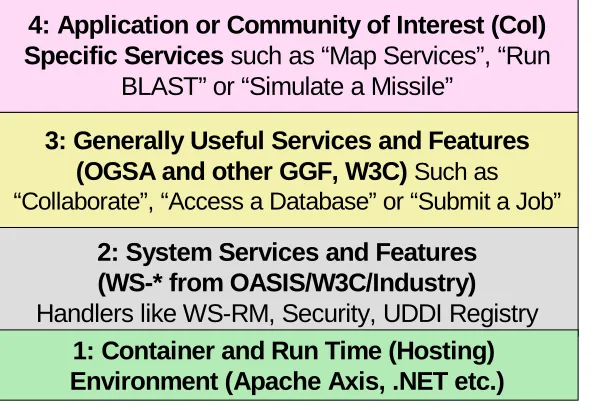
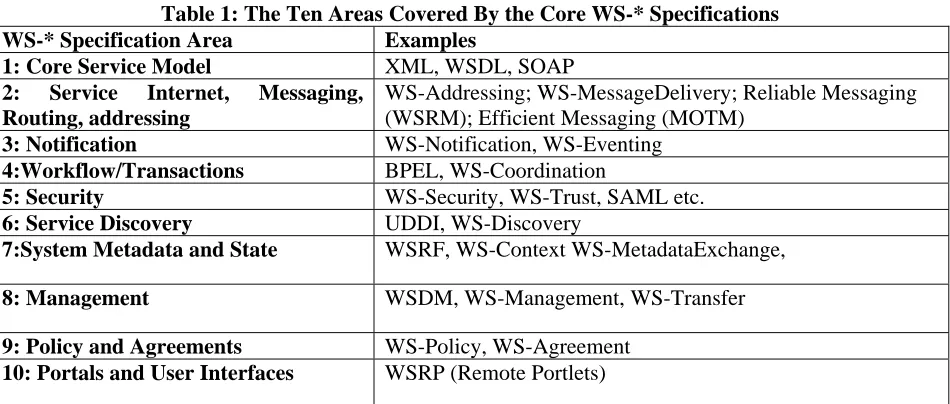
[image:6.612.164.461.249.454.2]We used a refinement of analysis originally developed to understand Dod’s Net-Centric architecture (section 2.1) in [DoD1] with this also summarized in [DOD2]. Here we divided service architecture components into four as shown in Figure 1. Layer 1 is the container and hosting environment where in eScience, Apache Axis or .NET are typically used. There is general agreement at the functionality here although some of the technology is still not very mature. The next layer is that of the WS-* divided into ten categories in table 1. These are the core service standards (specifications) and are set dominantly in W3C and OASIS. More details on the services in each category can be found in catalog [DoD3].
Figure 1. The Grid and Web service Institutional Hierarchy
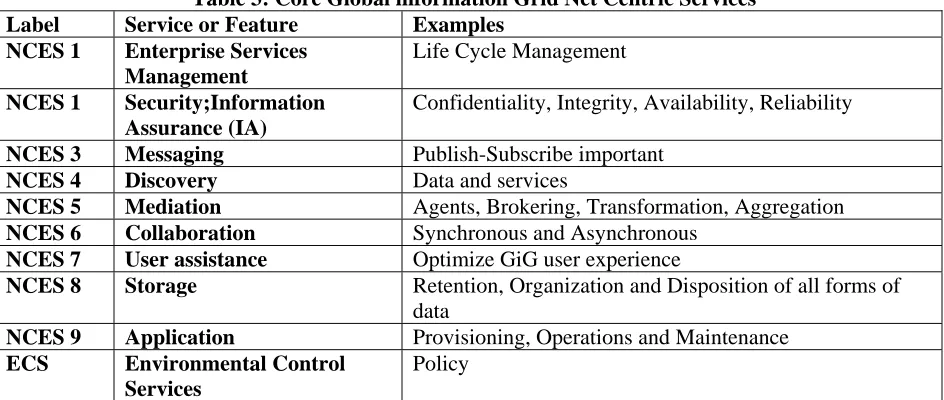
Layer 3 contains what is termed “generally useful services” which are higher level than the core services but used in multiple Grids. Examples include “Submit a Job”:, “Access a Sensor” or “Collaborate”. Here the Open Grid Forum standards activities are very important and so in table 2, we summarize GGF (OGF) work using the functional areas defined by OGF. Alternatively, we could have used the organization described by the OGSA architecture. These seven OGF areas are referred to as GS-* (*=1 to 7) below. Table 3 gives another cut on the division of a distributed system into service areas with a list of the 10 core areas (Enterprise Services) defined by DoD for their Global Information Grid. Table 4 is the main result in this section as it lists eighteen “features and services” that encompass current Grid applications, Net-Centric computing and the current work of W3C, OGF, OASIS and DMTF. As discussed in DoD analysis cited above, there are reasonable agreement between “GGF style” (OGSA) and DoD Net-Centric architectures. DoD does not put computing related services in their core but does highlight synchronous and asynchronous collaboration. Collaboration appears in OGSA style Grids as virtual organizations [PicklesItaly] [DoD2] but the services of interest to DoD have not been highlighted in OGF. AFRL (Air Force Research Laboratory) has defined aCollaborative Enterprise Environment CEE [CEE00] which has been implemented by Ball Aerospace [KK]. The CTS series of conferences [CTSxx] covers collaboration issues of interest to DoD.
Typical DoD application is "Command and Control" (called Emergency
Response in civilian case) and here collaboration is between commanders/first responders to
2: System Services and Features
(WS-* from OASIS/W3C/Industry)
Handlers like WS-RM, Security, UDDI Registry
3: Generally Useful Services and Features
(OGSA and other GGF, W3C)
Such as
“Collaborate”, “Access a Database” or “Submit a Job”
4: Application or Community of Interest (CoI)
Specific Services
such as “Map Services”, “Run
BLAST” or “Simulate a Missile”
make decisions in real-time.
Scheduling is discussed in GGF for computing but not for networks and services as needed by DoD. DoD also endorses the “Grids of Grids” architecture (termed by them systems of systems) as it allows modular development and the wrapping of “legacy” systems as grids. Table 4 includes all the broad service categories needed by the grids discussed here and all the analyses in section 2 reference the categories in this table. We discuss later confusion in the use data and information and we explicitly separate “raw and stored” data from “interpreted or managed” data for which we (and DoD) prefer the term information. However in conventional data grid terminology, information is used to describe monitoring. We distinguish these different concepts in our analysis. Finally note that layer 4 in figure 1 corresponds to the domain specific (community of interest) services that are not discussed much here as it is expected that these would be developed separately by each field. The “general” services of table 4 include capabilities in FS13-15 that are important in building domain specific services and further all the core services FS1-11 (especially workflow) will be important here. However the responsibility for building these services of layer 4 in fig. 1 lies with domain and not with the “central IT institutions”. [image:7.612.71.546.315.517.2]Section 2 analyses 68 different grids in terms of services and section 3 provides an analysis of workflow tools. Section 4 gives some conclusions.
Table 1: The Ten Areas Covered By the Core WS-* Specifications WS-* Specification Area Examples
1: Core Service Model XML, WSDL, SOAP 2: Service Internet, Messaging,
Routing, addressing
WS-Addressing; WS-MessageDelivery; Reliable Messaging (WSRM); Efficient Messaging (MOTM)
3: Notification WS-Notification, WS-Eventing 4:Workflow/Transactions BPEL, WS-Coordination
5: Security WS-Security, WS-Trust, SAML etc. 6: Service Discovery UDDI, WS-Discovery
7:System Metadata and State WSRF, WS-Context WS-MetadataExchange,
8: Management WSDM, WS-Management, WS-Transfer
[image:7.612.63.549.315.657.2]9: Policy and Agreements WS-Policy, WS-Agreement 10: Portals and User Interfaces WSRP (Remote Portlets)
Table 2: Activities in Global Grid Forum (OGF) Working Groups GGF Area Standards Activities
1: Architecture High Level Resource/Service Naming (level 2 of Fig. 1), Integrated Grid Architecture
2: Applications Software Interfaces to Grid, Grid Remote Procedure Call, Checkpointing and Recovery, Interoperability to Job Submittal services, Information Retrieval
3: Computing Job Submission, Basic Execution Services, Service Level Agreements for Resource use and reservation, Distributed Scheduling
4: Data Access Database and File Grid access, Grid FTP, Storage Management, Data replication, Binary data, High-level publish/subscribe, Transaction management
6: Management Resource/Service configuration, deployment and lifetime, Usage records and access, Grid economy model
[image:8.612.69.541.192.392.2]7: Security Authorization, P2P and Firewall Issues, Trusted Computing
Table 3: Core Global information Grid Net Centric Services Label Service or Feature Examples
NCES 1 Enterprise Services Management
Life Cycle Management
NCES 1 Security;Information Assurance (IA)
Confidentiality, Integrity, Availability, Reliability
NCES 3 Messaging Publish-Subscribe important NCES 4 Discovery Data and services
NCES 5 Mediation Agents, Brokering, Transformation, Aggregation NCES 6 Collaboration Synchronous and Asynchronous
NCES 7 User assistance Optimize GiG user experience
NCES 8 Storage Retention, Organization and Disposition of all forms of data
NCES 9 Application Provisioning, Operations and Maintenance ECS Environmental Control
Services
Policy
Table 4: Summary of 18 Categories of Core Features and Services Service or Feature WS-* GS-* NCES Comments A: Broad Principles
FS1: Use SOA: Service Oriented Architecture
WS1 Core Service Model, Build Grids on Web
Services. Industry best practice
FS2: Grid of Grids Strategy for legacy subsystems and modular architecture
B: Core Services (Mainly Service Infrastructure and W3C/OASIS focus) FS3: Service
Internet, Messaging
WS2 NCES3 Core transport service to service, REST implies HTTP not SOAP
FS4: Notification WS3 NCES3 JMS, MQSeries, WS-Eventing,Notification FS5 Workflow WS4 NCES5 Grid Programming
FS6 : Security WS5 GS7 NCES2 GSA, Grid-Shib, Permis Liberty Alliance ...
FS7: Discovery WS6 NCES4 UDDI, GT4 index and many custom services FS8: System
Metadata & State
WS7 Globus MCS, WSRF, WS-MetadataExchange,
Semantic Grid, REST has stateless paradigm FS9: Management WS8 GS6 NCES1 CIM, WSDM, WS-Management
FS10: Policy WS9 ECS WS-Policy
FS11: Portals and User assistance
WS10 NCES7 Portlets JSR168, NCES Capability Interfaces
C: Generally useful Services (Mainly Higher level and OGF focus)
FS12A: Core Computing GS3 Job Submittal and Scheduling FS12B: Managed Computing
or “Workload management”
GS3 Including services such as organize “parameter search” or related jobs such as those analyzing a group of LHC events
FS13A: Data and Storage GS4 NCES8 Parts of NCOW “Data” Strategy. Here we see files and databases. The metadata used often to adorn “raw data” can be considered as higher level FS14B
RLS, OGSA-DAI and SRM FS13B: Streams and
Sources/Sensors
Sources could include monitors whose content classified in FS14A
SensorML from OGC FS13C: Data Transport WS2
WS3 GS4
NCES3 NCES8
GridFTP or WS Interface to non SOAP transport, Globus RTF
FS14A: Information as Monitoring
GS4 In a “data grid” world, the results of a
monitoring source such as a job status update is called “information” as in GMA Grid
Monitoring Architecture FS14B: Information,
Knowledge, Wisdom part of D(ata)IKW
Can be considered as “Managed Data” combining data and metadata
GS4 NCES8 VOSpace for IVOA, JBI for DoD, WFS for OGC and parts of NCOW “Data” Strategy Federation at this layer major research area
services and FS13A for lowest level
SRB FS15: Applications and User
Services
GS2 NCES9 Standalone Services Proxies for jobs FS16: Resources and
Infrastructure
GS5 Ad-hoc networks
FS17: Collaboration and Community services
GS7 NCES6 XGSP, Shared Web Service ports
Advanced aspects of Virtual Organizations FS18: Scheduling and
matching of Services and Resources
GS3 This describes scheduling services – not the scheduling of computing jobs included in FS12 which is a major part of Grid activity
NCES refers to DoD Net-Centric Enterprise Services in Table 3 WS-* refers to Web services standards in Table 1
1.2 Notes on Data and Information Architecture
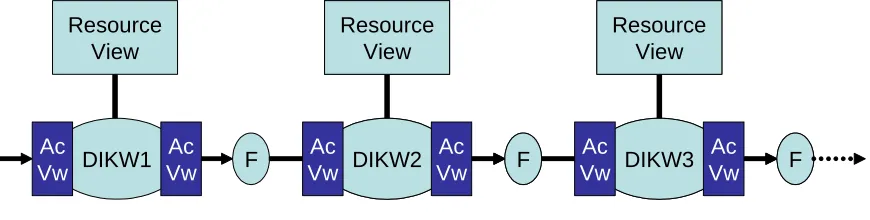
This elaborates on the topics labeled FS13 and FS14 in table 4. The data area is confused due to its diversity compounded by inconsistent use of terminology. We had noted that what is often called a data grid (as in EDG European Data Grid or gLite discussed here) was rather different from the database oriented Grids seen in IVOA (discussed here) and bioinformatics grids like MyGrid. We attempted to re-name them Compute-File and Information grids respectively in the Gap Analysis with Walker [GapAnalysis] but this terminology was not popular. In figure 2, we depict a general scenario. In all fields there is some transition often called DIKW through data, information, knowledge and wisdom. Always there are many processing steps and one hopes that the value of the bits produced increases so that one progresses up the D-I-K-W chain. Of course there is no rigorous division between the DIKW levels and one group could label as knowledge what another group labels information. Further one might use decision (support) as the name of the final stage rather than wisdom. There is of course similar
ambiguities between data and metadata; one person’s metadata is another person’s data. At each step of transformation chain shown in fig. 2, one can distinguish the user (access) and resource view. The user view focuses on the meaning of the DIKW while resource view on the mechanisms and physical devices used to store. The resource view includes issues such as storage device, file-caching, distribution and whether a database, structured or unstructured file or files are used. Other resource mechanisms are real-time streams, notification events, sensor outputs, and in-memory. The access view could vary from pure raw data, data plus a metadata catalog. SQL, XPATH to application specific syntax (VOQL in astronomy, WFS in GIS). Note both the resource view and access view can be exposed as Grid services but in some cases you have no choice as existing systems only expose the access view as in GIS systems that have database backends (resource views) but the exposed interoperability interface is the access view WFS.
Resource View DIKW1 F Resource View DIKW1 F Resource View DIKW1 F Resource View DIKW2 F Resource View DIKW3 F Ac Vw Ac Vw Ac Vw Ac Vw Ac Vw Ac Vw
[image:11.612.89.524.282.392.2]Ac Vw is Access View
Figure 2: Data-Information-Knowledge-Wisdom Pipeline. DIKWi represent different forms of DIKW with different terminology in different fields. Each DIKWi has a resource view describing its physical instantiation (different distributed media with file, database, memory, stream etc.) and an access view describing its query (input or output) model (dir or ls, SQL, XPATH, Custom etc.). The different forms DIKWi are linked by filtering steps F. This could be a simple format translation; a complex calculation as in the running of an LHC event processing code; a proprietary analysis as in a Search engines processing of harvested web pages; an addition of a
SRB, SRM and OGSA-DAI are important relevant grid technologies. SRM focuses on virtualizing a file-oriented resource view to hide the details of different storage devices; OGSA-DAI virtualizes many different database paradigms while supporting directly transformations to different access views (filters in fig. 2). SRB addresses the access view but with a focus on collections of files. GLite has a data management system that includes SRM functionality, caching and a metadata catalog to support a file-oriented access view. Note that in some parlance, GLite “manages data” to produce next step in DIKW pipeline but it is confusing to call this step information as this term is typically used in GLite and related data grids to refer to resource and job related (meta)data.
DIKW federation (integration of multiple services with the same access view) can be implemented at both access and resource view and at different points on pipeline. There is clearly substantial work in the database community on this point and OGSA-DAI implements as DQL for the Grid. However this resource view solution cannot be applied in cases where only the access view is available for federation. Here SRB would approach federation at the access level (a metadata catalog and typically a collection of files) by integrating the metadata catalogs of the federation components.
1.3 UDDI Universal Description, Discovery and Integration
All web-service based grids need some sort of service discovery and several have evaluated the
WS-I approved UDDI standard. However essentially all have found UDDI inadequate and below
we list the reasons for this. Briefly UDDI is not metadata-oriented (see points 1,2 below). It may
contain stale information about Web Service entries (see point 4). It does not support
session metadata (see point 3). It has a poor service description and inquiry matchmaking
process (see point 5). The UDDI does not address to domain-specific needs of various domains
such as GIS (see point 6). It is a centralized registry (see point 7) which like point 4 is a
comment on current implementations rather than the interface specification. Of course some of
the e-Science limitations reflect the e-Business focus of UDDI but many of the suggested
improvements from the Grid community should be beneficial in all applications of UDDI.
1)
Out-of-box UDDI [UDDI] is not metadata oriented. It does not support the ability to publish
and search prescriptive metadata of services. The prescriptive metadata is the
domain-specific information about the functionality of a service.
2)
In the same line with previous point (it is not metadata-oriented), the UDDI Specs does not
take into account descriptive metadata, i.e. quality of service attributes, into it’s discovery
process. The prescriptive metadata provided by a service may be fitted with client’s request,
however, this does not necessarily guarantee whether the service is sufficient for the desired
quality of service requirements. By matching Quality of Service attributes of service
discovery requests and service descriptions, a client is able to distinguish services that match
their requirements.
3)
UDDI does not support stateless web service interaction where services are not responsible
for storing session and/or state information generated due to service interactions.
4)
In UDDI, service descriptions of a registry may be stale because of the volatile behavior of
services. Services may come and go and service metadata can change frequently. To avoid
out-of-date information in the registries, a monitoring scheme is required to keep the
service-metadata up-to-date. [Mello]
integrating ontologies, which in turn define rules on the concepts and relations, with UDDI.
Unfortunately, this increases the complexity to the registry, and it is hard to come up with an
ontology which everybody agrees and accepts as an standard. Main Semantic Web and UDDI
research was originated from Cardiff Southampton and Univ. of Manchester. [Miles]
[UDDIe]
6)
UDDI is domain-independent and it does not provide domain-specific query capabilities such
as performing geospatial queries on the metadata-catalog. That is why its adaptation in
various specific domains such as GIS is slow. For instance, GIS community introduced their
own registry, Web Registry Service as an alternative. Their solution is only designed for GIS
domain and is not extendable. [Aktas]
2. Analysis of Services in Particular Grids
2.1 Net-Centric Environment
NCE or NCOW (Net-Centric or Network Centric Operations and Warfare) is a “target architecture” designed by the US Department of Defense for all their future information technology – an area with a $30B annual budget. NCE is specified with voluminous documentation which in its full detail is not generally available. However the key features are available on the Internet from papers and talks including [DoD1] [Hayes04] [Krieger03] [Levitt05] and [Mayfield03]. There are also several NCE related organizations including the Association for Enterprise Integration with a Net-Centric services activities [AFEI]; the Industry oriented Network Centric Operations Industry Consortium [NCOIC]; NCOIC is managed by the Open Group which also has a Grid Enterprise Forum [GEF]; there is a broad based forum called the World Wide Consortium for the Grid [W2COG]. Note the latter focuses on the GiG or Global Information Grid which in DoD-speak is the infrastructure on which NCE is built. The NCE/GiG architecture is consistent with the principles of general DoD studies such as the 1998 C4ISR (Command, Control, Communications, Computer Intelligence, Surveillance, Reconnaissance) architecture document [C4ISRarch].
DoD divides NCE into three “views” termed Operational, System and Target Technical. The operational view describes functionality and requirements divided into a set of quite detailed activities. The systems view describes the computer architecture with its decomposition into services including those implementing the different activities of the operational view. The Target Technical View or TTY describes the technologies that could be used in the NCOW implementing the systems view subject to the requirements of the operational view. The TTY discusses the relevance of web services, Globus and the work of GGF. The NCE defines a set of 10 core services given in table 3 but there is no available discussion (other than [DoD1] and table 4 here) of the relationship of these to grid and web service specifications and how DoD could build their services on top of more general specifications. DoD recognizes the importance of different applications (called communities of interest) building on the same core (table 3) services. DoD also has application-specific metadata standards developed including DDMS XMSF XBML and C2IEDM (Command & Control Information Exchange Data Model) [DDMS, Tolk04A].
The NCOW is aimed at satisfying some broad principle required by DoD applications: 1. Increased Shared Awareness
2. Increased Speed of Command 3. Higher Tempo of Operations 4. Greater Lethality
5. Increased Survivability 6. Streamlined Combat Support 7. Effective Self-Synchronization
The net-centric environment is designed to realize four key features:
1. Reach: corresponding to rapid linkage between spatially separated entities
2. Richness: reflecting the interoperability of service architectures including the number of disparate services that can be brought to bear to solve time-critical problems.
3. Agility: reflects the adaptability enabled by transformations that can “plugged” in real-time into any system to enhance decision making
DoD has a substantial discussion of the NCE data strategy with general goals (visible, accessible, understandable, trusted, interoperable, responsiveness to user needs, institutionalized) and some principle of use. The latter include “only handle information once” (OHIO), smart pull (as seen in subscription to pub-sub systems), posting data immediately before and after any processing, and support of shared spaces.
2.2 ServoGrid
http://www.servogrid.org Customers/Purpose:
Support integration of large scale 3D simulations, data-mining (pattern recognition) and both archival and real-time data to predict earthquakes. Note this is different from NEESGrid that supports earthquake engineering (the consequences of earthquakes). The field is seeing an explosion in available data that will be dramatic if InSAR satellite launched. Further as earthquakes are a “phase transition” sensitive to unknown details of physical make-up of faults, the role and nature of simulations is still an active and controversial area and balance between very large accurate simulations and multiple exploratory runs is unclear.
Area Service Name Description
FS3 Messaging Service This is used to stream data in workflow fed by real-time sources. It is based on NaradaBrokering which can also be used in cases just involving archival data FS4 Notification Service This supplies alerts to users when filters
(data-mining) detects features of interest FS5
FS9
Workflow/Monitoring/Management Services
The HPSearch project uses HPSearch Web Services to execute JavaScript workflow descriptions. It has more recently been revised to support WS-Management and to support both workflow (where there are many alternatives) and system management (where there is less work). Management functions include life cycle of services and QoS for inter-service links
FS6 Authentication and Authorization This uses capabilities built into portal. Note that simulations are typically performed on machines where user has accounts while data services are shared for read access
FS7 Registry and Discovery Services We have built data model extensions to UDDI to support XPath queries over Geographical Information System capability.xml files. This is designed to replace OGC (Open Geospatial Consortium) Web registry service
FS8 Context Data Service We store information gathered from users’ interactions with the portal interface in a generic, recursively defined XML data structure. Typically we store input parameters and choices made by the user so that we can recover and reload these later. We also use this for monitoring remote workflows. We have devoted considerable effort into developing WS-Context to support the generalization of this initial simple service.
FS11 Portal We use an OGCE based portal based on portlet
architecture FS11
FS15
FS11 FS15
Scientific Plotting Services We are developing Dislin-based scientific plotting services as a variation of our Web Map Service: for a given input service, we can generate a raster image (like a contour plot) which can be integrated with other scientific and GIS map plot images.
FS12A Compute Access We access specific job schedulers in straightforward ways as we do not need to link multiple compute jobs but rather single compute jobs on a user-chosen site with multiple services
FS13A File Services We built a file web service that could do uploads, downloads, and crossloads between different services. Clearly this supports specific operations such as file browsing, creation, deletion and copying.
FS13B Sensor Grid Services We are developing infrastructure to support streaming GPS signals and their successive filtering into
different formats. This is built over NaradaBrokering (see messaging service). This does not use Web Services as such at present but the filters can be controlled by HPSearch services.
FS14B FS15.
QuakeTables Database Services The USC QuakeTables fault database project includes a web service that allows you to search for Earthquake faults.
FS13A Data Tables Web Service We are developing a Web Service based on the National Virtual Observatory’s VOTables XML format for tabular data. We see this as a useful general format for ASCII data produced by various application codes in SERVO and other projects. FS14B
FS15.
Application and Host Metadata Service
We have an Application and a Host Descriptor service based on XML schema descriptors. Portlet interfaces allow code administrators to make applications available through the browser.
FS14B FS15
Web Feature Service We’ve built a Web Service version of this OGC standard. We’ve extended it to support data streaming for increased performance.
FS15 Specific Applications: Virtual California, Geofest, Park, RDAHMM ..
These can be all launched by a single Job
Management service or by custom instances of this with metadata preset to a particular application Key interfaces/standards/software Used GML WFS WMS
WSDL XML Schema with pull parser XPP SOAP with Axis 1.x
UDDI WS-Context JSR-168 JDBC Servlets
WS-Management VOTables in Research Key interfaces/standards/software NOT Used
(often just for historical reasons as project predated standard)
2.3 gLite 3.0.0
http://www.gLite.org
Customers/Purpose: This Grid software is produced by combining the work of the EGEE with that of the LCG (LHC Computing Group). Curiously gLite 3.0.0 was obtained by converging gLite 1.5.0 (workload management system, logging and bookkeeping, R-GMA, VOMS and File Transfer Service) and LCG 2.7.0 (other components including those that duplicate gLite 1.5.0 functionality)
http://lcg.web.cern.ch/LCG/LCGnews/LCGJunWeb-2006.pdf. LCG was the production system (based on European DataGrid EDG, GT2 and Condor) and gLIte 1.5.0 the “new system”; gLIte 3.0.0 is now the single supported system and is used in current round SC4 of LCG service challenges. Note gLite is the official CERN release and there are significant variants from the major LHC experiments including ATLAS http://www.gridpp.ac.uk/gridpp16/gridpp16_ATLAS.ppt, CMS
http://www.gridpp.ac.uk/gridpp16/gridpp16_CMS.ppt, ALICE (using AliEn written partly in Perl) http://www.gridpp.ac.uk/gridpp16/gridpp16_ALICE.ppt and LHCb
http://www.gridpp.ac.uk/gridpp16/gridpp16_LHCb.ppt. Further there is the related Open Science Grid USA effort whose software stack has a stronger Globus component. There again you will find variants of the core activity for each major LHC experiment.
gLite would be termed in a compute-file grid in language of the Fox&Walker Gap analysis but is more normally termed a data grid. Note that few Grid and Web service standards are used and GT2 not GT4 components are used.
Area Service Name Description
FS6 Security https://edms.cern.ch/document/487004/
http://glite.web.cern.ch/glite/security/ Currently uses transport level security but will move to WS-Security
Authentication MyProxy
LCAS (Local Centre Authorization Service) and LCMAPS (Local Credential Mapping Service) are the EGEE services that make the connection between GRID users certificates and local UNIX userids on the local site.
Authorization Uses VOMS
FS7 Service Discovery Can access XML files (with service information), R-GMA or BDII information. BDII (Berkeley Database Information Index) is a sophisticated LDAP based system using two instances to improve performance (over original MDS).
FS12B Workload Management (Computing)
FS12A Computing Element The Computing Element (CE) is the service representing a computing resource. Its main
by a matchmaking process. For job submission, the CE can work in push model (where the job is pushed to a CE for its execution) or pull model (where the CE is asking the Workload Management Service for jobs). Besides job management capabilities, a CE must also provide information describing itself. In the push model this information is published in the information Service, and it is used by the match making engine which matches available resources to queued jobs. In the pull model the CE information is embedded in a ``CE availability'' message, which is sent by the CE to a Workload Management Service. The matchmaker then uses this information to find a suitable job for the CE.
Developing CREAM: Web service Computing Element
FS14A Logging and Bookkeeping Provides events defining status of a job throughout its life. L & B interfaces with R-GMA and uses proxies to improve performance
FS12A Accounting DGAS The accounting service accumulates information about the usage of Grid resources by the users and by groups of users, including Virtual Organizations as groups of users
FS12B Workload Management WMS Manage the whole job cycle including Condor capabilities, checkpointing, logging/bookkeeping and accounting.
FS13,14 Data Management
FS13A Storage Element SRM used to virtualize storage devices with Posix-like Grid File Access Layer (GFAL) by LCG. There is also CASTOR (CERN Advanced Storage Manager) FS13A File & Replica Catalog Fireman (gLite) and LFC (LHC File Catalog)
supports caching of files to improve performance FS13C Data Movement FTS Service controls File Transfer
FS14B Metadata Catalog AMGA from EGEE but it is expected that this will be very application (VO) dependent
2.4 GEON
http://www.geongrid.org/
http://www.geongrid.org/communications/annual_reports/Annual_Report_2005_Final_Pub.pdf
Customers/Purpose NSF ITR addressing a broader range of GeoScience than SERVOGrid. The project is led by SDSC and has an emphasis on the Semantic Grid and Workflow. The annual report cited above has the best description of the architecture. The group is active in EarthScope and Geoinformatics communities.
http://www.geongrid.org/related.html
Node Types Description
Institutional (PoP) Node (following BIRN’s deployment stragy)
OGSI (NMI Globus GT3.2); OGSA-DAI (no longer used); Postgres; PostGIS; NWS; INCA; Tripwire; Condor
GEON Central Collection of useful software including applications managed by the distributed team.
FS6 GEON Certificate Authority GAMA
FS12 GEON Compute Node ROCKS
FS13,14 GEON Data Node DB2; Oracle; SRB; Postgres; MySQL; ArcIMS. Note GEON software stack shown above does not illustrate this software.
Capability/Service Description
FS5 Workflow Kepler for LIDAR data processing and rock classification FS6 Intrusion Monitoring Tripwire for basic OS Files. chkrootkit for testing for rootkits
on Linux servers
FS11 Portal A GridSphere based portal using portlets FS11
FS6
Registration and Login Portlets
GAMA (Grid Authentication and Account Management) is a complete GSI (Grid Security Inrastructure) credential
GAMA consists of two components: a backend security service that provides secure management of credentials, and a front-end set of portlets that provide integration into web/grid portals. Gama is a general SDSC Grid technology.
PostGRES handles user account information FS11 FS9 System Administration Portlet FS11 FS12 Backup Portlet FS11 FS12
myGEON User Space The GEON portal provides a private workspace called, myGEON, to store your work in progress. For example, you can store selected outputs from a GEONsearch, or store maps that you may have made using the GEON GIS mapping capability. You may log out and return to your work at myGEON. FS11 FS14 Monitoring Portlet FS11 FS14
GEONSearch Portlet Interfaces to GEON Metadata catalog
FS11 FS17
GEON Forum Portlet
FS12 Computing
FS12B Cluster ROCKS providing cluster management (customizable software configuration) integrated across the GEON sites by PoP nodes. See
http://www.rocksclusters.org/rocks-doc/papers/ieee-cluster-2004/Rocks-Geon/Sacerdoti04GridManagement.pdf ROCKS is a general SDSC Cluster technology
FS12A Job Scheduling Globus and Condor used for scheduling Inter-clusters and to TeraGrid
Sun Grid Engine and PBS used for Scheduling intra-Cluster FS13,14 Data
FS13A Data Replication Service DRS
Used to replicate large data-sets using WSRF, RFT (Reliable File Transfer)
FS13C Data Transport GridFTP
FS14B Hosted datasets SRB used for large data; not metadata.
SRB is a general SDSC dataset management system FS14 Information&Monitoring; IKW part of DIKW
FS14B FS15
Spatial Database PostGIS extension to Postgres database which does not seem to be presented as a web service. This supports Geos and Proj tools
FS14B FS15
Geographical Information system GIS
ArcIMS and ArcGIS from ESRI; GRASS GIS is part of GEON Central distributed software repository; Generic Mapping Tools GMT from University of Hawaii. http://gmt.soest.hawaii.edu/
FS14A System monitoring INCA collects GEONGrid system status (inter-Cluster). This is a TeraGrid technology and supports GRASP Benchmarks Ganglia is packaged with ROCKS and used to monitor clusters
search interface accumulates search results in a “data integration cart” whose contents can be passed to other GEON services such as mapping and refined searches. FS15 Applications Parallel Finite-element code for time dependent 3D
continental tectonics; SYNSEIS finite difference based generation of synthetic seismograms with GIS display; generation of ontologies and hosting of a range of Geoscience datasets; Kepler applications; visualization;
FS16 NWS Network Weather service
2.5 International Virtual Observatory Alliance IVOA
http://www.ivoa.net/
http://us-vo.org/summer-school/2005/proceedings/index.html is an excellent discussion of all components of the IVOA including technology and applicants. IVOA is an international standards and community building organization linking multiple (15 in May 2005) national projects including AstroGrid (UK) http://www.astrogrid.org and the National Virtual Observatory (USA) http://us-vo.org/. IVOA has 8 working groups and 4 community (interest) groups and sponsors general and interoperability meetings (See The IVOA in 2005: Assessment and Future Roadmap). The Working Groups follow the W3C model and are active in the areas of XML data format standards (VOTable), VO Resource Metadata, Universal Content Descriptions, Space-Time Coordinate Metadata, unified Data Access Layer standards for spectra and images, VO Resource Registries, VO Query Language, unified astronomical Data Models and Web Service technologies for the VO. The chairs of the Working Groups have also produced an overall architectural plan for an operational VO that identifies the critical areas for current and future
development of standards and technologies. The work of the IVOA is an excellent complement to that other standards bodies and has a clear application focus.
An Architecture for Scaling NVO Services to TeraGrid is a November 2005 report describing the integration of some US-NVO capabilities and the TeraGrid. This is an interesting architecture proposal that brings key data (SDSS and 2MASS) inside the TeraGrid moving away from the a full “take the computing to the data” model as seen in the earlier IVOA “data vision” seen in The Management, Storage, and Utilization of Astronomical Data in the 21st Century Version 1.00 IVOA Note 15 March 2004).
data repositories. The SRB has been used but not broadly as the International Alliance has not agreed to this choice; NGAS (Next Generation Archive System) from ESO (European Southern Observatory) has similar design goals to SRB. The articles VOSpace Architecture and National Virtual Observatory VOStore and VOSpace discuss in detail VOSpace, VOStore, NGAS and SRB.
VOtable (see VOTable Format DefinitionVersion 1.1 IVOA Recommendation 11 August 2004) is an IVOA standard that specifies how table data should be represented in XML for both direct and indirect (URI) specifications. The data servers (SkyNodes) are expected to return their data in VOTable syntax. One can expect this approach to be useful across many scientific and engineering domains with a suite of Microsoft Excel style functions to manipulate the table data. Currently only VOPlot is available as a generic VOTable tool.
The diagram below shows a functional diagram focused on the data side of an IVOA Grid.
Registry Registry OAI Updates SkyNode SkyNode SkyNode Cone Cone Cone User Cone Cone SIA ADQL SOAP VOTable SSA GET VOTable Archive Images and Image Servers Archive Spectra and Spectra Servers Cone Cone SSA Cone GET VOTable
Registry access Resource Metadata FITS data SQL Databases Data Access Services SIA GET VOTable VOEvent providers
Transient events notices
Script environment (could be CEA)
ROME Script requests
Elemental requests and responses
Node Types Description
SkyNodes Database Server
http://us-vo.org/summer-school/2005/proceedings/presentations/sky_nodes.html
A Database Server with an ADQL based SOAP interface returning VOTable based results. The VOQL group of IVOA is developing ADQL and Skynode specifications.
OpenSkyQuery Portal http://openskyquery.net/Sky/skysite is a portal allowing access to multiple Skynodes Capability/Service Description FS5 and FS12 Workflow JES/CEC/ CEA
JES (Job Execution System) is Astrogrid workflow engine that manages control flow and runs steps in a controlled asynchronous fashion. CEC (Common Execution Controller) manages step execution and data flow with
(UK) Workflow Engine described in
http://www.ivoa.net/Documents/Notes/AstrogridWorkflow/Astrogrid Workflow-20060227.pdf. It supports MySpace -- the forerunner of VOSpace. Interestingly this document references no other Grid Workflow activities – not even Taverna and Triana in UK where latter used in Astronomy (Ligo)
http://us-vo.org/summer-school/2005/proceedings/presentations/VOData.ppt gives a broader discussion and the use of Pegasus as a workflow engine is described in http://www.isi.edu/~deelman/Pegasus/galmorph_sc03.pdf FS7 Registry
http://us-vo.org/summer-school/2005/proceedings/presentations/dataservice.html
http://nvo.stsci.edu/voregistry/index.aspx is a registry of Skynodes. It does not appear to be based on UDDI
FS12 Clarens Grid System Coordination of compute and data services includes MySpace, workflow, batch job submission and access to data. An Architecture for Scaling NVO Services to TeraGrid describes the role of Clarens and compares it to GT4.
FS13A Data Access VOStore
This abstracts the raw data access and the dividing line between it and VOSpace is still being debated. It does not cover meta-data (that’s in VOSpace) and some discussion suggests it could be replaced by generic specifications like GridFTP or a simple application (file access only initially) of OGSA-DAI. Recently VOStore has been merged into VOSpace
FS14B Data Management VOSpace
This manages metadata and data-collections and sits between user (portal) and VOStore as in figure to right. Operationally VOSpace can function in near term as a SRB-NGAS-… interoperability layer.
FS14A and FS4
VOEvent
http://us-vo.org/summer-school/2005/proceedings/presentations/VOEvent_projects.ppt A publish-subscribe based event architecture for astronomical event notification.
Protocols
FITS Flexible Image Transport System
FITS is the traditional standard used for the transport, analysis, and archival storage of scientific data sets in the astronomy community. It supports Multi-dimensional arrays: 1D spectra, 2D images, 3D+ data cubes; Tables containing rows and columns of information and Header keywords providing descriptive information about the data
VOTable
with a server component resolved in a VO Registry and a server specific ID resolved by the server. Note VOTable cells cannot themselves by new XML objects as this was considered to make parsing very hard. Rather one sets the UCD (Unified Content Descriptor) to ucd="meta.link.url", or ucd="meta.link.ivoa", or ucd="meta.text.xml" to specify that Cell contents are respectively a URL, a URI interpretable by a VO Registry or a chunk of XML. ADQL This is an enhancement of SQL for astronomy adding capabilities for
fuzzy join and to select regions of the sky – this is analogous to spatial extensions of SQL used in GIS. This is intended to replace an older Cone Search capability
SIA Simple Image Access This forms the data model with SSA for the IVOA. SIA data model is the familiar "astronomical image" which generally means a 2D sky projection with a data array that is logically a regular grid of pixels encoded as a FITS image, GIF/JPEG, etc.
The SIA includes standardized dataset metadata such as provenance, Image geometry, Scale, Format, Position, Time of observation, Spectral bandpass and Access information
SSA This forms the data model with SIA for the IVOA. A simple query POS, SIZE, FORMAT - like cone search or SIA possibly refined by spectral or time bandpass, etc. Most metadata in the query response is optional. On Data retrieval, the simple retrieval is URL-based
returning a dataset "document" (VOTable, FITS, JPEG, etc.). In simplest case data could be wavelength, flux as text (for spectrum). UCD
http://us-vo.org/summer-school/2005/proceedings/presentations/UCD.ppt
Unified Content Descriptor to define astronomical type meta-data. Created at CDS Strasbourg
(the first VO prototype) Harvested
From 5000 tables, 20000 table columns To create ~450 UCD words
Example
pos.eq.ra means right ascension Resource Metadata for IVOA
VOResource
Resource Metadata for the Virtual Observatory Version 1.01 IVOA Recommendation 2004 April 26 describes in broad terms how various different metadata sources (Dublin Core, FITS, UCD etc.) should be integrated.
A VOResource
2.6 CICC: The Chemical Informatics Grid
http://www.chembiogrid.org
Customers/Purpose:
The goal of this project is to support cluster analysis, data mining, and quantum simulation/first principles calculations on experimentally obtained data on small molecules with potential use in drug development. Small molecule data is gathered from NIH PubChem and DTP databases, with additional large molecule data available from service-wrapped databases such as the Varuna, Protein Data Bank, PDBBind, and MODB. NIH-funded High Throughput Screening centers are expected to deluge the PubChem database with assays of the next several years, making the automated organization and analysis of data essential. Data analysis applications are interestingly combined with text analysis applications applied to journal and technical articles to make a comprehensive scientific environment. Workflow is a key part of this project as it encodes scientific use cases. Many CICC services and the general approach are based on Cambridge University’s WWMM project (http://wwmm.ch.cam.ac.uk/) led by Prof. Peter Murray Rust.
Area Service Name Description
FS5 FS9
Workflow/Monitoring/Management Services
CICC uses Taverna from the UK e-Science
Program/OMII. MyLEAD (from the LEAD project) is also being evaluated as a workflow environment. FS6 Authentication and Authorization Currently all services are openly available.
FS7 Registry and Discovery Services Will inherit registry services through previously developed SERVOGrid work.
FS11 Portal and portlets Use a JSR 168-based portal.
FS13A File Services No specialized service. URLs are used for naming files and simple remote download. Services
developed previously for SERVOGrid can be used for uploads.
FS14B NIH DTP Database Services This provides access to the NIH Developmental Therapeutics Program (DTP)’s database of molecular screens against 60 cancer cell lines.
FS14B This is a free service provided by the NIH and used
by us.
FS14B PubMed Search Service (in development)
PubMed provides a searchable online database of medical journal articles. CICC is developing harvesting services of the abstracts that can be combined with text analysis applications such as OSCAR3.
FS14B SPRESI Services CICC has developed clients/service proxies to the commercial SPRESI service
(http://www.spresi.com/). SPRESI’s scientific database houses extensive molecular and reaction data, as well as references and patents.
FS14B VARUNA Database Service This database contains molecular structure and more detailed information (such as force fields).
National Virtual Observatory’s VOTables XML format for tabular data.
FS15 Specific Applications: BCI, OpenEye, Varuna, AutoGEFF
CICC inherits job management services from SERVOGrid (including one based on Apache Ant) for managing the execution of both commercial and in-house developed high performance computing applications.
FS15, FS18
Condor and BirdBath Examining the use of Condor and its SOAP interface (BirdBath) as a super-scheduler for Varuna
applications on the TeraGrid.
FS15 ToxTree Service This service wraps an algorithm for estimating toxic hazards in a particular compound. Useful in combination with other clustering programs in a workflow.
FS15 and related to FS8
OSCAR3 Service This service (based on the OSCAR3 application developed by the WWMM group) performs text analysis on journal articles and other documents to extract (in XML) the chemistry-specific information (such as chemical compounds). SMILES may be automatically assigned to well-known compounds. This may be combined with more traditional database workflows and clustering algorithms.
FS15, FS18
CDK Services CICC has developed a number of simple services based on the Chemistry Development Kit (CDK). These include similarity calculations, molecular descriptor calculations, fingerprint generators, 2D image generators, and 3D coordinate molecular generators.
FS15, FS18
OpenBabel Service This service converts between various chemical formats (such as between InChI and SMILES). FS15,
FS18
InChIGoogle For a given InChI (a string specification of a molecular structure), performs a Google search to return a page-ranked list of matches.
Key interfaces/standards/software Used WSDL, SOAP (with Axis 1.x).
CML, InChI, SMILES, Taverna SCUFl JSR-168 JDBC Servlets
VOTables Key interfaces/standards/software NOT Used
(although these may be integrated in the future)
2.7 TeraGrid
http://www.teragrid.org Customers/Purpose:
TeraGrid is the NSF flagship Grid. It encompasses resources at all the major NSF supercomputing centers. TeraGrid is coordinated through the Grid Infrastructure Group (GIG) at the University of Chicago, working in partnership with the Resource Provider sites: Indiana University, Oak Ridge National Laboratory, National Center for Supercomputing Applications, Pittsburgh Supercomputing Center, Purdue University, San Diego Supercomputer Center, Texas Advanced Computing Center, and University of Chicago/Argonne National Laboratory. TeraGrid has over 100 TFlops of computing resources and 15 petabytes of online and archival data storage.
The TeraGrid service architecture is based on Globus GT4. Individual application groups are organized into Gateways. Currently they include SCEC Earthworks Project, Network for Computational
Nanotechnology and nanoHUB, The Earth System Grid (ESG), the Virtual Laboratory for Earth and Planetary Materials (VLAB), the Biology and Biomedicine Science Gateway, the Open Life Sciences Gateway (OLSG), the Telescience Project, the Grid Analysis Environment (GAE), the Neutron Science Instrument Gateway and the TeraGrid Visualization Gateway. Most of these take the form of Portals and an associated additional set of services that are deployed on top of TeraGrid resources. The core services provided by TeraGrid are still evolving. Many of the higher level application services are provided by Gateways. As the gateways evolve, the plan is to release a set of common gateway services.
Area Service Name Description
FS4 Notification Service GT4 WS-Notification FS5 Workflow/Monitoring/Management
Services
All the major workflow tools are used in TeraGrid. The primary supported one is based on Condor-G, Dagman and GridShell.
FS6 Authentication and Authorization GSI, Purse, MyProxy, VOMS are all used. FS7 Registry and Discovery Services GT4 Index Service.
FS8 System Metadata and State GT4 is based on WSRF, which provides service level metadata and state.
FS11 Portal The TeraGrid Gateway project uses OGCE,
NanoHub, Clarens as needed for a particular gateway. FS12 Compute Access GT4 WS-Gram. TeraGrid does not have a grid-wide
scheduler.
FS13 File Services Global File System is provided by GPFS. Data movement: GridFTP, Globus RFT. Metadata services are Gateway specific.
FS14 FS15.
2.8 The LEAD Grid
http://portal.leadproject.org Customers/Purpose:
The Linked Environments for Atmospheric Discovery project is about meso-scale storm prediction. It has a Grid that spans resources at seven universities (Oklahoma, Indiana, NCSA, Alabama Huntsville, UCAR, Millersville and UNC. While this is a stand-alone Grid, it is also an example of a TeraGrid Gateway. Both the LEAD Grid and TeraGrid are based on GT4 for many of the core services. However, on top of these, LEAD has a set of other essential services that support LEAD specific requirements. See [LEAD] for details.
Area Service Name Description
FS4 Notification Service WS-Eventing and GT4 WS-Notification FS5 Workflow/Monitoring/Management
Services
BPEL is the main workflow engine. This is supported by a “drop and drag” composition tool which is access via the portal. More details are provided in the section below on workflow. FS6 Authentication and Authorization GSI, Purse, MyProxy and a capability-based
authorization system that embeds authorization tokens in each web service request.
FS7, FS14
Registry and Discovery Services An information service that supports discovery of weather data as well as application service descriptions
FS8 System Metadata and State GT4 is based on WSRF which provides service level metadata and state. Additional monitoring services are provided by UNC
FS11 Portal The portal is based on a problem solving environment of their own design.
FS12 Compute Access GT4 WS-Gram. Grid scheduling is provided by the VGrADS project. Individual applications are wrapped as webservices and managed by an application factory service.
2.9 Naregi
2.10 Additional Grid Efforts
The list of nine Grids above is not intended to be comprehensive. Many more exist. For example Fusion Grid is a collaboratory project from the Department of Energy Office of Science to support the fusion research community. Eco Grid is building an internet architecture for data management and analysis for ecological data. BIRN, the Biomedical Informatics Research Network is a grid that is focused on data analysis of biomedical imaging. The Laboratory for the Ocean Observatory Knowledge INtegration Grid (LOOKING) is a Grid built around data analysis of remote ocean sensors. The Earth Systems Grid is a DOE-funded project to build a Grid for climate modeling. The OGF maintains a list of an additional 20 Grids and see also appendix D of the NSF OCI Vision [OCIVision]. The similarity in the architecture of these Grids is remarkable. Each has resource discovery service, metadata catalog services, data and compute services, workflow tools and models and a security framework. Most use the WS-* core services and either GT4 or gLite as well as SRB or OGSA-DAI. In the case of Grid web service infrastructure, there is also more than GT4 and gLite. The OMII and Legion and WSRF.Net and ASKALON projects have all developed Grid service stacks, which each include a secure service container, authorization system, registry services, a notification system, a data system, and a job submission service. We are not aware of any application Grids that currently use these, but that may change.
http://www.naregi.org
Customers/Purpose:
Naregi is the National Research Grid Initiative of Japan. It contains a large middleware development project with a focus on applications in Molecular Science in Japan. There is a strong emphasis on nano-science. GT4 is the current framework, but they are targeting a much larger OGSA-based design.
Area
Service Name DescriptionFS4
Notification Service GT4 WS-Notification and a Distributed Information Service.FS5
Workflow/Monitoring/Management ServicesBPEL is the main workflow engine. This is supported by a “drop and drag” composition tool which is access via the portal. More details are provided in the section below on workflow.
FS6
Authentication and Authorization GSI seems to be the primary security model andFS7,
FS14
Registry and Discovery Services A Distributed Information Service interoperates with the PSE
FS8
System Metadata and State The Distributed Information Service also communicates with the Super scheduler and a network information service.FS11
Portal The portal is problem solving environment which is used to submit WFT Grid MPI jobs to the Super scheduler.FS12
Compute Access A Super Scheduler submits jobs to a set of Grid VMs. These manage reservations and co-allocation.3. e-Science Workflow Systems.
3.1. An Overview of Workflow Systems Challenges for e-Science.
In many ways, the requirements for service-based e-science workflows do not differ substantially from those of business workflows. The primary difference stems from the fact that enterprise workflows are about repetitive business processes and science is based on experiments. While experimentation has a significant repetitive component, the scientist is constantly altering the pattern of a workflow because that is where discoveries are made. Hence, ease of composition and editing, the ability to automatically log and record workflow enactments and the flexibility to incorporate new tools are all important features. But the ability to launch large-scale data analysis and simulation tasks from the desktop is emerging as the central feature and greatest challenge.
e-Science workflow tools have been built to address a wide spectrum of applications. At one end of the spectrum are tools that are designed to handle “desktop” tasks such as simple data analysis and visualization where the size of the data and computing requirements are relatively small. Included in this are frameworks that are designed to integrate a variety of desktop interactive tools as “plug-in” components. At the next level are workflow frameworks that run on the desktop, but allow the user to integrate remote services such as data and metadata directories so that information can be pulled into the desktop as part of the workflow execution. In some cases this remote service interact involves pushing a computational task to a specific remote service for execution. Finally there are those workflow systems that are designed to run large-scale e-science application on remote Grid resource. These systems need to support multiple concurrent user, deal with security, and run workflows that may take days to months to complete. The most advanced of these use a sophisticated layer of service too meet these requirements. In this report we focus on core Service Oriented Architecture components that make these systems work and we discuss possible standardization issues that confront them.
There are seven widely recognized Grid workflow projects. Many of these began life in the “desktop” workflow space, but they have evolved over time to address the large-scale e-science applications. The seven are:
1. Triana (Cardiff University [triana]). A graphical composition workflow system that began life as a desktop tool, but has evolved into a reasonable Grid-aware framework.
2. Kepler (SDSC and UC Davis [kepler]). Like Triana, Kepler began life as a desktop tool, but it has undergone a full evolution into a Grid-aware and service oriented system. Kepler is one of the most widely used of the e-Science workflow tools.
3. Taverna (University of Manchester [taverna]). A workflow system designed for the life-sciences. The first system to recognize the importance of data provenance and semantic grid issues.
4. Pegasus (University of Southern California, ISI [pegasus]). Based on DagMan, the Cactus workflow system, this project is one of the most developed for large-scale e-science applications. 5. ASKALON (University of Innsbruck [askalon]). This is a complete Grid framework for the
construction of distributed workflows and their management and execution.
6. QoWL (University of Vienna [qowl]). A BPEL based e-Science workflow system that supports QoS as a first principle.
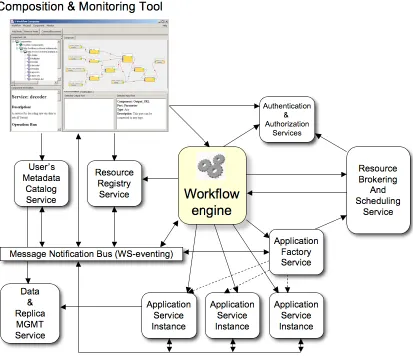
7. GPEL (Indiana University [gpel]). A BPEL based system that is designed for dynamic, adaptive large-scale e-science applications.