Abstract: The studies have shown that with the increase in the degree of cattle infestation with Echinococci, a decreased concentration of bound amino acids is observed in the organs and tissues, especially in the affected organs (liver, lungs), which is an evidence of their decomposition to free amino acids. The diversity of their concentrations in various organs and tissues has been established, which is related to the functional peculiarities of the organs. When comparing the total concentration of bound amino acids in the cattle strongly invaded with Echinococci with that in clinically healthy animals, it has been found that its concentration decreased 1.5 times in the liver and in the rib eye, 1.3 times — in the lung tissues and in the spleen, and 1.2 times — in the heart muscle and in the tissues of the kidneys. With a strong degree of infestation, the total concentration of bound amino acids in all organs and tissues was 1.5 times lower than in clinically healthy animals. It should be noted that in the case of echinococcosis, the following related amino acids were not registered in cattle: in the heart muscle — lysine, in the liver and lungs — lysine and tyrosine; and in the tissues of the liver of clinically healthy animals — bound amino acid lysine in the liver tissues, and lysine and tyrosine — in the lung tissues. Decreased concentration of bound amino acids in the case of echinococcosis is an evidence of the destructive processes in the organs and tissues of the animals, which results in deterioration of the quality and safety of animal slaughter products.
Index Terms: cattle, echinococcosis, bound amino acids, slaughter products, safety, organs, tissues.
I. INTRODUCTION
Improving the efficiency of food production is one of the main tasks for better satisfying the needs of the population and ensuring food security of the country [1-3]. Providing the population with high-quality food products is one of the most pressing problems of our time. Among food products, the
Revised Manuscript Received on May 06, 2019
Andrey Georgievich Koshchaev, Kuban State Agrarian University,
Krasnodar, Russia.
Tatyana Andreevna Inyukina, Kuban State Agrarian University,
Krasnodar, Russia.
Nino Nodarievna Guguchvili, Kuban State Agrarian University,
Krasnodar, Russia.
Alexander Vitalyevich Uspensky, K. I. Scriabin All-Russian Research
Institute of Fundamental and Applied Parasitology of Animals and Plants, Moscow, Russia.
Sergey Vasilievich Larionov, Saratov State Agrarian University named
after N.I. Vavilov, Saratov, Russia.
Fedor Ivanovich Vasilevich, Moscow state Academy of Veterinary
Medicine and Biotechnology - MVA by K.I. Skryabin, Moscow, Russia.
Sergey Vladimirovich Engashev, Nizhny Novgorod State Agricultural
Academy, Nizhny Novgorod, Russia.
meat of agricultural animals and poultry plays a special role as a source of complete proteins and high-quality fat [4, 5].
Food proteins serve as the building material for the muscle tissues, enzymes, hormones, and by their amino acid composition are similar to "ideal animal proteins", since they contain all essential amino acids in optimal quantities and shares, which increase the biological value of meat [6-8]. To ensure the full-fledged human nutrition, one should consider not only the amount of the dietary protein received with food but also the content of the essential amino acids recommended by the FAO/WHO [9-11].
Biological and food safety of products is currently relevant; it has gone beyond only economic issues and has become a major contemporary social problem [12-14]. Good quality of food is determined by a set of indicators, of which quality and safety are the most important ones; it is considered as a set of properties of the components that completely remove any harmful effects on human health. By systematic monitoring, compliance of food products to the quality requirements is determined, as well as the presence of harmful ingredients [15-17].
Quality and safety of meat products are some of the leading issues in nutrition, which contributes to the continuous improvement and validation of modern scientific achievements aimed at preventing sales of nonconforming products in the case of helminthiases in animals [18-20].
Currently, due to farm animals’ infestation, death, or decreased productivity, society loses large amounts of food products [21-23]. In the consumer market, the food problem related to the technology of obtaining high-quality food is most challenging. Solving this problem requires taking a set of measures aimed at preventing various diseases [24-27].
One of the main indicators of the nutritional value of meat is amino acids being the base of proteins. Most amino acids are needed for normal growth and development of the organism [28, 29]. Deficiency of amino acids may be caused by many negative factors (stress, traumas, infection, age, therapy and chemical imbalance in the organism). With that, one should make sure that the content of amino acids in the organism is balanced since the lack of at least one amino acid results in the disruption of protein biosynthesis [30-32]. This paper was aimed at establishing the amino acid composition of cattle
slaughter products in the case of echinococcosis.
The Effect of Metabolites Echinococcus
Granulosus On the Amino Acid Composition of
The Cattle Slaughter Products
Andrey Georgievich Koshchaev, Tatyana Andreevna Inyukina, Nino Nodarievna Guguchvili,
Alexander Vitalyevich Uspensky, Sergey Vasilievich Larionov, Fedor Ivanovich Vasilevich,
II. MATERIALSANDMETHODS
To determine the influence of echinococci's metabolic byproducts on the macroorganism, the authors performed biochemical studies of conceivably bound amino acids in the organs and tissues with the use of electrophoresis using a Kapel 103-R device.
Identification of bound amino acids concentrations in the extract from organs and tissues is important for determining the quality of the products of slaughtering healthy cattle and cattle with helminthiases, echinococcosis in particular.
As a result of postmortem examination of 2,500 animals, echinococcosis was found in 635 (25 %); 460 animals (18 %) had liver echinococcosis (Echinococcus granulosus larva), and 175 animals (7 %) had lung echinococcosis.
To determine the concentration of bound amino acids in the case of cattle echinococcosis, extract from organs and tissues was found (rib eye, heart muscle, liver, lungs, spleen, and kidneys). With that, one average sample of organs and tissues was taken from 10 animals. The studied animals were divided into 3 groups, 10 average samples in each. The reference group consisted of clinically healthy animals; the first experimental group consisted of cattle with a weak degree of infestation with Echinococci, the second experimental group — of cattle with a strong degree of infestation with
Echinococci.
The authors determined the concentration of bound amino acids (arginine, lysine, tyrosine, phenylalanine, histidine, leucine, methionine, valine, proline, threonine, tryptophan, serine, α-alanine, glycine) in the organs and tissues of clinically healthy animals and animals with echinococcosis. The results of the study were subjected to biometric processing.
III. RESULTSANDDISCUSSION
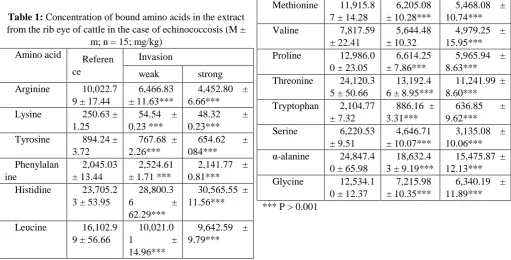
[image:2.595.42.554.354.614.2]To determine the nutritional value of capital slaughter products in the case of echinococcosis, depending on the extent of invasion, the authors determined the concentration of bound amino acids in the extract from organs and tissues (rib eye, heart muscle, liver, lungs, spleen, and kidneys). For instance, in the case of a low degree of cattle infestation with Echinococci, the concentration of bound amino acid histidine in the rib eye was 528 times higher than that of lysine, 38 times higher than that of tyrosine, 33 times higher than that of tryptophan, 11 times higher than that of phenylalanine, 6 times higher than that of serine, 5 times higher than that of valine and methionine, 4 times higher than that of arginine, glycine, and proline, 3 times higher than that of leucine, and 2 times higher than that of α-alanine and threonine (Table 1).
Table 1: Concentration of bound amino acids in the extract from the rib eye of cattle in the case of echinococcosis (M ±
m; n = 15; mg/kg)
Amino acid Referen
ce
Invasion
weak strong
Arginine 10,022.7
9 ± 17.44
6,466.83 ± 11.63***
4,452.80 ± 6.66***
Lysine 250.63 ±
1.25
54.54 ± 0.23 ***
48.32 ±
0.23***
Tyrosine 894.24 ±
3.72
767.68 ± 2.26***
654.62 ±
084*** Phenylalan
ine
2,045.03 ± 13.44
2,524.61 ± 1.71 ***
2,141.77 ± 0.81***
Histidine 23,705.2
3 ± 53.95
28,800.3
6 ±
62.29***
30,565.55 ± 11.56***
Leucine 16,102.9
9 ± 56.66
10,021.0
1 ±
14.96***
9,642.59 ± 9.79***
Methionine 11,915.8
7 ± 14.28
6,205.08 ± 10.28***
5,468.08 ± 10.74***
Valine 7,817.59
± 22.41
5,644.48 ± 10.32
4,979.25 ± 15.95***
Proline 12,986.0
0 ± 23.05
6,614.25 ± 7.86***
5,965.94 ± 8.63***
Threonine 24,120.3
5 ± 50.66
13,192.4 6 ± 8.95***
11,241.99 ± 8.60*** Tryptophan 2,104.77
± 7.32
886.16 ± 3.31***
636.85 ±
9.62***
Serine 6,220.53
± 9.51
4,646.71 ± 10.07***
3,135.08 ± 10.06***
α-alanine 24,847.4
0 ± 65.98
18,632.4 3 ± 9.19***
15,475.87 ± 12.13***
Glycine 12,534.1
0 ± 12.37
7,215.98 ± 10.35***
6,340.19 ± 11.89*** *** P > 0.001
It has been found that compared to the clinically healthy animals with a low degree of infestation with cattle Echinococci, the concentration of bound amino acids in the rib eye was lower: lysine — by 5 times, glycine, methionine, proline, threonine, tryptophan — by 2 times, leucine — by 1.6 times, arginine — by 1.5 times, α-alanine, valine and serine — by 1.3 times, tyrosine — by 1.2 times, and that of histidine and phenylalanine — on the contrary, higher by 1.2 times.
In the case of strong degree of invasion, the concentration of bound amino acid histidine in the rib eye was 633 times higher than that of lysine, 48 times higher than that of tryptophan, 47 times higher than that of tyrosine, 14 times higher than that of phenylalanine, 10 times higher than that of serine, 7 times higher than that of arginine, 6 times higher than
that of valine and methionine, 5 times higher than that of glycine and proline, 3 times higher than that of leucine and threonine, and 2 times higher than that of α-alanine.
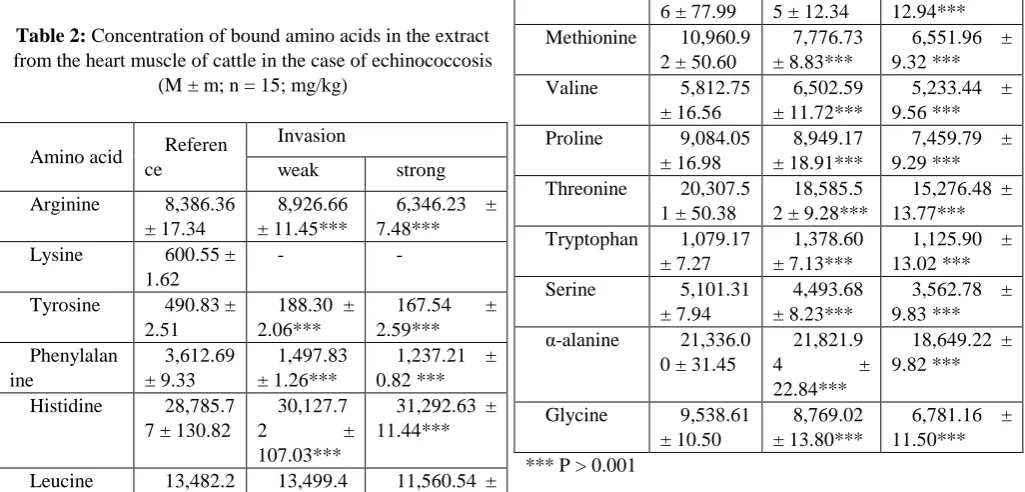
In the case of a weak degree of invasion with Echinococci, the concentration of bound amino acid histidine in the extract from the heart muscle was 160 times higher than that of tyrosine, 22 times higher than that of tryptophan, 20 times higher than that of phenylalanine, 7 times higher than that of serine, 5 times higher than that of valine, 4 times higher than that of methionine, 3 times higher than that of arginine, glycine, and proline, and 2
amino acids α-alanine and histidine were almost at the same level. Bound amino acid lysine was not identified in the
[image:3.595.42.555.76.322.2]extract from the heart muscle (Table 2).
Table 2: Concentration of bound amino acids in the extract from the heart muscle of cattle in the case of echinococcosis
(M ± m; n = 15; mg/kg)
Amino acid Referen
ce
Invasion
weak strong
Arginine 8,386.36
± 17.34
8,926.66 ± 11.45***
6,346.23 ± 7.48***
Lysine 600.55 ±
1.62
- -
Tyrosine 490.83 ±
2.51
188.30 ± 2.06***
167.54 ±
2.59*** Phenylalan ine 3,612.69 ± 9.33 1,497.83 ± 1.26***
1,237.21 ± 0.82 ***
Histidine 28,785.7
7 ± 130.82
30,127.7
2 ±
107.03***
31,292.63 ± 11.44***
Leucine 13,482.2 13,499.4 11,560.54 ±
6 ± 77.99 5 ± 12.34 12.94***
Methionine 10,960.9
2 ± 50.60
7,776.73 ± 8.83***
6,551.96 ± 9.32 ***
Valine 5,812.75
± 16.56
6,502.59 ± 11.72***
5,233.44 ± 9.56 ***
Proline 9,084.05
± 16.98
8,949.17 ± 18.91***
7,459.79 ± 9.29 ***
Threonine 20,307.5
1 ± 50.38
18,585.5 2 ± 9.28***
15,276.48 ± 13.77*** Tryptophan 1,079.17
± 7.27
1,378.60 ± 7.13***
1,125.90 ± 13.02 ***
Serine 5,101.31
± 7.94
4,493.68 ± 8.23***
3,562.78 ± 9.83 ***
α-alanine 21,336.0
0 ± 31.45
21,821.9
4 ±
22.84***
18,649.22 ± 9.82 ***
Glycine 9,538.61
± 10.50
8,769.02 ± 13.80***
6,781.16 ± 11.50*** *** P > 0.001
As one can see from the data above, in the case of a low degree of invasion with Echinococci, the concentration of bound amino acids in the extract from the heart muscle was subjected to dynamics: it was 3 times lower than that of tyrosine, 2.4 times lower than that of phenylalanine, 1.4 times lower than that of methionine, 1.1 times lower than that of glycine, serine, threonine, and, in contrast, it was 1.3 times higher than that of tryptophan, 1.1 times higher than that of arginine and valine. The content of bound amino acids α-alanine, histidine, leucine, and proline was almost at the same level with that in clinically healthy animals; at the same time, bound amino acid lysine was not found.
In the extract from the heart muscle, the concentration of bound amino acid histidine was 187 times higher than that of tyrosine, 28 times higher than that of tryptophan, 25 times
higher than that of phenylalanine, 9 times higher than that of serine, 6 times higher than that of valine, 5 times higher than that of arginine, glycine, and methionine, 4 times higher than that of proline, 3 times higher than that of leucine, 2 times higher than that of α-alanine and threonine. Bound amino acid lysine was not found.
In the extract from the liver of weakly invaded cattle, the concentration of bound amino acid histidine was 38 times higher than that of tryptophan, 22 times higher than that of phenylalanine, 7 times higher than that of serine, 6 times higher than that of valine, 4 times higher than that of arginine, methionine and proline, 3 times higher than that of glycine and leucine, and 2 times higher than that of α-alanine and threonine. Bound amino acids lysine and tyrosine were not found (Table 3).
Table 3: Concentration of bound amino acids in the extract from the liver of cattle in the case of echinococcosis (M ± m; n
= 15; mg/kg)
Amino acid Referen
ce
Invasion
weak strong
Arginine 13,498.
52 ± 6.17
7,456.58 ± 9.29***
5,638.95 ± 8.34***
Lysine - - -
Tyrosine 915.58
± 1.10
- -
Phenylalan ine
3,638.4 2 ± 12.34
1,384.08 ± 1.21***
1,125.53 ± 0.77***
Histidine 21,680.
20 ± 64.16
29,922.1
6 ±
46.74***
32,594.90 ± 11.31***
Leucine 15,552.
35 ± 21.34
10,242.0
6 ±
46.65***
9,848.10 ± 12.38***
Methionine 8,793.1 2 ± 15.67
8,079.30 ± 9.87***
7,551.29 ± 9.52***
Valine 10,375. 4,866.88 4,232.87 ±
75 ± 18.42 ± 16.09*** 8.99***
Proline 15,665.
44 ± 47.74
7,588.60 ± 8.39***
6,234.39 ± 9.97***
Threonine 21,969.
42 ± 22.25
13,567.6
3 ±
17.71***
10,290.00 ± 13.03***
Tryptophan 2,211.8 7 ± 9.09
791.39 ± 9.30***
621.65 ±
8.91***
Serine 6,108.9
1 ± 7.02
4,360.27 ± 9.93***
3,294.72 ± 8.92***
α-alanine 26,016.
25 ± 52.54
16,548.3
2 ±
11.70***
14,822.75 ± 27.13***
Glycine 15,174.
39 ± 10.08
9,876.57 ± 8.24***
8,239.69 ± 12.66*** *** P > 0.001
The concentrations of bound amino acids in the extract from the liver in the case of a weak degree of cattle invasion with Echinococci varied as
[image:3.595.44.555.522.812.2]lower than that of arginine, valine, and proline, 1.6 times lower than that of α-alanine and threonine, 1.5 times lower than that of glycine and leucine, 1.4 times lower than that of serine, in contrast, it was 1.4 times higher than that of histidine, compared to the clinically healthy animals. Bound amino acids lysine and tyrosine were not found.
In the case of a strong degree of cattle invasion with Echinococci, the concentration of bound amino acid histidine in the extract from the liver was 52 times higher than that of tryptophan, 29 times higher than that of phenylalanine, 10 times higher than that of serine, 8 times higher than that of valine, 6 times higher than that of arginine, 5 times higher than that of proline, 4 times higher than that of glycine and
methionine, 3 times higher than that of leucine and threonine, and 2 times higher than that of α-alanine. Bound amino acids lysine and tyrosine were not found.
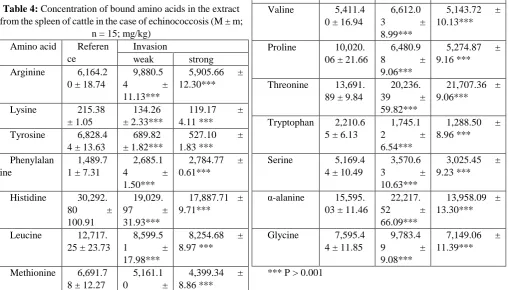
It has been found that the concentration of bound amino acid α-alanine in the extract from the spleen was 166 times higher than that of lysine, 32 times higher than that of tyrosine, 13 times higher than that of tryptophan, 8 times higher than that of phenylalanine, 6 times higher than that of serine, 4 times higher than that of methionine, 3 times higher than that of valine, leucine and proline, 2 times higher than that of arginine and glycine, 1.2 times higher than that of histidine, and 1.1 times higher than that of threonine (Table 4).
Table 4: Concentration of bound amino acids in the extract from the spleen of cattle in the case of echinococcosis (M ± m;
n = 15; mg/kg)
Amino acid Referen
ce
Invasion
weak strong
Arginine 6,164.2
0 ± 18.74
9,880.5
4 ±
11.13***
5,905.66 ± 12.30***
Lysine 215.38
± 1.05
134.26 ± 2.33***
119.17 ±
4.11 ***
Tyrosine 6,828.4
4 ± 13.63
689.82 ± 1.82***
527.10 ±
1.83 *** Phenylalan
ine
1,489.7 1 ± 7.31
2,685.1
4 ±
1.50***
2,784.77 ± 0.61***
Histidine 30,292.
80 ±
100.91
19,029.
97 ±
31.93***
17,887.71 ± 9.71***
Leucine 12,717.
25 ± 23.73
8,599.5
1 ±
17.98***
8,254.68 ± 8.97 ***
Methionine 6,691.7 8 ± 12.27
5,161.1
0 ±
4,399.34 ± 8.86 ***
8.49***
Valine 5,411.4
0 ± 16.94
6,612.0
3 ±
8.99***
5,143.72 ± 10.13***
Proline 10,020.
06 ± 21.66
6,480.9
8 ±
9.06***
5,274.87 ± 9.16 ***
Threonine 13,691.
89 ± 9.84
20,236.
39 ±
59.82***
21,707.36 ± 9.06***
Tryptophan 2,210.6 5 ± 6.13
1,745.1
2 ±
6.54***
1,288.50 ± 8.96 ***
Serine 5,169.4
4 ± 10.49
3,570.6
3 ±
10.63***
3,025.45 ± 9.23 ***
α-alanine 15,595.
03 ± 11.46
22,217.
52 ±
66.09***
13,958.09 ± 13.30***
Glycine 7,595.4
4 ± 11.85
9,783.4
9 ±
9.08***
7,149.06 ± 11.39***
*** P > 0.001
Compared to the clinically healthy animals in the case of a weak degree of invasion, a decreased concentration of bound amino acids was found in the extract from the spleen: 10 times lower than that of tyrosine, 2 times lower than that of histidine, lysine, leucine, proline and serine, 1.3 times lower than that of methionine and tryptophan, and on the contrary, increased concentrations were found: 2 times higher than that of arginine, threonine, and phenylalanine, 1.4 times higher than that of α-alanine, 1.3 times higher than that of glycine, 1.2 times higher than that of valine.
In the extract from the spleen, the concentration of bound amino acid threonine was 182 times higher than that of lysine, 41 times higher than that of tyrosine, 17 times higher than that of tryptophan, 8 times higher than that of phenylalanine, 7
times higher than that of serine, 5 times higher than that of methionine, 4 times higher than that of arginine, valine and proline, 3 times higher than that of glycine and valine, 1.6 times higher than that of α-alanine, and 1.2 times higher than that of histidine.
[image:4.595.47.557.221.511.2]In the case of a low degree of invasion, the concentration of bound amino acid α-alanine in the extract from the lung tissues was 25 times higher than that of phenylalanine, 13 times higher than that of tryptophan, 5 times higher than that of serine, 3 times higher than that of arginine, valine and methionine, 2 times higher than that of glycine, leucine and proline, 1.3 times higher than that of threonine, 1.2 times higher than that of histidine. Bound amino acids lysine and tyrosine were not found (Table 5).
Table 5: Concentration of bound amino acids in the extract from the lungs of cattle in the case of echinococcosis (M ± m;
n = 15; mg/kg)
Amino acid Referen
ce
Invasion
weak strong
Arginine 4,691.7
7 ± 11.21
4,365.7
2 ±
3,758.24 ± 7.20***
13.21***
Lysine - - -
Tyrosine 940.77
± 0.55
Phenylalan ine
1,428.0 9 ± 7.52
175.77 ± 2.31***
1,085.41 ± 0.73***
Histidine 13,610.
27 ± 11.87
10,661.
80 ±
40.10***
9,870.68 ± 7.29***
Leucine 6,248.2
8 ± 18.77
5,322.3
5 ±
10.67***
4,865.63 ± 11.46***
Methionine 3,593.6 3 ± 18.56
3,151.7
5 ±
18.58***
2,878.05 ± 9.11***
Valine 4,421.2
7 ± 17.71
3,202.3
8 ±
9.74***
2,757.18 ± 9.62***
Proline 6,610.9
3 ± 5.00
6,122.5
5 ±
9.65***
5,112.37 ± 7.63***
Threonine 9,420.9
5 ± 11.61
8,080.0
2 ±
11.30***
6,146.04 ± 14.31***
Tryptophan 869.64 ± 3.35
806.45 ± 6.56***
719.58 ±
10.97***
Serine 2,703.6
6 ± 9.57
2,307.4
8 ±
11.54***
1,959.54 ± 11.14***
α-alanine 10,893.
46 ± 6.29
10,842.
65 ±
17.75*
9,752.68 ± 9.42***
Glycine 7,525.0
5 ± 11.03
6,487.3
3 ±
12.25***
5,353.73 ± 13.04***
*P<0.05; *** P > 0.001
The table shows that in the extract from the lung tissue, the concentration of bound amino acids was 8 times lower than that of phenylalanine, 1.4 times lower than that of valine, 1.3 times lower than that of histidine, 1.2 times lower than that of leucine, serine, and threonine, 1.1 times lower than that of arginine, glycine, methionine and tryptophan, compared to the clinically healthy animals. Bound amino acids α-alanine and proline were almost at the same level as that of clinically healthy animals. Bound amino acids lysine and tyrosine were not found.
In the case of a strong degree of invasion with Echinococci, the concentration of bound amino acid histidine in the extract from the lungs tissue was 14 times higher than that of tryptophan, 9 times higher than that of phenylalanine, 5 times higher than that of serine, 4 times higher than that of valine, 3 times higher than that of arginine, and methionine, and 2 times higher than that of glycine, leucine, proline and threonine. The concentration of bound amino acid α-alanine was almost at the same level as that of clinically healthy animals. Bound amino acids lysine and tyrosine were not found.
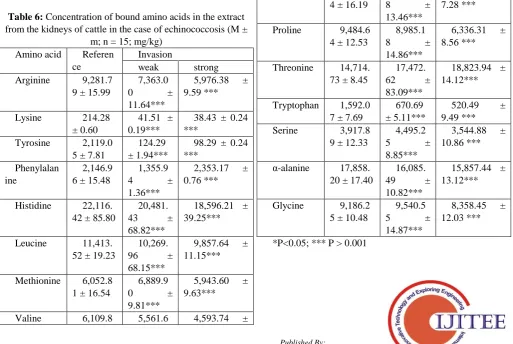
[image:5.595.42.556.466.810.2]In the extract from the kidneys, the concentration of bound amino acid histidine was 493 times higher than that of lysine, 165 times higher than that of tyrosine, 31 times higher than that of tryptophan, 15 times higher than that of phenylalanine, 5 times higher than that of serine, 4 times higher than that of valine, 3 times higher than that of arginine and methionine, 2 times higher than that of glycine, leucine and proline, 1.3 times higher than that of α-alanine, and 1.2 times higher than that of threonine (Table 6).
Table 6: Concentration of bound amino acids in the extract from the kidneys of cattle in the case of echinococcosis (M ±
m; n = 15; mg/kg)
Amino acid Referen
ce
Invasion
weak strong
Arginine 9,281.7
9 ± 15.99
7,363.0
0 ±
11.64***
5,976.38 ± 9.59 ***
Lysine 214.28
± 0.60
41.51 ± 0.19***
38.43 ± 0.24 ***
Tyrosine 2,119.0
5 ± 7.81
124.29 ± 1.94***
98.29 ± 0.24 ***
Phenylalan ine
2,146.9 6 ± 15.48
1,355.9
4 ±
1.36***
2,353.17 ± 0.76 ***
Histidine 22,116.
42 ± 85.80
20,481.
43 ±
68.82***
18,596.21 ± 39.25***
Leucine 11,413.
52 ± 19.23
10,269.
96 ±
68.15***
9,857.64 ± 11.15***
Methionine 6,052.8 1 ± 16.54
6,889.9
0 ±
9.81***
5,943.60 ± 9.63***
Valine 6,109.8 5,561.6 4,593.74 ±
4 ± 16.19 8 ±
13.46***
7.28 ***
Proline 9,484.6
4 ± 12.53
8,985.1
8 ±
14.86***
6,336.31 ± 8.56 ***
Threonine 14,714.
73 ± 8.45
17,472.
62 ±
83.09***
18,823.94 ± 14.12***
Tryptophan 1,592.0 7 ± 7.69
670.69 ± 5.11***
520.49 ±
9.49 ***
Serine 3,917.8
9 ± 12.33
4,495.2
5 ±
8.85***
3,544.88 ± 10.86 ***
α-alanine 17,858.
20 ± 17.40
16,085.
49 ±
10.82***
15,857.44 ± 13.12***
Glycine 9,186.2
5 ± 10.48
9,540.5
5 ±
14.87***
8,358.45 ± 12.03 ***
In the extract from the kidneys tissues, compared to the clinically healthy animals, the concentration of bound amino acids was 17 times lower than that of tyrosine, 5 times lower than that of lysine, 2 times lower than that of tryptophan and phenylalanine, 1.3 times lower than that of arginine, 1.1 times lower than that of α-alanine, valine, histidine, leucine and proline and, on the contrary, 1.2 times higher than that of threonine, and 1.1 times higher than that of methionine and serine. The concentration of bound amino acid glycine was virtually at the same level as that of clinically healthy animals.
In the extract from the kidneys’ tissues, compared to the clinically healthy animals, the concentration of bound amino acid threonine was 490 times higher than that of lysine, 191 times higher than that of tyrosine, 36 times higher than that of tryptophan, 8 times higher than that of phenylalanine, 5 times higher than that of serine, 4 times higher than that of valine, 3 times higher than that of arginine, methionine and proline, 2
times higher than that of glycine and leucine, 1.2 times higher than that of α-alanine. The concentration of bound amino acid histidine was almost at the same level as that of clinically healthy animals.
The total concentration of bound amino acids in the extract from the rib eye in the case of a weak degree of cattle invasion with Echinococci was 111,672.58 mg/kg, in the extract from the heart muscle – 132,517.21 mg/kg, in the extract from the liver – 114,683.84 mg/kg, in the extract from the lungs – 61,526.25 mg/kg, in the extract from the spleen – 116,826.50 mg/kg, and in the extract from the kidneys – 109,337.49 mg/kg. The highest content of bound amino acids was noted in the extract from the heart muscle, which was 2 times higher than in the extract from the lung tissues, 1.2 times higher than in the extract from the rib eye, kidney tissues and in the liver, and 1.1 times higher than in the extract from the tissues of the spleen (Figure 1).
0 20000 40000 60000 80000 100000 120000 140000 160000 180000
1 2 3 4 5 6
[image:6.595.104.502.300.522.2]Clinically healthy animals Weak invasion Strong invasion
Fig. 1: The total concentration of bound amino acids in the extract from the organs and tissues of cattle with
echinococcosis: 1 — rib eye; 2 — heart muscle; 3 — liver; 4 — lungs; 5 – spleen; 6 – kidney.
It has been found that in the case of a weak degree of cattle invasion with Echinococci, the total concentration of bound amino acids decreased: 1.4 times in the tissues of the liver and rib eye, 1.2 times in the tissues of the lungs, 1.1 times in the tissues of the kidneys and the spleen, compared to the clinically healthy animals. In the heart muscle, the concentration of bound amino acids was virtually at the same level as that of clinically healthy animals.
The total concentration of bound amino acids in the extract from the rib eye in the case of a strong degree of cattle invasion with Echinococci was 100,748.90 mg/kg, in the extract from the heart muscle – 115,244.88 mg/kg, in the extract from the liver – 104,494.84 mg/kg, in the extract from the lungs – 54,259.13 mg/kg, in the extract from the spleen – 97,425.48 mg/kg, and in the extract from the kidneys – 100,898.97 mg/kg. The highest content of bound amino acids
was noted in the extract from the heart muscle, which was 2 times higher than in the extract from the lungs tissues, 1.2 times higher than in the extract from the spleen tissues, 1.1 times higher than in the extract from the rib eye, the liver, and the kidneys tissues (Figure).
When comparing the total concentration of bound amino acids in the cattle strongly invaded with Echinococci with that in clinically healthy animals, it has been found that its concentration decreased 1.5 times in the liver and in the rib eye, 1.3 times in the lung tissues and in the spleen, and 1.2 times in the heart muscle and in the tissues of the kidneys. Depending on the degree of invasion with Echinococci, it has been found that in the case of a strong degree of cattle
invasion, the total
times in the rib eye, in the heart muscle and in the spleen, and 1.1 times in the extract from the liver, lungs and, kidneys, compared to a low degree of invasion with Echinococci. With a strong degree of infestation, the total concentration of bound amino acids in all organs and tissues was 1.5 times lower than in clinically healthy animals.
High concentration of bound amino acids in the clinically healthy animals is an evidence of the absence of the process of protein decomposition in the tissues and organs. However, in the case of echinococcosis, the concentration of bound amino acids decreased, and they decomposed to free amino acids; in addition, a change in the concentration was noted, depending on the functional peculiarities of the organ, and on the degree of invasion with Echinococci. Decreased concentration of bound amino acids in the organs and tissues of the animals with echinococcosis is an evidence of the destructive processes, which lead to deterioration of the quality of cattle slaughtering products, regardless of the degree of invasion.
IV. CONCLUSION
In the case of cattle echinococcosis, a significant decrease in the total concentration of bound amino acids was noted: 1.5 times — in the tissues of the liver and the rib eye, 1.3 times — in the lungs and spleen tissues, and 1.2 times — in the heart muscle and in the tissues of the kidneys, compared to the clinically healthy animals. Based on the obtained results, it has been determined that in the case of echinococcosis, especially in the affected organs and tissues, the quality of cattle slaughter products deteriorates due to the development of destructive processes; therefore, it is necessary to use animal carcasses in industrial processing (production of boiled and boiled-smoked sausages), the internal organs are to be sent for technical disposal.
REFERENCES
1. A. Semenov, E. Anisimova, E. Gosteva, ―Formirovanie myasnykh stad v Povolzhe‖ [Forming beef herds in the Volga region], Dairy and beef cattle breeding, 2, 2008, pp. 17 – 19.
2. A.G. Koshchaev, I.V. Shchukina, A.V. Garkovenko, E.V. Ilnitskaya, V.V. Radchenko, A.A. Bakharev, L.A. Khrabrova, ―Allelic variation of marker genes of hereditary diseases and economically important traits in dairy breeding cattle population‖, Journal of Pharmaceutical Sciences and Research, 10(6),2018, pp. 1566-1572.
3. A.A. Bakharev, O.M. Sheveleva, K.A. Fomintsev, K.N. Grigoryev, A.G. Koshchaev, K.A. Amerkhanov, I.M. Dunin, ―Biotechnological characteristics of meat cattle breeds in the Tyumen region‖, Journal of Pharmaceutical Sciences and Research, 10(9), 2018, pp. 2383 – 2390. 4. V. Burmistrov, I. Pustovit, ―Fiziko-khimicheskii sostav myshechnoi i zhirovoi tkani u svinei raznykh genotipov‖ [Physico-chemical composition of the muscle and fat tissues in pigs of various genotypes], Pig Breeding, 2, 2005, pp. 14 – 16.
5. I.N. Tuzov, V.G. Ryadchikov, A.N. Ratoshniy, N.I. Kulikova, A.G. Koshchaev, ―Using Holstein Cattle in Conditions of the Krasnodar Territory‖, Journal of Pharmaceutical Sciences and Research, 10(12), 2018, pp. 3160-3163.
6. A.G. Koshchaev, Y.A. Lysenko, A.V. Luneva, A.N. Gneush, M.V. Aniskina, V.I. Fisinin, I.P. Saleeva, ―Studying Biological Activity of Lactobacillus Hydrolysates‖, Journal of Pharmaceutical Sciences and Research, 10(10), 2018, pp. 2475-2479.
7. N.I. Kryukov, V.O. Yurchenko, A.G. Koshchaev, N.E. Gorkovenko, D.P. Vinokurova, A.A. Bogosyan, S.F. Sukhanova, ―The Derivative of Prussian Blue Paint ‒ Khzh-90 Cesium Isotopes’ Sorbent At Mycotoxicoses‖, International Journal of Pharmaceutical Research, 10(4), 2018, pp. 669-674.
8. A.G. Koshchaev, T.A. Inyukina, N.N. Guguchvili, Y.A. Makarov, A.M. Gulyukin, O.P. Neverova, V.N. Shevkopljas, ―The influence of
metabolic products of Echinococcus granulosus on the oxidation processes in the organism of pigs‖, Journal of Pharmaceutical Sciences and Research, 10(9), 2018, pp. 2317-2325.
9. V.I. Shcherbatov, L.I. Sidorenko, A.G. Koshchaev, V.K. Vorokov, L.N. Skvortsova, ―Chicken hatching syncronization for artificial incubation‖, Journal of Pharmaceutical Sciences and Research, 10(1), 2018, pp. 148-151.
10. M.A. Chasovshchikova, O.M. Sheveleva, M.A. Svjazhenina, N.I. Tatarkina, A.B. Satkeeva, A.A. Bakharev, E.A. Ponomareva, A.G. Koshchaev, ―Relationship between the genetic variants of kappa-casein and prolactin and the productive-biological characteristics of cows of the black-motley breed‖, Journal of Pharmaceutical Sciences and Research, 9(7), 2017, pp. 1038-1044.
11. S.V. Svistunov, A.G. Koshchaev, N.N. Bondarenko, O.V. Koshchaeva, A.M. Smirnov, Y.A. Yuldashbayev, O.G. Lorets, ―Selection of Bees of the Gray Mountain Caucasian Breed: Apis mellifera caucasica L. of the Krasnaya Polyana Type‖, Journal of Pharmaceutical Sciences and Research, 10(12), 2018, pp. 3185-3188.
12. A.N. Ratoshny, A.A. Soldatov, S.I. Kononenko, I.N. Tuzov, A.G. Koshchaev, ―Organization of feeding dairy cows for preventing metabolic disorders‖, Journal of Pharmaceutical Sciences and Research, 10(12), 2018, pp. 3273-3276.
13. I.V. Sobol, L.V. Donchenko, L.Y. Rodionova, A.G. Koshchaev, A.V. Stepovoy, ―Peculiarities of analytical characteristics of pectins extracted from sunflower hearts‖, Asian Journal of Pharmaceutics, 11(1), 2017, pp. S97-S100.
14. A.V. Garkovenko, V.V. Radchenko, E.V. Ilnitskaya, A.G. Koshchaev, I.V. Shchukina, A.A. Bakharev, S.F. Sukhanova, ―Polymorphism of cattle microsatellite complexes‖, Journal of Pharmaceutical Sciences and Research, 10(6), 2018, pp. 1545-1551.
15. E.I. Anisimova, A.G. Koshchaev, A.A. Nesterenko, A.A. Bakharev, A.G. Isaeva, T.M. Shuvaeva, T.V. Kalashnikova, ―Comparative Assessment of The Relationship Between Intrabreed Types Of Simmental Cows And Sectionized Traits‖, International Journal of Pharmaceutical Research, 10(4), 2018, pp. 604-610.
16. I.S. Koba, A.A. Lysenko, A.G. Koshchaev, I.A. Rodin, A.U. Shantyz, ―Effective treatment of chronic endometritis in cows by florinazol preparation‖, Indian Veterinary Journal, 94(10), 2017, pp. 15-18. 17. V.V. Radchenko, E.V. Ilnitskaya, A.S. Rodionova, T.M. Shuvaeva,
Y.A. Lysenko, G.A. Plutakhin, A.I. Manolov, I.M. Donnik, A.G. Koshchaev, ―Identification of autochthonous strains as a basis for the development of the therapeutic and profylactic probiotics‖, Russian Journal of Biopharmaceuticals, 8(1), 2016, pp. 3 – 12.
18. O.V. Arnautov, O.V. Bagryantseva, V.V. Bessonov, ―O neobkhodimosti sovershenstvovaniya sistemy preduprezhdeniya falsifikatsii pishchevykh produktov v evraziiskom ekonomicheskom soyuze‖ [On the necessity to improve the system of preventing the forfeiture of food products in the Eurasian economic Union], Problems of nutrition, 85(2), 2016, pp. 104 – 115.
19. A.V. Borodin, ―Upravlenie kachestvom i bezopasnostyu fermentirovannykh myasoproduktov v protsesse izgotovleniya‖ [Fermented meat products quality and safety management in the production process], Meat technology, 12(156), pp. 54 – 57.
20. V.A. Dolgov, S.A. Lavina, ―Metodologicheskie aspekty veterinarno-sanitarnoi ekspertizy prodovolstvennogo syrya i pishchevoi produktsii‖ [Methodological aspects of veterinary-sanitary expertise of food raw materials and food products], Problems of veterinary sanitation, hygiene, and ecology, 3(19), 2016, pp. 11 – 19.
21. S.S. Zykova, M.S. Danchuk, V.S. Talismanov, N.G. Tokareva, N.M. Igidov, I.A. Rodin, A.G. Koshchaev, N.N. Gugushvili, O.G. Karmanova, ―Predictive and experimental determination of antioxidant activity in the series of substituted‖, Journal of Pharmaceutical Sciences and Research, 10(1), 2018, pp. 164-166.
22. I.S. Koba, A.A. Lysenko, A.G. Koshchaev, A.K. Shantyz, I.M. Donnik, V.I. Dorozhkin, S.V. Shabunin, ―Prevention of Mastitis in Dairy Cows on Industrial Farms‖, Journal of Pharmaceutical Sciences and Research, 10(10), 2018, pp. 2582-2585.
23. I.P. Saleeva, V.S. Lukashenko, A.G. Koshchaev, V.G. Volik, D.Y. Ismailova, ―Quality of Broiler Chicken Meat with the Use of Various Methods of Growing‖, Journal of Pharmaceutical Sciences and Research, 10(11), 2018, pp. 2979-2984.
24. A. Koptelova, V. Khlebov, N. Sedukov, ―Vliyanie mezhporodnogo sparivaniya svinei na biokhimicheskie pokazateli myshechnoi tkani ikh potomstva‖ [The influence of
progeny], Pig Breeding, 6, 2005, pp. 10 – 11.
25. V.P. Krotenkov, N.M. Bedilo, ―Problemy parazitologicheskoi bezopasnosti pri proizvodstve i realizatsii produktsii ptitsevodstva‖ [Issued of parasitological safety in the production and sales of poultry products], Meat industry, 7, 2010, pp. 58 – 59.
26. I.M. Donnik, A.S. Krivonogova, A.G. Isaeva, A.G. Koshchaev, O.P. Neverova, O.A. Bykova, ―Productivity and health markers for large cattle‖, International Journal of Green Pharmacy, 11(3), 2017, pp. S620-S625.
27. 24. Quality assessment of chicken meat by analysis-of-variance method // Plutakhin G.A., Koshchaev A.G., Donnik I.M.// Research Journal of Pharmaceutical, Biological and Chemical Sciences. – 2016. ‒ No.7(3). ‒ P. 2293-2299.
28. A.G. Koshchaev, I.V. Shchukina, M.P. Semenenko, K.V. Vasilevich, ―Amino acid profile of meat of specialized beef breeds‖, Research Journal of Pharmaceutical, Biological and Chemical Sciences, 7(5), 2016, pp. 670-676.
29. P.D. Onischuk, M.P. Semenenko, E.V. Kuzminova, A.G. Koshchaev, ―Selective mechanisms of antiviral effect of triazole derivatives in a transplantable virus-producing cell culture of hamadryas baboon‖, Research Journal of Pharmaceutical, Biological and Chemical Sciences, 7(6), 2016, pp. 1778-1782.
30. L.V. Antipova, A.V. Makarov, S.M. Suleymanov, ―Mikrostrukturnye izmeneniya myasa perepelov v protsesse avtoliza‖ [Microstructural changes of meat of quails during autolysis], Meat industry, 2, 2007, pp. 54 – 56.
31. M.V. Zabelina, ―Soderzhanie svobodnykh aminokislot v belke myshechnoi tkani molodnyaka ovets‖ [The content of free amino acids in the protein of the muscle tissues of young sheep], Agricultural biology, 2, 2005, pp. 71 – 74.