
International Journal of Innovative Technology and Exploring Engineering (IJITEE) ISSN: 2278-3075, Volume-8 Issue-8, June, 2019
Abstract: The classification of texture plays a major role in many image processing applications. This paper proposes an extension to the existing motif co-occurrence matrix (MCM) [1] and its recent variants [2, 3]. This paper initially transforms the color image into HSV color plane and computes the individual color histograms for the H, S and V plane. This paper divides the V-plane of the image into macro regions of size 4x4. Each macro region is divided into four non-overlapped micro regions of size 2x2. Each micro region is replaced with a MCM index which ranges from 0 to 5. This process transforms the macro regions into a grid of size 2x2 with MCM indexes. This paper derives dynamic motif (DM) index on this 2x2 grid and this index ranges from 0 to 23 and extracts region based DM matrix (RDMM) by computing co-occurrence matrix on RDM index image. This paper derives two descriptors based on RDMM and color histogram. The first descriptor computes the histogram on RDMM and integrates these features with the histogram features of H, S and V plane and this form the feature vector. The second descriptor computes the GLCM features on RDMM and integrates with color histograms. The proposed two descriptors are experimented with popular color texture database and the results indicate the efficacy of the proposed method over the existing ones.
Index Terms: dynamic motifs; histogram; GLCM feature; motif indexes.
I. INTRODUCTION
One of the most vital and crucial step in many image processing applications [4-8] is the extraction of significant and distinctive features. The essential properties need to be considered, in the extraction of distinctive features, are quality of the features and computational cost. In the literature many different types of descriptors are proposed to extract features from the image surface with their own limitations and advantages. The descriptors based on local features have become widely popular in texture analysis due to their robustness and efficiency. The local binary pattern (LBP) and its variants [9-14] are very popular local descriptors and they derive robust local features more efficiently and they are easy to understand and compute.
The LBP was first introduced by Ojala et al.[15] and LBP is proven to be an efficient gray scale operator and it captures the significant local spatial features of the image and it has demonstrated the powerful discriminative capabilities. To improve the performance of LBP many variants are proposed in the literature. The LBP derives binary patterns an extension to this derived local ternary pattern (LTP) [16] and LTP overcomes the sensitive issues of LBP. The LBP derives
Revised Manuscript Received on June 13, 2019
K.S.R.K.Sarma, Research Scholar, JNTUA.Regd.No: 13PH0521,
Assistant Professor in CSE Department at VidyaJyothi Institute of Technology (Autonomous), Hyderabad, Telangana, India.
circular patterns and in the literature the Elongated local binary pattern (ELBP) are derived on elliptical neighborhood [17, 18]. The ELBP [17] are not used widely because one has to consider both horizontal and vertical elliptical neighborhoods and each of them requires 8-sampling points and put together requires 12-samlping points since both of them have some common sampling points over a center pixel. This derives a complex structure and derives a huge ELBP code ranging from 0 to 212-1 or 2*28-1 (by concatenating both); and further they derive only anisotropic local structure information and completely ignores the isotropic structural information. To have more precise information on local neighborhoods one should consider both circular (isotropic) and elliptical (anisotropic) neighborhood. To address this recently circular and elliptical local binary pattern (CE-LBP) [19] and its variants [20-21] are proposed in the literature. The CE-LBP and its variants [19-21] capture both circular and elliptical neighborhood information more precisely. The CE-LBP [19] quantizes the H-ELBP, V-ELBP and LBP neighborhood into a 3x3 neighborhood without losing any information. The CE-LBP is attained high classification rate on popular texture database when compared to LBP, ELBP and other variants of LBP [19]. The LBP compares the central pixel gray level value with sampling points and derives the binary pattern based on the sign difference. An improved version of this basic LBP known as improved local binary pattern (ILBP) [22] derived local binary patterns by comparing the mean gray level value of the 3x3 neighborhood with sampling points. To extract maximum mutual information between derived features and class labels compact LBP [23] is proposed and CLBP attained better classification results with small number of codes.
The LBP and its variants are derived on a circular neighborhood mostly on a 3 x 3 and also extended to 5 x 5 windows. The other local based popular methods known as textons [24] and piano scan motifs (PSM) or motif [1] are derived on 2 x 2 micro grids. The texton based approaches derived simple patterns by considering the identical pixels with similar grey level values on a 2 x 2 grid. The motifs derived patterns by scanning the 2x2 grid based on the incremental difference with the initial scan position and the initial scan position is always fixed i.e. the top left corner of the grid. This paper derives a dynamic approach of motif by not fixing the initial position and derives motifs on a region and this is called as a region based dynamic motif (RDM). This paper is organized as follows. In the second and third section the proposed method and results and discussions along with a brief discussion about the databases used is presented. The conclusions
are presented in section 4.
Classification of Color Textures Using Region
Based Motif and Color Features
II. PROPOSED METHOD
The images can be represented in three ways: i) binary or black and white images ii) gray level images iii) color images. The binary images only hold two levels of brightness or intensities. The brightness or intensity levels of each pixel in a gray level images ranges from 0 to g. The color images are represented by color bands /channels. In each color band the color brightness value ranges from 0 to b. One can specify and visualize the color of an image by using a color space method. Humans may define a color by its attributes of brightness, hue and colorfulness. A typical computer system may perceive a color using the amount of red, green and blue emission. The RGB color model is one of the primary models and it stores individual color brightness values of red, green, and blue. The RGB uses additive color mixing and this basically represents what kind of brightness or light is needed to produce a given color. The other color space knows as HSV (HUE, Saturation and Value) is used mostly by artists. This is mainly because color can be naturally represented in terms of hue and saturation than additive or subtractive mixing of color components like RGB. This paper initially transforms the RGB color texture image into HSV color space. The color histograms are computed on individual hue, saturation and value components. The region based dynamic motif features are extracted on V-components; since it holds the value or gray scale information. For this initially the V-plane of the texture image is divided into macro blocks of size 4x4. Each macro block is subdivided into four non-overlapped 2x2 micro blocks as shown in Fig.1.
X X X X X X X X
X X X X X X X X
X X X X X X X X
X X X X X X X X
(a) Macro region of
size 4x4
(b) Four micro
regions of size
2x2
. Fig 1: The macro and micro regions.
[image:2.595.304.507.64.114.2]This paper derives motif co-occurrence matrix (MCM) index on each micro block. The MCM index ranges from 0 to 5. The MCM always assumes the initial scan position starts from the left most corner pixel of the 2x2 grid. The MCM traverses the given 2x2 grid based on the incremental intensity difference among the other three pixels. The different traversals that can be generated by MCM are given in Fig.2.
Fig. 2: MCM framework: Different traversal with index of MCM.
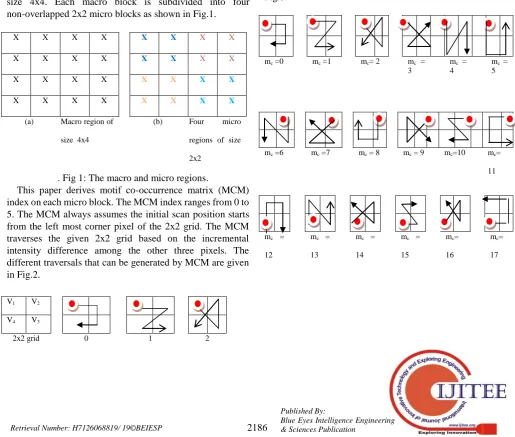
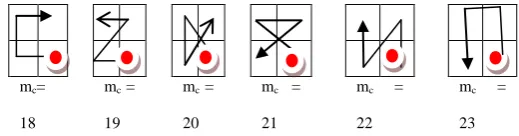
[image:2.595.40.556.398.835.2]The MCM index framework transforms the gray level image into an index image of range 0 to 5 and quantizes the image of size NxM by N/2XM/2. Each MCM index, assigned to a 2 x 2 grid, represents the complex structure of a texture image. This research further quantizes the MCM index image i.e. micro region of size 2x2 into a single unit by deriving a dynamic/ complete motif (DM) index image, and this is named as region based DM (RDM) index image. In the dynamic motif the initial scan position is not fixed and it can start from any position of the 2x2 grid and traverses the entire grid by visiting each pixel position only once based on incremental difference of pixel intensities. The pixel location with least gray level value is chosen as the initial scan position in DM. This results a total of 24 DM indexes on the 2x2 grid i.e. six indexes for each of the four pixel positions. The DM indexes are given in Fig.3.The motifs indexesMc ranging from 0 to 5, 6 to 11, 12 to 17 and 18 to 23 are derived by assuming the least pixel intensity value is at top left most corner, top right most corner, bottom left most corner and bottom right most corner of 2x2 grid respectively as shown in Fig.3.
mc =0 mc =1 mc= 2 mc =
3
mc =
4
mc =
5
V1 V2
V4 V3
2x2 grid 0 1 2
3 4 5
mc =6 mc =7 mc = 8 mc = 9 mc=10 mc=
11
mc =
12
mc =
13
mc =
14
mc =
15
mc=
16
mc=
International Journal of Innovative Technology and Exploring Engineering (IJITEE) ISSN: 2278-3075, Volume-8 Issue-8, June, 2019
Fig. 3: The 24 motifs derived by dynamic motif (DM) This research initially divides the texture image into macro regions of size 4x4 and these macro regions are quantified and transformed into a 2x2 motif index image. This 2x2 motif index image is further transformed into a DM index image with index values ranging from 0 to 23. The framework of region based dynamic motif (RDM) index image is shown in Fig. 4.
24 36 25 30 45 56 210 52
63 12 100 120 89 65 88 80
200 245 20 50 90 46 85 63
249 123 30 45 48 96 36 98
41 52 63 89 65 66 21 32
85 65 21 52 89 63 85 96
78 41 32 63 48 95 84 56
78 86 95 48 96 32 48 99
(a)
24 36 25 30 45 56 210 52
63 12 100 120 89 65 88 80
200 245 20 50 90 46 85 63
249 123 30 45 48 96 36 98
41 52 63 89 65 66 21 32
85 65 21 52 89 63 85 96
78 41 32 63 48 95 84 56
78 86 95 48 96 32 48 99
(b)
Fig.4: The frame work of RDM index image: (a ): 8 x 8 macro region patch; ( b ): division of 2 x 2 blocks of ( a); (c): generation of MCM index image; ( d ): division of MCM index image into 2 x 2 micro blocks; (e): generation of RDM index image patch
This paper computes a co-occurrence matrix on RDM index image and this derives a region based dynamic motif co-occurrence matrix (RDMM). The size of RDMM will be 24x24 (0 to 23 x 0 to 23). The RDMM exhibits the co-occurrence frequencies of region based local feature in the form of Peano scan motifs and dynamic motifs. The advantages of dynamic motif over the PSM are it contains the
only partial information. This research derives two methods on RDMM for classification of textures. In the first method a histogram is derived on RDMM. The RDMM is computed with a distance of 1 and with an angle of rotation i.e.00. This RDMM histogram is integrated with the color histogram of the H, S and V plane to derive final feature vector. The first method is named as color based RDMM histogram method (CRDMMH). In the second method this paper derived five gray level co-occurrences matrix (GLCM) features namely: Contrast, Entropy, Inverse Difference Moment (IDM), Homogeneity, Correlation, and Prominence feature on RDMCM with a distance value d=1 and 2 with an angle of rotation 0o, 450, 90o, 135o, 180o, 225o and 2700. This derives six RDMM for each d value with different rotations. Finally this derives a feature vector of size 2x7x5 =70. This method is named as RDMCM. The second descriptor integrates the histogram of H, S, V color plane with RDMM and it is named as color based RDMM (CRDMM).
The proposed algorithm for method 1: CRDMMH is given below.
Step 1: Transform the given RGB color image into HSV color plane.
Step 2: Compute histograms H, S and V color plane. Step 3: Divide the V-plane of the image into macro grids of size 4x4.
Step 4: Divide each macro grid into micro girds of size 2x2.
Step 5: Compute MCM index on each micro gird and replace the micro grid with MCM index (0 to 5).
Step 6: Derive region based dynamic motif (RDM) index on the 2x2 grid of MCM indexes and replace it with RDM index value (0 to 23).
Step 7: compute co-occurrence matrix on RDM and this become RDMM.
Step 8: Compute histogram RDMM with a distance value of 1 and angle of rotation 00.
Step 9: Derive feature vector by integrating the features derived in step 2 and in step 8.
Step 10: Apply machine leaning classifiers by giving feature vector as the input for classification.
The proposed algorithm for method CRDMM
The steps from 1 to 7 of method 1 are same for method 2. Step 1 to 7: Same as method 1
Step 8: compute two different RDMM with distance value d=1 and 2.
Step 9: on each RDMM with d value =1 and 2 compute 6 different RDMM with an angle of rotation 0o, 45o, 90o, 135o, 180o, 225o and 270o. This derives 7 RDMM on each distance value.
Step 10: Computer five GLCM features on each RDMM this leads to a total of 2x7x5 = 70 statistical features derived on structural information of texture.
Step 11: Integrate the features derived on Step 2 and on step 10 to derive final feature vector of CRDMM.
Step 12: Apply different machine learning classifiers for classification purpose.
End of the algorithm Main contribution of this paper:
mc=
18
mc =
19
mc =
20
mc =
21
mc =
22
mc =
23
2 1 0 5 2 1 0 5
1 5 3 2 1 5 3 2 9 3
0 2 0 1 0 2 0 1 0 0
5 2 2 2 5 2 2 2
based dynamic motif matrix.
2. Derivation of structural features of texture using MCM and DM indexes.
3. Derivation of macro and micro structural features that represent complex structural texture features.
4. Derivation of two methods: one is based on the color and region based dynamic motif co-occurrence histograms and the other is using GLCM features derived on RDMM.
III. RESULTS AND DISCUSSIONS
[image:4.595.310.551.45.688.2]To estimate the color texture classification accuracies of the popular existing methods and the proposed descriptors this research used the five most widely used color texture databases namely:, MIT Vision Texture database (Vistex) [25], Salzburg Texture database (Stex) [26], Colored Brodatz Texture database (CBT) [27], the USPtex [28], the Outex TC-00013 [29]. The sample images are displayed in the following figures and for the sake of clarity a brief description about the number of classes and images considered per each is given below. There are forty dissimilar color texton image classes with image dimension of 512 x 512 available in Vistex database [25].this paper portioned each image into non overlapping images of size 128 x 128. This results a total of 40 classers and in each class 16 images and results a total images of 640. The stex[26] database consists of 476 different images with a resolution of 512 x 512. This research divided each image into 16 non overlapping images of size 128 x 128 and this leads to a total database of sixe 7616 images with 476 classes and 16 images per class. The CBT [27] is an extension of Brodtax data base with images of dimension 640 x 640 with 112 images. This paper obtained 25 non overlapped images by size 128 x 128 by dividing each image in a non-overlapped manner. The USPtex [28] data base consists of 191 varieties of images with 12 images per class and with a dimension of 191 x 191. The Outex [29] database consists of sixty eight different classes of images with a dimension of 128 x 128 and twenty images per class.
Fig.5: Vistex-640 [24].
Fig.6: Stex-7616 [25].
Fig. 7: USPtex-2292 [26].
[image:4.595.55.292.524.735.2]International Journal of Innovative Technology and Exploring Engineering (IJITEE) ISSN: 2278-3075, Volume-8 Issue-8, June, 2019
Fig.9: Outex-1360 [28].
[image:5.595.299.567.255.350.2]This paper derived the feature vector by integrating the individual color histograms of H, S and V plane integrated the features of RDMM. The feature vector of the two proposed descriptors CRDMMH and CRDMM is given as input to the multilayer perceptron, naïvebayes, Ibk and J48 classifiers and they have achieved a good classification rate on the above affordable databases and the classification rates of the proposed descriptors CRDMMH and CRDMM are given in table 1 and 2 respectively. Out of these four classifiers, multilayer perceptron achieved high classification rate followed by Ibk, naïvebayes and J48. The final row of the
Table 1 and 2 displays the average classification rate on all databases considered. This paper used the classification rate of multilayer perceptron in the remaining part of the paper.
Table 1: classification rates of the proposed CRDMMH descriptor with different classifiers.
Database Multilayer
Perceptron Naivebayes IBK J48
MIT-VisTex 94.75 87.39 88.62 88.48
Stex 90.16 84.42 86.59 83.4
USPTex 96.25 89.58 90.4 87.3
CBT 94.91 88.4 89.71 86.21
Outex-13 95.51 88.28 88.72 88.86
Average 94.32 87.61 88.81 86.85
Table 2: classification rates of the proposed CRDMM descriptor using different machine learning classfiers.
Database Multilayer
Perceptron
Naivebayes IBK J48
MIT-VisTex 97.11 89.75 90.98 90.84
Stex 92.52 86.78 88.95 85.76
USPTex 98.61 91.94 92.76 89.66
CBT 97.27 90.76 92.07 88.57
Outex-13 97.87 90.64 91.08 91.22
Average 96.68 89.97 91.17 89.21
Table 3: Classification rate (%) of proposed and state-of-art-methods on various databases.
Database LBP
[15]
LTP [16]
CLBP-SMC[30] CS-LBP
[31]
MCM [1]
MMCM [2]
LMP-CM [3]
proposed CRDMMH
proposed CRDMM
MIT-VisTex 54.28 57.50 85.23 74.56 86.21 87.14 87.52 94.75 97.11
Stex 56.11 74.56 89.88 74.11 89.74 89.41 89.82 90.16 92.52
USPTex 56.19 75.88 90.30 74.64 90.65 90.99 91.01 96.25 98.61
CBT 62.86 67.16 87.64 74.24 87.88 88.85 89.21 94.91 97.27
Outex-13 64.16 66.18 89.14 72.14 89.65 89.91 90.21 95.51 97.87
To test the efficiency of the proposed descriptors i.e. CRDMMH and CRDMM, this research compared the classification rates of the popular descriptor of classification LBP [15], LTP[16], CLBP-SMC[30], CS-LBP [31] and the other counter parts of the motif based descriptors like MCM [1], MMCM [2] and LMP-CM [3]. This paper derived the feature vector of the existing descriptors by concatenating the features of the individual descriptors with the R, G and B color histograms of the color texture. The classification results of the proposed descriptors versus the existing descriptors with color features as mentioned above on the above affordable texture descriptors are plotted in the Fig.10. The MCM based descriptors attained high classification rate when compared to local based descriptors LBP and LTP. This paper initially compared the classification results among the two existing popular local neighborhood descriptors based on 3x3 neighborhoods and 2x2 grids. The LBP and its variants LTP, CSLBP-SMC, CS-LBP are derived on 3x3 windows. The local patterns in LBP and LTP are derived by comparing central pixel value with sampling pixels gray level value. The LBP derived binary patterns and LTP derived
comparing the grey level intensity relationships among symmetric sampling pixels over the central pixel. The CS-LBP produces relatively less number of bins when compared to LBP and LTP. The CS-LBP has attained high classification rate when compared to LBP and LTP. The motif based descriptors attained high classification rate than LBP, LTP and CS-LBP descriptors due to its compactness. Out of existing motif or PSM descriptors the new variants of motif namely MMCM and LMP-CM exhibited relatively improved classification rate than basic motif descriptors MCM on all the affordable databases. Out of the two recent motif descriptors the LMP-CM has attained relatively a narrow rate (0.2 to 1%) of high classification rate.
The proposed CRDMM attained high classification rate when compared to local descriptors derived on a 3x3 neighborhood i.e. LBP, LTP, CS-LBP and CS-LBP. The proposed CRDMM has exhibited relatively high classification rate than LMP-CM and MMCM and the proposed descriptor attained a 1% of high classification rate than these. Out of the five
[image:5.595.39.564.422.498.2]USPTex, Outex-13 and CBT databases followed by MIT-VisTex and Stex. Out of the two proposed descriptors CRDMMH and CRDMM, the second descriptor CRDMM attained a high classification rate due to the derivation of five grey level co-occurrence matrix (GLCM) features with seven rotation angles on two distances 1 and 2. The GLCM features
derived on RDMM represents the significant, precise and good amount of texture information than the frequency occurrence of co-occurrence pairs of dynamic motif indexes. That’s why the CRDMM attained high classification rate then histogram bins of CRDMMH.
Fig.10: Comparison of proposed method performance with existing methods on different database.
IV. CONCLUSIONS
This paper proposed a new variant to color texture classification by deriving color features from H, S and V plane and region based motif features on V-plane. This paper derived two descriptors: the first descriptor integrates the color features with the RDMM histogram features. The second descriptors integrate the color features with five GLCM features derived on different d values with 7 different angles of rotation. Both the descriptors have shown high classification rate when compared to other prominent descriptors of texture classification. The RDM image transforms the image texture of size NxM with 0 to g level of gray values into an image of size N/4xM/4 with a range of values 0 to 23. The results indicate the high classification rate for the proposed two descriptors when compared to the existing motif based descriptors on all the databases. The main reason for this, due to the derivation of region and local based motif features. Most of the research quantizes the regions into micro regions by computing the averages of each gird /window and the regions are replaced with the average value. The current paper transformed the macro regions into micro regions by deriving MCM index and each micro region is transformed into a unique code by deriving dynamic motif indexes. This has enhanced the classification rate of color textures. The machine learning classifiers performed well on the extracted feature vector. This paper derived only motif information to transform macro region into a unique motif index value, thus the proposed descriptor derive more precise and significant structural information than its counter parts.
REFERENCES
1 Jhanwar N, Chaudhuri S, Seetharaman G, Zavidovique B.
Content-based image retrieval using motif co-occurrence matrix. Image Vision Comput 2004; 22:1211–20.
2 A.Obulesu, V. Vijay Kumar, L. Sumalatha, “Content based Image
Retrieval Using Multi Motif Co-Occurrence Matrix” , I.J. Image, Graphics and Signal Processing, 2018, 4, 59-72.
3 A.Obulesu, V. Vijay Kumar, L. Sumalatha , “Image Retrieval based
Local Motif Patterns Code “, I.J. Image, Graphics and Signal Processing, 2018, 6, 68-78.
4 Lu, J., Liong, V.E., Xiuzhuang, Z., Zhou, J.: Learning compact
binary
face descriptor for face recognition. TPAMI 37(10) (2015) 2041–2056
5 Sun, Y., Wang, X., Tang, X.: Deep learning face representation from
predicting 10,000 classes. In: CVPR. (2014) 1891–1898
6 Liu, L., Lao, S., Fieguth, P., Guo, Y., Wang, X., Pietikainen, M.: Median robust extended local binary pattern for texture classification. TIP 25(3) (2016) 1368–1381
7 Wu, j., Rehg, J.M.: CENTRIST: A visual descriptor for scene
categorization. TPAMI 33(8) (2011) 1489–1501
8 Qi, X., Xiao, R., Li, C., Qiao, Y., Guo, J., Tang, X.: Pairwise rotation
invariant co-occurrence local binary pattern. TPAMI 36(11) (2014) 2199–2213
9 Guo, Z., Zhang, L., Zhang, D.: Rotation invariant texture
classification
using LBP variance (LBPV) with global matching. PR 43(3) (2010) 706–719
10 Lei, Z., Liao, S., Pietikainen, M., Li, S.Z.: Face recognition by exploring
information jointly in space, scale and orientation. TIP 20(1) (2011) 247–256
11 Zhao, G., Ahonen, T., Matas, J., Pietik¨ainen, M.: Rotation-invariant
image and video description with local binary pattern features. TIP 21(4) (2012) 1465–1477
12 Mehta, R., Egiazarian, K.: Rotated local binary pattern
(rlbp)-rotation
invariant texture descriptor. In: ICPRAM. (2013) 497–502
13 M. SrinivasaRao , V.Vijaya Kumar, Mhm Krishna Prasad, Texture
Classification based on First Order Local Ternary Direction Patterns, I.J. Image, Graphics and Signal Processing, 2017, 2, 46-54
14 B. Kishore , V. Vijaya Kumar, Local Texton Centre Symmetric
Pattern Matrix
(LTCSPM) On Wavelet Domain for Texture Classification, International Journal of Innovative Technology and Exploring Engineering (IJITEE), ISSN: 2278-3075, Volume-8 Issue-2S December, 2018
15 T.Ojala, M.Pietikainen ,T.T.Maenpaa, Multi-resolution gray-scale
and rotation invariant texture classification with local binary pattern, IEEE Trans. Pattern Anal. Mach.Intell.24(7)(2002)971–987.
16 X.Tan, B.Triggs, Enhanced local texture feature sets for face
recognition under difficult lighting conditions, in: Analysis and
Modelling of Faces and Gestures,in:
Lect.NotesComput.Sci.,vol.4778,2007,pp.168–182.
40 50 60 70 80 90 100
MIT-VisTex Stex USPTex CBT Outex-13
C
lass
if
icatio
n
r
ate
(%)
Different Databases
International Journal of Innovative Technology and Exploring Engineering (IJITEE) ISSN: 2278-3075, Volume-8 Issue-8, June, 2019
17 S. Liao, A. C. S. Chung, Face recognition by using elongated local
binary patterns with average maximum distance gradient magnitude, in: Proceedings of Asian Conference on Computer Vision (ACCV), 2007, pp. 672–679
18 Loris Nanni, Sheryl Brahnam, Alessandra Lumini, A local approach
based on a Local Binary Patterns variant texture descriptor for classifying painstates,ExpertSyst.Appl.37(12)(2010)7888–7894.
19 K. Subba Reddy, V. Vijaya Kumar, A.P. Siva Kumar, Classification
of Textures Using a New Descriptor Circular and Elliptical-LBP (CE-ELBP), International Journal of Applied Engineering Research , ISSN 0973-4562 Volume 12, Number 19 (2017) pp. 8844-8853,© Research India Publications. http://www.ripublication.com
20 K. Subba Reddy, V. Vijaya Kumar, A.P. Siva Kumar, Texture
Classification based on First Order Circular and Elliptical Ternary Direction Pattern Matrix, International Journal of Engineering & Technology, 7 (3.27) (2018) 601-608
21 K. Subba Reddy, V. Vijaya Kumar, A.P. Siva Kumar, Cross
Diagonal Circular and Elliptical Texture Matrix for Efficient Texture Classification , Jour of Adv Research in Dynamical & Control Systems, Vol. 10, No. 4, 2018
22 H.Jin, Q.Liu, H.Lu, X.Tong, Face detection using improved LBP
under Bayesian framework, in: Proceedings of the International Conference on Image and Graphics, Beijing, China, 2004, pp.306–309.
23 Bongjin Jun, Taewan Kim, Daijin Kim, A compact local binary
pattern using maximization of mutual information for face analysis, Pattern Recognit. 44 (3) (2011)532–543.
24 Y.SowjanyaKumari, V. Vijaya Kumar, Ch. Satyanarayana,
Classification of Textures Based On Multi Block Local Texton Feature Model , Journal of Adv Research in Dynamical & Control Systems, Vol. 10; Issue-01, 2018
25 Vision Texture. MIT Vision and Modeling Group. Available online:
http://vismod.media.mit.edu/pub/VisTex/ (accessed on 1 October 2017).
26 Kwitt, R.; Meerwald, P. Salzburg Texture Image Database. Available
online: http://www.wavelab.at/sources/STex/ (accessed on 1 October 2017).
27 USPTex dataset (2012). Scientific Computing Group. Available
online: http://fractal.ifsc.usp.br/dataset/USPtex.php (accessed on 1 October 2017).
28 Abdelmounaime, S.; Dong-Chen, H. New Brodatz-Based Image
Databases for Grayscale Color and
Multiband Texture Analysis. ISRN Mach. Vis. 2013, 2013, doi:10.1155/2013/876386
29 Outex Texture Database. University of Oulu. Available online:
http://www.outex.oulu.fi/index.php?page=classification#Outex_TC _00013 (accessed on 1 October 2017).
30 Z. Guo, L. Zhang, and D. Zhang, “A completed modeling of local
binary pattern operator for texture classification,” IEEE Trans. Image Process., vol. 9, no. 16, pp. 1657–1663, Jun. 2010
31 Marko Heikkil¨a1, Matti Pietik¨ainen1, and Cordelia Schmid2,
Description of Interest Regions with Center-Symmetric Local Binary Patterns, ICVGIP 2006, LNCS 4338, pp. 58–69, 2006.
AUTHOR’S PROFILE
Mr. K.S.R.K.Sarma, is pursuing his Ph.D. from
Jawaharlal Nehru Technological University
Anantapuram, Andhra Pradesh, India with the roll no. 13PH0521, Under the guidance of Dr. M. Ussenaiah, Assistant Professor, VikramaSimhapuri University, Nellore. Presently he is working as Assistant Professor in CSE Department at
VidyaJyothi Institute of Technology
(Autonomous), Hyderabad, Telangana, India. He is having more than ten years of teaching experience. He has published more than ten research articles in various conferences and journals.
Dr. M.Ussenaiah is working as assistant professor in the department of computer science at VikramSimhapuri University, Nellore, Andhra Pradesh, India. He is having a total of nine years of teaching experience. He has obtained Ph.D in
Computer science in 2008 from Sri
![Fig.6: Stex-7616 [25].](https://thumb-us.123doks.com/thumbv2/123dok_us/8200922.260802/4.595.310.551.45.688/fig-stex.webp)
![Fig.9: Outex-1360 [28]. This paper derived the feature vector by integrating the](https://thumb-us.123doks.com/thumbv2/123dok_us/8200922.260802/5.595.57.277.48.250/fig-outex-paper-derived-feature-vector-integrating.webp)
