USE OF WILD-RAW RAW MATERIALS OF THE KR TO DEVELOP NEW FOOD PRODUCTS WITH INCREASED BIOLOGICAL VALUE
ИСПОЛЬЗОВАНИЕ ДИКОРАСТУЩЕГО СЫРЬЯ КР ДЛЯ РАЗРАБОТКИ НОВЫХ ПРОДУКТОВ ПИТАНИЯ С ПОВЫШЕННОЙ БИОЛОГИЧЕСКОЙ ЦЕННОСТЬЮ
Prof. Dr. Djurupova B.1, Phd. Samatova G.2, Phd. Cand. Sheinshenbek kizi N.3, Aisuluu Duishebaevа. 4 , Junko Ishikawa5,
Faculty of Technology 1, 3, - Kyrgyz State Technical University after I. Razzakov, School of Tourism and Hotel Management 2 - Kyrgyz
Turkish Manas University, Kyrgyzstan, Project for development of rural business with forest products in the Kyrgyz Republic, HIT Япония.
Abstract: The article discusses the problems of nutrition, the impact on the human body and the ways of nutrition correction through the development of new products with high biological value from wild-growing raw materials of Kyrgyzstan. The possibilities of using wild fruits and berries and their complex processing are shown.
KEYWORDS: FOOD, A WILD RAW MATERIAL, BIOLOGICALLY ACTIVE SUBSTANCES, EXTRACTS, HAW, GELATINE AND DRINK
1. Introduction
The past century, especially the second half, was marked by an unprecedented rate of enrichment of a person with new knowledge, which entailed everything that is called scientific and technical progress. The rapidly changing modern civilization, with its colossal possibilities in any field of human activity, has generated and still unprecedented pollution of the human habitat, since human development has taken the anthropogenic and nature-destructive path. Air, water and food are over-saturated with industrial and transport waste (including carcinogenic and mutagenic benzo (a) pyrene, heavy metals, radionuclides, etc.), pesticides, antibiotics, mycotoxins and other numerous xenobiotics. The consequence of this is the deterioration of the so-called "endoecology" of human and the widespread increase in environmentally determined diseases and mortality from them.
In the Kyrgyz Republic, the negative dynamics in the state of health of the population is more pronounced due to the economic, social crisis that continues today, and entails a deficit in the nutritional structure of vital macro and micronutrients that can enhance the adaptive functions of the body.
The emergence and development of many nutritionally-related diseases are associated with the quality of nutrition. The solution to this problem is the large-scale industrial production of so-called “healthy” food products, raised to the rank of a state program. The first step in the
implementation of this program should be the development of scientific approaches to the creation of new generation food products containing biologically active substances with protective, regulatory and therapeutic effects. Food, as it is known, is a complex containing many precursors of biologically active substances, of which New biologically active substances are created in the body: hormones, transmitters, enzymes, biomolecules (DNA, RNA), and other structural elements of the living body.
Being one of the most important factors determining the health of the population, a complete, balanced, rational, age-appropriate, professional activity, living conditions, and state of health largely determines not only the health of children and adults, but is also an important element in the prevention of many common
chronic diseases, including cardiovascular,
oncological, gastrointestinal, endocrine, increases efficiency and creates the conditions for adequate adaptation of the organism to adverse factors of the environment. Water, air, food raw materials and food products contain an increased number of radionuclides, highly toxic chemical compounds, biological agents, pesticides, industrial and transport waste, nitrates and nitrites, mycotoxins, antibiotics, etc., which contributes to the growth of negative trends in the health of the population, reduce the well-being of people in almost all continents and states.
with physiological needs. According to the WHO, 80-95% of the substances alien to humans come with food, 4-7% with drinking water, 1-2% of the atmospheric air through the skin of the body into the adjacent tissues [1].
Another objective reason for the decline in
human health, especially in economically
developed countries of the world, is the widespread use of industrial products that have
undergone tough technological processing,
canning, and refining, which leads to almost complete and partial degradation of natural
biologically active compounds - vitamins,
minerals, phytosterols, nucleotides and other bioregulators of metabolism. This in turn leads to immunodeficiency, reduced mental and physical performance, exacerbation of chronic diseases [2]. Kyrgyzstan is among the first in terms of incidence and mortality from stroke. Distortions in the nutritional structure of the population of our country, the use of poor-quality and often counterfeit products affect the body’s ability to withstand environmental aggression, hence its health, especially the health of children.
2. Background to solve the problem
Indirect evidence of serious problems with food, the quality of food consumed in the Kyrgyz Republic is not only a decline in the physical development and health of children of all age groups, but also the continued growth of diseases of the adult population of the country in such nosology groups as cardiovascular, cancer, and metabolic diseases and etc.
In the Kyrgyz Republic, if in 2015 the energy value of the diet (2212 kcal / day) of the population as a whole and its working part was higher than the minimum consumption rate (2101 kcal / day) (approved by the Government of the Kyrgyz Republic (November 6, 2009 No. 694)), then 2017 there was a decrease by 5.1% and 0.2%, compared with data from 2015 (2097 kcal / day) and the minimum consumption rate (2101 kcal / day), respectively. According to research results, it is clear that almost all these years there has been
an insufficient consumption of proteins (meat, dairy products and legumes) and fats (vegetable oils) on average by 23.3% and 16.9%, respectively [2].
Energy demand of the population is filled by flour and confectionery (sugar) products and potatoes, since the majority of people in the Kyrgyz Republic (74% of the total population, 76.7% of men and 71.1% of women) consume less than 5 servings of vegetables and fruits per day (MOH KR, WHO, 2013) with the recommended 5-9 servings (on average at least 400 g / s).
Of great concern is the lack of nutrition among children. So, in the diet of the child population (1-17 years) during 2015-20(1-17. there was a
pronounced shortage of not only protein (by
27.5%) and fat (by 22.7%), but also energy value (by 2.5-2.8%). In children aged 1-3 years, the lack of proteins (by 46.8-45.2%), fat (by 44.1-40.7%) is almost half, and the deficit of kilocalories (by 26.1-22, 5%) - one fourth of the minimum need for them per day [3].
According to the Ministry of Health’s research, there is a high prevalence of iron deficiency anemia among the population of the Kyrgyz Republic (37.8% of pregnant women and 34.2% of non-pregnant women, 42.6% of children), latent iron deficiency (41% of women), folate deficiency (42% of non-pregnant women), iodine deficiency disorders (61.6% of pregnant women and 43.1% of children of school age), obesity overweight (35.7% of women and 9% of children of the first 5 years of age), underweight (7, 3% of women and 18% of girls 15-19 years) [4].
Kyrgyz Republic, for several years, heart and vascular diseases continue to occupy the first place in the structure of causes of mortality of the population (50.5%, RMRC).
In rural areas in Kyrgyzstan, more than 60% of families are unable to provide the minimum physiological need of children for basic foodstuffs, which is a threat to the preservation of the gene pool of the nation.
In terms of social groups (in terms of income), the most disadvantaged nutritional situation was among the citizens of the first quintile group (1 million 252 442 thousand people), who did not receive kilocalories, proteins and fats in the prescribed amount. Nutrition above the established level in all three estimated indicators is obtained only by citizens from the fifth, most wealthy quintile group (1 million 250 448 thousand people) [5].
Socio-economic shocks, the deterioration of the material well-being of the majority of the population, together with psychosocial and climatic-geographical factors, led to the growth of such diseases as anemia, iodine deficiency, malnutrition, and dystrophy of children and adults. In this case, the first thing need is treatment with proper nutrition.
Accumulated international experience suggests that it is almost impossible, due to economic, social and other factors, to achieve a rapid correction of the nutritional structure due to increasing the production of common types of food, as well as improving its quality and safety in traditional ways [6].
3. Experimental part
In these conditions, the most effective, reasonable and economically acceptable way to solve this problem is the creation and expansion of food products with high biological value.
The use of wild-growing fruits and berries as food with a high biological value makes it possible, on the one hand, to quickly and easily
eliminate the deficiency of essential nutrients that have a regulating effect on the organism as a whole or on certain systems, organs or functions, and on the other, to increase non-specific resistance of the organism to the effects of adverse environmental factors, to maintain a beneficial microflora in the human body, to reduce the risk of developing long-term effects of the environment [7].
For the prevention and correction of nutrition, we propose the use of wild-growing raw materials, which are not widely in demand, but at the same time are most important for maintaining human health and developing new foods with high biological value, natural foods made from environmentally friendly wild-growing raw materials, growing on the territory of our republic.
The main advantage of new types of food is 100% use of natural valuable types of raw materials with a high content of biologically active substances and multifunctional therapeutic and prophylactic properties. The basis of the selection of food models with a high biologically active value is the state of public health (reduced immunity, impaired functional activity of the gastrointestinal tract, cardiovascular system, atherosclerosis, arthritis, etc.), as well as the requirements of good flavoring and high biological value, balancing the nutritional value of foods according to the formula of nutrition in a quality set [8].
The main purpose of the work is to develop optimal modes of extracting blood-red hawthorn, with the aim of further using the extract in the production of food with high biological value (drinks and jelly).
Extraction of blood-red hawthorn was carried out in experimental conditions in reactors with a stirrer on the basis of JSC "Bailyk".
Extraction was carried out in two staged direct-flow method, with different margins and water ratios, and different temperature conditions. The obtained extracts were subjected to chemical analysis.
The modes in which the largest amount of biologically active substances passes into the extract and in which no color changes occur, the taste of the extract, and which do not lead to difficulties in carrying out technological processes were chosen as the optimal temperature regimes of extraction.
To extract the fruits, the blood red hawthorn was blanched at a temperature of 80-90 ° C with live steam for 3-5 minutes, then wiped with a single-stage wiping machine. Primary marc after obtaining puree, poured water was extracted at a temperature of 750 ° C for 30 minutes. The ratio of water and marc: 2:1.
The obtained primary extract was reused to extract secondary marc under the same conditions. The chemical composition of the raw material of blood-red hawthorn and secondary extract was studied. The results are listed in table 1.
Table 1 Analysis of the chemical composition of blood-red hawthorn and secondary extract
Name of raw materials Indicators
Blood-red hawthorn
Secondary extract of blood-red hawthorn
Dry matters, % 22,2 7,84
Ca
rb
o
h
y
d
ra
tes
,
%
Total 15,40 6,30
Mono and disah 12,00 5,54
Sucrose 3,40 0,76
Organic acids, % 0,60 0.31
Vitamin С mg% 89,00 12,2
Pectic substances, % 3,66 3,08
Cellulose, % 1,78 2,32
In these conditions, the most effective, reasonable and economically acceptable way to solve this problem is the creation and expansion of food products with high biological value.
The chemical composition of the extracts obtained according to the above regimes shows that mono and disaccharides, pectic substances are contained in the greatest quantity.
The content of a large amount of pectic substances in the extract is due to the fact that hawthorn fruits are subjected to heat treatment, which leads to an increase in soluble pectin. Pectic substances are very important matrix polysaccharides. Pectic acids are very easily extracted with water and are capable of forming gels. This ability in this work we use in the production of marmalade from secondary extracts.
A significant decrease in the sucrose content is due to the fact that in the process of extraction, obviously, under the influence of high temperature, sucrose is inverted to monosaccharides.
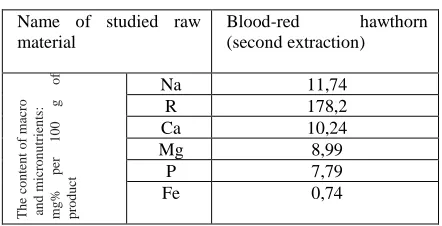
The mineral composition of the secondary extract of the blood-red hawthorn extract was also studied.
Table 2 The mineral composition of the secondary extract of the blood-red hawthorn
Name of studied raw material
Blood-red hawthorn
(second extraction)
T
he
c
ontent
of
mac
ro
a
nd
mi
cr
onutr
ients
:
mg%
pe
r
100
g
of
pr
oduc
t
Na 11,74
R 178,2
Ca 10,24
Mg 8,99
P 7,79
Fe 0,74
From table 2 it can be seen that the mineral composition of the secondary extracts is also rich.
the level of fiber intake and positive - with the total caloric intake and also with the consumption of food of animal origin. Given these properties of dietary fiber, squeezing hawthorn after secondary extraction is used for the production of dietary fiber.
4. Conclusion
Thus, studies on the study of secondary extracts from blood-red hawthorn, as a basis for creating new products with high biological value, show that:
- the obtained extracts contain a sufficiently high amount of biologically active substances;
- due to the biological value, the obtained extracts can be used for the production of diffusion drinks, jelly, marmalade;
- residual squeeze after secondary extraction, mainly contain fiber, and their use for the production of dietary fiber is possible;
From the obtained secondary extracts, a technology and formulation for obtaining diffusion drinks and marmalade have been developed. Conclusion:
- experimental data obtained confirm the feasibility of using blood-red hawthorn as an object for obtaining food products;
- justified and obtained a number of relationships that allow at the stage of preliminary research and practical implementation of the production of beverages, jellies, the necessary rational parameters of extraction modes.
- the results of various extraction methods were studied and summarized, the optimal ones were chosen.
- blood-red hawthorn husks are a rich source of pectic substances, and can be used to obtain food semi-finished products used in the canning and confectionery industry.
Thus, the blood-red hawthorn is an effective source of biologically active substances, most of which are extracted from the pomace with water, under certain optimal conditions, and can serve as an additional raw material for obtaining new foods with high biological value.
Sources:
[1]. The state of food security and nutrition in the
world. Increasing resilience to peace and food security. Food and Agriculture Organization of the United Nations. Rome, 2017.
[2]. Trunova S.E., Bogomolov A.V., Belimova
E.A. Management of the enterprise resource potential based on functional products // Bulletin of the Voronezh State University of Engineering Technologies. 2015.33. p 186-193
[3]. Helsing E. The scientific basis for the formulation of nutrition policy // Nutrition issues. -2006.-№3.-С.-3-8
[4]. Information Bulletin of the Kyrgyz Republic
on Food Security and Poverty, 06.12.2018
[5]. Open data - Statistics of Kyrgyzstan, website:
http://www.stat.kg/ru/opendata/
[6]. Monitoring the situation of children and
women of the Kyrgyz Republic. Multisectoral cluster survey. Final Report, November 2015
[7]. Bulletin of the National Bank of the Kyrgyz
Republic 2008-2017 The official website of the National Bank http://www.nbkr.kg./
[8]. Ranaa S, Guptad S, ranaa a, Bhushana S. Funktional properties, phenolic constituens and antioxsidant potential of industrial apple pomace for utilization as active food ingredient// Food Science and Yuman wellness. 2015. V.4. №4. Р. 180-187
[9]. Environment and food. Uryupina TV,