Abstract: A field study was carried out to find out the state of user experience design (UXD) practice in Malaysia. The field approach employed was an in-situ interview approach. Two companies were involved in the study. Three participants were interviewed, with two from company A and one from company B. The results of the study reveal low user experience awareness in industry and poor perception of the practice of UXD in Malaysia industry setting.
Keywords: Field study, industry setting, in-situ interview, pilot study, UXD practice
I.INTRODUCTION
The definition of practice refers to the performance in a range of professional situations (Schon, 1991, p.60). In the humanities, human practice is various and diverse and includes habit and tradition (Turner, 1994). “Obeying a rule” can also be considered as a practice (Luntley, 2003). The various meanings of practice itself make it difficult to infer. Practice is a kind of action, which is motivated by certain personal beliefs, values and goals (Eccles & Wigfield, 2002). Correspondingly, it can be defined as a repeated performance or systematic exercise for the purpose of acquiring a skill or proficiency or behaviour (Davis, 2012).
Revised Manuscript Received on May 22, 2019.
Azham Hussain, School of Computing, Universiti Utara Malaysia, 06010 UUM, Sintok, Malaysia
Idyawati Hussein, School of Computing, Universiti Utara Malaysia, 06010 UUM, Sintok, Malaysia
Emmanuel O.C. Mkpojiogu, Department of Computer and Information Technology, Veritas University, Abuja, Nigeria. School of Computing, Universiti Utara Malaysia, 06010 UUM, Sintok, Malaysia
[image:1.612.311.572.208.434.2]Aliza Sarlan, Software Quality and Quality Assurance (SQ2E) Research Cluster, Universiti Teknologi PETRONAS, Malaysia
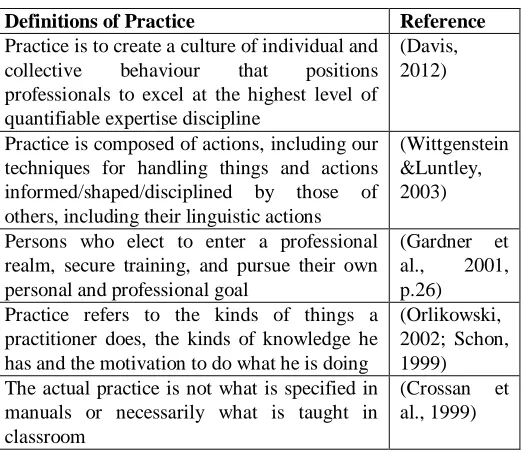
Table. 1 Definitions of practice
Definitions of Practice Reference
Practice is to create a culture of individual and collective behaviour that positions professionals to excel at the highest level of quantifiable expertise discipline
(Davis, 2012)
Practice is composed of actions, including our techniques for handling things and actions informed/shaped/disciplined by those of others, including their linguistic actions
(Wittgenstein &Luntley, 2003)
Persons who elect to enter a professional realm, secure training, and pursue their own personal and professional goal
(Gardner et al., 2001, p.26)
Practice refers to the kinds of things a practitioner does, the kinds of knowledge he has and the motivation to do what he is doing
(Orlikowski, 2002; Schon, 1999) The actual practice is not what is specified in
manuals or necessarily what is taught in classroom
(Crossan et al., 1999)
Table 1 identifies practice from different angles. While several researchers believe that practice is the kinds of knowledge a practitioner have, Crossan et al. (1999) noted that practice is not necessarily what is taught in the classroom. In this study, the following characteristic of practices is followed:
Table. 2 Characteristics of practices Practices Examples
Explicit Language, tools, documents, images, symbols, well-defined roles, specified criteria, regulations, and contracts that various practices make explicit
Implicit Implicit relations, tacit conventions, subtle cues, untold rules of thumb, recognisable intuitions, specific perceptions, well-tuned sensitivities, embodied understandings, underlying assumptions, and shared world views
In Table 2, the characteristics of practices, both explicit and implicit, differ between the obvious and less obvious dimensions (Tessem, 2011;
Vashist et al., 2011).
The State of User Experience Design (UXD) Practice
in Malaysia: An In-Situ Interview Approach
In behavioural study, observing an individual behaviour always identifies whether it was internally or externally caused (Robbins & Judge, 2010). Knowledge, skills and values are considered as internal causes whereas practices and rules can be both internal and external (Eccles &Wigfield, 2002). In this study, practice refers to an explicit practice, such as the act of evaluation, a UXD method to understand users and tasks, a multidisciplinary team which refers to the front-end designer and back-front-end developer, and the iteration process. Implicit characteristics are the values, goals and motivation to apply the explicit practice in an existing process. User-experience or HCI practitioners who have no direct involvement in creating products, systems or services, but have a strong belief in user experience, may be considered as UXD practitioners if they disseminate their knowledge to others e.g. sharing, lecturing or social media postings. Otherwise, a person is just a believer if he or she does not deliver their belief to others. This study assesses the state of UXD practice in Malaysia.
a. METHODOLOGY
[image:2.612.314.571.72.198.2]The purpose of this pilot study was to find issues and barriers related to recruiting potential participants highlighted in the previous preliminary studies (Idyawati et al., 2019a; Idyawati et al., 2019b). During this present field study, in-situ interview and document review was performed. Convenience sampling was applied, with participants volunteering to take part in the study. An e-mail was sent to project leaders and/or heads of department to request an interview session. In the e-mail, the aim and objectives of the study were explained. The targeted participants were those known by the researchers to have some influence in decision making in some IT projects. This approach is similar to Vukelja et al. (2007) who conducted study by choosing personal contacts. The importance of selecting participants at the decision-making level was to understand the design problems that they experienced during IT project development. These people also dealt with authority and understood the processes involved in the IT development process before, during and after a project. Thus, with authority granted, the researchers were able to directly request any related documents and private information related to issues of design. There were two companies involved in the field study. Company A was chosen for its relationship with the government and also because her main activities were in IT development. Two participants were involved in a three-hour interview, with observations and a document understanding session. The researchers (R) identified the participants as P1 and P2.
Table. 3 Field study
In Table 3, P1 is a female aged 34. She has been working with the company for about 13 years and her current position is Project Manager. However, in any project involving her team, her role is as systems analyst. P2 is a male aged 28. He has been working with the company for seven years and his current job is as a back-end developer. Company B is a government-linked company (GLC) with around 200 employees. P3 is head of the IT department. He has been working in his current position for about two years. In this study, the name of the participants and the company are not disclosed due to protection of privacy. This field study consisted of semi-structured interviews and observation of the workplace with people involved in IT design, development and management (i.e. project manager (P1), senior developer (P2) and head of IT department (P3)). The questions include:
1. Have you heard about User Experience?
2. How many users are included in the development process? How do you develop system?
3. How do you test users?
4. What are your frustrations when designing systems for users?
Analysis was done using Nvivo software. In the 1980s, the roles of people with responsibility for and/or interest in designing and developing technologies were collectively referred to as designers (Gould & Lewis, 1985). From the system development perspective, similar roles were given the label of systems developer (Hirscheim& Klien, 1989; Mayhew, 1999). Some researchers differentiate between software developers and HCI practitioners (Vredenburg et al., 2002; Mao et al., 2005; Vukelja et al., 2007).In the HCI literature, HCI practitioners are variously labelled as usability engineers, human factors professionals, UCD practitioners, interaction designers, UX designers and so on (Iivari, 2006; Putnam & Kolko, 2012). The subjects of these labels are similar but due to the interdisciplinary nature and complex history of HCI, the titles have varied (Ibargoyen et al., 2013). According to Norman (2010c), “A name is not a name. It‟s a mess, I know of no way to
fix it”; hence the importance of understanding real-world practices.
Methods Com
pany
Participant s
Characteristics
In-depth interview, Content analysis
A A B
P1= Project Manager P2=Senior Developer P3=Head of IT
Department
Involved in IT
The importance of this was reflected in earlier studies in the 1980s through interviews to discover how usable products were created by industry during the early days (Hammond et al., 1983; Butler, 1985). The word “user experience” was unexpectedly mentioned by designers referring to the complex relationship in HCI research that needs to be addressed (Hammond et al., 1983; Gould & Lewis, 1985).At that time, the researchers found that HCI research had hardly tackled the complex relationships between alternative task structures, user predisposition and user experience (Hammond, et al., 1983). Even though a human factors department was available in organisations, there was little input relevant to the designers (Hammond et al., 1983). The advice from such departments was perceived to be too narrow and inexperienced. However, most help was needed in task analysis and design specifications, according to the psychological aspects of users and user testing.
In 2001, Sutcliffe demonstrated how to transfer insights from psychology into more meaningful advice for designers. Today, it has been found that these psychological needs not only provide guides for aligning design decisions concerning experiences and materials, but also are potential sources of positive feelings, meaning and happiness of end users (Hassenzahl et al., 2013). Therefore, designers should take the responsibility for anticipating user appropriation in their design considerations as a moral practice. Design practice from communication theory highlights the importance of designers‟ values, feelings and consciousness during the creation of products (Crilly et al., 2008). This perspective is able to fulfil the missing element of “feelings” from the software engineering practices domain (Greenbaum, 1990). According to Greenbaum (1990), an individual designer‟s design decision is based on preferences, motivations and experiences but is lacking in terms of subjectivity, feeling, personality, emotions, love and people. However, a developer‟s practice may be different from the designer‟s role that often has an intermediary in those who are directing the design (Poltrock&Grudin, 1994). As such, a designer might be suffering from the authority of design intention and only translate certain requirements into a plan that can be realised through a product (Crilly et al., 2008). Therefore, the environment in which a designer is working is important in shaping the designer‟s intention. Practice constraints have become the central focus in designer‟s environment (Khalid, 2006). These constraints include the context of use, activity and society, which is identical with the disciplines contributing to designing for interactive systems (Benyon, 2010). This is inline with the Theory of Constraints (TOC) which has been developed to assist people and organizations to think about problems and implement solutions accordingly (Sadry & Yusof, 2006). In a production-related firm, TOC is able to calculate the optimal product price (Kee& Schmidt, 2000). In 1979, TOC received recognition in the academic literature and was successfully employed by many well recognised companies such as the Israeli Air Force, the United
States Department of Defense and many others (Khalid, 2006; Watson et al., 2007).
In Malaysia, a survey was conducted to identify the extent of TOC practice in automotive industry (Sadry & Yusof, 2006). It can be concluded that TOC is still very new in Malaysia and many companies do not have knowledge about TOC. The core of the theory involves identifying the systems constraints and making decisions about how to work with these constraints to synchronise a production process (Radovilsky, 1997). However, the limitation of this theory is the assumptions that a firm has either no control or has a complete control over its labour and overhead resources. Likewise, designers have their own motivations when designing technology (Anderson & Kolko, 2011). Technology has no intention of its own, and is inanimate (Verbeek, 2013). Therefore, it cannot have any form of morality (Verbeek, 2014). The designers producing quality computing technologies are part of a morally correct practice towards a morally correct experience (Hassenzahl et al., 2013). Berdichevsky and Neuenshwander‟s (1999) framework instils the characteristics of a designer with creating a persuasive technology (Verbeek, 2009). This proves that a designer‟s intention is among the most important influences on technology. Studies related to the intention of designers have received recognition since the mid-1980s. However, the relevance of intention to interpretation can always be questioned because designers are not free to translate their intentions directly into the featured product (Crilly et al., 2008). This is because designers operate under organisational, technical, financial and legislative constraints that might prevent products from being designed corresponding to the original intentions. This framework is in line with the goal of communication-oriented design where a message that can be accurately transmitted and correctly interpreted is developed. This will then produce the desired behavioural outcome after it has been understood by its users (Stolterman, 2008; Sutcliffe, 2001).
II. RESULTS
Two companies were selected in this study. Both were government-linked companies (GLCs) who received instructions from the government and were involved in executing and translating the instructions into consumables for public use. The companies shared similar values in terms of mission and vision statements, but differed significantly in terms of geographical location. Each interview lasted 2-4½ hours. The interview results produced a large amount of qualitative data, not only about the process of gathering user requirements but also about the overall design and development process on different projects. The questions regarding how user evaluations were conducted were based on the researchers‟ experience in interviewing companies; most companies confirmed their
In the literature, there are two types of practising companies: evaluating and non-evaluating organisations (Jakob et al., 2008).
Table. 4 Code and categories from interview excerpts Participants Interview
Excerpt
Code Categories
P1, P2, P3 “Heard of UX but just like that”
“Heard but
don‟t understand” “First time”
Heard but don‟t understand
Lack of
knowledge
P1, P2, P3 “Colours not right”
“Points to
subjective things” “Small things”
Subjective measures
Problems with with subjective measures
P1, P2, P3 “Users don‟t know what they want”
“Users just accept
suggestions”
Users don‟t know what they want
Culture in IT
development
P1, P3 “Developer
does first, then proposes” “We do first,
then get
feedback”
No user
involvement in early stage
Culture in IT
development
P1, P3 “Not doing it
yet”
“We give it a week”
No usability testing
Culture in IT
development
P3 “Management
doesn‟t know
what users
want; they just
make a
decision” “Users cannot
accept the
proposed systems”
User do not decide on their design
Culture in IT
development
A few of the categories in Table 4 were derived from Nvivo Coding, which is particularly useful in action research to interpret the terms that participants use in their professional practice, rather than the terms from the academic discipline (Saldaña, 2012). The details of each theme are as follows:
i. Lack of UX Knowledge. None of the participants from either company was aware of the term “UX”. When asked, two were reluctant to accept the fact that they did not know the term. The excerpts below are the recorded audio taken
on-site to prove such scenarios.“Yes, I‟ve heard about it but it‟s just like that. I don‟t even know what it is. I don‟t go deep.”One participant said that he had never heard of the term but claimed to have been practising it. The confident voice of the participant is due to his experience in development phases.“Actually, it‟s my first time hearing the term.”“Practically, I practise it and may be using a different term.” It can be seen from these excerpts that people in a higher position in the development team will be more likely to show that they are aware of certain new terminologies, tools or technologies. Even though they may not have heard of the term itself, they will say the opposite and ask to know more.“Yes? Requesting that the word be repeated again; I have heard of it but I don‟t understand it”. This may be due to the perception that they are leaders and should know more than the people who work with them.
ii. Avoiding Subjective Measurement: The importance of UX derives from the reflection of the participants‟ subjective comments on a system when they first see the final or mock-up product. According to the developer, users always comment on small items rather than the important ones: “Users like small things, for example, make-up such as font and colour.” Developers consider font and colour to be unimportant elements in design, but in UX they are among the aesthetic elements that make up the first impression of digital products, whether websites or online apps.
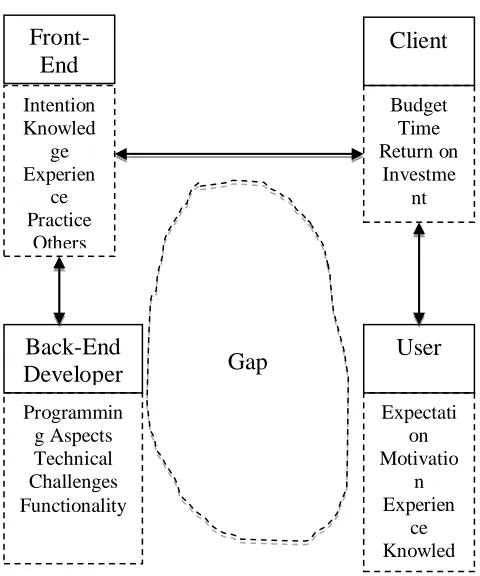
Fig. 1 Reflection of the gap between developer, designer, client and user
Table. 5 “Wicked problems” in the IT project development process
Company A Company B
Bureaucracy. Even to get approval for editing up and running content on a website requires a certain level of permission. This delays the whole process of changing or editing for improvement. Iterative design is not fully supported.
IT managers avoid being perceived as “persons who disobey” especially during a meeting. They must agree to the decision in a meeting. If anything is not right then they will meet higher decision makers to discuss things personally.
Procedures of certain
companies must be followed.
Reporting is important to top management.
The mindset of the client that does not want to accept new technologies.
The difference between old and young users requires different functions and designs.
Users like to point out “small matters” on the screen e.g. font, colour.
Users always complain about the colour and subjective items.
Table 5 illustrates the interview results which point to the user requirement gathering conducted according to the type of project. There are basically three types of project: (1) in-house projects; (2) „passed-on‟ projects; and (3) open projects. If the project is developed by an in-house development team, then user testing is normally conducted during a meeting. Users are known and accessible in an in-house project. Therefore,
briefing on the project‟s purposes and functions will be conducted in a meeting room. However, if the project is developed by an external party and passed on to the development team, no user study is conducted. This is due to the timeframe and the unknown target users at the beginning. The communication will be via e-mail and telephone with the clients. Clients are not necessarily the end users, especially in government projects. Clients are those who make decisions on a project, or the owner of a project, or make the highest financial contribution to a project. Open projects involve a proactive attitude by the IT development team in proposing any IT solution. However, user involvement, if it is not avoided altogether, only happens in a limited fashion during a project‟s sign-in. This is because of the perception that users do not know what they want in the proposed project. „Passed-on‟ projects are those government projects that were not completed due to technical difficulties or coding problems. At the beginning of the contract sign-off, the company developed IT solutions without properly studying the user. It receives instructions from the authority and management. However, when the development team left, the project was abandoned and had to be continued by Company A, through its close relation to the government.
Fig. 2 Scenario of an in-house IT project
The scenario illustrated in Figure 2 highlights the fact that end users are seldom involved in design decision making. The illustration is valid in identifying problems in a visual form (Roam, 2009). The findings are consistent with those of other study who found that user participation is a problem in the software development process (Heinbokel et al., 1996; Kujala, 2003). The scenario is explained by the following excerpt: “Normally, IT people must be very proactive. IT people develop a system first then propose it to the management, not the users. In the decision-making meeting, end users are not invited. Top management
makes decisions and they will request many things on Intention
Knowled ge Experien
ce Practice
Others
Client
Budget Time Return on
Investme nt
Back-End
Developer
Programmin g Aspects Technical Challenges Functionality
User
Expectati on Motivatio
n Experien
ce Knowled
ge Skills Others
Gap
Front-End
Designe
[image:5.612.42.304.399.641.2]top of what has been proposed.
When it comes to end users, many problems will be revealed. For example, recently we developed a booking system and top management requested a „booking function‟ only. When it came to the users, they requested „payment‟ along with the booking system. Logically, the booking must be done with payment. Otherwise, it‟s just a waste of everything. Then, we only realised the real use and scenarios. After the incident, the IT person goes directly to the user and asks what they want. Then, they will bring it up in a meeting with top management. However, sometimes it is difficult when the user does not even know what they want from a system. Therefore, the IT person has to become a user, think like the user and create a mental model like users to develop a system. After that, only the user can comment on the system.”
In practice, user testing is conducted on a functional basis, as can be seen in this excerpt;“After a system has been developed, I call the clients and explain how to use the system. Then, they test it and use it. The next week, they will give feedback. But it‟s not complete. Normally, it happens with a target group and is done in a meeting room where they bring their laptops. I explain what the functions are and then they use them. Sometimes, they test it for a week but the system is not yet complete because we cannot predict what might happen. IT people, in general, cannot predict. We predict what other people will understand. Most of the time, we think they understand but actually they don‟t. We give them a week to test. We must test and see if there are any problems. Normally, we report on modules. This results in low flexibility, few innovations and low team effectiveness.” Evidence shows that too much user involvement is harmful to the development process (Nielsen & Norman, 2005). Listening to customers is always wise, but accepting all their requests can lead to overly complex designs.
III. DISCUSSION OF FINDINGS
User Experience Not Important: In this pilot study, a strong rejection of user experience is seen from the behaviour of the developer and/or designer towards the user‟s subjective assessment of products such as colour. As colour preference is one of the fundamentals of aesthetics design, in this example all the participants in this study agreed to decide on the colour coding of the system. Here, the developer/designer tended to ignore the users‟ request for colours as they believed that colour is a subjective measurement. One basic philosophy of user-centred design (UCD) is to listen to users (Gould & Lewis, 1985; Nielsen & Norman, 2005). It seems that the fundamental principles of UCD have not been followed here.
Belief that UX is Practised When It Is Not: The user experience is considered a new term and is largely unrecognised in practice. As long as the final product is complete, then a project is considered to be successful. Project success is more important than product success. This is in line with previous literature that found that some companies considered meeting the deadline to be a benchmark for project
success (Nielsen, 1994; Bygstad et al., 2008).Participants from both companies are not aware of the terms UX, HCI or UCD. They believe that they practise user experience even though the terminology is different. It can be seen that the IT practitioners‟ philosophical assumptions focused only on the functionalist paradigm, which in turn will influence the project invention (Hirscheim & Klien, 1989).
IV. CONCLUSION
In the previous studies, questionnaire surveys (Idyawati et al, 2019a) and online surveys (Idyawati et al, 2019b) were conducted to investigate the practices of UXD among the people who are categorized as IT practitioners. It was noted that the low awareness and level of knowledge were insufficient to evaluate practised behaviour or actions among the targeted subject of study. To further understand the process involved in the software development process, this present study in the form of an in-situ interview field study was conducted to explore the process and situation in a real industrial setting. It was noted that there was little appreciation of user experience among IT professionals with job responsibilities to produce software. This study is limited as the methodology applied is unable to properly assess the practice of UXD. Due to the limitations of the findings, it may be necessary to conduct and utilize a participatory research design approach to investigate professionals who acknowledge user experience and intend to practise UXD.
REFERENCES
1. Anderson, R. & Kolko, J. (2011). On Designers as Catalytis Agent.
Interaction, 17, 80.
2. Benyon, D. (2010). Designing Interactive Systems: A Comprehensive
Guide to HCI and Interaction Design (2nd ed.). Essex, England: Pearson Education Limited.
3. Butler, K. A. B. (1985). Connecting theory and practice: a case study of
achieving usability goals. SIGCHI Bull., 16(4), 85-88. doi:
10.1145/1165385.317472
4. Crilly, N., Good, D., Matravers, D., & Clarkson, P. J. (2008). Design as
communication: exploring the validity and utility of relating intention to
interpretation. Design Studies, 29, 425-457. doi:
10.1016/j.destud.2008.05.002
5. Crossan, M. M., Lane, H. W., & White, R. E. (1999). An organisational
learning framework: From intuition to institution. The Academy of
Management Review, 24(3), 522-537.
6. Davis, N. (2012). Call yourself a practitioner? Prove it. Retrieved 16 Jan,
2012, from http://uxmatters.com/
7. Eccles, J. S., & Wigfield, A. (2002). Motivational beliefs, values, and
goals. Annual review of psychology, 53(1), 109-132.
8. Gardner, H., Csikszentmihalyi, M., & Damon, W. (2001). Good work:
When excellence and ethics meet. New York, USA: Basic Books. 9. Gould, J.D., & Lewis, C. (1985). Designing for usability: Key principles
and what designers think. Communications of the ACM, 28, 300-311.
10.Greenbaum, J. (1990). The head and heart: using gender analysis to study
the social construction of computer systems. SIGCAS Bulletin, ACM,
20(2), 9-17.
11.Hammond, N., Jorgensen, A. , MacLean, A. , Barnard, P., & Long, J.
(1983). Design practice and interface usability: Evidence from interviews
12.Hashim N.L., Adamu R. (2017). Usability evaluation of mobile banking
application interfaces. Journal of Engineering and Applied Sciences, Vol
12, Issue 21
13.Hassenzahl, M., Eckoldt, K., Diefenbach, S., Laschke, M., Lenz, E. &
Kim, J. (2013). Designing moments of meaning and pleasure: experience
design and happiness.
14.Heinbokel, T., Sonnentag, S., Frese, M., Stolte, W., & Brodbeck, F. C. (1996). Don't underestimate the problems of user centredness in software
development projectsthere are many! Behaviour & Information
Technology, 15(4), 226-236.
15.Hirscheim, R., & Klein, H. K. (1989). Four paradigms of information
systems development. Commun. ACM, 32(10), 1199-1216. doi:
10.1145/67933.67937
16.Ibargoyen, A., Szostak, D., & Bojic, M. (2013). The elephant in the conference room: let's talk about experience terminology. Paper presented at the CHI 2013, Paris, France.
17.Idyawati, H., Hussain, A. & Mkpojiogu, E.O.C. (2019a). The knowledge
of human-computer interaction (hci) and user experience design (uxd) in malaysia: an analysis of the characteristics of an hci-focused conference
18.Idyawati, H., Hussain, A. & Mkpojiogu, E.O.C. (2019b). The state of user
experience design practice in malaysia: an exploratory study
19.Jakob, O. B., Kim, N., Peter, R., & Jan, S. (2008). Obstacles to usability evaluation in practice: a survey of software development organisations. Paper presented at the Proceedings of the 5th Nordic conference on Human-computer interaction: building bridges, Lund, Sweden.
20.Kee, R., & Schmidt, C. (2000). A comparative analysis of utilizing activity-based costing and the theory of constraints for making
product-mix decisions. International Journal of Production Economics, 63, 1-17.
21.Khalid, H. M. (2006). Embracing diversity in user needs for affective
design. Applied Ergonomics, 37, 409-418. doi:
10.1016/j.apergo.2006.04.005
22.Kujala, S. (2003). User involvement: A review of the benefits and
challenges. Behaviour and Information Technology, 22(1), 1-16. doi:
10.1080/0144929021000055530
23.Luntley, M. (2003). Wittgenstein: meaning and judgment. Oxford, UK:
Blackwell Publishing Ltd.
24.Mao, J-Y., Vredenburg, K., Smith, P. W., & Carey, T. (2005). The state
of user-centered design practice. Commun. ACM, 48(3), 105-109. doi:
10.1145/1047671.1047677
25.Mayhew, D. J. (1999). The usability engineering lifecycle: a practitioner's
handbook for user interface design. San Francisco, California: Morgan Kauffmann Publishers, Inc.
26.Nielsen, J., & Norman, D. A. (2014). The definition of user experience.
Evidence-based user experience research, training and consulting. http://www.nngroup.com/articles/definition-user-experience/
27.Norman, D. A. (2010c). The transmedia design challenge: technology that
is pleasurable and satisfying. Interactions, January+February 2010.
28.Orlikowski, W. J. (2002). Knowing in practice: Enacting a colective
capability in distributed organizing. Organisation Science, 13(3), 249-273.
29.Poltrock, S. E., & Grudin, J. (1994). Organizational obstacles to interface
design and development: two participant-observer studies. ACM
Transactions on Computer-Human Interaction (TOCHI), 1(1), 52-80. 30.Putnam, C., & Kolko, B. (2012). HCI professions: differences &
definitions. In CHI'12 Extended Abstracts on Human Factors in
Computing Systems (pp. 2021-2026). ACM.
31.Roam, D. (2009). Unfolding the Napkin: The hands-on method for solving
complex problems with simple pictures: Penguin.
32.Robbins, S.P., & Judge, T.A. (2010). Essentials of organisational
behavior (10 ed.): Prentice Hall.
33.Saldaña, J. (2012). The coding manual for qualitative researchers: Sage.
34.Schon, D. A. (1999). The reflective practitioner: How professionals think
in action: Ashgate Arena.
35.Stolterman, E. (2008). The Nature of Design Practice and Implications for
Interaction Design Research. International Journal of Design, 2(1), 55-65.
36.Sutcliffe, A. G. (2001). Designing multisensory user interfaces.
Manchester: Department of Computation, UMIST.
37.Tessem, B. (2011). An empirical study of decision making, participation,
and empowerment in Norwegian software development organisations.
Paper presented at the LNBIP.
38.Turner, S. (1994). The social theory of practices: tradition, tacit
knowledge and presuppositions. Oxford: Polity Press.
39.Vashist, R., McKay, J., & Marshall, P. (2011). Reflecting on use of practice theories to understand 'practices': A boundary practice perspective on work of business analysts. Paper presented at the International Workshop on Practice Research, Helsinki.
40.Verbeek, P. P. (2009). The moral relevance of technological artifacts. In
Evaluating New Technologies (pp. 63-77). Springer Netherlands. 41.Verbeek, P. P. (2013). Technology design as experimental ethics. Ethics
on the Laboratory Floor, 79.
42.Verbeek, P.-P. (2014). Some Misunderstandings About the Moral
Significance of Technology The Moral Status of Technical Artefacts (pp.
75-88): Springer
43.Vredenburg, K., Mao, J-Y., Smith, P. W., & Carey, T. (2002). A survey of
user-centered design practice. Paper presented at the CHI 2002, Minneapolis, Minnesota, USA. Paper retrieved from
44.Vukelja, L., Muller, L., & Opwis, K. (2007). Are Engineers Condemned
to Design? A Survey on Software Engineering and UI Design in Switzerland. Paper presented at the INTERACT 2007.
45.Watson, K. J., Blackstone, J. H., & Gardiner, S. C. (2007). The evolution
of a management philosophy: The theory of constraints. Journal of