The primary school teachers’ competence in
implementing the 2013 curriculum
Wayan Maba*,Ida Bagus Nyoman Mantra
English Education Study Program, Mahasaraswati University, Denpasar, Bali, Indonesia
Abstract. This study was conducted to analyze the competence of primary school teachers in implementing the 2013 curriculum. The 2013 curriculum has been implemented in almost all schools and there are still many unsuccessful implementations in several Indonesian schools. Therefore it is important to study the teachers’ competence in implementing the 2013 curriculum. A qualitative research design was carried out in this study by utilizing argumentative descriptive analysis. The data was collected by carrying out in depth interviews to the primary schools teachers who were selected by random sampling techniques. The results of this study indicated that primary school teachers have insufficient competence in implementing the 2013 curriculum especially in designing lesson plan, lesson plan implementation and assessment practices. Consequently, it is recommended that further intensive training and focus group discussion should be held to improve the teachers’ competence in implementing the 2013 curriculum. Keywords: Primary School, Curriculum 2013, Teachers, Competence
1 Introduction
Recently, the Indonesian government has introduced a new educational curriculum which is called ‘2013 Curriculum’. This curriculum is implemented in an effort to make Indonesian students to be more productive, creative, and innovative through strengthening the attitude, skills, and knowledge of the students. The implementation of 2013 curriculum was also intended to provide answers to some of the problems inherent to the curriculum in 2006 and in the same time also to motivate students to be more scientifically minded people [17], [13, 11].
The 2013 curriculum put more emphasis on exercising the students to their three core competences, covering congnitive, affective, and psychomotoric competence. These competences are strongly immersed into several set of plans and arrangements consisting of the learning objectives, learning materials, teaching methods, learning media, learning experiences, and source of learning. These then are used to guide the organization in conducting the learning activities to achieve the main educational goals [14], [2, 7, 19]. Moreover, there are other things that should be considered in educational reforms that
happened today, among which are the internal challenges in the form of national standards [5], [14, 18].
Additionally, in the implementation of the 2013 curriculum in the classroom, several obstacles were found in many fields, including related to the unpreparedness of teachers as implementers in the classroom. The problems are mainly in the form of lesson planning, implementation of the lesson plan and assessment [17], [9, 12, 19]. The teachers are required to be really dedicated to their profession to be able to implement the lesson plan and the assessment properly. The assessment in particular as the curriculum suggested it should be more towards assessment for learning [20], [1, 21]. To able to implement the curriculum, teachers are required to have pedagogic competence, personality competence, social competence and professional competence [2], [3, 10, 11].
As part of the main competencies, the professional competence of the teacher becomes an important spotlight especially for the target teacher as an implementer of the curriculum [15]. Teachers who are not competent in their profession, they are clearly going to face obstacles in the implementation of 2013 curriculum. To anticipate this government has attempted to provide continuous training to the teachers. The trainings that are conducted by the government are still not enough to provide adequate knowledge and understanding to the teachers [9], [5, 7, 15].
Many studies have been conducted related to the general implementation of 2013 curriculum, therefore this study was specifically conducted with the aim mainly to investigate the competence of elementary school teachers in implementing 2013 curriculum viewed from their professional competence in carrying out the lesson in a real classroom setting. The primary school teachers became the primary choice in this study because successfull implementation of 2013 curriculum in primary school strongly affects the implementation of the curriculum at the higher level of education institutions.
2 Method
2.1 Research Design
This study employed qualitative research method and the data are described descriptively and argumentatively. The data were collected by conducting in-depth interviews and classroom observations to selected elementary school teachers participated this study. The schools were sampled by means of purposive sampling technique. The consideration was mainly based on School location limitations for the area of Bali province, as well as the limitations of elementary schools which have been implementing 2013 curriculum in Bali province.
2.2 Participants
happened today, among which are the internal challenges in the form of national standards [5], [14, 18].
Additionally, in the implementation of the 2013 curriculum in the classroom, several obstacles were found in many fields, including related to the unpreparedness of teachers as implementers in the classroom. The problems are mainly in the form of lesson planning, implementation of the lesson plan and assessment [17], [9, 12, 19]. The teachers are required to be really dedicated to their profession to be able to implement the lesson plan and the assessment properly. The assessment in particular as the curriculum suggested it should be more towards assessment for learning [20], [1, 21]. To able to implement the curriculum, teachers are required to have pedagogic competence, personality competence, social competence and professional competence [2], [3, 10, 11].
As part of the main competencies, the professional competence of the teacher becomes an important spotlight especially for the target teacher as an implementer of the curriculum [15]. Teachers who are not competent in their profession, they are clearly going to face obstacles in the implementation of 2013 curriculum. To anticipate this government has attempted to provide continuous training to the teachers. The trainings that are conducted by the government are still not enough to provide adequate knowledge and understanding to the teachers [9], [5, 7, 15].
Many studies have been conducted related to the general implementation of 2013 curriculum, therefore this study was specifically conducted with the aim mainly to investigate the competence of elementary school teachers in implementing 2013 curriculum viewed from their professional competence in carrying out the lesson in a real classroom setting. The primary school teachers became the primary choice in this study because successfull implementation of 2013 curriculum in primary school strongly affects the implementation of the curriculum at the higher level of education institutions.
2 Method
2.1 Research Design
This study employed qualitative research method and the data are described descriptively and argumentatively. The data were collected by conducting in-depth interviews and classroom observations to selected elementary school teachers participated this study. The schools were sampled by means of purposive sampling technique. The consideration was mainly based on School location limitations for the area of Bali province, as well as the limitations of elementary schools which have been implementing 2013 curriculum in Bali province.
2.2 Participants
The participants were randomly selected from the total population of primary high school teachers in Denpasar, and they were categorized based on edcuation background, teaching experience, age and the lenght of training on curriculum during the first term of 2017-2018 education year. Finally, there were 10 teachers were selected as the participants of the study.
2.3 Measures
The data of the primary school teachers’ competence in implementing the 2013curriculum were transcribed in a written form. All data were arranged and coded according their category. The data then were triagulated to establish reliable research findings. Cross verification across all data within its category ensures all research findings can be generalized to the whole population of the study.
2.4 Procedure and Data Analysis
The teachers were intensively interviewed in relax situation to ensure that teachers provide a valid and reliable information regarding the implementation of 2013 curriculum in their teaching practices. Direct classroom observations were conducted to collect data related to the implemenation ofthe curriculum. The data from the interviews and the observations were then coded and analyzed critically and urgumentatively to establish the reliable findings.
3
Findings
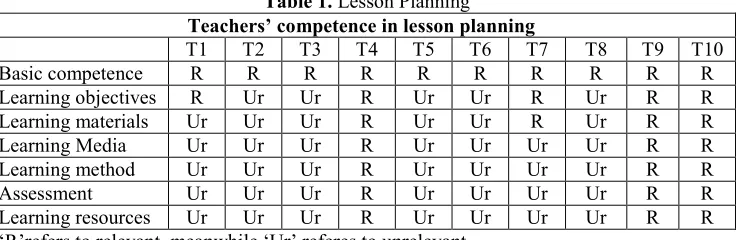
The main finding of the study can be tabulated as the following. Table 1. Lesson Planning Teachers’ competence in lesson planning
T1 T2 T3 T4 T5 T6 T7 T8 T9 T10 Basic competence R R R R R R R R R R Learning objectives R Ur Ur R Ur Ur R Ur R R Learning materials Ur Ur Ur R Ur Ur R Ur R R
Learning Media Ur Ur Ur R Ur Ur Ur Ur R R
Learning method Ur Ur Ur R Ur Ur Ur Ur R R
Assessment Ur Ur Ur R Ur Ur Ur Ur R R
Learning resources Ur Ur Ur R Ur Ur Ur Ur R R
‘R’refers to relevant, meanwhile ‘Ur’ referes to unrelevant
[image:3.482.58.428.308.428.2]According to the table, most of the primary school teachers had insufficient competence of lesson planing
Table 2. Lesson planning implementation and assessment Teachers’ competence in implementation and assessment
Techers’code T1 T2 T3 T4 T5 T6 T7 T8 T9 T10
Pre activity A Ina Ina Ina Ina Ina A Ina Ina A Whilst activity Ina Ina Ina A Ina Ina A Ina A A
Post activity Ina Ina Ina A Ina Ina A Ina A A
Assessment Ina Ina Ina A Ina Ina A Ina A A
‘A’refers to appropiate, meanwhile ‘Ina’ referes to inappropiate
According to the table, most of primary school teachers had insufficient competence in implementing the 2013 curriculum and most of teachers conducted inappropiate assessment.
4 Results and Discussions
plan implementation, and assessment of 2013 curriculum, several findings about teachers’ competence in those three aspects can be describes as the following.
In implementing a curriculum in a real classroom setting, having a good lesson plan is a highly vital component of the teaching-learning activity. Appropriately designed lesson plan certainly keeps teachers manage the classroom learning activities correctly, thus it makes easier for the teachers to help the students to reach objectives [2], [3, 7, 8, 21]. A lesson plan at least contains competence standards, learning objectives, learning material, learning experience, learning methods, assessment and source of learning.
Teachers in this study were found to have insufficient competence in determining the suitable learning materials and learning media. They did not know exactly the appropriate learning materials, this is due to the learning materials provided by the government are considered too difficult for the students and are not contextual to the students’ learning environment. Ideally, teachers should strongly comprehend the learning materials to be taught to their students [17], [5, 6, 11].
In addition, mot teachers were found to have insufficient competence in determining the teaching methods to be used in teaching. They found it difficult to figure out what appropriate teaching method in line with the principle of scientific approach as suggested by the 2013 curriculum. They still confused whether the scientific approach should be done merely using scientific teaching method or other methods which lead to more social activities, such as communicative learning methods, cooperative learning and community learning. A good understanding on the use of teaching methods is certainly highly essential for the teachers to be successful in teaching [7], [5, 12, 11, 14].
In addition, some teachers mentioned that they did know how select and design suitable teaching media. Appropriate use of teaching media obsulutely help the students in understanding the learning material [8], [12, 15]. Moreover, the teachers’ competence in determining the correct assessment is also important [20]. Moreover, in regard to 2013 curriculum, the teachers are required to carry out more productive assessment in the form of authentic assessment and formative assessment should be conducted regulary accompanied with corrected feedback and follow up actions [11], [1, 18]
Most teachers had insufficient competence in conducting the lesson plans. During the classroom observation, it was found that the teachers did not properly implemented the lesson plan based on the lesson plans previously made. This discrepancy might be due to low competency in classroom activities implementation which consists of five scientific steps. The success of classroom implementation of the 2013 curriculum is measured by how successfull the teachers in carrying out the scientific stages in class. Implementation stages of scientific still considered difficult for the school teachers [14]. Although, it was found that the teachers efforts to create maximum students’ creativity and higher thinking process, but it was not yet completely in maximum level. Their effort can be considered as a positive sign that the teachers are willing to create a better learning atmosphere [12], [7, 18].
plan implementation, and assessment of 2013 curriculum, several findings about teachers’ competence in those three aspects can be describes as the following.
In implementing a curriculum in a real classroom setting, having a good lesson plan is a highly vital component of the teaching-learning activity. Appropriately designed lesson plan certainly keeps teachers manage the classroom learning activities correctly, thus it makes easier for the teachers to help the students to reach objectives [2], [3, 7, 8, 21]. A lesson plan at least contains competence standards, learning objectives, learning material, learning experience, learning methods, assessment and source of learning.
Teachers in this study were found to have insufficient competence in determining the suitable learning materials and learning media. They did not know exactly the appropriate learning materials, this is due to the learning materials provided by the government are considered too difficult for the students and are not contextual to the students’ learning environment. Ideally, teachers should strongly comprehend the learning materials to be taught to their students [17], [5, 6, 11].
In addition, mot teachers were found to have insufficient competence in determining the teaching methods to be used in teaching. They found it difficult to figure out what appropriate teaching method in line with the principle of scientific approach as suggested by the 2013 curriculum. They still confused whether the scientific approach should be done merely using scientific teaching method or other methods which lead to more social activities, such as communicative learning methods, cooperative learning and community learning. A good understanding on the use of teaching methods is certainly highly essential for the teachers to be successful in teaching [7], [5, 12, 11, 14].
In addition, some teachers mentioned that they did know how select and design suitable teaching media. Appropriate use of teaching media obsulutely help the students in understanding the learning material [8], [12, 15]. Moreover, the teachers’ competence in determining the correct assessment is also important [20]. Moreover, in regard to 2013 curriculum, the teachers are required to carry out more productive assessment in the form of authentic assessment and formative assessment should be conducted regulary accompanied with corrected feedback and follow up actions [11], [1, 18]
Most teachers had insufficient competence in conducting the lesson plans. During the classroom observation, it was found that the teachers did not properly implemented the lesson plan based on the lesson plans previously made. This discrepancy might be due to low competency in classroom activities implementation which consists of five scientific steps. The success of classroom implementation of the 2013 curriculum is measured by how successfull the teachers in carrying out the scientific stages in class. Implementation stages of scientific still considered difficult for the school teachers [14]. Although, it was found that the teachers efforts to create maximum students’ creativity and higher thinking process, but it was not yet completely in maximum level. Their effort can be considered as a positive sign that the teachers are willing to create a better learning atmosphere [12], [7, 18].
The teachers’ competence in carrying out the assessment was also considered to insufficient. Teachers’ ability in conducting authentic assessment, performance and product based assessment certainly needs to be improved [1], [4, 11]. The 2013 curriculum requires teachers’ competence in assessing the students’ ability and conduct follow up actions based
on the results of the assessment. The follow up actions are absolutely needed to be done by the teachers to ensure the students’ learning progress [21]. .
As mentioned in the regulation of Minister of Education and Culture number 104 year 2014, learning assessment is conducted through authentic and non-authentic assessment [1], [20, 21], but authentic assessment is the main assessment [4], [17, 18]. It was found that most teachers still conducted assessment to measure the students’ cognitive rather than the attitude and psychomotoric of the students. This is clearly can be seen from the types of the assessment the teachers used are mainly non-authentic. Some teachers who used authentic assessment explained that they could not use the scoring rubric properly due to lack of understanding and a big number of the students in a class.
This study also found that teachers’ insufficient competence in implementing the 2013 curriculum due to some difficulties they faced, such as (1) the subject matters are complicated and mostly inapplicable in supporting of the students’ productive skill. Consequently, the teachers have to find materials to meet the students’ need and ability, (2) the content of the material in each chapter are not clearly defined, especially for materials that should be repeated at the next level, (3) the implementation procedures are rigidly designed to suit the scientific principles, (4) the assessment processes require the teachers’ competence in using scoring rubrics, (5) feedback and follow up actions should continually given to maintain and improve the students’ learning progress.
References
1. Ariev, P.R. A theoretical model for the authentic assessment of teaching. Practical Assessment, Research & Evaluation, 10(2), 1-11, (2005).
2. Chairani, N. Curriculum Reflected in an International Oriented Senior High School, Yogyakarta. Sino-US English Teaching, August 2015, Vol. 12, No. 8, 568-574, (2015). 3. Eraslan, A. Teachers’ reflections on the implementation of the new elementary school mathematics curriculum in turkey. HU journal of of Education, 28(2), 152-165, (2013). 4. Gulikers, J.T.M, Bastiaens, T.J., & Kirschner, P.A. A five-dimensional framework for
authentic assessment. Educational Technology Research and Development, 52(3), 67-86, (2004).
5. Hasan, S. H . History Education In Curriculum 2013:A New Approach To Teaching History. HISTORIA:International Journal of History Education, Vol. XIV, No. 2, (2013).
6. Hussain, Z., Adeeb, A., Aslam, H.D. Curriculum Implementation and Feedback Mechanism at Secondary School Level in Punjab Pakistan. International Journal of Learning & Development, 1(2), 92-98, (2011).
7. Lewis, Anne C. Teacher Development. Teach Directions, ProQuest Education Journals, Vol 67, No.6, (2008).
8. Lumadi, M.W. Challenges besetting teachers in classroom assessment: an exploratory perspective. Journal of Social Science, 34(3), 211-221, (2013).
9. Maba, Wayan. 2017. The Implementation of Education National Standard in the Instrument of School Accreditation of Bali Province Education Authority. International Research Journal of Engineering, IT & Scientific Research (IRJEIS). Vol. 3 Issue 4, July 2017, pages: 1-6, (2017).
11. Maba, Wayan. International Journal of Social Sciences and Humanities. Teachers’ Perception on the Implementation of the Assessment Process in 2013 Curriculum. Vol. 1 No. 2, August 2017, pages: 1-9, (2017).
12. Mantra, I.B.N. Promoting Primary School Teachers’ Competence through Dynamic Interactive Workshop and Partnership International Journal of Linguistics, Language and Culture (IJLLC)Vol. 3, No. 1, (2017).
13. Mulyasa, E. Pengembangan Implementasi Kurikulum 2013. Bandung:PT. Remaja Rosdakarya, (2013).
14. Nugraheni, A. S. Controversy a Policy Change in the Curriculum in Indonesia in Terms of the Point of View of Indonesian Language Subject. Journal of Education and Practice. (Online), Vol.6, No.2, (2015).
15. Oliva, Peter F. Developing the Curriculum. Boston: Little, Brown, and Co. (1982). 16. Ornstein, A.C. & Hunkins, F.P. Curriculum, Foundations, Principles, and Issues. Fifth
Ed. Singapore: Pearson, (2009).
17. Retnawati, H., Hadi, S., Nugraha, A. C.Vocational High School Teachers’ Difficulties in Implementing theAssessment in Curriculum 2013 in Yogyakarta Province of Indonesia. International Journal of Instruction. Vol.9, No.1, (2016)
18. Rusman. Curriculum Implementation at Elementary Schools A Study on “Best Practices” Done by Elementary School Teachers in Planning, Implementing, and Evaluating the Curriculum. Journal of Education and Practice . (Online)Vol.6, No.21, (2015).
19. Shilling, T. Opportunities and Challenges of Curriculum Mapping Implementation in One School Setting: Considerations for School Leaders. Journal of Curriculum and Instruction(JoCI), , Vol. 7, No. 2, Pp. 20-37, (2013).
20. Sri Widiastuti, I.A.Md. EFL Teachers’ Beliefs and Practices of Formative Assessment to Promote Active Learning. The ASIAN EFL Journal. Volume 3, (2016).