International Journal of Innovative Technology and Exploring Engineering (IJITEE) ISSN: 2278-3075, Volume-8 Issue-5S March, 2019
Abstract: The main objective of this research is to identify the impact of shift and schedule related to stress that are reflected in line maintenance performance. It is also intended to emphasize more on the consequences towards the line maintenance personnel so they would be aware and take precaution steps. With the utilization of quantitative methods, 100 Malaysian Aircraft Maintenance Technicians (AMTs) from a major low-cost airline company were given a specifically-tailored questionnaire which investigates the impact of shift and schedule in their Line Maintenance Department. Based in Selangor, these maintenance personnel were from the 23-46 years of age and had a variety of weekly work schedule. The data has concluded that among them, several different health issues have been recorded because of irregular and/or extensive working hours. Other contributing factors included tough deadlines, low wages, work environment, and mismatch between personnel’s capabilities and organizational demands.
Keywords: Aircraft Maintenance Technicians (AMTs), specifically-tailored questionnaire.
I. BACKGROUND
Airline industry has transported more than a three million people a day. It connects cultures and is integral to global commerce. But every aircraft has its own maintenance and inspection to do. Maintenance may include such task as ensuring compliance with Airworthiness Directives1. In
order to ensure safe and correct functioning during flight, the maintenance of aircraft is highly regulated. National regulations are coordinated under international standards, maintained by bodies such as the International Civil Aviation Organization (ICAO). The maintenance tasks, personnel and inspections are all tightly regulated, and staff must be licensed for the tasks they carry out2.
II. METHODS
The main purpose of this study is to find out the impact of shift and schedule related to stress that are reflected in line maintenance performance.
A set of questionnaires that will be used for this study will be comprised for about fifteen to twenty questions which will be categorized into five sections. Different question-types such as ranking, yes-no, categories, open ended and scales were used in the questionnaire. The respondents of this study will be carried out among the line maintenance personnel from AirAsia (KLIA2) Base.
Revised Manuscript Received on March 08, 2019.
Abdul Ghani Abdul Samad, Senior Specialist, Universiti Kuala Lumpur – Malaysian Institute of Aviation Technology, Dengkil, Selangor, Malaysia
Nur AinaaHusna Omar, Undergraduate student, Universiti Kuala Lumpur Malaysian Institute of Aviation Technology, Dengkil, Selangor, Malaysia
in order airports in Malaysia among the Air Asia Berhad to get a supportive information and analysis for completing this research. In order to get the actual findings and analysis, questionnaire will be distributed at the various maintenance crew. The respondents will be approached with initial question whether they have ever experienced the alcohol effects in their life before handing them the questionnaire. After that, they are required to complete up the questionnaire by answering the questions and give their opinion in the subjective section which can be used as future recommendation. This survey will be carried out in a short period of time in order to prevent any delay for this research and to prevent from disturbing the respondent’s duty at that time.
III. RESULTS
Section B (Shift System Details)
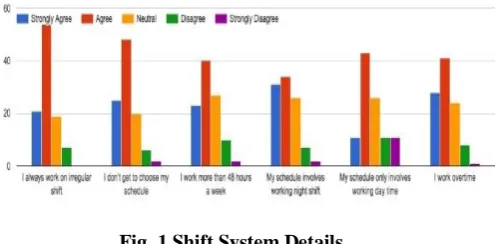
[image:1.595.311.561.486.608.2]The purpose of this question is to identify shift system details of each respondent that are completing the square. In this section forward, it will consist of Likert scale questionnaire. The answer category will be separated into 5 categories which is Strongly Agree, Agree, Neutral, Strongly Disagree and Disagree.
Fig. 1 Shift System Details
Question 1 - I always work on irregular shift: Based on the result shown it was clear that the respondent’s answers are most common in Agree column with (54%) respondent choosing the answer. Second highest is Strongly Agree with (21%) followed by (19%) of the respondent chose in Neutral column and (7%) respondent chose in column Disagree. It is evidence that a large proportion of respondent always work on irregular shift while the other respondent might be working on a regular shift.
Shift and Schedule Affecting Line Maintenance
Performance
Question 2 - I don’t get to choose my schedule: Result shown that the respondent’s answers are most common in Agree column with (48%) respondent choose the answer. Second Highest is Strongly Agree with (25%) respondent and followed by (20%) respondent choosing column Neutral while (6%) respondent choosing in Disagree column however the other (2%) respondent are in Strongly Disagree. As can be seen from the bar chart above, it indicates that most of the respondent don’t get to choose their schedule might be because the schedule has already been fixed by higher organization or management team. Therefore, it is hard for the workers to change their schedule since they must follow the rules.
Question 3 - I work more than 48 hours a week: The majority of the respondent of this survey answers in Agree column with (40%) respondent. Second Highest is Strongly Agree with (23%) respondent and followed by (27%) respondent choosing column Neutral and (10%) respondent choosing in Disagree column while the other (2%) respondent are in Strongly Disagree. According to the survey results, most of the respondent work more than 48 hours a week which might be due to heavy workload and delayed working task. Hence, the respondent that votes for disagree or strongly disagree may be because they did not work overtime.
Question 4 - My schedule involve working night shift:
The respondent’s answers are most common in Agree column with (34%) respondent choosing the answer. Second Highest is Strongly Agree with (31%) respondent and followed by (26%) respondent choosing in Neutral column and (7%) respondent are choosing in Disagree column and the other (2%) respondent are in Strongly Disagree. Based on the results, it can be concluded that most of the workers schedule are involve with working night shift. It may be because they might have to cover the work or task of the absentees which will enforce the workers that are working during day time to work overtime until night shift. The respondent that votes disagree and strongly disagree may be because their schedule only involves working day time.
Question 5 - My schedule only involves working day time: The result of this survey have indicated that the majority of (43%) respondent chose in Agree column and (11%) respondent answers in Strongly Agree column. However the other (22%) votes for Disagree and Strongly Agree. Most of the respondent schedule only involves working during day time, if maybe the respondent works overtime until night shift.
Question 6 - I work overtime: The majority of the respondent of this survey answers in Agree column with (41%) respondent. Second Highest is Strongly Agree with (28%) respondent and followed by (24%) respondent choosing column Neutral and (8%) respondent choosing in Disagree column while the other (1%) respondent is in Strongly Disagree. It can be conclude that, most of the workers work overtime. This might be because of the heavy workload and delayed working task. Therefore, this circumstance causes the worker undergo sleep loss and leads them to feel fatigue and stress.
Section C (Effect of Shift and Schedule Related to Stress)
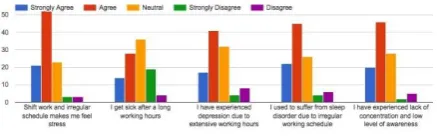
The purpose of this question is to identify the effect of shift and schedule related to stress that the respondent has experienced.
Fig. 2Effect of Shift and Schedule Related To Stress
Question 1 - Shift work and irregular schedule makes me feel stress: Result shown that the respondent’s answers are most common in Agree column with (52%) respondent that Shift work and irregular schedule makes them feel stress. Second Highest is Strongly Agree with (21%) respondent and followed by (23%) respondent choosing column Neutral while (3%) respondent choosing in Disagree column and the other (3%) respondent are Strongly Disagree. According to the survey results it is clearly can be seen that most of the respondent feel stress due to shift work and irregular schedule. This might be because of the workers are exposed to long working hours and the worker has overload work. As for the respondent that are Strongly Disagree or disagree with the statement might be because irregular shift work does not affect them.
Question 2 - I get sick after a long working hours: The respondent’s answers are most common in Neutral column with (36%) respondent choosing the answer. Second Highest is Agree with (28%) respondent and followed by (19%) respondent choosing in Strongly Disagree column and (14%) respondent are choosing in Strongly Agree column and the other (4%) respondent are Disagree that they get sick after a long working hour. Result of the survey have shown that most of the respondent get sick after a long working hour. It can be assumed that the workers feel fatigue and stress until they fell sick. Meanwhile respondent that answer neutral or disagree with the statement might be because they feel sick after a long working hour however it might does not affect them.
[image:2.595.311.530.116.184.2]International Journal of Innovative Technology and Exploring Engineering (IJITEE) ISSN: 2278-3075, Volume-8 Issue-5S March, 2019
The other respondent might not have undergone through depression because they are satisfied with their job.
Question 4 - I used to suffer from sleep disorder due to irregular working schedule: It can be seen that the majority (45%) of the respondent Agreed that they used to suffer from sleep disorder due to irregular working schedule. The second Highest are choosing Neutral with (26%) respondent choosing the answer. While (22%) respondent Strongly Agree followed by (6%) Disagree and the other (4%) Strongly Disagree to the statement. According to the survey results, more than half of the respondent used to suffer from sleep disorder due to irregular shift work. This might be because they may be facing problem of coping with the irregular schedule which inability to adapt with day-night rhythm. This are usually related to the inability to sustain long-quality sleep after a night shift. It shows that night shift worker might experience increased in fatigue, irritability, and decreased work efficiency which might leads to depression and affecting the workers work performance. Increased sleepiness, as emphasized in several studies, is associated with an increased risk of accidents.
Question 5 - I have experienced lack of concentration and low level of awareness: The result of the survey have shown that the majority (46%) of the respondent Agreed that they have experience lack of concentration and low level of awareness. The second Highest are choosing Neutral with (28%) respondent choosing the answer. While (20%) respondent Strongly Agree followed by (5%) Disagree and the other (2%) Strongly Disagree to the statement. Based on the results, it can be concluded that most of the workers have experienced lack of concentration and low level of awareness. This might be because these workers may be typically sleep one to four hours less than average. They might also feel that the quality of their sleep is very poor. They do not feel refreshed when they wake up. This can hinder their performance at work. It can also make them less alert. This can put them at risk of an injury on the job. Reduced levels of alertness or willingness to respond to everyday tasks are resulting in reduced capacity for performance of everyday activities not just during the night shifts, which in turn reflect on various aspects of personal safety.
Section D (Stress factor that are affecting working performance)
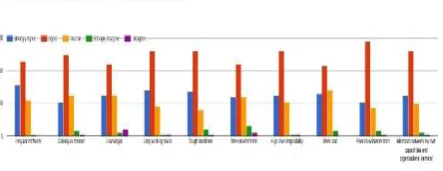
[image:3.595.52.274.633.718.2]The purpose of this question is to identify the stress factor that are affecting working performance.
Fig. 3 Stress factor that are affecting working performance
Question 1 - Irregular shiftwork: Result shown that the respondent’s answers are most common in Agree column with (46%) respondent choosing the answer. Second
Highest is Strongly Agree with (31%) respondent and followed by (22%) respondent choosing column Neutral while (1%) respondent Strongly Disagree that irregular shift work is the stress factor that are affecting human’s working performance. Results shown that most worker agree with irregular shiftwork are the stress factor that affecting human’s working performance. This might be that shifts workers can experience similar problems to jet lag. These can be due to working overnight, prone to work overtime or due to successive rotating shifts restricting the hours available for sleeping and rest. Therefore, it is stressful for the worker whom exposed to irregular shift work along with enforced to work overtime.
Question 2 - Colleague manner: Based on the result shown half (50%) of the respondent answers Agree that colleague manner are the stress factor that are affecting their working performance. Followed by (25%) Neutral, while (21%) Strongly Agree and (3%) Strongly Disagree. However, the other (1%) Disagree to the statement that colleague manner on of the stress factor can affect working performance. This shows that colleague manner plays an important role in an organization. Result shows that more than half of the respondent consider that colleague manner is one of the stress factors that affect their work performance. This might be because line maintenance is a stressful job with safety-critical task need to be done in short period. Therefore, the maintenance crew prone to cooperate with each other in order to complete the task.
Question 3 - Low wages: The majority (44%) of the respondent Agreed that low wage are the stress factor that are affecting human’s working performance. The second Highest are choosing Neutral and Strongly Agree with (25%) respondent for both answers. While (17%) respondent Strongly Agree followed by (8%) Disagree and the other (4%) Strongly Disagree to the statement. This stated that, working in a job that doesn’t pay enough to make ends meet can increase stress due to the inability to meet monthly obligations. This might also be because of the high level of responsibility or the workload that the worker attained is irrelevant to the wages paid. Therefore, the respondent that are disagree with the statement might be because of they are satisfied with the salary that has been paid and assuming that the workers might have less financial commitment.
disappeared after adjustment for self-assessed amount of work, mental workload, and sleeping time.
Question 5 - Tough deadlines: The majority (52%) of the respondent Agreed that tough deadlines are the stress factor that are affect work performance. The second Highest are choosing Neutral with (27%) respondent choosing the answer. While (16%) respondent Strongly Agree followed by (4%) Strongly Disagree and the other (1%) Disagree to the statement. It can be seen more than half of the respondent votes that tough deadline is a stress factor that can affect work performance. This might be because of line maintenance is a stressful task and need to be done in a short period. Therefore, the worker may be having problem with mismatching between their own capabilities and their ability to cope with work demand. The respondent that are disagree with the statement may be because they are familiar with the job and the can adapt with tough deadlines.
Question 6 - Work environment: Result of this survey shown that majority of respondents with (44%) of votes has Agreed that work environment is one of the stress factor that can affect human’s working performance. The second Highest are choosing Neutral and Strongly Agree with (24%) respondent for both answers. Meanwhile, (6%) of respondents had Strongly Disagree and the other (2%) Disagree to the statement. Most of the respondent votes that work environment can affect their working performance. In view of the fact that may be because of the weather that the worker exposed is too hot or the noise of the aircraft engine can affects their working performance. Therefore, they may be feeling stress which can also cause them to experience lack of concentration during working. The respondent that votes for disagree might be because of they are working during night shift and does not exposed to hot weather. Thus, it does not affect them.
Question 7 - High level responsibility: Result shown that the respondent’s answers are most common in Agree column with (52%) respondent choosing the answer. Second Highest is Strongly Agree with (25%) respondent and followed by (21%) respondent choosing column Neutral. Meanwhile, (1%) of respondent votes for Strongly Disagree and Disagree that high level of responsibility is one of the stress factors that are affecting human’s working performance. If more than half of the respondent agree to the statement, this might be because of line maintenance crew know that anything happen to the aircraft are their full responsibility. Hence, they must bear with the risk-taking decision causes the workers to feel stress and affects their work performance.
Question 8 - Work load: The result of this survey have indicated that the majority of the respondent with (43%) votes has agreed workload is one of the stress factor that can affect human performance. (28%) of the respondent votes for Neutral followed by (26%) votes Strongly Agree and the other (3%) Strongly Disagree to the statement. The worker that has agree with the statement may feel stress due to work load and the work must be done in short period since line maintenance task are usually done where the aircraft need to be inspected during passengers boarding time.
Question 9 - Poor co-worker relation: The majority of the respondent of this survey answers in Agree column with (58%) respondent. Second Highest is Strongly Agree with
(21%) respondent and followed by (17%) respondent choosing column Neutral and (3%) respondent choosing in Strongly Disagree column while the other (1%) respondent votes for Disagree. If a good teamwork play an important role in an organization. Thus, the workers need to have good cooperation in order to complete the high responsibility task to make sure that the aircraft is fit to fly.
Question 10 - Mismatch between my own capabilities and organizational demand: More than half of the respondent with (52%) votes for Agree while the other (25%) votes for Strongly Disagree followed by (2%). However, there is (1%) Disagree to the statement. More than half of the workers agree to the statement. In this situation, if most of workers were assigned with regular task in a longer period. Due to limitation of knowledge and skills the workers need to deal with the new difficult and unfamiliar task with limited time given.
IV. CONCLUSIONS
From the research that had been done, several conclusions can be made based on all the responses and data collected. The first objective for this thesis is to identify the impact of shift and schedule related to stress that are reflected in line maintenance performance. So, this first objective has been achieved since majority of response had pointed out that shift work and irregular shift will bring negative effects on human body during working along with affecting human working performance.
Next, the second objective of this thesis is to analyze the stress factor that affected in line maintenance performance. This second objective was also achieved. It is because, after analysis had been made based on the feedback collected, most of the respondents had agreed on all the stress factors that has been assumed at the beginning of this thesis, it can be conclude that irregular shift and schedule will affect the airline working performance. Thus, all objectives of this final year thesis had been successfully achieved.
In addition, there are much further research can be carried out and done in order to gain a better and more accurate results especially in a wider context of aviation such as, maintenance and management perspectives3-21. Based on the analysis made, several recommendations can be recommended for future researches. First thing that can be recommended for future researchers is that they can do a study on the effective implementation that can be done in order to reduce the stress factors that are affecting the working performance. For the next recommendation, further researcher can carry out studies on how to improve the rosters system among the line maintenance crew.
REFERENCES
1. Work-related factors and ill health: the Whitehall II study. Available on
https://www.centredoc.cnesst.gouv.qc.ca/in/fr/;jsessionid=D7613C99D 117DB0A7B797C4B58CF285Faccessed on 15/07/2018.
2. Pettersen K & Aase K. Explaining safe work practices in aviation line
International Journal of Innovative Technology and Exploring Engineering (IJITEE) ISSN: 2278-3075, Volume-8 Issue-5S March, 2019
3. Omar S, Johari M, & Abdul Samad A.Assessment on risk management
of helicopter services for offshore installations. Int. Jour. of Engine. & Tech. 2018;7(4.13):229-231
4. Jabarullah N, Verrelli E, Mauldin C, Navarro L, Golden J, Madianos L
& Kemp N. Novel conducting polymer current limiting devices for low
cost surge protection applications. Jour of Applied Phys.
2014;116(16):164501
5. Johari M, Jalil M, &Mohd Shariff M.Comparison of horizontal axis wind turbine (HAWT) and vertical axis wind turbine (VAWT). Int. Jour. of Engine. & Tech. 2018;7(4.13):74-80
6. Zainal Ariffin M, JohariM, & Ibrahim H.The needs of aircraft avionics'
radio line replaceable unit repair center at UniKL MIAT. Int. Jour. of Engine. & Tech. 2018;7(4.13):86-88
7. Ishak F, Johari M, &Dolah R.A case study of LEAN application for shortest lead time in composite repair shop. Int. Jour. of Engine. & Tech. 2018;7(4.13):112-119
8. Ya'acob A, Mohd Razali M, Anwar U, Mohd Radhi M, Ishak M,
Minhat M, Mohd Aris K, Johari M,Teh C.Investigation of closed compartment moulding for pull-winding process. Int. Jour. of Engine. & Tech. 2018;7(4.13):107-111.
9. Amzar M, Fard M, & Azari M. Characterization of the effects of vibration on seated driver alertness. Nonlinear Engine. - Model. and Appli. Journ. 2014;3(3):163-168
10.Jabarullah N, Mauldin C, Navarro L, Golden J, Madianos L, & Kemp
N. Modelling and Simulation Analysis for the Prediction of the Performance of Intrinsic Conducting Polymer Current Limiting Device. Adv. Sci. Letters. 2017;23(6):5117-5120
11.Abdul Samad A, Johari M, &Omar S. Preventing human error at an approved training organization using Dirty Dozen. Int. Jour. of Engine. & Tech. 2018;7(4.13):71-73
12.Johari M, & Jamil N.Personal problems and English teachers: Are they
always bad?. Int. Jour. of Applied Ling. And English Lit. 2014;3(1):163-169
13.Jabarullah N, Verrelli E, Gee A, Mauldin C, Navarro L, Golden J, & Kemp N. Large dopant dependence of the current limiting properties of intrinsic conducting polymer surge protection devices. RSC Advances. 2016;89:85710-85717
14.Amzar M, Fard M, Azari M, Benediktsdttir B, Arnardttir E, Jazar R, &
Maeda S. Influence of vibration on seated occupant drowsiness. Indust. Health Jour. 2016;54(4) :296-307
15.Amzar M, Fard M, Azari M, &Jazar R. Influence of vibration on seated
occupant drowsiness measured in simulated driving. Appl. Ergo. Jour. 2017;60:348-355
16.Amzar M &Padil H. Lane keeping performances subjected to whole-body vibrations. Int. Jour. of Engine. & Tech. 2018;7(4.13):1-4
17.Bardai A., Er A, Johari M, &Mohd Noor A. A review of Kuala Lumpur
International Airport (KLIA) as a competitive South-East Asia hub. Proceedings of an international conference. Putrajaya, 12 December 2017. IOP Publ. Ltd. 2017;270:012039
18.Khairuddin M, Yahya M, & Johari M. Critical needs for piston engine
overhaul centre in Malaysia. Proceedings of an international
conference. Putrajaya, 12 December 2017. IOP Publ. Ltd. 2017;270:012013
19.Ya'acob, A, Razali D, Anwar U, Radhi A, Ishak A, Minhat M, Mohd
Aris K, Johari M, &Teh C. Preliminary Study on GF/Carbon/Epoxy
Composite Permeability in Designing Close Compartment Processing.
Proceedings of an international conference. Pulau Pinang, 21-22 November 2017. IOP Publ. Ltd. 2017;370:012030
20.Jabarullah N, Verrelli E, Mauldin C, Navarro L, Golden J, Madianos L
& Kemp N. Superhydrophobic SAM Modified Electrodes for Enhanced Current Limiting Properties in Intrinsic Conducting Polymer Surge Protection Devices. Langmuir. 2015;31(22):6253-6264
21.Othman R, Hossain M, &Jabarullah N. Synthesis and characterization