Research Report DFE-RR121(b)
Evaluation of the
Parenting Early
Intervention Programme
A short report to inform local
commissioning processes
This research report was commissioned before the new UK Government took office on 11 May 2010. As a result the content may not reflect current Government policy and may make reference to the Department for Children, Schools and Families (DCSF) which has
now been replaced by the Department for Education (DFE).
The views expressed in this report are the authors’ and do not necessarily reflect those of the Department for Education.
1 Introduction
This report highlights the main findings from the Parenting Early Intervention Programme (PEIP) 2008-11. It will be of particular interest to those responsible for
commissioning programmes and services for parents whose children are experiencing mild to severe behaviour problems. A full evaluation of the programmei is available at
(http://www.education.gov.uk/publications/eOrderingDownload/DFE-RR121(a).pdf). Where relevant, references have been made to the full report where further details can be found.
Headline Findings
• The national roll-out of PEIP was successful in increasing the support available
for parents concerned about their child's behaviour.
• Outcomes were equally positive for the parents of older children (8-13 years, the
target age group for PEIP), as they were for parents of younger children.
Parenting programmes in the PEIP can therefore be effective interventions for a wide range of age groups.
• All four main parenting programmes used by the PEIP (Triple P, Incredible
Years, Strengthening Families Programme 10-14 and Strengthening Families Strengthening Communities) were effective in improving outcomes for parents and children, and these outcomes were maintained one year on from the end of the programme.
• The positive effects that these programmes have on parents’ mental well-being
and style of parenting, as well as on children’s behaviour, are all key factors known to contribute to positive long term child outcomes.
• The cost to local authorities of funding the delivery of parenting programmes
should be lower in future as infrastructure set up costs, especially the training of facilitators, have been met through PEIP.
The Parenting Early Intervention Programme 2008-2011 was funded by the Department for Children, Schools and Families (now the Department for Education). All local authorities in England received PEIP funding to support families by offering one or more of five evidence-based parenting programmes shown to improve parent and child outcomes.
This evaluation was commissioned by the Department to examine the impact of these five programmes when rolled out on a national scale and implemented in a variety of local and community settings. (Report, section 1.2)
The four parenting programmes with sufficient impact data from the PEIP evaluation for analysis are:
• Incredible Years (Webster Stratton).
• Triple P (Positive Parenting Program).
• Strengthening Families Programme 10-14 (Oxford Brookes).
• Strengthening Families Strengthening Communities.
The fifth PEIP programme, Families and Schools Together (FAST), was also included in the study. However, not enough pre- and post-group parent questionnaires were returned by FAST group leaders to allow us to include the programme in the full analysis of impact on parent and child outcomes. (Report, section 2.2; Summary data on FAST in Appendix 4)
2 The Parenting Early Intervention Programme
Parents are fundamental to their children’s development and successful parenting is a key element in preventing children from developing behavioural difficulties. All parents find parenting a challenge at times but parents differ in the internal and external resources they can draw from in order to manage this. Internal resources include their own mental well-being and personal resilience. External factors include poverty, social disadvantage and the absence of a support network. Early conduct problems during childhood are associated with antisocial behaviour during adolescence and put the young person at risk of poor outcomes. These enhanced risks persist into adulthood. Early behavioural difficulties are associated with adult mental health problems, crime, relationship and parenthood difficulties and substance dependence. Supporting parents to develop effective parenting skills is therefore an important part of prevention and early intervention. (Report, section 1.1)
Efficacy versus effectiveness
There is now good evidence for a number of parenting programmes, derived from carefully designed and implemented efficacy trials. The ‘gold standard’ approach is to run these as randomized controlled trials (RCTs)1, and four of the five parenting programmes used in the PEIP had this evidence (SFSC has no RCTs). (Report, Appendix 2)
1
RCTs provide the best evidence of real effects by randomly allocating parents to either the parenting programme or a control group that does not receive it. They require care and rigour to implement the programme according to its specified guidance, using well trained facilitators and appropriate measures of outcome. Ideally such trials should be replicated, preferably by
In practice, where programmes are implemented on a large scale, by a local authority for the use of the local population for example, optimum conditions required for trials are not
achievable. In these cases, programmes are expected to meet public needs and not the rigours of research. Effectiveness studies are therefore more helpful examinations of impact in real life settings, which is the aim of the current evaluation. (Report, section 1.2)
The history of the Parenting Early Intervention Programme
On the basis of a review of evidence by Moran et al. (2004)ii, three parenting programmes were selected for the Parenting Early Intervention Pathfinder which ran from 2006-08. This funded 18 LAs (Wave 1) to deliver one or more of the following programmes: Incredible Years, Strengthening Families Strengthening Communities and Triple P. The results of the effectiveness evaluation of the Pathfinder (Lindsay et al., 2008)iii were sufficiently positive to encourage the Department for Children, Schools and Families to try to implement PEIP parenting support on a national level. (Report, section 1.3)
Evidence from the Pathfinder informed the Guidance2 that was issued nationally to all LAs to help them set up and deliver the Parenting Early Intervention Programme (PEIP). From 2008-2011, the PEIP funded all 150 local authorities (LAs) in England to deliver evidence-based parenting programmes to parents of children aged 8-13, demonstrating or at risk of behavioural difficulties. In addition to the Wave 1 LAs in the Pathfinder, a further 23 LAs were funded from 2008 (Wave 2), with all remaining LAs in England funded from 2009 (Wave 3).
PEIP funding enabled LAs to implement one or more of five programmes approved by the DCSF on the advice of the newly created National Academy of Parenting Practitioners (NAPP). These included the programmes used in the original Pathfinder, with the addition of Strengthening Families Programme 10-14 (SFP 10-14) and Families and Schools Together (FAST). All five approved programmes are designed to address parenting skills and
children’s behaviour but have differences in their theoretical basis, aims and structure e.g. SFP 10-14 and FAST involve parent and child participation in the sessions while the other
independent researchers. Such efficacy trials provide the basic evidence of positive impact and are essential pre-requisites for considering a larger-scale roll-out.
2
http://webarchive.nationalarchives.gov.uk/20100202100514/dcsf.gov.uk/everychildmatters/strategy/parents/id91askclient/local authority/fundingforparents/ From June 2010, LAs were able to fund other parenting programmes using PEIP funding. As the numbers for these programmes are low, we do not report on these here but do so in the full report.
three PEIP programmes are parent only. The Appendix provides a brief overview: for a more detailed, structured comparison of the five programmes see Report, Appendix 2.
4 The findings
4.1 The level of need of the parents and children who participated in PEIP
The following findings were derived from the questionnaire on parent demographics in the pre-course evaluation booklets which were completed by parents on joining the parenting programme.
The parents participating in PEIP represented a wide spread of demographics, but were overall skewed towards the disadvantaged. All were concerned about at least one child displaying serious behavioural problems: (Report, section 2.3)
• 44% were living in single parent households.
• 63% lived in rented accommodation.
• 69% had sought help from one or more professionals in the previous six months.
• 54% had educational qualifications below the level of 5 GCSE A* -C or equivalent.
• 75% scored below the national median for mental well-being.
Compared with the national population the child about whom parents were most concerned (Report, section 2.4) displayed the following characteristics:
• Four times more likely to have a statement of special educational need (11.8% v
2.7%).
• Three times more likely to be entitled to a free school meal (49% v 16%).
• Six times more likely to be classified as having serious behavioural difficulties (SDQ
total score: 57% v around 10%). In addition:
• Nearly a third (31%) received additional support at school.
• Just over a half (54%) were in the PEIP target age range of 8-13 years (mean age
8.6 years: standard deviation 3.9 years).
• The majority of parents (61%) were most concerned about a son compared to 39% of
parents most concerned about a daughter.
4.2 The immediate and the longer term outcomes of PEIP
The following findings were derived from comparisons of responses in the pre- and post-course questionnaires, as well as those from the one year follow up questionnaires submitted by parents a year after the completion of the programme.
4.2.1 Parenting style
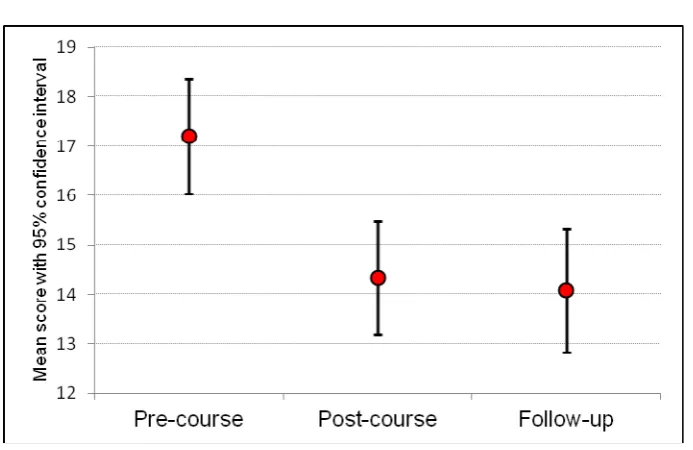
• By the end of the PEIP parenting group, 74% showed a reduction in score for
parenting laxness (e.g. less likely to back down and give in to their child) and 77% showed a reduction in score for over-reactivity (e.g. less likely to shout when their child misbehaved).
• At follow up one year later, highly significant improvements were maintained (Figure
1).
Figure 1 Follow-up sample: Mean Parenting Scale total score at pre-course, post-course and follow-up with 95% confidence intervals.
Note: The lack of any overlap between the pre-course mean score (95% confidence interval range as shown by the vertical black lines) and those of the post-course and the follow-up shows that the large improvements (drop in mean score) were statistically significant and are maintained between post-course and follow-up one year later.
4.2.2 Parent mental wellbeing
• On completion of a PEIP programme, 79% showed an increase in mental well-being.
• The average mental well-being score increased from the bottom 25th percentile of the
population at pre-course to the national average at post-course, a substantial and statistically highly significant improvement. (Report, section 2.6)
• At follow up one year later, although there was some reduction in mental well-being
compared to the immediate post-course score, the mean score remained significantly above that at the start of the parenting programme (Figure 2). (Report, section 2.9.4)
Figure 2 Follow-up sample: Mean parent mental well-being scores at pre-course, post-course and follow-up with 95% confidence intervals.
Note: As for Figure 1, except focus is rise in mean score.
4.2.3 Parents’ reports of child behaviour
There were substantial and highly significant improvements in the children’s
behaviour, as rated by their parents, following completion of PEIP programmes:
(
Report, section 2.6
)
• The percentage of children with significant behaviour problems (SDQ Total
difficulties) fell from 56% to 38%, a reduction of about a third.
• The percentage of children with conduct problems (SDQ Conduct problems) fell from
59% to 40%.
• The percentage of children whose behaviour difficulties had a substantial impact on
the family (SDQ Impact) fell from 62% to 36%.
• At follow up one year later, these substantial improvements relative to pre-course
scores were maintained (Figure 3). (Report, section 2.9.4)
• These improvements are comparable to those found in recent UK randomized
controlled trials. (Report, section 6.2)
• For children in the 8-13 age group, improvements in behaviour (SDQ Total difficulties
and Conduct problems) were similar to those of younger children, and improvements in the impact on the family (SDQ Impact) were greater than those for younger
[image:9.595.126.473.238.463.2]children.
Figure 3 Mean child SDQ total difficulties score at pre-course, post-course and follow-up with 95% confidence intervals.
Note: As for Figure 1.
4.2.4 Interview data on impact of PEIP
Evidence derived from interviews with parents, facilitators and LA operational and strategic lead officers explored a wider range of outcomes than measured by the questionnaires. (Report, section 2.10) It supports the above findings of improved outcomes for parents and children.
4. 3 Effectiveness of PEIP for full range of parents and children
The following findings were derived from questionnaire data on parent demographics, analysed in relation to mental well-being, parenting style and child behaviour. (Report section 2.7.1; detailed results Appendix 3)
The findings showed that most demographic variables did not affect whether there was a change in outcomes, or only explained a small proportion (on average about 3%) of the
variance in improvement. Therefore, the PEIP programmes were broadly effective for parents and children across the full range of background variables.
4.4 How the four programmes compared
The following findings were derived from data of parent outcomes at post-course for each parenting programme. These were analysed for any statistically significant differences, after controlling for small differences between programmes in the demographic profile of
participants, and for outcome variations between LAs. (Report, section 2.7.2)
• All four programmes examined were effective in improving all parent and child
outcomes.
• Parents were highly positive about the parenting group experience for all four
programmes.
• The few statistically significant differences found between programmes were
relatively small.
4.5 Cost-effectiveness
The following findings are only intended to be indicative. As no audited administrative data were available, our analyses were carried out on responses to questionnaires returned by 15 out of 43 LAs approached. The analysis took account of total PEIP income (mostly DfE grant) and expenditure, which included management and training costs as well as delivery costs. The findings showed that:
• There were substantial variations in cost effectiveness between LAs, e.g. on the
proportions of expenditure on management and delivery of training.
• The proportion spent on management costs reduced over time as the PEIP became
established.
• The average cost of funding a parent through a parenting programme was £1,244,
based on the assumption that all parents who started a PEIP parenting programme completed the programme. However, taking into consideration that only 73% of parents completed the programme (according to the surveys), this cost increases to £1,658.
• The lowest cost per parent, in one LA that had been operating for the full three years
of the programme, was only £534.
4.6 Facilitator demographics and impact on outcomes
4.6.1 Facilitator demographics
The PEIP programmes differ in their suitability criteria for facilitator recruitment, particularly in the prior qualifications and experience of facilitators deemed necessary. (Report,
Appendix 2)
Facilitator demographics were derived from responses to our Facilitator questionnaire which showed that:(Report, sections 3.1-3.5)
• 89% of facilitators were female, but otherwise they were a diverse group.
• 37% were aged 40-49 (range: aged 29 or under to 60 or over).
• 15% were from minority ethnic groups.
• They had a wide range of educational and professional qualifications: ¾ Only 9% were helping profession graduates.
¾ About 58% were non-graduates.
• Those that had professional qualifications came from a wide range of backgrounds –
the most frequent were education (30%), nursery nursing or health and social care (11%), and social work (11%).
• 34% reported no parenting programme training prior to the PEIP.
4.6.2 Lead facilitator demographics in relation to parent and child outcomes:
The following findings relate lead facilitators’ demographics to the parent and child outcomes above: (Report, section 3.7)
• There was no difference in most parent and child outcomes when groups had lead
facilitators with different levels of experience of parenting programme training or delivery gained prior to the PEIP. The few statistically significant differences found were relatively small.
• There were no differential effects relating to lead facilitators’ educational
qualifications for the majority of outcomes or for parents’ ratings of the group experience. The statistically significant but small effects were:
¾ Non-graduate lead facilitators were associated with greater improvement than
graduate lead facilitators for parent mental-wellbeing.
¾ Non-graduate lead facilitators with no parenting programmetraining or
delivery experience prior to that gained on PEIP had significantly higher parent ratings for group leader style than any other facilitator category, including lead facilitators with higher qualifications with or without prior training/delivery.
4.7 Other workforce factors that contributed to quality outcomes
The following findings were derived from interviews with LA PEIP leads, facilitators, school representatives and parents. (Report, 4.2.5) The key workforce factors enhancing the quality of the outcomes for parents and families were:
• Diversity among the facilitators (age, gender, ethnicity, employment background,
educational level, prior experience).
• Range of skills (e.g. in managing groups) and personal and inter-personal qualities
(e.g. having empathy, being respectful) that they brought to the task. (Report, Figure 4.3)
• Quality of their PEIP programme training and, where needed, additional group skills
training.
• Participation in some form of supervision to support delivery.
Analysis of the interviews showed that facilitators need regular supervision during delivery of the programmes both to ensure that the parenting programme is being delivered with fidelity and that facilitators are able to address emotionally challenging issues raised by parents. (Report, section 4.1.4) Delivering programmes with fidelity is favourable to positive
outcomes, and includes responsiveness in practice to the circumstances of individuals and groups so that sessions are delivered in the most effective way. Facilitators learned to do this with experience.
4.10 The local area factors that contributed to quality outcomes
The following findings were derived from interviews with LAs’ staff. The key factors that impacted on both the efficiency (outputs) and effectiveness (outcomes) of the programmes were: (Report, sections 4.2.1 – 4.2.5)
• Strategic leadership and operational coordination supporting the roll-out of the PEIP.
When these were not in place, the PEIP was less efficient in organising groups and reaching target parents.
• Three main models of PEIP delivery (core team plus others; multi-agency;
commissioned out), plus a fourth ‘hybrid’ model. No single model emerged as the ‘best’. It was a case of ‘best fit’ for the individual LA.
• A diverse pool of facilitators with varying demographic backgrounds e.g. level of
education and experience. The success factors were: sufficient capacity to deliver, and having the qualities, skills, knowledge and experience to enhance participants’ experiences.
• Investment in the recruitment/referral process, particularly in the pre-course
engagement of participants, led to an enhancement in programme implementation. Where this was unsuccessful, LAs reported multiple groups starting and closing prematurely due to disengagement (drop-out) or unexpectedly low turnout numbers from the start.
• Having a diverse pool of facilitators able to engage parents supported recruitment,
engagement and retention. This was enhanced where facilitators had existing trusting relationships with parents, or where a trusting relationship between a parent and a professional enabled a referral to be made.
4.11 How use of evidence-based, effective parenting programmes may be sustained
locally
The following findings on the sustainability of PEIP were derived from interviews with LA PEIP leads in strategic and/or operational roles. These interviews were conducted before final budgets for 2011-12 had been set and therefore need to be interpreted with caution. (Report, Section 4.2.4)
• The majority of interviewees were hopeful (though not certain) that the PEIP
parenting programmes would continue to be offered, albeit on a smaller scale, and would continue to be delivered with fidelity, using trained and supported facilitators.
• Confidence about sustainability was strengthened where senior managers
acknowledged the evidence of the effectiveness of parenting programmes as part of local early intervention strategies.
• The important factors which contributed to sustainability were:
¾ A good fit between the local infrastructure and the way the PEIP parenting
programmes were delivered.
¾ Having a multi-agency delivery model (drawing facilitators from a network of
services and agencies).
¾ Having ‘trained the trainers’ during PEIP, which enhanced LA capacity to train
further facilitators. (For programme approaches to training trainers, see Report, Appendix 2)
¾ Schools and other LA partners having the opportunity to ‘buy in’ to the delivery of
parenting programmes to suit local need.
5 Conclusions
Based on our evaluation of the Parenting Early Intervention Programme, we can conclude the following:
Outcomes
• Evidence-based parenting programmes can be effective when implemented under
variable local conditions. They should form part of local prevention and intervention strategies to prevent the development or reduce the impact of behavioural difficulties in children.
• All four PEIP programmes were effective in improving parenting skills, parent mental
well-being and in reducing children’s behaviour difficulties for parents and children across the full range of demographic backgrounds, including children with SEND.
• Outcomes were maintained one year on from the end of the programme.
• Differences in outcomes between programmes were small. The choice of
programmes for local use should be made in alignment with: local needs and priorities, how efficiently they use existing trained workforce, experience of delivery, and development of the local offer to parents.
• Positive outcomes in children’s behaviour and wellbeing would be expected to impact
positively on educational attainment.
Implementation
• Successful LAs had strong leadership, effective day to day management and
organisation, as well as a clear parenting policy.
•
Several organisational and delivery models worked well; the key was to match the model to local circumstances.
• A diverse workforce, including parents and non-graduates, delivered PEIP effectively
when provided with appropriate training, support and supervision.
• Effective selection of facilitators was based on their capacity to deliver programmes,
and the skills and personal qualities that enabled them to engage with parents.
• The cost of delivering parenting programmes reduced with time, as set up costs e.g.
infrastructure and training facilitators, are front loaded. Future costs should therefore be lower on average than those reported here.
Appendix 1 The five PEIP programmes (For full details, see Report, Appendix 2)
FAST (Families and Schools Together) – originated in USA
Age range 3 -18 years
Core programme 8 weekly 2.5 hour evening sessions, school-based. Followed by two years of
parent-led, school-supported, monthly booster sessions.
Session structure Family tables including meal; peer activity (parent group; child group);
parent-child activity, closing tradition.
Participants Families with children in a year group in a school serving a multiple risk
neighbourhood. 10 families per hub, with school running 4 to 6 hubs at a time.
Facilitators Five per hub - professionals from multiple agencies and parents of children in an
older year group in the school; young people also in secondary schools.
Example aim To increase protective factors for child [more aims in Appendix]
Incredible Years – originated in USA
Age range 8-13 years (for the PEIP programme)
Core programme Combines elements of the School Age BASIC program (12-16 sessions) with the
ADVANCE parent program (9 sessions) making 18-22 sessions of 2-2.5 hours.
Session structure Set out in manual – includes group discussion, video and live modelling, role play
or small group rehearsal. Refreshments provided.
Participants Group of 10-14 parents
Facilitators Two group leaders – ideally drawn from professionals with postgraduate
qualifications in fields such as psychology, psychiatry, social work, nursing
Example aim Treatment and prevention of child behaviour problems [more aims in Appendix]
Strengthening Families Programme 10-14(SFP 10-14) – originated in USA
Age range 10-14 years
Core programme Seven weekly 2 hour sessions. Followed by four optional booster sessions
beginning 6-12 months afterwards.
Session structure Set out in manual – parallel groups for parents and young people, family
activities. Includes refreshments and may include a meal.
Participants Up to 12 families
Facilitators At least three facilitators (one for parents, two for young people) – drawn from all
professional groups and parents who have previously attended the programme.
Example aim To decrease alcohol and drug use during adolescence [more aims in Appendix]
Strengthening Families Strengthening Communities (SFSC) – originated in USA
Age range 3-18 years
Core programme Thirteen weekly 3 hour sessions.
Session structure Set out in manual – includes facilitator modelling, role play, lectures, discussion.
Participants Group of 8-15 parents
Facilitators Co-facilitation model – practitioners from any occupation, ideally with Level 3
qualifications and experience and expertise in working with parents
Example aim To promote protective factors for child [more aims in Appendix]
Triple P (Positive Parenting Program) – originated in Australia
Age range 0-16 years
Core programme For PEIP, typically Level 4 Group or Group Teen – eight sessions: five as 2-hour
group sessions, three as 30 minute telephone calls.
Session structure Set out in manual – includes presentations, video demonstrations, discussion
Participants 10-12 parents
Facilitators One facilitator required – basic professional training required - typically drawn
from psychologists, social workers, teachers, family counsellors, nurses
Example aim To enhance parents’ knowledge, skills, confidence [more aims in Appendix]
Appendix 2 The evaluation (Report, section 1.4)
The evaluation of the Parenting Early Intervention Programme was carried out between September 2008 and March 2011.
3.1 Objectives: The evaluation objectives were to examine:
• Whether the positive impacts of the five selected parenting programmes
demonstrated in previous research were replicated when these programmes were rolled out on a larger scale in local and community settings.
• Whether the positive effects of the five selected parenting programmes were
sustained a year after completion of the programme.
• How far the PEIP fitted with other local authority parenting provision (e.g. parenting
experts, Parent Support Advisors) and how far this provision provided a preventative approach to working with children and families at risk of negative outcomes.
3.2 Sample:
• The sample comprised all 23 Wave 2 LAs and a sample of 24 Wave 3 LAs (selected
to ensure geographic distribution across England and of type of local authority).
• Administrative data on the total number of parents participating in PEIP was collected
by the DCSF initially but, following policy changes towards greater local autonomy, this practice was stopped. As a result, we do not know the total number of parents supported by PEIP, or the total number of facilitators involved.
• The evaluation data on parent and child characteristics were collected from 6143
parents that attended a PEIP parenting group and completed a pre-course booklet comprising four self-report measures. (Report, sections 2.3 and 2.4)
• Data on pre- to post-course change came from 3319 of the 6143 parents (53.5%).
These parents completed a post-course booklet also and were not substantially different from those where only a pre-course questionnaire was returned. (Report, section 2.5.2) The group is thus representative of all the PEIP evaluation parents.
• Data on impact one year after completing a parenting group came from 212 parents,
30% of the 705 parents contacted. There were only two statistically significant differences between the 212 parents who returned a follow-up questionnaire booklet compared to all those completing PEIP pre- and post-course booklets only. They were more likely to be owner occupiers and more likely to be from a minority ethnic group. These differences are explicable (Report, section 2.9.3) so we are confident the follow-up group is reasonably representative of all the PEIP evaluation parents.
• As the Pathfinder had produced substantial evidence about Triple P, Incredible Years
and Strengthening Families Strengthening Communities (Lindsay et al., 2008), the sub-sample of LAs selected to investigate implementation focused more on the new programmes: Strengthening Families Programme 10-14 and FAST.
3.3 Measures: Three well-established questionnaires were administered by the group facilitator and completed by parents as they started their programme (pre-course), at the last session (post-course) and one year after the course finished. These scales measure
parents’ self reports of factors that are associated with positive and negative outcomes for children mediated through parenting strategies.
• Parental Mental well-being - The Warwick-Edinburgh Mental Well-being Scale
(WEMWBSiv) examines how the parent feels, e.g. ‘I’ve been feeling useful’, and ‘I’ve been feeling good about myself’.
• Parenting style - The Parenting Scalev measures two important aspects of parenting
behaviour:
¾ Parental laxness - This scale examines whether parents are too lax when dealing
with their child: e.g., whether a parent backs down and gives in if their child becomes upset after being told ‘no’.
¾ Parental over-reactivity - This scale examines parents’ over-reactions: e.g.,
whether a parent raises their voice or yells when their child misbehaves as opposed to speaking to the child calmly.
• Parent rating of child behaviour - Parents rated the behaviour of their ‘target child’,
i.e. the child about whom they had most concern, on the Strengths and Difficulty Questionnaire (SDQ)vi
¾ Children’s conduct problems, e.g., if a child often lies or cheats.
¾ An aggregate measure (total difficulties) of conduct problems, hyperactivity,
peer problems and emotional symptoms.
¾ The impact of the children’s behaviour problems.
• Parent demographics - parents provided demographic information about themselves
and their target child in the family at pre-course.
• Parent group experience – Parents completed a PEIP-specific questionnaire, ‘How
was your group?’ at the end of their parenting programme in order to provide information on their group experience, with particular reference to the effectiveness of the group facilitator’s style and the helpfulness of the programme.
3.4 Additional information: A range of additional information was gathered.
• Facilitator questionnaire – Details of gender, age, ethnicity, qualifications, training in
and experience of delivering parenting programmes before the PEIP were provided by 1277 PEIP facilitators. This enabled us to describe the PEIP workforce. (Report, sections 3.1-3.6) For the sub-group of 253 facilitators matched as lead facilitator to
one of 470 parenting groups, it also allowed for an analysis of the relationship of these factors with improvements shown on the parent-completed measures. (Report, section 3.7)
• Cost effectiveness questionnaire – Fifteen local authorities out of the 43 contacted
completed a questionnaire that captured costs and numbers of parents supported and was used to examine cost-effectiveness of implementing the PEIP, as no administrative data were available. (Report, section 5)
• Interviews – A total of 429 interviews with LA strategic leads and/or operational leads
(n = 178), other professionals involved in parenting support such as Parenting
Experts (n = 83), parenting group facilitators (n = 77), school representatives (n = 16) and parents (n = 75) provided the opportunity to explore factors that supported or inhibited implementation. Semi-structured interviews administered face-to-face or by phone were used at appropriate stages of the study. (Report, Appendix 3)
3.5 Limitations: There are some limitations that need to be borne in mind:
• The lack of administrative data means we do not know the total population of parents
supported through PEIP and so cannot measure how representative our evaluation sample is of that total. However the size of the evaluation sample and the consistent pattern of findings from the Pathfinder report (Lindsay et al., 2008) to the Interim report (Lindsay et al. 2010vii) to the final report mean that the outcome data can be viewed as reliable.
• No evaluation data were collected from the children and young people involved in
SFP 10-14 or FAST. Instead, we relied on parent responses on the child about whom
19
they had most concern. This was to maintain comparability of data across all five programmes.
• The outcome data received relating to FAST was insufficient to be able to evaluate
the effectiveness of that programme.
• The lack of administrative data on expenditure means we could not carry out a full
cost effectiveness study. Instead we collected unaudited data by means of a questionnaire sent to the 43 LAs that also provided parent data. Consequently, our cost effectiveness study should be seen as indicative.
i
Lindsay, G., Strand, S., Cullen, M.A., Cullen, S., Band, S., Davis, H., Conlon, G., Barlow, J., & Evans, R., (2011). Evaluation of the Parenting early intervention programme. Research
Report DFE-RR121(a). London: DfE
ii
Moran, P., Ghate, D., & van der Werwe, A. (2004). What works in parenting support? A review of the
international literature. Research report 574. London: Department for Education and Skills.
iii
Lindsay, G., Davis, H., Strand, S., Band, S., Cullen, M.A., Cullen, S., Hasluck, C., Evans, R., & Stewart-Brown, S. (2008). Parenting early intervention pathfinder evaluation DCSF-RW054.
http://www.dfes.gov.uk/research/data/uploadfiles/DCSF-RW054.pdf
iv
Tennant, R., Hiller, L., Fishwick, R., Platt, S., Joseph, S., Weich, S., Parkinson, J., Secker, J. & Stewart-Brown, S. (2007). The WEMWBS: Development and UK validation. Health and Quality of life Outcomes, 5, (63).
v
Irvine, A.B., Biglan, A., Smolkowski, K., & Ary, D.V. (1999). The value of the Parenting Scale for measuring the discipline practices of parents of middle school children. Behavioural Research
and Therapy, 37, 127-142
vi
Goodman, R. (1997). The strengths and difficulties questionnaire: a research note. Journal of Child
Psychology and Psychiatry, 38, 581-586.
vii
Lindsay, G. Strand, S., Cullen, M.A.., Band, S., & Cullen, S. (2010). Parenting Early Intervention
Programme 2nd Interim Report. DFE-RR047. London: DfE.
20
Ref: DFE-121(b)
ISBN: 978-1-84775-922-1
© Department for Education