PROJECT MANAGEMENT EDUCATION FOR A
DEVELOPING PROFESSION
Barrie Todhunter
University of Southern Queensland
Toowoomba Australia 4350 Tel. +61 7 3853 3237 email [email protected]
ABSTRACT
Project management claims to be a profession, but its educational and training programs are focused on vocational needs only. A profession is defined by a wide variety of characteristics which include subjective values relating to ethics and values apart from a high level of professional skills and competencies. This paper looks at the early stages of doctoral research into project management education and suggests that the standards required of project managers for professional certification are too narrow and are inconsistent with the standards required of professionals in disciplines such as medicine, law, engineering, and architecture.
KEY WORDS:
PROJECT MANAGEMENT EDUCATION FOR A
DEVELOPING PROFESSION
Barrie Todhunter
University of Southern Queensland
Toowoomba Australia 4350 Tel. +61 7 3853 3237 email [email protected]
INTRODUCTION
This paper looks at the issues associated with training and education in project management. Often referred to as an ‘accidental profession’ because of the way that practitioners enter the field, project management is struggling to create an identity and a theoretical framework that can be used for professional practice and professional development. Initially the paper looks at the definition of effective education in a higher education context, and then considers the issues associated with project management education from the point of view of numerous stakeholders. PMI has adopted a multiple-choice questionnaire for professional certification under the PMP program, the Australian Institute of Project Management (AIPM) has chosen a competency-based approach, and this has led to a conflict between the models and objectives of project management training and those of higher education. This paper considers how a conceptual and theoretical framework could be developed that is suitable for ‘competency-based learning’ for the respective levels and modes of education including distance education.
This paper suggests that:
the vocational competency standards developed by professional bodies for project management lack consideration of attributes associated with recognised professions,
project management education lacks an adequate conceptual framework that is aligned with the objectives of valid professional development, and
valid competency standards and a conceptual framework must consider a broad range of higher-level outcomes.
EFFECTIVE PROJECT MANAGEMENT EDUCATION
Turner et al. (2000) observe that most project personnel hold a qualification or first degree in an area other than project management (thus project management education is commonly approached as postgraduate study), fewer than fifteen percent of project personnel hold any form of project management certification or registration, and that the majority of project personnel have gained their knowledge through experiential learning (on the job so to speak).
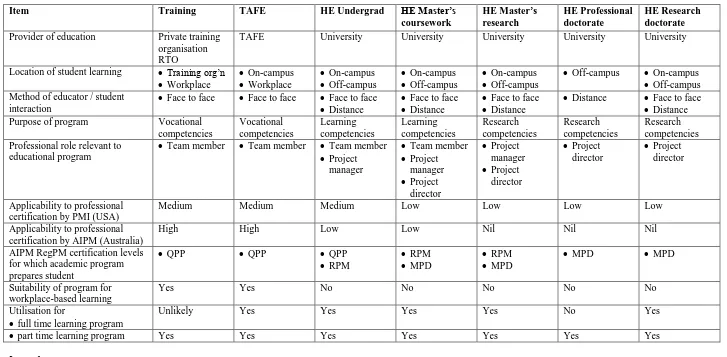
More than twenty distinct delivery methods of project management education have been identified in the United States of America (Wirth & Amos 1996) and Table 1 provides an overview of training and educational programs in Australia, ranging from vocational training programs offered by private training organisations and Technical and Further Education (TAFE) institutions, predominantly using a competency-based approach, through to doctoral programs. At this stage, there is no evidence of any undergraduate Bachelor programs in project management in Australia, consistent with the pattern internationally (Turner & Huemann 2000). From a review of articles in professional journals, the most common type of formal project management education is at Master’s level in an on-campus part-time mode, and apart from the program at the University of Southern Queensland, most are offered through the faculties of engineering, architecture or construction, consistent with the origins of the discipline (Australian Institute of Project Management 2002).
Unlike other traditional professions such as law, medicine, engineering and architecture, where formal university qualifications are a prerequisite for membership of, or certification by, professional bodies, project management has taken different approaches. The Project Management Institute (PMI) offers certification through their Project Management Professional (PMP) program based on prior academic qualifications (not necessarily in project management) and a knowledge-based multiple-choice questionnaire. The Australian Institute of Project Management (AIPM) offers Registered Project Manager (RegPM) certification using competency-based assessment with three levels of the RegPM program reflecting increasing levels of responsibilities—Qualified Project Practitioner (QPP), Registered Project Manager (RPM), and Master Project Director (MPD).
Project management education in Australia may be summarised as follows:
Private registered training organisations (RTOs) and TAFE colleges provide the bulk of project management education, and this is provided as vocational competency-based programs aimed at practitioners at team member level
There are few, if any, undergraduate degree programs, and formal education is undertaken predominantly at postgraduate level
Postgraduate programs are targeted at practitioners at a higher level of the professional community such as project managers and program directors
Coursework Master’s programs focus on a mix of knowledge, cognitive and functional competencies, whereas non-coursework postgraduate programs have an emphasis on personal, behavioural, values, ethical and research competencies (see the elements of professional competence in table 3).
Table 1: General Characteristics of Project Management Training and Educational Programs in Australia
Item Training TAFE HE Undergrad HE Master’s
coursework HE Master’s research HE Professional doctorate HE Research doctorate
Provider of education Private training organisation RTO
TAFE University University University University University
Location of student learning Training org’n
Workplace On-campus Workplace On-campus Off-campus On-campus Off-campus On-campus Off-campus
Off-campus On-campus
Off-campus Method of educator / student
interaction
Face to face Face to face Face to face
Distance
Face to face
Distance
Face to face
Distance
Distance Face to face
Distance Purpose of program Vocational
competencies Vocational competencies Learning competencies Learning competencies Research competencies Research competencies Research competencies Professional role relevant to
educational program
Team member Team member Team member
Project manager
Team member
Project manager Project director Project manager Project director Project director
Project director
Applicability to professional certification by PMI (USA)
Medium Medium Medium Low Low Low Low
Applicability to professional certification by AIPM (Australia)
High High Low Low Nil Nil Nil
AIPM RegPM certification levels for which academic program prepares student
QPP QPP QPP
RPM
RPM
MPD
RPM
MPD
MPD MPD
Suitability of program for workplace-based learning
Yes Yes No No No No No
Utilisation for
full time learning program
Unlikely Yes Yes Yes Yes No Yes
part time learning program Yes Yes Yes Yes Yes Yes Yes
Legend
TAFE Technical and Further Education QPP Qualified Project Practitioner
HE Higher Education RPM Registered Project Manager
THE NATURE OF PROFESSIONAL EDUCATION
Project management is often represented as a ‘profession’ although it is arguable whether it has reached that level of acceptance in the community (Turner 1999; Zwerman & Thomas 2002). Research indicates that professional practitioners should have a sound theoretical knowledge of the subject and that the provision of formal educational programs is an essential part of the development of a new profession (Turner & Huemann 2000; Zwerman & Thomas 2002). Based on the views of Schon (1987), Benson et al. (2001, p. 92) suggest ‘that the most important areas of professional practice lie beyond the instrumental boundaries based on technical expertise and go into the more indeterminate areas of practice that deal with uncertainty, uniqueness and value conflict’ and that the ‘outstanding professionals in all areas, including those with high levels of formal rationality, reflect wisdom, intuition and artistry beyond the instrumental’.
Dinham and Stritter (1986) differentiate professional education from trades or craft by its ‘reliance on theory’ (p. 952), and differentiate higher educational curricula by the inclusion of educational experiences and professional initiation through an apprenticeship. One of the distinctions of a profession is the requirement to ‘set aside personal beliefs and preferences in favour of the client’s best interests’ (p. 953). They describe professional education in terms of ‘transforming the student’s gestalt from confusion to familiarity, so the student comes to inhabit the professional world’ and conclude that there is no magical formula to predict a learner’s academic nor professional performance, that preparation must include more than merely cognitive knowledge, and that successful education requires both the ‘art’ of teaching and the ‘science’ of teaching’. They raise the following questions about determining the effectiveness of professional education (p. 964):
Are there student attributes that will result in better prepared professionals?
What aspects of professional education must students master before entering the practical environment?
Have the characteristics of effective practical instruction been fully identified?
What are the most efficient and the most effective methods for evaluating a learner’s practical performance?
OBJECTIVES OF LEARNING AND EDUCATION
Jones & Paolucci (1999, p. 9) suggest that assessment of learning outcomes ‘is critical in evaluating the instructional system and its effectiveness and consist of ‘cognitive tests (measurement of intellectual skills), performance tests (measurement of capability) and attitudinal tests (measurement of disposition and perspective)’. Bloom’s (1956) taxonomy of learning in the cognitive domain provides part of an essential framework for understanding desirable educational objectives and skills and comprise:
lower order learning objectives of knowledge, comprehension and application; and
higher order learning objectives of analysis, synthesis, and evaluation.
Jones & Paolucci (1999) suggest that ‘learning is achieved when a permanent change in thinking, attitude, or behaviour is experienced’ (p. 3) and that instructional objectives can and should be based on one or more of the following factors:
learning domain - cognitive, affective or psychomotor
task characteristics - instructional objectives should be appropriate for the tasks associated with the subject matter that is to be learned, and
grouping - instructional objectives should be appropriate for the grouping arrangement and learning situation.
Farivarsadri (2001) has researched the pedagogy of architectural education (which can be seen to have parallels with project management) and asserts that ‘education’s purpose goes much beyond the mere transformation of knowledge; it aims at implementing changes in the patterns of behaviour of a social group in the desired direction’ (p. 2). He also indicates that apart from preparing students for a profession, a university architectural education ‘is different from training that is only giving knowledge and skills necessary to serve a profession’ and that:
‘a holistic university education aims at addressing the whole person, developing the personalities of students in different dimensions, making them know how to acquire knowledge, to communicate, to be aware of his own values, and those of the other’s as well. (p . 2).
This is in conflict with the limited range of competencies considered for professional development and certification by professional bodies.
Research into the effectiveness of educational programs recommends consideration of the learning outcomes over the entire program, rather than perceptions of the effectiveness of a single component of the program, or of the learning processes themselves. Kretovics and McCambridge (2002) have indicated that ‘one systematic way to measure student learning would be to compare measures of student competencies at the beginning and end of their educational experience’ but concede that ‘few schools of business have conducted outcome studies that compare their graduates to their newly admitted students’.
EXPLORATORY RESEARCH INTO PROJECT MANAGEMENT EDUCATION
The author has interviewed representatives of major stakeholders in project management education including academic staff from three universities offering Master’s level programs in project management, a Government project manager responsible for providing project management services and training in the public service sector, a senior consulting project manager who is also an executive office-holder of a major professional body in Australia, a senior project manager providing consulting and contractual services to the Department of Defence, and a postgraduate project management student.
A total of six interviewees were selected on a purposive basis to gain views from a wide range of stakeholders. Interviews ranged in length from thirty minutes to sixty minutes, and were held at the workplace of the interviewees in Brisbane, Sydney and Melbourne. They were semi-structured based around a consistent framework of questions, but each interview was allowed to ‘unfold’ based on the experiences and views of the stakeholder. Interviews were taped and transcribed fully, and analysis of the interview material has identified the following themes and categories relating to postgraduate education in project management:
The need for incorporation of autonomous learning processes including:
reflective and self-referential learning skills
deep learning
mapping to an overall competency framework
incorporating a range of assessment techniques including self-assessment and peer-assessment
high levels of communication among educators and students
the need for personal transformation outcomes to include:
changing mindset and perspective
generating new visions
changing the platform of thinking
development of personal competencies and soft competencies
becoming a lifelong learner
challenging and addressing prejudices
qualifications, recognition and status
the need for professional transformation outcomes to include:
development of professional competencies
becoming self reflective with regard to ongoing professional development
involvement in the definition and development of the profession
providing a positive influence on changing the professional culture
establishment of professional standards and best practice
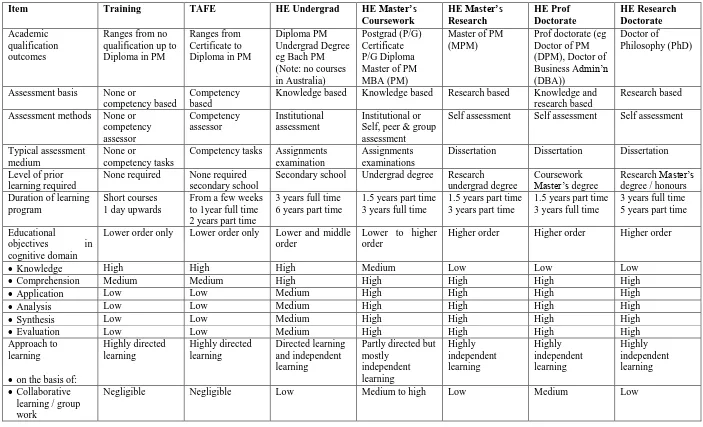
These conclusions are consistent with the views of Jarvis et al. (1998, p. 77) who suggest a focus on such concepts as ‘self-determination, self-actualisation or self-transformation as the underlying concepts of all education for adults’. Table 2 provides a comparison of the pedagogical issues associated with the project management programs identified in table 1. From the comparison in table 2, the following conclusions may be drawn with regard to postgraduate programs:
The ‘approach to learning’ changes significantly for postgraduate programs from one of directed learning to one of independent learning
Although the assessment media for postgraduate coursework programs are similar to those of undergraduate programs (assignments and examinations), the recommended assessment methods change significantly to incorporate self-assessment, peer-assessment and group-assessment.
The emphasis for learning objectives changes from lower order to higher order, and
Table 2: Pedagogical Dimensions of Project Management Training and Educational Programs in Australia
Item Training TAFE HE Undergrad HE Master’s
Coursework HE Master’s Research HE Prof Doctorate HE Research Doctorate Academic qualification outcomes
Ranges from no qualification up to Diploma in PM
Ranges from Certificate to Diploma in PM
Diploma PM Undergrad Degree eg Bach PM (Note: no courses in Australia)
Postgrad (P/G) Certificate P/G Diploma Master of PM MBA (PM)
Master of PM (MPM)
Prof doctorate (eg Doctor of PM (DPM), Doctor of Business Admin’n (DBA))
Doctor of
Philosophy (PhD)
Assessment basis None or
competency based
Competency based
Knowledge based Knowledge based Research based Knowledge and research based
Research based
Assessment methods None or competency assessor Competency assessor Institutional assessment Institutional or Self, peer & group assessment
Self assessment Self assessment Self assessment
Typical assessment medium
None or
competency tasks
Competency tasks Assignments examination
Assignments examinations
Dissertation Dissertation Dissertation
Level of prior learning required
None required None required secondary school
Secondary school Undergrad degree Research
undergrad degree
Coursework Master’s degree
Research Master’s degree / honours Duration of learning
program
Short courses 1 day upwards
From a few weeks to 1year full time 2 years part time
3 years full time 6 years part time
1.5 years part time 3 years full time
1.5 years part time 3 years part time
1.5 years part time 3 years full time
3 years full time 5 years part time
Educational
objectives in cognitive domain
Lower order only Lower order only Lower and middle order
Lower to higher order
Higher order Higher order Higher order
Knowledge High High High Medium Low Low Low
Comprehension Medium Medium High High High High High
Application Low Low Medium High High High High
Analysis Low Low Medium High High High High
Synthesis Low Low Medium High High High High
Evaluation Low Low Medium High High High High
Approach to learning
on the basis of:
Highly directed learning Highly directed learning Directed learning and independent learning
Partly directed but mostly independent learning Highly independent learning Highly independent learning Highly independent learning Collaborative learning / group work
Level of independent learning
Low Low Medium Medium to high High High High
Level of reflective learning
Negligible Negligible Low Medium High High Very high
Level of content delivery
Very high Very high High Medium Low Low Low
Instructor/student communication
High High High Medium Low Low Low
Student/student communication
Low Low Low to medium Medium to high Low Low Low
FRAMEWORK FOR EVALUATION OF PROJECT MANAGEMENT EDUCATION
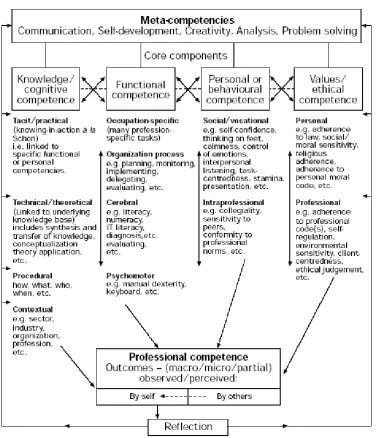
[image:10.595.113.490.182.621.2]Cheetham & Chivers (1996) have suggested a framework for evaluation of professional competencies which can be difficult concepts to pin down when they relate to occupations where roles are complex. They suggest that the components of professional competence are as indicated in figure 1 (p. 24).
Figure 1: Provisional model of professional competence Source: (Cheetham & Chivers 1996, p. 27)
The author is in the early stages of doctoral research into the development of a conceptual framework for project management education in a distance learning environment. Table 3 illustrates how the Cheetham and Chivers’ model above could be used to compare the competency-development aspects of three indicative, but distinct, learning environments for project management. Each of the three environments selected could have numerous variations at both undergraduate and postgraduate levels, and they are suggestive only of typical environments encountered in higher educational institutions. ‘On-campus learning’ suggests that students attend face-to-face lectures and tutorials and work both individually and in groups for learning and assessment. ‘Online’ suggests that students work individually remotely from the learning institution but have good electronic communications with teaching staff and other students for learning and assessment. ‘Traditional distance education’ suggests that students work individually remotely from the learning institution and have limited ability to communicate with other students for learning and assessment.
Numeric values in table 3 have been allocated for the likelihood of the competence element to be facilitated or enhanced by the respective program. At this stage of the author’s research, there is no empirical basis for the allocation of these values and they are based on personal judgement by the author.
ANALYSIS OF TABLE 3
Based on the evaluation framework, the comparative analysis in table 3 suggests the following possible conclusions with regard to the development of competencies in professional project management education:
Face-to-face education may be measurably superior to other educational environments
A web-based learning environment supplemented by email communications and electronic discussion boards (such as those supported by Blackboard and WebCT) may provide a better learning environment than print-based distance education (which ranks last of the three environments considered)
Print-based distance education may be particularly poor in developing the meta-competencies defined in the framework
There may be little difference between the various modes in the development of the knowledge/cognitive competencies
There may be marginal differences between the modes in the development of the functional competencies
There may be noticeable differences between the modes in the development of personal/behavioural competencies and values/ethical competencies
Table 3: Comparison of learning environments for project management education (based on the Cheetham/Chivers Competence Model)
Elements of professional competence based on framework by Cheetham & Chivers
(suggested scoring from 0 to 5, 5 being highest, ranking in brackets)
On-campus learning
Online Traditional
distance education
Learning environment Face to face Internet/ email Print-based
Suitability of program to develop or demonstrate professional competencies
Meta-competencies (generic & over-arching) 25 (1) 24 (2) 16 (3)
Communication 5 5 2
Self-development 5 4 3
Creativity 5 5 3
Analysis 5 5 4
Problem-solving 5 5 4
Core skill 1—Knowledge/cognitive competence 20 (1) 17 (2) 15 (3)
Tacit/practical (knowledge embedded in functional / personal competencies)
5 4 4
Technical/theoretical (underlying knowledge base of the profession, theories & principles)
5 4 4
Procedural (the how, what, when of routine professional activities)
5 4 3
Contextual (background knowledge specific to an organisation or industry)
5 5 4
Core skill 2—Functional competence 19 (1) 17 (2) 15 (3)
Occupation-specific (tasks that relate to a particular profession)
5 4 4
Organisational/process (tasks of a generic nature, planning, delegating etc)
4 4 3
Cerebral (skills involving mental activity—literacy, numeracy, etc)
5 5 5
Psychomotor (skills of a physical nature) 5 4 3
Core skill 3—Personal/behavioural competence 9 (1) 8 (2) 6 (3)
Social/vocational (behaviours relating to performance of professional tasks—self-confidence, task-centredness etc)
5 4 3
Intra-professional (behaviours relating to interaction with other professionals, collegiality, professional norms etc)
4 4 3
Core skill 4—Values/ethical competence 9 (1) 8 (2) 6 (3)
Personal (adherence to personal moral / religious codes etc)
5 4 3
Professional (adherence to professional codes, client centredness, environmental sensitivity etc)
4 4 3
Professional competence—outcomes 18 (1) 16 (2) 12 (3)
Macro outcomes (competencies developed over a period of time through a combination of core components)
4 3 3
Micro outcomes (indicate proficiency in single competencies)
5 5 4
Perceived by self (reflection) 4 4 3
Perceived by others 5 4 2
TOTAL SCORE 100 90 70
OVERALL RANKING 1 2 3
Source: Adapted from Cheetham & Chivers (1996)
CONCLUSION
This paper has questioned the suitability of the certification programs by project management bodies in Australia for recognition as a true profession. It has also looked at the effectiveness of project management education based on a review of recent literature, interviews with major stakeholders, and review of a framework for development of professional competence suggested by Cheetham & Chivers (1996). Comparison of various modes of delivery of project management education suggests that face-to-face education may be measurably superior to online delivery and print-based distance education, however, empirical research is required to confirm or refute the values attributed to the respective elements of competence in the analysis above, and this will form part of further research to be carried out by the author.
REFERENCES
Australian Institute of Project Management 2002, 'Project Management Courses', Australian Project Manager, vol. 22, no. 3, pp. 19-31.
Benson, R, Hardy, L & Maxfield, J 2001, 'The international classroom: Using reflective practice to improve teaching and learning', paper presented to ASCILITE 2002 The 18th Annual conference of the Australian Society for Computers in Learning in Tertiary Education, Melbourne, 9-12 December.
Bloom, BS 1956, Taxonomy of educational objectives: The classification of educational goals: Book I, cognitive domain, Longmans, New York.
Cheetham, G & Chivers, G 1996, 'Towards a holistic model of professional competence', Journal of European Industrial Training, vol. 20, no. 5, pp. 20-30.
Dinham, SM & Stritter, FT 1986, 'Research on Professional Education', in M Wittrock (ed.), Handbook of Research on Teaching, 3rd edn edn, The American Educational Research Association, Simon & Schuster Macmillan, USA.
Farivarsadri, G 2001, 'A critical view on pedagogical dimension of introductory design in architectural education', paper presented to Architectural Education Exchange AEE2001, Cardiff, 11-12 September.
Jaafari, A 1998, 'Project managers of the next millennium: do they resemble project managers of today?' paper presented to 14th Annual IPMA Project Management Conference, Ljubljana, Slovenia, 1013 June.
Jarvis, P, Holford, J & Griffin, C 1998, The Theory and Practice of Learning, Kogan Page, London, UK.
Jones, T & Paolucci, R 1999, 'Evaluating the Effectiveness of Educational Technology on Learning Outcomes: A Research Framework', Journal of Research on Computing in Education, no. Winter.
Kretovics, M & McCambridge, J 2002, 'Measuring MBA Student Learning: Does Distance Make a Difference?' The International Review of Research into Open and Distance Learning, vol. October.
Schon, DA 1987, Educating the Reflective Practitioner, Jossey-Bass, San Francisco, USA.
Turner, JR & Huemann, M 2000, 'Formal education in project management: current and future trends', paper presented to PMI Annual Seminars & Symposium, Houston, USA, 7-16 September 2000.
Turner, JR, Keegan, A & Crawford, L 2000, 'Learning by experience in the project-based organisation', paper presented to Project Management Research at the Turn of the Millennium: Proceedings of PMI Research Conference, Paris, 21-24 June.
Wirth, I & Amos, SJ 1996, 'Distance learning for project management', AACE Transactions.