Copyright © 2004, American Society for Microbiology. All Rights Reserved.
Selection of Functional 5
⬘
cis
-Acting Elements Promoting Efficient
Sindbis Virus Genome Replication
Rodion Gorchakov,
1Richard Hardy,
2Charles M. Rice,
3and Ilya Frolov
1*
Department of Microbiology and Immunology, University of Texas Medical Branch, Galveston, Texas 77555-10191;
Department of Biology, Indiana University, Bloomington, Indiana 474052; and Center for the Study of
Hepatitis C, Laboratory of Virology and Infectious Disease, The Rockefeller University,
New York, New York 10021-63993
Received 15 July 2003/Accepted 19 September 2003
The 5ⴕportion of the Sindbis virus (SIN) genome RNA is multifunctional. Besides initiating translation of the nonstructural polyprotein, RNA elements in the 5ⴕ200 bases of the SIN genome RNA, or its complement at the 3ⴕ end of the negative-strand intermediate, play key roles in the synthesis of both negative- and positive-strand RNAs. We used here a combination of genetic and biochemical approaches to further dissect the functions of this sequence. Replacement of the SIN 5ⴕend in defective-interfering (DI) and genome RNAs with sequences from a distantly related alphavirus, Semliki Forest virus (SFV), resulted in nonviable chimeras. The addition of five nucleotides from the 5ⴕ terminus of SIN restored negative-strand RNA synthesis in DI genomes but not their replication in vivo. Pseudorevertants of various SFV-SIN chimeras were isolated, and suppressor mutations were mapped to AU-rich sequences added to the 5ⴕend of the original SFV 5ⴕsequence or its “deleted” versions. Early pseudorevertants had heterogeneous 5ⴕ termini that were inefficient for replication relative to the parental SIN 5ⴕ sequence. In contrast, passaging of these pseudorevertant viral populations in BHK cells under competitive conditions yielded evolved, more homogeneous 5ⴕ-terminal se-quences that were highly efficient for negative-strand synthesis and replication. These 5ⴕ-terminal sequences always began with 5ⴕ-AU, followed by one or more AU repeats or short stretches of oligo(A). Further analysis demonstrated a positive correlation between the number of repeat units and replication efficiency. Interest-ingly, some 5ⴕ modifications restored high-level viral replication in BHK-21 cells, but these viruses were impaired for replication in the cells of mosquito origin. These studies provide new information on sequence determinants required for SIN RNA replication and suggest new strategies for restricting cell tropism and optimizing the packaging of alphavirus vectors.
The alphavirus genus of the familyTogaviridaeis comprised of about 30 known members (30).Sindbis virus(SIN), a pro-totype member of the genus, has been extensively studied to obtain information about fundamental issues of alphavirus replication, and the results from studies of this virus are largely applicable to other members of the genus (36).
The SIN genome is a single-stranded RNA of positive po-larity of about 12 kb in length. Like most cellular mRNAs, it is capped at the 5⬘end and contains a 3⬘-terminal poly(A) tail (36). Upon delivery into the cells, this RNA serves as the template for synthesis of nonstructural proteins (nsPs) that form the replicase-transcriptase complex required for genome RNA replication and subgenomic 26S RNA transcription. The latter RNA is coterminal with the 3⬘one-third of the genome and encodes the viral structural proteins (35). Replication of the viral genome and transcription of the subgenomic RNA are highly regulated processes. Early in SIN infection, viral nsPs are synthesized as two polyproteins, P123 and P1234. The latter is cleaved in cisby a papain-like protease in nsP2 to generate P123 and nsP4, the RNA-dependent RNA polymer-ase (RdRp). This partially processed protein complex, P123/ nsP4, efficiently synthesizes full-length negative-strand
inter-mediates but is inefficient for positive-strand RNA synthesis. Further processing of P123 to nsP1, nsP2, and nsP3, performed intransby nsP2 and nsP2-containing polyproteins, leads to the formation of a replicase consisting of nsP1, nsP2, nsP3, and nsP4. This complex is efficient for the synthesis of positive-sense genome and subgenomic RNAs (13–15, 32, 33). Both of these RNAs are required during the later stages of infection, when high levels of structural proteins and genome RNAs are needed for efficient formation of progeny virus.
Changes in replicase composition that correlate with regu-lated synthesis of the three RNA species suggest the use of different promoter elements. Initially, putative promoters were postulated on the basis of sequence conservation among al-phaviruses, and their importance was later confirmed by ex-tensive mutagenesis studies. One 24-nucleotide (nt) conserved sequence element (CSE) was identified upstream of and in-cluding the start of the subgenomic RNA (16, 23). The com-plement of this sequence in the negative strand is required for initiation of subgenomic mRNA transcription. A second CSE, a sequence of 19 nt immediately preceding the 3⬘poly(A) tail, was proposed as a core promoter for synthesis of the genome-length, negative-strand RNA (11, 24). However, the same CSE is present at the 3⬘end of the alphavirus subgenomic RNAs, and the absence of subgenomic intermediate implied that the 19-nt CSE was not sufficient for promoter activity. Other RNA elements essential for replication were found at the 5⬘end of SIN genome RNA and include the 5⬘UTR and a 51-nt CSE (6,
* Corresponding author. Mailing address: Department of Microbi-ology and ImmunMicrobi-ology, University of Texas Medical Branch, 301 Uni-versity Blvd., Galveston, TX 77555-1019. Phone: (409) 772-2327. Fax: (409) 772-5065. E-mail: [email protected].
61
on November 8, 2019 by guest
http://jvi.asm.org/
21, 22) located in the nsP1 coding sequence. Replacement of the SIN 5⬘ untranslated region (UTR) by heterologous 5⬘ UTRs derived from Semliki Forest virus (SFV) abolished RNA replication in vivo and negative-strand RNA synthesis in vitro (6). The 5⬘end of the SIN genome was also shown to bind a limiting component(s) essential for negative-strand initiation (6). Thus, SIN genome replication requires an interaction be-tween the 3⬘and the 5⬘ends of the genome to initiate negative-strand synthesis. The factors responsible for this interaction remain to be defined. Panhandle structures have been visual-ized by electronic microscopy and charactervisual-ized biophysically (4), but perfectly complementary sequences near the genomic 5⬘and 3⬘termini are not present. Protein factors, in particular those of the host translation apparatus, have also been pro-posed as candidates to bring the 5⬘and 3⬘ends in close prox-imity, as seen in translation of cellular and viral mRNAs (6, 10). The 51-nt CSE (replication enhancer) increases RNA replication, and its integrity is more important for SIN repli-cation in mosquito cells than in mammalian cells (22).
In addition to the roles of the 5⬘ end of the SIN genome RNA in translation and negative-strand initiation, the comple-ment of this signal-intense sequence functions in positive-strand synthesis. Mutations have been identified that block RNA replication in vivo but do not affect (or even enhance) RNA synthesis in the in vitro system (where only negative-strand synthesis occurs) (6).
To further probe the function of the SIN 5⬘UTR in RNA replication, we designed SIN genomes with 5⬘ UTRs from heterologous alphavirus, SFV. Some of these chimeras were lethal for virus replication, but viable variants containing com-pensating mutations could be selected. To characterize the effects of these mutations and pseudoreversions on different steps in RNA replication, we used a combination of in vitro and in vivo approaches, including an assessment of fitness in different host cell environments. Our data further define the elements in the 5⬘terminus of SIN genome RNA needed for efficient replication in mammalian cells.
MATERIALS AND METHODS
Cell cultures.BHK-21 cells were obtained from the American Type Culture Collection, Rockville, Md. These cells were propagated in alpha minimal
essen-tial medium (␣-MEM) supplemented with 10% fetal bovine serum (FBS) and
vitamins. Mosquito C710 cells were obtained from Henry Huang (Washington
University, St. Louis, Mo.). They were propagated in Dulbecco modified Eagle medium supplemented with 10% heat-inactivated FBS and 10% tryptose phos-phate broth.
Plasmid constructs.All plasmid constructions were prepared by standard
recombinant DNA techniques. The parental p5⬘SIN/DI and pToto1101 plasmids
coding the defective-interfering (DI) RNA and infectious SIN viral genome were
described elsewhere (6, 29). Briefly, the p5⬘SIN/DI contained the promoter for
SP6 RNA polymerase, followed by 425 nt of the SIN 5⬘end, 7335 to 7646 nt of
the SIN genome encoding the promoter of the subgenomic RNA, a TCTA GACC sequence, an 1,654-nt sequence encoding the entire luciferase gene, and
a 421-nt sequence containing the SIN 3⬘UTR, poly(A), followed by anEcoRI
restriction site. p5⬘SFV/DI and p5⬘SFVSL1/DI, described elsewhere (6), had
essentially the same sequence as p5⬘SIN/DI, except the 5⬘fragment of SIN (nt 1
to 40) was replaced by nt 1 to 65 and nt 1 to 27 of SFV, respectively. The same
modifications in the 5⬘UTR were made to design p5⬘SFV/SIN and p5⬘SFVSL1/
SIN that contained cDNAs of the entire genome of SIN with the SFV-derived 5⬘
end. For all other constructs, fragments containing modified 5⬘ UTRs were
generated by PCR amplification and cloned into p5⬘SIN/DI or pToto1101 by
using theSacI restriction site, located upstream of the SP6 promoter, and the
MfeI site located in the SIN 5⬘UTR. All of the 5⬘UTR-coding fragments were
sequenced before we performed the SP6 transcription reactions. The sequences
of the designed heterologous 5⬘UTRs are shown in the figures and are described
in Results.
The TSG/Pac replicon of SIN used as donor of the replicative complex has been described previously (5).
RNA transcriptions.Plasmids were purified by centrifugation in CsCl gradi-ents. Prior to transcription, the DI RNA coding and viral
genome-coding plasmids were linearized by treatment withEcoRI andXhoI, respectively.
RNAs were synthesized by SP6 RNA polymerase in the presence of cap analog (29). The yield and integrity of transcripts were monitored by gel electrophoresis under nondenaturing conditions. For electroporation, aliquots of transcription reactions were used without additional purification, and for the in vitro replica-tion system the RNAs were purified by phenol-chloroform extracreplica-tion and etha-nol precipitation.
In vivo replication assay.Testing of DI RNAs replication was performed by using a previously described in vivo replication system. Briefly, BHK-21 cells
were coelectroporated with 4g of TSG/Pac replicon, supplying the RdRp, and
6g of DI RNAs (17, 18). Transfected cells were divided into four dishes and
incubated at 37°C. After 4 h, cells in one dish were lysed in luciferase lysis buffer (Promega), and luciferase activity was assessed by using the luciferase assay system according to recommendations of the manufacturer (Promega). To rule out the possibility that lower Luc activity was a result of spontaneous mutations in the Luc gene introduced during the cloning procedure, the intracellular RNAs
in the second dish were metabolically labeled with [3H]uridine (20Ci/ml) in the
presence of 1g of ActD/ml at between 1 and 4 h posttransfection. RNAs were
isolated and analyzed by gel electrophoresis in the previously described condi-tions (1).
In vitro negative-strand RNA synthesis assay.Polymerase extracts from the cells infected with vaccinia viruses expressing SIN P123 and nsP4 were prepared and used for in vitro negative-strand RNA synthesis as previously described (14). RNAs were isolated by phenol-chloroform extraction and ethanol precipitated. Then RNAs were denatured with glyoxal and then separated by electrophoresis and visualized by autoradiography. The quantitation of radioactivity was per-formed by using a Storm 860 PhosphorImager (Molecular Dynamics).
Infectious center assay.In standard experiments, 1g of in vitro-synthesized,
full-length RNA transcripts (or 4g of 5⬘SFV/SIN and 5⬘SFVSL1/SIN RNA)
was used per electroporation. Tenfold dilutions of electroporated BHK-21 cells
were seeded in six-well tissue culture plates containing 5⫻105naive cells per
well. After 1 h of incubation at 37°C in an 5% CO2incubator, cells were overlaid
with 2 ml of 0.5% Ultra-Pure agarose (Invitrogen) containing MEM supple-mented with 3% FBS. Plaques were stained with crystal violet after 2 days of incubation at 37°C. The remaining cells were seeded into 100-mm dishes and incubated until the cytopathic effect (CPE) was observed.
Sequencing of the 5ⴕends of viral genomes.The 5⬘ends of the selected SIN variants were sequenced on plaque-purified viruses. Plaques were isolated from the agarose overlay during the infectious center assay before being stained with
crystal violet. Viruses were eluted in 1.5 ml of␣-MEM supplemented with 10%
FBS for several hours, and 0.5 ml was used to infect 5⫻105BHK-21 cells in
35-mm dishes. After 1 h of virus adsorption at 37°C, an additional 1 ml of
␣-MEM–10% FBS was added, and the incubation was continued until the CPE
was observed. Then, media were harvested, and RNAs were isolated from the cells by TRIzol by using the procedure recommended by the manufacturer
(Invitrogen). DNA fragments representing the 5⬘-terminal sequences of virus
isolates were synthesized by using a commercially available FirstChoice RLM-RACE (rapid amplification of cDNA ends) kit according to the procedure recommended by the manufacturer (Ambion). The primer used for cDNA syn-thesis was complementary to nt 417 to 435 of the SIN genome; the primers used for PCR amplification were (i) complementary to nt 241 to 260 of SIN genome
and (ii) the 5⬘RACE inner primer supplied with the kit. Fragments were purified
by agarose gel electrophoresis and cloned into the plasmid pRS2. Multiple,
independent clones were sequenced to determine variations in the 5⬘end of the
genomes.
Viral growth analysis.BHK-21 and C710 cells were seeded at a concentration
of 5⫻105and 106cells/35-mm dish, respectively. After 4 h of incubation at
appropriate temperature, monolayers were infected at the multiplicities of in-fection (MOIs) indicated in the figure legends for 1 h, washed three times with phosphate-buffered saline, and overlaid with 1 ml of complete medium. At the indicated times postinfection, media were replaced by fresh media, and virus titers in the harvested samples were determined by plaque assay on BHK-21 cells (12).
62 GORCHAKOV ET AL. J. VIROL.
on November 8, 2019 by guest
http://jvi.asm.org/
RESULTS
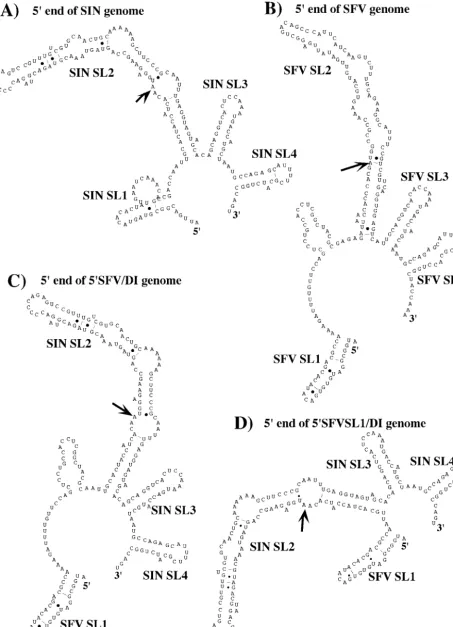
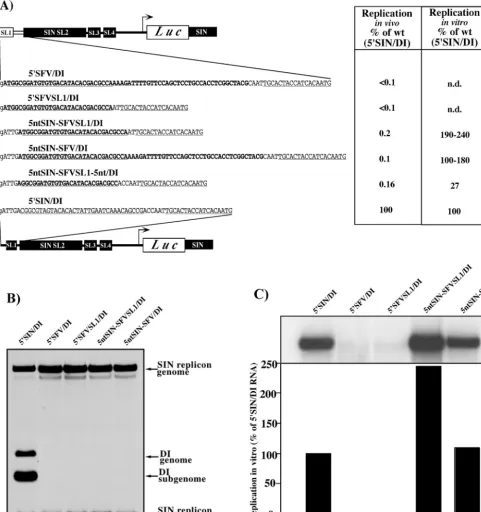
Importance of 5ⴕ-terminal nucleotides of SIN for positive-strand RNA synthesis.In a previous study, we made a number of modifications in the 5⬘UTR of SIN-specific DI RNAs and demonstrated that replacement of the SIN 5⬘UTR (Fig. 1A) by a heterologous 5⬘UTR derived from the distantly related alphavirus, SFV (Fig. 1B and C), or by the SFV 5⬘-terminal stem-loop structure SL1 (Fig. 1D), produced RNAs incapable of replication (6). The most striking observation was that RNAs with these heterologous 5⬘UTRs were highly inefficient templates for negative-strand RNA synthesis. To continue the investigation of the 5⬘ sequence elements involved in both positive- and negative-strand RNA synthesis, we designed sev-eral chimeric, luciferase-coding DI RNAs that contained the first five nucleotides of the SIN genome upstream of the 5⬘ -terminal stem-loop structure SL1 of SFV (Fig. 2). In the 5ntSIN-SFV/DI RNA, 5⬘-terminal SIN nucleotides were fol-lowed by SL1 and an interstem fragment of SFV fused with SL2, SL3, and SL4 of SIN. The 5ntSIN-SFVSL1/DI genome was similar, but the interstem fragment between SFVSL1 and SINSL2 was deleted. As in the SIN genome, the 5⬘-terminal nucleotides in both RNAs were predicted by M-fold not to be involved in SL1 stem formation (data not shown).
The addition of these five SIN nucleotides dramatically in-creased in vitro replication of the chimeric DI RNAs (Fig. 2A and C), yielding synthesis of negative-strand RNAs similar to that observed on 5⬘SIN/DI RNAs with homologous, SIN-de-rived, 5⬘and 3⬘ends. However, the addition of the SIN-specific sequence did not markedly improve replication of these DI RNAs in vivo (Fig. 2A and B). These chimeras replicated 1,000-fold less well than the DI RNAs with the authentic SIN 5⬘UTR, although they were 10- to 20-fold more efficient than their counterparts without the five SIN 5⬘-terminal nucleotides (Fig. 2A and B). This finding suggested that, by adding these five SIN 5⬘-terminal nucleotides, we restored the activity of the promoter for negative-strand but not for positive-strand RNA synthesis.
In an attempt to increase positive-strand RNA synthesis in vivo, we modified the interstem region between SFV SL1 and SIN SL2 in the context of 5ntSIN-SFVSL1/DI (Fig. 2A). In-sertion of three additional nucleotides made the 3⬘-terminal sequence of the negative-strand of 5ntSIN-SFVSL1-5nt/DI RNA capable of forming a stem structure that was similar, as determined by computer prediction, to the structure at the 3⬘ terminus of the SIN negative-strand template. This modifica-tion also did not increase the level of DI RNA replicamodifica-tion in vivo, compared to 5ntSIN-SFVSL1/DI (Fig. 2A), and signifi-cantly reduced negative-strand RNA synthesis in vitro. This suggests that the determinants for positive-strand RNA syn-thesis are more complex than simple addition of a few 3⬘ -terminal SIN-specific nucleotides to the negative-strand inter-mediate.
Selection of viable SIN pseudorevertants. Selection of re-vertants and pseudorere-vertants of impaired mutants, has been a powerful tool in alphavirus genetics (3, 9). Given the advantage of using infectious virus for selection of rare variants, we de-signed a panel of chimeric viral genomes (Fig. 3A). 5⬘SFV/SIN and 5⬘SFVSL1/SIN had 5⬘ sequences that were the same as those previously described for 5⬘SFV/DI and 5⬘SFVSL1/DI
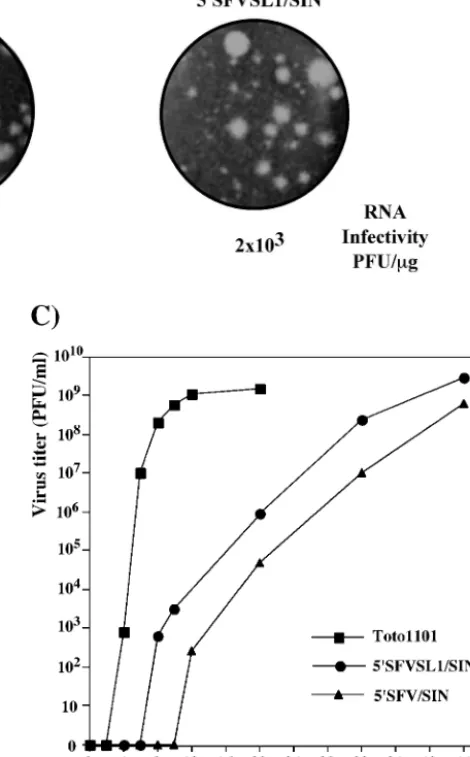
RNAs, respectively (see Materials and Methods for further details). In vitro-synthesized RNAs were transfected into BHK-21 cells to assess their infectivity and to generate virus stocks. In an infectious center assay, 5⬘SFV/SIN and 5⬘SFVSL1/SIN RNAs were 4 and 3 orders of magnitude less infectious, respectively, than the SIN Toto1101 parent and produced heterogeneous plaques (Fig. 3B). In addition, both 5⬘SFV/SIN and 5⬘SFVSL1/SIN exhibited significant delays in growth after electroporation of transcript RNA (Fig. 3C). These observations suggested that heterologous 5⬘ ends im-paired RNA replication to levels insufficient for productive infection. Delayed CPE and the low levels of plaque formation in infectious center assay were most likely due to the emer-gence of variants with increased replicative ability, because the 5⬘SFV/SIN and 5⬘SFVSL1/SIN RNAs demonstrated the same translational efficiency in vitro (in the rabbit reticulocyte lysate translation system), where the subsaturating amounts of RNAs were used (data not shown).
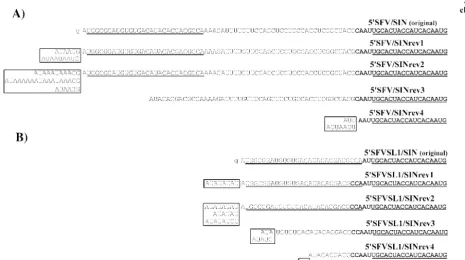
We randomly selected four plaques each for 5⬘SFV/SIN and 5⬘SFVSL1/SIN from the infectious center assay. The 5⬘ends of these isolates were subjected to 5⬘RACE, cloned into a plas-mid, and sequenced. Multiple modifications were identified in the 5⬘UTRs (Fig. 4). In some isolates, SFV SL1 was partially or completely deleted; others retained the stem-loop structure. The majority had additional 5⬘sequences that were not present in the original RNA transcripts. A notable common feature was the presence of short sequences enriched with adenosine and uridine. All sequenced plaques shared the 5⬘-terminal AU, followed by repeating combinations of A’s and U’s: (AAU)1-2,
(AU)1-4, [(A)3-6U]2-3, and (UAAU)1-2. The genome of 5⬘SFV/
SINrev3 lacked additional bases but began with the sequence 5⬘-AUACA that was generated by deletion of 16 bases from the 5⬘terminus.
Apparent heterogeneity in the number of AU-rich repeats was found between different plasmid clones derived from each plaque isolate (Fig. 4, sequences in the boxes). To rule out the possibility that this heterogeneity was an artifact, the same method of the 5⬘RACE was applied to determine 5⬘sequences for plaque isolates of the SIN parent, Toto1101. Four plaques were selected from the infectious center assay, the RNA was subjected to 5⬘RACE, and multiple plasmids were sequenced. All clones contained only the 5⬘nucleotide sequence of SIN Toto1101 and lacked the additional guanosine that is present on in vitro transcripts synthesized by SP6 RNA polymerase (and eliminated during replication).
The results suggest that SIN chimeras with heterologous 5⬘ ends were able to acquire multiple modifications in the 5⬘ UTRs that presumably increased replication. Plaque-purified viruses also contained heterogeneous 5⬘-terminal sequences, indicating ongoing evolution of the 5⬘ promoter elements within individual plaques.
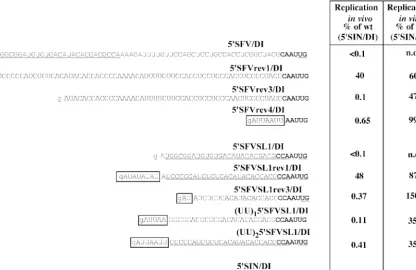
Replication of DI RNAs with modified 5ⴕUTRs.To directly test the ability of the 5⬘UTRs identified in the pseudorever-tants screen to drive replication, these fragments were first cloned into 5⬘SIN/DI RNA to replace the original SIN 5⬘UTR (Fig. 5). The (UU)15⬘SFVSL1/DI and (UU)25⬘SFVSL1/DI
RNAs were designed to test the effect of AUUAA and AUUAAUU sequences, which were found in 5⬘SFV/SINrev4 and were most similar to the authentic SIN 5⬘terminus. The resulting DI RNAs were evaluated for their ability to replicate
on November 8, 2019 by guest
http://jvi.asm.org/
FIG. 1. Computer-predicted secondary structures of the 5⬘end of SIN genome present in 5⬘SIN/DI RNA (A), 5⬘end of SFV genome (B), 5⬘ end of 5⬘SFV/DI RNA (C), and 5⬘end of 5⬘SFVSL1/DI RNA (D). Arrows indicate the initiating AUG codons. The computer-predicted stem-loop structures are indicated as SL1 to SL4. The SL3 and SL4 represent the 51-nt CSE.
64 GORCHAKOV ET AL. J. VIROL.
on November 8, 2019 by guest
http://jvi.asm.org/
in vivo and in vitro by using previously described assays (6; see also Materials and Methods). All of these modified 5⬘ UTRs restored negative-strand RNA synthesis to the level that was 35 to 150% of that observed for 5⬘SIN/DI RNA (Fig. 5).
How-ever, the same RNAs demonstrated a wide spectrum of repli-cation efficiencies in vivo, ranging from 0.1 to 48% of the 5⬘SIN/DI RNA parent (Fig. 5). This indicates that, for many of these sequences, the promoter for positive-strand RNA
syn-FIG. 2. Replication of the DI RNAs with the 5⬘ends containing SFV sequences. (A) Schematic representation and nucleotide sequences of the designed 5⬘ends in the DI RNAs and their replication activity in vivo and in vitro. SFV and SIN sequences are shown in boldface and plain type, respectively. Underlined type represents the sequences predicted to form the stem-loop structures. Lowercase type indicates an additional 5⬘ nucleotide resulting from the SP6 in vitro transcription. (B) Autoradiograph of the dried gel, with the RNAs metabolically labeled with [3H]uridine after coelectroporation of the substrate DI RNAs with SIN replicon. The detailed conditions of in vivo experiments are described in
Materials and Methods. (C) Autoradiograph of the dried gel with the32P-labeled RNAs isolated from in vitro negative-strand RNA synthesis
reactions. The lower panel shows the amount of radioactivity contained in the displayed RNA bands as measured by using a phosphorimager.
on November 8, 2019 by guest
http://jvi.asm.org/
[image:5.603.51.532.74.586.2]FIG. 3. Selection of SIN variants with heterologous 5⬘ends capable of replication in BHK-21 cells. (A) Nucleotide sequences of the 5⬘ends of the RNAs used for electroporation. SFV and SIN sequences are shown in plain and in boldface type, respectively. Underlined type represents the sequences predicted to form the stem-loop structures. Lowercase type indicates an additional 5⬘nucleotide resulting from the SP6 in vitro transcription. (B) Infectivity of in vitro-synthesized RNAs and morphology of plaques in an infectious center assay (see Materials and Methods for details). (C) Growth curves of viruses after transfec-tion of 4g of in vitro-synthesized, full-length RNA transcripts of SIN Toto1101, 5⬘SFV/SIN, and 5⬘SFVSL1/SIN RNAs into BHK-21 cells. Aliquots were taken at the indicated time points postelectroporation, and virus titers were determined by using a standard plaque assay on BHK-21 cells.
66 GORCHAKOV ET AL. J. VIROL.
on November 8, 2019 by guest
http://jvi.asm.org/
thesis is still significantly impaired. Both 5⬘-AUUAA and 5⬘ -AUUAAUU were inefficient for in vivo RNA replication, sup-porting the idea that it is not the presence of A’s and U’s alone but also their particular combination that determines the pos-itive-strand promoter activity.
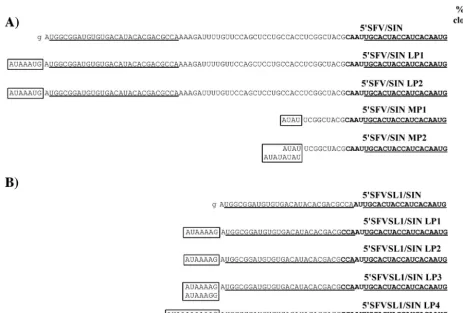
Selection of SIN variants with more efficient 5ⴕ promoter elements. To identify the sequences that could support the efficient SIN RNA replication, the original viral stocks, gener-ated after transfection of 5⬘SFV/SIN and 5⬘SFV SL1/SIN, were serially passaged under conditions where variants were com-peting with each other. Three passages were performed on BHK-21 cells at a high MOI (20 PFU/cell), followed by one passage at an MOI of 0.1 and an additional passage at an MOI of 0.01 PFU/cell. After passaging, the virus stocks formed more homogeneous plaques on BHK-21 cells than did stocks har-vested directly after the RNA transfection. The 5⬘SFVSL1/ SIN-derived virus contained only large plaque-forming vari-ants (plaque size was indistinguishable from SIN Toto1101 [data not shown]); the 5⬘SFV/SIN virus still contained variants generating medium-sized plaques. Four plaques were ran-domly selected in each virus preparation (two large and two medium-sized plaques in 5⬘SFV/SIN-derived stock and four large plaques in 5⬘SFVSL1/SIN-derived stock), and the 5⬘ -terminal sequences were analyzed (Fig. 6). Sequencing results confirmed that more-homogeneous viral populations had been selected. Variations in the 5⬘ends of viruses within individual plaque-purified stocks were also minor. Furthermore, we did
not detect a single variant with the same 5⬘-terminal sequence as seen in the primary isolates (Fig. 4).
The 5⬘UTRs of the passaged isolates exhibited a number of similar features. The genomes of large-plaque-forming vari-ants of both 5⬘SFV SL1/SIN- and 5⬘SFV/SIN-derived viruses started with 5⬘-AU, followed by oligo(A) (with minor varia-tions in length between three and eight residues) and then by U (in 5⬘SFV/SIN-derived large-plaque-forming isolates). Sim-ilar to some of the pseudorevertants shown in Fig. 4A, these sequences were followed by additional guanosine, which could have arisen from the original SP6 transcripts (all of the plas-mids contained the nonnative G in the ⫹1 position of the promoter to ensure efficient transcription with SP6 polymer-ase), and by the unmodified SL1 sequence of the SFV5⬘end. Only the 5⬘SFV/SIN MP1 and MP2 pseudorevertants (which were essentially the same) had different 5⬘UTRs. These iso-lates formed considerably smaller plaques but were present in significant concentrations even after six passages. Their ge-nomes also contained 5⬘-AU, followed by one or three AU repeats, but the entire SFV SL1 and major part of the inter-stem region between SL1 and SL2 was deleted. In the original stocks, as well as in the stocks after passaging, we did not detect pseudorevertants with the wild-type SIN 5⬘ sequence (5⬘-AUUGA or 5⬘-AUUGG).
[image:7.603.54.520.77.337.2]Replication of DI RNAs with different repeating elements in the 5ⴕUTRs.To evaluate the contribution of these sequences to RNA replication and, in particular, to test the effect of the
FIG. 4. Nucleotide sequences of the heterologous 5⬘ends in the genomes of randomly selected plaque isolates of SIN pseudorevertants. Four micrograms of in vitro-synthesized, full-length RNA transcripts of 5⬘SFV/SIN (A) and 5⬘SFVSL1/SIN (B) RNAs were transfected into BHK-21 cells, and plaques were randomly selected directly during the infectious center assay. The 5⬘ends of viral genomes were sequenced as described in Materials and Methods. SFV and SIN sequences are shown in plain and in boldface type, respectively. Underlined type represents the sequences predicted to form the stem-loop structures. Lowercase type indicates an additional 5⬘nucleotide resulting from the SP6 in vitro transcription (present in the original in vitro-synthesized RNA). Boxes indicate heterologous sequences found in the 5⬘termini. Multiple plasmids were sequenced for each plaque isolate, and the percentage of clones containing each acquired nucleotide sequence is indicated.
on November 8, 2019 by guest
http://jvi.asm.org/
repeating elements, we synthesized a set of 5⬘SFVSL1/DI RNAs containing 5⬘-AU, followed by different numbers of repeats: (AU)nor (A)n(Fig. 7A). These recombinant DI RNA
genomes were analyzed for their ability to replicate in vivo and in vitro (see Materials and Methods). The efficiency of both positive- and negative-strand RNA synthesis was dependent on the number of repeats. Five AUs, followed by SFVSL1, in 5⬘SFVSL1rev1/DI yielded an RNA with 48% efficiency of the SIN 5⬘UTR. In the in vitro assay, three AU repeats were even more efficient for negative-strand RNA synthesis than the au-thentic SIN 5⬘terminus. Interestingly, two AU repeats in the context of 5⬘SFVMP1/DI RNA functioned 100-fold more ef-ficiently than when they were fused with SFV SL1 in (AU)15⬘SFVSL1/DI construct, indicating that both the very 5⬘
terminus and downstream sequence of the 5⬘UTR strongly affect the activity of the promoter for positive-strand RNA synthesis.
Similarly, increasing the number of adenosine residues be-tween the 5⬘-AU and SFVSL1 augmented replication of the DI RNAs to the level of 5⬘SIN/DI both in vitro and in vivo. However, analysis of RNAs synthesized in vivo by gel electro-phoresis revealed that (A)35⬘SFVSL1/DI, 5⬘SFVSL1LP1/DI,
and 5⬘SFVSL1LP4/DI RNAs, containing three, four, and five adenosines, respectively, (and 5⬘SFVSL1rev1/DI, containing the highest number, i.e., five AU repeats at the 5⬘terminus) replicated not only as efficiently as 5⬘SIN/DI but also signifi-cantly interfered with replication of the helper genome, TSG/
Pac (Fig. 7B, lanes 6, 9, 10, and 11). This suggests that these RNAs had a higher affinity for thetrans-acting replicase than the 5⬘SIN/DI parent. The difference was not detected in the luciferase assay perhaps due to strong interference of these DIs with TSG/Pac replication, leading to limiting levels of active replicase and RNA accumulation.
Thus, sequences of the repeating elements in the 5⬘terminus and the number of repeats determined the efficiency of the RNA replication. Their activity was also strongly dependent on the downstream RNA sequence and/or higher-order RNA structure.
Replication of SIN with modified 5ⴕends. The results de-scribed above revealed an apparent discrepancy between the ability of primary viral pseudorevertants to grow in BHK-21 cells versus the low level of replication observed for DI RNAs with identical 5⬘ ends. One potential explanation for these differences could be in the presence of the additional muta-tions in the genomes of pseudorevertants conferring a positive impact on virus replication.
[image:8.603.103.519.72.342.2]To rule out this possibility and to test the replication of recombinant viruses in different cell types, we replaced the 5⬘ UTR of SIN with (i) selected sequences found in the primary pseudorevertants and (ii) sequences identified after additional passaging (with various number of repeating elements) (Fig. 8A). The in vitro-synthesized RNAs were transfected into BHK-21 cells, and an infectious center assay revealed that all of the reconstructed RNAs were essentially as infectious as the
FIG. 5. Replication of the DI RNAs with the 5⬘ends derived from the 5⬘SFV/SIN and the 5⬘SFVSL1/SIN pseudorevertants. Nucleotide sequences of the designed 5⬘ends in the DI RNAs, their replication activity in vivo, based on luciferase assay, and the in vitro negative-strand synthesis activity of the templates are shown. SFV and SIN sequences are in plain and boldface type, respectively. Underlining represents the sequences predicted to form the stem-loop structures. Boxes indicate the heterologous sequences acquired by viral pseudorevertants. Lowercase type indicates an additional 5⬘nucleotide resulting from the SP6 in vitro transcription. These data represent one of a series of repeated experiments that generated very reproducible data. n.d., an undetectable level of negative-strand RNA synthesis.
68 GORCHAKOV ET AL. J. VIROL.
on November 8, 2019 by guest
http://jvi.asm.org/
RNA of SIN Toto1101 (Fig. 8A). Only 5⬘SFVrev3/SINr RNA demonstrated a noticeably lower infectivity, but the difference was minor.
Virus stocks prepared after RNA electroporation were used to test virus growth on both BHK-21 and mosquito C710 cells
(Fig. 8B). Some viruses with the 5⬘ends found in the primary isolates (5⬘SFVrev1/SINr and 5⬘SFVSL1rev1/SINr) or in the isolates after competitive passaging (5⬘SFV/SIN/MP1r and 5⬘SFVSL1/SIN/LP4r) grew on BHK-21 cells as well as SIN Toto1101. 5⬘SFVrev4/SINr and 5⬘SFVrev3/SINr viruses dis-played significantly slower growth kinetics that correlated with the dramatically lower ability of corresponding DI RNAs to replicate in vivo (Fig. 5). Synthesis of viral genomic RNAs in BHK-21 cells (Fig. 8C) paralleled the virus growth rates. The 5⬘SFVrev4/SINr and 5⬘SFVrev3/SINr RNAs replicated 4-and 20-fold less efficiently than SIN Toto1101 (lanes 2 and 4, re-spectively). All of the other RNAs replicated at levels similar to Toto1101.
Evaluation of growth and RNA replication of the viruses in C710 cells revealed significant differences between the variants
(Fig. 8B and C). Surprisingly, only 5⬘SFV/SIN/MP1r and (A)15⬘SFVSL1/SINr were able to replicate at rates similar to
that of SIN Toto1101. All of the other viruses propagated much less efficiently. In particular, the 5⬘SFVSL1/SINLP4r, which had the highest growth rate and the highest level of RNA replication in BHK-21 cells, was incapable of replication in mosquito cells (Fig. 8C, lanes 9). Similarly, the lower num-ber of AU repeats in the genome of (AU)15⬘SFVSL1/SINr,
compared to 5⬘SFVSL1rev1/SINr, allowed this virus to repli-cate far more efficiently in mosquito cells.
Taken together, these data indicated that the modified 5⬘ ends of the pseudorevertants were sufficient to rescue replica-tion of SIN with an SFV-specific 5⬘ end in BHK-21 cells. However, these adaptations were host cell dependent and of-ten not beneficial for replication in mosquito cells.
DISCUSSION
One of the important features of the 5⬘cis-acting elements of SIN is the presence of sequence(s) serving as part of the promoters for the synthesis of both negative- and positive-strand genome-length RNAs. Sequences at or near the 5⬘ ter-minus make genomic, but not subgenomic, RNAs competent for replication (6, 21, 22, 38). At the same time, these
over-FIG. 6. Nucleotide sequences in the genomes of 5⬘SFV/SIN and 5⬘SFVSL1/SIN pseudorevertants after serial passaging. Viral libraries generated after electroporation of in vitro-synthesized RNAs were passaged three times on BHK-21 cells at a high MOI (20 PFU/cell), followed by one passage at an MOI of 0.1 and one passage at an MOI of 0.01 PFU/cell. Four plaques were randomly selected in both 5⬘SFV/SIN (A)- and 5⬘SFVSL1/SIN (B)-derived virus stocks. The 5⬘ends of virus genomes were sequenced as described in Materials and Methods. SFV and SIN sequences are shown in plain and boldface type, respectively. Underlined type represents the sequences predicted to form the stem-loop structures. Lowercase type indicates an additional 5⬘nucleotide resulting from the SP6 in vitro transcription (that is present in the original in vitro-synthesized RNA). Boxes indicate heterologous sequences found in the 5⬘ termini. Multiple plasmids were sequenced for each plaque isolate, and the percentage of clones containing each acquired nucleotide sequence is indicated.
on November 8, 2019 by guest
http://jvi.asm.org/
[image:9.603.59.523.69.382.2]70 GORCHAKOV ET AL. J. VIROL.
on November 8, 2019 by guest
http://jvi.asm.org/
lapping functions in a relatively short sequence at the 5⬘end of genome RNA (or its complement at the 3⬘ end of negative-strand RNA), as well as its role in translation initiation, make analysis of this element challenging. In order to exclude the effect of translational efficiency of the RNA templates from our analysis of the promoters for both negative- and positive-strand synthesis, we applied recently designed complementary in vivo and in vitro approaches, in which replication of the tested templates do not depend on their translational efficiency (6). We also used in our experiments BHK-21 cells that are believed to be deficient in alpha/beta interferon signaling and have not been reported as developing antiviral reaction.
The replacement of the SIN 5⬘UTR in DI RNAs by the 5⬘ UTR derived from SFV made these RNAs incompetent for replication (6; see also Fig. 2). The SIN replicative enzymes did not synthesize detectable levels of negative-strand on this tem-plate in vitro and, as expected, replication in vivo was very inefficient. Most importantly, the SFV 5⬘end was incapable of binding host and/or SIN-specific protein factors required for initiation of the negative-strand synthesis (6).
Previously, it was shown for both SIN and rubella virus that 5⬘-terminal nucleotides are critical for RNA replication (21, 27). Based on these data, we positioned five 5⬘-terminal nucle-otides of SIN genome upstream of the SFV 5⬘ stem-loop-forming sequence to increase the level of DI RNA replication. This modification increased negative-strand RNA synthesis in vitro, elevating it to the level found for 5⬘SIN/DI RNA. How-ever, the 5ntSIN-SFV/DI and 5ntSIN-SFVSL1/DI RNAs rep-licated in vivo 3 orders of magnitude less efficiently than RNA containing SIN 5⬘UTR. Further modification of the 5⬘end by inserting an additional sequence to mimic the RNA structure at the 3⬘ end of the negative-strand SIN template did not increase DI RNA replication in vivo. The 5ntSIN-SFVSL1-5nt/DI RNA still replicated 1,000-fold less efficiently than 5⬘SIN/DI RNA. Thus, although the addition of the SIN 5⬘ -terminal nucleotides restored negative-strand RNA synthesis, their complement at the 3⬘end of the negative strand did not function for efficient initiation of positive-strand RNA synthe-sis.
Since we were unable to predict which modifications were required for positive-strand promoter activity in the negative-strand template, we utilized an alternative strategy to define these elements. Specifically, we predicted that selection and analysis of pseudorevertants with enhanced replication and promoter activity would generate useful information. Fortu-nately, the 5⬘SFV/SIN and 5⬘SFVSL1/SIN RNAs were 4 and 3 orders of magnitude less infectious than SIN Toto1101 RNA (based on the infectious center plaque assay), indicating that
these genomes were defective but still capable of generating pseudorevertants. Analysis of randomly selected variants re-vealed a variety of modifications in the 5⬘-terminal sequences, suggesting that a library of replication-competent pseudorever-tants evolved upon transfection of the RNAs into the cells. Moreover, each plaque isolate of virus was not homogeneous and had a variety of similar 5⬘-terminal sequences differing in numbers of repeating elements, which indicated continued evolution. The presence of deletions in the SFV-specific se-quences was not surprising; this provides a simple means of eliminating SFV sequences that have a negative effect on SIN RNA replication. However, the appearance of new repeating elements was unexpected. All variants retained the 5⬘-terminal AU that is conserved among alphaviruses. This dinucleotide was followed by repeats of (AU), (AAUU) or (A), and one or two extra (U)’s were found inside the oligo(A) sequences in some sequenced variants. In a previous study, we determined the consequences of substituting the 5⬘UTR of bovine viral diarrhea virus (BVDV) with that of hepatitis C virus (7). In this case, replication-competent variants with additional 5⬘ se-quences were also selected but appeared to have arisen from template switching by the RdRp during RNA replication (7). This template switching allowed the apparent capture of RNA sequences from cellular mRNAs that could function in BVDV RNA replication. Based on the results of the infectious center assay tests, in the present study, the efficiency of acquiring adaptive 5⬘sequences was 2 to 3 orders of magnitude higher than in the case of the hepatitis C virus-BVDV chimeras. Although acquisition of these sequences from cellular mRNAs cannot be excluded, it looks more likely that the SIN RdRp can generate random AU-rich sequences at the 3⬘end of the neg-ative-strand RNA. Such sequences would then be positively selected based on their ability to promote positive-strand ge-nome RNA synthesis. In support of this idea, previous studies have shown that SIN has the ability to generate U-rich se-quences at the 3⬘ends of defective viral genomes and to re-generate a 3⬘-terminal poly(A) tail (8, 28). In addition, a recent study has shown that 3⬘-UA extensions to the negative strand (5⬘-AU in the positive-strand genome RNA) emerge and sup-press certain nonaromatic substitutions for the N-terminal Tyr residue of nsP4 (31). This additional enzymatic activity can continuously, but with low efficiency, generate new sequences on the SIN 5⬘UTR (most probably by adding them to the 3⬘ end of the negative strand). However, immediately upon syn-thesis the genomes with these modifications have to compete with the efficient promoters of SIN genomes for the replicative enzymes. By using SIN genomes with SFV-specific 5⬘UTRs or with mutations in nsP4 (31), it became possible to
downregu-FIG. 7. Replication of the DI RNAs with different repeating elements in the 5⬘ends. (A) Nucleotide sequences of the designed 5⬘ends in the DI RNAs, replication activity of the RNAs in vivo, based on luciferase assay, and the in vitro negative-strand synthesis. SFV and SIN sequences are shown in plain and boldface type, respectively. Underlining represents the sequences predicted to form the stem-loop structures. Lowercase type indicates an additional 5⬘nucleotide resulting from the SP6 in vitro transcription. Boxes indicate heterologous sequences that were not present in 5⬘SFV/SIN and 5⬘SFVSL1/SIN genomes. (B) Autoradiograph of the dried gel with the RNAs metabolically labeled with [3H]uridine after
coelectroporation of the substrate DI RNAs with SIN replicon into BHK-21 cells. The detailed conditions of in vivo experiments are described in Materials and Methods. Numbers designated for DI RNAs in panel A correspond to the numbers on lanes on the gel as follows: 1, 5⬘SIN/DI; 2, 5⬘SFVSL1/DI; 3, (AU)15⬘SFVSL1/DI; 4, (AU)25⬘SFVSL1/DI; 5, (AU)35⬘SFVSL1/DI; 6, 5⬘SFVSL1rev1/DI; 7, (A)15⬘SFVSL1/DI; 8,
(A)25⬘SFVSL1/DI; 9, (A)35⬘SFVSL1/DI; 10, 5⬘SFVSL1LP1/DI; and 11, 5⬘SFVSL1LP4/DI. These data represent one of two experiments that
generated very similar data.
on November 8, 2019 by guest
http://jvi.asm.org/
72 GORCHAKOV ET AL. J. VIROL.
on November 8, 2019 by guest
http://jvi.asm.org/
late viral replication and to remove the continuous selective pressure of efficiently replicating natural SIN templates. Both systems provided an opportunity to detect the formation of different 5⬘-terminal sequences that had ability to drive RNA replication.
After replacement of the SFV sequences in 5⬘SFVSL1/DI and 5⬘SFV/DI RNAs by the variants’ 5⬘ ends, these new chi-meras became efficient templates for negative-strand RNA synthesis in vitro. However, the same DI genomes were still impaired for replication in vivo in a system where DI RNAs and the helper genome compete for replicative enzymes. Un-der these conditions, replication of DI RNAs ranged from 0.1 and 48% of the 5⬘SIN/DI RNA level. Different abilities of the modified 5⬘ends to support DI RNA replication suggested the possibility that, upon transfection of 5⬘SFV/SIN and 5⬘SFVSL1/SIN viral RNAs into the cells, a library of SIN variants with heterogeneous 5⬘termini was generated. Some of these appeared to be capable of replication at levels sufficient for virus spread and CPE development, and we detected them as plaque-forming viruses. However, ineffective replication of the DI RNAs with the 5⬘ ends identified in the genomes of randomly selected viruses (except 5⬘SFVrev1/DI and 5⬘SFVSL1rev1/DI) indicated that a major fraction of the iden-tified 5⬘ UTRs encoded less-efficient promoters than the nat-ural SIN 5⬘ end. Thus, poorly replicating 5⬘SFV/SIN and 5⬘SFVSL1/SIN RNAs generated variants with a variety of 5⬘UTRs that were sufficient, but not necessarily optimal, for virus replication.
To identify sequences that allowed higher levels of SIN replication in BHK-21 cells, we applied an additional two-step selection. First, virus populations, harvested after transfection of in vitro-synthesized 5⬘SFV/SIN and 5⬘SFVSL1/SIN RNAs, were serially passaged at a high MOI, creating an environment where viral genomes competed with each other for replicative enzymes and/or host factors, as occurs during viral genome-DI RNA replication. In the second step, viruses were passaged at a low MOI to select variants with the highest growth rates. The resulting stocks showed less heterogeneity at the 5⬘ ends of their genome RNAs. The majority of randomly picked plaques contained viruses with the entire SFV SL1 containing a short acquired upstream sequence 5⬘-AU(A)3U or 5⬘-AU(A)4. We
detected more than four adenosine residues in only one plaque variant (5⬘SFVSL1/SIN LP4). Apparently, the addition of 5⬘ -AU(A)n (where n ⬎ 2) to the SFV 5⬘ end transformed an
inefficient positive-strand promoter into a highly competitive sequence, effectively functioning in RNA replication. One vari-ant resulted from a replacement of the 5⬘-terminal 56 nucleo-tides of SFV by a short 5⬘-(AU)2repeat. The presence of AU
repeats in SIN genomes is not new. The 5⬘-AUAU sequence was first detected at the 5⬘end of a naturally occurring SIN DI RNA containing a portion of tRNAAspinstead of the natural 5⬘
terminus (20, 37, 38). This DI RNA replicates efficiently and interferes with SIN replication, indicating the efficient recruit-ment of the SIN replicase. As recruit-mentioned above, 5⬘-AU and 5⬘-AUA were also found in SIN pseudorevertants harboring deleterious substitutions for the N-terminal tyrosine residue of nsP4 (31). The complement of this short sequence in the neg-ative-strand must be a key determinant for initiation of posi-tive-strand synthesis. Similar to the results of Shirako et al. (31), the heterologous AU-rich sequences that we identified were predicted to be unpaired in the 3⬘ end of the negative-strand template (data not shown), and this might be advanta-geous for initiation of the positive-strand RNA synthesis.
The 5⬘-terminal sequences found in passaged virus were tested in the context of DI RNAs. These 5⬘ termini led to efficient production of both positive- and negative-strand DI RNAs and effective competition with the helper construct in vivo. The efficiency of negative- and positive-strand RNA syn-thesis generally correlated with the number of the 5⬘repeats. Three to five 5⬘-AU repeats, followed by SFV SL1, led to negative-strand RNA synthesis similar to that of the natural SIN 5⬘UTR. In vivo, five 5⬘-AU repeats were needed to drive high levels of DI RNA replication and efficient interference with the helper replicon RNA. Similarly, one A residue in the 5⬘-terminal AU(A)nGAU sequence [(A)15⬘SFVSL1/DI
con-struct] was sufficient to make the DI RNA efficient template for negative-strand RNA synthesis in vitro, but more than three adenosines were required for high-level DI RNA repli-cation in vivo.
Similar results were obtained with viruses reconstructed with the 5⬘-terminal sequences found in pseudorevertants. Com-pared to parental 5⬘SFV/SIN and 5⬘SFVSL1/SIN RNAs, the modified 5⬘-UTR sequences increased the specific infectivity of in vitro-synthesized RNAs in BHK cells essentially to the level of SIN Toto1101. These results suggest that the 5⬘ modifica-tions, and not mutations elsewhere, were responsible for en-hanced replication and CPE. Growth rates of generated vi-ruses in BHK cells were also similar to those of SIN Toto1101.
FIG. 8. Single-step growth curves and replication of viral RNAs in different cell types. (A) 5⬘-Terminal sequences of the constructed SIN variants and infectivity of the in vitro-synthesized RNAs in the infectious center assay. The suffix “r” indicates that the genome was constructed in a cDNA form and used for generating virus stock. SFV and SIN sequences are shown in plain and boldface type, respectively. Underlining represents the sequences predicted to form the stem-loop structures. Lowercase type indicates an additional 5⬘nucleotide resulting from the SP6 in vitro transcription. Boxes indicate heterologous sequences that were not present in the original 5⬘SFV/SIN and 5⬘SFVSL1/SIN genomes. (B) BHK-21 and C710 cells were seeded
4 h prior to infection on 35-mm dishes (5⫻105cells/dish and 106cells/dish, respectively). Infections were performed at an MOI of 1 PFU/cell for 1 h
at 37 or 30°C (for BHK-21 or C710 cells, respectively) with shaking. The cells were then washed with the corresponding growth media, 1 ml of complete
BHK-21 or C710 medium was added, and incubation was continued at 37 or 30°C, respectively. The media were harvested and replaced at the indicated
time points. Released virus titers were measured by plaque assay on BHK-21 cells. (C) Autoradiograph of the dried gels with the RNAs metabolically labeled with [3H]uridine. Equal numbers of BHK-21 and C
710 cells (5⫻105and 1⫻106cells, respectively) were infected with different SIN variants
at MOIs of 5 PFU/cell (for BHK-21 cells) and 20 PFU/cell (for C710 cells). The RNAs were metabolically labeled with [3H]uridine (30Ci/ml for
BHK-21 and 40Ci/ml for C710 cells) in the presence of 1g of ActD/ml at between 2 and 6 h postinfection of BHK-21 cells and between 12 and 21 h
postinfection of C710 cells. Numbers designated for viruses in panels A and B correspond to the numbers on lanes on the gels shown on panel C as follows:
1, SIN Toto1101; 2, 5⬘SFVrev4/SINr; 3, 5⬘SFV/SIN/MP1r; 4, 5⬘SFVrev3/SINr; 5, 5⬘SFVrev1/SINr; 6, (AU)15⬘SFVSL1/SINr; 7, 5⬘SFVSL1rev1/SINr; 8,
(A)15⬘SFVSL1/SINr; and 9, 5⬘SFVSL1/SIN/LP4r.
on November 8, 2019 by guest
http://jvi.asm.org/
Interestingly, replication of the reconstructed viral RNAs was found to be cell type specific. An increase in the numbers of 5⬘-AU repeats or adenosines upstream of 5⬘SFVSL1 structure was beneficial for virus growth in BHK-21 cells but was dele-terious for growth in mosquito cells. Only one pseudorever-tant, 5⬘SFV/SIN MP1, was capable of growing in both BHK-21 and C710 cells as efficiently as SIN Toto1101. Thus, 5⬘UTRs
apparently have different requirements for optimal replication in mammalian versus insect cells, and this effect is likely achieved though binding of host factors with different se-quence specificity in the cells of mosquito and vertebrate ori-gin.
The structure of SIN replicative complex and the mechanism of recognition of the promoter elements in SIN genome and its replicative intermediate are not completely understood yet. Previously, it was demonstrated that the 3⬘ends of the negative strands of SIN and SFV genomes bind the same host proteins, and one of these proteins was later identified as a mosquito homolog of La autoantigen (25, 26). Its chicken homolog was also suggested as SIN RNA-binding protein (26). Nevertheless, the complement of SFV 5⬘UTR in the negative-strand RNA was incapable of functioning as a promoter for SIN RdRp. Apparently, the very 3⬘ terminus of the negative-strand tem-plate was not properly presented to SIN replicase, even if it contained five SIN-specific nucleotides (Fig. 2A). Binding of host cell proteins to viral RNA might play an important role(s) in stabilizing SIN RdRp and/or directing it to the 3⬘end of the negative strand. However, melting of the 3⬘-terminal secondary structure and recognition of the sequences on the 3⬘end of the negative-strand genome for initiation of the positive-strand RNA synthesis appear to be a function of SIN nsP4 protein (31). In agreement with this hypothesis, the results of our study suggest that in chimeric viruses, SIN nsP4 is probably incapable of melting the GC-rich stem-loop derived from SFV, and new variants, containing the deletions and/or short unpaired RNA fragments enriched with adenosines and uridines, are gener-ated and further selected. The new RNA elements strongly increased both positive- and negative-strand RNA synthesis, but their enhancing effect on replication depended on the cells used in the experiments. The upregulation of replication also depended on the number of generated repeats and their nu-cleotide sequencses. Based on analysis of functioning of the heterologous 5⬘ends, we propose that structure of SIN RdRp or its positioning may not be the same in mammalian and insect cells, most likely due to significant variations in host factors involved in replication. This different positioning, in turn, requires a distinct 5⬘terminus for initiation of the posi-tive-strand RNA synthesis. However, this hypothesis needs further experimental support.
The authentic SIN 5⬘UTR appears to be a successful com-promise that allows efficient replication of viral genome by SIN RdRp and virus growth in both vertebrate and invertebrate cells. It has undoubtedly been selected to function efficiently in nature, because a successful arbovirus must be able to replicate to high levels in amplifying vertebrate hosts and develop per-sistent infection in mosquitoes. This complex cycle, which has been optimized over countless transmission cycles, requires replication in multiple cell types within both hosts. In addition, it was recently demonstrated that sequence of the 5⬘ end is critical for resistance of another alphavirus, Venezuelan
equine encephalitis virus, to innate immune response (34, 40), and this factor, certainly, can cause additional selective pres-sure.
In conclusion, we have shown that SIN is capable of adapt-ing to deleterious heterologous 5⬘ UTR sequences through deletion and generation of new 5⬘-terminal sequences contain-ing short repeats enriched in adenosine and uridine. These sequences have a strong impact on both negative- and positive-strand RNA synthesis and their replication-enhancing ability depends on particular downstream sequences in the 5⬘ UTR and the nature or host cells (host protein factors) used in the experiments. These modifications can have differential effects on synthesis of negative- and positive-strand RNAs. Initiation of the negative-strand RNA synthesis relies more on the length of the 5⬘ unpaired terminus than on its particular sequence. However, for positive-strand synthesis, the SIN RdRp can uti-lize a more limited number of repeats with particular se-quences. Besides enhancing understanding of this multifunc-tional RNA element, our results have possible practical applications. Alphavirus-based vectors are being widely used for protein production and as possible vaccine delivery vehicles (2, 19, 39). Using the approaches outlined here, it should be possible to select 5⬘ variants with restricted host range and perhaps cell tropism. In addition, by varying the 5⬘sequence elements in defective helper and replicon RNAs, we can mod-ulate RNA replication and the synthesis oftrans-acting repli-case and structural proteins with the goal of enhancing the production of packaged replicon RNAs.
ACKNOWLEDGMENTS
We thank Peter Mason and Scott Weaver for critical reading of the manuscript.
This study was supported by Public Health Service grants AI50537 (I.F.) and AI24134 (C.M.R.).
REFERENCES
1. Bredenbeek, P. J., I. Frolov, C. M. Rice, and S. Schlesinger.1993. Sindbis virus expression vectors: packaging of RNA replicons by using defective
helper RNAs. J. Virol.67:6439–6446.
2. Chen, M., K. F. Hu, B. Rozell, C. Orvell, B. Morein, and P. Liljestrom.2002. Vaccination with recombinant alphavirus or immune-stimulating complex
antigen against respiratory syncytial virus. J. Immunol.169:3208–3216.
3. Davis, N. L., K. W. Brown, G. F. Greenwald, A. J. Zajac, V. L. Zacny, J. F. Smith, and R. E. Johnston.1995. Attenuated mutants of Venezuelan equine encephalitis virus containing lethal mutations in the PE2 cleavage signal
combined with a second-site suppressor mutation in E1. Virology212:102–
110.
4. Frey, R. K., D. L. Gard, and J. H. Strauss.1979. Biophysical studies on circle
formation by Sindbis virus 49S RNA. J. Mol. Biol.132:1–18.
5. Frolov, I., E. Agapov, T. A. Hoffman, Jr., B. M. Pra´gai, M. Lippa, S. Schlesinger, and C. M. Rice.1999. Selection of RNA replicons capable of
persistent noncytopathic replication in mammalian cells. J. Virol.73:3854–
3865.
6. Frolov, I., R. Hardy, and C. M. Rice.2001.cis-Acting RNA elements at the
5⬘end of Sindbis virus genome RNA regulate minus- and plus-strand RNA
synthesis. RNA7:1638–1651.
7. Frolov, I., M. S. McBride, and C. M. Rice.1998.cis-acting RNA elements
required for replication of bovine viral diarrhea virus-hepatitis C virus 5⬘
nontranslated region chimeras. RNA4:1418–1435.
8. George, J., and R. Raju.2000. Alphavirus RNA genome repair and evolu-tion: molecular characterization of infectious sindbis virus isolates lacking a
known conserved motif at the 3⬘end of the genome. J. Virol.74:9776–9785.
9. Grakoui, A., R. Levis, R. Raju, H. V. Huang, and C. M. Rice.1989. A
cis-acting mutation in the Sindbis virus junction region which affects
sub-genomic RNA synthesis. J. Virol.63:5216–5227.
10. Imataka, H., A. Gradi, and N. Sonenberg.1998. A newly identified N-terminal amino acid sequence of human eIF4G binds poly(A)-binding
pro-tein and functions in poly(A)-dependent translation. EMBO J.17:7480–
7489.
74 GORCHAKOV ET AL. J. VIROL.
on November 8, 2019 by guest
http://jvi.asm.org/
11. Kuhn, R. J., Z. Hong, and J. H. Strauss.1990. Mutagenesis of 3⬘
nontrans-lated region of Sindbis virus RNA. J. Virol.64:1465–1476.
12. Lemm, J. A., R. K. Durbin, V. Stollar, and C. M. Rice.1990. Mutations which alter the level or structure of nsP4 can affect the efficiency of Sindbis virus
replication in a host-dependent manner. J. Virol.64:3001–3011.
13. Lemm, J. A., and C. M. Rice.1993. Assembly of functional Sindbis virus RNA replication complexes: requirement for coexpression of P123 and P34.
J. Virol.67:1905–1915.
14. Lemm, J. A., and C. M. Rice.1993. Roles of nonstructural polyproteins and cleavage products in regulating Sindbis virus RNA replication and
transcrip-tion. J. Virol.67:1916–1926.
15. Lemm, J. A., T. Ru¨menapf, E. G. Strauss, J. H. Strauss, and C. M. Rice.
1994. Polypeptide requirements for assembly of functional Sindbis virus replication complexes: a model for the temporal regulation of minus- and
plus-strand RNA synthesis. EMBO J.13:2925–2934.
16. Levis, R., S. Schlesinger, and H. V. Huang.1990. Promoter for Sindbis virus
RNA-dependent subgenomic RNA transcription. J. Virol.64:1726–1733.
17. Liljestro¨m, P., and H. Garoff.1991. A new generation of animal cell expres-sion vectors based on the Semliki Forest virus replicon. Bio/Technology
9:1356–1361.
18. Liljestro¨m, P., S. Lusa, D. Huylebroeck, and H. Garoff.1991. In vitro mu-tagenesis of a full-length cDNA clone of Semliki Forest virus: the small 6,000-molecular-weight membrane protein modulates virus release. J. Virol.
65:4107–4113.
19. Lundstrom, K.2002. Alphavirus-based vaccines. Curr. Opin. Mol. Ther.
4:28–34.
20. Monroe, S. S., and S. Schlesinger.1983. RNAs from two independently isolated defective interfering particles of Sindbis virus contain a cellular
tRNA sequence at their 5⬘ends. Proc. Natl. Acad. Sci. USA80:3279–3283.
21. Niesters, H. G. M., and J. H. Strauss.1990. Defined mutations in the 5⬘
nontranslated sequence of Sindbis virus RNA. J. Virol.64:4162–4168.
22. Niesters, H. G. M., and J. H. Strauss.1990. Mutagenesis of the conserved 51
nucleotide region of Sindbis virus. J. Virol.64:1639–1647.
23. Ou, J. H., C. M. Rice, L. Dalgarno, E. G. Strauss, and J. H. Strauss.1982. Sequence studies of several alphavirus genomic RNAs in the region
contain-ing the start of the subgenomic RNA. Proc. Natl. Acad. Sci. USA79:5235–
5239.
24. Ou, J. H., E. G. Strauss, and J. H. Strauss.1981. Comparative studies of the
3⬘terminal sequences of several alphaviruses. Virology109:281–289.
25. Pardigon, N., E. Lenches, and J. H. Strauss.1993. Multiple binding sites for
cellular proteins in the 3⬘ end of Sindbis alphavirus minus-sense RNA.
J. Virol.67:5003–5011.
26. Pardigon, N., and J. H. Strauss.1996. Mosquito homolog of the La
autoan-tigen binds to Sindbis virus RNA. J. Virol.70:1173–1181.
27. Pugachev, K. V., and T. K. Frey.1998. Effects of defined muations in the 5⬘
nontranslated region of rubella virus genome RNA on virus viability and
macromolecule synthesis. J. Virol.72:641–650.
28. Raju, R., M. Hajjou, K. R. Hill, V. Botta, and S. Botta.1999. In vivo addition
of poly(A) tail and AU-rich sequences to the 3⬘terminus of the Sindbis virus
RNA genome: a novel 3⬘-end repair pathway. J. Virol.73:2410–2419.
29. Rice, C. M., R. Levis, J. H. Strauss, and H. V. Huang.1987. Production of infectious RNA transcripts from Sindbis virus cDNA clones: mapping of lethal mutations, rescue of a temperature-sensitive marker, and in vitro
mutagenesis to generate defined mutants. J. Virol.61:3809–3819.
30. Schlesinger, S., and M. J. Schlesinger.2001.Togaviridae: the viruses and
their replication, p. 895–916.InD. M. Knipe and P. M. Howley (ed.), Fields
virology, 4th ed. Lippincott/The Williams & Wilkins Co., Philadelphia, Pa. 31. Shirako, Y., E. G. Strauss, and J. H. Strauss.2003. Modification of the 5⬘
terminus of Sindbis virus genomic RNA allows nsP4 RNA polymerases with nonaromatic amino acids at the N terminus to function in RNA replication.
J. Virol.77:2301–2309.
32. Shirako, Y., and J. H. Strauss.1990. Cleavage between nsP1 and nsP2 initiates the processing pathway of Sindbis virus nonstructural polyprotein
P123. Virology177:54–64.
33. Shirako, Y., and J. H. Strauss.1994. Regulation of Sindbis virus RNA replication: uncleaved P123 and nsP4 function in minus strand RNA syn-thesis, whereas cleaved products from P123 are required for efficient plus
strand RNA synthesis. J. Virol.185:1874–1885.
34. Spotts, D. R., R. M. Reich, M. A. Kalkhan, R. M. Kinney, and J. T. Roehrig.
1998. Resistance to alpha/beta interferons correlates with the epizootic and virulence potential of Venezuelan equine encephalitis viruses and is
deter-mined by the 5⬘noncoding region and glycoproteins. J. Virol.72:10286–
10291.
35. Strauss, E. G., C. M. Rice, and J. H. Strauss.1984. Complete nucleotide
sequence of the genomic RNA of Sindbis virus. Virology133:92–110.
36. Strauss, J. H., and E. G. Strauss.1994. The alphaviruses: gene expression,
replication, evolution. Microbiol. Rev.58:491–562.
37. Tsiang, M., S. S. Monroe, and S. Schlesinger.1985. Studies of defective interfering RNAs of Sindbis virus with or without tRNAAsp sequences at
their 5⬘termini. J. Virol.54:38–44.
38. Tsiang, M., B. G. Weiss, and S. Schlesinger.1988. Effects of 5⬘-terminal modifications on the biological activity of defective interfering RNAs of
Sindbis virus. J. Virol.62:47–53.
39. Tsuji, M., C. C. Bergmann, Y. Takita-Sonoda, K. Murata, E. G. Rodrigues, R. S. Nussenzweig, and F. Zavala.1998. Recombinant Sindbis viruses ex-pressing a cytotoxic T-lymphocyte epitope of a malaria parasite or of influ-enza virus elicit protection against the corresponding pathogen in mice.
J. Virol.72:6907–6910.
40. White, L. J., J. G. Wang, N. L. Davis, and R. E. Johnston.2001. Role of alpha/beta interferon in Venezuelan equine encephalitis virus pathogenesis:
effect of an attenuating mutation in the 5⬘untranslated region. J. Virol.
75:3706–3718.