A Power and Bandwidth Efficient Remote Wireless Video
Surveillance System Using Joint Source-Channel Coding
Wei Xiang
Faculty of Engineering and Surveying University of Southern Queensland Toowoomba, QLD 4350, Australia
Abstraction: A novel wireless remote video surveillance system based on joint source-channel coding is proposed in this paper. The proposed system exhibits superior bandwidth and power effi-ciency thanks to the adoption of the proposed iteratively decodable variable-length codes (IDVLCs). An experimental platform was built and simulation results were shown to demonstrate the superior performance of the proposed video surveillance system in terms of both objective and subjective measurements.
1 Introduction
Advanced wireless technologies have helped transform traditional video surveillance techniques. There has been growing demand on remote video surveillance systems using latest wireless tech-niques. Power and bandwidth have always been two constraints for developing such wireless re-mote video surveillance systems. As the available radio spectrum is limited, such systems can only be achieved through advanced source coding and powerful channel error control coding techniques.
From the perspective of information theory, source coding aims to remove unwanted redundancy from uncompressed source signals, whereas channel coding adds deliberate redundancy into com-pressed source signals. For the past decades, Shannon’s classic separation theorem [1] motivated a separate source and channel coding approach, which states that the end-to-end system performance can be optimised by separately optimising source and channel coding. This theorem is, however, constrained by two hypothetical assumptions, namely perfect source codes that remove all source redundancy and perfect channel codes that guarantee error-free transmission. The two hypotheses have proved unrealistic for practical video communications systems. This fact justifies a joint source and channel coding approach that may achieve better performance for practical video com-munications systems.
This paper proposes a novel wireless remote video surveillance system based on the joint source-channel coding approach. The joint approach is able to improve significantly the power and band-width efficiency for transmitting image and video signals over noisy wireless channels compared to conventional video surveillance systems. The novel approach can find its ways in a wide range of machine vision applications including remote surveillance and visual remote control. In this paper, we aims to describe a novel power and bandwidth efficient remote video surveillance based on the proposed joint source-channel coding approach.
2 Wireless Remote Video Surveillance Systems Design Overview
The wireless remote video surveillance system we consider in this paper is contingent on error resil-ient image and video signals transmission over highly corrupted wireless channels. Advanced source compression and channel error control mechanisms are imperative to design such systems. As mentioned in the previous section, we are only able to achieve the design goals through jointly designing source and channel coding due to the two unrealistic hypothetical assumptions imposed by Shannon’s classic ‘separation’ theorem.
For conventional remote video surveillance systems, source coding and channel coding are done in a separate way. That is, source coding tries to compress source signals as much as possible to re-duce channel bandwidth consumption, whereas channel coding utilises all available channel band-width to add error control redundancies. The system is not optimised in terms of bandband-width and power use from a global point of view. The essence of the novel wireless remote video surveillance system proposed in this paper is the so called joint source-channel coding approach [2], which allo-cates bandwidth and power resources between source and channel coding from a global optimisa-tion perspective.
To achieve best source compression performance, most source entropy codes adopt variable-length coding. The resulting variable-variable-length codes (VLCs) have the advantage of being able to rep-resent most frequent source symbols with short codewords and less frequent source symbols with long codewords. Whilst it achieves nearly optimal performance solely from the source coding per-spective, however, the variable length coding strategy presents a big challenge to VLC decoding. This is due to the error propagation property of VLCs. The variable length coded signals are very prone to channel noise. Even a single bit error could destroy the whole coded bitstream if no other error control schemes are adopted.
To circumvent the VLC decoding challenge, we can extend the well-known “turbo principle” [3] in channel coding to joint iterative source-channel decoding (ISCD). Iterative decoding between the source and channel decoders enables the two decoders to exchange soft a priori and a posteriori decoding information with each other, and thus significantly improve the overall decoding perform-ance.
Huffman codes [4] are the most popular VLCs that are typically employed in international image and video coding standards. The codes are optimal in terms of minimising source redundancy. Huffman codes have little redundancy and thus small free distance from the channel coding per-spective. While Huffman codes exhibit superior source compression performance, their small free distance prohibits iterative decoding between the source and channel decoders, which could yield potentially much more coding gain using a joint source-channel coding approach. In this paper, we show how VLCs like Huffman codes can be reconstructed into powerful iteratively decodable vari-able-length codes (IDVLCs). The proposed IDVLCs can be utilised in the remote video surveil-lance system to significantly improve system performance as opposed to conventional systems.
3 Soft-output decoding of source codes
To implement the ISCD algorithm stated in Section 2, both source and channel decoders of the video surveillance system need to generate soft-output information. This is not a problem for the channel decoder that employs the a posteriori probability (APP) decoding algorithm. However, conventional VLC source decoders are not able to generate soft-output information. We need to modify VLC decoders to yield soft-output information as the first step toward joint iterative source-channel decoding.
Channel Coding 373
decoding module for VLCs was derived by applying the BCJR algorithm [7] to such a VLC-trellis. Therefore, an APP VLC source decoder can be implemented to yield soft outputs, and exchange ex-trinsic information with the channel APP decoder.
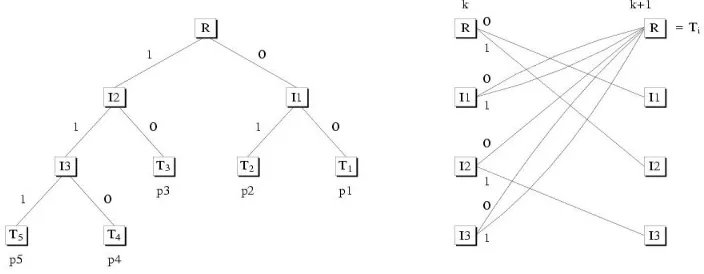
For a variable length-coded sequence, the source symbol or codeword probabilities are usually assumed to be known. The a priori bit probabilities can be derived directly from the tree representa-tion of VLCs using the symbol probabilities of the codes, and then be used in a joint source-channel decoding process. We proposed a method to derive the state transition probabilities (STPs) [8], based on the bit-level trellis representation of variable length codes.
[image:3.595.117.469.396.533.2]Fig. 1 shows the tree representation and the bit-level trellis of an example variable-length code C = {00, 01, 10, 110, 111}with the corresponding codeword probabilities P = {p1, p2, p3, p4, p5}.The nodes in the tree are subdivided into a root-node (R), internal nodes (I) and terminal nodes (T). We can treat the VLC-trellis as an irregular trellis in comparison to the trellis of a recursive systematic convolutional (RSC) code. The trellis of an RSC code has nice systematic properties. Each state has two paths emanating and two paths merging with the same probabilities. In contrast to the system-atic trellis of an RSC code, each state in the VLC-trellis might have an arbitrary number of emanat-ing or mergemanat-ing paths or even have parallel paths emanatemanat-ing and mergemanat-ing between states. Moreover, different paths might emanate or merge to a state with different probabilities from each other be-cause the codeword probabilities of VLCs are in general different. We can utilise the codeword probabilities of VLCs to derive the STPs which are used as a priori information to facilitate ISCD.
Fig. 1. Tree representation and VLC-trellis with parallel transitions
For a generic trellis, we formulise the state transition probabilities between two adjacent states associated with an input bit i as
∑
∑
∈ ∈ + = = = = + ) ( ) , ( ' 1 1 ) | , ( k k S g i S f k k k s p p m S i d m S P β βα α (1)
where are all the forward nodes indices connected to with the input bit i and are all the forward nodes indices connected to .
) , (S i
f k Sk g(Sk)
k
S
For the purpose of ISCD, we need a source decoder that produces soft outputs. The soft output Viterbi algorithm or the BCJR algorithm [9] can be applied to the VLC-trellis to decode variable length codes. We modified the well-known BCJR algorithm for the soft decoding of VLCs. The forward state metric and backward state metric are calcualted in a similar way as in [10]. However, the branch metric '
is expressed as m k α m k β ,
,mm i k
δ
k=
χ
kexp
(
L
cr
ki
)
Pr
(
S
k+1=
m
,
d
k=
i
|
S
k=
m
)
(2) whereχ
kis a constant and . is the variance of the AWGN noisy channel. The last term in (2) is the STP which can be obtained from the VLC-trellis from (1). Note that the recursive calculation of both the forward state metric and reverse state metric use the same STPs.2
/ 2 σ
=
c
L σ2
m k
α m
k
β
4 Iteratively decodable variable-length codes
By employing the soft decoding techniques for source codes presented in Section 3, one can trans-form a conventional VLC source decoder into an APP VLC decoder, which is capable of producing soft outputs, and exchange the soft information with a channel APP decoder. For the best known source codes, i.e., Huffman codes, however, iterative source-channel decoding performs rather poorly. This is because of the small free distance of Huffman codes (df = 1). It is well known that
the free distance of the codes used in an iterative decoding system dictates the performance of itera-tive decoding. In this section, we discuss the construction of the so-called iteraitera-tively decodable variable-length codes (IDVLCs) which have large free distance (df ≥ 2) with minimally increased
redundancy.
The free distance metric dfplays an important role in soft VLC decoding. Due to the nonlinearity
of VLCs, direct evaluation of df is relatively complicated. However, other distance metrics such as
minimum block distance , minimum prefix distance and minimum suffix distance can be utilised to reduce the evaluation complexity of d
b
d dp ds
f. We therefore give the following two theorems
re-garding the upper bound and lower bound of the free distance df:
Theorem 1. The lower bound of the free distance df of a VLC is C
df ≥min
(
db,dp+ds)
(3)Theorem 2. The upper bound of the free distance df of a VLC is C
df ≤db (4)
The significance of evaluating of a VLC C is to understand its iterative decoeding performance. For Huffman codes, their of 1 means that the codes are virtually hopeless when applied to ISCD. As a result, based on an existing Huffman codes, we can construct the correspond-ing IDVLC with ≥ 2 to realize the powerfulness of ISCD. To design good IDVLCs, our aim is
to increase as much as possible but minising the increase of source reduancy. In essence, the de-sign principle for IDVLCs is to trade off source redundancy again larger free distance. IDVLCs with = 2 and = 3 are of particular interests because of the appropriate trade-off between
redundancy and good iterative decoding capability. To design IDVLCs with large free distance met-ric, we give the following lemmas as guidelines.
f
d
f
d
f
d
f
d
f
d df
Lemma 1. A necessary condition for a variable-length code with a prefix distance of one to have a free distance ≥ 2 is to satisfy the suffix-free condition, i.e., no codeword is the suffix of
an-other codeword.
C
f
Channel Coding 375
Lemma 1 indicates that C is a reversible variable-length code (RVLC) [11] which satisfies both prefix-free and suffix free conditions.
Lemma 2. For a variable-length code C with ≥ 2, either = 1 and = 1 or = 2 can
guaranty ≥ 2.
b
d dp ds dp
f
d
Lemma 3. For a variable-length code C with ≥ 3, either = 1 and = 2 or = 2 and
= 1 can guaranty ≥ 3.
b
d dp ds dp
s
d df
.
The above theorems and lemmas are given without mathematic proofs. Refer to [12] for more de-tails. These theorems and lemmas provide useful design criteria and insightful thoughts on structing the proposed IDVLCs. In the next section, we will present three example IDVLCs con-structed using the given guidelines.
5 Architecture of the Wireless Remote Video Surveillance System
Based on Joint Iterative Source-Channel Coding
In this section, we present the system architecture of the proposed wireless remote video surveil-lance system. In order for the system to be more bandwidth and power efficient as opposed to con-ventional systems, the core part of the system, which is made up of a transmitter and receiver, will adopt the joint source-channel coding paradigm discussed in the previous chapters.
The transmitter of the video surveillance system consists of a source encoder serially concate-nated with a recursive systematic convolutional (RSC) channel encoder. The receiver performs it-erative decoding between the source and channel APP decoders. The two decoders are separated by a pseudo-random interleaver.
The coded bit-stream is sent through a highly corrupted wireless noisy channel. The iterative re-ceiver of the serial concatenated system is depicted in Fig. 2. It consists of an inner channel APP decoder and an outer source APP decoder. The two source and channel APP decoders exchange soft reliability decoding information at every iteration, except for the initial iteration when the a priori soft input to the source APP decoder is set to zero. The iterative decoding system will exhibit sig-nificant bandwidth and power gain provided that the VLC source code used has a large free dis-tance. However, if Huffman codes with = 1 are used in the system, the performance gain will be
minimal as explained in the previous section. Therefore, in order to exploit the potential gain of the proposed system, it is essential to construct good IDVLCs with larger free distance based on the original Huffman codes.
f
Fig. 2. Joint iterative receiver of the wireless video remote surveillance system
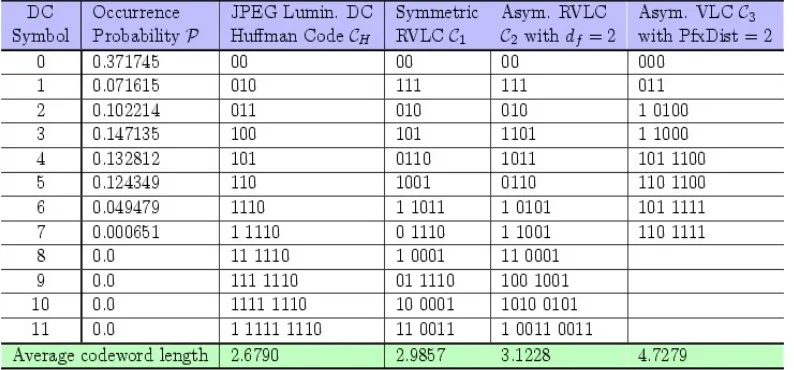
We evaluate the performance of the proposed system architecture on JPEG coded image and video sequences. The JPEG standard adopts Huffman codes as its entropy source code. The DC lu-minance components of a JPEG image are coded using a 12-entry Huffman DC table. The original JPEG DC Huffman code does not exhibit good convergence behaviour in iterative source-channel decoding due to its poor free distance = 1. Using the code design criteria presented in
Section 4, we construct three IDVLCs based on the existing Huffman code . Table 1 presents such three codes, i.e., a symmetric RVLC ( = 1 = 1 = 1), an asymmetric RVLC C2
( = 2 = 1 = 1), and an asymmetric VLC C
H C
f
d
H C
1
C db dp ds
b
d dp ds 3( = 2 = 2 = 0). Note the
probabil-ity distribution P of DC symbols in Table 1 was obtained by training several typical JPEG images.
Code is symmetric that means that it has the nice property of needing only one code table for both forward and backward decoding, which is an advantage from the viewpoint of memory usage and simplicity. Code and have = 2 at the expense of modestly increased average
code-word length.
b
d dp ds
1
C
2
C C3 df
[image:6.595.105.502.553.738.2]Channel Coding 377
6 Experimental platform and results
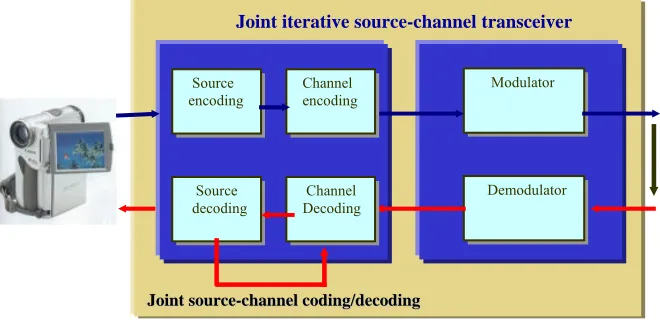
In this section, we present the experimental platform and simulation results to demonstrate the supe-rior performance of the proposed wireless remote video surveillance system. Fig. 3 illustrates the experimental platform that we developed for the video surveillance system. In Fig. 3, a video cam-era acts as the video source capture device. The joint itcam-erative source-channel transceiver shown in the figure is the core part of the wireless remote surveillance system, which is made up of two func-tional blocks, i.e., joint source-channel coding/decoding and modulation/demodulation. The first functional block is implemented via computer software program, whereas the second block is im-plemented via hardware.
Joint iterative source-channel transceiver
[image:7.595.130.460.297.457.2]Modulator
Fig. 3. Experimental platform for wireless remote video surveillance system
For the purpose of demonstrating the performance of the proposed system as opposed to conven-tional systems, a standard JPEG coded “Lena” 256×256 image is transmitted over a noisy channel. Assume only the DC components of the image are affected by channel noise, and the AC compo-nents are transmitted error-free. The 2000 coded DC symbols of the image are protected by a 16-state inner channel code with code polynomials 35/23 in octal notation. The channel coding rate us-ing the reference Huffman code CH is 1/2. S-random interleavers are used [13]. The interleaver sizes
for CH, C1, C2 and C3are 5335, 5899, 6221, 9290 with S = 54 57 58 and 71, respectively. We
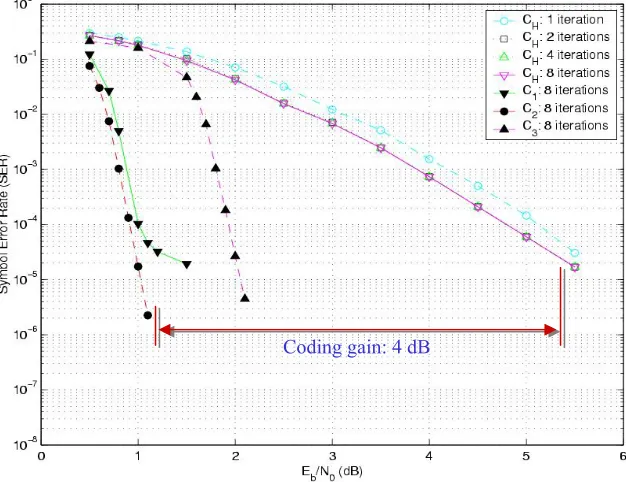
punc-ture the coded bitstreams so that the overall coding rate is one half for all system configurations. The objective simulation results regarding the bit error rate (BER) are presented in Fig. 4. As can be seen from the figure, iterative decoding using the proposed iteratively decodable VLC C2
re-markably outperforms the original JPEG Huffman code CH. A coding gain of 4 dB is obtained at a
BER around 6 106. It is also observed that iterative decoding of the Huffman code C
Hdoes not
yield additional coding gain with increasing number of iterations. The performance improvement nearly stops after two iterations. This observation is consistent with the fact that Huffman codes have very little source redundancy, and a small free distance df= 1.
The subjective simulation results regarding the reconstructed images at the receiver using C2at a
EbN0 of 1.5 dB are presented in Fig. 5. It is evident that iterative decoding using C2 improves
swiftly the quality of the reconstructed images with increasing number of iterations.
Source encoding
Demodulator Source
decoding
Channel encoding
J
Jooiinnttssoouurrccee--cchhaannnneel lccooddiinngg//ddeeccooddiinngg
Coding gain: 4 dB
Fig. 4. BER results for iterative decoding using CH, C1, C2 and C3
O
OrriiggiinnaallLLeennaaiimmaagge e 11sstt iitteerraattiioonn 22nnddiitteerraattiioonn
6
6tthh iitteerraattiioonn
8
8tthhiitteerraattiioonn 44tthhiitteerraattiioonn
Fig. 5. Lena image decoded by iteration with C2 at a EbN0 of 1.5 dB
[image:8.595.171.468.441.635.2]Channel Coding 379
7 Concluding remarks
In this paper, we proposed an innovative wireless remote video surveillance system based on joint source-channel coding using IDVLCs. The proposed video surveillance system exhibits superior bandwidth and power efficiency thanks to the adoption of IDVLCs. The IDVLCs have larger free distance relative to Huffman codes with slightly increased average codeword length.
An experimental platform was built and results were shown to demonstrate the performance of the proposed wireless surveillance system. The objective simulation results in terms of the BER showed a remarkable 4 dB coding gain as opposed to conventional systems, whereas the subject simulation results in terms of reconstructed images were considerably better than those of conven-tional systems.
8 References
[1] C. E. Shannon, “A mathematical theory of communication,” Bell System Tech. Journal, vol. 27, pp. 379-423, 623-656, July, Oct. 1948.
[2] W. Xiang, “Joint source-channel coding for image transmission and related topics,” Ph.D. dissertation, University of South Australia, Adelaide, Australia, 2004.
[3] J. Hagenauer, “The Turbo principle – Tutoiral introduction and state of the art,” in Proc. Int. Symp. on Turbo Codes & Related Topics, Brest, France, Sept. 1997, pp. 1-11.
[4] D. A. Huffman, “A method for the construction of minimum redundancy codes,” Proc. IRE, vol. 40, pp.
1098-1101, Sept. 1952.
[5] V. B. Balakirsky, “Joint source-channel coding with variable length codes,” in Proc. IEEE Int. Symp. In-form. Theory, Ulm, Germany, June-July 1997, p. 419.
[6] R. Bauer and J. Hagenauer, “On variable length codes for iterative source/channel decoding,” in Proc. IEEE Data Compression Conference (DCC’01), Snowbird, UT, USA, Mar. 2001, pp. 272–282.
[7] L. R. Bahal, J. Cocke, F. Jelinek, and J. Raviv, “Optimal decoding of linear codes for minimizing symbol error rate,” IEEE Trans. Inform. Theory, vol. IT-20, pp. 284–287, Mar. 1974.
[8] W. Xiang, S. S. Pietrobon, and S. A. Barbulescu, “Joint source-shannel codec: a more power efficient tech-nology for image transmission,” in Proc. 3rd International Symposiumon Turbo Codes & Related Topics,
Brest, France, Sept. 2003, pp. 59–62.
[9] L. R. Bahal, J. Cocke, F. Jelinek, and J. Raviv, “Optimal decoding of linear codes for minimizing symbol error rate,” IEEE Trans. Inform. Theory, vol. IT-20, pp. 284–287, Mar. 1974.
[10] S. Pietrobon, “Implementation and performance of a Turbo/MAP decoder,” Int. J. Satellite Commun., vol. 16, pp. 23–46, Jan.-Feb. 1998.
[11] Y. Takishima, M. Wada, and H. Murakami, “Reversible variable length codes,” IEEE Trans. Commun., vol. 43, pp. 158–162, Feb.-Apr. 1995.
[12] W. Xiang and J. Leis, “EXIT chart analysis of iteratively decodable source codes for wireless multimedia
communications,” Proc. 4th Workshop on the Internet, Telecommunications and Signal Processing
(WITSP'05), Sunshine Coast, Australia, Dec. 2005, pp. 393-398.