
Vol. 36, No. 7, 10 June 2005, 405–413
Optimal controller and filter realizations using
finite-precision, floating-point arithmetic
JAMES F. WHIDBORNE*
{
, DA-WEI GUz, JUN WUx
and SHENG CHEN
{Department of Aerospace Sciences, Cranfield University, Bedfordshire MK43 0AL, UK
zDepartment of Engineering, University of Leicester, Leicester LE1 7RH, UK
xNational Key Laboratory of Industrial Control Technology, Institute of Industrial Process Control, Zhejiang University, Hangzhou, 310027, PR China
Department of Electronics and Computer Science, University of Southampton, Highfield, Southampton SO17 1BJ, UK
(Received 13 January 2003; revised 14 February 2005; accepted 8 April 2005)
The problem of reducing the fragility of digital controllers and filters implemented using finite-precision, floating-point arithmetic is considered. Floating-point arithmetic parameter uncertainty is multiplicative, unlike parameter uncertainty resulting from fixed-point arithmetic. Based on first-order eigenvalue sensitivity analysis, an upper bound on the eigenvalue perturbations is derived. Consequently, open-loop and closed-loop eigenvalue sensitivity measures are proposed. These measures are dependent upon the filter/controller realization. Problems of obtaining the optimal realization with respect to both the open-loop and the closed-loop eigenvalue sensitivity measures are posed. The problem for the open-loop case is completely solved. Solutions for the closed-loop case are obtained using non-linear programming. The problems are illustrated with a numerical example.
Keywords: Finite-precision arithmetic; Finite word length; Digital controller; Digital filter; Eigenvalue sensitivity; Floating-point arithmetic; Controller fragility
1. Introduction
The finite word-length used for number representation in digital computers means that controllers and filters implemented with digital hardware are subjected to errors. The errors in the arithmetic result from two sources (Mullis and Roberts 1976). The first is quantiza-tion errors resulting from the quantizaquantiza-tion of the signals and roundoff of the results of multiplication and addi-tion. The second is coefficient errors resulting from the rounding of the coefficients of the filter/controller. This paper is concerned with the second of these. There are other finite word-length effects that need to be considered in implementing digital filters/controllers, notably the effects of overflow and (for floating point arithmetic) underflow and limit cycles resulting from the quantization. These are not considered in this paper.
In the past, digital controllers were often implemented using fixed point arithmetic; however, the reducing cost and increasing speed of computer hardware means that there is an increasing tendency for imple-mentations to use floating-point arithmetic. It is well known (Wilkinson 1963) that quantization and round-ing effects with floatround-ing point arithmetic is of a different nature to that of fixed point. Fixed-point quantization error results in additive noise independent of the signal, but with floating-point arithmetic, the quantiza-tion error is correlated with the signal that is being quantized. Similarly, coefficient rounding in fixed-point arithmetic results in additive perturbations on the coefficients, whereas with floating-point arithmetic the perturbations are multiplicative. Thus, the analysis and optimization of finite-precision filter and controller implementations needs to take the arithmetic into account.
The quantization error effect on digital filters resulting from the finite precision using floating-point arithmetic
*Corresponding author. Email: j.f.whidborne@cranfield.ac.uk
International Journal of Systems Science
ISSN 0020–7721 print/ISSN 1464–5319 online2005 Taylor & Francis Group Ltd http://www.tandf.co.uk/journals
has been fairly extensively studied over the last four decades (for example, Sandberg 1967, Liu and Kaneko 1969, Kan and Aggarwal 1971, Kaneko and Liu 1971, Liu 1971, Zeng and Neuvo 1991, Smith et al. 1992, Rao 1996, Bomar et al. 1997, Tsai 1997, Ko and Bitmead 2004), see Kontro et al. (1992) for a review. The effect of coefficient rounding in floating-point arith-metic seems first to have been considered by Kaneko and Liu (1971) (see also Liu 1971), who analysed the sensitivity of the filter poles and the sensitivity of the fre-quency response to multiplicative perturbations on the coefficients for several filter structures. Liu (1971) also performs an analysis of the sensitivity of the filter frequency response, as do both Ku and Ng (1975) and Kallioja¨rvi and Astola (1994).
The finite-precision effects on closed-loop control systems have been extensively studied for fixed-point implementations; see Istepanian and Whidborne (2001) for a review. There has been far less work looking explicitly at the finite-precision effects for floating-point digital controller implementations. The quantiza-tion errors have been analysed by Rink and Chong (1979a, b), and by Vanwingerden and De Koning (1984) for optimal controllers. Milleret al. (1988) have also analysed the quantization errors, but notably also include the inter-sample behaviour. A method to design optimal controllers that minimize the quantiza-tion errors has been developed by de Oliveira and Skelton (2001). The effect on the robust stability caused by coefficient rounding has been analysed by Molchanov and Bauer (1995), but an additive perturba-tion is assumed for the floating point implementaperturba-tion. Closed-loop stability subject to perturbations on the floating-point coefficients has been analysed by Faris et al. (1998) using modern robust techniques. The sensitivity of the time responses has been analysed by Farrell and Michel (1989) for both fixed and floating-point arithmetic.
It is known that some controller/filter realizations are very sensitive to small errors in the parameters and these small errors can even lead to instability. These param-eter errors may result from the finite-precision of the computing device. Such controller realizations can be described as fragile (Keel and Bhattacharryya 1997). However, a dynamical system has an infinite number of equivalent realizations. If a digital linear system is implemented in the state space form, CðzIAÞ1Bþ
D, thenCTðzIT1ATÞ1T1BþDis an equivalent
realization for any non-singular matrixT. It so happens that the effect of the finite precision is partially depen-dent upon the realization. Thus, in order to ensure a non-fragile implementation, it is of interest to know the realization or matrix T which minimizes the effect on the system of the finite precision.
One approach to obtaining non-fragile realizations is to minimize the sensitivity of the system eigenvalues. This approach has been extensively investigated for fixed-point realizations. It was first considered for the open-loop (filter) case by Mantey (1968) and subse-quently by Gevers and Li (1993), who solved the problem for state-space realizations based on a norm for the open-loop eigenvalue sensitivities. The case of the closed-loop system eigenvalue sensitivity for state-space controller realizations was first considered by Li (1998) and has subsequently been thoroughly investi-gated (Istepanian et al. 1998, 2000, Chen et al. 1999, Wuet al. 1999, 2000, Whidborne et al. 2001).
In this paper, a simple eigenvalue sensitivity measure is considered for both filter and controller realizations. The filter problem is completely solved whilst solutions to the controller problem may be obtained using non-linear programming. The main results of this paper were originally presented by Whidborne and Gu (2002). Other eigenvalue sensitivity minimization indices for floating-point implementations have recently been proposed by Wuet al. (2003, 2004). An alternative eigenvalue sensitivity index has been proposed for floating point arithmetic by Ko and Yu (2004) and conditions for the existence of a minimizing realization established. However, additive perturbations on the coefficients are assumed, and this index is actually an upper bound on an index proposed by Whidborne
et al. (2001).
In the next section, floating-point arithmetic is dis-cussed and the rounding operation is shown to result in multiplicative perturbations on the filter/controller coefficients. Based on this perturbation model, an upper bound on the eigenvalue perturbations is obtained in section 3. In section 4, a measure of the relative stability based on this upper bound is proposed for digital filter implementations, and the problem of minimising this measure for state-space realizations is solved. In section 5, a similar measure for closed-loop controller implementations is proposed. Non-linear programming is proposed to obtain solutions to the closed-loop problem. The problems are illustrated by a numerical example in the penultimate section and non-linear programming is shown to be effective for the closed-loop problem.
1.1. Notations
½x floor function, that is the largest integer less than or equal tox AB¼ ½aijbij Hadamard product ofAandB
AT transpose of a matrixA
AH complex conjugate transpose of a
vec(A) column stacking operator of a matrix A
kAkF ¼ ffiffiffiffiffiffiffiffiffiffiffiffiffiffiffiPi,ja2 ij
p
Frobenius norm of a matrixA A1=2 for a matrixA0, the unique
sym-metric matrix satisfying A1=20 andA1=2A1=2¼A
C set of all complex numbers
R set of all real numbers
Z set of all integers
OðxÞ ‘is of orderx’
2. Floating-point representation
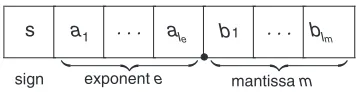
Numbers in a digital computer are represented by a finite number of bits—the word-length, ‘2Zþ. In a floating-point arithmetic, the word consists of three parts:
(1) one bit,s2 f0, 1g, for the sign of the number, (2) ‘m2Zþ bits for the mantissa,m2R, and
(3) ‘e2Zþ bits for the exponent, e2Z.
Therefore, ‘¼‘mþ‘eþ1. The number is typically
stored as shown in figure 1 and, with this representation, the valuexis interpreted as
x¼ ð1Þsm2e ð1Þ
where the mantissa is usually normalized so that m2 ½0:5, 1Þ. Now, since ‘e and ‘m are finite (‘ is typically 16, 32 or 64 bits), the set of numbers that is represented by a particular floating-point scheme is not dense on the real line. Thus, the set of possible floating-point numbers,F, is given by
F:¼
(
ð1Þs 0:5þX ‘m
i¼1
bi2ðiþ1Þ
!
2e:s2 f0, 1g,
bi2 f0, 1g,e2Z,eee )
[ f0g ð2Þ
where e2Z and e2Z represent the lower and upper limits of the exponent, respectively, andee¼2‘e1.
Note that, unlike fixed-point representation, underflow can occur in floating-point arithmetic.
In the remainder of this paper, it is assumed that no underflow or overflow occurs, that is ‘e is unlimited, so e2Z. Define the floating-point rounding operator,
q:R! F, as
qðxÞ:¼ sgnðxÞ2
ðe‘m1Þb2ð‘meþ1Þjxj þ0:5c, forx6¼0
0, forx¼0
ð3Þ
wheree¼ blog2jxjc þ1.
The rounding error, ", is defined as
":¼ jxqðxÞj: ð4Þ
It can be shown easily that the rounding error is bounded by
" <jxj2ð‘mþ1Þ: ð5Þ
Thus, when a number is implemented in finite-precision floating-point arithmetic, it may be perturbed to
qðxÞ ¼xð1þÞ, jj< max: ð6Þ
where max¼2ð‘mþ1Þ. Thus, as is well-known
(Wilkinson 1963), the perturbation is multiplicative, unlike the perturbation resulting using finite-precision fixed-point arithmetic, which is additive.
3. Eigenvalue sensitivity
In general, the perturbations on the controller param-eters resulting from finite-precision implementation will be very small. Thus, perturbations on the closed-loop system eigenvalues can be approximated by considering the first-order term of a Taylor expansion, i.e. the eigenvalue sensitivities to changes in the con-troller parameters. A number of different eigenvalue sensitivity indices have been proposed for fixed-point digital controller and filter implementations (Mantey 1968, Gevers and Li 1993, Istepanian et al. 1998, Li 1998, Whidborne 2001, Wuet al. 2001).
Assume that a controller/filter realization,x¼vecðXÞ, is implemented with floating-point arithmetic with finite precision, that is the actual realization will be q(x). Then, from (6), each element of x will be perturbed to xið1þiÞ, jij< max¼ 2ð‘mþ1Þ and the realization
vector will be perturbed toxþx, where¼ ½i. Proposition 1: Let fðxÞ 2Cbe a differentiable function
of x2Rnx. Assume that x is perturbed to xx where~
~ x
xi¼xið1þiÞ. Then, to a first-order Taylor series approximation
s a1 ale b1 blm
sign exponent e mantissa m
[image:3.609.83.263.652.698.2]. . . . . .
jfðxx~Þ fðxÞj maxkgk2kxk2þ jOð2maxÞj ð7Þ
where jij< max for all i and g(x) is the gradient vector,i.e.
gðxÞ:¼@fðxÞ
@x ¼ @f @xi
x
ð8Þ
evaluated at x.
Proof: Taking a first-order Taylor series approximation:
fðxx~Þ ¼fðxÞ þX
nx
i¼1 @f @xi
x ~ x xixi
ð Þ þ Oð2maxÞ ð9Þ
Now, from (6),xxi~ ¼xið1þiÞ, so
fðxx~Þ fðxÞ ¼X
nx
i¼1
giðxÞxiiþ Oð2maxÞ: ð10Þ
Hence
jfðxx~Þ fðxÞj X
nx
i¼1
jgiðxÞjjxijjij þ Oð 2maxÞ ð11Þ
< maxX nx
i¼1
jgiðxÞjjxij þ Oð 2maxÞ ð12Þ
which, by the Cauchy-Schwartz inequality, gives
jfðxx~Þ fðxÞj< maxkgðxÞk2kxk2þ jOð2maxÞj: ð13Þ œ
Iff() is the system pole/eigenvalue,x is the infinite-precision parameter vector and xx~ is the finite-precision parameter vector, then Proposition 1 can be used to measure the relative system stability when subject to finite-precision implementation using floating-point arithmetic. Based on Proposition 1, tractable eigen-value sensitivity indices can be formulated which are appropriate for finite-precision floating-point digital controller and filter implementations.
4. Optimal digital filter realizations
Consider the problem of implementing a digital filter,
FðzÞ ¼Cf ðzIAfÞ1Bf þDf, where Af 2Rnn and
has no repeated eigenvalues,Bf 2Rnq,Cf 2Rln and
Df 2Rlq. In this paper, ðAf,Bf,Cf,DfÞ is also called a realization of F(z). The realizations of F(z) are not unique, ifðA0
f,B0f,C0f,D0fÞis a realization ofF(z), then so
is ðT1A0
fT,T1B0f,C0fT,D0fÞ for any non-singular
similarity transformation T2Rnn. The system poles are simply the eigenvalues of Af. The problem under consideration is to find the similarity transformation such that the realization has a minimal eigenvalue sensitivity when implemented using finite word-length floating-point arithmetic.
Based on Proposition 1, the following tractable eigenvalue sensitivity index,, is proposed
¼ kAfk2F
Xn
k¼1
wkk ð14Þ
wherewkis a non-negative real scalar weighting and
k¼ @k @Af
2
F
ð15Þ
where fi:i¼1,. . .,ng represents the set of unique
eigenvalues of Af. The weights, wk, k¼1,. . .,n, are generally chosen so that the eigenvalues closer to the unit circle have the larger values. The measure is dependent upon the filter realization, that is, given
Af ¼T1A0fT,
ðTÞ:¼T1Af0T2 F
Xn
k¼1
wkkðTÞ ð16Þ
where (Gevers and Li 1993, Li 1998),
kðTÞ ¼tr RHkT
TT1R k
tr LH kTT
TL k
ð17Þ
and whereRkandLkare the right and left eigenvectors, respectively, for thekth eigenvalue ofA0
f.
Problem 1: Given an initial realizationðA0f,B0f,Cf0,D0fÞ,
calculate
min¼ min
T2Rnn detðTÞ6¼0
ðTÞ ð18Þ
and calculate a subsequent similarity transformation Tmin such thatmin¼ðTminÞ.
Theorem 1: The solution to Problem 1 is given by
min¼X
n
k¼1
jkj2X
n
k¼1
wk ð19Þ
and
where R¼[Ri]is the matrix of right eigenvectors of A0 f, W¼diagðw1,. . .,wnÞis a diagonal matrix of the weights and V is an arbitrary orthogonal matrix.
Proof: From Lemma 6.2 and Theorem 6.1 of Gevers and Li (1993, pp. 137–138), it follows thatk1 with equality for all k if Af is normal. From Horn and Johnson (1985, p. 101),
kAfk2F X
n
k¼1
jkj2 ð21Þ
with equality ifAf is normal. Clearly, if Af is normal,
is minimal and (19) holds. Theorem 6.2 of Gevers
and Li (1993, p. 141) gives (20). œ
Remark 1: The requirement for minimal eigenvalue sensitivity for FWL fixed-point arithmetic is also that the transition matrixAf is in the normal form (Gevers and Li 1993, p. 139).
5. Optimal digital controller realizations
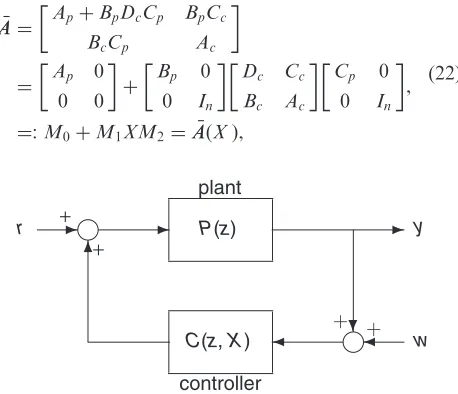
Consider the linear discrete-time feedback control system shown in figure 2. Let the plant beP(z) and let the controller beC(z,X), whereXis the parametrization of the controller.
Let ðAp,Bp,Cp, 0Þ be a state space description of the strictly proper plant PðzÞ ¼CpðzIApÞ1Bp,
Ap2Rmm, Bp2Rml and Cp2Rqm. Let ðAc,Bc,Cc,DcÞ be a state space description of
CðzÞ ¼CcðzIAcÞ1BcþDc, where Ac2Rnn,
Bc2Rnq,Cc2Rln andDc2Rlq.
The transition matrix of the closed loop system is
A
A¼ ApþBpDcCp BpCc
BcCp Ac
¼ Ap 0
0 0
þ Bp 0
0 In
Dc Cc Bc Ac
Cp 0 0 In
,
¼:M0þM1XM2¼AAðXÞ,
ð22Þ
where
X:¼ Dc Cc
Bc Ac
, ð23Þ
In the sequel, it is assumed that AA has no repeated eigenvalues.
Let the realization ðA0c,B0c,C0c,D0cÞ of C(z) be represented by
X0¼ D
0 c C0c B0c A0c
" #
, ð24Þ
then any realization is given by
X¼ I 0
0 T
1
D0 c Cc0 B0c A0c
" #
I 0
0 T
, ð25Þ
¼:TI1X0TI, ð26Þ
for some non-singularT2Rnn. LetRk¼ ðRTkð1ÞRTkð2ÞÞ
T
andLk¼ ðLTkð1ÞLTkð2ÞÞ T
be the right and left eigenvectors respectively, for the kth eigenvalue ofAA partitioned such thatRkð1Þ,Lkð1Þ 2Cm and Rkð2Þ,Lkð2Þ 2Cn, i.e. the partitions correspond to the partitions of X defined by (23). Then, it can be shown (Li 1998, Whidborneet al. 2001) that
@k @Ac
T
¼Rkð2ÞLHkð2Þ, ð27Þ
@k @Bc
T
¼CpRkð1ÞLHkð2Þ, ð28Þ
@k @Cc
T
¼Rkð2ÞLHkð1ÞBp, ð29Þ
@k @Dc
T
¼CpRkð1ÞLHkð1ÞBp, ð30Þ
wherefk:k¼1,. . .,nþmgrepresents the set of unique
eigenvalues ofAA.
Based on Proposition 1, the following tractable eigenvalue sensitivity index,, is proposed
ðXÞ:¼ kXk2FX
nþm
k¼1
wkk ð31Þ
wherewkis a non-negative real scalar weighting and
k¼ @k @Ac
2
F
þ @k
@Bc
2
F
þ @k
@Cc
2
F
þ @k
@Dc
2
F
: ð32Þ
P(z)
C(z, X)
-6
-?
--
-+ +
+ +
r y
w plant
[image:5.609.62.291.501.698.2]controller
The weights,wk,k¼1,. . .,nþm, are generally chosen so that the eigenvalues closer to the unit circle have the larger values. The measure is dependent upon the controller realization. Given an initial realization
ðA0
f,B0f,C0f, D0fÞ, then it can be easily shown that
kXk2F ¼trðP1A0cPA0Tc Þ þtrðP1B0cB0Tc Þ þtrðPC0Tc Cc0Þ þtrðD0cD0Tc Þ,
ð33Þ
whereP¼TTT and, from (27)–(30), that
k¼trðR0Hk ð2ÞP1R0kð2ÞÞtrðL0Hk ð2ÞPL0kð2ÞÞ þktrðL0Hk ð2ÞPL0kð2ÞÞ
þktrðR0Hk ð2ÞP1R0kð2ÞÞ þkk,
ð34Þ
where k¼trðR0Hk ð1ÞC H
pCpR0kð1ÞÞ and k¼trðL0Hk ð1Þ BpBH
pL0kð1ÞÞ. Rearranging gives ðPÞ ¼
trðP1A0cPA0Tc Þ þtrðP1B0cB0Tc Þ þtrðPCc0TC0cÞ
þtrðD0cD0Tc ÞX
nþm
k¼1
trðP1MRkÞtrðPMLkÞ
þtrðPWLÞ þtrðP1WRÞ þc
ð35Þ
where
MRk ¼w1k=2R 0 kð2ÞR
0H
k ð2Þ ð36Þ
MLk ¼w1k=2L0kð2ÞL0Hk ð2Þ ð37Þ
WL¼L0ð2Þdiagðw11,. . .,wnþmnþmÞL0Hð2Þ, ð38Þ
WR¼R0ð2Þdiagðw11,. . .,wnþmnþmÞR0Hð2Þ, ð39Þ
are all Hermitian and
c¼X
nþm
k¼1
kk: ð40Þ
Problem 2: Given an initial realizationðA0c,B0c,C0c,D0cÞ,
calculate
min¼ min
P2Rnn P¼PT>0
ðPÞ
ð41Þ
where P¼TTT and calculate a subsequent similarity transformation Tmin such thatmin¼ðTminTT
minÞ. Remark 2: The function(P) is everywhere differen-tiable over the set fðPÞ:P¼PT >0g. Hence, it is
proposed that non-linear programming is used to find local solutions to Problem 2. The problem of finding a global solution remains open.
To solve the problem using non-linear programming, a search is required over nn real, positive definite symmetric matrices. This can be accomplished by utilising a Cholesky factorization given by the following theorem (Golub and Van Loan 1989, p. 141).
Theorem 2 (Cholesky factorization): For P2Rnn,
P¼PT, P>0, there exists a unique lower triangular G2Rnn with positive diagonal entries such that
P¼GGT.
Thus a search can be made over the set
ga gb
:ga2Rðn1Þn=2,gb 2Rn
þ
:
Remark 3: SinceVVT ¼I whereVis any orthogonal
matrix, thenPmin¼GminVVTGT
min and so
Tmin¼GminV: ð42Þ
This provides an extra degree of freedom which could be utilized to find, for example, sparse realizations (Liet al. 1992).
6. Example
The following numerical example is taken from Gevers and Li (1993, pp. 236–237). The discrete time system to be controlled is given by
Ap¼
3:7156 5:4143 3:6525 0:9642
1:000 0 0 0
0 1:000 0 0
0 0 1:000 0
2 6 6 6 6 6 6 4
3 7 7 7 7 7 7 5
, ð43Þ
Bp¼ 1 0 0 0
T
, ð44Þ
Cp¼0:1116 0:0043 0:1088 0:0014105: ð45Þ
A pole-placement controller is designed to place the closed-loop poles at
0:98440:0357j, 0:96430:0145j, ð46Þ
and a state observer is designed with poles located at
The initial realization of the feedback controllerC(z) is given by (to 4 decimal places)
A0c ¼ApþBpCc0B0cCp ð48Þ
¼
2:6743 5:7443 2:5096 0:9176
0:2877 0:0273 0:6947 0:0088
0:3377 0:9871 0:3294 0:0042
0:0830 0:0032 0:9190 0:0010
2 6 6 6 6 6 4
3 7 7 7 7 7 5
, ð49Þ
Bc0 ¼1:0963 0:6385 0:3027 0:0744T106, ð50Þ
Cc0 ¼0:1818 0:2831 0:0500 0:0617, ð51Þ
D0c ¼0: ð52Þ
The weights are set to wi¼ ð1maxÞ=ð1 jijÞ where max¼maxifjijg and fig are the eigenvalues of A0c
and AA (from (22)) for the open-loop and closed-loop sensitivity indices, respectively. Thus, the eigenvalues closer to the unit circle have the larger weighting values. The initial realization has an open-loop pole sensitiv-ity, ¼1:5737106. From Theorem 1, the optimal
open-loop pole sensitivitymin ¼6:1746, which can be achieved with the realization (to 4 decimal places):
Ac¼
0:6194 0:1992 0:0835 0:1265
0:1346 0:6052 0:2297 0:0171
0:0508 0:1650 0:5315 0:2813
0:2047 0:0653 0:2218 0:5605
2 6 6 6 6 6 4
3 7 7 7 7 7 5
, ð53Þ
Bc¼0:6508 0:0048 2:0020 0:2961T106, ð54Þ
Cc¼0:1100 0:0222 0:0142 0:0168: ð55Þ
The closed-loop pole sensitivity for the initial realization is¼3:99031022and for the open-loop optimal
real-ization, it is ¼9:81561021. It is a fairly common
practice to implement controllers using a balanced reali-zation. Using the MATLAB routine balreal:m a balanced realization was obtained (to 4 decimal places):
Ac¼
0:1119 0:5408 0:1954 0:0531
0:5408 0:7216 0:1647 0:0350
0:1954 0:1647 0:7643 0:1298
0:0531 0:0350 0:1298 0:7189
2 6 6 6 6 4
3 7 7 7 7 5,
ð56Þ
Bc¼ 203:1819 63:5703 32:0424 4:1143
T
, ð57Þ
Cc¼203:1819 63:5703 32:0424 4:1143: ð58Þ
The closed-loop pole sensitivity for the balanced realization is¼1:25461011.
The MATLABroutinefminsearch:mwas used with the Cholesky factorization of Theorem 2 to solve Problem 2. The routine fminsearch:m implements the Nelder-Mead simplex method. Using a 350 MHz Pentium PC, from a random starting point, the routine took 30 minutes to converge. An optimal closed-loop pole sensitivity value of min¼4:3366108 was
obtained with a realization (to 4 decimal places):
Ac¼
1:0614 0:9631 0:0054 0:0018
2:2892 1:7570 0:0235 0:0057
1:4089 0:4759 0:6716 0:0868
1:7421 2:3837 0:4706 0:9494
2 6 6 6 6 6 4
3 7 7 7 7 7 5
, ð59Þ
Bc¼ 129:2367 137:2672 56:4560 23:7868
T
,
ð60Þ
Cc¼155:1427 119:5560 32:1475 1:0368: ð61Þ
7. Discussion and conclusions
In previous works, the eigenvalue sensitivity approach to obtain optimal digital filter and controller realizations so as to account for the finite precision inherent in digital computing devices has been thoroughly investi-gated. However, there has been an assumption that the parameter uncertainty is additive. This assumption is perfectly valid for filter and controller implementa-tions that use fixed-point arithmetic, however, for floating-point arithmetic, the parameter uncertainty is multiplicative. It is becoming increasingly common to use floating-point arithmetic for digital filters and controllers. Thus, in this paper, the work of Gevers and Li (1993) is extended to obtain optimal floating-point digital filter realizations; and the work of Whidborne et al. (2001) is extended to obtain optimal floating-point digital controller realizations.
The methods are demonstrated on a numerical example of a control system. Both the initial realization of the controller and the optimal open-loop realization result in very high closed-loop pole sensitivities. This is significantly reduced by using a balanced realiza-tion. However, the closed-loop pole sensitivity of the balanced controller realization can be reduced by three orders of magnitude by the optimal closed-loop realization.
References
digital signal processors’’, IEEE Trans. Circuits & Syst. II, 44, pp. 952–955, 1997.
S. Chen, J. Wu, R.H. Istepanian and J. Chu, ‘‘Optimizing stability bounds of finite-precision PID controller structures’’,IEEE Trans. Autom. Control, 44, pp. 2149–2153, 1999.
M.C. de Oliveira and R.E. Skelton, ‘‘State feedback control of linear systems in the presence of devices with finite signal-to-noise ratio’’,Int. J. Control, 74, pp. 1501–1509, 2001.
D. Faris, T. Pare, A. Packard, K.A. Ali and J.P. How, ‘‘Controller fragility: what’s all the fuss?’’, inProc. Annual Allerton Conference on Communication Control and Computing, Monticello, Illinois, 1998, Vol. 36, pp. 600–609.
J.A. Farrell and A.N. Michel, ‘‘Estimates of asymptotic trajectory bounds in digital implementations of linear feedback control systems’’,IEEE Trans. Autom. Control, 34, pp. 1319–1324, 1989. M. Gevers and G. Li,Parametrizations in Control, Estimations and
Filtering Problems: Accuracy Aspects, Berlin: Springer-Verlag, 1993. G.H. Golub and C.F. Van Loan,Matrix Computations, Baltimore,
MD: John Hopkins University Press, 1989.
R.A. Horn and C.R. Johnson, Matrix Analysis, Cambridge, UK: Cambridge University Press, 1985.
R.H. Istepanian, G. Li, J. Wu and J. Chu, ‘‘Analysis of sensitivity measures of finite-precision digital controller structures with closed-loop stability bounds’’, IEE Proc. Control Theory and Appl., 145, pp. 472–478, 1998.
R.S.H. Istepanian and J.F. Whidborne, ‘‘Finite-precision computing for digital control systems: current status and future paradigms’’, in Digital Controller Implementation and Fragility: A Modern Perspective, London, UK: Springer-Verlag, 2001, pp. 1–12. R.S.H. Istepanian, S. Chen, J. Wu and J.F. Whidborne, ‘‘Optimal
finite-precision controller realization of sampled-data systems’’,
Int. J. Systems Sci., 31, pp. 429–438, 2000.
K. Kallioja¨rvi and J. Astola, ‘‘Required coefficient word length in floating-point and logarithmic digital filters’’, IEEE Sig. Proc. Letters, 1, pp. 52–54, 1994.
E.P.F. Kan and J.K. Aggarwal, ‘‘Error analysis of digital filter employing floating-point arithmetic’’,IEEE Trans. Circuit Theory, 18, 678–686, 1971.
T. Kaneko and B. Liu, ‘‘Effect of coefficient rounding in floating-point digital filters’’,IEEE Trans. Aerosp. Electron. Syst., 7, pp. 995–1003, 1971.
L.H. Keel and S.P. Bhattacharryya, ‘‘Robust, fragile, or optimal?’’,
IEEE Trans. Autom. Control, 42, pp. 1098–1105, 1997.
H.-J. Ko and W.-S. Yu, ‘‘Guaranteed robust stability of the closed-loop systems for digital controller implementations via orthogonal Hermitian transform’’,IEEE Trans. Syst. Man & Cybernetics – B, 34, pp. 1923–1932, 2004.
S. Ko and R.R. Bitmead, ‘‘Covariance calculation for floating-point state-space realizations’’, IEEE Trans. Sig. Proc., 52, pp. 3370–3377, 2004.
J. Kontro, K. Kallioja¨rvi and Y. Neuvo, ‘‘Floating-point arithmetic in signal processing’’, inProc 1992 IEEE Int. Symp. Circuits and Syst.
San Diego, CA, 1992, pp. 1784–1791.
W. Ku and S.-M. Ng, ‘‘Floating-point coefficient sensitivity and roundoff noise of recursive digital filters realized in ladder structures’’,IEEE Trans. Circuits & Syst., 22, pp. 927–936, 1975. G. Li, ‘‘On the structure of digital controllers with finite word length
consideration’’,IEEE Trans. Autom. Control, 43, pp. 689–693, 1998. G. Li, B.D.O. Anderson, M. Gevers and J.E. Perkins, ‘‘Optimal FWL design of state space digital systems with weighted sensitivity minimization and sparseness consideration’’,IEEE Trans. Circuits & Syst. II, 39, pp. 365–377, 1992.
B. Liu, ‘‘Effects of finite word-length on the accuracy of digital filters—a review’’, IEEE Trans. Circuit Theory, 18, pp. 670–677, 1971.
B. Liu and T. Kaneko, ‘‘Error analysis of digital filters realised with floating-point arithmetic’’, inProc. IEEE, 57, pp. 1735–1747, 1969.
P.E. Mantey, ‘‘Eigenvalue sensitivity and state-variable selection’’,
IEEE Trans. Autom. Control, 13, pp. 263–269, 1968.
R.K. Miller, M.S. Mousa and A.N. Michel, ‘‘Quantization and overflow effects in digital implementations of linear dynamic controllers’’,IEEE Trans. Autom. Control, 33, pp. 698–704, 1988. A.P. Molchanov and P.H. Bauer, ‘‘Robust stability of digital
feedback control systems with floating point arithmetic’’, inProc. 34th IEEE Conf. Decision Contr., New Orleans, LA, 1995, pp. 4251–4258.
C.T. Mullis and R.A. Roberts, ‘‘Synthesis of minimum round off noise fixed-point digital filters’’,IEEE Trans. Circuits & Syst., 23, pp. 551–562, 1976.
B.D. Rao, ‘‘Roundoff noise in floating point digital filters’’,
Control and Dynamic Systems, 75, pp. 79–103, 1996.
R.E. Rink and H.Y. Chong, ‘‘Covariance equation for a floating-point regulator system’’, IEEE Trans. Autom. Control, 24, pp. 980–982, 1979a.
R.E. Rink and H.Y. Chong, ‘‘Performance of state regulator systems with floating point computation’’, IEEE Trans. Autom. Control, 24, pp. 411–421, 1979b.
I.W. Sandberg, ‘‘Floating-point-roundoff accumulation in digital-filter realizations’’,Bell Syst. Tech. J., 46, pp. 1775–1791, 1967. L.M. Smith, B.W. Bomar, R.D. Joseph and G.C.-J. Yang,
‘‘Floating-point roundoff noise analysis of second-order state-space digital filter structures’’,IEEE Trans. Circuits & Syst. II, 39, pp. 90–98, 1992.
C.M. Tsai, ‘‘Floating-point roundoff noises of first- and second-order sections in parallel form digital filters’’, IEEE Trans. Circuits & Syst. II, 44, pp. 774–779, 1997.
A.J.M. Vanwingerden and W.L. De Koning, ‘‘The influence of finite word-length on digital optimal-control’’, IEEE Trans. Autom. Control, 29, pp. 385–391, 1984.
J.F. Whidborne and D.-W. Gu, ‘‘Optimal finite-precision controller and filter implementations using floating-point arithmetic’’, in Proc. 15th IFAC World Congress, Barcelona, 2002 CD-ROM Paper 990.
J.F. Whidborne, R.S.H. Istepanian and J. Wu, ‘‘Reduction of control-ler fragility by pole sensitivity minimization’’,IEEE Trans. Autom. Control, 46, pp. 320–325, 2001.
J.H. Wilkinson, Rounding Errors in Algebraic Processes. London, UK: HMSO, 1963.
J. Wu, R.H. Istepanian and S. Chen, ‘‘Stability issues of finite-precision controller structures for sampled-data systems’’, Int. J. Control, 72, pp. 1331–1342, 1999.
J. Wu, S. Chen, G. Li and J. Chu, ‘‘Optimal finite-precision state-estimate feedback controller realizations of discrete-time systems’’,
IEEE Trans. Autom. Control, 45, pp. 1550–1554, 2000.
J. Wu, S. Chen, G. Li, R.H. Istepanian and J. Chu, ‘‘An improved closed-loop stability related measure for finite-precision digital controller realizations’’, IEEE Trans. Autom. Control, 46, pp. 1662–1666, 2001.
J. Wu, S. Chen, J.F. Whidborne and J. Chu, ‘‘A unified closed-loop stability measure for finite-precision digital controller realizations implemented in different realization schemes’’, IEEE Trans. Autom. Control, 48, pp. 816–822, 2003.
J. Wu, S. Chen, J.F. Whidborne and J. Chu, ‘‘Optimal realizations of floating-point implemented digital controllers with finite word length considerations’’,Int. J. Control, 77, pp. 427–440, 2004. B. Zeng and Y. Neuvo, ‘‘Analysis of floating point roundoff errors
James F. Whidbornewas born in Zimbabwe in 1960. He received a B.A. degree in Engineering from Cambridge University in 1982, and an M.Sc. and a Ph.D. in Systems and Control from UMIST, Manchester, in 1987 and 1992 respectively. From 1982 to 1985 he worked in industry, and from 1986 to 1991, he was with the Control Systems Centre, UMIST. From 1991 to 1994, he held a position of Research Associate with the Department of Engineering, University of Leicester. From 1994 to 2003, he was a Lecturer, then Senior Lecturer with the Department of Mechanical Engineering, King’s College London. James Whidborne is currently a Senior Lecturer in the Department of Aerospace Sciences at Cranfield University, UK. His research interests include optimal finite-precision controller implementations, multi-objective robust con-trol design, fluid flow concon-trol and concon-trol of UAVs. He has nearly 100 research publications, including three books. He is a Chartered Engineer and a Member of the IEE and a Member of the IEEE. He currently serves on the Editorial Board of the International Journal of Systems Science and on the Editorial Board of the International Journal of Automation and Computing, and is Chair of the IEEE (UK&RI) Control Systems Chapter.
Da-Wei Gu graduated from the Department of Mathematics, Fudan University, Shanghai, China, in 1979, and received an M.Sc. degree in applied mathematics from Shanghai Jiao Tong University, China, in 1981, and a Ph.D. degree in control system theory from Department of Electrical Engineering, Imperial College of Science and Technology, London, U.K., in 1985. During 1981–1982, he was a lecturer in Shanghai Jiao Tong University. He was a postdoctoral research assistant in the Department of Engineering Science, Oxford University, U.K., from 1985 to 1989. In 1989, he was appointed to a University Lectureship in the Department of Engineering at Leicester University, UK, and has since been promoted to a Senior Lecturer and to a Reader at Leicester. His current research interests include robust and optimal control, optimization algorithms, control system computer-aided design and numerical perturbation analysis, with applications in aerospace and manufacturing industry. He has over 230 research publications, including two books. He is a Chartered Engineer and a Member of the Institution of Electrical Engineers.
Dr Jun Wu is currently a professor in National Key Laboratory of Industrial Control Technology, Institute of Advanced Process Control, Department of Control Science and Engineering at Zhejiang University, China. His research interests include finite word length implementation of digital controllers, robust control, networked control and model reduction. He has published over 50 papers in international journals and conference proceedings. He was awarded a Royal Society K.C. Wong fellowship in 2002 and the 1997/1998 IEE Heaviside Premium.
![Bis((E) 2 {5,5 dimethyl 3 [4 (1H 1,2,4 triazol 1 yl κN4)styryl]cyclohex 2 enylidene}malononitrile)diiodidomercury(II)](data:image/gif;base64,R0lGODlhAQABAIAAAP///wAAACH5BAEAAAAALAAAAAABAAEAAAICRAEAOw==)