Serial Search Based Initial Code Acquisition in the Multiple Transmit/Receive
Antenna Aided Multi-Carrier DS-CDMA Downlink
SeungHwan Won and Lajos Hanzo School of ECS, Univ. of Southampton, SO17 1BJ, UK.
Tel: +44-23-8059 3125, Fax: +44-23-8059 4508 E-mail:{shw04r, lh}@ecs.soton.ac.uk
http://www-mobile.ecs.soton.ac.uk
Abstract— Initial code acquisition schemes designed for the multiple transmit/receive antenna aided Multi-Carrier (MC)-DS-CDMA down-link are analysed, when communicating over uncorrelated Rayleigh channels. The achievable Mean Acquisition Time (MAT) performance is characterised as a function of both the number of transmit/receive antennas and that of the number of subcarriers. It is demonstrated that in contrast to our expectations, the achievable MAT tends to degrade at low Ec/Io values right across the Signal-to-Interference plus Noise Ratio (SINR) per chip (Ec/Io) range considered, when the number of transmit antennas and/or that of the subcarriers are increased. An exception is constituted by Single-Carrier (SC)-DS-CDMA usingP = 2 and4transmit antennas andR=1 receive antenna. This increased MAT has a grave detrimental effect on the performance of Rake receiver based synchronisation schemes, when the perfectly synchronised idealised system is capable of attaining its target bit error rate performance at reduced SINR values, as a benefit of the diversity gain achieved by employing both multiple transmit antennas and multiple subcarriers. Therefore our future research will be aimed at specifically designing powerful iterative acquisition schemes for MIMO-aided multi-carrier transmission systems.
I. INTRODUCTION
Employing multiple transmit antennas in the downlink of wireless systems constitutes an attractive technique of reducing the detrimental effects of time-variant multi-path fading environments [1]. Further-more, exploiting multiple subcarriers in the downlink of wireless systems exhibits considerable benefits in terms of the achievable data throughput [2],[3]. The combination of Single-Carrier Code Division Multiple Access (SC) CDMA and Orthogonal Frequency Division Multiplexing (OFDM) has drawn substantial research attention [2]-[5]. In inter-cell synchronous CDMA systems the mobile station’s (MS) receiver must be capable of synchronously aligning a locally generated pseudonoise (PN) code with the desired user’s PN sequence which may be completely buried in CoChannel Interference (CCI). Substantial research efforts have been devoted to the design of code acquisition techniques for Singe-Input Single-Output (SISO) systems [5], with the aim of minimising the Mean Acquisition Time (MAT) [5],[6]. The serial acquisition performance of Multi-Carrier (MC) DS-CDMA has been analysed in [7]. A serial search based code acquisition scheme was analysed in the context of the multiple transmit antenna aided SC-DS-CDMA downlink in [8]. However, since no in-depth analysis of code acquisition schemes designed for a multiple transmit/receive antenna aided MC-DS-CDMA system is available in the literature, this is the objective of the present contribution. Against this backcloth, we set out to analyse a serial search based initial code acquisition scheme designed for multiple transmit/receive antenna aided MC-DS-CDMA systems.
The financial support of the Ministry of Information and Communica-tion(MIC), Republic of Korea and the European Union under the auspices of the Phoenix and Newcom projects and that of the EPSRC is gratefully acknowledged.
More explicitly, we quantify both the correct detection probability as well as the false alarm probability as a function of both the SINR per chip and that of the number of transmit/receive antennas as well as that of the number of subcarriers. Furthermore, we quantify the MAT versusEc/Io performance parameterised by both the number of transmit/receive antennas and that of the subcarriers.
This paper is organised as follows. Section II describes the sys-tem investigated, followed by the correct detection and false alarm probability analysis of serial-search based initial code acquisition schemes in the context of uncorrelated Rayleigh channels, whilst the MAT aspects of initial code acquisition designed for multiple transmit/receive antenna aided MC-DS-CDMA systems are briefly considered in Section III. In Section IV, our numerical MAT results are discussed, while our conclusions are offered in Section V.
[image:1.595.329.547.352.488.2]II. CORRECT DETECTION AND FALSE ALARM PROBABILITY
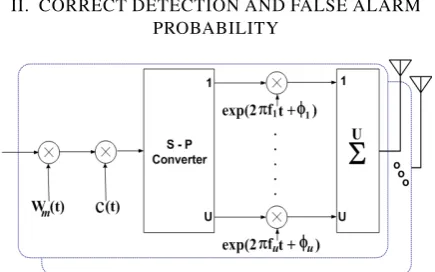
Fig. 1. Transmitter schematic of the MC-DS-CDMA downlink havingP transmit antennas andUsubcarriers.
Fig.1 portrays the transmitter schematic of the MC-DS-CDMA downlink having P transmit antennas and U subcarriers. In the MC-DS-CDMA system considered the input bit sequence is Serial-to-Parallel (SP) converted and each of the parallel sequences is transmitted on a separate subcarrier, as seen in Fig.1. The transmitted signal of the multiple transmit antenna assisted base station can be expressed as
Stot(t) = P
m=1
U
u=1 [
Ec
P Tcb(t)c(t)wm(t) (1) ·exp(2πfut+φu)],
where p = 1, ..., P indicates the number of transmit antennas,
is theuth subcarrier frequency, andφu denotes theuth subcarrier phase of the modulator. Furthermore,Tb represents the bit duration of the data sequence before serial-to-parallel conversion, while Ts indicates the symbol duration after SP conversion. Accordingly, we haveTs=U·Tb. The total allocated power is equally shared by theP transmit antennas. The spreading factor of the subcarrier signals in the MC-DS-CDMA systemSF isTs/Tc, whileSF1=Tb/Tc1 denotes
the spreading factor of a corresponding SC-DS-CDMA system, where
Tc1 denotes the chip duration of the corresponding SC-DS-CDMA
[image:2.595.69.283.293.498.2]signal. For the sake of simplicity we postulate in the forthcoming analysis that the main spectral lobes of two adjacent subcarriers do not overlap in the MC-DS-CDMA system considered here [7]. Furthermore, we assume that each subcarrier signal occupies an identical bandwidth and the total bandwidth is equally divided among theU number of subcarriers. Therefore, the following relationships hold Tc = U·Tc1, SF1 = SF since Ts = U·Tb. According to the above assumption, both the MC- and the corresponding SC-DS-CDMA systems have the same information rate of1/Tband the same bandwidth of 2/Tc1, as suggested in [7], which allows their direct comparison in our forthcoming discourse.
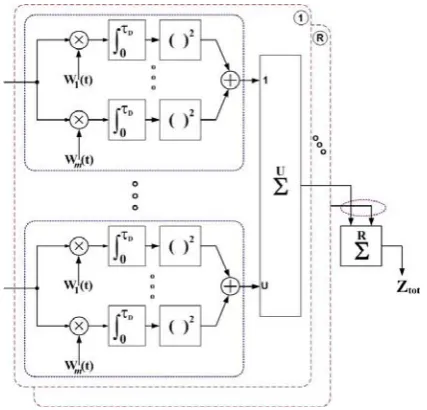
Fig. 2. Receiver structure of a noncoherent code acquisition system employing bothRreceive antennas andUsubcarriers.
The received signal of the MIMO-aided noncoherent MC-DS-CDMA downlink may be expressed as
rtot(t) = P
m=1
R
n=1
U
u=1 [αm,n,u
Ec
P Tcc(t+dTc)wm(t+dTc) (2) ·exp(2πfut+φ(m,n,u)) +I(m,n,u)(t)],
where n = 1, ..., R is the number of receive antennas, αm,n,u represents the envelope of the (m, n, u)th received signal path obeying the Rayleigh distribution, d is the code phase offset with respect to the phase of the local code andτD indicates the integral dwell time. Furthermore,I(m,n,u)(t)is the complex-valued Additive
White Gaussian Noise (AWGN) having a double-sided power spectral density ofI0, which contaminates the(m, n, u)thpath. Fig.2 depicts the block diagram of the noncoherent receiver designed for our MC-DS-CDMA code acquisition scheme using multiple transmit/receive antennas, which generates a decision variable by accumulating
(P·R·U) number of independently faded signals observed over a time interval. In the context of the receiver structure of Fig.2, the final decision variable may be expressed with the aid of the procedures suggested in [10] as follows
Zk = P
m=1
R
n=1
U
u=1
√12·
4Ec
N I0P ·Sk(m,n,u) +Ik(m,n,u)
2
,
(3) where k denotes the kth chip’s sampling instant, Sk(m,n,u) is
assumed to be deterministic as shown in [10], ·2 represents the squared envelope of the complex-valued argument and 1/√2 is a normalisation factor regarding the noise variance. Therefore, the decision variable Zk obeying a noncentral chi-square PDF with
(2P·R·U) degrees of freedom has its noncentrality parameter λx, which is either2PN(Ec
I0), when it is deemed to be present(x= 1)or
2
NP(EI0c), when it is deemed to be absent(x= 0)[10], where the
PDF is given by [11]
fZk(z|Hx) = 12 z
λx
(P RU−1) 2
·exp −(z +2λx)
(4)
·I(P RU−1)
z·λx
and wherez ≥ 0, x = 0or1and I(P RU−1)(·) is the(P·R·U −
1)st-order modified Bessel function. It is worth mentioning that for SC-DS-CDMA, the coherent integration interval ofN chip durations in the above formula should be substituted by N1 = N U, since
in this scenario N1 = τD/Tc1 = M U indicates the number of
chips accumulated within the integral dwell timeτD. For the sake of expressing the PDF conditioned on the presence of the desired user’s signal infZk(z|Hx)formulated for transmission over an uncorrelated
Rayleigh channel, first the PDF fZk(m,n)(z|Hx, β) corresponding
to a specific SINRβ conditioned on the hypothesis of the desired signal being transmitted over an AWGN channel is weighted by the probability of occurrencef(β)of encountering the SINRβ, as quantified by the PDF. The resultant product is then averaged over its legitimate range of−∞ ∼ ∞, yielding:
fZk(m,n,u)(z|Hx) =
∞
−∞
f(β)·fZk(m,n,u)(z|Hx, β)dβ (5)
=
∞
0
e−β/σ2
σ2
·exp[−(z +2 βλx)/2](6)
·I0
2√βλxz
2
dβ
= exp[−(2 +z/(2 +λxσ2)]
λxσ2) (7)
≡ exp[−z/(2 +λx)] 2 +λx ,
(8)
where the definition of (Ec/I0) [9] encompasses the effects of
both timing errors and frequency mismatches and the corresponding noncentrality parameter, λx ≡ λxσ2 is either 2PN(Ec
I0)
for the hypothesis of the desired signal being present(x= 1)or NP2 (Ec
I0)
desired signal in the form of:
fZk(m,n,u)(z|Hx) = 1μ xe
−z/μx. (9)
Since the decision variable Zk of Eq.3 is constituted by the sum of (P·R·U) number of independent variables (Zk =
P m=1
R n=1
U u=1
Zk(m,n,u)), which has a PDF given by Eq.9, we can
de-rive the Laplace transform of each by raising them to the (P·R·U)th
power and then performing the inverse transform in order to generate the resultant PDF [9], leading to:
fZk(z|Hx) =
z(P RU−1)e−z/μx
Γ(P RU)·μxP RU , (10) whereΓ(·)is the Gamma function. Finally, the probability of correct detection or false alarm corresponding tox = 1or0, respectively, is obtained as
P|x=1or0 =
∞
θ
fZk(z|Hx)dz (11)
= exp(− θ
μx)· P RU−1
k=0
(θ/μx)k
k! , (12)
where θ is a threshold value. Given Eq.12, the transfer functions required for the sake of characterising the multiple antenna aided SC- and MC-DS-CDMA schemes can be readily derived [9],[12].
Before moving on to the next section, it is worth noting that the PN sequence chip durationTc1of the SC-DS-CDMA signals isU times lower than that of the MC-DS-CDMA signals, namely,Tc1=Tc/U. This is because given the same allocated bandwidth and the same total transmitted energy per chip, the bandwidth of the SC-DS-CDMA signal is U times higher than that of the subcarrier signals in the MC-DS-CDMA system exploitingU subcarriers. Moreover, for the sake of maintaining a constant integral dwell time of τD, the chip energy accumulated by the SC-DS-CDMA receiver during the period ofτD is U times higher than that collected by the MC-DS-CDMA correlator of each subcarrier, since the number of chips within the period ofτD isU times higher for the SC-DS-CDMA system than that of the MC-DS-CDMA system [7].
III. MAT ANALYSIS OF CODE ACQUISITION
The family of serial search acquisition techniques [9] has been traditionally applied, where the search window width is quite wide, on the order of (215−1) chips. As a consequence, in the context of serial search achieving a low MAT constitutes the most critical performance criterion, as exemplified by the downlink of the inter-cell synchronous CDMA-2000 system [9],[12]. In initial code acquisition designed for SC-DS-CDMA, the main objective is to synchronise with the direct received signal path, corresponding to the reference finger of the Rake receiver.
The MAT of a single-antenna aided serial search based initial code acquisition scheme was analysed in [9],[12]. The main difference between a single-antenna and a multiple-antenna assisted MC-DS-CDMA system manifests itself in terms of deriving the correct detection and the false alarm probability as a function of both the number of the transmit/receive antennas and that of the subcarriers, both of which influence the attainable MAT. We will commence our discourse by analysing the MAT performance of an initial code acquisition scheme employing Double Dwell Serial Search (DDSS) [12]. We assume that in each chip durationTc,l number of correct
timing hypotheses are tested, which are spaced byTc/l. Hence the total uncertainty region is increased by a factor ofl. All the resultant (ν − 2l) states that may lead to a false alarm are expected to increase the MAT as a function of the associated penalty time which corresponds to the time required for the system to revert back to its search mode, since it was taken by declared that it identified the perfectly synchronised state. The 2l legitimate locking states within a lag of one chip duration of the correct timing instant are considered in the MAT analysis. The requried transfer functions [12] are defined as follows. The functionHD(z)includes all branches of a state diagram [12] leading to successful detection,H0(z) denotes
the absence of the desired user’s signal at the output of the code acquisition scheme, whilstHM(z)indicates the probability of failing to detect the correctly synchronised code-phase during a search run carried out across the entire uncertainty region. These definitions are detailed in [12] for DDSS. Then, it may be inferred that the generalised expression derived for calculating the MAT of the serial search based initial code acquisition scheme is given by [9],[12]:
E[TACQ] = 1 HD(1)[HD
(1) +HM(1) + (13)
{(ν−2l)[1−HD(1)
2 ] + 12HD(1)}H0
(1)]·τD1,
whereHx(z)|x=D, M or0is a derivative ofHx(z)|x=D, M or0 and
τD1 represents the1st dwell time.
IV. NUMERICAL SYSTEM PERFORMANCE RESULTS In this section we will characterise the MAT performance of the multiple transmit/receive antenna aided MC-DS-CDMA code acquisition scheme of Fig.2. Our performance comparison between the SC-DS-CDMA system (U = 1) and various MC-DS-CDMA (U = 2 and 4) systems using different number of subcarriers is based upon the assumptions that these systems support the same total transmission rate and employ the same total transmitted energy per chip. Furthermore, it is assumed that the integral dwell time,
τD, is the same for all the scenarios considered here. In Table 1 we outlined the maximum SINR degradation imposed by both the Doppler shift and the frequency mismatch between the transmitter and receiver in conjunction with the coherent integration interval of N chip durations, seen in Fig.2 for the initial code acquisition. The length of the PN sequence in our system was assumed to be (215 −1) ·Tc, where the chip-durations employed here for
U = 1,2 and 4 are Tc1 = 1/2.4576μs, Tc = 1/1.2288μsand
was -0.91dB, which is a typical value for the search step size [9],[12]. The total uncertainty region of initial code acquisition was assumed to entail 65534 hypotheses. Finally, in the spirit of [13], the false locking penalty factor was assumed to be 1000. For simplicity, it was assumed that only a single received signal path is encountered in a given search window. All the performance curves have been obtained at the threshold value of Ec/Io = −16dB, which was experimentally designed for the initial code acquisition scheme.
Fig.3 characterises the MAT versus SINR per chip performance of DDSS for the initial code acquisition arrangement of the SC-DS-CDMA benchmark system as a function of the number of transmit antennas for P = 1,2 as well as 4 and that of the number of receive antennas for the specific values ofR = 1,2 and4. As the number of transmit antennas is decreased, all the curves seen in Fig.3 illustrate an improved MAT peformance of the systems exploiting
R = 2 and 4 receive antennas, except for the R = 1 scenarios over the specific SINR range shown in Fig.3. To illustrate the above fact a little further, in the cases of both P2R1 and P4R1 the DDSS scheme exhibits a better MAT peformance in comparison to theP1R1 arrangement across the specific SINR range considered. In other words, this clearly implies that the DDSS scheme employing
R= 1receive antenna benefits from a higher diversity gain in the SC-DS-CDMA scenario. However, the peformance degradation imposed by employing multiple antennas becomes more drastic in the low SINR range, as the number of transmit antennas is increased in the DDSS-aided initial code acquisition scenario. In case of employing both multiple transmit and multiple receive antennas, similar trends are observable, although using two or four receive antennas has the potential of mitigating the associated acquisition performance degradation imposed by the low per-branchEc/Iovalues associated with the employment of multiple transmitters.
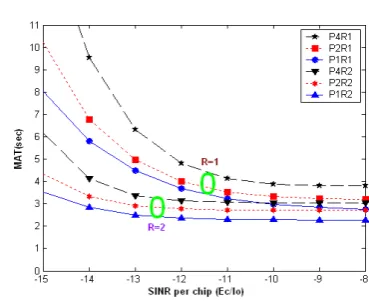
Fig.4 and 5 illustrate the achievable MAT versus SINR per chip performance of the DDSS-aided MC-DS-CDMA initial code acqui-sition scheme parameterised with both the number of transmit and receive antennas, when usingU = 2and4subcarriers, respectively. In the case of the MC-DS-CDMA system, these schemes benefit for a predefined inherent diversity order determined by the number of subcarriers used. It is also assumed that the total transmitted energy per chip is the same in all the scenarios considered. Accordingly, the effect of the inherent frequency diversity is the same as that of the multiple transmit antenna aided diversity, as documented in [8]. This fact clearly indicates that employing multi-carrier transmissions based on the DS-CDMA principle leads to exactly the same detrimental im-pact on the achievable MAT performance as that caused by employing the multiple transmit antennas. For the sake of a fair comparison, the maximum diversity order considered in Fig.4 and 5 is limited to 16. The results of Fig.4 are parameterised by both the number of transmit antennas forP = 1,2as well as4 and by the number of receive antennas forR = 1as well as 2. Similarly, the results of Fig.5 are parameterised by both the number of transmit antennas forP = 1 and 2as well as by the number of receive antennas for
R= 1and2. As both the number of transmit antennas and that of the subcarriers is decreased, all the curves seen in both Fig.4 and Fig.5 indicate an improved MAT peformance. This trend explicitly illustrates that the DDSS-aided MC-DS-CDMA initial acquisition scheme degrades the achievable MAT performance of SC-DS-CDMA as a consequence of both the low per-antenna power imposed by employing multiple transmit antennas for the sake of attaining either a transmit diversity gain or an increased throughput and the low
per-subcarrier power imposed by using multiple per-subcarriers for the sake of achieving a frequency diversity gain. To interpret the above results a little further, a low level of both per-branch and per-subcarrier received signal strength would lead to a low acquisition performance, despite achieving a high transmit and frequency diversity gain. In other words, a high transmit and frequency diversity order effectively results in an acquisition performance loss, as a consequence of the insufficiently high signal strength per both transmit antenna branch and subcarrier branch.
Fig.6 documents the relationship between the SINR per chip required by the DDSS-aided initial code acquisition scheme for ap-proaching their lowest possible MAT versus the number of subcarriers (U = 1,2and 4) parameterised with both the number of transmit and receive antennas. More explicitly, forR= 1andR= 2receive antennas, the requiredEc/Io values are compared at MAT = 6 and 4 seconds, respectively. As either the number of transmit antennas or the number of subcarriers is increased, the value of the required
Ec/Io is also increased, except for theP1R1 scenario, benefiting from the positive effect of the increased frequency diversity gain. It is also worth mentioning that according to Fig.6 the requiredEc/Io value tends to increase, as the number of subcarriers is increased, on provided that there exists no spectral overlap between the spectral main lobes of two adjacent subcarriers in the MC-DS-CDMA system considered [7]. Since the reliable operational range in the verification mode of the DDSS-aided initial code acquisition scheme is a false alarm probability spanning from 10−3 to 10−4, as the number of subcarriers is increased, the correct detection probability considerably decreases according to the relationship between the correct detection versus false alarm probability formulated in Eq.12.
V. CONCLUSION
In this treatise, we analysed the multiple antenna aided trans-mit/receive diversity effects on the performance of the initial code acquisition scheme of the inter-cell synchronous MC-DS-CDMA downlink. The probabilities of correct detection and false alarm have been derived analytically and numerical results were provided in terms of the attainable MAT performance. Unexpectedly, our results suggest that increasing both the number of transmit antennas and that of the subcarriers in a MIMO-aided MC-DS-CDMA system results in combining the low-energy, noise-contaminated signals of both the transmit antennas and the subcarriers, which may degrade the MAT by an order of magnitude, when the SINR is relatively low. This phenomenon imposes a grave degaradation on the performance of Rake receiver aided initial code acquisition schemes, when the perfectly synchronised idealised system is capable of attaining its target bit error rate performance at reduced SINR values, as a benefit of exploiting both multiple transmit antennas and frequency diversity. Hence our future research will be focused on specifically designing iterative turbo acquisition schemes [5] for MIMO-aided multi-carrier transmission systems.
REFERENCES
[1] D. Gesbert, M. Shafi, D.S. Shiu, P.J. Smith, and A. Naguib, From Theory to Practice: An Overview of MIMO Space-Time Coded Wireless Systems, IEEE Journal on Selected Areas in Communications, vol. 21, NO.3, Issue 3, 2003, pp281–302.
[2] S. Hara, R. Prasad, Overview of Multicarrier CDMA, IEEE Communications Magazine, Vol. 35, NO.6 Issue 12, 1997, pp126–133.
[4] L-L Yang, L. Hanzo, Performance of Generalized Multicarrier DS-CDMA over Nakagami-m Fading Channels, IEEE Transactions on Communications, vol. 50, NO.6, Issue 6, 2002, pp956–966.
[5] L. Hanzo, L-L Yang, E-L Kuan, K. Yen, Single- and Multi- Carrier DS-CDMA, IV Multi-Carrier CDMA, Wiley, 2003.
[6] B-G Lee, B-H Kim, Scrambling Techniques For CDMA Communications, Chapter 2 and 3, Kluwer Academic Publishers, 2001.
[7] L-L Yang, L. Hanzo, Serial Acquisition Performance of Single-Carrier and Multicarrier DS-CDMA over Nakagami-m Fading Channels, IEEE Transactions on Wireless Communications, vol. 1, NO.4, Issue 4, 2002, pp692–702. [8] S.H. Won, L. Hanzo, Analysis of Serial Search Based Code Acquisition in the
Multiple Transmit Antenna Aided DS-CDMA Downlink, Vehicular Technology Conference, 2005, vol. 1, 25-28 September 2005, pp98–102.
[9] A.J. Viterbi, CDMA: Principles of Spread Spectrum Communication, Chapter 3, Addison-Wesley, 1995.
[10] J-C Lin, Differentially Coherent PN Code Acquisition with Full-Period Correlation in Chip-Synchronous DS/SS Receivers, IEEE Transactions on Communications, vol. 50, NO.5, Issue 5, 2002, pp698–702.
[11] J.G. Proakis, Digital Communications, 3rd ed. Chapter 2, McGraw-Hill, 1995. [12] H-R Park and B-J Kang, On Serial Search Code Acquisistion for Direct-Sequence
Spread Spectrum System: An Applicaion to IS-95 CDMA System, Vehicular Technology Conference, 1995, vol. 1, 25-28 July 1995, pp291–295.
[13] H.R. Park, Performance Analysis of a Double-Dwell Serial Search Technique for Cellular CDMA Networks in the Case of Multiple Pilot Signals, IEEE Transactions on Vehicular Technology, vol. 48, NO.6, Issue 6, 1999, pp1819–1830.
TABLE I
MAXIMUMSINRDEGRADATION INFLICTED BY BOTH THEDOPPLER
SHIFT AND A1000HZ FREQUENCY MISMATCH IN COMPARISON TO A
STATIONARY RECEIVER HAVING NO FREQUENCY DRIFT FOR THE
COHERENT INTEGRATION INTERVAL OFNCHIP DURATIONS AT A CARRIER
FREQUENCY OF1.9GHZ AS A FUNCTION OF THE NUMBER OF
SUBCARRIERS(U= 1,2AND4)
N(Chips): U=1 128 256 512 768 1024
N(Chips): U=2 64 128 256 384 512
N(Chips): U=4 32 64 128 192 256
Degradation(dB) 0.061 0.2449 0.9969 2.3144 4.3213
Fig. 3. MAT versus SINR per chip performance of the DDSS-aided SC-DS-CDMA initial code acquisition scheme parameterised with both the number of transmit and receive antennas.
Fig. 4. MAT versus SINR per chip performance of the DDSS-aided MC-DS-CDMA initial code acquisition scheme parameterised with both the number of transmit and receive antennas forU= 2subcarriers.
[image:5.595.339.524.70.221.2]Fig. 5. MAT versus SINR per chip performance of the DDSS-aided MC-DS-CDMA initial code acquisition scheme parameterised with both the number of transmit and receive antennas forU= 4subcarriers.
[image:5.595.64.272.355.573.2] [image:5.595.335.525.529.670.2]