Generic Reduced-Complexity MMSE Channel Estimation
for OFDM and MC-CDMA
J. Akhtman and L. Hanzo
School of ECS., Univ. of Southampton, SO17 1BJ, UK. Tel: +44-23-80-593 125, Fax: +44-23-80-593 045 Email: [email protected], http://www-mobile.ecs.soton.ac.uk
Abstract— The performance of a decision-directed channel estimation scheme is analyzed in the context of both OFDM and MC-CDMA systems. A difficulty associated with the employment of the Least Squares (LS) approach to the problem ofa posteriorichannel estimation in the context of a MC-CDMA system is described and a suitable MMSE-based estimator is proposed instead. It is demonstrated that the computational complexity associated with the MMSE estimation method proposed is relatively high in compararison to that of the conventional LS technique. Thus a low-complexity version of the MMSE estimator is proposed. The MC-CDMA system using a low-complexity MMSE estimator proposed is shown to outperform the corresponding OFDM-based scheme.
I. INTRODUCTION
The ever-increasing demand for high data rates in wireless net-works requires the efficient utilisation of the limited bandwidth available, while supporting a high grade of mobility in diverse prop-agation environments. Orthogonal Frequency Devision Multiplexing (OFDM) and Multi-Carrier Code Devision Multiple Access (MC-CDMA) techniques [1] are capable of satisfying these requirements, since they are capable of coping with highly time-variant wireless channel characteristics. However, as pointed out in [2], the capacity and the achievable integrity of communication systems is highly de-pendent on the system’s knowledge concerning the channel conditions encountered. Thus, the provision of an accurate and robust channel estimation strategy is a crucial factor in achieving a high performance. The family of well-documenteddecision directedchannel estima-tion (DDCE) methods [1], [3]–[5] provides a suitable soluestima-tion for the problem of channel estimation in OFDM-based systems. The major benefit of the DDCE scheme is that in contrast to purelypilot assisted
channel estimation methods [6], [7] both the pilot symbols as well as all the information symbols are utilised for channel estimation [1]. The simple philosophy of this method is that in the absence of transmission errors we can benefit from the availability of 100% pilot information by using the detected subcarrier symbols as an a posteriori reference signal. The employment of this method allows us to reduce the number of pilot symbols required.
A basic component of the DDCE schemes proposed in the liter-ature is an a posteriori Least Squares (LS) temporal estimator of the OFDM-subcarrier-related Frequency-Domain Channel Transfer Function (FD-CTF) coefficients [1], [5]. The accuracy of the re-sultant temporal estimates is typically enhanced using one- or two-dimensional interpolation exploiting both the time- and the frequency-domain correlation between the desired FD-CTF coefficients. The LS-based temporal FD-CTF estimator was shown to be suitable for QPSK-modulated OFDM systems [1], [5], where the energy of the
Acknowledgements: The work reported in this paper has formed part of the Wireless Enabling Techniques work area of the Core 3 Research Programme of the Virtual Centre of Excellence in Mobile and Personal Communications, Mobile VCE, www.mobilevce.com, whose funding support, including that of EPSRC, is gratefully acknowledged. Fully detailed technical reports on this research are available to Industrial Members of Mobile VCE.
transmitted subcarrier-related information symbols is constant. How-ever as it will be pointed out in Section III-B.1 of this contribution, the LS method cannot be employed in MC-CDMA systems, where – in contrast to OFDM systems – the energy of the transmitted subcarrier-related information symbols fluctuates as a function of both the modulated sequence and that of the choise of the potentially non-constant-modulus modulation scheme itself. Thus we propose an MMSE-based DDCE method, which is an appropriate solution for both OFDM and MC-CDMA systems.
The rest of this paper is structured as follows. The system model and the channel model considered are described in Section II. The difficulty of employing the Least Squares (LS) approach to the problem of estimating the OFDM-subcarrier-related FD-CTF coefficients is described in Section III-B.1. The alternative MMSE FD-CTF estimator circumventing the problem outlined in Section III-B.1 is analyzed in Section III-B.2. Our discourse evolves further by proposing a MMSE Channel Impulse Response (CIR) estimator exploiting the frequency-domain correlation of the FD-CTF coeffi-cients in Section III-C.1 and a reduced-complexity version of the CIR MMSE estimator considered is proposed in Section III-C.2. The computational complexity of both methods is compared in Section III-D. Finally, the achievable performance of the estimation methods proposed is studied in Section IV.
II. SYSTEMMODEL
The discrete baseband model of the OFDM/MC-CDMA system can be described as in [8]
(1)
for and all, where andare the received symbol, the transmitted symbol and the Gaussian noise sample respectively, corresponding to theth subcarrier of the th OFDM block. Furthermore,is the complex channel transfer function (CTF) coefficient associated with th subcarrier and time instance. Note that in the case of an -QAM modulated OFDM system,corresponds to the -QAM symbol accommodated by theth subcarrier, while in a MC-CDMA system, such as a Walsh-Hadamard Transform (WHT) assisted OFDM scheme using-chip WH spreading code and hence capable of supportingusers [1] we have
(2)
whereis theth chip of theth spreading code, whileis the -QAM symbol spread by theth code. Each of thespreading codes is constituted bychips.
As it was pointed out in [5], in OFDM/MC-CDMA systems using a sufficiently long cyclic prefix and adequate synchronisation, the
discrete CTF can be expressed as
¼
(3)
for , where
is the sample-spaced CIR (SS-CIR) having significant non-zero tap values only at sample-spaced raster positions and
. Note that in realistic channel conditions associated with non-sample-spaced path-delays the receiver will en-counter dispersed received signal components in several neighbouring samples owing to the convolution of the transmitted signal with the system’s impulse response, which we refer to as “leakage” [1]. This phenomenon is usually unavoidable and therefore the resultant SS-CIR will be constituted of numerous correlated non-zero taps. Although the results of the present contribution are applicable in the contest of estimating the fractionally-spaced CIR, we opted for concentrating our attention on the case of SS-CIRs for the sake of notational simplicity. Therefore, we assume hereafter a SS-CIR constituted of uncorrelated taps .
III. CHANNELESTIMATION
A. Decision Directed Channel Estimator
Decoder Detector
Demodulator Feedback
CIR Predictor Robusta priori
FFT
-
-?
6
CIR estimator
a posteriori
IFFT ˆ[n]
ˆ [n] [n]
[n]
ˇ [n+1] ˇ
[image:2.612.53.290.322.439.2][n+1]
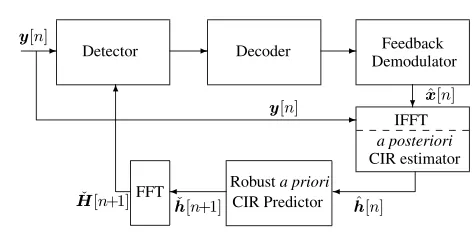
Fig. 1. Schematic of the channel estimator constituted by ana posteri-ori decision-directed CIR estimator, based on frequency-domain modulated symbol estimates, followed by ana prioriCIR predictor.
The schematic of the channel estimation method considered is depicted in Figure 1. Our channel estimator is constituted by what we refer to as ana posterioridecision-directed CIR estimator followed by an a prioriCIR predictor [1]. As seen in Figure 1, the task of the CIR estimator is to estimate the SS-CIR taps of Equation (3). The Inverse Fast Fourier Transform (IFFT) based transformation from the subcarrier-related frequency domain to the SS-CIR-related time domain is invoked in order to exploit the frequency-domain correlation of the subcarrier-related CTF coefficients as well as to reduce the computational complexity associated with the CTF prediction process, because the SS-CIR typically has a lower number of taps, which have to be predicted, than the number of FD-CTF coefficients. Hence the overall channel estimation com-plexity is reduced, even when the comcom-plexity of the FD-CTF to CIR transformation and its inverse are taken into account.
As seen in Figure 1, thea posterioriSS-CIR estimator inputs are the frequency-domain signal and the decision-based estimate
. The transformation from the frequency to time domain is performed within the CIR estimator of Figure 1 and its output is ana posterioriestimateof the SS-CIR taps of Equation (3), which is fed into the low-rank time-domain SS-CIR tap predictor of Figure 1 for the sake of producing ana prioriestimate
of the next SS-CIR on a SS-CIR tap-by-tap basis [1].
Finally, the predicted SS-CIR is converted to the FD-CTF with the aid of the FFT block of Figure 1. The resultant FD-CTF is employed by the receiver for the sake of detecting and decoding of the next OFDM symbol. Note, that this principle requires the transmission of a based channel sounding sequence, such as for example pilot-assisted OFDM block, during the initialisation stage.
B. A PosterioriFD-CTF Estimation
In order to emphasize the major difference between the OFDM and MC-CDMA systems in the context of the associated channel estimation scheme, first we would like to analyze the performance of the temporal estimator of the subcarrier-related FD-CTF coefficients
based on the a posteriori decision-aided estimates of the transmitted subcarrier-related samples of Equation (1). In Section III-B.1 we will show that the LS approach typically employed in DDCE-aided OFDM systems [1], [5] is not applicable in the case of MC-CDMA systems. In Section III-C.1 we propose an MMSE estimator, which renders the DDCE philosophy discussed in [1], [5] suitable for MC-CDMA systems. However, the estimator introduced in Section III-C.1 exhibits a computational complexity, which is significantly higher than the computational complexity of the conventional LS-based estimator of [1], [5]. Thus a reduced-complexity approximation of the MMSE estimator of Section III-C.1 is proposed in Section III-C.2.
1) Least Squares CTF estimator: Following Equation (1), the Least Squares (LS) approach [9] to the problem of estimating the discrete-abscissa FD-CTF coefficients , based on the knowledge of the decision-aided estimatesof the transmitted frequency-domain samplesof Equation (1) can be expressed as
(4)
where represents the Rayleigh-distributed FD-CTF coeffi-cients having a variance of
, while
denotes the trans-mitted subcarrier-related samples having zero mean and a variance of
. The distribution of the samples
is dependent on the particular modulation scheme employed by the system. For instance, in a MC-CDMA system using an arbitrary modulation scheme, the samplesare complex-Gaussian distributed, having a Rayleigh-distributed amplitude and uniformly-distributed phase. By contrast, in a -PSK-modulated OFDM system the samples are uniformly distributed within the set of -PSK symbols having a constant amplitude
and a discrete-uniform distributed phase
.
Finally, the noise samples are independent identically dis-tributed (i.i.d.) complex-Gaussian variables having a zero mean and a variance of
.
Under the assumption of carrying out error-free decisions we have
and Equation (4) may be simplified to
(5)
The Mean Square Error (MSE) associated with the LS FD-CTF estimator of (5) is given by
(6)
corresponding to the estimator of Equation (5) is given by
(7)
The AWGN samplesare known to be i.i.d. complex-Gaussian and hence the MSE of Equation (6) is determined by the statistical distribution of the transmitted subcarrier-related samples. The NMSE encountered assumes its minimum value, when
is constant, as in the case of an -PSK-modulated OFDM system. Thus, we have
(8)
where
(9)
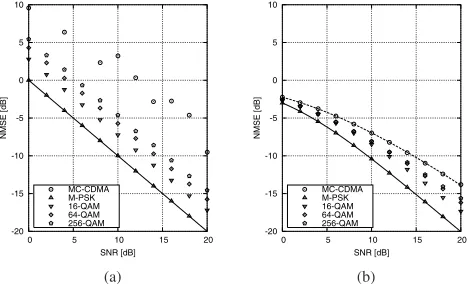
is the average SNR level. On the other hand, the NMSE value will increase substantially, if the energy of the transmitted samples varies as in the case of -ary Quadrature Amplitude Modulation ( -QAM)-based OFDM or MC-CDMA. In fact, in the case of strictly Gaussian-distributed samples, which corresponds to encountering a MC-CDMA system having a sufficiently long spread-ing code, the NMSE value of Equation (7) does not exist, since the variance of the resultant Cauchy distributed variable associated with the ratio of two Gaussian-distributed variablesandof Equation (7) cannot be defined [10]. The NMSE of the LS estimator of Equation (5) derived for QPSK, 16-, 64- and 256-QAM-modulated OFDM, as well as QPSK-modulated MC-CDMA is depicted in Figure 2(a). The solid line in Figure 2(a) corresponds to the lower NMSE bound described by Equation (8).
The performance degradation of the LS estimator of Equation (5) was imposed by the energy-fluctuation of the near-Gaussian dis-tributed subcarrier-related samples, which renders the LS es-timator inapplicable for employment in MC-CDMA systems. There-fore, for the sake of mitigating this performance degradation we would like to turn our attention to the MMSE estimation approach.
-20 -15 -10 -5 0 5 10
0 5 10 15 20
NMSE [dB]
SNR [dB] MC-CDMA M-PSK 16-QAM 64-QAM 256-QAM
(a)
-20 -15 -10 -5 0 5 10
0 5 10 15 20
NMSE [dB]
SNR [dB] MC-CDMA M-PSK 16-QAM 64-QAM 256-QAM
[image:3.612.50.299.172.230.2](b)
Fig. 2. NMSEassociated with (a)Least Squares (LS)and (b)Minimum Mean Square Error (MMSE) estimators of the uncorrelated Rayleigh-distributed subcarrier-related CTF coefficients of Equation (1)
corre-sponding to the various statistical distributions of the transmitted subcarrier-related samples. The markers on the plot correspond to the simulated
cases of-PSK, 16-, 64- and 256-QAM modulated OFDM as well as
-QAM modulated MC-CDMA, while the lines correspond to the analytically calculated performance recorded for the cases of-PSK OFDM (solid) and
MC-CDMA (dashed), which represent the lower and the upper NMSE bounds, respectively. Note that the upper bound for the LS estimator in conjunction with MC-CDMA does not exist.
2) MMSE CTF Estimator: In order to derive a FD-CTF estimator, which is suitable for employment in a MC-CDMA system, where the energy-fluctuation of the subcarrier-related samples is near-Gaussian, we turn to the MMSE approach. Following the Bayesian linear model theory of [9], the MMSE estimator of the FD-CTF coef-ficientsof the scalar linear model described by Equation (1), where the parameters are assumed to be complex-Gaussian distributed with a zero mean and a variance of
, is given by [9]:
¾ Û
¾ À
(10)
The corresponding NMSE can be expressed as [9]
(11)
where is the average SNR level defined by Equation (9). As we have seen previously in the context of Equation (11), the NMSE is determined by the statistical distribution of the transmitted subcarrier-related samples and assumes its minimum value, when the energy of these samples
is constant. On the other hand, in contrast to the NMSE of the LS estimator of Equation (4), the NMSE of the MMSE estimator of Equation (10) is upper-bounded, which is evidenced by Figure 2(b). The NMSE assumes its maximum value, when the samples are complex-Gaussian distributed, as in the case of a MC-CDMA system having a sufficiently high spreading factor.
C. A PosterioriSS-CIR Estimator
1) MMSE SS-CIR Estimator: We would like to commence our portrayal of the proposed channel estimation philosophy rendering the DDCE OFDM scheme of [1], [5] also applicable to employment in MC-CDMA with the derivation of thea posterioriMMSE SS-CIR estimator of Figure 1.
By substituting the FD-CTF of Equation (3) into (1) we arrive at
(12)
where we define the -dimensional matrix as a diagonal matrix having the corresponding elements of the vector on the main diagonal, as well as the
-dimensional Fourier Transform matrix, which corresponds to the Fourier transform of the zero-padded SS-CIR vectorand is defined by
for and .
As before, the SS-CIR taps are assumed to be uncorrelated complex-Gaussian distributed variables having a zero mean and a covariance matrix of
The MMSE estimator of the SS-CIR taps of the linear vector model described by Equation (12) is given by [9]
(13)
where we omit the time-domain OFDM-block-spaced indexfor the sake of notational simplicity.
Based on Equation (11) the corresponding NMSE associated with theth MMSE SS-CIR tap estimate
can be expressed as follows:
¾ Û
¾ Ü
¾ Ð
(14)
The overall NMSE corresponding to the MMSE SS-CIR estimator of Equation (13) may be found by summing all the th NMSE contri-butions in Equation (14) over the
[image:3.612.53.288.477.619.2]which can be expressed as ¼ ¾ Û ¾ Ü ¾ Ð (15)
where, as before, is the number of OFDM subcarriers and is the average SNR value, while is the number of non-zero SS-CIR taps encountered.
2) Low Complexity SS-CIR Estimator: As it is seen from Equa-tion (13), the direct MMSE approach to the problem of estimating the SS-CIR taps involves a time-variant matrix inversion, which introduces a relatively high computational complexity [1]. In order to reduce the associated computation complexity, we introduce a two-step low-complexity SS-CIR estimator invoking an approach, which bypasses the computationally intensive matrix inversion operation encountered in Equation (13). We will show that the method proposed first employs a scalar MMSE estimator of the subcarrier-related FD-CTF coefficientsof Equation (10), followed by employing a simplified MMSE SS-CIR estimator, which exploits the average MSE expression associated with the scalar MMSE FD-CTF estimator of the first processing step.
Following the Bayesian estimation theory of [9] the MMSE CTF estimates
of Equation (10) may be modelled as complex Gaussian-distributed variables having a mean identical to that of , which represents the actual FD-CTF coefficients encountered and a variance of
, where is the average channel output power and
is the average NMSE. Thus we can write
(16)
where represents the i.i.d. complex-Gaussian noise samples having a zero mean and a variance of
. By substituting (3) into (16) we arrive at
(17)
where the-dimensional matrix corresponds to the Fourier transform of the zero-padded SS-CIR vectorand is defined by
for
and .
The MMSE estimator of the FS-CIR tapsof the linear vector model described by Equation (17) is given by [9]
(18)
where we omit the time-domain OFDM-block-spaced index for the sake of notational simplicity and define
and
as the covariance matrices of the SS-CIR vector and the scalar-MMSE FD-CTF estimator’s noise vector, respectively. The elements of the noise vector are assumed to be complex-Gaussian i.i.d. samples and therefore we have
. On the other hand, as follows from the assumption of having uncorrelated CIR taps, the SS-CIR taps’ covariance matrix is a diagonal matrix
, where we have
. Substituting and into Equation (18) yields
(19)
Finally, upon substituting Equation (10) into Equation (19) we arrive at a scalar expression for the Reduced-Complexity (RC) a posterioriMMSE SS-CIR estimator in the form of:
¾ Û ¾ (20)
The corresponding NMSE associated with theth LC-MMSE SS-CIR tap estimate
is given by [9]
¾ Ú ¾ Ð (21) where
is the variance of the noise samples in Equation (16), while is the maximum NMSE of the scalar MMSE FD-CTF estimator of Equation (10). The overall NMSE corresponding to the MMSE SS-CIR estimator of Equation (20) can be found by summing all of the th contributions quantified by Equation (21) over the
taps of the CIR encountered, which can be expressed as
¼ ¾ Ú ¾ Ð (22)
where, as before, is the number of OFDM subcarriers and is the average SNR value, whileis the number of non-zero SS-CIR taps encountered. The resultant NMSE described by Equation (22) represents the lower-bound of the NMSE exhibited by the RC-MMSE SS-CIR estimator in conjunction with complex-Gaussian distributed transmitted samples typically encountered in a MC-CDMA system having a high spreading factor.
D. Complexity Study
As it was shown in Section III-B, the LS approach to the problem of DDCE-aided OFDM schemes [1] is not suitable in the case of MC-CDMA systems. The MMSE approach of Section III-C.1 con-stitutes an appropriate solution, however it exhibits a relatively high computational complexity imposed by the evaluation and inversion of the-dimensional matrix
in Equation (13). More explicitly, the MMSE SS-CIR estimator of Equation (13) has a computational complexity, which is of the order
of
, where is the number of OFDM subcarriers and is the number of SS-CIR taps encountered. By contrast, the reduced-complexity SS-CIR estimator of Equation (20), which avoids the matrix inversion operation, has a complexity of the
order of
, which is similar to the complexity associated with the conventional LS estimator employed in [1]. It can be seen that the difference between the proposed estimation methods expressed in terms of the associated computational complexity is substantial.
IV. SIMULATIONRESULTS
In this section, we present our simulation results for both the full-complexity MMSE and for the RC-MMSE SS-CIR estimation scheme advocated in the context of both OFDM and MC-CDMA systems communicating over seven-path dispersive Rayleigh fading channels. Our simulations were performed in the base-band frequency do-main and the system configuration characterised in Table I is to a large extent similar to that used in [5]. We assume having a total bandwidth of 800kHz. In the OFDM mode the system utilises 128 QPSK-modulated orthogonal subcarriers. In the MC-CDMA mode we employ a full set of 128-chip Walsh-Hadamard (WH) codes for frequency-domain spreading of the QPSK-modulated bits over the 128 orthogonal subcarriers. All the 128 WH spreading codes are assigned to a single user and hence the data-rate is similar in both the OFDM and the MC-CDMA modes. For forward error correction (FEC) we use
-30 -25 -20 -15 -10
0 5 10 15 20
NMSE [dB]
SNR [dB]
OFDM MC-CDMA MMSE RC-MMSE
(a)
10-6
10-5
10-4
10-3
10-2
10-1
100
0 5 10 15 20
BER
SNR [dB]
OFDM MC-CDMA MMSE RC-MMSE
(b)
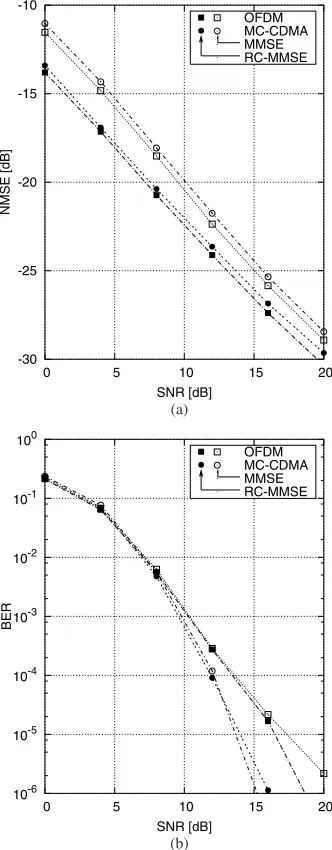
Fig. 3. (a)Normalised Mean Square Error (NMSE)and (b)Bit Error Rate (BER) exhibited by channel estimator which follows the philosophy of Figure 1 and employs Minimum Mean Square Error (MMSE) and
Reduced-Complexity MMSE a posteriori SS-CIR estimators of Equa-tions (13) and (20) respectively. Thea prioriprediction is performed using the robust SS-CIR predictor [1] assuming matching propagation conditions described by the COST-207 BU channel model with normalised Doppler frequency of
. The Turbo-coded QPSK-modulated OFDM and
MC-CDMA modes are depicted usingandÆmarkers respectively.
We employed the seven-path Rayleigh-fading COST-207 Bad Urban (BU) channel model characterised in [13], using the delay spread of !
"s and the normalized Doppler frequency of
#.
Figure 3 demonstrates (a) the Normalized Mean Square Error (NMSE) performance and (b) the achievable turbo-coded Bit Error Rate (BER) of the DDCE scheme of Figure 1 using both the full-complexity MMSE and the RC-MMSE SS-CIR estimators described in Sections III-C.1 and III-C.2, respectively, in the context of both the above-mentioned OFDM and MC-CDMA systems. The simula-tions were carried out over the period of 10,000 QPSK-modulated
-subcarrier OFDM/MC-CDMA symbols. It can be seen in Figure 3(a), that the RC-MMSE method performs at least as well as its MMSE counterpart in the context of both the OFDM and
MC-CDMA systems considered. Moreover, as it becomes evident from Figure 3(b), the MMSE/RC-MMSE SS-CIR operating in the context of the MC-CDMA system outperforms its OFDM counterpart.
TABLE I SYSTEM PARAMETERS.
Parameter OFDM MC-CDMA
Channel bandwidth 800 kHz
Number of carriers 128
Symbol duration 160s
Max. delay spread
40
s
No. of CIR taps 3
Channel interleaver WCDMA [12] – 248 bit
Modulation QPSK
Spreading scheme – WH
FEC Turbo code [11] , rate 1/2
component codes RSC, K=3(7,5) code interleaver WCDMA (124 bit)
V. CONCLUSIONS
In this paper we have proposed a low-complexity MMSE SS-CIR estimator, which is suitable for employment in DDCE-aided OFDM and MC-CDMA systems. As it was shown in Section IV, the performance of the low-complexity MMSE method proposed is at least as good as that of its high complexity counterpart, while its complexity does not exceed the complexity of the conventional LS-based estimator. Furthermore, it was shown that the turbo-coded MC-CDMA system using the proposed MMSE DDCE method out-performs the corresponding OFDM-based system.
REFERENCES
[1] L. Hanzo, M¨unster, B. Choi, and T. Keller, OFDM and MC-CDMA
for Broadband Multi-user Communications, WLANs and Broadcasting.
John Wiley – IEEE Press, 2003, 992 pages.
[2] A. Goldsmith, S. Jafar, N. Jindal, and S. Vishwanath, “Capacity limits of MIMO channels,”IEEE Journal on Selected Areas in Communications, vol. 21, no. 5, pp. 684–702, June 2003.
[3] J.-J. van de Beek, O. Edfords, M. Sandell, S. K. Wilson, and P. O. B¨orjesson, “On channel estimation in OFDM systems,” inIEEE
Vehic-ular Technology Conference, Chicago, IL, July 1995, pp. 815–819.
[4] O. Edfords, M. Sandell, J.-J. van de Beek, S. K. Wilson, and P. O. B¨orjesson, “OFDM channel estimation by singular value decomposi-tion,” IEEE Transactions on Communications, vol. 46, pp. 931–939, April 1998.
[5] Y. Li, L. Cimini, and N. Sollenberger, “Robust channel estimation for OFDM systems with rapid dispersive fading channels,”IEEE
Transac-tions on CommunicaTransac-tions, vol. 46, no. 7, pp. 902–915, April 1998.
[6] M.-X. Chang and Y. Su, “Model-based channel estimation for OFDM signals in Rayleigh fading,” IEEE Transactions on Communications, vol. 50, pp. 540–544, April 2002.
[7] Y. Li, “Pilot-symbol-aided channel estimation for OFDM in wireless systems,” IEEE Transactions on Vehicular Technology, vol. 49, pp. 1207–1215, July 2000.
[8] ——, “Simplified channel estimation for OFDM systems with multiple transmit antennas,” IEEE Transactions on Wireless Communications, vol. 1, no. 1, pp. 67–75, January 2002.
[9] S. Kay, Fundamentals of Statistical Signal Processing. Englewood Cliffs, NJ, USA: Prentice-Hall, 1998.
[10] A. Papoulis,Probability, Random Variables, and Stochastic Processes, 2nd ed. New York, USA: McGraw-Hill, 1984.
[11] L. Hanzo, T. Liew, and B. Yeap, Turbo Coding, Turbo Equalisation
and Space-Time Coding. Chichester, UK; Piscataway, NJ, USA: John
Wiley, IEEE Press, 2002, 766 pages. (For detailed contents, please refer to http://www-mobile.ecs.soton.ac.uk.).
[12] H. Holma and A. Toskala, Eds.,WCDMA for UMTS : Radio Access for
Third Generation Mobile Communications. John Wiley and Sons, Ltd.,
2000.
[image:5.612.83.249.48.473.2]