EFFECT OF EARLY MOBILIZATION TRAINING ON GROSS
MOTOR FUNCTION AND FUNCTIONAL OUTCOME IN
HEMIPARETIC STROKE SUBJECTS
- An Experimental Study
Dissertation submitted to The Tamil Nadu Dr. M.G.R. Medical University towards partial fulfilment of the requirements of Master of Physiotherapy [Advanced PT in Neurology] Degree Programme.
KMCH COLLEGE OF PHYSIOTHERAPY
[A Unit of Kovai Medical Center Research & Educational Trust]
Post Box No. 3209, Avanashi Road, Coimbatore-641 014.
CERTIFICATE
This is to certify that research work entitled “EFFECT OF EARLY MOBILIZATION TRAINING ON GROSS MOTOR FUNCTION AND FUNCTIONAL OUTCOME IN HEMIPARETIC STROKE SUBJECTS”-An Experimental study was carried out by the candidate bearing the Register No: 27091612, KMCH College of Physiotherapy towards partial fulfillment of the requirements of the Master of Physiotherapy (Advanced PT in Neurology) of the Tamil Nadu Dr. M.G.R. Medical University, Chennai-32
PROJECT GUIDE PRINCIPAL
Mr. K.SENTHIL KUMAR, M.P.T, Dr. EDMUND M. D’COUTO, Vice Principal, MBBS.Dip.Phy.Med & Rehab, KMCH College of Physiotherapy, KMCH College of Physiotherapy, Coimbatore- 641014. Coimbatore- 641014.
INTERNAL EXAMINER EXTERNAL EXAMINER
Dissertation evaluated on:
ACKNOWLEDGEMENT
First and foremost, I thank GOD for showering me with his divine blessings, enriched love and matchless grace, which gave me inner strength and guidance throughout my study.
I’m deeply indebted to My Beloved Parents and Brother for their unconditional love, sincere prayers, encouragement, constant inspiration and care without which I would not have accomplished anything.
My warm hearted thanks to the KMCH Management, especially to the Chairman Dr. Nalla G. Pallaniswami M.D.(AB), and the Trustee Dr. Thavamani D. Pallaniswami M.D. (AB) F.A.A.P., who are the stalwarts of the institute.
I thank Dr. O.T. Bhuvaneswaran PhD, Chief Executive Officer, for his intensive efforts towards the academics.
I express my heartiest thanks in this instance to my project guide Mr. K. Senthil Kumar, M.P.T. (Neuro), vice principal, KMCH College of physiotherapy for his benevolent guidance, support and valuable suggestions throughout the course of the study.
My heartfelt thanks to my class in-charge Mrs.A.Brammatha, M.P.T. (Neuro) for her guidance and encouragement throughout the study.
I extend my gratitude to Mr. K. Venugopal, M.A., M.Phil, Professor in
Research & Biostatistics for letting me know the intricacies of Biostatistics. I wish to express my thanks to all the faculty members for their support.
I perpetuate my thanks to my librarians, Mr.P.Dhamodharan and his fellow members for their co-operation and patience in providing books for reference, which helped me to complete this project successfully.
And last but obviously the most I would like to express my hearty thanks to my classmates and friends for their active participation and co-operation without which this study would not have progressed to be successful.
CONTENTS
CHAPTER TITLE PAGE
NO.
Abstract
1. Introduction 1
1.1 Need for the study 4
2 Review of Literature 6
2.1 Stroke 6
2.2 Influence of Motor Impairments on disability
6
2.3 Gross motor dysfunction in stroke 8 2.4 Early mobilization training 10 2.5 Motor recovery following stroke 12 2.6 Motor relearning programme 14 2.7 Motor assessment scale 16
2.8 Barthel index 17
3 Aim and Objectives 18
3.1 Aim 18
3.2 Objectives 18
4 Materials and methodology 19
4.1 Study design 19
4.3 Study setting 19
4.4 Sample size 19
4.5 Sample technique 19
4.6 Criteria for selection 20
4.7 Hypothesis 21
4.7.1 Null hypothesis 21
4.7.2 Alternate hypothesis 22
4.8 Procedure 23
4.8.1 Conventional therapy 24
4.8.2 Early mobilization training 26
4.9 Outcome measures 38
4.10 Statistical analysis 38
5 Data presentation 40
5.1 Tabular representation 40
5.2 Graphical representation 44
5.3 Data analysis and Results 48
6. Discussion 52
7. Summary and conclusion 57
8. Limitation and suggestion 58 Bibliography
Appendices
ABSTRACT
Objective: To study the effect of early mobilization training on gross motor function and functional outcome following acute stroke. Design: Pre and post test experimental study. Sample size: Twenty hemiparetic stroke subjects within onset 24-48 hours allocated ten in each group. Age between 40-60 years. Motor arm and leg-2 (NIHSS), Dynamic balance sitting score-poor (Functional balance grade scale).Intervention: Both groups were treated with conventional therapy on second day of stroke, with experimental group received early mobilization training which was started with in 24-48hours of stroke onset and the control group were mobilized after one week of stroke onset. Outcome measure: Motor assessment scale for gross motor function, Barthel index for functional outcome. Results: Statistical analysis was done by using ‘t’ test, which shows there was a significant improvement in gross motor function with early mobilization training group than conventional group. Conclusion: Early mobilization training is feasible and effective in improving gross motor function in hemiparetic stroke subjects.
KEY WORDS:
NIHSS-National institute of health stroke scale.
MAS-Motor assessment scale.
1.
INTRODUCTION
The World Health Organization (WHO) defines Stroke as a “rapidly developing clinical signs of a focal /global disturbance of cerebral function, with symptoms lasting more than 24 hours or longer, or leading to death, with no apparent causes other than vascular origin.”
The brain is functionally active due to rapid blood flow on the physiological basis of circulation in the body. The most common causative factor which disturbs the brain after trauma is of vascular origin where the protective mechanism of brain fails resulting in permanent damage.
Stroke is the third leading cause for the death in this world. Stroke as a neurological illness has third longest stay for rehabilitation. It is one of the leading causes for severe handicap in the world.
persistent motor deficits that impair motor function probably has the greatest impact on ADL independence.
Stroke rehabilitation is a programme designed to help the stroke victim to overcome the disability resulting from brain damage and to enable him or her at physical, psychological, social levels despite the disability that remains after all spontaneous recovery from brain damage is ceased.
Early administration of physical rehabilitation following acute stroke may improve the functional mobility of patient, so who they can be discharged home (or) rehabilitation setting earlier. In acute stroke, most of the hospitals enforce the patient to be in bed rest for prolonged days.
In the older studies they have used bed rest in acute stroke, and conventional therapy with in the bed, like passive movements and stretching. But recent years researchers have used rehabilitation programme of out of bed activities based on task specific exercise to improve the motor function.
Early mobilization is one of feature of stroke unit care. One study demonstrated substantially better outcomes for patients managed in stroke units that incorporated early mobilization as compared to those patients who received general medical ward care and not mobilized early in intensive care unit.
1.1 NEED FOR THE STUDY
Bernhardt (2007) in their study they concluded that acute stroke
patients are at very high possibility of developing complications, resulting from immobility which may report for up to 51% of deaths in first 30 days after ischemic stroke with over 62% complication happening in first week.
Complication for instance spasticity, pressure sore, depression, deconditioning and infection. This made the negative effect on functional outcome and barriers to most favorable recovery.10
out during this critical interval.43 In current approaches, the authors suggested that in the acute rehabilitation of stroke patients, physiotherapy treatment using the motor relearning programme (MRP) is preferable then the other approaches. Julie Bernhardt (2007) in his study, Mobilization “in bed” is not mobilization. There is no opportunity for any form of movement beyond rolling side to side. Clearly
getting out of bed is likely to affect more then just blood flow to brain.5
Birgitta et al (1999) the patients in the MRP group were mobilized earlier on in the rehabilitation and kept active to a greater extent than patients in the bobath group. Previously several studies were conducted by the effect of early mobilization on death, disability, complication and physiological variables following acute stroke.
But up to date, limited literature is available in early mobilization in acute stroke subjects on motor function. So in this study an effort has been made to analyze the effect of early mobilization based on motor relearning programme for gross motor function and functional outcome in acute stroke subjects there by promoting the functional independence and quality of life.
2. REVIEW OF LITERATURE
2.1. STROKE:
• Arthur anconitz et al (1993) defined Stroke as a loss of functioning brain
tissue, with an accompanying disability, such as weakness, paralysis,
blindness, (or) speech impairments. Stroke is triggered by deprivation of
blood to part of brain.
• Rowan harwood et al (2005) defined a rapidly developing episode of focal
(or) global neurological dysfunction lasting longer than 24 hours (or)
leading to death and presumed vascular origin.
2.2. INFLUENCE OF MOTOR IMPAIRMENT ON DISABILITY:
• Chae et al (2005) In this studies they to investigate the fugl‐meyer (FMA)
motor impairment scale and physical disability measured by FIM as
prediction of physical independence after stroke. Fourty eight patients are
admitted to rehabilitation within six weeks of stroke onset. They suggested
that physical activity dependency of daily living after stroke is primary
• Farhan et al (2005) A total of 100 patients with ischemic stroke was
assessed at neurology department. River mead motor assessment to
measure motor impairment and Functional independent measure (FIM) to
measure disability were used and the baseline and post stroke values were
taken in seventh to tenth day and three month. They concluded that stroke
related motor impairment and disability were found to be significantly
correlated with each other.27
• Kenneth et al (2001) in their study, motor and cognitive abilities were
measured by FMA and neurobehavioral cognitive status examination and
functional performance was measured by FIM assessment was conducted
at admission, after two weeks and at discharge. The results from this study,
motor impairment, balance, lower limb ability, strongly accounts for
functional recovery in rehabilitation of patients with in stroke staying in
hospital.37
• Patel et al (1998) performed a study with the aim of assessing the
relationship between impairment and functional outcome. Mobility and
ADL were assessed at 1, 3, and 6 month post stroke by using functional
cumulative deficits post stroke affect patients functional outcome in the
first six months.49
• Nancy et al (1999) done a study with the purpose to describe the
disabilities experienced by person with stroke during first year and explore
the evaluation of impairment, disability, handicap, and health related
quality of life. They suggest that much of improvement in impairment and
disability occurs during the first month and then reaches a plateau.
Handicap and quality of life continue to be issue later.47
• Masiero et al (2007) had done a study to investigate predictive factors for
ambulatory recovery in stroke patients undergoing rehabilitation.
Functional status at admission and discharge was evaluated by FIM and its
motor component, upper and lower motricity index, trunk control test.
Results indicate that age and level of motor and functional impairment
measure at baseline are significant predictors of ambulatory outcome.42
2.3. GROSS MOTOR DYSFUNCTION IN STROKE:
• Dean et al (1992) in their study stating that balance impairment in sitting is
such as weakness, loss of co ordination but also tendency to adapt behavior
to avoid the threat to balance. More than 70% stroke patients admitted to
rehabilitation are unable to reach side wards to floor while sitting.
• Joanne et al (2006) in his study, evaluates stroke patients with upper limb
motor deficits using measure of impairment and activity limitation to
quantify recovery of of upper limb function, box and block test
performance was used as a outcome over five weeks. Author’s data shows
that deficits in strength appear to be most influential sensorimotor
association with limited reaching performance in acute hemiparesis.33
• Richared et al (2007) in their study suggested that sit to stand activities is
important in every function, but independent in activity is often lost after
stroke.54
• Patricia et al (2009) conducted a study to analyze which stroke related
physical impairment influence the performance in the six minute walk test.
They concluded stroke related impairments are power full modifiers of
performance in the six minute walk test. Motor deficits of lower limb and
decreased balance contribute to distance an adult with stroke can walk on
• Cameron et al (2003) in his study compared the kinetic energy and duration
of task during sit to stand and curb‐climbing of two groups, in hemiparesis
stroke patients and matched control also. Study design is descriptive and
correlation, physical performance variables measured was standing
balance, paretic extremity weight bearing, and knee extension strength.
They revealed that impaired balance and maximum weight bearing are
relevant to sit to stand and curb‐climbing limitation after stroke.
2.4. EARLY MOBILIZIATION TRAINING:
• B.Indredavik et al (1999) done a study with an aim of identifying the
differences in treatment between stroke unit and general ward and which
aspect of the stroke unit care was most responsible for the better outcome.
Only 206 patients were included in this study. They analyzed that shorter
time to start of mobilization/training was the most important factor
significantly association with the outcome, discharge to home within 6
weeks. They concluded that shorter time to start the mobilization was most
important factor associated with discharge to home followed by stabilized
• Toby B Cumming (2008) in their study of randomized control design, the
patients in the very early mobilization group receive mobilization earlier
within 24 hours and more frequently than in standard group. Totally 71%
patients were included and patients were assessed on the irritability,
depression and anxiety scale at multiple times. He concluded that early
mobilization may reduce depressive symptoms in stroke patients at 7 days
post stroke.36
• Julie Bernhardt et al (2008), they performed a randomized control trial
with blinded outcome assessment which hypothesing that very early
rehabilitation protocol would be safe and feasible.71 patients were
recruited within 24 hours and randomly assigned to receive standard care
(SC) or SC along with early mobilization. They concluded that mobilization
commencing within 24 hours of symptom onset appears both safe and
feasible. Early mobilization may be one of the simplest yet most important
components of effective stroke unit care.6
• Geis et al (1997) suggested in their study that during the acute
management of stroke, there are rehabilitation medicines issues that must
be addressed to maximize facilitation of recovery includes techniques
This technique helps to facilitate early recovery, and acts as guidelines for
assessing rehabilitation needs after acute care.30
• Shutter et al (2002) in their study they suggest that the approach to
therapy for acute stroke patient should incorporate a variety of measures
to facilitate early activation. Therapy should include getting the patient out
of bed as soon as possible and facilitating the patient’s as much as possible
in mobility activities such as rolling over in bed, sitting up, and
transferring.45
• Torunn askim et al (2009) performed a study to assess early motor network
changes after acute ischemic stroke in patients treated with very early
mobilization and task oriented therapy in a comprehensive stroke unit.
Patients were assessed by functional magnetic imaging and by clinical tests
within the first week after stroke and three months later. They concluded
the changes in motor activity between acute and chronic phases seem to
correspond to motor learning process.66
2.5. MOTOR RECOVERY FOLLOWING STROKE:
• Gereon et al (1999) in their study used positron emission tomography to
hemiplegic stroke patients, before motor recovery. Regional cerebral blood
flow (r CBF) was measured in six hemiplegic patients with single, sub
cortical infarct. Results shows changes of cerebral activation in sensory and
motor system occur early after stroke and may be a first step forward in
restoration of motor function following stroke.31
• Gao cong et al (2001) stated that early rehabilitation training of the
patients with stroke hemiplegic may obviously improve motor function of
upper and lower limbs and raises ADL scores.29
• Catherine et al (2000) concluded that during the early rehabilitation
following stroke subject who were admitted to stroke unit and also
received daily rehabilitation therapy for up to eight weeks exhibited
improvement in postural sway and activities based, range of balance.
• Frederice et al (1970) concluded that there is no contraindication to early
initiation of rehabilitation and those patients for whom initiated
immediately after stroke have the most rapid and optimal recovery, 90‐95%
of hemiplegia got good return of function in upper extremity, 65% of
patients became independent in self‐care and ambulation.28
• Tarasova et al (2008) done a study in which ninety six patients were
functional disablement, functional disorder, and quality of life also tested.
Results proved that intensive rehabilitation in the acute phase of stroke to
an improvement of the functional state and a reduction of the measure of
the impairment of motor and cognitive function.64
• Feys et al (2004) performed a study of single blinded, randomized
controlled multicenter trial, 100 patients was allocated to two groups,
sensorimotor stimulation was given to experimental group and they were
evaluated by the level of impairment and action research arm test and
barthel index. Results showed that adding in early, repetitive and targeted
stimulation to arm during acute phase resulting in long lasting effect on
motor function in patients.
• Hayes and corroll (1986) suggested that earlier ambulation have shown to
reducing mortality, earlier return of mental and motor function and activity
of daily living.
2.6. MOTOR RELEARNING PROGRAMME:
• Dora yl Chan et al (2006) had conducted a study to find out the effects of
motor relearning programme in promoting physical function and task
scale, timed up and go test, functional independence measure are used as
outcome. He suggested that motor relearning programme was found to be
effective for enhancing functional recovery of stroke patients. Both
‘sequential ‘and ‘functional –based ‘concepts are important in applying the
motor relearning approach to the rehabilitation of stroke patients.
• Langhammer and Stanghelle (2000) conducted a study in randomized
control trial. Compared the bobath approach and the motor relearning
programme in stroke patients.61 patients was taken.33 patients received
motor relearning programme and 28 patients received bobath approach.
Tested after 3 days, 2 weeks after admission and 3 months post stroke by
Motor assessment scale, Sordring motor evaluation scale, Barthel index and
Nottingham health profile. The results showed both groups improved in
motor assessment scale and sordring motor evaluation scale. But the motor
function improvement was significantly greater in the MRP group. Finally,
they concluded that in the acute rehabilitation of stroke, using the MRP is
preferable to using bobath approach.41
• P M Van Vliet et al.(2005),they Compared bobath based physiotherapy
with movement science based physiotherapy intervention for stroke in 120
functional independence between patients receiving Bobath based or
movement science based intervention in stroke patients.
2.7. MOTOR ASSESSMENT SCALE:
• Pool and Whitney (1988) stated to establish the concurrent validity and
inter rater reliability of motor assessment scale and fugl‐meyer assessment
scale; they concluded that there is high correlation between MAS and
FMA.52
• Aarmodt et al (2006) done a study to investigate the two aspects of
reliability of MAS in 24 patient’s shows a highly reliable value with an
average inter rater correlation of 0.95 and an average test retest
correlation of 0.98.2
• Carr, J.H., shepherd et al (1985) performed a study on “investigation of a
new motor assessment scale for stroke patients”‐they found it highly
reliable and its validity and usefulness in measuring the progress of patients
in physical therapist should be investigated.15
• Dean, C.M., Markey et al (1992) conducted a study on “motor assessment
scale scores as a measure of reliable outcome following stroke”, reported
from admission to discharge from stroke rehabilitation after an average of
seventy one days of rehabilitation.
2.8. THE BARTHEL INDEX:
• Salter et al (2006) concluded that barthel index of activities of daily living
was originally intended as simple index independence by which to quantify
the ability of a patient with neuromuscular or musculoskeletal disorders to
care for him or himself and is most widely used measures of functional
disability.59
• Granger et al (1988) in their study they have found that barthel index to be
highly reliable and consistent with other stroke evaluations.
• Wade and Collin et al (1988) performed a study concluded that barthel
index may not able to detect change within an individual who is
independent but is able to detect when a patient require assistant. This
distinction may, have more significance to clinical practice then to research.
3. AIM &OBJECTIVES
3.1. AIM:
To study the effect of early mobilization training on gross motor function and functional outcome in hemiparetic stroke patients.
3.2. OBJECTIVES:
¾ To evaluate the effect of early mobilization training started within 24- 48
hours following stroke in hemiparetic stroke subjects.
¾ To compare the effect of early mobilization training started with in 24- 48
hours on gross motor function, and functional outcome in hemiparetic stroke patients.
¾ To implement the technique into clinical practice.
4. MATERIALS & METHODOLOGY
METHODOLOGY
4.1. Study design:
Pre and post test experimental study design.
4.2. Study population:
Acute MCA hemiparetic stroke subjects.
4.3. Study setting:
Kovai Medical Center and Hospital, Coimbatore.
4.4. Sample size:
20 ischemic acute stroke subjects.
Group I; 10 subjects (mobilization started after a week of stroke onset).
Group II; 10 subjects (mobilization started within 24-48 hours of stroke onset).
Purposive sampling.
4.6. Criteria for selection of patients:
Inclusion criteria:
1. Age 40‐60 years.
2. Middle cerebral artery ischemic stroke.
3. Genders: both male and female.
4. Admitted within 24‐48 hours of symptom onset.
5. Medically stable, confirmed by neurologist.
6. Motor arm &leg‐2(National institute of health stroke scale)
7. Dynamic balance sitting score‐poor(Functional balance scale)
8. Should react to verbal commands.
Exclusion criteria:
1.
Hemorrhagic
stroke2.
Progressive
neurological disorder.3.
Musculoskeletal
impairments4.
Acute
coronary syndrome.6.
Cognitive
impairment.7.
Medically unstable.4.7. HYPOTHESIS:
4.7.1 Null hypothesis:
HO1- There is no significant improvement on gross motor function, with
mobilization training started after a week following stroke in hemiparetic stroke subjects.
HO2- There is no significant improvement on functional outcome, with
mobilization training started after a week following stroke in hemiparetic stroke subjects.
HO3- There is no significant improvement on gross motor function, with
early mobilization training started within 24-48 hours following stroke in hemiparetic stroke subjects.
HO4- There is no significant improvement on functional outcome, with early
HO5-There is no significant difference exists between early mobilization
training started within 24-48 hours and mobilization training started after a week following stroke on gross motor function in hemiparetic stroke subjects.
HO6-There is no significant difference exists between early mobilization
training started within 24-48 hours and mobilization training after a week following stroke on functional outcome in hemiparetic stroke subjects.
4.7.2. Alternate hypothesis:
HA1- There is a significant improvement on gross motor function with
mobilization training started after a week following stroke in hemiparetic stroke subjects.
HA2- There is a significant improvement on functional outcome with
mobilization training started after a week following stroke in hemiparetic stroke subjects.
HA3- There is a significant improvement on gross motor function with early
HA4- There is a significant improvement on functional outcome with early
mobilization training started within 24-48 hours following stroke in hemiparetic stroke subjects.
HA5-There is a significant difference exist between early mobilization
training started within 24-48 hours and mobilization training after a week following stroke on gross motor function in hemiparetic stroke subjects.
HA6-There is a significant difference exist between early mobilization
training started within 24-48 hours and mobilization training started after a week following stroke on functional outcome in hemiparetic subjects.
4.8. PROCEDURE:
A written consent was taken from patients who fulfilled the inclusion
and exclusion criteria. Pre test was taken with Motor assessment scale for gross
motor function and barthel index scale for functional outcome. ). Subjects were
randomly allocated to 2 groups. Patients in Group 1 received conventional
physical therapy with mobilization training started after a week of stroke onset.
And Patients in Group 2 received Conventional physical therapy with early
mobilization training started within 24‐48 hours of stroke onset for 2 weeks. Post
4.8.1. CONVENTIONAL THERAPY:
Group I- procedure:
(1)Electrical stimulation:
Electrical stimulation was given to upper and lower limb muscles.
9 Type of current- Faradic current.
9 Pulse duration- 1ms.
9 Pulse frequency- 50Hz.
9 Pulse amplitude - Sufficient enough to achieve desired strength of
contraction.
9 Muscles- Triceps, wrist and finger extensor, dorsiflexors of ankle.
9 No of contraction: based on response of muscle in order to avoid
muscle fatigue.
(2) Stretching:
9 Type - Manual passive stretching.
9 Muscles - Biceps, triceps, long flexors of forearm, hamstring, and
9 Holding time -15 sec.
9 Repetition - 5times.
(3) Normalization of tone:
9 Slow sustained stretching of biceps and wrist flexors, hamstrings and
calf.
9 Cryotherapy to biceps and hamstrings.
9 Upper limb weight bearing position in long sitting.
9 Quick stretching to facilitate muscle tone.
9 Slow rocking movements.
(4)Range of motion exercises:
4.8.2. EARLY MOBILIZIATION TRAINING:
Group II-Procedure:
Mobiliziation
Definition:
“The act of getting a patient to move in the bed, sits up, stand and eventually walk”.
In this study, mobilization as a form of exercise consists of getting out of bed, standing and walking based on motor relearning programme along with rest in between.
With first 3 days after stroke, blood pressure, oxygen saturation, heart rate, temperature should be circumspectly monitored before and after each mobilization.
Supine lying:
¾ Therapist lifts the patient’s arm and supports it in forward flexion. Patient
attempts to reach up towards ceiling.
¾ Instructions:
“Reach up towards the ceiling.”
“Think about using your shoulder.”
“Now let your shoulders go back on to the bed.”
¾ Then asking him to take his hand to his head and take his hand above his
Instructions:
“See if u can take your down to your forehead-gently-don’t let your hand drop.”
“See if you can take your hand above your head to the pillow.”
¾ Rolling to either side.
¾ Pelvic bridging.
Inside lying
¾ Therapist encourages the patient to turn his head, assist him to bring his shoulder and arm forward, and to flex his hips and knees.
¾ Therapist assists the patient to lift his head off the pillow and patients
attempts to lower his head to pillow.
Instructions:
“Lower your head to the pillow.”
“Lift your head from the pillow.”
¾ Patient lifts his head laterally, while therapist, one hand under the shoulder and other pushing downwards on his pelvis, helps him to move up into the sitting position.
Instructions:
“Now, sit up and I will help you.”
In sitting
¾ Sitting at a table, patient practices reaching forward and upward. He should
work within the range he can control, gradually increasing it. Instruction:
“Reach out to touch this.don’t let your arm drop.”
¾ Patient sitting with arm supported on table, forearm in mid position, fingers
and thumb around a glass. Patient attempts to lift the glass and lower it.
Instruction:
“Lift the glass up.”
“Let it down slowly.”
Progress to:
“Move the glass to this point on the table.”
¾ Patient hands in lap, patient turns head and trunk to look over his shoulder
Instructions
“Turn around and look behind you”
“Turn your body as well as your head”
“Don’t lean back”
¾ Patient reaches forward to touch an object, downwards towards floor and to both sides; each time returning to upright position, therapist supports the affected arm while necessary.
Instruction:
“Reach out and touch”
“Look at the object.”
“Now, sit up again.”
“Let’s do it again”
¾ Therapist assists the patient sideways to support himself on the forearm of
his affected side on one (or) two pillows. Then sitting up from this position.
“Lower yourself on to the pillow.”
“Now sit up.”
Standing up
¾ In sitting, Patient feet flat on floor, then practices inclining his trunk forward
by flexing at hips with the neck and trunk extended, with enough momentum to move the knees forward.
Instruction:
“Move your shoulders in front of your feet and push down and back through your feet.”
“Push down more through affected foot.”
“Look straight ahead.”
¾ With his shoulders and knees forward, the patient practices standing up. The
therapist can give him the idea of pushing down through his affected foot by pushing down through his knee along the line of the shank while moving forward.
“Press down through your foot and stand up.”
“When you are standing: bring your hips forward.”
¾ Therapist may need to help the patient with the forward movement of
shoulder and knee at the beginning of the movement.
Instruction:
“Move your knees forward.”
¾ Standing with feet a few inches apart, the patient looks up at ceiling.
Instruction:
“Look up at the ceiling.”
“Bring your hips forward.”
“Move forward at your ankles as you look up.”
¾ Reaching forward, sideways, backwards encouraged.
Instructions:
“See if you can touch this. Come on, just a little further.”
“Don’t shift your feet.”
¾ Patient takes a step forward with intact leg then backwards.
Instructions:
“Keep your weight on this affected foot.”
“Your hip should move in front of your foot.”
“Now, step backwards.”
¾ Pick up a glass from the floor with one hand (or) bimanually.
¾ Patient takes a step forward with intact leg, then backwards.
Walking
¾ Patient practices stepping forward and backward with intact leg as above,
making sure he extends his affected hip as he steps forward.
Instructions:
“Take your weight through affected leg.”
“Step forward with intact leg. You need to move forward at affected ankle.”
¾ Standing with intact leg in front of affected leg. Patient practices moving his
weight forward over his intact foot and back while maintaining the knee extension of the affected leg.
Instruction:
“Keep your knees straight.”
“Practice bending and straightening affected knee a few degrees.”
“Keep your hip forward while you do this.”
¾ In standing hips in front of ankles, patient practices shifting his weight from
one foot to the other. Therapist indicates with her finger how far his pelvis should shift.
Instructions:
“Move your weight over on to your right foot.”
“Now move it back on to your left foot.”
“To move to the right, push gently through your left foot.”
¾ Walking in sideways and backwards is encouraged.
Instruction:
“Let’s walk sideways, stand on your right leg and step sideways with your left foot.”
¾ Walking combined with other activities such as conversation.
Repetition: 10 repetitions per exercise for 6 days a week.
Treatment duration: 1 hour daily.
No. Of session: 2 times per day.
4.9. OUTCOME MEASURES:
1. Motor assessment scale (AppendixIII).
2. Barthel index scale (Appendix IV).
4.10. STATISTICAL TEST
Pre-test and Post-test values of the study was collected and assessed for variation in improvement & their results will be analyzed using Independent `t’ test and Paired `t’ test.
¾ INDEPENDENT `t’ TEST (between groups)
∑ ∑
¾ PAIRED `t’ TEST (within groups)
t = √
Where,
S = ∑
S =combined standard deviation
& =difference between initial & final readings in group A
&group B respectively.
& =number of patients in group A & group B respectively.
& =Mean of group A & group B respect
5. DATA PRESENTATION
5.1. TABULAR REPRESENTATION
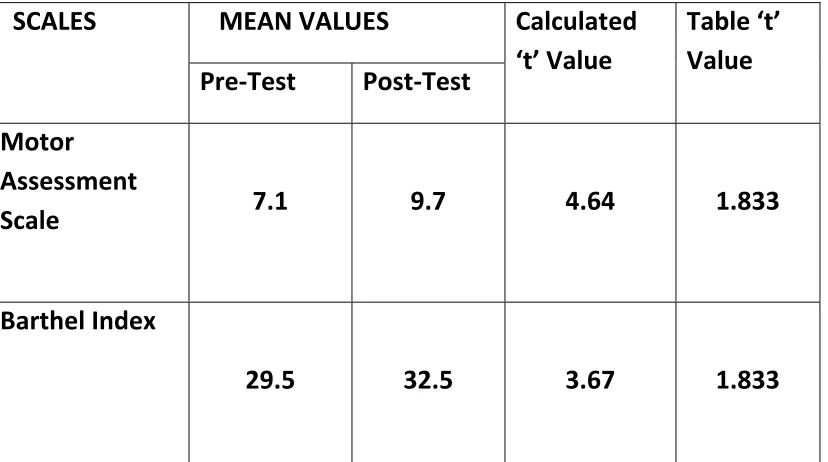
TABLE 1: PAIRED‘t’ TEST
GROUP 1‐ CONTROL GROUP
SCALES MEAN VALUES Calculated
‘t’ Value
Table ‘t’
Value
Pre‐Test Post‐Test
Motor
Assessment
Scale
7.1
9.7 4.64
1.833
Barthel Index
29.5 32.5 3.67 1.833
[image:47.612.72.486.360.591.2]
For 9 degrees of freedom and at 5% level of significance, the table‘t’ value
is 1.833 and the calculated ‘t’ value is 4.64. Since the calculated ‘t’ value is greater
than the table‘t’ value the null hypothesis is rejected.
BARTHEL INDEX:
For 9 degrees of freedom and at 5% level of significance, the table‘t’ value
is 1.833 and the calculated ‘t’ value is 3.67. Since the calculated’ value is greater
than the table‘t’ value the null hypothesis is rejected.
TABLE 2
GROUP II: EXPERIMENTAL GROUP
SCALES
MEAN VALUES Calculated
‘t’ Value
Table ‘t’
Value
Pre‐Test Post‐Test
Motor
Assessment
Index
6.3 15.1 12.14
1.833
Barthel Index
29.0 34.0 4.7
MOTOR ASSESSMENT SCALE
For 9 degrees of freedom and 5% level of significance the table‘t’ value is
1.833 and the calculated’ value is 12.14. Since the calculated’t’ value is greater
than the table‘t’ value the null hypothesis is rejected.
BARTHEL INDEX
For 9 degrees of freedom and 5% level of significance the table‘t’ value is
1.833 and the calculated t’ value is 4.7. Since the calculated’t’ value is greater
than the table‘t’ value the null hypothesis is rejected.
INDEPENDENT‘t’ TEST:
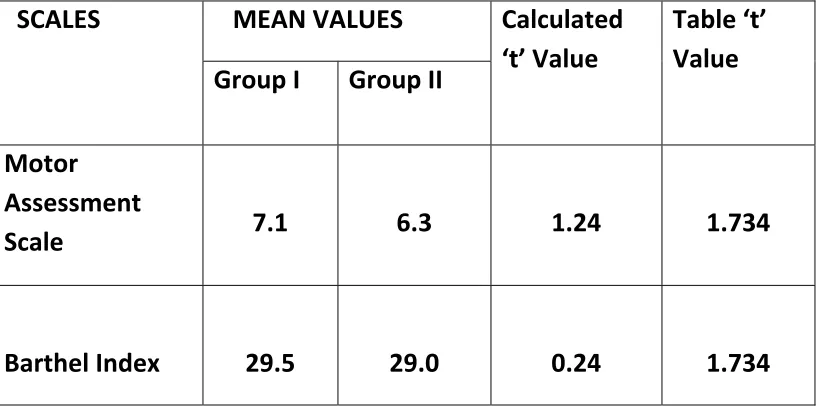
TABLE 3
Pre‐Test values: Group I and Group II
SCALES MEAN VALUES Calculated
‘t’ Value
Table ‘t’
Value
Group I Group II
Motor Assessment Scale 7.1
6.3 1.24 1.734
Barthel Index
29.5
29.0 0.24
1.734
PRE TEST VALUES GROUP I AND II
[image:50.612.70.481.309.512.2]For 18 degrees of freedom and 5% level of significance, the table‘t’ value is
1.734 and the calculated ‘t’ value is 1.24. Since the calculated‘t’ value lesser than
the table‘t’ value the null hypothesis is accepted.
BARTHEL INDEX
For 18 degrees of freedom and 5% level of significance, the table‘t’ value is
1.734 and the calculated ‘t’ value is 0.24. Since the calculated‘t’ value lesser than
the table‘t’ value the null hypothesis is accepted.
INDEPENDENT‘t’ TEST
TABLE 4
Post‐Test values: Group I and Group II
SCALES MEAN VALUES Calculated
‘t’ Value
Table ‘t’
Value
Group I Group II
Motor
Assessment
Scale
9.7
15.1 4.81
Barthel Index
29.5
34.0 1.68 1.734
POST TEST VALUES: GROUP I AND II
MOTOR ASSESSMENT SCALE
For 18 degrees of freedom and 5% level of significance, the table‘t’ value is
1.734 and the calculated ‘t’ value is 4.21. Since the calculated‘t’ value lesser than
the table‘t’ value the null hypothesis is rejected.
BARTHEL INDEX
For 18 degrees of freedom and 5% level of significance, the table‘t’ value is
1.734 and the calculated ‘t’ value is 1.68. Since the calculated‘t’ value lesser than
the table‘t’ value the null hypothesis is accepted.
GRAPH ASSESS
1: PRE AN
SMENT SCA
GRAP
5.2.
ND POST TE
ALE IN CON
H 2 PRE AN
GRAPHICA
EST MEAN
NTROL GR
ND POST T
INDEX
AL REPRES
VALUES O
OUP
TEST MEAN
SENTATION
OF MOTOR
N VALUES
N
R
GRAPH
3: PRE ANND POST TEEST MEAN
EXPERIM
N VALUES O
MENTAL GR
OF MOTOR
ROUP.
R ASSESSM
MENT SCAL
GRAPH
4 PRE AND
GRAPH 5 P
D POST TE
PRE TEST M
EST MEAN
MEAN VAL
VALUES O
LUES OF M
OF BARTHE
MOTOR ASS
L IN
SESSMENT
DEX SCALE
T SCALE
GRA
APH 6 PO
OST TEST MEAN S
VALUES SCALE
S OF MOT
TOR ASSE
ESSMENT
T
GRAP
GRA
PH 7 PRE T
APH 8 POS
TEST MEAN
ST TEST ME
N VALUES
EAN VALU
OF BARTH
ES OF BAR
HEL INDEX
RTHEL INDEEX
PAIRED
GROUP
MOTOR
F
is 1.833
than th
improve
week fo
D’t’ TEST:
P I: CONTRO
R ASSESSM
For 9 degre
3 and the c
e table‘t’ v
ement on
ollowing st
5.3 D
OL GROUP
MENT SCAL
ees of free
calculated
value the
gross mot
roke in he
DATA
ANA
P
LE:
edom and
‘t’ value is
null hypot
tor functio
miparetic
ALYSIS
AN
at 5% leve
s 4.64. Sinc
hesis is re
on with mo
stroke sub
ND RESULT
el of signifi
ce the calc
jected .Th
obilization
bjects.
TS
icance, the
ulated‘t’ v
us, There
n training s
e table‘t’ v
value is gre
is a signifi
started aft value
eater
cant
BARTHEL INDEX:
For 9 degrees of freedom and at 5% level of significance, the table‘t’ value is 1.833 and the calculated ‘t’ value is 3.67. Since the calculated‘t’ value is greater than the table‘t’ value the null hypothesis is rejected. Thus, There is a significant improvement on functional outcome with mobilization training started after a week following stroke in hemiparetic stroke subjects.
GROUP II: EXPERIMENTAL GROUP
MOTOR ASSESSMENT SCALE
For 9 degrees of freedom and 5% level of significance the table ‘t’ value is
1.833 and the calculated‘t’ value is 12.14. Since the calculated‘t’ value is greater
than the table‘t’ value the null hypothesis is rejected. Thus, there is a significant
improvement on gross motor function with mobilization training started within
24‐48 hours following stroke in hemiparetic stroke subjects.
BARTHEL INDEX
For 9 degrees of freedom and 5% level of significance the table‘t’ value is
than the table‘t’ value the null hypothesis is rejected. Thus there is a significant
improvement on gross motor function with mobilization training started within
24‐48 hours following stroke in hemiparetic stroke subjects.
INDEPENDENT’t’ TEST:
PRE TEST VALUES GROUP I AND II
MOTOR ASSESSMENT SCALE
For 18 degrees of freedom and 5% level of significance, the table‘t’ value is
1.734 and the calculated ‘t’ value is 1.24. Since the calculated‘t’ value lesser than
the table‘t’ value the null hypothesis is accepted. There is no significant exist
between the groups. Hence homogeneity is maintained
BARTHEL INDEX
For 18 degrees of freedom and 5% level of significance, the table‘t’ value is
1.734 and the calculated ‘t’ value is 0.24. Since the calculated‘t’ value lesser than
the table‘t’ value the null hypothesis is accepted. There is no significant exist
between the groups. Hence homogeneity is maintained
POST TEST VALUES: GROUP I AND II
For 18 degrees of freedom and 5% level of significance, the table‘t’ value is
1.734 and the calculated ‘t’ value is 4.21. Since the calculated‘t’ value lesser than
the table‘t’ value the null hypothesis is rejected. Thus, there is a significant
difference exist between early mobilization training started within 24‐48 hours
and mobilization training after a week following stroke on gross motor function in
hemiparetic stroke subjects.
BARTHEL INDEX:
For 18 degrees of freedom and 5% level of significance, the table‘t’ value is
1.734 and the calculated ‘t’ value is 1.68. Since the calculated‘t’ value lesser than
the table‘t’ value the null hypothesis is accepted. Thus, there is no significant
difference exist between early mobilization training started within 24‐48 hours
and mobilization training after a week following stroke on functional outcome in
hemiparetic stroke subjects.
6. DISCUSSION
Stroke is considered to be one of the leading causes of disability in society as about 30% to 50% of patients who sustain a stroke are left with considerable residual deficits. 57% of subjects with stroke developed moderate to severe disability at the time of discharge, the disabilities are due to medical complication and motor impairment caused by loss of mobility and activities of daily living.
Motor dysfunction is one of the most frequently encountered and therapeutically constant problems in acute stroke. Therefore the primary source of movement dysfunction (or) universal disability in many hemi paretic stroke patients is due to motor impairment, which will affect the individual’s ability to do entire activities of daily living.
In acute stroke the amount of gross motor limitation is not only dependent on level of motor impairments but also dependent on other medical complication such as deconditioning, depression, mood disorder and infection. The early activation and transition of patients as quickly as possible into more intensive rehabilitation minimize complication, accelerate recovery and improve ultimate outcome.
early mobilization training along with conventional therapy and other 10 was given conventional therapy but mobilized one week after the onset of stroke. Mobilization training was given for 5 days per week about 2 sessions per day. Results were analyzed with gross motor component of motor assessment scale and barthel index scale. Statistical analyses were done with paired‘t’ test and independent‘t’ test.
On statistical analysis of motor assessment scale using paired‘t’ test
there was a significant improvement of gross motor function in both control and
experimental groups. On analyzing two groups using independent‘t’ test the
experimental group had a higher improvement in gross motor function. Even
there was significant improvement found in both experimental and control group,
comparatively experimental group has shown significant improvement than
control group in gross motor function, this might be due to early mobilization
which was given to the experimental groups.
In control group, improvement was not seen in sitting to standing and
walking components of motor assessment scale, as conventional therapy was
given within the bed and they are not mobilized until one week. This suggests that
the gross motor function had a significant improvement with the early
development of impairments which is exist earlier. It’s caused by involvement of
the upper motor neuron, its pathway and connections. They are weakness,
abnormal muscle activation and tone changes, abnormal reflexes, and disordered
motor control. Lower extremities lose their strength about twice as fast as upper
extremity muscles. Bernhardt J (2008) Loss of strength of as much as 40% has
been reported within the first week of immobilization, and the antigravity
muscles of the calf and back, needed for standing up, become visible to atrophy
at a faster rate than non antigravity muscles.10 These impairments got better of
with early mobilization intervention. So rehabilitation of stroke patients should
begin as soon as any impairment is apparent. Sinikka (2007) et al.,
revealed
that
active training need to be initiated promptly after stroke (i.e.) 2 To 8 days of
Post Stroke to promote cortical reorganization and achieve better functional
benefits.62
Another important reason is development of deconditioning which is due
to the bed rest in post stroke. Patients in control group had reduced exercise
tolerance and become fatigued easily at relatively low levels of exercise during
mobilization. They did not have physical endurance to sit supported to actively
due to orthostatic hypotension while mobilizing in control group. Four subjects
were developed fever following chest infection. This might also be the one of the
reason for inactive participation for rehabilitation. Fabienne et al (2001) they
emphasize the concept of primary post stroke fatigue, which may develop in the
absence of depression (or) significant cognition sequela, and which may be linked
to intentional deficits resulting from specific changes to reticular formation and
related structures involved in sub cortical net work. In the patients with excellent
neurological and neuropsychological recovery, post stroke fatigue may be the
only persistent sequela, which may severely limit their return to previous
activities.
Sibley K.M, Tang et al (2008) they suggested for those unable to walk
quickly enough or unable to walk at all, a recumbent cycle ergometer is a safe and
acceptable form of training, which has been successfully used in the subacute
(within 14 days) and chronic stages after stroke and can help to counter the
deconditioning that occurs after a stroke.61
Whereas when considering barthel index there was a significant
improvement of functional outcome in both groups. And there was no significant
both the control and experimental groups, improvement was found only in
feeding, transfer, mobility components of barthel index, this is considered due to
the direct influence of early mobilization training which includes sitting and
standing up. The functional improvements obtained from the subjects of both the
groups within the short duration of two weeks were not sufficient enough to
produce considerable changes in the scores of barthel index. Also the barthel
index scoring has only 3 grades as dependent, partially dependent, and
independent which cannot be able identify the minimum detectable changes.
There is no evidence existing against the early mobilization training in acute stage. The literatures suggest that rehabilitation programme should be started as soon as the subject becomes medically stable. Indredavik(2008) conducted a study on the impact of early mobilization on physiological variables for acute stroke individuals. The results showed that majority of subjects were able to sit out of bed for 55miutes on first day of stroke with small transitory increase in blood pressure, heart rate and sustained improvements in consciousness and oxygen saturation.10
7.
SUMMARY AND CONCLUSION
The aim the study was to find the effect of early mobilization
training in improving gross motor function and functional outcome of acute
stroke subjects. Twenty acute hemi paretic stroke subjects were selected by
purposive sampling method in which ten of them were underwent early
mobilization training with conventional and another ten subjects conventional
with mobilized after one week of stroke onset for study duration of two weeks.
Gross motor function and functional outcome were assessed. Gross
motor functions were assessed by gross motor component of motor assessment
scale and functional outcome were assessed by barthel index. The data were
analyzed by using‘t’test. The results show significant improvement of gross motor
function between the groups. But there is no much significant improvement of
functional outcome between the two groups.
From this study I concluded, that early mobilization had a beneficial
and not a harmful effect in the acute stage stroke subjects. Thus, this may be a
simple and effective intervention, which will improve the gross motor function in
acute stroke subjects.
9.
LIMITATIONS AND SUGGESTIONS
Limitations:
¾ Sample size was smaller.
¾ Fine motor function was not considered.
¾ Follow up was not done.
¾ No group where no treatment was given.
¾ Study was a short term.
¾ Study was done only on middle cerebral artery ischemic stroke.
¾ Hemorrhagic patients are not included in the study.
¾ Brunnstorm stages are not included in this study.
¾ 14 days are not enough to find the functional outcome.
Suggestions:
¾ Larger population can be included in this study.
¾ Study can be done as a long term study.
¾ These treatment techniques can also be studied with other artery
involvement of stroke.
¾ River mead motor assessment scale can also be used for assess the gross
motor function in this study.
¾ Functional independence measure scale can also use instead of barthel index.
BIBLIOGRAPHY
1. Antje sundseth: Akershus early mobilization in acute stroke study. The royal Norwegian ministry of health. (2009)
2. Astrid; Jahnsen, Aamodt, et al: Dimenonality and scalability of the motor
assessment scale; Dis and Rehab vol 28, No 16, pg.1007-13.(2006). 3. Bernhardt J, Thuy MNT, and Collier: very early versus delayed mobilization
after stroke. (40) e489-e490 (2009).
4. Bernhardt, J. And H.dewey, et al: Acute stroke patients. Early hospital management.”Australian family physician 36:904-912. (2007).
5. Bernhardt, J, B.Indredavik, et al: Mobilization “in bed” is not mobiliziation.cerebrovascular diseases 24:157-158(2007).
6. Bernhardt, J., H.Deway, et al: “A very early rehabilitation trial (AVERT).”International journal of stroke 1:169-171. (2006).
7. Bernhardt, J., H.M.Dewey, et al: Protocol review: Protocol 06PRT/5424: A very early rehabilitation trial: phase III Australian clinical trials registry (2007).
8. Bernhardt, J., J.Chan et al: Little therapy, little physical activity: rehabilitation within the first 14 days of organised stroke unit care. Journal of rehabilitation medicine 39:43-48(2007).
9. Bernhardt, J: Advancing rehabilitation clinical trials design. International journal of therapy and rehabilitation 14:52(2007).
10.Bernhardt,j: very early mobilization following acute stroke: controversies, the unknowns and a way forward. “Annals of Indian academy of neurology 11(5):s88-98(2008).
12.Bernhardt,j ,N. chitravas ,et al: Not all stroke units are the same: A comparison of physical activity pattern in Melbourne, Australia and Trondheim ,Norway.”Stroke 39:2059-2065(2008).
13.Chae J, Johnston et al: Admission motor impairment as a predictor of physical disability after stroke rehabilitation. University of Medicine and Dentistry of New Jersey-New Jersey Medical School, Newark, USA.(2005) 14.Colleem G.Laning, Louise-ada et al: Loss of strength contributes more to
physical disabilities after stroke than loss of dexterity.
15.Carr J.H., Shepherd et al: Investigation of new motor assessment scale for stroke patients. Phys Ther, vol 65.pg: 175-80.(1985).
16.Crystal phend: ASA Physical activity safe within 24 hours of stroke. (2007). 17.Cumming T.B., Collier, et al: The effect of very early mobilization after
stroke on psychological well being.”Journal of rehabilitation medicine 40:609-614. (2008).
18.David X Cifu, Deborah et al: Factors affecting functional outcome after stroke: A critical review of rehabilitation interventions. Archives of physical medicine rehabilitation 80(1999).
19.Dewey HM, Sherry E, and Collier JM.: Stroke rehabilitation 2007.What should it be? International journal of stroke.2:191(2007).
20. Diserns K, Michael P, et al.,: Early mobilization after a stroke: review of the literature.Cerbrovascular Diseases.22:183-190(2006).
21.Dobkin B,: Neuromedical complication in stroke patients transferred for rehabilitation before and after diagnostic related groups Neurology rehabilitation 1:3-7(1987).
23.Dromerick A, Reding M: Medical and neurological complication during inpatient stroke rehabilitation, stroke; 25:358-61(1994).
24.Ellery F Commentary of smith: Early mobilization of acute stroke patients. Journal of clinical nursing 17, 1957-1958(2007).
25.Ellery, F J .bernhardt : Commentary on arias smith L: Early mobilization of acute stroke patients. Journal of clinical nursing 17:1957-1958(2008).
26.Fatima de N.A.P Shelton et al; Motor Impairment as a Predictor of Functional Recovery and Guide to Rehabilitation Treatment After Stroke. 27.Ferhan soyar and Ali soyar: ischemic stroke: motor impairment and
disability with relation to age and lesion location. The internet journal of neurology 2005. Vol 3 , No 2
28.Frederic J. Kottke, MD; Rehabilitation after Stroke. Canadian Family Physician (1970).
29.GAO Cong., PU Shuxiang, ZHU Deyi et al; Effects of early rehabilitation on motor function of upper and lower extremities and activities of daily living in patients with hemiplegia after stroke. Chinese Journal of Rehabilitation.(2001).
30.Geis Carolyn, Grissom et al: Rehabilitation medicine issues in acute stroke: Prevention of common complications, Facilitations of recovery, and Assessment of Rehabilitation Potential.vol 3; issue 5.(1997).
31.Gereon , Nelles, Gregor et al: Reorganization of sensory and motor system in hemiplegic stroke patients. A positron emission tomography study. American Heart Association ,vol 3; 1510-1516.(1999).
33.Johanne Higgins, MSc Nancy E. Mayo, PhD, Johanne Desrosiers,: Upper-limb function and recovery in the acute phase poststroke. Journal of Rehabilitation Research And Development, Volume 42, Number 1, (2005). 34.Johnston MV, Keister M.: Early rehabilitation for stroke patients; a new
look. Archives physical medicine rehabilitation 65:437-41(1984).
35.Jorgensen HS, Nakayama H, Raaschou HO, et al: Outcome and time course of recovery in stroke. Part II: Time course of recovery .The Copenhagen stroke study. Archives physical medicine rehabilitation 1:3-7(1995).
36.Karen tyedin, toby B.Cumming: quality of life; An important outcome in a trial of very early mobilization after stroke.31:875-884(2010).
37.Kennath N K.,Fong et al: Relationship of motor and cognitive abilities to functional performance in stroke rehabilitation 2001, Vol. 15, No. 5 , Pages 443-453 (2001).
38.Kotila M, Waltimo et al: The profile of recovery from stroke and factors influencing outcome, stroke 15:1039-44(1984).
39.Kwakkel G, Kollen B et al: Understanding the pattern of functional recovery after stroke; facts and theories.22:281-99(2004).
40.Lincoln, Ellis, Jackson et al: An investigation of f