0022-538X/96/$04.0010
Copyrightq1996, American Society for Microbiology
Construction and Characterization of Replication-Competent
Simian Immunodeficiency Virus Vectors That Express
Gamma Interferon
LUIS D. GIAVEDONI
ANDTILAHUN YILMA*
International Laboratory of Molecular Biology for Tropical Disease Agents, Department of Veterinary Pathology,
Microbiology, and Immunology, University of California, Davis, California 95616
Received 7 September 1995/Accepted 14 December 1995
We report the construction and characterization of several replication-competent simian immunodeficiency
virus (SIV) vectors with a deletion in the viral
nef
gene (SIV
Dnef) that express gamma interferon (IFN-
g
). The
expression of the cytokine gene was controlled either by the simian virus 40 early promoter or by the SIV 5
*
long terminal repeat regulatory sequences, utilizing the
nef
gene splice signals. To enhance the expression of
IFN-
g
, the two in-frame
nef
start codons were mutated without altering the Env amino acid sequence (SIV
Hy-IFN). Plasmids containing full-length proviral genomes were used to obtain high-titer stocks of each
recombi-nant virus in cell cultures. Expression of IFN-
g
by SIV
HyIFNreached levels as high as 10
6U/ml after 11 days
in culture. The IFN-
g
gene was unstable and sustained deletions after serial passage of SIV
Dnefvectors in
CEM-X-174 cells. The degree of instability appears to depend on size and orientation of the insert and the
expression of IFN-
g
. Only one virus, SIV
HyIFN, expressed detectable levels of IFN-
g
up to the sixth passage.
Prospects for the use of IFN-
g
and other lymphokines to enhance the safety and efficacy of live attenuated
vaccines are discussed.
Simian immunodeficiency virus (SIV) infection of macaques
is a model for human immunodeficiency virus (HIV) infection
(11). In light of the immunity-enhancing (2, 17, 31) and
atten-uating (12, 15, 18, 20, 27) activities of gamma interferon
(IFN-g
), we believe that prospects are good for enhancing the safety
and efficacy of live attenuated HIV vaccines by expressing this
and other lymphokines.
Retroviral vectors efficiently transfer gene sequences into
cells and promote their stable expression. Some simple
retro-viruses that have been engineered are replication competent;
others need helper packaging cells. Recently, more complex
retroviruses, such as HIV, have been used as vectors for the
expression of reporter genes such as those encoding luciferase
(4, 5), chloramphenicol acetyltransferase (10), and alkaline
phosphatase (16). Other recombinant HIVs have been used to
study the functions of viral genes (7, 25, 29) or even antiviral
compounds (24). We have applied similar methods in using
another complex retrovirus, SIV, as an expression vector. We
have constructed recombinant SIVs that have deletions in the
nef gene (SIV
Dnef) and that express the lymphokine IFN-
g
. We
also report their abilities to grow in different cell types and
their genetic stabilities after serial passage in cell cultures.
MATERIALS AND METHODS
Cells and viruses.CEM-X-174 cells and rhesus peripheral blood mononuclear cells (PBMCs) were used for SIV isolation and propagation; these cells were maintained in RPMI supplemented with 10% fetal bovine serum. Human A549 cells (American Type Culture Collection, Rockville, Md.) were propagated in Dulbecco’s modified Eagle’s (DMEM) supplemented with 10% fetal bovine serum and antibiotics. SIVmac239and derivatives of the virus were propagated in either CEM-X-174 cells or rhesus PBMCs. Encephalomyocarditis virus (EMCV) used for the antiviral assay of human IFN-g(HuIFN-g) was propagated in A549 cells.
Construction of pSIV239Dnef.The first step in the construction of a recombi-nant SIVmac239that expresses HuIFN-gwas the deletion of a portion of the nef
coding sequences and incorporation of a unique SalI cloning site at the position of the deletion. The cloning strategy involved PCR amplification of specific sequences with the following four oligonucleotide primers: sense primers A (59GTACCATGGCCAAATGCAAG39, NcoI, nucleotide [nt] 8720) and C (59ATAGACATGTCGACTTTTAT39, SalI, nt 9681) and antisense primers B (59ATTGTCGACCCTCACAAGAG39, SalI, nt 9491) and D (59TGCTAGGA ATTCTCCTGCTT39, EcoRI, nt 10530) (nucleotides numbers for SIVmac239are as in GenBank accession number M33262; restriction sites are underlined, and mutations appear in boldface). Plasmid pVP-2, containing the 39half of
SIV-mac239provirus, was the template for all PCR amplifications.
The region on the SIV genome encompassing the 39half of the env coding sequence was amplified with PCR primers A and B. Primer B incorporated two stop codons and a SalI site into the nef translation frame. The ends of the amplified DNA fragment were repaired with T4 DNA polymerase, and the DNA was cloned into the HindII site of plasmid pBluescript (Promega, Madison, Wis.) to generate pA1B. We selected the plasmid with the closest proximity of the new SalI and the vector EcoRI sites. In a separate PCR, primers C and D were used to generate a DNA fragment that included the 39long terminal repeat (LTR) of SIVmac239with SalI and EcoRI sites at the 59and 39ends, respectively. This fragment was then digested with SalI and EcoRI and cloned into plasmid pA1B to generate pAD.
A fragment extending from the SacI site in the env gene (nt 9487) to a SacI site in the cellular DNA sequence in pVP-2 was removed by SacI digestion. A similar SacI fragment was isolated from pAD, which contained the same SacI site in env to another SacI site in the polylinker region of pBluescript. The latter SacI fragment was cloned into pVP-2 generate pVP-2/Dnef.
Plasmid pMA239 (provided by A. Adachi, Kyoto University, Kyoto, Japan) contains the complete SIVmac239proviral genome; a HindIII site is located in flanking cellular DNA at the 59end of the provirus, and an EcoRI site is present in the 39cellular DNA flanking sequences. Both pMA239 and pVP-2/Dnef were digested with SphI (nt 6707) and EcoRI, and the 39halves were interchanged to produce pSIV239Dnef. This plasmid contains the SIVmac239provirus with a 186-base deletion in the nef gene and a unique SalI site between the end of env and the beginning of the 39LTR.
Construction of SIV vectors expressing IFN-g.Plasmid pSV7b, containing the simian virus 40 (SV40) early promoter, was modified to eliminate 300 bp of SV40 DNA sequences not involved in transcription regulation. pSV7b was digested with SalI and PvuII, treated with Klenow enzyme, and religated to produce pSVD with a SalI site in proximity to the SV40 early promoter sequences. The HuIFN-g gene was obtained as a SmaI cassette from pHuIFN-g(12) and cloned into the SmaI site of pSVD. The SV40 early promoter and the HuIFN-gcoding se-quences were released as a SalI cassette and inserted in the SalI site of pSIV239Dnef; because the cloning of this cassette was not directional, both ori-entations were obtained. Plasmid pSIV239Dnef/SV-g(s) has the SV40 promoter and IFN-ggene sequences in the same orientation as the SIV reading frame, whereas pSIV239Dnef/SV-g(as) has the gene cassette in the opposite orientation. * Corresponding author. Phone: (916) 8306. Fax: (916)
752-1354.
2247
on November 9, 2019 by guest
http://jvi.asm.org/
that no unintended changes had been introduced in SIV sequences during PCR amplification.
Preparation of infectious SIV vectors.All plasmids were grown in Escherichia coli DH5acells. To reduce the instability of plasmid DNA containing retroviral sequences, bacteria containing these plasmids had to be grown at 308C with low oxygenation and gentle agitation. Plasmids containing full-length retroviral ge-nomes were used in electroporation of CEM-X-174 cells. Briefly, cells in the exponential phase of growth were resuspended in electroporation medium (10 mM dextrose and 0.1 mM dithiothreitol in RPMI 1640) at a concentration of 1.3
3107
cells per ml. A volume of 0.3 ml of cell suspension (43106 cells) was mixed with 5mg (100ml) of plasmid DNA. The DNA-cell mixture was kept on ice at electroporation conditions of 960mF and 200 V. After pulsing, cells were removed from the electroporation chamber and resuspended in 5 ml of 10% fetal calf serum–RPMI. Transfected cells were kept in the exponential growth phase; cultures were maintained for no more than 14 days and monitored daily to score cytopathic effects. Viral replication was measured by an enzyme-linked immu-nosorbent assay (ELISA) specific for the SIV p27 antigen (Coulter Corp., Hi-aleah, Fla.).
Rhesus macaque PBMCs were obtained by centrifugation in Ficoll gradients and stimulated with 0.5mg of Staphylococcus enterotoxin A per ml for 48 h. Cells were then electroporated with proviral DNA as described for CEM-X-174 cells and cultured in medium containing 50 U of recombinant human interleukin-2 (Cetus Corp., Emeryville, Calif.) per ml.
Antiviral activity of IFN-g.The antiviral activity of IFN-gwas determined by measuring inhibition of the cytopathic effects of EMCV on A549 cells (12). Supernatants from CEM-X-174 cells infected with SIV vectors were diluted threefold in DMEM for assay of IFN-gtiters. Aliquots of 50ml of these dilutions were placed in 96-well plates, and 104A549 cells in 100ml of DMEM with 10% fetal calf serum were added to each well. After 24 h of incubation, the cells were challenged with the minimum dose of EMCV (104PFU per well) that gave 100% cytopathic effect in cells not treated with IFN-g. Units of IFN-gare expressed as the reciprocal of the dilution of sample giving 50% protection against challenge virus.
Stability of SIVDnefvectors after serial passage in cell culture.CEM-X-174 cells (106
) were infected with 10 ng of virus (p27), incubated for 1 h at 378C, washed twice in RPMI 1640, and maintained in culture for 7 days. Progeny virus was quantitated by SIV gag-specific ELISA (Coulter Corp.), and 10 ng of virus was then used to infect fresh CEM-X-174 cells. Proviral DNA was isolated from infected cells after each passage and subjected to analysis by PCR; primers for PCR amplification were A (sense primer; described above) and E (59AAATC CCTTCCAGTCCCCCC39, antisense, nt 9710). PCR conditions were denatur-ation at 948C for 1 min, annealing at 658C for 1 min, and extension at 728C for 2 min; the number of cycles was 30. The IFN-gproduction for each virus passage in cell culture was determined as described above.
RESULTS
Replication of SIV
Dnefvectors expressing IFN-
g
.
Several
SIV
Dnefvectors were engineered and tested for infectivity,
IFN-
g
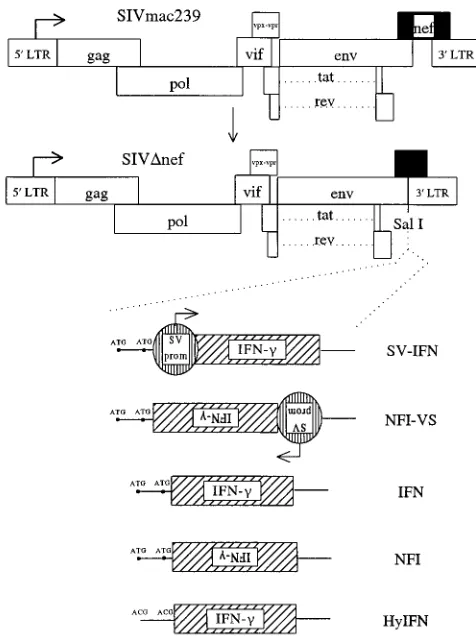
expression, and genetic stability (Fig. 1). Initially, we
incorporated the early SV40 promoter to achieve a high level
of IFN-
g
expression (SIV
SV-IFNand SIV
NFI-VS). Next, we
con-structed SIV
Dnefvectors expressing IFN-
g
under the control of
the 5
9
LTR (SIV
IFNand SIV
NFI). Finally, we mutated the two
in-frame nef start codons without altering the Env amino acid
sequence (SIV
HyIFN).
Plasmids containing proviral forms of SIV
Dnefvectors were
used to produce infectious viruses by transfection of different
types of cells. Several of the SIV vectors replicated rapidly and
reached peak titers by 6 days after transfection of CEM-X-174
cells. After 9 days, the amounts of SIV p27 in the medium were
similar for all cultures with SIV vectors (Fig. 2A). In addition,
extensive cytopathologic effects in CEM-X-174 cells,
charac-terized by multinucleate syncytia, were similar in cultures
transfected with all SIV vectors and SIV
mac239(data not
shown). In macaque PBMCs, however, SIV
Dnefreplicated
faster and to higher titers than any of the SIV
Dnefvectors
containing IFN-
g
sequences (Fig. 2B).
Expression of lymphokine by SIV
Dnefvectors.
IFN-
g
pro-duced by SIV vectors was measured by a standard antiviral
assay (Fig. 3). Expression of IFN-
g
by SIV
HyIFNwas detected
by 2 days after transfection, at a time when SIV p27 was barely
detectable. Levels of IFN-
g
for this recombinant virus were the
highest of all the vectors tested; after 11 days in culture, this
vector produced as much as 10
6U/ml. Cells transfected with
SIV
SV-IFNexpressed readily detectable amounts of HuIFN-
g
,
although the maximum level was about 2 orders of magnitude
lower than that of SIV
HyIFN. In contrast, the expression of
IFN-g
by SIV
IFNwas significantly lower. SIV
NFI-VShad very
low IFN-g
activity by 11 days (20 U/ml), and SIV
NFIdid not
express detectable quantities of the lymphokine.
Stability of SIV vectors.
All SIV
Dnefrecombinants were
an-FIG. 1. Strategy for the generation of SIVDnef and recombinant SIVDnef expressing IFN-g. A 186-base fragment of the SIVmac239nef coding sequence (between the end of env and the beginning of the 39LTR) was deleted, and a unique SalI cloning site was incorporated for the insertion of the human IFN-g gene. The SV40 early promoter and the HuIFN-gcoding sequences were cloned in both orientations to produce the SIVSV-IFNand SIVNFI-VSproviral genomes. Additionally, the HuIFN-gcoding sequences were inserted, without the SV40 promoter, to generate SIVIFNand SIVNFI. Finally, SIVHyIFNwas generated by mutating T residues at positions 9334 and 9352 in the ATG codons at the beginning of nef (codons 1 and 10) to C residues to preclude translation.
on November 9, 2019 by guest
[image:2.612.315.553.69.388.2]alyzed for stability after serial passage in cell culture by PCR
amplification of the 3
9
end of each viral vector, using primers
that encompassed the IFN-
g
sequences (Fig. 4A). The degree
of instability of the SIV vectors appeared to depend on the size
and the orientation of the insert. SIV
SV-IFNand SIV
NFI-VS,
which contain the 800-bp SV40 promoter/IFN-
g
insert, deleted
part of these heterologous sequences rapidly; for SIV
SV-IFN,
deletion fragments were detected as early as the first passage.
For SIV
IFNand SIV
HyIFN, instability was first observed after
the third passage; by the sixth passage, PCR amplification
analysis failed to detect intact IFN-
g
sequences in either of
these vectors. In contrast, SIV
NFI, which contains the same
500-bp IFN-
g
insert but in the opposite orientation, still
re-tained most of the insert after six passages.
Supernatants from each passage were assayed for IFN-g
production by the various SIV vectors (Fig. 4B). Expression of
IFN-
g
by SIV
SV-IFNwas undetectable by the third passage; this
observation is consistent with the rapid deletion of IFN-
g
cod-ing sequences from the viral genome. SIV
IFNand SIV
HyIFN,
both more stable than SIV
SV-IFN, continued to produce IFN-g
by the fifth passage. Only SIV
HyIFN, which expressed the
high-est amount of the lymphokine for every passage, still produced
detectable IFN-
g
by the sixth passage, despite the fact that the
PCR amplification analysis of this vector revealed extensive
loss of IFN-
g
sequences.
DISCUSSION
Our long-term goal is to develop a system for the generation
of safer and more efficacious live attenuated vaccines for
in-fectious diseases and in particular for AIDS. Inactivated SIV
or recombinant subunit vaccines have provided limited or no
protection against infection with SIV (1, 14, 23, 28). Macaques
vaccinated with live SIV
Dnefdid not develop disease (19) and
resisted challenge with virulent SIV
mac251(6). However,
SIV
Dnefpersists indefinitely in macaques, provides partial or
no protection until a year or more after immunization (6, 30),
and is pathogenic to neonatal macaques (3), limiting its use as
a vaccine (8).
One approach toward the development of effective vaccines
that we and others have taken is to exploit the
immunity-enhancing (2, 31) and attenuating activities of lymphokines
such as IFN-
g
and interleukin-2 (9, 12, 20, 26). Vaccinia virus
recombinants expressing interleukin-2 or IFN-
g
have clearly
been demonstrated to be attenuated for nude mice by a 10
6-fold. The mechanism of attenuation for the most part remains
an enigma. Here we describe the construction and
character-ization of replication-competent SIV
Dnefvectors expressing
human IFN-
g
as a step toward development of a safer and
more efficacious attenuated live vaccine for AIDS. Human
IFN-
g
is fully active in monkey cells, induces an antiviral state
in Vero cells, and enhances major histocompatibility complex
class II expression in macaque PBMCs (21, 22).
In our initial attempts, we incorporated a strong
heterolo-gous promoter (early SV40 promoter) to achieve a high level
of IFN-
g
expression. Of the two SIV vectors developed with
this promoter, only SIV
SV-IFNexpressed high levels of IFN-g;
the vector carrying the opposite orientation, SIV
NFI-VS,
man-ifested minimal activity after several days in culture. We
be-lieve that the polyadenylation signals located in the 3
9
LTR of
SIV are important for increasing the stability of IFN-
g
mRNAs
FIG. 2. Characterization of the in vitro replication of SIVDnefrecombinants. [image:3.612.325.539.72.231.2](A) Replication in CEM-X-174 cells. Proviral DNA of SIVDnef(1), SIVSV-IFN (Ç), SIVNFI-VS(å), SIVIFN(E), SIVNFI(F), and SIVHyIFN(}) was used to generate infectious virus in CEM-X-174 cells by electroporation as described in Materials and Methods. (B) Replication in rhesus macaque PBMCs. SIVDnef (1), SIVNFI(F), and SIVHyIFN(}) proviral DNA was electroporated in stim-ulated PBMCs as described in Materials and Methods. Transfected cells were kept in the exponential growth phase with daily monitoring to score cytopathic effects. Viral replication was measured by an ELISA specific for SIV p27 antigen (Coulter Corp.).
FIG. 3. Kinetics of IFN-gexpression by SIVDnefrecombinants. Accumula-tion of human IFN-gin the supernatant of CEM-X-174 cells transfected with SIVSV-IFN(Ç), SIVIFN(E), and SIVHyIFN(}) proviral DNA. The antiviral activity of human IFN-gwas measured by prevention of the cytopathic effect of EMCV in human A549 cells as described in Materials and Methods.
on November 9, 2019 by guest
http://jvi.asm.org/
initiated by the SV40 promoter, and SIV
NFI-VSlacks signals for
efficient polyadenylation.
Because SIV
SV-IFNand SIV
NFI-VSwere highly unstable, we
designed a vector to express IFN-g
by using the same SIV
signals that produce nef mRNA. We believe that rapid deletion
of the insert is due to the limited capacity of retroviruses to
accommodate extra genomic material as well as their tendency
to delete sequences not providing a selective advantage for
replication. We speculated that by reducing the size of the
insert (i.e., removing the SV40 early promoter) in the SIV
ticular arrangement of IFN-
g
and 3
9
LTR sequences and the
expression of IFN-
g
may contribute to gene instability.
We hypothesize that the establishment of persistent
infec-tion by SIV
Dnefcan be reduced or eliminated by the expression
of IFN-
g
, a cytokine with potent antiviral activity on
retrovi-ruses (8a). In addition, the expression of IFN-
g
is expected not
only to attenuate SIV
Dnefbut also to enhance the protective
immune responses of macaques to challenge with pathogenic
uncloned SIV
mac251. Moreover, the deletion of IFN-
g
after the
several passages has an advantage: IFN-
g
will be present only
during the early phase of the immune response to SIV,
elim-inating the possibility of any untoward effects with the
contin-uous expression of the lymphokine. These predictions have
proved correct in studies with macaques vaccinated with
SIV
HyIFNand challenged with SIV
mac251(13). Therefore, the
incorporation of IFN-g
or other lymphokines is a
methodolog-ical advance in vaccinology that promises to lead to the
devel-opment of safer and more efficacious vaccines for AIDS.
ACKNOWLEDGMENTS
We are grateful to P. Luciw for critical advice and for providing some of the plasmids used in the study. We thank S. Owens for the critical review of the manuscript and L. Parodi for excellent technical assistance.
L. Giavedoni is a scholar of the American Foundation for AIDS Research. This work was supported by National Institutes of Health grant UO1-A129207 to T.Y. Other support was provided by Center for AIDS Research grant AI27732 and training grant AI07398.
REFERENCES
1. Ahmad, S., B. Lohman, M. Marthas, L. Giavedoni, Z. El-Amad, N.
Haig-wood, C. Scandella, M. Gardner, P. Luciw, and T. Yilma.1994. Reduced virus load in rhesus macaques immunized with recombinant gp160 and challenged with simian immunodeficiency virus. AIDS Res. Hum. Retrovi-ruses 10:195–204.
2. Anderson, P. K., H. Fennie, and T. Yilma. 1988. Enhancement of a secondary antibody response by interferon-gamma treatment at primary immunization. J. Immunol. 40:3599–3604.
3. Baba, T. W., Y. S. Jeong, D. Pennick, R. Bronson, M. F. Greene, and R. M.
Ruprecht.1995. Pathogenicity of live, attenuated SIV after mucosal infection of neonatal macaques. Science 267:1820–1825.
4. Chen, B., K. Saksela, R. Andino, and D. Baltimore. 1994. Distinct modes of human immunodeficiency virus type 1 proviral latency revealed by superin-fection of nonproductively infected cell lines with recombinant luciferase-encoding viruses. J. Virol. 68:654–660.
5. Connor, R. I., B. K. Chen, S. Choe, and N. R. Landau. 1995. Vpr is required for efficient replication of human immunodeficiency type-1 in mononuclear phagocytes. Virology 206:935–944.
6. Daniel, M. D., F. Kirchhoff, S. C. Czajak, P. K. Sehgal, and R. C. Desrosiers. 1992. Protective effects of a live attenuated SIV vaccine with deletion in nef gene. Science 258:1938–1941.
[image:4.612.88.269.66.495.2]7. Delwart, E. L., G. L. Buchschacher, Jr., E. O. Freed, and A. T. Panganiban. 1992. Analysis of HIV-1 envelope mutants and pseudotyping of replication-defective HIV-1 vectors by genetic complementation. AIDS Res. Hum. Retroviruses 8:1669–1677.
FIG. 4. Genetic stability of SIVDnefvectors after six serial passages in cell culture. CEM-X-174 cells were infected with 10 ng of virus (p27) and maintained in culture for 7 days. Progeny virus was quantitated by SIV gag-specific ELISA (Coulter Corp.), and 10 ng was then used to infect fresh CEM-X-174 cells. (A) PCR analysis of the 39-end regions of SIVDnefvectors. Proviral DNA was isolated from infected cells after each passage and subjected to analysis by PCR with primers A (nt 8720) and E (nt 9710) as described in Materials and Methods. Molecular weight markers (MWM) are indicated in kilobases. The full-length PCR fragments are 1,600 bp for SIVSV-IFNand SIVNFI-VS, 1,300 bp for SIVIFN, SIVNFI, and SIVHyIFN, and 800 bp for SIVDnef. (B) IFN-gproduction for each virus passage in cell culture. The concentration of IFN-gwas determined as described for Fig. 3. The species specificity was confirmed by a human-specific IFN-gELISA kit (Intertest-g; Genzyme Corp., Cambridge, Mass.).
on November 9, 2019 by guest
8. Desrosiers, R. C. 1994. Safety issues facing development of a live-attenuated, multiply deleted HIV-1 vaccine. AIDS Res. Hum. Retroviruses 10:331–332. 8a.Fan, S. X., J. A. Turpin, J. R. Aronovitz, and M. S. Meltzer. 1994. Interferon-gamma protects primary monocytes against infection with human immuno-deficiency virus type I. J. Leukocyte Biol. 56:362–368.
9. Flexner, C., A. Hugin, and B. Moss. 1987. Prevention of vaccinia virus infection in immunodeficient mice by vector-directed IL-2 expression. Na-ture (London) 330:259–262.
10. Gabuzda, D. H., K. Lawrence, E. Langhoff, E. Terwilliger, T. Dorfman, W. A.
Haseltine, and J. Sodroski.1992. Role of vif in replication of human immu-nodeficiency virus type 1 in CD41T lymphocytes. J. Virol. 66:6489–6495. 11. Gardner, M. B., and P. A. Luciw. 1992. Simian retroviruses, p. 127–144. In
G. P. Wormser (ed.), AIDS and other manifestations of HIV infection. Raven Press, New York.
12. Giavedoni, L., L. Jones, M. Gardner, H. L. Gibson, C. T. L. Ng, P. Barr, and
T. Yilma.1992. Vaccinia virus recombinants expressing chimeric proteins of human immunodeficiency virus and gamma interferon are attenuated for nude mice. Proc. Natl. Acad. Sci. USA 89:3409–3413.
13. Giavedoni, L. D., L. Jones, S. Ahmad, and T. Yilma. Expression of IFN-gby SIVDnefincreases attenuation and vaccine efficacy for rhesus macaques. Submitted for publication.
14. Giavedoni, L. D., V. Planelles, N. L. Haigwood, S. Ahmad, J. D. Kluge, M. L.
Marthas, M. B. Gardner, P. A. Luciw, and T. D. Yilma. 1993. Immune response of rhesus macaques to recombinant simian immunodeficiency virus gp130 does not protect from challenge infection. J. Virol. 67:577–583. 15. Hartshorn, K. L., D. Neumeyer, M. W. Vogt, R. T. Schooley, and M. S.
Hirsch.1987. Activity of interferons alpha, beta and gamma against human immunodeficiency virus replication in vitro. AIDS Res. Hum. Retroviruses
3:125–133.
16. He, J., and N. R. Landau. 1995. Use of a novel human immunodeficiency virus type 1 reporter virus expressing human placental alkaline phosphatase to detect an alternative viral receptor. J. Virol. 69:4587–4592.
17. Heagy, W., J. Groopman, J. Schindler, and R. Finberg. 1990. Use of IFN-g
in patients with AIDS. J. Acquired Immune Defic. Syndr. 3:584–590. 18. Karupiah, G., R. V. Blanden, and I. A. Ramshaw. 1990. Interferon-gamma is
involved in the recovery of athymic nude mice from vaccinia virus/interleu-kin-2 infection. J. Exp. Med. 172:1495–1503.
19. Kestler, H. W., D. J. Ringler, K. Mori, D. L. Panicali, P. K. Sehgal, M. D.
Daniel, and R. C. Desrosiers.1991. Importance of the nef gene for
mainte-nance of high virus loads and for the development of AIDS. Cell 65:651–662. 20. Kohonen-Corish, M. R., N. J. King, C. E. Woodhams, and I. A. Ramshaw. 1990. Immunodeficient mice recover from infection with vaccinia virus ex-pressing interferon-gamma. Eur. J. Immunol. 20:157–161.
21. Maheshwari, R. K., V. Srikantan, D. Bhartiya, S. K. Puri, G. P. Dutta, and
B. N. Dhawn.1990. Effects of interferon in malaria infection. Immunol. Lett.
25:53–57.
22. Morill, J. C., C. W. Czarniecki, and C. J. Peters. 1991. Recombinant human interferon-gamma modulates Rift Valley fever virus infection in the rhesus monkey. J. Interferon Res. 11:297–304.
23. Murphey-Corb, M., L. N. Martin, B. Davison-Fairburn, R. C. Montelaro, M.
Miller, M. West, S. Ohkawa, G. B. Baskin, J. Y. Zhang, and S. D. Putney.
1989. A formalin-inactivated whole SIV vaccine confers protection in ma-caques. Science 246:1293–1297.
24. Nagy, K., M. Young, C. Baboonian, J. Merson, P. Whittle, and S. Oroszlan. 1994. Antiviral activity of human immunodeficiency virus type 1 protease inhibitors in a single cycle of infection: evidence for a role of protease in the early phase. J. Virol. 68:757–765.
25. Page, K. A., N. R. Landau, and D. R. Littman. 1990. Construction and use of a human immunodeficiency virus vector for analysis of virus infectivity. J. Virol. 64:5270–5276.
26. Ramshaw, I. A., M. E. Andrew, S. M. Phillips, D. B. Boyle, and B. E. Coupar. 1987. Recovery of immunodeficient mice from a vaccinia virus IL-2 recom-binant infection. Nature (London) 329:545–546.
27. Schijns, V. C. J., T. H. Borman, H. Schellekens, and M. C. Horizinek. 1988. Antiviral activity of recombinant rat interferon gamma in immunologically impaired and immunosuppressed rats. J. Gen. Virol. 69:1979–1985. 28. Schultz, A. M., and S. L. Hu. 1993. Primate models for HIV vaccines. AIDS
7:161–170.
29. Wang, C.-T., and E. Barklis. 1993. Assembly, processing, and infectivity of human immunodeficiency virus type 1 Gag mutants. J. Virol. 67:4264–4273. 30. Wyand, M. S., K. Manson, and R. C. Desrosiers. 1994. Vaccine protection against pathogenic SIVmac251 using live-attenuated vaccines SIV239D3 and SIV316Dnef. Conf. Adv. AIDS 7:109.
31. Yilma, T., P. K. Anderson, K. Brechling, and B. Moss. 1987. Expression of an adjuvant gene (interferon-a) in infectious vaccinia virus recombinants, p. 393. In R. M. Chanock, H. Giensburg, R. Lerner, and F. Brown (ed.), Modern approaches to new vaccines including prevention of AIDS. Vaccines 87. Cold Spring Harbor Laboratory, Cold Spring Harbor, N.Y.