EFFECT OF BONDING AGENT ON THE PROPERTIES OF PINEAPPLE LEAF FIBRE STARCH COMPOSITE
ASYRAF KASYIDI BIN MOHD SHOBI
EFFECT OF BONDING AGENT ON THE PROPERTIES OF PINEAPPLE LEAF FIBRE STARCH COMPOSITE
ASYRAF KASYIDI BIN MOHD SHOBI
This report is submitted
in fulfillment of the requirement for the degree of Bachelor of Mechanical Engineering (Structure and Materials)
Faculty of Mechanical Engineering
UNIVERSITI TEKNIKAL MALAYSIA MELAKA
ii
DECLARATION
I declare that this project report entitled “Effect of Bonding Agent on the Properties
of Pineapple Leaf Fibre Starch Composite” is the result of my own work except as
cited in the references
Signature : ...
Name : Asyraf Kasyidi bin Mohd Shobi
iii APPROVAL
I hereby declare that I have read this project report and in my opinion this report is
sufficient in terms of scope and quality for the award of the degree of Bachelor of
Mechanical Engineering (Structure & Materials).
Signature :. ...
Name of Supervisor : Dr Mohd Zulkefli bin Selamat
iv
DEDICATION
To my beloved family and fellow friends,
All your contributions, I will always keep in my heart.
v
ACKNOWLEDGEMENT
Alhamdulillah, thanks to Allah S.W.T, finally I have completed my thesis. First of all, I wish to express my honest appreciation to my supervisor, Dr Mohd Zulkefli bin Selamat for his valuable idea, advice, encouragement and for his guidance throughout this project. Without his continued support and interest, this thesis and research would not been the same as presented here.
Thanks also to the master student, Ms. Ayu Natasya binti Kasim for her on-going support and contribution to the success of this thesis. I am extremely thankful and indebted to her sincere and valuable guidance and her encouragement throughout my final year in completing this project.
vi
ABSTRACT
vii
ABSTRAK
viii
TABLE OF CONTENT
CHAPTER CONTENT PAGE
DECLARATION ii
APPROVAL iii
DEDICATION
ACKNOWLEDGEMENT ABSTRACT
ABSTRAK
TABLE OF CONTENT LIST OF FIGURES LIST OF TABLES
iv v vi vii viii xi xiii
LIST OF ABBREVIATIONS xiv
LIST OF SYMBOLS xv
CHAPTER 1 INTRODUCTION 1
1.1 BACKGROUND 1
1.2 PROBLEM STATEMENT 3
1.3 OBJECTIVES 4
1.4 SCOPE OF PROJECT 4
CHAPTER 2 LITERATURE REVIEW 5
2.1 INTRODUCTION
2.1.1 Biodegradable Composites
5 6 2.2 MATRIX (BINDER)
2.2.1 Starch 2.2.2 Epoxy
7 7 9
2.3 BONDING AGENT 10
2.4 REINFORCEMENT 2.4.1 Natural Fibre
ix
2.5 FIBRE LENGTH 13
2.6 FIBRE EXTRACTION METHOD 2.6.1 Mechanical Extraction 2.6.2 Chemical Treatment 2.7 TESTING
2.7.1 Tensile Test 2.7.2 Hardness Testing 2.7.3 Density Measurement 2.7.4 Microstructure Analysis
14 14 14 15 15 16 16 16
CHAPTER 3 METHODOLOGY 17
3.1 EXPERIMENTAL OVERVIEW 17
3.2 SELECTION OF RAW MATERIALS 19
3.2.1 Pineapple Leaf Fibre 19
3.2.2 Starch
3.2.3 Composition of SH/GLY 3.2.4 Composition of PLF/SH
20 21 21 3.3 FABRICATION METHOD
3.4 BINDER PREPARATION
3.4.1 Determine appropriate parameter of matrix SH/GLY
3.5 COMPRESSION MOULDING 3.6 CUTTING PROCESS
3.7 MECHANICAL TESTING 3.7.1 Tensile Test
3.7.2 Hardness Test 3.7.3 Density Test
3.7.4 Macrostructure Analysis
22 23 26 26 30 31 31 34 36 37
CHAPTER 4 DATA AND RESULTS 4.1 TENSILE TEST
4.1.1 PLF(SH/GLY) and SH/GLY Tensile Test Result
x 4.2 HARDNESS TEST
4.2.1 PLF(SH/GLY) and SH/GLY Hardness Test Result
4.3 DENSITY TEST
4.3.1 PLF(SH/GLY) and SH/GLY Density Test Result
4.4 MACROSTRUCTURE ANALYSIS 4.4.1 PLF(SH/GLY) Result
40 40 42 42 43 43
CHAPTER 5 DISCUSSION AND ANALYSIS 5.1 PARAMETER FINDINGS
5.2 EFFECT OF PLF COMPOSITION AND PLF LOADING ON TENSILE
5.3 EFFECT OF PLF COMPOSITION AND PLF LOADING ON HARDNESS
5.4 EFFECT OF PLF COMPOSITION AND PLF LOADING ON DENSITY
5.5 MACROSTRUCTURE ANALYSIS 5.6 COMPARISON EFFECT OF PLF COMPOSITION AND PLF LOADING ON DENSITY AND HARDNESS
45 45 47 49 50 52 54
CHAPTER 6 CONCLUSION AND RECOMMENDATIONS 6.1 CONCLUSION
6.2 RECOMMENDATIONS
xi
LIST OF FIGURES
FIGURE TITLE PAGE
2.1 Application of natural fibres in automotive industry. 5
2.2 Biodegradable composite. 6
2.3 Chemical structure of amylose. 8
2.4 Chemical structure of amylopectin. 9
2.5 Classification of natural fibres as reinforcement. 12
2.6 Pineapple Leaf Fibre. 13
2.7 Pineapple Leaf. 13
2.8 Sodium Hydroxide. 15
3.1 Flowchart of the methodology 18
3.2 Starch in powder form 20
3.3 Chemical treatment of PLF 23
3.4 Mechanical extraction method of PLF 23
3.5 Hot Press Machine 27
3.6 Size of mould 28
3.7 The mould is pressed by hotpress machine. 28
3.8 The cooling process 29
xii
3.10 Dimension of PLF/SH sample 31
3.11 Universal Testing Machine Instron 8872 32
3.12 Dimension of sample for tensile test 33
3.13 The sample is mounted on the machine 33
3.14 Stress-strain curve 34
3.15 The Analogue Shore Scale 35
3.16 Measurement of the sample 35
3.17 Electronic Densimeter 36
3.18 Dino Lite Digital Microscope 37
4.1 Tensile Stress (MPa) versus PLF Loading (%) 39
4.2 Hardness (Shore-D) versus PLF Loading (%) 41
4.3 Density (g/cm3) versus PLF Loading (%) 42
5.1 Tensile Stress (MPa) versus composition (%) 48
5.2 Macrostructure view of 70% fibre loading 49
5.3 Hardness (Shore-D) versus composition (%) 49
5.4 Density (g/cm3) versus composition 51
xiii
LIST OF TABLES
TABLE TITLE PAGE
3.1
3.2
Preliminary composition of SH/GLY
The preliminary composition of PLF/SH with Bonding Agent
21
22
3.3 Composition of SH/GLY 24
3.4 Samples of SH/GLY 24
3.5 Comparison of parameters 26
3.6 Composition of PLF/SH 27
3.7 Samples of PLF/SH 29
4.1 Tensile test data 40
4.2 Hardness test data 41
4.3 Data of density test 42
4.4 Macrostructure analysis view 43
5.1 Parameters findings of SH/GLY 46
xiv
LIST OF ABBREVIATIONS
PLF Pineapple Leaf Fibre
SH Starch
PLF/SH Pineapple Leaf Fibre/Starch SH/GLY Starch/Glycerol
PLA Polylactic Acid NaOH Sodium Hydroxide HCl Hydrochloric Acid
ASTM American Standard Testing Method GLY Glycerol
xv
LIST OF SYMBOLS
oC = Degree Celsius
% = Percent MPa = MegaPascal GPa = GigaPascal kN = kiloNewton mm = millimetre
g = gram
1 CHAPTER 1
INTRODUCTION
1.1 BACKGROUND OF STUDY
2
Reinforcement in a simplest word can be described as a material that will strengthen the structure. The reinforcement is made up of material or fibre. Nowadays, the natural fibres are increasingly used as reinforcement in polymer composite (Campbell, 2010). The reinforcement also can come from natural or made by human. There are other several types of reinforcement in industries such as synthetics fibre and natural fibre. The example of fibres that normally used in industries is glass fibre and carbon fibre. Glass fibre is well known as the combination made between steel sheet and zinc diecasting. For example in automotive industry, carbon fibre dominates as the main reinforcement that has low-cost composites. Furthermore, they has already reached its impressive performance level in automotive manufacturing process (Haruna et al., 2014).
There are a few examples of natural fibres such as sisal fibre, bamboo fibre, pineapple leaf fibre, hemp fibre and jute fibre. Nowadays, natural fibres such as sisal and jute fibre composite materials are being alternative natural fibres that can replace the glass and carbon fibers since the cost of glass fibre is quite expensive in market. Furthermore, the hardness and flexibility is good and compare to the glass fibre. The performance of natural fibre is improved remarkably due to the fact that the field of application is improved day by day especially in automotive industries.
3
certain parts of the plant such as leaf. Therefore, the strength of natural fibre will increase if it undergoes chemical treatment.
1.2 PROBLEM STATEMENT
Natural fibre composites are widely used in a few industries includes an automotive industry especially as an interior part. Currently in industries, normally for the type of natural fibre material used is synthetic fibre. Thus, natural fibres like sisal, banana, jute, oil palm, kenaf and coir has been used as reinforcement in thermoplastic composite industries for applications in consumer goods, furniture, low cost housing and civil structures (Munirah, Abdul Razak, & Hassan, 2007). Since the cost is much more affordable and it is a natural availability compared to the cost of glass fibres and carbon fibres, the industries try to harness the advantages of natural fibre composite. Nowadays, the automotive field tries to diversify the natural fibre in manufacture of a car bumper from kenaf while a car seat from coconut fibre. Furthermore, most of natural fibres are renewable, cheap and recyclable. Therefore in this project, the pineapple leaf fibre (PLF) is used as a reinforce material and starch (SH) as a matrix materials to produce PLF/SH composite. Thus the composite is biodegradable composite, which is consists of those two materials in order to keep strengthening the mechanical properties. Many advantages are associated with the use of biodegradable composite, including low cost, abundance, low density, high specific properties and lack of residues upon incineration (Sahari & Sapuan, 2011). Besides, it is also a solution to maintain the sustainabale development of economical and ecological technology.
4
PLF/(SH/GLY) composition. In order to determine the effectiveness of bonding agent several mechanical tests will be carry out such as tensile test, hardness and flexural test. Therefore, the mechanical properties of PLF/SH composite will be performed in order to investigate their actual mechanical properties. On the other hand, composite also have good potential to be used as an interior part of automotive but its potential has not been explored yet.
1.3 OBJECTIVES
There are two goals which are listed to be achieved on this project:
1. To determine the effect of GLY as binder loading on the physical and mechanical properties of SH/GLY composition.
2. To study the effect of PLF loading on the properties of PLF/(SH/GLY) composite.
1.4 SCOPE OF PROJECT
5 CHAPTER 2
LITERATURE REVIEW
2.1 INTRODUCTION
[image:21.612.151.507.507.663.2]Natural fibres composites are widely used in industry in order to produce a new product since it is an environmental friendly. Nowadays, the industrial automotive is trying to use the natural fibres composites especially in the making of interior part as shown in Figure 2.1 below. This is highlighting on their advantages which are low cost and weight, also can prevent from damage towards processing equipment and great in mechanical properties (Sanjay et al., 2016). Natural fibres also can be defined as substances that come from agricultural residues. Thus, they can be used as the reinforcement with biodegradable polymer composites as a development in order to obtain useful products in industries.
6
The combination of the natural fibres reinforced with biodegradable polymer composite also can provide an alternative way in order to solve the problems that associated with agriculture crop residues. All of thems are being produced everyday and they are being obtained in a large amount of quantity. Therefore, the reinforcement of natural fibres and biodegradable composite can prevent from negative effect on the environment due to the air pollution of the residues.
2.1.1 Biodegradable Composites
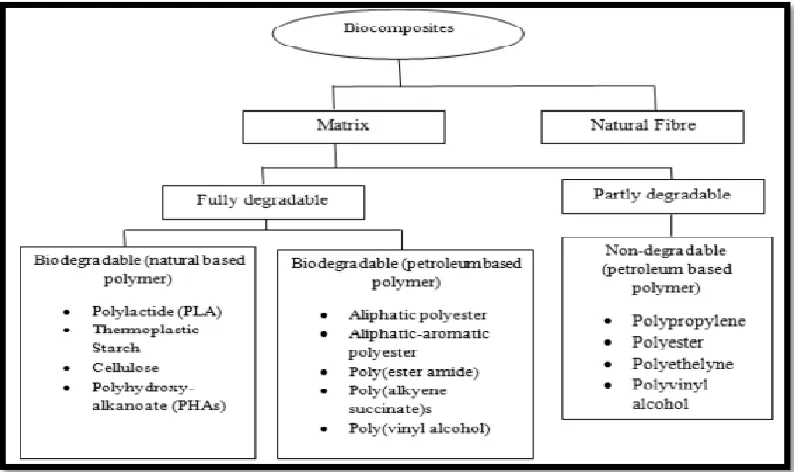
[image:22.612.113.510.444.680.2]Biodegradable composite can be defined as composite material or the combination between matrix and reinforcement of natural fibres. These kinds of materials have their own function which keep strengthening the properties of the matrix that was used, but always providing biodegradable compatibility. It is also known as composite material made from natural fibre and polymer matrix derived from petroleum such as polylactic acid (PLA), cellulose and thermoplastic starch (Sahari & Sapuan, 2011). Thus, the matrix part of the biodegradable composite can be classified into two parts which are fully degradable and partly degradable as shown in Figure 2.2 below:
7
For more specific, the combination of the composite material is being used in one of the world’s major palm oil producer in Malaysia, where the natural fibre of oil palm has been successfully compounded with thermoplastics such as PLA in order to produce biodegradable composites. The forming biocomposite which is lignocellulose fibre is a renewable material and also can increased the surface roughness of the fibre by the removal of hemicellulose and surface impurities (Schaschke & Audic, 2014).
2.2 MATRIX (BINDER)
There are many types of materials used as matrix in composites. Therefore, in order to combine the matrix with the fibre, it must be in the suitable type of the matrix. This is because the combination of the fibre with the appropriate matrix will form a very good strength property. A good matrix has many advantages to the reinforcement such as can prevent the natural fibre of abrasion and defects in surface, also acting as a binder to the fibre used in composition (Verma et al., 2012).
The types of matrix that normally used in composites are metal matrix and polymer matrix. However, these two matrices have their own characteristics that could affect the performance of the composition formed. For more specific, metal matrix has good strength at higher temperatures, but high in density that can cause lower specific mechanical properties if compared with polymer matrix (Verma et al., 2012). However, the matrix used in this project is thermoplastic starch which is included in polymer matrix. The matrix will support load among the reinforcements since the reinforcements are discontinuity.
2.2.1 Starch
8
friendly and biodegradable renewable sources. However, the research shows that the application of starch can be further expanded, and can be developed more in order for wider usage. The starch brings many advantages especially in composites. This is because starch is naturally form in much quantities, can be renew and cheap in market (Wattanakornsiri & Tongnunui, 2014).
Before forming into the thermoplastic polymers, there are various sources of starch that has been used such as corn starch, tapioca starch, rice starch and wheat starch, which need to be bonded with addition of plasticizers in high temperature and shearing force. The purpose of this converting process is to obtain the lower friction between the molecules of the starch. The example of plasticizers that usually used is water and glycerol (Wattanakornsiri & Tongnunui, 2014).
[image:24.612.170.456.487.642.2]In the chemical properties of starch, the starch contains two main elements which are amylose and amylopectin as shown in the presence of chemical structure in Figure 2.3 and Figure 2.4. These kind of elements can be hydrolyzed the compound into glucose. Initially, the starch is in crystalline form. The starch is normally need to be gelatinized which the intermolecular bonds molecules of starch is break by the water and heat, that make the hydrogen bonding sites is reduced and irreversibly dissolves the starch granules in water (Wattanakornsiri & Tongnunui, 2014).