Immunodeficiency Virus Replication in Mauritian Cynomolgus
Macaques
Melisa L. Budde,bJustin M. Greene,aEmily N. Chin,dAdam J. Ericsen,bMatthew Scarlotta,aBrian T. Cain,aNgoc H. Pham,a Ericka A. Becker,bMax Harris,aJason T. Weinfurter,b,cShelby L. O’Connor,a,bMichael Piatak, Jr.,eJeffrey D. Lifson,eEmma Gostick,f David A. Price,fThomas C. Friedrich,b,cand David H. O’Connora,b
Department of Pathology and Laboratory Medicine, University of Wisconsin, Madison, Wisconsin, USAa; Wisconsin National Primate Research Center, Madison, Wisconsin, USAb; Department of Pathobiological Sciences, University of Wisconsin, Madison, Wisconsin, USAc; Department of Cellular and Molecular Biology, University of Wisconsin, Madison, Wisconsin, USAd; AIDS and Cancer Virus Program, Science Applications International Corporation-Frederick, Inc., Frederick National Laboratory for Cancer Research, Frederick, Maryland, USAe; and Cardiff University School of Medicine, University Hospital, Heath Park, Cardiff, United Kingdomf
Specific major histocompatibility complex (MHC) class I alleles are associated with an increased frequency of spontaneous con-trol of human and simian immunodeficiency viruses (HIV and SIV). The mechanism of concon-trol is thought to involve MHC class
I-restricted CD8ⴙT cells, but it is not clear whether particular CD8ⴙT cell responses or a broad repertoire of epitope-specific
CD8ⴙT cell populations (termed T cell breadth) are principally responsible for mediating immunologic control. To test the
hy-pothesis that heterozygous macaques control SIV replication as a function of superior T cell breadth, we infected MHC-homozy-gous and MHC-heterozyMHC-homozy-gous cynomolgus macaques with the pathogenic virus SIVmac239. As measured by a gamma interferon
enzyme-linked immunosorbent spot assay (IFN-␥ELISPOT) using blood, T cell breadth did not differ significantly between
ho-mozygotes and heterozygotes. Surprisingly, macaques that controlled SIV replication, regardless of their MHC zygosity, shared durable T cell responses against similar regions of Nef. While the limited genetic variability in these animals prevents us from making generalizations about the importance of Nef-specific T cell responses in controlling HIV, these results suggest that the T cell-mediated control of virus replication that we observed is more likely the consequence of targeting specificity rather than T cell breadth.
S
tudies of human immunodeficiency virus (HIV) “elite con-trollers” implicate major histocompatibility complex (MHC) class I genes, and by extension the CD8⫹T cell responses they restrict, in immunologic containment of viral replication (25). Identifying the specific attributes of CD8⫹T cell responses that are fundamental to HIV control could clarify whether immunologic containment is possible for the majority of infected individuals who do not become elite controllers and could facilitate the design of prophylactic vaccines that elicit cellular immune responses ca-pable of mediating viral control.A T cell response directed against a large number of distinct viral epitopes, i.e., high “T cell breadth,” has frequently been pro-posed to be a favorable immunologic attribute (21, 30). This breadth hypothesis is attractive because it is conceptually simple: if immunologic control fails because too few epitope-specific CD8⫹ T cell responses are elicited, interventions designed to broaden the CD8⫹T cell response should be beneficial. The data in support of the breadth hypothesis are mixed. Perhaps the most striking supporting evidence is the observation that individuals who are MHC homozygous experience faster disease progression than fully heterozygous individuals (8, 29). Because MHC-heterozygous individuals have twice as many different MHC class I molecules available to bind and present HIV-derived peptides, the theoretical breadth of their CD8⫹T cell response at any mo-ment is double that of their MHC-homozygous counterparts. Sev-eral studies have suggested that broadly directed CD8⫹T cell re-sponses are associated with low virus loads and/or high CD4⫹T cell counts (9,11,12). However, other studies of HIV-infected humans have yielded conflicting results (1,16,19). Furthermore,
Indian rhesus macaques that expressMamu-B*17, an MHC class I allele associated with simian immunodeficiency virus (SIV) elite control, do not segregate into controllers and progressors based on the breadth of their CD8⫹T cell responses (13,20). All of these studies are confounded by complex host MHC genetics, which contributes to the persisting controversy.
Unlike humans and other macaques, Mauritian cynomolgus macaques (MCM) are geographically isolated and descend from a small founder population that arrived on Mauritius within the last 500 years (17). Consequently, MCM have extremely limited MHC genetic diversity, with only seven major haplotypes (6,22), termed M1 through M7. The MHC alleles on each of these seven haplo-types are known.
In an earlier study, we showed that MHC-heterozygous MCM maintained lower chronic-phase viremia than MHC-homozy-gous animals, although this was in a cohort enriched for the M3 haplotype (24). Here, we expand this study to include 27 SIV-mac239-infected MCM representing all seven MHC haplotypes. The previous observation that M3 homozygous macaques have higher viral loads than do M1/M3 heterozygous macaques was
Received22 March 2012Accepted30 April 2012 Published ahead of print9 May 2012
Address correspondence to David H. O’Connor, [email protected].
M.L.B and J.M.G. contributed equally to this article.
Copyright © 2012, American Society for Microbiology. All Rights Reserved.
doi:10.1128/JVI.00716-12
on November 7, 2019 by guest
http://jvi.asm.org/
confirmed. Overall, however, we found no significant correlation between MHC zygosity and viral load. Control of SIV replication, defined as a plasma viral load below 1,000 RNA copies/ml, was observed only in MCM possessing the M1 or M7 haplotypes, re-gardless of MHC zygosity. Moreover, animals that successfully controlled viral replication consistently mounted durable, immu-nodominant responses against a region of the Nef protein. These responses were subdominant or absent in animals that failed to control SIV replication.
MATERIALS AND METHODS
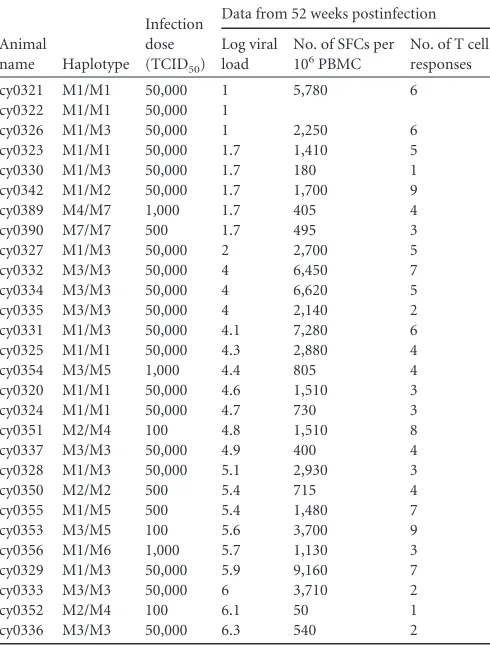
Animals and infections.This study was based on an initial prospective evaluation of 18 MCM (6 M1/M1, 6 M1/M3, and 6 M3/M3). Following our initial study, we included 10 additional MCM of various haplotypes (Table 1). Animals were infected intrarectally with molecularly cloned SIVmac239 nef-open virus (50% tissue culture infective dose [TCID50], from 100 to 50,000), accession numberM33262(27). All animals were cared for by the Wisconsin National Primate Research Center (University of Wisconsin, Madison, WI) according to experimental protocols ap-proved by the University of Wisconsin Graduate School Animal Care and Use Committee. A panel of microsatellite markers spanning the MHC region was used to determine individual haplotypes as described previ-ously (31). Genotypes were confirmed using Roche/454 pyrosequenc-ing (6).
Plasma viral load analysis.Virion-associated SIV RNA in plasma was measured using a real-time (RT) quantitative reverse transcription-PCR assay, essentially as described previously (10).
Peptides.The NIH AIDS Research and Reference Reagent Program (Germantown, MD) provided 15-mer peptides with an 11-residue
over-well in 100l of R-10 to a precoated monkey IFN-␥ELISPOT Plus plate (Mabtech Inc., Mariemont, OH) with the peptides of interest. Tradi-tional, full proteome peptides contained pools of 10 peptides at a concen-tration of 10M or 1M each. To identify single peptides that elicited IFN-␥release, we performed a second ELISPOT in tandem using matrix pools containing a randomized assortment of 10 peptides at a concentra-tion of 10M each. Concanavalin A (10M) was used as a positive control in duplicate wells. A minimum of six wells (three samples in du-plicate) did not receive any stimulant and served as negative controls. All samples were repeated in duplicate or triplicate. Wells were imaged using an AID ELISPOT reader, and spots were counted using an automated program with fixed parameters. For the assay to be considered successful, a minimum of 100 spots was required in each positive-control well. Ex-perimental responses exceeding the arithmetic mean of the negative-con-trol wells plus 2 standard deviations were considered positive. The limit of detection was set at 70 spot-forming cells (SFCs) per 106PBMC. To
ac-count for the difference in SFCs between animals, responses were normal-ized using the following equation: 100⫻(SFCs from a positive peptide)/ (SFCs from all positive peptides).
Viral sequencing.Viral RNA was isolated from cell-free plasma using the QIAmp MinElute Virus Spin kit (Qiagen, Valencia, CA). Four over-lapping PCR amplicons spanning the entire SIVmac239 genome were then amplified using the SuperScript III One-Step RT-PCR system with PlatinumTaqHigh Fidelity (Invitrogen, Carlsbad, CA) as described pre-viously (2). Products were gel purified and fragmented with the Nextera DNA Sample Prep kit (Epicentre, Madison, WI), and then multiplex iden-tifier (MID) tags and adapter sequences for Roche/454 pyrosequencing were added. Purified fragments were pyrosequenced using a Roche/454 GS Junior instrument. Variants present in⬎1% of reads were considered authentic, a threshold that we had previously determined empirically (2). Amino acid alignments were derived from the sequence read data using a custom data analysis pipeline in Galaxy, an open-source system for pro-cessing next-generation sequence data previously described (3,4,14,23). ICS.Peptide-specific cytokine release by CD8⫹T cell lines was de-tected by flow cytometry as described previously (5). Briefly, peptide-pulsed B-lymphoblastoid cell line (BLCL) or MHC class I transferents were incubated with CD8⫹T cell lines specific for Nef 196-203 HW8 in the presence of brefeldin A (10g/ml; Sigma-Aldrich, St. Louis, MO). After 5 h, the cells were surface stained with the directly conjugated mono-clonal antibodies (MAbs)␣CD3-Alexa Fluor 700 (clone SP34-2; BD Bio-sciences, San Jose, CA) and␣CD8-Pacific Blue (clone RPA-T8; BD Bio-sciences) and then washed, fixed, and permeabilized prior to intracellular staining with␣-IFN-␥-fluorescein isothiocyanate (␣IFN-␥-FITC) (clone 4S.B3; BD Biosciences) and tumor necrosis alpha-alpha-phycoerythrin (␣TNF-␣-PE) (clone MAb11; BD Biosciences). Stained cells were fixed in 2% paraformaldehyde and acquired using an LSRII flow cytometer (BD Biosciences). Data were analyzed using FlowJo software version 8.8.2 (TreeStar, Ashland, OR). All intracellular cytokine staining (ICS) results were confirmed in at least two individual experiments.
Tetramer staining.Soluble tetrameric peptide-MHC class I com-plexes were generated as described previously (26). Cryopreserved PBMC were resuspended in 150l of R-10 with 5g/ml of phycoerythrin
(PE)-cy0327 M1/M3 50,000 2 2,700 5
cy0332 M3/M3 50,000 4 6,450 7
cy0334 M3/M3 50,000 4 6,620 5
cy0335 M3/M3 50,000 4 2,140 2
cy0331 M1/M3 50,000 4.1 7,280 6 cy0325 M1/M1 50,000 4.3 2,880 4
cy0354 M3/M5 1,000 4.4 805 4
cy0320 M1/M1 50,000 4.6 1,510 3
cy0324 M1/M1 50,000 4.7 730 3
cy0351 M2/M4 100 4.8 1,510 8
cy0337 M3/M3 50,000 4.9 400 4
cy0328 M1/M3 50,000 5.1 2,930 3
cy0350 M2/M2 500 5.4 715 4
cy0355 M1/M5 500 5.4 1,480 7
cy0353 M3/M5 100 5.6 3,700 9
cy0356 M1/M6 1,000 5.7 1,130 3 cy0329 M1/M3 50,000 5.9 9,160 7
cy0333 M3/M3 50,000 6 3,710 2
cy0352 M2/M4 100 6.1 50 1
cy0336 M3/M3 50,000 6.3 540 2
on November 7, 2019 by guest
http://jvi.asm.org/
[image:2.585.41.286.78.402.2]conjugated tetramer for 20 min at 37°C and washed once with fluores-cence-activated cell sorter (FACS) buffer. Subsequently, cells were surface stained with␣CD3-Alexa Fluor 700,␣CD14 ECD (clone RMO52; Beck-man Coulter),␣CD19 ECD (clone J4.119, Beckman Coulter), and␣ CD8-Pacific Blue and then washed and fixed with 2% paraformaldehyde. Stained cells were acquired using an LSRII flow cytometer (BD Biosci-ences) and data analyzed using FlowJo software version 8.8.2.
Statistical analysis.Replicates were graphed using GraphPad Prism (GraphPad Software, La Jolla, CA). A two-way or one-way analysis of variance (ANOVA) with Tukey’s multiple-comparison posttest was used to compare the columns and determine significance. Correlations were also assessed in GraphPad Prism assuming Gaussian populations. Bars on graphs represent the standard errors of the means.
RESULTS
MCM with low viral loads do not have increased T cell breadth.
We analyzed a cohort of 27 MCM infected with SIVmac239; each of the major MHC haplotypes, M1 through M7, was expressed in at least one of these animals (Table 1). The cohort included six M1/M1 homozygous macaques, six M1/M3 heterozygous ma-caques, and six M3/M3 homozygous macaques. Nine of the 27 MCM, including three M1/M1 homozygotes, four M1 heterozy-gotes, one M7/M7 homozygote, and one M7 heterozygote, con-sistently maintained low plasma viral loads (⬍103copies of viral
RNA per ml plasma) in the chronic phase of infection through 52 weeks postchallenge (Fig. 1A). In agreement with our previous study (24), M3/M3 homozygous MCM fared poorly, with none of these animals exhibiting chronic-phase viral load control (Fig. 1B). Low viral loads in four homozygous MCM (three M1/M1 and one M7/M7) reduced the mean viral load of the entire homozy-gous group, and as a result, there was no significant difference in mean viral loads between heterozygous and homozygous MCM at 52 weeks postinfection.
SIV control in four MHC-homozygous macaques was some-what unexpected but fortuitous, as it allowed us to examine the attributes of T cell responses in the context of both MHC-homozygous and MHC-heterozygous viral control. We first ex-amined T cell breadth at 24 and 52 weeks postinfection to test the hypothesis that controllers mount T cell responses targeting a greater number of epitopes than animals that fail to control SIV-mac239. We stimulated freshly isolated PBMC with peptide pools spanning the entire viral proteome and measured IFN-␥ produc-tion using ELISPOTs. Cells from one controller, cy0322, could not
be analyzed by IFN-␥ELISPOT due to a high level of nonspecific cytokine secretion.
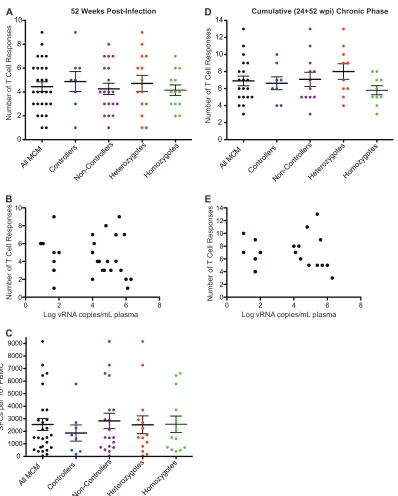
To examine T cell breadth, we tabulated the number of T cell responses targeting distinct peptide pools at 52 weeks postinfec-tion. Each animal made between one and nine distinct T cell re-sponses. Neither MHC zygosity nor SIV controller status corre-lated with the breadth of the measured T cell response (Fig. 2Aand
B). We also assessed the strength of the total SIV-specific T cell response by summing the magnitudes of individual T cell re-sponses observed at 52 weeks postinfection. There was no corre-lation between the total response magnitude, as measured by SFCs per million PBMC, and viral load at 52 weeks postinfection (Fig. 2C).
Some responses were detected at 24 weeks postinfection but not at 52 weeks, and vice versa. Therefore, to approximate the total T cell breadth in each animal over time, we determined the total number of distinct T cell responses detected at either or both of these time points (Fig. 2D). For technical reasons, data are not available from six animals (two M1/M1, two M1/M3, and two M3/M3). When considering both time points in aggregate, the measured breadth increased slightly, up to 13 T cell responses per animal. Heterozygous MCM had slightly more chronic phase T cell responses than homozygous MCM in this analysis, but the difference was not significant. Again, the number of cumulative chronic-phase T cell responses did not appear to correlate with SIV control (Fig. 2E).
MCM with low viral loads share similar immunodominant
CD8ⴙT cell responses.CD8⫹T cell responses against particular
epitopes in individual HIV and SIV proteins have been associated with viral control. Indeed, the benefits of CD8⫹T cell responses specific for Gag, Pol, Vif, Vpr, Vpu, Tat, Rev, Env, and/or Nef have been championed by various studies and in various contexts (15,
16,18,28). We therefore analyzed the ELISPOT data described above to examine CD8⫹T cell responses by protein target.
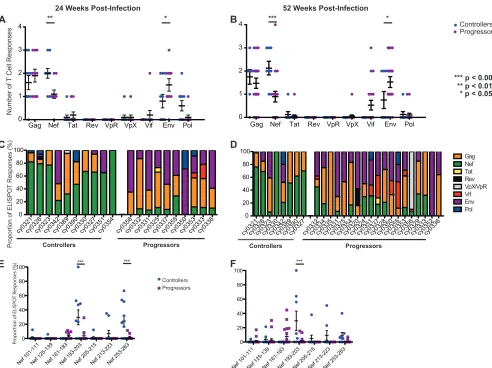
First, we compared T cell breadth at the protein level in con-trollers and progressors, determining the number of distinct pep-tides derived from each viral protein targeted at both 24 and 52 weeks postinfection (Fig. 3AandB, respectively). Notably, a sim-ilar level of T cell breadth was observed over the course of time for each protein. The relative number of Nef-specific T cell responses was significantly greater in MCM with low viral loads (P⬍0.01
FIG 1Effects of heterozygosity on chronic-phase viral loads. (A) Mean viral loads (number of viral RNA copies per ml plasma) for all 27 MCM at 52 weeks postinfection. (B) Mean viral loads for a subgroup of 18 MHC-matched (six M1/M1, six M1/M3, and six M3/M3) MCM at 2, 12, 21, and 52 weeks postinfection with SIVmac239. The horizontal dashed line represents the threshold of viral control as defined for this cohort (1,000 copies/ml). There were no statistically significant differences between the different haplotypes.
on November 7, 2019 by guest
http://jvi.asm.org/
[image:3.585.124.463.66.203.2]andP⬍0.001 at 24 and 52 weeks postinfection, respectively). In contrast, the relative number of Env-specific T cell responses was significantly (P⬍0.05 at both time points) greater in MCM with high viral loads.
Next, to identify which proteins immunodominant T cell pop-ulations targeted, we examined the percent contribution of each T cell response to the total SIV-specific response. Within each ani-mal, the dominant T cell responses were mainly directed against
one of three proteins: Gag, Env, or Nef. Interestingly, a majority of MCM with low viral loads (8/10 and 6/8 at 24 and 52 weeks postin-fection, respectively) mounted dominant T cell responses against epitopes in the Nef protein. In contrast, Nef was not the dominant target in any progressors at 24 weeks postinfection, and only one progressor made a dominant Nef-specific T cell response at 52 weeks postinfection (Fig. 3CandD).
To extend these findings, we determined the regions within
FIG 2The number and strength of T cell responses detected by IFN-␥ELISPOT do not correspond to viral load or MHC haplotype. (A) Number of positive T cell responses in 26 MCM at 52 weeks postinfection separated into controller, noncontroller, homozygote, and heterozygote populations. (B) Comparison of the number of distinct T cell responses and viral loads at 52 weeks postinfection. (C) Sum of all SIV peptide-specific SFCs per million PBMC separated into controller, noncontroller, homozygote, and heterozygote populations at 52 weeks postinfection. (D) Cumulative (24⫹52 weeks postinfection) chronic-phase T cell responses in 20 MCM separated into controller, noncontroller, homozygote, and heterozygote populations. (E) Comparison of the number of cumulative T cell responses and viral loads at 52 weeks postinfection.
on November 7, 2019 by guest
http://jvi.asm.org/
[image:4.585.97.495.60.556.2]Nef that were recognized by these T cell responses. In total, seven Nef-specific T cell epitopes were identified. At 24 weeks postinfec-tion, T cell responses against two epitopes, Nef 193-203 and Nef 253-263, were detected more frequently and accounted for a greater proportion of the total virus-specific response in control-lers than in progressors (Fig. 3E). By 52 weeks postinfection, only the T cell response against Nef 193-203 accounted for a signifi-cantly higher proportion of the total SIV-specific response in controllers versus progressors (Fig. 3F). The two M7 control-lers each mounted a T cell response against Nef 213-223, but due to the small number of animals with the M7 haplotype, the significance of this observation could not be determined. In-terestingly, all three putatively beneficial responses clustered in a narrow region near the carboxy terminus of Nef, and two of them, Nef 193-203 and Nef 213-223, were restricted by MHC class I A alleles (Fig. 4).
High viral load is associated with rapid accumulation of
sub-stitutions in Nef 196-203.The observation that a subset of the
M1/M1 homozygous and M1/M3 heterozygous MCM controlled
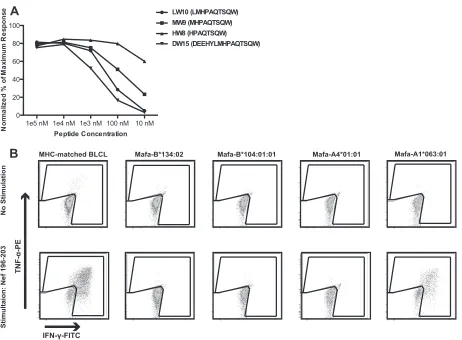
SIVmac239 and mounted strong responses against Nef 196-203 is paradoxical. Why did the other animals with identical MHC ge-netics not recognize this epitope? To explore this issue, we first confirmed the MHC restriction of Nef 196-203, the minimal optimal epitope. We constructed transferents expressing Mafa-A1*063:01, -A4*01:01, -B*104:01, or -B*134:02 and used them in an intracellular cytokine staining assay (Fig. 4). A CD8⫹T cell line specific for Nef 196-203 HW8 released cytokines when stimulated by peptide-pulsed, MHC-matched BLCLs as well as transferents expressing only Mafa-A1*063.
One potential explanation for the apparent absence of re-sponses against Nef 196-203 HW8 in some chronically infected animals expressing the M1, M2, or M3 haplotypes is that SIV effectively escapes from CD8⫹T cells recognizing this epitope early during infection in some, but not all, animals. Accordingly, we examined whether viruses isolated from the subgroup of six M1/M1 homozygous, six M1/M3 heterozygous, and six M3/M3 homozygous MCM accumulated amino acid substitutions in this region at 12 weeks postinfection. One M1/M1 homozygous MCM
FIG 3The number and magnitude of T cell responses to Nef peptides during chronic infection differ between controllers and progressors. (A and B) Number of T cell responses per SIV protein in controllers and progressors at 24 (A) and 52 (B) weeks postinfection. Controllers (animals with viral loads of⬍103RNA copies/ml plasma) target significantly more Nef peptides than do progressors (P⬍0.01), while progressors target significantly more Env peptides than do controllers (P⬍0.05). (C and D) Proportion of the total T cell response directed against each SIV protein in each animal at 24 (C) and 52 (D) weeks postinfection. (E and F) Individual T cell responses within the Nef protein at 24 (E) and 52 (F) weeks postinfection. MCM with low viral loads mounted significantly larger responses against Nef 193-203 at both 24 and 52 weeks postinfection (P⬍0.001 in each case).
on November 7, 2019 by guest
http://jvi.asm.org/
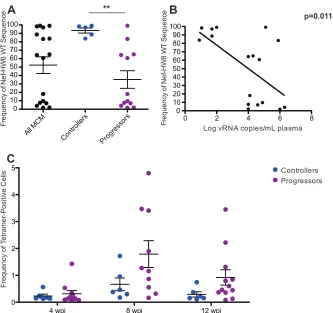
[image:5.585.45.537.63.431.2]that maintained low viral loads could not be analyzed. Interest-ingly, viruses from all five controllers almost exclusively displayed wild-type sequence across Nef 196-203 HW8, while only 2/12 pro-gressors harbored viral populations with dominant wild-type se-quence at this epitope (Fig. 5A). The frequency of wild-type Nef 196-203 HW8 correlated significantly with chronic-phase viral loads at 52 weeks postinfection (Fig. 5B).
To confirm that differential CD8⫹T cell pressure was driving viral escape at Nef 196-203 HW8 in progressors prior to 12 weeks postinfection, we examined response kinetics using the corre-sponding peptide-MHC class I tetramer. Although not signifi-cantly different, progressors tended to have higher frequencies of Nef 196-203 HW8 tetramer-positive cells at 8 weeks postinfection than controllers (Fig. 5C). Collectively, these observations suggest that early events in viral infection, specifically the timing of CD8⫹ T cell responses and viral escape, may have a significant impact on whether or not individuals are able to maintain low viral loads during chronic infection.
DISCUSSION
Full heterozygosity in MHC class I alleles is associated with de-layed progression to AIDS (8). However, the complex MHC ge-netics of humans and Indian rhesus macaques have frustrated
efforts to discern the underlying mechanism of this association. Two possibilities have received considerable attention. One is that fully heterozygous individuals simply have a greater likelihood of possessing one or more protective MHC class I alleles (16), imbu-ing these individuals with the ability to mount unusually effica-cious CD8⫹T cell responses. A second explanation is that at any moment, cells from MHC-heterozygous individuals present a broader array of virus-derived epitopes than do homozygous ones, allowing a larger number of distinct CD8⫹T cell specificities to target infected cells. A broader T cell repertoire may simply be more robust, i.e., better able to maintain control over a diversity of viral variants, than a narrow one. These mechanisms are not mu-tually exclusive. Our data suggest that in the model studied here, SIV-infected MCM, MHC heterozygosity maximizes the likeli-hood of having an allele that restricts one or more durable CD8⫹ T cell responses that correlate with viral control. To our knowl-edge, this is the first comprehensive demonstration that directly examined both of these possibilities in the same study, leading to the conclusion that in this model favorable CD8⫹T cell responses and not epitopic breadthper seinfluence the heterozygote advan-tage.
Care must be taken when assessing T cell breadth usingex vivo FIG 4Identification of the Nef 196-203 HW8 epitope. (A) MHC-matched BLCLs were pulsed with serial dilutions of prospective optimal peptides and cocultured with a Nef 196-203 HW8-specific T cell line. Activation of CD8⫹T cells was measured by ICS using␣IFN-␥-FITC and␣TNF-␣-PE. When responses were normalized to the percentage of the maximum response, Nef 196-203 HW8 was determined to be the optimal epitope. (B) MHC class I transferent K562 antigen-presenting cells were pulsed with cognate peptide and cocultured with a Nef 196-203 HW8-specific T cell line. Activation of CD8⫹T cells was measured by ICS as described for panel A. Nef 196-203 HW8 was found to be restricted by Mafa-A1*063. Results are representative of at least two separate experiments.
on November 7, 2019 by guest
http://jvi.asm.org/
[image:6.585.64.526.62.402.2]immunologic assays. We measured T cell breadth by IFN-␥ ELISPOT in blood samples, but it is possible that the breadth of the CD8⫹T cell response in other anatomic compartments may be different. In addition, the ELISPOT method measures only a single functional attribute of T cell responses, i.e., IFN-␥secretion, and may therefore underestimate those T cell populations that primarily elaborate other effector molecules. It seems unlikely, however, that these caveats would generate a systematic bias lead-ing to the detection of greater T cell breadth only in heterozygous individuals. Furthermore, allex vivoassays suffer to a greater or lesser extent from a lack of sensitivity. It is possible that bona fide responses below the limit of ELISPOT detection exist, and we cannot exclude the possibility that a difference in CD8⫹T cell breadth exists among such minor responses.
It is important to note that while we examined T cell responses at two different time points, we could not rigorously evaluate cumulative T cell breadth in this study. We stopped the study at 52 weeks postinfection, before the development of AIDS. It is possi-ble that, given enough time, the heterozygous animals would sup-press virus replication for a longer time than their homozygous counterparts, perhaps because some CD8⫹T cell specificities can be engaged in heterozygotes only after the failure of frontline re-sponses detected in the first year. The importance of cumulative T cell breadth may therefore become apparent only on time scales longer than that of the present study, and importantly, cumulative
T cell breadth could give heterozygous macaques longer disease-free survivorship without affecting the level of SIV replication. It is also possible that T cell responses would be affected if different SIV strains, instead of a single clonal virus, were used.
Previously, we demonstrated that MHC-heterozygous MCM maintained lower chronic-phase viremia than MHC-homozy-gous animals in a cohort heavily enriched for the M3 haplotype. In the present study, we again observed that M3 homozygous caques had higher viral loads than did M1/M3 heterozygous ma-caques (24). Surprisingly, however, we found no significant cor-relation between MHC zygosity and viral load when examining MCM of all seven haplotypes. This does not indicate that the heterozygous advantage does not exist in HIV-seropositive co-horts. Instead, considering the limited genetic diversity of this population, we suspect that our results are strongly influenced by the presence of two protective haplotypes that associate with du-rable viral control regardless of zygosity. Despite this limitation, the MCM system will allow us to dissect the differences between “favorable” and “unfavorable” CD8⫹T cell responses that are and are not associated with virologic control in future experiments. Further, due to the limited genetic diversity of both MCM and the clonal pathogenic virus SIVmac239, we will be able to more accu-rately assess how stochastic immunological and viral events influ-ence durable control.
Additional studies will be required to understand why
MHC-FIG 5High viral loads are associated with the rapid accumulation of substitutions in Nef 196-203. (A) The wild-type (WT) frequency of Nef 196-203 HW8 was examined by 454 pyrosequencing at 12 weeks postinfection. There was a significant difference (P⬍0.01) in the frequency of wild-type Nef 196-203 HW8 sequences between controllers and progressors. (B) Comparison of wild-type Nef 196-203 HW8 sequence frequency at 12 weeks postinfection and viral loads at 52 weeks postinfection. (C) Nef 196-203 HW8-specific CD8⫹T cell populations quantified by tetramer staining. Although most progressors mounted substantial responses to this epitope by 8 weeks postinfection, there were no significant differences between controllers and progressors at any time point.
on November 7, 2019 by guest
http://jvi.asm.org/
[image:7.585.124.457.63.376.2]was influenced by the selection of escape variants elsewhere in the genome (23). Such conditional escape could be resolved only by using a clonal virus, studying the initial responses that select im-mune escape variants during acute infection, and examining MHC-defined animals. Similar interepitope relationships may pertain to chronic infection and are amenable to identification with substantial data sets that could be generated relatively easily, using deep-sequencing methodologies such as those employed here.
Claims that specific domains of the HIV or SIV proteome rep-resent magic bullets as universally effective CD8⫹T cell targets should be viewed skeptically. Nonetheless, it is possible that some epitopes may make more effective targets than others. Indeed, the benefit of CD8⫹T cell responses specific for Gag has been cham-pioned by various studies and in various contexts (15,16,18,28). One potential mechanism for this effect is that Gag is subject to strong evolutionary constraints and escape mutations in Gag fre-quently exact a cost to viral fitness. In our study, viral control correlated with a single response directed against Nef 196-203 HW8. There may be isolated examples of Nef-specific responses that are similarly protective in HIV-seropositive individuals but whose effect is masked in population studies with heterogeneous HLA representation. Certain regions of Nef may also be under significant constraint. Conversely, there may be Gag-specific CD8⫹T cell responses in other macaque populations that can control SIV viral loads but are restricted by MHC class I alleles not represented in MCM.
In conclusion, our data indicate that in SIV-infected MCM there is no relationship between viral control and either the num-ber or the magnitude of CD8⫹T cell responses at a given moment. Instead, controllers shared stable CD8⫹ T cell recognition of epitopes located in a small region of the SIV Nef protein. The presence of the MHC class I allele capable of restricting these ben-eficial epitopes is not, by itself, enough to confer control of plasma viremia. Rather, durable control may depend on both definable parameters, such as the presence of a protective MHC class I allele, and stochastic ones, such as the direction and rate of viral evolu-tion under CD8⫹T cell pressure. It seems likely that both T cell breadth and durable effective targeting of selected, evolutionarily constrained epitopes can contribute to control of AIDS virus rep-lication by CD8⫹T cells; the critical goal of outflanking the ability of the virus to mutationally escape T cell responses can be achieved by multiple mechanisms. However, in the SIV-infected MCM studied here, stable CD8⫹T cell recognition of epitopes located in a small region of the SIV Nef protein appears to be the key factor associated with control of viral replication.
Center’s Animal Services and Scientific Protocol Implementation Units for their assistance with this study.
REFERENCES
1.Addo MM, et al.2003. Comprehensive epitope analysis of human im-munodeficiency virus type 1 (HIV-1)-specific T-cell responses directed against the entire expressed HIV-1 genome demonstrate broadly directed responses, but no correlation to viral load. J. Virol.77:2081–2092. 2.Bimber BN, et al.2010. Whole-genome characterization of human and
simian immunodeficiency virus intrahost diversity by ultradeep pyrose-quencing. J. Virol.84:12087–12092.
3.Blankenberg D, et al.2010. Manipulation of FASTQ data with Galaxy. Bioinformatics26:1783–1785.
4.Blankenberg D, et al.2010. Galaxy: a web-based genome analysis tool for experimentalists. Curr. Protoc. Mol. Biol.Chapter 19:Unit 19.10.1–21. 5.Budde ML, et al.2011. Transcriptionally abundant major
histocompat-ibility complex class I alleles are fundamental to nonhuman primate sim-ian immunodeficiency virus-specific CD8⫹T cell responses. J. Virol.85: 3250 –3261.
6.Budde ML, et al.2010. Characterization of Mauritian cynomolgus ma-caque major histocompatibility complex class I haplotypes by high-resolution pyrosequencing. Immunogenetics62:773–780.
7.Burwitz BJ, et al.2009. Mauritian cynomolgus macaques share two ex-ceptionally common major histocompatibility complex class I alleles that restrict simian immunodeficiency virus-specific CD8⫹T cells. J. Virol.
83:6011– 6019.
8.Carrington M, et al.1999. HLA and HIV-1: heterozygote advantage and B*35-Cw*04 disadvantage. Science283:1748 –1752.
9.Chouquet C, et al.2002. Correlation between breadth of memory HIV-specific cytotoxic T cells, viral load and disease progression in HIV infec-tion. AIDS16:2399 –2407.
10. Cline AN, Bess JW, Piatak MJ, Lifson JD.2005. Highly sensitive SIV plasma viral load assay: practical considerations, realistic performance expectations, and application to reverse engineering of vaccines for AIDS. J. Med. Primatol.34:303–312.
11. Dalod M, et al.1999. Broad, intense anti-human immunodeficiency virus (HIV) ex vivo CD8(⫹) responses in HIV type 1-infected patients: com-parison with Epstein-Barr virus responses and changes during anti-retroviral therapy. J. Virol.73:7108 –7116.
12. Frahm N, et al.2004. Consistent cytotoxic-T-lymphocyte targeting of immunodominant regions in human immunodeficiency virus across multiple ethnicities. J. Virol.78:2187–2200.
13. Friedrich TC, et al.2007. Subdominant CD8⫹T-cell responses are in-volved in durable control of AIDS virus replication. J. Virol.81:3465– 3476.
14. Goecks J, Nekrutenko A, Taylor J.2010. Galaxy: a comprehensive ap-proach for supporting accessible, reproducible, and transparent compu-tational research in the life sciences. Genome Biol.11:R86. doi:10.1186/ gb-2010-11-8-r86.
15. Honeyborne I, et al.2007. Control of human immunodeficiency virus type 1 is associated with HLA-B*13 and targeting of multiple gag-specific CD8⫹T-cell epitopes. J. Virol.81:3667–3672.
16. Kiepiela P, et al.2007. CD8⫹T-cell responses to different HIV proteins have discordant associations with viral load. Nat. Med.13:46 –53. 17. Lawler SH, Sussman RW, Taylor LL.1995. Mitochondrial DNA of the
Mauritian macaques (Macaca fascicularis): an example of the founder effect. Am. J. Phys. Anthropol.96:133–141.
18. Loffredo JT, et al.2008. Patterns of CD8⫹immunodominance may
on November 7, 2019 by guest
http://jvi.asm.org/
influence the ability of Mamu-B*08-positive macaques to naturally con-trol simian immunodeficiency virus SIVmac239 replication. J. Virol.82: 1723–1738.
19. Luo M, et al.2012. For protection from HIV-1 infection, more might not be better: a systematic analysis of HIV Gag epitopes of two alleles associ-ated with different outcomes of HIV-1 infection. J. Virol.86:1155–1180. 20. Maness NJ, et al.2008. Comprehensive immunological evaluation reveals
surprisingly few differences between elite controller and progressor Mamu-B*17-positive simian immunodeficiency virus-infected rhesus macaques. J. Virol.82:5245–5254.
21. McElrath MJ, et al.2008. HIV-1 vaccine-induced immunity in the test-of-concept Step Study: a case-cohort analysis. Lancet372:1894 –1905. 22. Mee ET, et al.2009. MHC haplotype frequencies in a UK breeding colony
of Mauritian cynomolgus macaques mirror those found in a distinct pop-ulation from the same geographic origin. J. Med. Primatol.38:1–14. 23. O’Connor SL, et al.2012. Conditional CD8⫹T cell escape during acute
simian immunodeficiency virus infection. J. Virol.86:605– 609. 24. O’Connor SL, et al.2010. MHC heterozygote advantage in simian
im-munodeficiency virus-infected mauritian cynomolgus macaques. Sci. Transl. Med.2:22ra18. doi:10.1126/scitranslmed.3000524.
25. Pereyra F, et al.2010. The major genetic determinants of HIV-1 control affect HLA class I peptide presentation. Science330:1551–1557. 26. Price DA, et al.2005. Avidity for antigen shapes clonal dominance in
CD8⫹T cell populations specific for persistent DNA viruses. J. Exp. Med.
202:1349 –1361.
27. Regier DA, Desrosiers RC.1990. The complete nucleotide sequence of a pathogenic molecular clone of simian immunodeficiency virus. AIDS Res. Hum. Retroviruses6:1221–1231.
28. Rolland M, et al.2008. Broad and Gag-biased HIV-1 epitope repertoires are associated with lower viral loads. PLoS One3:e1424. doi:10.1371/ journal.pone.0001424.
29. Tang J, et al.1999. HLA class I homozygosity accelerates disease progres-sion in human immunodeficiency virus type 1 infection. AIDS Res. Hum. Retroviruses15:317–324.
30. Watkins DI, Burton DR, Kallas EG, Moore JP, Koff WC.2008. Non-human primate models and the failure of the Merck HIV-1 vaccine in humans. Nat. Med.14:617– 621.
31. Wiseman RW, et al.2007. Simian immunodeficiency virus SIVmac239 infection of major histocompatibility complex-identical cynomolgus ma-caques from Mauritius. J. Virol.81:349 –361.