HIGHER EDUCATION GOVERNANCE (SCOTLAND)
BILL
——————————
EXPLANATORY NOTES
(AND OTHER ACCOMPANYING DOCUMENTS)
CONTENTS
As required under Rule 9.3 of the Parliament’s Standing Orders, the following documents are published to accompany the Higher Education Governance (Scotland) Bill introduced in the Scottish Parliament on 16 June 2015:
Explanatory Notes;
a Financial Memorandum;
a Scottish Government statement on legislative competence; and the Presiding Officer’s statement on legislative competence.
EXPLANATORY NOTES
INTRODUCTION
1. These Explanatory Notes have been prepared by the Scottish Government in order to assist the reader of the Bill and to help inform debate on it. They do not form part of the Bill and have not been endorsed by the Parliament.
2. The Notes should be read in conjunction with the Bill. They are not, and are not meant to be, a comprehensive description of the Bill. Where a section or schedule, or a part of a section or schedule, does not seem to require any explanation or comment, none is given.
SUMMARY AND BACKGROUND
3. The Bill makes provision to improve and modernise aspects of the governance of higher education institutions (HEIs). The Bill contains provision covering four areas:
Appointment of the chairing member of the governing body within an HEI: A
power is conferred on the Scottish Ministers, through regulations, to stipulate how the process for appointment of a chairing member of a governing body should be conducted by an HEI. In addition, the Scottish Ministers may make provision in such regulations for remuneration and allowances to be payable to chairing members. Membership of the governing body within an HEI: A requirement is placed on
each HEI to ensure that the membership of its governing body includes a chairing member appointed in accordance with the process stipulated by the Scottish Ministers in regulations; two members who are directly elected from the HEI’s staff; one member nominated by a trade union representing academic staff; one member nominated by a trade union representing support staff; two student members nominated by a students’ association of the HEI; and two members nominated by a graduates’ association of the HEI.
Composition of an HEI’s academic board: A requirement is placed on HEIs to
ensure that academic boards do not consist of more than 120 members. In addition, all staff and student board members appointed under the Bill’s election process for staff and students, with the exception of any members attending ex officio, must be elected by the constituency they represent; and the elected members must comprise more than 50% of the total membership of the academic board. Overall, at least 10% of the academic board must be made up of elected student members.
Academic freedom: Section 26 of the Further and Higher Education (Scotland) Act
4. Throughout these Explanatory Notes various terms and abbreviations are used; the most important are as follows:
“the 1992 Act” means the Further and Higher Education (Scotland) Act 1992; “the 2005 Act” means the Further and Higher Education (Scotland) Act 2005;
“academic board” means the body within the HEI which is charged with dealing with and making decisions on academic and research matters; some HEIs refer to the academic board as the Senate;
“designated institution” means an institution designated under section 44 of the 1992 Act;
“HEI” means an institution which is a university or designated institution (with the exception of the Open University), and which is listed in schedule 2 to the 2005 Act; these institutions are institutions based in Scotland which provide higher education within the meaning of section 38 of the 1992 Act and which are eligible for funding from the Scottish Further and Higher Education Funding Council;
“post-16 education body” means a body listed in schedule 2 to the 2005 Act and a college that is assigned to a regional strategic body under section 7C of the 2005 Act; “Universities (Scotland) Acts” means the Universities (Scotland) Acts of 1858, 1889,
1922, 1932 and 1966.
COMMENTARY ON SECTIONS
5. The Bill has the following three Parts:
Part 1 is concerned with governance arrangements for HEIs and is separated into three chapters. The first chapter deals with appointment of a chairing member of a governing body of an HEI and membership of that governing body more broadly. The second chapter addresses the composition of academic boards in HEIs. The third chapter deals with relevant definitions and regulations associated with the provisions in chapters 1 and 2.
Part 2 replaces the statutory definition of academic freedom as set out in section 26 of the 2005 Act.
Part 3 addresses general provisions.
PART 1: GOVERNANCE ARRANGEMENTS
Chapter 1: Governing bodies
Section 1: Appointment as chairing member
appointment including, for example, through public advertisement of the position, selection criteria, interview of candidates, shortlisting of candidates and holding an election from among candidates shortlisted as suitable for appointment. Section 1(2)(c) allows the regulations to make provision for reimbursement of candidates’ expenses incurred in any process set out by the Scottish Ministers.
Section 2: Remuneration to be payable
7. Section 2(1) and (2)(a) to (c) provide that the Scottish Ministers may by regulations provide that remuneration and allowances are payable to chairing members of governing bodies of HEIs. The Scottish Ministers may delegate, to another person, the function of establishing the level of any sums payable to chairing members. The Scottish Ministers may also specify or limit the circumstances in which sums must be offered and require those sums to be reasonable, given the responsibilities of the chairing member, thus ensuring that meaningful remuneration is offered.
Section 3: Consultation for sections 1 and 2
8. Section 3 requires that, prior to making regulations under section 1 or 2 of the Bill, the Scottish Ministers must consult with the HEIs to which the regulations relate and such other persons as the Scottish Ministers consider appropriate. For example, these could include groups or persons appearing to represent the interests of staff, trade unions, current students and alumni of HEIs, as well as wider stakeholder groups.
Membership of governing body
Section 4: Composition of governing body
9. Section 4 sets out the composition of the membership of an HEI’s governing body. This provision is intended to introduce greater consistency in the basic composition of the governing bodies of HEIs. Section 4(1) provides that each governing body must include the following members:
a chairing member appointed in accordance with the process stipulated by the Scottish Ministers in regulations made under section 1 of the Bill (section 4(1)(a)); two members directly elected by the staff of the HEI from among the staff of the HEI
(section 4(1)(b));
two members nominated by trade unions. Both members must be members of staff of the HEI in question and must be members of a branch of a union that has a connection with the HEI. One member is to be nominated by a trade union which is recognised by the HEI in relation to the academic staff of the HEI and one member is to be nominated by a trade union which is recognised by the HEI in relation to the support staff of the HEI (section 4(1)(c) and (d));
two members nominated by a students’ association of the HEI (section 4(1)(e)). The student nominees must be students of the HEI;
other persons appointed in accordance with the governing instruments of the HEI or any related enactment (section 4(1)(g)). This leaves the governing body to appoint the remaining members as it wishes, provided that this is in line with its governing instruments or any applicable legislation, for example the Universities (Scotland) Acts or individual governance orders made under section 45 of the 1992 Act.
10. Section 4(2) provides that a trade union is recognised in relation to a category of staff of an HEI if it is recognised for collective bargaining purposes by that HEI (as described in section 178(3) of the Trade Union and Labour Relations (Consolidation) Act 1992 or if the HEI otherwise considers the union to be representative of the category of staff.
Section 5: Election to governing body
11. Section 5 makes provision for the election of staff members appointed under section 4(1)(b). Section 5(2) states that the election is to be conducted according to rules made by the governing body of the HEI. While the rules required under this section deal only with the election process, HEIs will remain free to make provision for matters such as removal of members under their own governing documents. Section 5(3) clarifies that the rules may make different provision for different vacancies (which means that different rules could be made by an HEI to apply to different categories of membership of the governing body if the HEI considers that to be appropriate) and may define “staff” as academic staff, support staff or all staff in order to specify the electorate and eligible candidates for a particular vacancy. Section 5(4) makes it clear that when eligible candidates are equal to or fewer than the number of staff members being sought in any category of staff, those candidates are deemed to be elected.
Section 6: Nominations to governing body
12. Section 6 makes provision for the nomination of the members of the governing body appointed by being nominated under section 4(1)(c) to (f). Section 6(2) requires that the nomination process is conducted according to any rules on nomination made by the governing body of the HEI. The rules required under this section deal only with the nomination process, although HEIs will remain free to make provision for matters such as removal of members under their own governing documents (noting that the Bill provides that the role of nominating bodies is to nominate, and not a more extensive role which might include the recall of nominees). Section 6(3) provides that the rules may determine who can exercise the right of nomination (for example, where there is more than one body which meets the criteria for making a nomination under section 4) and that different provision might be made for different vacancies on the governing body.
Section 7: Validity of body’s proceedings
14. Section 7 ensures that the validity of proceedings of the governing body of an HEI is not affected by any vacancy arising in membership or category of membership (section 7(a)). This means that, in the event of an unexpected vacancy arising, the HEI can continue to function pending the appointment of a new member under section 4. Further, this validity is not affected by any defect in the appointment of a member of the relevant governing body (section 7(b)).
Section 8: Power to modify section 4
15. Section 8 gives the Scottish Ministers a power to amend, by regulations, the categories of governing body membership set out in section 4(1) or the number of persons to be appointed under a particular category.
Chapter 2: Academic boards
Section 9: Size of academic board
16. Section 9 requires that the number of persons on an HEI’s academic board must be no more than 120 members.
Section 10: Composition of academic board
17. Section 10(1) sets out the composition of the membership of an academic board of an HEI. Each academic board must include the following members:
the principal of the HEI (section (10)(1)(a));
heads of school, who are the individuals who are the most senior academics in a particular department within an HEI (section 10(1)(b));
academic staff elected from among their own number (section 10(1)(c)); students elected from among their own number (section 10(1)(d)); and
other persons appointed by virtue of a related enactment (section 10(1)(e)(i)) or in accordance with the governing instruments of the HEI (section 10(1)(e)(ii)) or in accordance with a decision made by the governing body of the HEI (section 10(1)(e)(iii)).
18. Section 10(2)(a) provides that more than 50% of the membership of the academic board members must be persons elected by staff or students. Section 10(2)(b) provides that at least 10% of the membership of the academic board members must be persons elected by students. The proportions that will be required (just over 50%, and 10%, respectively) are generally reflected in the composition of the majority of existing academic boards. Election, rather than nomination, of student members to academic boards will be new to the majority of HEIs.
Section 11: Elections to academic board
with rules made by the governing body of the HEI. Under section 11(3) the rules may determine the number of appointments to be made (paragraph (a)), and make different provision for different vacancies (paragraph (b)) (which means that the rules for the election of staff members could be different to the rules for the election of student members).
20. Section 11(4) provides that where the number of eligible candidates in one of the categories in section 10 is equal to or fewer than the number of vacancies available in that category, those candidates will be deemed to be elected.
Section 12: Validity of board’s proceedings
21. Section 12 ensures that the validity of proceedings of the academic board of an HEI is not affected by any vacancy in membership or category of membership (paragraph (a)). It further provides that this validity is not affected by any defect in the appointment of a member of the relevant academic board (paragraph (b)).
Section 13: Power to modify sections 9 and 10
22. Section 13(1) gives the Scottish Ministers a power to amend, by regulations, the number of members of the academic board specified in section 9. Section 13(2) gives the Scottish Ministers the power to amend, by regulations, the categories of membership of the academic board set out in section 10(1) and to amend the number and percentage of members to be appointed under a particular category. By virtue of section 13(3) they can amend the number of members in section 9 or the number or percentage of persons to be appointed under a particular category of section 10(1) by specifying a fixed number or percentage, or a maximum or a minimum.
Chapter 3: Regulations and definitions
Section 14: Procedure for regulations
23. Section 14 sets out that any regulations made under Chapters 1 and 2 of the Bill are subject to the affirmative procedure.
24. Section 14(2) provides the Scottish Ministers with the power, when making any regulations under Chapters 1 and 2 of the Bill, to make different provision for different purposes and to include in such regulations any supplemental, incidental, consequential, transitional, transitory or saving provision.
Section 15: Meaning of higher education institution
26. The 2005 Act definition of “higher education institution” is found in section 35(1) of that Act where it is defined as (1) a university or (2) a designated institution within the meaning of section 44(2) of the 1992 Act. In practice, the only non-universities which are currently designated under that section are:
the Royal Conservatoire of Scotland (which was designated by SI 1992/1025 under its former name, the Royal Scottish Academy of Music and Drama),
Glasgow School of Art (which was also designated under SI 1992/1025), and
SRUC, or Scotland’s Rural College (which was designated by SSI 2008/177 under its former name, the Scottish Agricultural College).
27. Any institution listed in schedule 2 to the 2005 Act is a fundable post-16 education body, meaning that it is currently eligible to receive funding from the Scottish Further and Higher Education Funding Council. However, the further education colleges listed under the first italic heading in that schedule will not be caught, as they are not covered by the definition of higher education institution in section 35(1) of the 2005 Act.
28. The effect of the definition is to capture institutions which provide higher education in Scotland only if they are eligible for public funding, while excluding the Open University on the basis that it is a single institution established elsewhere and operating across multiple jurisdictions which might otherwise be made subject to conflicting governance requirements.
29. Section 15(2) provides that the Scottish Ministers may by regulations modify the definition of “higher education institution” in subsection (1). This would enable the Scottish Ministers to include or exclude a particular HEI (including the Open University itself) from that definition. Section 15(3) provides that such regulations will be subject to the negative procedure.
Section 16: Meaning of governing document
30. Section 16 sets out the meaning of the term “governing document” used in Part 1 of the Bill. Section 16(1)(a) confirms that in the case of an older university this means any ordinances made under the Universities (Scotland) Acts. Under the same subsection, paragraph (b) confirms that for an HEI established by royal charter, a governing document is any of its charters and any statutes made under them (paragraph (b)).
31. Section 16(1)(c) confirms that in the case of a “designated institution”, a governing document will be any orders of the Privy Council which are in force with respect to the HEI, except where the HEI is a registered company under the Companies Acts and it has no orders of the Privy Council in force in relation to it. In such cases the governing document is the articles of association of the HEI. Section 16(2) clarifies that the term “designated institution” means an institution designated under Part II of the 1992 Act (where the definition is found in section 44).
33. In addition to defining “designated institution”, section 16(2) provides that, “older university” is to be construed in accordance with section 16(1) of the Universities (Scotland) Act 1966. These are the University of Aberdeen, the University of Edinburgh, the University of Glasgow and the University of St. Andrews. It also provides that “registered company” means a company registered under the Companies Acts as defined in section 2 of the Companies Act 2006.
Section 17: Meaning of governing body
34. Section 17 states that, in Part 1 of the Bill, the term “governing body” has the same meaning as in Part II of the 1992 Act (where the definition is found in section 56(1)).
Section 18: Meaning of academic board
35. Section 18 states the meaning of the term “academic board” in the context of an HEI. Section 18(1)(a) and (b) explains that the term means the body of persons with responsibility for overall planning, co-ordination, development and supervision of the academic work of the HEI but that the academic board discharges that responsibility subject to the general control and direction of the governing body of the HEI.
36. Section 18(2) clarifies that the “academic board” is also known in some HEIs as the Senate, Senatus or (and in the case of the older universities, in the Universities (Scotland) Acts) Senatus Academicus.
PART 2: ACADEMIC FREEDOM
Section 19: Upholding academic freedom
37. Section 19 of the Bill substitutes a new section 26 into the 2005 Act. The new section strengthens the obligation on post-16 education bodies by providing that such bodies must aim to uphold the academic freedom of persons engaged in teaching, the provision of learning or research at that body (section 26(1)(a)). Specifically, the new section 26(1)(b) provides that post-16 education bodies must aim to ensure that appointments of such persons (whether held or sought) and any entitlements or privileges enjoyed by such persons are not adversely affected by the exercise of their academic freedom. The new section 26(4) expands the current definition of academic freedom to clarify that it includes the freedom, within the law, to develop and advance new ideas or innovative proposals. This adds to the existing freedom to hold and express opinions, question and test established ideas or received wisdom, and present controversial or unpopular points of view.
PART 3: GENERAL PROVISIONS
Section 20: Ancillary regulations
add to, replace, or omit any part of the Act or any other Act. Section 20(2)(b) provides that, in all other circumstances, regulations will be subject to the negative procedure.
Section 21: Consequential modifications
39. Section 21 introduces a schedule to the Bill making a number of consequential amendments to, or modifications of, other enactments as a result of the Bill. Paragraph 1 of the schedule makes consequential amendments to the Universities (Scotland) Act 1858. Paragraph 2 of the schedule makes consequential amendments to the Universities (Scotland) Act 1889. Finally, paragraph 3 makes consequential amendments to the Universities (Scotland) Act 1966. The consequential amendments are necessary as a result of the Bill’s provisions on the appointment of chairs of governing bodies, the composition of governing bodies of HEIs and the composition of academic boards.
Section 22: Commencement
FINANCIAL MEMORANDUM
INTRODUCTION
1. This document relates to the Higher Education Governance (Scotland) Bill (“the Bill”) introduced in the Scottish Parliament on 16 June 2015. It has been prepared by the Scottish Government to satisfy Rule 9.3.2 of the Parliament’s Standing Orders. It does not form part of the Bill and has not been endorsed by the Parliament. The Memorandum summarises the cost implications of the Bill.
OVERVIEW
2. The Scottish Government aims to strengthen governance arrangements across the higher education sector. The Bill will support this. It will also support the Scottish Government’s key aim of creating an inclusive, strong and sustainable economy by enabling more transparent, accessible and inclusive participation in higher education governance.
3. The principal objective of the Bill is to enable a framework of higher education governance that is more modern, inclusive and accountable. It will strengthen existing governance in the higher education sector in Scotland, ensuring it remains fit for purpose.
CONTENTS
4. The Memorandum summarises the cost implications of the Bill. The Bill:
Requires higher education institutions (“HEIs”) to appoint the chair of their governing body in accordance with a process set out in regulations made by the Scottish Ministers. Regulations may include provision for periods of appointment and means of selection for appointment (for example, through public advertisement of the position, selection criteria, interview of candidates, short listing of candidates and holding an election from among candidates shortlisted as suitable for appointment). The regulations may also require HEIs to make available to candidates reimbursement of reasonable expenses incurred as a result of attending an interview, should a pre-selection process operate, and to make available to chairs remuneration commensurate with the responsibilities of carrying out the functions of office. The Bill also requires the Scottish Ministers, before making regulations, to consult with HEIs to which the regulations relate and other such persons that Ministers consider appropriate.
Requires HEIs to include within the membership of their governing bodies the person appointed as chairing member, two directly elected staff members, one member nominated by academic and related unions, one member nominated by administrative, technical or support staff unions, two students nominated by the students’ association, and two graduates of the HEI nominated by the graduates’ association.
student representation. The Bill also ensures that all board members appointed under the Bill’s election process for staff and students are elected by the constituency that they represent.
Replaces the current definition of academic freedom in section 26 of the Further and Higher Education (Scotland) Act 2005, with a view to strengthening it and making explicit the freedom to develop and advance new ideas and innovative proposals.
FUNDING
5. The analysis and estimates contained in this Memorandum draw on a variety of sources including:
Discussions with partners and stakeholders for whom there may be modest financial implications, to be absorbed within existing budgets,
Discussions with Scottish Government finance and analytical specialists, and
Consideration as part of preparing the draft Business Regulatory Impact Assessment (BRIA).
6. This document should be read in conjunction with the Policy Memorandum which sets out the reasoning behind the Bill more fully.
COSTS ON THE SCOTTISH ADMINISTRATION
7. It is expected that when the Bill comes into force there will be a small resource requirement attributable to the Scottish Government, as HEIs will be obliged to amend their governing instruments to align with the changes to primary legislation. These adjustments will be made over a transitional period and the negligible additional costs associated with Scottish Government staff time will be met from within existing Scottish Government budgets and have not, therefore, been highlighted as new costs in this Memorandum. The typical resource cost associated with consideration of subsequent amendments to HEIs’ governing instruments and charters arising from the provisions in this Bill would involve two to three days’ working time per legislative change for between two and four Scottish Government officials.
8. The Higher Education and Learner Support Division (HELS), working primarily with colleagues in the Scottish Government Legal Directorate (SGLD), advises Ministers on the governance changes being sought by HEIs through the Privy Council. This is an existing practice that will continue when governance changes are sought in response to the Bill and the costs involved will be absorbed by the Scottish Government without the need for additional funding.
COSTS ON LOCAL AUTHORITIES
COSTS ON OTHER BODIES, INDIVIDUALS AND BUSINESSES
Part 1 (Sections 1 to 3): Governance arrangements, governing bodies, chairing of governing body
10. The Report of the Review of Higher Education Governance in Scotland1 (“the Review”)
highlighted the importance of a rigorous and transparent process for appointing a chair of a governing body and a number of its recommendations were taken forward through the Scottish Code of Good Higher Education Governance2 (“the Code”). In general, prior to the
implementation of the Code, the chair was selected by the members of its governing body and it was uncommon for this position to be advertised externally. The exception to this was the ancient universities, where the rector has the right to chair the governing body (the universities of Aberdeen, Edinburgh, Glasgow and St. Andrews). However, the Code now requires that the process of appointment of a chair is managed by a nominations committee, that there is a full job description and that the vacancy is widely advertised both within and outwith the institution. The costs associated with this process are incurred by individual HEIs and are generally accepted as the standard costs of recruitment.
11. The Code One Year into Implementation report3 of 2014 concludes that, in relation to the
six vacancies for chair which have arisen across the sector since the Code came into effect, each recruitment process has been compliant with the Code.
12. Depending on the content of eventual regulations made under the Bill, there may be additional costs for HEIs related to the election of chairs of the governing body and making available remuneration linked to carrying out the duties of the office, or reasonable expenses for individuals being interviewed for the role of chair. This latter cost would be relevant where there is a pre-selection interview process based on suitability for assuming the role before the chair of the governing body is elected or appointed from among the shortlisted candidates.
13. The potential selection of candidates for chair might involve open advertisement and selection of candidates based on suitability for the role of chair. This process already happens at most HEIs in line with the Code. As such, it is considered that any potential additional cost will be minimal and should be absorbed within existing institutional budgets. A chair of a governing body will normally retain the position for up to a period of four years and, if re-appointed, this can increase to a maximum of nine years. Analysis of available estimated costs has been compiled for the recruitment of a chair:
I. Recruitment exercise for appointing a chair of a governing body: Resource costs attributed to the individual HEI will largely take the form of staff time to process applications and hold interviews (assuming that an interview process is to operate). There is no information readily available to calculate staff costs associated with the recruitment of a chair; however, advice from Robert Gordon University suggested that the cost to an
1http://www.gov.scot/Resource/0038/00386780.pdf
2
http://www.scottishuniversitygovernance.ac.uk/wp-content/uploads/2013/07/Scottish-Code-of-Good-HE-Governance.pdf
3
HEI would not exceed £3,000 per recruitment exercise. These costs would be absorbed within individual institutions’ existing budgets. For those institutions already adhering to the Code, such costs would not be new. The 18 HEIs affected by the new statutory requirement to appoint a chair via a process set out in regulations will typically replace the chairing member of their court or governing body once every four years. Based on an assumed cost of £3,000 per recruitment exercise, over the course of a four year cycle of chair replacements for the higher education sector in Scotland, the total cost of administering these recruitment exercises might be £54,000.
Another cost incurred in a recruitment exercise will be the cost of advertising the vacancy. HEIs can advertise board member vacancies through their individual websites as well as the public appointments website (www.appointed-for-scotland.org) with no upfront cost to individual HEIs. While the detail of the regulations is yet to be determined, they may require the vacancy to be publicised more widely. Accordingly, an examination of external advertising costs was carried out within both traditional newspaper advertising and social media outlets. It was calculated that publicising the vacancy through external services such as print and media would be likely to cost an HEI in the range of £750 to £2,000 per recruitment exercise. Assuming the maximum estimated advertising cost for each of the 18 HEIs affected, over the course of a four year cycle of chairing member replacements for the higher education sector in Scotland, the cost of advertising the vacancies might total a maximum of £36,000.
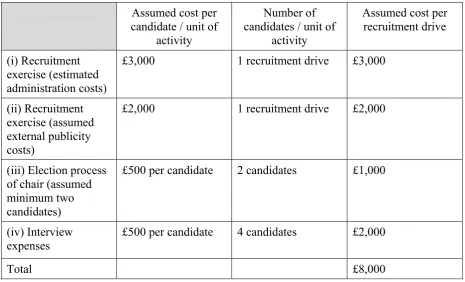
II. Appointment of chair: The requirement for HEIs to run an election to appoint the successful candidate would present a new cost to individual institutions. Although costs will depend upon the nature and size of the electorate which features in the regulations, it is considered that the maximum cost of this election would be broadly equivalent to the cost of electing a rector within the ancient universities. The University of Aberdeen provides detailed guidance4 on the process of electing a rector and specifies the maximum permitted campaigning costs. During the election process, candidates and their proposers are limited to spending £500 in connection with promoting their own campaign. This includes expenditure on items such as posters, leaflets, advertisements and websites. The University subsequently reimburses expenditure of up to £300, subject to receipts being provided. Candidates may personally contribute or obtain sponsorship of up to a further £200. The cost of allowing candidates to campaign for election is, therefore, estimated at £500 per candidate. It is assumed that this cost would be met in its entirety from the existing budgets of HEIs. Table 1 assumes that there might typically be two candidates involved in an election for the role of chairing member of the governing body of an HEI. The 18 HEIs that the requirement to elect a chair would be relevant to, typically replace the chairing member of their governing body every four years. Based on these cost assumptions, over the course of a four year cycle of chair replacements for the higher education sector in Scotland, the cost of running chairing member elections might total £18,000, which would be met from existing budgets. This estimation of cost does not include information on the costs to institutions of conducting the election and ensuring its probity. These costs will be influenced by the final form of the franchise selected for election of a chairing member. However, it is expected that any additional
costs will be minimal and able to be absorbed within existing institutional budgets. This conclusion has been reached based on the availability of relatively low cost ICT solutions, as well as free online platforms for voting and convening elections. Assuming the electorate is confined to the HEI in one form or another (be that its students, its staff, the members of its governing body, or a combination of these), the HEI is likely to have email addresses available to it for all potential voters. The use of ICT solutions should negate the need for investment in items such as postal charges or significant involvement of a Returning Officer over and above the existing duties they perform within an institution.
III. Provision of expenses to candidates invited to interview:- This is not current practice across HEIs, but the University of Glasgow has existing policies in place to provide reasonable interview expenses to candidates when attending interviews for staff positions (subject to qualifying criteria). The criteria set out by the University of Glasgow5 suggest a maximum of around £500 will be paid to interviewees travelling outwith a radius of 35 miles for attending an interview. During the typical four-year cycle of appointment), assuming that each of the 18 HEIs affected by the Bill is required to carry out an open recruitment process which involves the interview of potential candidates and a shortlisting process, it is estimated that up to four candidates might gain an interview at each HEI. Accordingly, the approximate maximum costs for providing reasonable interview expenses will be £2,000 per HEI. When multiplied by the 18 HEIs affected by this provision of the Bill, this would equate to around £36,000 per four year cycle of recruitment. This is a cost for individual HEIs which will be absorbed within their existing budgets. If the eventual regulations do not in fact require an interview process, no costs will arise under this heading. If the maximum costs for appointment of a chair (including costs associated with an election) are totalled for all 18 HEIs, then over a typical four year appointment cycle, these costs will amount to £144,000, or £8,000 per institution.
IV. Provision of reasonable remuneration to chair of governing body:- Again, it is anticipated that modest costs associated with this provision will be absorbed within existing budgets of HEIs. It is also anticipated that governing bodies will meet on average between four and six times per academic year. For illustrative purposes the Scottish Government has used the Public Sector Pay Policy for Senior Appointments Technical Guide 2013/2014 to estimate a maximum daily fee rate of £512. Attributing this to all HEIs (assuming the chair attends six meetings per year), would suggest a cost to an individual HEI of £3,072 per annum which, when multiplied by the 18 HEIs affected by this provision of the Bill, would equate to a total approximate cost of £55,296 per annum. This figure is considered a maximum, as it is unlikely that all chairs will request the remuneration available for taking the position. Where the chairs of certain HEIs are already receiving remuneration, the costs for those HEIs will not necessarily increase.
Table 1. Costs to individual HEIs for carrying out appointment of chair
Assumed cost per candidate / unit of
activity
Number of candidates / unit of
activity
Assumed cost per recruitment drive
(i) Recruitment exercise (estimated administration costs)
£3,000 1 recruitment drive £3,000
(ii) Recruitment exercise (assumed external publicity costs)
£2,000 1 recruitment drive £2,000
(iii) Election process of chair (assumed minimum two candidates)
£500 per candidate 2 candidates £1,000
(iv) Interview
expenses £500 per candidate 4 candidates £2,000
Total £8,000
Note: this total estimated cost will be incurred once every typical four year recruitment cycle.
Table 2. Assumed annual cost to HEIs for remuneration of chair
Assumed
Daily Rate meetings per Number of year (max) Assumed total cost per institution per year Assumed cost per 18 institutions
** (i) Remuneration of reasonable expenses
£512 6 £3,072 £55,296
**Source: public sector pay policy for senior appointments, technical guide 2013/14 (page 29)6
Part 1 (Sections 4 to 8): Governance arrangements, governing bodies, membership of governing body
[image:18.595.53.514.471.589.2]15. The requirement on each HEI to hold an election for two staff members is a new requirement and, therefore, may require alternative processes to be set up for appointing board members, which may incur additional costs. However, HEIs already hold elections for staff members for positions on academic boards (the costs of which are met from within HEIs’ existing budgets). There is no information available to determine the anticipated costs of staff elections for governing bodies, but it is likely that the systems that HEIs already have in place could be adapted relatively easily. The costs to HEIs of conducting the election and ensuring its probity are therefore expected to be minimal and will be absorbed within existing institutional budgets. All HEIs are likely to have systems in place to manage the various internal elections that they already conduct.
16. There is no requirement to allow staff membership candidates for election to campaign but, should HEIs wish to do so then, similar to the requirement for elections to select a chairing member of the governing body, an estimate can be made based on the University of Aberdeen guidance on election of rectors. The estimate is that the election of two staff members to the governing body of an HEI may cost in the region of £500 per candidate, although in practice a lower cap may well be imposed given that the position is not that of the chairing member. However, if four candidates are reimbursed at this level, this would equate to a maximum cost per HEI of £2,000, or £36,000 for all HEIs affected by this provision of the Bill. As with the chair of the governing body, appointments are typically for a period of four years, and so the costs would only arise once in each four year appointment cycle. Any additional cost attributed to the Bill would be absorbed by the existing budgets of HEIs.
17. Rights of nomination are granted by the Bill to staff unions, students’ associations, and graduates’ associations. In each case, the nomination process must be conducted in accordance with rules set down by the governing body of the HEI. Accordingly, it is possible that an HEI might either require or permit its nominating organisations to hold elections in order to select their nominees. In such a case, the cost to the nominating organisation would depend upon the precise details of the rules set down by the HEI, although the nominating organisations are likely to already have processes in place for the election of their own office bearers. It is expected that these processes could be adapted with relative ease and at minimal or no cost. However, there is no requirement to compel the nominating organisations to hold an election in order to select their nominees. For example, a nominating organisation could be permitted simply to nominate its own office bearers to the relevant position on the HEI’s governing body. Given that each HEI is under an obligation to consult with its nominating organisations before making rules, it is expected that the costs of any nominating process will factor heavily in the decision as to which approach is adopted, and that an election will only occur where either the costs are minimal or it is in line with the wishes of the nominating body. Overall, it is therefore considered that there are no anticipated additional costs on other bodies, individuals or business.
Part 1 (Sections 9 to 13): Governance arrangements, academic boards
association President, who is generally an ex officio member. The requirement in section 10 that the majority of members of the academic board be elected by the constituency they represent and that at least 10% of board members should be students, may require additional elections to be held which may lead to additional costs for HEIs. However, as the costs of existing elections are already absorbed within individual HEIs’ budgets, it is expected that any further elections required as a consequence of the Bill will also be absorbed within existing budgets. As with the election of staff to governing bodies, the costs to the institutions of conducting the election and ensuring its probity are expected to be minimal. All HEIs are likely to have systems in place to manage the various internal elections that they already conduct, and HEIs already hold elections for staff members for positions on academic boards so while the detail of the election process may be new, the holding of elections itself is not. It is not expected that any campaigning would be carried out other than the circulation by the HEI of a brief biography for each candidate, so no campaigning costs have been allocated here.
Part 2 (Section 19): Academic freedom
SCOTTISH GOVERNMENT STATEMENT ON LEGISLATIVE
COMPETENCE
On 16 June 2015, the Cabinet Secretary for Education and Lifelong Learning (Angela Constance MSP) made the following statement:
―In my view, the provisions of the Higher Education Governance (Scotland) Bill would be within the legislative competence of the Scottish Parliament.‖
——————————
PRESIDING OFFICER’S STATEMENT ON LEGISLATIVE
COMPETENCE
On 16 June 2015, the Presiding Officer (Rt Hon Tricia Marwick MSP) made the following statement:
HIGHER EDUCATION GOVERNANCE (SCOTLAND)
BILL
EXPLANATORY NOTES
(AND OTHER ACCOMPANYING DOCUMENTS)
Parliamentary copyright. Scottish Parliamentary Corporate Body
Information on the Scottish Parliament’s copyright policy can be found on the website - www.scottish.parliament.uk
Produced and published in Scotland on behalf of the Scottish Parliamentary Corporate Body by APS Group Scotland.