UNIVERSITI TEKNIKAL MALAYSIA MELAKA
DESIGN AND DEVELOPMENT CASTING
MOULD FOR RESIN BASED MEDALS
Thesis submitted in accordance with the partial requirements of the Universiti Teknikal Malaysia Melaka for the
Bachelor of Manufacturing Engineering (Manufacturing Design)
By
LIAW CHIN YEE
UTeM Library (Pind.1/2007)
UNIVERSITI TEKNIKAL MALAYSIA MELAKA
BORANG PENGESAHAN STATUS TESIS*
JUDUL: Design and Development Casting Mould For Resin Based Medals
SESI PENGAJIAN : Semester 2 2007/2008
Saya LIAW CHIN YEE_____________________________
mengaku membenarkan tesis (PSM/Sarjana/Doktor Falsafah) ini disimpan di Perpustakaan Universiti Teknikal Malaysia Melaka (UTeM) dengan syarat-syarat kegunaan seperti berikut:
1. Tesis adalah hak milik Universiti Teknikal Malaysia Melaka .
2. Perpustakaan Universiti Teknikal Malaysia Melaka dibenarkan membuat salinan untuk tujuan pengajian sahaja.
3. Perpustakaan dibenarkan membuat salinan tesis ini sebagai bahan pertukaran antara institusi pengajian tinggi.
4. **Sila tandakan (√)
(HURUF BESAR)
SULIT
TERHAD
TIDAK TERHAD
(Mengandungi maklumat yang berdarjah keselamatan atau kepentingan Malaysia yang termaktub di dalam AKTA RAHSIA RASMI 1972)
(Mengandungi maklumat TERHAD yang telah ditentukan oleh organisasi/badan di mana penyelidikan dijalankan)
(TANDATANGAN PENULIS)
Alamat Tetap:
A-5, KG.MUHIBBAH FASA 1, 31100 SG.SIPUT (U),
PERAK. Tarikh: _______________________ Disahkan oleh: (TANDATANGAN PENYELIA) Cop Rasmi: Tarikh: _______________________
DECLARATION
I hereby, declare this thesis entitled “Design and Development Casting Mould for Resin Based Medals” is the results of my own research except as cited in the
reference.
Signature : ………
APPROVAL
The thesis submitted to the senate of UTeM has been accepted as partial fulfillment of the requirement for the degree of Bachelor of Manufacturing Engineering (Design).
The members of the supervisory committee are as follows:
……… Main Supervisor: Mr. Hassan Attan Date : ………..
ABSTRACT
ABSTRAK
DEDICATION
To God for His blessings,
To my beloved parents for their support, To my family for standing besides me, To all my friends for their encouragement and help,
ACKNOWLEDGEMENT
I would like to offer thanks and deepest gratitude from the bottom of my heart for all the support, encouragement and inspirations I obtained through out the duration of this project. The help rendered to me priceless, be it from the smallest of its kind to the largest. They include;
The first person would like to personally thank my supervisor, Mr. Hassan Bin Attan for guiding me and also giving me useful advice. Without his advice and guidance, I would be lost. Besides that, his constant urge for me to complete my project helps me to complete this project in time. To my second supervising, Mr. Wahnoyo Sapto Widodo who gives me full of support and advice.
Secondly, I would like to express greatest thankfulness and appreciation Mr. Syahrul, Mr. Syafik and all the technicians who have given advice, suggestion, guideline and information about design process for this project and process of fabricate the mould. To Mr. Ebi Karim YB from Cast Craft Industry (CCI) who gives me a lot of opinions, ideas and helping to complete this project.
Thirdly, I would like to thank all my friends and my family whom are constantly supporting me and giving me advice, opinion and also criticism. Their constant mumbling help fueled my burning desire to give everything I have on this project to prove myself as someone capable.
TABLE OF CONTENTS
Abstract………….………i
Abstrak……….. ……… ii
Dedication………iii
Acknowledgement……… iv
Table of Contents………v
List of Figures………..………ix
List of Tables………xii
Sign and Symbols………xiii
List of Appendices………..………viii
1. INTRODUCTION……….1
1.1 Background Introduction……….………...1
1.2 Statement of the Problem ………...………2
1.3 Objective ………2
1.4 Scope and Key Assumptions……… 2
1.5 Importance of the Project …………..……….3
1.6 Definition of Terms ………4
1.6.1 Design………...………4
1.6.2 Development……….4
1.6.3 Casting ……….4
1.6.4 Mould ………..5
1.6.5 Resin……….5
1.6.6 Medal……….5
1.7 Organization of the Report ………..6
1.8 Summary ………..7
2. LITERATURE REVIEW……….……….. 8
2.1 Introduction to Casting Resin ………8
2.3 Mold Design and development ………..9
2.4 Design consideration ………11
2.5 Concept Generation ………..13
2.6 Concept Selection ……….………....14
2.6.1 Concept Screening ……….…….………15
2.6.2 Concept Scoring ………..………16
2.7 Design analysis ……….18
2.8 Mold material……….19
2.8.1 Casting resin mould material ………...19
2.9 CAD/CAM……… 20
2.9.1 2D drafting software ………...21
2.9.2 Parametric Modeling software ………22
2.10 Mold manufacturing process ………...22
2.10.1 Laser ……….………23
2.10.2 Laser machining in die making………... 24
2.10.3 CNC Milling ………..25
3. METHODOLOGY ………...27
3.1 Description of Methodology……….………….... 29
3.1.1 Define the Scope, Objective and Problem statement of project…….29
3.1.2 Measure the standard dimension of the medal ………..29
3.1.3 Research ………...30
3.1.4 Literature Review ………...30
3.1.5 Concept generation and Sketching ………..30
3.1.6 Concept Selection .……….………....……..…...31
3.1.6.1 Concept Screening ……..……..……….…... 31
3.1.6.2 Concept Scoring ……….…………...………….…...32
3.2 Design improvement. ……….………...32
3.3 CAD drawing ………...33
3.4 Material Selection ………...33
3.6 Prototyping ………..…….……..…...36
3.7 Casting testing ………...36
3.8 Project Realization and Verification ……….……….……...37
3.9 Discussion, Conclusion and Suggestion ………...37
4. GEOMETRICAL DESIGN AND MACHINING PROCESS...27
4.1 Measure the standard dimension of the medal………..38
4.2 Concept generation and Sketching……….41
4.2.1 Concept 1……….42
4.2.2 Concept 2……….….43
4.2.3 Concept 3……….44
4.2.4 Concept 4……….………45
4.2.5 Concept 5……….….46
4.2.6 Concept 6……….…47
4.3 Concept Selection……….48
4.3.1 Concept Screening……….48
4.3.2 Concept Scoring……….52
4.4 Design improvement……….…54
4.5 Material Selection……….…56
4.6 Machining Process……….…59
4.6.1 Laser Machining……….…60
4.6.2 Lathe machining………..66
4.6.3 CNC machining………...69
4.6.3.1 Small Base machining……….…70
4.6.3.2 Big Base machining……….….77
5. RESULTS……….83
5.1 Result of machining………83
5.2 Results of assembly………86
5.4 Costing Evaluation………92
5.4.1 Small mould………92
5.4.2 Big mould………..…..….…..…...………..……93
6. DISCUSSION. ………..95
6.1 Discussion on design and development on mould. ……….95
6.2 Discussion on resin medal………97
7. CONCLUSIONS AND RECOMMENTATIONS………..98
7.1 Conclusion… ………..………98
7.2 Recommendation………..……99
REFERENCE ……….………...100
APPENDICES A Ghant Chart for PSM 1………...……….………...103
B Ghant Chart for PSM 2……….….……....………..…...104
C Small base……….……...………..…...105
D Big base……….……….………..………..…...106
E Big load……….………..….……..….………..…...107
F Small load……….……….….……..…..………..…...108
G Plate 1……….………...…….…..…………..…...109
H Plate 2……….………...………...…………..…...110
LIST OF FIGURES
1.1 Resin medal 3
1.2 Organization of the report 6
2.1 By designing a uniform metal section at the boss (essentially removing 22 unnecessary material at the center of the boss), both weight and machining costs are reduced. In addition, to avoid heat concentration, spread lugs
2.2 Laser processing techniques in the major manufacturing groups 24 2.3 Process chain in model and mould making 25
3.1 Activity Flow Chart 28
3.2 Medal (I) and (II) are the reference for the standard dimension 29
4.1 Medal (I) and (II) are the reference for the standard dimension 39
4.2 The longest length of the medal 39
4.3 The length for label of the medal 39
4.4 The length for the hanger of the medal 40
4.5 The thickness of the medal 40
4.6 Front view and side view of the medal 40
4.7 Concept 1 42
4.8 Concept 2 43
4.9 Concept 3 44
4.10 Concept 4 45
4.11 Concept 5 46
4.12 Concept 6 47
4.13 Concept selected 54
4.15 Big mould (catia) 59 4.16 Methodology of laser cutting machine set up 60
4.17 Autocad Drawing 61
4.18(a) DWG file drawing in CADMAN software 61
4.18(b) CADMAN software 62
4.19 CADMAN software (select material using) 62
4.20 CADMAN software with g-code 63
4.21 Laser machine in machine shop UTeM 64
4.22 Laser cutting finish 64
4.23 Small Plate (laser machine) 65
4.24 Big Plate (laser machine) 65
4.25 Work piece (140mm rod) 66
4.26 Cutting tool setting 66
4.27 Measure the dimension of the work piece 67
4.28 Drilling process 67
4.29 Work piece by lathe machining 68
4.30 Drawing of small base (Catia) 70
4.31 Roughing using Catia software 71
4.32 G-code 72
4.33 Oil reservoir and air filter 73
4.34 Coolant unit 73
4.35 make sure the pressure is on the level of 6psi 73
4.36 Work piece for base (Aluminum) 74
4.37 Clamp the work piece 74
4.38 tool offset measurement 75
4.39 Establishing the Work Coordinate System 75
4.40 Small base 76
4.41(a) Simulate using Catia 77
4.41(b) Simulate by CNC 5-axis machine 77
4.42 Alignment by using Dial indicator 78
4.43 tool offset measurement 79
4.45 Roughing process with 25mm end mill tool 80
4.46 Work piece 80
4.47 Clamp the both side of the work piece 81 4.48 Milling process with 16mm end mill tool 81
4.49 Base mould 82
4.50 File the sharp corner 82
5.1(a) Small Plate (laser machine) 83
5.1(b) Big Plate (laser machine) 84
5.2 Rod (lathe machine) 84
5.3 Small Base (CNC 3-axis machine) 85
5.4 Big Base (CNC 5-axis machine) 85
5.5 Assemble of Small mould 86
5.6 Assemble of Big mould 86
5.7 Gap between base and plates 87
5.8 Small mould with load 87
5.9 Difference type of patterns 88
5.10 Resin casting by part 89
5.11 Resin casting medal by part 89
5.12 Difference type of shape 90
5.13 Resin medals 90
5.14 Resin medals dimensions 91
LIST OF TABLES
2.1 Scale of rating 17
3.1 Rating with relative performance (Karl T. Ulrich & Steven D. 32 Eppinger, 2003)
3.2 Glass Transition and melting temperature of some polymers 34 (Serope Kalpakjian & Steven Schmid, 2006)
3.3 Physical Properties of various Materials in room temperature 35 (Serope Kalpakjian & Steven Schmid, 2006)
4.1 The dimension of standards size resin medal 41
4.2 Concept Screening 52
4.3 Concept Scoring 54
4.4 Physical Properties of aluminum 56
4.5 Characteristic of stainless steel choosing 58
LIST OF ABBREVIATION, SYMBOLS, APECIALIZED
NOMENCLATURE
CHAPTER 1
INTRODUCTION
1.1 Background Introduction
1.2 Statement of the Problem
UTeM is approach by Cast Craft Industry (CCI) which is located in Telok Emas, Melaka, to solve the problem facing of the existing mould is made of wood, which takes long time to fabricate. In addition, the flexibility of the pattern design is very low. Therefore the type of the pattern produce is limited. The existing mould also encounters the problem of difficulty in taking out the finished medal product in repetition process.
1.3 Objectives
The aim of this project is to design a casting mould for resin based medal in difference type of geometry and at the same time, the pattern is easy to drop from a mould. The objectives of the project include:
1. To get the general standard dimension of medal.
2. Able to carry out several concept design of the mould and able to generate 3D model of mould by using parametric design software. 3. To conduct the material selection for the mould.
4. To do the process planning and fabrication of the mould.
5. To do assembly and functional testing of the resin medal mould.
1.4 Scope and Key Assumptions
At the end of this project, a mould for resin medal will be generated. Several conceptual design of the mould need to be generate base on the problem statement. Here below are some specifications of the mould design:
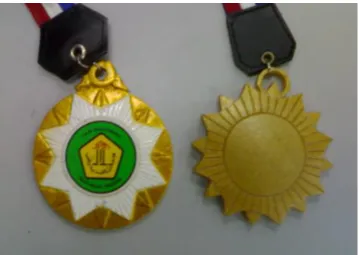
Figure 1.1: Resin medal.
2. To choose the best conceptual of design the geometry of the casting mould.
3. The mould configuration is finalized regardless to the pattern design available.
4. The task of modeling will be done using software available in FKP lab. 5. Study the machining process that related to manufacture the casting
mould. The mould fabricate process is only limited to which available at the lab.
1.5 Importance of the Project
1.6 Definition of Terms
1.6.1 Design:
A drawing or sketch. It was art or practice of designing or making designs. A basic scheme or pattern that affects and controls function or development: the overall design of an epic poem [22].
1.6.2 Development:
An significant event, occurrence, or change. Determination of the best techniques for applying a new device or process to production of goods or services[22].
1.6.3 Casting:
Casting is a manufacturing process by which a molten material such as metal or plastic is introduced in a mold, allowed to solidify within the mold, and then ejected or broken out to make a fabricated part. Casting is used for making parts of complex shape that would be difficult or uneconomical to make by other methods, such as cutting from solid material [22].
1.6.4 Mould:
The hollow former into which molten material (typically metal) is poured or soft plastic material is pressed to harden into a required predetermined shape. The simplest type of mould is a one-piece open former in which the casting emerges with one flat unshaped face. Two- and three-piece moulds for use in metalworking were available from middle Bronze Age times onwards. Moulds were also used for making figurines and occasionally for making pottery [22].
1.6.5 Resin:
Any of numerous clear to translucent yellow or brown, solid or semisolid, viscous substances of plant origin, such as copal, rosin, and amber, used principally in lacquers, varnishes, inks, adhesives, synthetic plastics, and pharmaceuticals [22].
Any of numerous physically similar polymerized synthetics or chemically modified natural resins including thermoplastic materials such as polyvinyl, polystyrene, and polyethylene and thermosetting materials such as polyesters, epoxies, and silicones that are used with fillers, stabilizers, pigments, and other components to form plastics[22].
1.6.6 Medal:
1.7 Organization of the Report
In chapter 1, it contains the research of problem statement, scope, aims and objective outline.
In chapter 2, it contains the highlight or journals, books, internet and previous study that related to this thesis.
In chapter 3, it contains the relevant theoretical and analytical techniques that should be outlined.
In chapter 4, it will contain the several concept designs and machining process.
In chapter 5, it will contain the result of assembly and the final outcome.
In chapter 6, it provides the general discussion on the method using and finding of the project under taken.
[image:23.595.122.248.117.675.2]In chapter 7, it contains the brief summary of the entire work, including method, results, major conclusions and recommendations arising from the work.
1.8 Summary