1 Presentation title: ‘It’s what we do here’: embedding evidence-based practice at USQ Library
Alisa Howlett and Clare Thorpe
Abstract: Over the past two decades, evidence-based practice and its application to library and information science has been an ongoing topic of discussion among researchers and practitioners. Evidence-based practice refers to a structured process of articulating questions or problems, collecting, interpreting and applying valid and reliable research and evidence to support decision making and continuous service improvement in professional practice. Earlier research focused on how librarians perceive and experience evidence-based practice, and the benefits of doing so (Miller et al, 2017, Gillespie et al, 2017, Gillespie et al, 2016, Luo, 2018). In 2016, the University of Southern Queensland Library chose to intentionally
incorporate evidence-based practice, by creating a role explicitly dedicated to enabling capacity among staff and to develop the library’s evidence base. While other libraries may have a person responsible for analysing data and statistics, the Coordinator (Evidence-Based Practice) is charged with a broader mandate – to work with library staff to develop tools, skills and expertise in evidence-based practice. By doing this, we aim to enable the library to demonstrate value to stakeholders, gain a deeper understanding of clients’ needs and experiences, promote robust decision making and improve service delivery.
2 with library staff to understand their business and the evidence needed to support business improvement for the Library. The paper will discuss how we have
supported a culture of evidence-based practice and the benefits of having a dedicated role has had on building the capacity of library staff as evidence-based practitioners.
USQ Library is still at the beginning of the journey in developing, not only the evidence-based practice function, but also harnessing the potential of the local evidence base to support the university’s strategic goals and objectives. The new role of Coordinator (Evidence-Based Practice) demonstrates evidence-based practice in action. It represents a clear strategic and intentional commitment by decision makers to make evidence-based practice a visible, embedded and valuable part of professional practice at USQ Library.
3 Introduction
Over the past two decades, evidence-based practice and its application to library and information science has been an evolving focus of discussion, experimentation and application among researchers and practitioners. In 2016, the University of Southern Queensland Library chose to intentionally incorporate evidence-based practice into the library’s workforce, by creating a role explicitly dedicated to enabling capacity among staff and to develop the library’s evidence base. While other libraries may have a person responsible for analysing and compiling data or monitoring
quality, the Coordinator (Evidence-Based Practice) has a broader mandate – to work with library staff to develop tools, skills and expertise in evidence-based practice. This paper draws on the broader, existing understanding of evidence-based library and information practice to describe why this role was created and how the
Coordinator (Evidence-Based Practice) is working to engage with library staff to both understand their business and to source the evidence needed to support business improvement for the library. The paper will discuss how we have supported a culture of evidence-based practice. We will explore the benefits of having a staff member dedicated to evidence-based practice and propose this as a new model for
embedding evidence-based practice into Australian academic libraries.
Literature review
Evidence-based practice is a structured process of articulating questions or
problems, collecting, interpreting and applying valid and reliable evidence to support decision making and continuous service improvement in professional practice. The decision-making framework has its roots in medicine, and its adaptation and
4 among researchers and practitioners over the past two decades. Understanding evidence-based practice in the LIS professional context has evolved from
questioning the types of research evidence that inform practice, to a broadened view of what constitutes as ‘evidence’, and an appreciation of the complexities that impact on the model’s implementation to day-to-day practice (Eldredge, 2000; Booth, 2002; Koufogiannakis, 2011a; Koufogiannakis, 2012; Howlett and Howard, 2015; Gillespie et al, 2017).
Early discourse promoted, and focused primarily on research evidence as the only type of evidence (Koufogiannakis, 2013, p. 8). Using a practice-based perspective, Koufogiannakis suggested two other types of evidence LIS professionals may draw upon for making decisions – local evidence and professional knowledge (2011a, 2011b). LIS professionals bring their knowledge and experience to the problems and questions they seek to solve on a daily basis through critical thinking and reflection, while local evidence that is found within the working context is directly applicable to the very communities library and information services seek to serve.
In a study that explored how Canadian academic librarians use evidence in their decision-making, Koufogiannakis found that although a number evidence sources were used, these could be classified as either hard or soft types of evidence (2012, p. 10). ‘Hard evidence’ included published literature, statistics, policies and
5 professionals from academic and public libraries found observations, feedback, professional colleagues, research literature, statistics and intuition were recognised as evidence (Gillespie et al, 2017). Findings from these empirical studies confirm that LIS professionals identify and use a variety of evidence types, beyond the research literature and often combine different types, to inform their daily practice.
LIS professionals also conceive and experience the process of, or being evidence-based in different ways. An Australian study was the first to explore variation in how LIS professionals experience evidence-based practice. Partridge, Edwards and Thorpe (2010) used a phenomenographic approach to capture and categorise this variation:
1. Evidence-based practice is experienced as not relevant.
2. Evidence-based practice is experienced as learning from published research.
3. Evidence-based practice is experienced as service improvement.
4. Evidence-based practice is experienced as a way of being.
5. Evidence-based practice is experienced as a weapon.
Further studies in different LIS professional contexts – academic libraries, teacher-librarianship, public and special libraries - exploring lived experiences of evidence-based practice have found the experience of, or being an evidence-evidence-based
6 both deliberate and unintended. Finding evidence can be through ‘pull’, ‘push’ or serendipitous and either used immediately or filed away for future use (Gillespie, 2014; Koufogiannakis, 2012; Howlett and Howard, 2015). Evidence-based practice as a ‘way of being and doing’ is influenced by a number of factors including time, accessibility and availability of evidence (Howlett and Howard, 2015;
Koufogiannakis, 2015; Miller et al, 2017; Luo, 2018). These studies and variations of experiences share an overarching theme that applying evidence-based practice is highly contextualised and influenced by the practitioner’s workplace.
So far, an understanding of evidence-based practice in the LIS professional context captures the experience of individual practitioners, rather than the organisation as a whole (Koufogiannakis, 2013, p. 9). Decisions in libraries are often made as a group or team and may require approval from outside the library or information service. There is documented growing demand from institutional and library leaders for evidence-based arguments to demonstrate why investments in libraries should continue (Baker and Allden, 2017, p. 10; Council of Australian University Librarians, 2016, p. 8) and yet organisational dynamics are reported to be the largest obstacle to the effective use of evidence (Koufogiannakis, 2015, p. 104). So how does a library move in the direction of becoming evidence-based?
An Australian ethnographical study into library and information professional
7
• A culture of valuing involves staff being valued and value each other.
• A culture of being involves being and becoming a professional.
• A culture of learning involves being a learner and supporting others to learn.
• A culture of leading involves leadership at many levels towards a shared
vision.
In this study, evidence, whether intentionally sought or not, affirms, acknowledges, guides and develops library services and collections, and helps to build relationships with its clients and ensure services align with their needs through an attitude and culture of continuous improvement that is shared throughout the library (Gillespie et al, 2016). Findings of this study suggests that these four cultural elements must be present to enable and support evidence-based practice at an organisational level.
With the exception of Gillespie et al (2016), there has been little research into experiences of evidence-based practice in an organisational setting, either within libraries or other industries and domains. Using an evidence-based practice
8 stressed the necessity of evidence in increasingly complex decision-making
processes and the use of evidence-based measurements of value to articulate the library's contribution to their university. The Council of Australian University
Librarians has also identified an aspirational long-term goal to nurture a culture of evidence-based thinking and communication across academic libraries in Australia and New Zealand (Owen et al, 2017).
Understanding how LIS professionals, including library leaders, experience
evidence-based practice provides insight into the various factors that come into play and influence the ways in which evidence is conceived and encountered or sought, and is used to improve service delivery and make decisions. Existing evidence-based practice models have primarily focussed on the individual experience.
Approaches to enable, support and develop staff capacity and expertise in evidence-based practice are needed across the whole library in order for it to readily respond to its environment and demonstrate value and impact to its stakeholders. In
particular, library leaders need to be able to evaluate the evidence-based practice maturity of their teams and their organisation. Existing evidence-based practice models applicable to individual practitioners or specific situations potentially create a false impression that evidence-based practice is an ad hoc process or the
9 role dedicated to fostering and supporting a whole of library culture of evidence-based practice.
A new role at USQ Library
USQ Library operates on three campuses in regional south-east Queensland, with approximately 60 library staff members. The library serves a student population of 30,000 students, mostly studying off-campus and online, and a staff population of approximately 700 academics. USQ Library is passionate about continuous improvement and providing the best quality resources and programs to meet the current and future needs of its clients (O’Sullivan & Partridge, 2016). In late 2014, USQ Library embarked on an organisational change process to better serve the needs of staff and students, both now and in the future. Beginning with an external review and an internal strategic visioning exercise, one of the aims of the change management process was to establish an evidence base to inform workforce planning and to guide strategic planning (O’Sullivan & Partridge, 2016).
Koufogiannakis and Brettle (2016, p. 17) argue that in order for evidence-based practice to be successful, library managers need to create a climate in which evidence-based decision-making and practice is valued. Through a process that emphasised decision-making grounded in evidence and experience (O’Sullivan 2017), staff and senior leaders identified the need for a new role within USQ Library that went beyond the capabilities of a data analyst solely focussed on data
10 Evidence-based practice is not just about defining measures and undertaking data analysis. Nor does evidence-based practice end with gathering and reporting data. Rather, it promotes an approach to professional practice and service delivery that is ongoing and reflective, in which the library staff positions themselves to respond readily to challenges or opportunities to improve within its environment. Measures are the means through which service is improved and professional practice is continuously developed. As an explicit demonstration of USQ Library’s commitment to fostering a culture of evidence-based practice, the role of Coordinator (Evidence-Based Practice) was created to engage with library staff to understand their
business, the evidence needed to support business improvement for the library, and to advise and support staff to engage in evidence based practice. The role sits within the library’s Quality and Planning portfolio and is a member of the Library’s Advisory Team, the library’s primary decision-making committee. Working collaboratively with the Associate Director (Library Quality and Planning), the Coordinator works with USQ Library staff to develop tools, skills and expertise in evidence-based practice. By building capacity in evidence-based practice across the whole library, we aim to:
• better demonstrate our value to stakeholders,
• gain a deeper understanding of client needs and experiences
• promote robust decision making and
• improve service delivery.
11 role aims to help incorporate the whole evidence-based process into ‘it’s what we do here'.
Influencing and embedding evidence-based practice into library culture The function and role of the Coordinator (Evidence-Based Practice) has been in place, working with USQ Library staff for over 12 months. At this time, we ask the question, what have been the benefits of a dedicated role in developing a culture of evidence-based practice at USQ Library? What is the evidence that this role is having an impact? Taking this question wider, what benefits can other academic libraries anticipate with a dedicated evidence-based practitioner role? In the following sections, this paper explores how this role has influenced and supported embedding of evidence-based practice across the library, and explore the benefits of having a dedicated role working with individuals and teams. We argue that the dedicated role has had a demonstrated effect at USQ Library, building capacity and empowering individual staff to become evidence-based practitioners. The impact and influence of the Coordinator (Evidence-Based Practice) is challenging to measure at strategic and operational levels. Through the three case studies below, we suggest that the leadership provided by the Coordinator is critical to developing USQ Library into a mature, evidence-based organisation.
Case study 1: Increased staff awareness and application of evidence based
practice
12
• Content Management Framework for USQ Library – This strategic document
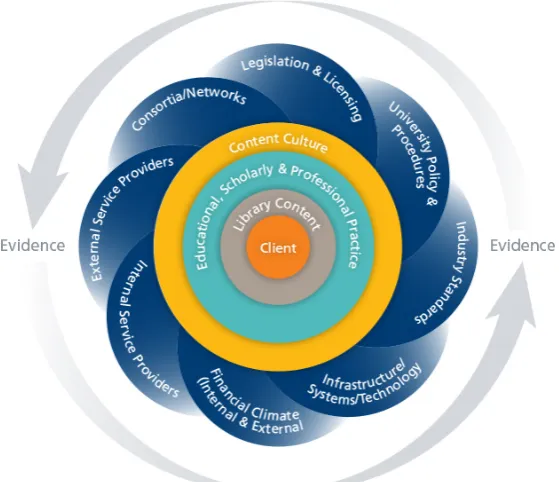
[image:12.595.172.452.468.709.2]written by the Associate Director (Content) articulates the role USQ Library must play in moving from the traditional notions of collection management to curating and creating content in the digital environment. This framework (Figure 1) positions the client at the centre. Evidence-based practice informs and supports the entire cycle. The draft framework (Pearse, 2018) used the 5As model of evidence-based practice – Articulate, Assemble, Assess, Agree, Adapt (Koufoginanakis & Brettle, 2016, p. 14) - to explain the development of the framework and its influencing factors. Earlier drafts of the framework included evidence as only one aspect of the cycle. Input and feedback from the Coordinator (Evidence-Based Practice) influenced a more holistic view of evidence as underpinning the entire content framework with evidence now defined as an integral part of each element.
13
• Electronic content appraisal tool – as a practical application of the Content
Management Framework, staff from the Content and Engagement teams developed an evidence based decision-making tool for the purchase and decommissioning of electronic content. The matrix applies specific
quantitative criteria for each identified principle and provides appropriate weightings to inform the evaluation process. Principles covered include an assessment of Return on Investment, Content Quality and Functionality. Evidence is key to ensure a transparent and equitable process is
communicated to stakeholders, via liaison librarians working with academic staff and the Library Director conveying the ‘story’ and value of the library’s content to university leadership.
Case study 2: Improved outcomes for library clients
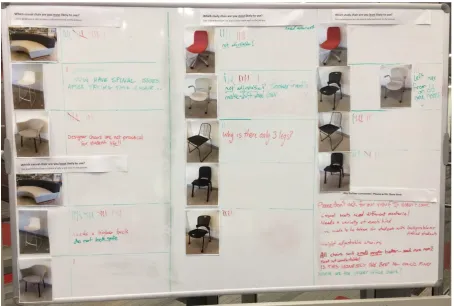
14 than a literature or data focussed approach provided valid local evidence that
[image:14.595.71.526.133.439.2]improved the physical library experience for students (Howard & Davis, 2011).
Figure 2: Student feedback on Springfield library seating options
Case study 3 – implemented evidence-based practice into staff workflows
15 evidence as an essential characteristic of robust and mature library management. The enhanced capabilities of our new systems to provide analytics data, reports and trend analyses has also reinforced the relevance and benefit of embedding
evidence-based practices into our future workflows. To facilitate this new way of working, the Coordinator led a workshop to help staff recognise evidence generated through daily work processes and to identify evidence needed to inform day-to-day work decisions and processes. The Coordinator continues to work with all library teams post-implementation to help staff further explore the capabilities and application of analytics reports as a source of evidence to improve client services and staff workflows.
Conceptualising and applying EBP at the organisation level
Understanding the newly created Coordinator role has involved applying what is known about evidence-based practice to a much broader purpose. That is, enabling and supporting the library to consistently operate in an evidence-based way as an organisation. Little has been written about how evidence-based practice is
experienced as an organisation, or how it is applied for strategic success and performance needs, rather than, or as an add-on to professional practice at an individual or team level. Visualising evidence-based practice at an organisational level came from an application of existing models and a ‘light bulb moment’ about understanding the Coordinator’s role.
16 (Koufogiannakis and Brettle, 2016, p. 14). An academic library has the added layer of needing to be strategically aligned and accountable to its institution’s purpose and direction. This needs to happen as a continuous cycle through a series of
coordinated and interrelated activities. The right evidence must be interpreted and service delivery evaluated as a matter of routine. Measures must capture the relevant outcomes and impact, and evidence used to communicate how the library contributes to the university’s strategic direction.
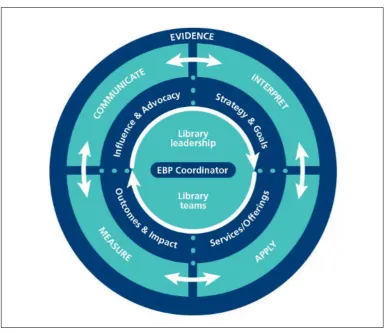
At USQ Library, we have observed that a dedicated evidence-based practitioner role can create a ‘ripple effect’, sending incremental developments in evidence-based practice capacity and expertise throughout the library to enable and influence a culture of evidence-based practice. We have designed a ‘lens’ that conceptualises how the library can effectively be evidence-based and implement this as a ‘way of being’ (Figure 3).
Guided by the existing evidence-based practice literature and informed by
17 facilitator and conduit, relating the library’s strategy through the teams in order to effectively communicate the library’s contribution and value to the university. The cycle is multi-directional, reflecting the interplay between the various stages and messiness that sometimes accompanies evidence-based practice.
Figure 3: A lens for evidence-based library in an organisational context.
There are four elements to the model – interpret, apply, measure and communicate. USQ Library needs to interpret its landscape and context. As an academic library, this means examining what is happening in the higher education sector, other libraries and information services, the LIS profession, learning and teaching trends and digital learning environments. The strategic direction of the university is
18 and our community. These sources of evidence enable the library to develop its strategy, priorities and goals.
Applying the library’s strategy via the delivery of its services and program offerings is done through the completion of procedures and workflows, the use of professional knowledge and experience, and other evidence needed for day-to-day decisions and service improvements. Measures of outputs, such as usage statistics, are gathered, evaluated, analysed and made sense of to identify and understand the library’s outcomes, value and impacts on the clients’ experiences.
The library must communicate statistics with stories relevant to its stakeholders, linking numbers with powerful narratives. This element, if all others are done effectively, generates influence and advocates for what the library is, and what it achieves for the university. A check back to the interpretation of the context
completes the cycle and ensures that what the library offers, delivers and measures remains relevant and strategically aligned.
19 Directions for future research
This paper has allowed us to reflect on the influence that the Coordinator (Evidence-Based Practice) has had in embedding evidence-based practice across USQ Library. Being a brand new role has its challenges. Specifically, we encountered difficulties in effectively measuring this influence and answering questions, such as, how does a library know it is being evidence-based? What characteristics exist at varying levels of evidence-based practice adoption and maturity? How can a library leader identify and progress evidence-based practice maturity among staff and teams?
As previously discussed, evidence based practice has been explored predominantly as an individual experience, rather than at whole of library level. The existing
literature and its story to date focuses on:
• Adapting models from evidence-based medicine to apply to the library and
information science context ;
• Questioning what evidence informs library and information practice, and
• Exploring how individual library and information professionals experience
evidence-based practice day-to-day.
20 we are an evidence-based library? We plan to develop a maturity model for
evidence-based academic libraries and we anticipate that having a dedicated evidence-based practitioner or leadership role in libraries will be a characteristic of higher-level maturity.
Conclusion
Evidence is increasingly important in interpreting, measuring and communicating value to clients and stakeholders in the academic library context. At USQ Library we have given high prominence to evidence-based practice through the dedicated role of Coordinator (Evidence-Based Practice). To shift the evidence-based practice conversation from the individual to the organisational, we have developed a lens that describes how evidence-based practice is implemented strategically and
21 References
Abbott, W. (2006). Persuasive Evidence: Improving Customer Service through Evidence Based Librarianship. Evidence Based Library and Information Practice, 1(1), 58-68. DOI: https://dx.doi.org/10.18438/B8H59J
Baker, D. and Allden, A, (2017) Leading libraries: the view from above. London: SCONUL. Retrieved from https://www.sconul.ac.uk/publication/the-view-from-above
Booth, A. (2002). From EBM to EBL: Two Steps Forward or One Step Back? Medical Reference Services Quarterly, 21(3), 51-64. DOI:
https://doi.org/10.1300/J115v21n03_04
Council of Australian University Librarians (2016). Principles and guidelines for Australian higher education libraries. Retrieved from
http://www.caul.edu.au/content/upload/files/best-practice/principles-guidelines2016public.pdf
Eldredge, J. (2000). Evidence-based librarianship: an overview. Bulletin of the Medical Library Association, 88(4), 289-302.
22 Gillespie, A., Partridge, H., Bruce, C. and Howlett, A. (2016). The experience of evidence-based practice in an Australian public library: an ethnography. Information Research, 21(4), paper 730. Retrieved from
http://InformationR.net/ir/21-4/paper730.html
Gillespie, A., Miller, F., Partridge, H., Bruce, C. and Howlett, A. (2017). What Do Australian Library and Information Professionals Experience as Evidence? Evidence Based Library and Information Practice, 12(1), 97-108.
DOI: https://dx.doi.org/10.18438/B8R645
Harland, F., Stewart, G. and Bruce, C. (2017) Ensuring the academic library's
relevance to stakeholders: The role of the Library Director. The Journal of Academic Librarianship, 43(5), 397-408. DOI: https://doi.org/10.1016/j.acalib.2017.06.009
Howard, Z., & Davis, K. (2011). From Solving Puzzles to Designing Solutions: Integrating Design Thinking into Evidence Based Practice. Evidence Based Library and Information Practice, 6(4), 15-21. DOI: https://doi.org/10.18438/B8TC81
Howlett, A. and Howard, Z. (2015). Exploring the use of evidence in practice by Australian special librarians. Information Research, 20(1), paper 657. Retrieved from http://InformationR.net/ir/20-1/paper657.html
Jamali, H., R. (2018). Use of research by librarians and information professionals. Library Philosophy and Practice. Retrieved from:
23 Koufogiannakis, D. (2011a). Considering the place of practice-based evidence within Evidence Based Library and Information Practice (EBLIP). Library and Information Research, 35(111), 41-58. Retrieved from:
http://www.lirgjournal.org.uk/lir/ojs/index.php/lir/article/view/486/527
Koufogiannakis, D. (2011b). What is Evidence? Evidence Based Library and Information Practice, 6(2), 1-3. DOI: https://doi.org/10.18438/B8TW52
Koufogiannakis, D. (2012). Academic Librarians’ Conception and Use of Evidence Sources in Practice. Evidence Based Library and Information Practice, 7(4), 5-24. DOI: https://doi.org/10.18438/B8JC8J
Koufogiannakis, D. (2013). EBLIP7 Keynote: What We Talk About When We Talk About Evidence. Evidence Based Library and Information Practice, 8(4), 6-17. DOI: https://doi.org/10.18438/B8659R
Koufogiannakis, D. (2015). Determinants of Evidence Use in Academic Librarian Decision Making. College & Research Libraries, 76(1), 100-114. DOI:
https://doi.org/10.5860/crl.76.1.100
24 Lembinen, L. (2018). Academic Library Directors’ Strategic Decision-Making
Process. LIBER Quarterly, 27(2), 1-21. DOI: http://doi.org/10.18352/lq.10224
Luo, L. (2018). Experiencing Evidence-Based Library and Information Practice (EBLIP): Academic Librarians’ Perspective. College & Research Libraries, 79(4), 554-567. DOI: https://doi.org/10.5860/crl.79.4.554
Miller, F., Partridge, H., Bruce, C., Yates, C. & Howlett, A. (2017). How academic librarians experience evidence-based practice: A grounded theory model. Library & Information Science Research, 39(2), 124-130. DOI: 10.1016/j.lisr.2017.04.003
Newton Miller, L. (2018). University Community Engagement and the Strategic Planning Process. Evidence Based Library and Information Practice, 13(1), 4-17. DOI: https://doi.org/10.18438/eblip29351
O'Sullivan, C. & Partridge, H. (2016). Organisational change and renewal: can
strategic communication methods ease the pain? A case study from the University of Southern Queensland. New Review of Academic Librarianship, 22(2-3), 282-293.
O’Sullivan, C. (2017). Transforming organisations: Putting people first. Poster presented at the QULOC University Librarians’ forum, Brisbane, November. Retrieved 12/02/18 from:
25 Owen, S, Peasley, J. and Paton, B. (2017). Principles and guidelines for Australian higher education libraries: capturing value. Paper presented at the 2nd annual
TEQSA Conference, Melbourne, pp 146-158. Retrieved from
https://www.hes.edu.au/sites/default/files/uploaded-content/field_f_content_file/teqsa_2017_conference_proceedings.pdf
Partridge, H., Edwards, S., & Thorpe, C. (2010) Evidence-based practice : information professionals' experience of information literacy in the
workplace. In Lloyd, A. & Talja, S. (Eds.) Practising Information Literacy : Bringing Theories of Learning, Practice and Information Literacy Together. Centre for
Information Studies, Charles Sturt University, Wagga Wagga, N.S.W., pp. 273-298.