..
COM(9Q) 283 final - SYN 309 to 312
Brussels, 14 November 1990
Future system for the free movement of medicinal products in the European Community
Proposal for a COUNCIL REGULATION CEEC)
Laying down Community procedures for the authorization and supervision of medicinal products
for human and veterinary use and establishing
a European Agency for the Evaluation of Medicinal Products
Proposal for a COUNCIL DIRECTIVE
amending Directives 65/65/EEC, 75/318/EEC and 75/319/EEC in respect of medicinal products
ProposaL for a COUNCIL DIRECTIVE
amending Directives 81/851/EEC and 31/352/EEC in respect of veterinary medicinal products
ProposaL for a COUNCIL DIRECTIVE
repealing Directive 87/22/EEC on the approximation of national measures relating to the placing on the market
of high technology medicinal products particularly those derived from biotechnology
(presented by the Commission)
SYN 309
SYN 310
SYN 311
:z..-3-E X P L A N A T 0 R Y M E M 0 R A N D U M 0 N T H E F U T U R E S Y S T E M
F 0 R
0 F
T H E
M E D
F R E E
C I N A L
M 0 V E M E N T
P R 0 D U C T S
EXPLANATORY MEMORANDUM
SUMMARY
1. GENERAL CONSIDERATIONS 1.1. State of consultations
TABLE OF CONTENTS
1.2. Objectives of the future system 1 .3. The two Community procedures
1.4. The r'elnforced CPMP/CVMP 1.5. The need for an Agency
2. THE AUTHORIZATION OF MEDICINAL PRODUCTS AFTER 1992 2.1. The decentral lzed procedure
2.2. Relationship between the decentral lzed procedure and national authorization procedures
2.3. The central I zed procedure
2.4. The mechanism for binding community decisions 2.5. Transparency of administrative procedures 2.6. Status of marketing authorizations
3. EUROPEAN PHARMACOVIGILANCE
3.1. Pharmacovlgl lance experience in the EEC 3.2. Adverse drug reaction reporting
3.3. Future obi igations on pharmaceutical companies 3.4. An Increasing role for the Community
4. SUPERVISION AND SANCTIONS
4.1. Access to Inspection reports
4.2. Supervision of manufacturers, withdrawal of authorization and sanctions
5. THE EUROPEAN AGENCY FOR THE EVALUATION OF MEDICINAL PRODUCTS 5.1. Functions of the Agency
5.2. Structure of the Agency 5.3. Finance and resources
6. OTHER AMENDMENTS TO COMMUNITY PHARMACEUTICAL LEGISLATION 6.1. Tlmel lmit for the evaluation of applications by Member States 6.2. Environmental assessment
6.3. Imports from third countries
6.4. Conditional marketing authorizations
7. SPECIAL PROVISIONS FOR VETERINARY MEDICINAL PRODUCTS
7.1. Residues
7.2. Link between the veterinary medicines legislation and the feed additives directives
8. FINAL REMARKS
Tables -II Ill
The DecentralIzed Procedure The Centralized Procedure The Structure of the Agency
SUMMARY
Future system for the free movement of medicinal products In the European Community
Following the Intensive consultations which have taken place over the past two years, the Commission Is now presenting Its proposals for the future system for the free movement of medicinal products (both for human and veter lnary use) within the Community. These consultations have shown the existence of wide support for the main features of these proposals, Including:
-the establ lshment of a new European Agency for the Evaluation of Medicinal Products;
-the creation of a new biotechnology products
central lzed Community procedure, and veterinary medicines used
compulsory for as performance enhancers, and aval lable on an optional basis for other Innovatory medicinal products, leading to a Community authorization, val ld throughout al 1 12 Member States;
- a decentralized procedure, based on the principle of mutual recognition, which wl II allow the progressive extension of a marketing authorization from one Member State to the others, wl th Important safeguards to ensure that there Is no dl Iutton of the strict standards of qual lty, safety and efficacy.
In the case of appl lcatlons submitted through the central lzed procedure, following the evaluation of the appl lcatlon, the decision on whether or not to grant authorization will be taken by the Commission, In cooperation with the Member States. Thereafter, the Community wll I be responsible for the monitoring of the product, and the technical updating of the authorization. In the case of veterinary medicinal products Intended for use as performance enhancers In farm animals, consideration Is being given to Community arrangements to assess the Impact of their use.
However, It Is the decentral lzed procedure which wl I I continue to be the most widely used after 1992. In this procedure, the Agency wl II only be Involved If there Is a disagreement between Member States about the qual lty, safety or efficacy of a medicinal product. In this case, the Agency will provide an Independent scientific evaluation of the Issues Involved, and a binding arbitration procedure at Community level wl I I follow. The monitoring of the product will remain the responsibility of the Individual Member States. By 1996, this procedure wl I I become the most commonly used for obtaining authorization for products Intended for use In more than one Member State.
Future system for tha free movement of med!elnal products In the European Community
1. GENERAL CONSIDERATIONS
1.1. State of consultations
During the preparation of these prOposals, the services of the Commission hav~ engaged In an lntens!ve round eof consultations with the Member States, representatives of the pharmaceutical Industry, representatives of consumer groups and the Consultative Committee for Consumers, .and with European representatives of the various health professions concerned, In particular, pharmacists, doctors and veterinarians. Three consultation documents have been Issued by the Commission or Its servtces:
-the Report on the Activities o~ the Committee for Proprietary Medicinal Products (COM (88) 143 final of 22 March 1988);
-the "Memorandum on the future system for the authorization of medicinal products in the European Community, Apr I I 1989";
- a further dIscuss I on document on the future system of December 1989
(I I 1/8267/89 Rev. 2.).
All. the detailed comments received In response to these documents have been carefully analysed and taken Into consideration during the. formulation of these proposals.
1.2. The objectives of the future system
Following this lengthy consultation exercise, there now appears to be general agreement on the objectives of the future system. These objectives can be presented from three points of view, without, however, attempting to present them In any order of priority:
-from the point of view of the protection of public health within the CommunIty;
-from the Industrial pol Icy point of view;
From the point of view of public he~lth:
a) A scientific evaluation of dossiers for authorization by the best European experts which can be recognized throughout the Community;
b) Criteria of qual lty, safety and efficacy based upon rigorous requirements Imposed by harmonized Community legislation;
c) Clearly defined political and legal responsibilities for each authority deal lng with the authorization of medicinal products In the Community and the refusal or withdrawal of products from the market;
d) A capacity to authorize the marketing of a new medicinal product as rapidly as possible so that It can be available to all patients throughout the Community;
e) A capacity to restrict or withdraw a medicinal product from the market throughout the Community as rapidly as possible on the basis of reliable Information collected through a European pharmacovlgllance network (adverse effects) and surveillance network (defect lve lots, counterfeiting);
f) Identical publ lshed Information on the conditions of marketing a medicinal product val ld throughout the Community:
- a single summary of product characteristics;
- identical labelling and patient Information leaflet In the different languages of the Community;
-same legal status for obtaining the prroduct (hospital use only, prescription only, self-medication, ... );
From the point of view of Industrial ·policy:
a) Uniform, clear and well-known reQuirements for the presentation and content of application dossiers (EEC Guidelines and Notice to AP.P I I cants);
b) Deposit of a single fl le, If possible to a single competent authority In order to protect confidentiality and reduct the admlnlstr~tlve .burden (sma I I number of copIes; sImp I If I cat I on of admInIstratIve
reQuirements);
c) Simple, transparent, fair and non-bureaucratic procedu~es, respecting the time I lmrts establ !shed by Community law;
d) Objective crJterla for evaluation, based exclusively on the Qual lty, safety and efficacy of the product, expressed In evaluation reports;
e) Rights to a hearing, to detailed reasons for decisions and appeal mechanisms for the appl !cant;
f) Reasonable registration fees corresponding to the true level of
Aspects of specific Community Interest:
a) the possibility of European concertatlon with Innovatory companies during the research and development stage;
b) the pool lng of expertise for the evaluation of Innovatory products and the promotion of cooperation between Member States;
c) a single scientific evaluation valid for the whole Community;
d) allowing companies with a Community vocation direct access to a Community-scale market, while maintaining local/regional s·ystems for other fIrms;
e) to provide a credible European authorization, which may be an aid to exports;
f) a single management of Community authorizations (renewals and variations);
g) coordination of the Implementation of Community obligations (GMPs, GLPs, GCPs etc);
1.3. The two Community procedures
1 t appears that these objectIves can best be met by a nuanced approach Involving two procedures; one decentralized and the other centralized. The prImary obJect 1 ve of the decentra II zed procedure wIll be to enab I e pharmaceutical companles·to Increase progressively their penetration from one nat lona 1 mar!-:'.et to · an IncreasIng number of Member States. The object lve of th.;, centralized Community procedure. on the other hand, Is to provide major Innovatory products with direct access to a Community-scale market. The scope of these community procedures wl II be revised In the light of the experience acquired after a reasonable. period of. time
ra.g. for the year 2000).
The decentral lzed procedure wl I I continue to be the most frequently used, even after 1992. A company which has obtained authorisation 1n one Member State will be able· to apply for· the acceptance of the authorization In one or more of the other Member States. If the Member States concerned consider that they cannot accept the authorizat-Ion. and If after consultation with the first Member State, .they are unable to reach bilateral agreement, the matter will be referred for an arbitration at Community level.
The centralized procedure·wlll be compulsory, In the first Instance. for medicinal products derived from biotechnology and veterinary medicines
1.4. The reinforced CPMP/CVMP
So far as the mechanism for evaluating appl lcatlons for authorization Is concerned, It appears clear that the Community wl I I have to draw heavl ly on the resources and experience existing within the Member States. It does not appear feasible to create a complex set of new and lndependant structures at· Community
level. Rather the aim
level to duplicate those existing at national should be the creation of a technical and administrative secretariat with the necessary resources to coordinate and avoid duplication of existing efforts. In short, the primary emphasis should be on a pooling of resources at Community level, rather than establ lshlng a massive European Drug Administration.
In practical terms, this means that the primary responsibility for the evaluation of appl lcatlons wl II remain with the Committee for Proprietary Medicinal Products and the Committee for Veterinary Medicinal Products, aJ_belt with Increased resources and responsibilities. In the case of the decentra I I zed procedure It appears that the prImary task of the two Committees will remain, as now, the resolution of disagreements which have arisen during the examination of appl lcatlons for authorization at national level, with Important difference that the opinions of the two Committees wll I also be addressed to the Community Institutions for the adoption of binding decisions at the Community level.
1.5. The need for an Agency
The progressive Introduction of the two new Community authorization procedures will result In a very substantial Increase In the workload of the CPMP/CVMP, which are likely to undergo maJor changes over the next few years .. If the two Committees are to be able to function effectively and with proper coordination between them, It Is essential that they be given th.e proper logistical support and resources to make the new procedures work. After considerable reflection, the Commission has concluded that for managerial and budgetary reasons these functions would be undertaken better within an Independent European Agency for the Evaluation of Medicinal Products rather than within the Commlslon Itself.
First, It Is Important to emphasize the sheer scale of the task. of evaluating applications for new high technology medicinal products. A typical appl lcation for authorization for an Innovatory medlclne.costs In the region of 100 ml II lon ECU to prepare and runs to tens of thousands of pages. Although the detailed evaluation of each application will be undertaken by a smal I number of highly Qual If led rapporteurs working on behalf of the Community, the logistics Involved In preparing assessment reports, summaries of product characteristics and label 1 lng and patient
leaflets for 12 Member States are considerable.
Moreover, the authorization of medicinal products Is not a once and for all process. Manufacturers are constantly changing the formulation of their products In order to try to Improve them, and also seek. to amend the terms of an Indication, In order to allow the use of the product for new therapeutic Indications. It has been estimated that on average two appllcat Ions are made each year to amend or vary the terms of each marketing authorization. This Implies that within a relatively short period of time, the workload Involved In managing existing Community authorizations wl II exceed the workload of assessing new appl !cations for
In addition to the workload resulting from appl lcatlons by the pharmaceutical Industry to amend the terms of an authorization, account must also be taken of the continuing supervision of the manufacturer by the regulatory authorities, Ln particular through the monitoring of adverse reaction reports, and Inspections and controls of manufacturers. Particularly, In the case of the centralized system, arrangements must be made for:.the proper exercise and coordination of these responsibilities at the Community level, which Implies a need for substantial resourcss.
For the reasons noted below, It Is difficult at the present time to assess In detal I the I lkely workload which wll I result from the Introduction of the new procedures. It Is therefore Important to ensure· that the administrative arrangements which are adopt~d are sufficiently flexible to allow for the rapid recruitment and redeployment of personnel, as a function of nesd.
Finally, It Is Interesting to note that within the Member States the evaluation of medicinal products is frequently entrusted to agencies· or Institutes which are themselves autonomous of the organs of the central government. The Commission considers that the arguments which have led Member States to take this course of action are also valid for the Community.
15
-2. THE AUTHORIZATION OF MEDICINAL PRODUCTS AFTER i992
As noted above, .there will be three procedures for the authorIzatIon of medicinal products after 1992: decentralized and centralized Community procedures and national registration procedures.
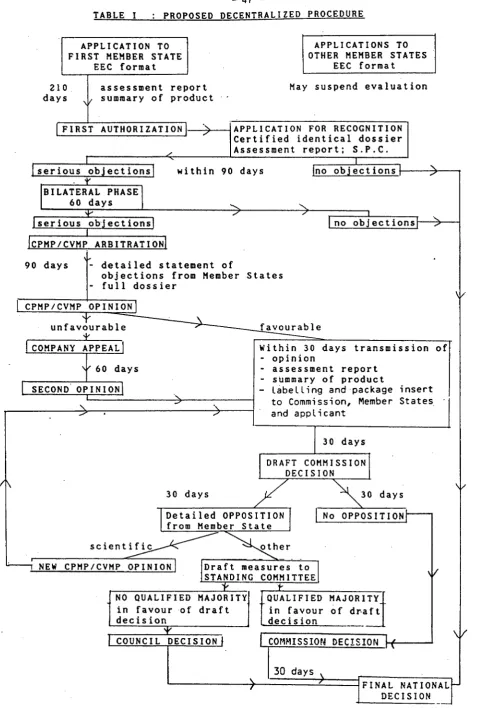
2.1. The decentralized procedure (see table I)
The decentralized procedure Is based upon the principle of mutual recognition of national authorizations, but with Important safeguard clauses to allow for the public health Issues raised by the authorization of medicinal products, whether human or veterinary. The proposals for the decentralized procedure take account of the experience acquired under the multi-State procedure establ l~hed by Directive 83/570/EEC and of the more I lmlted experience acquired In the authorization of veterinary medicinal products under Directive 81/851/EEC. In addition, the Commission has decided to try to ensure that the decentralized procedure Is as simple and flexible as possible In order to facl I ltate progressive access to a Community scale market for small and medium sized companies. UnlIke the existing Community procedures, there Is therefore no minimum threshold number of Member States nor Is there any restr let ion on the number of
times the procedure may be used In respect of the same product.
In order to use the decentralized procedure; the company concerned must first submit an application for authorization to one or more Member States In accordance with the current requirements laid down by Community legislation. The reasons for which companies wl I I be permitted to submit this Initial appl lcatlon to more than one Member State are further discussed In section 2.2 below. The Member State(s) concerned examine the appl lcatlon In accordance with the normal procedures currently used and decide whether or not to grant author lzat ion.· Before grant lng authorization for any new medicinal product, each Member State wll 1 be
When a company applies for recognition of the Initial authorization by one or more of the other Member States of the CommunIty. It w II I have to submit an Identical application to that accepted by the first Member State, Including the same appt tcatlon dossier, the same summary of product characteristics and the same formulation and trade mark, unless there are obJectively Justified reasons for a difference. In addition the other Member State(s) concerned wll I receive the assessment report directly from the authorities of the first Member State to authorize the product.
In accordance with the principle of mutual recognition, the countries concerned by the decentral tzed appl lcatlon should usually recognise the authorization granted by the first Member State within a period of 90 days. However, a series of safeguard clauses wl I I allow Member States to oppose mutual recognition If they consider that the medicinal product concerned presents risks to publ lc health.
In this case, the rapporteur from the first Member State to authorize the product and the co-rapportuers from the other Member States concerned wl I I present an agreed statement of the Issues Involved, and submit al 1
their assessment reports to the Agency. In addition, the applicant will be required to submit a full copy of the application to the Agency. As appropriate, the CPMP/CVMP wl II nominate experts to consider the outstanding objections and review
characteristics, the label I lng and
the draft summary package Insert and
'of the
product various assessment reports. The conclusions of these experts would then as appro~rlate be submitted to the various expert panels before submission to the CPMP/CVMP for the adoption of an opinion. This opinion would become binding for the Member States concerned following the regulatory mechanism out I lned In section 2.4. However, It sbould be noted that the final decision at the end of the decentral lzed procedure wl I I be binding only on those Member States concerned by the application, and will not prevent another Member State from subsequently raising additional objections to the product.
2.2. Relationship between the decent r a I I zed procedure and national authorization procedures
After careful consideration the Commission has concluded that during the Initial phase of the decentral lzed procedure, before any Member State has authorized the product, It would be_ appropriate to continue to allow companies to submit appl lcatlons In paral lei to two or more of the Member States. In practice, to limit the Industry to choosing only one Member State for the Initial application would g-Ive that country an unacceptable unilateral power of decision on the access of a product to the Community market. Moreover, In principle It appears desirable to encourage a degree of c~mpetltlon between the regulatory authorities of the Member States.
However, the possibility of submitting parallel applications Is subject to two Important restrictions.
First, with effect from 1993 onwards, where a Member State Is aware that another Member State Is undertaking a detal led evaluation of the medicinal product concerned, It wl I I be able to suspend Its own evaluation and walt for the detailed assessment report from the other Member State. This provision wl I I provide the Member States with a means of el lmlnatlng any unnecessary dupl lcatlon of effort and waste of scarce scientific resources.
Second, from 1996 onwards, It will no longer be possible to pursue paral lei appl !cations after one Member State has authorized the product concerned. Once the first authorization Is granted, all other pending applications will automatically be transformed Into applications for mutual recognition under the decentralized procedure, thus guaranteeing uniform decisions throughout the Internal market.
It follows that after 1996, national registration procedures will be limited to the Initial phase of the decentralized procedure, and for pure I y loca I products whIch are not Intended for export to any other Member State.
2)
19
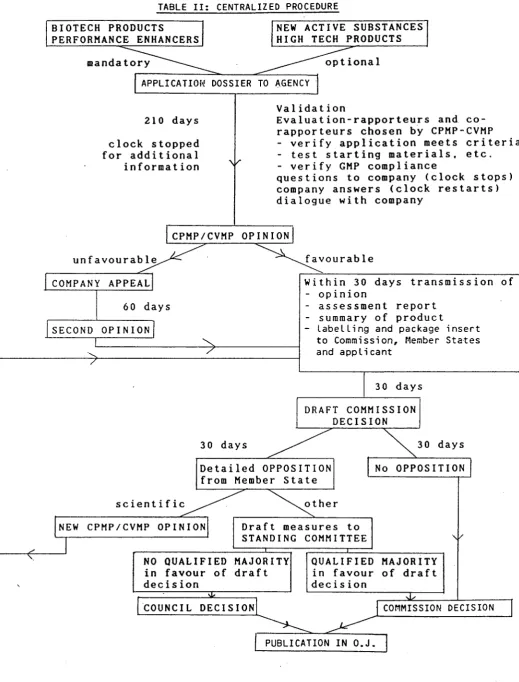
-2.3. The central !zed procedure (Table 1 I)
The proposals for the new centralized Community authorization procedure take Into account the practical experience acquired during the operation of the existing procedures establ lshed for biotechnology-high technology medicinal products established by Directive 87/22/EEC.
The use of the procedure will be compulsory for the vast maJorIty of medicinal products derived from biotechnology, listed In Part A of the Annex' to the regulation. In addition, In a new departure, the use of the centralized procedure will also be compulsory for veterinary medicinal products which are Intended to Increase the productivity of food-productlng animals, because of the specific Community Interest which these products represent.
In addition, the procedure will be available on an optional basis for other high-technology medicinal products I lsted tn Part B of the Annex, and, In a further new departure, to other products containing a new chemical entltlty.
These restrictions on the scope of the centralized procedure appear necessary In the first Instance to ensure the progressive establishment of the Agency and a smooth transfer of respons·lbllltles from the Member States to the Community. The scope of the central I zed procedure wl 11 be reviewed In the I lght of experience In 1998-99, when the posslbl I ity of extending It to other categories of products, either on an optional or a compulsory basis, wi I I be reconsidered.
The appl lcatlon wl I I then be referred to the CPMP or the CVMP as appropriate for review. For each appl lcatlon a rapporteur wl 11 be appointed to undertake overal I responslbl I lty for the coordination of the review of the product, and experts will be appointed to assist the rapporteur In the evaluation of Individual parts of the file. These rapporteurs and experts wl I I be appointed by the Committee responsible, from I I sts of experts provIded by the Member States. They w I I I however report directly to the Committee and not to their Individual national authorities.
Working under the supervision of the CPMP/CVMP and consulting Its expert advisory panels as appropr late, the task of the rapporteur will be to prepare an asse~sment report for the product concerned, and to review the draft summary of product characteristics and the labelling and package
Inserts for the medicinal product concerned proposed by the appl lcant.
These drafts will then be presented to the CPMP/CVMP for Its scientific opinion, which will become binding following the regulatory mechanism described In section 2.4.
2.4. The mechanism for binding Community decisions
In accordance with the principles underlying the Community treaties, the tasks of the new Agency are purely advisory, and It Is neither possible or appropriate to delegate to the Agency the power to take decisions on the authorization of new medicinal products which would be binding on the Community and the Member States. Such decisions can only be taken by the existing Community Institutions.
In proposing a mechanism for the adoption of binding decisions on the authorization of medicinal products within the Community, the Commission .has sought to ensure that, as far as possible, decisions are taken on the basts of the objective scientific criteria of qual tty, safety and efficacy. It was also thought Important to protect the Integrity of the Agency by ensuring that at I questions of a scientific nature are resolved within the Agency structure and are not subject to a second review during the decision-making process. In addition consideration has to be given to the very 1 arge number of decIsIons I ll<e I y to be requIred, probab I y we II
in excess of 500 per year· by 2000, particularly when decisions on variations and amendments to existing authorizations are taken Into consideration .
.
··' ..At the conclusion of Its evaluation the CPMP/CVMP wl II forward to the Commission, to the Member States and the appl !cant Its opinion consisting of:
-the assessment report on the product, and In the event of a favourable opinion;
- the summary of product character 1st lcs, languages;
In alI nine Community
Following receipt of the opinion, the Commission will have 30 days to prepare a draft of the decision to be taken. In the vast majority of cases this draft wl I I reflect the scientific opinion transmitted by the Agency. Because of Its general obligation to supervise the legality of all the work undertaken by the Agency taking Into consideration the objectives of Community pol lcles, the Commission must reserve the right In exceptional circumstances, not to follow the opinion. In such cases, however, the Commission will have to provide detailed reasons for not following the opinion.
The draft decision will be circulated to all Member States and to the appl lcant. The Member States wll I have 30 days to submit detal led written reasons explaining any objections to the draft decision. If no objections are received within the 30 day tlmel lmlt, the Commission wl II adopt the decision to grant or refuse a European marketing authorization.
If object Ions are received, the Commission will have to consider, In consultation with the staff of the Agency, whether these objections raise new scientific Issues which have not yet been fully explored within the relevant Committee. If this Is the case, the Commission will refer the appl lcatlon back to the Agency with a request that the Committee concerned reconsider Its opinion within a 60 day period.
2.5. !ransparency of admlnls~ratlve procedures
At the present t lme, the Community pharmaceutical directives already the transparency In particular, the for all negative decisions. These contaIn sever a I provIsIons desIgned to ensure
authorization procedures for medicinal products. authorities are required to give datal led reasons decisions, . to grant appeal rights and to publIsh
requirements wl 11 also apply to both Community registration procedures.
During the decentral lzed procedure, app! lcants wl I I be given the right to participate In discussions between the Member States during the bilateral phase. In both the centralized and decentralized procedures they will have the right to submit oral or written responses to questions posed by the CPMP/CVMP during the evaluation of the product, and a formal right of appeal prior to the transmission of the opinion of the Agency to the Member States and to the Commission. The appl lcant may also be given an opportunity to make representations to the regulatory Committee, at the discretion of that Committee.
In addition, appl lcants wl I I, of course have the formal rights of redress against acts of the ~ommission or the Counci I conferred by Articles 173, 175 and 215 of the EEC Treaty.
In addition to the appeal rights· given to pharmaceutical companies, efforts are also being made to Increase the openness of the authorization process for the general public. It Is envisaged that the assessment reports prepared by the Agency will be made available to the public, If
2.6. Status of marketing authorizations
a) European Marketing Authorizations
European market lng author lzat Ions which have been granted following the central lzed procedures will apply throughout the Community, and have the same status In each Member State as marketing authorizations granted In accordance with nat lonal procedures. They will apply for five years, renewable on appl lcatlon at least three months In advance. European marketing authorizations may be amended only by the Commission, after the opinion of the CPMP/CVMP has been obtained, In accordance with the procedures described above.
Although In principle a Community marketing authorization based on the criteria of qual lty, safety and efficacy wl I I be val ld throughout the Community, there are occasional circumstances which may justify restrictions on the use of a medicinal product which satisfy these criteria.
In the case of medicinal products for human use, It Is proposed to Include In the basic Directive 65/65/EEC an Article to enable Member States to prohibit the use of a product on their territory for objectively defined reasons of publ lc order or publ lc pol Icy. Such a provision appears necessary, In particular, In order to take account of the rather dIfferent poI I c I es of the Member States In reI at I on to birth control. However, Member States wl I I be obi lged to Inform the Commission whenever this exception Is Invoked, and the Commission wl 11 be able to Intervene In cases of abuse.
The use of Immunological veterinary medicinal products may also present certain difficulties result~ng from differences In animal
Moreover, within the veterinary. medicines sector, the grant of a ~uropean Market lng Author lzat ion will In no way effect the operation of particular legislation prohibiting or restricting the use of certain types of veterinary medicine, resulting from the objectives of the Common Agricultural Pol Icy.
In exceptional cases, where there Is a serious new risk to public health, a Member State may Impose temporary restrictions on the use of a product covered by a European marketing authorization provided that the CPMP/CVMP and the Commission are Informed of the measure and the detailed reasons for It, at the latest on the working day following the lmposlt ion of the measure. The CPMP/CVMP will be required to consider urgently the measures taken by the Member States and to give Its opinion on them. The CPMP/CVMP opinion wl I I be circulated to the Commission, the Member States and the person responsible for marketing In accordance with the procedures described above, but with shorter time 1 lmlts to take account of the urgency. The Member State which has adopted temporary measures may maintain them In force untl I such time as a deflnltfve decision Is adopted.
b) Acceptance· of· national authorlzitlons·
c) National procedures after 1992
The facility of purely national authorization procedures will rem;~ln for companies too small to avail themselves of the Internal market, and for products of local Interest. The procedures for granting marketing authorization wl I I remain unchanged.
in the case of products authorized before 1993, the Member States wl 11
3. EUROPEAN PHARMACOVIGILANCE
The term "Pharmacovlgtlance" Is meant to cover the cOile~tlon of Information on adverse drug reactions (AORs), at pre~and post~ ~arketlng stage, the scientific evaluation of these AOR reports and _thEt regulatory decIsIons whIch may have to be tal< en fo I I owIng theIr analysts. These regulatory decisions may Include In extreme cases wlthdr~wal or suspension of the marketing authorization, but, .more ·often,, a modification of the legal status of the drug and amend!f!~hts or warnings In the summary of products characterIstIcs, · I al:)e I II ng and package leaflet.
3.1. Pharmacovlgl lance experience In the EEC
Pharmacovigllance Is a major Issue for the current functioning of the CPMP or the CVMP, as well as for any future system of authorization of medicinal products In Europe.
Arising from Its mandate under Directive 75/319/EEC, and Its public hea I th respons lb Ill ty, the CPMP has for many years been concerned wl th . ~ . . Issues of pharmacovlgl lance. The original system of routine discussion at meetings and manual exchange of data has been superseeded by.a number of
Innovations, namely:
- a rapid alert system using fast communication methods;
-a drug Information monitor which Identifies selected products and updates the Information at each CPMP meeting;
- pharmacovlgl lance hearings WIth companies, fo I lowed by CPMP
phar~acovlgl lance opinions;
-standardization of summary of product characteristics for products of significant Community Interest.
In December 1988, the Commission circulated to the Member States a detailed questionnaire relating to their pharmacovlgllance system. The Commission Issued thereafter, In September 1989, a report on the present situation of pharmacovlgllance In the European Community (111/3577/89). Furthermore, In 1989, the Commission has, In consultation with the CPMP, established an ad hoc Pharmacovlgllance working party, which meets In para I lei with the CPMP. This new working party has two essential advisory roles to the Commission and the CPMP, first on general questions of · pharmacovlgl lance methodology, second to assist the CPMP for the scientific evaluation of ADR data related to specific medicinal products.
Our lng the last 12 months, lnformat lon on 30 medicinal
the CPMP has exchanged pharmacovlgl lance products. S I nee Ju I y 1986, the CPMP has adopted 6 formal pharmacovlgl lance opinions.
In the veterinary medicines sector, Increasing Importance Is being attached to that question, and the CVMP has recently establ lshed Its own working party to exchange Information and try to harmonize methodology on pharmacovlgl lance questions.
3.2. ADR reporting
In most of the Member States. reporting by the medical veterinary professlon(s) and by pharmacists Is voluntary. For routine reporting by companies a 6 month frequency Is the emerging pattern. For serious ADRs, time limits and frequency of reporting vary. Where reporting Is mandatory, sanctions may be taken for not doing so. Causal lty Is either assessed by expert Judgement alone (staff of the centres, expert panels and committees) or In combination wl.th an algorithm. The body reviewing 1 nformat Jon has access to the marketIng authorIzatIon doss ler. Member States do not systematically relate adverse drug reactions to data on drug·usage. This can however be done In cases of concern.
Experience has shown that pharmacovlgllance centres should be situated as close as possible to the source of the reports. As far as spontaneous ADR reports are concerned, regional or national centres wl I I remain the most Important I Ink between the source of the report and any Community coordination system of pharmacovlgl lance.
3.3. Future obi lgatlons on pharmaceutical companies
-the organization and malntalnence of a system for collecting adverse reaction data, from whatever source, and the maintenance of a register of alI reported ADRs.
-supplying alI relevant Information to the competent authorities In the Community regarding the benefit/risk assessment Including Information on the volume of sales or prescription as well as reports on ADRs occurring outside the European Community;
-preparation and submission of regular reports to the authority which authorized the medicinal product; (e.g. every 6 months during the first two years of marketing and annually for the next three years).
-the preparation and submission of post-marketing studies, when these are required as a condition of the authorization.
3.4. An Increasing role for the Community
Each Member State will required to designate a national center as a contact point for the Community. National or Regional centres should be establ lshed for the col lectlon of ADRs and the evaluation of both spontaneous reports and reports submitted by the holders of market lng authorization. Companies should be notified by the national center of al 1
spontaneous reports they receive, and should be given a possibility to comment on them.
The technical aspect of the exchange of Information between Member States as wet I as the causal lty assessment method should preferably be harmonized at Community level. Systems utilized by WHO or CIOMS should normally be adopted by the Community pharmacovlgl lance network. As from 1993, pharmacovlgllance data will have to be evaluated with -a view to harmonizing decisions and actions applicable In all the Member States. The EEC pharmacovlgllance network Is thus clearly not Intended to replace neither the national nor the WHO system, but to optimize and harmonize pharmacovlgllance activities In the EEC. When reQuired under Directive 89/341/EEC, the Community will also bring to the attention Information wh)ch may affect the protection of publ lc health In third countries via
31
-Current experience In the CPMP shows that pharmacovlgl lance Information Is sometimes transmitted too late, when a national decision has already been taken. Community legislation should provide for regular transmission of evaluated data and for Immediate transmission by the national centres of all lnformat ion on ser lous ADRs. A routine lnformat lon exchange, e.g. covering alerts on non-serious AORs and the rapid alert system would continue to run In parallel. The rapid alert system, recently Implemented, wl I I have to be Improved, using electronic mall. A pharmacovlgllance Information should be considered as an alert If, In case of confirmation, It Implies the modifications of the conditions of marketing authorization. In order not to overload the system, only laerts concerning serious ADRs should be transmitted via the "Rapid Alert System".
4. SUPERVISION AND SANCTIONS
4.1. Access to Inspection reports
The rapporteurs for the application will, where necessary, be able to request a copy of the most recent Inspection report covering the manufacturer concerned, for decentral lzed and central lzed appl !cations.
Where a manufacturer Is establ lshed In a third country, appropriate multi-lateral arrangements wl I I also have to be made to ensure that the rapporteurs working on behalf of the CPMP/CVMP have access to Inspection reports and other relevant documents, In the same way as rapporteurs currently working for the Individual Member States.
During Its evaluation of a live rONA vaccine, manufactured In a third country, the CVMP considered that an Inspection of the manufacturing plant was deslreable In order to verify the guarantees offered relating to the qual lty and safety of the product concerned. During discussions on the proposal to extend the veterinary medicines directives to cover Immunological products, the Councl I has also requested that arrangements shou I d be made to enab I e coordInated
third countries to be undertaken on appropriate cases.
Inspect Ions of manufacturers behalf of the Community
In In
4.2. Supervision of manufacturers, withdrawal of authorization and sanctions
In accordance with the general principles laid down In the Community pharmaceutical directives, the primary responslbll lty for the supervision of manufacturers I les with the competent authorities of the Member State In which the manufacturer Is establ lshed. In the case of products Imported from third countries, this responslbl I lty wl I I I le on the authorities of the Member State where the tests and controls necessary on Importation are carried out, unless an appropriate arrangement has been made between the Community and the third country concerned to ensure that the product Is manufactured In accordance with Community requirements and the necessary controls are conducted In the third country. In case of doubt, provision Is made for coordinated lnspec.tlons using Inspectors from two or more Member States or Inspectors employed by the Agency.
The grounds for the suspension or withdrawal of .a European marketing authorization are the same as for the suspension or ·withdrawal of a national authorization. However, a European authorization can be withdrawn only by the Community, following the opinion of the Agency and the appllcat I on of the procedures descrIbed In sect ion 2.4. In case of urgency, however, a Member State would be able to temporarl ly suspend the use of a medicinal product, provided that the matter was Immediately referred to the Commission for appl lcatlon of the Community procedures.
5. THE EUROPEAN AGENCY FOR THE EVALUATION OF MEDICINAL PRODUCTS
The establ lshment of a new European Agency for the evaluation of
medicinal produc,ts will be essential In order to enable the Community
Institutions to discharge the major new responsibilities Imposed upon
them·as a result of the Introduction of the new Community authorization
procedures and the additional responsibilities In the field of
ph~rmacovlgllance and the supervision of manufacturers.
In the early years, the establishment of the Agency will Inevitably
result In a significant Increase In the overall level of public
expenditures associated with the authorization and supervision of
medicinal ~roducts. In order to ensure the orderly phasing In of the new
Co!llml,lnlty procedures alongside national procedures, some degree of
dupllcatl.on will be necessary at first. However, In the longer term the
pooling
of
resources at Community level and the elimination of wasteful dupl lcat!on of effort In the evaluation of medicinal products wl II resultlri significant reductions In the overall cost to society of authorizing
and supervising medicinal products through reduced expenditures at
n.at lona I I e~e I.
In a I I Memb!3r States, the costs of regIsterIng pharmaceut I ca I products
·are met In. part from fees paId by the pharmaceut I ca I Industry. However,
ln.most Member States, these fees are paid Into the general national
budget and are not speclflcal ly devoted to the costs of the authorization
system. It Is therefore difficult to know what proportion of the cost of
the system. Is met by fees. Moreover, In the case of medicinal products
for human use, this question Is to some extent academic, since the costs
of fees are undoubtedly passed on to the consumer/patient, and, therefore
For the Introduction of the future system, the Commission considers that those costs which are directly attributable to the evaluation of applications for authorization of new medicinal products should be covered by fees from the pharmaceutical Industry. On the other hand, the general activities undertaken by the Agency In respect of pharmacovlgl lance, the provision of Information about medicinal products, Inspect ion and standards should be financed by a general contr I but ton from the Community budget, under a new budgetary I lne to be created In the operations part of the budget. Given the difficulty of making precise estimates of the workload of the Agency, at least In the early years, the exact fee structure wl I I be determined by a special financial regulation, to be adopted following consultation of the pharmaceutical Industry.
5.1. Functions of the Agency
Under the direct supervision of the CPMP/CVMP, placed at the top of Its scientific structures, the European Medicines Agency wl I I be responsible for:
-the coordination of the evaluation, on a scientific basis, of the qual tty, safety and efficacy of medicinal products which are submitted
In accordance with Community authorization procedures;
-the production of evaluation reports, summaries of product characteristics and label I lng and package Inserts for these medicinal products;
-the continuing supervision of medicinal products authorized for use within· the Community, and the provision of advice on appropriate
regulatory action to be taken In respect of such products;
-coordinating the exercise by the Community and the Member States of the various supervisory responslbl I ltles concerning the manufacture and testing of medicinal products, Including GMPs, GLPs, GCPs, batch controls etc;
-advising the. Member States and the Community Institutions on at I questions relating to medicinal products;
The. Agency will also be responsible for promot lng better cooperat lon between public control laboratories (collaborative tests, methods and reference preparatIons) In close cooper at I on wl th the European Pharmacopoeia. Furthermore, the Agency should become an Interface between national pharmacovlgl lance centres throughout the Community.
5.2. Structure of the Agency
Besides Its scientific committees at the top of the structure (CPMPiCVMP), the Agency shall have an executive director, who wl I I report to an administrative board.
a) Scientific bodies: CPMP, C'mP and Scientific Councl I
The examination of scientific questions submitted to the Agency for opinion wl I 1 be the responslbl I lty of:
-the Committee for Proprietary Medicinal Products, for medicinal products for use In humans;
- the Committee for Veterinary Medicinal Products, for medicinal products for veterinary use.
In order to maintain high scientific standards In the operations of the Agency, the CPMP and CVMP should have the possibility to tal<e advice from a high_ level Scientific Council of 5 personalities of International repute (Nobel prize etc.) nominated by the Council of Ministers upon proposal from the Commission. This Council would meet once or twice a year to deal with difficult ethical or scientific Questions referred to It by the CPMP/CVMP and to evaluate globaly the scientific statements of the Agency.
b) Administrative board
The administrative board wl I 1 consist of two representatives from each Member State and of the Commission. One representative wl I I be specifically responsible for matters relating to medicinal products for human use and one for veterinary medicinal products. The mandate of the representatives shal 1 be for three years, renewable. The administrative board will elect Its president for a period of three years and shal I adopt Its own Internal rules of procedure. Each member of the administrative board wl I I have one vote. The decisions of the administrative board wl I I be adopted by a two-thirds majority of Its members. The secretariat of the administrative board wl II be provided by the Agency. Each year the administrative board wl II adopt:
-the report of activities for the past year - the programme of work for the following year - the draft annual accounts for the past year
-the draft estimate of Income and expenditure for the following year.
c) Secretariat of the Agency
An executive director In charge of the secretariat of the Agency, wl I I be nominated by Council, upon a proposal from the Commission, for a renewable period of five years. The executive director will be the
-the routine administration of the Agency
-the preparation of the Income and expenditure report, and the administration of the budget of the Agency
-all matters relating to the personnel of the administrative and technical secretariat.
The technical and administrative staff of the Agency wl 11 be responsible for providing all necessary logistical support for the CP~P and the CVMP, and for assisting In the discharge of the various responslbl I ltles of the Agency as described In section 5.1.
5.3. Finance and Resources
a) Estimated Workload
The establ lshment of an administrative and technical secretariat wl 11 be progressive, based Initially on the anticipated workload; In the medium term, the real location of workload via the reinforced CPMP/CVMP wl I I globally tend to reduce the workload of the 12 competent authorities.
39
-So far as veterinary medicines are concerned, Initially much of the ·workload for .the reinforced CVMP will result from the setting up of a centralized Community procedure for the establ lshment of maximum residue levels. Over the period 1993-1997, the toxicology data for approximately 150 compounds wl II have to be reviewed. Since It Is Intended that from 1992 onwards, all appl !cations for NCE's Intended for use In food-productlng animals wl II be submitted to a centralized Community procedure for the determination of maximum residue level, It may be that there will also be a greater take up of the centralized procedure for applications for marketing authorization. It Is therefore prudent to estimate that 10 appl !cations for NCE's wl II be referred to the central Jzed procedure, together with 5 biotech appl lcatlons, making 15 In total. In addition, approximately 25 referrals a year could be expected Initially under the decentralized procedure, although this could rise very substantially should the decentral lzed procedure prove an attractive option for extending the terms of existing authorization Into minor species.
b) Resources
The responslbl I I ties of the Agency and It's permanent secretariat wl I 1
encompass a range of activities. In estimating personnel resource ·requirements, the following functions must be considered.
-management of the dossiers, Including val !dation of European dossiers and variations;
-administration of the reinforced CPMP/CVMP;
-administrative and technical support of the reinforced CPMP/CVMP, Its working parties and expert panels;
-administrative operation of expert groups, contracts etc; -coordination of pharmacovlgl lance activities;
- establ lshment of veterinary residue I lmlts;
- Implementation of Community certification procedures In the areas of GMP, GCP, GLP etc.;
-support for the pharmaceutical data bank;
The number of meetings, meeting rooms and facl I ltles would relate to workload but a core requirement would be:
- 2 meetings per annum of the administrative board;
- 1 meeting per month of the 2 scientific committees (CPMP/CVMP) ; -panel meetings of rapporteurs and experts to assess an appl lcatlon
(experts released for week long meetings);
-working party meetings of experts (8 W.P. X 4 times per annum); -ad hoc meetings of partrcular scientific experts and drafting groups
lfor example, 5 experts, 15 meetings per year).
6. OTHER AMENDMENTS TO COMMUNITY PHARMACEUTICAL LEGISLATION
In addition to the Incidental changes to the existing directives relating to human and veterinary medicinal products resulting from the establ lshment of the new Community registration procedures, several other detal led changes to the legislation are also proposed.
6.1. Tlmel lmlt for the evaluation of appl !cations by Member States
The tlmel lmlt of 120 days, plus a further 90 days In exceptional circumstances, allowed for the evaluation of appl !cations by Member States was first laid down In 1965. However, since that time, the amount of Information to be provided In an application and Its complexity has Increased substantially. In practice, all Member States are finding It Increasingly difficult, If not Impossible to meet their obi lgations under Community Law In this respect, and a period of 210 days has become the general rule. The Commission Is therefore proposing to extend the period allowed for review by Member States to 210 days. However, In return, the Commission wl I I expect the Member States to respect these new dead I lnes scrupulously, and reserves the right to Institute proceedings under Article 169 of the Treaty against any Member State which does not comply with the new time I lmlts.
6.2. Environmental assessment
In view of the Increasing awareness of the effects of medicinal products on the environment, the Commission Is proposing that In appropriate cases an appl !cation for authorization for a medicinal product for human use Include an assessment of the potential risks presented by the product for the environment. The detal Is of the Information required wl II be specified In the Annex to Directive 75/318/EEC on the testing requirements for medicinal products for human use.
So far as veterinary medicinal products are concerned, similar provisions have already been proposed by the Commission and are currently under consideration by the councl I (COM (88) 779 final).
6.3. Imports from third countr'ies
Proposals are Included to ensure that medicinal products Imported from thIrd countrIes are manufactured In accordance wIth standards of good manufacturing practice at least eQuivalent to those laid down by the CommunIty.
6.4. Conditional marketing authorizations
At the present time, the directives relating to human and veterinary medicines do not make any express provision for conditions to be attached
7. SPECIAL PROVISIONS FOR VETERINARY MEDICINAL PRODUCTS
7.1. Residues
.In February ~989, the Commission presented proposals for laying down Community procedures for the establ lshment of maximum! residue levels for residues of veterinary medicines In foods. These proposals are currently under consideration In the Council, and it Is therefore necessary to consider the relationshiP between the proposed procedure for the estaollshment of MRLs with the new Community authorization procedures provided for by the present proposals.
In recent years some concern has been expres~ed by consumers that foodstuffs from animals which are used In clinical trials of veterinary medicines are being sold for human consumption, thereby exposing the consumer to residues of experimental substances whose properties are not· fully known.
However, for economic r~a~ons, It Is often Impossible to run large-scale trIa is Involving hundreds or thousands of animals unless It Is possible to sel I the animals for human consumption.
In practice, alI Member States have developed national systems for monitoring the conduct of cl lnlcal trials ln.anlmals and for removing any rlslc to the consumer. In order to provide equivalent guarantees at the Community level, the Commission Is proposing that It should not be permitted to let foodstuffs from trial animals enter the human food chain unless the safety of the compound concerned has been evaluated at the Community level and residues have been found to be without risk for pub I I c hea I th.
7.2. Link between the veterinary medicines legislation and the feed additives Directives
For h 1 stor I ca I reasons, a number of pharmaco I og I ca I I r· y actIve compounds are authorized for use In the Community as additives to animal feedlngstuffs under Directive 70/524/EEC rather than as veterinary medicinal products. In accordance with Directive 70/524/EEC, a decision on the transfer of the coccldlostats and other medicinal substances from that Directive to the veterinary medicines directives shal I be taken once the level of harmonization In the veterinary medicines sector has attained that applicable to additives.
The Introduction of the new Community procedures provided for by these proposals wl I I undoubtedly be a major factor In this respect. However, a number of other difficult questions wl I I need to be resolved, In particular whether the authorizations urider Directive 70/524/EEC, which are granted by substance, should be converted Into European marketing authorizations, which are granted for Individual products produced by specific manufacturers.
In any case, It Is essential to ensure that any transfer of these products from one regulatory regime to the other does not result In any lowering of the level of harmonization already achieved, any reduction In the level of protection of health or any disruption for the manufacturers of the products concerned.
8. FINAL REMARKS
In accordance with the provisions of Articles SA and
ac
of the Treaty establishing the European Economic Community, the Commission requests the member States to take the measures necessary to comply with this package of proposals by 1 January 1993.The Commission has taken Into account the requirements of Article
ac
of the Treaty and has concluded that no special provision seems to bejustified at this stage.
TABLE I PROPOSED DECENTRALIZED PROCEDURE
APPLICATION TO APPLICATIONS TO
FIRST MEMBER STATE OTHER MEMBER STATES
EEC format EEC format
210 assessment report May suspend evaluation days \V summary of product ..
lFIRST AUTHORIZATION I
.,
/ APPLICATION FOR RECOGNITION Certified identical dossier/ Assessment report; S.P.C.
'
lserious object ions
I
within 90 days !no object ions,
'
. 't'
~BILATERAL PHASE!
60 days ...
··"-. i"'··"-. / /
-"'
!serious ob·jectionsl I no objections /
ICPMP/CVMP ARBITRATION I
90 days
-
detailed statement ofobjections from Member States
-
fu 11 dossier\ / ] CPHP/CVMP OPINION]
unfav!urable , \ favourable
+'
=----I
COMPANY APPEAL! Within 30 days transmission of-
opinion"' 60 days
-
assessment report - summary of productI SECOND. OPINION
I
-,
- labelling and package insert'
_. ., to Commission, Member States
.,..,
,
and applicant[ 30 days
DRAFT COMMISSION] DECISION
I \
/
~30
\v
30 days days
I
Detailed OPPOSITIONI
I
No OPPOS IT I ONr--from Member Statescient~
~er
__~NEW CPMP/CVMP OPINION! 'Draft measures to:]
,;
STANDING COMMITTEE1'
J-NO QUALIFIED MAJORITY QUALIFIED MAJOR
I~
in favour of draft in favour of dr-aftdecision decision
'+' \
v
COUNCIL DECISION I COr1MISSION DECISION L~
'
30 days \
,
!FINAL NATION~~ [image:46.574.44.522.45.754.2]TABLE II: CENTRALIZED PROCEDURE
BIOTECH PRODUCTS
PERFORMANCE ENHANCERS
NEW ACTIVE SUBSTANCES TECH PRODUCTS
COMPANY
210 days
clock stopped for additional information
60 days OPINION
scientific
30 days
Validation
Evaluation-rapporteurs and co-rapporteurs chosen
by
CPMP-CVMP - verify application meets criteria - test starting materials. etc. - verify GMP compliancequestions to company <clock stops) company answers (clock restarts) dialogue with company
Within 30 days transmission of - opinion
- assessment report - summary of product
Labelling and package insert to Commission, Member States and applicant
30 days DRAFT COMMISSION
DECISION
30 days
Detailed OPPOSITION from Member State
to COMMITTEE
NO QUALIFIED MAJORITY in favour of draft decision
QUALIFIED MAJORITY in favour of draft decision
[image:47.574.26.546.66.749.2]TABLE III: THE EUROPEAN AGENCY FOR THE EVALUATION OF MEDICINAL PRODUCTS
CPMP (*) SCIENTIFIC
\. COUNCIL /
-
Central opinions I \.
- Arbitration - Pharmacovigilance
~
MANAGEMENT/
BOARD .1 EXECUTIVE \ / EXPERTS J-RAPPORTEURSJ
WORKING PARTIES - ----t
COMMISSION DIRECTORADMINISTRATIVE AND TECHNICAL SECRETARIAT
-Validation
- CPMP/CVMP procedures
- Coordination of inspections - Translation, interpretation
A G E N C Y
-
-
-
-STANDING--1
COMMITTEES / / / COMMUNITY 1.:::'DECISIONS
(*) CPMP • Committee for Proprietary Medicinal Products CVMP • Committee for Veterinary Medicinal Products
COMPANIES
CVMP (*)
[image:48.574.32.562.60.747.2].INDEX OF THE ARTICLES
1. Proposal for a Council Regulation (EEC) laying down Community procedures for the authorization and supervision of medicinal products for human and ,veterinary use and establishing a European Agency for the Evaluation of
Medicinal Products
1. Central lzed Community authorization procedure
Scope of compulsory central lzed procedure Scope of optional central lzed procedure
Authorization Procedure
-submission of appl lcatlon to.Agency - CPMP/CVMP to give opinion
-preparation of appl lcatlon, tlmel lmlt for examination
-examination of application
-manufacturer, Inspection before MA -preparation and presentation of opinion - procedure for decision
-grounds for refusal -status of authorization -duration of authorization -conditional authorization - 10 years protection
-authorization does not affect I labl I lty
Hearings/Appeals
-during CPMP/CVMP examination - formal appeal to CPMP/CVMP
-representations to regulatory committee formal appeal against final decision
Supervision and sanctions
-updating of Information, variations -appointment of supervisory authority - responslbl I lty of supervisory authority - Inspection after authorization
- suspension and withdrawal/safeguard clause
Human 3(1) 3(2) 4 5 6 7 8 9 10 11 12 13 ( 1) 13(2) 13(3) 14
7(C) 9(1) 1 0(4) 67 15 16 17(1) 17(2) 18 Veterinary
+ Annex
+ Annex