This is a repository copy of
Java Enterprise Edition Support in Search-Based JUnit Test
Generation.
.
White Rose Research Online URL for this paper:
http://eprints.whiterose.ac.uk/113441/
Version: Accepted Version
Proceedings Paper:
Arcuri, A. and Fraser, G. (2016) Java Enterprise Edition Support in Search-Based JUnit
Test Generation. In: Deb, K. and Sarro, F., (eds.) Search Based Software Engineering.
International Symposium on Search Based Software Engineering, October 8-10, 2016,
Raleigh, NC, USA. Lecture Notes in Computer Science, 9962 . Springer , pp. 3-17. ISBN
978-3-319-47105-1
https://doi.org/10.1007/978-3-319-47106-8_1
The final publication is available at Springer via
http://dx.doi.org/10.1007/978-3-319-47106-8_1
[email protected] Reuse
Unless indicated otherwise, fulltext items are protected by copyright with all rights reserved. The copyright exception in section 29 of the Copyright, Designs and Patents Act 1988 allows the making of a single copy solely for the purpose of non-commercial research or private study within the limits of fair dealing. The publisher or other rights-holder may allow further reproduction and re-use of this version - refer to the White Rose Research Online record for this item. Where records identify the publisher as the copyright holder, users can verify any specific terms of use on the publisher’s website.
Takedown
If you consider content in White Rose Research Online to be in breach of UK law, please notify us by
Java Enterprise Edition Support
in Search-Based JUnit Test Generation
Andrea Arcuri1
and Gordon Fraser2
1
Westerdals Oslo ACT, Faculty of Technology, Oslo, Norway, and University of Luxembourg, Luxembourg
2
Department of Computer Science, The University of Sheffield, UK
Abstract. Many different techniques and tools for automated unit test generation target the Java programming languages due to its popular-ity. However, a lot of Java’s popularity is due to its usage to develop enterprise applications with frameworks such as Java Enterprise Edition (JEE) or Spring. These frameworks pose challenges to the automatic gen-eration of JUnit tests. In particular, code units (“beans”) are handled by external web containers (e.g., WildFly and GlassFish). Without consid-ering how web containers initialize these beans, automatically generated unit tests would not represent valid scenarios and would be of little use. For example, common issues of bean initialization are dependency in-jection, database connection, and JNDI bean lookup. In this paper, we extend theEvoSuitesearch-based JUnit test generation tool to provide
initial support for JEE applications. Experiments on 247 classes (the JBoss EAP tutorial examples) reveal an increase in code coverage, and demonstrate that our techniques prevent the generation of useless tests (e.g., tests where dependencies are not injected).
Keywords: Java enterprise edition, JEE, search-based testing, auto-mated unit test generation, database
1
Introduction
As the Java programming language remains one of the most popular program-ming languages, it is one of the dominant languages for research on software engineering and automated unit test generation. However, there are two main versions of Java: the Standard Edition (SE), and the one tailored for enterprise needs, i.e., the so called Java Enterprise Edition (JEE) [8]. JEE extends SE in various ways, for example by providing APIs for databases, distributed and multi-tier architectures, web applications (e.g., using servlets) and services (e.g., REST and SOAP). The popularity of the Java programming language is in part due to the use of the latter version of Java. However, there are large differences between SE and JEE programs.
In a typical Java SE application, there is an entry point class that has amain
the application, and new object instances are created with thenewkeyword. Once the application is started, it then interacts with its environment, for example using a GUI, accessing the network, file system, console, etc. Writing a unit test for a class in this context usually means to instantiate it, call its methods with some input parameters, and to mock or simulate its interactions with the environment.
In JEE, in contrast to SE, the developed applications are not standalone: they need to be run in a container, like for example WildFly3
or GlassFish4 . These containers scan deployed applications for XML configurations or annotations directly in the Java classes. Object instances of the applications are created via reflection, and possibly augmented/extended (e.g., using proxy classes) based on the container’s configurations. A typical case is access to databases: a Java class that needs to access the application’s database will not need to have code to deal directly with all the low level details of accessing databases (e.g., handling of transactions), or configure it explicitly. In fact, a reference to a handler for the database can be automaticallyinjected in a class by the container, and each of its method would be automatically marked for transaction delimiters (e.g., create a new transaction when a method is called, commit it once the method is finished, or rollback if any exceptions are thrown).
All these JEE functionalities make the development of enterprise applica-tions much easier: engineers just need to focus on the business logic, where many complex tasks like handling databases and web connections are transpar-ently delegated to the containers. However, these features make unit testing JEE classes more complicated. Given a classX, one cannot simply create an instance using new X() in a unit test, as that way all the dependencies injected by the container would be missing. This is a challenge for automated unit test genera-tion: There has been a lot of research on how to automatically generate unit tests for Java software, and practitioners can freely download research prototypes like for example T3 [11], JTExpert [12], Randoop [9], orEvoSuite[7]. These tools,
however, all target Java SE, and not JEE software.
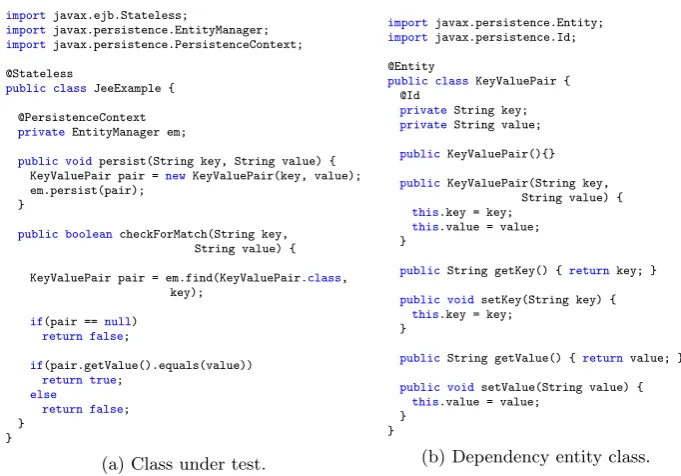
To illustrate the effects of this, consider the example class JeeExample in Figure1a, which contains a number of JEE features.JeeExampleis an Enterprise Java Bean, as it is annotated with @javax.ejb.Stateless. It has a reference to anEntityManager, which is used to access the application’s database. This reference is expected to be injected by the container, because the field em is annotated with@PersistenceContext. The class has two methods:persist()
to save data, and a boolean checkForMatch() which just does some checking on the existing state of the database.KeyValuePairis an auxiliary class shown in Figure1b.
Unit test generation tools intended for Java SE cannot cover any of the branches in this class. The reason is that the fieldemis not injected, and so all calls on it result in a null pointer exception. For example, Figure2 shows a test generated byEvoSuiteand Figure3shows one generated by Randoop. Without
3
http://wildfly.org, accessed April 2016 4
importjavax.ejb.Stateless;
importjavax.persistence.EntityManager; importjavax.persistence.PersistenceContext;
@Stateless
public classJeeExample {
@PersistenceContext privateEntityManager em;
public voidpersist(String key, String value) { KeyValuePair pair =newKeyValuePair(key, value); em.persist(pair);
}
public booleancheckForMatch(String key, String value) {
KeyValuePair pair = em.find(KeyValuePair.class, key);
if(pair ==null) return false; if(pair.getValue().equals(value)) return true; else return false; } }
(a) Class under test.
importjavax.persistence.Entity; importjavax.persistence.Id;
@Entity
public classKeyValuePair { @Id
privateString key; privateString value;
publicKeyValuePair(){}
publicKeyValuePair(String key, String value) { this.key = key;
this.value = value; }
publicString getKey() { returnkey; }
public voidsetKey(String key) { this.key = key;
}
publicString getValue() {returnvalue; }
public voidsetValue(String value) { this.value = value;
} }
[image:4.595.135.476.114.352.2](b) Dependency entity class.
Fig. 1: Code example showing a stateless enterprise Java bean accessing a database.
@Test(timeout = 4000)
public void test0()throws Throwable { JeeExample jeeExample0 = newJeeExample(); try{
jeeExample0.checkForMatch("z","]#");
fail("Expecting exception: NullPointerException"); }catch(NullPointerException e) {
verifyException("JeeExample", e); }
}
Fig. 2: Example test generated by the standard version of EvoSuite on the
example class from Figure1a.
handling dependency injection and database initialization, all tests result in null pointer exceptions. These tests are not particularly useful, as they test the class under test (CUT) only when it is not in an initialized, meaningful state.
In this paper, we describe and evaluate an approach to include JEE features in the search space of the search-based test data generation tool EvoSuite[7].
In particular, in this paper we provide the following contributions:
@Test
public void test1()throws Throwable {
if (debug) { System.out.format("%n%s%n","ErrorTest0.test1"); }
JeeExample jeeExample0 = newJeeExample();
// during test generation this statement threw an exception of // type java.lang.NullPointerException in error
jeeExample0.persist("hi!",""); }
Fig. 3: Example test generated by Randoop on the example class from Figure1a.
– Automated initialization of in memory, embedded databases.
– Handling of some JEE functionalities through environment mocks [3,4], like for example bean lookup resolution.
– An empirical study on 247 JEE classes, which shows that code coverage increases.
Using the JEE extension presented in this paper, EvoSuite
gener-ates the tests shown in Figure 4 when applied on the class JeeExample
from Figure 1a (note, there are further initializations done in @Before
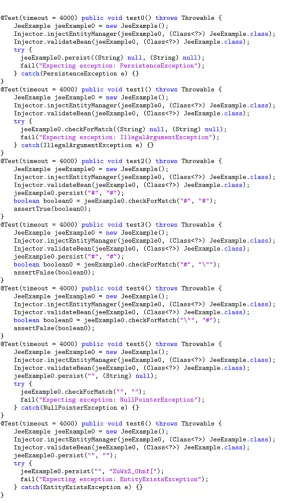
and @After methods, but those are not shown due to space limitations). Seven tests are generated, which achieve full code coverage. Furthermore, those tests even point to bugs in the class JeeExample, for example by throwing exceptions likePersistenceException,IllegalArgumentException,
NullPointerException and EntityExistsException. In particular, test0
leads to a PersistenceException because it tries to persist to the database an entity with null id. test1 leads to an IllegalArgumentException
because the method EntityManager#find cannot be called with a null key. test5 shows a null pointer exception due to the statement
if(pair.getValue().equals(...)) in the method checkForMatch, where
getValue() returns null. Finally, test6 tries to insert a new entity that al-ready exists (same id) into the database, leading to aEntityExistsException. Note that no test was generated in which the fieldem was not injected (i.e., left null).
2
Background
2.1 Java Enterprise Edition
@Test(timeout = 4000)public void test0() throwsThrowable { JeeExample jeeExample0 = newJeeExample();
Injector.injectEntityManager(jeeExample0, (Class<?>) JeeExample.class); Injector.validateBean(jeeExample0, (Class<?>) JeeExample.class); try{
jeeExample0.persist((String)null, (String)null); fail("Expecting exception: PersistenceException"); }catch(PersistenceException e) {}
}
@Test(timeout = 4000)public void test1() throwsThrowable { JeeExample jeeExample0 = newJeeExample();
Injector.injectEntityManager(jeeExample0, (Class<?>) JeeExample.class); Injector.validateBean(jeeExample0, (Class<?>) JeeExample.class); try{
jeeExample0.checkForMatch((String) null, (String)null); fail("Expecting exception: IllegalArgumentException"); }catch(IllegalArgumentException e) {}
}
@Test(timeout = 4000)public void test2() throwsThrowable { JeeExample jeeExample0 = newJeeExample();
Injector.injectEntityManager(jeeExample0, (Class<?>) JeeExample.class); Injector.validateBean(jeeExample0, (Class<?>) JeeExample.class); jeeExample0.persist("#","#");
boolean boolean0 = jeeExample0.checkForMatch("#","#"); assertTrue(boolean0);
}
@Test(timeout = 4000)public void test3() throwsThrowable { JeeExample jeeExample0 = newJeeExample();
Injector.injectEntityManager(jeeExample0, (Class<?>) JeeExample.class); Injector.validateBean(jeeExample0, (Class<?>) JeeExample.class); jeeExample0.persist("#","#");
boolean boolean0 = jeeExample0.checkForMatch("#","\""); assertFalse(boolean0);
}
@Test(timeout = 4000)public void test4() throwsThrowable { JeeExample jeeExample0 = newJeeExample();
Injector.injectEntityManager(jeeExample0, (Class<?>) JeeExample.class); Injector.validateBean(jeeExample0, (Class<?>) JeeExample.class); boolean boolean0 = jeeExample0.checkForMatch("\"", "#"); assertFalse(boolean0);
}
@Test(timeout = 4000)public void test5() throwsThrowable { JeeExample jeeExample0 = newJeeExample();
Injector.injectEntityManager(jeeExample0, (Class<?>) JeeExample.class); Injector.validateBean(jeeExample0, (Class<?>) JeeExample.class); jeeExample0.persist("", (String) null);
try{
jeeExample0.checkForMatch("","");
fail("Expecting exception: NullPointerException"); }catch(NullPointerException e) {}
}
@Test(timeout = 4000)public void test6() throwsThrowable { JeeExample jeeExample0 = newJeeExample();
Injector.injectEntityManager(jeeExample0, (Class<?>) JeeExample.class); Injector.validateBean(jeeExample0, (Class<?>) JeeExample.class); jeeExample0.persist("", "");
try{
jeeExample0.persist("", "ZuWxZ_0hnf[");
fail("Expecting exception: EntityExistsException"); }catch(EntityExistsException e) {}
[image:6.595.141.429.121.625.2]}
Fig. 4: Example test suite generated by EvoSuite on the example class from
JEE functionalities. JEE can be seen as a series of packages providing different functionalities, from database access to web communication handling. Among the main functionalities of JEE, some important examples are the following:
– Java Persistence API (JPA): This is used to automatically map Java classes to tables in databases, and to read/write those objects. To achieve this, these classes need to be annotated with the@Entityannotation (see the example in Figure 1b). Read/write operations are done through an EntityManager
provided by the container.
– Enterprise Java Bean (EJB): These are objects responsible for the busi-ness logic of the application. Beans are instantiated and managed by the container. A Java object is made into an EJB by using annotations like
@Stateless,@Statefuland@Singleton(see example in Figure1a).
– Java Transaction API (JTA): This is used to handle the transactions with the databases. By default, each call to an EJB method will be in a transaction, which will be rolled back if any exceptions are thrown in the EJB code.
– Java Naming and Directory Interface (JNDI): This is used to find objects that were bound by name in the current application or remote servers.
– JavaServer Faces (JSF): This is used to create component-based user inter-faces for web applications. A web page would be developed in the xhtml
format, mixing together Html/CSS/JS elements with calls to the backend Java beans.
– Java Message Service (JMS): This is used to make asynchronous point-to-point and publish-subscribe communications between distributed compo-nents.
– Web Services: These are used to develop and query web services like REST and SOAP.
Convention over configuration. To simplify development, JEE follows the con-vention over configuration approach: A typical JEE application is not a stan-dalone process packaged as a jar(Java Archive) file, but rather as awar(Web Application Archive) file that has to be deployed on a server container (e.g., WildFly or GlassFish). When such awarfile is deployed on a server, the server will do a series of operations and initialization based on thewar’s content. The developers do not need to configure them, unless they want to do something different from the standard convention.
For example, an entity Java class will be mapped to a database table with the same name as the Java class. The developers just need to use the annotation
@Entity, and the server will take care of rest. However, if, for example, a given entity class needs to be mapped to a table with a different name (e.g, when using JPA on a legacy database that cannot be changed), further annotations/settings can be added to change that default naming convention. Similarly, all methods in an EJB are automatically marked for required transactions: the container will create a new transaction if the method is called from a non-transactional client. If this default behavior is not the desired one, JTA annotations (e.g.,
On one hand, the use of convention over configuration makes development easier and quicker, as the engineers need to specify only the non-conventional cases. On the other hand, debugging and code understanding might become more difficult, as the container might do a lot of hidden operations behind the scenes that are not obvious for a non-expert in JEE.
Dependency Injection. One of the main characteristics that distinguish JEE from SE isDependency Injection. If an objectX needs to useY, instead of instanti-ating Y directly (or calling an external method to get an instance of it), it will delegate the container to provide an instance ofY. This is particularly useful to decouple components, as an enterprise application could be deployed on different containers (e.g., WildFly and GlassFish) that have different implementations for resources like database management. Furthermore, dependency injection entails different wiring of the application based on different contexts without the need of recompilation. For example, in a testing scenario a container could rather inject a mocked bean instead of a production one. In JEE, there are different ways to do dependency injection. A typical case is to use annotations on private fields. See for example theemfield in Figure1a, which is automatically injected by the container because it is annotated with@PersistenceContext.
2.2 JUnit Test Generation with EvoSuite
The EvoSuite tool [7] automatically generates JUnit test suites optimized to
achieve high code coverage. Test generation uses a search-based approach, where a genetic algorithm evolves a population of candidate solutions (test suites), guided by a fitness function that captures the target coverage criteria. A test suite in EvoSuite is a variable size set of test cases, and a test case, in turn,
is a sequence of statements that instantiate or manipulate objects. The initial population consists of randomly generated tests, and then search operators are applied throughout the search. First, the fitness value for each candidate test suite is calculated. Then, individuals are selected for reproduction based on their fitness value; fitter individuals are more likely to be selected. With a certain prob-ability, crossover is applied to the selected individuals, and then, with a certain probability, mutation is applied. Mutation consists of adding new (random) test cases to a test suite, and modifying existing tests (e.g., by adding, removing, or changing some of the statements). The search operators are applied until a new generation of individuals has been produced, and this then becomes the next generation. At the end of the search (e.g., when the allocated time has been used up), the resulting test suite goes through several post-processing steps such as minimization (i.e., removal of redundant statements) or assertion generation (i.e., addition of JUnit assert statements to check the observed behavior).
The search algorithm and the post-processing steps are both applicable re-gardless of whether the underlying Java class under test is Java SE or JEE code. Nevertheless,EvoSuiteup to now was not able to generate tests for JEE
specific code; the main reason for this lies in restrictions to EvoSuite’s search
particular, consider the insertion of statements (which is also used to generate random test cases): EvoSuite either inserts a randomly selected method call
of the class under test, or inserts a random method call to a randomly chosen object generated in the current sequence of calls. If the method takes parame-ters, these are either satisfied with existing objects in the test, orEvoSuitewill
recursively insert statements that generate the required objects.
Consider classJeeExample from Figure 1a: The candidate methods of the class under test arepersist,checkForMatch, and the implicitly defined default constructor. All parameters are of type String, and EvoSuite will generate
random or seeded strings. Although EvoSuite can also read from and write
to public fields, the standard operators will not access the private field em, and thus EvoSuite has no means of initializing the EntityManager. Note that, if
JeeExample would do dependency injection by providing a constructor with an
EntityManager, then EvoSuite would attempt to explicitly instantiate one.
However, this does not guarantee that EvoSuite would be able to create and
configure a valid instance.
3
JEE Support in EvoSuite
In this section, we describe an approach to enable search-based tools like Evo-Suiteto generate unit tests for JEE software. We do not cover the whole JEE
specification, as that is simply too large to cover in a single study, but rather focus on some of the most common features, in particular dependency injection, JPA and JNDI.
Support for these features is added via two techniques: First, the search space of call sequences is modified to include relevant JEE calls, for example to handle injection. The challenge lies in constraining these calls to result in valid JEE scenarios. Second, the code under test is instrumented to ensure that the JEE environment set up byEvoSuiteis used, for example by directing all database
accesses to an in-memory database automatically initialized byEvoSuite.
3.1 Dependency Injection
Every time a new object is created as part of the search,EvoSuite checks
if it, or any of its superclasses, has fields that should be injected. To check for injection, we look at JEE annotations like@Inject,@PersistenceContext,
@PersistenceUnit, @Resource, @EJB, @WebServiceRef, @ManagedProperty, and @Context. We also look at annotations used in popular frameworks like
@Autowired in Spring5
. For each of these types of injections, the helper class
Injectorprovides helper methods. For each injectable field, the corresponding helper methods are inserted in the test.
We distinguish between two kinds of injected objects:pre-defined and new. For some types of objects,EvoSuitedefines specific, pre-defined instances that
can be injected inject. These are, for example, customized entity managers, as done with Injector#injectEntityManager. The use of these pre-defined in-stances allows EvoSuite to more easily explore complex scenarios, where the
random object initialization is unlikely to lead to interesting scenarios.
If for an injectable field f, of type F in a class X, we have no pre-defined instance inEvoSuite, we add a call to a more genericInjector#inject. This
method takes not onlyX as input, but also an objectiof typeF, i.e., this new object i will be injected in the field f of object X. The new object i will be created as part of the search, just like standard method parameters, and will evolved like any other objects (e.g., mutation operators might add new calls on it). Note that this new object imight itself need injection for some of its fields, and this will be handled recursively.
After a classX has all of its injectable fields injected,EvoSuite checks for
methods marked with@PostConstructin the class hierarchy ofX, and also add calls toInjector#executePostConstruct.
AddingInjectormethods in the tests has major consequences their evolu-tion during the search. Recall from Secevolu-tion2.2thatEvoSuiteperforms several
kinds of operations to evolve tests, such as deleting statements, changing func-tion calls, creating new statements at any posifunc-tion in the test, etc. These can change the tests to an inconsistent state, e.g.,EvoSuitecould delete all calls to
Injectormethods. To avoid this issue, we definedconstraints on the test state-ments, and modified allEvoSuitesearch operators to enforce these constraints.
Given a classX with injectable fields, these constraints are for example:
– No call toInjectorcan be deleted untilX is in the test.
– IfX is deleted, then delete all its calls toInjector.
– Fields cannot be injected more than once.
– Calls to Injector should be automatically added when a new object is instantiated. Search operators should not add new unnecessary calls to
Injector, or modify existing ones.
– Calls toInjector methods cannot take null as input. This might prevent the deletion of objects that are used as input.
– Between the statement whereXis instantiated and its last call onInjector,
X cannot be used as input in any method that is not an injector, and no call can be added onX (asX is not fully initialized yet).
5
One drawback of injecting fields directly in the unit tests is test maintenance. Assume tests are generated for a classX with some injected fields. Assume also that, in a future release ofX, a new injected field is added, although the external behavior (i.e., its semantics) of X has not been changed. Now, it might well be that the previously generated tests for X will now fail due to null pointer exceptions on this new field, although no regression bugs were introduced. To avoid this kind of false positives, after each bean initialization we add a call to
Injector#validateBean(recall Figure4). This method checks if all injectable fields have indeed been injected. If not, an AssumptionViolatedException is thrown, which prevents the tests from failing (JUnit will consider a test throwing this exception as ignored, as if it was marked with@Ignore).
3.2 Database Handling
JEE applications tend to depend on databases. To test applications that access a database, a database needs to be configured and running. As this is typically not within the scope of capabilities of a unit test generation tool, this configuration would typically need to be done manually. To avoid this issue, we extended
EvoSuite to be able to perform the initialization automatically. In particular,
we use the Spring framework to scan the classpath for @Entity classes, and automatically start an embedded database (HyperSQL6
) for those entities, using Hibernate7
as JPA implementation.
When beans need entity managers, we inject custom ones that are configured for this embedded database. Furthermore, we mock
javax.persistence.Persistence, which consists of only static methods to ac-cess entity managers, to return our custom entity manager.
The embedded database is cleaned up after each test execution, in order to avoid dependencies among tests. Starting/resetting the database is done in the
@Before and @After methods in the tests. However, initializing a database is time consuming, and may potentially take several seconds to complete. There-fore, it is not initialized by default, but only if the CUT really uses the database.
3.3 JNDI Mocking
When unit testing a class, the CUT might use JNDI to access objects that have been initialized in other classes since the application was started, or re-mote ones outside the running JVM. This is a problem for unit testing, as JNDI lookups might fail. To avoid this issue, we mock JNDI, similarly to howEvoSuitealready mocks environment interactions with the file system [3]
and the network [4]. In particular, we provide a mock version of the class
javax.naming.InitialContext. DuringEvoSuite’s bytecode instrumentation
phase, all calls to the original class are automatically replaced with calls to the mocked version. Furthermore, EvoSuite maintains information about the
6
http://hsqldb.org, accessed April 2016. 7
known classes, their methods, and how to generate them (referred to as test cluster). This information is derived statically during initialization, and all ref-erences to the original class are replaced with refref-erences to the mock class.
By default, the mock class forInitialContextwill fail to resolve any object lookups, i.e., it will return null. However, it also keeps track of all objects that have been requested during the search. If any objects were requested, then Evo-Suite’s test cluster is extended with additional methods to instantiate these
objects and to make them accessible through JNDI. The mocked JNDI resolu-tion is re-initialized at each new test execuresolu-tion, in order to avoid dependencies among tests.
4
Empirical Study
The techniques presented in this paper enable tools likeEvoSuiteto be applied
on JEE software. By construction, tests with non-initialized beans (which are not useful; recall Figure 2 and Figure 3) are no longer generated. However, in order to understand the effects of this change, it is also important to see what is the impact on code coverage. In particular, in this paper we address the following research question:
RQ: What is the effect of the JEE extensions on branch coverage?
Note that looking at fault detection (e.g., the throwing of undeclared ex-ceptions) is not trivial to do automatically, as the lack of dependency injection might lead to many failing tests that are just false positives (recall Figure2and Figure 3), because they would throw exceptions when non-injected fields are accessed. However, even when injection is handled, the CUT could lead to null pointer exceptions that show actual bugs (e.g., recalltest5in Figure4).
4.1 Experimental Setup
Open-source repositories like GitHub8
and SourceForge9
host a large amount of Java SE software, like libraries and applications. However, as JEE is targeted at enterprises, the amount of JEE software on open-source repositories is obviously lower. Furthermore, a JEE project might be simply marked as “Java”, and so a systematic search for JEE projects is not necessarily trivial.
As JEE specifications are very large, and we are only interested in classes that use JEE features, we chose the set of JEE examples used to demonstrate JBoss EAP / WildFly application servers as case study. These consist of a total of 247 Java classes, hosted on GitHub10
.
On each of these 247 classes, we ranEvoSuite with and without our JEE
extension, 30 times per CUT, for a total of 247×2×30 = 14,820 runs. For
8
https://github.com, accessed April 2016. 9
https://sourceforge.net, accessed April 2016. 10
the experiments, we used the default configuration of EvoSuite, which is
as-sumed to show good results on average [2]. In each experiment, the search phase for EvoSuite was executed until either 100% branch coverage was achieved,
or a timeout of two minutes was reached. For each run we collected data on the achieved branch coverage as reported byEvoSuite. Results were analyzed
based on standard guidelines [1]. In particular, to assess statistical difference we used the non-parametric Mann-Whitney-Wilcoxon U-test, whereas we used the Vargha-Delaney ˆA12 as effect size.
4.2 Results
Without JEE support, the default version of EvoSuite achieves an average of
77% branch coverage on these 247 classes. When using the techniques presented in this paper, branch coverage increases to 80%.
This modest +3% increase warrants closer inspection: Only 102 out of the 247 classes have some kind of JEE annotation for dependency injection. In contrast, many classes are trivial (e.g., skeletons with empty bodies representing some business logic), and might only be needed to compile other classes in which the JEE features are really used. In particular,@Entityclasses (e.g, recall Figure1b) usually have just basic setters and getters, and pose no challenge for unit test generation. This explains the already high coverage of 77% thatEvoSuitecan
achieve even without any JEE support.
If we assume that a class, on which EvoSuite can achieve 90% or more
branch coverage even without JEE support, does not depend on JEE, then the average coverage on the remaining 88 classes increases from 37.7% to 46.0%, i.e., a 8.3% improvement.
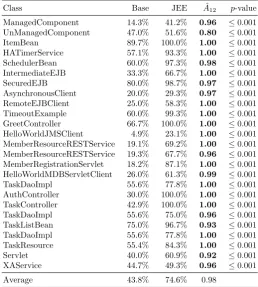
To get a better picture of the importance of handling JEE features, Table1
shows detailed data on the 25 challenging classes where JEE handling had most effect: On these classes, the average branch coverage nearly doubles from 43.8% to 74.6%. All comparisons are statistically valid (p-values very close to zero), and the average effect size for ˆA12 is nearly maximal, i.e., 0.98.
RQ:JEE support significantly increases branch coverage (average +3%), with substantial increases in JEE relevant classes.
5
Threats to Validity
Threats tointernal validity result from how the experiments were carried out. The techniques presented in this paper have all been implemented as part of the
EvoSuitetool. AlthoughEvoSuite is a mature tool used by practitioners, no
system is guaranteed to be error free. Furthermore, becauseEvoSuite is based
on randomized algorithms, each experiment has been repeated several times, and the results have been evaluated with rigorous statistical methods.
Table 1: Branch coverage comparison of EvoSuite with (JEE) and without
(Base) support for JEE, on the 25 classes with the largest increase. Note, some classes have the same name, but they are from different packages.
Class Base JEE Aˆ12 p-value
ManagedComponent 14.3% 41.2% 0.96 ≤0.001 UnManagedComponent 47.0% 51.6% 0.80 ≤0.001
ItemBean 89.7% 100.0% 1.00 ≤0.001
HATimerService 57.1% 93.3% 1.00 ≤0.001
SchedulerBean 60.0% 97.3% 0.98 ≤0.001
IntermediateEJB 33.3% 66.7% 1.00 ≤0.001
SecuredEJB 80.0% 98.7% 0.97 ≤0.001
AsynchronousClient 20.0% 29.3% 0.97 ≤0.001 RemoteEJBClient 25.0% 58.3% 1.00 ≤0.001 TimeoutExample 60.0% 99.3% 1.00 ≤0.001 GreetController 66.7% 100.0% 1.00 ≤0.001 HelloWorldJMSClient 4.9% 23.1% 1.00 ≤0.001 MemberResourceRESTService 19.1% 69.2% 1.00 ≤0.001 MemberResourceRESTService 19.3% 67.7% 0.96 ≤0.001 MemberRegistrationServlet 18.2% 87.1% 1.00 ≤0.001 HelloWorldMDBServletClient 26.0% 61.3% 0.99 ≤0.001
TaskDaoImpl 55.6% 77.8% 1.00 ≤0.001
AuthController 30.0% 100.0% 1.00 ≤0.001 TaskController 42.9% 100.0% 1.00 ≤0.001
TaskDaoImpl 55.6% 75.0% 0.96 ≤0.001
TaskListBean 75.0% 96.7% 0.93 ≤0.001
TaskDaoImpl 55.6% 77.8% 1.00 ≤0.001
TaskResource 55.4% 84.3% 1.00 ≤0.001
Servlet 40.0% 60.9% 0.92 ≤0.001
XAService 44.7% 49.3% 0.96 ≤0.001
Average 43.8% 74.6% 0.98
implementation of all the techniques presented in this paper as open-source (LGPL license), and we made it available on a public repository11
.
Threats toconstruct validity come from what measure we chose to evaluate the success of our techniques. We used branch coverage, which is a common coverage criterion in the software testing literature. However, it is hard to auto-matically quantify the negative effects of tests that do not handle dependency injection, as the presence of false positive tests on software maintenance is a little investigated topic in the literature.
Threats to external validity come from how well the results generalize to other case studies. To have a variegated set of classes showing different features of JEE, we chose the JEE examples used to demonstrate the JBoss EAP / WildFly application servers, which consist of 247 Java classes. Larger case studies on industrial systems will be needed to further generalize our results.
11
[image:14.595.176.435.163.451.2]6
Related Work
While there are numerous tools and techniques to generate unit tests for Java classes and programs, we are not aware of any work targeting unit tests for JEE classes directly.
Some of the problems caused by JEE are related to its use of databases. Emmi et al. [6] use dynamic symbolic execution to collect constraints on database queries and populate a database with data to satisfy these queries. The MODA framework [13] instruments database-driven programs to interact with a mock database instead of a real database. A test generator based on dynamic symbolic execution is then applied to insert entries into the database. A refined version of this approach [10] correlates various constraints within a database application. The code coverage increase reported by these approaches is comparable to the increases we observed in our experiments in this paper.
Besides database applications, other external dependencies such as filesys-tem [3], networking [4], or cloud services [14] have been integrated into test gen-eration, typically by making test generators configure mock objects. For some of the JEE features, the approach presented in this paper also follows this strategy.
7
Conclusions
Jave Enterprise Edition (JEE) applications pose challenges that have not previ-ously been handled by Java unit test generation tools. In order to address this problem, we have extended theEvoSuite unit test generation tool in order to
support the core JEE features of (1) dependency injection, (2) database access, and (3) JNDI object lookups. This posed several technical challenges in order to ensure that several constraints on the validity of tests are maintained at all time during the search-based test generation. These techniques are fully automated, and require no human intervention (not even to initialize/run the databases). We are aware of no other tool that handles JEE specific functionalities.
An empirical study on 247 Java classes shows that, with high statistical confidence, our techniques improve branch coverage (+3% on average), espe-cially on challenging classes heavily dependent on JEE functionalities (increase from 43.8% to 74.6%). Importantly, this approach prevents, by construction, the generation of misleading tests that throw null pointer exceptions just because dependency injections are not handled.
JEE has a very large set of specifications, and what has been addressed in this paper is just a first step. Future work will focus on handling other JEE components, like for example JMS and REST/SOAP web services. Furthermore, there is large space for improving the handling of databases, like for example extending the search to directly create objects in the database based on the class under test’s queries.
All techniques discussed in this paper have been implemented as part of the
EvoSuite test data generation tool.EvoSuiteis open-source (LGPL license)
and freely available to download. To learn more about EvoSuite, please visit
Acknowledgments. This work is supported by the EPSRC project (EP/N023978/1) and by the National Research Fund, Luxembourg (FN-R/P10/03).
References
1. Arcuri, A., Briand, L.: A hitchhiker’s guide to statistical tests for assessing ran-domized algorithms in software engineering. Software Testing, Verification and Reliability 24(3), 219–250 (2014)
2. Arcuri, A., Fraser, G.: Parameter tuning or default values? an empirical investiga-tion in search-based software engineering. Empirical Software Engineering 18(3), 594–623 (2013)
3. Arcuri, A., Fraser, G., Galeotti, J.P.: Automated unit test generation for classes with environment dependencies. In: IEEE/ACM International Conference on Au-tomated Software Engineering (ASE). pp. 79–90 (2014)
4. Arcuri, A., Fraser, G., Galeotti, J.P.: Generating TCP/UDP network data for automated unit test generation. In: ACM SIGSOFT International Symposium on the Foundations of Software Engineering (FSE). pp. 155–165. ACM (2015) 5. Collberg, C., Proebsting, T.A.: Repeatability in computer systems research.
Com-munications of the ACM 59(3), 62–69 (2016)
6. Emmi, M., Majumdar, R., Sen, K.: Dynamic test input generation for database applications. In: Proceedings of the 2007 international symposium on Software testing and analysis. pp. 151–162. ACM (2007)
7. Fraser, G., Arcuri, A.: Evosuite: automatic test suite generation for object-oriented software. In: ACM SIGSOFT International Symposium on the Foundations of Soft-ware Engineering (FSE). pp. 416–419. ACM (2011)
8. Goncalves, A.: Beginning Java EE 7. Apress (2013)
9. Pacheco, C., Lahiri, S.K., Ernst, M.D., Ball, T.: Feedback-directed random test generation. In: ACM/IEEE Int. Conference on Software Engineering (ICSE). pp. 75–84 (2007)
10. Pan, K., Wu, X., Xie, T.: Guided test generation for database applications via synthesized database interactions. ACM Transactions on Software Engineering and Methodology (TOSEM) 23(2), 12 (2014)
11. Prasetya, I.S.W.B.: T3i: A Tool for Generating and Querying Test Suites for Java. In: ACM SIGSOFT International Symposium on the Foundations of Software En-gineering (FSE) (2015)
12. Sakti, A., Pesant, G., Gueheneuc, Y.G.: Instance generator and problem represen-tation to improve object oriented code coverage. IEEE Transactions on Software Engineering (TSE) (2015)
13. Taneja, K., Zhang, Y., Xie, T.: Moda: Automated test generation for database applications via mock objects. In: IEEE/ACM International Conference on Auto-mated Software Engineering (ASE). pp. 289–292. ACM (2010)