Full Terms & Conditions of access and use can be found at
http://www.tandfonline.com/action/journalInformation?journalCode=cres20
Download by: [University of Sheffield] Date: 06 October 2017, At: 06:46
ISSN: 0034-3404 (Print) 1360-0591 (Online) Journal homepage: http://www.tandfonline.com/loi/cres20
Territory, power and statecraft: understanding
English devolution
Sarah Ayres, Matthew Flinders & Mark Sandford
To cite this article: Sarah Ayres, Matthew Flinders & Mark Sandford (2017): Territory, power and statecraft: understanding English devolution, Regional Studies, DOI: 10.1080/00343404.2017.1360486
To link to this article: http://dx.doi.org/10.1080/00343404.2017.1360486
© 2017 The Author(s). Published by Informa UK Limited, trading as Taylor & Francis Group
Published online: 07 Sep 2017.
Submit your article to this journal
Article views: 483
View related articles
Territory, power and statecraft: understanding English
devolution
Sarah Ayres
a, Matthew Flinders
band Mark Sandford
cABSTRACT
In recent decades, the devolution of power to subnational regional authorities has formed a key element of what has been termed the‘unravelling’or‘unbundling’of the state in many parts of the world. Even in the United Kingdom, with its distinctive global reputation as a power-hoarding majoritarian democracy, the devolution of powers to Scotland, Wales and Northern Ireland since 1998 can be located within this broader devolutionary dynamic. In recent years, this process has focused on ‘the English question’and a reform agenda that claimed to offer a‘devolution revolution’. This paper offers the first research-led analysis of the scope, scale and implications of these post-2015 reforms to English governance. It utilizes Jim Bulpitt’s statecraft approach to explore the changing nature of centre–periphery relationships within England. The main conclusion has been that a‘rhetoric–reality gap’currently exists and a‘devolution revolution’ has not occurred.
KEYWORDS
governance; statecraft; devolution; England; power; Jim Bulpitt
JEL D7, G38, H7, R5
HISTORY Received 5 October 2016; in revised form 3 July 2017
INTRODUCTION
Over recent decades, many countries have witnessed the decentralization of state functions in the form of both pol-itical devolution and administrative deconcentration (Asthana,2013). Hooghe et al. (2016), for example, assert that there has been a global trend towards decentralization. Of the 52 countries they examined, two-thirds have wit-nessed an increase in their levels of regional authority. Such restructuring is viewed by commentators as a response to a variety of pressures including managing distinct subna-tional identities and cultures (Tang & Huhe,2016), miti-gating economic diversity (Martin, Pike, Tyler, & Gardiner, 2016), relieving the political and bureaucratic burden associated with centralization (Organisation for Economic Co-operation and Development (OECD),
2015), and changing political views on the contribution of decentralization to achieving economic and social pol-icies (Hambleton, 2015; Jessop, 2016). In recent years the UK has witnessed far-reaching devolutionary reforms to Scotland, Wales and Northern Ireland and the
introduction of an elected Mayor and Assembly in London (Flinders,2009; Sandford,2016b). And yet the paradox of these devolutionary measures was that (1) they were intro-duced withinthe constitutional parameters of the West-minster Model; and (2) they were periphery focused in geographical terms with little obvious thought to how by far the largest constituent nation of the UK (i.e., England) might be included. In May 2015, a Conservative govern-ment was elected with manifesto commitgovern-ments‘to devolve powers and budgets to boost local growth in England’ (Conservative Party, 2015, p. 1). Since then the govern-ment has rapidly initiated a potentially far-reaching reform agenda, statutorily underpinned by the Cities and Local Government Devolution Act 2016.
The aim of this paper is to analyze whether the post-2015 reforms to English governance have transformed centre–periphery relationships, and whether the approach of the current Conservative government is markedly differ-ent to that employed by previous UK governmdiffer-ents. It draws upon the analytical framework and historical lens developed by Jim Bulpitt in hisTerritory and Power in the
© 2017 The Author(s). Published by Informa UK Limited, trading as Taylor & Francis Group
This is an Open Access article distributed under the terms of the Creative Commons Attribution License (http://creativecommons.org/licenses/by/4.0/), which permits unrestricted use, distribution, and reproduction in any medium, provided the original work is properly cited.
CONTACT
a(Corresponding author)
[email protected] School for Policy Studies, University of Bristol, Bristol, UK. b
m.flinders@sheffield.ac.uk
Department of Politics, University of Sheffield, Sheffield, UK. c
[email protected] House of Commons Library, London, UK.
United Kingdom(1983). Bulpitt adopted the controversial position that the study of UK territorial politics had over-emphasized the role of ideas and ideology, to the detriment of a far more basic focus on the art of governing and prac-tical politics–what he calledstatecraft. Crucially, he sought to examine territorial relations through a historical analysis of territorial politics in the UK and from the perspective of central government. For Bulpitt, territorial politics has been characterized by the relationship between the‘centre’ and‘periphery’. The centre is defined as a‘political admin-istrative community of senior ministers and top civil ser-vants’ and ‘the periphery, or country, was usually, from the centre’s viewpoint, all other places’(p. 3). He makes a distinction between ‘high politics’and ‘low politics’. The former involve matters that are regarded as primarily the responsibility of the centre and might include, for example, macro-economic policy and tax-raising powers. The latter covers those residual matters that in normal circumstances could be left to interests on the periphery. Bulpitt argued that the centre’s operational code is determined primarily by its desire for autonomy over high politics and the reci-procal granting of control to the periphery over low politics. He described the separation of powers between centre/per-iphery and high/low politics as a‘Dual Polity’(p. 3). Much of what shapes territorial politics could be explained by challenges to the dual polity equilibrium and the response of the centre. His framework has great contemporary rel-evance in that it offers a historically grounded framework to capture the challenges and changes in centre–periphery relations in England.
The analysis presented in this paper draws upon the findings of three research projects undertaken between March 2015 and August 2016. The core conclusion is that English governance sitswithina well-established fra-mework of centre–periphery relationships. Claims regard-ing the ‘revolutionary’ nature of this agenda are not therefore sustainable. What is identified is the emergence of an increasingly complex institutional landscape across England, lack of public engagement or public understand-ing, and even a pushback from local actors as the impli-cations of the government’s agenda become clearer.
Thefindings in this paper draw attention to the impor-tance of understanding the‘politics’shaping the trajectory of English devolution. The paper makes a distinct contri-bution to the political science and regional studies literature in three distinct ways. First, by exploring the codes, strat-egies and resources employed by key actors to shape Eng-lish local governance, it provides clarity on the political imperatives underpinning current devolution reforms. Second, it offers an intriguing insight into how institutions actually work and what drives territorial reform in the UK. Third, it explores how political momentum and control ebbs and flows in the policy process and why this makes territorial reform in England so challenging. This contri-bution has broader international implications for the analy-sis of territorial politics, multilevel governance and executive politics.
The paper is structured as follows. The next section provides a brief descriptive account of the evolution of
English devolution policy, which highlights the long-term absence of any clear constitutional vision. Then it out-lines Bulpitt’s ‘statecraft approach’ to understanding centre–periphery relationships and argues that it has much to offer a contemporary analysis of UK territorial politics. The third section sets out the paper’s methodo-logical approach, while the fourth section presents the empirical analysis, reflecting the core themes in Bulpitt’s thesis: governing codes, political resources and governing strategies. This supports the core conclusion that the‘ devo-lution revodevo-lution’should actually be interpreted as a con-tinuation of the dual polity equilibrium that has characterized UK territorial politics for at least half a cen-tury. Thefinal section reflects upon the broader empirical and theoretical implications of this argument.
CONTEXT
England has been a landscape of almost permanent admin-istrative reconfiguration and rescaling during the second half of the 20th century (e.g., Banks, 1971; Garside & Hebbert,1989; Mawson & Bradbury,2006). Devolution in Scotland, Wales and Northern Ireland was associated with identity and democratic representation, and the devo-lution debate in those areas has been founded upon the cre-ation of strong subncre-ational institutions with democratic elections, significant policy responsibilities and accepted status within the unwritten UK constitution. This bot-tom-up public pressure has been almost entirely absent within England. Over at least the past 50 years, UK gov-ernments of various colours have sought to deconcentrate powers and functions to regional or local tiers of govern-ment. The Labour governments of the 1960s established regional economic and planning councils for nine regions in England. These developed a considerable intelligence capacity but lacked political and economic clout, eventually being abolished in 1979 (Hogwood & Keating, 1982). Under the Margaret Thatcher Conservative governments, private-sector, geographically focused urban development corporations were used to catalyze economic development in deprived urban areas. Spatial scales shifted again in 1992–94 with the creation of nine government offices for the English regions to coordinate bids for European Union funding along with numerous strands of develop-ment funding from central governdevelop-ment.
The Tony Blair and Gordon Brown New Labour gov-ernments sought to draw together the constitutional/terri-torial dimension of the ‘English question’, but in practice their policy was equivocal in its effect. Deputy Prime Min-ister John Prescott drove the establishment of regional development agencies (RDAs), alongside expanded gov-ernment offices for the regions, and ‘regional chambers’ bringing together local government leaders and regional stakeholders. The ultimate aim was the introduction of elected assemblies in the regions of England. However, a first referendum, in the North East, saw an elected body rejected by a large margin in November 2004, and the pol-icy was quietly abandoned. In 2007, the‘regional chambers’ were replaced with‘local authority leaders’boards’(Ayres &
Stafford, 2009), and government policy began to shift towards city-regions and functional economic areas (FEAs) (Ward, Deas, Haughton, & Hincks, 2015). Thus, successive governance ‘solutions’ within England have been imposed by the centre, and have been driven purely by an economic/technocratic outlook (Tomaney,
2016). Devolution in Scotland, Wales and Northern Ire-land constituted a break with the practice of‘ power-hoard-ing majoritarianism’ by the UK central government, but this remains in place with regard to England (Rees & Lord,2013; Richards & Smith,2015). Since 2010, local areas have enjoyed greater discretion over the formation of supra-local governance and partnership arrangements (Pugalis & Townsend, 2013; Waite, MacLennan, & O’Sullivan, 2013), but this has not been accompanied by the transfer of additional power.
The current English devolution policy initially hinted at a move away from this impasse. It evolved during George Osborne’s term as Chancellor of the Exchequer (May 2010–July 2016). It eschewed a constitutional approach: the new policy cast devolution more as a functionally effi -cient means to achieve agreed policy outcomes. This served both to challenge local areas to articulate their desired out-comes instead of entitlements to‘powers’, and to reassure central government participants that they would retain some control when power was devolved (Political Studies Association (PSA),2016). The early focus was upon‘city deals’, negotiated between the government and local repre-sentatives of FEAs, twinned with competitive bid-based funding of specific development and regeneration projects. But doubts persisted about the degree to which these shifted power and responsibility (Pike & O’Brien,2015).
In response to growing stakeholder and think-tank sup-port (e.g., City Growth Commission,2014; Cox, Hender-son, & Raikes,2014; Morrin & Blond,2014), city-deals were overtaken by a series of ‘devolution deals’. These began with the Greater Manchester Agreement in Novem-ber 2014. They have consisted mostly of pan-urban‘ com-bined authorities’with directly elected mayors managing a spread of new powers and programmes (Gains, 2016; Pike, Coombes, O’Brien, & Tomaney,2016).
To date, as Table 1 illustrates, a number of other devo-lution deals have been agreed between central government and specific English localities, with six‘city-region’mayors expected to be elected in May 2017. However, central–local relations surrounding the process have frequently been fraught, and a number of deals have collapsed after being agreed. A deal for the large rural area of East Anglia was split in two (Cambridgeshire/Peterborough and Norfolk/ Suffolk); several small district councils in Norfolk rejected the successor deal, and the government withdrew support. Similar events played out in Greater Lincolnshire, driven in large part by the requirement for directly elected mayors– an unofficial deal breaker for the government. One partici-pant in a successful deal area described the mayoralties as‘a price worth paying’ (Lord Peter Smith; House of Lords Hansard, 22 June 2015, c1412). Areas that sought alterna-tive governance arrangements for devolution arrangements simply found that no deal was forthcoming. The then Chancellor, George Osborne, stated that‘I will not impose this model on anyone: but neither will I settle for less’ (Osborne,2015).
Thus, central preferences were decisive in determining the structures through which locally devolved powers were to be exercised. This was allied to opaque and largely secret deal negotiations, also the subject of considerable cri-tique (Lyall, Wood, & Bailey, 2015; Prosser, Renwick, Giovannini, Sandford, & Flinders, 2017; Sandford,
2016b). Participants may have perceived this too as a price worth paying to obtain new powers, but it stymied the process in a number of localities. Research has also indi-cated that the scope of devolution was firmly limited in practice by government priorities (Communities and Local Government Committee,2016; PSA, 2016; Sand-ford, 2016b). At the time of writing, the prognosis that devolution deals provide a successful formula for devolving power in England is, therefore, under challenge.
The new mayors will take office in the context of sig-nificant cuts to local public spending (Innes & Tetlow,
[image:4.595.57.289.522.787.2]2015; National Audit Office (NAO), 2016), and the departure of Osborne, architect of the ‘Northern Power-house’agenda that provided the backdrop to many deals, from the government in July 2016. This makes under-standing the forces underpinning developments in English governance even more timely, especially in relation to the territorial dynamics and constitutional forces that may have (intentionally or unintentionally) been unleashed. As Tony Wright has argued, constitutional reforms in the UK are generally not explosive or revolutionary but gener-ally occur through the gradual widening of initial‘cracks’in policy areas:‘It is a“crack”that provides space for“wedges” Table 1.Devolution deals to date.
Devolution deal agreed
Greater Manchester 3 November 2014, 27 February 2015, 8 July 2015, 25 November 2015, 16 March 2016
Sheffield City Region 5 October 2015, 12 December 2014, mayoral election postponed to 2018
West Yorkshire 18 March 2015
Cornwall 27 July 2015, no elected mayor North East 23 October 2015 (rejected) Tees Valley 23 October 2015
West Midlands 17 November 2015
Liverpool City Region 17 November 2015, 16 March 2016
Cambridgeshire/ Peterborough
20 June 2016
Norfolk/Suffolk 20 June 2016 (rejected) West of England 16 March 2016
Greater Lincolnshire 16 March 2016 (rejected)
Source: Authors’own.
that extend [what] has already been achieved’ (Wright,
2004, p. 870).
The question arises whether, after 50 years of impo-sition of territorial‘solutions’on England by central govern-ment, the latest generation of devolution policy can be a ‘crack’ that leads to more enduring shifts in governing relationships between English localities and the UK gov-ernment. Scotland, Wales and Northern Ireland have seen substantial change in their relations with the UK centre, culminating in their recognition in statute as perma-nent institutions (a significant, if purely declaratory, devel-opment). By contrast, analysis of central–local relationships in England has often been crowded out by updates on the rapid developments in devolution deals (for a detailed review, see Sandford, 2016a). In order to move beyond description, it is necessary to place recent events within a conceptual and theoretical framework that is historically attuned to the British political tradition. Thus, the next sec-tion outlines Bulpitt’s statecraft theory, which is capable of exploring the embeddedpolitics of devolutionin the sense of the codes, strategies and resources through which new centre–periphery relationships are negotiated.
THEORY
This section outlines the core elements of Bulpitt’s frame-work and explains how it can be utilized in relation to
contemporary developments. It also situates Bulpitt within the broader regional studies literature on English devolu-tion to demonstrate both its complementarity and capacity to advance our understanding.
Bulpitt’s framework
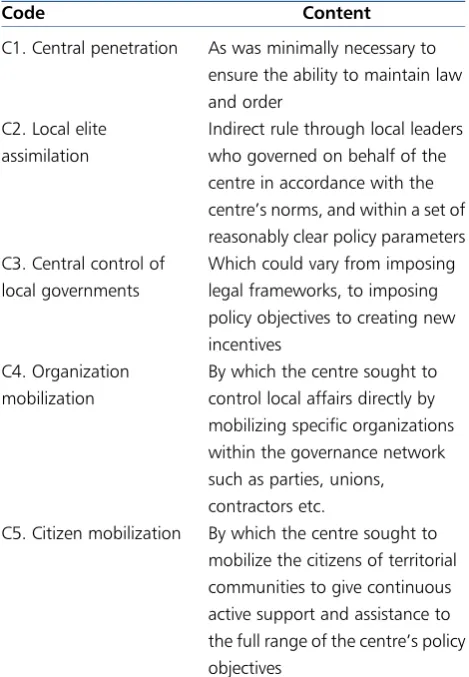
Bulpitt’s framework identifies options in relation to govern-ing codes,political resources andgoverning strategies, which can generally be used to identify one of four broadmodels of centre–periphery relations. Bulpitt ascribes analytical pri-macy to ‘the Court’, a small number of individuals that form the decision-making political elite. As rational actors, they will be primarily focused on‘the art of winning elec-tions and achieving some necessary degree of governing competence in office’(Bulpitt,1986, p. 21): that is, state-craft. Winning elections and displacing blame are the pri-mary drivers of any decision-making calculation and in this regard‘governing codes’play a crucial role. Governing codes form a set ofrelatively coherent principles or rules underlying policies and policy-related behaviour and five were identified (Table 2).
On resources:
he suggested that a centre aspiring to dominance would seek a hegemonic unionist culture, a constitution that obstructed periphery articulation, a bureaucracy with strong territorial penetration, a mass party system controlled by central poli-ticians, the economic resources necessary to dispel territorial deprivation and time to devote to peripheral politics.
(Bradbury,2006, p. 567)
These resources are elaborated further in Table 3. If one assumes that the centre is aiming for maximum possible control of the periphery, Bulpitt suggests that ‘it will need to possess most (just how many is not clear) of [these] resources’(Bulpitt,1983, p. 63).
[image:5.595.56.291.444.783.2]In terms of implementing and sustaining a territorial code, the national government could adopt a ‘hands off’ Table 2.Bulpitt’s codes of territorial management.
Code Content
C1. Central penetration As was minimally necessary to ensure the ability to maintain law and order
C2. Local elite assimilation
Indirect rule through local leaders who governed on behalf of the centre in accordance with the centre’s norms, and within a set of reasonably clear policy parameters C3. Central control of
local governments
Which could vary from imposing legal frameworks, to imposing policy objectives to creating new incentives
C4. Organization mobilization
By which the centre sought to control local affairs directly by mobilizing specific organizations within the governance network such as parties, unions, contractors etc.
C5. Citizen mobilization By which the centre sought to mobilize the citizens of territorial communities to give continuous active support and assistance to the full range of the centre’s policy objectives
[image:5.595.306.542.587.791.2]Source: Authors’own, derived from Bulpitt (1983).
Table 3.Bulpitt’s classification of political resources.
Resources
R1. A hegemonic unionist culture, influencing peripheral bureaucrats, political leaders and citizens
R2. A constitution that obstructs, or does not positively assist, the articulation of peripheral interests
R3. An effective central bureaucratic machine with an extensive presence on the periphery
R4. A mass party system controlled by politicians at the centre, which can be used as an instrument to control peripheral politics
R5. The ability to manage the overall economy so that peripheral interests rarely perceive any intense degree of economic deprivation
R6. Sufficient time to devote to peripheral politics so that the centre is not preoccupied with other affairs
Source: Authors’own, derived from Bulpitt (1983).
laissez-faire strategy, which implies‘an indifference to con-trol over economic and social responsibilities’ (Bradbury,
2006, p. 567). It might adopt a ‘hands on’ promotional strategy that necessitates central intervention, but which can be costly. Finally, an arm’s-length regulatory strategy involves governing at a distance and may have contractual characteristics (Table 4). A key issue to note is that differ-ent sections of the same cdiffer-entral governmdiffer-ent departmdiffer-ent often possess different strategic intentions that can change over time (Ayres & Stafford,2014).‘Moreover, the centre may adopt different strategies in different peripheries, and the intentions as listed may be designed to produce differ-ent results’(Bulpitt,1983, p. 63).
This mixture of codes, resources and strategies led Bul-pitt to identify four broad models of centre–periphery relations (Table 5).
The central autonomy model (M1) seeks to produce a structure of territorial politics in which the centre is pre-pared to allow considerable‘operational autonomy to per-ipheral governments and political organizations, so long as they do not challenge its autonomy over matters of ‘High Politics’(p. 65). This assumes a capacity on behalf of‘the Court’to insulate the centre from peripheral pen-etration on matters of importance. Thecapital city bargain-ing model(M2) suggests more‘interference in the centre’s affairs but often in a cooperative fashion and generally only on issues of interest to the periphery’ (Bradbury,
2006, p. 568). Thecentral authority model(M3) describes a situation whereby there may be some periphery support for the centre’s mandate but there is a consistent need for continuous central assertion in the periphery. Finally, the
coercive power model(M4) involves systematic central inter-vention and use of threats. However, this model is resource intensive, unstable and not democratically desirable.
The nature of the specific relationship or model owed less, according to Bulpitt, to ideology and more to pragmatic politics–orstatecraft–and the need to adopt an efficient and proportional relationship. This was demonstrated through a historical methodology that identified several stages of centre–periphery relations in the UK. Using this framework Bulpitt provided‘the long view’of the UK’s territorial poli-tics and identified‘the central autonomy model’(Table 5, M1) as the dominant model of centre–periphery relations for at least three centuries. British territorial management was therefore a history of continuity rather than change based around a‘dual polity’whereby the national govern-ment preferred to concentrate on‘high politics’. Analyses of Scotland, Wales and Northern Ireland through a Bulpit-tian framework have concluded that the central autonomy model remains dominant there despite the strength of devolved powers (Bradbury, 2006; Convery, 2014). Our Bulpittian analysis continues in this historical and qualitat-ive vein to look at the political imperatqualitat-ives shaping the most recent chapter in English territorial governance.
Bulpitt’s contribution to the regional studies literature on English devolution
Our analysis contributes to ongoing and pertinent debates in the regional studies literature. Below, we illustrate this by drawing on a number of recent studies that have particular significance for Bulpitt. These studies are relevant because they deal directly with territorial management and two key facets central to the current devolution deal debate, i.e., drives to boost economic development and attempts to reduce spatial disparities. They also highlight the impor-tance of historical context, the path dependent nature of territorial management and the centrality of statecraft in managing centre–periphery relations. The following dis-cussion explores the connection between our Bulpittian analysis and this body of work in the regional studies literature.
[image:6.595.59.290.102.161.2]Pike et al. (2016), for example, recognize the impor-tance of historical context and institutional legacies in shaping pressures for territorial change and continuity. In their recent analysis of the abolition of RDAs in England they explore how actors in particular political and economic contexts shape and negotiate transitions to new territorial arrangements. Likewise, Rees and Lord (2013) suggest that the creation of local enterprise partnerships (LEPs) in city-regional areas in the early 2010s in England was ‘as much about therealpolitikoffinding workable govern-ance arrangements and consonant political objectives as they were about uncritically following economic logic’(p. 684). Like Bulpitt, they recognize the pivotal role of critical actors at the centre and how politics serve to shape territor-ial reform over a more evidence-based approach. Their Table 4.Bulpitt’s governing strategies.
Strategies Characteristics
S1. Hands off Laissez-faire
S2. Hands on Promotional
S3. Arm’s length Regulatory
Source: Authors’own, derived from Bulpitt (1983).
Table 5.Bulpitt’s models of centre–periphery relationships.
Model Essence
M1. Central autonomy model
Postulates a centre seeking and gaining autonomy from peripheral forces to concentrate on what it regards as‘high politics’ M2. Capital city
bargaining model
In which peripheral groups and governments articulate, defend and satisfy their interests within the institutional complex of the centre M3. Central authority
model
The centre achieves its aims because peripheral citizens, politicians and officials accept it has a legitimate right to demand their cooperation and acquiescence
M4. Coercive power model
Centre–periphery relations are characterized by systematic central intervention and use of threats
Source: Authors’own, derived from Bulpitt (1983).
[image:6.595.56.291.550.784.2]qualitative analysis, based on the views of key insiders, offers an illuminating account of English territorial reform from the perspective of those closest to the process.
Pike, Rodriguez-Pose, and Tomaney (2017, p. 47) ‘trace the evolution of thinking about local and regional development in order to situate current debates in their sometimes neglected historical context’. While Bulpitt takes a historical political stance steeped in the British tra-dition, Pike et al. explore territorial rescaling in a global context by drawing on international literature on macro-economic factors, such as global financial flows and agglomeration economies, and the roles of creative individ-uals and networks in shaping place and territory. Theyfind that, despite calls for a common theoretical language on local and regional development, there are‘highly variegated international practices and experiences’ (p. 47). Martin et al. (2016) examine English governance by examining the persistence of spatial inequalities and the challenges of rebalancing the economy. They do so from a spatial economic perspective. Like Pike et al. (2017) and Bulpitt, they also take a historical perspective, examining economic growth data from 1871 to conclude that spatial economic imbalances, most notably between the north and south of England, are deeply rooted in the highly‘centralized nature of the national political economy’ (Martin et al., 2016, p. 342). They conclude that‘only a bold and radical change in that political economy – based on a devolution and decentralization of economic, financial and political power – is called for’ (p. 342). While it is too early to pass judgement on the eventual impacts of the current devolution deals, our Bulpittian analysis offers a valuable insight into whether the Conservative government’s devo-lution plans represent early evidence of the radical change that Martin et al. call for in their recent work.
The issue about entrenched UK government positions and the path-dependent nature of English territorial man-agement is also identified by Harrison (2007) and Ether-ington and Jones (2016). Harrison (2007) explores the inability of spatial reforms in England to deal with the pro-blems of rebalancing the UK economy, inequality and spatial injustice. He concludes that‘the spatial and scalar reorganisation of the state from one scale to another–in this case from the region to the city-region–merely dis-tracts attention away from the state’s inability to manage the capitalist tendency for uneven development’(p. 328). In a similar vein, Etherington and Jones (2016) explore the failure of more recent spatial reforms around the devo-lution deals and localism to deal with spatial inequalities. Like Harrison, they conclude that ‘failure arises because of the primacy of a neoliberal-dominated strategy orien-tated towards the market’ (p. 371). Interestingly, they draw on notions of governance and metagovernance failure as important to understanding both the limitations to and contradictions of devolution and city-region building in England. They argue that:‘Metagovernance–the“ govern-ment of governance” through “over-seeing, steering, and coordinating governance arrangements” (Bell and Hind-moor,2009: 11)–has received minimal detailed attention in urban and regional studies’(p. 373).
Bulpitt’s focus onstatecraftequates to this description of metagovernance. In his account, theCourtseeks to manage the separation of powers between centre/periphery and high/low politics by creating what it views as the right environment or arena for doing business. Below we argue in detail that the evidence from English devolution deals backs up Bulpitt’s perspective: but we also argue that aspects of the evidence point towards a shift in the UK gov-ernment’s approach to metagovernance. Our detailed analysis of the UK government’s codes, resources and strat-egies complements the valuable work of Etherington and Jones (2016) and advances our understanding of the meta-governance of English devolution.
This paper offers a detailed Bulpittian analysis of Eng-lish governance since 2015. It achieves this by deriving three central research questions (RQs) from Bulpitt’s state-craft approach:
RQ1. What territorial management code has shaped English devolution under the current Conservative government?
RQ2. What political resources are being invoked to promote the governing code?
RQ3. What governing strategies are being pursued to implement the governing code?
These questions facilitate the presentation of the research findings and underpin the core argument: that the post-2015 devolution reforms should be understood as a con-tinuation of‘the central-autonomy model’(Table 5, M1).
METHODS
The evidence presented in this paper has been collected through three research projects conducted between March 2015 and August 2016. Key data and findings from across the three datasets were triangulated to ensure the validity and reliability of the findings presented. This involved verifying core observations using data emanating from all three projects. The first project (P1) examined the role of informal governance on devolution to England’s cities since May 2010. It included a detailed literature review, 14 face-to-face interviews in December 2015 and a focus group involving 18 senior devolution stakeholders in January 2016. The interviews and focus group involved seniorfigures in (1) central and (2) local government, (3) prominent think tanks and (4) research bodies (PSA,
2016).
The second project (P2) was an Economic and Social Research Council (ESRC)-funded project that focused on devolution to two English regions (South Yorkshire and Hampshire/Isle of Wight). This project received face-to-face comments from 37 expert witnesses including officials, policy-makers, special advisers, former ministers and serving politicians from local and central government. It adopted a comparative case design whereby one ‘pure’ assembly (Assembly North) consisted of 32 members of the public; and one ‘mixed’ assembly (Assembly South)
consisted of 23 members of the public and six politicians (for a full methodological statement and analysis, see Crick Centre, 2016). The insights from P1 and P2 are used to inform and substantiate the analysis and argument offered in this paper. The final project (P3) tracked the devolution deals that were announced (and often amended) during 2015 and 2016 and also analyzed a vast set of pri-mary governmental reports, ministerial statements, parlia-mentary papers, plus ‘grey literature’ from think tanks, consultants, professional peak organizations etc. This pro-ject was based within the House of Commons Library and ensured that the other projects were informed by the very latest and up-to-date information.
RESEARCH FINDINGS
This section draws upon the data andfindings collected in the three research programmes discussed in the methods section, and structures them around the statecraft frame-work that was the focus of the theory section in order to delineate the dominant model of centre–periphery relation-ship and therefore the extent of change.
RQ1. What territorial management code has shaped English devolution under the current Conservative government?
Findings indicate that the governing code is one of‘central control of local governments’ (Table 2, C3) but with elements of‘local elite assimilation’(C2) and weak‘citizen mobilization’ (C5). C3 is framed around imposing legal frameworks, policy objectives or creating new incentives. In this context the devolution deals are really little more than a new form of top-down control whereby new incen-tives are offered (primarilyfinancial or related to policy dis-cretion) within‘the shadow of hierarchy’. Thus, the text of the deals will govern the central–local relationship, and sta-keholders at the focus group (P1) were in agreement that central government was dictating how this ‘text’ was to be developed. While senior Department for Communities and Local Government (DCLG) and HM Treasury offi -cials outlined a ‘desire to devolve as much as possible to local areas’ they also recognized that power and control was to be ‘granted by central government and not taken from it’(P1). A senior official from a think tank suggested that the guidelines for developing deals‘were purposefully vague and light touch to provide the government with the wriggle room required to seek the outcome they wanted’(P1).
Lack of formal or written guidance affords repeated opportunities for the enforcement of the centre’s norms, and this has become more systematic in more recent deals. For instance, the West Midlands deal, signed in November 2015, states that it will ‘develop a business case for an innovative pilot to support those who are hard-est to help. The business case should set out the evidence to support the proposed pilot, cost and benefits and robust evaluation plans… ’(HM Treasury,2015b, p. 11). A num-ber of ‘readiness conditions’ are stipulated for the West Midlands to take on 19+ skills funding, including the
completion of a joint ‘area review process’and finalizing of risk-sharing arrangements. More recently, the three March 2016 deals include a provision for the authority:
[to] develop a full implementation plan, covering each policy agreed in this Deal, to be completed ahead of implemen-tation. This plan will include the timing and proposed approach for monitoring and evaluation of each policy and must be approved by the DCLG Accounting Officer.
(HM Treasury,2016, p. 20)
Other elements of this governing code involve a degree of ‘local elite assimilation’(C2), largely through appointments to the LEPs that have spearheaded centre–periphery nego-tiations on the part of localities (NAO, 2016; Pike et al.,
2016). Deal negotiations were generally conducted in secret between LEP representatives, council leaders and the government. The publication of thefinal deal was the first point at which most local councillors, stakeholders and members of the public knew about the agreement (Blunkett, Flinders, & Prosser, 2016). Indeed, this view is confirmed by Kenealy (2016, p. 1) who claims that in the Manchester deal, for example, ‘key decisions were taken quickly and by a small number of key officials’. The vast majority of interviewees referred to a ‘streamlined and closed process’(P1, local government official) whereby central and local actors could exert strong leadership (Bent-ley, Pugalis, & Shutt,2016). Interestingly, the majority of respondents in P1 research expressed their support for closed discussions and process-light arrangements. As an HM Treasury official indicated, ‘something is lost if you try to standardize process too much. In many instances informality has afforded stakeholders the right environ-ment to broker deals for their areas’(P1).
Members of the public were–unsurprisingly–far less impressed with a dominant governing code that seemed to operate through a set of informal, secretive, elite-to-elite relationships. This was a corefinding of P2 where members of the citizens’assemblies overwhelmingly voted in favour of greater public participation in order to legitimate the devolutionary processes. More specifically, when able to decide and then vote upon the key priorities for the new devolved governance arrangements ‘public engagement and transparency’emerged as a leading issue (Crick Centre,
2016, p. 33). Furthermore the analysis of subsequent rejec-tions of‘deals’by local councils–such as North Somerset, Gateshead, Erewash, Norwich, Breckland, Great Yar-mouth etc. – suggests that a concern regarding public engagement or‘the missing link in the devolution debate’ (Bailey, Lyall, & Wood, 2015) has eroded confidence in the reforms (Hammond,2016). An official from a leading think tank opined:‘there is a very real chance that devolu-tion deals will fall apart at the implementadevolu-tion stage with-out the commitment from a broader range of stakeholders’ (PI). And yet –paradoxically –a weak strain of ‘citizen mobilization’ (C5) runs through the government’s plans, as a commitment to accept a directly elected mayor was generally a government requirement for the granting of a deal (HM Treasury,2015a, p. 1).
Two other features of the process resonate with Bul-pitt’s characterization of centre–periphery relations in the UK. Thefirst relates to Bulpitt’s focus on ‘Court politics’ and the small number of key individuals that form the decision-making political elite. In relation to post-2015 English devolution, the‘Court’was very small with the pol-icy being personally associated with and driven by one per-son: George Osborne (Ayres, 2017). This might explain the manner in which several Whitehall departments – e.g., the departments for Education and Skills and Work and Pensions–seemed reluctant to engage in devolution-ary discussions and why negotiations over specific policy areas (e.g., housing, pre-16 education etc.) often ended abruptly. This variation in Whitehall commitment to pol-icies was a key element of Bulpitt’s analysis as he empha-sized how different departments may have very different strategic intentions, and that these may ebb andflow over time (Pike & O’Brien,2015).
A second issue relates to‘blame games’and‘blame dis-placement’, which Bulpitt saw as a key factor in central gov-ernment’s selection of a governing code. In the context of far-reaching public sector budget cuts a number of intervie-wees (P1) and assembly members (P2) viewed the deals as an attempt to devolve responsibility for making unpopular cuts to public services. Likewise, a DCLG official outlined ‘the two acid tests for deal proposals are that local areas can do it cheaper and better than the centre’(P1). This raises the question of why local authorities would risk becoming a lightning rod for centrally imposed public cutbacks in return for relatively modestfinancial and policy incentives. The answer can be found in Wright’s (2004)‘cracks and wedges’ thesis. Local authority leaders have consistently suggested that the importance of the deals lays not in their current initial content but in their potential to evolve into a quite different relationship in the future. For example, a recent Localis and Grant Thornton (2015, p. 16) report a local authority official described the devolution deal process as ‘the most positive negotiating experience I’ve ever had. The government genuinely tried to do this in partnership. The civil service is on board… ’. This view was echoed by a number of local government respon-dents during interviews (P1 and P2) and the focus group (P1). English localities were therefore adopting a pragmatic position based on therealpolitikthat (1) local authorities are under increasingfiscal pressure, (2)‘this was the only deal on the table’ (local government official, P1) and (3) the constitutional balance of power and resources lies firmly in the hands of the centre.
RQ2. What political resources are being invoked to promote the governing code?
Evidence suggests that all the resources identified by Bul-pitt (Table 3) are still available to the centre in England (though they have weakened considerably in recent years in relation to Wales, Northern Ireland and especially Scot-land). However, they are not being used as assiduously as in previous eras; and this has opened the door for a weakening
of the central autonomy approach. The resources are exam-ined in turn.
The existence of a ‘hegemonic unionist culture’ (R1) seems to have waned (Mitchell, 2002). Political disputes in England are mostly refracted through traditional party politics and cleavages of class and economics, not through territorial claims. But a ‘hegemonic culture’could also be interpreted as an acceptance by local areas of the govern-ment’s narrative of the role and purpose of English devolu-tion. This lies behind the assumption that local areas seeking devolution must ‘give the confidence to devolve’ (Localis & Grant Thornton,2015, p. 32), by demonstrat-ing how they can deliver improved outcomeswithin the fra-mework of the government’s approach. A local government official (P1) described ‘building relationships and assur-ances with central government as critical to securing a deal’. Bulpitt’s (1983, p. 63) second requirement is a consti-tution which ‘does not positively assist the articulation of peripheral interests’ (Table 3, R2). There are no formal mechanisms of intergovernmental relations within Eng-land, and no representative apparatus such as an upper house of parliament. Local authorities compete with mem-bers of parliament to articulate local interests and their influence is dependent on the quality of their relationship with Whitehall (Wills,2016). Thus, the central autonomy model continues to dominate on paper. But there is evi-dence that the devolution deal process has constituted a limited break with this orthodoxy. Local participants have reported that it is thefirst genuine attempt to transfer power that they had been involved in (Cox & Hunter,
2015). Central and local government interviewees described ‘relationships as far more collaborative and less adversarial than in the past’ (central government official, P1), and there is evidence of some localities pushing back against central demands (see below). A senior official from the Greater Manchester Combined Authority described their relationship with the centre as based on ‘mutual understanding and shared goals’(P1), although it was clear from the focus group that not all localities shared this positive experience (Henderson,2015).
The question of a‘central bureaucratic machine’(R3) as a mechanism of governance is more nuanced. A recurring theme from interviewees in both central and local govern-ment was a concern that central governgovern-ment lacks the resources to negotiate and monitor increasing numbers of devolution deals (P1). This would hinder the functioning of a central autonomy model, but some local respondents also saw a lack of central resources as a threat to devolution: it could affect (1) the quality of central–local negotiations, (2) the ability to explore more innovative and creative pos-sibilities, and what one local government respondent referred to as (3)‘parity of opportunity if not parity of out-comes to all areas’(P1). One view mooted by a number of interviewees was the need to strengthen the‘local bureau-cratic machine’, bringing stronger negotiating partners for government into being.
The resource of a ‘mass party system’ (R4) is not as strong as it may appear. The leading devolved areas are
all Labour dominated, and a number of interviewees com-mented on their political alliance with a Conservative gov-ernment. A think tank official (P1) stated that:‘Labour-led areas had seen the potential in devolution and were less inclined to play party politics.’Finally,‘managing the omy so that peripheral interests are protected from econ-omic deprivation’ (R5) and ‘sufficient time to devote to peripheral politics’ (R6) have not been utilized to great effect. The global financial crisis and ensuing austerity measures in the UK have in fact exacerbated concerns about deprivation, social justice and spatial inequalities in England.
The following section examines the governingstrategies
shaping centre–periphery relations.
RQ3. What governing strategies are being pursued to implement the governing code?
Research suggests that the governing code is mainly pur-sued via‘hands on’(Table 4, S2) intervention. There was a perception amongst interviewees (P1) and expert wit-nesses (P2) that Whitehall has its‘priority areas to secure a deal with, whether for political or economic motives’ (aca-demic interviewee, P2). Indeed, respondents referred to informal and off-the-record discussions between so-called Westminster ‘big hitters’ and localities with a view ‘to knocking heads together to secure a deal’(central govern-ment official, P1).
But despite the enduring presence of many tools of con-trol associated with central autonomy, data also suggest the beginnings of a shift in central–local relations. Some local government interviewees reported that government was ‘desperate’ to conclude deals (P1) – contrasting with its claims that it did not intend to oblige any areas to do so. Regarding the negotiations themselves, the data suggest that the government did not hold all the cards. One local government interviewee reported that a local leader had been able to extract concessions from the government: ‘she threatened to walk out. She literally had her coat on and was in the doorway, and they said –all right’ (P1). Some participants at the focus group (P1) also reported having successfully ‘pushed back’ the government on a number of points where initially the government had refused to consider devolution and onfirming up commit-ments to delivery within the deal texts. This suggests an inkling of a long-term relationship with more affinity to the ‘capital city bargaining model’ (M2), where the localities negotiate on more equal terms. More recently, sector representatives have suggested in the media that devolution is floundering amidst a loss of momentum in the centre: this hints again that any move towards this model would be dependent on central government intentions.
The mayoral role demonstrates the ambivalence of the centre’s position. The newly elected mayors may be able to articulate, defend and satisfy their interests within the institutional complex of the centre using their democratic mandate. But the constraints of the deals may require them to take on the ‘less gratifying functions’ of
government, with little leeway for independent action. The requirements for monitoring, evaluation, and implementation plans in the deals suggest that the centre intends to maintain hands-on control via output targets. How this translates into practice depends upon two main factors: whether central government will have the resources (or the will) to monitor in this way and how far elected mayors will be able to push back against such control. This brings us to reflect on the wider implications of the analysis of English regional devolution offered in this paper.
CONCLUSIONS
This paper has explored recent developments in the gov-ernance of England. It has achieved this by presenting the findings of three interrelated research projects using Bulpitt’s statecraft approach. The main conclusion has been that a ‘rhetoric–reality gap’ currently exists and a ‘devolution revolution’has not occurred. Bulpitt’s ‘central autonomy model’remains the dominant mode of central statecraft and to some extent the recent deals might be more accurately described not in the language of‘ devolu-tion’ but as a ‘new partnership’ in centre–periphery relationships. Thisfinding demonstrates the continuation and intensification of the transactional approach identified by Pike & O’Brien (2015) in their analysis of city deals. Indeed, this is exactly the interpretation promoted by the former Conservative Deputy Prime Minister, Lord Heseltine:
When one talks of devolution it’s not realistic to talk about freedom. This is a partnership concept. Central government are elected and they are entitled to have their manifestos implemented and it cannot be contemplated there is a sense of freedom at a local level which can actually frustrate the clear mandates upon which governments are elected.… I am sympathetic to the word‘partnership’rather than‘ free-dom’or‘devolution’.
(Heseltine,2015, p. 1)
To some extent this conclusion is not surprising and has been noted elsewhere (Tomaney, 2016). Despite the hyperbole of politicians rhetoric–reality gaps are far from uncommon in polities around the world and the British political tradition is well known for being evolutionary, organic and conservative. The question is really then one of what makes thesefindings particularly distinctive or of relevance to political scientists and regional studies scholars around the world? Three brief responses help to tease out the broader relevance of the research presented in this paper. Thefirst focuses on the issues of clarity; the second on how institutions work and the third on policy momen-tum and control.
At a very basic level one of the most significant contri-butions of this paper has been to offer an accurate, coherent and up-to-date snapshot on the reform of English local governance. The importance of mapping the changing topography of this institutional landscape should not be
understated given the rather ad-hoc, sporadic and confused rollout of this agenda to date. The key strength of Bulpitt’s framework in this context lies in the manner in which it dissects the underlying strategies and resources of key actors. The descriptive element of this study has therefore identified the emergence of an increasingly complex and asymmetrical governance framework at the subnational level.
This leads into a related focus on how institutions work and what drives reform agendas. The work of George Tse-belis (TseTse-belis,2002) is particularly relevant in this context due to the manner in which it develops the concept of veto players within a legislative context and in relation to specific policy areas. A veto player is–put simply–a player in the political game with the capacity to prevent change from the status quo. The conceptual value of this approach to under-standing how institutions work lies in the manner in which it reveals the existence of embedded but generally unequal or asymmetrical distributions of power within and between institutions. Any reform will therefore generally produce ‘winners’ and ‘losers’. This explains the ebb and flow of reform demands and the role of crises in potentially jolting systems out of their pre-existing pathways. Bulpitt’s analy-sis underlines the role of the national government as the key veto player with the capacity to facilitate or block changes to the status quo.
The almost embedded obstacle to reform is therefore an unwillingness amongst those political elites that currently benefit from the existing status quo to support reforms that are explicitly designed to shift the balance of power. In this context comparative political and institutional ana-lyses have consistently highlighted the importance of two factors: crises and constitutional entrepreneurs. Crises open‘windows of opportunity’by potentially jolting insti-tutions or constitutional configurations out of established pathways and thereby facilitating the introduction of new structures and relationships. The opening of a‘window of opportunity’ is not on its own enough to guarantee that an opportunity for change will be taken. Established politi-cal elites are likely to seek to frame or control the crisis quickly in such a way that the reform parameters are reduced and the‘window’is quickly closed. In this context the role of an individual with a personal and explicit com-mitment to a specific reform agenda and who has the capacity to remove ‘executive blockages’ (i.e., a consti-tutional entrepreneur) is often vital. This account can be drawn upon to explain failures in the meta-governance of English devolution. This historical institutionalist account complement explanations of failure based on the predomi-nance of a neo-liberal strategy put forward by Etherington and Jones (2016). This Bulpittian analysis also provides an in-depth account of the political drivers and constraints shaping governance reform in England that contributes to the international literature on understanding the context specific factors shaping territorial reform globally (Pike et al.,2017).
In this instance, a‘window of opportunity’was opened by a constitutional entrepreneur in the form of the Chan-cellor of the Exchequer, George Osborne, who was very
clearly personally driving the agenda (Hambleton, 2015; Ward et al., 2015). In many ways Osborne’s role was to remove the ‘executive blockages’ that other members of his government placed in the way of the reform agenda. The obvious risk of having a policy attached to a consti-tutional entrepreneur is that if the individual loses their capacity to shape and control the emerging meta-govern-ance, as Osborne did when he was not offered a place in Theresa May’s Conservative government from July 2016 onwards, then the policy agenda may well wither and the ‘window of opportunity’close.
This brings us to a third andfinal point that highlights the broader significance of recent developments in the UK–the issue of policy momentum and control. The Brit-ish constitution is well known for evolving according to what has become known as the‘cracks and wedges thesis’ (Wright,2004). This suggests that change generally occurs through the imposition of relatively minor concessions in relation to rules, procedures or relationships which then provides a wedge that can be used to expand and develop the initial concession into a more significant change over time. The relevance of this argument for this paper is that it may well be far too soon to really understand the implications of recent reforms to English governance. Elected mayors have the potential to act as‘wedges’, push-ing for greater local purchase on policy through the‘cracks’ afforded by the devolution deals. The interim Mayor for Greater Manchester, Tony Lloyd, has already described the devolution deal to Greater Manchester as‘ transforma-tional’and over time thismaybe true. To make this sugges-tion is not to undermine the core argument of this paper regarding the maintenance of a clear ‘central autonomy model’. And yet looking to the future there is clearly a strong chance that if the economic, social and democratic benefits of‘devolution deals’begin to be realized then the centre–periphery model will shift, implying that the gov-ernment has ceded some control. Stronger English localities with visible ‘metro mayors’ and greater govern-ance capacity will, so the theoretical logic and international experience suggests, move into a position whereby they can work with government in partnership to broker arrange-ments that suit their local circumstances. That is, the ‘centre–periphery model’ may evolve more towards Bul-pitt’s‘capital city bargaining model’and the UK’s contin-ued existence as an international exemplar of a power-hoarding majoritarian polity may itself have to be reassessed.
DISCLOSURE STATEMENT
No potential conflict of interest was reported by the authors.
FUNDING
This work was funded by the Economic and Social Research Council,‘Democracy Matters: A Constitutional Assembly for the UK –A Comparative Study and Pilot Project’ [grant number ES/N006216/1 (Flinders)]; as
well as by The Political Studies Association Research Commission, ‘Examining the Role of “Informal Govern-ance”on Devolution to England’s Cities’(Sarah Ayres).
ORCiD
Sarah Ayres http://orcid.org/0000-0002-5791-6955
Matthew Flinders http://orcid.org/0000-0003-3585-9010
Mark Stanford http://orcid.org/0000-0002-2987-4356
REFERENCES
Asthana, A. N. (2013). Decentralisation and supply efficiency: Evidence from a natural experiment.International Development Planning Review,35(1), 67–86.doi:10.3828/idpr.2013.5 Ayres, S. (2017). Assessing the impact of informal governance on
pol-itical innovation. Public Management Review, 19(1), 90–107. doi:10.1080/14719037.2016.1200665
Ayres, S., & Stafford, I. (2009). Dealmaking in Whitehall: Competing and complementary motives behind the review of sub-national economic development and regeneration. International Journal of Public Sector Management, 22(7), 605–
622.doi:10.1108/09513550910993371
Ayres, S., & Stafford, I. (2014). Managing complexity and uncer-tainty in regional governance networks: A critical analysis of state rescaling in England.Regional Studies,48(1), 219–236. Bailey, D., Lyall, S., & Wood, M. (2015).Democracy: The missing link
in the devolution debate. London: New Economics Foundation (NEF).
Banks, J. C. (1971).Federal Britain. London: Harrap.
Bell, A., & Hindmoor, A. (2009).Rethinking governance: The central-ity of the state in modern society. Cambridge: Cambridge University Press.
Bentley, G., Pugalis, L., & Shutt, J. (2016). Leadership and systems of governance: The constraints on the scope for leadership of place-based development in subnational territories. Regional Studies,51(2), 194–209.doi:10.1080/00343404.2016.1181261 Blunkett, D., Flinders, M., & Prosser, B. (2016). Devolution,
evol-ution, revolution…democracy? What’s really happening to English local governance? Political Quarterly, 87(4), 553–564. doi:10.1111/1467-923X.12282
Bradbury, J. (2006). Territory and power revisited: Theorising terri-torial politics in the United Kingdom after devolution.Political Studies,54(3), 559–582.doi:10.1111/j.1467-9248.2006.00615.x Bulpitt, J. (1983). Territory and power in the United Kingdom.
Manchester: Manchester University Press.
Bulpitt, J. (1986). The discipline of the new democracy: Mrs Thatcher’s domestic statecraft. Political Studies, 34(1), 19–39. doi:10.1111/j.1467-9248.1986.tb01870.x
City Growth Commission. (2014).Unleashing metro growth. London: Royal Society for the Arts.
Communities and Local Government Committee [House of Commons]. (2016).Devolution: The next five years and beyond (HC 369 2015–16). London: HMSO.
Conservative Party. (2015).Strong leadership, A clear economic plan, a brighter, more secure future. London: Conservative Party. Convery, A. (2014). Devolution and the limits of Tory statecraft: The
Conservative Party in coalition and Scotland and Wales. Parliamentary Affairs,67(1), 25–44.doi:10.1093/pa/gst020 Cox, E., Henderson, G., & Raikes, L. (2014).Decentralisation decade:
A plan for economic prosperity, public service transformation and democratic renewal in England. London: Institute for Public Policy Research (IPPR)/PricewaterhouseCoopers (PwC).
Cox, E., & Hunter, J. (2015).Empowering counties: Unlocking county devolution deals. London: Institute for Public Policy Research (IPPR).
Crick Centre. (2016).Democracy matters: Lessons from the 2015 citi-zens assemblies on English devolution. Sheffield: University of Sheffield.
Etherington, D., & Jones, M. (2016). The city-region chimera: The political economy of metagovernance failure in Britain. Cambridge Journal of Regions, Economy and Society,9, 371–389. doi:10.1093/cjres/rsw007
Flinders, M. (2009). Charter 88, New labour and constitutional anomie.Parliamentary Affairs,62(4), 645–662.doi:10.1093/pa/ gsp023
Gains, F. (2016). Metro mayors: Devolution, democracy and the importance of getting the ‘devo manc’ design right. Representation, 51(4), 425–437. doi:10.1080/00344893.2016. 1165511
Garside, P., & Hebbert, M. (Eds.). (1989).British regionalism 1900– 2000. London: Mansell.
Hambleton, R. (2015). Power, place and the new civic leadership. Local Economy, 30(2), 167–172. doi:10.1177/ 0269094215570563
Hammond, E. (2016).Cards on the table: Tips and tricks for getting in on the action of devolution. London: Centre for Public Scrutiny. Harrison, J. (2007). From competitive regions to competitive
city-regions: A new orthodoxy, but some old mistakes. Journal of Economic Geography,7, 311–332.doi:10.1093/jeg/lbm005 Henderson, S. (2015). From sub-regional networks to sub-regional
localism: Experiences of collaboration in England’s historical black country.Regional Studies,49(9), 1497–1513.doi:10.1080/ 00343404.2013.845655
Heseltine, D. (2015). Speech given at the Local Government Association conference, June 2015.
HM Treasury. (2015a).Autumn statement 2015. London: HMSO. HM Treasury. (2015b). West Midlands devolution deal. London:
HMSO.
HM Treasury. (2016).Greater Lincolnshire devolution deal. London: HMSO.
Hogwood, B., & Keating, M. (Eds.). (1982).Regional government in England. Oxford: Clarendon.
Hooghe, L., Marks, G., Schakel, A., Niedwiecki, H., Chapman, S., Osterkatz, S., & Sharir-Rosenfield, S. (2016).Measuring regional authority: A postfunctionalist theory of governance, Vol. 1. Oxford: Oxford University Press.
Innes, D., & Tetlow, G. (2015).Central cuts, local decision-making: Changes in local government spending and revenues in England, 2009–10 to 2014–15. London: Institute for Fiscal Studies (IFS). Jessop, B. (2016). Territory, politics, governance and multispatial metagovernance. Territory, Politics, Governance, 4(1), 8–32. doi:10.1080/21622671.2015.1123173
Kenealy, D. (2016). A tale of one city: The devo manc deal and its implications for English devolution. Political Quarterly, 87(4),
572–581.doi:10.1111/1467-923X.12278
Localis & Grant Thornton. (2015).Making devolution work: A prac-tical guide for local leaders. London: Grant Thornton/Localis. Lyall, S., Wood, D., & Bailey, D. (2015).Democracy: The missing link
in the devolution debate. Sheffield: University of Sheffield. Martin, R., Pike, A., Tyler, P., & Gardiner, B. (2016). Spatially
reba-lancing the UK economy: Towards a new policy model?Regional Studies,50(2), 342–357.doi:10.1080/00343404.2015.1118450 Mawson, J., & Bradbury, J. (2006). Devolution, regionalism and
regional development: The UK experience – Regions and cities. London: Taylor & Francis.
Mitchell, J. (2002). England and the centre.Regional Studies,36(7),
757–765.doi:10.1080/0034340022000006079
Morrin, M., & Blond, P. (2014). Devo max–devo manc. London: Respublica.
National Audit Office (NAO). (2016).English devolution deals (HC-948). London: HMSO.
Organisation for Economic Co-operation and Development (OECD). (2015).Local economic leadership. Paris: OECD. Osborne, G. (2015). Chancellor on building a Northern Powerhouse.
London: HMSO.
Pike, A., Coombes, M., O’Brien, P., & Tomaney, J. (2016). Austerity states, institutional dismantling and the governance of sub-national economic development: The demise of the regional development agencies in England. Territory, Politics, Governance, 6(2), 1–27. doi:10.1080/21622671. 2016.1228475
Pike, A., & O’Brien, P. (2015). City deals, decentralisation and the governance of local infrastructure funding andfinancing in the UK. National Institute Economic Review, 233, R14–R26. doi:10.1177/002795011523300103
Pike, A., Rodriguez-Pose, A., & Tomaney, J. (2017). Shifting hor-izons in local and regional development. Regional Studies, 51(1), 46–57.doi:10.1080/00343404.2016.1158802
Political Studies Association (PSA). (2016). Examining the role of
‘informal governance’ on devolution to England’s cities. Seaford: PSA.
Prosser, B., Renwick, A., Giovannini, A., Sandford, M., & Flinders, M. (2017). Citizen participation and changing governance: Cases of devolution in England.Policy and Politics.https://doi.org/10. 1332/030557317X14895974141213
Pugalis, L., & Townsend, A. (2013). Trends in place-based economic strategies: England’s fixation with ‘fleet-of-foot’ partnerships. Local Economy, 28(7–8), 696–717. doi:10.1177/02690942135 04726
Rees, J., & Lord, A. (2013). Making space: Putting politics back where it belongs in the construction of city regions in the north of England. Local Economy, 28(7–8), 679–695. doi:10.1177/ 0269094213501274
Richards, D., & Smith, M. (2015). Devolution in England, the British political tradition and the absence of consultation, consen-sus and consideration.Representation, 51(4), 385–401. doi:10. 1080/00344893.2016.1165505
Sandford, M. (2016a). Devolution to local government in England. London: House of Commons Library.
Sandford, M. (2016b). Signing up to devolution: The prevalence of con-tract over governance in English devolution policy.Regional and Federal Studies.http://doi.org/10.1080/13597566.2016.1254625 Tang, M., & Huhe, N. (2016). The variant effect of decentralization
on trust in national and local governments in Asia. Political Studies,64(1), 216–234.doi:10.1111/1467-9248.12177 Tomaney, J. (2016). Limits of devolution: Localism, economics and
post-democracy. Political Quarterly, 87(4), 546–552. doi:10. 1111/1467-923X.12280
Tsebelis, G. (2002). Veto players: How political institutions work. Princeton: Princeton University Press.
Waite, D., MacLennan, D., & O’Sullivan, T. (2013). Emerging city policies: Devolution, deals and disorder.Local Economy,28(7–8),
770–785.doi:10.1177/0269094213500122
Ward, K., Deas, I., Haughton, G., & Hincks, S. (2015). Placing greater Manchester. Representation, 51(4), 417–424. doi:10. 1080/00344893.2016.1165510
Wills, J. (2016).Locating localism. Bristol: Policy Press.
Wright, T. (2004). Prospects for parliamentary reform.Parliamentary Affairs,57(4), 867–876.doi:10.1093/pa/gsh067