This is a repository copy of
Variation in polar interrogative contours within and between
Arabic dialects
.
White Rose Research Online URL for this paper:
http://eprints.whiterose.ac.uk/128569/
Version: Accepted Version
Book Section:
Hellmuth, Sam orcid.org/0000-0002-0062-904X (2018) Variation in polar interrogative
contours within and between Arabic dialects. In: Proceedings of Speech Prosody 2018. .
10.21437/SpeechProsody.2018-200
[email protected]
https://eprints.whiterose.ac.uk/
Reuse
This article is distributed under the terms of the Creative Commons Attribution-NonCommercial-NoDerivs
(CC BY-NC-ND) licence. This licence only allows you to download this work and share it with others as long
as you credit the authors, but you can’t change the article in any way or use it commercially. More
information and the full terms of the licence here: https://creativecommons.org/licenses/
Takedown
If you consider content in White Rose Research Online to be in breach of UK law, please notify us by
University of York, UK
Abstract
Quantitative analysis of fundamental frequency (F0) contours in yes/no-questions and coordinated questions, are compared across eight Arabic dialects, based on scripted role play data from the Intonational Variation in Arabic corpus [1]. Visualisation of the F0 contour of all tokens is used to evaluate how consistently speakers produce a typical contour in each dialect, for each question type. A series of simple Generalised Additive Models (GAM) is used to identify dialects which stand out from others in the realization of one or both question types, as well as groups of dialects which might be further differentiated by more fine-grained analysis.
Index Terms: colloquial Arabic dialects, prosody, polar
questions, disjunctive questions, inter-speaker variation
1.
Introduction
This paper reports initial results of quantitative analysis of the intonation contours found in two types of polar interrogatives, elicited in a scripted dialogue from speakers of eight Arabic dialects. The aim is to demonstrate the potential utility of intonation contours for differentiation of Arabic dialects using quantitative acoustic analysis (without qualitative or manual annotation). The polar interrogatives investigated are yes/no-questions, and coordinated questions (of the type ‘is it X or Y?’, also called disjunctive or alternative questions, cf. [2]).
For an intonation contour to serve as a useful accent detection diagnostic, it would need to be both typical of the dialect in which it is observed but distinctive in that it is not observed in other dialects. We operationalize typicality in terms of reduced inter-speaker variation: a typical contour is one that is produced in a similar fashion consistently by all speakers. Typicality is explored here through visualization of holistic fundamental frequency (F0) contours for all tokens of a particular interrogative type. Distinctiveness is determined through comparison of F0 contours across dialects using Generalised Additive Models (GAM), for whole utterances and for the F0 contour in the final nuclear accented portion. The results indicate that there are cases of ‘outlier’ dialects, which show a truly distinctive contour (which in some cases have not previously been described in the literature), as well as potential groupings among dialects for further investigation.
The research context of the study is described in §2, followed by the methods in §3. In §4 the results are presented to support the claims of typicality and then of distinctiveness. The paper concludes in §5-6 with a discussion of the results and suggestions for further study.
2.
Research context
There are relatively few studies of variation in intonation both within and between varieties of a single language family, and
fewer still which take a purely quantitative approach. This study takes some of its inspiration from the work of Grabe et al [3] which modelled the degree of intra-speaker variation within dialects of British English, for comparison with the degree of inter-dialect variation, in various sentence types. That study relied on counts of tokens of putative intonation categories (distinct nuclear contours) arising from prior qualitative annotation. A later study sought to corroborate the proposed categories modelling them directly from the F0 contour [4]. Most other work on variation in intonation is based on qualitative analysis using prosodic annotation [5, 6].
For Arabic, directly parallel study of intonation variation has not been possible till now, due to lack of comparable data, though there are strong indications of variation in intonation across Arabic dialects based on secondary analysis of prior published sources [7, 8]. At the same time, there is increasing awareness of important inter-speaker variation in realization of intonation contours [9, 10], including for Arabic [11].
This study therefore seeks to identify variation in intonation contours between Arabic dialects, alongside consideration - albeit only descriptively, in this study - of the degree to which speakers converge on the same contour in realization of particular category of meaning. Observed differences across dialects will only be useful for practical purposes such as accent detection if an observed pattern is both typical (consistently produced by most speakers) and distinctive (sets that dialect apart from others) [cf. 12].
3.
Methods
3.1. The data
The data are from the Intonational Variation in Arabic (IVAr) open access corpus [1], which comprises a range of different speech data, both scripted and unscripted. The ‘scripted dialogue’ data were elicited using a scripted role play containing a number of different sentence types, including declaratives, wh-questions, yes/no-questions, coordinated questions and vocatives, as well as focus statements of different types (produced in response to the different types of question). The present study investigates yes/no-questions (ynq) and coordinated questions (coo) only.
Speech data was collected with 12 speakers each (six female/six male) of eight colloquial Arabic dialects, as listed in Table 2 (with their file codes). Data collection took place in fieldwork locations in North Africa and Middle East (speakers of Syrian Arabic and Iraqi Arabic were recorded in Amman, Jordan). Speakers were aged between 18-34 years (mean=23; SD=3.5) and in most cases were university students. Full metadata for all participants is provided with the IVAr corpus. The role play was recorded by pairs of participants, who were able to read through the text and rehearse the dialogue aloud at least once before recording. At a later stage in the recording session they exchanged roles so that all questions/answers were produced by each participant.
Table 1: Sample ynq and coo interrogatives (for joka).
Code Target sentence
ynq1 ru t l-nna di l-jamani
Did you go to the Club Yemeni?
ynq2 l-zawa l-madani ra jku:n fi-l-mabna l-baladi Will the civil wedding be in the municipal office? ynq3 ga balu ba id an t ari g ze na
Did they meet each other through Zena? ynq4 ja ni ra tzu r uxutha laja li
Do you mean she will visit her sister Layali? ynq5 ya ni t arrafit ale fi-l-mat am illi fi-l-mo l
Do you mean they met in the restaurant in the mall? ynq6 wa lid nabi l ra jku:n mawu d
Will Nabil’s parents be present?
coo1 ari s di na libna ni willa yamani
Is Dina’s groom Lebanese or Yemeni? coo2 ra jku:n l-zawa di ni willa madani
Will the wedding be religious or civil? coo3 mi n illi ra tit awwaz di na willa majja da
Who is getting married, Dina or Mayyada? coo4 ru t l-nna di ma lajla willa li na
Did you go to the club with Layla or Lina? coo5 l- afli ra tku n fi: qa it laya li na willa baya n
Will the party be in wedding hall Layalina or Bayan? coo6 ra jru u ba d l-zawa dubaj willa libna n
[image:3.595.331.547.423.530.2]Will they go after the wedding to Dubai or Lebanon?
Table 2: Arabic dialects investigated in this study.
Code Dialect
moca Moroccan Arabic (Casablanca) tuns Tunisian Arabic (Tunis) egca Egyptian Arabic (Cairo) joka Jordanian Arabic (Karak) syda Syrian Arabic (Damascus)
irba Iraqi Arabic (Muslim Baghdadi) kwur Kuwaiti Arabic (Urban) ombu Gulf Arabic (Buraimi, Oman)
3.2. Data analysis
The scripted dialogue recordings were segmented into individual tokens of each sentence type using Praat [13] for further analysis. For each type of polar interrogative (ynq/coo) there are up to 576 tokens for analysis (12 speakers x 8 dialects x 6 lexical sets). Disfluent tokens were excluded from analysis leaving 513 ynq + 509 coo tokens for further analysis. A romanised orthographic transcription was force-aligned to the acoustic signal in Praat textgrids using the Prosody Lab
Aligner [14]. The resulting word-level segmentation was used to identify the portion of the utterance expected to bear the nuclear contour: in ynq, the last word; in coo, the last three words (‘X or Y’). A Praat pitch object was created for each token and manually checked to correct tracking errors. A Praat script was then used to extract F0 measurements through each token (50 measuring points over the whole contour) and through the portion of the utterance expected to bear the nuclear contour (20 measuring points in the nuclear contour). Extracted F0 contours were smoothed at 15Hz to remove effects of microprosody. As noted above, the nuclear contour was expected to be realized on the last word in the utterance in ynq and over the last three words in the utterance in coo questions; these portions are shown underlined in Table 1.
The extracted smoothed F0 time series data were analysed further using R [15], to produce visualizations of the whole F0 contour in all tokens overlaid over each other, by dialect and split by gender, to support evaluation of how consistently speakers of a dialect produced similar contours for each type of question, that is, as an indication of typicality. To explore distinctiveness a series of Generalised Additive Models (GAM) were used to compare the whole versus nuclear contour respectively across dialects, for ynq and coo [16].
4.
Results
4.1. Do speakers in each dialect use the same contour?
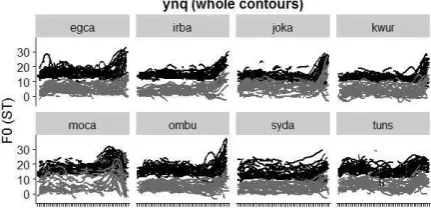
Figures 1-2 show time-normalised smoothed whole F0 contours in all tokens by dialect (as in Table 2) and by sex. We can see that there is a high degree of consistency in the shape of the overall contour, in most dialects; the least consistent appears to be Moroccan (moca).
Figure 1: Time-normalised smoothed whole F0 contours for all tokens of yes/no-questions, by dialect,
[image:3.595.331.551.590.693.2]and by sex (dark grey = female; light grey = male).
Figure 2: Time-normalised smoothed whole F0 contours for all tokens of yes/no-questions, by dialect,
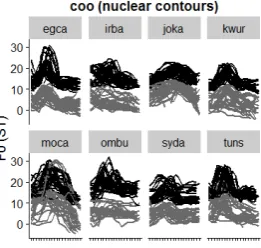
Similarly, Figures 3-4 show time-normalised smoothed nuclear F0 contours for all tokens. These plots confirm a high degree of consistency among speakers within each dialect, with just a small number of variant contours (e.g. a small number of ‘outlier’ falling contours in ynqs for most dialects).
Figure 3: Time-normalised smoothed F0 contours in the last word of all yes/no-questions, by dialect, and
[image:4.595.329.548.147.282.2]by sex (dark grey = female; light grey = male).
Figure 4: Time-normalised smoothed nuclear F0 contours over the last three words in all coordinated questions (‘is it X or Y?’), by dialect, and by sex (dark
grey = female; light grey = male).
The overall picture suggests a high degree of consistency across speakers in each dialect, and perhaps most clearly for coo questions, which show no obvious cases of a different contour being produced by speakers to express the question. This suggests that coordinated questions are a potentially useful place to look for a difference between dialects in the shape of the contour realized, since the contour used in each dialect is used consistently by all speakers and is thus typical.
Already from these data visualisations we can see there are differences in the alignment, scaling and/or shape of the nuclear contour across dialects in both ynq and coo questions. These differences are modelled further in the next section.
4.2. Do question contours vary between dialects?
Figures 5-6 show predictions of GAM models of the whole F0 contour, by dialect, using cubic regression splines (cr) fitted
using maximum likelihood estimation (ML) for ynq and coo.1 The key observation that we can make from these models is that most of the differences between dialects are found in the nuclear portion of the contour (towards the right edge); there are differences in scaling in the pre-nuclear region, but not in the shape of the F0 contour (apart from Moroccan Arabic).
[image:4.595.329.547.327.457.2]Figure 5: Model predictions for ynq whole contours.
Figure 6: Model predictions for coo whole contours.
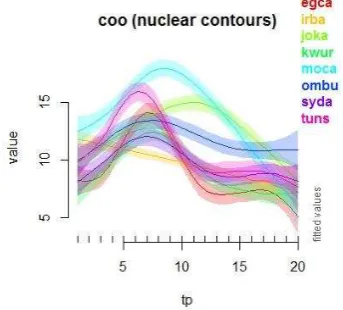
Figures 7-8 show predictions of GAM models of nuclear F0 contours, by dialect, also using cr/ML, for ynq and coo.2
For yes/no-questions, in this simple model with a single smooth fitted to each dialect, Moroccan Arabic stands out strongly, with a clear rise-fall nuclear contour, in contrast to rising contours in most other dialects. In Tunisian Arabic we see a rise-plateau contour, and a plain rise in all other dialects. Among dialects with a similar shape to the F0 contour there appear to be differences in overall F0 register and scaling of the rise also; for example, the scooped rise in Jordanian (joka) and Kuwaiti (kwur) appears similar but the Jordanian rise is realized within a higher pitch register; likewise there is a similar rise shape between Egyptian (egca) and Syrian (syda) but the Egyptian rise is realized within a higher pitch register.
For coordinated questions, the simple GAM model suggests again that Moroccan Arabic stands out as having a
1
gam(F0 ~ dialect + s(tp, by=dialect, bs="cr"), data=whole_y, method="ML"; gam (F0 ~ dialect + s(tp, by=dialect, bs="cr"), data= whole_c, method="ML"; note that ‘tp’ = timepoint.
2
gam(F0~dialect + s(tp, by=dialect, bs="cr"), data= nuclear_y, method="ML"); gam(F0~dialect + s(tp,
[image:4.595.107.238.336.460.2]different contour, with a single rise-fall over the three words bearing the nuclear contour. A similar contour shape, albeit with a later peak, is also seen in Jordanian Arabic, however, and appears to distinguish Jordanian from the other dialects. All of the other dialects (except Iraqi) appear to share a similar contour, with a higher peak on the first contrasted item than on the second, but the difference in scaling between the two items, as well as overall pitch register, varies greatly with the highest in Tunisian and Egyptian, then Kuwaiti, Gulf and Syrian. Iraqi Arabic appears to show a falling contour over the last three words in coo questions, when averaged across all speakers, but we can see in Figure 4 that there are also some speakers who produce a contour more similar to that seen in most other dialects.
Figure 7: Model predictions for ynq nuclear contours.
Figure 8: Model predictions for coo nuclear contours.
5.
Discussion
The first aim of this initial exploration of the intonation contours in polar interrogatives (ynq and coo) across Arabic dialects was to identify - if possible - the typical contour for each question type in each dialect. The visualisations in Figures 1-4 suggest that there is a high degree of similarity between speakers in their choice of prosodic contour in yes/no-questions, with only a few variant falling tokens observed. For coordinated questions the agreement among speakers appears to be even higher though, making this context a potentially useful one for eliciting parallel intonation
contours across speakers of the same dialect. This may be because the coordinated question context is semantically rather narrowly constrained, as it contains a contrast between overtly expressed alternatives [17, cf. 18], embedded within the illocutionary force of the yes/no-question. Although no contour necessarily entails a specific function in natural interaction [19], this inter-speaker consistency stands out.
The second aim of the study was to determine to what extent the intonation contours in ynq and coo questions might differentiate Arabic dialects. Moroccan Arabic stands out as having a different contour from all other dialects in both types of question. This supports previous suggestions in the literature that there is a fundamental difference between Moroccan Arabic and all other dialects, in that it is the only Arabic dialect (in this sample at least) which lacks word-level lexical stress [20-22]. In ynqs, Tunisian Arabic differs from other dialects in showing a rise-plateau, and this distinction is potentially useful, since Tunisian does not differ from other dialects in the shape of the contour in coo questions (though appears to differ in scaling and/or register). Similarly, although Jordanian Arabic does not differ greatly from other dialects in the rising contour found in ynqs, Jordanian does appear to differ from other dialects in the shape of the contour in coo questions; this pattern has not previously been reported and thus merits further investigation (in conjunction with phonological analysis of the contours, for example). The falling contour seen in Iraqi coo questions also merits further investigation to clarify whether there is in fact speaker variation in the shape of the contour produced. All of the other dialects appear to be broadly similar in the shape of the F0 contour used in each question type. In future work, further statistical analysis, controlling for gender, speaker and item, will determine which of the more subtle differences in the shape, alignment or scaling of the F0 contour may yet prove to be distinctive in one or both question types. The best indication of a further sub-division of dialects into distinct groups is in the coo questions, which show more variation between dialects overall (Figure 8) than ynqs (Figure 7).
6.
Conclusion
Quantitative analysis of the intonation contours found in polar interrogatives (ynq and coo) suggests a good degree of similarity among speakers in the read speech realisation of both question types, and in particular for coo questions. The typical contour observed in each dialect was found to be distinctive in both question types in Moroccan Arabic, and distinctive in at least one question type in Tunisian Arabic (ynq = distinctive) and in Jordanian Arabic (coo = distinctive), and these patterns thus merit further investigation from a phonetic and phonological perspective. For other dialects, future research should employ additional statistical analysis to determine whether the more fine-grained differences observed in the data - in particular in coo questions - amount to an additional sub-grouping of dialects in scaling and/or register.
7.
Acknowledgements
[image:5.595.84.256.427.582.2]8.
References
[1] S. Hellmuth and R. Almbark, "Intonational Variation in Arabic Corpus," UK Data Archive Colchester, Essex 2017. http://reshare.ukdataservice.ac.uk/852878/ [2] K. Pruitt and F. Roelofsen, "The interpretation of prosody
in disjunctive questions," Linguistic Inquiry, vol. 44, pp. 632-650, 2013.
[3] E. Grabe, G. Kochanski, and J. Coleman, "The Intonation of Native Accent Varieties in the British Isles: potential for miscommunication?," in English pronunciation models: a changing scene., K. Dziubalska-Kolaczyk and J. Przedlacka, Eds., ed Oxford: Peter Lang, 2005, pp. 311-337.
[4] E. Grabe, G. Kochanski, and J. Coleman, "Connecting intonation labels to mathematical descriptions of fundamental frequency," Language and Speech, vol. 50, pp. 281-310, 2007.
[5] P. Prieto and P. Roseano, Transcription of Intonation of the Spanish Language. Muenchen: LINCOM, 2010. [6] S. Frota and P. Prieto, Intonation in Romance. Oxford:
Oxford University Press, 2015.
[7] D. Chahal, "Intonation," in Encyclopedia of Arabic Language and Linguistics. Volume 2., K. Versteegh, Ed., ed The Netherlands: Brill Academic, 2006, pp. 395-401. [8] D. El Zarka, "Arabic Intonation," Oxford Handbooks
Online, 2017.
[9] O. Niebuhr, M. D'Imperio, B. Gili Fivela, and F. Cangemi, "Are there 'shapers' and 'aligners': individual differences in signalling pitch accent category," Proc.17th ICPhS, pp. 120-123, 2011.
[10] F. Cangemi, M. Grice, and M. Krüger, "Listener-specific perception of speaker-specific production in intonation," in Individual Differences in Speech Production and Perception, ed Frankfurt Am Main: Peter Lang, 2015, pp. 123-145.
[11] F. Cangemi, D. El Zarka, S. Wehrle, S. Baumann, and M. Grice, "Speaker-specific intonational marking of narrow focus in Egyptian Arabic," Proceedings of Speech Prosody 2016, Boston, 2016.
[12] P. French and P. Harrison, "Position Statement concerning use of impressionistic likelihood terms in forensic speaker comparison cases, with a foreword by Peter French & Philip Harrison," International Journal of Speech Language and the Law, vol. 14, pp. 137-144, 2007.
[13] P. Boersma and D. Weenink, "Praat: doing phonetics by computer (Version 5.4.09) [ http://www.praat.org] " 2015.
[14] K. Gorman, J. Howell, and M. Wagner, "Prosodylab-Aligner: A tool for forced alignment of laboratory speech," Journal of the Canadian Acoustical Association, vol. 39, pp. 192-193, 2011.
[15] R. Core Team, "R: A language and environment for statistical computing," R Foundation for Statistical Computing, Vienna, Austria2014.
[16] M. Sóskuthy, "Generalised additive mixed models for dynamic analysis in linguistics: a practical introduction," arXiv preprint arXiv:1703.05339, 2017.
[17] M. Rooth, "Focus," in The Handbook of Contemporary Semantic Theory, S. Lappin, Ed., ed Oxford: Blackwell, 1996, pp. 271-297.
[18] K. Kiss, "Identificational focus versus informational focus " Language, vol. 74 pp. 245-273, 1998.
[19] T. Walker, "Form (does not equal) function: The independence of prosody and action," Research on Language and Social Interaction, vol. 47, pp. 1-16, 2014. [20] U. Maas, "Die marokkanische Akzentuierung," in Nicht
nur mit Engelszungen [Beitr„ge zur semitischen
Dialektologie: Festschrift f• r Werner Arnold zum 60. Geburtstag] , R. Kuty, U. Seeger, and S. Talay, Eds., ed Wiesbaden: Harrassowitz Verlag, 2013.
[21] S. Hellmuth, N. Louriz, B. Chlaihani, and R. Almbark, "F0 peak alignment in Moroccan Arabic polar questions," Proceedings of ICPhS Glasgow, 2015.