,Q
...
-...
>
-
)(..
tt1
u
DIRECTORATE GENERAL XV
Internal Market and Financial Services
General matters and coordination, free movement of persons and direct taxation
External dimension of the internal market and financial services
TAIWAN
Rue de la Loi 200, B-1049 Brussels, Belgium - Office: C 107 8/27.
Brussels, 19 June 1995
Ref: Nigg- jv\tcr\taiwan
XV-A-2
Introduction
In 1994, GNP in the Republic of China (ROC) was US$ 244.7 bn (205.5 bn of ECU•), with an annual average growth rate since 1986 of 6%. With a population of 21.12 mn, this represented a GDP per head of US$ 11,629 (9,767 ECU) compared to 15,800 ECU in the EU.
CREDIT INSTITUTIONS
Establishment
ROC's banking system has expanded significantly over the last three years. A ban on the granting of new domestic banking licences was lifted in 1991. Subsequently a number of new banks were established which were allowed to open additional offices in each subsequent years. However, the commercial banking system is still dominated by state-owned banking institutions. There are 78 banks in ROC and 38 foreign banks. Fourteen
commercial banks are owned by local authorities. They account for 51 % of bank offices
and 74% of bank deposits and loans. They are the major credit suppliers to state-owned and small private enterprises, providing over 90% and 80% of loans for these two borrowers, respectively.
Although improvements have occurred since the 1992 report, entry into ROC's banking market for foreign banks is still restricted to branches and representative offices. Wholly owned subsidiaries are not allowed. The ban on foreign investment in local banks was lifted in June 1994. Permission has also been given for foreign banks to acquire shares in local banks that are not listed on the ROC Stock Exchange. However, a foreign institutional investor may only hold up to 5% of the total issued stock of a listed company and foreign institutional investors together may only hold up to 10% of the total issued stocks of that company. Any individual person, foreign or national, shall not hold shares in a bank in excess of 5% of the total issued shares of the bank. Shareholding by related groups is limited to 15% unless approval from the Ministry of Finance (MoF) has been obtained. Potential investors must submit their applications during the period from May 12 to October 11 of each year.
The above mentioned limits on foreign investments m the banking sector is a considerable obstacle to access.
In 1994, 38 foreign banks have been approved to set up 58 branches of which 11 banks
are from the Community. European banks account for 6 % of the total assets of the
overall banking system. Moreover, 25 foreign banks have established representative offices in ROC, of which 7 are from the EU.
Exchange Rates : End year 1994 : Average 1994 :
f'
i
Although the restrictions on geographical expansion have been lifted the first branch of a foreign bank must be established in Taipei. Additional branches may only be established two years after the establishment of the first branch, down from the previous five year requirement. Each branch needs a separate endowment capital, 150 million New Taiwan dollars for first branch and 120 million New Taiwan dollars for each subsequent branch. In addition to the elimination of geographical expansion restrictions there are no longer any numerical limits on the number of additional branches which may be established. The two year waiting period to establish additional branches does not apply to domestic banks.
A foreign bank wishing to establish its first branch in ROC must meet a prior ·bl18iness
-' £
activity test, or rank among the top five hundred banks in the world by assets or capital. The prior - business - test requires that a foreign bank should have a total business volume of at least US$ 1 billion with the banks and major enterprises of Chinese Taipei in the previous three calendar years, of which there shall have been a total amount of not less than US$ 180 billion granted as medium or long-term credits.
, Foreign banks are allowed to set up offshore banking branches, even if they do not have a commercial presence in ROC. Applicants to set up Offshore Banking Units (OBUs) must rank among the top 500 banks world-wide in terms of assets.
OBUs provide for the foreign currency needs of foreign and domestic financial institutions. By the end of 1993, a total of 38 OBUs were operating in ROC. Among them, 19 were run by domestic banks and were run by EU banks. The combined assets of the OBUs at the end of 1993 were US$ 26.8 billion, 13% more than in 1992. Deposits . by . banking institutions and borrowing accounted for 90 percent of their capital funds, i.e., 60 percent from foreign financial institutions, 22 percent from domestic financial institutions, and 8 percent from inter-OBU sources. The OBUs re-deposit over 70 percent of their fun~s, although lending to non-residents has been growing rapidly and was up 17 percent in 1993.
New entry is prohibited for trust investment companies even as branches. A joint venture with a domestic company is possible. Contrary to deposit banks the foreign investment ceiling is 40% in a company.
Credit-card institutions:
The issuing of credit cards by foreign credit-card institutions was liberalized upon promulgation of the Rules Governing Credit Card Business in June 1993. Major international credit cards have been prevailing in the ROC since then.
Bills finance companies :
Since May 1992, banks in the ROC have been permitted to trade short term bills on a principal or on an agent basis. The restriction on the establishment of new bills finance companies was lifted in August 1994 and from 24th August 1995, banks, including foreign bank branches, will be able to apply for authorisation to engage in the business of
·'
Leasing companies :
The restriciton on foreign share-ownership in leasing companies was totally removed in 1994.
There were seven trust and investment companies operating 60 branches throughout ROC at year-end 1993. They accounted for 2.4 percent and 3.2 percent of all banking institutions' assets and outstanding loans, respectively. They may not take any kinds of deposits, although they are. permitted to raise and manage trust funds. They can extend only medium to long-term loans. They may invest in securities, and they may provide underwriting and brokerage services in the securities market.
Community banking institutions held one-third of total banking offices at the end 1993, received 25% of outstanding deposits and held 19% of outstanding loans. Their assets represented 16% of the banking system's. total assets. They are organised on the basis of membership rather than as incorporated companies, belonging to farmer's and fishermen's associations. They are subject to many restrictions. No foreign membership is allowed in Community banking institutions.
Activity
Most operational ratios of foreign banks (branches) are tied to remitted-in capital, rather than to the parents' capital. This restricts considerably the scope of activities which foreign banks can carry out.
Foreign banks can guarantee commercial papers only up to 10 times their net worth while domestic banks are not subject to a similar limit. Foreign banks are not allowed to raise capital locally by issuing bank debentures. Neither are all domestic banks. Total New Taiwan dollar loans for a single customer (a natural or a corporate entity) may not exceed 10% of the bank's total lending portfolio or one billion New Taiwan dollars which ever is higher.
Foreign banks are subject to per client foreign currency credit extension limit of 25% of their head office. These limits may become a constraint in the future as the scale of business of EU firms in ROC expands. Local banks face lending limits as well, sometimes more stringent than those imposed on foreign banks.
A number of restrictions related to capital movement exist. They act as a deterrent for foreign banks. Foreign exchange deposits shall not be pledged against new Taiwan dollar finance. Foreign currency loans are not allowed to be converted into New Taiwan dollars.
Acceptance of foreign exch~ge checking account deposits and issuance of foreign · exchange negotiable certificates of time deposit are not allowed.
Banks are not allowed to engage in short-term bills underwriting and certification business. Nor are they allowed to receive trust funds of which the principal or interest is guaranteed.
OBUs accepting foreign exchange deposits are not permitted to accept foreign currency
cash deposits or to withdraw foreign exchange deposits in New Taiwan dollars.
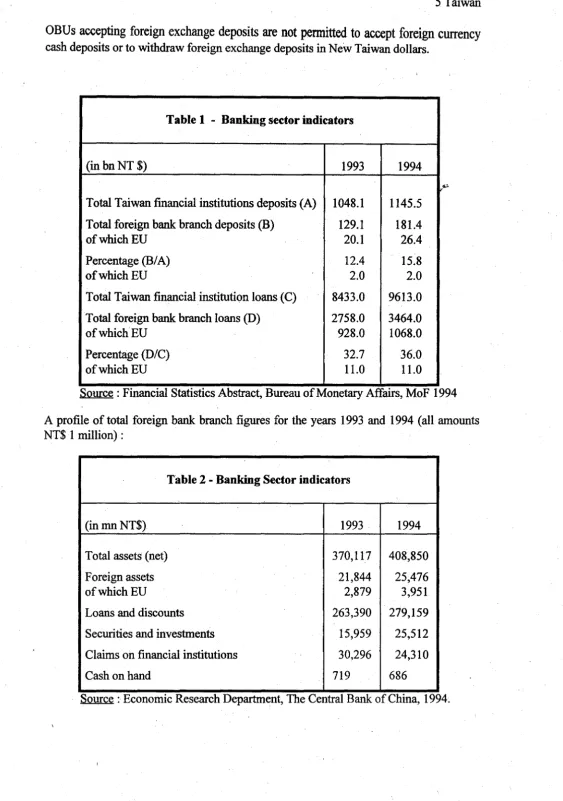
Table 1 - Banking sector indicators
(in bnNT $) 1993 1994
-Total Taiwan financial institutions deposits (A) 1048.1 1145.5
Total foreign bank branch deposits (B) 129.1 181.4
ofwhichEU 20.1 26.4
Percentage (B/ A) 12.4 15.8
ofwhichEU 2.0 2.0
Total Taiwan financial institution loans (C) 8433.0 9613.0
Total foreign bank branch loans (D) 2758.0 3464.0
ofwhichEU 928.0 1068.0
Percentage (DIC) 32.7 36.0
ofwhichEU 11.0 11.0
Source: Financial Statistics Abstract, Bureau of Monetary Affairs, MoF 1994
A profile of total foreign bank branch figures for the years 1993 and 1994 (all amounts NT$ 1 million) :
Table 2 - Banking Sector indicators
(inmnNT$) 1993 1994
Total assets (net) 370,117 408,850
Foreign assets 21,844 25,476
ofwhichEU 2,879 3,951
Loans and discounts 263,390 279,159
Securities and investments 15,959 25,512
Claims on financial institutions 30,296 24,310
Cashon hand 719 686
[image:5.600.25.589.50.852.2]INSURANCE
Establishment
Foreign insurance companies may establish wholly owned subsidiaries or branches in ROC. Applications have to be filed with MoF. No European insurance company has · applied for establishment.
However, a foreign institutional investor may only hold up to 5% of the total issued stock . of a listed company and foreign institutional investors together may only hold up to 10% of the total issued stock of that company. There are no limitations on shareholdings by.
individuals. £~
The organization form of an insurance enterprise is restricted to that of a company limited by shares. Mutuals and cooperatives are not admitted.
A foreign insurance company wishing to establish a subsidiary must have operated the same type of insurance business for more than ten years and not yet have established a branch in Taipei. If it has a branch it must be-dismantled first. It may be set up again immediately after. The non-life insurance's net policy premium income for the previous · year must be above an amount equivalent to ten billion New Taiwan dollars, or the life insurance's total assets must be above an amount equivalent to fifty billion New Taiwan dollars. ·
In order to set up a branch the following conditions must be met : the first branch must be established in Taipei, the paid-in capital be equivalent to one billion or more New Taiwan dollars, the net worth be equivalent to two billion or more New Taiwan dollars, operation of the insurance business applied for must have been carried out over five years, that in the last three years before application, the business results have been graded as first rank by the reputable insurance commentary organization which is recognised by MoF and that a liaison office has been in place in Taipei over one year ..
Additional branches may be established only two years after the establishment of the first branch, without any limits on the number nor geographical restrictions. The net worth of each additional branch must exceed fifty million New Taiwan dollars.
Foreign insurance agents, broker and adjuster companies may set up branch offices in ROC (but not wholly owned subsidiaries) to operate the same kind of business which they have been operating in their home countries over five years. Foreign actuarial companies are not allowed to establish in ROC.
The investment limits of 5 and 10% act as a serious barrier to access for Community insurance companies. The requirement of having operated the same type of insurance business for more than ten years appears excessive and unnecessary. So does the . requirement of a two year waiting period between the first and subsequent branches. .
Activity
The ROC authorities state that foreign insurance companies receive national treatment for the carrying out of their activities. However, foreign insurance" companies need the prior approval of MoF for providing new insurance services.
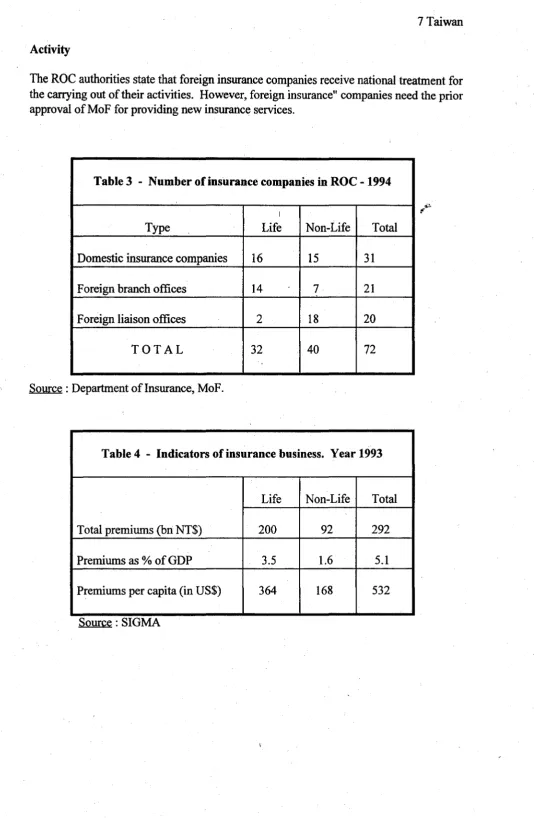
Table 3 - Number of insurance companies in ROC - 1994
I
Type Life Non-Life Total
Domestic insurance companies
16
1531
Foreign branch offices
14
7
21
Foreign liaison offices
2
18
20
TOTAL
32
40
72
Source : Department of Insurance, MoF.
Table 4 - Indicators of insurance business. Year 1993
Life Non-Life Total
Total premiums (bn NT$)
200
92
292
Premiums as% of GDP
3.5
1.6
5.1
Premiums per capita (in US$)
364
168
532
[image:7.596.40.574.29.846.2] [image:7.596.18.579.154.853.2]SECURITIES
Establishment
The last couple of years ROC has deployed considerable efforts to liberalise its securities market. Foreign securities firms may now establish the number of branches they wish. They may also establish subsidiaries that can perform all the same securities services that domestic securities firms can perform, and the capital requirements for establisliing are identical to local subsidiaries.
However, discriminatory treatment still restricts access to the ROC securities market. Foreign securities firms (including securities finance offshore companies and futures brokerage) must have operated a representative office in Taipei for a period of not less
than one year before it is allowed to set up a branch in Taipei. There are no such restrictions on the establishment of subsidiaries. Foreign futures brokerage firms may operate its brokerage business only by establtshment of a branch in Taipei.
Aggregate foreign equity holding in a securities investment trust company is subject to a ceiling limitation of 49% of the company's total shares. A single party is subject to a ceiling limitation of 25%.
No such limits apply for securities investment consulting companies, although the one year representative office requirement is applicable.
Securities can be traded either on the Taiwan Stock Exchange or in the over the -counter (OTC) market. For equity shares, a company must choose between either of the two markets. Bonds may be traded in either market concurrently. In practice, bonds generally trade on the OTC market and equity shares trade on the stock exchange. ' The Stock exchange is not a membership organization. Foreign companies can have a contract with the stock exchange. However, only Taiwanese companies may list their stocks on the stock exchange.
The Securities and Exchange Commission (SEC) is the official regulatory agency of the capital market under the jurisdiction of MoF. SEC has prepared a foreign futures trading act and a new securities and exchange law which would liberalise· further both access and operation conditions. SEC will still keep both surveillance and licensing authority. By the end of 1994, the total market value of 313 listed companies on the Taiwa&n Stock Exchange reached approximately US$ 245.3 bill.
With regard to the securities industry, as of December 1994, there were 262 securities brokerage firms, 57 securities underwriters and 72 securities dealers registered with the SEC. Additionally, there are 15 securities investment trust companies and 95 investment consulting companies operating in the Territory.
i
1
l
representative offices in ROC. One foreign se"curit(ies firm was operating branch business in ROC.
Activity
The liberalisation carried out in ROC relating to market access has extended to the carrying on of activity as well. Foreign securities companies may provide essentially the same services as domestic firms (incl. brokerage, dealing, underwriting and securities
financing). Furthermore, foreign firms may provide brokerage services for local
investors to deal in foreign securities while local securities firms may not. Specifically, foreign firms may broker securities ( equity shares and bonds) listed in the New York, London and Tokyo stock exchanges on the condition that their parent compa.n1es are a member of the exchange. They may not, however, broker foreign securities· listed on stock exchanges other than the above mentioned three exchanges or securities traded in foreign OTC markets. Such limitations have constituted a constraint for foreign branches in developing their business in Taiwan. However, domestic securities firms may not broker and trade foreign securities at all in Taiwan.
Foreign securities firms continue to face discriminatory treatment in several areas, however. Foreign institutional investors are subject to a US$ 200 million individual investment limit and a US$ 7.5 billion aggregate investment limit. In addition, foreign institutional investors are subject to restrictions on repatriation of capital and earnings.
Among foreigners, only "qualified foreign institutional investors" are permitted to invest in Taiwanese stock. Foreign individuals are prohibited. In addition foreign individuals may not hold equity and debt instruments listed on the exchange.
Secuiiities investment consulting companies may only provide research, analysis or advice, on a commission basis, on mat:ters related to investment in securities (incl. foreign securities, publish material relating to securities investment activities, conduct seminars in connection with securities investment and perform other relevant secUliities investment consulting activities as approved by SEC). They are not allowed to trade in foreign securities on behalf of clients.
Only banks, domestic and foreign, have been permitted to offer new financial products -e.g. New Taiwan dollar interest rate swaps, forward rate agreements, foreign currency derivative products. Domestic and foreign securities firms are limited to brokering and dealing in listed securities. There are no stock index options or stock futures contracts currently permitted.
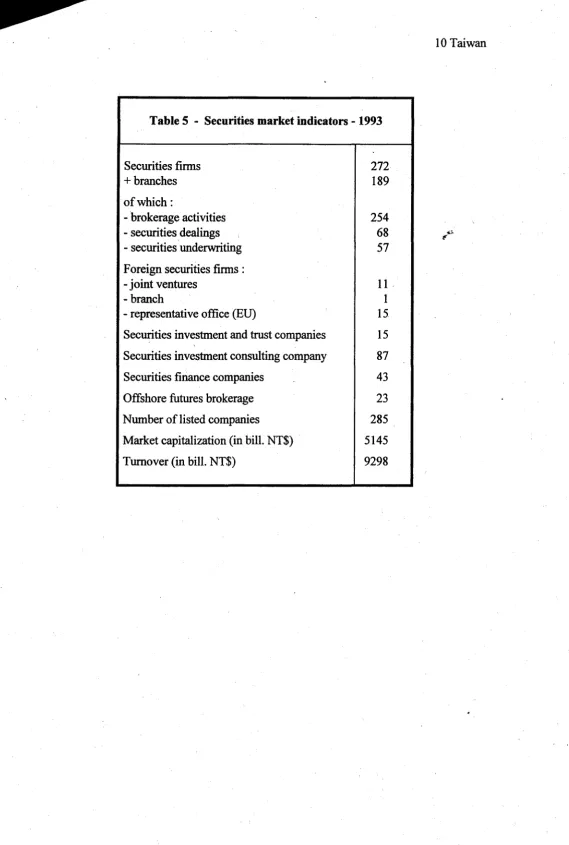
Table 5 - Securities market indicators - 1993
Securities firms
272
+
branches189
of which:
- brokerage activities
254
- securities dealings
68
- securities underwriting
57
Foreign securities firms:
- joint ventures 11
- branch
1
- representative office (EU)
15
Securities investment and trust companies
15
'
Securities investment consulting company
87
Securities finance companies
43
Offshore futures brokerage
23
Number of listed companies
285
Market capitalization (in bill. NT$)