systematic review and meta-analysis.
White Rose Research Online URL for this paper: http://eprints.whiterose.ac.uk/136792/
Version: Accepted Version Article:
Krasuska, M. and Webb, T.L. orcid.org/0000-0001-9320-0068 (2018) How effective are interventions designed to help owners to change their behaviour so as to manage the weight of their companion dogs? A systematic review and meta-analysis. Preventive Veterinary Medicine, 159. pp. 40-50. ISSN 0167-5877
https://doi.org/10.1016/j.prevetmed.2018.08.016
Article available under the terms of the CC-BY-NC-ND licence (https://creativecommons.org/licenses/by-nc-nd/4.0/).
[email protected] Reuse
This article is distributed under the terms of the Creative Commons Attribution-NonCommercial-NoDerivs (CC BY-NC-ND) licence. This licence only allows you to download this work and share it with others as long as you credit the authors, but you can’t change the article in any way or use it commercially. More
information and the full terms of the licence here: https://creativecommons.org/licenses/
Takedown
If you consider content in White Rose Research Online to be in breach of UK law, please notify us by
1 2 3
How effective are interventions designed to help owners to change their behaviour so as 4
to manage the weight of their companion dogs? A systematic reviewand meta-analysis 5
6
Marta Krasuska, PhD and Thomas L. Webb, PhD
7
Department of Psychology, The University of Sheffield, UK
8 9
Preventive Veterinary Medicine ms# PREVET_2018_174 R1
10 11
Corresponding author: 12
Thomas L. Webb
13
Department of Psychology, The University of Sheffield, Cathedral Court, 1 Vicar Lane,
14
Sheffield, S1 2LT, UK
15
Abstract 17
Objective. The present review sought to evaluate whether – and to what extent – targeting 18
owners’ behaviour is an effective way to reduce the problem of overweight and obesity among
19
companion dogs.
20
Methods. A systematic search of electronic databases identified 14 studies that evaluated the 21
effect of an intervention targeting owners’ behaviour on (i) the owner’s behaviour or (ii) the
22
weight, (iii) body fat, or (iv) body condition of the dog. We coded aspects of the study design
23
(e.g., the outcome variable), intervention (e.g., use of theory, specific behaviour change
24
techniques or BCTs, inclusion of nutritional intervention alongside the behavioural
25
intervention), and sample (e.g., age, gender, and weight of the dogs at baseline) that could
26
influence the effect sizes.
27
Results. The interventions had, on average, a medium sized effect on outcomes (d+ = 0.59,
28
95% CI: 0.23 to 0.96, k = 14, N = 384). The effect sizes from the primary studies were relatively
29
homogenous, Q(13) = 12.10, p = .52 and the nature of the intervention, methodological and
30
sample characteristics did not moderate the effect sizes.
31
Conclusions and clinical relevance. The findings of the review suggest that targeting owners’ 32
behaviour can be an effective way to reduce overweight and obesity among companion dogs.
33
However, this conclusion is based on a limited number of studies and so we hope that the
34
present findings serve as the impetus for further research in this area.
35 36
Introduction 38
Overweight and obesity1 are common problems in dogs; and between 30 and 60% of
39
adult companion dogs worldwide are estimated to have an excess of body fat (McGreevy et al.,
40
2005; Colliard et al., 2006; Lund et al., 2006; Mao et al., 2013). An excess of body fat can
41
predispose dogs to a number of serious health conditions, including musculoskeletal disorders,
42
diabetes, cardiovascular disease, and cancers (Rocchini et al., 1987; Perez Alenza et al., 2000;
43
Rand et al., 2004; Marshall et al., 2009). It has also been linked to a reduced life span (Kealy
44
et al., 2002) and impaired wellbeing; in part, as a result of reduced energy and activity levels
45
(Yam et al., 2016). Overweight and obesity can also have financial implications for the owner,
46
who will likely have to pay for treatment. Together then, it is clear that what has been termed
47
‘the obesity epidemic’ among companion dogs is a serious concern (Kushner et al., 2006;
48
Sandoe et al., 2014) and that there is a need to identify effective ways to address this problem.
49
Traditionally, weight management interventions for companion dogs have centred
50
around prescribing specific foods or feeding regimes to reduce energy intake (Laflamme et al.,
51
1997; Burkholder & Bauer, 1998). This approach has been shown to produce desired outcomes
52
in dogs kept in experimental conditions where feeding and living conditions can be easily
53
controlled (Laflamme et al., 1997; Yamka et al., 2007). However, its effectiveness in dogs
54
living in domestic contexts is less clear (German et al., 2012). This might be because the
55
effectiveness of nutritional interventions for dogs living at home depends on owners adhering
56
to the feeding regime; something which has been shown to be less than optimal (German et al.,
57
2012). More recently, pharmacological treatments have become available to treat overweight
58
1
It is difficult to define overweight and obesity in dogs, primarily because breeds differ in size so that simple calculations of, for example, the ratio of height to weight (as used to compute BMI in humans), are not possible. There have been some efforts to quantify obesity (e.g., Simpson et al., 1993, stated that an animal could be deemed obese when it was 15% over its optimal weight); however, most people use the terms overweight or obese simply
and obesity in dogs (Roudebush et al., 2008). However, while pharmaceutical treatments have
59
been shown to assist weight loss (Pena et al., 2014) they can be associated with side-effects
60
(Wren et al., 2007) and, similarly to nutritional interventions, they rely on the owners’
61
adherence to a medication regime which has, again, been shown to be problematic (Gossellin
62
et al., 2007).
63
Managing the weight of dogs by targeting owners’ behaviour 64
One key factor that influences a dog’s weight is their owner’s behaviour. That is, it is
65
typically the owner that feeds and exercises the dog and thus dictates their energy intake and
66
expenditure. Perhaps not surprisingly then, evidence suggests that the behaviour of owners of
67
overweight and obese dogs differs from that of the owners of healthy weight dogs. For example,
68
the owners of overweight and obese dogs tend to walk their dogs less frequently, feed them
69
more treats, and weigh their dog less often than owners of dogs of an optimal weight (Kienzle
70
et al., 1998; Robertson, 2003; Bland et al., 2009; Raffan et al., 2015). Therefore, promoting
71
weight loss in companion dogs likely involves finding ways to help the owner to feed and
72
exercise their animal appropriately (Webb, 2015; White et al., 2016).
73
Researchers have started to develop interventions that explicitly target owners’
74
behaviour, either as part of a multi-component intervention or as its primary focus. For
75
example, German et al. (2007) designed an intervention that combined a nutritional component
76
(each dog was fed high protein, fat restricted food with the size of the portion tailored to the
77
specific needs of each dog), with advice to owners on strategies to prevent excessive feeding
78
(e.g., providing non-food-related rewards) and to increase the dog’s physical activity levels
79
(e.g., playing with the dog indoors). The intervention also provided owners with feedback on
80
their dog’s weight during the intervention. Another intervention exclusively targeted the
81
behaviour of owners of overweight dogs in an effort to increase the amount of time that they
82
spend walking their dog - owners received information on the health benefits of exercising the
dog, the likely exercise needs of their dog (stratified by breed and age), and instructions on
84
how to start walking their dog more (Rhodes et al., 2012). Despite the recent interest in
85
interventions designed to modify owners’ behaviour however, to date, there has not been a
86
systematic review of these studies. As a result, researchers and practitioners currently do not
87
know whether – and to what extent – targeting owners’ behaviour is an effective way to reduce
88
overweight and obesity among companion dogs. The primary aim of the present review then,
89
was to estimate the effectiveness of interventions targeting owners’ behaviour.
90
Behaviour Change Techniques 91
It is also unclear what specific techniques have been used to modify owners’ behaviour
92
and whether the use of particular techniques is linked to the effectiveness of the intervention.
93
Around 10 years ago, there was a similar problem in health psychology with many
94
interventions designed to promote health behaviour among humans being unclear about the
95
specific intervention techniques that they used. As a consequence, it was difficult to reach
96
conclusions about the best way to intervene (i.e., to identify which components of the
97
intervention were effective and might be taken forward to subsequent interventions). To
98
facilitate the accumulation of evidence, replication of interventions, and evaluation of
99
behaviour change interventions, researchers attempted to classify Behaviour Change
100
Techniques (or BCTs, defined as ‘reliable components of an intervention designed to alter or
101
redirect causal processes that regulate behaviour’, Michie, Abraham, et al., 2011) according to
102
their content (Abraham & Michie, 2008; Michie, Abraham et al., 2011), culminating in the
103
Behaviour Change Techniques Taxonomy (BCTTv1, Michie et al., 2013). A second aim of the
104
present review then, was to use this taxonomy to describe the BCTs used in interventions
105
designed to help the owners of overweight and obese dogs to manage the weight of their dogs
106
and attempt to link the use of specific BCTs to effectiveness. So doing should not only help to
107
describe the current ‘state of the art’ (e.g., what do these interventions typically do?), but also
help to identify which BCTs are effective in promoting changes in relevant outcomes (as well
109
as those that are less effective).
110
Other factors that may influence the effectiveness of interventions 111
It is also important to consider the extent to which interventions and the use of particular
112
BCTs has been informed by theory. For example, theoretical models such as Control Theory
113
(Carver & Scheier, 1982) would suggest that selecting BCTs that target the three putative
114
processes involved in regulating behaviour (namely, goal setting, goal monitoring, and goal
115
operating) might be particularly effective. However, whether interventions that are informed
116
by a theory are more effective than interventions that are not informed by a theory remains an
117
open question and, to date, a large proportion of interventions are not based on theory
118
(Prestwich et al., 2015). Therefore, the present review aimed to identify the extent to which
119
interventions designed to help dog owners to change their behaviour with respect to their dog
120
are informed by theory and whether this influences their effectiveness. Finally, the present
121
review aimed to evaluate the impact of other factors that could influence – or moderate – the
122
effectiveness of interventions targeting owners’ behaviour. For example, the inclusion of an
123
additional nutritional interventions alongside interventions designed to change owners’
124
behaviour may produce a larger effect on relevant outcomes than interventions that only target
125
the owners’ behaviour. Similarly, methodological characteristics such as the duration of the
126
intervention, design of the study (e.g., between vs. within designs, duration of the follow-up),
127
risk of bias (e.g., methodological quality of the study and source of funding) and type of
128
outcome reported (e.g., the dog’s weight, body fat, or body condition, owners’ behaviour) may
129
influence the actual, or apparent, effect of the interventions on these outcomes.
130
The Present Review 131
The primary aim of the present review was to estimate the effect of interventions that
132
target owners’ behaviour on the owner’s behaviour or on the weight or body condition of the
dog. The review also had three secondary aims – (i) to describe the BCTs used in interventions
134
designed to help owners to manage the weight of their dogs and attempt to link the use of
135
specific BCTs to effectiveness, (ii) to identify the extent to which interventions designed to
136
help dog owners to change their behaviour are informed by theory and whether this influences
137
their effectiveness, and (iii) to evaluate the impact of other factors that could influence – or
138
moderate – the efficacy of interventions targeting owners’ behaviour.
139
Material and Methods 140
Inclusion criteria 141
There were four inclusion criteria for the review. First, the study needed to evaluate an
142
intervention that was intended to help owners to make changes to their behaviour in an effort
143
to manage the weight of their companion dog. As this review focused on the effects of
144
interventions targeting owners’ behaviour, studies evaluating weight loss interventions for
145
dogs living in research facilities (e.g., kennel dogs) were excluded. Second, the intervention
146
had to contain at least one BCT designed to change owners’ behaviour with regards to feeding,
147
exercising and / or other weight management behaviours (e.g., weighing the dog), with BCTs
148
defined as those included in the BCTTv1 taxonomy (Michie et al., 2013). Third, the study had
149
to measure at least one relevant outcome, defined as (i) the dog’s body weight, percentage
150
change in dog’s body weight, amount of body fat or body condition, or (ii) a measure of the
151
owner’s behaviour (e.g., time spent walking the dog, number of treats given to the dog). We
152
included both randomized controlled trials and quasi experimental studies (i.e., studies with
153
between participants’ designs), as well as studies that measured outcomes before and after the
154
intervention (i.e., studies with within participant designs). Finally, studies needed to report
155
sufficient information for us to be able to compute an effect size representing the effect of the
156
intervention on relevant outcome(s), or this information needed to be available from the
157
authors. Studies published in peer-reviewed journals, reports, book chapters as well as
unpublished data (including university dissertations), written in any language (provided that an
159
English version of the abstract was available) were considered for inclusion.
160
Literature search strategy 161
Figure 1 shows the flow of studies through the review. The first author searched Web
162
of Science and ProQuest (which covers ProQuest Dissertation and Theses) in December 2016
163
using predefined search filters (i.e., FILTER 1 - Dogs’: Dog* OR Canine* OR Pet OR Pets OR
164
‘Companion animal*’; FILTER 2 - ‘Weight management behaviours’: Walk* OR Exerc* OR
165
‘Physical activity’ OR Diet* OR Food OR Weight OR Overweight OR Obes*; FILTER 3 -
166
‘Interventions’: Intervention* OR Program* OR Management OR Control OR Trial OR Study
167
OR Restriction OR Treatment). This yielded 8,071 papers (excluding duplicates). Four
168
additional studies were identified by looking through lists of studies cited by potentially eligible
169
articles for additional studies published up to December 2016 (i.e., an ancestry approach,
170
Johnson, 1993). The titles and abstracts of these papers were then examined for eligibility and
171
clearly ineligible studies were excluded. Reference management software (e.g., EndNote X7)
172
was used to identify duplicates and to store the citations and the electronic copies of the
173
identified papers.
174
Forty-three papers were then screened in detail by reading the full text. Studies were
175
rejected at this stage if they did not report the effects of an intervention designed to promote
176
weight loss or management among companion dogs (33% of studies, e.g., Laflamme et al.,
177
1997) or did not include a BCT as part of the intervention (28% of studies, e.g., Floerchinge et
178
al., 2015, reported the effects of a nutritional intervention). Finally, three studies (7%) did not
179
provide enough information to enable computation of the effect sizes (e.g., Carciofi et al.,
180
2015). This was mostly the case for studies that employed a within participant design as these
181
studies typically only reported the percentage change in the dog’s weight at the end of the
182
intervention, from which it was not possible to calculate an effect size (as there was nothing to
compare this value to). In each case, the respective authors were emailed to request the required
184
data (e.g., the average weight of the dogs and respective standard deviation at the beginning
185
and at the end of the intervention). In total, k = 14 studies, from 13 papers were included in the
186
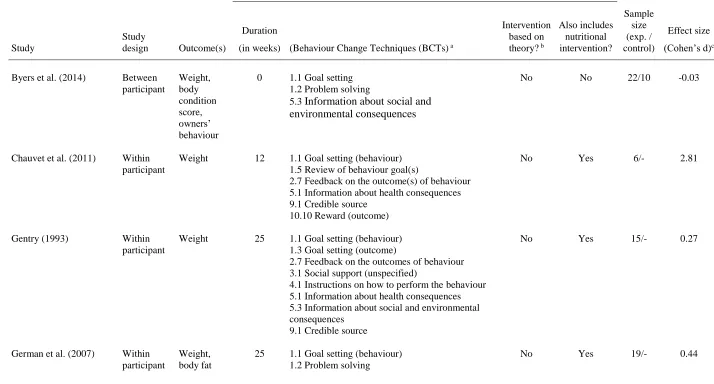
review. Table 1 provides a list of these studies and their characteristics.
187
Coding of the study characteristics 188
The characteristics of each study were coded by the first and second authors
189
independently using a data extraction sheet that was specified a priori. Disagreements were
190
resolved jointly by discussion. Information on the design of the study was coded into two
191
categories: (i) studies with between participant designs (i.e., where outcomes were assessed for
192
participants in experimental and control conditions, such as in quasi experimental designs and
193
in randomized controlled trials) or (ii) studies with within participants designs (i.e., where
194
outcomes were assessed for the same participants at the beginning and at the end of the
195
intervention). The duration of the intervention and length of the longest follow-up was coded
196
in terms of the number of weeks, respectively. We also identified sample characteristics for
197
owners (namely, age and gender) and for dogs (namely, body weight at the beginning of the
198
intervention, sex, neutering status, and most common breed). The source of funding was
199
divided into commercial (typically pet food manufacturers such as WALTHAM or Purina),
200
non-commercial (e.g., University, foundation, funding council), or not specified. Finally, we
201
assessed the methodological quality of the study using Downs and Black’s Quality Index (QI,
202
Downs & Black, 1998), on which scores can range from 0 to 32 with higher scores indicating
203
higher quality). We scored item 27 on statistical power by computing the minimum number of
204
participants required in the intervention condition to detect a medium-sized effect (i.e., d =
205
0.50) at p < .05. Studies that provided < 80% power were scored 0, those with 80% power were
206
scored 1, those with 85% power were scored 2, those with 90% power were scored 3 those with
207
95% power were scored 4, and those with 99% power were scored 5.
Three aspects of the interventions were coded. First, we coded the BCTs that were
209
employed by each of the interventions with respect to the 93 techniques listed in the BCTTv1
210
taxonomy (Michie et al., 2013). The BCTTv1 taxonomy defines 93 unique BCTs clustered into
211
16 categories. For example, goal setting (from the ‘goals and planning’ category) involves
212
setting or agreeing on a goal defined in terms of the behaviour or outcome to be achieved, while
213
comparative imagining of future outcomes (from the ‘comparison of outcomes’ category)
214
involves asking the person to compare the likely outcomes of changing versus not changing
215
their behaviour (Michie et al., 2013). Given the relatively small number of interventions that
216
have targeted the behaviour of dog owners to date, it was not possible to evaluate the impact
217
of specific BCTs on outcomes. We therefore compared interventions that used (vs. did not use)
218
BCTs in each of the 16 categories identified by the BCTTv1 taxonomy and then considered
219
whether the use of specific categories of BCTs was associated with outcomes. In addition, we
220
investigated whether there was a linear relationship between the number of BCTs employed in
221
the intervention (regardless of category) and outcomes.
222
Second, we used a coding scheme developed by Michie and Prestwich (2010) to
223
identify the extent to which the development of the intervention was informed by a theory of
224
behaviour change. Specifically, we used the first three categories from the coding scheme that
225
identify whether the intervention: (i) referred to underpinning theory, (ii) targeted one or more
226
relevant theoretical constructs, and (iii) used theory to select recipients and/or tailor the
227
intervention. Finally, we coded whether the owners were also provided with a nutritional
228
intervention (i.e., specific food) alongside the behavioural intervention.
229
Computing effect sizes 230
Effect sizes (Cohen’s d) were calculated for each study. For studies with between
231
participant designs, the outcomes for experimental versus control groups were compared. For
232
studies with within participant designs, the relevant outcomes were compared before versus
after the intervention. Given that studies adopting within participants designs can produce
234
different estimates of the effect size than studies with between participant designs (Dunlap et
235
al., 1996), we converted effect sizes into a common metric before conducting the meta-analysis,
236
using the approach proposed by Morris and DeShon (2002).
237
Five types of outcomes were considered: (i) the dog’s body weight (in kg), (ii) the
238
percentage change in the dog’s body weight, (iii) the proportion of body fat that the dogs had,
239
(iv) the dog’s body condition score (BCS; Laflamme et al., 1997), and / or (v) owners’
240
behaviours that could influence the dog’s weight (i.e., exercising, feeding, and weighing the
241
dog). When more than one outcome was reported, we calculated an effect size for each outcome
242
and then computed an average effect size across the available outcomes to enter into the
meta-243
analysis (this procedure retains as much data as possible while ensuring the independence of
244
effect sizes that is crucial to the validity of meta-analysis).
245
Meta-analytic strategy 246
SPSS Version 23 and David Wilson’s Macros for meta-analysis were used to conduct
247
the analyses (Lipsey & Wilson, 2001). A random effects model was used, as we expected
248
significant variation in our effect sizes that was unlikely to be attributable to systematic
249
differences in the samples, methods, or interventions (Borenstein et al., 2010). Each effect size
250
was weighted by its inverse sampling variance, which was calculated using the technique
251
recommended by Morris and DeShon (2002). Effect sizes were interpreted using Cohen’s
252
recommendations, where d = 0.20, 0.50, and 0.80 indicate small, medium, and large effect
253
sizes, respectively (Cohen, 1992) and p < .05 was used as the threshold for determining
254
statistical significance throughout.
255
To test the moderating effects of categorical variables (i.e., the design of the study, the
256
type of outcome measured, use of behaviour change theory or specific BCTs) the studies were
257
divided into levels of the categorical moderator (e.g., those with between vs. within participant
designs) and separate meta-analysis were conducted for each level to calculate and compare
259
the average effect sizes for each level of the moderator. To ensure the validity of the
260
comparisons, we only compared levels of the moderators that were represented by at least two
261
effect sizes from the primary studies. The average effect sizes across levels were then compared
262
using the homogeneity Q statistic (Cooper, 1986). The influence of continuous moderators (i.e.,
263
number of BCTs, duration of the intervention, age of the sample) on effect sizes was assessed
264
using meta-regression (Sutton & Higgins, 2008).
265
Results 266
Overall effect of the interventions on outcomes 267
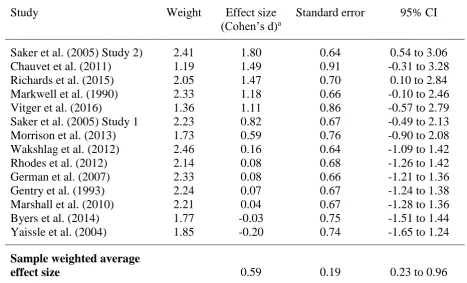
The (adjusted) effect sizes derived from the primary studies varied from d = -0.20 to d
268
= 1.80 with a weighted average effect size of d+ = 0.59 (95% CI: 0.23 to 0.96), based on k = 14 269
studies and a total sample of 384 dogs / owners (Table 2). This finding suggests that, on
270
average, the interventions had a medium sized effect on outcomes, although it is notable that
271
only two of the studies had significant effects (based on 95% CIs) when evaluated individually,
272
in part because individual studies were typically underpowered to detect statistical significance
273
(none of the primary studies provided 80% power to detect a medium-sized effect, according
274
to our calculations). Effect sizes did not differ significantly across the primary studies, Q(13)
275
= 12.10, p = .52.
276
Categorical moderators of the effect of interventions on outcomes 277
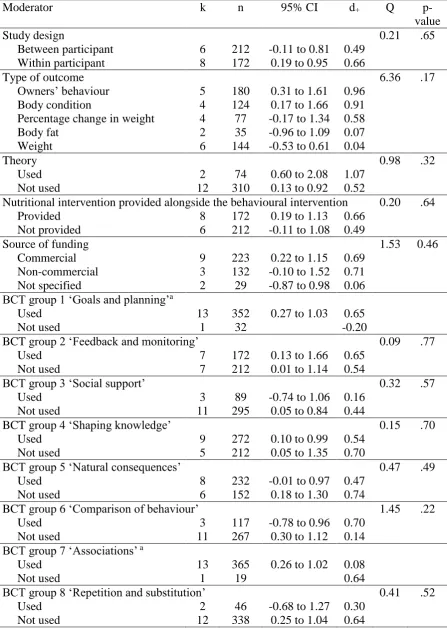
Table 3 shows the effect of the categorical moderators on effect sizes.
278
Type of study design. There was no difference between the effect sizes for the 6 studies 279
that employed between participants designs (d+ = 0.49) and the 8 studies that employed within 280
participant designs (d+ = 0.66), Q(1) = 0.21, p = .65. 281
Type of outcome. In order to evaluate whether the nature of the outcome variable 282
influenced the effect of the interventions, we compared the effects of the interventions on the
different outcome variables.2 The average effect size ranged from very small for outcomes
284
reflecting the dog’s body fat and weight (d+ = 0.07 and 0.04, respectively) to large for outcomes 285
reflecting the owners’ behaviour (d+ = 0.96) or the dogs’ body condition (d+ = 0.91). The 286
difference between the effects of the interventions on the different outcomes did not, however,
287
differ significantly, Q(4) = 6.36, p = .17, and only the effect of the interventions on the owners’
288
behaviour and the dogs’ body condition reached statistical significance.
289
Use of theory. In order to examine whether the use of theory influenced the 290
effectiveness of the intervention, the studies were divided into those that reported using theory
291
(2 studies) and those studies that did not report that they used theory (12 studies). The average
292
effect size for studies that reported using theory (d+ = 1.07) and those that did not (d+ = 0.52) 293
did not differ significantly, Q(1) = 0.98, p = .32.
294
Inclusion of an additional nutritional intervention. There was no difference between 295
the effect sizes associated with studies that did not include a nutritional intervention in addition
296
to the behavioural intervention (6 studies, d+ = 0.49), and those that did include an additional 297
nutritional intervention (8 studies, d+ = 0.66), Q(1) = 0.20, p = .64. 298
Nature of the behaviour change techniques used. Table 1 lists the BCTs that were 299
used in each of the primary studies. The primary studies used BCTs from 11 of the 16 categories
300
identified by the BCTTv1 taxonomy: (i) goals and planning, (ii) feedback and monitoring, (iii)
301
social support, (iv) shaping knowledge, (v) natural consequences, (vi) comparison of
302
behaviour, (vii) associations, (viii) repetition and substitution, (ix) comparison of outcomes,
303
(x) reward and threat, and (xi) antecedents. There was, however, no statistical differences in
304
2
the effect sizes associated with interventions that reported using (versus not using) BCTs from
305
the various categories of techniques.
306
Source of funding. Nine studies (64%) were funded by pet food companies or other 307
commercial interests, 3 (21%) were funded by non-commercial organisations (e.g.,
308
Universities, Foundations, or Research Councils) and 2 (14%) did not report the source of
309
funding. The effect sizes between studies that were funded (d+ = 0.69) versus not funded by 310
commercial organisations (d+ = 0.71) did not differ significantly from one another, or from the 311
effect sizes for studies that did not report the source of funding (d+ = 0.06), Q(2) = 1.53, p = 312
0.46.
313
Continuous moderators of the effect of interventions on outcomes 314
Number of behaviour change techniques. On average, the interventions used 7 BCTs 315
(SD = 5, range = 1 to 19); however, the number of BCTs that were used was not associated
316
with the magnitude of effect sizes (beta = 0.09, p = .75).
317
Duration of the intervention. The mean duration of the interventions evaluated in the 318
primary studies was about 3 and a half months (M = 15.61 weeks, SD = 9.30, range: 0 [i.e., the
319
entire intervention took place at one time point] to 28.70 weeks). The duration of the
320
intervention was not associated with the magnitude of effect sizes (beta = 0.04, p = .89).
321
Length of follow-up. The length of follow-up in the primary studies was 22.75 weeks, 322
SD = 24.42, range: 7.57 to 104 weeks). The length of follow-up was not associated with the
323
magnitude of effect sizes (beta = -0.35, p = .18).
324
Characteristics of the sample. Only a relatively small proportion of studies reported 325
the baseline characteristics of the owners in the sample (e.g., only 4 studies reported the
326
owner’s age and 3 studies reported owner’s gender at baseline) and their dogs (11 studies
327
reported the dog’s weight and 9 reported the dogs age at baseline). There was little variation in
328
the mean age of owners at baseline across the primary studies (47.05 years, SD = 2.52, range
of means: 44.80 to 49.70) or the percentage of female participants in the samples (M = 87, SD
330
= 5, range of means: 82 to 90), and so we did not test whether this moderated the effect of the
331
interventions. The mean age of the dogs at baseline across the primary studies was 6.15 years
332
(SD = 1.06, range of means: 3.70 to 7.60) and, on average, the dogs weighed 32.52kg at baseline
333
(SD = 5.70, range of means: 22.68 to 40.63). Neither characteristic of the dogs moderated the
334
effect of the interventions on outcomes (betas = 0.06 and -0.15, for age and weight,
335
respectively, ps = .89 and .63).
336
Quality of the study. The mean QI score across studies was 15.93 (out of a possible 337
32, SD = 3.08, range: 9 to 21). There was no evidence that the methodological quality of the
338
study was associated with the magnitude of the effect sizes reported by the primary studies
339
(beta = 0.19, p = .50).
340
Discussion 341
The present review sought to evaluate the effectiveness of interventions designed to
342
help owners to change their behaviour so as to manage the weight of their companion dogs.
343
Overall, the findings suggest that targeting owners’ behaviour is an effective way to promote
344
changes in relevant outcomes; having on average medium-sized effect on outcomes, reflecting
345
a large-sized effect of the interventions on owners’ behaviour and the body condition of the
346
dogs, a medium-sized effect on weight, and (very) small or null effects on the dogs’ weight
347
and body fat (although it should be noted that the magnitude of effects did not differ
348
significantly across the different outcomes). A medium-sized effect of interventions targeting
349
dog owners’ behaviour on relevant outcomes is comparable to effects reported in other domains
350
(e.g., on physical activity among humans, Olander et al., 2013) and reviews focusing on
351
specific BCTs (e.g., planning, Gollwitzer & Sheeran, 2006, or self-monitoring, Harkin, Webb
352
et al., 2016) It was also notable that the effect sizes from the primary studies were relatively
353
homogenous and that the nature of the intervention, methodological, and sample characteristics
did not moderate the effect sizes. The implication is that interventions that target owners’
355
behaviour can be an effective way to reduce overweight and obesity among companion dogs
356
and could and should form the basis of holistic interventions to manage this problem.
357
Caution is however needed considering the relatively small number of primary studies
358
that were available for review (just 14 studies to date) and the varied, but generally low,
359
methodological quality of the primary studies; although, again, it should be noted that the
360
methodological quality of the studies did not influence effect sizes. In short, there is still work
361
to be done to improve the evidence base and produce high quality studies evaluating
362
interventions that use BCTs to influence owners’ behaviour. Specifically, studies should recruit
363
samples that provide sufficient power to detect potentially relatively small-sized effects. We
364
would also note that, while reporting changes in the dog’s weight at the end of the intervention
365
seems to be an established practice, change scores can be problematic (Peter et al., 1993) and
366
we were not able to calculate effect sizes for studies that only reported this outcome measure.
367
Future studies should, therefore, consider measuring and reporting several outcomes (e.g.,
368
owners’ behaviour, dogs’ body weight, fat or condition), especially as the intervention may
369
have different effects on each. We would also appeal to researchers to consider how theory
370
(including theoretical models of human behaviour and how it can be influenced) can help to
371
inform the design of interventions. Although the present review found no difference in the
372
effectiveness of interventions that reported using theory versus those that did not, only two
373
studies reported using theory and research in other domains has found clear evidence that using
374
theory is associated with more effective interventions (for a review, see Prestwich et al., 2015);
375
particularly if used in a systematic way (e.g., in accordance with the intervention mapping
376
approach, Bartholomew et al., 1998).
Which behaviour change techniques are effective? 378
One of the key objectives of this review was to identify which Behaviour Change
379
Techniques (or BCTs) are most effective in helping owners’ to managing the weight of their
380
dogs. The most commonly used techniques involved setting goals with regards to behaviour
381
(e.g., walking the dog five times a week for half an hour, giving the dog no more than one treat
382
per day) and / or outcomes (e.g., helping the dog to lose 2.5% of its body mass each week),
383
techniques to shape knowledge (e.g., instructions on how best to feed or exercise the dog),
self-384
monitoring behaviour (e.g., using a wallchart to record when the dog is fed) or the provision of
385
feedback on behaviour or the outcomes of that behaviour (e.g., weekly visits to the veterinary
386
practice where owners’ are briefed about changes in their dog’s weight). However, the present
387
review found no evidence that including such strategies or, indeed, BCTs involving social
388
support, comparison of behaviour or outcomes, repetition or substitution etc. were associated
389
with more effective interventions. This does not necessarily mean that these BCTs do not help
390
owners’ make changes to their behaviour. This is a field in its infancy and our analyses were
391
based on a relatively small number of studies. Therefore, more (high quality) evidence is
392
probably needed to evaluate the effectiveness of different BCTs with more certainty. It was
393
also notable that only about half of the BCTs listed in the BCTv1 taxonomy have been
394
employed thus far in interventions targeting overweight and obesity among companion
395
animals. There is, therefore, the opportunity for studies in the future to try other techniques and
396
other combinations of techniques. For example, techniques such as modelling (e.g., showing a
397
video of a person performing the desired behaviour) and relapse prevention (e.g., helping
398
people to adopt a self-compassionate approach to slips) have been found to influence peoples’
399
behaviour with regards to their own health (Webb et al., 2010; Sirois et al., 2015).
400
There are a number of limitations to the present review that may help to inform future
402
research into behavioural interventions to address the problem of obesity in companion
403
animals. First, the review is based on a relatively small number of studies, pointing to a need
404
for additional evaluations of weight loss interventions targeting owners’ behaviour. It was
405
frustrating, for example, not to be able to include studies that reported the effect of an
406
intervention targeting owners’ behaviour on changes in dogs’ weight over time (i.e., using a
407
within participant design) in the present review. We therefore appeal to scientists and
408
researchers conducting these sorts of studies to report descriptive statistics for relevant
409
outcomes at baseline and at follow-up in addition to change scores, so that these data can be
410
included in subsequent reviews. Second, while there is a general agreement that randomized
411
controlled trials constitute the most reliable and valid evidence on the effects of interventions
412
on outcomes and should form a basis for meta-analysis, due to the relatively small number of
413
available studies we also included studies with non-randomized designs including between and
414
within participant designs (e.g., Marshall et al., 2009; Vitger et al., 2016). Third, the
415
methodological quality of the included studies was often low which might impact the reliability
416
of our findings. Several guidelines exist with regards to the design and evaluation of
417
interventions in the area of human health (e.g., CONSORT guidelines for randomized
418
controlled trials, Moher et al., 2010) that could be used to guide reporting of veterinary studies,
419
along with guidelines on reporting animal research (e.g., ARRIVE guidelines, Kilkenny et al.,
420
2010). Finally, we were not always able to fully extract details of the intervention from the
421
reports and therefore may not have fully identified the BCTs that they used. While we are aware
422
that space constraints mean that it is not always possible to include all of the relevant details,
423
we would echo appeals for more detailed reporting of interventions (e.g., Hoffman et al., 2014).
424
Possible ways of achieving this include using templates and guides for reporting (e.g.., the
TIDieR checklist, Hoffman et al., 2014) and / or publishing a study protocol before collecting
426
data (Munafò, 2016).
427
Conclusions 428
Owners’ behaviour clearly contributes to the ‘the obesityepidemic’ among companion
429
dogs (Webb, 2015). Fortunately, behaviour can be changed and the present review suggests
430
that interventions designed to help owners to change their behaviour with respect to their dogs
431
can have beneficial effects on outcomes, particularly the condition of the dog. However, it is
432
also clear that the evidence base is in its infancy and could be improved in a number of ways.
433
We therefore propose that the present review serves as a starting point on which to base future
434
research. In particular, studies are needed that investigate the effectiveness of a range of BCTs
435
and that measure outcomes in a relatively large number of participants.
Acknowledgments 437
No third-party funding or support was received in connection with this study or the
438
writing or publication of the manuscript. Funding sources did not have any involvement in
439
the study design, data analysis and interpretation, or writing and publication of the
440
manuscript. The authors declare that there were no conflicts of interest.
References 442
Abraham, C., Michie, S., 2008. A taxonomy of behavior change techniques used in
443
interventions. Health Psychol. 27, 379-387. https://doi.org/10.1037/0278-444
6133.27.3.379
445
Bartholomew, L.K., Parcel, G.S., Kok, G., 1998. Intervention mapping: A process for
446
developing theory- and evidence-based health education programs. Health Educ
447
Behav. 25(5), 545-563. https://doi.org/10.1177/109019819802500502
448
Bland, I.M., Guthrie-Jones, A., Taylor, R.D., Hill, J., 2009. Dog obesity: Owner attitudes and
449
behaviour. Prev Vet Med. 92, 333-340.
450
https://doi.org/10.1016/j.prevetmed.2009.08.016
451
Borenstein, M., Hedges, L.V, Higgins, J.P.T., Rothstein, H.R., 2010. A basic introduction to
452
fixed-effect and random-effects models for meta-analysis. Res Synth Methods. 1(2),
453
97-111. https://doi.org/10.1002/jrsm.12
454
Burkholder, W.J., Bauer, J.E., 1998. Foods and techniques for managing obesity in
455
companion animals. J Am Vet Med Assoc. 212(5), 658-662.
456
Byers, C.G., Wilson, C.C., Stephens, M.B., Goodie, J.L., Netting, F.E., Olsen, C.H. 2014.
457
Owners and pets exercising together: Canine response to veterinarian-prescribed
458
physical activity. Anthrozoos. 27, 325-333.
459
https://doi.org/10.2752/175303714X14036956449224
460
Carciofi, A.C., Goncalves, K.N.V., Vasconcellos, R.S., Bazolli, R.S., Brunetto, M.A., Prada,
461
F., 2005. A weight loss protocol and owners participation in the treatment of canine
462
obesity. Cienc. Rural. 35, 1331-1338 http://dx.doi.org/10.1590/S0103-463
84782005000600016
Carver, C.S., Scheier, M.F., 1982. Control Theory - a useful conceptual-framework for
465
personality-social, clinical, and health psychology. Psychol Bull. 92, 111-135.
466
https://doi.org/10.1037/0033-2909.92.1.111
467
Chauvet, A., Laclair, J., Elliott, D.A., German, A.J., 2011. Incorporation of exercise, using an
468
underwater treadmill, and active client education into a weight management program
469
for obese dogs. Can Vet J. 52,491-496.
470
Cohen, J., 1992. A power primer. Psychol Bull. 112, 155-159.
471
http://dx.doi.org/10.1037/0033-2909.112.1.155
472
Colliard, L., Ancel, J., Benet, J.J., Paragon, B-M., Blanchard, G., 2006. Risk factors for
473
obesity in dogs in France. J Nutr. 136, 1951S-1954S.
474
https://doi.org/10.1093/jn/136.7.1951S
475
Cooper, H.M. 1986. Integrating research: A guide for literature reviews. London: Sage.
476
Crane S.W., 1991. Occurrence and management of obesity in companion animals. J Small
477
Anim Pract. 32, 275-282. https://doi.org/10.1111/j.1748-5827.1991.tb00930.x
478
Downs, S.H., Black, N., 1998. The feasibility of creating a checklist for the assessment of the
479
methodological quality both of randomised and non-randomised studies of health care
480
interventions. J Epidemiol Community Health. 52, 377-384.
481
Dunlap, W.P., Cortina, J.M., Vaslow, J.B., Burke, M.J., 1996. Meta-analysis of experiments
482
with matched groups or repeated measures designs. Psychol Methods. 1, 170-177.
483
http://dx.doi.org/10.1037/1082-989X.1.2.170 484
Floerchinger, A.M., Jackson, M.I., Jewell, D.E., MacLeay, J.M., Paetau-Robinson, I., Hahn,
485
K.A., 2015. Effect of feeding a weight loss food beyond a caloric restriction period on
486
body composition and resistance to weight gain in dogs. J Am Vet Med Assoc.
487
247(4), 375-384. http://dx.doi.org/10.2460/javma.247.4.375
Gentry, S.J. 1993. Results of the clinical use of a standardized weight-loss program in dogs
489
and cats. J Am Anim Hosp Assoc. 29, 369-375.
490
German, A.J., Holden, S.L., Bissot, T., Hackett, R.M., Biourge, V., 2007. Dietary energy
491
restriction and successful weight loss in obese client-owned dogs. J Vet Intern Med.
492
21, 1174-1180. https://doi.org/10.1111/j.1939-1676.2007.tb01934.x
493
German, A.J., Holden, S.L., Morris, P.J., Biourge V., 2012. Long-term follow-up after weight
494
management in obese dogs: The role of diet in preventing regain. Vet J. 192, 65-70.
495
https://doi.org/10.1016/j.tvjl.2011.04.001
496
Gollwitzer, P. M., Sheeran, P., 2006. Implementation intentions and goal achievement: A
497
meta-analysis of effects and processes. Adv Exp Soc Psychol. 38, 69-120.
498
https://doi.org/10.1016/S0065-2601(06)38002-1
499
Gossellin, J., McKelvie, J., Sherington, J., Wren, J.A., Eagleson, J.S., Rowan, T.G.,
500
Sunderland, S.J., 2007. An evaluation of dirlotapide to reduce body weight of
client-501
owned dogs in two placebo-controlled clinical studies in Europe. J Vet Pharmacol
502
Ther. Suppl. 1, 73-80. https://doi.org/10.1111/j.1365-2885.2007.00866.x
503
Harkin, B., Webb, T. L., Chang, B. P. I., Prestwich, A., Conner, M. T., Kellar, I., Benn, Y.,
504
Sheeran, P., 2016. Does monitoring goal progress promote goal attainment? A
meta-505
analysis of the experimental evidence. Psychol Bull. 142(2), 198-229.
506
https://doi.org/10.1037/bul0000025
507
Hoffmann, T.C., Glasziou, P.P., Boutron, I., Milne, R., Perera, R., Moher, D., Altman, D.G.,
508
Barbour, V., Macdonald, H., Johnston, M., Lamb, S.E., Dixon-Woods, M.,
509
McCulloch, P., Wyatt, J.C., Chan, A.W., Michie, S., 2014. Better reporting of
510
interventions: template for intervention description and replication (TIDieR) checklist
511
and guide. BMJ. 348, g1687. https://doi.org/10.1136/bmj.g1687
Johnson, B.T., 1993. DSTAT. Software for the meta-analytic review of research literatures.
513
NJ: Hillsdale.
514
Kealy, R.D., Lawler, D.F., Ballam, J.M., Mantz, S.L., Biery, D.N., Greeley, E.H., Lust, G.,
515
Segre, M., Smith, G.K., Stowe, H.D., 2002. Effects of diet restriction on life span and
516
age-related changes in dogs. J Am Vet Med Assoc. 220, 1315-1320.
517
https://doi.org/10.2460/javma.2002.220.1315
518
Kienzle, E., Bergler, R., Mandernach, A., 1998. A comparison of the feeding behavior and
519
the human-animal relationship in owners of normal and obese dogs. J Nutr. 128(12
520
Suppl), 2779S-2782S. https://doi.org/10.1093/jn/128.12.2779S
521
Kilkenny, C., Browne, W.J., Cuthill, I.C., Emerson, M., Altman, D.G., 2010. Improving
522
bioscience research reporting: The ARRIVE Guidelines for reporting animal research.
523
PLoS Biol. 8(6), e1000412 https://doi.org/10.1371/journal.pbio.1000412
524
Kushner, R.F., Blatner, D.J., Jewell, D.E., Rudloff, K., 2006. The PPET study: People and
525
pets exercising together. Obesity. 14, 1762-1770.
526
https://doi.org/10.1038/oby.2006.203
527
Laflamme, D.P., Kuhlman, G., Lawler, D.F. 1997. Evaluation of weight loss protocols for
528
dogs. J Am Anim Hosp Assoc. 33, 253-259. https://doi.org/10.5326/15473317-33-3-529
253
530
Lipsey, M.W., Wilson, D.B., 2001. Practical meta-analysis. Thousand Oaks: Sage.
531
Lund, E.M., Armstrong, P.J., Kirk, C.A., Klausner, J.S, 2006. Prevalence and risk factors for
532
obesity in adult dogs from private US veterinary practices. Intern J Appl Res Vet
533
Med. 4, 177-186.
534
Mao, J.F., Xia, Z.F., Chen, J.N., Yu, J., 2013. Prevalence and risk factors for canine obesity
535
surveyed in veterinary practices in Beijing, China. Prev Vet Med. 112, 438-442.
536
https://doi.org/10.1016/j.prevetmed.2013.08.012
Markwell, P.J., van Erk., W., Parkin, G.D., Sloth, C.J., Shantz-Christienson, T. 1990. Obesity
538
in the dog. J Small Anim Pract. 31, 533-537. https://doi.org/10.1111/j.1748-539
5827.1990.tb00680.x
540
Marshall, W.G., Bockstahler, B.A., Hulse, D.A., Carmichael, S., 2009. A review of
541
osteoarthritis and obesity: current understanding of the relationship and benefit of
542
obesity treatment and prevention in the dog. Vet Comp Orthop Traumatol. 22,
339-543
345. https://doi.org/10.3415/VCOT-08-08-0069
544
William G. Marshall, W.G., Hazewinkel, H.A.W., Mullen, D., De Meyer, D., Baert, K.,
545
Carmichael, S., 2010. The effect of weight loss on lameness in obese dogs with
546
osteoarthritis. Vet Res Commun. 34, 241-253. https://doi.org/10.1007/s11259-010-547
9348-7
548
McGreevy, P.D., Thomson, P.C., Pride, C., Fawcett, A., Grassi, T., Jones, B. 2005.
549
Prevalence of obesity in dogs examined by Australian veterinary practices and the risk
550
factors involved. Vet Rec. 156, 695-702. https://doi.org/10.1136/vr.156.22.695
551
Michie, S., Abraham, C., Eccles, M.P., Francis, J.J., Hardeman, W., Johnston, M., 2011.
552
Strengthening evaluation and implementation by specifying components of behaviour
553
change interventions: a study protocol. Implement Sci. 6, 10.
554
https://doi.org/10.1186/1748-5908-6-10
555
Michie, S., Churchill, S., West, R., 2011. Identifying evidence-based competences required to
556
deliver behavioural support for smoking cessation. Ann Behav Med. 41, 59-70.
557
https://doi.org/10.1007/s12160-010-9235-z
558
Michie, S., Prestwich, A. 2010. Are interventions theory-based? development of a theory
559
coding scheme. Health Psychol. 29, 1-8. https://doi.org/10.1037/a0016939
Michie, S., Richardson, M., Johnston, M., Abraham, C., Francis, J., Hardeman, W., Eccles,
561
M.P., Cane, J., Wood, C.E., 2013. The Behavior Change Technique Taxonomy (v1)
562
of 93 Hierarchically Clustered Techniques: Building an international consensus for
563
the reporting of behavior change interventions. Ann Behav Med. 46, 81-95.
564
https://doi.org/10.1007/s12160-013-9486-6
565
Moher, D., Hopewell, S., Schulz, K.F., Montori, V., Gøtzsche, P.C., Devereaux, P.J.,
566
Elbourne, D., Egger, M., Altman, D.G., 2010. CONSORT 2010 explanation and
567
elaboration: updated guidelines for reporting parallel group randomised trials. BMJ.
568
340, 28. https://doi.org/10.1136/bmj.c869
569
Morris, S.B., DeShon, R.P., 2002. Combining effect size estimates in meta-analysis with
570
repeated measures and independent-groups designs. Psychol Methods. 7, 105-125.
571
https://doi.org/10.1037//1082-989X.7.1.105
572
Morrison, R., Reilly, J.J., Penpraze, V., Westgarth, C., Ward, D.S., Mutrie, N., Hutchison, P.,
573
Young, D., McNicol, L., Calvert, M., Yam, P.S., 2013. Children, parents and pets
574
exercising together (CPET): exploratory randomised controlled trial. BMC Public
575
Health. 13, 1096. https://doi.org/10.1186/1471-2458-13-1096
576
Munafò, M., 2016. Open science and research reproducibility. Ecancermedicalscience. 10,
577
ed56. https://doi.org/10.3332/ecancer.2016.ed56
578
Olander, E.K., Fletcher, H., Williams, S., Atkinson, L., Turner, A., French, D.P., 2013. What
579
are the most effective techniques in changing obese individuals' physical activity
self-580
efficacy and behaviour: a systematic review and meta-analysis. Int J Behav Nutr Phys
581
Act. 10, 29. https://doi.org/10.1186/1479-5868-10-29
Pena, C., Suarez, L., Bautista-Castano, I., Juste, M.C., Carretón, E., Montoya-Alonso, J.A.,
583
2014. Effects of low-fat high-fibre diet and mitratapide on body weight reduction,
584
blood pressure and metabolic parameters in obese dogs. J Vet Med Sci. 76,
1305-585
1308. https://doi.org/10.1292/jvms.13-0475
586
Perez Alenza, M. D., Pena, L., del Castillo, N., Nieto, A. I., 2000. Factors influencing the
587
incidence and prognosis of canine mammary tumours. J Small Anim Pract. 41(7),
588
287-291. https://doi.org/10.1111/j.1748-5827.2000.tb03203.x
589
Peter, J.P., Churchill, G.A., Brown, T.J., 1993. Caution in the use of difference scores in
590
consumer research. J. Consumer Res 19, 655-662. http://dx.doi.org/10.1086/209329
591
Prestwich, A., Webb, T.L., Conner, M., 2015. Using theory to develop and test interventions
592
to promote changes in health behaviour: evidence, issues, and recommendations. Curr
593
Opin Psychol. 5, 1-5. https://doi.org/10.1016/j.copsyc.2015.02.011
594
Raffan, E., Smith, S.P., O'Rahilly, S., Wardle J., 2015. Development, factor structure and
595
application of the Dog Obesity Risk and Appetite (DORA) questionnaire. PeerJ. 3,
596
e1278. https://doi.org/10.7717/peerj.1278
597
Rand, J.S., Fleeman, L.M., Farrow, H.A., Appleton, D.J., Lederer, R., 2004. Canine and
598
feline diabetes mellitus: nature or nurture? J Nutr. 134, 2072S-2080S.
599
Rhodes, R.E., Murray, H., Temple, V.A., Tuokko, H., Higgins, J.W., 2012. Pilot study of a
600
dog walking randomized intervention: Effects of a focus on canine exercise. Prev
601
Med. 54, 309-12. https://doi.org/10.1016/j.ypmed.2012.02.014
602
Richards, E.A., Ogata, N., Ting, J., 2015. Dogs, Physical Activity, and Walking (Dogs
603
PAW): Acceptability and feasibility of a pilot physical activity intervention. Health
604
Promot Pract. 16(3), 362-70. https://doi.org/10.1177/1524839914553300
Robertson, I.D., 2003. The association of exercise, diet and other factors with
owner-606
perceived obesity in privately owned dogs from metropolitan Perth, WA. Prev Vet
607
Med. 58, 75-83. https://doi.org/10.1016/S0167-5877(03)00009-6
608
Rocchini, A.P., Moorehead, C., Wentz, E., Deremer, S. 1987. Obesity-induced hypertension
609
in the dog. Hypertension. 9, 64-68.
610
Roudebush, P., Schoenherr, W.D., Delaney, S.J., 2008. An evidence-based review of the use
611
of therapeutic foods, owner education, exercise, and drugs for the management of
612
obese and overweight pets. J Am Vet Med Assoc. 233, 717-725.
613
https://doi.org/10.2460/javma.233.5.717
614
Saker, K.E., Remillard, R.L., 2005. Performance of canine weight-loss program in clinical
615
practice. Vet Thera. 6, 291-302.
616
Sandoe, P., Palmer, C., Corr, S., Astrup, A., Bjørnvad, C.R., 2014. Canine and feline obesity:
617
a One Health perspective. Vet Record. 175:610-616. https://doi.org/10.1136/vr.g7521
618
Simpson, J.W., Anderson, R.S. & Markwell, P.J., 1993. Clinical nutrition of the dog and cat.
619
Oxford, Boston, Blackwell Scientific. pp 56-95
620
Sirois, F.M., Kitner, R., Hirsch, J.K., 2015. Self-compassion, affect, and health-promoting
621
behaviors. Health Psychol. 34, 661-669. https://doi.org/10.1037/hea0000158
622
Sutton, A.J., & Higgins, J.P.T., 2008. Recent developments in meta-analysis. Stat Med. 27,
623
625-650. https://doi.org/10.1002/sim.2934
624
Vitger, A.D., Stallknecht, B.M., Nielsen, D.H., Bjornvad, C.R., 2016. Integration of a
625
physical training program in a weight loss plan for overweight pet dogs. J Am Vet
626
Med Assoc. 248, 174-182. https://doi.org/10.2460/javma.248.2.174
Wakshlag, J.J., Struble, A.M., Warren, B.S., Maley, M., Panasevich, M.R., Cummings, K.J.,
628
Long, G.M., Laflamme, D.E., 2012. Evaluation of dietary energy intake and physical
629
activity in dogs undergoing a controlled weight-loss program. J Am Vet Med Assoc.
630
240, 413-419. https://doi.org/10.2460/javma.240.4.41
631
Webb, T.L., Joseph, J., Yardley, L., Michie, S., 2010. Using the internet to promote health
632
behavior change: A systematic review and meta-analysis of the impact of theoretical
633
basis, use of behavior change techniques, and mode of delivery on efficacy. J Med
634
Internet Res. 12, e4. https://doi.org/10.2196/jmir.1376
635
Webb, T.L., 2015. Why pet owners overfeed: a self-regulation perspective. Companion
636
Animal Nutrition Summit: the future of weight management. Barcelona: Nestle
637
Purina.
638
White, G.A., Ward, L., Pink, C., Craigon, J., Millar, K.M., 2016. "Who's been a good dog?" -
639
Owner perceptions and motivations for treat giving. Preventive Veterinary Medicine.
640
132, 14-19. . https://doi.org/10.1016/j.prevetmed.2016.08.002
641
Wren, J.A., Gossellin, J., Sunderland, S.J. 2007. Dirlotapide: a review of its properties and
642
role in the management of obesity in dogs. J Vet Pharmacol Ther. 30 Suppl 1, 11-16.
643
https://doi.org/10.1111/j.1365-2885.2007.00864.x
644
Yaissle, J.E., Holloway, C., Buffington, C.A.T. 2004. Evaluation of owner education as a
645
component of obesity treatment programs for dogs. J Am Vet Med Assoc. 224,
1932-646
1935. https://doi.org/10.2460/javma.2004.224.1932
647
Yam, P.S., Butowski, C.F., Chitty, J.L., Naughton, G., Wiseman-Orr, M.L., Parkin, T., Reid
648
J., 2016. Impact of canine overweight and obesity on health-related quality of life.
649
Prev Vet Med. 127, 64-69. https://doi.org/10.1016/j.prevetmed.2016.03.013
650
Yamka, R.M., Frantz, N.Z., Friesen, K.G. 2007. Effects of 3 canine weight loss foods on
651
body composition and obesity markers. Intern J Appl Res Vet Med. 5, 125-132.
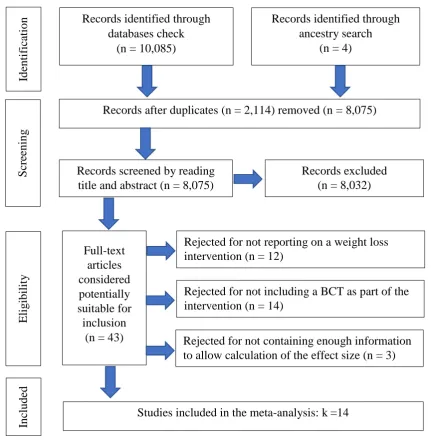
Figure 1 653
Flow of Information through the Review
654 655
Id
enti
fic
ati
on
S
cre
enin
g
Elig
ibi
li
ty
In
cluded
Records identified through databases check
(n = 10,085)
Records identified through ancestry search
(n = 4)
Records after duplicates (n = 2,114) removed (n = 8,075)
Records screened by reading title and abstract (n = 8,075)
Records excluded (n = 8,032)
Full-text articles considered potentially suitable for
inclusion (n = 43)
Rejected for not reporting on a weight loss intervention (n = 12)
Rejected for not including a BCT as part of the intervention (n = 14)
Rejected for not containing enough information to allow calculation of the effect size (n = 3)
[image:31.595.63.495.127.574.2]Table 1 656
Characteristics of the Studies Included in the Meta-Analysis
657
Intervention
Study
Study
design Outcome(s)
Duration
(in weeks) (Behaviour Change Techniques (BCTs) a
Intervention based on theory? b
Also includes nutritional intervention?
Sample size (exp. / control)
Effect size
(Cohen’s d)c
Byers et al. (2014) Between participant
Weight, body condition score, owners’ behaviour
0 1.1 Goal setting 1.2 Problem solving
5.3 Information about social and
environmental consequences
No No 22/10 -0.03
Chauvet et al. (2011) Within participant
Weight 12 1.1 Goal setting (behaviour) 1.5 Review of behaviour goal(s)
2.7 Feedback on the outcome(s) of behaviour 5.1 Information about health consequences 9.1 Credible source
10.10 Reward (outcome)
No Yes 6/- 2.81
Gentry (1993) Within participant
Weight 25 1.1 Goal setting (behaviour) 1.3 Goal setting (outcome)
2.7 Feedback on the outcomes of behaviour 3.1 Social support (unspecified)
4.1 Instructions on how to perform the behaviour 5.1 Information about health consequences 5.3 Information about social and environmental consequences
9.1 Credible source
No Yes 15/- 0.27
German et al. (2007) Within participant
Weight, body fat
25 1.1 Goal setting (behaviour) 1.2 Problem solving
1.3 Goal setting (outcome) 1.5 Review of behaviour goal(s) 1.7 Review outcome goals 2.3 Self-monitoring of behaviour 3.1 Social support (unspecified)
4.1 Instructions on how to perform the behaviour 5.3 Information about social and environmental consequences
7.3 Reduce prompts / cues 8.2 Behaviour substitution
Markwell et al (1990) Within participant
Weight 12 1.1 Goal setting (behaviour) 1.3 Goal setting (outcome) 1.5 Review of behaviour goal(s)
2.7 Feedback on the outcomes of behaviour 5.3 Information about social and environmental consequences
No Yes 24/- 2.23
Marshall et al. (2010) Within participant
Weight 16 1.1 Goal setting (behaviour)
4.1 Instructions on how to perform the behaviour
No Yes 14/- 0.16
Morrison et al. (2013) Between participant
Owners’
behaviour
10 1.1 Goal setting (behaviour) 1.2 Problem solving
1.5 Review of behaviour goal(s) 1.8 Behavioural contract 2.2 Feedback on behaviour 2.3 Self-monitoring of behaviour 3.1 Social support (unspecified)
3.2 Social support (practical) 3.3 Social support (emotional)
4.1 Instructions on how to perform the behaviour 6.1 Demonstration of behaviour
8.1 Behavioural practice/rehearsal 8.2 Behavioural substitution 9.1 Credible source
9.2 Pros and cons 10.3 Non-specific reward
12.1 Restructuring the physical environment
12.5 Adding objects to the environment
Rhodes et al. (2012) Between participant
Owners’
behaviour
0 1.1 Goal setting (behaviour)
4.1 Instructions on how to perform the behaviour 5.3 Information about social and environmental consequences
6.3 Information about others approval
No No 30/28 0.08
Richards et al. (2015) Between participant
Owners’
behaviour
13 1.1 Goal setting (behaviour) 1.2 Problem solving
1.5 Review of behaviour goal(s) 2.3 Self-monitoring of behaviour 3.1 Social support (unspecified) 3.2 Social support (practical) 3.3 Social support (emotional)
4.1 Instruction on how to perform the behaviour 5.1 Information about health consequences 5.2 Salience of consequences
9.1 Credible source
12.2 Restructuring the social environment
Yes No 23/24 1.47
Saker et al. (2005) Study 1 Within participant
Body condition score
14 1.1 Goal setting (behaviour) 1.3 Goal setting outcome 1.5 Review of behaviour goal(s)
4.1 Instructions on how to perform the behaviour 12.5 Adding objects to the environment
No Yes 21/- 1.18
Saker et al. (2005) Study 2 Within participant
Body condition score
28 1.1 Goal setting (behaviour) 1.3 Goal setting outcome 1.5 Review of behaviour goal(s)
4.1 Instructions on how to perform the behaviour 12.5 Adding objects to the environment
No Yes 39/- 2.60
Vitger et al. (2016) Between participant
Weight, body fat, owners’ behaviour
Wakshlag et al. (2012) Within participant
Weight 27 1.1 Goal setting (behaviour) 1.5 Review of behaviour goal(s) 1.7 Review of outcomes goal(s) 2.3 Self-monitoring of behaviour
2.7 Feedback on the outcomes of behaviour 12.5 Adding objects to the environment
No Yes 35/- 0.65
Yaissle et al. (2004) Between participant
Weight, body condition score
26 4.1 Instruction on how to perform the behaviour 5.1 Information about health consequences 6.1 Demonstration of behaviour
9.1 Credible source
No No 16/16 -0.21
a We intended to assess the extent to which the intervention was based on theory using a continuous measure developed by Michie and Prestwich 658
(2010). However, the majority of studies did not mention theory and so we converted the score into a binary measure indicating whether the
659
intervention was based on theory or not.
660
b These are the BCTs that are unique to the experimental group. BCTs that are shared with the control group were not included as they cannot 661
explain any differences in outcomes between the studies.
662