White Rose Research Online URL for this paper: http://eprints.whiterose.ac.uk/114873/
Version: Accepted Version
Article:
Basu, S and Savani, K (2017) Choosing one at a time? Presenting options simultaneously helps people make more optimal decisions than presenting options sequentially.
Organizational Behavior and Human Decision Processes, 139. pp. 76-91. ISSN 0749-5978 https://doi.org/10.1016/j.obhdp.2017.01.004
© 2017 Elsevier Inc. This manuscript version is made available under the CC-BY-NC-ND 4.0 license http://creativecommons.org/licenses/by-nc-nd/4.0/
[email protected] https://eprints.whiterose.ac.uk/
Reuse
Items deposited in White Rose Research Online are protected by copyright, with all rights reserved unless indicated otherwise. They may be downloaded and/or printed for private study, or other acts as permitted by national copyright laws. The publisher or other rights holders may allow further reproduction and re-use of the full text version. This is indicated by the licence information on the White Rose Research Online record for the item.
Takedown
If you consider content in White Rose Research Online to be in breach of UK law, please notify us by
Choosing One at a Time? Presenting Options Simultaneously Helps People make more Optimal Decisions than Presenting Options Sequentially
Shankha Basu
Division of Marketing and International Business Nanyang Business School, Nanyang Technological University
50 Nanyang Ave S3-B1C-125, Singapore 639798
&
Leeds University Business School University of Leeds, Leeds LS2 9JT, UK
Phone: +65-8312-8617 E-mail: [email protected]
Krishna Savani (Corresponding Author)
Assistant Professor of Strategy, Management, and Organization Nanyang Business School, Nanyang Technological University
50 Nanyang Ave S3-01C-81, Singapore 639798
Phone: +65-6790-4628 E-mail: [email protected]
Acknowledgement: This research was supported by a Nanyang Assistant Professorship grant awarded by Nanyang Technological University to Krishna Savani, and ACRF Tier 2 grant MOE2013-T2-2-059 awarded by the Singapore Ministry of Education to Krishna Savani. We thank Monica Wadhwa for helpful feedback on earlier drafts, Pranav Phalgun for developing the website for Experiment 7, and Yu Ding and Li Shi Tan for their invaluable assistance with conducting this research.
Abstract
This research examines an element of choice architecture that has received little
attention—whether options are presented simultaneously or sequentially. Participants
were more likely to choose dominating options when the options were presented
simultaneously rather than sequentially, both when the dominance relationship was
transparent (Experiment 1) and when it was not (Experiments 2-3). Depth of cognitive
processing mediated the effect of option presentation on optimal choice (Experiment 4).
Memory load was unlikely to be the underlying mechanism, as individual differences in
working memory span did not predict optimal choice in the sequential condition (which
places a greater memory load; Experiment 5), and manipulations of memory load did
not reduce the benefits of simultaneous presentation (Experiments 6a-6c). Instead,
participants’ working memory span predicted optimal choice in the simultaneous
condition (which allows for more in-depth processing; Experiment 5), and a
manipulation of processing load eliminated the benefits of simultaneous presentation
(Experiment 7).
Keywords: choice architecture; cognitive load; option presentation; processing load;
Choosing One at a Time? Presenting Options Simultaneously Helps People make more Optimal Decisions than Presenting Options Sequentially
Imagine Susan, a 23 year old woman, who quit her job and opened a start-up in
2012. Upon losing her employer-provided insurance, she visited the websites of
numerous insurance providers, one at a time, viewed the plans that they offered, and
then finally chose a health insurance plan. Now imagine Sarah, a 23 year old woman
who quit her job to open a start-up in 2014. Instead of visiting the website of each and
every insurance provider, Sarah went to www.healthcare.gov, entered her information,
and saw a big table listing all the health insurance plans that she was eligible for, along
with their values on various attributes. Assuming that the plans that Susan and Sarah
were eligible for were identical, who would be more likely to choose the plan that best
met her needs?
Both types of choices described above are common in people’s everyday lives.
In many cases, decision makers make a choice after considering options one at a time.
For example, hiring managers typically interview one candidate at a time before
selecting one for the position. Journal editors typically receive and consider one
manuscript at a time. Other times, decision makers make a choice with all options laid
out at the same time. For example, for journal special issues, guest editors typically
consider multiple manuscripts submitted at the same time and then select a subset.
Often times, people have a choice of whether to consider multiple options sequentially
or simultaneously. For example, when buying electronic products online, people can
view the specifications of each product at a time by going to the product’s webpage, or
Similarly, investors choosing a mutual fund may study one fund at a time, or compare
multiple mutual funds all laid out together. Could viewing options all together rather than
one at a time help or hurt managers hire better job candidates, journals select more
high quality papers, consumers buy better products, and investors choose more
profitable mutual funds? We investigate this possibility in the present research.
To assess the extent to which people encounter options that are presented
sequentially vs. simultaneously in real life, we explored websites of the top 10 car
manufacturers (Statista, 2016) and the top 10 life insurance providers (National
Association of Insurance Commissioners, 2016) in the US, in terms of market share. All
car manufacturers’ and life insurance providers’ websites had individual web pages for
each of their products, allowing customers to view options one at a time. However, they
differed in the extent to which customers could view multiple products simultaneously.
Four car manufacturers allowed consumers to view multiple cars together but showed
only two attributes—price and mileage—instead of more than 20 attributes that are used
to describe cars. All car manufacturers featured a compare products tool. However,
reaching this tool was not straightforward. Compared to the webpages for individual
products, which could be accessed by 1.1 clicks (SD = .3) after landing on the
homepage, a visitor would have to make 2.7 clicks (SD = .46) to reach the comparison
tool. Furthermore, people could compare only 3.5 cars (SD = .67) at a time. On the
other hand, six insurance providers featured a comparative table listing all their
products, and one company provided a comparison tool that required five clicks from
the home page and could be used to compare three of six available policies. Three
analyses suggest that the default format in which consumers acquire information about
products varies both across and within different purchase domains. Further, when given
the option, people can typically compare only a few options on a few attributes
simultaneously, but have to sequentially view one product at a time if they want detailed
information.
The decision of whether to present options sequentially or simultaneously is a
key element of choice architecture (Thaler & Sunstein, 2008), which refers to the fact
that “there are many ways to present a choice to the decision-maker, and that what is
chosen often depends upon how the choice is presented” (Johnson et al., 2012, p. 488).
Researchers have investigated numerous elements of choice architecture that influence
decisions, such as the number of alternatives (Cronqvist & Thaler, 2004), the presence
of defaults (Johnson & Goldstein, 2003), the categories in which the options are
grouped (Fox, Ratner, & Lieb, 2005), and the units used to describe attributes (Larrick &
Soll, 2008). We investigate an element of choice architecture that has received little
attention in past research—whether options are presented simultaneously or
sequentially (see Mogilner, Shiv, & Iyengar, 2013; Bohnet, Van Geen, & Bazerman,
2015, for exceptions).
Our key hypothesis is that when people choose among simultaneously presented
options, they would make more optimal decisions than when they choose among
sequentially presented options. The rationale behind this prediction is that when
individuals consider options simultaneously, the key attributes on which the options
differ from one another are easier to compare, thus allowing them to engage in more
options simultaneously would lead decision makers to process the options more
comprehensively and analytically, such as by examining the relative advantages and
disadvantages of the options and integrating the relevant information (Maheswaran &
Chaiken, 1991; Maheswaran & Meyers-Levy, 1990). This more comprehensive,
extensive, and in-depth processing, in turn, would help them identify the optimal option.
Although past research has not examined this question, we review the extant literature
on sequential vs. simultaneous option presentation.
Simultaneous versus Sequential Option Presentation Strategic Decision Making.
Although research has not explicitly tested whether people make better decisions
when they consider options sequentially vs. simultaneously, some research on strategic
decision making is consistent with this idea. Gemünden and Hauschildt (1985) obtained
detailed minutes of 83 decisions that the executive board of a mid-size German
company made over an 18-month period. They noted the number of options that each
decision involved: 40% were whether-or-not decisions involving single options
considered individually, and 55% were decisions involving two options considered
simultaneously. Eight years later, the executive board was asked to evaluate the quality
of each of the 83 decisions. Strikingly, executives rated the initial decision as being
“very good” 43% of the time when it involved two options, but only 6% of the time when
it involved a single option. Although this study was not a controlled experiment, this
finding suggests the intriguing possibility that when people consider multiple options
simultaneously, they might make better decisions than when they consider options one
Consumer Decision Making.
Recent research has more specifically investigated people’s choices among
sequentially versus simultaneously presented options. Mogilner et al. (2013) found that
when consumers chose among sequentially presented hedonic options (e.g., chocolate,
wine), they were less satisfied with their chosen option than when they chose among
simultaneously presented options. For example, individuals presented with descriptions
of five chocolates and asked to choose one were subsequently happier with their choice
and less likely to change their choice compared to those who were presented with the
descriptions one at a time. The rationale for this finding was that when presented with
options sequentially, individuals hope that they would encounter an even better option
subsequently, which makes them dissatisfied with their chosen option. However, when
options are presented simultaneously, the question of hoping for a better option does
not even arise, and thus people are more satisfied with their chosen option.
Our research differs from this work in important ways. Mogilner et al. (2013)
examined choice among hedonic stimuli that cannot be broken down into attributes
(e.g., chocolate, wine), and are thus holistically perceived and judged based on their
subjective properties as perceived by the chooser. Instead, we study choice among
quantifiable stimuli that are specified in terms of numerically represented attributes and
judged based on their objective attributes. Further, among hedonic options, people are
entitled to choose whatever they fancy, so there is no optimal option. Instead, we
investigate cases in which there is a normatively correct option that should not be
influenced by people’s idiosyncratic preferences. Finally, Mogilner et al.’s key outcome
people choose the optimal option. Thus, the present research studies choice stimuli
(attribute-based vs. holistic), mechanisms (cognitive processing vs. hope), and decision
outcomes (optimal choice vs. post-choice satisfaction) that are distinct from those
studied by Mogilner et al. (2013).
An extensive body of research has examined a related phenomenon—how
presenting a single option versus multiple options influences people’s evaluations of the
options (Hsee & Zhang, 2010). The typical paradigm in this stream of research is to
show some participants either one of two different options (e.g., either one of two
different test scores; the separate evaluation conditions), and to show a third group of
participants both the options (e.g., two test scores presented together; the joint
evaluation condition; Hsee, 1996). This research has found that people’s evaluation of
options violate basic economic principles in single evaluation but not in joint evaluation
(Hsee & Zhang 2010, but see Sher & McKenzie, 2014, for arguments on why such an
inconsistency might be rational). Our research differs from the literature on single vs.
joint evaluation in two key ways. First, both sequential and simultaneous presentations
are joint evaluations—all participants are presented with all options (unlike single
evaluation, in which participants are presented with only one option). Second, our
outcome variable is the choice of the best option. However, research on single vs. joint
evaluation cannot even investigate this outcome because in the single evaluation
condition, participants do not have multiple options to choose from.
Potential benefits of considering options simultaneously
Comparing options is a key element of making a choice (Medin, Goldstone, &
among visually presented options, they initially scan each option to form an overview;
then, they narrow down the choice set to the options in which they are interested, and
selectively compare individual attributes of those options while ignoring the other
options; finally, they conclude with a scan of previously ignored options before deciding
on one of the options (Russo & Leclerc, 1994, see also Pieters & Warlop, 1999;
Reutskaja, Nagel, Camerer, & Rangel, 2011; Willemsen & Johnson, 2011). Even when
the choice is between choosing an option or not, people compare the available option
with ones that they might have previously encountered, or compare the value of the
available option with their internal reference value for similar options (Simonson,
Bettman, Kramer, & Payne, 2013). Therefore, it is not a stretch to claim that
comparisons form the basis of choice.
We submit that when people are deciding between options that are all laid out
together, the differences between the options would become salient and help people
compare the options with each other. Some research in the way people acquire
information from visually displayed options suggest that this may be the case. After
viewing details of various options presented together rather than one at a time, people
acquire a better understanding of the differences among the options (Goldstone, 1996;
McKenzie, 1998). For example, compared to participants who learned about both
common and unique symptoms of two illnesses sequentially, participants who were
presented with the symptoms of both illnesses simultaneously were more likely to use
diagnostic symptoms in a subsequent diagnosis task (Klayman & Brown, 1993).
Similarly, viewing simultaneously presented options helps people realize the
the predictions of two experts sequentially, participants who were presented with both
experts’ predictions simultaneously were more likely to average the two experts’
predictions, which is the normative strategy as each expert could independently over- or
under-predict the true value, rather than relying on either one of the two experts’
predictions (Larrick & Soll, 2006).
These findings suggest that when options are presented simultaneously, it
becomes easier for the decision maker to compare options and understand the ways in
which the options differ from each other, and to assess their relative advantages and
disadvantages. If viewing options simultaneously helps the decision maker engage in
more in-depth information processing about the options, then they would have a higher
chance of identifying the optimal option. In contrast, when options are presented
sequentially, while viewing any particular option, the decision maker would not be able
to readily compare all the options with each other. This may inhibit the decision maker’s
ability to process the information about the various options, and therefore, reduce their
likelihood of identifying the optimal option.
To illustrate the hypothesis, consider how Susan would choose among the
various health insurance plans in the absence of a comparative tool such as
www.healthcare.gov. Susan would visit the webpage of each of the health insurance
plans that she is interested in, one at a time. She would probably form a subjective
evaluation of each plan on important attributes and then move on to the next plan. After
she has viewed all available plans, she can create a table listing the important attributes
of each plan, but most likely, she would try to mentally compare the leading options and
simultaneously, she can directly assess which option is the best on the attributes that
she cares most about, make judgments about the relative advantages and
disadvantages of each plan, and choose the option that best meets her preferences. In
other words, viewing options simultaneously is likely to help Sarah engage in more
in-depth information processing, which would help her make an optimal choice.
Potential benefits of considering options sequentially
The arguments laid out above suggest that people would make better decisions
when they consider options all together. However, research on consumer choice
suggests that in certain cases, people might make better decisions when they consider
options one at a time. When evaluating multiple options, a person can compare the
options in two different ways, using either alternative-based comparisons or
attribute-based comparisons (Bettman, Luce, & Payne, 1998; Payne, Bettman, & Johnson,
1993). In the alternative-based comparison strategy, the decision maker evaluates one
alternative in its entirety, across all attributes, and then moves on to the next alternative.
In the attribute-based comparison strategy, the decision maker compares all
alternatives on one attribute, and then moves on to the next attribute. An
alternative-based strategy called the weighted additive strategy is often considered the best
strategy for making choices (Payne, Bettman, & Johnson, 1988; Zakay & Wooler,
1984). A decision maker following this strategy would take an alternative, assign a value
to each of its attributes, multiply each attribute value with the subjective importance or
weight of that attribute, and then sum these across all attributes for that alternative. The
decision maker would then repeat this procedure for all alternatives, and then choose
When considering options sequentially, the decision maker might be more likely
to engage in alternative-based comparisons, as they only see one option at a time.
When considering options simultaneously, the decision maker might be more likely to
engage in attribute-based comparisons, as they see all options and their attributes laid
out all together. To the extent that a highly effective decision strategy is
alternative-based, this line of reasoning would predict that people would make better decisions
when choosing among sequentially presented options. However, people can engage in
either alternative-based or attribute-based comparisons with either sequentially or
simultaneously presented options. For example, a decision maker considering options
one at a time can employ an attribute-based comparison strategy by going back and
forth among options. Similarly, a decision maker considering options all together can
employ an alternative-based comparison strategy by focusing on one option at a time
rather than focusing on one attribute at a time. Further, people are unlikely to have
pre-assigned weights for different attributes in mind unless they have carefully thought
about the choice in advance. Thus, we did not consider it likely that people would make
better choices when choosing among sequentially rather than simultaneously presented
options.
Overview of Studies
We first conducted a pilot study to examine whether people choose among both
sequentially and simultaneously presented options in their everyday lives. We then
tested our hypotheses across seven experiments. In each experiment, we asked people
to choose among options that were defined in terms of quantitative attributes, such as
in the consumer behavior literature; Wright, 1975), and gambles varying in payoffs and
probabilities (the types of decisions most studied in the judgment and decision making
literature; Slovic & Lichtenstein, 1968). Experiment 1 tested our main hypothesis that
individuals presented with consumer items varying on five different attributes would be
more likely to choose the dominating option that had the highest value on each attribute
when the options are displayed simultaneously rather than sequentially. Experiment 2
sought to conceptually replicate this finding with more complex stimuli in which the
dominance relationship was not obvious but had to be inferred based on one latent
parameter—price per unit quantity. Experiment 3 aimed to further replicate the findings
with stimuli in which the dominance relationship had to be inferred based on two latent
parameters—expected value and variance.
Experiment 4 investigated the underlying mechanism, that simultaneously
presentation helps people engage in more in-depth cognitive processing than sequential
presentation, using an open-ended thought protocol analysis. Experiment 5 tested two
competing explanations for the observed effect—between-condition differences in the
depth of cognitive processing rather than between-condition differences in memory
load. We did so by assessing the role of individual differences in working memory span.
Corroborating this finding with experimental evidence, Experiments 6a-6c found that
manipulations of working memory load did not reduce the extent to which simultaneous
presentation helped people make better choices over sequential presentation, indicating
that between-condition difference in working memory load is not the key mechanism.
However, Experiment 7 found that when people’s cognitive processing resources were
attenuated, strengthening our argument for the underlying role of more in-depth
cognitive processing.
No participants were dropped from the analyses in any experiment unless
reported. All conditions and choice measures are reported. In each experiment, data
were analyzed only after the target sample size was met.
Pilot Study
Before testing our hypothesis, we wanted to establish the relevance of the
problem in the real world. If people consider options sequentially in a significant
proportion of their choices, then presenting the options all together can nudge them to
make better choices. We provided participants with a description of sequential and
simultaneous option presentation and gave them an example of each. Next, we asked
participants to estimate how frequently they considered options sequentially vs.
simultaneously when making their everyday choices.
Method
Participants. We recruited 211 participants (Mage = 36.75 years; 104 women,
105 men, 2 unreported) from the US using Amazon Mechanical Turk.
Procedure. Participants were first presented with a brief description of the two
option consideration strategies:
When people shop for a product, they often consider multiple options before making a choice.
There are two different ways in which people can go about this process: They can either consider options one at a time (sequentially) or consider them all together (simultaneously).
They repeat this process until they have considered all the options. Once they have done so, they make a choice.
At other times, people view all the options together. They view all the relevant options together, such as by putting all options side by side in a store or viewing all options on a single page when shopping online. They consider the pros and cons of all the options. Once they have done so, they make their choice.
Next, to provide participants with a concrete example, we asked them to imagine
that they were buying a laptop and considering four options. To illustrate sequential
option consideration, we showed participants each option one at a time on different
screens. Next, to illustrate simultaneous option consideration, we showed participants
all the options together on a single screen.
Thereafter, participants were asked “What percentage of time in the past did you
view options one at a time vs. all together before making the final choice?” Participants
had to indicate the percent of time they viewed options sequentially and simultaneously,
with the total adding up to 100%.
Results
Participants indicated that they considered options sequentially in 42.85% of
choices and simultaneously in 57.15% of choices in the past. The data from the pilot
study indicates that in nearly half of their everyday choices, people consider options
sequentially. Thus, if considering options simultaneously helps people make better
decisions, then switching from sequential option consideration to simultaneous option
consideration would have a significant impact on the quality of nearly half the decisions
Experiment 1
The goal of Experiment 1 was to test whether people choosing from
simultaneously presented consumer products would be more likely to pick the
dominating option compared to those choosing from sequentially presented options.
Across five trials, we showed participants multiple products varying on different
attributes. One of these options had the highest value across all attributes, and thus
was the dominating option. We hypothesized that participants who view the options
simultaneously would be more likely to choose the dominating option than those who
view the options sequentially.
Method
Participants. As we did not have any prior data for conducting a power analysis,
we decided on a target sample size of 100 participants per cell at the outset, given that
a sample size of 100 per cell would provide 80% power to detect a medium effect size
(Cohen’s d = .40) with = .05 (two-tailed). A survey seeking 200 US residents was
posted on Amazon Mechanical Turk. In response, 201 participants (Mage = 32.76 years;
116 women, 85 men) completed the survey. We randomly assigned participants to the
sequential or the simultaneous option presentation conditions.
Procedure. We presented participants with five trials in which they had to
choose one of six different options for a consumer product. In each trial, we asked
participants to imagine that they were planning to buy an electronic product (e.g., a
laptop) and had shortlisted six options differing across five attributes (e.g., battery,
processor, RAM, storage, and warranty). We designed the stimuli such that each
options dominated all others by assigning it the higher of the two values on each
attribute—this option was thus the optimal option in the choice set. The dominating
option appeared in different locations in each of the five trials. We randomized the order
of the five trials for each participant (see Appendix A for complete stimuli).
In the simultaneous presentation condition, in each trial, participants were
presented with all six options together on a single screen, and asked to “Choose one
and indicate your choice in the next page.” Once participants clicked on the continue
button, they were presented with the same options again and asked, “Which of the
following 6 models would you choose?” Participants indicated their choice by clicking on
a button next to their preferred option. Participants moved on to the next trial after
making their choice.
In the sequential presentation condition, in each trial, participants were only
presented with one option at a time. They could view the next option by clicking the
continue button and go back to the previous options by clicking the back button. Once
they had viewed all the options, they were instructed, “That was the last option for this
question. Now you will see the options once again. This time, locate the option that you
would choose using the continue and back buttons.” They then saw the six options
again presented one at a time with a “Yes, I want to choose this option” button below
each option. They could navigate to the desired option, and upon making a choice,
moved to the next trial.
Results
The dependent variable was the percentage of trials in which the participants
considered the options simultaneously were more likely to choose the dominating option
than those who considered options sequentially, Msimultaneous = 84.42%, 95% CI [79.94%,
88.90%], SD = 21.03%, Msequential = 75.46%, 95% CI [70.83%, 80.10%], SD = 25.25%,
t(199) = 2.72, p = .007, Cohen’s d =.39.2
Discussion
We know from the literature (e.g., Mogilner et al., 2013) that when choosing
among simultaneously presented options, people are more satisfied with their choices
than when choosing among sequentially presented options. Experiment 1 shows for the
first time that although a priori, people might be more likely to use more optimal
alternative-based comparisons when choosing among sequentially presented options
(Payne et al., 1988), they make better choices when choosing among simultaneously
presented options. When participants chose among simultaneously presented
consumer products, they were more likely to choose the option that had the highest
level of each attribute, the dominating option, compared to when they chose among
sequentially presented options. It appears that simultaneous option presentation made it
easier for the participants to compare the options, thereby helping them identify the best
one.
Experiment 2
Experiment 2 aimed to assess the generalizability of Experiment 1’s findings in
two ways. Although the type of choice that participants made in Experiment 1 is similar
to common consumer choices, it can be argued that the dominance relationship may be
transparent in simultaneous presentation but obscured in sequential presentation given
whether simultaneous presentation helps people identify dominating options even when
the dominance relationship is not transparent but instead needs to be inferred from the
presented attributes.
In this experiment, we asked participants to choose between different suppliers
offering different quantities of the same product at different prices. We varied the
options such that one supplier provided the product at the lowest price per unit quantity,
which was the optimal option. Unlike in Experiment 1, participants did not see the price
per unit quantity—instead, this was a latent parameter that they had to infer. We
hypothesized that participants would be more likely to choose the option with the lowest
price per unit quantity when choosing among simultaneously presented options than
when choosing among sequentially presented options.
Participants. A power analysis based on Cohen’s d = .39 (from Experiment 1),
= .05 (two-tailed), and power = 80% indicated that we would need to recruit 105
participants per cell. To ensure that we have high power, we decided on a larger target
sample size of 250 participants per cell, which would give us 99% power. A survey
seeking 500 US residents was posted on Amazon Mechanical Turk. In response, 472
participants (Mage = 36.18 years; 250 women, 187 men, 35 unreported) completed the
survey. We randomly assigned participants to either the sequential or the simultaneous
option presentation conditions.
Procedure. Participants were asked to imagine that they owned a large
restaurant that bought weekly supplies of different products. They were asked to make
purchase decisions for five products (e.g., ketchup, ground cloves), and for each
of the product for different prices. We designed the stimuli such that for each product,
the five suppliers varied in the price per unit quantity, with one supplier offering the
lowest price per unit, which would be the optimal choice. We ensured that the optimal
option occurred at different positions across the five products (i.e., whether it was listed
first, second, third, fourth, or fifth), and we randomized the order of the five products
(see Appendix B for the complete stimuli).
We manipulated option presentation in the same manner as in Experiment 1. In
the simultaneous condition, we first presented participants with all the options together
and then asked to choose one of the five options, which were again presented together.
In the sequential condition, we first presented participants with the options one at a
time, and then asked to choose one of the five options, which were again presented one
at a time.
Results.
The dependent variable was the percentage of trials in which the participants
chose the supplier offering the lowest price per unit quantity. An independent samples
t-test found that participants in the simultaneous presentation condition chose the optimal
option in a greater percentage of the trials compared with those in the sequential
presentation condition, Msimultaneous = 61.34%, 95% CI [57.50%, 65.19%], SD = 31.42%,
Msequential = 54.87%, 95% CI [51.00%, 58.75%], SD = 28.84%, t(470) = 2.33, p = .02,
Cohen’s d = .21.3
Discussion.
Experiment 2 provided further support for our hypothesis that when people
optimal decisions than when they choose from sequentially presented options, even
when the relevant parameters that define the optimal option are implicit and need to be
inferred from the attribute values. Participants making purchase decisions among five
suppliers were more likely to pick the supplier offering the lowest price per unit quantity
when the options were presented together as compared to when they were presented
one at a time. It appears that simultaneous presentation made it easier for participants
to assess and compare the options even on latent parameters, thereby increasing their
chances of choosing the optimal option compared to sequential presentation.
Experiment 3
Experiment 3 sought to further generalize the findings of the previous studies
using even more complex choices—risk decisions. In the context of risky options with
relatively small stakes, the optimal decision is to select an option with the highest
expected value (given that rational agents should not exhibit small stakes risk aversion;
Rabin, 2000), but with lower variance when expected value is held constant (given the
assumption of risk aversion captured by the idea “never take additional risk without
additional returns;” Markowitz, 1959). This idea is consistent with the notion of
stochastic dominance, which suggests that for two options with the same expected
value, the less risky option dominates the riskier one (second-order stochastic
dominance; Hadar & Russel, 1969; Hanoch & Levy, 1969).
In Experiment 3, we presented participants with risky options that varied on
expected value. Two of these options had the highest expected value. Among these two
options, there was a second-order stochastic dominance relationship such that, for the
based on two latent parameters (i.e., expected value and variance), both of which were
not obvious but had to be inferred from the payoffs. We hypothesized that participants
would be more likely to choose the option with the highest expected value and lower
variance when choosing from simultaneously presented options than when choosing
from sequentially presented options.
Method
Participants. A power analysis based on Cohen’s d = .39 (from Experiment 14),
= .05 (two-tailed), and power = 80% indicated that we would need to recruit 105
participants per cell. To ensure that we have high power, we decided on a larger target
sample size of 150 participants per cell, which would give us 92% power. A survey
seeking 300 US residents was posted on Amazon Mechanical Turk. In response, 294
participants (Mage = 35.28 years; 145 women, 147 men, 2 undisclosed) completed the
survey. We randomly assigned participants to the sequential or the simultaneous option
presentation conditions.
Procedure. We presented participants with ten trials in which they had to choose
one of five different risky options, each of which would give one of two payoffs with
equal probability (see Appendix C for complete stimuli). In each trial, two options had
the highest expected value but differed in the variance of their outcomes (e.g., “Option
1: Heads $10, Tails: $20”, “Option 2: Heads $8, Tails: $22”). We ensured that the
dominating option (e.g., “Option 1: Heads $10, Tails: $20”) occurred in each of the five
possible positions in the choice set exactly twice across the ten trials, thus
We manipulated option presentation in the same manner as in the previous
experiments. In the simultaneous condition, we first presented participants with all the
options together and then asked to choose one of the five options, which were again
presented together. In the sequential condition, we first presented participants with the
options one at a time, and then asked them to choose one of the five options, which
were again presented one at a time.
Results.
The dependent variable was the percentage of trials in which the participants
chose the optimal option—the option with the highest expected value and lower
variance. An independent samples t-test found that participants in the simultaneous
presentation condition chose the optimal option on a greater percentage of trials
compared with those in the sequential presentation condition, Msimultaneous = 62.66%,
95% CI [57.64%, 67.69%], SD = 33.10%, Msequential = 46.29%, 95% CI [41.02%,
51.56%], SD = 30.04%, t(292) = 4.45, p < .0001, Cohen’s d = .52.5
Discussion.
Experiment 3 provided further support for our hypothesis that when people
choose from simultaneously presented options, they are more likely to make more
optimal decisions than when they choose from sequentially presented options. This
occurred not only when the optimal option was based solely on a single latent
parameter, as in Experiment 2, but also on multiple latent parameters, as in the current
experiment. Participants presented with five lotteries simultaneously were more likely to
pick the lottery with the highest expected value and lower variance, two parameters that
sequentially. It appears that simultaneous presentation made it easier for participants to
assess and compare the options even when making these relatively complex decisions,
thereby increasing their chances of choosing the best option compared to sequential
presentation.
Experiment 4
Experiments 1 through 3 indicate that viewing options simultaneously increases
people’s likelihood of choosing the optimal option from a choice set. Our assumption
has been that simultaneous presentation increases optimal decision making compared
to sequential presentation because it allows participants to easily compare the options
across different attributes, helping them engage in more in-depth cognitive processing
about the options, and thereby, identifying the best option. Experiment 4 aimed to
directly test this idea by assessing whether people engage in more in-depth cognitive
processing when presented with simultaneously rather than sequentially presented
options.
In this study, we asked participants to make choices among sequentially and
simultaneously presented risky options across five trials, as in Experiment 3.
Participants were asked to list their thoughts after each decision that they made. We
analyzed the content of participants’ thoughts to test whether the depth of cognitive
processing differed across conditions (Chen & Berger, 2013; He & Bond, 2013; Iliev &
Axelrod, 2016; Kuhnen & Niessen, 2012). To assess the specificity of the mechanism,
we further tested whether the two conditions would differ in affective processing.
Although affective processing is often taken as a counterpart to cognitive processing
not have any a priori reasons for expecting between-condition differences in affective
processing.
Method
Participants. A power analysis based on Cohen’s d = .52 (from Experiment 3,
which used a superset of the current stimuli), = .05 (two-tailed), and power = 80%
indicated that we would need to recruit 60 participants per cell. To ensure that we have
high power, we decided on a larger target sample size of 100 participants per cell,
which would give us 95% power. A survey seeking 200 US residents was posted on
Amazon Mechanical Turk. In response, 214 participants (Mage = 34.80 years; 85
women, 129 men) completed the survey.
Procedure. We presented participants with five trials in which they had to
choose one of five lotteries varying in expected value and variance, which was a subset
of lotteries used in Experiment 3 (see Appendix C for the stimuli). There was, however,
one crucial difference. In each trial, after participants chose an option, we asked them,
“Please write down what thoughts you had while choosing one of the five options on the
previous screen. Please tell us anything you thought or felt while making the choice.”
We provided them with five separate text boxes to list their thoughts.
Results
Choice. As in the previous experiments, the dependent variable was the
percentage of trials in which the participants chose the optimal option. An independent
samples t-test found that participants in the simultaneous presentation condition chose
the optimal option (i.e., the option with the highest expected value and lower variance)
condition, Msimultaneous = 52.57%, 95% CI [46.37%, 58.78%], SD = 31.41%, Msequential =
39.82%, 95% CI [33.73%, 45.91%], SD = 33.05%, t(212) = 2.89, p =.004, Cohen’s d =
.40.6
Depth of cognitive processing. We next used the Linguistic Inquiry and Word
Count program (LIWC; Pennebaker, Booth, & Francis, 2007) to analyse the content of
participants’ thoughts during the decision making process. We submitted each
participant’s responses across all five trials to the LIWC program. The program provided
numeric scores indicating the extent to which each participant’s responses referred to a
number of different constructs. The key constructs of interest were the percentage of
words that indicated cognitive thought process and those that indicated affective
thought process. As LIWC has five sub-categories under affective processes and eight
under cognitive processes, we created each participant’s cognitive and affective
processing score by adding their scores across the various sub-categories within each
of these two larger categories. Compared to participants in the sequential condition,
those in the simultaneous condition described thoughts that scored higher on cognitive
processing, Msimultaneous = 24.79, 95% CI [23.66, 25.92], SD = 5.96, Msequential = 22.56,
95% CI [21.45, 23.68], SD = 5.82, t(212) = 2.76, p =.006, Cohen’s d = .38, but not on
affective processing, Msimultaneous = 10.20, 95% CI [9.06, 11.34], SD = 4.21, Msequential =
11.41, 95% CI [10.29, 12.53], SD = 7.19, t(212) = -1.51, p =.13, Cohen’s d = .20.7
Mediation. Next, we conducted a mediation analysis using Model 4 of the
PROCESS macro (Preacher & Hayes, 2008) to test whether between-condition
differences in the extent of cognitive processing mediated between-condition difference
the effect of option presentation condition on the percentage of trials on which
participants chose the optimal option was mediated by participants’ cognitive processing
scores, indirect effect = 1.73, 95% CI [.23, 4.57].
Discussion
Experiment 4 replicated the previous experiments’ findings and provided
converging support for the underlying mechanism. Compared to participants who
viewed the options sequentially, those who viewed the options simultaneously were
more likely to choose the optimal option and to use words related to cognitive
processing while describing their thoughts during the choice process.
Between-condition differences in choice was explained by the depth of cognitive processing that
participants engaged in while making the decision. The effect was specific to depth of
cognitive processing and did not emerge for depth of affective processing.
Experiment 5
Experiment 4 provided support for the argument that simultaneous presentation
increases optimal decision making compared to sequential presentation because it
allows participants to engage in more in-depth cognitive processing about the options.
However, an alternative explanation is that sequential presentation decreases optimal
decision making compared to simultaneous presentation because sequential
presentation increases working memory load, as participants in the sequential condition
have to keep multiple options in memory whereas those in the simultaneous condition
do not. The goal of Experiment 5 was to tease apart these two potential explanations.
Multiple studies have found that individual differences in working memory
capacity predict the quality of people’s judgments and decisions (Bara, Bucciarelli, &
Lombardo, 2001; Kyllonen & Christal, 1990; Stanovich & West, 2000). The beneficial
effect of higher working memory capacity on judgments and decisions could work
through two routes: the ability to store more information, and the ability to process more
information (Baddeley & Hitch, 1974; Barrouillet, Portrat, & Camos, 2011; Daneman &
Carpenter, 1980; Turner & Engle, 1989). These two functions of working memory help
tease apart the two competing mechanisms for why simultaneous option presentation
helps people make better decisions than sequential presentation. If sequential
presentation is driving the effect, reducing people’s ability to make optimal decisions
because they have to hold information in memory, then sequential presentation should
have a stronger negative effect on people with lower working memory capacity. On the
other hand, if simultaneous presentation is driving the effect, increasing people’s ability
to make optimal decisions because it makes it easier for them to process information,
then simultaneous presentation should have a stronger positive effect on people with
higher working capacity.
We tested these competing hypotheses by first administering a task measuring
individual differences in working memory load, in which participants had to actively store
some information in memory while simultaneously processing other information online,
and recalling the stored information at the end of the task (Conway, 1996; Daneman &
Carpenter, 1980). We then presented participants with lotteries, as in Experiment 3, and
tested the relationship between working memory and optimal lottery choice across the
Method
Participants. A power analysis based on Cohen’s d = .52 (from Experiment 3,
which used a superset of the current stimuli), = .05 (two-tailed), and power = 80%
indicated that we would need to recruit 60 participants per cell. To ensure that we have
high power, we decided on a larger target sample size of 100 participants per cell,
which would give us 95% power. A survey seeking 200 US residents was posted on
Amazon Mechanical Turk. In response, 192 participants (Mage = 31.86 years; 98
women, 87 men, 7 unreported) completed the survey.
Procedure. We first asked participants to complete the automated operation
span (automated OSPAN) task, which is a validated measure of working memory
capacity (Turner & Engle, 1989; Unsworth, Heitz, Schrock, & Engle, 2005). The
automated OSPAN task measures how well an individual can maintain information in
memory while performing another cognitive task simultaneously. Across multiple trials,
participants had to evaluate whether a numeric operation (e.g., 3 X 3 = 18) was True or
False. After each operation, we presented participants with a letter (e.g., E). Each trial
comprised 3 to 7 operation-letter pairings. At the end of each trial, participants were
given a multiple-choice test in which they were asked to identify the letters shown during
the trial (in the order displayed) from a total of 12 options. There were a total of 15 trials
in which participants were exposed to a total of 75 operation-letter pairings. Participants’
working memory score was calculated by adding the number of correctly recalled
operations-letter pairings across all perfectly recalled sets (for a detailed description of
Participants were then randomly assigned to either sequential or simultaneous
option presentation condition. We asked participants to choose one of five lotteries,
each of which would give one of two rewards with equal probability. The procedure was
identical to that used in Experiment 3 except that participants were presented with five
trials that were a subset of the ten trials used in Experiment 3 (see Appendix C for the
stimuli).
Results
Nine participants who scored zero in the working memory task (i.e., did not recall
any set correctly) were excluded from the analyses because they were likely to be
unmotivated or highly distracted. The mean working memory score of the remaining
participants was 49, ranging from 3 to 75. We regressed the percentage of trials in
which participants chose the optimal option in the lottery choice task on condition
(sequential = 0, simultaneous = 1), participants’ working memory score (mean
-centered), and their interaction. As in the previous experiments, there was a main effect
of option presentation, B = 15.03, SE = 4.66, 95% CI [5.83,24.23], t(179) = 3.22, p =
.001, Cohen’s d = .46, indicating that participants in the simultaneous condition chose
the optimal option on a greater percentage of trials, Msimultaneous = 50.43%, 95% CI
[43.88%,57.00%], SD=37.33%, Msequential = 35.82% 95% CI [29.23%,42.42%], SD =
25.21% . The main effect of working memory score was non-significant, B = .14, SE =
.12, 95% CI [-.10,.38], t(179) = 1.18, p = .24, but we found an interaction between option
presentation condition and working memory score, B = .60, SE = .24, 95% CI [.12,1.08],
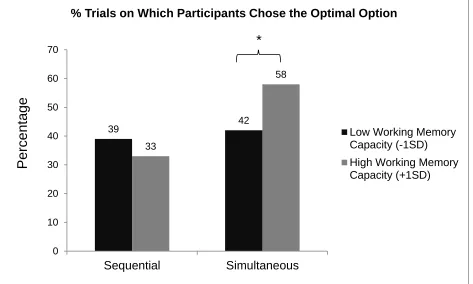
t(179) = 2.47, p = .01. To investigate the interaction effect, we assessed the relationship
conditions. As shown in Figure 1, in the simultaneous condition, participants with higher
working memory scores were more likely to choose the most optimal option, B = .44,
95% CI [.03,.85], t(90) = 2.14, p = .04. However, this relationship disappeared in the
sequential condition, B = -.16, 95% CI [-.42,.11], t(89) = -1.19, p = .24.8
Discussion.
Experiment 5 tested two competing mechanisms for why simultaneous
presentation helps people make more optimal decisions than sequential presentation:
because simultaneous presentation allows for more in-depth cognitive processing, or
because sequential presentation imposes a bigger load on working memory. Supporting
the idea that simultaneous presentation leads to more optimal decision making because
it allows for more cognitive processing, we found that individual differences in working
memory capacity were associated with optimal decision making only in the
simultaneous condition. In other words, when the option presentation allowed
participants to easily compare the options, an individual difference associated with
information processing capacity predicted participants’ ability to make optimal choices.
In the sequential presentation condition, in which it was more difficult for
participants to compare the options, participants’ working memory span was unrelated
to their ability to make optimal decision. This finding argues against working memory
load as the mechanism explaining differences in optimal decision making across the two
conditions because if sequential presentation led to more suboptimal decision making
than simultaneous presentation because it imposed a greater load on working memory,
then individual differences in working memory capacity would have predicted optimal
Experiments 6a, 6b, and 6c
Experiment 5’s finding that participants’ working memory score was unrelated to
the percentage of trials on which they selected the optimal option indicates that
between-condition differences in memory load might not be contributing to the
difference in optimal choice between the simultaneous and sequential option
presentation conditions. Given that one cannot make firm conclusions based on null
effects, we decided to further investigate whether memory load moderates the effect of
option presentation on optimal choice using a series of three experiments. If sequential
presentation was reducing people’s ability to choose the optimal option because it
imposed a greater memory load compared to simultaneous presentation, then adding
an external source of memory load to both conditions would reduce the advantage of
simultaneous presentation. However, if memory load is not the mechanism at play, then
adding an external source of memory load to both conditions would not reduce the
difference between the two conditions.
Method
Participants. We recruited 293 US participants (Mage = 36.63 years; 166 women,
127 men) from Amazon Mechanical Turk for Experiment 6a, 89 participants (Mage =
20.61 years; 41 women, 48 men) from a large public university in Singapore for
Experiment 6b, and 634 US participants from (Mage = 34.81 years; 375 women, 254
men, 5 unreported) from Amazon Mechanical Turk for Experiment 6c. Across all three
experiments, we randomly assigned participants into one cell of a 2 (Sequential vs.
Simultaneous presentation) X 2 (High vs. Low memory load) design. Experiments 6a
Procedure. We used a similar procedure across all three experiments. Across
five trials, we asked participants to make choices among five options presented either
sequentially or simultaneously. In Experiments 6a and 6b, we presented participants
with the five lotteries used in Experiments 4 and 5 (see Appendix C for the stimuli). In
Experiment 6c, we presented participants with the product purchase options used in
Experiment 2 (see Appendix B for the stimuli).
We manipulated memory load by adopting a procedure widely used in the
literature (e.g., Gilbert, Pelham, & Krull, 1988; Menon & Kahn, 2003; Monga & Houston,
2006; Shiv & Fedorikhin, 1999; Wadhwa & Zhang, 2015). At the start of the experiment,
we told participants that they would see some numbers (in Experiments 6a and 6b) or
letters (in Experiment 6c), which they must memorize. We further informed them that we
would test their recall at a later stage. In the high memory load condition, we asked
participants to memorize 549872 (Experiment 6a), 4293758 (Experiment 6b), &
SWJXHYU (Experiment 6c). In the low memory load condition, we asked participants to
memorize 7 (Experiment 6a), 7777777 (Experiment 6b), & W (Experiment 6c).
Participants then proceed to complete the choice task. At the end of the choice task, we
asked participants to recall the numbers and letters that they were asked to memorize.
Results
For each experiment, we submitted the percentage of trials in which the
participants chose the optimal option to a 2 (option presentation condition) X 2 (memory
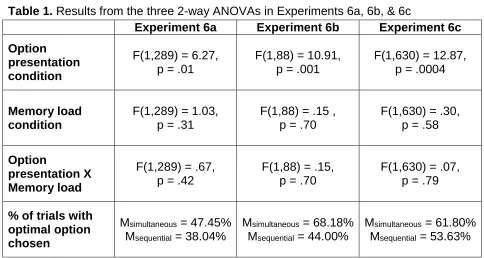
load condition) ANOVA. Table 1 reports the results from the three ANOVA analyses.
Across the three experiments, we observed only a significant effect of option
on a greater percentage of trials as compared to those who viewed options sequentially.
The effect of memory load and its interaction with option presentation remained
non-significant across the three experiments.
Discussion
Experiments 6a through 6c corroborate the correlational results obtained in
Experiment 5. Across the three experiments, differences in memory load had no effect
on participants’ likelihood of choosing the optimal option, irrespective of whether they
viewed the options sequentially or simultaneously. If participants were less likely to
choose the optimal option when viewing options one at a time because of higher
memory load, an external source of memory load should reduce the advantage offered
by simultaneous presentation. However, across the three experiments, we observed
neither a main effect of the memory load manipulation nor any interaction between
memory load and option presentation, suggesting that between-condition differences in
memory load is unlikely to be the mechanism explaining between-condition differences
in participants’ likelihood of choosing the optimal option.
Experiment 7
Whereas Experiments 6a, 6b, and 6c indicated that higher memory load did not
reduce the advantage of simultaneous presentation over sequential presentation,
Experiment 7 tested whether higher cognitive processing load would indeed reduce the
advantage. This hypothesis is based on Experiment 4’s finding that between-condition
differences in the depth of cognitive processing mediated the effect of simultaneous
presentation on more optimal choice. Thus, if we restrict participants’ processing
manipulate processing load without manipulating memory load, we used a dual task
paradigm (e.g., Brandstatter, Lengfelder, & Gollwitzer, 2001;Brunken, Steinbacher,
Plass & Leutner, 2002; Cierniak, Scheiter, & Gerjets, 2009; Finley, Benjamin, &
McCarley, 2014). In the no processing load condition, participants were asked to make
choices without working on a secondary task, as in the previous studies. In the
processing load condition, participants were asked to work on a secondary task while
making choices. This secondary task would therefore tax their cognitive processing
resources available for the primary choice task. We hypothesized that the difference in
optimal choice between the sequential and the simultaneous presentation conditions
would attenuate under high processing load.
Method
Participants. A power analysis based on Cohen’s d = .52 (from Experiment 3,
which used a superset of the current stimuli), = .05 (two-tailed), and power = 80%
indicated that we would need to recruit 60 participants per cell. To ensure that we have
high power, we decided on a larger target sample size of 100 participants per cell,
which would give us 93% power. A survey seeking 400 US residents was posted on
Amazon Mechanical Turk. In response, 395 participants (Mage = 35.44 years; 256
women, 137 men, 2 unreported) completed the survey. We randomly assigned
participants into one cell of a 2 (Sequential vs. Simultaneous presentation) X 2
(Processing load vs. No load) design.
Procedure. The primary task used the same lotteries as in Experiments 4 and 5.
one of two rewards with equal probability, presented either sequentially or
simultaneously (see Appendix C for the stimuli).
We manipulated processing load by varying whether participants were asked to
complete a secondary task that required cognitive processing while working on the
primary choice task. We developed a website in which participants’ computer screen
was divided into two parts, with 70% of the screen on the left reserved for the primary
task, and 30% of their screen on the right reserved for the secondary task. In the no
load condition, the right side remained blank. In the processing load condition, the
secondary task appeared on the right side.
In the processing load condition, at the start of the experiment, participants were
informed that they would have to complete two tasks simultaneously—a math task and
a coin toss game. In the math task, participants were presented with statements about
the addition of two two-digit numbers (e.g., “The sum of 35 and 22 is 77”), half of which
were true and half were false. Each statement remained on the screen for exactly five
seconds, and then the next statement appeared. Participants could select either True or
False during the five seconds when each statement was displayed on the screen. We
decided to show each math statement for a fixed duration to ensure that participants
would not ignore the primary task and just solve as many math problems as possible.
To ensure that participants were involved in both tasks, we told them that the
respondent who got the most number of math statements correct per minute while
completing the coin toss game at the same time would receive a bonus of $10. Thus, it
In the no load condition, there was no secondary task. To maintain equivalence
across conditions, participants were informed that one respondent would be randomly
selected to receive a bonus of $10.
Results
We submitted the percentage of trials in which the participants chose the optimal
option to a 2 (option presentation condition) X 2 (processing resources load condition)
ANOVA. We found a main effect of option presentation, F(1,391) = 20.75, p < .0001, 2 p
= .05, a significant main effect of cognitive load, F(1,391) = 14.91, p = .0001, 2
p = .04,
and a significant interaction, F(1, 391) = 6.82, p = .009, 2p = .02. To illustrate the main
effects, participants who viewed options simultaneously chose the optimal option on
more trials compared to those who viewed options sequentially, Msimultaneous = 36.78%,
95% CI [33.23, 40.09], SD = 27.92%, Msequential = 25.25%, 95% CI [21.63, 28.76], SD =
22.90%, t(393) = 4.50, p < .0001. Further, participants in the processing load condition
chose the optimal option on fewer trials compared to those in the no load condition,
Mprocessing_load = 26.18%, 95% CI [22.53, 29.84], SD = 21.16%, Mno_load = 36.06%, 95%
CI [32.49, 39.63], SD = 29.57%, t(393) = -3.83, p = .0002.
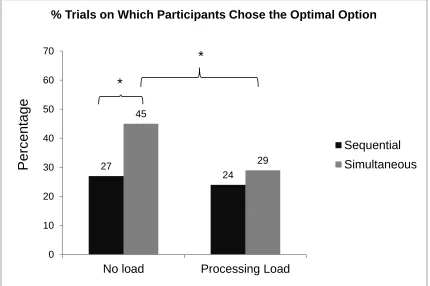
To analyze the interaction effect, we conducted a series of independent samples
t-tests (see Figure 2). First, we compared the participants’ performance within the
processing load and no load conditions. In the no load condition, participants who
viewed options simultaneously chose the optimal option on a greater percentage of
trials compared to those who viewed options sequentially, Msimultaneous = 44.81%, 95% CI
[39.35, 50.26], SD = 29.56%, Msequential = 26.77%, 95% CI [21.15, 32.39], SD = 26.73%,
significant difference between the two option presentation conditions, Msimultaneous =
28.51%, 95% CI [24.38, 32.65], SD = 23.55%, Msequential = 23.62%, 95% CI [19.29,
27.96], SD = 17.95%, t(191) = 1.63 , p = .10.
Analyzing the interaction effect another way, we reasoned that if simultaneous
option presentation helps people make more optional choices because it leads to more
in-depth cognitive processing, then the effect of processing resources load would be
especially pronounced for participants who viewed options simultaneously. Confirming
this prediction, among participants who viewed options simultaneously, processing load
significantly decreased the percentage of trials on which they chose the optimal option,
t(203) = -4.37, p < .0001. However, the presence of processing load had no effect
among participants who viewed options sequentially, t(188) = -.96, p = .34.9
Discussion
Experiment 7 provided converging experimental evidence for the findings of
Experiments 4 and 5, that people make better decisions when viewing simultaneously
presented options because they can engage in more in-depth cognitive processing
about the options, compared to when they view sequentially presented options. When
participants’ cognitive processing resources were taxed by a secondary task, the
simultaneous vs. sequential option presentation made no difference to their likelihood of
choosing the optimal option. However, when their ability to process information was
unhindered, participants were more likely to choose the optimal option when choosing
among simultaneously rather than sequentially presented options.
General Discussion
Seven experiments showed that people choosing among multiple options
presented all together were more likely to select the optimal option than those choosing
from the same options but presented one at a time. In Experiment 1, when choosing
among six consumer electronic products varying on five attributes, participants were
more likely to choose the dominating option when they saw all the options
simultaneously compared to when they saw the options one at a time. Experiment 2
found evidence for this effect when the dominance relationship was not transparent but
was instead implicit: Participants were more likely to choose the lowest price per unit
quantity (which had to be inferred from the price and the quantity) when they considered
options simultaneously as compared to when they considered options sequentially.
Experiment 3 found that this effect held for even more complex choices in which the
optimal choice is based on two latent parameters: Participants were more likely to
choose the dominating lottery (the one with the highest expected value and lower
variance) when they considered the options simultaneously than when they considered
the options sequentially.
Experiments 4-7 investigated the underlying mechanism. In Experiment 4, an
open-ended thought protocol analysis revealed that participants in the simultaneous
condition were more likely to use words related to depth of cognitive processing when
describing their thoughts during the choice process, compared with those in the
sequential condition, which mediated the effect of sequential-simultaneous processing
on optimal choice. Experiment 5 found that individual differences in working memory
simultaneous presentation improves optimal choice because it allows people to engage
in cognitive processing, making individual differences in processing capacity relevant.
However, working memory span did not predict optimal choice in the sequential
condition, indicating that it is unlikely that sequential presentation reduces optimal
choice because it imposes a greater working memory load. Corroborating this
correlational finding, Experiments 6a-6c showed that manipulations of memory load did
not reduce the difference between the simultaneous and sequential conditions. Finally,
Experiment 7 found that when participants’ processing capacity was reduced because
they were working on a secondary task, participants who viewed options together were
no more likely to make the optimal choice compared to those who viewed options one at
a time.
Theoretical Implications
Our research contributes to multiple streams of literature in the judgment and
decision making area. First, we contribute to the highly important and relevant literature
on choice architecture (Johnson et al., 2012; Thaler & Sunstein, 2008). Our research
highlights a dimension of choice architecture that has as of yet not received much
attention—whether options are presented simultaneously or sequentially. After deciding
on the number of options to provide in a choice set (Cronqvist & Thaler, 2004; Kling,
Mullainathan, Shafir, Vermeulen, & Wrobel, 2012), the choice architect has to decide
how to present the options, even before they make other important decisions, such as
whether to set defaults (Johnson & Goldstein, 2003). The current research suggests