European Communities
EUROPEAN
PARLIAMENT
1
WORKING DOCUMENTS
29 May 1985
WG(2)/1798E
English Edition
SERIES A
INTERIM REPORT
1985-86
DOCUMENT A 2-45/85
UNIVERSITY OF PITTSBURGH
LIBRARIES
SEP
~ 19~5GIFT & EXCHANGE
drawn up on behalf of the Committee on External Economic Relations
on economic relations between the European Community and Latin America
Rapporteur: Mr J. van AERSSEN
c·cp
,)r:_
By Letter of 18 October 1984, the Committee on External Economic Relations requested authorization to draw up a report on economic relations between the European Community and Latin America.
At its meeting of 21 November 1985, the European Parliament authorized the committee to report on this subject.
At its sitting of 14 January 1985, the European Parliament authorized the committee to report on this subject.
At its sitting of 11 February 1985, the European Parliament referred the motion for a resolution tabled by Mr Vergeer and others on future relations with Central America and Latin America (Doc. 2-1500/84) pursuant to Rule 47 of the Rules of Procedure, to the Committee on External Economic Relations as the committee responsible and to the Political Affairs Committee, the Committee on Development and Cooperation, the Committee on Economic and Monetary Affairs and Industrial Policy and the Committee on Budgets for an opinion.
At its meetings of 26 March 1985, 25 April 1985 and 20 May 1985, the Committee on External Economic Relations considered the draft interim report. At the
Last meeting it adopted the motion for a resolution as a whole unanimously.
The following took part in the vote: Dame Shelagh Roberts, chairman; Mr Hindley, vice-chairman; Mr van Aerssen, vice-chairman and rapporteur; Mr Costanzo, Mr De Winter, Mr Ford, Mr Hitzigrath, Mr Kilby, Mrs Lizin
(deputizing for Mr Massari), Mrs van Rooy, Mr Toussaint, Mr Tzounis, Mrs Wieczorek-Zeul, Mr Zahorza and Mr Zarges.
The report was tabled on 24 May 1985.
The deadline for tabling amendments to this report will be indicated in the agenda for the part-session at which it will be debated.
C 0 N T E N T S
:Page
A. MOTION FOR A RESOLUTION •••••••••••••••••••••••••••••••••••••• 5
B. EXPLANATORY STATEMENT •••••••••••••••••••••••••••••••••••••••• 8
ANNEXES.
I - Trade between the Community of Ten and Latin America
(9 tables > •••••••••••••••••••••••••••••••••••••••••••••••••• 16
The Committee on External Economic Relations hereby submits to the European Parliament the following motion for a resolution together with explanatory statement :
A
MOTION FOR A RESOLUTION
on economic relations between the European Community and Latin America
The European Parliament,
A. having regard to the Final Act of the VIth European Community/Latin
America Interparliamentary Conference held in Brussels from 13 to 16 June 1983 (PE 85.416/fin.),
B. having regard to the resolution of 12 October 19831 on economic and
trade relations between the European Community and Latin America,
C. having regard to the resolution of 13 April 19842 on the conclusion of
the framework agreement for cooperation between the European Economic Community on the one hand and the countries party to the Cartagena Agreement (Bolivia, Colombia, Ecuador, Peru and Venezuela) on the other hand,
D. having regard to the outcome of the meeting held on 28-29 September 1984
between the Foreign Ministers of the Member States, including Spain and Portugal, and the Foreign Ministers of the Central-American Common Market and of the four countries of the Contadora Group,
E. having regard to the Communication from the Commission to the Council
entitled 'guidelines for strengthening relations between the Community and Latin America' of 6 April 1984, (COM(84) 105 final),
F. having regard to the motion for a resolution tabled by Mr Vergeer and
others <Doc. 2-1500/84),
G. having regard to the interim report by the Committee on External Economic
Relations (Doc. A 2-45/85),
H. whereas the expansion of trade relations between the Community and Latin
America has not been commensurate in past years with the capacity of the regions in question,
I. having regard to the importance of intensifying economic and trade
relations between the Community and Latin America in order to sustain and give a broader basis to the recovery of the world economy that began to appear in 1984,
As regards trade
1. Emphasizes the vital necessity for most of the countries of Latin America to maintain, as in 1984 and also in future years, a high level of exports to enable them to service their foreign debt without restricting imports beyond a Level compatible with the expansion of their economies;
2. Points out to this end the desirability for the countries of Latin America to be able to diversify increasingly their flow of goods, thereby
strengthening both regional economic integration and trade with the Community;
3. Points out furthermore that the Community could make an essential
contribution by further opening its markets to exports from Latin America;
4. Notes that this aim is linked to the efforts in progress for restructuring specific sensitive sectors in the Community (notably iron and steel and textiles), and to the prospects for restructuring the CAP;
5. Stresses that these restructuring efforts by the Community should have favourable effects on the opportunities for efforts from Latin America to the markets of third countries;
Economic and financial cooperation
6. Underlines the importance of a growing influx in Latin America of capital from the Community, mainly risk capital, both for the current equilibrium of the balance of payments of the countries of Latin America and for the future prospects for economic development in the region;
7. Hopes for the creation on the part of the countries of Latin America of the most favourable climate possible for joint ventures and direct Community investments;
8. Welcomes the conclusion of the framework agreement for cooperation between the Community and the Andean Pact and the definite prospects for
conclusion of an agreement with the countries of the Central-American Common Market and Panama; these agreements will have a positive influence on the moves towards sub-regional integration in Latin America;
(a) the negotiation and signature of a framework agreement between the Community and SELA
(b) further-going implementation of the EP/Mexico and EC/Brazil
agreements
(c) the conclusion of an agreement in the energy sector between the EC
and OLADE
(d) improvements in the generalized system of preferences for Latin
America
(e) the establishment of a Euro/Latin-American Bank
(f) the extension of EIB activity to Latin America;
10. Calls for contacts to be pursued with the aim of normalizing relations and concluding a cooperation agreement between the Community and Argentina;
11. Notes the importance of supporting the endeavours of the Latin-American countries to restructure their foreign debt and to obtain reduced
brokerage margins;
12. 'stresses finally the deep-rooted links that inevitably exist in all
countries between economic development and social and political stability as also respect for human rights;
13. Adopts the present interim report in anticipation of the Seventh European Community-Latin America Interparliamentary Conference and intends to re-examine the subject of economic relations between the two regions in greater depth in a subsequent report;
B
EXPLANATORY STATEMENT
I. Economic evolution of the countries of Latin America
1. 1984 saw a significant reversal of economic trends in Latin America: GNP, which had fallen by 1% in 1982 and by 3.1% in 1983, increased by 2.6% in 1~.
In the case of per capita GNP, however, the rate of increase for 1984 was just 0.2%, and negative rates were recorded by as many as twelve of the nineteen countries for which information is available. Speaking generally, per capita GNP may be said to have remained at the 1976 Level, with a fall of 9% against 19801.
2. Despite the upturn in economic activity, the overall situation for the Latin American countries has thus remained extremely serious.
The rates of urban unemployment have remained high (ranging from 4% tor
Argentin~19.8% for Nicaragua), while the rates of inflation, although
their range of variation was enormous, between
1682.3%
(Bollvia) and 1.1% (Panama), averaged 175.4%.On the other hand, the effort of adaptation undertaken by the Larger countries in the region resulted in a further improvement in the balance on current account (a deficit of $40,000 m in 1982, which was reduced to $9,000 m
in 1983 and $3,100, in 1984).
It is important to point out that whereas the improvement in 1983 was Largely due to the dramat1c fall in imports, the 1984 result was due in the main to the strong rise in Latin American exports (+ 9% in value), given that imports also increased, albeit to a Lesser extent (+ 4.4%).
The balance of trade thus showed a surplus of $37,620 m, the bulk of which was acounted for by Mexico C$13,500 m) and Brazil C$12,600 m).
3. Capital movements were influenced largely by the problem of foreign borrowing (see Section III), with payments amounting to $37,300 m being made in 1984 for the servicing of debts C$34,500 m in 1983).
On the other hand, there was significant growth in capital influx, which increased from $4,400 m in 1983 to $10,600 m in 1984. Yet the net balance of capital movements was still negative (- $26,700 m), which means that in 1984, once again, the economic development of Latin America was hampered by a net transfer of resources to other countries.
4. Assessment
The figures quoted make it clear that the situation in the region is improving to a degree: some countries, in particular Larger countries Like Brazil and Mexico, which were the first to embark on an effort of adaptation, were able to take advantage of the revival of world trade, by substantially boosting their exports, which were helped above all by the high dollar
exchange rate. At the same time, the drastic reductions in imports, which in previous years resulted in a substantial decline in activity, paved the way for modest increase.
Yet this rather more positive picture must not divert attention from certain basic facts:
(a) the improvement concerns only a Limited number of countries, the ones which have the most highly developed economic systems and the Largest domestic markets;
(b) the immense social costs of the brutal, but indispensable, adjustment
made in the period 1982-83 will make themselves felt for years to come;
(c) the problem of debt servicing will continue in future years to place a
severe constraint on expansionist economic policies.
II. Trade relations between the Community and Latin America
5. Development of trade
Given the potential of the regions concerned, trade between the Community and Latin America has not progressed at a satisfactory pace in the recent past.
Latin America's share in the EEC's imports fell steadily after 1963 (9.5%), reaching a Low of 5.4% (1978), before settling at around 6% (1983)1.
In the case of the EEC's exports, developments have been even more dis-appointing, with a continuous decline from 7% (1963) to 3.6% (1983).
Similarly, the Community's share in Latin American trade has declined in
recent years, from
21.3%
(1978) to 18.6% (1982) for exports and from 20.3%(1978) to 15.2% (1982) in the case of imports2.
It is nevertheless clear that EC-Latin American trade occupies a much more important place in the structure of Latin America's trade than it does in that of the EEC's trade.
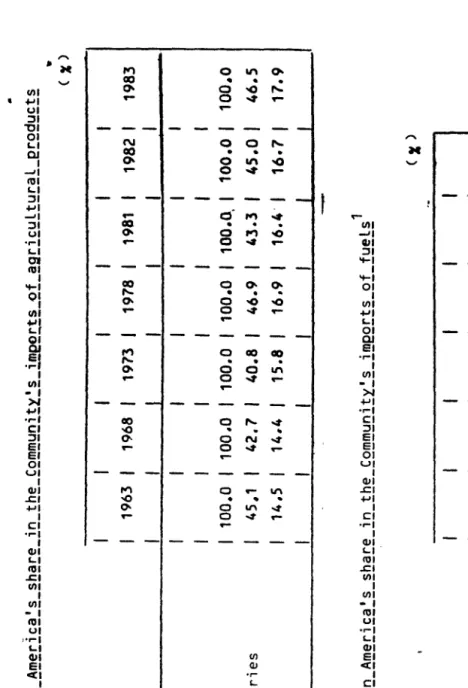
6. With regard to the products actually traded, (see table ~~: ~~e EEC's
imports still consist Largely of primary commodities (1983: 53.9%), albeit to
a markedly Lower extent than in the past (cf. 1978: 74.2%). This is due in
the main to the increase in the share accounted for by fuels <5.2% in 1978, 26.6% in 1983), while manufactured products are showing no signs of continuing the progress which began in the 1960s and their share has remained static at around 18%.
As far as the EEC's exports are concerned, attention should be drawn to the clear dominance of manufactured products <77% in 1983); however, this figure is markedly lower than the figures for previous years (88.5% in 1981), owing to the substantial increase, in the period under consideration, in
exports of goods classified separately in SITC accounts (Section 9: arms and
non-monetary gold).
The balance of trade, traditionally negative for the Community, has moved further into the red, from 2.1 m ECU (1981) to 5.4 m ECU <1982) and 9.3 m ECU (1983) (see table 6).
7. In its recent communication to the Council on guidelines for ~he
strengthening of relations between the Community and Latin America , the
Commission points out that 85% of Latin American exports are admitted into the EEC either duty-free or on payment of duties of 5% or less. It also draws attention to the fact that the GSP is applied to all exports of industrial manufactures and to a Large proportion of processed agricultural and tropical products.
The Latin Americans, however, complain of the difficulties of access to the Community for their products, and of the rise of protectionism in the industrialized countries, which, coupled with the deterioration in the terms of trade, has penalized Latin American exports2.
This applies in particular to agricultural products, where criticism has been expressed not only over the import levies under the CAP, but also at the fact that subsidized exports from the Community introduce unfair competition on the markets of third countries.
Despite this, exports of agricultural products to the Community increased in the period from 1978 to 1982, and their rise was stronger than that of exports from the other developing countries.
8. With regard to manufactured products, the Latin American countries point
to the gradual weakening in the multilateral system of international trade, as a result of which the industrialized countries have endeavoured to defend their sensitive sectors with a tight network of bilateral voluntary restraint agreements. This applies particularly to the steel and textile sectors: in the latter sector, for instance, the Community has negotiated voluntary
restraint agreements with Brazil, Colombia, Guatemala, Haiti, Mexico, Peru and Uruguay under the MFA.
9. Assessment
More generally, Latin American sources point out that the substantial expansion in exports was due primarily to the vigorous economic recovery in
the United States: it was accordingly the countries with previously existing
and closer ties with the United States economy which were able to derive most benefit, and they subsequently redirected their products onto the US
1coM<84) 105 final
market 1• This development clearly entails risks for the future, and runs counter to the diversification of commercial outlets which had previously been a priority.
However, it is evident that if the Community market were to be opened up to a degree, with, at the same time, the restructuring of the sensitive industrial sectors and the removal of the agricultural surpluses, the prospects for diversification would be considerably improved.
Despite this, the Commission, in its document on the future guidelines for EC-Latin American relations, does not hold out much hope of being able to open up the Community market in the short term, and points to the Lack of corresponding good will on the Latin American side.
III. Cooperation between the EC and Latin America
10. This is the most important aspect of the development of relations between the Community and Latin America. The Commission's guidelines pay due regard to the difficulties inherent in this area, emphasizing the considerable disparities among the Levels of development of the Latin American countries, which make it necessary to deploy a vast range of instruments and thus give the Commission cause to question whether a framework agreement between the Community and Latin America would be of any use.
The instruments deployed by the Community in its cooperation policy are in effect extremely varied: financial and technical aid, food aid, a1d for training and regional integration, cooperation in the energy sector and emergency aid.
For a breakdown of the types and beneficiaries of aid, see table 7.
One of the most important facts, according to the Commission is that, 'the impact of (the Community's) aid on the economic development of Latin America as a whole is virtually non-existent•2.
11. The initiatives to promote a dialogue between the Community and Latin America at regional level seem for the moment to be in difficulty: the negotiat1on of an EEC-LAES framework agreement seems blocked following the decision (in October 1984) by the Latin American side to suspend the
negotiations owing to 'the lack of substantial progress' and to 'the
Community's protectionist policies', especially in the agricultural sector.
In its resolution of 12 October 19833 on relations with Latin America, the European Parliament strongly advocated the conclusion of such an agreement and also called on the Latin American countries to set up an ad hoc political body, which would be responsible for pursuing cooperation with the Community.
1ECLA: Preliminary assessment, quoted above
2coM(84) 105 final, p. 2
Nor have the contacts with OLADE, seeking a specific cooperation agreement in the energy sector, progressed as had been hoped.
12. It is accordingly at sub-regional level that the most positive developments have occurred: a framework cooperation agreement has been concluded between the Community and the Andean Pact1, and real prospects have now emerged for negotiations on a framework agreement between the Community and the countries of Central America.
The conference held in San Jose <Costa Rica) in September 1984 was an important preparatory step in this process, and it may well be possible to open negotiations in the near future.
The Community has a twofold interest in seeking agreements of this type: not only do they serve to consolidate cooperation between the Community and the region concerned, they are also a means of strengthening sub-regional cooperation within Latin America itself. Given the current economic and financial crisis, there is an urgent need to develop such cooperation and increase Latin American internal tradeZ.
13. At bilateral level, there has been a revival of activity in connection with the EC-Mexico cooperation agreement (meetings of the Joint Committee in November 1983 and December 1984) and with the agreement between the Community and Brazil (meeting in January 1984).
14. Financial cooperation is overshadowed by the problem of the Latin
American external debt, which has assumed gigantic proportions in recent years.
In 1984, the total debt reached a level of $360,000 m, with an increase of 5.5% on the previous year: this rate of increase was Lower than in 1983
(7%) and 1982 (12%)2.
Because of the exceptional success with exports, the ratio of debt to
exports fell for the first time in the last four years and stood at 3.3 1.
The relation of interest payments to exports also improved slightly, moving to 33.5% in 1984 (1983: 35%, 1982: 37%) (see table 9).
1cf the European Parliament's resolution of 13 April 1984, OJ No. C 127, 14.5.1984
2cf ECLA: International economic relations and regional cooperation in Latin
America (1984). (In Spanish).
The percentage of export earnings swallowed up by the servicing of the debt, which is still extremely high, only serves to underline the imperative need for the countries of Latin America to increase their exports,
d1vers1fy1ng them 1n terms of both products and dest1nat1ons, 1n order to shield themselves from violent fluctuations in raw material prices and the business cycles in the recipient countries.
15. At the same time, capital inflows from abroad have picked up to a certain extent <$10,600 m, compared with $4,400 m in 1983), which is a sign of a
return of confidence in the Latin American economies. However, this influx was a good $26,700 m lower than the payments made for debt servicing.
It follows that measures to increase the flows of direct investment are essential for an economic revival: for the Latin Americans, th1s would mean the creation of favourable conditions for investment <especially as regards the rules on the transfer of dividends, shareholding, etc).
The Latin American countries tend to prefer foreign Loans to direct foreign investment, and they ought to reconsider this attitude: with direct investment, it is the investor who bears the risk, whereas with loans, the economic risk is borne entirely by the borrower.
16. It is also vitally important to step up international financial
cooperation, for the purpose of rescheduling the debt. At the conferences held in Qu1to, Cartagena, Mar del Plata (1984) and San Domingo <1985), the Latin American countries spelled out the criteria for the renegotiation of the debt, which are based on the principle of joint responsibility of creditors and debtors. A number of important results were achieved in 1984-85 in
connection with this renegotiation, especially by Mexico and Venezuela (margin
of + 1.13% on the LIBOR interest rate).
17. The Community's role in the financing of development should be suitably strengthened.
The Commission1 emphasizes that, 'the time has now come for the
Community to consider making a greater effort in financing development', with assistance channelled 'into specific sectors or projects', and maintains in particular that, 'the EIB should be asked to make use of its extra-Community financing possibilities to help Latin American countries'.
A greater commitment along these Lines was also called for by the Vlth European Community- Latin America Interparliamentary Conference, but it has not yet proved possible to take practical action. Nor has any action been taken on the proposal to set up a Euro-Latin American bank2, as advocated by the European Parliament in its resolution of 12 October 1983 on trade
relations between the Community and Latin America.
Tsee COM(84) 105 final
18. The prospects for industrial cooperation appear favourable; we have already referred to its potential importance in increasing the available capital and to the need to improve the climate for investment.
The Community, for its part, will endeavour to 1encourage joint ventures,
direct investment or technical agreements between Community and Latin American firms•1.
The VIth Interparliamentary Conference expressed its support for measures to this end, and in addition emphasized the need to provide 'guarantees for investors from the European Community•1.
19. The Commission should therefore take suitable initiatives, especially as regards cooperation between small and medium-sized undertakings and the
development of cooperation in the mining sector.
20. There are other important areas of cooperation which are, however, of less direct concern to the Committee on External Economic Relations, namely scientific cooperation, training programmes and cultural relations;
cooperation in the energy sector and in environmental prot~ct1on are separate
cases: the VIth Interparliamentary Conference called 1n those sectors for an agreement to be concluded with OLADE, and for the organization of a Euro-Latin
American Conference on the environment. It has not been possible so far to
take practical action on these requests.
IV. Conclusions
In 1984, Latin America was implicated in a process of the most radical economic adaptation: despite the fact that some positive results were
obtained, one should not ignore the high social costs that this process entailed, and the related risks to the political stability of the countries concerned.
There remain a number of worrying economic problems, Linked in particular tb the severe external pressure on balances of payments resulting from the servicing of the external debt.
To continue the progress that began in 1984, the countries of Latin America will accordingly have to maintain their exports, for a considerable length of time, at levels sufficiently high to allow substantial improvements in their balances of trade.
The European Community will thus have to do what it can to aid the
expansion and diversification of Latin American exports, which might otherwise become excessively dependent on the current economic cycle in the United
States.
The following will be important factors in this connection:
(a) the current process of restructuring of the CAP, to reduce Community surpluses of given agricultural products;
(b) the gradual abandonment of the bilateral approach, based on voluntary
restraint agreements, in the sensitive sectors of Community industry, and moves towards multilateral liberalization under the GATT;
(c) the widening and intensification of initiatives to promote financial and industrial cooperation between the Community and Latin America, so as to create the most favourable possible conditions for an influx of capital, especially risk capital, to Latin America;
(d) support, through framework agreements, for the processes of sub-regional
integration in Latin America: this approach would also allow the
expansion of trade within Latin America;
<e> the cultivation of institutional relations (reactivation of dialogue
within GRULA; resumption of the Community's dialogue with both LAES and OLAOE).
(Sc;urce: Commodity Trade ttnit, United Nations, Geneva) 1963 1968 1973 1978
I
I
EEC H1PORTS FROrl:
I
Total third countries 100.0 100 .o 100.0 100.0I
-Tot:al rleveloring countries 40.0 38.5 37. 6 40. 7I
-Latin America 9. 5 7.66.7
5. 4I
I
EEC EXPORTS TO:
I
Total third countries 100.0 100.0 100.0 100,.0I
-Total developing countries 34,3 29,9 28,2 39.0I
-Latin America 7.0 6.6 5.7 5.3 , 1 All the fi!1ttres shown in the tables are expresseu in terms of value ANNEXI < X
)
1981
1982
1983
I
100.0I
1100. 0 1100
.o
I
42.4I
40. 1 I 37.1I
5.5I
5. 6 6.1I
I
100.0I
Table 3
•
I
1963 1968 1973I
1978 1981 1982I
1983I
I
I
I
IMPORTS TO THE EEC FROM:I
I
I
Total third countries 100.0 100.0I
100.0I
100.0I
100.0.I
1oo.oI
100.0I
-
Total developing countries 45,1 42.7I
40.8I
46.9I
43.3I
45.0I
46.5 -Latin America 14.5 14.4I
15.8I
16.9I
16.4I
16· 1 1 17.9I
I
I
Table 4 (% )I
I
I
I
I
1963I
1968I
1973I
1978I
1981I
1983I
I
I
I
I
I
I
I
I
I
I
H1PORTS TO THE EEC FROr1:I
I
I
I
I
I
Total third countries 100,0I
100,0I
100,0I
100.0I
100.;-0I
1oo,oI
..:.
Total developing countries 82.9 87.0I
88t9I
81.1I
78.5I
67.7I
.:.
Latin [image:18.864.52.521.92.780.2]Table
5
(X)
I
1963
1968
1973
I
1978
1981
1983
I
I
EXPORTS
FROM
THE
EE~
TO
I
Total
third
countries
100,0
100.0
100,0
I
100.0
100.,0
100~0
-,Total
developing
countries
35,6
30,5
28.7
I
39,6
42~8
38~7
-Latin
America
7,9
7,1
6,2
I
5.7
6,2
3
.•
5
I
T---
SITCsections
5,
6,
7
and
8:
Chemicals,
basic
manufactures,
machines
and
transport
equipment
EvatuatiO'l ;n 11HUCJ"l ECU
Fin. & Food aid
tech. wrld E'NfgetiC)' Tl'ade . TNint
11sist. prices •i4: ~- TotAL
Central MeriQ I I l I r
:,;co
I
I
I
0.40 II
·:
l
I
0,262I
0,662G.Jat-la I 0.78
l
I
0,20~
I ·I
I
I
j
0,911HaOanit;7;,., lle!U>lic
I
0 51 I I 0.20 I I It
I I 0,712.2 2 .o2 I I o .o5- I I I I I I 4,27
El Salvacbr
I
2.42 I I I I . I I I I 2,42ttn:Lras I 7.o 6.29 I I 0.20 I I I I I
113,49
Nicar8!JJI I 3.5 9.10 I 0.~25 I 0.20 I I I I f
113.05
Costa Rica 1 0.12
1 I·
o.ze
1 1 1 I 11
o, 2 32
Pan.na I I I 0 .lO t I I f I I 0 .. 0
f«ogiooal q,eratitns I I I I I
t
It
IOCIE I I I I I I I I I 2 0
~~~!e
1 2•0 I I ' I I . I I I I 'FLACSO
I
i
I
I I
I
I
0,101I
0,10C
cst~A
I 1 4 I l I 1- I I0~07
I I o1,o407IT. • I I I I I I I I "'
OtRAheDARr li!SP. : 1 • 5 I I I I I I I I 1 • 5
I I I o.2 I I I I I I 0' 2
~imal ~r. br 1Jge I
. I I I I l I I I
TOT~ Central lerica ~ 17.6 I 21 .. 24 I 0.25 I 1.15 I I I I 0 .• 17 I Q .. 262 j41.,372
---+---~--~---.,.t'"'----·r---r--t---t-·---~-Sa.rt:h
-t---t---lm!r-ica I ! I I I I I
Argentino
1
1 o.2s1
1
1
1
0.02 o.1741
0.444chile 1 1
.n
1 11 1 1
o.40
o,o5a
1a.2aa
Brazil I I 0.10 t I t I o.40 o.192 I 1,292
colarbia I
o.sa
I 0.20 I I I I 0.01 0.554 I 1.404=.rue.._
11.4 I 4.07 I o.42 I I I I 1.40111.29 .
Ecuador
I
o.76j o.:so j
I
I
I
o.ao
o.a141 2.674 ·
B:>livia 16.0 I
4.4~
I 0.45 I I I1 I 0.,30 0.,15 I 21.32
Parag.Jay I 1.95 I
o.
10 I I I I I 2.o5Llru!;p.Jay I 0 .. 31 I I I I I o.ooa I o .. Jaa
Regimal ~rations I I I I I I f
~
1 1 1 1 I I 0.0141 I o.ot4Cit'ft!YT 6•0 I I I I I I
o ..
12 I I 6 •12--- I I I I
t
I I ITOT~ Sruth ~rica I 33.4 I 19.99 I 1~42 I I I I 3.391 I 0.1341 • 1.942 I 61.284
·----
~---4-·---+---··
,_
--+---+---+---...
+-+---+---Other operat ;ens
in latin -rica
ll
' I I J I I I I I I I I I I I I I I I I I I I I I I I I I I
I 1 .o I I I I I I I I I 1 •0
CIAT I 1• 7 I I I I I I I I I 1 • 7
~~ot
I I I I 1- I I I Io
526 I o.--526P~ --- --- · · I ~ I I I I I I I I I I • I
f f· I I I I I
I 53.7 I 41.23 I 2 .. 67 I 1.15 I I I 3,391 I ·o.3041 2.73 hos .. aa
I t I I i I I I . I I
I I I I I I I I I I I I I I I . I f I I I
JO'
·---LATIN Af.1ERICA: GROWTH OF GLOBAL GDP
Growth rates Country
197,_
1979-1981 1982 1978 1980
Araenrina u 3.7 -6.2
.,..
'.a Suliwia
u
1.2 ..0.9 ... 7Br:uil 6.5 6.1 -U 0.9
...
CDiombia 4.9 4.7
u
0.9CDsra Ria
,.,
2.8 ·2.) -7.3Cuba•b 6.r/ c 2.9 U.6 2.6
Chile 1.7 a.o 5.7 ·14.3
Ecu.ador 7.0. 5.1 ).9 1.8
EJ Salv:ador
,,
·M ...,
-5.6G~~.~r~mala 5.5 4.2 0.7 ·3.5
H:aid 3.7 7.5 -2.8 -2.5
Hondur:u 5.8 (.7 1.2 ·1.8
Mbico
,
8.8 7.9 .0.5Nic:angua 1.2 -10.0 5.3 -1.2
P:uumi
'·'
9.1 4.2 5.5Paugu:ar 9.2 11A 8.7 -1.0
Peni u 4.0 3.9 o . .a
· Dominican Repl.bl ic 4.7
'·'
4.0 l7Urug.ur 4.1 6.0 1.9 -9.7
v~nezuda 5.9 ·H ..0.3 0.7
Tow e 4.8 6.1 1.7 -1.0
Source: ECLA, on the basis of official slat i st i
cs-aPreliminary estimates subject to revision bRefers to;the concept of global social product
cFor the third period 1976-1978
dFor the period 1981-1983
eExcluding Cuba
22
-1983 ).1 -7.6
-u
o.a 2.3 5.2 ..0.8 ·3.3 0.0 -2.7 ..0.6 .0.5 -5.3 4.0 o..a ·).0 -10.8 3.9 -4.7 -4.8 -3.1·-
.. ---·-iAccLmULated rate.; 19U'EI • , • • "1 1981-1984~
'
...
·. .....
~.
··' ... -~ ~0 ' '·: 0.5 ' 16.1''
~. 3.': "..0,)
. ).0 7 ...
3.0 . .'-4.5 d ,, '24.8"
'·'
.,
...
. 2.0
"''
u -12.2 0.0
.,,,
3.0 ~-3.0
2.0 . 0.9 2.5 . :· 4.0.
Q.)
as.
0.0 10.3 3.0 7.4 3.5 -3.8
u 11.6 -2.0 ·:13.9 -1.5 -6.1
2.6 0.0
LATIN AMERICA : RATIO OF TOTAL INTEREST PAY"ENTS TO EXPORTS OF GOODS AND SERVICES a)
(Percentage)
Country 19n 1978 1979 1980 1981 1912
Latin America 12,4 ' 15,5 17,4 19,9 26,4 38,3
Oil-exporting countries 13,0 16,0 15,7 16,5 22,3 31,1
Sol ivia 9,9 13,7 11,1 24,5 35,5 43,5'
Ecuador 4,8 10,3 13,6 1_,2 24,3• 29,3
Mexico 25,4 24,0 24,8 23,1 28,7 37,6
Peru 17,9 21,2 14,7 16,0 21,8 24,7
Venezuela 4,0 7,2 6,9 8,1 12,7 21,4
Non-oil-exporting countries 11,9 15,1 18,8 23,3 31,3 46,2
Argentina 7,6 9,6 12,8 22,0 31,7 54,6
Brazil 18,9 24,5 31,5 34,1 40,4 57,0
Colombia 7,4 7,7 10,1 13,3 21,6 22,7
Costa Rica 7,1 9,9 12,8 18,0 25,5 33,4
Chile 13,7 17,0 . 16,5 19,3 34,6 47,2
El Salvador 2,9 5,1 5,3 6,5 7,5 11,1
Guate•ala 2,4 3,6 3,1 5,3 7,5 7,6
Hatti 2,3 2,8 3,3 2,0 3,2 2,3
Honduras 7,2 8,2 8,6 10,6 14,5 22,5
Ni caragu• 7,0 9,3 9,7 15,7 15~5 31,7
Paraguay 6,7 8,5 10,7 14,3 15,9 14,9
Dominican Republic 8,8 14,0 14,4 14,7 10,5 22,6
Uruguay 9,8 10,4 9,0 11,0 13,1 22,4
~ : 1977-1982 : International Monetary Fund, S.lance of Pa,.tnts Ynrbook;
1983 : ECLA, on the basis of official infor•ation. a) Interest includes interest pa,.ent on short-ter• dtbt. b) Preli•inary esti•ates subject to revision.
From: COM(84) 105 final/Annex
1983 &t>
35,0
31,0
35,5 25,5 38,0 31,5 19,0
39,0
ANNEX II
MOTION FOR A RESOLUTION (DOCUMENT 2-1500/84) tabled by Mr VERGEER, Mrs RABBETHGE, Mr LANGES, Mr STARITA, Mrs FONTAINE, Mrs LENTZ-CORNETTE and Mr DALSASS
pursuant to Rule 47 of the Rules of Procedure on future relations with Latin America and Central America
The European Parliament,
having regard to the historical and cultural Links that bind Europe and Latin America,
having regard to the Final Act of the fifth European Community/Latin
American Interparliamentary Conference held in Bogota from 25 to 28 January 1981,
having regard to the Final Act of the sixth European Community/Latin American Interparliamentary Conference held in Brussels from 13 to 16 June 1983,
having regard to its resolution of 12 October 1983 on econ~mic and trade
relations between the European Community and Latin America ,
having regard to its decision setting up interparliamentary delegations2, having regard to the information forwarded by the President-in-Office of the Council on 23 November 1983 to its committees responsible on the negotiation of the framework agreement between the EEC and Latin America and the Cartagena Agreement (PE 87.928) in accordance with the
Luns-Westerterp procedure,
having regard to the proposal from the Commission of the European Communities to the Council (COM(84) 105 final) of 6 April 1984, A. whereas a new Lome Convention has recently been concluded with the
Community's partners in Africa, the Caribbean and the Pacific (ACP),
B. whereas the European Community cannot content itself with being a model for European economic integration but must in fact make a contribution that is valid for all,
C. whereas the external debt problem could impede the process of economic, social and political development in Latin America,
D. whereas any long-term planning is dangerous because of the wide variations in the price of the raw materials exported,
E. whereas reciprocal exports and imports consist mainly of complementary goods,
F. whereas the European Community and Latin America should regard each other as trade partners on an equal footing,
G. whereas the peoples of Latin America are moving towards democracy one after
the other,
H. whereas the forthcoming enlargement of the EEC to include Spain and Portugal should make it possible to establish Links between the enlarged Community and Latin America,
I. having regard to the importance of the countries of Latin America as potential suppliers of raw materials that the EEC needs,
J. whereas the countries of Latin America are important as importers of Community products,
K. whereas, following the ministerial meeting in San Jose, an EEC/Central American economic cooperation agreement should soon be negotiated,
L. whereas there is no objective reason for limiting the European Investment Bank's activities outside the Community to countries with which the Community is associated,
M. having regard to the resolve of both parties to cooperate in setting up a Europe/Latin America Institute1,
N. whereas the decisive factor in bilateral relations is not awareness of vast
potential but the will to translate proposals into concrete action,
1. Considers it particularly important now that the time is ripe to reforge
political, economic, financial, cultural and technological links between Europe and Latin America;
2. Takes the view that a cooperation agreement not only serves an economic and trade purpose but also has a political dimension;
3. Points out that closer relations with Latin America should make it possible to reinforce both respect for human rights and compliance with democratic principles and to sustain the attitude of countries that have initiated reforms along these Lines;
4. Considers it important that measures be taken to promote trade between the
two parties, particularly by eliminating non-tariff trade barriers;
5. Points out that development and cooperation in the following
spheres: economic and financial cooperation, technical and industrial cooperation, cultural cooperation, protection of the environment,
agriculture, communications and transport are of particular importance for Latin America;
6. Believes it is in the interest of both parties that Community investments in the South American continent be increased, and urges the countries of Latin America to adapt their current regulations so that there are as few barriers as possible to such investments;
7. Calls on the Commission to make recommendations to the Member States whereby the European Investment Bank, in cooperation with the
Inter-American Development Bank, furthers the development of economic cooperation so that small and medium-sized undertakings in the countries of Latin America and projects implemented jointly with undertakings in the European Community receive the aid they need;
8. Calls for the creation of a special committee on small and medium-sized undertakings;
9. Calls on the Commission to increa5e its representation in the countries of Latin America, particularly by setting up new branch offices;
10. Endorses the wish of the Andean Pact that the latin American seat of the European-Latin American Institute be established in Quito, for instance, as decided at the 6th Interparliamentary Conference;
11. Welcomes the fact that the Latin American Parliament and the Andean Paliament have cooperated more closely with the European Parliament elected by direct universal suffrage;
12. Welcomes the fact that the Community and all the countries of Latin America have defined a procedure for dialogue between the EEC and the GRULA, and hopes that the dialogue can be resumed as soon as possible;
13. Hopes, as regards Central America, that an EEC/Central America agreement
can be negotiated ~oon;
14. Urges the EEC to make an effort to strengthen and revive its cooperation links with Latin and Central America and to this end calls on the Council to state its position on the Commission communication CCOMC84) 105 final/
Annex) of 6 April 198~ so that the Commiasion can draw up specific
proposals;
15. Calls on the Council to ma~e full us~ of the possibilities afforded by the
various framework agreement~;
16. Calls on the Council to invite the European Investment Bank, pursuant to Article 18 of the ElB, to intervene on behalf of the Latin American countries;