Effects.
White Rose Research Online URL for this paper: http://eprints.whiterose.ac.uk/99470/
Version: Accepted Version
Article:
Hermena, Ehab, Drieghe, Denis, Hellmuth, Sam orcid.org/0000-0002-0062-904X et al. (1 more author) (2015) Processing of Arabic Diacritical Marks: : Phonological-Syntactic Disambiguation of Homographic Verbs and Visual Crowding Effects. Journal of Experimental Psychology: Human Perception and Performance. pp. 494-507. ISSN 1939-1277
https://doi.org/10.1037/xhp0000032
[email protected] https://eprints.whiterose.ac.uk/
Reuse
Items deposited in White Rose Research Online are protected by copyright, with all rights reserved unless indicated otherwise. They may be downloaded and/or printed for private study, or other acts as permitted by national copyright laws. The publisher or other rights holders may allow further reproduction and re-use of the full text version. This is indicated by the licence information on the White Rose Research Online record for the item.
Takedown
If you consider content in White Rose Research Online to be in breach of UK law, please notify us by
PROCESSING DIACRITICS IN READING ARABIC
!
1
Processing of Arabic Diacritical Marks: Phonological-Syntactic Disambiguation of
Homographic Verbs and Visual Crowding Effects
Ehab W. Hermena1, Denis Drieghe1, Sam Hellmuth2 and Simon P. Liversedge1
1
University of Southampton, 2 University of York
Author Note
Ehab W. Hermena, Denis Drieghe, and Simon P. Liversedge, Center for
Vision and Cognition, Psychology, University of Southampton, Southampton,
England. Sam Hellmuth, Department of Language and Linguistic Science, University
of York, York, England.
This research was supported by Research Grant RPG-2013-205 from the
Leverhulme Trust. We thank Sachiko Kinoshita, Jon Andoni Du–abeita and two
anonymous reviewers for their helpful suggestions on an earlier version of this article. !
Correspondence regarding this article should be addressed to Ehab W.
Hermena, Centre for Vision and Cognition, School of Psychology, Shackleton
Building, University of Southampton, Highfield Campus, Southampton, SO17 1BJ,
!
Abstract
Diacritics convey vowel sounds in Arabic, allowing accurate word pronunciation.
Mostly, modern Arabic is printed non-diacritised. Otherwise, diacritics appear either
only on homographic words when not disambiguated by surrounding text or on all
words as in religious or educational texts. In an eye tracking experiment we
examined sentence processing in the absence of diacritics, and when diacritics were
presented in either modes. Heterophonic-homographic target verbs that have different
pronunciations in active and passive (e.g., /daraba/, hit; /doriba/, was hit) were embedded in temporarily ambiguous sentences where in the absence of
diacritics, readers cannot be certain whether the verb was active or passive. Passive
sentences were disambiguated by an extra word (e.g., /bijad/, by the hand of). Our results show that readers benefitted from the disambiguating diacritics when present
only on the homographic verb. When disambiguating diacritics were absent, Arabic
readers followed their parsing preference for active verb analysis, and garden path
effects were observed. When reading fully diacritised sentences, readers incurred
only a small cost, likely due to increased visual crowding, but did not extensively
process the (mostly superfluous) diacritics, thus resulting in a lack of benefit from the
disambiguating diacritics on the passive verb.
!
Reading in a number of the world’s languages has been studied using the
methodology of tracking readers’ eye movements (see e.g. Rayner, 1998; 2009). Eye
tracking research in Arabic sentence reading has explored basic properties of the
perceptual and oculomotor systems (e.g., the size of readers’ effective visual field
during reading Arabic text—the perceptual span, Jordan, Almabruk, Gadalla,
McGowan, White, Abedipour, & Paterson, 2014) and questions relating to single
word processing (e.g. Farid & Grainger, 1996; Jordan, Almabruk, McGowan, &
Paterson, 2011; Jordan, Paterson, & Almabruk, 2010). Eye movement investigations
exploring sentence and text processing, beyond the level of the isolated word (e.g.,
Roman & Pavard, 1987; Roman, Pavard, & Asselah, 1985) can help us to better
understand the influence of the unique linguistic properties of Arabic on reading (e.g.
the role of vowel phonology in Arabic in the computation of syntactic structure, and
the construction of semantic representations). In addition, these unique properties
allow us to pose novel questions concerning written language processing in general.
Eye tracking is a non-intrusive way of studying the cognitive processes associated
with reading since readers’ eye movements are tightly linked with these processes
(e.g., Liversedge & Findlay, 2000; Rayner & Liversedge, 2004; 2011; Rayner, 1998;
2009). The research reported here used eye-tracking methodology to explore readers’
processing of Arabic vowel phonology, and whether, and how, this phonological
processing interacts with syntactic processing.
Arabic is an alphabetic language, which, like Hebrew, is written and read from
right to left. Also like Hebrew, letters mainly denote consonant sounds, whereas short
vowels are denoted by diacritical marks (diacritics hereafter, see Abu-Rabia, 2002;
Haywood & Nahmad, 1965; Schulz, 2004), which are added to the written letters.
!
with identical orthography (homographs) but which have a number of possible
pronunciations (i.e., heterophones). An example of such a word in English would be
the word lead, which denotes either a verb, or a noun. Heterophonic-homographs of
this type are very common in Arabic: One estimate is that every second or third word
in Arabic text is a heterophonic-homograph (e.g. Abu-Rabia 1997a; 1998). For
instance, the string /ktb/ can be pronounced kutub, meaning books (noun); kataba, meaning he wrote (past tense active verb); or kutiba, meaning was written (past tense passive verb). In these examples, the vowels presented in superscript are used toillustrate how the pronunciation of each consonant is altered depending on the added vowel sounds: Tu, Ta, or Ti (e.g., the specific examples above denote respectively , , and each with its intended pronunciation). This is in contrast to the
non-diacritised form . Diacritics then can inform the reader as to the pronunciations of
these identical letter strings that are different for each syntactic case: Noun, active
verb, or passive verb respectively. In other words, it is clear from this example that in
addition to providing phonological information, diacritics also provide information
about the syntactic status of a letter string, which can potentially serve as
(syntactically) disambiguating information if such strings are encountered in a
temporarily structurally ambiguous context.
Modern Standard Arabic (MSA) is typically printed without diacritics (Schulz,
2004). Thus, when heterophonic-homographs are presented in text, skilled readers
use grammatical and semantic cues to disambiguate them (Abu-Rabia, 1997a; 1997b;
1998). If presented as single words, readers make use of the word diacritisation, if
present, to ensure they pronounce the word accurately. In printed MSA,
heterophonic-homographs may be diacritised if the surrounding text does not
!
with diacritics added to every word. This is the least common form of use of
diacritics but is far from being rare or unusual. Fully-diacritised texts are typically:
(a) Children’s educational texts (up to 9-10 years of age and thereafter diacritics are
removed, Abu-Rabia, 1999; similar to Hebrew texts for learners, e.g. Shany, Bar-on,
& Katzir, 2012); and, (b) Texts where great precision of pronunciation is required,
such as religious texts and poetry, (Haywood & Nahmad, 1965; Schulz, 2004), which
are encountered regularly by skilled and novice readers. Whether skilled readers
process diacritics in a similar way when dealing with these two modes of
diacritisation (added only to the heterophonic-homographs, or to the whole text)
during natural reading, is one issue the current research aimed to explore.
Until now, most investigations focusing on processing diacritics in both
Arabic and Hebrew has been limited to isolated word tasks (e.g. lexical decision
tasks, LDTs; and naming), with or without priming (e.g. Bentin, Bargai, & Katz,
1984; Bentin & Frost, 1987; Koriat, 1984); and offline measures in text reading tasks
(e.g. reading speed and accuracy, or comprehension measures, e.g. Abu-Rabia, 1997a;
1997b; 1998; 1999). Some studies have suggested that the presence of diacritics
contributes to improved reading accuracy and comprehension. Abu-Rabia (1997a),
for instance, presented readers with single words, sentences and paragraphs, which
were diacritised, or non-diacritised. The readers were 10th grade (about 16 years old)
native Arabic speakers, who were split into high and low ability on the basis of their
performance on a fully-diacritised, single word, reading aloud task. With reading
(aloud) accuracy as the dependent measure, Abu-Rabia reported that both groups of
readers benefited from the presence of diacritics, particularly in single-word reading.
Similar findings were reported for similar tasks in other investigations where reading
!
informative prose, e.g., Abu-Rabia, 1997b; 1998; 1999; 2001). Abu-Rabia concluded
that diacritics facilitate reading Arabic aloud. Additionally, the improved silent
reading comprehension findings for reading diacritised Arabic and Hebrew texts, in
Abu-Rabia (2001), replicate those reported by Shimron and Sivan (1994), where the
presence of diacritics improved native Hebrew readers’ performance.
Other investigations of processing diacritised and non-diacritised single
Hebrew words (e.g., Bentin & Frost, 1987; Koriat, 1984; 1985a; 1985b) highlighted,
to some extent, the interaction between the presence of diacritics and task demands.
In all of these investigations, the presence of diacritics in Hebrew had no, or a
negative (slowing), influence on response time in lexical decision times (LDTs).
Indeed, performance on these tasks was less affected by the presence of diacritics than
in word naming tasks, where performance was significantly slower when the words
were diacritised (though, c.f. Roman & Pavard, 1987, Experiment 3). As an
explanation for this pattern of findings, Bentin and Frost suggested that full and
complete phonological access, including diacritics-based phonological information, is
necessary in naming tasks, compared to LDTs. However, Bentin and Frost also
suggested that if diacritics are present in LDTs, readers do not ignore them
completely, for example, they documented a word frequency effect whereby
homographic words diacritised as the high-frequency pronunciation were responded
to faster than those diacritised as the low-frequency pronunciation.
In light of the findings discussed above, we can consider two questions. First,
to what extent are diacritics processed automatically, that is, involuntarily, in a
reflexive and mandatory manner during normal text reading? And second, does the
mode of the diacritisation (diacritics only on critical heterophonic-homographs, vs.
!
reading? Roman and Pavard (1987) tracked native Arabic readers’ eye movements
while silently reading passages of text (about 95 words) which were either fully- or
non-diacritised. They reported that the presence of full text diacritics resulted in a
significant reduction in reading speed, as well as significant increases in the number
of fixations made and the duration of fixations. They also reported a 75 ms increase
in gaze duration per word in the fully-diacritised condition. The authors suggested
that these effects are attributable to one of two causes whereby the presence of full
text diacritics could result in slower reading. First, diacritics might increase what they
termed perceptual noise, whereby the additional visual information (the diacritics)
may interfere with adjacent visual materials, which may result in delayed word
identification—an issue which we return to below. Second, the presence of diacritics
might induce additional diacritics-based syntactic and semantic information
processing that would be more costly in terms of processing time. However, the
results do not clarify which, or whether both, possible causes produce the findings. In
addition, it is not clear to what extent the results reflect online processes associated
solely with reading given that the participants in this investigation were told that when
they finished reading each passage they would be required to provide a verbal
summary of its content. The reading times, thus, may reflect the costs of processes
other than reading (e.g., memorization and rehearsal).
Note also, that when only an ambiguous word is diacritised in a sentence, and
not the entire sentence as per the Roman and Pavard (1987) study, and participants
were required to read sentences aloud, readers were very accurate (almost at ceiling
level) in their pronunciations compared with when these verbs are not diacritised
(Roman et al., 1985). However, again it is not clear whether processing of diacritics
Abu-!
Rabia, 1997b; 1998; 1999; 2001; or in Hebrew word naming tasks e.g., Bentin &
Frost, 1987) compared to normal silent reading.
To further explore processing of diacritics to disambiguate
heterophonic-homographs during natural silent reading, Roman et al. (1985) reported an eye
tracking experiment where they used verbs that were heterophonic-homographs
whose active and passive voice pronunciations differ, while letter orthography
remains identical. This is an ideal means of exploring the processing of diacritics that
can be used to disambiguate the active and passive pronunciations of such verbs.
Arabic active and passive sentences have very similar structure: Both contain a verb
followed by a noun phrase (representing the agent in the active form, and the patient
in the passive form). Roman et al. (1985) presented these verbs either diacritised as
active or passive (disambiguated) or non-diacritised (ambiguous). The verbs were
embedded in frame sentences such that the passive sentences were disambiguated as
passive downstream by the presence of a prepositional phrase (PP) followed by a
noun phrase representing the agent. Active sentences, on the other hand, ended with a
noun phrase that represented the patient. Roman et al. reported increased reading
times of diacritised passive verbs, compared to non-diacritised passive, and no
difference between two active conditions (diacritised and non-diacritised).
However, due to major methodological shortcomings, the findings reported by
Roman et al. (1985) are not interpretable with regards to the theoretical issues our
investigation deals with. For instance, Roman et al. required the readers to repeat
sentences as accurately as possible, with eyes closed, after the initial reading. It is
possible that the memorisation demands of this additional task may have altered
readers’ eye movement patterns collected during reading. More importantly, when
!
(initial reading) measures, which index early processes (e.g. lexical) and second pass
(re-reading) measures, which index later processes (e.g., reanalyses or integration).
This severely limits our ability to interpret their results and learn about the time
course of linguistic processing in this experiment. Furthermore, the pattern of
findings reported at the passive disambiguating region (PP) is unexpected and
suggests that readers did not detect their misanalysis of non-diacritised passive
sentences as active. This deviates from established findings that readers do detect
their own misanalyses at disambiguating regions, and considerable disruption to
processing is typically recorded at these regions (see e.g. Frazier & Rayner, 1982;
Lipka, 2002; Liversedge, Paterson, & Clayes, 2002; Murray & Liversedge, 1994).
Finally, the extremely low power of this investigation (only 5 participants were
tested) may have compounded the problems with this investigation.
In the current investigation we aimed to address a number of important
theoretical questions that, as yet, have not been addressed satisfactorily in the
literature. The first of these relates to how readers process diacritics in normal Arabic
reading, and whether this processing is influenced by the mode of text diacritisation.
The second, tightly linked, question relates to whether Arabic readers have an initial
preference for processing verb-noun pairs as actives over passives, and whether, and
how, they make use of disambiguating diacritics to resolve the ambiguity of the verb
voice (active vs. passive). To this end, we used verbs that are
heterophonic-homographs whose active and passive voice pronunciations differ, while letter
orthography remains identical (as per Roman et al., 1985). Similarly, we embedded
these verbs in carefully constructed sentence frames to examine the processing of
disambiguating diacritics during normal sentence reading. In other languages,
!
analysing noun-verb-noun structures as subject-verb-object (SVO, i.e., the active
analysis, e.g., Fodor, Bever & Garrett, 1974; see also Ferreira, 2003; Rayner, Carlson
& Frazier, 1983; Liversedge et al., 2002), and it is possible that a similar preference is
at work in Arabic. A preliminary indication that this may be the case was obtained
from a survey that we conducted of over 5,000 sentences from Arabic texts (books
from various genres and literary appendices of newspapers), from a number of
Arabic-speaking countries (Egypt, Kuwait, Jordan, Lebanon, Saudi Arabia and
Qatar), which were published over the last 30 years. In these texts we explored those
occasions on which words were diacritised, and we found that active verbs were never
assigned diacritics when they appeared in non-diacritised text. Typically, passive
verbs were diacritised, but only when they were not disambiguated as passives by the
surrounding sentential context (100% of instances encountered in our survey).
Assuming that diacritics are used to overtly demark verbs as passives when they are
ambiguous and must be processed in a non-preferred form, then it seems likely that
the non-diacritised versions of such verbs are typically analysed as the active.
If Arabic readers do have a parsing preference for an active over a passive
analysis, then they are likely to pursue such an analysis when they encounter a
non-diacritised verb followed by a noun (typical word order in Arabic), e.g. (the
student pushed, see Figure 1) embedded in a neutral context. Whilst this analysis
would be accurate in the diacritised active condition (Act-Non-D), in the
non-diacritised passive condition (Pass-Non-D), this analysis would turn out to be
incorrect. Hence, when the reader processes the text at the disambiguating PP region
(region ii, Figure 1), they should be garden pathed (e.g., Frazier & Rayner, 1982) and
!
<Figure 1 about here>
Specifically, when the sentences contain a non-diacritised passive verb, then at
disambiguation, we would expect inflated first pass reading times (first fixation: the
first fixation a reader makes on a word during first reading; single fixation: the first
and only fixation made by the reader on a word during first pass reading; and gaze
duration: the sum of the durations of all fixations made by the reader on a word from
entering the region of interest until they exit this region going forward or backwards
in the text). Such effects would be consistent with previous findings in English, for
instance, Rayner et al. (1983), who reported that readers experienced disruption in the
disambiguating region of relative clause sentences that were temporarily ambiguous
between a passive and a simple active reading. Rayner et al. argued that readers were
garden pathed because they initially processed such ambiguous sentences according
to the principle of minimal attachment (attaching newly encountered material in a
sentence to existing representational structures for the sentence, using the fewest
nodes possible). We might also observe disruption to processing in subsequent
sentence regions (e.g., region iii the spillover region, and region iv, the end of
sentence region; see Figure 1). Such effects might reflect not only disruption
associated with the detection of the initial syntactic misanalysis, but also processing
associated with the recovery from that initial misanalysis. Furthermore, we would
expect this disruption to persist beyond first pass reading times into later reading
measures in the disambiguating and possibly also the subsequent regions. Following
the work of Rayner, Frazier and their colleagues, there have been numerous
investigations that have documented the presence of such effects in readers’ eye
!
Clifton, Traxler, Mohamed, Williams, Morris, & Rayner, 2003; Lipka, 2002;
Liversedge et al., 2002; Murray & Liversedge, 1994; Paterson, Liversedge, &
Underwood, 1999; Rayner & Frazier, 1987). However, to date, there has been no eye
movement research to investigate whether comparable garden path effects occur in
Arabic reading. Thus, if readers process the disambiguating diacritics on the
homographic verb (in the Pass-Verb-D condition), and they use this on-line to guide
syntactic processing, then no garden path effect should occur at the disambiguating
PP. Thus, comparing reading times at the PP for the Pass-Non-D and the
Pass-Verb-D conditions (Figure 1) should allow us to learn (1) whether readers’ have a initial
parsing preference for an active analysis, and (2), whether the presence of
disambiguating diacritics on the ambiguous verb causes readers not to be garden
pathed.
Given the characteristics of homography and the use of diacritisation in Arabic
discussed above, we can use the same experimental conditions (Pass-Verb-D and
Pass-Full-D) to answer our original theoretical question of whether diacritics-based
parsing guidance is contingent on the mode of diacritisation (i.e., only on the
homograph vs. full sentence). It is an open question whether diacritics on the main
verb of the sentence will provide as effective a cue to sentential syntactic structure
when the sentence is fully diacritised, relative to when the verb alone is diacritised. In
the fully-diacritised passive condition (Pass-Full-D), if readers process the
phono-syntactic information provided by the diacritics at the verb, then, similar to the
prediction made for the Pass-Verb-D condition, garden path effects should be absent.
However, given that adult readers have long experience of processing non-diacritised
text, then their approach to processing diacritics in full diacritisation mode may not
!
require disambiguation. Furthermore, for these readers, fully-diacritised texts are,
typically, regularly encountered, and well-learnt texts (arguably over-learnt in some
cases, e.g. religious texts or poetic verses), which require little disambiguation
through diacritics-based phonological analysis. Consequently, to skilled readers,
diacritics in full sentence diacritisation mode may be to a certain extent redundant,
and, therefore, potentially ignored as a cue to the appropriate syntactic analysis during
normal reading. Thus, if processing of diacritics is indeed influenced by the mode of
diacritisation, a different pattern of findings may be plausibly predicted. In its most
extreme form, for fully diacritised text in the Pass-Full-D condition, readers may fail
to process the disambiguating diacritics at the passive verb, and consequently
experience garden path effects upon arrival at the disambiguating, PP, region, similar
to the non-diacritised passive condition.
Another unavoidable aspect of processing diacritics during reading is the fact
that full sentence diacritics, when present, add a considerable amount of visual
information to the text. This is clear from comparing the sentences in the
non-diacritised conditions (Act- and Pass-Non-D) with the fully-non-diacritised ones (Act- and
Pass-Full-D) in Figure 1. In other writing systems, English for instance, increasing
the amount of visual information in the same space is sometimes referred to as visual
crowding, which results in lateral inhibition, whereby interference of adjacent visual
materials (c.f., adjacent letters within a word) slows the identification of that word
(see e.g., Paterson & Jordan, 2010; Slattery & Rayner, 2013). The effects of
crowding or lateral inhibition have also been explored via investigations of word
spacing in alphabetic (Bouma, 1970; 1973; Drieghe, Brysbaert & Desmet, 2005, see
also Pelli, Tillman, Freeman, Su, Berger, & Majaj, 2007) and other writing systems
!
& Liversedge, 2013). In all these investigations, visual crowding was mainly
described in terms of the effects of letter-, character-, and word-spacing, and was
shown to reduce the speed of reading (e.g., increased numbers and durations of
fixations; as well as decreased word-per-minute reading counts). Reading speed
typically recovered when crowding was reduced. Slattery and Rayner (2013), for
instance, found that as the within-word letter space decreased from normal size to
half-normal size, average fixation duration increased by about 6 ms. Somewhat
similarly, Liversedge, Zang, Zhang, Bai, Yan, and Drieghe (2014) manipulated the
visual properties of Chinese characters in terms of the number of strokes comprising a
character. Chinese characters vary in their visual and linguistic complexity while
occupying the same amount of space (e.g. Zang, Liversedge, Bai, & Yan, 2011), and
an increased number of strokes in a character leads to an increase in the time required
for its identification (Yang & McConkie, 1999). In their experiment, Liversedge, et
al. orthogonally manipulated Chinese character frequency and visual complexity,
where the number of strokes in target characters was considered a proxy of visual
complexity. They reported interactive effects for first and single fixation and gaze
durations such that readers spent about 9-11 ms longer fixating low frequency
characters of high complexity relative to characters in all the other conditions.
Arguably, increased visual complexity due to the presence of diacritics could result in
similar effects for Arabic sentence reading; this is what Roman and Pavard (1987)
termed perceptual noise. The amount of visual information in fully diacritised
sentences is clearly increased relative to the same sentence in its non-diacritised form.
As yet, whether full-diacritisation results in similar visual crowding effects during
natural reading have not been explored. Obviously, reducing letter-spacing in
!
full sentence diacritics in Arabic are very different phenomena, but perhaps like the
earlier two, full sentence diacritisation in Arabic is a source of visual crowding effects
during reading. No investigation of the influence of diacritics on eye movements
during reading can ignore this issue given the striking visual differences between
diacritised and non-diacritised sentential forms, and the fact that diacritised Arabic
text is used by default in both language teaching materials and is regularly
encountered in significant pieces of Arabic literature. Therefore, we also considered
this aspect of processing in the current study by comparing global measures of eye
movement behaviour for the diacritised and non-diacritised active conditions
(Act-Non-D vs. Act-Full-D, Figure 1). These two conditions are ideal to examine how full
diacritisation may result in crowding effects as no garden path effects are expected for
them, and any increase in reading times may be attributed solely to the increased
visual complexity of the diacritised text. The findings discussed above (e.g. Drieghe
et al., 2005; Liversedge et al., 2014; Slattery & Rayner, 2013) suggest that crowding
effects are subtle and manifest as small, but significant, increases in fixation
durations. Thus, we anticipated that average fixation durations, total number of
fixations and total sentence reading times would be increased for the sentences in the
Act-Full-D condition relative to those in the Act-Non-D condition.
To summarise, in this experiment we explored the theoretical questions
pertaining to processing of diacritics, in both modes of diacritisation (on the
homograph alone, or on the full sentence), to disambiguate
heterophonic-homographic verbs. Furthermore, our sentence manipulation allowed us to
simultaneously answer another linked theoretical question relating to whether Arabic
readers have a parsing preference for simple active analysis over passive. If readers
!
disambiguating PP in passive sentences without diacritics (the Pass-Non-D
condition), relative to those with diacritics on the verb (Pass-Verb-D condition), and
potentially, fully diacritised passive sentences (Pass-Full-D). Any such disruption
may also spill over into later sentence regions (e.g., the end of sentence region), and
into later reading time measures on the disambiguating and subsequent regions (e.g.,
go past time: the sum of all fixation durations made from entering the region of
interest until exiting this region forwards), reflecting sentence re-analysis associated
with recovery from the initial garden path. The absence of garden path effects in the
Pass-Verb-D and Pass-Full-D conditions would provide strong evidence for the
automatic use of information conveyed by diacritics in relation to initial syntactic
commitments, regardless of the mode of diacritisation. Finally, we explored whether
full sentence diacritisation produced visual crowding effects, that we anticipated
would manifest as small but significant increases in fixation times for the diacritised
compared with the non-diacritised active sentences (Act-Full-D vs. Act-Non-D
sentences respectively). It is important to reiterate that, although less common,
fully-diacritised texts are regularly encountered by Arabic readers, and for this reason, it is
very important to consider reading behaviour in response to this mode of text
diacritisation.
Method
Participants
Twenty five adult native Arabic speakers were paid £10 for participation. All
!
participants (12 females) ranged in age between 18 and 61 (mean = 34.5, SD = 10.5, 8
participants > 36 years, 3 participants > 50 years, 1 participant > 60 years1). All participants had normal or corrected-to-normal vision. The majority of participants
spoke and read English as a second language. Participants were required to provide
additional information about their Arabic reading habits and experience, and the time
they spent away from their native Arabic-speaking countries. 19 of the participants
(76%) indicated that they read Arabic daily, and the remainder indicated that they
read Arabic at least once a week. All participants had normal or lens-corrected
vision, and all reported being able to clearly see the words and diacritics on the screen
during a practice block. Their high comprehension scores (see Results) clearly
indicate that they were able to see and read the materials on the screen with ease.
Stimuli
Forty target sentences were constructed, with 5 versions of each, making up
the 5 experimental conditions (full- and non-diacritised active and full-, non- and
verb-only-diacritised passive). Figure 1 above contains a sample stimulus sentence.
As explained above, the main interest regions, in canonical order, are the verb (region
i), which in each sentence was a heterophonic-homograph, followed by a noun which
was the agent in active sentences and the patient in passive sentences. These were
followed by a 5-7 words long interjectory phrase, which was always of neutral
meaning and provided no disambiguating information to the readers about whether
the homographic verb was active or passive. This ensured that any disambiguating
material was outside of the perceptual span whilst fixating the verb. Subsequently the
sentences contain a second noun phrase which represented the patient in active,
!
region, given that it was preceded by the optional prepositional phrase (PP, region ii)
which acted as the passive-disambiguating region.
Sixty filler sentences of similar length and complexity to the target sentences,
which also contained active or passive verbs, were also presented to the participants.
These sentences were presented, like the targets, with full-, verb-only, or
no-diacritics. Ten additional sentences made up a practice block, thus each participant
read 110 sentences in total.
All sentences were written and displayed on a single line and in natural
cursive script. We used a commonly available and widely used cursive
non-monospaced font (Traditional Arabic, size 18, roughly equivalent to English text in
Times New Roman font size 14). Our choice to use a non-monospaced font was
deliberate to ascertain that the reading experience was as natural as possible (e.g.,
Boudelaa & Marslen-Wilson, 2001; 2005; Ibrahim & Eviatar, 2009), given that
monospaced fonts are typically not used in Arabic print. The reason for using this
particular non-monospaced font is for the clarity with which it displays the diacritical
marks.
All sentences were normed whereby 10 ratings of verb commonness and 10
ratings of sentence structure naturalness were obtained on 5-point scales (1 = the verb
is rare/the sentence structure is highly unnatural, 5 = the verb is very common/the
sentence structure is perfectly natural). The additional participants who performed
the norming did not take part in the eye tracking experiment and were recruited using
Amazon Mechanical Turkers (AMT). In addition to the required ratings, the Turkers
were required to perform other linguistic tasks (e.g., construct original new sentences)
to demonstrate that they were native and skilled Arabic speakers. Participants were
!
once. The ratings showed that the target verbs were rated as highly common (average
= 4.46, SD = 0.35, range = 3.3 – 5), and the naturalness of the sentences was rated as
high (average = 4.37, SD = 0.40, range = 3.2 – 5). The target verbs were on average
3.7 letters long (SD = 0.73, range = 3-6), with the majority of the verbs used being
either 3 or 4 letters long. The target verbs had an average orthographic frequency of
28.6 per million (SD = 43.1, range = 0.13 – 168.12) in the Aralex corpus (Boudelaa &
Marslen-Wilson, 2010).
Prior to taking part in the eye movement experiment each participant took part
in a paper-based screening task. Each participant was presented with a printed
passage extracted from an Arabic newspaper (146 words, the topic was the Kuwaiti
Stock Market), and was required to read this aloud to allow the experimenter for
screening to check their accuracy (percentage of words read accurately). This
resulted in the exclusion of 1 participant (mean text reading accuracy = 98.86%, SD =
0.96, range = 97.26 – 100%).
Following the participation in the eye tracking procedure, participants were
presented with a printed list of single words (target words were 36 diacritised words
and 24 undiacritised words) to read aloud from a card. The diacritisation patterns on
the target words were similar to those of the target verbs in the target sentences and
allowed us to test their fluency in the use of diacritics. Participants were fluent
decoders of diacritical marks (mean word reading accuracy = 92.78%, SD = 8.52,
range = 72.2 – 100%).
!
An SR Research Eyelink 1000 tracker was used to record participants’ eye
movements while they read the sentences. Viewing was binocular, but eye
movements were recorded from the right eye only. The eye tracker was interfaced
with a Dell Precision 390 computer, with all sentences presented on a 20 inch
ViewSonic Professional Series P227f CRT monitor. The participants leaned on a
headrest, which supported their chin and forehead during reading to reduce head
movements. The words were in black on a light grey background. The display was
70cm from the participants, and at this distance, an average of 3.8 characters equalled
about 1¡ of visual angle.
Participants used a Microsoft gaming button box to enter their responses to
comprehension questions and to terminate trials after reading the sentences.
When participants read screening materials aloud their voices were recorded
using a standard digital voice recorder.
Design
The stimuli in the 5 conditions (Act-Non-D, Act-Full-D, Non-D,
Pass-Verb-D, & Pass-Full-D, see Figure 1), were counterbalanced using a Latin square and
presented in random order such that all participants saw each sentence only once, and
they saw an equal number of target stimuli from all conditions.
!
This experiment was approved by the University of Southampton Ethics
Committee. Upon arrival, participants were given a description of the apparatus and
instructions for the experiment.
The participants started by signing consent forms, then they read aloud the
first paper-test (the paragraph) while being audio-recorded. This was followed by the
eye tracking procedure, then finally the single word reading task, again while being
audio-recorded.
The eye tracker was calibrated, following a horizontal 3-point calibration at
the beginning of the experiment and the calibration was validated. Calibration
accuracy was always < 0.25¡, otherwise calibration and validation were repeated. The
participants were told to read silently, and that they would periodically be required to
answer yes/no questions about the sentences. Participants read the 10 practice
sentences followed by the 100 experimental trials. Drift measurement was performed
at the beginning of each trial with the fixation circle (1¡!1¡) appearing at the location of the first character of the sentence. Re-calibration was performed if necessary.
Participants were allowed to take breaks whenever they needed, and following any
breaks the tracker was re-calibrated. The testing session lasted 35-45 minutes.
Results
We used the lmer package (lme4, Bates, Maechler, & Bolker, 2011) within the
R environment for statistical computing (R-Core Development Team, 2013) to run
Linear Mixed Models. We report the output for the specific contrasts that allow us to
address the theoretical questions we set out above. In all reported contrasts, the
!
values (b), standard error (SE), and t statistics for reading time and fixation count
data. For each contrast we started with models containing maximal random effects
structure (Barr, Levy, Scheepers & Tily, 2013) that was trimmed if failure to
converge occurred (first by removing correlations between random effects, and if
necessary also by removing interactions). All findings reported here are from
successfully converging models.
The reported contrasts were carried out on log transformed fixation time data
to reduce distribution skewing (Baayen, Davidson, & Bates, 2008). For skipping and
regression data we performed logistic LMMs and thus report z statistics.
In all analyses, fixation times shorter than 80ms, or longer than 800ms were
removed. However, fixations shorter than 80ms that were located within 10 pixels or
less (about 0.33¡ of visual angle approximately) from another longer fixation, were
merged into the longer fixations. Furthermore, for each of the fixation duration
measures, we removed data points ±2.5 standard deviations away from the mean
fixation duration per participant.
Direct comparison between active and passive conditions was not possible
given the inclusion of an extra word in the passive conditions (the disambiguating
prepositional phrase), and also given the difference in the verb voice. Therefore, our
analyses of the active and passive conditions will be carried out separately.
Specifically, in the passive conditions we focus on local analyses of specific sentence
regions to examine readers’ use of verb diacritics to avoid potential garden path
effects in the Pass-Verb-D and Pass-Full-D conditions, whereas in active, sentences
we focus on global measures to examine the processing of diacritics in the full
diacritisation mode, in simple active text, and in the absence of potential garden path
!
Comprehension questions followed 25% of all sentences. Participants
responded accurately on average 84% of the time (SD = 7.6, range = 70.37 – 100%)
indicating that participants read and understood the sentences. There were no
differences between the accuracy scores across the conditions.
Examining the numerical trends for the older adult participants (4 who were
over 50 years of age), we can confirm that the performance of this group was almost
identical with the remaining sample in all eye movement measures reported below.
This is an important point given that previous research has shown that older adults
may adopt different text scanning strategies (Rayner, Reichle, Stroud, Williams, &
Pollatsek, 2006) and respond differently to visual properties of text (Jordan,
McGowan, & Paterson, 2014). Furthermore, the performance of the participants in
the offline measure (sentence comprehension question) was not influenced by their
chronological age (r = 0.1).
Garden Path Effects
To explore these effects, we ran two contrasts: First, between the Pass-Verb-D
and the Non-D conditions; and second, between the Verb-D and the
Pass-Full-D conditions. In both contrasts, the Pass-Verb-D was coded as the baseline
condition, which is ecologically appropriate given the prevalence of diacritising single
homographic words for disambiguation in most Modern Standard Arabic texts. We
report analyses of eye movement measures at the regions outlined in Figure 1 (the
verb, the disambiguating PP, the spillover, and end-of-sentence regions).
!
First pass measures for this region included skipping rate, first fixation
duration, single fixation and gaze duration. We also examined the extent to which
readers made regressive saccades to revisit the verb region from subsequent sentence
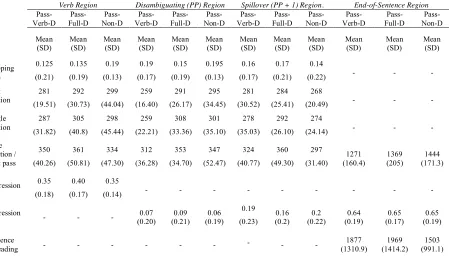
regions (regressions in). Descriptive statistics for all of the regions and all of the
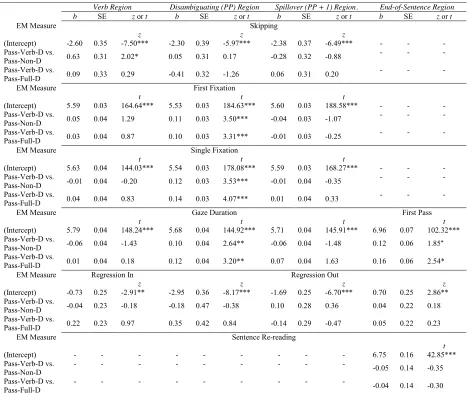
measures we report here and below are available in Table 1, and inferential statistics
in Table 2.
<Table 1 about here>
<Table 2 about here>
Our analyses revealed that the verb was skipped significantly more in the
Pass-Non-D condition compared to the Pass-Verb-D condition. However, there was
no difference in skipping between the two diacritised (verb only and full sentence)
conditions. This suggests a sensitivity to the presence of diacritics on the upcoming
word that increases the likelihood of its being fixated. As for reading time measures:
first fixation, single fixation and gaze durations, the removal of outliers resulted in
removing 6.4%, 3.9%, and 4.9% of the data points from the analyses of these
measures respectively. The results indicated that there were no significant differences
between the passive conditions in any of the contrasts. There were also no significant
differences between the conditions for the regression in measure. Thus, at the verb
region, the only reliable effect occurred for word skipping, and this effect was entirely
driven by the visual complexity of the verb. When it was diacritised and visually
complex it was more likely to be fixated than when it was not, regardless of whether
!
extremely unlikely that this effect has anything to do with the syntactic commitments
that readers were making on line at the verb since at the point when the decision is
made regarding whether to skip or fixate the verb, the eyes are positioned at a word
preceding it. Thus, if syntactic considerations were to be associated with this
decision, it would suggest that readers had parafoveally processed the word, fully
identified it, accessed its syntactic category and made a parsing commitment all on
the basis of a parafoveal view. We consider this possibility to be extremely unlikely,
and if we are correct, then it implies that the effect is entirely driven by the visual
complexity of the diacritised compared to the non-diacritised verb. This finding is in
line with results from Liversedge et al. (2014) who also found visual complexity
effects for word skipping in Chinese.
The Disambiguating (PP) Region
In addition to skipping, first fixation duration, single fixation duration and
gaze duration, we will report the later processing measure of regressions out of the
disambiguating region. The regressions out measure is defined as the proportion of
regressive, rightward in Arabic, saccades from the PP region, and is known to be a
measure sensitive to disruption associated with garden path effects (Frazier & Rayner,
1982; Murray & Liversedge, 1994).
There were no significant differences between the three passive conditions in
any of the contrasts for skipping rates. We did, however, obtain reliable and
consistent effects for the early reading time measures: first fixation, single fixation,
and gaze duration, the removal of outliers resulted in removing 6.9%, 4.5%, and 7.1%
!
indicated that readers spent significantly less time reading the disambiguating region
in the Pass-Verb-D condition, compared to the Pass-Non-D condition. This
difference provides evidence that readers were garden pathed when reading
non-diacritised passive sentences relative to sentences in which the verb only was marked
with diacritics as a passive.
The contrast between the Pass-Verb-D and the Pass-Full-D conditions,
however, yielded a pattern of results that might initially be considered somewhat
surprising. Recall that we predicted that if readers used the diacritics in fully
diacritised sentences to guide initial parsing decisions, then garden path effects should
be absent at the disambiguating PP. Recall also, however, that we considered an
alternative possibility, namely, that to skilled readers full sentence diacritics may be
redundant, and therefore, they may not engage in processing of information conveyed
by the diacritics to the same degree that they do when diacritics are assigned
exclusively to specific homographs for disambiguation (i.e., in the Pass-Verb-D
condition). Our results showed that at the disambiguating region in the Pass-Full-D
condition, readers made longer first and single fixations and had longer gaze durations
compared to the Pass-Verb-D condition. This difference suggests that readers
experienced garden path effects in the fully diacritised condition relative to the verb
only diacritised condition. This occurred despite the presence of the disambiguating
diacritics on the passive verb in both conditions. This pattern of effects indicates that
when reading fully diacritised sentences, our sample of adult, skilled, readers did not
make use of the diacritical cues at the verb to inform their initial syntactic
commitments. This suggests that readers disengage from processing of diacritical
information during silent reading to guide syntactic processing when diacritics are
!
discriminately to specifically disambiguate individual homographs.
We next considered regressions from the disambiguating PP, and found that
there were no differences across conditions. Readers were no more likely to make a
regression to re-read the text when they were garden pathed than when they were not.
Furthermore, since the regression rate was very low (on average 7.3%), we did not
analyse go past (regression path duration) reading times.
The spillover (PP+1) region
We computed skipping rate, first and single fixation durations and gaze duration. For
the fixation duration measures, the removal of outliers resulted in removing 3.1%,
2.7%, and 6.2% of the data points from the analyses of the first fixation duration,
single fixation duration and gaze duration on the spillover region and there were no
significant effects for any measures.
End-of-sentence region
For the final region we computed first pass reading times. Removing outliers
resulted in removing 4.6% of the data points from the analysis for this measure. We
also computed the probability that readers made a regression to examine an earlier
portion of the sentence. Finally, we computed the time participants spent re-reading
the sentence. We defined re-reading time as the sum of all the fixations the reader
made after making a regression from the final region until they pressed the button to
indicate they had understood the sentence. Removing outliers resulted in removing
!
This region received significantly longer first pass reading time in the
Pass-Non-D condition compared to the Pass-Verb-D. This suggests that garden path
effects maintained through this region: The increased first pass reading time suggests
that readers needed more time to process the final sentence region and perhaps to
perform sentence integration in the absence of the disambiguating verb diacritics
(Pass-Non-D condition), relative to when they were present (Pass-Verb-D condition).
A similar effect was observed in the contrast between the Verb-D and the
Pass-Full-D conditions, with longer first pass reading time for the latter. This difference
approached significance and also highlights the persistence of garden path effects in
this region in the fully-diacritised passive condition, and of course, this is in line with
the findings reported at the disambiguating PP region.
There were no significant differences between the passive conditions in any of
the contrasts for the regression out measure. Finally, there were also no differences
between the three conditions in the sentence re-reading measure.
The absence of effects in the regression out measure and for re-reading time in
both the disambiguating and end of sentence regions can be taken to indicate that the
disruption to processing caused by the garden path manipulation was short-lived.
Processing Diacritics in the Active Full Sentence Diacritisation Condition
We compared the Active-Full-D and Active-Non-D conditions to explore the
effects of the presence of the additional visual information conveyed by the diacritics,
in the absence of other effects (e.g. of processing passive sentence analysis, or related
potential garden path effects) on global eye movement measures: Average fixation
!
analysis for this measure), number of fixations, and total sentence reading time2 (Removing outliers resulted in removing 2.6% of the data points from the analysis of
total sentence reading time). We coded the contrasts between the two active
conditions such that the non-diacritised condition was the baseline. This is
ecologically appropriate given the prevalence of non-diacritised text in adult native
readers’ experience with printed Modern Standard Arabic.
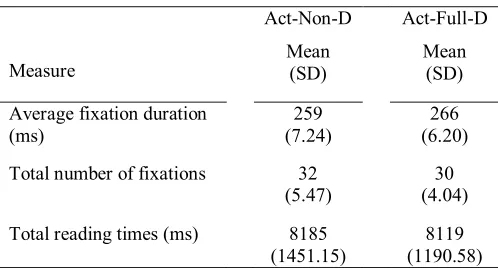
The descriptive statistics for these measures are reported in Table 3 and
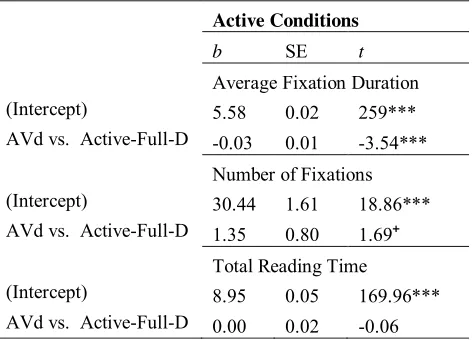
inferential statistics are presented in Table 4.
<Table 3 about here>
<Table 4 about here>
The presence of full sentence diacritics resulted in a small (7 ms), but reliable,
increase in average fixation duration. Fully-diacritised sentences attracted a slightly
lower total number of fixations, but the difference was not significant between the
two conditions. Finally, there was no difference in total sentence reading time
between the two conditions.
The small but significant increase in average fixation duration in the
Act-Full-D condition is similar to the costs of visual crowding effects reported by Liversedge
et al. (2014) and Slattery and Rayner (2013).
Additional Analyses
We also investigated whether the reported effects of diacritisation varied as a
function of longitudinal effects during the experiment (e.g. increased familiarity with
!
effects of full-diacritisation were stronger earlier compared to later within the testing
session). Thus, we used trial rank as a predictive variable of the reported eye
movement measures, for all contrasts. We coded this in a Linear Mixed Effects
model, with participants and items as random effects. Our findings showed that trial
rank had no effect on any of the eye movement measures, in any of the contrasts (all
ts < 1.6).
Similarly, we investigated whether the reported patterns of findings were
influenced by participants’ chronological age. We used participants’ age as a
predictive variable in Linear Mixed Effects models3, with participants and items as random effects. The analyses revealed that participants’ age had no effect on any of
the eye movement measures, in any of the contrasts (all ts < 1).
Discussion
Our investigation aimed to address a number of important theoretical issues
relating to the processing of diacritics during natural silent reading in Arabic. We will
discuss each of these in turn shortly. However, prior to discussing the details and
theoretical significance of our findings, we note a general aspect of our results,
namely, that in common with other investigations of eye movements during reading
Arabic (e.g., Jordan et al., 2014), the fixations durations we report (first, single and
average) are somewhat elevated compared with those observed during reading of
Latinate languages (see Rayner, 1998; 2009). We are not entirely sure why this is the
case, but in all likelihood reflects a general cross-linguistic difference in reading
behaviour (rather like that observed between Chinese and other Latinate languages).
!
though this suggestion is clearly speculative at this stage. Another factor that may be
taken into consideration with regards to this aspect of our results is that the
participants were all bilingual (Arabic-English), and it may be useful to replicate these
patterns with a monolingual sample in the future. However, we think it is unlikely
that this factor limits how generalizable our findings are, given that (1), the
participants were demonstrably fluent in reading Arabic (and read it on a regular
basis), and (2), because it is unlikely that their knowledge of English affected their
ability to read Arabic given the extensive differences between the two languages (e.g.
in typography, phonology, etc.), compared to, for instance, languages with more
similar characteristics such as Dutch and English (e.g. Brysbaert & Duyck, 2010).
Our selection of heterophonic-homographic verbs which can be disambiguated
as active or passive through diacritisation allowed us to explore whether Arabic
readers have a preference for simple active verb analysis, and whether they will use
diacritics as phono-syntactic disambiguation cues for diacritised passive verbs. We
predicted that if readers have this preference for active analysis, they would
experience a garden path effect in the absence of diacritics which disambiguate the
verb as passive (Pass-Non-D condition), compared to when these diacritics were
present (the Pass-Verb-D condition).
A clear picture of the time course and costs of processing diacritics during
reading began to emerge at the ambiguous verb region. The effect of diacritisation
was limited to skipping rates, and did not influence fixation time measures. Readers
were significantly less likely to skip the verb in the Pass-Verb-D condition. As we
suggested above, this skipping effect is likely to be related to visual complexity (see
e.g. Liversedge et al., 2014), which increases if the upcoming word is diacritised, and
!
than diacritised words. This is more plausible than suggesting that processing of the
upcoming diacritised verb was performed parafoveally to such an extent that a
decision to skip it, or not, was made on the basis of such deep processing.
Furthermore, our patterns of effects for the early fixation time measures on the verb
suggest that disambiguating a critical homograph using the provided diacritics does
not entail additional processing demands which significantly increase word reading
time. Our data, therefore, also suggest that processing passive verbs does not pose
that much of a cognitive demand on readers given that passive is a common, albeit
less preferred, analysis (c.f. Roman et al., 1985).
The remaining findings of the contrasts performed on the passive conditions
provided unequivocal answers to our research questions. At the disambiguating PP
region, the most striking finding was the clear garden path effect: Readers
experienced immediate disruption to processing upon arrival at this region in the
Non-D condition, relative to the Verb-D condition. Compared to the
Pass-Verb-D, first and single fixation and gaze durations were significantly inflated in the
Pass-Non-D condition. This pattern of results clearly shows that Arabic readers have
a parsing preference for simple active over passive analysis of the verb: When
verb-disambiguating diacritics were not available, the readers followed this active parsing
preference until arriving at the passive disambiguating region. Our results replicate
previous research findings which show that when readers’ initial parsing preferences
are violated, the resulting disruption to processing is manifest at the disambiguating
region in the violating conditions (e.g. Frazier & Rayner, 1982; Lipka, 2002;
Liversedge et al., 2002; Paterson et al., 1999; Rayner et al., 1983; Rayner & Frazier,
!
preference for simple active over passive, as is the case in other languages (e.g.
English, Fodor et al., 1974; Ferreira, 2003 etc.).
The contrast between the Pass-Verb-D and Pass-Non-D conditions in the
spillover region showed no significant difference between these two conditions.
However, we obtained more evidence for garden path effects in the end-of-sentence
region. Reading time measures of early (first pass) processing clearly show that
readers were slower in the Pass-Non-D condition, compared to the Pass-Verb-D
condition. This pattern of results replicates previous findings (e.g. Frazier & Rayner,
1982; Lipka, 2002).
The disruption our readers experienced appeared in early, first pass, reading
measures in the disambiguating PP and end-of-sentence regions. The fact that garden
path effects in the disambiguating PP region were limited to first pass measures can
be seen as somewhat deviant from previous findings (e.g., Frazier & Rayner, 1982;
Lipka, 2002). In these investigations garden path effects persisted into later reading
measures (e.g. regression out, and go past reading time). Yet we do not find this
surprising, for two reasons: (a) Passive is a natural sentence structure in Arabic, as our
sentence naturalness ratings suggest, albeit it is the less preferred analysis of the
verb-noun pair; and (b) Good semantic matching of the agent and patient of the sentence
with its verb meant that the disambiguating region did not contain any semantic
implausibility (e.g. the verb pushed in the provided example (see Figure 1) could
equally be performed by the student, or by her colleague). This can be contrasted
with, for example, the materials used by Rayner, Warren, Juhasz, and Liversedge
(2004) where significant differences were obtained at go past reading times when the
!
The results thus far suggest that readers processed the available passive verb
diacritics in the Pass-Verb-D condition, and thus avoided the garden path seen in the
Pass-Non-D condition. Contrastingly, when the whole passive sentence was
diacritised (Pass-Full-D condition), and despite the presence of the verb
disambiguating diacritics, readers showed evidence of disruption to processing of a
similar magnitude to when the passive verb was not diacritised. In the pass-Full-D
condition the readers showed significantly longer first and single fixation and gaze
durations in the disambiguating region, as well as significantly longer first pass in the
end-of-sentence region, compared to the Pass-Verb-D condition.
Clearly, then, the mode of diacritisation (only on the homograph vs. on the
entire sentence) impacts how readers process diacritics. That is to say, readers do not
always appear to engage in automatic (involuntarily, reflexive and mandatory)
processing of diacritics: Whereas it is clear that readers processed the present
disambiguating diacritics on the verb in the Pass-Verb-D condition such that they
were able to extract the disambiguating information provided by these diacritics, there
is no evidence that such processing occurred in Pass-Full-D condition, indicating that
diacritics are not necessarily automatically processed. In the Pass-Full-D condition
participants treated full sentence diacritics as if they were redundant and thus failed to
utilise the verb diacritics as a phono-syntactic disambiguation cue. Failure to use the
diacritical information resulted in readers experiencing garden path effects.
Comparing the active conditions (Act-Non-D and Act Full-D) to learn about
readers’ processing of full sentence diacritics, revealed that full sentence diacritisation
resulted in a small, reliable, increase in average fixation duration. This was offset by
a small (non reliable) decrease in the number of fixations made in that condition
!
presence of full sentence diacritisation thus has resulted only in a small increase in
average fixation duration. We are inclined to attribute this effect to visual crowding,
where the presence of the additional visual information (the diacritics) slows readers’
uptake of visual information. However, there is an alternative possibility. While
fully-diacritised texts are regularly encountered by native Arabic readers, these texts
are typically religious or other literary works. Given that our experimental sentences
were neither religious nor from formal literature, then it can be argued that the effects
may be caused by readers not being familiar with reading fully-diacritised single
sentences which are not of these types. One way to assess whether this might have
been the case is to investigate whether readers’ performance with fully-diacritised
sentences changed as they encountered successive examples of such sentences
throughout the experiment. We therefore examined this possibility by taking the trial
number into account in relation to our dependent measures. Our data indicated that
readers’ processing of full sentence diacritics did not change as their familiarity with
the stimuli developed across the duration of the experiment. Of course, we cannot
completely rule out the possibility that any familiarity effects that may have explained
the full diacritics effect could have developed over a period much longer than the
duration of the experimental testing session. However, in our view, these analyses
certainly weaken any such explanation. Rather, this small cost seems more
reasonably attributed to the undisputable increase in visual crowding resulting from
the presence of full sentence diacritics, and is in line with the small but reliable
increase in average fixation duration (6 ms) reported by Slattery and Rayner (2013) as
a result of increasing visual crowding. This pattern is also in line with the small (9-11
ms) increase in fixation time reported by Liversedge et al. (2014). However, unlike
!
significant increase in total sentence reading time for the crowded Act-Full-D
condition, compared to Act-Non-D. If a diacritics-based crowding effect is what is
driving this pattern of findings, then its weakness, relative to what was reported by
Slattery and Rayner, is perhaps due to Arabic readers’ experience with reading fully
-diacritised texts. Similarly, the subtle effect of visual crowding we obtained is weaker
than the effects reported by Roman and Pavard (1987). It is hard to speculate as to
what was driving the increased fixation times in their fully diacritised conditions.
One possibility is that the stimuli were made up of entire paragraphs, rather than
single sentences, and faster first-pass reading of paragraphs compared to single
sentences may have compounded the visual crowding effects (e.g. longer gaze
durations for sentence reading compared to passage reading, Radach, Huestegge, &
Reilly, 2008; Wochna & Juhasz, 2013).
In our view, the theoretical implications of these results are important: The
small effect, likely due to visual crowding, and the fact that there were no other
differences between the two active conditions (similar total number of fixations and
total sentence reading times) lend more support to the suggestion that readers do not
engage automatically, or to any significant extent, in cognitive processes to access the
linguistic information provided by the diacritics in the full diacritisation mode. This is
in line with the findings reported above regarding the Pass-Full-D condition. If
readers treat full sentence diacritisation as information that is redundant and therefore
do not automatically process the phonetic and syntactic information provided by these
diacritics in fully-diacritised sentences, then it might be considered that, under
“normal” reading circumstances, this would be a cognitive resources-saving strategy
!
text context and syntactic structure to effectively disambiguate homographic words
(e.g. Abu-Rabia, 1997a; 1997b; 1998).
Compared to the literature reviewed above (e.g. Abu-Rabia, 1997a; 1997b;
1998; 1999; 2001), which suggested that the presence of diacritics contributed to
improved reading accuracy and, or, comprehension performance, our findings bring
considerable insight into the time course of processing diacritics, and the influence of
the mode of diacritisation on processing during natural silent reading. Similarly, our
findings clarify how readers process diacritics in the course of natural silent reading
compared to in lexical decision or word naming tasks. In such single word tasks
participant are typically asked to perform the task accurately and are thus obliged to
perform complete analyses of the diacritised letter-strings, and this may explain the
additional processing time costs reported when diacritics are present (see similar
suggestions made by Bentin & Frost, 1987). By contrast, when readers are asked to
read sentences for comprehension, as in our experiment, this does not entail
performing lengthy additional analyses of the linguistic information provided by the
diacritics when reading fully-diacritised sentences. In our experiment, it is likely that
readers followed their assumption about full sentence diacritics being redundant, in
both fully-diacritised conditions, active and passive, and spared cognitive resources.
This, in turn, resulted in the different outcomes for the fully-diacritised passive
compared to the fully-diacritised active condition.
To summarise, our findings address a number of theoretical issues in reading
Arabic for which, up until now, there has been no interpretable eye movement data.
By exploring processing diacritics during natural reading of Arabic, we have
demonstrated that Arabic readers extract phono-syntactic information from diacritics