http://eprints.whiterose.ac.uk/95272/
Version: Draft Version
Book Section:
Drabble, S.J. and O'Cathain, A. (2015) Moving from randomized controlled trials to mixed
methods intervention evaluations. In: Hesse-Biber, S. and Burke Johnson, R., (eds.) The
Oxford Handbook of multimethod and mixed methods research inquiry. Oxford Library of
Psychology . Oxford University Press , New York , pp. 406-425. ISBN 9780199933624
https://doi.org/10.1093/oxfordhb/9780199933624.013.26
[email protected] https://eprints.whiterose.ac.uk/ Reuse
Unless indicated otherwise, fulltext items are protected by copyright with all rights reserved. The copyright exception in section 29 of the Copyright, Designs and Patents Act 1988 allows the making of a single copy solely for the purpose of non-commercial research or private study within the limits of fair dealing. The publisher or other rights-holder may allow further reproduction and re-use of this version - refer to the White Rose Research Online record for this item. Where records identify the publisher as the copyright holder, users can verify any specific terms of use on the publisher’s website.
Takedown
If you consider content in White Rose Research Online to be in breach of UK law, please notify us by
C H A P T E R
Moving From Randomized Controlled Trials
to Mixed Methods Intervention Evaluations
Sarah J. Drabble and Alicia O’Cathain
Abstract
This chapter explores why mixed methods intervention evaluations are needed when undertaking randomized controlled trials in order to address a wide range of questions relevant to
understanding the effectiveness of an intervention. It provides a description of three different frameworks describing different ways in which mixed methods intervention evaluations may be undertaken within the context of a randomized controlled trial: the temporal framework; the process-outcome framework, which includes process evaluations; and the “aspects of a trial” framework. The chapter considers how the language used to describe qualitative research undertaken with trials can represent different underlying assumptions about the relative value of the qualitative research in relation to the trial. The chapter concludes with a discussion of some of the challenges that arise when undertaking mixed method intervention evaluations and the value of including qualitative research in systematic reviews of trials via evidence synthesis.
Key Words: randomized controlled trials, mixed methods intervention evaluations, process evaluation, evidence synthesis, temporal framework, process-outcome framework, aspects of a trial framework
Introduction
Randomized controlled trials (RCTs) are used in social, education, and health research to test whether interventions are efective (Cnaan & Enosh, 2001; Torgerson & Torgerson, 2001), for example, to test the efectiveness of new approaches to delivering foster care, new curriculum in schools, and new ways of delivering self-management advice to people with chronic health conditions. In this chapter we consider the change in use of RCTs to address the single question of “does an intervention work?” to multimethods (Grissmer, Subotnik, & Orland, 2009) or mixed methods (Creswell, Fetters, Plano Clark, & Morales, 2009) interven-tion evaluainterven-tions to address a range of quesinterven-tions related to understanding the efectiveness of an intervention. We call these wider designs “mixed methods intervention evaluations” rather than “mixed methods randomized controlled trials” for
reasons we explain later in the chapter. Although multimethod or mixed methods intervention evaluations are undertaken within education and social research—in particular there is a guide to combining multimethods and RCTs produced by the American Psychological Association (Grissmer et al., 2009)—we focus here on health research because RCTs are common within this ield and it is our area of expertise.
In the health ield a randomized controlled trial is deined as:
Dr a bbl e , O’C a t h a i n interventions are assigned within individuals.
(Cochrane Collaboration, 2013)
he terms randomized controlled trial and ran-domized clinical trial are sometimes used inter-changeably in the health ield because historically they have tested drugs and devices in clinical set-tings. We prefer the term randomized controlled trial (RCT) because this encompasses public health trials that test the efectiveness of inter-ventions that are designed to impact on health behaviors in a range of settings. An example of a public health intervention is peer support deliv-ered in schools to aid smoking cessation among young people (Campbell et al., 2008; Munro & Bloor, 2010).
We have based this chapter on our belief that accepted practice among some communi-ties of researchers has moved from undertaking lone RCTs toward combining qualitative meth-ods and RCTs within mixed methmeth-ods interven-tion evaluainterven-tions. We cannot, however, chart the exact size of this shift and rely on less than ideal methods to suggest its extent. We would ideally compare a random sample of RCTs funded in dif-ferent decades and measure the proportion using a mixed methods approach within each decade, showing an increase over time. his information is not available, so instead we rely on perceptions that multimethod or mixed methods interven-tion evaluainterven-tion is common (Lewin, Glenton, & Oxman, 2009), is increasing (Grissmer et al., 2009), or is a relatively recent phenomenon (Jansen, Foets, & de Bont, 2009). Evidence that mixed methods intervention evaluations are common is available from a range of sources. In a search for pragmatic trials in primary care, Jansen et al. found 33 articles published between 2001 and 2007 reporting the use of qualitative research. Lewin et al. found that between 2001 and 2003, 30% of published trials of changes to organization of health care included qualitative research. In a systematic review of international journal articles reporting qualitative research undertaken with trials in health, we identi-ied 296 articles published between 2008 and September 2010 (O’Cathain, homas, Drabble, Rudolph, & Hewison, 2013).
In this chapter we address why the move from lone RCTs to mixed methods intervention evalua-tions has occurred and the beneits it can deliver. We also describe three existing frameworks for mixed methods intervention evaluations that can
help researchers understand the range of ways in which diferent methods can be used in conjunc-tion with trials, examine the developing language used to describe this approach, and consider the challenges faced by researchers when making the move to mixed methods intervention evaluations. We provide case studies of published evaluations to illustrate some of these points.
Why Are Mixed Methods Intervention Evaluations Necessary?
In the context of health research, RCTs are used to test whether new drugs, services, or tech-nologies improve health. RCTs are considered the “gold standard” in the hierarchy of providing evi-dence of efectiveness. However, it appears that within health research, the question “is it efec-tive?” is the gold standard question in an implicit research question hierarchy, with the result that methods that best address other questions may be dismissed as inferior and require defend-ing (Giacomini, 2001). We believe that RCTs are an excellent way of addressing the efective-ness question but that this question needs to be expanded to “efective for whom under what circumstances?” (e.g., Pawson & Tilley, 2004). We identify other important questions relevant to evaluations of interventions that RCTs alone cannot address.
If the Intervention Was Efective in the Trial, Will It Be Efective in the Real World?
MO v i ng F r OM r C t s t O M i x e D M e t hOD s i n t e r v e n t iOn e va l ua t iOns Why Was the Intervention Not Efective?
RCTs can be expensive and time consuming to undertake. In theory, RCTs producing null results are as valuable as those with positive results. However, in practice, null RCTs, which identify that an intervention was not efective, can feel like a waste of time and money unless research-ers can undresearch-erstand why the intervention was not efective and thus steer other researchers away from evaluating similar types of interventions and toward those that have a better chance of efective-ness. Researchers use qualitative and quantitative methods to facilitate understanding of why inter-ventions do not work. For example, these meth-ods can explore whether interventions have been delivered as planned or met barriers to successful implementation.
What Is the Optimal Intervention to Test? Undertaking a large and expensive RCT of an intervention that is not well understood may waste resources if the results are that an intervention was not efective because it was not feasible for deliv-ery by health professionals or was not acceptable to patients. Questions about feasibility and accept-ability of interventions can be addressed in prepa-ration for an RCT to optimize interventions and their implementation before they undergo expen-sive evaluation. Qualitative methods such as inter-views and focus groups with those delivering the intervention can explore feasibility. For example, the intervention being tested in the RCT may be delivered in busy health service clinics that require health professionals to change their work practices. Interviews and focus groups with those receiving the intervention can explore how the intervention its into the context of patients’ lives and their man-agement of their health condition. Nonparticipant observation or structured observation can be used to consider the idelity of implementation of the intervention, that is, understand whether the inter-vention in practice was similar to that planned. All of these methods can help to identify how the intervention can be adapted to operate well in the context in which it will be tested and/or delivered in the real world.
Never Mind the Intervention; Will the Randomized Controlled Trial Work?
It can be challenging to run RCTs. For example, RCTs can struggle to recruit suicient participants, resulting in low statistical power, or they can lack external validity because they recruit a narrow
proile of the population that will actually use the intervention in the real world. Questions around how to improve the conduct of the RCT can be important, and qualitative research has been used for this purpose. For example, interviews with health professionals recruiting patients for RCTs, and interviews with the patients approached for participation, can identify misunderstandings that lead to nonparticipation in the trial. Observations of recruitment practices can identify poor commu-nication that has led to these misunderstandings.
Have We Really Understood the Complexities of What We Are Researching?
An industry has grown up around RCTs of drugs. Yet much of what is evaluated in health is more complex than a drug and is known as a com-plex intervention. A comcom-plex intervention has been deined in diferent ways. First, it is deined by what it is not: it is not a drug or surgical procedure (Oakley, Strange, Bonell, Allen, & Stephenson, 2006). When deined by what it is, a complex intervention has many components or active ingre-dients (Campbell et al., 2007; Munro & Bloor, 2010; Oakley et al., 2006), which combine inde-pendently and interdeinde-pendently (Campbell et al., 2007), making the whole more than the sum of its parts (Hawe, Shiell, & Riley, 2004; Oakley et al., 2006). Complex interventions are also deined as organizationally elaborate and socially mediated (Munro & Bloor, 2010). he complexity of the intervention can take diferent forms, such as the variation in behaviors of the people delivering or receiving the intervention, the diferent groups or organizations afected by the intervention, and the variation in outcomes (Medical Research Council [MRC], 2008). Examples of complex interventions include the introduction of lifestyle interventions for people with obesity or the reorganization of the way in which a service is delivered.
Dr a bbl e , O’C a t h a i n contribution of qualitative methods to
under-stand the complexity of interventions (Glenton, Lewin, & Scheel, 2011).
Complexity can be related to more than the intervention: drug trials may be undertaken with complex patient groups (e.g., Romo, Poo, & Ballesta, 2009) or within complex environments (e.g., Shagi et al., 2008), beneiting from qualitative methods to engage with this complexity.
Frameworks for Undertaking Mixed Methods Intervention Evaluations
hree frameworks for multimethod and mixed methods intervention evaluations have been described in the literature: the temporal frame-work, the process-outcome frameframe-work, and the “aspects of a trial” framework. hese frameworks can help researchers consider the range of questions relevant to their evaluation and the range and tim-ing of methods within their evaluation. We discuss these frameworks in the following sections.
he Temporal Framework
A common approach to describing the use of qualitative research with RCTs is a temporal frame-work, which considers how qualitative research can be used before, during, or after a trial (Creswell et al., 2009; Jansen et al., 2009; Lewin et al., 2009; Sandelowski, 1996). It is worth relecting on what
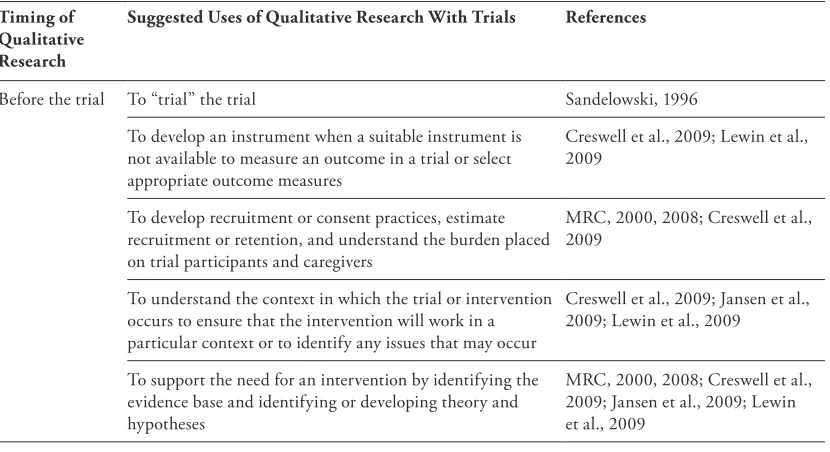
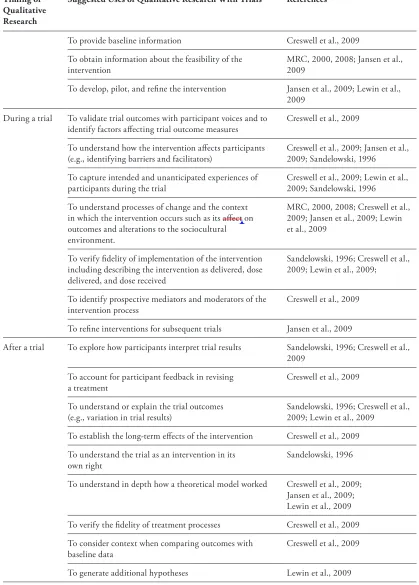
[image:5.552.70.485.472.698.2]these authors mean by trial before exploring how qualitative research is used before during and after the trial. By trial these authors mean what is vari-ously called the “deinitive RCT” (MRC, 2000) or “Phase III” trial, which measures the efectiveness of an intervention in large groups of people (US National Library of Medicine, 2008). When test-ing drugs, other phases occur before and after this Phase III trial. Before the trial, studies are under-taken to test the safety of drugs in a small group of people (Phase I) and to explore efectiveness in a larger group (Phase II); after the Phase III trial, research is undertaken to test the drug’s efect in the longer term (Phase IV). A similar phased approach has been described for complex interven-tions where early phases are carried out before the deinitive RCT to prepare for the Phase III deini-tive trial, and Phase IV occurs after the deinideini-tive trial to study longer term implementation of the intervention in the real world (MRC, 2000). his phased approach to trials of complex interventions has been updated to consider development and feasibility phases prior to the trial of efectiveness, which is then followed by implementation studies (Craig et al., 2008). In Table 23.1 we display the diferent work authors have suggested qualitative research can do before, during, and after the trial, and then we go on to explore these stages in more detail.
Table 23.1 he Use of Qualitative Research With Trials at Diferent Stages of the Trial
Timing of Qualitative Research
Suggested Uses of Qualitative Research With Trials References
Before the trial To “trial” the trial Sandelowski, 1996
To develop an instrument when a suitable instrument is not available to measure an outcome in a trial or select appropriate outcome measures
Creswell et al., 2009; Lewin et al., 2009
To develop recruitment or consent practices, estimate recruitment or retention, and understand the burden placed on trial participants and caregivers
MRC, 2000, 2008; Creswell et al., 2009
To understand the context in which the trial or intervention occurs to ensure that the intervention will work in a particular context or to identify any issues that may occur
Creswell et al., 2009; Jansen et al., 2009; Lewin et al., 2009
To support the need for an intervention by identifying the evidence base and identifying or developing theory and hypotheses
MRC, 2000, 2008; Creswell et al., 2009; Jansen et al., 2009; Lewin et al., 2009
MO v i ng F r OM r C t s t O M i x e D M e t hOD s i n t e r v e n t iOn e va l ua t iOns Timing of
Qualitative Research
Suggested Uses of Qualitative Research With Trials References
To provide baseline information Creswell et al., 2009
To obtain information about the feasibility of the intervention
MRC, 2000, 2008; Jansen et al., 2009
To develop, pilot, and reine the intervention Jansen et al., 2009; Lewin et al., 2009
During a trial To validate trial outcomes with participant voices and to identify factors afecting trial outcome measures
Creswell et al., 2009
To understand how the intervention afects participants (e.g., identifying barriers and facilitators)
Creswell et al., 2009; Jansen et al., 2009; Sandelowski, 1996
To capture intended and unanticipated experiences of participants during the trial
Creswell et al., 2009; Lewin et al., 2009; Sandelowski, 1996
To understand processes of change and the context in which the intervention occurs such as its afect on outcomes and alterations to the sociocultural environment.
MRC, 2000, 2008; Creswell et al., 2009; Jansen et al., 2009; Lewin et al., 2009
To verify idelity of implementation of the intervention including describing the intervention as delivered, dose delivered, and dose received
Sandelowski, 1996; Creswell et al., 2009; Lewin et al., 2009;
To identify prospective mediators and moderators of the intervention process
Creswell et al., 2009
To reine interventions for subsequent trials Jansen et al., 2009
After a trial To explore how participants interpret trial results Sandelowski, 1996; Creswell et al., 2009
To account for participant feedback in revising a treatment
Creswell et al., 2009
To understand or explain the trial outcomes (e.g., variation in trial results)
Sandelowski, 1996; Creswell et al., 2009; Lewin et al., 2009
To establish the long-term efects of the intervention Creswell et al., 2009
To understand the trial as an intervention in its own right
Sandelowski, 1996
To understand in depth how a theoretical model worked Creswell et al., 2009; Jansen et al., 2009; Lewin et al., 2009
To verify the idelity of treatment processes Creswell et al., 2009
To consider context when comparing outcomes with baseline data
Creswell et al., 2009
[image:6.552.66.485.95.680.2]Dr a bbl e , O’C a t h a i n Case Study 1: Adherence to Treatment
of Cystic Fibrosis in Adolescents
his study (Marciel, Saiman, Quittell, Dawkins, & Quittner, 2010) was conducted in the United States using mixed methods (focus groups, interviews, survey) before an RCT to adapt a peer support group intervention for adolescents, which had previously been tested on preschool and school-age children. he aim of the intervention was to improve adherence to treatment for cystic ibrosis. Focus groups were undertaken with 17 health care professionals and interviews with 18 adolescent patients, 6 adult patients, and 12 parents. he qualitative research
-
According to Creswell et al. (2009), a before-trial design entails the collection and analysis of quali-tative data before the trial with the purpose of improving the subsequent trial; Sandelowski (1996) refers to this as “to ‘trial’ the trial” (p. 361). he qualitative research occurs at the development or feasibility/piloting phases of an evaluation (Craig et al., 2008) and can ensure that the deinitive or Phase III trial evaluates the optimum intervention, recruits participants eiciently, and measures the right outcomes in a valid way. he focus of the qual-itative research can be on the intervention, the trial conduct, or both. In their study of trials of complex interventions designed to change the organization of care, Lewin et al. (2009) found that half of the studies combining qualitative research and RCTs (14/30) collected qualitative data before the trial. O’Cathain et al. (2013) found that a quarter of jour-nal articles reporting qualitative research under-taken with RCTs were based on data collection carried out before the deinitive trial. he deini-tive trial can beneit from the before-trial qualita-tive research indings if the learning is acted upon whereby researchers adapt the intervention, improve recruitment practices, or select outcomes informed by the beneits the patients believe they have gained from the intervention. Although researchers have described the use of qualitative research before the deinitive trial, quantitative and qualitative ods can be used at this stage within a mixed meth-ods intervention evaluation. Case study 1 describes how researchers used a mixed methods study prior to a trial to consider adapting an efective interven-tion for use within a diferent group before it was then tested in the deinitive trial.
-
A during-trial design involves the collection of qualitative data during the deinitive trial to under-stand how the intervention is implemented in prac-tice. Lewin et al. (2009) found that 9 of 30 studies collected qualitative data solely during the trial, and 2 studies collected data both before and during the trial. Process-outcome evaluations are a during-trial design, and these are described in detail in the next framework. he purpose of understanding how the intervention was implemented in practice is usually to explain the trial results. Yet, interest-ingly, authors who use this temporal framework include the use of qualitative research to explain the trial results in the after-design, where quali-tative research is used after the trial. here is no doubt that the trial must be complete and the results known before qualitative research can be used to help interpret those results. However, the data collection and analysis of qualitative research can be carried out during the trial. Indeed, explain-ing the trial results is often the key aim of process evaluations undertaken alongside RCTs.
-
An after-trial design involves collecting qualita-tive data after the trial has ended to explore the lon-ger term implementation of an intervention (MRC, 2000, 2008). Lewin et al. (2009) found that very few of their studies (4/30) included qualitative research conducted after the trial. Some studies collect quali-tative data after a trial that could have been collected during a trial. In Case Study 2, qualitative research was conducted after a trial to help to explain why an intervention was not as efective as expected.
MO v i ng F r OM r C t s t O M i x e D M e t hOD s i n t e r v e n t iOn e va l ua t iOns
he Process-Outcome Framework
Process evaluations are usually undertaken alongside deinitive or Phase III trials and comple-ment the trial’s focus on outcomes. hey started in health research in the mid- to late 1980s in the
context of evaluating applied public health inter-ventions but have a longer history of use within program evaluation (Linnan & Steckler, 2002). Process evaluations were seen as a necessary addi-tion to trials of complex intervenaddi-tions because tri-als cannot provide insights about the mechanisms behind interventions or how interventions are actually delivered in practice (Glenton et al., 2011; Oakley et al., 2006). Researchers have argued that process evaluations should be an integral part of trials of complex interventions, researching why and how interventions work or do not work (e.g., Linnan & Steckler, 2002; Munro & Bloor, 2010; Oakley et al., 2006; Siu, Shek, & Poon, 2009). heir strength is the ability to distinguish between what is planned in a particular setting and what is actually done in practice, which may depend on factors such as the resources available, the orga-nizational structure in which the intervention is delivered, and the stakeholders involved in deliv-ering the intervention (Aro, Smith, & Decker, 2008). In particular, process evaluations can dis-tinguish between “interventions that are inher-ently faulty (failure of intervention concept or theory) and those that are badly delivered (imple-mentation failure)” (Oakley et al., 2006, p. 413). his can help to avoid what has been termed “type III errors” (Audrey, Holliday, Parry-Langdon, & Campbell, 2006), that is, where a trial has a null result because the intervention was inadequately implemented rather than a failure in the interven-tion design itself. It has been argued that process evaluations are particularly useful in cluster or multisite trials to understand the context when the same intervention is delivered at diferent sites (Oakley et al., 2006) and when an intervention is trying to change the organization of healthcare delivery (Glenton et al., 2011). A process evalua-tion can help to explain the results of trials with positive results by identifying which aspects of the intervention contributed to its success and trials with null results in terms of why the interven-tion was not efective (Linnan & Steckler, 2002). Whilst many process evaluations are conducted during the deinitive trial, the importance of pro-cess evaluations used alongside feasibility and pilot studies prior to the deinitive trial has also been highlighted; for example, when used along-side a pilot trial, process evaluations can aid the decision about whether to progress to the deini-tive trial, and they may inform changes to the intervention to be tested in that deinitive trial (Munro & Bloor, 2010).
Case Study 2: An Exploration of the Structural and Personal Factors hat Might Have Reduced the Acceptability or Feasibility of the Intervention
A cluster RCT (Pope et al., 2010) was carried out in 20 primary-care clinics in the Eastern Cape Province of South Africa. he RCT, which tested an intervention of provider-initiated HIV counseling for newly diagnosed tuberculosis, had a positive result, but the magnitude of the efect was smaller than expected. Once these results were known, a qualitative study of inter-views and focus groups was undertaken with the tuberculosis nurses who conducted the educa-tion, counseling, and testing sessions to identify barriers to implementation. hree potential bar-riers to delivery of the intervention were identi-ied: inadequate staing levels due to the use of nonqualiied nurses to provide counseling who then needed to ind a qualiied nurse to provide HIV testing; a lack of space and privacy in a primary-care environment to conduct counsel-ing sessions; and nurses’ beliefs that despite the importance of counseling and testing, the skills required to deliver counseling are innate and therefore cannot be taught, which may have led to inadequate training. In this case, the qualita-tive research conducted at the end of the RCT enabled the team to understand structural and individual level factors that inluenced the suc-cess of HIV counseling and testing for newly diagnosed tuberculosis patients. his explained the small efect size in the RCT and highlighted the need for future research to consider innova-tive and coordinated approaches to service pro-vision in a primary-care environment.
Dr a bbl e , O’C a t h a i n Linnan and Steckler (2002) present seven key
components of a process evaluation that are simi-lar to how qualitative research can be used at the during-trial stage (see Table 23.1), even though process evaluations make use of both qualita-tive and quantitaqualita-tive methods. Each component is described in the following: context, reach, dose delivered, dose received, idelity, implementation, and recruitment.
Context includes the broader social, political, and economic setting in which the intervention is delivered (Glenton et al., 2011). For example, a process evaluation undertaken alongside a trial of a treatment for diabetes may use interviews with stakeholders or analysis of policy documents to allow the researcher to consider what is already available for participants in the community, how the intervention its in with this, and how the inter-vention is delivered within the existing context of a general practice.
Reach is the proportion of the target popula-tion that participates in the intervenpopula-tion. For example, in a trial of medication for blood pres-sure, it is important to access as many participants who can beneit from the medication as possible, including hard-to-reach subgroups of the popula-tion. Interviews with service providers may reveal information about particular groups of patients that have been excluded, even if this was not the intention of the trialist. For example, family practi-tioners screening patients for inclusion in a trial of medication for reducing high blood pressure may exclude those with diabetes even though they are eligible for the study. his has implications for the generalizability of the RCT results.
Dose delivered is how much of the intervention is intended to be delivered to participants and is often determined by the behavior of the people delivering the intervention; for example, in a trial of cognitive behavioral therapy provided through the Internet, it may be how many sessions were actually delivered to participants. Quantitative methods can be used to record numbers of sessions delivered. Closely related to dose delivered is dose received, which in the previous example of cognitive behavior therapy would be the proportion of Internet sessions par-ticipants actually accessed and completed.
Fidelity is identiied by Linnan and Steckler (2002) as the most diicult component to assess and relates to the quality of the implementation of the intervention, that is, the extent to which the inter-vention was delivered as planned. Assessment may include quantitative methods such as checklists of
how aspects of the intervention were delivered and qualitative methods to make a subjective assess-ment of whether it was delivered in the “manner and the spirit in which it was intended” (p. 13). his could involve observations of therapy sessions or consultations or questionnaires for staf deliver-ing the intervention.
Program implementation is a combination of reach, dose, and idelity and is conceptualized by Linnan and Steckler as a composite score indicat-ing the extent to which the intervention has been implemented and received by the intended popula-tion. here is debate about how to calculate imple-mentation and what an acceptable impleimple-mentation score would be.
Recruitment concerns how trialists attract and approach prospective participants and how they interact with participants once the trial starts. It is important for trialists to recognize sampling bias in the study, identify how this bias might afect the results, and determine how the intervention should be implemented in clinical practice. Researchers should be aware of problems concerning generaliz-ing the indgeneraliz-ings of the trial to subgroups that were not included in the participant sample or consider whether the trial indings apply to all participants in the trial sample.
MO v i ng F r OM r C t s t O M i x e D M e t hOD s i n t e r v e n t iOn e va l ua t iOns if cost is an issue. Case Study 3 also highlights the
mixed methods approach to these process evalua-tions, with methods such as questionnaires, inter-views, and observations used in both evaluations. Additionally, it is interesting to see process evalua-tions undertaken at the during-trial phase, where an RCT is used to test the efectiveness of an interven-tion, and then at the after-trial phase, where an RCT is used to test diferent strategies for implementing the efective intervention. Finally, it highlights that Linnan and Steckler’s components of a process eval-uation are not comprehensive and could also include acceptability of an intervention.
he Aspects of a Trial Framework
We have considered two frameworks for think-ing about mixed methods intervention evaluations. A third and inal framework is ofered by ourselves and detailed in O’Cathain et al. (2013), where we considered how qualitative research was actu-ally used in practice with RCTs rather than how it might be used. hat is, this framework was empiri-cally rather than theoretiempiri-cally based. We identiied 296 articles published between January 2008 and September 2010 that reported qualitative research undertaken with RCTs and mapped the focus of the qualitative research in relation to the RCT. We found that 28% of these publications had been car-ried out before the trial. However, it was diicult to distinguish between qualitative research under-taken during or after a trial because data collection might occur during the trial, but analysis and inter-pretation might occur after the trial results were known. he timing of data collection, analysis, and interpretation of the qualitative research in rela-tion to the RCT was rarely clearly reported in these articles. hus the temporal framework described earlier was not a helpful way of categorizing these articles in practice, and instead a new framework was developed inductively from reading the 296
Case Study 3: Process Evaluations for the Pool Cool Eicacy and Difusion Trials
Pool Cool was a skin cancer prevention inter-vention in the United States initially tested in a RCT in 1999 at 28 swimming pools in Hawaii and Massachusetts (Glanz, Geller, Shigaki, Maddock, & Isnec, 2002; see also Escofery, Glanz, & Elliott, 2008; Escofery, Glanz, Hall, & Elliott, 2009). he intervention program was aimed at children age 5 to 10 years, their par-ents, lifeguards, and swimming instructors. he intervention included staf training, sun safety lessons, onsite interactive activities, provision of sunscreen, shade and signage, and promotion of safe sun environments in order to improve sun protection. he control groups received an inter-vention program aimed at bike safety, traic safety, ire safety, or poisoning and choking pre-vention. he process evaluation focused on three aspects of the intervention—reach, implementa-tion, and participant satisfaction—assessed using monitoring forms, questionnaires, and posttest observations. he trial showed that the Pool Cool skin cancer prevention program improved sun protection behaviors and environments at swim-ming pools. he process evaluation showed that the Pool Cool program was successfully imple-mented at swimming pools and that it was well received by both parents and children. he Pool Cool trial was followed by a difusion trial, which ran over four years, evaluating the efects of two strategies for carrying out the Pool Cool program (Escofery et al., 2008, 2009). he basic strat-egy was to send a tool kit to sites that included a leaders’ guide about how to implement the program, laminated lesson cards and interactive
Dr a bbl e , O’C a t h a i n publications identiied. We found ive aspects
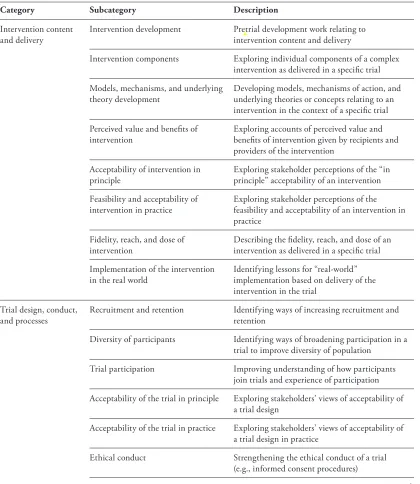
of a trial that qualitative research could inform (O’Cathain et al., 2013): the intervention, the trial design and conduct, the outcomes, the process and outcome measures used, and understanding of the health condition at which the intervention was aimed (Table 23.2).
his framework, which is based on articles researchers published from the qualitative research
[image:11.552.69.489.215.699.2]they carried out with RCTs, has some notable diferences compared with the two frameworks presented earlier. One of the ive aspects of the trial within this framework was the intervention. We identiied eight aspects of the intervention addressed in the articles, some of which appeared in the two frameworks presented earlier: interven-tion development, mechanisms of acinterven-tion, the feasi-bility and acceptafeasi-bility of an intervention, idelity,
Table 23.2 Framework of the Focus of Qualitative Research Used With Trials
Category Subcategory Description
Intervention content and delivery
Intervention development Pretrial development work relating to intervention content and delivery
Intervention components Exploring individual components of a complex intervention as delivered in a speciic trial
Models, mechanisms, and underlying theory development
Developing models, mechanisms of action, and underlying theories or concepts relating to an intervention in the context of a speciic trial
Perceived value and beneits of intervention
Exploring accounts of perceived value and beneits of intervention given by recipients and providers of the intervention
Acceptability of intervention in principle
Exploring stakeholder perceptions of the “in principle” acceptability of an intervention
Feasibility and acceptability of intervention in practice
Exploring stakeholder perceptions of the feasibility and acceptability of an intervention in practice
Fidelity, reach, and dose of intervention
Describing the idelity, reach, and dose of an intervention as delivered in a speciic trial
Implementation of the intervention in the real world
Identifying lessons for “real-world” implementation based on delivery of the intervention in the trial
Trial design, conduct, and processes
Recruitment and retention Identifying ways of increasing recruitment and retention
Diversity of participants Identifying ways of broadening participation in a trial to improve diversity of population
Trial participation Improving understanding of how participants join trials and experience of participation
Acceptability of the trial in principle Exploring stakeholders’ views of acceptability of a trial design
Acceptability of the trial in practice Exploring stakeholders’ views of acceptability of a trial design in practice
Ethical conduct Strengthening the ethical conduct of a trial (e.g., informed consent procedures)
MO v i ng F r OM r C t s t O M i x e D M e t hOD s i n t e r v e n t iOn e va l ua t iOns reach and dose, and implementation of the
inter-vention in the real world. However, we also found articles of qualitative research used to describe the intervention in practice, including identifying hid-den or unexpected components of the intervention. We also distinguished between qualitative research to identify the acceptability of the intervention in principle for future trials and in practice for cur-rent trials because the possibility of ixing problems identiied with an intervention is diferent for each of these. Understanding these aspects of an inter-vention could help researchers to explain the trial results.
he second aspect of a trial addressed by quali-tative research in our framework was design and conduct. Very little of this aspect was addressed by the earlier frameworks presented. here was over-lap in terms of understanding ways of improving recruitment and retention within the speciic trial or future trials. Indeed, Creswell et al. (2009) give an example of the innovative work by Donovan et al. (2002) who use interviews and observation before the trial to improve recruitment practices iteratively to ensure the successful implementation of the future trial. We found many other uses of qualitative research to explore the acceptability of
the trial in principle and in practice and identify ways of improving the ethical conduct of future trials.
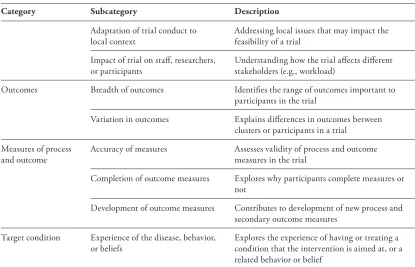
We also found articles focusing on the breadth and variation in outcomes and the development and accuracy of outcome and process measures; these are largely included in the temporal frame-work. One aspect of the trial that was not iden-tiied either by the temporal framework or the process-outcome evaluation framework was the use of qualitative research to explore patient experi-ences of the disease or behavior at which the RCT intervention was aimed, for example, exploring the lived experience of having a particular illness or condition. Researchers may have set out to explore this, or it may have been a by-product of explor-ing the intervention itself. We would suggest that it may be problematic to set out with an aim of exploring patient experiences of a health condi-tion using participants in an RCT because trials are rarely representative of the population with that condition. However, it may be an additional bonus for the mixed methods intervention evaluation to understand something more about the health con-dition, especially if this has implications for the intervention under study.
Category Subcategory Description
Adaptation of trial conduct to local context
Addressing local issues that may impact the feasibility of a trial
Impact of trial on staf, researchers, or participants
Understanding how the trial afects diferent stakeholders (e.g., workload)
Outcomes Breadth of outcomes Identiies the range of outcomes important to participants in the trial
Variation in outcomes Explains diferences in outcomes between clusters or participants in a trial
Measures of process and outcome
Accuracy of measures Assesses validity of process and outcome measures in the trial
Completion of outcome measures Explores why participants complete measures or not
Development of outcome measures Contributes to development of new process and secondary outcome measures
Target condition Experience of the disease, behavior, or beliefs
Explores the experience of having or treating a condition that the intervention is aimed at, or a related behavior or belief
[image:12.552.68.483.83.350.2]Dr a bbl e , O’C a t h a i n While presenting these three frameworks we have
drawn on language used by scholars discussing this methodology. he temporal framework privileges the RCT by describing other methods undertaken in relation to the RCT. Similarly the aspects of a trial framework considers qualitative research in relation to the trial. he process-outcome evaluation frame-work ofers a more balanced relationship between the mixed methods components and the RCT. he language used to describe the combination of qualitative methods and trials may indicate the value given to diferent aspects of a mixed methods inter-vention evaluation, and therefore we discuss it next.
Developing Language for a Developing Methodology
Researchers use a variety of terms to describe the relationship between qualitative research and the trial that is carried out within mixed methods intervention evaluations. Creswell et al. (2009) use the term embedded for a qualitative study car-ried out during a trial. Similar terms used by other researchers include incorporating, nested, sample from, and sub-study. One could argue that these terms relegate the qualitative research to secondary status, with the trial as the primary method. Indeed Hesse-Biber (2012) identiies how terms such as embedded suggest a positivistic lens applied to the qualitative research, where it is given a secondary role as an “add-on” to the more important and val-ued trial. She argues that this limits the ability of the qualitative research to inform the trial other than in terms of validating or conirming the dom-inant quantitative results. However, Plano Clark et al. (2013) discuss variations in and disagree-ments about the deinition of the term embedded and how it can be used to mean a more integrated approach between methods. hey then go on to describe how interpretive qualitative research was embedded in an RCT.
Embedding can occur in other ways. Some researchers describe mixed methods intervention evaluations as trials embedded in qualitative research (Donovan et al., 2002; Hoddinott, Britten, & Pill, 2010), signifying the way in which qualitative research has shaped the trial. Case Study 4 is an example of an innovative study design that does just that by embedding a trial within a broader qualitative study. he case study is interesting because it shows how adopting this diferent perspective allowed the researchers to step outside the bounds of the single question of efectiveness to consider contextual dif-ferences between clusters in a cluster RCT.
Case Study 4: he Breastfeeding in Groups Study
Hoddinott, Britten, and Pill (2010) used the term “prospective mixed method embedded case studies” approach (p. 777) to describe how they assessed the efective-ness of an intervention to improve breast-feeding rates. he breastbreast-feeding in groups trial was a cluster trial of 14 localities in Scotland in which 7 intervention localities were asked to increase group activities related to breastfeeding. he seven control localities did not change their existing group activi-ties. Hoddinott’s research team adopted an ethnographic, realist evaluative approach (Pawson & Tilley, 2004) to their trial design and conduct, keeping relective diaries about meetings, telephone conversations, e-mails, and their thoughts and views about their experiences during the trial. hey explored their backgrounds as a general practitioner and a former breastfeeding volunteer and how this interacted with their research roles. hey hypothesized that there would be diferences between the clusters receiving the interven-tion related to the local environment in which the intervention was conducted. hey carried out focus groups, interviews, and breastfeed-ing group observations throughout the study. Before conducting analysis of the outcomes of the trial, they used the qualitative research to formulate an explanatory model of fac-tors contributing to the success or failure of the localities in terms of delivering the intervention. he trial itself had a null out-come, with breastfeeding rates declining in three of the seven intervention localities. he model built from the qualitative data helped the researchers to explain diferences in out-comes between clusters, identifying problems with the leadership, rooms where the group sessions were held, and a lack of resources in clusters with declining breastfeeding rates.
MO v i ng F r OM r C t s t O M i x e D M e t hOD s i n t e r v e n t iOn e va l ua t iOns when integration is needed in terms of the
quali-tative research shaping and impacting the RCT. Concerns about the language used may diminish over time as a variety of relationships between the trial and other methods emerges, and researchers select the language that best describes the relation-ship between the methods they have used. his may be facilitated by a move to view these types of studies as complex evaluations rather than as tri-als with extra parts (Song, Sandelowski, & Happ, 2010). We have chosen to use the term mixed methods intervention evaluation in this chapter to describe these types of studies, deliberately using the term evaluation rather than RCT so that no method is privileged.his consideration of the chal-lenge of the language being used to describe studies that combine qualitative research and RCTs high-lights that, although there are considerable beneits to this endeavor that we have described earlier in the chapter, there are also challenges involved in moving from RCTs to mixed methods intervention evaluations. We discuss some of these challenges in the next section.
Challenges of Making the Move from Randomized Controlled Trials to Mixed Methods Intervention Evaluations
We now explore some challenges for research-ers in moving from an evaluation consisting of a single RCT to a mixed methods intervention evaluation. When more than one method is involved, consideration needs to be given to inte-gration of those methods, since diferent methods may be associated with diferent research tradi-tions and paradigms and the increase in funding may be required to deliver them. Additionally, there is a tradition of synthesizing evidence from RCTs, thus if studies are undertaken as mixed methods intervention evaluations, then the chal-lenge of synthesizing this multicomponent evi-dence arises.
Integration Between Methods
A key value of mixed methods research is that the whole is more than the sum of its parts (Barbour, 1999). For this to happen, one method must inluence in some way the objectives, sam-pling, data collection, analysis, or interpretation of the other method within the study (O’Cathain, Murphy, & Nicholl, 2007). Within mixed meth-ods intervention evaluations, the expectation
is that the qualitative research should help to optimize the intervention to be trialed, improve the eiciency and ethics of the trial conducted, increase the internal validity of the trial by ensur-ing the right outcomes are measured in the right way, help interpret trial results, or facilitate the transferability of the trial indings to contexts outside the trial (O’Cathain et al., 2013). hus the expected integration is one directional, with the qualitative research working to enhance the trial (Popay & Williams, 1998; Song et al., 2010). Examples of this integration are qualitative research showing how diferences in staf attitudes and resources between clusters in a cluster RCT could explain diferences in the primary outcome of breastfeeding rates between those clusters (see previous Case Study 4; Hoddinott et al. 2010), with qualitative research identifying problems with recruitment practices and the solutions to these problems resulting in increasing recruit-ment rates so that the trial was viable (Donovan et al., 2002) and qualitative research identifying a problem with an outcome measure in a feasibil-ity study, which resulted in the use of a diferent outcome measure in the main trial (Farquhar, Ewing, Higginson, & Booth, 2010). However, Lewin et al. (2009) identiied that publications from mixed methods intervention evaluations often had no evidence of integration of the ind-ings from the qualitative research and the trial. hat is, the promise of qualitative research helping to explain the trial indings was simply not deliv-ered in practice, or at least not in a way that was visible outside the original research team. We drew a similar conclusion from our review of the use of qualitative research with trials (O’Cathain et al., 2013), as well as identifying examples of visible integration. his lack of visible integration is not surprising given the paucity of visible integration of data or indings within mixed methods stud-ies generally in health research (O’Cathain et al., 2007), but it is disappointing given the potential value of the qualitative research to the endeavor of generating evidence of efectiveness. A chal-lenge to all researchers engaged in mixed methods intervention evaluations is to explicitly report in journal articles the “yield” or insights gained from undertaking qualitative research and RCTs within the same study.
Dr a bbl e , O’C a t h a i n the analysis of the trial outcomes so that
research-ers can anticipate factors likely to afect outcomes uninluenced by prior knowledge of the outcome of the trial (Ellard & Parsons, 2010; Munro & Bloor, 2010). his may be diicult where roles within the trial team overlap (Audrey et al., 2006), for example, if the trial manager is also the qualitative researcher. Whether researcher bias is a real issue or not, it is important that data collection pro-cesses and integration are addressed up front by the evaluation team, with a clear data collection and analysis plan and relective and critical engagement about any potential challenges around integration. Otherwise the qualitative research or process evalu-ation risks being no more than “post-hoc allocevalu-ation of success or failure,” only useful for the develop-ment of future interventions (Jansen et al., 2009, p. 224).
Integration may be diicult because some evaluation team members may not feel able to act on indings generated from the qualitative research. he indings may not be available at the time they are needed, the indings may not have credibility among some team members such as the lead researcher, the trialists may be wedded to a particular path for their intervention and trial and be unwilling to deviate from it, or the quali-tative research may challenge established ways of thinking and practice. For example, Jansen et al. (2009) raise a concern that researchers do not consider how an intervention can be adapted to it the context in which it will be delivered but actually focus on adapting the context to it the intervention. With such a mindset, qualitative research suggesting a need to adapt the interven-tion to it the context may be unpalatable to the wider team. To facilitate integration, the whole evaluation team may need to adopt a relexive approach associated with qualitative research (Hesse-Biber, 2012) and described earlier in Case Study 4. his occurs best at an early stage of study implementation when teams can discuss values and beliefs that shape their actions and relect on their openness to diferent possibilities. his is likely to be essential when the qualitative research challenges aspects of the trial in terms of questioning the integrity of the processes utilized during the trial, the ability of the trial to gener-alize to a population, and the underlying theory on which the intervention is based. Case Study 5 explores this last point, describing how qualita-tive research can challenge the accepted theoreti-cal basis for an intervention.
Case Study 5: he Use of a Narrative Approach to Understand Smoking Cessation and Challenge Current hinking
A process evaluation was undertaken along-side a pilot trial of smoking cessation groups in Scotland (Ritchie, Schulz, & Bryce, 2007). he intervention tested in this pilot trial included nar-rative therapy that encouraged participants to tell stories about their smoking and ofered lexibility in group membership, allowing participants to choose whether to attend group sessions or not depending on their needs at a particular time. Ritchie, Schulz, and Bryce (2007) conducted observations of 12 existing smoking cessation groups over a six-week period, debrieing sessions with the group facilitator, and interviews with people who had attended sessions at least three times over six months to assess perceptions and impact of the intervention on smoking behav-ior. hey used narrative analysis to make explicit practitioners’ assumptions underlying their work in the cessation groups and participants’ views about the groups. he use of narrative therapy was valued and accepted by participants. Facilitators felt that using stories helped the participants to understand information and engage with the group better than simply giving them facts and igures. Many participants perceived that their intention to stop smoking was unstable and that they required long-term support. his long-term support was ofered by the intervention in terms of helping with the decision to stop and in con-tinuing not to smoke. Furthermore, participants valued lexibility in making the decision to stop smoking and how and when to attend group ses-sions. Researchers also found that the inclusion of smokers, those still trying to quit and those who had lapsed, to be beneicial by providing motivation and valuable insights to others at dif-ferent/earlier stages of the quitting process. he research challenged many previous smoking ces-sation interventions that were often based on an uncritical adoption of the “one size its all” “stages of change” model (Prochaska & DiClemente, 1983), which leads to assessment of motivation and readiness to quit as a stable concept.
MO v i ng F r OM r C t s t O M i x e D M e t hOD s i n t e r v e n t iOn e va l ua t iOns may enrich understanding of the trial indings,
this understanding “will always be nuanced and qualiied and rarely determinate” (Munro & Bloor, 2010, p. 710), and the researcher must always remain open to the possibility of other interpreta-tions of the data. Munro and Bloor (2010) discuss a process evaluation carried out alongside a fea-sibility study for a deinitive RCT, highlighting a challenge they faced in practice whereby after completing their data collection for the process evaluation, they were asked to explain unexpected indings from the feasibility study. he feasibility study concerned an intervention to train inluential school pupils as “peer supporters” to be able to dis-cuss smoking cigarettes and/or cannabis with their peers in order to educate them about the dangers of smoking. he trial had three arms: two schools had peer supporter training in cigarette smoking, two schools had peer supporter training in cigarette and cannabis smoking, and two schools were controls. One of the outcome measures was the intention to smoke cannabis in three months and at age 16. he researchers found that there was no evidence of an efect of the intervention on intention to smoke cannabis in the intervention schools, but unexpect-edly they found an increase in expectations among peer supporters that they would be smoking can-nabis by the time they were 16. By the time this unexpected inding emerged, the process evalu-ation data collection was complete and there was no resource for further data collection. herefore the researchers had to analyze the data they had already collected in the hopes of inding some rea-sons for this outcome. Although they suspected that the fatalism of the teenagers in being subjected to drugs through their training as peer supporters underpinned this unexpected outcome, they were unable to provide evidence of this because it had not been explored speciically in their focus groups. Although they did ind limited evidence that it was more diicult to talk about smoking cannabis than smoking cigarettes, Munro and Bloor (2010) argued that there is a danger in process evaluations of trying to generalize indings from single cases.
We have presented a number of challenges around integration of the qualitative research and RCT that we consider to be surmountable. We recommend that, in order to gain the beneits of mixed methods intervention evaluations explored earlier, researchers should
• Be explicit in publications about the insights
for the trial gained from the qualitative research
so that this learning is visible to other researchers, intervention developers, and research users.
• Plan how and when integration will occur,
and who will be involved in it, so that issues such as researcher bias can be explicitly considered and addressed if appropriate.
• Adopt a relexive approach to the whole
evaluation at the beginning, where team members discuss their underlying beliefs and values about the intervention, the methods, and how integration can occur. his can help to prepare team members to be open to any challenging indings from the qualitative research and hopefully help them to take appropriate actions based on those indings.
• Manage expectations of what the qualitative
research or process evaluation can deliver within the constraints of the evaluation so that the strengths and limitations are recognized when interpreting the indings.
Paradigmatic Diferences
Dr a bbl e , O’C a t h a i n enhancing role within the mixed methods
interven-tion evaluainterven-tion rather than being viewed as integral to the evaluation (Song et al., 2010). If studies are viewed as evaluations rather than trials with added qualitative components, then teams can pay attention to a vari-ety of epistemological stances and consider the best approach to take within their evaluation.
It is standard practice to publish a protocol for an RCT so that researchers can be held to account, for example in their choice of primary outcome. Oakley et al. (2006) argue that process evaluations should prospectively specify a set of research questions and identify the processes to be studied, the methods to be used, and the procedures for integrating the indings of the process evaluation with the results of the trial. We concord with this view because it encourages planning of the qualitative research and sharing of this plan with the whole team, something that we believe can facilitate integration between rel-evant components of the study. his approach has been taken up by some research communities where researchers include a process evaluation within pub-lished trial protocols (e.g., Murphy et al., 2010) or publish standalone process evaluation protocols (e.g., Ellard, Taylor, Parsons, & horogood, 2011; Grant, Dreischulte, Treweek, & Guthrie, 2012).
High-quality RCTs are governed by external trial steering committees, and data monitoring com-mittees are conducted according to standardized operating procedures and are reported uniformly in accordance with the Consolidated Standards of Reporting Trials (CONSORT) statement (Schulz, Altman, & Moher, 2010). his raises the question of whether other methods used with trials should be included in these trial practices and procedures. his requires careful thought of the pros and cons
so that qualitative research is not blindly subsumed within all these procedures with an accompanying loss of its key strengths, nor blindly excluded from core aspects of the evaluation. Discussion about the whole study at trial steering committees, rather than only the trial, can ensure more opportunities for integration and that the study is seen as a whole rather than a trial with add-ons. It is also the case that process evaluations can uncover worrying issues about adherence to a planned intervention and the potential for bias within the study, which steering committees may need to be aware of and take action on (Riley, Hawe, & Shiell, 2005). Having a stan-dard operating procedure for the qualitative research undertaken with a trial may ensure that thought is given to any possible damage qualitative research can do to the experiment (Rapport et al., 2013).
For all the potential beneits there might be to including qualitative research in the usual processes and procedures of a trial, we recommend a cautious approach be taken so that a key strength of quali-tative research—its lexibility—is not damaged. In particular, a CONSORT statement for reporting qualitative research carried out with trials may be more prohibitive than helpful because of the range of approaches to data collection and analysis, the wide range of possible insights to be gained, and the wide range of ways of reporting these insights. here is also an alternative approach to consider—that the approach to trials is shaped by issues associated with qualitative research. In Case Study 6, Hawe et al. (2004) discuss how using qualitative research in community-based complex interventions may pro-vide an alternative way of conceptualizing the rela-tionship between the variability of the community context and the standardized RCT.
Case Study 6: Community Trial Design
MO v i ng F r OM r C t s t O M i x e D M e t hOD s i n t e r v e n t iOn e va l ua t iOns We have presented a number of challenges
related to paradigmatic diferences and recom-mend that researchers:
• Recognize that there are a variety of
philosophical and methodological approaches to mixed methods intervention evaluations that they may wish to consider. Undertaking an embedded qualitative study within a trial is not the only option.
• Continue to publish protocols for process
evaluations and relect on the strengths and weaknesses of doing so.
• Proceed with caution in terms of including
qualitative research within the formal procedures of trials, thinking about the evaluation as a whole rather than attempting only to squeeze qualitative research into the RCT paradigm.
An Additional Expense?
It costs money to undertake research in prepa-ration for an RCT, process evaluations alongside RCTs, and studies of implementation after RCTs. It has been argued that the additional costs of conducting process evaluations are outweighed by greater explanatory power and an understanding of how well the intervention can be generalized (Oakley et al., 2006). It may also be argued that investment in preparation for a trial is beneicial because optimizing the intervention and having conidence in the feasibility of the full trial can save money by reducing the probability of expen-sive trials of lawed interventions or failed trials due to inability to recruit.
Even so, mixed methods intervention evalu-ations occur in the context of limited resources, time, and researchers to collect and analyze data (Linnan & Steckler, 2002). herefore decisions need to be made about how much qualitative
research is necessary for a particular trial, as well as how much can be resourced. Even in the context of ample resources, the volume of data generated by qualitative research can be challenging to analyze, and it may be necessary to focus on salient compo-nents in order to gain the most beneit.
here is also the challenge of false economy. Setting up qualitative research that is underre-sourced by employing unskilled researchers and placing unreasonable limits on time required to complete an in-depth analysis may lead to poor-quality research that lacks credibility.
We believe that qualitative research undertaken with trials is valuable and is worth paying for. We recommend that it is
• Properly resourced for focusing on important
aspects of a particular RCT.
• Proves its value by explicitly communicating in
publications the impact it has had on the endeavor of evaluating the efectiveness of an intervention.
Moving Beyond Primary Research Toward Evidence Synthesis
Systematic reviews of RCTs are carried out to summarize the evidence of efectiveness of spe-ciic interventions. We have shown in this chapter that qualitative research undertaken with trials can help to explain the indings of a speciic trial. Qualitative research is also relevant to systematic reviews of trials, potentially adding to their value by helping to explain heterogeneity of trial indings (Noyes, Popay, Pearson, Hannes, & Booth, 2011). An excellent example of this is described in Case Study 7, where an evidence synthesis of qualitative research focusing on diferent approaches to pro-moting healthy eating in children helped to explain the diferent efect sizes found in trials of healthy eating interventions (homas et al., 2004).
Case Study 7: Integration of Qualitative Research and Trials in Systematic Reviews of Healthy Eating Promotion Interventions in Children
Dr a bbl e , O’C a t h a i n and vegetables rather than perceiving them as both belonging to a healthy food group. Finally, homas and colleagues synthesized the results of both reviews in a matrix to explore the relationship between the interventions used in the efectiveness trials and the children’s views. hey concluded that studies in their sample that had little or no emphasis on health messages were more likely to promote increases in fruit and vegetable consumption. his use of evidence synthesis of both qualitative research and trials can be further mined by synthesizing evidence from mixed methods intervention evaluations so that the qualitative research undertaken with a speciic trial is used to understand the context in which those trial results were achieved. Combining learning from each mixed methods intervention evaluation can then lead to an understanding of the important components of interventions and the subpopulations and the health environments in which they may be efective.
Conclusions and Future Directions
In this chapter we have discussed the move from the lone RCT addressing the single question of inter-vention efectiveness to a mixed methods interven-tion evaluainterven-tion addressing a wide range of quesinterven-tions relevant to understanding efectiveness of interven-tions. We present this as a positive move driven by researchers understanding the complexity of the interventions they evaluate, the trials they conduct, and the environments in which they research. While it can be argued that this move has become part of routine practice in some research communities, we have identiied a number of challenges with this approach in health research. hese challenges relate to a current and ongoing shift in how researchers evaluate interventions. None of the challenges pre-sented are insurmountable, and indeed relecting on these challenges is likely to help research communi-ties to understand how to gain the potential beneits of mixed methods intervention evaluations. Our main hope is that, as time goes by, we see a further move from qualitative research taking an enhance-ment role within trials toward researchers viewing their evaluations as whole studies—mixed methods intervention evaluations—with value placed on all components of these complex evaluations.
Discussion Questions
1. What are the beneits of using mixed methods intervention evaluations rather than standalone RCTs?
2. Why do you think we need to consider the language used to describe the relationship between the qualitative research and the trial?
3. What are some of the challenges in moving from RCTs to mixed method intervention evaluations?
Suggested Websites
http://www.mrc.ac.uk/documents/pdf/ complex-interventions-guidance/
he Medical Research Council provides guid-ance for the development and evaluation of complex interventions, including RCTs and multimethods.
http://w w w.methodolog yhubs.mrc.ac.uk / default.aspx
MRC Hubs for Trials Methodology Research is a focus for the development of trials methodology in the UK.
http://www.bristol.ac.uk/social-community- medicine/centres/conduct2/
ConDuCT-II, the collaboration and innova-tion in diicult or complex RCTs in invasive pro-cedures, is one of the MRC hubs with a theme of qualitative research with pragmatic RCTs.
http://w w w.shef.ac.uk/scharr/sections/hsr/ mcru/quart/conf
he MRC Hubs for Trials Methodology orga-nization funded a conference on the use of qualita-tive research with trials, and some of the talks are available here.
h t t p : // w w w. a p a . o r g /e d /s c h o o l s /c p s e / randomized-control-guide.pdf
A guide to multimethod trials in social sci-ence and education produced by the American Psychological Association.
References
Aro, A. R., Smith, J., & Dekker, J. (2008). Contextual evi-dence in clinical medicine and health promotion. European Journal of Public Health, 18(6), 548–549. doi:10.1093/ eurpub/ckn082
Audrey, S., Holliday, J., Parry-Langdon, N., & Campbell, R. (2006). Meeting the challenges of implementing process evaluation within randomized controlled trials: he exam-ple of ASSIST (A Stop Smoking in Schools Trial). Health Education Research, heory and Practice, 21(3), 366–377. doi:10.1093/her/cyl029
Barbour, R. S. (1999). he case for combining qualitative and quantitative methods in health services research. Journal of Health Services Research and Policy, 4, 39–43.